



Abstract
To better understand how ethnicity is actually experienced within organizations, we examined reported increases in ethnic identity salience at work and responses to such increases. Thirty British black Caribbean graduate employees were interviewed about how and when they experienced their ethnic identity at work. The findings demonstrated that increased salience in ethnic identity was experienced in two key ways: through ‘ethnic assignation’ (a ‘push’ towards ethnic identity) and ‘ethnic identification’ (a ‘pull’ towards ethnic identity). We explore how and when ethnic assignation and ethnic identification occur at work, and their relevance to how workplaces are experienced by this group of minority ethnic employees. The findings suggest the need for further research attention to the dynamic and episodic nature of social identity – including ethnic identity – within organizations, and to the impact of such increases in salience of social identities on behaviour at work.
Introduction
Increasing levels of ethnic diversity within many organizations increases the need for a more sophisticated understanding of the role of ethnicity 1 in the workplace. Much previous scholarship on ethnicity in organizations has considered ethnicity simply as a demographic variable (Cox and Nkomo, 1990; Kenny and Briner, 2007; Nkomo, 1992; Roberson and Block, 2001). Such approaches ignore the key distinction between an individual belonging to versus identifying with a social identity category (Cox and Nkomo, 1990; Verkuyten, 2005). Researchers have therefore called for more studies that recognize the role of ethnic or racial identity in how ethnicity plays out and is actually experienced within the workplace (Cox and Nkomo, 1990; Kenny and Briner, 2007; Niemann and Dovidio, 1998; Roberson and Block, 2001).
Ethnic identity is considered to be an important construct within the social sciences and a key influence on the way individuals interpret their environment (Jenkins, 2008; Markus, 2008), including their work environment. This article focuses on the salience of ethnic identity and how it might increase in response to situational cues in the workplace. Identity salience occurs ‘… when an individual is prompted to categorize himself or herself along identity orientated criteria’ (Forehand et al., 2002: 1087) and involves the individual assessing their level of similarity and dissimilarity to others. It is this short-term activation of identity initiated largely by social stimuli (Forehand et al., 2002; Verkuyten, 2005) and some of the work-related reactions to such activation that are the focus of this research. Our intention is to help address the demand for further research on how ethnicity salience in social contexts influences thoughts, feelings and actions (Markus, 2008). Such research aims to broaden our understanding of the role and relevance of ethnicity to social environments such as the workplace, and may help to account for some ethnicity-related workplace phenomena, such as differential career outcomes.
This article makes several unique contributions to understanding ethnicity at work. It presents a model of how and when increases in ethnic identity salience occur for one group of minority ethnic employees and some of the subsequent thoughts and feelings that result. This article therefore seeks to provide a more nuanced understanding of ethnicity in the workplace beyond its role as a demographic category or marker for workplace discrimination. This article also seeks to build on suggestions about how work in this area can be improved to capture the ‘… complex and subtle nature of race and ethnicity in organisations’ (Proudford and Nkomo, 2006: 338). We attempt to address the identified lack of qualitative studies in this area and assist in the development of a theoretical focus (Cox and Nkomo, 1990; Kenny and Briner, 2007; Proudford and Nkomo, 2006). We also present data from a non-North American context to address a further shortcoming of previous research (Kenny and Briner, 2007; Proudford and Nkomo, 2006). The specific research question we address in this article is as follows: How and when do increases in ethnic identity salience occur for one group of minority ethnic employees, and what are some of the subsequent work-related thoughts and feelings that result?
Ethnic identity
Ethnic identity has been defined as ‘… the degree to which individuals perceive themselves to be included and aligned with an ethnic group’ (Smith and Silva, 2011: 42). As a key social identity (Jenkins, 2008), it is one of the lenses used by individuals to make social comparisons and in-group and out-group distinctions (Tajfel and Turner, 1979), and hence it is highly relevant to behaviour at work. Ethnic identity may be considered to be a ‘primary identity’ alongside being a human and gender (Jenkins, 2008). Primary identities are in themselves less subject to change and mutability than other social identities. Owing to primary socialization and subsequent interactions with others, most people recognize themselves as members of a particular gender or ethnic group (Jenkins, 2008). What is more mutable (and discussed later) is the meaning given to that group membership (Jenkins, 2008). In addition, although considered ‘real’ by those who hold it, ethnic identity is argued to be socially constructed and therefore ‘… imagined but not imaginary …’ Jenkins (1997: 77). People may strongly believe themselves to be members of particular ethnic groups and this may guide some of their behaviour. However, once people try to define specific ethnic groups, the criteria in use often become inconsistent, leading to the view that ethnicity is socially constructed (Barth, 1969).
Two key strands of ethnic identity scholarship consider its development and how it is experienced. The first (see Phinney and Ong, 2007; Quintanta, 2007 for overviews) examines how ethnic identity develops during adolescence and early adulthood, its purpose and its measurement. The second focuses on how it is experienced. In this latter tradition Jenkins (2008) stresses the distinction between the ‘name’ and the ‘experience’ of an identity. While an individual may acknowledge membership of a particular ethnic group as a key social identity, what that membership means and how it is experienced will differ between individuals and is, in part, dependent on social interaction (Jenkins, 2008).
Hall (1996) and Brah (2000) argue that as ethnic identities lack fixed meaning the actual content of an ethnic identity is dependent on the context. For example, whether the ethnic identity is appraised as containing specific cultural features or behaviours or something positive or negative may depend on the situation. Therefore although ethnic identity may largely be thought of as an individual-level phenomenon, the way it is conceived and experienced is profoundly influenced by others through their actions, expectations and discourse (Brah, 2000; Jenkins, 2008; Nkomo and Cox, 1996). Jenkins (1997) argues that even when an individual is internally defining their ethnic identity they remain ever-aware of a potential external audience for their conceptualization of this element of their self.
Hence, ethnic identity, although important to individuals, is argued to be socially constructed and lacking in any fixed meaning. In addition it is conceptualized as something that may increase in salience in response to situational cues (Forehand et al., 2002; Hutnik, 1991; Hutnik and Sapru, 1996; Rosenthal et al., 1989; Wharton, 1992). Therefore, particular features of a situation, such as the demographic make-up of the group, may influence when an individual becomes more or less aware that they are a member of a particular ethnic group. Hence, although ethnic identity can be thought of as a primary identity, something we may always acknowledge to be a key part of who we are, whether or not we are aware of it in our moment to moment encounters with others, may depend on the contingencies of the situation. It is precisely this change in salience of ethnic identity and the work-related thoughts and feelings this engenders that form the focus of this article.
Specifically, this research focuses on increases in the salience of the ethnic identity of British black Caribbean employees. Black Caribbean employees are less likely to be in managerial and professional roles than employees from most other ethnic groups (Smeaton et al., 2010). In addition, negative stereotypes exist about the intellectual ability and competence of people from black Caribbean origins. Hence, in the context of professional work, a black Caribbean identity may arguably be experienced as a lower status ethnic identity than that of some other ethnic groups, especially the majority ethnic group. This perception that, at times, others may see contradiction between ethnic identity and professional identity may be relevant to how some increases in ethnic identity salience are experienced.
Ethnic identity at work
Research on ethnic identity and work-related behaviour falls into two distinct areas. The first is concerned with the role of ethnic or racial identity (usually stage of ethnic or racial identity development as measured by a scale) in career decision-making, while the second examines the role of ethnic or racial identity in the workplace. According to Byars-Winston (2010), much of the research on ethnic or racial identity and career decision-making has focused on self-efficacy and career interests (e.g. Jackson and Neville, 1998). Research in this area has also explored links between ethnic identity and the types of careers individuals might aspire towards (Evans and Herr, 1994), career decidedness (Duffy and Klingaman, 2009), the types of organizations individuals might consider as employers (Kim and Gefland, 2003), and religious identity and career choice (Kirton, 2009).
The second area focuses largely on how ethnic identity may be relevant to the assessment and management of discrimination. This includes work by Roberson and Block (2001), who discuss proposed links between stage of ethnic identity development and the identification of and reaction to discrimination, and work by McKay et al. (2007), who argue that racial identity may affect perceptions about diversity climate, which may affect turnover intentions. However, most research on the role of ethnic identity at work has examined the level of ethnic identity and its relationship to career decisions. Calls have been made for more research on how minority ethnic group members experience organizational settings (Niemann and Dovidio, 1998; Roberson and Block, 2001) and on how social identities are managed in multi-ethnic group contexts (Brown, 2000). Social identity theory largely focuses on self-definition, although the role of social context in how identity is experienced is also emphasized (Nkomo and Cox, 1996), including the role of others (e.g. Ybema et al., 2009). Evidence exists for the impact of situational cues on the salience of social identity (e.g. Forehand et al., 2002; Kanter, 1977a, 1977b; Niemann and Dovidio, 1998; Phinney, 1990; Verkuyten, 2005) and understanding increases in ethnic identity salience can provide important insights into how minority ethnic individuals experience their environments (Yip, 2005).
Why a specific social identity should increase in salience in a workplace situation when the workplace offers many opportunities for identification (e.g. by profession, department, occupation, etc.) is an issue raised by Wharton (1992), who suggests several features of a situation that make the salience of an ethnic (or gender) identity more likely to increase in a workplace setting. These include the experience of perception of discrimination, the numbers of co-ethnics in one’s workgroup, and when an identity is distinctive for a particular setting or role.
Kanter’s (1977a, 1977b) work on gender describes women who worked in environments where they made up less than 15 per cent of the workforce as ‘tokens’. Her work demonstrates some of the ways in which gender identity increased in salience in such organizational demographic contexts, arguing that tokens experienced heightened visibility, felt more isolated from informal and professional networks and felt that the differences between them and their male colleagues received more focus. Similarly, a study by Niemann and Dovidio (1998) highlights how increases in salience of ethnic identity for African American faculty who were the only people from their ethnic group in their work group (i.e. solos) could negatively affect job satisfaction. Being occupationally distinctive (e.g. a token or a solo) increased the salience of social identity and perceived pressure to perform to a high standard (Kanter, 1977a, 1977b; Niemann and Dovidio, 1998; Yoder, 1991). Feeling occupationally distinctive is also related to feeling that one may be stereotyped (Kanter, 1977a; Niemann and Dovidio, 1998).
Such research, from a social identity perspective, highlights some of the potentially negative workplace consequences of increases in salience of social identity. In addition, Niemann and Dovidio (1998) discuss the potential negative effects of stereotype threat on African American solo faculty. Stereotype threat (Steele, 1997; Steele, 2010; Steele and Aronson, 1995) may occur and reduce performance in a task when the individual undertaking the task is from a group where a negative stereotype about their likely performance on a task exists and is made or considered to be salient. It has been shown to affect, among others, African Americans taking cognitive ability tests (e.g. Steele and Aronson, 1995), women taking maths tests (e.g. Good et al., 2008) and white males in sport (e.g. Stone et al., 1999). It is the belief that the stereotype is active in the mind of evaluators that activates stereotype threat – hence the importance of the stereotype being made salient (Roberson et al., 2003; Steele, 2010). In addition, the individual must care about their performance in that task for stereotype threat to take effect (Roberson et al., 2003; Steele, 2010). Research on stereotype threat within the workplace has demonstrated that it is more likely to occur for African American ‘solo’ professionals and has a negative impact on feedback seeking and the discounting of feedback from superiors (Roberson et al., 2003).
In addition, increases in salience of ethnic identity may in certain circumstances result in the individual feeling that their professional identity is somehow being challenged or is under scrutiny. Such ‘identity threats’ may lead to increased impression management activity (Roberts, 2005). This will be discussed in more detail later.
Hence there are specific situational factors within the workplace (including solo or minority status) that may increase ethnic identity salience, which may in turn have consequences for performance, job satisfaction, impression management and other behaviour. There are also likely to be individual differences affecting the extent to which these specific situational factors lead to an increase in awareness of ethnic identity (Wharton, 1992). One of these, stigma consciousness (Brown and Pinel, 2003; Pinel, 1999), refers to differences in the expectation of being negatively stereotyped in relation to a particular aspect of social identity. Stigma consciousness has been linked to increased susceptibility to stereotype threat (Brown and Pinel, 2003).
We therefore argue for an approach to the study of ethnic identity at work that recognizes how this particular social identity it is actually experienced in the workplace, and some of the social stimuli influencing increases in its salience and the work-related consequences of such changes. Hence the aim of this study was to examine how and when increases in ethnic identity salience occur for one group of minority ethnic professionals and the work-related thoughts and feelings that follow as a result.
The current study – Method
Qualitative interviews were conducted with 30 London-based, self-identified British black Caribbean graduate employees drawn from a range of public and private sector organizations. Most were recruited via minority ethnic employee networks or minority ethnic professional networks, of which most participants were members. Ten participants were male and 20 were female, ranging in age from 26 and 41 years and all having a minimum of 3 years of post-graduation work experience. Details of the participants’ education and job roles can be found in the Appendix. We chose to focus on one ethnic group as we were mindful of the differences in the ways different ethnic groups might experience their places of work, owing to the different social histories of different minority ethnic groups and differences in the way minority ethnic groups are viewed and stereotyped within Britain (Kenny and Briner, 2007).
Interviews were conducted by the first author, herself from a British black Caribbean background, between late 2004 and early 2005 as a part of a wider study on minority ethnic employee experiences in the workplace, and examined racial discrimination and social class as well as ethnic identity. The specific interview questions on ethnic identity explored how and when ethnic identity was experienced in the workplace, and the extent to which participants felt ethnic identity was relevant to their current career experiences and their future career development. Questions asked included: ‘to what extent do you feel being British black Caribbean is a key part of your identity?’ and ‘are there times (incidences) when you feel your ethnic identity is stronger than at others? (if yes, when?)’; and ‘how did you experience x organisation/job role as a black professional?’.
The interviews lasted between 35 minutes and 2 hours, with a mean length of 67 minutes. Interviews were recorded and fully transcribed. Data from the transcripts were coded and template analysis (King, 2004) used to draw out the key themes regarding how and when ethnic identity was experienced at work and the impact on their thoughts and feelings about their organizations and careers. Codes for the template analysis were created from the interview topic guide and an initial analysis of some of the data. As the research was exploratory, the original codes reflected a wide range of ways in which ethnic identity might be experienced at work, e.g. salience, biculturalism, incongruence, etc. However, as the data were analysed it became clear that salience, and the different ways in which ethnic identity increased in salience, was the key way in which participants reported experiencing their ethnic identity. Codes were re-worked over time to help ensure their validity, and the authors worked together to assess the reliability of the coding.
We explore this issue from a perspective not wholly adopting, but influenced by, critical realism (Madill et al., 2000). Hence we consider the accounts given to be representative of participants’ experiences as they understand them to be but that there may be important influences on the way those experiences are conceptualized and reported, i.e. participants’ wider experiences of being a minority ethnic person in British society.
Findings – Increases in the salience of ethnic identity at work
From the coded data, two key themes emerged in relation to how and when ethnic identity was experienced in the workplace. The two different types of increased awareness are displayed in Table 1. The first of these we term ethnic assignation. This term is used to describe instances when participants felt an increased awareness of their ethnicity in situations where they felt others appeared to be ‘assigning’ them to their ethnic group. Features of such situations made participants feel that others were primarily considering them in terms of their membership of that ethnic group and all other identities that they may have that would generally have been more relevant to this work-related situation (e.g. manager, co-worker, professional, etc.) were secondary. Ethnic assignation was experienced as a ‘push’ by participants from others towards their ethnic identity, leading to the increased salience of this element of their identity.
Workplace ethnic identity fluctuation.

A second way in which ethnic identity was experienced was through what we termed ethnic identification. The term ethnic identification is used, in this context, to refer to instances where features of a situation led to participants experiencing an increased affinity with their ethnic group, resulting in an increased salience of their ethnic identity. In such situations, participants felt a ‘pull’ towards their ethnic group, which contrasts with the ‘push’ towards their group experienced during ethnic assignation.
This section of the article will be used to describe both ethnic assignation and ethnic identification in more detail and the situations that elicit them, and to highlight the sense of ‘push’ and ‘pull’ to ethnic identity that these different types of increase in salience of ethnic identity evoked. Quotes from the data will be used to provide examples of how these two types of increase in ethnic identity salience occurred and to illustrate some of the ways in which participants responded.
Ethnic assignation at work
Feeling ‘assigned’ to an ethnic category by others was generally felt by participants to be an uncomfortable experience for two main reasons. First, in such situations participants were made to feel that their ethnic identity was the only identity they possessed and that they had been stripped of their numerous other work-related identities such as graduate, manager, co-worker, etc. − almost a sense of being ‘pushed’ into just that single ethnicity-related category. Hence they felt they were being defined by one situationally irrelevant element of the self rather than other more relevant elements. Second, participants felt that when others focused only on their ethnicity they may not be regarding them positively given the negative stereotypes about black Caribbean people, especially in the context of professional work.
Ethnic assignation was, for the participants, more than just having their attention drawn to the fact that they were a member of a particular ethnic group as it was also accompanied by cues or suggestions that this was, at that moment, the dominant or even the only way in which they were being considered and that they were in danger of being stereotyped. Such cues were more likely to be present in situations where they were less familiar with those they were interacting with, or where previous experiences with those individuals had led them to believe that those individuals may be more likely behave in ways that would lead to ethnic assignation.
Ethnic assignation was a by-product of being ‘distinctive’. The discomfort that accompanied the experience of feeling ethnically assigned may have been owing to participants coming from a lower status group. Niemann and Dovidio (1998) and Yoder (1991) argue that being in a situation where one is numerically or occupationally distinctive is likely to have a more negative impact on members of low status or culturally stigmatized groups than members of high status groups.
There were two main ‘triggers’ to ethnic assignation. The first of these related to when individuals appeared to be ‘distinctive’ occupationally – specific interactions that sometimes occurred when they occupied positions of power or status that may have seemed to some to be unusual for someone from their ethnic group. This we termed ethnic assignation in a ‘power/ status’ situation. The second related to when participants were numerically distinctive. This we termed ethnic assignation in a ‘minority’ situation. We will discuss each in turn.
Ethnic assignation in power/status situations Whilst doing their jobs, participants sometimes found themselves in situations where they felt the person they were interacting with assumed they did not hold their job or position because, they felt, of their ethnicity. This, they felt, was manifested through factual errors and/or expressions of surprise made by the person they were interacting with when it became clear to them what their job actually was.
This took place in three main ways: first, in situations when an assumption was made that the participant was not in a particular job; second as a consequence of an expectation in a specific situation that the person holding that particular job would not be black; and third, in specific situations where participants felt because of particular black hairstyles, they felt less likely to be viewed as fully ‘professional’. We now provide examples of ethnic assignation in each of these three ‘power/status’ situations.
One example of a participant whom others assumed did not hold a particular job was Anthea, discussing her previous job as a uniformed prison officer: … I remember taking a prisoner to the hospital because he had a punctured lung … I went into the consulting room with him and the nurse said to me … ‘you need to stay outside’… It was that assumption that you can’t be an officer even when you are wearing a uniform. Somehow people can’t see that you might be a professional, you must be the prisoner’s mother. Another time I had taken a prisoner to immigration tribunal and the adjudicator had said to the prisoner after he had given evidence that ‘you need to go back and sit with the prison officer’ and he had to be handcuffed because it wasn’t a secure room, so he came and sat next to me and the adjudicator said … ‘I didn’t mean you to sit with your family’… I stood up and said ‘you can see I am actually wearing a uniform I am from the prison service’ … It was just seeing a black face and then not noticing the uniform or anything … (Anthea, Senior Executive Officer, Civil Service, 39)
As Anthea was black and many of the prisoners she was working with were black, mental shortcuts employed by some of those she encountered in these situations made it difficult for them to place her in a professional or job role context. This was despite the fact she was in all of these situations actually visually demonstrating her job role through wearing a prison officer’s uniform and undertaking specific job-related activities. In each of these cases, ethnic assignation denied Anthea her professional status. Another participant, Sandra, a 26-year-old civil servant, felt that the assumption was often made that she could not be the person in her job role because of her ethnicity (as well as her age). Each time this took place she felt reminded that as a black person she was not expected to hold a managerial job. Being occupationally distinctive meant that, despite many cues, she was sometimes not automatically assumed to be the holder of her post.
Another participant, Laura, discussed a similar situation where her occupational distinctiveness meant the connection between being ‘black’ and ‘professional’ sometimes appeared severed. The participants in the study were all British born and had British accents and English-sounding names and had often worked closely with clients and colleagues through email and the telephone for some time before meeting. When eventually face to face meetings took place, it was sometimes clear that these clients and colleagues were not expecting them to be black: … I spoke to her for 2 years on the phone … and I could tell it was a big shock for them and I think for me it made me aware that people have certain perceptions about you and they will make judgements about you, without knowing you. (Laura, HR Business Partner, Oil and Gas Industry, 30)
Laura’s perceptions of this colleague were changed by this encounter because she felt her colleague had not expected her to be black. Ethnic assignation meant her identity as a professional was attenuated and she was only being considered as a ‘black person’. She felt judged and regarded in a less positive light and felt the need to take steps to enhance her professional image: … I just felt the pressure was on to be professional and not showing my blackness, but what does that mean? I suppose it was just about the way I carried myself or the way I spoke to them, the way I dress even maybe, because here the culture is very relaxed, I wouldn’t necessarily wear a suit to work but I found myself wearing suits. (Laura, HR Business Partner, Oil and Gas Industry, 30)
Attention to ‘impression management’ in a bid to counteract the experience of being ethnically assigned was not uncommon. Roberts (2005) introduces a specific form of impression management that she argues may take place in diverse working environments termed social identity-based impression management or SIM. It is defined as: … the process of strategically influencing others’ perceptions of one’s own social identity in order to form a desired impression. (Roberts, 2005: 695)
Participating in this form of impression management appeared to be one of the responses to being ethnically assigned, and this will be discussed in more detail later.
Participants also felt that the impact of being occupationally distinctive was compounded when there were aspects of their appearances that appeared to further emphasize their ethnic origins. It was almost as if stressing this aspect of their appearance further ‘severed’ the constructs of ‘black’ and ‘professional’. One participant, Arthur, a project manager with an IT company, discussed how he was told that having plaits in his hair had prevented his progression onto an important project team. Another participant, Martha, who had locks in her hair, felt that she had to ‘tone down’ her ‘ethnicity’ in order to avoid ethnic assignation. She undertook impression management activity to enable her to feel more comfortable as a black woman in that specific occupational environment: I felt I had to tone down my ethnicity … I’d started wearing my locks then, I think … Think at that stage it was able to go into a ponytail anyway, but I always felt that I was toning myself down and trying to integrate myself. Didn’t feel comfortable at all … (Martha, HR Administrator, National Health Service Trust, 35)
One participant, Rhoda, discussed strategies undertaken to try to avoid this type of ethnic assignation: … but I know how I wear my hair people perceive me differently depending on how I am looking. And if you are looking particularly ‘rootsy’ you have to work hard to make sure that the way you portray yourself if not like that you know so they can see beyond the way you look. So you have to speak particularly, even more eloquent or you have to be calm and whatever and … that is something that I am aware of as a black woman and someone who wasn’t black probably wouldn’t even have to think about. (Rhoda, Publicity Professional, Media Company, 37)
Rhoda provides insight into her impression management strategies and how she felt the need to highlight her professionalism in order to compensate for particular hairstyles and retain the aura of professionalism to reduce the likelihood of ethnic assignation. Although the type of hairstyles she refers to reflect its natural texture and her cultural background, displaying them was perceived as being at odds with retaining the image of a professional in that environment. Rhoda’s quote also highlights the additional cognitive effort associated with such potential ethnic assignation, which is a theme to which we will return.
Ethnic assignation in minority situations At times, participants felt ethnically assigned not because they were in a job role they were not expected to be in or did not ‘look’ like they should be in but rather because they were the only person from their ethnic group at a work-related meeting or event. In such situations, participants sometimes felt they were taking on the role of a ‘representative’ or an ‘ambassador’ for their ethnic group, in order to compensate for the negative stereotypes that exist for their ethnic group. Hence they felt more pressure to ensure that they presented their group, through their own behaviour, in a ‘good light’ to try to militate against ethnic assignation: … I think definitely if I’m in a working environment, whether it’s I’m going to a meeting or I’m just sitting in at my desk on a day to day basis or I’m meeting people, I’m holding a meeting, et cetera … I definitely feel … that side of my identity is stronger than say, the British side if you like. Because I feel that when I’m in work I am not only representing me, I’m representing my family and my culture if you like. Because some people don’t have any interaction with black people at all … (Sandra, Higher Executive Officer, Civil Service, 26)
Participants indicated that in these situations they did feel their ethnic identity more keenly as they felt they were being considered by others largely in terms of their ethnicity and this was the basis on which they were being ‘judged’. For Sandra especially, her sense of acting as a representative was strengthened by her perception that some of her colleagues did not have any interaction at all with other black people. In addition, Anna expressed: … I can be in a room where everything is very white and English and Anglo Saxon … and that highlights my blackness in a different way. But I don’t have to act upon that, my being there is enough … just by your sheer existence. You don’t have to do anything on top of that – I’m a black person, whey! And I’m sure other people are there going ‘oh no, there’s a black person!’ You know, but then again … it’s just one of those things. I’ve never really felt it welling up inside me or anything. It’s just you deal with things when they come. I suppose. (Anna, Senior Accounts Executive, Media Company, 32)
Both participants make the point that in such situations their ethnic identity was stronger in the sense that they were more aware of it. Ethnic assignation in minority situations was experienced as an increased visibility owing to numerical distinctiveness and an expectation of stereotype. This again demanded cognitive effort and impression management strategies to counter.
Dealing with the consequences of ethnic assignation at work
When participants felt ‘ethnically assigned’ they felt that others were regarding them only in terms of their ethnic group membership. This increased their own awareness of their ethnic identity within their workspace and made them feel more ‘black’. The sense that they were being perceived only as a member of their ethnic group led to a number of potential outcomes. In some situations, this increased awareness that they were being considered largely in terms of their social identity as a ‘black’ person could be viewed as a positive, because being ‘black’ was considered an asset in that particular situation. However, in many situations participants were aware that being from their ethnic group was not viewed as an asset and that, rather, many negative stereotypes exist about someone of their ethnic origin in that situation. One tenet of social identity theory (Tajfel and Turner, 1979) is that if an individual feels a social identity they hold is devalued they can either try to distance themselves from that social identity group and/or they can try to change the way the group is perceived. Because of their skin colour, participants may perceive that it is difficult not to look as if they are from their minority ethnic group. One strategy for dealing with ethnic assignation that may remain open to them is to try to improve the way their group is considered by acting in ways that helped counter the negative stereotypes about their group. We have already touched upon (and will discuss further later in the article) the use of impression management strategies employed by participants to counter a perceived severance between the constructs of ‘black’ and ‘professional’. In this section we will discuss further impacts of the increase in salience in ethnic identity. For example, in discussing how they dealt with ‘ethnic assignation’, participants expressed the following: … I think as a black women you are not sort of carrying the black community on your shoulders but you are aware of the image you are presenting, so you work hard, you lead by example, people look at that but you do know that people think – ‘oh well she’s not lazy’. And people make judgements about black people being lazy so I’m not sort of wearing it on my shoulders all the time but I am aware sometimes if I do a good piece of work, or if I’m presenting a negative image it does have an impact on how black people or black women are perceived … (Esther, Senior Executive Officer, Civil Service, 29) … I mean I spend most of my time in rooms where I am the only black person there, let alone black woman there. So I am always having to sort of slightly adapt my behaviour to make sure that I am, you know, represent as they say … And to a certain extent that is adapting to how I am perceived by other people. (Anna, Senior Accounts Executive, Media Company, 32)
Participants discussed those situations when they felt ethnically assigned, and the sense of being a ‘representative’ for their ethnic group. Some felt the need to demonstrate a higher level of performance to show that people from their ethnic group could perform well at work and manage the impression of their ethnic group, in a bid to reduce the future likelihood of being stereotyped.
One could argue that this ‘pressure’ could provide a boost to their performance at work. However, work on stereotype threat (Steele, 1997; Steele, 2010; Steele and Aronson, 1995) suggests that such heightened awareness that one is from a group not expected to perform well in a particular situation could be potentially detrimental to performance.
Another way in which the occupational distinctiveness that preceded ethnic assignation may impact negatively on workplace experiences is by increasing, for some, the sense that they might be in their job for reasons other than their competence – perhaps as a ‘token’, a way of the organization demonstrating its commitment to ‘fairness’. This suspicion potentially left some participants less secure in their achievements. For example: I wonder sometimes − and the only reason I say that is because I am the only black HR person there … when I got the job it was like a double-edged sword because I thought, are they doing this to make me fall flat on my face? But the other side is ‘damn I’m going to have to work hard to prove myself’. And those were the thoughts I had because I am the only black HR person here and you think to yourself, now why is that? Is it because … black people haven’t come to the positions? Is it something they are conscious about and now that I am here I am the token black person? Those thoughts have run through my mind … (Laura, HR Business Partner, Oil and Gas Industry, 30) I find that when I am in customer meetings I am more likely the only black person in the room and it is disconcerting. To know that the percentage of black people, especially in London is so high, but in jobs at certain levels they are not there. And it makes me wonder well, where are they? What are they doing? Am I the only one that can reach this high? (Simon, Project Manager, IT Company, 29)
Laws (1975) described ‘tokens’ as having adopted the values of the dominant group and viewing themselves as distinct and more talented than other members of their original group. However, in this instance, participants are actively wondering whether they are being ‘used’ as tokens and whether they have been selected primarily to reach a target or a quota. They suspect discrimination, and the lack of others from the same ethnic group at their organizational level does not make them feel more special, but less so. It makes them question whether they have achieved their position on merit, and this could potentially impact negatively on self-esteem and job satisfaction.
However, there was some recognition that the visibility from being a minority could sometimes be adapted as a resource: You are the token black person. In a lot of cases it is a bad thing but it can be a good thing. You all go into a room and you know for a fact that you are the only black person there, people are automatically on their ps and qs and sometimes it is good … alright you socialise with a lot of big wigs and they think black people are quite hip … it is not necessarily a good thing but it is a thing that can work for you positively. (Arthur, Project Manager, IT Company, 33)
Arthur advocates adopting some of the visibility available through ethnic assignation and finding ways of using it to further one’s career. Another participant, Anna, echoes this point and argues that one of the advantages of such visibility is that ‘… No-one ever forgets you …’.
However, evidence from Kanter (1977a) indicated that although tokens are more visible, they may find it more difficult to have their actual work-related achievements noticed. As their minority social identity is what is noticed (and what they risk being stereotyped by) they may need to work much harder than non-tokens to have their work-related achievements noted.
Therefore one of the key ways ethnic identity increased in salience at work was through ‘ethnic assignation’. This was increased perception that the participant was being considered only in terms of their ethnic group membership, brought on largely by the situational, verbal and non-verbal cues. The second way in which ethnic identity increased in salience in organizations was through ethnic identification.
Ethnic identification at work
We use the term ‘ethnic identification’ to refer to instances when participants felt a greater awareness of themselves as an individual from a specific cultural heritage and belonging to a particular group of people, almost a sense of ‘pull’ towards that specific identity. Unlike ethnic assignation, ethnic identification was not experienced as a consequence of distinctiveness, but rather through similarity/relevance. In the workplace, ethnic assignation was often experienced through participants perceiving themselves as actual or potential role models for others in their places of work. Participants drawn from the further education (FE) field (i.e. post-compulsory, largely non-higher education colleges), where they tended to work with many minority ethnic students, were most likely to report this type of ethnic identification: … some of the things that you hear students say. Or you know just by giving them a little guidance … they think ‘no, no I can’t … I’ve never heard of that. My teacher never said that to me. I can’t be a doctor’. I said ‘of course you can’ … They genuinely undervalue themselves because they’ve been subconsciously fed that for the last 10 years. That you know, football and sports and music … That’s you … you can go up to a certain level but leave the serious stuff to the … And … that’s made my resolve even stronger and the fact that a lot of them do come to me … they’re reaching out and especially … the young black males … because many of them haven’t got father figures. And so they’ve got no-one really giving them guidance … they actually reach out … they just talk to me … and they tell me stuff and you know, and I mean it’s a burden … But I’m also touched that they feel they can … So that’s why I think this is something I want to stay and work with … (James, Lecturer, FE College, 33)
His comments indicate that in such instances his awareness of his ethnic identity increases in a way that stresses his relevance and his ability to add something positive to a situation. He feels a ‘pull’ towards his ethnic identity. In a similar mode: I work in … an inner city area with … students who are black predominating. And I think that it kind of gives me a common ground … not saying as if you know it’s them and us. But I do think that they are able to relate or I am able to relate to certain things they may say or do. They may well not have a – a positive role model in their lives, and this is not me being … judgmental … they may not have that And I feel that as a person of colour that I can be that for them even if I didn’t teach them, just for them to see me in the building and know that I have a lot of responsibility for example. That … in itself can make them aspire to be more than what they maybe had started out with. (Gina, Curriculum Team Leader, FE College, 31)
Ethnic identification appeared to occur less regularly in work contexts that did not include large numbers of minority ethnic customers or clients. For participants who did not work in FE, tasks or topics periodically arose which led them to feel that their ethnicity was relevant and enabled them to bring something very specific and valuable to their employment: I suppose it … comes more to the forefront maybe when I am in situations where there are other black people there … because the work I do is very global, it’s very international. Like yesterday I was at this trade show and a few people from the South African delegation came to visit our stand and everything and it was really kind of like whey! You know I felt I could ratchet up the blackness a bit … you didn’t have to hold it down, you could let it rip. You know in terms of language and things. (Senior Accounts Executive, Media Company, 32)
Ethnic identification enabled the participant to feel it was appropriate in that circumstance to bring her ethnic identity into the working environment and use it to gain rapport (or just to have some fun) with potential clients. Ethnic identification was also relevant at times to this participant working in the media. She felt a particular responsibility to ensure a level of fairness in terms of how black people were represented in news stories and she saw herself as having a role in her team to help to ensure this: Times I’d say relevant to work is when you see the odd something on the news relevant to black people because you get very defensive. And then you question the news or you question you know, the sources and what’s happened. And I just remember the time I saw a black person being beaten up by six officers and that … CCTV footage and I felt very strongly about that. And I thought it was good that there were black people in the news room because it meant that the other people around as well were careful about what they were seeing, and you know, they had to be more sensitive … I think that’s why it’s very important to have a diverse work team … (Daphne, Manager, Media Company, 25)
For many participants a lack of ethnic identification at work did not appear to be an issue. Participants were able to gain ethnic identification through their non-work activities and interactions. However, for some participants the lack of ethnic identification within the workplace did matter. This was often because there was something about the culture of the organization that prevented them, as an individual from their particular ethnic group, from feeling fully included. For example: … if I was white, I think it would be easier for me. I’d feel more comfortable. I think people would feel more comfortable around me … we’d probably have more in common … so we’d have more to talk about … the reality is that we haven’t got a lot in common … especially in an office … like that … I can’t think of anything I’ve got in common with anyone. (Ben, Journalist, Media Company, 26)
Discussion
This study provided unique insights into the way increases in the salience of ethnic identity, a key social identity, was managed at work by a group of British black Caribbean graduate employees. It was found that increases in ethnic identity salience were experienced through two main processes not previously explored in the workplace − ethnic assignation and ethnic identification − that affected the way participants felt about their organizations.
Feeling ethnically assigned was not generally a positive experience. When participants felt that others were classifying them only in relation to their ethnic group membership and were aware that stereotypes about their group in those situations were not positive, they felt uncomfortable. Ethnic assignation mirrors to some extent a phenomenon identified by Pinel (1999) as stigma consciousness − an individual difference that relates to the extent to which an individual feels they will be stereotyped based on their group membership.
There are similarities between ethnic assignation and stigma consciousness in that both relate to the experience of increased awareness of how an element of one’s social identity may be viewed by others. A key difference, however, might relate to whether or not ethnic assignation always leads to a feeling of ‘stigma’. It is not clear what would happen if someone felt ethnically assigned in a situation where there was also a positive stereotype about their ethnic group and if it would still impact negatively on how they felt about their organization. Also stigma consciousness is presented by Pinel as a measurable trait. Ethnic assignation as described here is something individuals experience episodically. More research would be required on ethnic assignation to identify the features it shares with stigma consciousness. However, as they are similar it is worth drawing on some of the research that has been conducted by Pinel on stigma consciousness to discuss some of the findings on ethnic assignation.
Pinel (1999) found that those with higher levels of stigma consciousness were more likely to avoid situations where negative stereotypes about people from their group existed, making it more difficult for them to disprove stereotypes. This would suggest that some participants in this study might have sought to avoid situations in which they perceive they may feel ethnically assigned. This might lead individuals to avoid particular types of organizations or particular roles where they would be the only person from their ethnic group. Indeed there did seem to be some indications, particularly with regard to geographical location of jobs, where for some participants this became a consideration e.g. a couple of participants mentioned not wishing to work outside London for this reason. Also some participants found that working in organizations where they felt that there were too few black employees problematic. For example, Ben craved a working environment that was more ethnically mixed and Gina believed the only way she would achieve her ambition to be a college principal would be to move to the US, where she expected to find a greater proportion of black professionals in her field.
However, demographic realities within Britain make it difficult for black Caribbean graduates seeking graduate careers to avoid being in situations where they are the only ‘representative’ from their ethnic group − especially if they wish to progress up the organizational hierarchy. Although some sectors (including the National Health Service) employ significant proportions of minority ethnic employees, vertical segregation remains an issue for some minority ethnic groups (Smeaton et al., 2010). Some participants indicated that this extra awareness of the danger of being stereotyped did make them more conscious of their efforts and some spoke of trying harder and putting extra effort in to ensure that their group was perceived in a positive light. This demonstrated an additional cognitive burden that could accompany ethnic assignation. If this also results in anxiety about performance, it could potentially increase vulnerability to stereotype threat. Stigma consciousness itself has also been linked to increased vulnerability to stereotype threat (Brown and Pinel, 2003).
The stereotype threat concept is potentially useful to this study. The idea that if an individual is concerned about fulfilling a negative stereotype when they undertake a task this can impact negatively on task performance has much empirical support (see Steele, 2010). Also its relevance to this study is increased by participant reports of working harder to try to disprove stereotypes. Further research would help us to understand whether, and in what circumstances, stereotype threat is a factor in how minority ethnic graduates experience their places of work.
There are also important parallels between ethnic assignation and Kanter’s work on gender in organizations. Kanter (1977a, 1977b) argued that ‘token’ females were often treated as representatives of their group and subjected to stereotyping. They also had to work harder to have their achievements noticed and were often mistaken for lower status employees or expected to take on more junior tasks (‘status levelling’). Applying some of Kanter’s work to ethnicity, Niemann and Dovidio (1998) examined the experience of minority ethnic workplace ‘solos’ and found that they felt ‘distinctive’/‘distinctiveness’ was linked to feeling stigmatized, vulnerable, and to lower job satisfaction. In addition, through exploring the experience of ‘token’ minority ethnic professionals in Belgium, Van Laer and Janssens (2011) found the subtle discrimination that participants encountered made them feel like representatives for their group, reinforced their lower status, made them feel that difference was problematic, and generally maintained the unequal status quo.
Ethnic assignation can also be linked to threats to participants’ images of themselves as professionals. Impression management appeared to be one of the key strategies used by those feeling ethnically assigned. Social identity-based impression management is argued by Roberts (2005) to be a process undertaken by employees who feel a threat to their professional identity because of their ‘devalued’ social identity.
Roberts (2005) posits that there are four main types of social identity-based impression management: two are aimed at reducing one’s association with one’s social identity group (social recategorization through decategorization or through assimilation) and two are aimed at communicating the value of difference and emphasizing the positive contribution that members of one’s social identity group bring to that situation (positive distinctiveness through social identity integration or confirmation).
Roberts’ framework is useful for interpreting the impression management strategies used by participants in this study. It initially appears that participants tended to use ‘decategorization’, e.g. they took actions to highlight their professional identity to encourage others to define them on the basis of their professional role rather than their ethnic identity. It could be argued that they used this strategy to try to prevent them as being thought of solely as a ‘black person’ and to reduce the negative stereotyping that they sensed went along with that.
However, there may also be elements of positive distinctiveness in the response to ethnic assignation – in particular the strategy of social identity integration. Social identity integration is a strategy where an individual deals with social identity threats by attempting to reduce the potency of the negative stereotype. Social identity integration strategies involve creating associations between their social identity and professional identity, such as the display of cultural artefacts in their offices or the use of verbal statements challenging negative stereotypes about their group.
It could be argued that by reacting to ethnic assignation largely by ‘upping’ their professional behaviour and appearance, participants were engaging simultaneously in ‘decategorization’ and social identity integration. They were attempting both to increase the likelihood of themselves being seen as professionals (rather than negatively stereotyped by their ethnicity) and at the same time trying to ‘detoxify’ their social identity by associating it with positive and professional behaviours. Further work would be required to examine this.
For some participants, ethnic assignation was related to increased visibility at work. There may be career-related opportunities that can be grasped from increased visibility, and such individuals may be able to act to some degree to carve out a particular impression of themselves as strong workplace performers. How such visibility is managed and capitalized on should be subjected to further research. However, participant accounts also suggested that even where this strategy was adopted the pressure for performance to remain consistent was immense and, they suspected, more intense than it would have been if they were not from their minority ethnic group.
Participants recognized that ethnic identification was not available in every job role and neither did they require it to be. For some, where it took place, it had the potential to provide additional job satisfaction. At the same time we speculate that there may be instances where ethnic identification may result in negative emotions (e.g. in situations where because of identification an individual feels ‘duty bound’ to assist a client but are unable to owing to factors beyond their control).
Although we must guard against ghettoizing individuals from particular ethnic groups into particular job roles, it is worth recognizing that, for some, ethnic identification can add additional dimensions to occupations. What is probably more important, however, is cultivating work environments where such sentiments are considered laudable but do not mean that the individual is then only considered in a one-dimensional way – work environments where we are so comfortable about ethnicity that it can matter and not matter at the same time.
Even though most participants stated the importance of their ethnic identity to their sense of self, there were indications of individual differences in the need for ethnic identification at work. Possibly, for some, the issue was less the need to be around other people from the same ethnic group but more the need to be in an environment where they do not feel vulnerable to being judged negatively just because of their ethnicity; they possibly perceived that they would be more likely to experience that in organizations that were more used to employing and promoting minority ethnic employees. Being around other minority ethnic employees for some possibly played a dual role – providing a link with people who were similar to them in some ways but also making it less likely that they would feel that they would be judged negatively automatically. Of course, skin colour similarities are no guarantee that people would work well together.
The key limitation of the study was the self-selected nature of the sample and the fact that most of the participants were sourced through the use of minority ethnic networks. Networks were used to overcome the problem of locating sufficient numbers of participants meeting the study criteria as their small number meant they would have been few and far between in individual organizations or departments.
It can be argued that participants sourced through minority ethnic networks would be more likely to have an increased awareness of ethnicity-related issues, and this increased awareness may have in some way acted as a source of bias in the responses given. The self-selected nature of the sample may mean that those volunteering to participate in the study may be those who have had more experience with ethnicity-related issues at work and so may have biased the sample in that way. A further limitation of this study is that it does not make clear the extent to which these phenomena would apply to people drawn from other minority ethnic groups. There may also be gender and age implications of this phenomenon which are not explored in this study, and indeed the intersection of these identities with ethnicity (along with the identity of ‘graduate’ and ‘professional’) may also be highly pertinent. However, although these issues are relatively unexplored in this study, we consider the ethnic and gender mixed nature of this research team to be an advantage to this study as evidence suggests it may have afforded increased rapport with participants and supported both insight and reflexivity with regard to the findings (Ramji, 2009).
These limitations and their potential implications for the findings of this study should be noted and the findings further explored. It should also be noted that, although there were clear themes emerging from the interviews, participants did express a variety of views and discuss a range of experiences. Participants who came forward for the study also varied with regard to the strength and meaning of their ethnic identities, and their views and experiences of their ethnicity in organizations. However, future work should involve also interviewing participants from outside such networks.
Conclusions
Individuals bring a range of identities to work with them. This article has argued that the salience of ethnic identity increases at work in two key ways: ethnic assignation and ethnic identification. Both impact on the way in which minority ethnic employees feel and think about their organizations. Although the roots of these phenomena may lie outside the workplace, understanding their effect can assist in the process of building more inclusive workplaces and improving support to the career development of minority ethnic employees.
This study provides an important demonstration of the dynamic and episodic nature of ethnic identity in the workplace. We have identified two mechanisms that influence its changes in salience. We have outlined ways in which such increases in ethnic identity salience impact on how organizations are experienced and conceptualized. By going beyond examining ethnic identity simply as a demographic category and exploring ways it is actually experienced, we feel that we have contributed to a richer, more nuanced understanding of its importance to behaviour within organizations.
Footnotes
Appendix
Participant details.
| Name (pseudonym) | Age | Gender | Sector | Role | Highest qualification |
|---|---|---|---|---|---|
| Amy | 27 | F | Publishing | Senior Marketing Executive | BA |
| Anna | 32 | F | Media | Senior Accounts Executive | BA |
| Anthea | 39 | F | Civil Service | Senior Executive Officer | MSc |
| Arthur | 33 | M | IT | Project Manager | MSc |
| Belinda | 36 | F | Civil Service | Executive Officer | Postgraduate Diploma |
| Ben | 26 | M | Media | Journalist | Postgraduate Diploma |
| Brendan | 40 | M | Local Government | Accountant | BSc also ACCA qualified |
| Carlotta | 39 | F | Further Education | Manager in FE College | BSc |
| Charles | 30 | M | Engineering | Programme Manager | MSc |
| Daphne | 25 | F | Media | Media Manager | MSc |
| Eleanor | 35 | F | Further Education | Senior Manager in FE College | Postgraduate Certificate in Education |
| Esther | 29 | F | Civil Service | Senior Executive Officer | MA |
| Eva | 38 | F | Civil Service | Executive Officer | BA |
| Freya | 36 | F | Civil Service | Higher Executive Officer | BSc |
| Gina | 31 | F | Further Education | Curriculum Team Leader | Postgraduate Certificate in Further Education |
| Holly | 41 | F | Civil Service | Higher Executive Officer | BA |
| Hortense | 36 | F | Charity | Project Manager | BA* |
| James | 33 | M | Further Education | Lecturer | Postgraduate Certificate in Education |
| Lance | 35 | M | Charity | Executive Director | Postgraduate Certificate in Education |
| Laura | 30 | F | Oil and Gas | HR Business Partner | BA |
| Lavinia | 38 | F | Health | Senior Manager | BA |
| Lawrence | 34 | M | Civil Service | Senior Executive Officer | BA |
| Martha | 35 | F | Health | HR Administrator | BA* |
| Nina | 31 | F | Civil Service | Senior Executive Officer | MSc |
| Otis | 40 | M | Media | In Legal Rights | MA |
| Rhoda | 37 | F | Media | In Publicity | BA |
| Sandra | 26 | F | Civil Service | Higher Executive Officer | BSc* |
| Simon | 29 | M | IT | Project Manager | BSc |
| Stacey | 32 | F | Health | Specialist Nurse | BA also Dip in Nursing |
| Wayne | 33 | M | Construction | Commercial Manager | BSc |
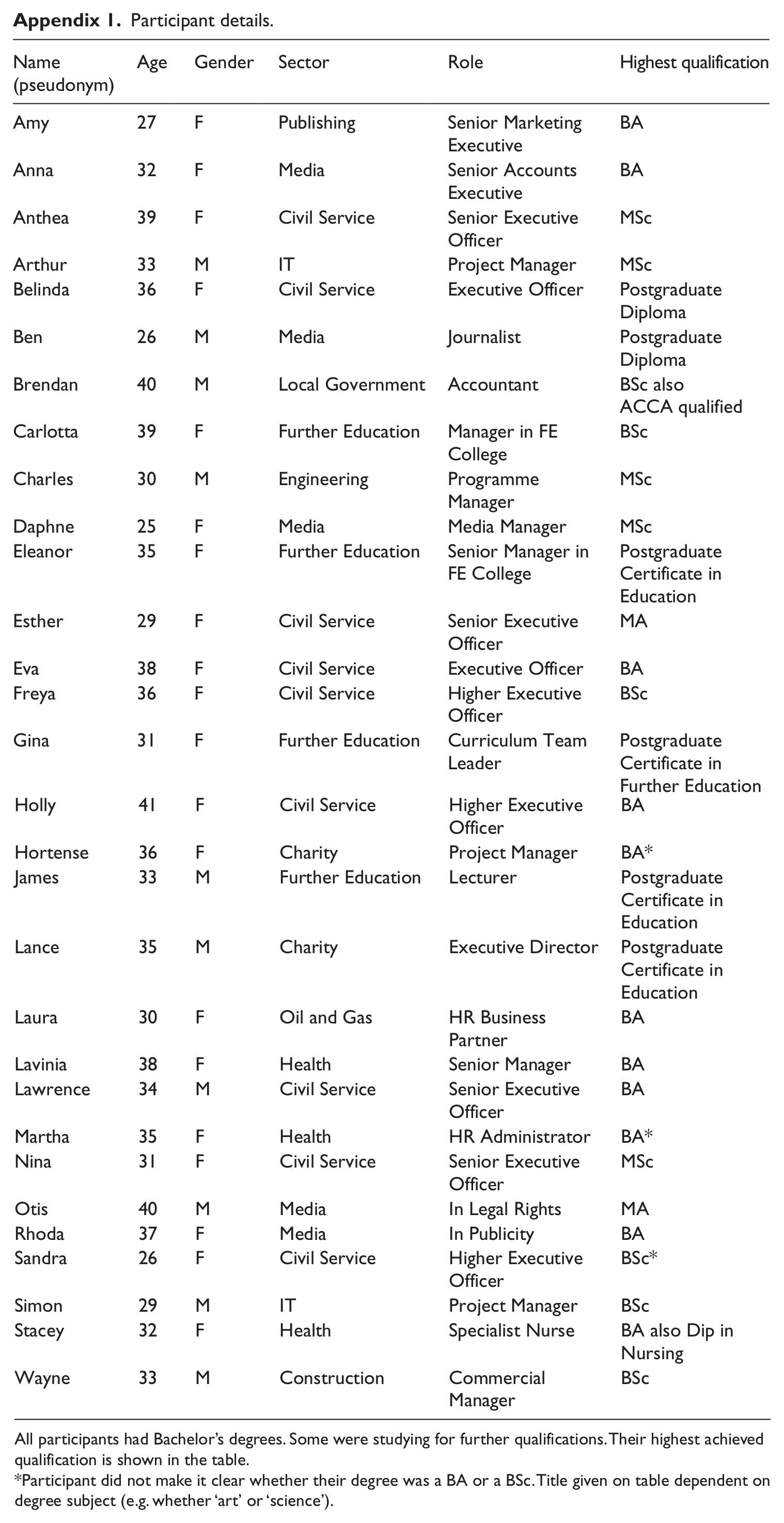
All participants had Bachelor’s degrees. Some were studying for further qualifications. Their highest achieved qualification is shown in the table.
Participant did not make it clear whether their degree was a BA or a BSc. Title given on table dependent on degree subject (e.g. whether ‘art’ or ‘science’).
Funding
This research was supported by the Economic and Social Research Council.
Notes
Etlyn J Kenny is a Lecturer in Organizational Psychology in the Department of Organizational Psychology at Birkbeck, University of London, UK. Her research focuses on the significance of ethnicity in the development of careers in organizations, and includes specific consideration of the roles played by ethnic identity, racial discrimination and social class in the workplace experiences of minority ethnic employees. Etlyn also researches career development more generally, and the role played by staff networks and mentors in the development of careers. Her previous publications include articles in Journal of Occupational and Organizational Psychology and Equality, Diversity and Inclusion: An International Journal. [Email:
Rob B Briner is Professor of Organizational Psychology in the School of Management at the University of Bath, UK. He has wide research interests that focus on the reciprocal relationships between work conditions, affect and behaviour. Other research interests include the psychological contract, ethnicity, absence, work−non-work relationships, and food and organizations. He is also involved in several initiatives around evidence-based management, including the Center for Evidence-Based Management ( ), which seeks to identify ways of increasing the use of evidence of various kinds (including academic research) in management practice. [Email: