



Abstract
The article examines the relationship between community embeddedness and work outcomes (e.g. job motivation, networking behavior, and organizational identification) and the mediating role that organizational embeddedness plays in those relationships. We draw upon conservation of resources theory to explain this mediating effect. Data were collected from 338 employees from multiple organizations at three points in time over a ten-month period; this design allowed us to use latent growth modeling to examine the relationships among changes in the independent, mediating, and outcome variables over time. Results from latent growth modeling analyses generally supported the proposed model. Although community embeddedness has been somewhat marginalized in recent empirical research on organizational embeddedness, this article highlights that it is indeed relevant in predicting job attitudes and job behaviors.
Keywords
Since its introduction a decade ago by Mitchell and his colleagues (Lee et al., 2004; Mitchell et al., 2001), the construct of organizational embeddedness has received increasing attention from researchers. Rather than focusing on why employees leave their jobs, researchers coming from the embeddedness perspective focus on why employees remain with their firms. The three key components of embeddedness proposed to keep employees attached to their employers are perceptions of person–job and person–organization fit, links with colleagues and work activities, and sacrifices that would be incurred if employees were to leave their firms. There has been a substantial amount of empirical research on this topic over the past ten years, and it has generally supported embeddedness theory (e.g. Halbesleben and Wheeler, 2008; Ng and Feldman, 2009; Sekiguchi et al., 2008; Wijayanto and Kismono, 2004).
In their initial presentation of embeddedness theory, Mitchell et al. (2001) posited that community embeddedness (that is, the extent to which individuals are enmeshed in their communities) combined with organizational embeddedness is keeping employees attached to their current jobs, as changing jobs often requires geographical relocation. Parallel to the argument regarding fit, links, and sacrifices on the job, an individual’s fit and links within a community, as well as the sacrifices associated with leaving it, were also posited as three major reasons why an individual is embedded in his/her residential community. Over the past ten years, however, much less attention has been devoted to community embeddedness than to organizational embeddedness. Indeed, some embeddedness researchers have even excluded community embeddedness from their studies (Halbesleben and Wheeler, 2008; Hom et al., 2009; Ng and Feldman, 2009; Sekiguchi et al., 2008).
Is it reasonable to exclude community embeddedness from research on organizational embeddedness? Unfortunately, there has been virtually no empirical research on this question. It is important to address this gap for several theoretical reasons.
First, excluding community embeddedness is inconsistent with Mitchell et al.’s (2001) original conceptualization of the construct as a web of both work and non-work factors that keep individuals rooted where they are. Indeed, the weight of empirical evidence in the organizational sciences suggests that it is difficult, if not impossible, to understand individuals’ careers without understanding how their lives outside of work inform and influence their career decisions (Hansen, 2001; Lee et al., 2011; Voydanoff, 2001, 2004).
A second reason to address this gap is to understand the impact of organizational embeddedness on work outcomes found in previous studies (e.g. Halbesleben and Wheeler, 2008; Hom et al., 2009; Sekiguchi et al., 2008). Some of that impact might, in fact, be partially attributable to the unmeasured effects of community embeddedness as well.
Third, community embeddedness and organizational embeddedness share a close and interesting relationship with each other. On one hand, they are likely to be mutually reinforcing, because embeddedness in one domain may reinforce embeddedness in other domains (Ng and Feldman, 2012). On the other hand, previous research has shown that community embeddedness and organizational embeddedness do not necessarily display similar patterns of relationships with work attitude and work behavior variables (Harman et al., 2009; Lee et al., 2004; Mallol et al., 2007). As such, it is particularly important to examine simultaneously (a) how community and organizational embeddedness are related to each other, and (b) how both are related to work attitudes and behaviors.
The main purpose of the present study, then, is to fill the above gaps in the literature by addressing how community embeddedness, along with organizational embeddedness, affects work outcomes. Our investigation is guided by two key components of conservation of resources (COR) theory (Hobfoll, 1989).
First, this theory suggests that individuals’ resources can be, and are, transferred across different life domains. Based on this resource transfer argument, we argue that community embeddedness and organizational embeddedness often co-vary in the same direction. For instance, by helping employees generate surplus resources (such as more time and energy), community embeddedness allows individuals to invest more of those resources into the work domain and become more embedded in their organizations. Conversely, communities that do not meet employees’ personal and family needs and/or that divert employees’ time and energy away from work demands help dislodge employees from their current job situations.
Second, COR theory suggests that individuals are motivated to acquire more and more resources to buffer potential losses in the future, even if those resources seem sufficient at the present time (De Cuyper et al., 2012; Hobfoll, 1989). Based on this continuous resource acquisition rationale, we argue that organizational embeddedness enhances individuals’ motivation to acquire even more resources in the work domain. Thus, increases in organizational embeddedness should be related to increases in work outcomes, too. Hence, we propose here that community embeddedness may also be indirectly related to a variety of work outcomes through the mediating effects of organizational embeddedness. The proposed model appears in Figure 1.
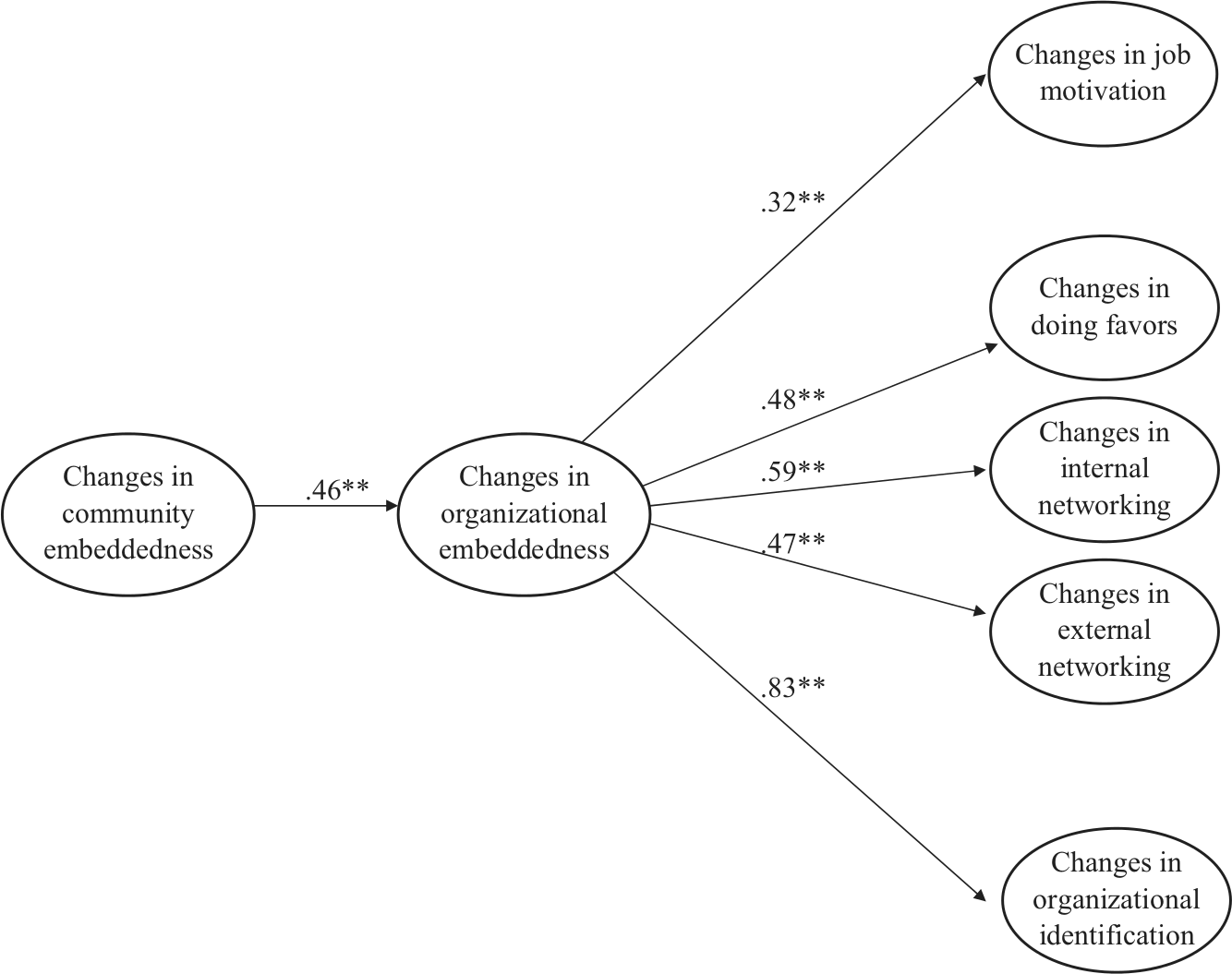
The proposed model (and the parameter estimates).
Key constructs
Organizational embeddedness and community embeddedness
Organizational embeddedness consists of three components: fit, links, and sacrifices. Fit refers to the extent to which an individual’s abilities match organizational requirements and an individual’s interests match organizational rewards. Links refer to the number of ties individuals have with other people and activities at work. Sacrifice refers to the rewards or benefits that people would have to give up if they left their organizations.
It should be noted that we consider the terms “job embeddedness” and “organizational embeddedness” as largely synonymous because most individuals who are embedded in their jobs are also embedded in their organizations. However, in the present study, we consistently use the term “organizational embeddedness” because our focus is on the individual’s broad relationship with his/her employer (rather than with just his/her job). This focus also parallels our attention to the individual’s broad relationship with his/her community.
Mitchell et al. (2001) also introduced the construct of community embeddedness, which refers to the forces outside the workplace that keep individuals rooted where they live. A community is the geographical area that serves as the context for both work life and family life. It encompasses the physical environment, infrastructure (e.g. mass transit), demographic profiles of residents, institutional resources (e.g. school systems), and social support systems (Bookman, 2005). Parallel to organizational embeddedness, community embeddedness also consists of fit, links, and sacrifices. Community fit is the extent to which individuals’ needs and interests are congruent with the community’s environment (Cowell and Green, 1994; Hassan et al., 2010; Pugh et al., 2008). Community links refer to the number of ties individuals have with other people and activities, such as extended family members who live nearby. Community sacrifices refer to the resources individuals would lose if they left their communities, such as easy access to recreational areas and cultural opportunities.
Mitchell et al. (2001) operationalized both organizational and community embeddedness as equally weighted composites of fit, links, and sacrifice. However, Crossley et al. (2007) argue that perceptions of embeddedness emerge from idiosyncratic, complex mental processes. In addition, the initially proposed composite approach might ignore some factors beyond fit, links, and sacrifice that affect embeddedness and/or the possibility that one or two factors might disproportionately influence the magnitude of embeddedness. Therefore, Crossley et al. (2007) argue that employee embeddedness can also be operationalized in terms of gestalt subjective perceptions and that these gestalt subjective perceptions also predict work outcomes. Although both these measurement perspectives are reasonable, we use Crossley et al.’s (2007) perceptual approach because we are interested in exploring how employees react to perceived embeddedness, and that approach requires us to assess employees’ perceptions of their own embeddedness. Moreover, because individuals vary in how they define the boundaries of their communities, it is important that we focus on their global perceptions of community embeddedness.
Work outcomes
In this article, we hope to illustrate that community embeddedness is an important variable in the nomological network of organizational embeddedness and work-related outcomes. The three outcomes we examine, in particular, are job motivation, social networking behavior, and organizational identification. These outcomes were chosen because we believe embedded employees will increase their resource investments in the three levels of the work environment with which they interact most intensely on a daily basis: the job level (represented by job motivation), the social level (represented by networking behaviors), and the organizational level (representing by organizational identification) (Tett and Burnett, 2003). Tett and Burnett (2003) suggest that employees constantly receive cues and stimuli from these three levels of the work environment and are very attentive in responding to them. By examining job motivation, networking behavior, and organizational identification in one single study, we were able to identify how the two types of embeddedness relate to employees’ own job behavior, their relationships with colleagues at work, and their attitudes toward the organization as a whole.
Conservation of resources theory
Our proposed model is informed by conservation of resources (COR) theory (Hobfoll, 1989, 2002). COR theory posits that people are motivated to acquire, protect, and retain valued assets or resources. Hobfoll (1989) argues that the motivation to acquire, protect, and retain resources arises out of individuals’ essentially hedonistic nature. That is, individuals prefer to create situations that are pleasurable for themselves and, at the same time, avoid situations that can lead to the loss of valued resources. Further, both actual and perceived losses of resources can lead to psychological distress (Brotheridge and Lee, 2002; Xanthopoulou et al., 2009). Three key tenets of COR theory, which explain how individuals expend their resources both across and within life domains, have particularly strong relevance to the current study.
First, COR theory suggests that individuals who have accumulated surplus resources in one life domain may redeploy or invest those resources for use in other domains as needed (Hobfoll, 1989). When resource deficits occur in one domain, resources from other domains (such as time and energy) can be transferred into it to minimize losses (Hobfoll, 1989, 2001). This tenet leads us to expect that community embeddedness and organizational embeddedness are correlated positively.
Second, the loss of resources is emotionally unpleasant for individuals. COR theory posits that resources are not necessarily distributed equally among individuals and that people who seem to have sufficient resources at present will still be motivated to keep accruing resources in order to protect themselves in the future (Halbesleben et al., 2009; Hobfoll, 2001). This tenet leads us to expect that organizational embeddedness is positively related to a variety of work outcomes (Halbesleben et al., 2009; ten Brummelhuis et al., 2011; Wright and Hobfoll, 2004).
Third, COR theory suggests that resource surpluses and losses do change over time (Hakanen et al., 2011; Hobfoll, 1989). Thus, the COR theory implies that the relationships among our study constructs will be dynamic, rather than static, in nature. Consequently, not only are the levels of community embeddedness likely to change over time, but the outcomes associated with community embeddedness are likely to change over time as well. To capture this change perspective, we investigate how changes in community embeddedness are related to changes in other variables. Such a focus is important from a theoretical standpoint because only through examining intra-individual changes in perceptions and behaviors can researchers truly address co-variation among constructs (Ployhart and Vandenberg, 2010).
Hypotheses
The model presented in Figure 1 proposes that community embeddedness affects organizational embeddedness, which in turn affects job attitudes and job behaviors. This model is based on the two key premises of COR theory discussed above. First, COR theory suggests that individuals who have accumulated surplus resources in one life domain may redeploy or invest those resources for use in other domains as needed (Hobfoll, 1989). Based on this resource transfer premise, we argue that individuals who experience increases in community embeddedness will have more resources to transfer to the work domain to enhance their organizational embeddedness. Second, COR theory suggests that, in order to buffer themselves from potential resource losses in the future, individuals who are already highly embedded in their organizations may continue to invest some of their surplus energy into work activities nonetheless. Based on this continuous resource acquisition premise, we argue that organizational embeddedness will be positively associated with several work-related outcomes.
Community embeddedness and organizational embeddedness
Two types of resources stand out to be important both off the job and on the job − time and energy (Clawson and Haskins, 2000; Edwards and Rothbard, 2000; Heller and Watson, 2005; Kirchmeyer, 1992; Valcour, 2007). These two types of resources, therefore, are particularly relevant to the current investigation of community and organizational embeddedness. Specifically, based on the resource transfer premise discussed above, we suggest that surplus time and energy obtained from increases in community fit, community links, and community sacrifices are likely to be re-invested in the work domain to increase organizational fit, organizational links, and organizational sacrifice.
The research on person–environment fit suggests that individuals with high person–community fit will experience greater physical well-being, better mental health, and stronger positive mood (Gareis and Barnett, 2008; Muhajarine and Janzen, 2006; Roosa et al., 2009). In turn, greater well-being allows individuals to become more engaged in the work domain (Hakanen et al., 2011). For example, employees who are highly embedded in their communities may have more time and energy to participate in additional training and career development programs at work. Conversely, because participating in additional training creates greater demands on employees’ time, individuals who are already struggling to meet non-work-life demands would be much less likely to invest any additional energy into work training.
Similarly, the research on links suggests that individuals who are highly embedded in their communities might accrue excess energy because they receive more help from members of their networks. For example, individuals who have more ties in a community might receive additional tangible support with childcare, intangible support in terms of leads for good medical care, and more socio-emotional support in times of family emergencies (Herrero and Gracia, 2007; Lin et al., 2009; Martins et al., 2002). In turn, this excess energy can be utilized to develop additional links within the work organization (Muhajarine and Janzen, 2006). For instance, individuals who are highly embedded in the community might have more energy for attending work-related social functions on evenings or weekends. Thus, increases in community embeddedness might lead to increases in workers’ ability and willingness to become more socially active in the workplace.
Community sacrifice is likely to co-vary with organizational sacrifice, too. Indeed, the work of Voydanoff (2005) suggests that individuals often try to calibrate their level of organizational embeddedness to their level of community embeddedness to enhance the consistency of their attitudes about their life situations. For example, if employees engage in more behaviors aimed at increasing community embeddedness (e.g. they volunteer to be leaders of community organizations), they are likely to find ways to increase their embeddedness at work to secure their jobs and avoid relocations. Thus, the perceived losses associated with leaving a community or an employer will amplify perceived losses in the other life domain. The resource transfer tenet of COR theory, then, leads us to expect that community sacrifices and organizational sacrifices will increase (or decrease) synchronously over time. Thus, we predict:
Hypothesis 1: Changes in community embeddedness will be associated with changes in organizational embeddedness.
Organizational embeddedness and work outcomes
Based on the continuous resource acquisition premise of COR theory, we also propose that organizational embeddedness will be associated positively with more investments at work. Indeed, as long-term job security with any one firm declines and the employee’s responsibility for managing his/her own career increases (Arthur and Rousseau, 1996), employees face more challenges deciding when and where to look for new employers. However, as organizational embeddedness increases, individuals infer it is safer and more desirable to channel increasing amounts of time and energy into their current employment relationships. Below, we discuss how resource investments at the job level (through job motivation), social level (through networking behavior), and the organizational level (through organizational identification) change in response to changes in organizational embeddedness. Consistent with the previous discussion, we focus on time and energy as the key resources to be transferred here.
Job motivation
At the job level, we hypothesize that increasingly embedded workers will enhance their time and energy investments in the work domain by demonstrating greater motivation in performing their jobs. Job motivation represents the individual’s willingness to put forth time and effort on the job; the level of job motivation determines the direction, intensity, and duration of work effort (Ambrose and Kulik, 1999; Latham and Pinder, 2005). In one of the few empirical studies linking organizational embeddedness to job behaviors, Lee et al. (2004: 714) noted that “because high on-the-job embeddedness reflects (1) many links, (2) a good fit, and/or (3) consequential things that an employee gives up by quitting, the motivation to perform should be high.”
Motivation to perform well at work is governed collectively by employees’ emotions, felt obligations, and rational calculations. First, highly embedded employees are likely to be more motivated at work because they have more positive emotional relationships with colleagues and supervisors. High fit suggests that employees have similar values and attitudes as colleagues and are likely to cooperate with them more readily (Kwantes et al., 2007). Second, increasingly embedded employees are more motivated to perform well at work because they feel obligated to reciprocate for the rewards they receive. Third, increasingly embedded employees may be more motivated to perform well because they desire to keep their jobs and to make sure that the rewards associated with their current jobs continue into the future. In other words, highly embedded workers have stronger incentives to work hard because they want to ensure that their firms continue to thrive and thereby enhance their own job security (Ng and Feldman, 2007). Thus, we predict:
Hypothesis 2: Changes in organizational embeddedness will be associated with changes in job motivation.
Social networking behaviors
Social capital refers to interpersonal relationships that create value for individual employees (Coleman, 1990). In general, we use the term social networking behavior to encompass activities aimed at developing greater social capital (Forret and Dougherty, 2001). These networking behaviors might include making the acquaintance of colleagues in other departments to discover internal promotion opportunities, becoming active in outside professional organizations to raise personal visibility in the field, or going beyond the call of duty for a supervisor to increase the likelihood of getting a positive performance review. Employees who anticipate staying or who desire to stay with their employers in the years ahead have greater incentives to build more social capital. Further, as employees become more embedded in their organizations, they learn how to use that social capital to their own advantage more effectively. Certainly, much of the focus of the embeddedness research has been on how social ties increase organizational embeddedness (Mitchell et al., 2001). However, COR theory suggests that even highly embedded individuals are likely to continue to engage in further networking behavior to secure their embeddedness over the long haul.
We examine three different types of social networking behaviors in this study (doing favors for supervisors, internal networking, external networking), each geared at a somewhat different target audience. First, employees may do favors for their supervisors to increase the probability of obtaining desired resources controlled and allocated by them (Wayne et al., 1997). Internal networking behavior also helps individuals advance their careers (Seibert et al., 2001; Wayne et al., 1999); it helps employees build ties with others who can be instrumental in their careers, including immediate coworkers, teammates, mentors, senior managers, and other colleagues outside the unit (Kraut et al., 2005). Moreover, building social ties outside the organization (external networking behavior) is instrumental for employees’ careers as well. Although most social network research has largely focused on how external networking helps employees find new job opportunities in the outside labor market (Granovetter, 1973; Marsden and Hurlbert, 1988; Zippay, 2001), external networking may also enhance employees’ resources inside the firm by increasing access to potential clients and suppliers and by enhancing personal reputation (Acquaah, 2006; Bolino et al., 2002). Taken together, these three networking behaviors represent one’s overall engagement with the social environment at work.
Hypothesis 3: Changes in organizational embeddedness will be associated with changes in social networking behaviors, including doing favors for supervisors (H3a), internal networking behavior (H3b), and external networking behavior (H3c).
Organizational identification
We also hypothesize that increasingly embedded workers will invest more time and energy into their employment relationships by increasing their identification with their firms. Identity is the subjective concept an individual has of himself or herself as a person (Vignoles et al., 2006). Individuals often develop identities based on their social roles or their group memberships. In the work context, the most frequently studied identity is organizational identity, or the extent to which individuals perceive themselves as one with the organization (Elsbach and Bhattacharya, 2001).
Individuals have a strong need to develop identities around the groups to which they belong (Vignoles et al., 2006), and it is psychologically uncomfortable for individuals to stay with employers with whom they do not feel identified. In addition, developing identities around salient group memberships can enhance individuals’ self-esteem (Hogg et al., 2004; Hornsey and Hogg, 2000) and lead to greater acceptance of the groups’ values as ideals to be achieved (Bartel, 2001; Meyer et al., 2006). Consequently, increasingly embedded employees are more motivated to strengthen their identification with the firm and to view their membership in the organization as a key life role. Thus, we predict:
Hypothesis 4: Changes in organizational embeddedness will be associated with changes in organizational identification.
Mediation process
Guided by COR theory, we argued above that changes in community embeddedness are likely to covary with changes in organizational embeddedness (Hypothesis 1). In turn, changes in organizational embeddedness are likely to be associated with various work outcomes (Hypotheses 2 to 4). Taken together, these four hypotheses suggest that changes in organizational embeddedness will mediate the relationships of changes in community embeddedness with changes in work outcomes. The relationship is formally stated in Hypothesis 5:
Hypothesis 5: Changes in organizational embeddedness will mediate the relationships of changes in community embeddedness with changes in job motivation (H5a), social networking behavior (H5b), and organizational identification (H5c).
Alternative theoretical models
Although we have provided theoretical reasons for the proposed relationships in Figure 1, it is possible that other models could be justified theoretically as well. Here, we examined three alternative theoretical models to further test the robustness of our proposed model. These three alternative theoretical models are depicted in Figure 2.
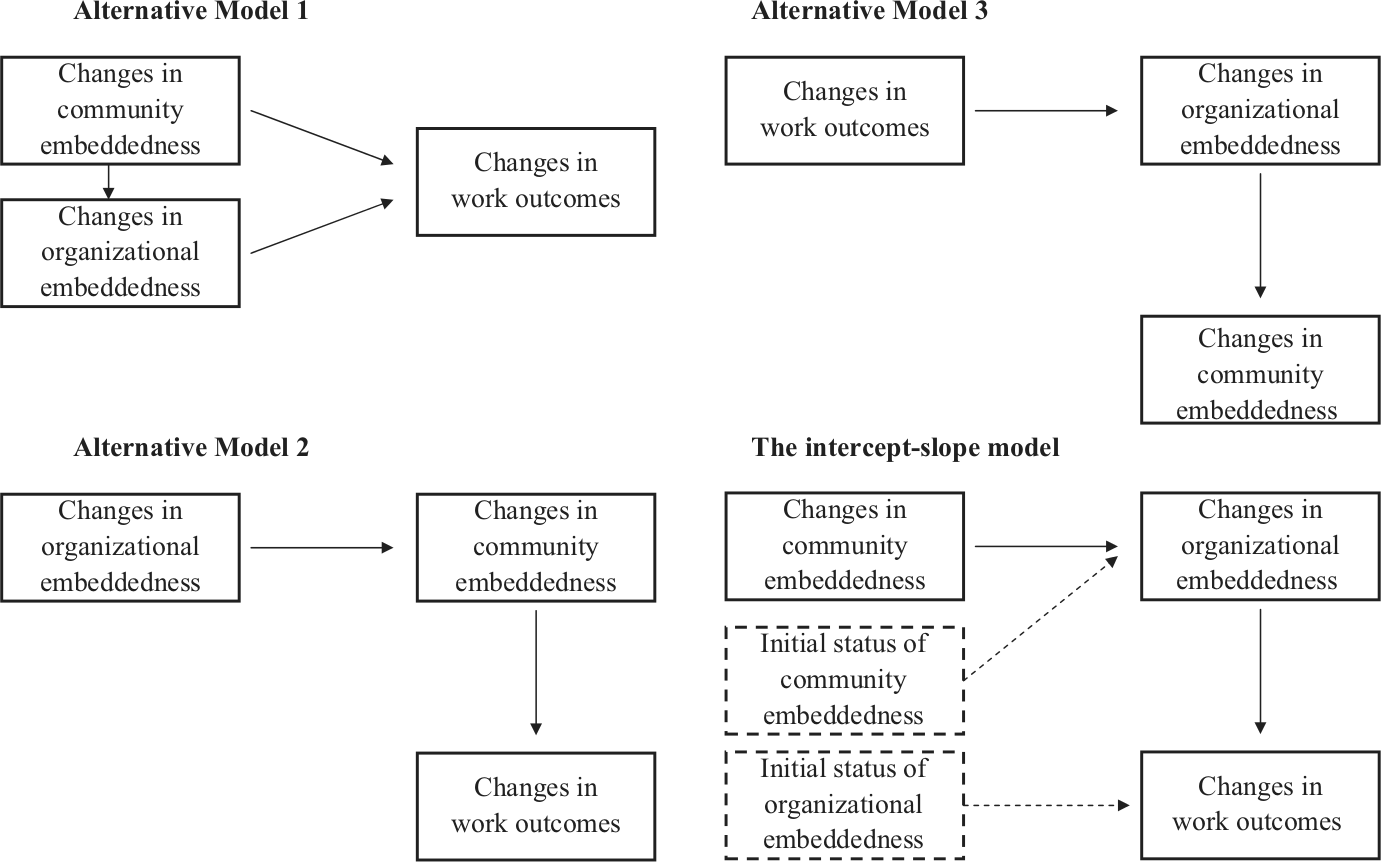
Alternative models.
Alternative Model 1
The first alternative model is the same as the originally proposed model, except that both community embeddedness and organizational embeddedness are posited to be related directly to work outcomes. This model, if supported, would suggest that resource surpluses generated in the community domain can directly fuel an individual’s job motivation, social networking behavior, and organizational identification (Kirchmeyer, 1992). Thus, in this model, we posit that there are both direct and indirect effects of community embeddedness. In essence, Alternative Model 1 tests for the validity of the resource transfer argument (via organizational embeddedness).
Alternative Model 2
The second alternative model is one in which the roles of community embeddedness and organizational embeddedness are reversed. That is, changes in community embeddedness were specified as the mediator in the model, whereas changes in organizational embeddedness were specified as the independent variable. For instance, because resource transfers could be bi-directional, it is possible that increased organizational embeddedness leads to greater community embeddedness (rather than vice versa).
Alternative Model 3
The third alternative model is an extension of Alternative Model 2, but goes further in its test of presumed causal order. That is, in Alternative Model 3 the flow of the entire proposed theoretical model is reversed. Changes in work outcomes are specified as antecedents of changes in organizational embeddedness, which in turn are specified as antecedents of community embeddedness. Support for this causal ordering would suggest that increases in organizational identification, for example, lead to increased perceptions of organizational embeddedness, as salient organizational identification prompts individuals to invest more time and energy into helping the organization achieve its goals (Meyer et al., 2006). In turn, increases in organizational embeddedness may promote the growth of community embeddedness.
Method
Research design
Respondents were recruited by StudyResponse Center for Online Research, a non-profit academic service run by Syracuse University that recruits academic survey participants in exchange for small monetary rewards (e.g. gift certificates to Amazon.com). Other organizational behavior researchers have also successfully sampled participants through StudyResponse (Montes and Zweig, 2009; Piccolo and Colquitt, 2006; Richards and Schat, 2011; Rogelberg et al., 2010; Triana et al., 2010).
Data were collected from respondents at three points in time over a ten-month period. This design allowed us to track intra-individual changes in the study variables over nearly a year and then examine the co-variation of those changes. Five months after the initial survey, StudyResponse sent the second online survey to those respondents who participated in the first survey. Ten months after the initial data collection (five months after the Time 2 data collection), StudyResponse sent the third online survey to individuals who had completed the second survey.
Sampling strategy
Several parameters were set regarding sampling participants. First, respondents were to be age 18 or older. Second, respondents were to be currently employed full-time by an organization. Third, to increase the generalizability of our findings, respondents were to be chosen from a diverse set of industries and professions, including both higher-skill jobs like engineers and lower-skill jobs like administrative assistants. Given these parameters, 1947 subjects were chosen at random and were contacted for the initial survey.
Sample
At Time 1, StudyResponse sent out 1947 surveys to respondents who were currently employed. Five hundred and forty-four usable surveys were returned (a response rate of 28%). Next, the Time 2 survey was sent to the 544 respondents who participated in the first survey. We received 448 usable surveys back, representing a response rate of 82 per cent at Time 2. Then, the Time 3 survey was sent to those 448 respondents who participated in both the first and second surveys. We received 380 usable surveys back, representing a response rate of 85 per cent at Time 3. We then excluded those 42 respondents who had changed organizations in the preceding ten-month period because, had we included these job changers, they would have used different organizations as referents in their responses to the second and/or third surveys.
Thus, the final sample size was 338, representing an overall response rate of 20 per cent. We also compared our response rates to those of other organizational behavior studies that recruited online participants through StudyResponse. These studies report response rates ranging from 15 per cent to 26 per cent (Piccolo and Colquitt, 2006; Rogelberg et al., 2010; Triana et al., 2010). Our initial response rate of 28 per cent, then, is above the average for organizational behavior studies conducted by StudyResponse.
We then compared the responses of individuals who participated in all three surveys with those from individuals who dropped out at some point during the data collection. There were no significant differences on key study variables or demographic variables. For instance, respondents and non-respondents did not differ on organizational tenure, job level, or any of the seven key study variables (p > .05 in all nine cases).
The average age of the participants in the study was 34.83 years old (SD = 8.23). All participants resided in the United States. Thirty-four per cent of respondents were female and 78 per cent were Caucasian. Average organizational tenure was 7.9 years. Eighty-five per cent of the sample held bachelor degrees or higher-level degrees. In terms of hierarchical level, 67 per cent of participants identified themselves as having some supervisory responsibilities and 33 per cent identified themselves as having no supervisory responsibility. Participants worked in a wide array of industries, including accounting or finance (14%), architecture (4%), biotechnology or pharmaceuticals (4%), consulting (7%), engineering or design (14%), law (4%), research (2%), technology (e.g. web design, computer network) (29%), and general administration (23%).
Measures
Except where noted, survey items were measured on five-point Likert-format scales. Response scales ranged from 1 (Strongly Disagree) to 5 (Strongly Agree). The means, standard deviations, and correlations among the study variables within and across each of the three time points are provided in Table 1. All the scale items are provided in the Appendix.
Means, standard deviations, and correlations among study variables (N = 338).
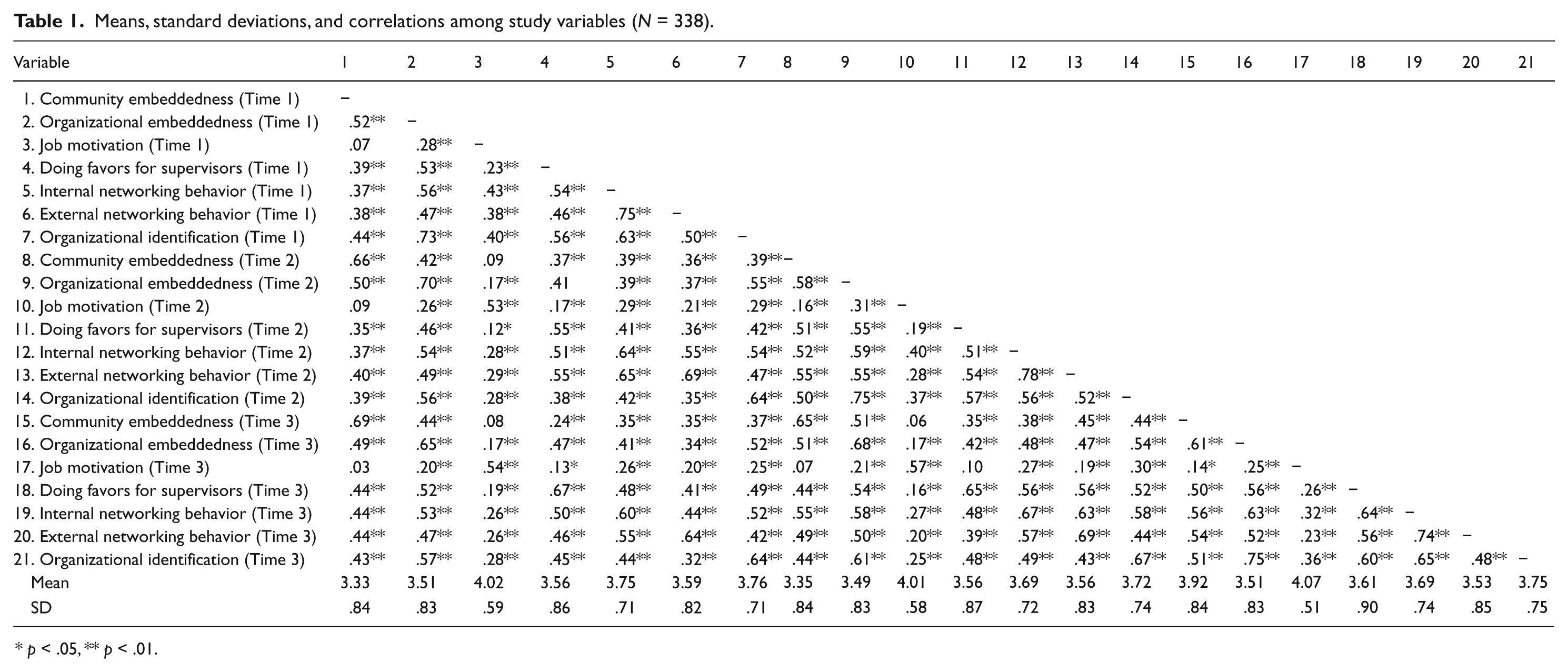
* p < .05, ** p < .01.
Community embeddedness
Mitchell et al. (2001) developed a scale of community embeddedness containing three components: fit, links, and sacrifice. Separate scores are computed for each component, and then those three components are equally weighted to reflect community embeddedness. Crossley et al. (2007) subsequently developed a measure that captures global perceptions of embeddedness, regardless of why individuals are attached, how much they like being attached, and whether individuals are attached by choice or default. Because we are also interested in how global feelings of community embeddedness relate to work outcomes, we adopted Crossley et al.’s (2007) approach and created a six-item overall perceptual measure for this study. The coefficient alpha for this scale was .91 at all three points in time.
Organizational embeddedness
We measured organizational embeddedness with Crossley et al.’s (2007) scale. The coefficient alpha for this scale was .91 at all three points in time.
Job motivation
Job motivation was measured with six items created by Warr et al. (1979). The coefficient alpha for this scale was .82 at Time 1, .80 at Time 2, and .77 at Time 3.
Doing favors for supervisors
Doing favors for supervisors was measured with Wayne et al.’s (1997) three-item scale. The coefficient alpha was .83 at Time 1, .82 at Time 2, and .84 at Time 3.
Internal networking behavior
Internal networking behavior was measured with the six-item scale used by Ng et al. (2010). The coefficient alpha was .89 at Time 1, .90 at Time 2, and .90 at Time 3.
External networking behavior
External networking behavior was measured with the six- item scale used by Ng et al. (2010). The coefficient alpha was .92 at Time 1, .92 at Time 2, and .93 at Time 3.
Organizational identification
Organizational identification was measured with Mael and Ashforth’s (1995) five-item scale. The coefficient alpha for this scale was .86 at Time 1, .88 at Time 2, and .89 at Time 3.
Confirmatory factor analyses (CFA)
Before proceeding with any model tests, confirmatory factor analyses (CFA) were conducted to determine whether the measurement models had acceptable model fit. The fit of the model was evaluated by various fit indices recommended by Hu and Bentler (1998): Tucker-Lewis Index (TLI), Bollen’s Fit Index (BL89), the Comparative Fit Index (CFI), the Root Mean Squared Error of Approximation (RMSEA), and the Standardized Root-Mean-Squared Residual (SRMR). To conclude that a model fits the data well, Hu and Bentler (1999) suggest that TLI, BL89, and CFI should be .95 (or higher), RMSEA should be .06 (or lower), and SRMR should be .08 (or lower). Finally, we included the Akaike Information Criterion (AIC), which is particularly useful in model comparison when models are non-nested (Rust et al., 1995). Although significance difference tests are not available for AIC, researchers typically consider the model with the lowest AIC to be the best fitting one relative to other models (Rust et al., 1995).
In the first CFA, we examined whether it was reasonable to treat the three social networking variables (doing favors for supervisors, internal networking, and external networking) as separate constructs. We specified these variables in a CFA, and found that the three-dimensional model has an excellent fit. The first row in Table 2 presents the values of the fit indices associated with this measurement model. We observed that the chi-squared value was 1721.67 (d.f. = 864). TLI was .98, BL89 was .99, CFI was .99, RMSEA was .05, and SRMR was .04. On the other hand, when we combined the three social networking variables into one dimension at each time point, we found that the CFA model had much worse fit. The chi-squared value was 3363.34 (d.f. = 897). TLI, BL89, and CFI were all .96, RMSEA was .11, and SRMR was .07. Taken together, these results suggest that it was more appropriate to treat the three social networking variables as separate constructs.
Fit indices.
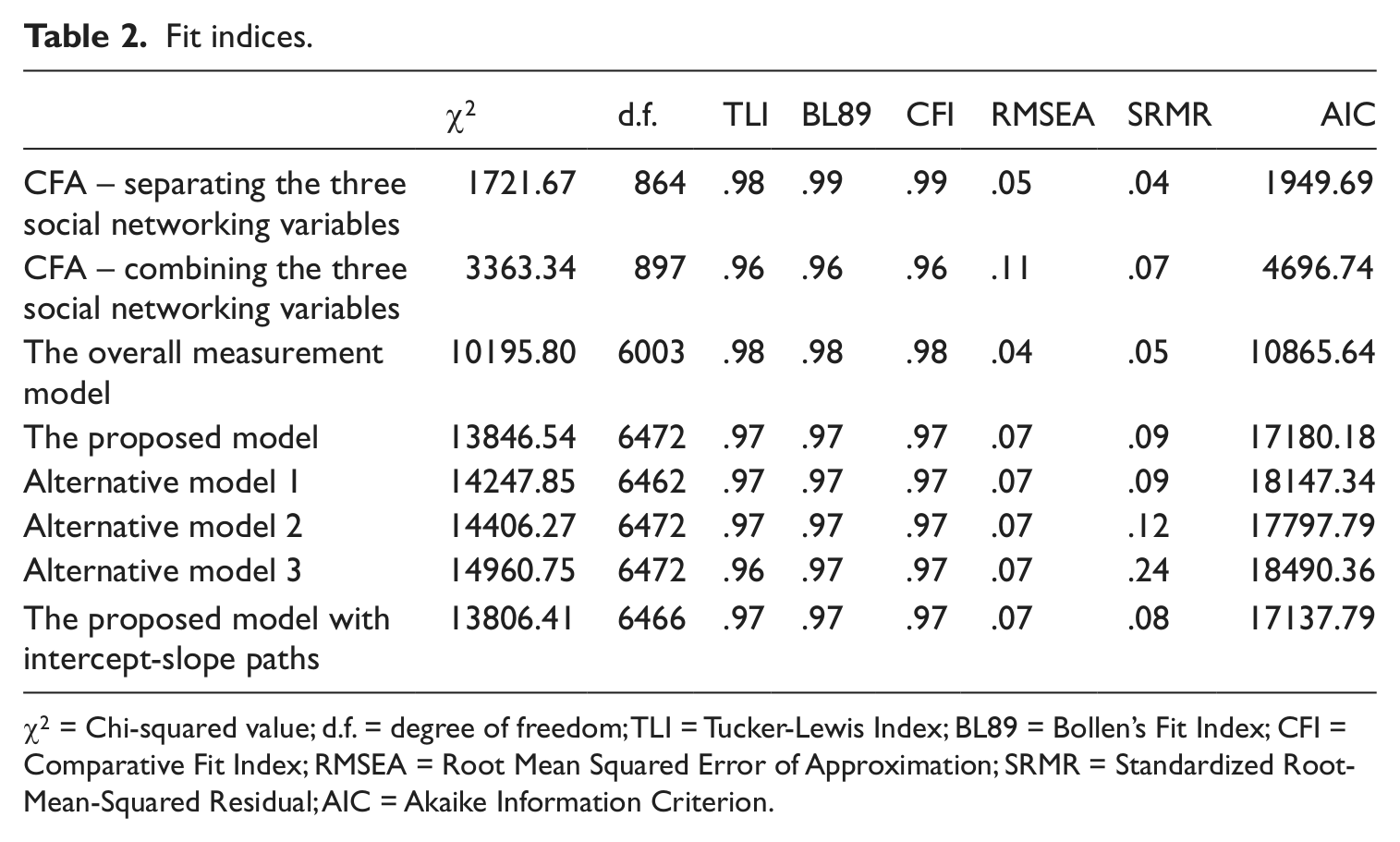
χ2 = Chi-squared value; d.f. = degree of freedom; TLI = Tucker-Lewis Index; BL89 = Bollen’s Fit Index; CFI = Comparative Fit Index; RMSEA = Root Mean Squared Error of Approximation; SRMR = Standardized Root-Mean-Squared Residual; AIC = Akaike Information Criterion.
Second, we conducted a CFA in which each measurement item was allowed to load only on the construct that it was intended to represent. Then, each measurement model was identified by setting the construct variance equal to the value of one (Anderson and Gerbing, 1988). The inter-correlations among all the constructs were allowed to be estimated freely. Finally, as in other similar studies (Lance et al., 2000), the error variances of those measurement items that were repeatedly used across time points were allowed to be correlated. As shown in Table 2, the overall measurement model (which contains all the scales measured in this study) has acceptable fit. All the factor loadings were statistically significant. The results of the second CFA suggest that the measurement scales have acceptable psychometric properties across all three points in time.
Finally, we examined whether these scales demonstrated measurement invariance longitudinally (Chan, 1998; Vandenberg and Lance, 2000). Based on chi-squared difference tests, we found that two items in the job motivation scale and one item in the external networking behavior scale had significantly different factor loadings at the three points in time. However, this partial scale invariance does not materially affect the interpretation of our results, for both theoretical and practical reasons. Theoretically speaking, it is overly stringent to expect complete scale invariance in longitudinal research when the underlying assumption in undertaking such research is that there will be some changes in variables of interest over time (Pentz and Chou, 1994). Further, Lance et al. (2000) proposed a reasonable methodological remedy for the lack of full scale invariance, namely, allowing variant factor loadings to be estimated freely in the testing model whereas the invariant items are set to have equal factor loadings. By doing so, the parameter estimates in the subsequent latent growth modeling analyses will control for the lack of full metric invariance at the first-order-factor level, which in turn defines true initial status and change at the second-order-factor level.
Latent growth modeling (LGM)
LGM was used to test the proposed model. LGM is an extension of structural equation modeling; it assesses changes in levels of variables and examines how these changes are related to other constructs in the nomological network (Bollen and Curran, 2006; Duncan et al., 2006). Although LGM does not provide definite evidence of causality, it is a stronger causal design than a cross-sectional design because it provides evidence on the co-variation among changes in variables over time, not just the covariation among levels of variables at one time point (Ployhart and Vandenberg, 2010).
In using LGM, researchers are interested in several parameter estimates. First, researchers examine the means and variances of the latent intercept factor (representing the average initial status of individuals on a measure) and the latent slope factor (representing the average rate of change over time). These intercept and slope estimates allow researchers to address such research questions as the relationships between two intercepts (e.g. Does community embeddedness at Time 1 relate to organizational embeddedness at Time 1?), between an intercept and a slope (e.g. Does community embeddedness at Time 1 relate to changes in organizational embeddedness at Time 2 and Time 3?), and between two slopes (e.g. Do changes in community embeddedness relate to changes in organizational embeddedness?). Researchers can also use LGM to examine the variability of intercept and slope factors (e.g. Is there significant between-subject variability in the within-subject change trajectories in community embeddedness?).
In the present case, we are particularly interested in the strength of the relationships among the latent slope factors. In order to obtain these parameter estimates, we specified relationships among the intercept and slope factors of the variables in this study. Thus, the intercept factor and the slope factor of community embeddedness were specified to be associated with those of organizational embeddedness (see Hypothesis 1), which in turn were specified to be associated with the intercept factor and the slope factor of job motivation (see Hypothesis 2), social networking behaviors (see Hypotheses 3a to 3c), and organizational identification (see Hypothesis 4).
Next, each first-order latent factor was represented by its respective measurement items. The error variances of measurement items collected at multiple time points were allowed to be correlated. Moreover, partial metric invariance was specified because, as noted earlier, three items had significantly different factor loadings at three points in time (Bentein et al., 2005; Lance et al., 2000; Vandenberg and Lance, 2000). Readers are referred to several additional studies for more technical details associated with the use of LGM, including Bollen and Curran (2006), Chan (1998), and Duncan et al. (2006).
Finally, it is important to note that we included two control variables − age and organizational tenure − in testing each of our models. That is, age and organizational tenure of respondents were specified to be related to all the change variables in all the models tested. The rationale for doing so was that some of the co-variation posited in these models may have been owing to increases in chronological age and organizational tenure over time. Thus, including age and organizational tenure as control variables helps rule out the effects of these two time-variant individual differences.
Results
In the first step of LGM, we examined the mean levels of intercept and slope factors of all seven study variables. In the case of community embeddedness, the estimated mean intercept is 3.24 (p < .01) and the estimated mean slope is .03 (ns). In the case of organizational embeddedness, the estimated mean intercept is 3.65 (p < .01) and the estimated mean slope is .04 (ns). In the case of job motivation, the estimated mean intercept is 4.18 (p < .01) and the estimated mean slope is .02 (ns). In the case of doing favors for supervisors, the estimated mean intercept is 3.52 (p < .01) and the estimated mean slope is .03 (ns). In the case of internal networking behavior, the estimated mean intercept is 3.67 (p < .01) and the estimated mean slope is −.03 (ns). In the case of external networking behavior, the estimated mean intercept is 3.52 (p < .01) and the estimated mean slope is −.04 (p < .05). Finally, in the case of organizational identification, the estimated mean intercept is 3.58 (p < .01) and the estimated mean slope is .00 (ns).
It is important to note that the non-significant estimates of some of mean slopes above do not signal that no changes in these variables occurred across time. Rather, further analyses indicate that some participants experienced increases, whereas others experienced decreases on these variables over time. For example, we found that 49 per cent of subjects reported declines in community embeddedness over time (that is, estimated slope less than zero), but 48 per cent of subjects reported increases in community embeddedness over time (that is, estimated slope greater than zero), with only 3 per cent reporting no changes over time (that is, estimated slope equals to zero). Similar percentages of increases/decreases were observed for other study variables.
In addition, the variance component estimates suggest that there is indeed predictable inter-individual heterogeneity in intra-individual change trajectories. Specifically, the intercept factor variances for all study variables were statistically significant, indicating that there were significant individual differences in these variables at Time 1. Similarly, the slope factor variances for all study variables were statistically significant, revealing that there were individual differences in the rate of change in these variables, too. The factor co-variances between the intercept and slope factors for all study variables (except community embeddedness) were significantly and negatively related. These findings suggest that respondents who reported higher mean levels of these variables at Time 1 reported less change in these variables over time.
The results of the model testing illustrate whether or not subjects who reported increases (decreases) in community embeddedness over time also reported increases (decreases) in the other study variables. The fit indices shown in the fourth row in Table 2 indicate that the proposed model has largely acceptable fit. TLI, BL89, and CFI were all .97, thereby meeting the “.95 cutoff” criterion proposed by Hu and Bentler (1999). The RMSEA was .07, which marginally met the “.06 cutoff” criterion proposed by Hu and Bentler (1999). The SRMR was .09, which also marginally met the “.08 cutoff” criterion suggested by Hu and Bentler (1999).
Alternative models
Three of the five fit indices indicate that our proposed model had acceptable fit, with two indicating marginal fit. Nonetheless, we also examined the three alternative theoretical models discussed earlier (see Figure 2) in order to further validate the model before testing our hypotheses.
Alternative Model 1
The results demonstrate that Alternative Model 1 has poorer fit than the original model. As shown in Table 2, the increase in chi-squared value (which indicates badness of fit) was statistically significant (△χ2 = 401.31, △d.f. = 10, p < .01). Thus, the results here suggest that the original model, which proposes a transfer of resources from the community domain to the work domain, fits the data better than a model that contains both direct and indirect effects.
Alternative Model 2
As shown in Table 2, even though the degrees of freedom remained the same, Alternative Model 2 had a larger chi-squared value than did the original model, indicating worse model fit. In addition, the fit index most highly sensitive to model misspecification (SRMR) changed from .09 to .12. Further, the AIC was 17797.79, which was larger than that of the originally proposed model (17180.18). The results here suggest that treating organizational embeddedness as a mediator rather than an independent variable (as proposed in the original model) fits the data better.
Alternative Model 3
As shown in Table 2, even though the degrees of freedom remained the same, Alternative Model 3 had a larger chi-squared value than did the original model, indicating worse model fit. In addition, the fit index most highly sensitive to model misspecification (SRMR) changed from .09 to .24. Further, the AIC was 18490.36, which was larger than that of the originally proposed model (17180.18). The results here suggest that it was reasonable to treat work outcomes as the dependent variables in the model rather than as independent variables, as we did in the original model.
Hypothesis results
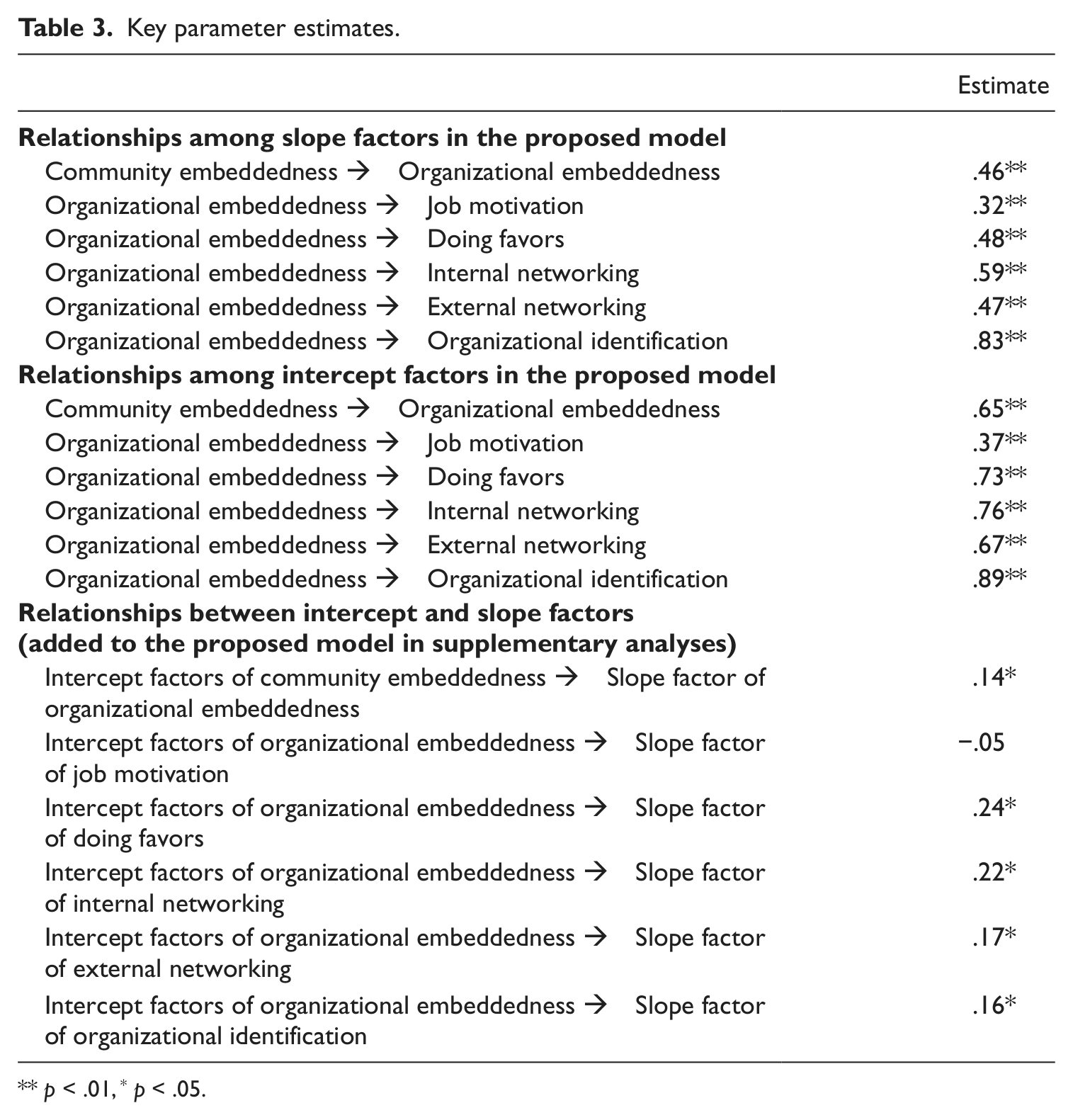
Given the proposed model has good fit and has better fit than the alternative models, we then proceeded to test the parameter estimates in Figure 1. The parameter estimates, which indicate whether our specific hypotheses are supported, are provided in both Figure 1 and Table 3.
Key parameter estimates.
p < .01, * p < .05.
Hypothesis 1 predicted that changes in community embeddedness would be associated with changes in organizational embeddedness over time. This hypothesis was supported. As shown in Table 3, the slope factor of community embeddedness was significantly and positively associated with the slope factor of organizational embeddedness (β = .46, p < .01). Hypothesis 2 predicted that changes in organizational embeddedness would be associated with changes in job motivation over time. This hypothesis was also supported (β = .32, p < .01). We found support for Hypothesis 3 as well − that is, the slope factor of organizational embeddedness was positively related to the slope factor of doing favors for supervisors (β = .48, p < .01), internal networking (β = .59, p < .01), and external networking (β = .47, p < .01). Finally, we found that the slope factor of organizational embeddedness was indeed related to the slope factor of organizational identification (β = .83, p < .01), providing support for Hypothesis 4.
It is important to note that tests for the significance of the above relationships controlled for the relationships among the intercept factors. That is, the estimates of the relationships among the changes in study variables reported above partialled out the effects of the initial status of these variables, too. We report the static effects in Table 3. The results in Table 3 indicate that the intercept factors of all study variables are correlated significantly with each other, providing further support for the idea that community embeddedness, organizational embeddedness, and work outcomes are usually related positively to each other at any one point in time.
Mediation effects
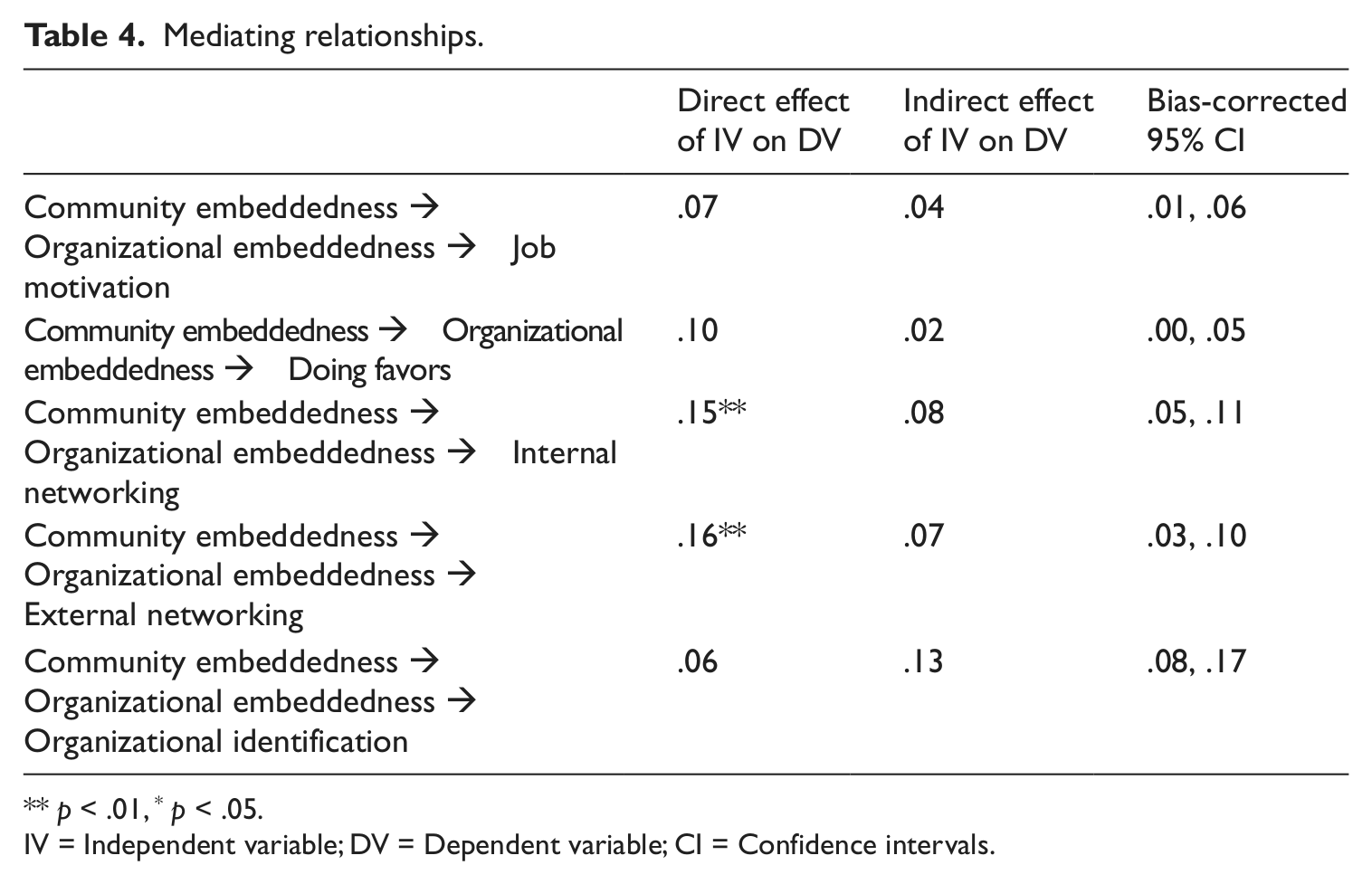
Hypothesis 5 states that changes in organizational embeddedness will mediate the relationships of changes in community embeddedness with changes in job motivation (H5a), social networking behavior (H5b), and organizational identification (H5c). To test for these mediation effects, we followed the approach recommended by Preacher and Hayes (2008). They suggest that a mediation effect can be said to have occurred when the product of the paths between the independent variable and the mediator (called path a) and between the mediator and the dependent variable (called path b) is statistically significant. Whether the mediation is partial or complete in nature depends on whether the path between the independent variable and dependent variable is significant or not. This approach has been recommended over Baron and Kenny’s (1986) method because it has greater power and better controls for Type I errors (MacKinnon et al., 2002).
Selig and Preacher (2009) further extended this testing approach to LGM applications. According to Selig and Preacher (2009), a mediation effect is said to have occurred when the product of the paths between (a) changes in the independent variable and changes in the mediator and (b) changes in the mediator and changes in the dependent variable is statistically significant. Selig and Preacher (2009) emphasize that mediation tests can be performed on both intercept and slope factors, even though in most cases of LGM applications the interest is on the slope factors (as was the case here).
Using Selig and Preacher’s (2009) approach, we found five mediation relationships and tested the statistical significance of each one. The results are presented in Table 4. We found that the bootstrap confidence intervals for four of the five mediation relationships excluded zeros (the exception was doing favors for supervisors), suggesting that those four indirect effects were statistically significant. Specifically, changes in organizational embeddedness mediated the effects of changes in community embeddedness on job motivation (.04), internal networking (.08), external networking (.07), and organizational identification (.13). In addition, changes in community embeddedness also have non-zero direct effects on both internal networking (.15) and external networking (.16). In sum, we found that two of the four significant mediating relationships exhibited complete mediation and two showed partial mediation. Thus, Hypotheses 5a to 5c were all supported by our data.
Mediating relationships.
p < .01, * p < .05.
IV = Independent variable; DV = Dependent variable; CI = Confidence intervals.
Intercept-slope effects
So far, our analysis has been focusing on relationships among change factors. However, it is also important to rule out the possibility that the initial status of community embeddedness at Time 1 affected the changes in organizational embeddedness that had occurred over the study period (above and beyond the effects of changes in community embeddedness). If the initial status of community embeddedness is indeed related to the changes in organizational embeddedness over time, it would suggest that the direction and magnitude of changes in organizational embeddedness are not only a function of changes in community embeddedness, but also a function of the initial level of community embeddedness. Similarly, we needed to rule out the possibility that the initial status of organizational embeddedness at Time 1 affected changes in work outcomes that occurred during the time of the study (above and beyond the effects of changes in organizational embeddedness).
To test these possibilities, we added additional paths to our original model, which had specified relationships among intercept factors and among slope factors, but not relationships between intercept and slope factors. First, we specified that the intercept factor of community embeddedness be related to the slope factor of organizational embeddedness. Second, we specified that the intercept factor of organizational embeddedness be related to the slope factor of each of the work outcomes we examined. This intercept-slope model is depicted in Figure 2 as well. In essence, this supplementary analysis is a more conservative test of Hypotheses 1−4 because the initial status of community and organizational embeddedness are now taken into consideration.
As shown in Table 2, we found that the fit of the above model was acceptable. As shown in Table 4, we found that the intercept factor of community embeddedness was related significantly to the slope factor of organizational embeddedness (β = .14, p < .05). The positive direction of this relationship suggests that if community embeddedness is initially high, people will transfer more resources to the work domain over time. In addition, the intercept factor of organizational embeddedness was related significantly to the slope factors of doing favors for supervisors (β = .24, p < .05), internal networking (β = .22, p < .05), external networking (β = .17, p < .05), and organizational identification (β = .16, p < .05). The positive direction of these relationships suggests that if organizational embeddedness is initially high, people will continue to deploy more resources in the work domain and invest more energy into their jobs, social networks, and the employment relationship over time. Most importantly, all the significant relationships among slope factors we observed in our proposed model remained statistically significant even after controlling for the initial status of community and organizational embeddedness. Overall, this supplementary analysis reveals that our findings are generally robust.
Discussion
Most previous empirical research on embeddedness has largely focused on the work domain, even though Mitchell et al. (2001) proposed that organizational and community embeddedness should be weighted equally in one overall construct. To redress partially this imbalance in previous research, the present study contributes to the embeddedness literature by providing evidence that changes in community embeddedness are associated positively with changes in job motivation, social networking behavior, and organizational identification – and that changes in organizational embeddedness either fully or partially mediate these relationships. Thus, the inclusion of community embeddedness in embeddedness research continues to be warranted. Simply assuming community embeddedness does not influence work outcomes, and therefore excluding community embeddedness as a predictor of those outcomes can lead to unwarranted conclusions. In this final section, we consider the implications of these findings for future research.
Implications for theory development
A key finding in this study is that community embeddedness affects work outcomes through the mediating effects of organizational embeddedness. Therefore, we suggest that a major focus of future research should be cross-domain relationships. That is, future research should explore the relationships between community and organizational embeddedness, on one hand, and work-related and community-related outcomes on the other. Indeed, one interesting avenue here would be exploring the relationships of organizational and community embeddedness to work-to-family and family-to-work enrichment. Although much of the previous research in this area has examined how job and family demands create conflicts across work and non-work domains (e.g. Allen et al., 2000), our research suggests that embeddedness can generate resource surpluses that create positive cross-domain outcomes. Future research might also identify the specific types of resource surpluses that lead to the positive outcomes we found here.
Another area that deserves greater theoretical development is the nature of the relationships between community embeddedness and social networking behaviors. We found that community embeddedness had direct (as well as indirect) effects on internal networking behavior. One possibility worth exploring in future research is whether these positive direct effects occur because increases in community embeddedness lead to more frequent interactions with a diverse set of colleagues outside of work, which in turn facilitates their networking more easily with those colleagues on the job. We also found that community embeddedness had direct (as well as indirect) effects on external networking behavior. This finding is particularly noteworthy because most previous research has viewed external networking as a means of looking for new employment relationships rather than as a way of solidifying old ones. Therefore, researchers should examine the reciprocal relationships among these three constructs (community embeddedness, organizational embeddedness, and external networking behaviors) in much greater detail.
Although the findings in this study suggest there are positive spillover effects of community embeddedness on organizational embeddedness, future researchers should also consider how community embeddedness might actually deplete employees’ resources by placing additional demands on their time (Brown and Ferris, 2007; Devine-Wright, 2009). For instance, in a qualitative study, Boutain and Spigner (2008) found that employees who participated heavily in community activities were more likely to have high blood pressure, a finding which suggests that increases in community embeddedness can deplete, rather than enhance, an individual’s personal resources (Ng and Feldman, 2010). Moreover, as instrumental as building social capital might be (Zanzi et al., 1991), it often takes considerable time and effort to achieve (Ferris et al., 2007; Macan, 1994), it can induce stress and fatigue (Cropanzano et al., 1997), and its cumulative effects can contribute to greater role conflicts among work, community, and family demands over time (Booth et al., 1991; Ng and Feldman, 2010; Voydanoff, 2001, 2004). The data here certainly support a positive view of community embeddedness, but we encourage future researchers to investigate both the negative and positive effects of community embeddedness on employees across multiple time periods.
Lastly, the current findings suggest that both community and organizational embeddedness are likely to change over time and, as such, the roles of age and tenure in the embedding process warrant much greater attention. As the empirical evidence here suggests, community and organizational embeddedness can change even within just a ten-month period. In the present study, we found that controlling for age and organizational tenure did not change the patterns of our results significantly. Nonetheless, we suspect that over even longer periods of time (e.g. five to ten years), the effects of age and tenure might be stronger. For example, age might heighten the effects of community embeddedness; as older workers continue to accrue more and more links in the community over time, it is even more likely they will stay in the community until retirement. Similarly, as individuals accrue more and more years of service, their opportunities for exit are narrowed as well. Given that age and tenure may serve to heighten the cumulative effects of organizational and community embeddedness, we recommend they be used as moderators rather than control variables in embeddedness research.
Limitations of the present research
The current study illustrates the benefits of using a longitudinal change approach to studying employee embeddedness. Examining intra-individual changes in constructs over time is preferable to the predominant cross-sectional approach in this research area, where results are often inflated by common method variance and preclude accurate assessments of causality. However, even though three waves of data were collected over a ten-month period, the present research design does not fully answer all questions about causality because all the study variables were still measured at the same time at each of the three time points. Instead, to establish firmer claims of causality, it would be important to separate the time period during which changes in the independent variable occur from the time period during which changes in the dependent variable occur. In the present case, for example, that would mean measuring changes in community embeddedness over time first and then measuring changes in organizational embeddedness during a subsequent time period. By separating the time period during which changes in the independent variable occurred from the time period during which changes in the outcome variable occurred, researchers can assess the longitudinal relationships between these changes. If significant relationships are observed, researchers can be more certain that changes in the former lead to and cause the changes in the latter.
In addition, in the present study we largely focused on linear changes and excluded any non-linear changes that might have occurred. Although the LGM results here indicate that modeling linear trends for the variables in this study was a reasonable assumption, more careful attention to this issue is warranted.
Further, all the variables in this study were self-reported, albeit measured at multiple points in time. However, although the problem of common method bias was alleviated, it was not completely eliminated. In addition, the hypotheses in this study were informed by COR theory, even though we did not have data to directly test the resource transfer or continuous resource acquisition arguments. COR theory has received strong empirical support in previous work (Hakanen et al., 2011; Hobfoll, 2001) and we believe it provides a rich foundation for future research on community embeddedness. Nonetheless, more direct measures of COR theory constructs would be very helpful.
More research should also be done on operationalizing the community embeddedness construct. As noted earlier, some of the lack of attention to community embeddedness may be owing to conceptual ambiguity about what the term “community” encompasses (Putnam, 2001; Solnit, 2009). Indeed, that is why we adopted the Gestalt perceptual approach (Crossley et al., 2007) in measuring community embeddedness. That being said, we did not have the data to evaluate whether the results we observed could be replicated if we used the three-component scales (fit, links, sacrifice) created by Mitchell et al. (2001).
It is important to note, as well, that some of the relationships in this study may have been reciprocal in nature. The models tested in this article provide some evidence that organizational embeddedness mediates the relationship between community embeddedness and work outcomes. In contrast, there is much weaker evidence that community embeddedness mediates the relationship of organizational embeddedness to these work outcomes (see Alternative Model 2), or that employee attitudes and behaviors drive organizational and community embeddedness (see Alternative Model 3). Nevertheless, although the focus of the present article was the transfer of resources from the community domain to the work domain, some transfers going in the other direction are certainly possible.
In addition, we argue that community-embedded workers are likely to develop links to increase organizational embeddedness and that organization-embedded workers are likely to engage in more networking behaviors. From a theoretical perspective, social networking is a strong component of organizational embeddedness. However, it may be difficult to disentangle whether networking leads to embeddedness or embeddedness leads to networking. Therefore, from an empirical perspective, it is important that future research examine the relative strength of these reciprocal relationships. Doing so would help us better understand whether networking is more likely a cause or an outcome of organizational embeddedness.
Finally, although four of the five fit indices suggest an acceptable fit, the RMSEA and SRMR associated with the proposed model fell short of the cutoff criterion proposed by Hu and Bentler (1999). Thus, future research needs to extend our model in other settings to strengthen its generalizability.
Conclusion
We hope the present study stimulates further research on how community embeddedness contributes to job-level, social-level, and organization-level outcomes and how organizational embeddedness mediates these effects. We encourage researchers to attend to the social psychological processes through which community embeddedness and organizational embeddedness affect each other and the potential enrichment effects across the two types of embeddedness. We also encourage future researchers to rely more heavily on longitudinal designs so that the important dynamics that underlie the embedding process can be more fully understood and firmer conclusions about causality can be drawn. Moreover, at a time when cultivating strong organizational identity in the workforce is difficult (Rousseau, 1998), we hope organizations will consider ways they can further embed employees through sponsoring and encouraging involvement in community activities.
Footnotes
Appendix. Scale items used
Funding
This research received no specific grant from any funding agency in the public, commercial, or not-for-profit sectors.