



Abstract
With the changing demographics of the labor force, management of work and family role boundaries has become an important area of research. However, the literature surrounding boundary theory – one of the most prevalent theories of work–family role management – has evolved too narrowly. Although early boundary theory development acknowledged the importance of higher level social institutions, they have been largely omitted from the current research, which is predominantly individual-focused. The present article further develops the role of international regulative institutions in managing work and family role boundaries, including the consequences of their omission in the current literature for individual employees, organizations and the fit between them.
Keywords
Introduction
The labor force is changing in ways that present challenges for individuals to manage work and family demands. Today’s labor force is characterized by more women, dual earner couples, variation in working time arrangements and older workers (Galinsky et al., 2009; Raley et al., 2006; Toossi, 2005). With these changes in labor force demographics and working time needs, managing work and family roles has emerged as a key challenge for employees across industries and occupations and become a growing area of academic research cutting across disciplines (Lambert and Kossek, 2004; Pitt-Catsouphes et al., 2005). Boundary theory (Nippert-Eng, 1996) serves as the foundation for much of the work–family research that attempts to explain how and why workers and their employers manage often conflicting work and family demands in particular ways.
In this article, we critique the existing literature of work–family boundary management and present a model showing that previously unaccounted for regulative institutional factors can significantly affect the interpretation of previously empirically established relationships based on boundary theory. We argue that boundary theory research has focused too narrowly on issues of individual work–family boundary management and organizational practices without acknowledging the impact of the regulative environment in which individuals and organizations must act. A broader, institutionally inclusive view of boundary theory can more accurately explain why people are able to manage their work and family boundaries in particular ways, prevent misattribution of organizational practices to strategy or a more general work–family response, and create a better understanding of the components of fit between individual employees and the organizations in which they work.
Evolution of boundary theory
Boundary theory has evolved too narrowly from its formation in cognitive sociology to its use in organizational behavior and human resource (HR) strategy. Throughout its development, scholars have noted the importance of broader social and cultural structures in the creation, maintenance and enactment of roles; however, we demonstrate that these factors have neither been theoretically explicated nor empirically examined alongside those more proximal to the individual’s actual behavior.
Boundary theory grew from a stream of research about the cognitive organization of roles. It is heavily influenced by Zerubavel (1993, 1996), who discusses the idea that people use heuristic classification systems to organize mental and physical constructs: either lumping them together into one mental category or splitting them into separate mental categories. Importantly, Zerubavel argues that these construct categorizations are socially created through interactions with others and observations of differences that are exaggerated by the mind in order to aid the classification and identification process. In other words, the mental categorizations of social roles at the heart of boundary theory are influenced by broader social factors, which cause individuals in the same social structures to create similar classification schemas. Zerubavel (1993, 1996) also described how individuals carve mental islands of meaning (described as the discrete chunks of reality we create from the world around us). These islands are an outcome of subconscious cognitive construction: the conflicting yet complimentary processes of lumping and splitting (Zerubavel, 1997). Zerubavel (1996) specifically points out that social classification of roles should be approached comparatively so as to elucidate different classification schemas across thought communities or cultures.
Nippert-Eng (1996: 106) applied this broader notion of cognitive sociological classification of roles to the work–family interface. She first developed the idea of individual segmentation and integration of work and home mental categorizations into a theoretical continuum. Individuals thus vary in the degree that their mental classifications of work and family domains overlap. Nippert-Eng’s (1996) conceptualization of boundary negotiation, in which individuals may play a more active role than in the subconscious mental lumping and splitting of roles, became a foundation for the current individual-level boundary management research. Thus, the concept of mental classifications has been extrapolated to be not just a heuristic mechanism for day-to-day behavior but also a conscious, strategic and purposive choice in which individuals actively manage conflicting role demands by adjusting and navigating the boundaries between roles.
Boundary management research describes an individual’s boundary management strategy as ‘the principles one uses to organize and separate role demands and expectations into specific realms of home and work’ (Kossek et al., 1999). Two strategies are commonly accepted in this literature: integrating and segmenting (Desrochers et al., 2005; Matthews et al., 2010). Individuals who prefer a high degree of overlap between work and family domains are deemed integrators, while segmenters (also interchangeably called separators) are those who prefer to keep work and family domains distinct. Research has also identified other types of individuals such as alternators, who oscillate between strategies (e.g. Kossek and Lautsch, 2012; Kossek et al., 2006). Importantly, individuals differ in their general preferences for either segmenting or integrating work and family and, when possible, act in accordance with these preferences through various behavioral tactics (Kreiner et al., 2006). These preferences have in the past been argued to be partially determined by family demands such as the presence of children, as well as by other individual differences such as gender and personality (Kossek et al., 1999) and, more recently, role centrality (Kossek and Lautsch, 2012), though empirical evidence is limited.
Researchers such as Hall and Richter (1988) and Pleck (1977) described boundary flexibility and permeability as the two primary characteristics that distinguish boundaries. These conceptualizations were developed in greater depth through examinations of individual transitions from one role to another (Ashforth et al., 2000; Clark, 2000). The extent to which the work and family domains are distinct – and an individual’s preferences for segmentation or integration can be met – depend primarily on the strength of the flexibility or permeability of work–family role boundaries.
Boundary flexibility refers to the capacity of the boundary to be moved temporally or physically; it encompasses the ‘where and when’ in which a role can be enacted (Sundaramurthy and Kreiner, 2008). Work roles with flexible boundaries can be enacted in multiple locations and/or at multiple times and allow for easier transitions into and out of those roles (Ashforth et al., 2000; Kossek et al., 1999). Boundary permeability, on the other hand, refers to the degree to which a role domain’s boundary is easily disrupted by thoughts or behaviors associated with another role (Pleck, 1977). At one extreme, integrated roles are characterized by highly permeable and flexible boundaries. At the other extreme, boundaries of segmented roles are highly inflexible and impermeable (Ashforth et al., 2000). Most people’s role boundaries will consist of an amalgamation of flexible and inflexible, permeable and impermeable characteristics. Note that boundary flexibility is conceptually distinct from boundary control, defined as an individual’s ability to enact boundaries consistently with his/her preference (Kossek and Lautsch, 2012). While employees in general prefer more boundary control, those with higher segmentation preferences desire less flexible role boundaries, allowing roles to be more easily segmented.
Because individuals generally prefer to either segment or integrate their work and family roles, it follows that they also have matching preferences for the flexibility and permeability of their roles. Yet situations may arise where segmenters with inflexible and impermeable work hours, who typically prefer to keep family demands out of the workplace, may need to respond to a family emergency during work hours. Similarly, overworked integrators may occasionally desire a vacation without any work interruptions. Though integration and segmentation are conceptualized as a continuum in boundary theory, actual preferences for integration and segmentation are likely more complex and situation dependent (Kossek and Lautsch, 2012; Kossek et al., 2006). Some research also suggests that, for example, preferences are informed by dynamic family characteristics (e.g. those with more family demands are more likely to prefer to integrate family and work roles) (Kossek et al., 1999). Despite more nuanced situational variation, boundary theory contends that individuals have general preferences concerning work–family integration/segmentation and should thus prefer their roles to be constructed as consistently as possible with these preferences.
Modern research grounded in boundary theory has to a large degree focused on these integrating/segmenting preferences and can be categorized into three partially overlapping types, which we discuss in greater detail later: individual boundary management, organizational boundary management and person–environment (PE) fit. Individual boundary management research focuses on how individuals move from one role to another, the outcomes associated with being a segmenter or integrator, and how individuals enact their preferred boundary management strategies (Ashforth et al., 2000; Bulger et al., 2007; Desrochers et al., 2005; Hecht and Allen, 2009; Illies et al., 2009; Kreiner et al., 2009; Voydanoff, 2001; Winkel and Clayton, 2010). The organizational work–family boundary management literature, grounded in an HR perspective, is based on the idea that organizations might choose to acknowledge the family demands of their employees through HR practices that facilitate segmenting and/or integrating behavior (Beauregard and Henry, 2009; Hall and Richter, 1988; Kirchmeyer, 1995; Rau and Hyland, 2002; Rothbard et al., 2005). Finally, the PE fit literature examines the extent to which an employee’s integrating/segmenting preferences are met by the environment (e.g. Chen et al., 2009; Edwards and Rothbard, 1999; Kreiner, 2006).
Examining its development from the broader field of cognitive sociology, boundary theory’s literature has grown narrowly. It has focused primarily on individual level and occasionally organization level outcomes, behaviors and processes associated with being a segmenter or integrator, even though role boundaries were originally conceptualized with more contextual and structural factors heavily in mind. While some recent studies have acknowledged the importance of social and institutional forces in boundary management beyond the organization, they have not explained their theoretical role or their implications for individual and organization level studies (Ashforth et al., 2000; Clark, 2002). The lack of any clear theoretical discussion on how to reconcile these lower-level boundary studies with the need for a consideration of socio-structural forces is an important area in need of further research.
In the present article, we combine constructs from the three types of work–family boundary management literature into a single, broader, multi-level theoretical model. We introduce regulative institutions (RIs) into the model, demonstrating how they act through organizational practices to ultimately influence important individual employee outcomes such as work–family conflict. Furthermore, we provide several examples of implications for the omission of these regulative institutional effects in each of these three literatures. By synthesizing existing boundary theory research and expanding it to allow for institutional forces, we begin to build beyond the literature’s primarily micro-level focus.
Regulative institutions
Conceptually, institutions are viewed differently across disciplines. In the modern human resources tradition, institutions are defined as ‘patterns of human action and relationships that persist and reproduce themselves over time, independently of the identity of the biological individuals performing within them’ (Crouch, 2005: 10). We adopt an industrial relations perspective on institutions. According to North (1990: 3), ‘[i]nstitutions are the rules of the game in a society or, more formally, are the humanly devised constraints that shape human interaction. In consequence they structure incentives in human exchange, whether political, social, or economic.’
More specifically, we focus only on the subset of institutions that seems to most directly affect work–family roles: RIs. RIs of interest in the present study include laws and public policies related to the interaction of work and family roles. These RIs exist at multiple levels ranging from local to international, including the presence of a local law mandating paid sick leave, a national law on paid paternity leave or a European Union directive on working time. These RIs could be defined not only by whether they are present for individuals or organizations under study, but also by the degree of coverage provided. For example, in one city, paid sick leave may extend only to workers in organizations of a certain size while in other cities the policy may apply to all organizations. Similarly, one country might have a law mandating six weeks of paid maternity leave while another might more generously mandate 12 weeks.
Thus, we define more extensive regulative institutional environments as those that create more or more generous ways of managing work–family demands. As we discuss below, this typically comes in the form of laws that require that organizations adopt particular HR practices that create opportunities for employees to manage work–family roles in different ways. This definition provides researchers two options in operationalizing RIs: the existence of the RI or the extent of the RI. In some cases, it may be appropriate to measure an RI based on its existence. For example, when conducting large scale comparisons across many countries, one might compare the effects of the right to request a flexible schedule by assigning the UK a ‘1’ and the USA a ‘0.’ An alternative strategy is to operationalize RIs according to their generosity; for example, by counting the weeks of paid vacation mandated by the RI (in which case the USA could be scored with zero and Canada with 2). This method would be useful when studies span similar but distinct regulative institutional contexts.
Though we recognize its importance, we do not include a broader conceptualization of culture under the umbrella of institutions discussed throughout the article. While previous boundary management literature has largely focused on what Nippert-Eng (1996: 6) calls ‘personal practices through which we enact . . . situational constraints,’ we focus on what she calls ‘social-structural constraints on home and work’ and their implications for such personal practices. Cultural institutions beyond the scope of this article (e.g. the social norm of acceptable part-time work in the Netherlands) would fall under a different contextual socio-structural factor described by Nippert-Eng (1996: 6): ‘internalized cultural images of home and work.’ RIs are more easily operationalized and therefore are a good first step in contextualizing the boundary management literature. Below, we discuss in greater detail how RIs relate to boundary management. These effects are outlined and numbered in our model.
Theoretical model
Our theoretical model (Figure 1) combines previous research from each of the three types of literature discussed above and explicates the function of RIs in each of them. The model includes relationships that have been previously empirically established, and adds relationships to RIs. Examining these relationships together provides evidence for our propositions. Thus, each numbered line in the model does not correspond with one specific proposition in all cases. Rather, each proposition is an implication of various relationships. In developing our propositions, we describe which lines in the model are relevant. Non-numbered lines are empirically established relationships not directly related to the impact of RIs. The model shows the research implications of RIs and our propositions describe how RIs impact the relationships among key constructs in the three aforementioned literatures.
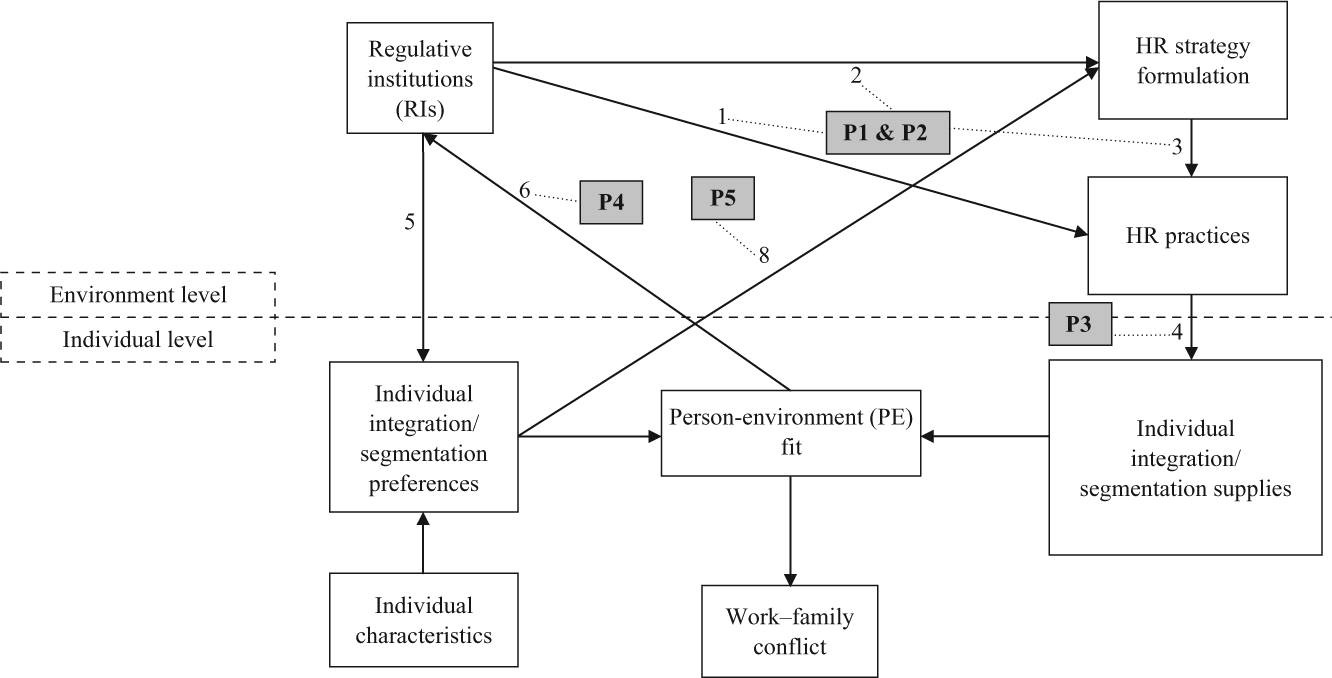
Theoretical model of the role of RIs in work–family boundary management.
RIs directly affect how organizations respond to employees’ work–family integration/segmentation preferences by requiring that organizations maintain specific HR practices (Line 1). RIs can mandate minimum standards for organizations’ HR practices. There is a wide variety of RI mandates that affect HR practices related to the work–family boundary. Such mandates include RIs that create maximum weekly working hours. Additionally, RIs can mandate the right to collective bargaining, allowing employees to bargain for practices at the organizational level. RI mandates can also include the right to paid sick leave or carer’s leave, and the right to request flexible schedules as in the UK and throughout the EU. RI mandates also include laws regulating overtime and vacation and paternal leave. These mandates are largely enforced through penalization of non-compliant organizations with fines and expensive remedies for affected employees.
Ultimately, these practices, though offered by the organization, are the direct result of RIs that require they be offered. Practices offered for the sole purpose of compliance will generally only meet the minimum standard required by the RI. This could be empirically tested by comparing the extent of practices with the rationale for their adoption. For example, a study of paid sick leave may assess the extent of paid sick leave offered and whether this paid sick leave is offered to attract new employees (i.e. has a strategic intent), or is offered to comply with the law. We should expect that organizations with a strategic intent will offer more paid sick leave than those with a compliance intent, given the same RI context.
This kind of test is possible because HR practices are not always created by organizations merely to comply with the law. HR practices can also be part of an organization’s HR strategy that is formulated with consideration of the external environment (Line 3) (Noe et al., 2012). The organizational boundary management literature identifies retention and recruitment as key strategic goals of work–family HR practices (Rau and Hyland, 2002). Given these goals, RIs also affect strategy formulation by creating a baseline or minimum for organizational work–family HR practices (Line 2).
The purpose of HR strategy is to create a sustainable organizational competitive advantage (Lado and Wilson, 1994). As described above, RIs establish minimum standards to which all organizations must adhere. To achieve competitive advantage and differentiate themselves from opponents in recruiting or retaining talented employees, organizations must go above and beyond these minimum standards. As a result, what might be considered a strategic HR practice in one context may hold no strategic value in another, and HR practices must be more extensive to hold strategic value in more extensively regulated institutional environments. As we argue in greater detail below, proper contextualization of the RI environment is therefore necessary for the correct interpretation of results relating to strategic value of HR practices; this argument could feasibly apply beyond HR practices focused on work–family role management to other benefits also commonly subjected to RIs such as healthcare or retirement.
Organizations can surpass minimum standards by offering more practices than the baseline standard requires or more generous versions of baseline practices. For example, in a weaker regulative institutional environment such as in the USA, an organization may be more easily able to gain a strategic advantage in recruiting or retention with relatively few additional work–family practices. The USA has no RIs with respect to vacation, so a generous vacation package might be a bigger factor in an individual’s employment decision compared with a country where all employers must offer a generous vacation package. The exact same practice can thus have strategic value in one context but not in another. As a result, we may expect to see competitive work–family HR strategies more frequently in contexts where RIs are fewer or less extensive.
More numerous and more expansive HR practices can provide additional strategic value, but again only if they go beyond the baseline established by the regulative institutional context. As such, HR strategy is formulated in a regulative institutional context and should be operationalized in comparison with its mandated baseline. To accomplish this, research should not assume a policy was strategically formulated without actually investigating whether the practice in fact surpasses the baseline established by RIs. For example, to measure the strategic value of a practice in a context where two weeks of paid vacation is mandated, researchers should measure the amount of paid vacation above two weeks. As a more general measure, one might simply indicate whether the practice goes beyond the mandate. Regardless, it is essential to understand the context of the practice to understand its purpose. Our discussion of the theoretical model to this point, and the relationships demonstrated by lines 1, 2 and 3 yield two propositions.
Proposition 1: Compliance-based organizational HR practices meet minimum regulative institutional requirements while strategy-based organizational HR practices exceed minimum regulative institutional requirements.
Proposition 2: In contexts with more extensive RIs, strategic HR practices will be less effective in generating competitive advantage.
Much of the lower portion of the model in Figure 1 has already been empirically established and involves the construct of PE fit. According to previous research, the organization can provide supplies that employees can use to either segment or, at the other end of the continuum, integrate work–family roles. Supplies are defined in this previous research as ‘aspects of the environment that may fulfill the person’s values’ (Edwards and Rothbard, 1999: 88) or ‘conditions and resources that enable a given level of segregation or integration’ (Kreiner, 2006: 486). The employee ‘fits’ with the environment when these supplies match his/her preference (Edwards and Rothbard, 1999; Kreiner, 2006).
The extant literature has not yet determined the mechanism through which supplies are generated by HR practices and has defined ‘supplies’ vaguely. Practices have been directly equated to supplies without considering the different ways practices might be utilized by employees. Indeed, there is no clear one-to-one mapping of practices to the ability to segment or integrate roles. For example, flextime could be thought of as either providing opportunities to segment or integrate (Rau and Hyland, 2002). Segmenters might use it to drop kids off at school and start work later (making the work boundary less permeable to family demands by completing family role demands before work), while integrators might use it to attend a school play during the day and stay at work later (giving the work role greater temporal flexibility). Similarly, leave may provide either integrating or segmenting opportunities. An employee may use leave to stay at home to care for a sick child, but could plausibly either put work demands aside, segmenting work from the family domain, or work from home simultaneously, integrating work into the family domain.
To address this issue, we argue that organizational practices, rather than being supplies in and of themselves, instead create opportunities for employees to extract their desired supplies from the environment (Line 4). While many environmental factors may contribute to supply opportunities (e.g. supervisor support) (Kreiner, 2006), we focus on HR practices as a formal source of integration/segmentation supply opportunities. Segmentation and integration supplies can be reconceptualized as an employee’s perception of his or her ability to segment or integrate work and family roles, respectively. This is consistent with how they have been measured in empirical studies (e.g. Kreiner, 2006). By similarly reconceptualizing HR practices as supply opportunities rather than directly as supplies, different employees may interpret and use the same formal practices in different ways and practices do not need to correspond one-to-one or even mostly with either segmenting or integrating supplies. An employee that generally prefers to segment work from family will extract segmentation supplies from HR practices and perceive a higher ability to segment than an integrator in the same context.
As mentioned above, fit is a matter of match between individuals’ integrating/segmenting preferences and integrating/segmenting supplies. Supplies are extracted from opportunities, which are created by organizational HR practices. But, because RIs affect organizational HR practices (as shown through lines 1, 2 and 3 in the model), they also have an indirect effect on supply opportunities, perceived supplies and ultimately fit. This indirect path from RIs to PE fit demonstrates how the environment beyond the organization plays a role in creating fit. Accounting for the institutional context expands our notion of what constitutes the relevant environment within the PE fit literature, which has been traditionally conceptualized too narrowly as the organization alone. We encourage those conducting PE fit studies to include and distinguish RIs in their measurement of environment. We discuss the implications of this inclusion for theory and practice in the next section.
PE fit has been linked to reduced work–family conflict and other desirable employee outcomes (Edwards and Rothbard, 1999; Kreiner, 2006). Our model includes both preference and supply aspects of fit in accordance with this research (Kreiner, 2006; Kristof, 1996) as well as pathways that demonstrate the role of RIs in establishing fit as described above, primarily indirectly by generating supply opportunities through organizational HR practices. The model also includes a link from individual characteristics to integration/segmentation preferences as suggested by previous studies, though these links are largely untested empirically. For example, Kossek et al. (1999) proposed that personality traits, gender, caregiving demands and resources, work context, and living arrangements would all play a role in an employee’s general tendency to use boundary integrating/segmenting strategies. We also include a link from RIs to integration/segmentation preferences (Line 5) to acknowledge that RIs can also create or alter socio-cultural norms, which may affect how individuals prefer to manage work–family roles, as suggested by early boundary theory research discussed above.
Considering PE fit, the reason why strategically formulated HR practices are less effective in more extensive RI contexts becomes clearer. In more extensive RI contexts, more employees can extract sufficient supplies from RI-mandated opportunities. If a potential employee is satisfied with the integration/segmentation supplies they can extract from opportunities provided by the regulative institutional environment, then he/she will have satisfactory fit within any legally compliant organization in that regulative institutional context. Greater variety and extensiveness of practices mandated by RIs mean a greater likelihood that an individual can extract satisfactory integration/segmentation supplies and achieve fit.
For example, parents are entitled to partially paid parental leave up to 36 months in France and Germany (Hegewisch and Gornick, 2008). The length of leave used will be determined by each individual employee’s integration/segmentation preference. Thus, in France and Germany all employees can achieve fit if their integration/segmentation preferences are met simply with a partially paid parental leave of 36 months or less. RIs both directly (through mandates on HR practices) and indirectly (through their effect on formulation of HR strategy) affect the opportunities for employees to extract integration/segmentation supplies. Lines 1, 2 and 3 resulted in Propositions 1 and 2, which showed how RIs could impact HR practices. Line 4 in the model shows that these practices are a source of individual integration/segmentation supplies. This relationship demonstrates how RIs are part of the ‘environment’ in PE fit. Thus, lines 1, 2, 3 and 4 together lead to Proposition 3.
Proposition 3: More varied and more extensive RIs are associated with a higher likelihood of PE fit.
Of course, RIs do not exist in a vacuum. They are informed by the people to whom they apply. This feedback mechanism is shown by Line 6. Employees with insufficient supply opportunities will seek to create them. When organizations do not create sufficient supply opportunities out of strategy, corporate social responsibility or compliance, aggregate PE fit may sink low enough to spark collective action to alter RIs and create additional mandates. As an example, there is currently a sizeable movement for paid sick leave in various regions of the USA. Presumably, employees in these areas believe that paid sick leave practices would allow them to extract their desired integration/segmentation supplies from their environment and provide better fit. Cities such as Milwaukee, Portland, Seattle and San Francisco have all recently adopted legislation mandating paid sick leave for certain employees.
This feedback mechanism occurs because employee integration/segmentation preferences are formed through a number of channels not directly related to RIs, including individual characteristics like family demands as discussed above. At the aggregate level, such preferences might result in collective action such as the paid sick leave movement. Broader demographic, economic and social trends may also be important contributors to the emergence of RIs. For example, the current movement for paid sick leave in the USA could be partially explained by increased labor force participation of women, aging of the workforce or a widening income gap and financial difficulties (Drago and Lovell, 2011). Indeed, women’s groups have pressured legislators to create or expand laws around paid sick leave and similar benefits (Greenhouse, 2005). Regardless of the cause, however, when individuals collectively cannot extract sufficient supplies from the environment, fit is lower in aggregate and they may pursue legislative reform. Line 6 in the model corresponds directly to Proposition 4.
Proposition 4: If aggregate employee integration/segmentation preferences are not being met by organizations (i.e. PE fit is low), employees will be more likely to seek supply opportunities through RIs.
Given the link between RIs and organizational HR strategies discussed above, there are many implications for these work–family campaigns, which are traceable through our model. Employers in cities that mandate paid sick days now meet the integration/segmentation preferences of more employees, as integration/segmentation supply opportunities are created by organizations via RIs. Offering paid sick days is also no longer as viable a recruitment strategy, as now it is the minimum standard to which organizations must adhere. Organizations wishing to compete through work–family policies must go beyond the minimum established by the local legislation or potential employees will not be more attracted to them. Additionally, any employees whose integration/segmentation preferences can be met solely by access to paid sick days are less likely to be influenced by an organization’s strategically motivated offering of flextime, as opposed to an employee whose preferences are not met solely by paid sick days. If better fit is possible, there will still be room for employers to use strategically formulated practices, but if the RI context allows for a generally high degree of fit then the strategic viability of practices is limited. When fit is generally low, employees may choose to coalesce their power and pressure legislators for more RI mandates.
Similarly, organizational HR strategies grounded in work–family practices can only be successful if they are informed by employee preferences, as they determine which work–family practices will provide a competitive advantage in recruitment and retention of talented employees. This is represented in the model by Line 8. Strategic advantage in recruitment and retention is only possible when an organization’s practices better meet the demands of the labor market than its competitors; in other words, when organizations respond to employee preferences that are not met by RIs through mandates. Thus, organizations attempting this type of HR strategy must develop practices that create supply opportunities to meet the preferences of their targeted workforce as effectively as possible. In less institutionally extensive contexts, gaps between a workforce’s preferences and supplies are likely to be higher on average, creating more room for organizations to step in with strategically motivated practices. In this way, the labor market’s aggregate integration/segmentation preferences can impact HR strategy formulation. Line 8 in the model shows this relationship and leads to Proposition 5.
Proposition 5: HR strategy formulation responds to collective labor market integration/segmentation preferences that are unmet by RIs.
Implications of institutional effects in previous research
Having shown the various ways that RIs affect the work–family interface, we next demonstrate the consequences and theoretical implications of omitting RIs in each of the three boundary theory literatures we introduced above (individual, organization and PE fit). Adding a discussion of regulative institutional effects to these three literature streams has several benefits. First, it accounts for contextual characteristics that affect the various ways individuals are able to manage their work–family boundaries. Second, it prevents misattribution of regulative institutional effects to other contextual factors such as HR strategy. Third, including institutions in the discussion can improve the accuracy and interpretation of future studies. Fourth, inclusion of regulative institutional forces in the discussion of boundary theory elucidates how the broad social forces discussed by Zerubavel (1993, 1996) and Nippert-Eng (1996) affect the work–family boundary and its management. We discuss these implications of the inclusion of RIs specifically in terms of each of the three previously identified literatures.
Individual work–family boundary management
Research at the individual level represents the majority of work–family boundary management studies. Much of this research is devoted to outcomes of particular work–family boundary management strategies. For example, Desrochers et al. (2005) give preliminary evidence that role blurring owing to integration was related to more work hours, role transitions and role conflict. Kossek et al. (2009) found that more integration led to more family-to-work conflict. Bulger et al. (2007) showed that boundary flexibility was generally associated with less role interference and permeability was associated with more interference.
A major implication of RIs for the individual level literature is that they can change how effectively individuals are able to act upon their integration/segmentation preferences; that is, to actually integrate or segment. Although this role enactment is not represented in our theoretical model, it has been shown in the individual level literature through the use of boundary management tactics. One study by Kreiner et al. (2006) qualitatively categorized the tensions and demands related to the work and family identities of priests, then identified various tactics they use to maintain their preferred work–family boundaries. For example, these authors describe the tactic of ‘controlling work time’ in which priests manipulated their use of time in managing work and family roles. These behavioral tactics may be likened to the use of integration/segmentation supplies extracted from organizational practices.
RIs are important contributors to an individual’s actual ability to behaviorally enact his/her existing boundary management preferences. They set minimum standards for employees’ ability to integrate and segment by granting additional supply opportunities through organizational mandates and raising the floor for strategically formulated practices. The Family Medical Leave Act in the USA gives employees greater ability to segment or integrate work–family roles. Employees could potentially take their leave and ignore work demands without penalty (i.e. segment) or use the leave and work from home, simultaneously meeting work and family demands (i.e. integrate). Similar policies in Europe provide more extensive and usable options by mandating that such leaves be paid (Hegewisch and Gornick, 2008). Additionally, these practices protect employees who use them to meet their preferences through legal penalties against organizations that fail to appropriately offer them. By granting employees more supply opportunities and protecting the extraction of supplies from these opportunities, RIs can create a pathway for employees to segment or integrate work and family domains.
Additionally, the individual literature lacks discussion of a mechanism through which employees can make major long-term changes in their ability to manage their work–family boundaries: feedback to RIs. Individuals can – and do – band together to change the legal framework in which they work, as seen in the numerous paid sick leave campaigns across US cities. Similarly, Australia’s recent paid parental leave legislation was championed by unions and women’s groups (Baird and Williamson, 2010). Boundary research has thus far focused mostly on how individuals act within the context of the opportunities created by their workplaces, but the broader institutional context also impacts how they act and should be considered as well.
Overall, RIs affect boundary characteristics and the ability to act on a particular boundary management preference. Researchers should be careful to discuss the institutional context in which their research takes place in order to interpret the results of their studies correctly. The baseline ability to enact boundary management tactics will vary across different RIs. These RIs can vary not only across countries, but also within country at the state or even local level. Sick leave practices discussed above can vary from city to city in the USA, and other institutional factors, such as union density, can vary from state to state. When researchers do not adequately consider these contextual factors, they may find themselves comparing employees with substantially different opportunities to integrate and/or segment, which may limit their ability to observe certain types of boundary tactics or increase the chance of observing others.
Organizational work–family boundary management
The organizational work–family boundary management literature applies boundary theory to the organizational level, attributing segmenting and integrating preferences not only to individuals but also to organizations in the form of a purposive response to assumed work–family preferences of employees. This organizational response occurs in the form of HR practices and can be either strategically formulated, most commonly to attract or retain a particular type of worker, or more generally formulated simply to help employees meet their preferences. We argue that often the regulative institutional environment is in fact driving the adoption of policies sometimes solely credited to an organization’s response or HR strategy formulation.
The idea that organizations respond to employee demands is well-established. Kanter (1977) identified two types of organizational responses to non-work roles, which Kirchmeyer (1995) expanded upon. The first response type is ‘separation,’ in which organizations assume no responsibility or concern for the management of employees’ non-work lives. Alternatively, organizations may respond to employees’ non-work preferences with ‘integration.’ With this response type, organizations recognize that work and non-work roles are necessarily interdependent and attempt to help employees manage them both. The Kirchmeyer study also adds a third response type, ‘respect,’ characterized by a non-paternalistic, mutual style of integration. Hall and Richter (1988) also discuss the importance of acknowledging the family lives of employees and suggest a number of more specific ways an organization can help ease work–family role transitions for employees through culture and policy, focusing on integration. These and other early studies (e.g. Orthner and Pittman, 1986) identified that organizations could have a profound effect on individual employees’ work–family boundary management.
But the notion of organizational response in boundary management literature has been taken too far; though organizations are understood to have such responses to workers’ needs, not every practice can be attributed to a strategic formulation or general response. Regulative institutional forces prevent organizations from undertaking certain practices (e.g. unpaid overtime) and mandate the offering of others (e.g. paid paternal leave). Such institutionally influenced policies cannot be attributed to HR strategy because they were not enacted at the will of the organization and may not provide strategic value. Similarly, an organization wishing to separate itself from employees’ family needs would still be required to offer practices compliant with RIs.
Given that organizational HR practices can result from a general organizational response, HR strategy or regulative institutional mandate, the problem with ignoring RIs becomes clearer. If the role of RIs is unaccounted for in analyses, individual outcomes may be falsely attributed to HR strategy or organizational response, when in reality the policy is driven by regulative mandate. For example, drawing conclusions about an organization’s work–family strategy based on the amount of paid leave it gives its employees may be misleading when a certain level of paid leave is legally mandated. This attribution can be especially problematic when studying multiple organizations in different parts of the world where such mandates vary widely. The exact same policy may mean vastly different things in different regulative institutional contexts. If the regulative institutional contexts of the firms being compared are not similar there is substantial risk of this misattribution.
While the consequences for omission of RIs from international comparative research are more severe, there are also implications for single-country studies because RIs can vary substantially at the state and even local level. The majority of such studies in this literature are US based, but those that have samples of organizations from multiple states or organizations operating in multiple states risk ignoring effects of RIs or confounding them with strategy. For example, 23 states have passed statutes that address the availability of flexible work arrangements for employees (Pitt-Catsouphes et al., 2009). Such statutes can remove legal obstacles to flexible work arrangements, provide a right to ask for them, create positive incentives for their use, set norms around their use, mandate particular outcomes, or mandate traditional benefits (Georgetown Law, 2006). They may apply to some sub-groups of employees but not others, complicating comparisons further. Other examples of US state-level policies include protections for workplace breastfeeding, leave for school involvement, paid family leave and dependent care tax assistance. Studies should at minimum discuss how these differences may impact results or preferably include controls for whether these policies are mandated when they are used as key variables. Even for those studies in which samples fall only in a single context, researchers must take care as generalizability to other regions and comparisons with other studies may not be prudent when the regulative institutional contexts are dissimilar.
For many organizational practices, not only is a contextual analysis absent, but it is also unclear whether the practice is actually intended to promote integration, segmentation, both, or in the case of a separation response, neither. Similarly, if organizations do create practices to encourage segmentation or integration, it is unclear if employees use them as intended. As we discuss above, most practices could potentially work both ways and are likely intended to provide employees with more opportunities. This creates a substantial measurement issue in that practices do not correspond with supplies.
Despite the lack of conceptual clarity, researchers have sometimes linked specific practices with specific individual integrating/segmenting preferences. For example, Rothbard et al. (2005) studied the effects of flextime as a segmenting policy and on-site day care as an integrating policy. However, despite this conceptualization these authors also acknowledge that flextime can be an integrating practice because it adds flexibility to the temporal boundary of work by allowing employees some control over when it starts or stops. Thus, in order to determine the degree to which HR practices affect the ability of employees to segment and integrate work–family roles, researchers should assess employee perceptions of whether they are able to segment or integrate based on the opportunities created by the practice. In other words, supplies should be measured distinctly from practices – at the individual level – and practices should not be classified as either segmenting or integrating.
Measures of practices should consider the rationale of the practice. For example, researchers might ask about both a regulative institutionally driven practice and an organization’s strategically formulated practice to determine from where in the environment employees are extracting their integration/segmentation supplies. If an organization finds that employees are extracting integration/segmentation supplies from opportunities created by RI-mandated practices rather than strategically formulated practices, the strategically formulated practices may not actually be contributing strategic value. Considering that the USA has no law requiring vacation but does offer unpaid family medical leave, in the USA such items might be ‘My ability to take paid vacation makes it easier to segment (integrate) my work and family roles,’ for a strategically formulated practice and ‘My ability to take unpaid time off to care for a sick family member makes it easier to segment (integrate) my work and family roles,’ for an institutionally mandated practice.
The meaning and use of practices can be easily misattributed to an HR strategy or response without consideration of the regulative institutional environment. For flextime to be considered a strategic practice, a study would need to either carefully examine how organizations differed in their offering of the practice or ask about the role of RIs in the formulation of the practice. If there is an institutionally mandated minimum standard for flextime, then organizations must offer more for the practice to add competitive advantage. A mandate also means that firms will offer flextime regardless of whether it aligns with their broader strategy or intended work–family response. Future studies, particularly those that cut across institutional boundaries, should be careful then to distinguish between practices resulting from regulative institutional mandates, organizational responses, and organizational HR strategies as a practice can mean something different from one regulative institutional context to the next. A study seeking to capture effects of strategy may not be assessing strategy at all, but rather RI compliance.
We can apply these ideas directly to previous empirical findings. Rau and Hyland (2002) examined whether flexibility practices could offer an organizational strategic advantage by testing whether job seekers’ role conflict was related to attraction to the organization based on several work–family practices offered. They found that there were slight differences in attraction based on practice and individual preference, and that organizations should consider their labor market in providing these practices. But, as discussed above, regulative institutional forces establish a minimum standard of available work–family practices and influence how individuals interpret organizational offers that meet or exceed the standard. Under the Family and Medical Leave Act (FMLA), larger organizations must, for example, provide unpaid sick leave to their employees in the USA. Simultaneously, it changes the meaning of what makes a sick leave practice strategic. Paid family sick leave in the USA may be a strategic advantage to hiring younger employees likely to have kids in the USA, but such a practice would not provide a strategic advantage in many European countries where paid sick leave is mandated. Furthermore, medical leave has less strategic value when competing with large employers for applicants, as all large employers will offer at least the FMLA-mandated minimum 12 weeks to eligible employees.
This creates range restriction. In regulative institutional contexts that grant employees many opportunities to extract integration/segmentation supplies from the environment, only those who have more extreme integration/segmentation preferences will be attracted to organizational work–family policies that go above the baseline mandate. Everyone else’s preferences will be met by the mandate and thus these preferences will play a smaller role in employment decisions. Where work–family practice has less room to effectively recruit and retain employees, scholars are less likely to see effects of its use. The ultimate result is that in more generous regulative institutional contexts, it will be harder to observe positive effects of an organizational work–family policy strategy for recruiting and retention and more practices will be compliance-driven.
While such range restriction and misattributions of effects may impact the results of empirical research, they are more likely to impact the interpretations of results. This is also the case in nearly all PE fit research in the work–family context, which aptly includes contextual forces but often limits the context to the organization without accounting for the effect of regulative institutional forces that might influence the organization’s HR practices. Given the relationship between RIs, organizational practices and an individual’s perceived integration/segmentation supplies, there are important implications for the PE fit literature as well.
Person-environment fit
PE fit is a broad concept that has been applied across many organizational research domains, including work–family boundary management. In boundary theory studies that utilize PE fit as a key construct, researchers typically examine the ability of the organization to match the employee’s desire for integration/segmentation, commonly within the framework of supplies and preferences (e.g. Kreiner, 2006). This is a logical step from the individual and organizational literatures; individuals have preferences to segment or integrate work–family roles and organizations may or may not adopt HR practices to help individuals meet these preferences. However, by combining aspects of these two literatures that themselves do not appropriately include RIs, the PE fit literature suffers from even more complicated issues.
Edwards and Rothbard (1999) measured the congruence between available supplies for segmentation (i.e. the degree to which the organization allows employees tosegment) and an individual’s values for segmentation (i.e. the strength of the employee’s preference for segmentation). They demonstrate that employee well-being is highest when the supply-value fit matches regardless of the direction. But how are employees getting these supplies? We have shown that regulative institutional forces mandate that organizations offer particular practices and thus contribute opportunities for employees to extract their desired supplies from the environment. A substantial portion of variation in fit may therefore be ascribed to variation in supply opportunities stemming from RI-mandated HR practices. This is particularly problematic for large sample comparative studies that are likely to encounter a wide variety of regulative institutional forces. But even smaller samples that cut across state lines or even include organizations of moderately different sizes are likely to encounter a variety of regulative institutional contexts. The proper sourcing of supplies is important because research suggests that employees’ attribution of policies can play a role in work-related attitudes (Nishii et al., 2008).
The importance of this issue can be seen in a study by Kreiner (2006) that prevents a more generalizeable interpretation of the results. In this study, the author measures PE fit as the interaction between an employee’s preference for segmenting work and home roles and his/her perception of the degree to which that segmentation is provided by the workplace. The study finds that fit was negatively related to work–home conflict and stress, and positively related to job satisfaction. But employees may experience greater changes in organization-targeted attitudes from practices correctly attributed to the organization than correctly attributed to the regulative environment. When researchers only ascribe practices to the organization, attitudes resulting from the broader environment may also be incorrectly ascribed to the organization leading to improper conclusions.
This omission also affects how we define the environment portion of PE fit. The incorrect attribution of work–family integration/segmentation supply sources may be problematic when using perceptual measures with the workplace as the frame of reference if the structure from which supplies are extracted is unclear to participants. Whereas the Kreiner (2006) study provides strong evidence that variance in segmentation supplies matters, we do not fully know the source of this variance, whether employees can accurately identify it, whether it affects important outcomes differently when it is attributed to different sources, or if the variance in supplies would be smaller in a more tightly regulated institutional context or larger in a sample that represented more regulative contexts.
Fit thus becomes an even more multi-level issue as environment spans well beyond the organization. Because of regulative institutional effects, employees under the same institutional coverage have the same baseline opportunities for integration/segmentation supplies. Studies like Edwards and Rothbard’s (1999), with a relatively narrow sample of university employees, have a limited ability to measure variation in employees’ perceived supplies because the sample shares a regulative institutional context and thus they all share a similar baseline level of supply opportunities. While this lack of variation makes the results of the study all the more impressive, it can only account for supply opportunities from strategically formulated practices. Any part of employees’ PE fit attributable to RIs is lost. There is thus an entire level of variation in fit that research has yet to adequately capture. Thus, in studies primarily in one RI context, only between-organization sources of variation in integration/segmentation supply opportunities such as practice quality, ease of use or accessibility can be examined. In cross-context studies, measures of employees’ perceptions of supplies sourced to an organizationally-determined practice confound strategically placed and institutionally mandated practices, leaving us with an incomplete picture of how supply opportunities are created and perceived, as well as how they relate to fit.
Overall, the consideration of regulative institutional factors expands upon the concept of environment in the PE fit literature. This expansion requires researchers to disaggregate the effects of organizational characteristics and institutional practices on individual fit. Accounting for RIs also reduces misattribution of results and increases the extent to which results can be accurately generalized.
Conclusion
We have explained how the broader inclusion of the regulative institutional context can significantly change how studies using boundary theory are conducted and interpreted. RIs can have important effects on organizational HR practices and affect how we examine both individuals and organizations in boundary theory research. We have shown that research has utilized boundary theory far too narrowly, resulting in substantial implications for the interpretation of empirical findings. Moreover, boundary theory in its current form assumes an institutional environment in an advanced stage of economic development and free from much legal regulation. This orientation risks international isolation as many developed and less-developed economies operate in a more regulated institutional environment. Similarly, RIs vary at even more local levels in institutionalized economies. Within the USA, RIs vary substantially from state to state and city to city. In order to have a broadly applicable boundary theory and be able to examine and compare boundary theory studies across contexts, regulative institutional forces must be considered.
We encourage future research to explore cultural institutions, or what Nippert-Eng (1996) refers to as internalized cultural images of home and work. These institutions also broadly influence how boundaries are constructed and interpreted, and they have serious implications for the potentially gendered nature of work–family practices across cultures. RIs are also likely influenced by cultural images of home and work through the feedback mechanisms from integration/segmentation preferences to RIs. For example, research suggests that RIs and their effects on HR practices may represent very different approaches to women in the workplace (Ely and Meyerson, 2000; Ely and Thomas, 1996). Further, organizations’ translation of RIs into integration/segmentation supplies may be influenced by local culture (Rapoport et al., 2002). The omission of contextual factors such as these in the application of boundary theory diminishes its ability to reflect the diversity of work environments seen across the world and limits our ability to compare them. Future research should also examine the interaction between family domain characteristics, RIs and individual preferences as family demands likely play an important role in how people manage work–family roles.
In an increasingly globalized world with a similarly increasingly globalized research agenda, consideration of institutional factors is vital. Without understanding the context in which a study is situated, we cannot assume that results of one study can generalize into other institutional contexts. We call for more richly contextualized cross-institutional research grounded in boundary theory at all levels from local to international. We have described a number of ways in which one key contextual factor – RIs – can impact other more commonly assessed variables and relationships in the work–family boundary literature. We have also described a number of ways in which RIs and related practices can be operationalized to be studied directly or aid in the interpretation of study results.
When empirical examination of RIs is difficult, researchers should at minimum provide a description of the regulative institutional context in which their sample sits to facilitate cross-contextual comparisons and better generalization and interpretation of results. Researchers should also take great care in attributing work–family practices to organizational strategy when they may in fact be institutionally driven by RIs. Similarly, researchers should be careful in fit studies to understand the institutional baseline to ensure that proper comparisons are being made and that there is room for fit to vary. Including the role of RIs and other broader social forces is necessary to understand the formation and management of work–family role boundaries.
Footnotes
Acknowledgements
We would like to thank Mark Roehling for his comments as well as seminar participants at the London School of Economics, who provided helpful feedback on a previous version of the paper.
Funding
This research received no specific grant from any funding agency in the public, commercial, or not-for-profit sectors.