



Abstract
To date, the role of employee perceptions of customers has largely been overlooked in the emotional labor literature, particularly in the area of customer power. In two studies, we first examined the relationships between perceptions of the customer (i.e. power and politeness), surface acting and job-related outcomes in a typical service context (a department store; Study 1) and then explored the generalizability of these findings to a health care service context (a nursing home; Study 2), in which customer–employee relationships, the emotional climate and customer behavior norms differ substantially. Survey results indicate that for department store employees, perceiving customers as having higher power was associated with more reported surface acting and that certain negative effects of surface acting were exacerbated by interacting with impolite customers. These results were not replicated in our sample of nursing home employees. Our research suggests that customer-related variables have an impact on surface acting strategies, both in terms of usage and its relationship to job-related outcomes in certain service contexts. Divergent findings across our two studies suggest that different service contexts may require different assumptions regarding surface acting, customer perceptions and outcomes.
Many employees respond to formal and/or informal demands of emotional expression in the workplace by manipulating their emotions and emotional expressions. Such efforts to modify emotions are known as emotional labor or emotion regulation (Grandey, 2000; Grandey et al., 2005; Hochschild, 1983; Wharton and Erickson, 1993). Employees in customer service industries are particularly prone to regulate their emotions (Grandey, 2000) and do so for a variety of reasons, such as a desire to engage in socially acceptable behaviors or to achieve desired outcomes tied to emotional displays (Kanfer and Kantrowitz, 2002).
As many types of service jobs are plagued with high turnover and emotional exhaustion (Bitner et al., 1990; Härtel et al., 2002), and employee satisfaction has been linked to customer satisfaction (see Brown and Lam, 2008 for a meta-analysis), it is important for organizations intent on retaining employees and customers to understand the potential sources of stress and dissatisfaction for service employees. Whereas much literature has focused on the effects of emotion regulation on employee stress and other work-related variables (e.g. Brotheridge and Grandey, 2002; Grandey, 2000; Morris and Feldman, 1996), research examining the specific influence of customer-related variables on these relationships remains sparse and has mainly explored the frequency of customer contact (Grandey and Brauburger, 2002). We propose to address this gap in the literature by examining the roles of employee perceptions of customers, namely perceived customer power and customer politeness, in the context of emotion regulation in the service industry. Figure 1 illustrates the hypothesized relationships, which will be discussed in the following sections.
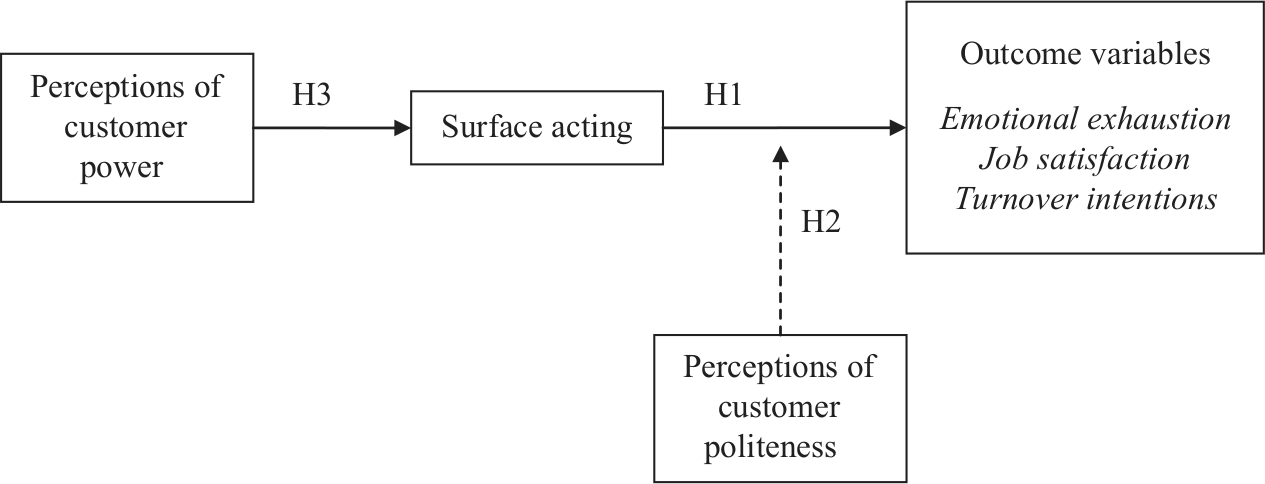
Illustration of hypotheses.
Surface acting
In many service occupations, organizations have expectations about the emotions that should be shown to customers, known as display rules. Generally, employees are expected to display positive emotions towards customers, even if these are not the emotions that they experience spontaneously (Rafaeli and Sutton, 1987; Spencer and Rupp, 2009). Surface acting is a type of emotion regulation that involves faking emotions, such as smiling or expressing cheerfulness, without changing the actual inner experience of the emotion (Beal et al., 2006; Hochschild, 1983). It reflects an inauthentic response to emotionally demanding situations (Grandey, 2000).
It has been argued that surface acting increases job-related strain owing to both the cognitive resources needed to self-monitor responses (Diefendorff and Gosserand, 2003; Goldberg and Grandey, 2007) and the emotional dissonance experienced between one’s expressions and one’s actual feelings (Morris and Feldman, 1996; Schaubroeck and Jones, 2000). Empirically, research has shown that the more employees report faking emotions with others, the more emotionally exhausted they feel (Goldberg and Grandey, 2007; Grandey, 2003; Martinez-Inigo et al., 2007).
Research examining surface acting and other job-related outcomes has also found other negative consequences of surface acting. Constantly controlling one’s emotions at work is difficult for the individual (Hochschild, 1983), and negative feelings stemming from that process may spread to more global evaluations (Beal et al., 2006), such as those related to one’s job. Specifically, faking positive emotions has been found to be related to lower job satisfaction (Grandey, 2003; Morris and Feldman, 1996), higher turnover intentions (Chau et al., 2009) and greater turnover (Goodwin et al., 2011). To summarize, previous research has hypothesized and found that employees who engage in surface acting (or behaviors similar to surface acting) feel more negatively about themselves, their jobs and their lives (Beal et al., 2006). Based on this research, we hypothesize the following as replications of previous findings:
Hypothesis 1a: The use of surface acting strategies will be positively associated with reported emotional exhaustion.
Hypothesis 1b: The use of surface acting strategies will be inversely associated with job satisfaction.
Hypothesis 1c: The use of surface acting strategies will be positively associated with intentions to turnover.
Customer politeness
The relationships between surface acting and negative job outcomes (lower satisfaction, greater turnover intentions, greater emotional exhaustion) stem from the negative effects of emotional dissonance and the extra cognitive resources used, which may increase or decrease depending on other customer-related variables. Dealing with a rude customer can be especially draining emotionally, as the contrast between felt and expressed emotions increases during an unpleasant interaction (Diefendorff and Gosserand, 2003; Goldberg and Grandey, 2007). Simulation studies conducted by Goldberg and Grandey (2007) and Rupp and Spencer (2006) suggest that interacting with impolite or hostile customers results in using similar or greater amounts of surface acting than interacting with polite customers. Given the greater emotional dissonance, engaging in surface acting strategies to act similarly positively with all customers will require more effort by employees when dealing with customers who are low on customer politeness (defined as the extent to which customers treat employees with dignity and respect), thus leading to greater emotional exhaustion in such situations. Grandey et al. (2004) found that call-center employees who reported encountering a greater number of impolite customers in a given day were also more likely to report emotional exhaustion, compared with employees who reported a lower number of such encounters. However, they did not examine the potential moderating effect of impolite encounters on the relationship between surface acting and outcomes, as we do in this study.
Interacting positively with hostile or impolite customers may also violate the norm for reciprocity (Gouldner, 1960), as one’s positive behaviors are not being responded to in kind. Customers typically reciprocate positive treatment in service encounters (Grandey, 2003; Pugh, 2001; Tsai, 2001), making rude customers a particularly salient violation of reciprocity norms for employees who are engaging in high amounts of surface acting. Further, feeling that one must act positively toward a customer who is rude may decrease one’s feelings of fairness concerning the process of emotion regulation at work (Grandey and Fisk, 2005; Leventhal, 1976). That is, when engaging in surface acting with an impolite customer, service employees are more likely to feel that they are not expressing their true emotions and are constrained by their work environment norms, which could lead to lower perceptions of fairness. Grandey and Fisk (2005) proposed that in situations where emotional display norms are viewed as reducing one’s control over one’s emotions, service employees will experience low service emotion rule fairness, which leads to increased job-related strain. Thus, the use of surface acting strategies with a rude customer may lead to significantly more negative job-related outcomes, exacerbated by the experienced violations of reciprocity and process fairness. Although Goldberg and Grandey (2007) did not find that employees were more emotionally exhausted when given specific instructions to display positive emotions (i.e. display rules), they did not specifically examine the interaction between compliance with those instructions through surface acting and customer hostility. Thus, we address the previously unexamined moderating role of perceived negative customer interactions (i.e. perceptions of customer impoliteness) on job-related outcomes and emotional exhaustion, predicting the following:
Hypothesis 2: Perceptions of customer politeness will moderate the relationship between surface acting and job-related outcomes (emotional exhaustion, satisfaction, turnover intentions), such that surface acting will have a stronger relationship to negative job outcomes (high emotional exhaustion, low satisfaction and high turnover intentions) when employees perceive their customers as being less, as opposed to more, polite.
Customer power
Perceptions of customers may also come into play when employees decide whether or not to engage in surface acting strategies. Not all employees display the same level of emotion regulation in a given occupation. Contextual, personal and interactional variables can influence the use of emotion regulation strategies (Diefendorff et al., 2005). Of particular interest in our research is how general perceptions employees have of their customer base can explain inter-individual differences in emotional displays (Rafaeli and Sutton, 1990), with perceived customer power being a potentially important perceptual variable in relating with customers.
It has been argued that individuals will emotionally regulate with others out of self-interest (Goffman, 1963). Specifically in a work setting, employees may choose to regulate emotions to meet work demands and thus obtain desired work-related outcomes (Grandey and Brauburger, 2002; Kanfer and Kantrowitz, 2002). Creating positive emotions in customers through emotional contagion (Hatfield and Cacioppo, 1994) is one avenue for meeting such work demands. Displaying positive emotions to customers can thus lead to the fulfillment of desired work-related outcomes such as positive performance evaluations (Pugh, 2001) and/or direct monetary benefits (Tidd and Lockard, 1978). Indeed, Diefendorff and Gosserand (2003) proposed a direct connection between the use of emotion regulation strategies and the attainment of higher-order work goals, such as meeting performance demands.
Researchers have suggested that employees use varying levels of emotion regulation depending on the perceived relative power of the target, defined by the relative authority the target has over the employee (Diefendorff and Greguras, 2009; Grandey et al., 2010; Hecht and LaFrance, 1998). Specifically, employees should display more positive emotions toward high-power individuals than toward low-power individuals, as the approval of high-power people is perceived as benefitting the employee professionally (Côté and Moskowitz, 2002). To illustrate, compared with co-workers, customers should be perceived as having relatively high power, as their interaction with the employee can have an effect on performance evaluations in many service jobs, which in turn can have a wide range of influence on work-related outcomes (Grandey et al., 2010). Whereas support for the influence of target power on emotion regulation has been mixed (Diefendorff and Greguras, 2009; Grandey et al., 2010; Hecht and LaFrance, 1998), previous studies did not measure perceptions of power directly, but rather inferred power based on target roles (i.e. supervisors, customers, coworkers), with customers considered to be high-power targets in studies conducted in the organizational context (Diefendorff and Greguras, 2009; Grandey et al., 2010). Thus, lack of consistent support for the effect of power on emotion regulation could be because of variations in perceptions of target power within organizational target categories. For example, two employees in the same organization may differ in their perceptions of how much power their customers have, even though customers are often considered high-power targets in organizational settings in the literature (e.g. Pfeffer and Fong, 2005). We propose to extend previous research on customer power by measuring employee perceptions of customer power explicitly, and predicting:
Hypothesis 3: Perceptions of customer power will be positively associated with reported use of surface acting strategies.
We conducted two studies in different organizational contexts to evaluate the validity of our hypotheses. The first study, conducted in the customer service context of a large department store, corresponds to a typical context for studying emotional labor examining reactions of employees who have direct sales-related contact with customers. In order to extend this line of research to other service industry contexts, Study 2, of a more exploratory nature, was conducted in a nursing home context by examining employees who have contact with residents who are the clients of these organizations. Following the presentation of Study 1, we explore the theoretical considerations in relation to the context examined in Study 2.
Study 1
Method
Participants
We collected data from one site of a large, national department store chain (N = 80; 68 women, 85%) in France. Specifically, we surveyed 56 sales people (70%), 20 cashiers (25%) and four sales managers (5%). Seventy-one percent of the employee participants worked full-time.
Procedure
All department store employees were asked to fill out a questionnaire voluntarily, in groups of two to three participants.
Measures
Customer-related variables
Participants answered four items assessing perceptions of customer power (α = .74), using a 1 (strongly disagree) to 5 (strongly agree) scale. Items concerned perceptions of the customer’s relative power at work (e.g. ‘While interacting with customers, I feel the customer has some authority over me’) and were adapted from Hall et al. (2002). Participants also responded to four items (α = .87) capturing perceptions of customer politeness (e.g. ‘In the past two weeks, to what extent did your customers treat you in a polite manner?’), on a 1 (to a small extent) to 5 (to a large extent) scale. These items were used by Rupp and Spencer (2006) and adapted from Colquitt’s (2001) items measuring interpersonal justice. The scales were translated into French by native French speakers, and back-translated into English by a native English speaker. This process resulted in minor modifications to the French scales to respect the meaning of the original English version questionnaires.
Surface acting
Using a 1 (never) to 5 (always) scale, participants answered five items (α = .74) concerning their typical amplification of positive emotions or typical use of surface acting at work (e.g. ‘When interacting with the public (customers), in the past two weeks, how often did you fake a good mood?’). Surface acting items were adapted from Grandey (2003). This scale had previously been used in a French version (Grandey et al., 2005), which we obtained for this study.
Job-related outcomes
Participants completed items concerning their experienced emotional exhaustion at work (e.g. ‘I feel emotionally drained from my work’), their job satisfaction (e.g. ‘All in all, I am satisfied with my job’) and their turnover intentions (e.g. ‘I would leave this job if I could’). The six emotional exhaustion items (α = .88), three job satisfaction items (α = .86) and three turnover intentions items (α = .87) all used a 1 (strongly disagree) to 5 scale (strongly agree). They were adapted from Cropanzano et al. (1993), Spector (1997) and Wharton (1993), respectively. These measures had previously been used in their French adaptations (Grandey et al., 2005), which we obtained for this study.
Job-related items
Participants were asked to indicate their job titles, the time status of their job (full-time or part-time), the number of hours worked per week, the amount of time they had worked for this particular employer and how many salaried employees there were at their particular workplace. See Appendix A for full scales from this study.
Results
We first tested for common method bias using a post-hoc exploratory factor analysis (EFA) method (Andersson and Bateman, 1997; Carlson and Kacmar, 2000). Although this method does not statistically control for potential method effects (Podsakoff et al., 2003), it can indicate if one underlying factor accounts for the majority of variance in the data or if several factors account for a significant amount of variance. For both Studies 1 and 2, an EFA including all participant response items (from the six constructs measured in these studies) indicated that several factors (six and seven, respectively) accounted for significant amounts of variance in the data and that no single factor accounted for a majority of variance in item responses.
Table 1 shows the inter-correlations of all variables. Hypotheses 1a–1c predicted relationships between surface acting and job-related outcomes (emotional exhaustion, job satisfaction, turnover intentions). The correlations in Table 1 indicate significant relationships between surface acting and the outcomes of emotional exhaustion (r = .35, p < .01), job satisfaction (r = –.24, p < .05) and turnover intentions (r = .34, p < .01), all in the hypothesized directions. These results support Hypotheses 1a–1c.
Study 1: Inter-correlations for department store employees (lowest N = 78).

p < .05; ** p < .01.
Hypothesis 2 predicted a significant interaction between surface acting and perceptions of customer politeness, such that employees would report more negative job-related outcomes when they engaged in surface acting with impolite customers. We therefore conducted moderated regressions to evaluate this interaction in predicting the job-related outcomes. Because full-time employees might be more subject to negative consequences from interactions with impolite customers, we used full-time versus part-time status as a control variable in these analyses. Thus, three separate hierarchical regressions tested the significance of full-time status as a control variable (Step 1), surface acting and customer politeness (Step 2), and the interaction of surface acting and customer politeness (Step 3) in predicting emotional exhaustion, job satisfaction and intentions to turnover. All non-dichotomous predictor variables used in the regression were standardized. In this study and in Study 2, we controlled for participants’ length of service, to allow for the possibility that longer serving employees become accustomed to the demands of surface acting. There were no notable effects on our hypothesized relationships when we controlled for this variable, which suggests that the results are robust (details are available from the authors).
Analyses (see Table 2) revealed a significant interaction of surface acting and politeness perceptions for both emotional exhaustion (ß = –.23, p < .05) and job satisfaction (ß = .26, p < .05), such that department store employees who reported low perceptions of customer politeness showed a stronger relationship between surface acting and each of these outcomes (see Figures 2 and 3). The interaction between surface acting and politeness perceptions was not significant with turnover intentions as the dependent variable. Thus, Hypothesis 2 was supported, for emotional exhaustion and job satisfaction but not for turnover intentions (see Table 2). 1
Hierarchical linear regression of job-related outcomes on hypothesized variables, department store employees, Study 1 (lowest N = 77).

p > .05; ** p > .01. All non-dichotomous variables were standardized.

Interaction between surface acting and customer politeness for job satisfaction for department store employees, Study 1.

Interaction between surface acting and customer politeness for emotional exhaustion for department store employees, Study 1.
Finally, Hypothesis 3 predicted that customer power would significantly relate to surface acting strategies. In support of the hypothesis, Table 1 shows that perceptions of customer power are significantly associated with reported surface acting (r = .36, p < .01).
Discussion
Results from Study 1 replicate past findings linking reported typical surface acting to job satisfaction and emotional exhaustion (e.g. Goldberg and Grandey, 2007; Grandey, 2003) and suggest that customer-related variables play a role in surface acting and its outcomes in this department store, service context. Specifically, analyses indicated that employees who perceive customers as having higher power engage more in surface acting on the job, and that certain negative effects of surface acting (i.e. lower job satisfaction, more emotional exhaustion) are exacerbated by interacting with impolite customers. This finding supports the idea that employees are motivated to surface act in order to obtain desired outcomes (Diefendorff and Greguras, 2009; Grandey et al., 2010; Hecht and LaFrance, 1998), as they were more inclined to fake emotions when they saw customers as powerful and thus potentially connected to desirable job-related outcomes (Grandey et al., 2010). This finding advances the literature on power and emotion regulation, as we directly measured and accounted for individual variation in perceptions of power, rather than inferring power from category memberships (e.g. customers vs co-workers) as has been done in past research.
The interaction between surface acting and perceptions of customer politeness in this department store context suggests that acting politely toward impolite customers can take a toll on employees, in terms of their job satisfaction and emotional exhaustion. This finding supports the idea of customer rudeness as experienced violations of reciprocity (Gouldner, 1960) and process fairness norms (Grandey and Fisk, 2005). That is, customers are perceived as failing to respond in kind to positive displays from the employee, and surface acting toward these impolite customers could be experienced as a loss of control over one’s actions. These negative outcomes of surface acting, augmented by perceptions of customer impoliteness, could have far-reaching effects on the customer–employee relationship and the organization. Specifically, employee reactions to perceived mistreatment from customers can lead to subsequent service performance deficits (for that customer and/or other customers), which in turn lead to negative reactions from customers and further perceived mistreatment, creating a negative exchange spiral (Groth and Grandey, 2012). Future research using a dyadic methodology would help illuminate the interactive and ongoing relationship between perceived customer treatment of employees and their negative reactions and job-related outcomes.
Study 2
To extend the potential generalizability of the results obtained in the typical, employee–customer interaction of a department store, in Study 2 we examined the relationships among the same variables in the health care service context of nursing homes. Indeed, the health care industry needs highly-qualified individuals and is often characterized by high turnover rates (Diefendorff et al., 2011), necessitating further research to explain how perceptions of customers/clients and emotion regulation may be linked to negative outcomes in this context. Although much of the research on emotion regulation has used occupations involving one-time, low-involvement interactions between employees and customers, such as call center operators (Goldberg and Grandey, 2007; Grandey et al., 2004; Holman et al., 2002; Rupp and Spencer, 2006), bank tellers (Pugh, 2001) and retail workers (Rafaeli and Sutton, 1990), a growing area of emotion regulation research has focused on ongoing service interactions, such as those between health care providers and their clients (e.g. Diefendorff et al., 2011; Hayward and Tuckey, 2011; Seery and Corrigall, 2009). However, none of these studies has examined the role of customer power on surface acting or the interaction between surface acting and customer politeness in relation to work-related outcomes. The typical characteristics of a health care work environment suggest that certain relationships between surface acting and outcomes will mirror those of more typical service settings, whereas other relationships may differ because of the unique characteristics of this particular service context.
In terms of similarities, one would expect surface acting to be exhausting for all service employees, including health care employees. In fact, Seery and Corrigall (2009) found that for a sample of nurses, surface acting related to lower job satisfaction, higher turnover intentions and greater emotional exhaustion. However, health care contexts are typically more emotionally demanding than other service environments, as health care providers encounter ill patients, anxious families and other stressors on a daily basis (Grandey et al., 2012). This may make surface acting toward impolite or hostile clients uniquely difficult (and exhausting) for health care providers, as they are already cognitively and emotionally strained by various aspects of their work.
Health care contexts are also unique in that they can be described as more closed systems than traditional service contexts, such as the department store examined in Study 1. Foxall and Greenley (1999) distinguish service environments in terms of the openness of the ‘customer behavior settings’. In an open system, customers are in control of the service interaction and there is little to no structure imposed on the interaction. For example, the department store examined in Study 1 could be described as an open system. Customers can come in, browse and leave as they please. They can approach an employee for help or wait to be approached. A nursing home, on the other hand, is better described as a closed system for customers. There is more structure to interactions (i.e. meals and check-ups are routine and occur at specific times), meaning the organization and the service provider generally hold more power (and the customer less power) than they would in a more open system. A closed system may alleviate some of the stress of surface acting with an impolite individual, because the interactions are more structured and employees know when they will have to deal with a difficult customer/client next.
Health care contexts are also distinct from typical service environments in that they are more likely to be service relationships environments rather than service encounters environments. Gutek (1995) distinguished between customer service occupations that typically involve service encounters (i.e. service encounter systems), in which customers and employees are usually strangers and have a one-time service interaction, from those that typically involve service relationships (i.e. service relationship systems), in which customers and employees have ongoing, frequent interactions and expect to see one another in the future. This difference in degree of familiarity and expectation of future interaction may affect the way in which employees respond to customers. That is, employees in service relationships have more time to get to know their customers/clients and can respond to them based on their idiosyncratic needs rather than employing surface acting tactics by default (Gutek, 1995). It is important to note that certain health care contexts may involve service encounters (e.g. an emergency room); however, health care is a service industry in which clients are more likely to see their service provider as someone with whom they have an ongoing relationship (Gutek et al., 1999). Further, the specific health care context examined in Study 2 (nursing home) is characterized by ongoing interactions between employees and customers or residents, as residents stay in the nursing homes for months or years.
These features of typical health care environments suggest that examining surface acting in health care may require some modifications in our assumptions. However, this environment constitutes a service context (i.e. involves interactions with customers/clients of the organization), and past studies have replicated emotion regulation findings (that used typical service employees) with health care employees (e.g. Diefendorff et al., 2011; Seery and Corrigall, 2009). Therefore, we wish to explore the generalizability of all Study 1 hypothesized relationships to this different service context:
Research Question: What are the relationships between surface acting, customer perceptions (power and politeness,) and outcomes (job satisfaction, turnover intentions and emotional exhaustion) in a health care service context?
Method
Participants
Nursing home employees (N = 89; 76 women, 85.4%) of six different nursing homes (four public and two private) situated in the same region of Southern France as the department store of Study 1 were solicited for our data collection. Employees in our sample represented eight different job types within the organizations, all of which involved regular and frequent contact with nursing home residents. Specifically we collected surveys from 39 nurse’s aides or functional equivalents (43.8%), 21 cleaning staff members (23.6%), 21 employees who chose not to identify their job type (23.6%), three nurses (3.4%), three receptionists (3.4%), one laundry worker (1.1%) and one coordinator (1.1%). 2 Eighty-seven percent of nursing home employee participants worked full-time.
Procedure
Employees were asked to fill out a questionnaire voluntarily, either in groups or individually, depending on the data collecting arrangements permitted by the particular nursing home.
Measures
Participants responded to the same items used in Study 1 concerning customer power (α = .72), customer politeness (α = .87), surface acting (α = .66), emotional exhaustion (α = .90), job satisfaction (α = .56), turnover intentions (α = .73) and job-related items. To fit this service encounters context, the term ‘customers’ was replaced by ‘residents’ in the formulations of the items.
Results
Table 3 displays comparisons of the means, standard deviations and t-test/χ2 difference results of all measured and demographic variables between the samples of the two studies (Study 1, department store; Study 2, nursing homes). We did not test for differences in hours worked between job types, as almost half of the nursing home employees (N = 40) did not respond to that item. These two job context samples differed significantly on two variables present in our hypotheses and on one demographic variable. Specifically, department store employees reported engaging in more surface acting (M = 2.63) than did nursing home employees (M = 2.04), and department store employees reported greater turnover intentions (M = 2.62) than did nursing home employees (M = 2.25). Department store employees were also significantly less likely to be full-time employees (M = .71) than were nursing home employees (M = .93). Thus, we controlled for full-time status in the regression analyses for both studies.
Variable comparisons by job type.

p < .05; ** p < .01.
Full-time work: 0 = part-time, 1 = full-time. M = Mean; SD = Standard deviation.
Lowest N = 78 (department store), 80 (nursing home).
Table 4 presents the inter-correlations among all variables for the nursing home sample. For these employees, surface acting was not significantly related to any of the job-related outcomes, failing to support Hypotheses 1a–1c. As with the sample in Study 1, three separate hierarchical regressions tested the significance of full-time status as a control variable (Step 1), surface acting and customer politeness (Step 2), and their interaction (Step 3) on emotional exhaustion, job satisfaction and intentions to turnover (see Table 5). All non-dichotomous predictor variables used in the regression were standardized. For the nursing home employees, Hypothesis 2 was not supported. There were no significant interactions between surface acting and customer politeness perceptions for any of the three job-related outcomes, although politeness perceptions were significantly related to lower emotional exhaustion (ß = –.44, p < .01) and higher job satisfaction (ß = .36, p < .01). Hypothesis 3 was also not supported, as perceptions of customer power were not significantly correlated with surface acting.
Study 2: Inter-correlations for nursing home employees (lowest N = 77).

p < .05; ** p < .01.
Sex: 0 = female, 1 = male.
Full-time status: 0 = part-time, 1 = full-time.
Hierarchical linear regression of job-related outcomes on hypothesized variables, nursing home employees, Study 2 (lowest N = 74).

p > .05; ** p > .01. All non-dichotomous variables were standardized.
General discussion
Although many of our hypotheses were supported in the department store context in Study 1, none was supported in the nursing home context in Study 2. Customer power and customer politeness did not play a role in surface acting and its relations to outcomes for nursing home employees, and even our replication hypotheses associating surface acting with negative job-related outcomes were not supported by the nursing home data.
There are several potential explanations for why these relationships found with department store employees did not hold for nursing home employees. First, other emotionally-demanding aspects of this type of job (Grandey et al., 2012) may be masking any effects of surface acting on work-related outcomes. Thus, in a lower-intensity work context, interactions with customers may be a great source of stress, but in a context in which there are many other (perhaps larger) demands on one’s emotions (such as patient illness and death), surface acting and customer politeness may be relatively small contributors to one’s feelings of burnout, satisfaction and turnover.
Second, the relatively closed system (Foxall and Greenley, 1999) in the nursing home context may have reduced the effects of surface acting in dealing with impolite customers. Employees in a nursing home encounter have more knowledge as to when and for how long they will have to interact with certain customers (residents), and perhaps they can prepare themselves beforehand. For department store employees, the relatively open system creates an environment in which the employee will typically have no warning that their next customer interaction will be an unpleasant one. That is not to say that there are no unanticipated negative interactions with residents in a nursing home atmosphere but rather that, compared with a department store, employees in a nursing home have had frequent interactions with their customers and likely have a better understanding of the full range of emotional responses that may come from a specific individual.
This second point also relates to a final potential explanation, pertaining to the service encounters–relationships distinction. Owing to increased familiarity with customers, nursing home employees may have easily accessible surface acting strategies for dealing with impolite individuals, thus making interactions less stressful and less dissatisfying, as opposed to the experiences of department store employees, who are not as familiar with their customers. Further, occupations differ in terms of the level of autonomy granted to employees (Morgeson et al., 2010), suggesting that employees in certain occupations may engage in more autonomous emotional expression, as opposed to regulated emotional expression (Vincent, 2011). As discussed by Bélanger and Edwards (2013), it may not even be possible to standardize certain types of health care work given individual patient needs, necessitating a certain level of autonomy. Just as it has been suggested that more autonomous national cultures relate to freer emotional expression of employees in those cultures (Grandey et al., 2010), perhaps the familiarity with customers in service relationships occupations and the relative autonomy of health care work allows for expression of felt emotions and feeling in control of one’s emotions, even if customers are perceived to be powerful. In fact, our nursing home sample did report engaging in significantly less surface acting than did the department store sample, suggesting that their emotions at work are more autonomous and less regulated (Vincent, 2011). It is important to note, however, that health care work can differ in terms of the amount of management regulation and autonomy granted to employees, with larger health care contexts instituting regulations that may restrict some autonomy of workers (Bélanger and Edwards, 2013).
Potential limitations and future directions
These studies and samples are characterized by several limitations. Without being able to isolate specific distinctions between the two contexts (e.g. open vs closed system) while controlling for other contextual differences, we can only speculate as to why the proposed relationships were significant for department store employees but not for nursing home employees. Overall, however, our findings emphasize the problems of over-generalizing emotion regulation findings in the ‘service industry’ that may be missing the unique experiences of service industry employees in health care contexts or other less transaction-oriented service environments. Future research examining one specific type of service context with varying levels of openness, relationships and/or emotional climates, would help in discerning the specific aspects of this context that may necessitate changes in assumptions about surface acting and its related outcomes.
It could be argued that using a nursing home is not truly a service context and differs in too many ways from the typical types of service jobs examined in the emotion regulation literature (e.g. Goldberg and Grandey, 2007; Grandey et al., 2004; Holman et al., 2002; Pugh, 2001; Rafaeli and Sutton, 1990; Rupp and Spencer, 2006). However, nursing homes are a service industry, and employees must interact closely with the residents who are their customers, and these interactions involve a variety of emotional displays by employees toward these customers. As stated earlier, we see the inclusion of their data as an illustration of issues related to certain service contexts that may not be properly addressed by the current literature.
Another potential limitation of our sample is its gender composition. Both job contexts had a larger proportion of female as opposed to male employees. Past research suggests that women engage in emotion regulation more than men, possibly owing to factors stemming from gender-based socialization (Hochschild, 1983; Morris and Feldman, 1996; Rafaeli, 1989). Whereas a female-dominant sample could potentially affect generalizability in our overall findings, it is not a probable explanation for the differential findings between our job sites, as the nursing home and department store were similar in gender composition.
Another potential limitation concerns our measure of customer power. We used a measure adapted from Hall et al. (2002), which asked about one’s general feelings of power over one’s customers (e.g. when interacting with customers, I feel powerless), but we did not assess the felt source of one’s power. Therefore, our significant customer power findings for department store employees may reflect perceptions of customer reward power (i.e. perceived ability to give or take away tangible benefits), customer referent power (i.e. personal admiration) or another type of power (e.g. expert, legitimate: French and Raven, 1959). As such, our inferences from the department store concern general perceptions of power, but do not speak to specific types of power and their potentially unique effects on surface acting.
The internal consistency of our measure of satisfaction was at an unacceptable level for the nursing home sample (α = .56), limiting our ability to make inferences from the non-significant findings for this dependent variable. However, it is important to note that the emotional exhaustion dependent variable demonstrated good internal consistency (α = .90) in the nursing home sample and also resulted in non-significant findings for this sample. Further, the low reliability of the satisfaction measure would attenuate its relationships with other variables. In the nursing home sample, the relationship between surface acting and satisfaction is so low (.04) that it is unlikely that a more reliable measure would increase the magnitude of this relationship to a meaningful level.
The same-source and self-report nature of both study samples creates the potential for common method bias. However, the focus of interest in these studies is employee perceptions, which are essential to understanding how the customer might influence surface acting and outcomes. Indeed, employees within each study did vary on their perceptions of customers, meaning that categorizing customers as more or less powerful (rather than using employee perceptions of customers) would have missed meaningful differences in perceptions between employees. Further, the presence of interaction effects in Study 1 argues against common method bias. Lastly, our test of common method bias (see Results section) did not support a single factor explanation for variance in the data. Although inferences made from this study would be strengthened with a longitudinal method, we feel that common method bias is not a pervasive concern for these particular samples.
We also used a two-week timeframe for the surface acting and customer politeness variables, but a current timeframe for the customer power variable. We felt this was appropriate for the construct of power, as it is typically conceptualized as a relatively stable construct in this literature (e.g. Diefendorff and Greguras, 2009; Grandey et al., 2010). However, it should be noted that there could be events specific to this timeframe that affect responses to the time-referenced variables and those to the general timeframe variables to a different extent.
Lastly, this study was conducted using French employees. As with any study using data collected from a single country, characteristics of the specific culture can limit generalizability to other cultures. France is thought to be a culture particularly averse to non-genuine emotional displays (Grandey et al., 2005). It has been suggested that, unlike United States employees, where the ‘service with a smile’ culture dominates and institutional norms for surface acting are particularly high (Goldberg and Grandey, 2007), French employees tend to feel more ownership over their emotions and are more likely to choose to engage in emotion regulation to achieve their own personal goals, rather than follow organizational display rules (Grandey et al., 2005). Thus, the hypothesized negative effect of surface acting with impolite customers may be stronger in countries with a stronger norm for surface acting. Nonetheless, the results we found for the department store employees are highly consistent with those based on studies conducted elsewhere, and notably within North America. The contextual factors studied may therefore be robust across many cultures, with effects being potentially stronger in places likes the US, where emotional display norms are stronger. Future research examining perceptions of customers and emotion regulation cross-culturally will help expand our knowledge of cultural moderators on these relationships.
Conclusion
The goal of this study was to examine the relationships between customer-related variables, surface acting and job-related outcomes. In our studies examining two different service contexts, we found very dissimilar findings, suggesting that the service industry is complex and context-dependent. In the more traditional service context (a department store), our findings suggest that the customer does indeed play a role in the engagement in and effects of surface acting strategies, through both perceptions of customer power and perceptions of customer politeness.
Footnotes
Appendix A. Scales (English translation)
Acknowledgements
We are grateful to Jonathan Provvidenza and Erica Trape for their data collection efforts.
Funding
This research received no specific grant from any funding agency in the public, commercial or not-for-profit sectors.