



Abstract
Findings from prior research on the relationship between functional diversity and team innovation have been inconclusive. This study aims to reconcile the mixed findings in the literature by investigating how functional diversity may influence team innovation and when such influence may or may not occur. The view of teams as information processors suggests that functionally diverse teams may capitalize on their knowledge benefits to produce innovations through knowledge sharing. However, knowledge sharing and subsequent team innovation do not necessarily occur in functionally diverse teams. Drawing on the motivated information processing in groups theory, we propose that affect-based trust in a team moderates the effects of functional diversity on team innovation (via knowledge sharing). The results based on a sample of 96 research and development teams indicate that functional diversity had a negative indirect relationship with team innovation via knowledge sharing when affect-based trust in a team was low, and this relationship became less negative as the level of affect-based trust in a team increased. The relationship was not significant when affect-based trust in a team was high.
Keywords
To compete in the uncertain and competitive business environment, corporations often rely on teams for innovation (Anderson et al., 1992), defined as the development and implementation of novel and useful ideas (West and Farr, 1990). Given the importance of team innovation, numerous studies have examined it as an outcome variable (see the meta-analytic reviews by De Dreu and Weingart, 2003; Hülsheger et al., 2009). Corporations, in particular, are increasingly using functionally diverse teams for innovation (West and Farr, 1990). Functional diversity can be defined as the degree to which team members differ in terms of their experience with a function ‘in which they have spent the greater part of their career’ (Bunderson and Sutcliffe, 2002: 878). Embedded in such teams is a diverse set of task-related expertise that serves as a potential source of knowledge (Bantel and Jackson, 1989; Tziner and Eden, 1985) that increases team innovation (Amabile, 1988; Milliken et al., 2003; West and Richter, 2008). However, research findings on the relationship between functional diversity and team innovation remain inconclusive. Some studies have found a positive relationship (Ancona and Caldwell, 1992; Bantel and Jackson, 1989; Bell et al., 2011; Drach-Zahavy and Somech, 2001), whereas others have found a negative (Keller, 2001) or no relationship (Sethi et al., 2001; Somech, 2006). Overall, there is a need to better understand how and when functional diversity may influence team innovation.
Teams can be viewed as information processors (Hinsz et al., 1997). The knowledge benefits that reside in a functionally diverse team may be realized to facilitate team innovation through an information-based mechanism (e.g. Buyl et al., 2011; Drach-Zahavy and Somech, 2001; Hoever et al., 2012; Somech, 2006). Some studies have provided support for this positive relationship between functional diversity and the information-based mechanism (Drach-Zahavy and Somech, 2001). However, other studies have found a negative (Bunderson and Sutcliffe, 2002) or no relationship (Buyl et al., 2011; Cummings, 2004; Hoever et al., 2012; Somech, 2006). Indeed, it has been well supported in the work team diversity literature that members in functionally diverse teams do not necessarily engage in information sharing behavior owing to risk concerns and intergroup bias (Van Knippenberg et al., 2004). A key question is thus to understand when the information-based mechanism may or may not work in the relationship between functional diversity and team innovation. In this study, we examine knowledge sharing – defined as the sharing of information, expertise, ideas and perspectives among team members (Cummings, 2004; Wah et al., 2007) – as such a mechanism, because it is essential to the different conceptions of the information-based mechanism in the literature, such as information exchange and information elaboration.
To address the ‘when’ question, researchers have examined several boundary conditions that are primarily cognitive in nature (e.g. Hoever et al., 2012; Somech, 2006). For example, Hoever et al. (2012) examined perspective taking as a boundary condition on the effect that diversity in perspectives exerts on team creativity via the information-based mechanism. Other approaches, particularly those that are socio-emotional in nature (Hinsz et al., 1997), have received scant attention. There are two potential exceptions. Peters and Karren (2009) found that trust moderated the relationship between functional diversity and team performance, while Buyl et al. (2011) suggested that interpersonal trust influences the effects of functional diversity on knowledge sharing and subsequent firm financial performance. However, the former did not examine the mechanism underlying the relationship and the latter did not empirically test the suggestion. Neither study referred specifically to affect-based trust, nor examined team innovation as the outcome. Overall, there is limited understanding of the boundary conditions of the information mechanism linking functional diversity and team innovation from the affective perspective.
Guided by motivated information processing in groups (MIP-G) theory (De Dreu et al., 2008; Nijstad and De Dreu, 2012), we theorize and test affect-based trust in a team (i.e. a shared perception of emotional bonds among team members) as a boundary condition. In essence, we propose that the affect-based trust relationship among team members buffers their concerns about sharing knowledge and motivates cooperative interactions in functionally diverse teams. Affect-based trust is defined as the emotional bonds between a trustor and a trustee (McAllister, 1995). It ‘reflects a strong sense of rapport and a desire to work together’ (Ilgen et al., 2005: 527) and focuses on the motivation to engage in cooperative and risk-taking behavior (Colquitt et al., 2007). MIP-G theory suggests that contextual factors that promote cooperative interactions among team members (e.g. cooperative reward system) may trigger team members’ prosocial motivation (i.e. the desire to achieve collective goals), driving them to consider others’ views and ideas (De Dreu et al., 2008) and thus enhancing their sharing of knowledge. We propose that affect-based trust in a team is a potential trigger for prosocial motivation because affect-based trust has been found to motivate cooperative interactions (McAllister, 1995). We suggest that functional diversity impedes team innovation when the level of affect-based trust is lower because functionally diverse team members are less likely to share knowledge. As the level of trust increases, the relationship between functional diversity and team innovation (via knowledge sharing) becomes less negative.
This study contributes to research on functional diversity and team innovation by extending the current focus on the cognitive to the affective boundary conditions. There has been increasing interest in how affective factors might influence information-related processes in teams (Gong et al., 2012; Hinsz et al., 1997). By examining the affect-based trust that motivates cooperative behavior among team members, this study paints a more complete picture of when team members are more motivated to share knowledge in functionally diverse teams. Doing so also answers the call to integrate cognitive and affective approaches to understand creative outcomes in work teams (Zhou and Shalley, 2011). Functional diversity brings cognitive (knowledge) resources to the team. Affect-based trust in a team motivates members to share knowledge for collective benefits. They jointly influence knowledge sharing and thus team innovation. Finally, this study contributes to the much-needed research on the boundary conditions of the functional diversity–knowledge sharing relationship (Mannix and Neale, 2005; Phillips et al., 2004). The inconsistent research findings concerning the effects of functional diversity on knowledge sharing (Bunderson and Sutcliffe, 2002; Cummings, 2004) suggest the existence of moderators (Van Knippenberg and Schnippers, 2007). This study reveals affect-based trust in a team as one such moderator.
Theory and hypotheses
Motivated information processing in groups theory
Motivated information processing in groups (MIP-G) theory (De Dreu et al., 2008; Nijstad and De Dreu, 2012) suggests that information sharing in teams is a motivated form of behavior. The theory postulates that individuals are driven by epistemic and social motivation when they engage in information sharing in teams. It is applicable to team tasks that require and provide opportunities for knowledge sharing (Nijstad and De Dreu, 2012), such as team innovation (De Dreu et al., 2011). Epistemic motivation is defined as the eagerness to spend effort on the acquisition of abundant, comprehensive and precise information about a task or problem (Nijstad and De Dreu, 2012). According to MIP-G theory, such motivation drives information search and sharing (De Dreu, 2007; De Dreu et al., 2008). Diversity in a team (Nijstad and Kaps, 2008; Schulz-Hardt et al., 2006), such as functional diversity (De Dreu et al., 2011), can potentially trigger epistemic motivation because team members are likely to be curious about new information when they encounter different ideas and perspectives in a diverse team (De Dreu et al., 2011).
The theory also suggests that individuals are driven by a mixture of prosocial and pro-self motives. The former directs a person’s attention to collective outcomes and fairness (De Dreu et al., 2008), whereas the latter directs a person’s attention to personal interests and thus motivates the person to ignore the inputs or preferences of others (Nijstad and De Dreu, 2012). ‘Compared with pro-self group members, prosocial group members are more likely to input information conductive to group goals and collective functioning, they are more likely to disseminate information in an accurate way, and they are less likely to spin information conducive to personal goals and preferences, to strategically withhold information, and to engage in lying and deception’ (De Dreu et al., 2008: 38). The higher team members’ pro-self motivation, the more their informational efforts will be aimed at achieving personal outcomes, which may harm team performance (Nijstad and De Dreu, 2012). When team members are high in prosocial motivation, their effortful informational behavior will be used to achieve collective success, leading to enhanced team performance (Nijstad and De Dreu, 2012). Situational cues that promote cooperation (e.g. a team-based reward scheme; Bechtoldt et al., 2010) are potential triggers for prosocial motivation. Accumulated research evidence from lab experiments (see De Dreu et al., 2008; Nijstad and De Dreu, 2012 for thorough reviews) and a recent field study (Hu and Liden, 2015) provide support for the theory.
Functional diversity and team innovation: Knowledge sharing as a mediator
Corporate research and development (R&D) projects are often knowledge intensive and require diverse expertise owing to the complex, non-routine and developmental nature of the tasks (West, 2002). It has been suggested that the diverse body of knowledge associated with functional diversity can potentially benefit team innovation in R&D projects (Amabile, 1988; Milliken et al., 2003; Taylor and Greve, 2006). Team innovation requires the generation of novel ideas about products, services or processes (Amabile, 1988; West, 2002). The diverse body of knowledge associated with functional diversity provides the cognitive (knowledge) resources for team innovation (Amabile, 1988; Milliken et al., 2003; Taylor and Greve, 2006). A team with functionally diverse members can potentially benefit from its diverse pool of knowledge, skills and information by sharing and combining them to generate novel ideas (Somech and Drach-Zahavy, 2013). Groupthink is less likely to be a problem in such teams because members are exposed to different experiences and perspectives that may challenge their own (Sethi et al., 2001). Nevertheless, we do not expect a direct positive relationship between functional diversity and team innovation. Individual team members are the repositories of knowledge (Walsh and Ungson, 1991). They need to engage in knowledge sharing so that the team as a whole can capitalize on the knowledge resources (associated with functional diversity) for team innovation. Therefore, we propose that knowledge sharing is a potential mechanism through which functional diversity influences team innovation.
Specifically, we suggest that knowledge sharing is a mechanism that helps to realize the knowledge benefits of functional diversity for team innovation because functionally diverse team members can acquire information, know-how and perspectives from each other through knowledge sharing. The diverse knowledge resources may then contribute to the cross-fertilization of ideas (Hülsheger et al., 2009; Perry-Smith, 2006). The process of knowledge sharing, beyond the knowledge itself, may benefit idea generation by facilitating problem identification, which is the initial step in the creative process (Amabile, 1996). Team members with different functional backgrounds may identify various problems. The process of knowledge sharing allows them to discuss those problems, develop a common understanding of which of them should be worked on and identify opportunities for improvement. They may also develop alternative approaches to solve the target problem(s). Projects developed by teams in which the members openly exchange and constructively challenge each other’s ideas achieve higher scores for creativity (Amabile et al., 1996).
Team innovation also involves turning novel ideas into actual products or processes. When multiple novel ideas are generated, members must decide which of these ideas should be implemented and how (Levine and Moreland, 2004). Knowledge sharing among members with different functional backgrounds facilitates the exchange of views concerning the feasibility of alternative ideas and provides feedback to be used during the implementation process. Because team members need to incorporate their novel ideas into actual work practices (Anderson and West, 1998), the approval and support of others are necessary (Axtell et al., 2000). Knowledge sharing benefits the implementation of novel ideas, allowing team members to share information and achieve consensus on how to implement products, services or practices (De Dreu and West, 2001; Taylor and Greve, 2006). The more functionally diverse team members participate in knowledge sharing, the more likely they will perceive that their views are heard and important to idea implementation. They thus become more motivated to accept and implement the resulting novel ideas. Overall, we expect knowledge sharing to mediate the relationship between functional diversity and team innovation.
Knowledge sharing, however, may or may not actually happen in functionally diverse teams. According to MIP-G theory, exposure to different perspectives in functionally diverse teams can potentially trigger members’ epistemic motivation (De Dreu et al., 2011), which facilitates knowledge sharing. This prediction, based on MIP-G theory, is consistent with the categorization-elaboration model (CEM; Van Knippenberg et al., 2004), which suggests that functional diversity can potentially evoke the information mechanism in teams. In contrast, functional diversity may impede knowledge sharing due to team members’ concerns about the risks associated with sharing knowledge with functionally dissimilar others. For instance, team members may worry that other members with different functional expertise do not understand the knowledge in their own areas (Bunderson and Sutcliffe, 2002). They may withhold their knowledge to prevent potential criticism or embarrassment that may arise during the knowledge sharing process (Edmondson, 1999). Team members may also worry about the risk of free-riding, whereby some team members share knowledge while others free-ride on their efforts, and the risk of exploitation, whereby others take advantage of their knowledge disclosure yet leave no personal benefits for the focal members who shared the knowledge (Rosendaal and Bijlsma-Frankema, 2015). According to MIP-G theory, such concerns about personal interests could lead functionally diverse members to shy away from knowledge sharing. In other words, knowledge sharing among functionally diverse team members is less likely to occur as the level of team members’ pro-self motivation increases. The CEM (Van Knippenberg et al., 2004) posits similar arguments for the potential backfiring of functional diversity on informational processes, suggesting that functional diversity may evoke the social categorization process and thus trigger intergroup bias among team members, which impedes knowledge sharing. As noted, previous studies have reported inconsistent findings on the relationship between functional diversity and knowledge sharing. Overall, the opposing conceptual arguments and the mixed empirical findings indicate that functional diversity does not necessarily foster knowledge sharing.
Affect-based trust in a team as a moderator
Drawing on MIP-G theory, we propose that affect-based trust in a team moderates the relationship between functional diversity and knowledge sharing. In general, affect-based trust in a team is a specific type of interpersonal trust that hinges on whether trustees are willing to perform a proper action (McAllister, 1995). It motivates members to behave cooperatively toward each other (McAllister, 1995; Ng and Chua, 2006) and contribute their resources to the team task (Ng and Chua, 2006). In a team with higher levels of affect-based trust, members engage in more affiliative citizenship behavior toward their trustees and are more aware of the trustees’ needs (McAllister, 1995). The higher the level of affect-based trust in a team, the more members are willing to contribute resources to benefit each other and to achieve team goals (Ng and Chua, 2006). With trust comes a reduced feeling of vulnerability (Dirks and Ferrin, 2001), members are more willing to share unusual perspectives (ideas) and are less concerned about guarding themselves against the opportunistic behavior of others (McEvily et al., 2003). Therefore, when there are higher levels of affect-based trust in a team, the emotional bonds may direct team members’ attention away from personal interests. They are thus more motivated to search for the preferences or perspectives of their peer members, and to share unusual or unique information.
Applying such logic to theorize the moderating effect of affect-based trust in a team on the functional diversity–knowledge sharing relationship, we posit that at lower levels of affect-based trust, members in functionally diverse teams are more concerned about their personal interests than the team’s collective goals. In low trust teams, functionally diverse members may seek information from other team members that is specifically useful for their own task performance, such as advice on issues and problems that they perceive are related to their own functions (Bunderson and Sutcliffe, 2002), while neglecting information that they perceive to be irrelevant to their own functions. They may also withhold their own functional knowledge to avoid potential criticism or exploitation. As a result, knowledge sharing in these functionally diverse teams is reduced (Bunderson and Sutcliffe, 2002). It is therefore suggested that the relationship between functional diversity and knowledge sharing becomes more negative as the level of affect-based trust in a team decreases. The emotional bonds motivate functionally diverse team members to note their peers’ perspectives and to share their own. Trust means that diverse members have good faith in others’ intentions, which encourages risk taking in knowledge sharing. As the level of affect-based trust in a team increases, functionally diverse team members become less concerned about the risks associated with knowledge sharing and more motivated to understand others’ points of view. As a result, the functional diversity–knowledge sharing relationship becomes less negative as the trust level increases. To summarize, we hypothesize:
Hypothesis 1: Affect-based trust in a team moderates the relationship between functional diversity and knowledge sharing, such that the relationship is more negative as the level of affect-based trust in a team decreases. The relationship becomes less negative as the trust level increases.
Combining the potential mediating role of knowledge sharing in linking functional diversity and team innovation and the moderating role of affect-based trust in the functional diversity–knowledge sharing relationship, we propose that the affect-based trust in a team buffers the indirect effect of functional diversity on team innovation via knowledge sharing. Functional diversity provides the information resources while affect-based trust in a team reduces the pro-self motivation associated with diversity that directs attention to self-interest and thus reduces knowledge sharing. Hence, in a functionally diverse team with lower levels of affect-based trust, members are more motivated to protect their personal interests and thus are less willing to share their unique knowledge with other team members. These teams are less likely to realize the informational benefits associated with functional diversity, leading to reduced team innovation. In a functionally diverse team with higher levels of affect-based trust, members are less concerned about the risks associated with sharing knowledge, thus reducing the negative effect on knowledge sharing and subsequently team innovation. To summarize, we propose the following conditional indirect effect hypothesis:
Hypothesis 2: Affect-based trust in a team moderates the indirect relationship between functional diversity and team innovation via knowledge sharing, such that it is more negative as the level of affect-based trust in a team decreases. The indirect relationship is less negative as the trust level increases.
Methods
Sample and procedures
We recruited employees from a large IT company in China to participate in our study. The participants worked on R&D teams and their daily duties involved designing new software and hardware for internal and external customers, trial product testing and problem solving and improving the quality of existing products. To successfully accomplish the team tasks, the members had to work interdependently and rely on each other’s knowledge and skills. Functional diversity and knowledge sharing were thus relevant to the innovations made by the teams.
Before the surveys were distributed, the company’s HR department sent out a letter soliciting employees’ voluntary participation. The employees were assured that their responses were confidential, would not be identified individually and would only be used for the purposes of this research. There was no penalty for non-participation. The employees were asked to complete the surveys during their work time. Surveys were distributed to 569 employees working on 117 teams. We only used data from teams whose participation rates were over 50 percent (i.e. at least half of the team members provided complete responses to the survey), and when at least three team members responded to the survey. This resulted in usable data from 443 employees on 96 teams. Most of these teams (N = 82, 85.40%) had a 100 percent response rate from their team members. The team size ranged from 3 to 13 (median = 4). The majority of the participants were male (91.00%) and had a college degree or higher (97.70%). Their average age was 27.95 years (standard deviation [SD] = 4.03). On average, they had worked on their current team for 1.82 years (SD = 1.74) and in the organization for 2.26 years (SD = 2.04).
Data were collected at two time points, three months apart. The team members completed the survey items on functional diversity, knowledge sharing, affect-based trust and demographic information at Time 1. The team leader rated the team innovation at Time 2. Thus, the data were collected from different sources, which helped to reduce potential bias owing to a common method of measurement (Podsakoff et al., 2003). We translated all of the surveys from English to Chinese following Brislin’s (1980) approach. Unless otherwise noted, all of the responses were measured using a 7-point scale (1 = strongly disagree, 7 = strongly agree).
Measurements
Functional diversity
Following Bunderson and Sutcliffe (2002), we asked team members to report their years of work experience in each of the nine functional areas (e.g. sales, marketing, manufacturing, R&D). We first determined the dominant function of each team member by looking at the functional area in which the member had spent the longest time in his or her career. We then computed the dominant functional diversity using Blau’s (1977) heterogeneity index:
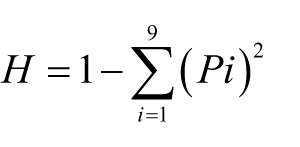
where Pi equals the percentage of group members whose dominant functional background is in the ith functional area (with a total of nine different functions, in this case). This is the most commonly used index for measuring diversity as variety (Harrison and Klein, 2007). It is also consistent with the concept of functional diversity as an indication of the variety/breadth of knowledge among teams (Harrison and Klein, 2007). The minimum and maximum indices in this study were 0 and 0.66.
Affect-based trust in a team
Affect-based trust was measured using five items adapted from McAllister (1995). The original items reflect an employee’s affect-based trust in a coworker. We modified the referent in the items to reflect the team rather than individual level of trust. The participants were asked to rate the extent to which they agreed that each item described the degree of emotional bond among members of their team. Sample items were, ‘We would feel a sense of loss if any of our team members was transferred and we could no longer work together as a team,’ and ‘Team members have made considerable emotional investments in our working relationship’ (α = .90).
Knowledge sharing
We adapted the 4-item knowledge sharing scale from Wah et al. (2007) to the team level. A sample item was, ‘Team members routinely share ideas and best practices within the team.’ We added one item, ‘Our team strongly encourages knowledge sharing among members’ to the scale (α = 0.93).
Team innovation
Team innovation was measured using four items adapted from De Dreu (2002). A sample item was, ‘Team members often produce new services, methods, or procedures’ (α = 0.91).
Control variables
We included team size and the means of the team members’ age, organizational tenure and team tenure as control variables (Hülsheger et al., 2009; Shin and Zhou, 2007). A large team size may inhibit communication and thus the sharing of knowledge that is conducive to team innovation. The educational level of team members indicates the potential for knowledge and information that could be brought to bear on team innovation. Longer tenure in an organization and on a team may reduce communication and, subsequently, knowledge sharing (Katz, 1982). We also controlled for several demographic diversity variables (i.e. age, organization tenure, team tenure, gender and educational level) to partial out their potential effects on knowledge sharing and team innovation. People tend to interact with others sharing similar attributes (Schneider, 1987). Members similar in age, organization tenure and team tenure may share similar self-interests or beliefs (Harrison and Klein, 2007). These similarities may facilitate more knowledge sharing among demographically more similar members. Categories of gender (i.e. men vs women) and education levels have ‘qualitatively different caches of knowledge’ (Harrison and Klein, 2007: 1209). The diversity in these attributes within a team may spark innovation (Harrison and Klein, 2007). Following Harrison and Klein’s (2007) suggestions, we computed the standard deviation for diversity in age, organization tenure and team tenure, and Blau’s index for diversity in gender and educational level.
The regression results showed that only the team members’ average age was significantly and positively related to team innovation. We compared the findings on knowledge sharing with and without control variables, and the findings on team innovation with a complete set of control variables and with only the average age of the team members. The patterns of the findings for knowledge sharing and team innovation were consistent. Guided by the principle of parsimony, we report the findings exclusively with the significant control variable.
Aggregation tests
We followed LeBreton and Senter’s (2008) recommendations to select the aggregation indices and interpret the results. The rwg(j) values in our study suggested that there was strong agreement, on average, among team members’ ratings. For the affect-based trust in a team, the mean and median values of rwg(j) across teams were 0.92 and 0.95, respectively. For knowledge sharing, the mean and median values of rwg(j) across teams were 0.93 and 0.96, respectively. One-way random factor ANOVA results suggested that there were significant differences in the means of individuals’ ratings of affect-based trust and knowledge sharing across teams: Fs (95, 347) = 1.40 and 1.63, ps < 0.05, intraclass correlation coefficient(1) [ICC(1)] = 0.08 for affect-based trust and ICC(1) = 0.12 for knowledge sharing. An ICC(1) value of 0.10 represents a medium effect of group membership (Bliese, 2000; LeBreton and Senter, 2008). Thus, the ICC(1) values in our study suggested that group membership had a medium effect on team members’ ratings of affect-based trust and knowledge sharing.
Like other studies (e.g. Chen and Bliese, 2002; Erdogan et al., 2006; Ou et al., 2014; Zhang et al., 2007), we found low ICC(2) values for affect-based trust in a team (i.e. 0.28) and knowledge sharing (i.e. 0.39). These values indicate low between-team variance, which may limit the statistical power to detect unit-level relationships using group means (Chen and Bliese, 2002; Erdogan et al., 2006; Zhang et al., 2007), making the test of the hypothesized relationships more conservative. While noting the low ICC(2) values, the levels of interrater agreement within teams support the aggregation of the individuals’ ratings of affect-based trust and knowledge sharing at the team-level.
Analytical strategies
The proposed theoretical model is a first-stage moderated mediation model, i.e. only the path from the predictor to the mediator variable is moderated by the moderator variable (Edwards and Lambert, 2007). To test the hypotheses, we followed the procedure developed by Edwards and Lambert (2007). We first conducted two hierarchical multiple regression analyses with knowledge sharing and team innovation as the outcome variables. In the first regression model, knowledge sharing was regressed on functional diversity, affect-based trust in a team and their product term. Before creating the product term, functional diversity and affect-based trust were mean-centered to remove the non-essential collinearity between the predictor variables and their product term, and to facilitate the interpretation of the findings (Cohen et al., 2003). In the second regression model, team innovation was regressed on the control variable, the direct effects of the predictors and knowledge sharing.
We then drew 1000 bootstrap samples from the current sample and estimated the two regression models repeatedly for each bootstrap sample. The regression coefficient estimates from the bootstrap samples were used to derive the confidence intervals of the conditional indirect effects of functional diversity on team innovation via knowledge sharing at different levels of affect-based trust in a team. All of the confidence intervals constructed from the sampling distribution of the bootstrapping were adjusted for the difference between the 50th percentile value in the sampling distribution and the point estimate from the sample, yielding bias-corrected confidence intervals (Efron and Tibshirani, 1993). These bias-corrected bootstrap confidence intervals of the indirect effects were then used to test Hypothesis 2 (Edwards and Lambert, 2007).
Results
The means, standard deviations and correlations among the study variables are presented in Table 1. These preliminary results showed that functional diversity was negatively correlated with knowledge sharing (r = −0.21, p < 0.05), but was not significantly correlated with affect-based trust in a team and team innovation. Knowledge sharing was positively correlated with team innovation (r = 0.34, p < 0.01).
Means, standard deviations and correlations.
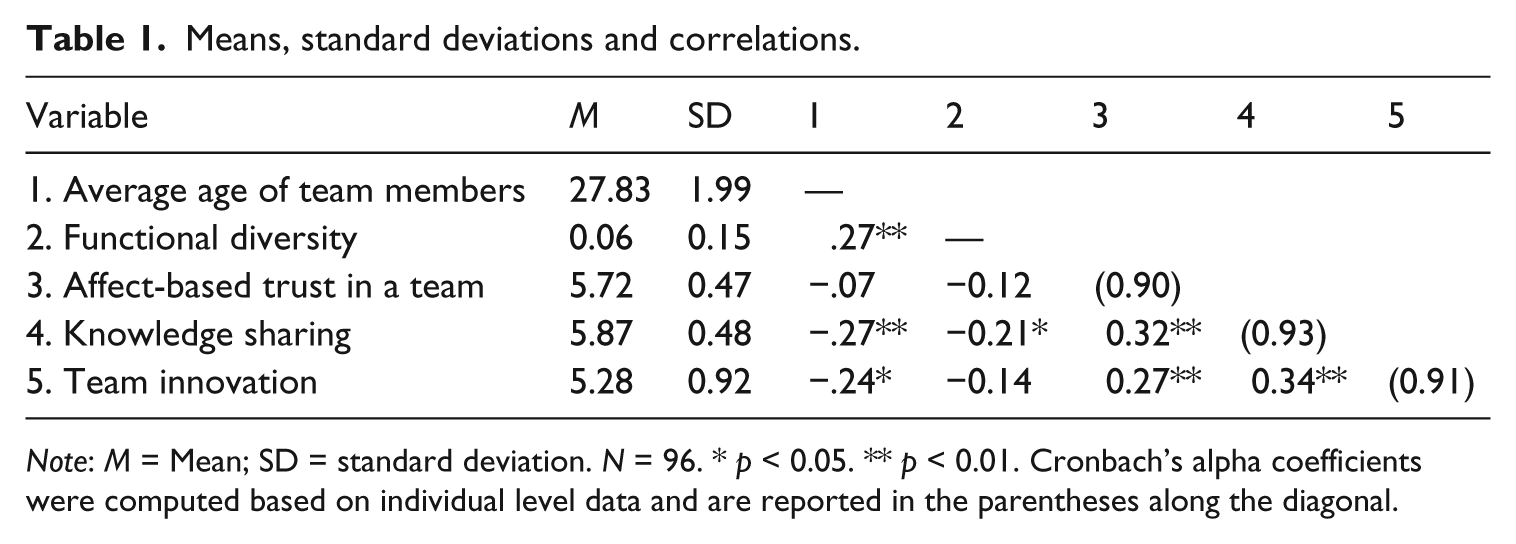
Note: M = Mean; SD = standard deviation. N = 96. * p < 0.05. ** p < 0.01. Cronbach’s alpha coefficients were computed based on individual level data and are reported in the parentheses along the diagonal.
Hierarchical multiple regression analyses
The hierarchical multiple regression results with knowledge sharing as the outcome variable are presented in Table 2. In the first step, functional diversity and affect-based trust in a team collectively accounted for 13 percent of the variance in knowledge sharing. Functional diversity did not have a significant relationship with knowledge sharing. Affect-based trust in a team was positively related to knowledge sharing (B = 0.31, p < 0.01). In the second and final step, the interaction term of functional diversity and affect-based trust in a team accounted for 4 percent of the variance in knowledge sharing above and beyond the main effects of the predictors (ΔF[1, 92] = 4.60, p < 0.05). This interaction term was positively related to knowledge sharing (B = 1.23, p < 0.05). Following Cohen et al. (2003), we plotted the relationship between functional diversity and knowledge sharing across the observed value spectrum of affect-based trust in a team (i.e. observed minimum value, −2 standard deviation [SD], −1 SD, mean, +1 SD, +2 SD and observed maximum value) to facilitate understanding of this interaction effect. Figure 1 shows that when the affect-based trust in a team was between −1 SD and the observed maximum value, functional diversity did not have a significant effect on knowledge sharing. When the affect-based trust in a team was −1 SD or lower, functional diversity had a significant and negative relationship with knowledge sharing (B = −0.85, p < 0.05, at −1 SD). This pattern of findings reveals that as the affect-based trust level decreased, the relationship between functional diversity and knowledge sharing grew more negative but the relationship became less negative as the level of affect-based trust increased. Thus, Hypothesis 1 was supported.
Regression models for predicting knowledge sharing.

Note: N = 96. * p < 0.05. ** p < 0.01. SE = standard error.

Affect-based trust in a team moderates the relationship between functional diversity and knowledge sharing.
The hierarchical multiple regression results with team innovation as the outcome variable are presented in Table 3. In the first step, the control variable explained a significant 6 percent of the variance in team innovation (R2 = 0.06, F [1, 94] = 5.59, p < 0.05). In the second step, functional diversity, affect-based trust in a team and their interaction term collectively accounted for 7 percent of the variance in team innovation, which was not significantly above and beyond the effect of the control variable (ΔF [3, 91] = 2.40, p > 0.05). In the last step, knowledge sharing was entered into the regression equation and accounted for an additional 5 percent of the variance in team innovation (ΔF [1, 90] = 4.98, p < 0.05). Knowledge sharing was positively and significantly related to team innovation (B = 0.46, p < 0.05).
Regression models for predicting team innovation.
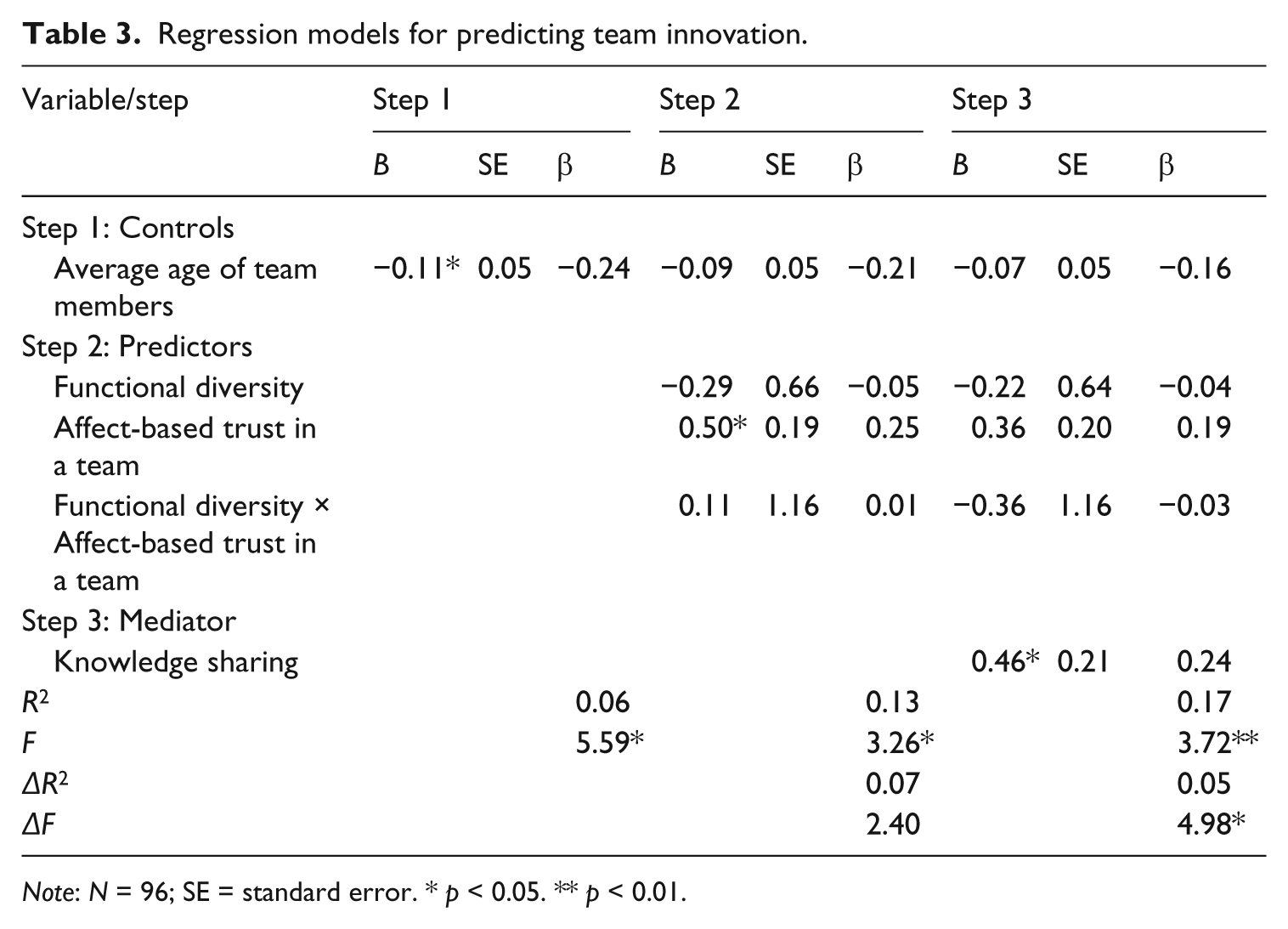
Note: N = 96; SE = standard error. * p < 0.05. ** p < 0.01.
Testing moderated mediation with bootstrap sampling
We drew 1000 bootstrap samples to test Hypothesis 2. Each bootstrap sample contained 96 teams randomly drawn with replacements from the original sample. Following Edwards and Lambert’s (2007) approach, the conditional indirect effects of functional diversity on team innovation via knowledge sharing across the observed value spectrum of affect-based trust in a team were derived by timing the conditional estimates in each bootstrap sample. The point estimates and 95 percent bias-corrected bootstrap confidence intervals (CIs) of these conditional indirect effects are presented in Table 4. These findings show that when the affect-based trust level was at −1 SD and lower, functional diversity had a negative indirect relationship with team innovation via knowledge sharing (indirect effect = −0.39, 95% bias-corrected CI = [−1.10, −0.01] at −1SD). However, when the affect-based trust level was high, the indirect relationship between functional diversity and team innovation via knowledge sharing was not significant. Further analysis showed that the difference in the indirect effects between high affect-based trust (+1 SD) and mean affect-based trust was statistically significant (difference = 0.27, 95% CI = [0.01, 0.85]). The difference in the indirect effects between low affect-based trust (−1 SD) and mean affect-based trust was also statistically significant (difference = −0.27, 95% CI = [−0.01, −0.86]). Therefore, Hypothesis 2 was supported.
Estimates of the indirect effects on team innovation at different levels of affect-based trust in a team.
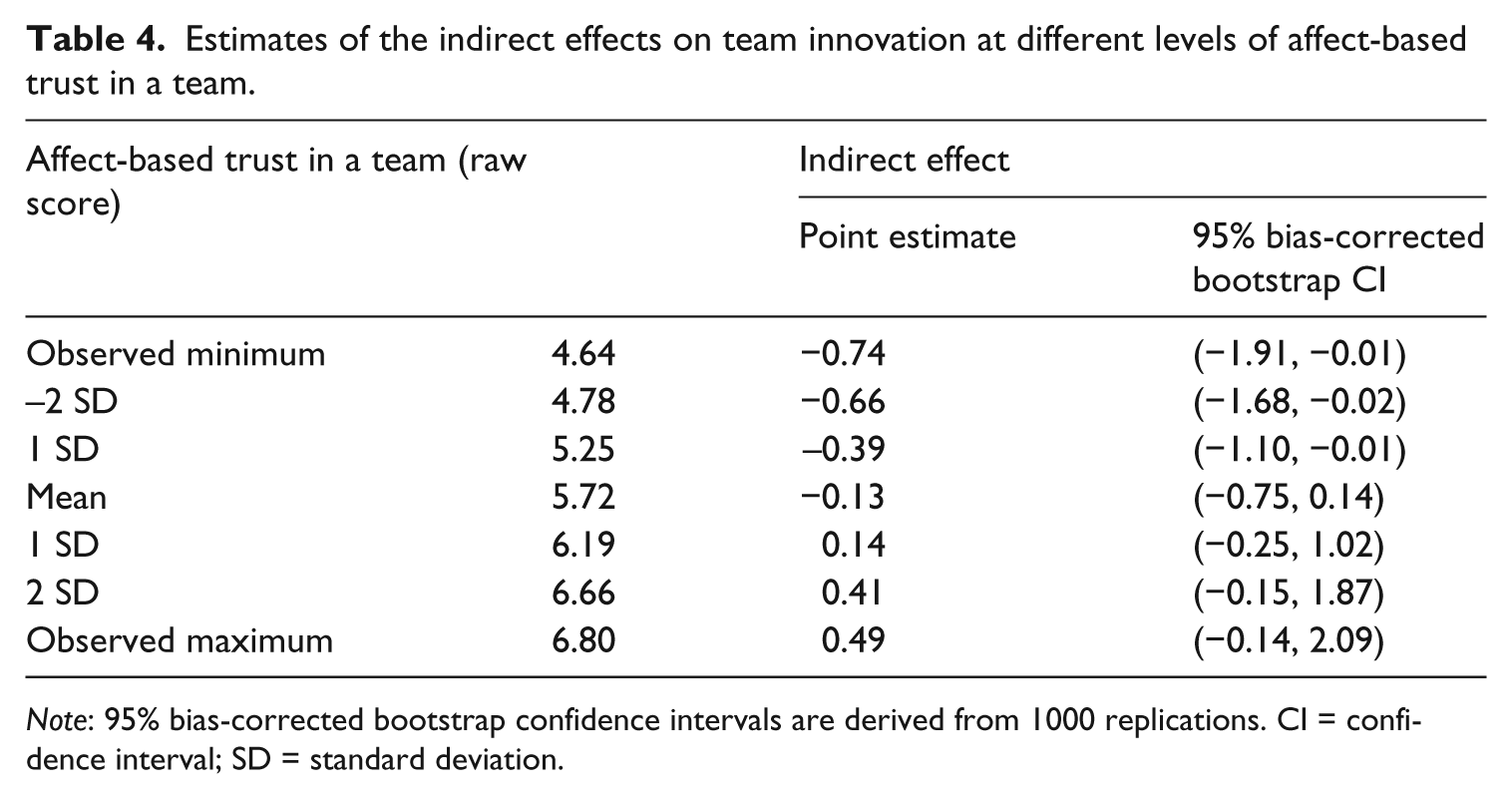
Note: 95% bias-corrected bootstrap confidence intervals are derived from 1000 replications. CI = confidence interval; SD = standard deviation.
Discussion
This study advances the current understanding of how and when functional diversity influences team innovation. The findings indicate that the relationship between functional diversity and knowledge sharing was negative when affect-based trust in a team was low (1 SD below the mean) and became less negative as the affect-based trust level increased. Knowledge sharing had a positive relationship with team innovation. Overall, functional diversity had an indirect negative relationship with team innovation through knowledge sharing when the level of affect-based trust in a team was low. This indirect relationship became less negative as the trust level increased. It was not significant when affect-based trust in a team was high.
Implications for theory and research
We reconciled the inconsistent findings on the relationship between functional diversity and team innovation by theorizing and examining knowledge sharing as an information mechanism and affect-based trust in a team as a boundary condition for the mechanism. Functional diversity is a source of diverse knowledge (Tziner and Eden, 1985; Williams and O’Reilly, 1998), and such cognitive resources are crucial inputs to team innovation (Axtell et al., 2000; Shin and Zhou, 2007; Taylor and Greve, 2006). However, the benefits of this diversity are unlikely to be realized unless team members share their knowledge (De Dreu et al., 2011; Van Knippenberg et al., 2004). Moving beyond the typical approach to study the cognitive boundary conditions for the knowledge sharing mechanism linking functional diversity and team innovation (e.g. Hoever et al., 2012; Somech, 2006), this study demonstrates that the affect-based trust in a team (i.e. an affective factor) serves as a contingency factor. The findings reveal that at low levels of affect-based trust in a team, functional diversity impedes knowledge sharing and a high level of affect-based trust in a team does not necessarily enable significant knowledge sharing among functionally diverse members. This asymmetrical pattern of the moderating effects of affect-based trust in a team may be attributable to the human tendency to rely more on negative than on positive information in the process of making an overall evaluation (Baumeister et al., 2001; Peeters and Czapinski, 1990). ‘When equal measures of good and bad are present, the psychological effects of the bad ones outweigh those of the good ones’ (Baumeister et al., 2001: 323). A low level of affect-based trust in functionally diverse teams was sufficient to derail knowledge sharing, whereas a high level was insufficient to motivate cooperative interactions and knowledge sharing among functionally diverse team members.
Although the indirect effect of functional diversity on team innovation (via knowledge sharing) was not statistically significant when the level of affect-based trust in a team was above average, the indirect effects at high versus average levels of affect-based trust were significantly different from each other. The results suggest that when affect-based trust in a team becomes higher, the relationship between functional diversity and team innovation through knowledge sharing becomes less negative. The results indicate the buffering effects of affect-based trust in a team on knowledge sharing in functionally diverse teams and subsequent team innovation. Overall, this study offers interesting insights into the role of affective boundary conditions in the relationships that functional diversity has with knowledge sharing and subsequently team innovation. It enriches the literature on team innovation by integrating the cognitive and affective approaches. In their review, Zhou and Shalley (2011) called for more research that integrates the different approaches to expand our current knowledge of creative outcomes. In this study, we examined the interplay between a cognitive factor (i.e. knowledge resources associated with functional diversity) and an affective factor (i.e. affect-based trust in a team) to understand when functional diversity can impede team innovation through knowledge sharing. As a whole, the findings demonstrate that an integration of cognitive and affective approaches helps to clarify the mixed findings documented in the literature on the effects of functional diversity on team innovation.
This study also offers insights into the broader diversity literature by revealing how affective factors may influence the effects of diversity on team performance. Previous studies have examined the effects of other diversity attributes (e.g. age and education) on team processes and outcomes (e.g. Knight et al., 1999; Simons et al., 1999). The results of those studies revealed a similar pattern of mixed findings to those reported in functional diversity research. There has been a similar focus on the cognitive approach to boundary conditions (e.g. team need for cognition; Kearney et al., 2009; team reflectivity; Nederveen Pieterse et al., 2011). This study went beyond such a cognitive focus by theorizing and examining the boundary condition of team diversity effects from an affective perspective. While noting that we are not the first to propose interpersonal trust as such a boundary condition, we focus specifically on the affective aspect of such trust; we conceptualize and provide a direct test of affect-based trust in a team as a boundary condition of the functional diversity effects on knowledge sharing and subsequent team innovation. This study therefore expands the broader diversity literature to include the affective approach to boundary conditions.
This study also contributes to work team research that views teams as information processors by addressing the omission of the role of affective factors in influencing the information-based mechanism (Hinsz et al., 1997). The findings of this study offer insights for research grounded in MIP-G theory (De Dreu et al., 2008; Nijstad and De Dreu, 2012) and the CEM (Van Knippenberg et al., 2004). We found a negative indirect relationship between functional diversity and team innovation (via knowledge sharing) at low levels of affect-based trust in a team. The result is consistent with MIP-G theory, which suggests that pro-self motivation in a team undermines team performance by weakening the information mechanism in the team. Moreover, as shown in Figure 1, the difference in the level of knowledge sharing between the high affect-based trust (see prosocially motivated) and low affect-based trust (see pro-self motivated) conditions is greater in high than in low functionally diverse teams. This pattern of interaction effects for affect-based trust and functional diversity on knowledge sharing supports MIP-G theory, which suggests that ‘the differences between pro-socially motivated groups and pro-self motivated groups will be bigger under high rather than low epistemic motivation’ (De Dreu et al., 2011: 83). Our results are also generally consistent with the CEM which suggests that the informational processes underlying the functional diversity–team innovation relationship are contingent on factors that may promote (or inhibit) such processes. Overall, the MIP-G based theorizing and results in this study extend the CEM by suggesting that prosocial motivation and factors promoting such motivation (e.g. affect-based trust in a team) can influence the information mechanisms.
We note that the results for the non-significant indirect relationship between functional diversity and team innovation (via knowledge sharing) at high levels of affect-based trust in a team are not consistent with MIP-G theory. We would expect, according to the theory, the indirect relationship to be positive and significant. While the theory suggests that functional diversity is a potential trigger for epistemic motivation, it does not suggest how functional diversity may inhibit knowledge sharing, such as through risk concerns and/or intergroup bias, as suggested by the CEM (Van Knippenberg et al., 2004). The consideration of personal interests in functionally diverse teams suggests that functional diversity can potentially trigger pro-self motivation. The non-significant moderating effect of high affect-based trust on the relationship between functional diversity and knowledge sharing suggests that strong emotional bonds among team members (see prosocial motivation) are insufficient to totally offset the risk concerns and/or intergroup bias (see pro-self motivation) that impede knowledge sharing. More research is thus needed to identify other team affective factors (e.g. cohesion, affective commitment; Van Knippenberg et al., 2004) that may trigger prosocial motivation in teams.
Another related question is whether functional diversity actually triggers epistemic motivation in corporate work teams. Extensive evidence from studies using tightly controlled lab experiments using student samples and short-lived tasks supported MIP-G theory’s assertion that epistemic motivation facilitates information processes (see Nijstad and De Dreu, 2012 for a review). However, the findings from this study showed that functional diversity did not have a significant relationship with knowledge sharing, suggesting that functional diversity may not necessarily trigger epistemic motivation in organizational teams, such as the corporate R&D teams working on knowledge-intensive tasks in our sample. Therefore, an extension of MIP-G theory based on the CEM is that social categorization and intergroup bias associated with functional diversity may have constrained its epistemic motivation potential. Generally, we suggest that the MIP-G theory and the CEM may extend each other to advance current knowledge of the relationship between team diversity and team innovation through the effects of informational processes.
Finally, this study contributes to the team knowledge sharing literature by uncovering the buffering effect of affect-based trust in a team on knowledge sharing in a functionally diverse team. Our findings suggest that affect-based trust in a team alleviates team members’ concerns about sharing knowledge in functionally diverse teams, leading to improved team innovation. It thus advances current understanding on when functional diversity relates to knowledge sharing (Mannix and Neale, 2005; Phillips et al., 2004).
Managerial implications
A major implication of this study for managers is the importance of developing and maintaining affect-based trust, especially in functionally diverse teams. Our analysis suggests that when the level of affect-based trust in a team is low, functional diversity may backfire because team members are more reluctant to share their knowledge with each other, thus hampering team innovation. Affect-based trust among team members can alleviate such negative effects of functional diversity. It is therefore important to build such trust in functionally diverse teams. On the other side of the same coin, this study suggests to managers that the development of affect-based trust needs to be accompanied by the composition of teams that combine a wide array of knowledge. When teams are composed of employees with similar functional backgrounds, there is little unique or diverse knowledge to be shared to develop innovation, even though the members have a mutual trust and are motivated to share. To fully leverage the benefits of affect-based trust in a team for team innovation, managers also need to be aware of the importance of functional diversity.
Some previous studies have provided useful suggestions on the development of affect-based trust in teams. McAllister (1995) showed that peer affiliative citizenship behavior and the frequency of interaction both help to foster affect-based trust. Managers may encourage functionally diverse team members to interact with each other more frequently. Employees’ institutionalized socialization experiences may also influence their affect-based trust relationships (Lapointe et al., 2014). Newcomers who have opportunities to communicate and work closely with the incumbent coworkers, for example through mentoring programs and/or job rotation programs, may develop stronger affect-based trust in their peers (Lapointe et al., 2014). Organizations may use these institutionalized socialization tactics to nurture the affect-based trust of newcomers to functionally diverse teams. Moreover, employees’ trust in their leaders may spill over to their peers (Lau and Liden, 2008). Their affect-based trust in their leaders may motivate them to engage in more helping behavior towards their peers (Zhu and Akhtar, 2014), and thus may foster the affect-based trust among team members. Employees are likely to have greater affect-based trust in their leaders who display servant-oriented behavior (e.g. an emphasis on serving others and teamwork, building a sense of community and sharing power; Schaubroeck et al., 2011), and who convey care and consideration (Zhu and Akhtar, 2014).
Limitations of the study
This study has several limitations. First, we could not fully establish the causal relationships we hypothesized, despite the temporally lagged research design. The proposed relationships, however, are conceptually viable because there is no strong reason to suggest that behavior (i.e. knowledge sharing) led to a change in team composition (i.e. functional diversity). We recommend that this study be replicated using a longitudinal research design. Second, the ICC(2) values for affect-based trust and knowledge sharing were low. The low between-team variance may be attributable to the specific research context. We collected the data in the relationship-oriented Chinese context where affect-based trust is particularly important (Chen et al., 2011), and in teams (specifically R&D teams) where knowledge sharing is a common and expected work phenomenon. The low ICC(2) scores may have reduced the statistical power to detect team-level effects (Bliese, 2000; Erdogan et al., 2006). Researchers have also suggested that the power to detect moderators in field data is inherently low (McClelland and Judd, 1993). Despite the low power and the resulting conservative estimates, the findings supported the hypotheses.
Third, the participants in this study were demographically similar: very young, almost all male and with at least a college-degree level of education. The data were collected from R&D teams in only one company. The specific context of the study might have limited the generalizability of our findings. Finally, we were unable to collect objective data on team innovation (e.g. patents and citations) in this study. The R&D teams from which we collected data were involved in different client-based projects that varied in the products or services produced. A fair comparison of the innovative outcomes across teams was not possible. Shin and Zhou (2007) faced a similar challenge in their study of team creativity. The subjective rating of team innovation by team leaders, which is a common practice in team innovation research (e.g. Bantel and Jackson, 1989; De Dreu, 2002; Somech, 2006), is an alternative way to collect data on team innovation. Team leaders should possess knowledge in assessing the quality of their teams’ innovation outputs that may serve as a proxy for expert ratings.
Future research directions
An interesting avenue for future research is to investigate factors that may mitigate the negative effects of functional diversity on knowledge sharing when the level of affect-based trust in a team is low. One possibility is to examine the joint moderating effects of affect-based trust in a team and the procedural justice climate on the mediating relationship. When team members feel greater uncertainty in their interpersonal context, they are likely to rely on the formal organizational rules and procedures to provide structural protection (Takeuchi et al., 2012). A higher level of procedural justice climate may thus compensate for a lower level of affect-based trust in a team.
Future studies could also examine both the ability- and affect-based trust in a team as moderators and ascertain their differential moderating effects on the team processes linking functional diversity and team innovation. Cognition- and affect-based trust (McAllister, 1995) differ in what the trustor expects from the trustee: cognition-based trust is concerned with whether the trustee ‘can’ (i.e. has the ability to) perform a proper action and affect-based trust is concerned with whether the trustee ‘will’ do so (Colquitt et al., 2007). While functional diversity provides a variety of information, it often creates divides among team members such that those with dissimilar functional backgrounds often fail to cooperate with each other (Chattopadhyay et al., 1999). Therefore, what is critical is the factor that motivates team members to share their knowledge rather than whether they possess such knowledge. Affect-based trust focuses on the relationships that motivate cooperative and risk-taking behavior (i.e. will do) (Colquitt et al., 2007). It is thus conceptually more relevant to the motivational underpinning of the information mechanism. Nevertheless, future research may replicate this study by including the moderating effects of both types of trust as suggested by McAllister (1995). Similarly, we examined knowledge sharing only in the information mechanism. Our results on the moderating effect of the affect-based trust in a team could be conservative because our concept and measure of knowledge sharing did not include knowledge integration. Theoretically, strong emotional bonds in a team are even more critical for the synthesis of knowledge in functionally diverse teams because team members must integrate varied knowledge that is novel to the team. Future research may include both knowledge sharing and integration (e.g. information elaboration) to provide a richer understanding of the effects of affect-based trust in a team as a boundary condition on the relationship between functional diversity and team innovation.
Finally, future research may include a larger sample size and a broader sample of work teams to enhance the statistical power and generalizability (Harrison et al., 1998). Researchers may collect data in less relationship-oriented contexts (e.g. the Western context), and in teams where knowledge sharing is a less common work phenomenon and where members are more diverse in their demographic backgrounds (e.g. age, gender, education level, etc.).
Footnotes
Acknowledgements
We gratefully acknowledge the comments of four anonymous reviewers and the expert guidance of Associate Editor Nick Turner.
Funding
This study was supported by funding from the Research Grants Council, University Grants Committee, Hong Kong (project no. 242012).