




Abstract
The current study utilizes attachment theory to understand how leader–follower relationships impact emotional and behavioral outcomes in the workplace. Specifically, we examine the roles of two dysfunctional attachment styles – anxious and avoidant attachment – as determinants of trust in leaders, stress and citizenship behaviors. Results showed that followers with anxious attachment orientations reported experiencing more stress, whereas followers with avoidant attachment orientations were less likely to engage in organizational citizenship behaviors. Moreover, we found that the relationship between attachment orientations and workplace outcomes are mediated by affective and cognitive trust. However, these negative outcomes only occur when the follower has a leader with an avoidant attachment orientation. Implications for training, selection, job design and understanding leader–follower dynamics are discussed.
Researchers interested in the question of how personality impacts leadership processes are increasingly coming to understand that it is necessary to account for the idiosyncratic relationships that emerge as a joint effect of leader and follower personalities (Grijalva and Harms, 2014; Liden and Antonakis, 2009). This study utilizes the attachment styles (Fraley and Waller, 1998) of leaders and followers in order to examine how leader–follower dynamics can lead to emotional and behavioral outcomes in followers. Attachment theory is particularly well-suited for understanding leader–follower dynamics, for a number of reasons. First and foremost is the fact that attachment styles are believed to be fundamental for understanding interpersonal processes in that they represent both perceptions of others and an individual’s willingness to engage in close, supportive relationships (Fraley and Shaver, 2008). Moreover, attachment theory provides a framework for determining which follower outcomes are most likely to be impacted by attachment styles as well as the processes and conditions under which attachment styles are expected to impact emotional and behavioral outcomes.
That said, existing literature examining the role of attachment styles as a determinant of workplace outcomes has been deficient in several ways. First, attachment styles are often used to predict workplace outcomes without concern for which outcomes are most likely to be impacted by attachment processes (see Harms, 2011). Second, the processes through which attachment styles influence workplace outcomes are frequently ignored. And finally, the nature of the interpersonal contexts in the workplace that are most likely to trigger attachment processes has not been addressed in prior research. In other words, much of the prior literature has ignored important moderators and mediators of the effects of attachment styles. Consequently, such studies are more likely to generate attenuated or null effects, and researchers may mistakenly conclude that attachment styles are largely unimportant for workplace outcomes.
The current study aims to: (i) review the theoretical basis of the relevance of attachment styles as an antecedent of workplace outcomes; (ii) suggest a psychological mechanism – trust in leaders – that explains the process through which this occurs; and (iii) demonstrate how attachment theory can be utilized to better understand the interactive nature of leader–follower relationships and their consequences. Specifically, it contributes to the existing literature linking attachment with workplace outcomes (see Harms, 2011) by utilizing a dyadic approach that allows for testing the proposed interactions between leader and follower attachment styles. This expands on the existing leader–follower dyad literature (Krasikova and LeBreton, 2012) by testing whether certain psychological features can moderate when such interactions are most likely to impact work outcomes. Further, the present study demonstrates how attachment theory can be used to move from general to specific hypotheses concerning which work outcomes should be most associated with each attachment dimension and showing how two types of trust – cognitive and affective – can mediate the effects of attachment styles on emotional and behavioral workplace outcomes. See Figure 1 for an outline of the model being proposed.

Model of leader and follower attachment styles.
Theoretical framework
Leadership is fundamentally an interpersonal process (Uhl-Bien, 2006). However, the vast majority of research examining the role of personality in leadership involves examining the personality of leaders alone (e.g. Judge and Bono, 2000). Even research focused on leader–follower dynamics is dominated by studies that assess the personality of only one side of the leader–follower relationship (Dulebohn et al., 2012). Consequently, there is a need for research that not only assesses both leader and follower characteristics, but does so in such as a way as to evaluate whether or not interactive relationships exist (Krasikova and LeBreton, 2012).
Adult attachment styles
One relatively unexplored domain of personality that has been identified as being particularly well-suited to understanding leader–follower dynamics is that of adult attachment styles (Harms, 2011). This is because the dual function of leaders as both instructors and disciplinarians mirrors that of parent–child relationships (Freud, 1939; Keller, 2003). Current understanding of adult attachment styles was originally based on Bowlby’s (1982) attachment theory. Bowlby postulated that individuals are born with an innate tendency to seek proximity with individuals they trust to protect them in times of distress, referred to as attachment figures. This need to be close to an attachment figure may even be triggered simply by becoming aware that the attachment figure is no longer present. Successful attempts to gain proximity in times of distress result in feelings of security. Moreover, the belief that one has a ‘secure’ base to fall back on leads individuals to be more willing to engage in exploratory behaviors such as meeting new people, exploring new ideas, or simply moving a greater distance from the attachment figure. Unsuccessful attempts to gain proximity may be met with either increasingly extreme emotional reactions until the attachment figure is driven to return or with resentment towards the attachment figure resulting from a sense of abandonment. Bowlby speculated that a history of successful or unsuccessful attachment events in childhood would develop into a working model of interpersonal relationships that would persist into adulthood and influence all interpersonal relationships to some degree. Individuals with a history of receiving love and support from attachment figures maintain a secure attachment style, whereas those who had attachment figures who were neglectful or unavailable may develop one or both of insecure attachment styles: anxious and avoidant (Fraley and Shaver, 2008).
Although attachment research initially began with the assumption that attachment styles would fall into the three primary attachment patterns identified in children – secure, anxious and avoidant – more recent work has suggested that a two-dimensional model of attachment is more appropriate than type-based models (Brennan et al., 1998). In this model, attachment styles are defined in terms of their dysfunctional ends. Individuals with anxious attachment have a lack of faith that attachment figures will be available when needed because they lack a sense of their own self-worth. They tend to feel unloved and underappreciated, but still desire close relationships and are preoccupied with keeping their attachment figures close. When they feel that this relationship is threatened, they may engage in increasingly extreme, and often emotional, behaviors in order to pressure their target into returning. Individuals with avoidant attachment lack faith in attachment figures not because they doubt their own self-worth, but because they have developed a negative perception of others as unworthy of their attention. They report little desire or willingness to emotionally engage with others and tend not to develop the social skills that would allow them to do so (Brennan et al., 1998). Consequently, they are unlikely to respond positively or to even notice the efforts of potential attachment figures to engage them in attempts to create intimacy and trust. Securely attached individuals are those who are low on both of these dimensions. They tend to possess a high sense of self-worth and are both willing and able to engage in close relationships. Moreover, their history of successful attachment events leads them to internalize their faith in the availability of attachment figures. They do not need constant reassurance and they are expected to readily rebound from isolated negative interpersonal experiences (Fraley and Shaver, 2008). Because the two insecure styles are associated with ineffective strategies for coping with stress as well as a reduced capacity or likelihood for forming close relationships, they are generally considered dysfunctional even though neither represents an approach to others that is necessarily hostile. In the present research, we adopt this two-dimensional approach and do not make specific hypotheses concerning securely attached individuals who would fall at the low end of each of these dimensions. 1 We would also like to note that because these attachment styles are dimensions, it is possible, and indeed likely, that individuals will fall somewhere between the extreme ends of each dimension. Thus, an individual’s relative standing on each dimension represents the probability of them behaving in a certain manner, but each individual may display different patterns depending on the situation, their stress levels and their partners (Fraley et al., 2015). In the following sections, we detail how these two dysfunctional attachment styles relate to two theoretically-linked emotional and behavioral workplace outcomes: stress and citizenship behaviors.
Attachment styles and stress
Attachment theory postulates that when individuals are separated from their ‘secure base’ they are likely to experience distress (Bowlby, 1982). When individuals have a history of separation events where the distress was not alleviated by the return of the attachment figure, they respond by developing dysfunctional coping strategies that become the basis for the two insecure attachment styles. Individuals who develop an anxious attachment pattern tend to have chronic anxiety surrounding the idea that they will be separated from their attachment figure and experience particularly high levels of distress when they do become separated. Individuals who develop an avoidant attachment pattern resolve their repeated distress events by disengaging from close, personal relationships and devaluing the value of such relationships. Consequently, when these individuals are separated from their attachment figures, they show little or no signs of outward distress.
Because anxious attachment is, at its core, characterized by experiencing more distress and worry about the possibility of failing relationships and the inability to quickly recover from stressful events (Gander and Buchheim, 2015), we would expect followers with anxious attachment, but not necessarily those with avoidant attachment, to experience higher levels of stress in the workplace in general. This is consistent with prior research (e.g. Schirmer and Lopez, 2001).
Hypothesis 1: Higher levels of follower anxious attachment will be positively related to follower stress.
Attachment styles and organizational citizenship behaviors
Organizational citizenship behaviors (OCBs) are discretionary work behaviors that may facilitate the success of an organization or work group, but are not formally part of an individual’s job role (Podsakoff et al., 2000). These behaviors can be directed either towards organizations or towards coworkers (Williams and Anderson, 1991), and can signal a willingness to invest in relationships with a target through voluntary behaviors. Because attachment styles are fundamentally interpersonal in nature, organizational citizenship behaviors directed at individuals (OCB-I) are more likely as outcomes of attachment styles in the workplace. Specifically, individuals with an avoidant attachment orientation are characterized by a belief that others are not worth engaging in relationships with and, as a consequence, would be unlikely to see the value in helping others in the workplace (Little et al., 2010). As OCB-I frequently necessitate close interactions with others, it is expected that avoidant individuals, but not necessarily those who are anxiously attached, will be disinclined to engage in such behaviors irrespective of the target. This is consistent with prior research findings (e.g. Geller and Bamberger, 2009; Hardy and Barkham, 1994).
Hypothesis 2: Higher levels of follower avoidant attachment will be negatively related to OCB-I.
Trust as a mediator of attachment styles and work outcomes
Although prior research has established significant relationships between the attachment styles of leaders and followers and workplace outcomes, the process by which this occurs remains relatively unexplored. However, Harms (2011) suggested trust as a possible explanation of the link between attachment styles and employee outcomes. Fundamentally, having a secure attachment style reflects an ability and willingness to form the close, intimate relationships that characterize trust (Fraley and Shaver, 2008). Each of the insecure styles reflects a lack of a sense of trust for a different reason. For anxiously attached individuals, their lack of trust stems from a belief that they are not worthy of being loved and a constant worry that others will leave them. For avoidant individuals, their lack of trust is a symptom of their unwillingness to engage in intimate relationships (Brennan et al., 1998).
There is considerable evidence for the attachment–trust relationship both in (e.g. Simmons et al., 2009) and outside of work settings (e.g. Feeney and Collins, 2001; Mikulincer, 1998). Within the context of work, trust has been proposed as a key mediator of the relationship between follower attachment and work outcomes (e.g. Frazier et al., 2015). However, although the extant literature examining the role of attachment in the workplace has tended to view trust as a single construct (e.g. Simmons et al., 2009), current thinking in the trust literature is suggestive that there are two types of trust: cognitive and affective (McAllister, 1995). Moreover, these two types of trust have unique antecedents and often show different relationships with work outcomes.
Cognitive trust derives from faith in the capacity or characteristics of another person, with low scores on this dimension reflecting a distrust of others. Because this type of trust reflects an active concern that others are unreliable, it has been associated with lower levels of job stress (Staples and Ratnasingham, 1998). Affective trust, on the other hand, derives from strong personal bonds and feelings for another person. Low scores do not necessarily reflect hostility for others. Rather, they reflect that an individual has not formed a close bond with others (McAllister, 1995). Prior research has shown that affective trust is more closely associated with discretionary behaviors such as OCBs (e.g. Yang et al., 2009). The reason for this is that when individuals form close emotional bonds with one another they may feel obligated to reciprocate past favors or initiate helping behaviors in order to demonstrate mutual affection.
In terms of attachment styles, it is expected that anxiously attached individuals in particular will report lower levels of cognitive trust, but not necessarily affective trust. As noted earlier, anxiously attached individuals desire close relationships and can form bonds with others, but they worry about whether their attachment figure truly cares for them in return, and ruminate on whether that individual will terminate the relationship. Consequently, they are inclined to be suspicious or distrustful of the intentions of others regardless of whether or not they like those particular individuals. On the other hand, individuals with avoidant attachment would be expected to report lower levels of affective trust but not necessarily cognitive trust – that is, these individuals do not want to be in close relationships regardless of whether or not they believe that the other person is capable of providing intimacy, security, or resources. Consequently, we expect follower anxious attachment to be positively related to job stress via cognitive trust in their leader, and follower avoidant attachment to be negatively related to OCB-I via affective trust in their leader.
Hypothesis 3: Follower cognitive trust will partially mediate the relationship between follower anxious attachment and job stress.
Hypothesis 4: Follower affective trust will partially mediate the relationship between follower avoidant attachment and OCB-I.
Leaders as a context for follower attachment
Trait activation theory (Tett and Burnett, 2003) posits that behavioral expressions of traits are only activated when situations provide trait-relevant cues. Similarly, attachment theory suggests that the attachment system is only activated if there is a potential threat of becoming separated from an attachment figure (Fraley and Shaver, 2000). That is not to say that it does not regularly impact behavior. One’s attachment styles will still influence how one approaches and engages in relationships regardless of whether an appropriate attachment figure is present, but the dysfunctional tendencies will become particularly acute when there is an attachment figure present and there is reason to believe the relationship may become severed or strained. Within the context of the workplace, leaders are expected to serve as attachment figures because they often assume a parent-like role in the eyes of followers (Freud, 1939; Harms, 2011; Keller, 2003). Consequently, the behaviors of leaders towards their subordinates are an important contextual factor in determining the degree to which dysfunctional attachment behaviors are displayed by their followers.
Curiously, although this implies that attachment styles are most appropriately studied in a dyadic context, this has rarely been done (Game, 2008; Keller, 2003). Instead, the majority of prior research on attachment styles has focused almost exclusively on the attachment styles of either leaders or followers. Moreover, there is nearly no prior literature examining how the attachment styles of leaders and followers may interact to influence follower outcomes. An exception to this is work by Keller (2003) speculating that matching attachment styles are most likely to generate positive outcomes because having a leader who fits with one’s implicit beliefs about what leaders are like is reassuring. However, this line of thinking does not reflect the benefits of complementary relationships between leader and follower attachment styles that are predicted by attachment theory and has not been tested using measures designed to assess the two primary attachment dimensions. That said, a number of studies have looked at relationship dynamics within the context of romantic couples (e.g. Simpson and Overall, 2014). Notable in these findings is a broad disconfirmation of the idea that matched attachment styles result in positive outcomes, but also that certain sets of partner attachment styles tend to produce patterns that either reduce or exacerbate underlying behavioral tendencies (Simpson and Howland, 2012; Simpson and Overall, 2014; Simpson and Rholes, 2012).
As noted above, the attachment system is only triggered when an individual feels that an attachment figure is absent or may become absent. When followers high on anxious attachment are paired with leaders who are willing to provide intimacy and support, that is, those low on avoidant attachment, there is no need for them to worry or engage in such theatrics because they never feel threatened and their dysfunctional attachment system does not become activated (Simpson and Howland, 2012; Simpson and Overall, 2014). However, followers with an anxious attachment who are paired with a leader high on avoidant attachment will not receive such positive signals to let them know that the relationship is secure. Consequently, we expect them to experience higher feelings of distrust (low cognitive trust) because they feel that the relationship is threatened or that they will be abandoned.
Hypothesis 5: Higher levels of follower anxious attachment will be more negatively related to cognitive trust in leadership when their leader is high on avoidant attachment.
On the other hand, followers with an avoidant attachment pattern are likely to have their attachment system activated when their partners try to force them to engage in intimacy or display affection. In particular, being paired with someone who is anxiously attached and who engages in dramatic and emotional displays in order to elicit attention is likely to result in disgust, rejection and an attempt to remove oneself from the situation (Simpson and Howland, 2012; Simpson and Overall, 2014). For this reason, we could expect that a follower high on avoidant attachment would be most likely to rate their leader as being unlikeable (low affective trust) when they are paired with an anxiously attached leader.
Hypothesis 6: Higher levels of follower avoidant attachment will be more negatively related to affective trust in leadership when their leader is high on anxious attachment.
The logic we have outlined above implies a special case of moderated mediation, in which ‘an interaction between an independent and moderator variable affects a mediator variable that in turn affects an outcome variable’ (Edwards and Lambert, 2007: 7). In other words, we expect leader attachment to interact with follower attachment in influencing follower trust; that follower trust should in turn affect follower outcomes. This model would also be consistent with what Preacher et al. (2007: 195) refer to as conditional indirect effects. That is, there are the indirect effects of follower anxious attachment on job stress through cognitive trust as well as indirect effects of follower avoidant attachment on OCB-I through affective trust, and these vary in strength conditional on the value of the moderator variables (leader avoidant attachment and leader anxious attachment, respectively). In summary, we expect to find:
Hypothesis 7: The positive indirect effect of follower anxious attachment on employee job stress, via follower cognitive trust, would be moderated by leader avoidant attachment, such that the strength of the mediated relationship is stronger when leader avoidant attachment is high.
Hypothesis 8: The negative indirect effect of follower avoidant attachment on employee OCB-I, via follower affective trust, would be moderated by leader anxious attachment, such that the strength of the mediated relationship is stronger when leader anxious attachment is high.
Many of the proposed relationships in this study have been well-established by prior research. The idea that leader–follower relations are important antecedents of follower outcomes is not new (see Dulebohn et al., 2012), nor is the idea that having a supportive supervisor may be a significant determinant of follower stress (e.g. Kahn and Byosiere, 1992) and OCBs (e.g. Podsakoff et al., 2000). What is new is the idea that the attachment styles of leaders are particularly important for certain followers. There is some existing evidence to support this idea. For example, a study of soldiers in the Israeli military (Davidovitz et al., 2007) demonstrated that the mental health of soldiers declined when the soldiers had high anxious attachment and their leaders were high on avoidant attachment. That said, the present study represents the first time that the interactive nature of leader and follower attachment styles has been tested with regards to trust in the workplace and, in particular, used cognitive and affective trust to understand how particular attachment orientations lead to work outcomes. Thus, it represents the first time that both the dyadic context and the psychological processes of the attachment system have been jointly tested.
Method
Sample and procedure
Participants were employees and their supervisors from eight restaurants in Ohio. Restaurants represent a good setting for testing the effects of attachment processes because managers have frequent, direct contact with followers and for many followers it is their first job. Consequently, it is their first opportunity to create a schema for leader–follower dynamics.
Employees/followers were asked to rate their attachment styles, trust in their supervisor, OCB-Is, and job stress. Their supervisors were asked to rate their own attachment styles. The employee work numbers were used to match the supervisor and follower data, and all questionnaires were collected on-site by the researchers immediately after completion to protect confidentiality.
In total, 30 supervisor questionnaires and 176 follower questionnaires were distributed. After excluding incomplete questionnaires, a total of 152 sets of supervisor (28)–follower (152) dyads remained, constituting the final sample for the study (an overall usable response rate of 86.4%), with an average of 5.4 followers in each team. The average job tenure of followers was 4.30 years (SD = 5.01). Most of them were female (52.0%). The average tenure of supervisors was 7.92 years (SD = 7.63), and most were male (75.0%).
Measures
All items were scored on seven-point Likert scales of agreement (1 = ‘strongly disagree;’ 7 = ‘strongly agree’).
Attachment style
Bartholomew and Horowitz’s (1991) self-report relationship questionnaire (RQ) was included in the study to measure attachment style. The RQ consists of four short paragraphs describing four attachment patterns (secure, preoccupied, fearful and dismissing) that would be descriptive of individuals falling into the four quadrants if the two attachment dimensions were crossed. Specifically, secure would be low on both dimensions, dismissing would be high on avoidant attachment alone, preoccupied would be high on anxious attachment alone, and fearful would be high on both dimensions. The specific paragraphs were: ‘it is relatively easy for me to become emotionally close to others. I am comfortable depending on others and having others depend on me. I don’t worry about being alone or having others not accept me’ for secure; ‘I want to be completely emotionally intimate with others, but I often find that others are reluctant to get as close as I would like. I am uncomfortable being without close relationships, but I sometimes worry that others don’t value me as much as I value them’ for preoccupied; ‘I am somewhat uncomfortable getting close to others. I want emotionally close relationships, but I find it difficult to trust others completely, or to depend on them. I sometimes worry that I will be hurt if I allow myself to become too close to others’ for fearful; and ‘I am comfortable without close emotional relationships. It is very important to me to feel independent and self-sufficient, and I prefer not to depend on others or have others depend on me’ for dismissing. Respondents were asked to rate the degree to which each description matched their own general relationship style on the seven-point Likert scale. Following Bartholomew and Horowitz’s (1991) guidelines, we computed the two attachment dimensions from these four items using a simple formula based on which patterns would be considered high or low on each dimension. Specifically, anxious attachment = [(fearful + preoccupied) – (secure + dismissing)] and avoidant attachment avoidant attachment = [(fearful + dismissing) – (secure + preoccupied)]. This scoring procedure has been shown to result in dimensional scores similar to those of other attachment measures (i.e. the Peer Attachment Interview and the Family Attachment Interview: Bartholomew and Shaver, 1998).
Trust
Followers’ trust in leaders was measured with the two-dimensional trust scale developed by McAllister (1995). The two dimensions were affective trust (five items; α = .96) and cognitive trust (six items; α = .97). An example item of affective trust is ‘I would have to say that we have both made considerable emotional investments in our working relationship.’ An example item for cognitive trust is ‘I can rely on my leader not to make my job more difficult by careless work.’
OCB-I
Followers’ organizational citizenship behavior towards individuals was measured with the seven-item scale from Williams and Anderson (1991; α = .81). An example item is ‘I help others who have heavy workloads.’
Job stress
Followers’ perception of job stress was measured with six items adopted from Parker and DeCotiis (1983; α = .87). An example item is ‘There are lots of times when my job drives me right up the wall.’
Control variables
Consistent with previous research on trust (Brower et al., 2009; Mayer and Davis, 1999) and to rule out the possible effects of personal demographics on work outcomes (Bolino and Turnley, 2005; Podsakoff et al., 2000), the age, gender and organizational tenure of supervisors and followers were included as control variables in this study. The similarities of tenure and age between leader and follower may help followers to identify and trust their leader (Tsui et al., 1992), and thus we also included the tenure and age similarities as control variables. Tenure was measured by number of years. Age was rated with the category code: ‘20–25 years old’ as 1, ‘26–30’ as 2, ‘31–35’ as 3, ‘36–40’ as 4, ‘41–45’ as 5, ‘46–50’ as 6, ‘51–55’ as 7, ‘56–60’ as 8, ‘above 60’ as 9. Gender was coded as 1 for male and 2 for female. The similarities of tenure and age were computed with Euclidean distances (Bunderson and Sutcliffe, 2002), that is, the absolute values of differences in tenure and age between leader and follower.
Analytical strategy
Because our data were intrinsically hierarchical (multiple followers evaluated the same supervisor) and this nested feature precluded independence among observations, we used Bentler and Liang’s (2002) EQS 6.1 program and hierarchical linear modeling (HLM) (Raudenbush and Bryk, 2002) in our analyses. The former was used for multi-level confirmatory factor analyses to examine the properties of our measures. HLM was used for hypothesis testing as it controls for these non-independences in the data by partitioning the total variance into within-group and between-group components. It can deal not only with the level-1 mediation of follower attachment → trust → outcome, but also with the cross-level mediation of leader attachment → trust → outcome, as well as the cross-level interaction between leader and follower attachment styles on trust (Hofmann and Gavin, 1998).
It has been suggested that multilevel analyses may prove inadequate when fewer than 30 groups (of 30 individuals) exist (Kreft and De Leeuw, 1998). However, for organizational research it is usually hard to collect such large samples (Scherbaum and Ferreter, 2009). Snijders and Bosker (1999: 44) have argued that multilevel modeling can still be robust when the number of groups is larger than 10, and a number of recent studies have evidenced robust results with small sizes of second-level samples (e.g. Dollard and Bakker, 2010: 18 teams; Hom and Xiao, 2011: four organizations; Urbach et al., 2010: 21 teams). Methodologically, Maas and Hox’s (2005) simulation research found that regression coefficients of HLM could be accurately estimated with as few as 10 groups, though standard errors are biased to a small extent. To offset the potential low statistical power arising from our small second-level sample size (28 teams), we used restricted instead of full maximum likelihood in HLM, which is suggested in previous studies (Hom and Xiao, 2011; Maas and Hox, 2005; Scherbaum and Ferreter, 2009).
Results
Analyses of measurement model
Table 1 presented the results of the multilevel CFA with all variables. The fit statistics indicated that the baseline model with the eight factors (leader anxious and avoidant attachment at level 2, and follower anxious and avoidant attachment, affective trust, cognitive trust, OCB-I and job stress at level 1) had a good model fit (χ = 685.05, d.f. = 606; root mean square error of approximation [RMSEA] = .029; comparative fit index [CFI] = 1.00; goodness of fit index [GFI] = .95). 2 Moreover, all factor loadings in within-group (mean estimated standardized loading = .74) and between-group (mean estimated standardized loading = .87) were significant and sizeable, suggesting adequate convergent validity (Anderson and Gerbing, 1988). To assess discriminant validity, we conducted multilevel CFAs combining two or more factors as one factor, and compared the model fits of these nested models with the baseline model. As shown in Table 1, all seven-factor models combining two factors as well as the null model yielded worse model fits than the baseline model. Thus, these findings revealed discriminant validity of our measurements.
Results of multilevel confirmatory factor analyses. a
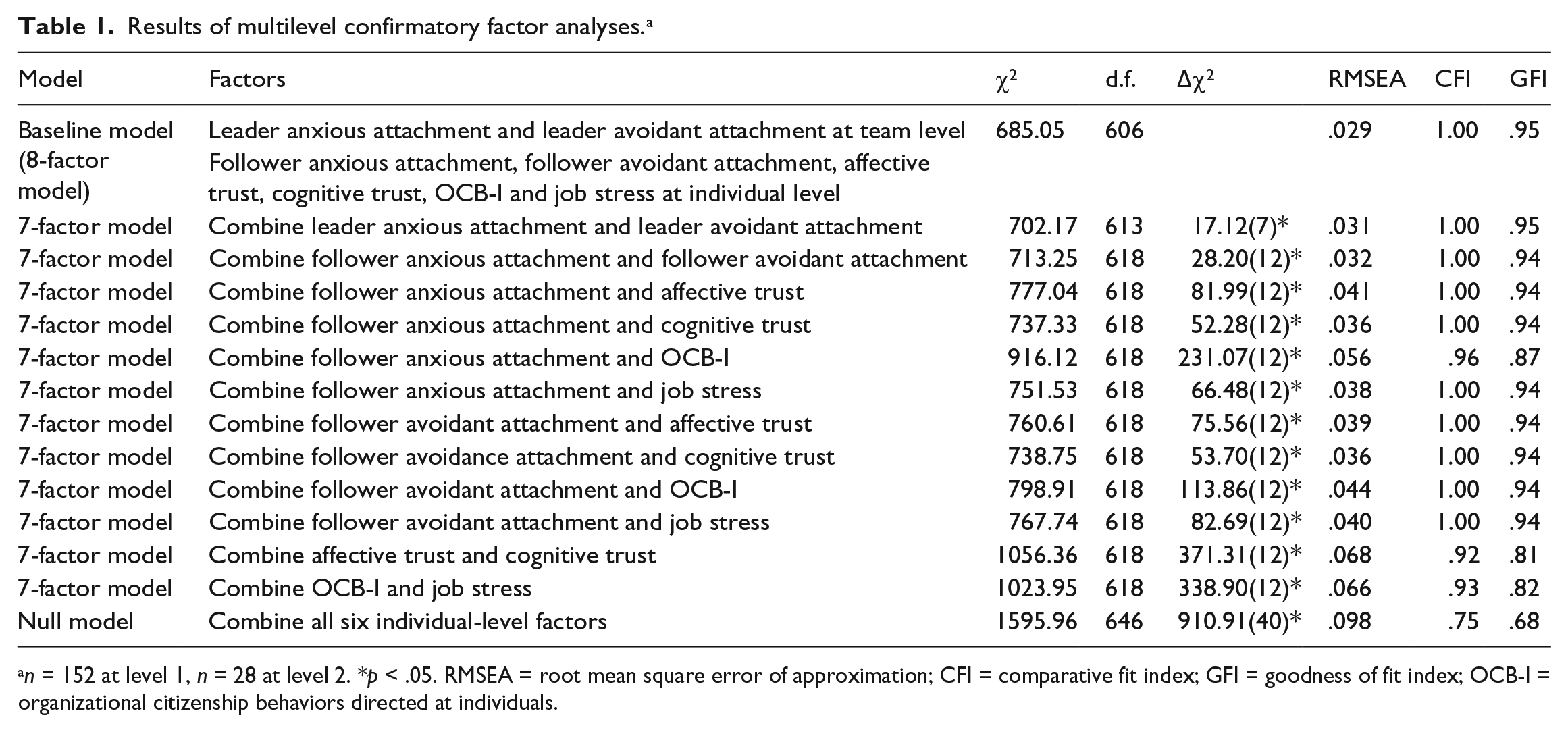
n = 152 at level 1, n = 28 at level 2. *p < .05. RMSEA = root mean square error of approximation; CFI = comparative fit index; GFI = goodness of fit index; OCB-I = organizational citizenship behaviors directed at individuals.
Descriptive statistics
A summary of the descriptive statistics and correlations among variables is presented in Table 2. The correlations between follower anxious attachment, follower avoidant attachment, trust, OCB-I and job stress were in the expected direction that follower anxious attachment was negatively and significantly related to cognitive trust (r = –.25, p < .05) and positively and significantly related to job stress (r = .26, p < .05). Follower avoidant attachment was negatively and significantly related to affective trust (r = –.20, p < .05) and OCB-I (r = –.30, p < .05).
Means, standard deviations and correlations. a

n = 152. Correlation coefficients > .17 as significant at p < .05. Numbers in parentheses on the diagonal were Cronbach’s alphas of the scales. SD = standard deviation.
F = follower; L = leader. Age was coded: ‘20–25 years old’ as 1, ‘26–30’ as 2, ‘31–35’ as 3, ‘36–40’ as 4, ‘41–45’ as 5, ‘46–50’ as 6, ‘51–55’ as 7, ‘56–60’ as 8, ‘above 60’ as 9.
Gender was coded: Male = 1 and Female = 2.
Sim = similarity; F-Anx = follower anxious attachment; F-Avoid = follower avoidant attachment; L-Anx = leader anxious attachment; L-Avoid = leader avoidant attachment; A-trust = affective trust; C-trust = cognitive trust; OCB-I = organizational citizenship behaviors towards individuals. All the variables were level-1, except leader’s age, gender, tenure, anxiety and avoidance were level-2.
Hypothesis testing
Because our hypotheses posited that both level-1 and level-2 predictors would be significantly related to the level-1 mediators (affective trust and cognitive trust) as well as the level-1 dependent variables (employee OCB-I and job stress), there had to be significant between-group variances in the mediators and dependent variables. Using HLM, we estimated a null model in which no predictors were introduced into either the level-1 or level-2 regression to test the significance level of the level-2 residual variance of the intercept (Γ00) and ICC. ICC can be interpreted as the proportion of variance in the outcome variable that resides between groups. The null model analyses revealed that: for affective trust, Γ00 = .47, p < .001, ICC = .21; for cognitive trust, Γ00 = .47, p < .001, ICC = .17; for OCB, Γ00 = .05, p < .05, ICC = .14; and for job stress, Γ00 = .35, p < .001, ICC = .20. These results showed the significant between-group variances of the outcome variables which justified the use of HLM testing for our hypotheses.
Table 3 presented the HLM results for testing our hypotheses. Hypothesis 1 predicted that follower anxious attachment would be positively associated with job stress. Among the control variables in M1 of Table 3, follower gender was significantly related to job stress. In M2, consistent with our Hypothesis 1, when controlled for demographics, follower anxious attachment was significantly related to job stress (M2: β = .05,p < .05), supporting our Hypothesis 1. Hypothesis 2 predicted that follower avoidant attachment would be negatively associated with OCB-I. In support of H2, M4 showed that follower avoidant attachment was negatively and significantly related to OCB-I (M4: β = –.05, p < .05).
Results of HLM analyses. a
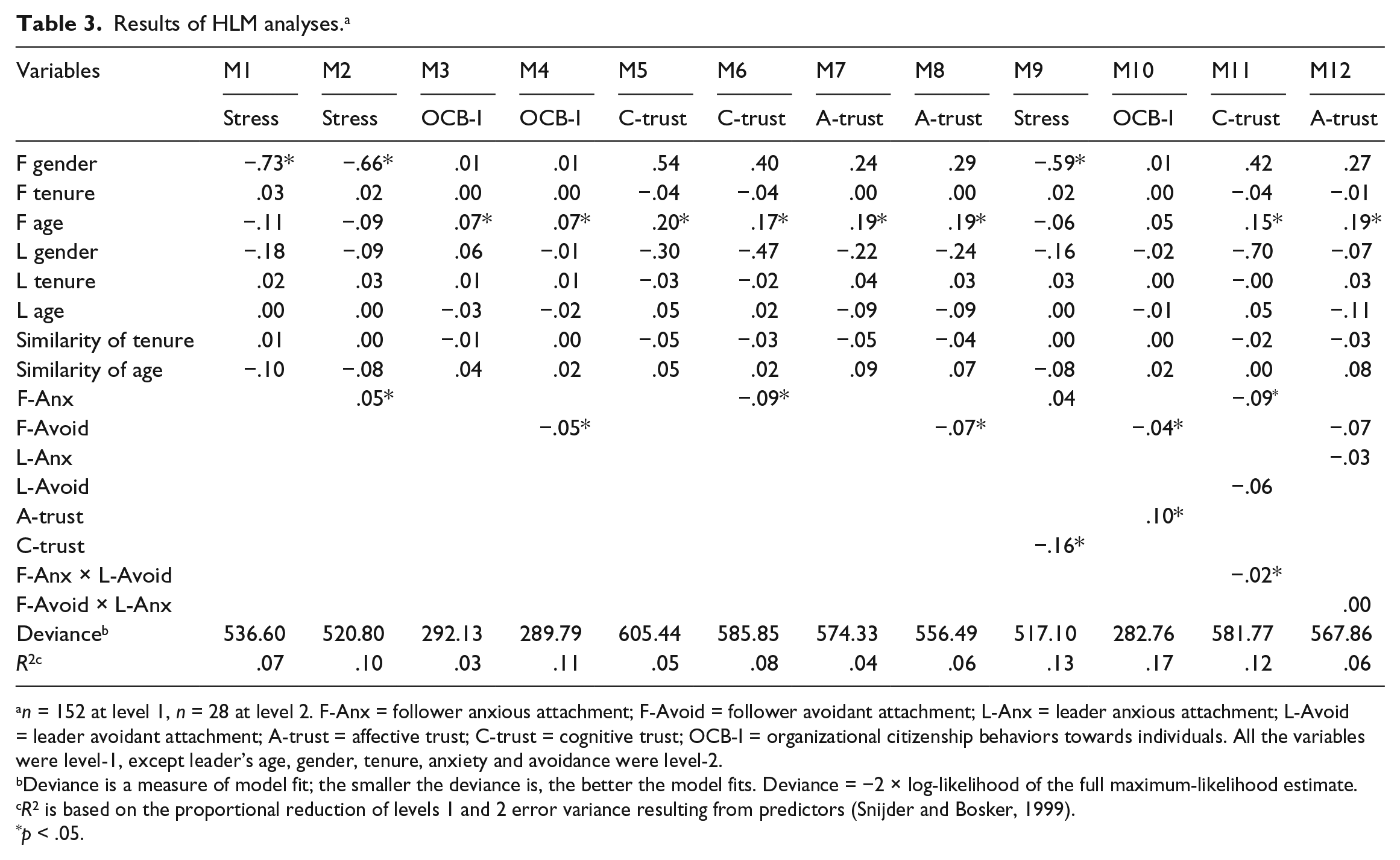
n = 152 at level 1, n = 28 at level 2. F-Anx = follower anxious attachment; F-Avoid = follower avoidant attachment; L-Anx = leader anxious attachment; L-Avoid = leader avoidant attachment; A-trust = affective trust; C-trust = cognitive trust; OCB-I = organizational citizenship behaviors towards individuals. All the variables were level-1, except leader’s age, gender, tenure, anxiety and avoidance were level-2.
Deviance is a measure of model fit; the smaller the deviance is, the better the model fits. Deviance = −2 × log-likelihood of the full maximum-likelihood estimate.
R2 is based on the proportional reduction of levels 1 and 2 error variance resulting from predictors (Snijder and Bosker, 1999).
p < .05.
Hypotheses 3 and 4 predicted the mediating role of cognitive trust and affective trust between the relationships of follower anxious attachment with job stress and follower avoidant attachment with OCB-I, respectively. We first used the conventional mediation test procedure from Baron and Kenny (1986). The first step was to test the effects of independent variables on dependent variables, as mentioned above, that follower anxious attachment was positively related to job stress (in M2) and follower avoidant attachment was negatively related to OCB-I (in M4). The second step was to test the relationship between independent variables and mediators, as also shown above, that follower anxious attachment was negatively related to cognitive trust (β = –.09, p < .05 in M6) and follower avoidant attachment was negatively related to affective trust (β = –.07, p < .05 in M8). The third step was to regress the dependent variables on both independent variables and mediators. As the results shown in M9, when both follower anxious attachment and cognitive trust were introduced, only cognitive trust was significantly related to job stress (β = –.16, p < .05), and the significant effect of follower anxious attachment on job stress in M2 became insignificant (β changed from .05, p < .05 to .04, p > .1). Thus, cognitive trust fully mediated the relationship between follower anxious attachment and job stress. In M10, when both follower avoidant attachment and affective trust were introduced, affective trust had a significant effect on OCB-I (β = .10, p < .05), and the significant effect of follower avoidant attachment became smaller, although still significant (β changed from –.05, p < .05 to –.04, p < .05). Thus, affective trust partially mediated the relationship between follower avoidant attachment and OCB-I. To further assess the significance of indirect effects of trust in leadership, a bias-corrected bootstrap procedure suggested by Preacher and Hayes (2004) was adopted. Bootstrap results (number of bootstraps = 1000) showed that the indirect effect of cognitive trust at the path of follower anxiety → job stress (γ = .02, 95% confidence interval CI = [.01, .05], not containing zero) and the indirect effect of affective trust at the path of follower avoidant attachment → OCB (γ = −.01, 95% confidence interval CI = [−.02, −.01], not containing zero) were both significant, confirming the mediating roles of cognitive trust between follower anxious attachment and job stress and affective trust between follower avoidance and OCB-I. On the whole, the results of these analyses supported Hypotheses 3 and 4.
Hypothesis 5 predicted a significant interaction pattern whereby follower anxious attachment would be associated with lower levels of cognitive trust when their leaders were higher on avoidant attachment. To test this, we followed the recommendation of Aiken and West (1991) for examining interaction effects. We introduced the main effects of follower anxious attachment and leader avoidant attachment and their interaction term (follower anxious × leader avoidant attachment) into the regression models of cognitive trust in M11. The hypothesized interaction of follower anxious attachment × leader avoidant attachment was significantly related to cognitive trust (M11: β = –.02, p < .05). Thus, follower anxious attachment and leader avoidant attachment had a negative interaction effect on follower cognitive trust. To understand the interactions we plotted follower anxious attachment and leader avoidant attachment at values one standard deviation above and below their means (Aiken and West, 1991). The plot of the interaction on cognitive trust is shown in Figure 2. The simple slopes of the regression lines shown in the figure were then tested. When leader scored low in avoidant attachment, there was no significant relationship between follower anxious attachment and cognitive trust (simple slope = .01, p > .1), but when leader score was high in avoidance, there was a significant, negative relationship between follower anxious attachment and cognitive trust (simple slope = –.20, p < .05). This supports Hypothesis 5. The same procedure was used to test the interaction effect of follower avoidant attachment and leader anxious attachment on affective trust (Hypothesis 6). However, in M12, the interaction term, follower avoidant attachment × leader anxious attachment, was not significantly related to follower affective trust (M12: β = .00, p > .1). Therefore, Hypothesis 6 was not supported.
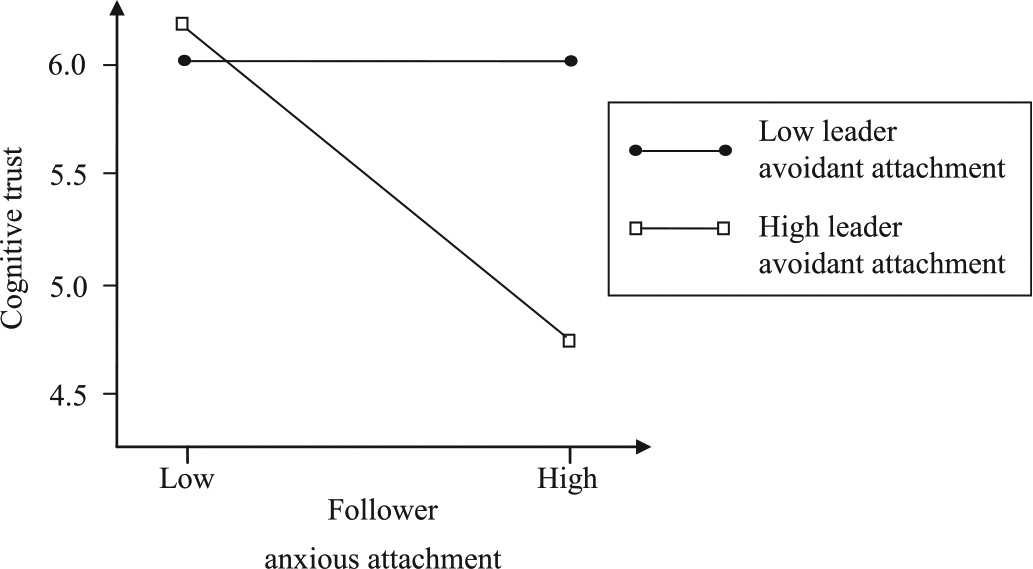
Interaction effect on cognitive trust.
To test the moderated mediation hypotheses (Hypotheses 7 and 8), we followed Edwards and Lambert’s (2007) moderated path analysis approach, which can simultaneously, rather than separately, examine the moderating effect and the mediating effect. Their approach statistically combines the moderation equation (see Equation 5, Edwards and Lambert, 2007) with the mediation equation (see Equation 4, Edwards and Lambert, 2007) into a larger equation (see Equation 9, Edwards and Lambert, 2007) to test the moderated mediation. This tests whether the indirect effect of the independent variable on the dependent variable through the mediator varies according to the level of the moderator. Our research model is consistent with Edwards and Lambert’s (2007) first-stage moderated mediation model that the moderator influences the relationship between independent variable and mediator as shown in Figure 1 (Edwards and Lambert, 2007; Preacher et al., 2007). As Hypothesis 6 was not supported, there was no need to test Hypothesis 8. For Hypothesis 7, the results showed that the link from follower anxious attachment to cognitive trust and then to job stress varied significantly as a function of leader avoidant attachment style. Specifically, the indirect effect of follower anxious attachment on stress was significant (indirect effect = .05, p < .05) when the leader scored high on avoidant attachment, whereas the indirect effect was not significant when the leader scored low on avoidant attachment (indirect effect = .00, p > .1). The difference of indirect effects between the two conditions was significant at the .05 level, which supports Hypothesis 7 that when anxiously attached followers have avoidant leaders they tend to report lower levels of cognitive trust in the leader and, in turn, higher levels of job stress.
Discussion
The present study aimed to advance our understanding of the role of personality in leader–follower relationships in a number of ways. First, by utilizing Bowlby’s (1982) attachment theory, we enlisted a rich theory rooted in biology, psychodynamic theory, evolutionary psychology and developmental psychology in order to advance our understanding of leader–follower dynamics. In it, we demonstrated that follower insecure attachment styles were predictive of both stress and OCB-I. Specifically, we found that follower anxious attachment was associated with higher levels of stress, and follower avoidant attachment was associated with lower levels of OCB-I. In addition, we demonstrated that both affective and cognitive trust mediated the relationships between attachment styles and the workplace outcomes under investigation. Specifically, cognitive trust partially mediated the relationship between anxious attachment and stress, and affective trust partially mediated the relationship between avoidant attachment and OCB-I. These findings not only support evidence found in prior research for the importance of attachment as an antecedent of important work outcomes, but also replicate and expand on prior findings (e.g. Simmons et al., 2009), demonstrating that they do so by fostering (or failing to foster) a close, supportive relationship with leaders.
Perhaps the most important finding in the present study was demonstrating that attachment theory could also explain how the characteristics of leaders foster positive and negative outcomes in their followers. We found evidence that the attachment styles of leaders could act as moderators of the attachment style–trust relationship in followers. Paralleling similar work in the romantic relationships literature (e.g. Simpson and Rholes, 2012), we demonstrated that the experience of lacking cognitive trust in leaders typically seen in anxious followers was only present when leaders were high on avoidant attachment and were unwilling or unable to provide the emotional support needed by their followers. Although we expected to find that the negative relationship between avoidant attachment and affective trust would be exacerbated by the presence of an anxiously attached leader, we failed to find support in our results. It could be that our research setting – restaurants with rotating shifts – did not force the avoidant followers to engage with their leaders enough to elicit a reaction of this sort. Further research in more intimate settings is therefore warranted.
Implications for theory and practice
The current study offers additional evidence that attachment orientation can play an important role in workplace behaviors, especially those related to interpersonal behaviors and emotional experiences. Not only was the current study able to demonstrate unique antecedents of affective and cognitive trust, but also that each of these mediated the effects of attachment on particular outcomes. In addition, our results suggest that the leadership literature needs to more fully address the nature of interpersonal dynamics between followers and leaders. That means not just assessing whether or not relationship quality has important outcomes, but also delving more deeply into the antecedents of those relationships. Moreover, our study is suggestive of the importance of supportive leadership in the workplace. Although the majority of followers tend to fall into the category of individuals who do not need constant reassurance from their leaders, there are a significant number who do. If these individuals do not get the support they need, the evidence suggests that they will not contribute as much as they could and may also experience psychological distress and related health disorders. More broadly, our findings are suggestive that more attention is needed to understand how congruence (e.g. Zhang et al., 2012) or complementarity (e.g. Grijalva and Harms, 2014) may influence interpersonal dynamics in the workplace.
A number of practical implications follow from this as well as from utilizing an attachment framework to understand leader–follower dynamics. For example, organizations could utilize attachment dimensions in their selection systems for supervisors with the goal of selecting individuals capable of engaging their followers on a personal level. Further, they could encourage supervisors with more displays of encouragement and support, or they could simply match followers to supervisors using attachment orientations to create optimal pairings. Another possibility is to utilize job design to ensure closer contact with supervisors for anxiously attached individuals who may experience a sense of loss when physically separated from their leaders. Finally, performance reviews could be conducted and delivered in a way that is salient of the fact that some followers may be particularly sensitive to feedback that may indicate that their leader has a negative perception of them. That is, they are suggestive of ways to strengthen the relationship rather than simply pointing out past behaviors that were seen to be disruptive or off-putting.
We are confident that as researchers become more familiar with attachment theory, they will find it to be an excellent source of potential research avenues for the future. For example, attachment theory postulates that individuals with a ‘secure base,’ whether it be a supportive supervisor or their own secure orientation, will be more likely to engage in exploratory behaviors. We would then expect that these individuals may be more willing to engage in creative activities or be more willing to transfer to overseas assignments. Another potential avenue for research would be to investigate how followers react to the loss of their current leader or colleagues (to retirement, transfer, etc.). Attachment theory postulates that individuals with different attachment orientations and available alternative attachment figures would react differently and may ‘mourn’ for varying periods of time. Essentially, wherever interpersonal processes are relevant for job outcomes, attachment theory could provide a solid theoretical foundation to build on. Finally, although the present study was not designed to address the issue, there could be workplace outcomes that may be particularly impacted when individuals are high on both anxious attachment and avoidant attachment (as opposed to other combinations). For example, one could speculate that such individuals would not only be hyper-sensitive to abuse from their supervisors, but would react with anger rather than sadness.
Limitations
Although the current study makes a number of advances over prior research, it does have a number of limitations. First and foremost is that there were few leaders in the current study. The ideal number is 30 teams with 30 employees in each team, although many statistical scholars have argued against this restricted benchmark with statistical simulations (Maas and Hox, 2005; Scherbaum and Ferreter, 2009). Nonetheless, we were able to find statistically significant effects in spite of the small sample in the current study. That said, future research with larger sample sizes is warranted. Second, the participants were relatively young and from a single industry. That said, these results broadly replicate those in other settings (e.g. Davidovitz et al., 2007; Simmons et al., 2009), and the youth of the participants may have made the leader-as-an-attachment-figure relationship particularly salient. Third, the measure we utilized may suffer from the problems associated with highly abbreviated measures such as lack of breadth in content (see Credé et al., 2012). That said, the measures we employed are well-validated and the constructs in question are very straightforward, so this threat to validity is diminished. Fourth, although the present mindset of participants was most relevant to the study, the fact that all measures were collected at a single point in time may have influenced results. Longitudinal replication would be helpful to boost more research avenues on this direction. Finally, the present study only investigated how leader behaviors triggered follower attachment patterns and reactions, but did not investigate how leaders respond to follower attachment-seeking behaviors. That is, we used self-rated leader attachment styles as an indicator of impersonal and unsupportive leadership behaviors, but did not assess these directly. Nor did we enquire about specific events that may have signaled to followers that a leader did not care for them. Future research could address these issues more directly in order to confirm the causal sequence implied in the present model.
Conclusion
The present study utilized a multi-trait, multi-source framework to evaluate the role of attachment orientation in determining workplace performance outcomes and job stress. Results demonstrated that both leaders’ and followers’ attachment orientations played a role in determining whether or not they formed trusting relationships and that the experience of trust mediated the effects of attachment on workplace outcomes. Our results were suggestive that leaders who are willing and able to provide social and emotional support to followers are particularly important for followers with anxious attachment orientations because the presence of such leaders may prevent the formation of distrust and the resulting negative outcomes. In other words, when the followers felt strongly that they needed support and reassurance from their leaders, only leaders who were willing and able to provide love and support would do.
Footnotes
Acknowledgements
We would like to thank R Chris Fraley for suggesting this line of research and Jeffry Simpson for his supportive comments and suggestions. We would also like to thank the anonymous reviewers at Human Relations and especially our editor, Neil Conway, for their helpful suggestions throughout the review process. The second author would also like to thank the CIBER center at Georgia Tech for the support as a visiting scholar.
Funding
This study was supported by a Youngstown State University Research Council Grant, National Natural Science Foundation of China (No. 71302073), China Scholarship Council, and the Research Fund for the Outstanding Young Researcher Training Plan of Fujian Province.