




Abstract
This study examines the alleged organization of violence by Coca-Cola through a field study conducted in a village in India. It draws on the works of Judith Butler to show how subaltern groups are derealized and made into ungrievable lives through specific, yet recurrent, practices that keep violence unchecked. Many participants attempt to resist derealization through protest activities that showcase their vulnerability. However, the firm appropriates their claims to vulnerability through a paternalistic discourse that justifies intensified violence and derealization. This research offers insights into accumulation through derealization and on the effects of resistance to it.
Recent studies of neoliberal capitalism have highlighted the centrality of economic accumulation through dispossession by businesses across the world (Harvey, 2003; Roy, 2012; Sassen, 2014). These contributions have drawn attention to the role of violent exclusion and expulsion of people in profit extraction. Although there are several studies on violence in organizations (e.g. Ironside and Seifert, 2003; Kelly, 1998), there are no detailed accounts of how firms sustain a sphere of violence within and outside their organizational boundaries, in spite of legal and juridical systems that should, in principle, exclude the possibility of this form of abuse. The reader interested in capitalist violence is thus left with a double puzzle: how can we explain the failure of the dispossessed to reclaim their rights and to keep violence in check? And how can we explain the failure of a legal framework that promises to treat dissenting citizens on an equal footing and to protect their basic needs? We propose insight into these puzzling questions through a field study of the resistance and violence at play in Mehdiganj, an Indian village where a Coca-Cola bottling plant started its activities in 1999.
We understand violence as a specific form of aggression that involves coercion, harm and injury. Our conception not only includes the use of physical force to injure someone, but also more insidious – and equally harmful – forms of non-physical and symbolic violence that make coercion unaccountable (Butler, 2004a, 2004b, 2009). Our analysis draws on Butler’s (2004a, 2004b) concepts of derealization and ungrievable lives to understand how violent accumulation remains unchecked.
The interest of our study is three-fold. First, it helps distant readers to refine their understanding of the mechanisms of power, resistance and violence involved in capitalist accumulation. We provide a thick case study that places violence at the core of the analysis and provides accounts of different participants. In a sense, our study echoes Spivak’s (1992: 46) exhortation to ‘let the subaltern speak’. It also responds to Banerjee’s (2011: 341) call for ‘more rigorous empirical accounts and ethnographic analysis of on-going conflicts over resources’.
Second, this research answers a puzzling theoretical question that is under-examined in general studies of organizations: through what practices is violence made possible in spite of a legal and administrative environment that should, in principle, protect the fundamental interests of local populations? In this respect, the case of India is telling. With a population of over one billion, India is considered as the world’s largest democracy. On paper, it has labour laws that protect workers, as well as institutions that purport to create accountability for those managerial practices that affect the social and ecological well-being of citizens. Yet, as our study indicates, these mechanisms of accountability are systematically ignored or perverted in the setting we examine – a situation that seems to be a common one in the Third World (Patnaik, 2013; Sassen, 2014).
Third, our study offers insights into the violent spiral that leads from derealization to violence, and to resistance, further derealization and unchecked violence. In the context of Mehdiganj, resistance to derealization reinforced, rather than replaced, the paternalist neo-liberal discourse through which villagers are derealized, and violence is condoned or even justified.
Theoretical framework
India continues to witness a coexistence of capitalist and pre-capitalist economic configurations and practices after its decolonization (Chatterjee, 2008; Sanyal, 2007). A large part of the private enterprise continues to profit from primitive forms of accumulation (Banerjee, 2011; Kaviraj, 1988; Sanyal, 2007). Marx (1976: 874) considered primitive accumulation to be capitalism’s external point of origin and described it as ‘the process which divorces the worker from the ownership of the conditions of his own labour’. Although Marx considered primitive accumulation a point of departure of capitalism, accumulation through violent dispossession remains common. Indeed, whenever dispossession is challenged through formal and informal forms of resistance (Böhm et al., 2008; see also Levy, 2008), corporations and neoliberal states respond by intensifying violence (Bernstein et al., 2008; Harvey, 2003; Sassen, 2014). Corporate violence, however, unfolds with a major contradiction under capitalism. Violence against people who count as humans creates grief and popular revulsion, and has led to the formation of widespread regulatory structures that restrict it (Butler, 2004a). This creates a contradiction between the rejection of violence and the necessity of violence for private accumulation. Corporations face, therefore, a challenge: how can they pursue their violent activities in spite of systems of control that purport to ban violence? We propose that corporations resolve this contradiction by relying on social and discursive processes of derealization through which the lives of victims are made ungrievable and their sufferings impalpable. We turn to the writings of Judith Butler to clarify and to develop this issue.
Violence
Butler recognizes the significance of physical coercion, and in addition offers a broader understanding of violence that also encompasses harm performed at the level of existential vulnerability (Butler, 2009: 170; 2006a: xxi), injurious speech (Butler, 1997), exclusion from representation (2004a?), and through deprivation (Butler and Athanasiou, 2013). Central to her analysis is the idea that violence is often inherent to normative or epistemic frameworks. A violent response,
. . .does not ask, and does not seek to know. It wants to shore up what it knows, to expunge what threatens it with not-knowing, what forces it to reconsider the presuppositions of its world, their contingency, their malleability. (Butler, 2004b: 35)
Accordingly, normative and epistemic stances define ‘ontological commitments’ to separate grievable lives that count from ungrievable lives that do not count and over which violence is justified (Butler, 2009: 156).
In an explicit engagement with the question of labour and capitalist violence, Butler further observes that,
. . .we have to be able to think about the arbitrary and violent rhythms of being instrumentalized as disposable labor: never knowing the future, being subjected to arbitrary hirings and firings, having one’s labor intensively utilized and exploited and then enduring stretches of time, sometimes indefinite in which one has no idea when work might come again. Subjection to such violent rhythms produces that pervasive sense of a damaged future to which Lauren Berlant refers, but also a radical helplessness in the face of no health insurance and no clear sense of whether permanent shelter can be maintained. (Butler and Athanasiou, 2013: 148)
Such acts of violence can be perpetrated with ‘indifference or even righteousness’ because these underclass lives have been annulled (Butler, 2009: 41).
In summary, violence is broader than physical force. Therefore, we refer to violent phenomena through diverse concepts such as coercion, harm, threat, deprivation and derealization. Violence is intricately linked with the limitations of epistemic and normative frameworks that define which lives count as real and grievable, and which do not. In the following section, we review Butler’s examination of derealization in connection with violence, grief and resistance.
Derealization, ungrievable lives and resistance
According to Butler, ‘derealization’ occurs whenever particular identities are excluded from discourse, with the effect of creating ungrievable lives. Whereas subordinate identities are deemed inferior, derealized identities are even more fundamentally excluded because they do not fit recognizable categories through which subjects may vindicate rights, express needs or even claim existence as human beings. Butler attends, for instance, to the derealized identities of Guantanamo prisoners who fall through legal and media discourses (Butler, 2004a, 2009) and of transgendered persons who present challenges both to patriarchal and to feminist discourses (Butler, 2004b). Her analyses focus on the violence inherent to and caused by practices of derealization.
Derealization is in itself an act of violence operating at the symbolic level by negating, criminalizing or pathologizing unrecognizable identities. Thus, derealized subjects are deprived of the ability to give an account of themselves fully as human beings. Derealization is also conducive to further violence, including physical violence, in several ways. First, derealization motivates further violence when the existence of subjects who do not fall into dominant categories is perceived as a dangerous subversion of the social order. Hence, Butler interprets the desire for physical violence against ‘deviant’ sexual identities as ‘a vain and violent effort to restore order, to renew the social world on the basis of intelligible gender, and to refuse the challenge to rethink that world as something other than natural or necessary’ (Butler, 2004a: 34).
Second, derealization operates as a condition of possibility for further violence by making it acceptable. Thus, even when state institutions such as the police or tribunals do not perform physically violent acts against unreal persons, they may allow such violence to remain unchecked. Although an explicit rejection of violence is constitutive of liberal discourse and institutions, violence is seldom interrupted against those who are made unreal (Butler, 2004a). Thus, violence against the ungrievable remains all too often unaccountable and unpunishable in tribunals, or in police investigations or even in public discussions.
Ellipses of public discourse provide liminal sites where derealized identities and violence are relegated. As Butler remarks about a newspaper’s refusal to publish an obituary for Palestinian victims of Israeli armed forces: ‘it is not just that a death is poorly marked, but that it is unmarkable. Such a death vanishes, not into explicit discourse, but into the ellipses through which public discourse proceeds’ (Butler, 2004a: 33, emphasis added). This foreclosure of violence and its victims operates as an attempt to maintain social order. At the same time, it also tends to generate spirals of resistance and paranoia followed by intensified violence.
Butler is conscious that derealized persons are not passive victims, and they resist violence in different ways. She observes (Butler, 2004a: 33), ‘[they] have a strange way of remaining animated and so must be negated again (and again)’. Unreal people continue to breathe, to occupy a space, to speak, and to bond, even when their lives are ignored, their bodies are segregated, their language remains unintelligible to the powerful, and their rights of association are negated. Moreover, derealized persons produce resistance by forming associations through which they bond, develop counter-discourses that render them intelligible (at least among each other), and through which they may countervail derealization to claim their rights.
The persistence and perceived resistance of the derealized may create feelings of paranoia for those who identify with dominant discourses. In the case of the US invasion of Iraq, Butler (2004a: 33) remarks that ‘the derealization of the “Other” means that it is neither alive nor dead but interminably spectral’. The spiral of violence is thus maintained and intensified as ‘the infinite paranoia that imagines the war against terrorism as a war without end will be one that justifies itself endlessly in relation to the spectral infinity of its enemy’ (Butler, 2004a: 33).
Butler (2014) further reflects on how actors resist derealization by showcasing their vulnerability. 1 Accordingly, whenever people resist derealization, they put themselves in situations of heightened vulnerability to violence and retaliation (Butler, 2014: 17). Yet, through public displays of vulnerability, they also reaffirm their reality as human subjects endowed with needs and desires, reflexivity and irony (see, for instance, the discussion of poems written by Guantanamo detainees in Butler, 2009: 55–62).
Butler (2014: 15–16) warns, however, that the signifier ‘vulnerability’ is prone to paternalist appropriation by dominant groups: ‘once groups are marked as “vulnerable” within human rights discourse or legal regimes, those groups become reified as “vulnerable”, fixed in a political position of powerlessness and lack of agency’. Although some of the injuries may get repaired, the political agency of the so-called vulnerable populations gets effaced. Even more perversely, claims of vulnerability can and are also made by dominant groups to silence protest (Butler, 2014). Through this ideological seizure and reversal, vulnerability may operate to expand and rationalize inequalities. Despite these limitations, Butler (2014: 15) remains hopeful that displays of vulnerability can be effective in limiting dominance by creating renewed forms of agency that depart from the masculine ideal of a political subject who establishes agency by denying his/her vulnerability (Butler, 2014) and/or by engaging in violent action (Butler, 2006b).
In summary, Butler’s framework is particularly relevant for the present study of corporate violence as it provides a theoretical prism that highlights specific processes through which derealization leads to unchecked violence, diffused resistance and paranoid reactions that generate, in turn, intensified violence.
Research context and method
India is the second most populous country in the world, with about 1.2 billion citizens. Although it experienced a compound annual growth of over 7% between 2003 and 2010 with a recent slowing down, this growth was mainly concentrated in urban areas. The country has high levels of poverty, and many have argued that the inequality and destitution resulting from being a Third World capitalist state have created a large reserve army of docile workers (e.g. Patnaik, 2013). Moreover, rural areas were subjected to systematic disinvestment from the state, leading to striking impoverishment and the reported suicide of circa 200,000 peasants over a period of 15 years from the 1990s (Sainath, 2010). This has resulted in a sense of neglect and injustice across rural India (Sainath, 2010; Sharma, 2009). This feeling of unfair treatment by the state, corporations and urban elites forms a leitmotiv in the narratives of protest collected during our fieldwork.
We conducted our study in the village of Mehdiganj, which has a population of approximately 12,000 and is primarily comprised of Patels (a community of weavers). Most villagers make their living from agriculture: wheat, rice, pulses and sugarcane are the main crops grown in this region. Many farmers and activist organizations in and around Mehdiganj are protesting against a Coca-Cola bottling plant located in the region. The most contentious issue is access to water. Farmers claim that Coca-Cola has been siphoning around 2.5 million litres of underground water every day, reducing their access to underground water meant for farmland irrigation. Water scarcity is a serious problem in the region since much of irrigation depends on rainfall, which has been below normal for the three years preceding our study (i.e. before 2005). Other complaints include poor management of waste, pollution of neighbouring agricultural land, encroachment of farms, bribing of local officials and poor treatment of workers.
Data collection and analysis
We started this research with the broad objective of trying to understand the protest and resistance movement against Coca-Cola emanating from Mehdiganj. We collected data in various forms with the help of a research assistant and used a number of methods for one year in 2005–2006. We began the study by examining and analysing information brochures, media articles and websites providing news about the anti-Coca-Cola protest in Mehdiganj. We identified Lok Dal (People’s Association) that was spearheading the resistance movement in the region, Gaon Bachaon Dal (Save the Village Association) and Azad Banao (Create Freedom) as the three organizations protesting against Coca-Cola in and around Mehdiganj. We have used pseudonyms to disguise the real names of these organizations and of our participants. Lok Dal is part of Lok Andolan, a Gandhian organization that seeks the larger goal of sarvodyaya or collective welfare. Similarly, Azad Banao is another Gandhian organization that explicitly pursues Gandhi’s vision of swaraj (independence) and swadeshi (local production). These organizations operate primarily in North India, and for nearly three decades their activities have focused on espousing Gandhian ideals and the swadeshi ideology.
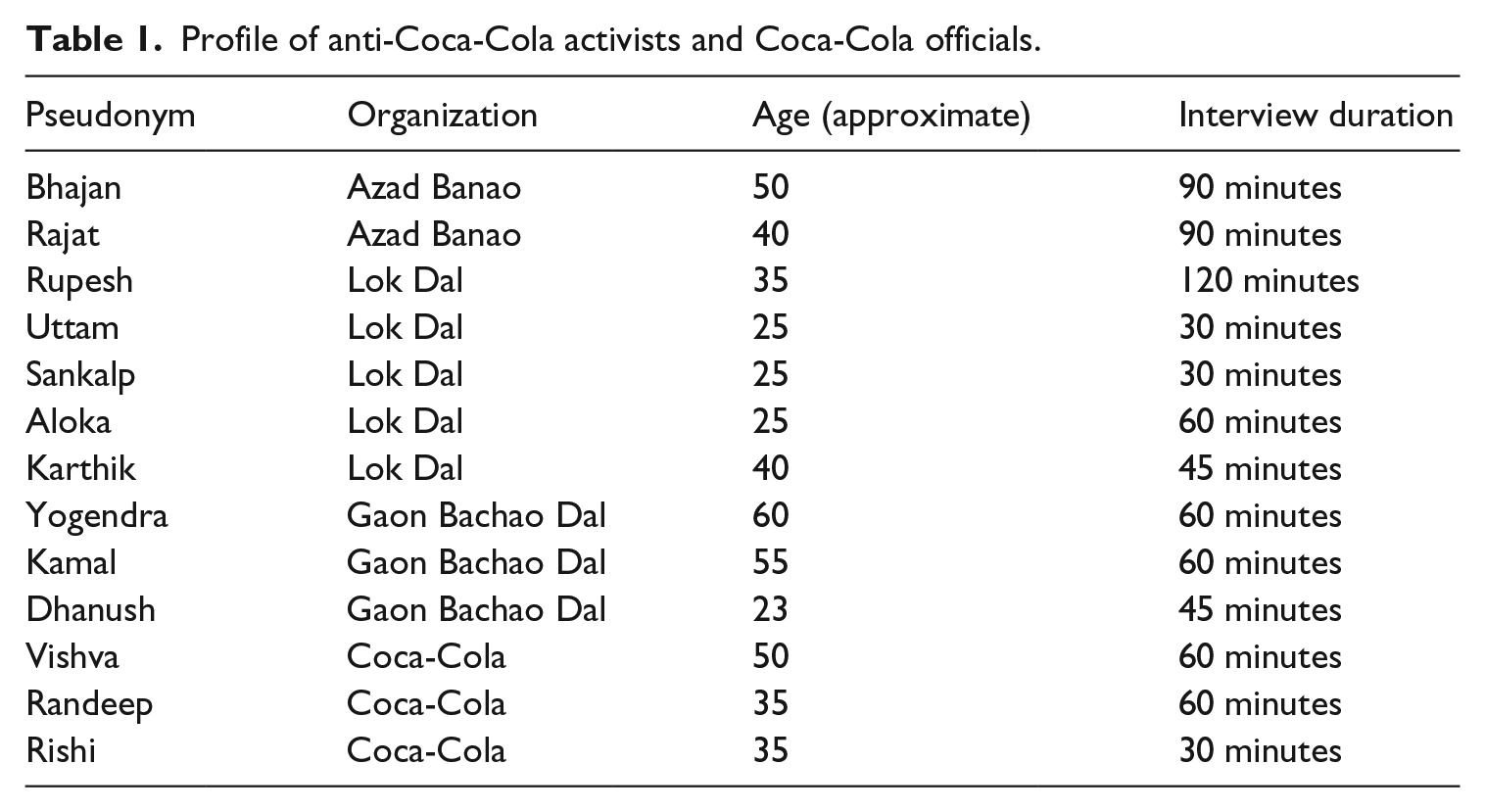
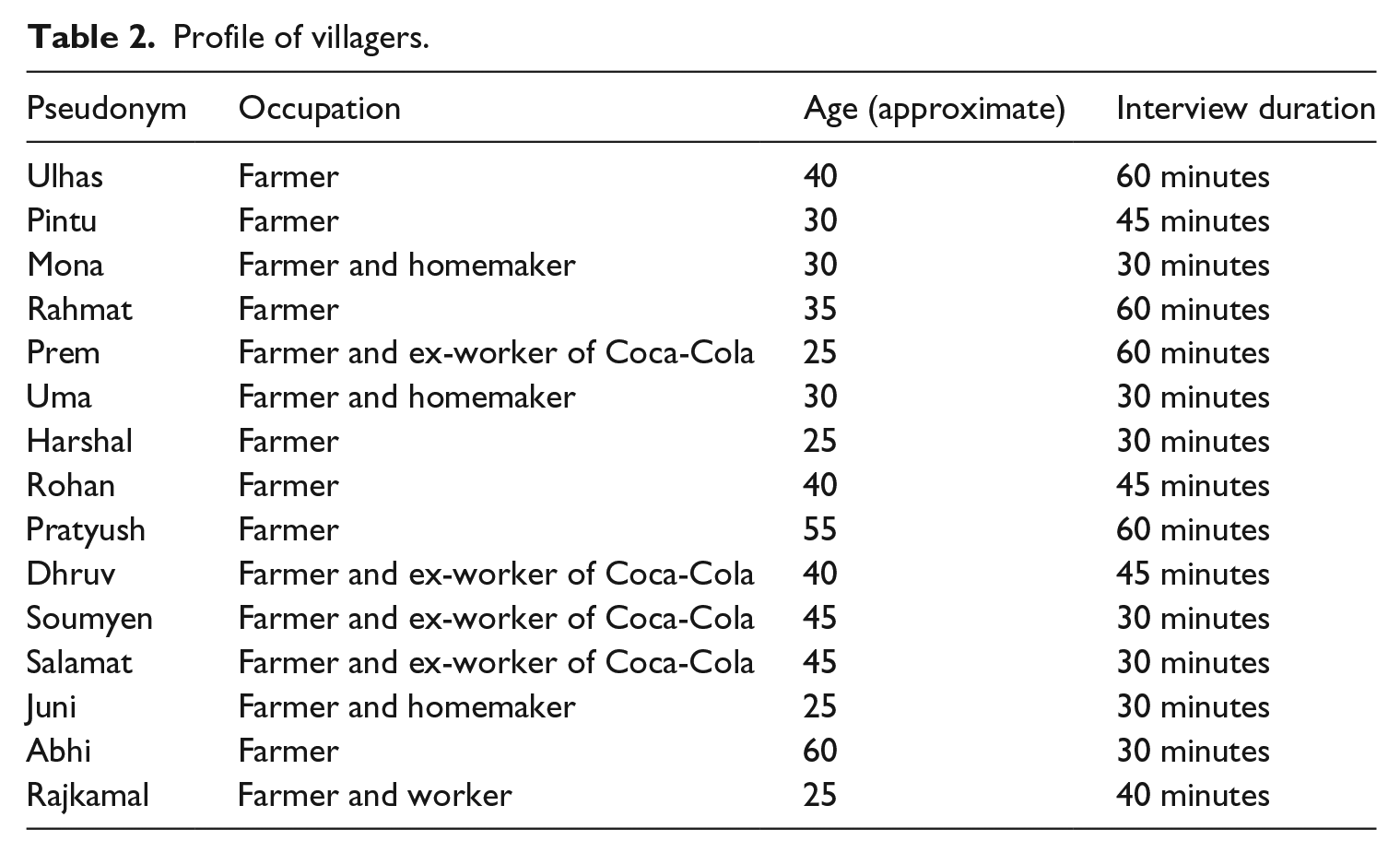
We visited and observed protests and other activities of anti-Coca-Cola activists by way of non-participant observation in Mehdiganj and neighbouring villages. Additionally, we conducted 28 unstructured interviews. Ten of these involved activists (see Table 1), giving representation to each of the organizations. We questioned these activists about their reasons for opposing Coca-Cola and their understanding of the forms of resistance at play. We also conducted 15 interviews with villagers and workers/ex-workers of Coca-Cola in Mehdiganj and surrounding villages to understand their views on the protest and the reasons for it (see Table 2). We conducted these interviews in Hindi, and transcribed and translated them into English. We started our primary data collection by interviewing an activist of Azad Banao, who was an old acquaintance. This activist gave the reference of Lok Dal and its key leader. In our subsequent visits to Mehdiganj, we interviewed some participants initially through Lok Dal and then independently as we became more familiar with the setting. Following qualitative research conventions, our sample plan was purposeful, looking at various relevant actors in the resistance movement.
Profile of anti-Coca-Cola activists and Coca-Cola officials.
Profile of villagers.
In addition, we visited the Coca-Cola bottling plant and observed the operation of the plant during a non-production period. This gave us an opportunity to understand the water extraction, cleaning and disposal processes of the plant. We interviewed three officials associated with the firm and the bottling plant, questioning them about the allegations made by the villagers, activists and workers to elicit their versions of events. These interviews were not audio-recorded as the managers did not allow recording. However, we were allowed to take notes when they spoke with us.
We conducted our interpretation of the interviews through a hermeneutical process that involved continuous movement between transcripts and the emerging understanding of the entire data set. Our analysis required repeated iterations between text and context until we could understand participants’ narratives in connection with the broader world with which they engaged (Gadamer, 2004; Prasad, 2005). For example, after some activists informed us about satyagraha against Coca-Cola, we read up on Gandhi’s writings and other historical sources (Gandhi, 1982 [1927], 1997; Sarkar, 2000) to understand its origins and logic. Moreover, we searched some of the activist websites and journals to understand their deployment.
From the continuous movement between text and context, more specific research questions started to emerge, as well as possible ways to answer them. In particular, we were intrigued by the tension between, on the one hand, the darkness of activists’ and villagers’ narratives and, on the other hand, the dutifulness conveyed by Coca-Cola management and the inconclusiveness of villagers’ legal actions. After considering several frameworks, such as Marxist false consciousness and Foucauldian power/knowledge, we found that Butler’s reflections on derealization allowed us to highlight crucial, yet neglected, processes through which violence is used to quell resistance.
Findings
We begin this section by taking stock of the violent practices performed, or mandated, by Coca-Cola to make profits and subdue resistance. We then examine the practices of derealization that allow violence to remain unchecked in spite of institutions and ideologies that should impede it. We also follow protestors’ attempts to resist derealization by publicizing villagers’ vulnerability, which generates paternalistic and paranoid appropriations of vulnerability by Coca-Cola and creates intensified violence.
Violence in Mehdiganj
The bottling plant comprises buildings and open areas delimited by high walls covered with barbed wire and controlled by security guards. Inside the plant, workers work on an impressive automated bottling machine. The overall atmosphere evokes order, discipline and cleanliness. Those occupying managerial or professional positions have offices and wear Coca-Cola branded shirts. Several workers monitor the machines and prevent potential blockages. Randeep, a Coca-Cola manager, proudly informed us that they employ ‘15 deaf and dumb workers as a form of social responsibility’. One interpretation is that Coca-Cola recruited these differently abled workers for philanthropic reasons. Another interpretation, which our subsequent observations confirm, is that ‘deaf and dumb workers’ provide an ideal workforce that fits management’s expectations of docile and silent employees.
Work outside of the bottling room is far less capital intensive and includes tasks such as cleaning individual bottles manually. Here, workers squatting around large tubs of soapy water clean bottles. These workers are paid extremely low wages – below the minimum wage of US$2/day – and are closely monitored by supervisors. Salamat, a Coca-Cola employee who worked in the cleaning section, informed us, ‘They do not give gloves to everyone. They only give them to one or two workers. The hands get burned [while cleaning the bottles with chemicals].’ Salamat further told us that he is not entitled to question his working conditions, and highly distrusting Coca-Cola officials interpret any enquiry as a sign of dissent and brand it as a union activity. If he complains about hazardous work conditions, Coca-Cola management will construe it as resistance for which they can fire him. He told us that ‘unionbazi’ (union activity) is one of the most common grounds for dismissal. He was paid only INR 0.75 for cleaning 24 bottles with ordinary stains and INR 1.5 for cleaning bottles with rust stains. Salamat could barely earn INR 60 (US$ 0.9) from a day’s work. His poverty level did not allow him to risk posing questions to the Coca-Cola management.
Furthermore, the local villagers informed us that Coca-Cola is extracting underground water in excess and is polluting their farms. This makes farming, which is the primary source of livelihood in the region, economically unviable (see also Sainath, 2010). Harshal, a farmer in the neighbouring village of Bhikaripur, told us that Coca-Cola has been discharging wastewater near his farm, severely affecting crops and the fertility of the land. We visited this particular pond and found the water to be almost black in colour, yet there was no way of ascertaining the claims of the villagers. While we were examining the pond, a group of 15–20 villagers came to us and started blaming Coca-Cola for allowing its wastewater to accumulate in their fields. Harshal took us to his neighbouring farm and brought some freshly harvested wheat, black in colour, to show the harmful effects of the wastewater. These farmers believed that Coca-Cola was violating the law and polluting their farms. However, they felt helpless, and observed that they did not have the means to get their voices heard and to challenge the corporation.
These forms of economic and ecological violence coexist with physical and verbal abuse (see also Chatterjee, 1983) that come in a mix of bullying, physical threats, false legal charges and paternal condescendence. Ex-workers and activists further informed us that Coca-Cola’s unwritten code of discipline does not allow for the formation of a union, and any attempt to form such a collective invites coercion. Ex-workers claim that the state–Coca-Cola collusion and use of violence scuppered their attempts to form a union. Several villagers and activists informed us that some workers, under the leadership of Dhruv, a plant employee, tried to form a union. Dhruv informed us that they met the state agencies responsible for registering their union and got support within the plant from most workers. However, Coca-Cola came to know about the development and immediately fired Dhruv and the group of workers close to him. Accordingly, a large group of workers from another state were brought in to replace the local workers. These migrant workers were expected to be more pliant and submissive. Moreover, the local workers were framed in legal cases of violence, which Dhruv claims were utterly false. He further informed us that the workers never got their jobs back and were continuously harassed by the police because of the false legal cases filed against them.
We further found that after active resistance started against Coca-Cola in 2002 there has been an intensification of violence. In the first three years of operation of the plant, Coca-Cola was seen as a benevolent sovereign who would patronize the region and help it to prosper by providing economic opportunities for the villagers. However, the alleged violation by Coca-Cola of labour and environmental laws led to protests by activist organizations. Coca-Cola responded to this resistance by dismissing workers and by mobilizing state violence. The following citation from a pamphlet issued by Lok Dal provides an illustrative account:
The people of Mehdiganj have been holding peaceful protests against Coca-Cola according to the norms of democracy ever since they started to see the deadly dangers it is spreading in the whole area. The Mehdiganj panchayat [village council] had unanimously passed a resolution to cancel the license of the company in May 2005. But the state government behaved as a domestic dog of the company and used brutal violence on the peacefully protesting people of the place and on their supporters, beating up men and women alike, locking them up and suing them in the court with fake criminal cases.
The above text refers to the recourse to violence by police on 24 November 2004 when protesters were peacefully marching on the streets of Mehdiganj, and the police launched a baton charge and brutally beat up the men and women participating in the protest. They dragged several participants on the road, dumped them inside police vehicles, and took them away from the site. The police jailed many protestors for their participation in the rally. Despite the firm’s denial, activists and villagers allege that the state conducted the attack at the behest of Coca-Cola. They claim that police violence could not be inspired by concerns about security since the rally was pacific and non-violent. Coca-Cola officials claim, however, that the protestors were planning to vandalize the plant and to destroy their property.
In addition to violence exerted by police forces, villagers accused Coca-Cola of recruiting a number of spies and hit men from a neighbouring village. Rohan, a farmer in Mehdiganj, informed us that:
There is a lot of poverty in this area. The Yadavs [a caste group] share a great relationship with Coca-Cola. They are agents of Coca-Cola, and if you say anything against Coca-Cola, they will thrash you (utha ke patak daingey). This fellow is a Yadav [almost whispers and points towards a stocky man, in his early thirties, who was moving just outside the tent] and is an informer of Coca-Cola. He keeps an eye on the activities that are happening here and reports to Coca-Cola. He will tell whether the dharna [protest meeting] is going on or has stopped, how many people and who has visited the tent of protestors … Some tell me that any day you will get killed and then you will realize. This company has lakhs and crores of rupees [millions and billions of rupees], it can do anything to a small fry like you.
Rohan hints at the constant threat of physical violence that subaltern groups in Mehdiganj live with and how Coca-Cola uses to its advantage the caste divide between Patels and Yadavs in the region. Most local activists against Coca-Cola were Patels, including the leadership of Lok Dal. He reports that Coca-Cola has an extensive system of surveillance that involves a network of spies. These spies are recruited from the village and provide information on resistance activities to the corporation. Rohan believes that the continuous threat of violence makes it extremely difficult for activists to form an effective resistance campaign against Coca-Cola.
In summary, we found violence to be an important part of the operation of Coca-Cola in Mehdiganj. Coca-Cola initially perpetrated violence by creating exploitative working conditions, threatening recalcitrant workers, withdrawing excessive water and polluting the fields of neighbouring villagers. However, as voices of resistance against Coca-Cola grew louder in the region, violence also intensified. To understand the persistence of violence in spite of discursive and institutional frameworks meant to impede it, we now examine the practices of derealization at play in Mehdiganj.
Practices of derealization
We analyse the derealization of the people of Mehdiganj both as a cause and as a consequence of recurrent practices that deny their needs and rights. Derealization is a form of violence and, in making lives ungrievable, it also allows intensified coercion (Butler, 2004a). We identify three practices through which Coca-Cola negates lives: influencing official reports, the threat of the sack and disempowering panchayats (village council). These practices create unchecked corporate violence through derealization of dispossessed farmers, protesting workers and active citizens.
Derealizing dispossessed farmers by influencing official reports
We collected accounts of dispossession of natural resources that were articulable in villagers’ private accounts while being systematically excluded from legally acceptable accounts. Villagers question the clearance given by the state pollution-control department to Coca-Cola, and claim that the firm has sufficient financial power to buy the government machinery and influence their findings. The villagers claim that Coca-Cola’s managers refused to listen to them whenever they approached them. Rahmat, a farmer, indicated that when he tried to approach a Coca-Cola official, who had come to assess the quality of wastewater, he was told rudely, ‘hamara dimag mat kharab karo [don’t trouble me]. Hato rasta chodo [get out of my way]’. Anti-Coca-Cola activists and villagers accuse Coca-Cola of fraudulent practices, and of bribing local village and state officials to gain support. According to Lok Dal’s Rupam, ‘Coca-Cola bribes panchayat officials by giving them mobile phones, clothes, utensils, and by providing them with hand pumps’. For instance, villagers believed that in order to show that Coca-Cola was not having a harmful impact on the local environment, government officials, in collusion with the firm, collected only samples of good water and soil for testing. Rahmat further claimed that:
They collect good water from the hand pump. One fellow was taking water, and I asked him why he was taking good water. Then he said for testing. They fill good water from hand pumps and wells and collect good soil from the fields.
The decline of underground water exacerbates the problem of access to water in the region. Several farmers complained that the underground water levels had gone down in the last decade, and there was a risk of the extinction of aquifers. Farmers blame Coca-Cola for their plight and claim that the firm is siphoning millions of litres of water every day with its powerful pumps. Yogendra, a farmer and a member of Gaon Bachaon Dal, informed us, ‘It used to take five hours to irrigate my farm earlier. Previously water level was high now it has gone down, it takes more time to irrigate my farm. It sometimes takes 15 hours’. Another farmer Ulhas informed us:
There used to be water everywhere when we were kids. We used to go to school in water. There used to be a lot of rain now there is no rain. Water was available at 25 to 30 feet; now it is available at 150 feet. In our area of Mehdiganj, people are very much affected by Coca-Cola. It has bored a 500–600 feet deep well that draws a lot of water.
These farmers believe that Coca-Cola and the state have dismissed their concerns, and their resources are taken away by a large private enterprise. Although independent hydrological reports produced by university professors corroborate the claims of villagers, the latter do not have access to the data collected by the state authority and have no ability to make claims that can withstand legal scrutiny. When we tried to get the data on underground water from one of the offices in a nearby city, we were asked to go from one desk to another and then from one office to another office before being told to go to the state capital to get the data. Despite these efforts, we could not get the data.
Derealizing protesting workers through the threat of the sack
We found that the threat of the sack is actively used as a form of violence to silence the work force and to derealize subalterns, whose pleas remain in the ellipses of public discourse. Coca-Cola keeps its workers under a continuous threat of the sack, a threat that acts as a potent silencing mechanism in conditions of high unemployment. Prem, an ex-Coca-Cola worker, confirms Salamat’s testimony (supra) on the systematic threatening of those claiming their labour rights:
Minimum wage is more than Rs 90/- [1.5 US$] per day.
They pay Rs 75/- inside the plant and Rs 60/- outside the plant.
Don’t you protest for minimum wages?
If someone protests then he is told that he is indulging in union activities and is thrown out … A lot of people come here for work, and sometimes they get work, but mostly they are made to stand in front of the gate [and are not given any job]. Workers work under contractors, and all contracts go to people who are very powerful. Coca-Cola exploits its workers. Instead of the usual eight hours, workers are forced to work for 12 hours [without any overtime payment]. Still, there is so much poverty and unemployment that people come here for work.
Prem’s account indicates that Coca-Cola can get away with the exploitative conditions and violence because of poverty and unemployment levels in the region. The expression ‘a lot of people’ is an important part of this narrative as it refers to a reserve army of workers that renders demands for better working conditions ineffective.
We concur with Patnaik’s (2013) observation that in such settings, ‘the place of the Monseigneur’s whip is taken by the threat of the sack. Anyone who is suspected to be a laggard is given the sack and the fear of this happening makes people work’. Thus, physical coercion is not needed to silence workers, and violence in the form of threats can create the desired outcome of a docile workforce. Villagers further informed us that Coca-Cola got workers from outside Mehdiganj to lower the bargaining power of the local workers. Soumyen told us: ‘Workers are getting low wages. People are also not getting jobs. Biharis (from another state) are working after coming here … Local people are not getting jobs and people of Bihar are coming and are working’.
Villagers further recalled that when an attempt was made to form a union by some of the workers, Coca-Cola fired them and got workers from outside as replacements. Since most of these were temporary contract workers, it was easy for Coca-Cola to fire them without any legal liability. The workers coming from outside the region have no local linkages and support groups, and help Coca-Cola to drive down the wages without much resistance.
When we questioned a Coca-Cola manager about wage payments, he told us that the firm pays the wage bill to the contractors according to the minimum wage law. In this instance, responsibility is again passed to the contractors hiring workers. According to Indian law, the responsibility to pay minimum wages is shared by contractors and principal employers (namely, Coca-Cola). However, as with other aspects of the case, workers claim Coca-Cola overlooks this legal responsibility, while state officials continue to ignore violations. Similarly, during one of our visits to Mehdiganj a worker who had developed skin problems on his feet was brought to us. We could see that his feet were covered with blisters, and he was in visible pain. He and the activists told us that in the process of working at the Coca-Cola plant the chemicals used for cleaning the bottles went inside his shoes and caused the skin problem. The plight of such workers is a standard part of public speeches given by anti-Coca-Cola activists but is ignored by the state authorities and dismissed by Coca-Cola management.
Workers believe that state officials are broadly aware of such instances of legal violations but choose to overlook them in favour of more powerful business interests. And under the threat of losing their jobs, workers have no choice but to maintain silence on the violence they face from Coca-Cola.
Derealizing active citizens by bypassing panchayats
Our field study revealed that the pleas of villagers against violence do not circulate through political institutions. The result is an elliptic public discourse that can hardly be mobilized by subaltern groups, whose lives are made ungrievable.
The problems in Mehdiganj have to be understood in the context of subaltern groups’ disenfranchisement. In India, the panchayat or the village council is the basic state body and is responsible for administering a village. In the 73rd Amendment to the constitution in 1992, panchayats were given a constitutional status with the state rhetoric of making it the cornerstone of local self-governance. These panchayats are administered by blocks, which in turn are managed by taluq and district-level administrative bodies. The villagers elect members of a panchayat, including its Pradhan (President), through a secret ballot. Despite the promises of self-governance and deepening of democracy, it is widely accepted that panchayats remain weak institutions with little power to govern their constituencies (Upadhyay, 2002).
Access to panchayats plays a critical role in local confrontations and political mobilizations. The subaltern groups in Mehdiganj complained that their access to such institutions and their ability to mobilize support were limited. Several participants told us that the panchayat in Mehdiganj refused to register their complaints against Coca-Cola. They claimed that Coca-Cola regularly bribed the Pradhan and other members of the panchayat. We also found that certain segments of the village are without any voice mechanism. These subaltern groups comprising women and lower caste groups believe that a patriarchal and caste-based system disenfranchises and silences them (see Spivak, 1988). Uma, a resident of Bhikaripur, said that she could not lodge a complaint against Coca-Cola to the village panchayat because she was a woman:
We are women, how can we speak? They do not listen to us. We do not know what happens. People who are not getting affected [by Coca-Cola] go and make speeches that there is no harm [owing to Coca-Cola]. They do not know anything, and they speak on our behalf … Whoever benefits, people who are getting saris, whose crops are not getting destroyed, they are telling that Coca-Cola is good.
Uma further reveals that Coca-Cola regularly distributes gifts to villagers who have a positive disposition toward the firm. Coca-Cola bypasses subaltern groups and offers these benefits to some of the rich and powerful villagers, many of whom are members of the local panchayat. Supporting this view, Harshal, a small farmer, said the wastewater from the Coca-Cola plant destroyed his plant and that the panchayat refused to hear his complaint against this act of violence.
It also appeared that those panchayat members who might identify with villagers’ pleas lack the time, wealth and training needed for their roles to keep violence in check – hence the surprise of one of the authors in the following dialogue with Abhi, an agricultural worker in Mehdiganj who was a member of the local panchayat:
What are the wages now?
Rs 50/- and if I work harder then Rs 60/-.
Do you get money or grains as wages?
They give money also but generally we get grains. Whatever is the crop, like wheat or paddy, we get the same.
How many hours do you work?
10 hours.
For 10 hours of work, you get only Rs 60/-?
Yes.
Do you know the Government rate?
No.
You were a member of the panchayat and you do not know about Government rates? I know that I keep repeating this, but I am surprised.
Who has got disposable time for panchayat? If I will do panchayat’s job then what will I eat (agar panchayati karaingey to khayaingey kya)?
The above exchange indicates that local institutions such as the panchayat that were created to empower and include subaltern groups at grassroots have had only limited success. The poverty experienced by the poor in the region makes it difficult for them to actively participate in these local institutions and to organize as a political group to negotiate with the state. In this light, poverty appears as a self-reinforcing mechanism that denies citizenship and excludes people from democratic decision-making processes. Villagers are unable to articulate their pleas in the idioms of state institutions, and elected officials lack the means necessary to fulfil their responsibilities. It becomes a vicious circle in which those who are trapped in poverty cannot devote the time needed to participate in governance processes that can alleviate their state. However, this outcome is also a structural feature of a class-based capitalist order in which a vast majority is kept poor with low wages to create a pliant labour force. Hence, this process of derealization is only partially self-created and is more of a structural feature of capitalism as it prevails in the setting.
Moreover, politicians in urban centres have little incentive to invest resources (staff, people, institutional reorganization) to give voice to subalterns or keep violence in check. We understand this neglect as a result of the political consensus in neoliberal India. The state has replaced the welfare policies created in post-independence India by market-centric interventions that benefit privileged sections (Chandra, 2010; Patnaik, 2007). A policy convergence on neoliberal reforms across mainstream political parties in the country deprives voters of any real alternative through the electoral process. The dominant political parties actively employ intrinsically biased indicators (such as GDP and its growth) that favour activities that generate monetary exchanges. This has created emphases on finance capital, services and manufacturing in contemporary India. In the new development discourse, agriculture, which employs the majority of the rural population and has witnessed a slower growth rate in the last 20 years, is considered a bottleneck that needs to be replaced by the higher economic growth activities of urban India (Sainath, 2010; Sharma, 2009). The neglect of rural areas is not the act of any single actor but results from a complex configuration. Our study shows that Coca-Cola has benefited from this neglect to bypass the panchayats. By doing so, Coca-Cola has also contributed to derealization of the people of Mehdiganj while negating their identities as active citizens.
In summary, our field study indicates a number of violent processes through which the claims of the people of Mehdiganj are systematically neglected or denied. Our informants indicate that Coca-Cola influences systems of state surveillance, uses the state machinery for physical violence, relies heavily on the threat of the sack, and exploits panchayats’ limitations. The resulting image is that of lives made ungrievable as their needs and pleas are excluded from those authoritative discourses through which ‘real’ subjects voice ‘real’ concerns and claim their ‘real’ rights. In the face of this neglect, some practices of resistance arise, to which we next turn in our analysis.
Resisting derealization by invoking vulnerability
Several activist organizations challenge Coca-Cola’s might and attempt to raise awareness of how the firm’s practices exploit the vulnerabilities of consumers, villagers, workers and citizens. These activists denounce the excessive water usage, pollution of farms, drain of national resources and poor treatment of workers by Coca-Cola. They claim that the neoliberal discourse of progress makes villagers vulnerable to loss of national identity, injustice and deprivation. They frame their arguments within the discourse of development and cite injustice owing to increasing economic and geographic (rural–urban) inequality. Furthermore, activists insist that Coca-Cola as a symbol of neoliberalism in India is not only violent but is an agent of alienation from the traditional Indian identity. In doing so, these activists use the counter-discourse of swadeshi or local production that was one of the central pieces of the Gandhian ideology (Gandhi, 1997).
Activists fall back on swadeshi or nationalist frameworks to also denounce the cultural imperialism created by Coca-Cola beverages and advertisements. The following extract from a pamphlet by Azad Banao illustrates this feature by claiming that Coca-Cola is ‘indoctrinating small children into this hedonistic lifestyle by sponsoring religious celebrations, advertising in schools and colleges, and through beauty contests. These activities are making a mockery of our culture’.
Children and young adults constitute a critical market segment for Coca-Cola drinks. For activists, they are both an audience that is vulnerable to advertising and also a point of vulnerability for Coca-Cola, whose sales are likely to be affected by these consumers’ defection. Rajat, an activist of Azad Banao, claimed, ‘we aim to target around 10,000 schools to educate children against these firms. These children will grow up and hold the key to our future’. The activists form groups and use schools as important sites of their protest, and they attempt to influence children by organizing lectures against Coca-Cola and by inviting them to participate in protest activities. The following claim of progress by Rajat underscores this strategy: ‘We do considerable work in schools. Several schools have responded to our call and have started boycotting these beverages. We have also organized several rallies across the region to protest against the consumption of these soft drinks’.
In the meetings in which we participated, activists pictured Coca-Cola as a hegemonic corporate force. They also emphasized the economic and cultural resources that multinational corporations employ to control the media, shape social norms and influence behaviours. They further try to create an anti-Coca-Cola sentiment and shed light on their injuries by regularly engaging people in a public dialogue through protest meetings and other forms of dissenting activities, including boycotts, hunger strikes and the regular publication of brochures and periodicals. Recently these activists have also attempted to involve people transnationally by using the internet. As Butler (2014: 4) observes in the case of western anti-austerity movements, ‘[i]n many of the public assemblies that draw people who understand themselves to be in precarious positions, the demand to end precarity is enacted publically by those who expose their vulnerability to failing infrastructural conditions’.
Given the demographic make-up of the country, where 70% of the population resides in villages and where agriculture is the main occupation, anti-Coca-Cola activists clearly attempt to link their protest to feelings of vulnerability experienced by the region’s inhabitants. Bhajan, who works with Azad Banao, shared with us, ‘Coca-Cola is a multinational, and it siphons our resources and takes the profits to the parent country. Coca-Cola sends out the profit that it makes by selling in our country’. In a two-pronged attack, he asserts that Coca-Cola is siphoning off the resources of the country by expatriating profits outside and is hurting the economic interests of the farming community by consuming millions of litres of water meant for irrigation of farms.
Activists further accuse Coca-Cola of bribing state officials to get their support, hence leaving farmers, workers, consumers and citizens all the more vulnerable in the absence of state support. An attempt is made to portray Coca-Cola as a large and violent enterprise that has the power to silence protest by organizing counter-events. As Dhanush, a Lok Dal activist observes:
When we protest the officials of Coca-Cola organize volleyball tournaments. They arrange training programs for preparing pickles, knitting and stitching for the village women. Electronic and print media give massive coverage to all these events. They call ignorant and illiterate females to protest against us by paying them Rs 100–150.
The protest in Mehdiganj goes beyond creating a consciousness about Coca-Cola’s questionable practices and attempts to engage consumers in boycott activities. Most activists encourage people to look for alternatives to carbonated soft drinks and regularly distribute pamphlets, calling for a boycott and even sabotage of the producers of these drinks. Activists write in a pamphlet, ‘If you see any Coca-Cola hoarding in your neighbourhood, then you should destroy it to demonstrate the anger of Indian consumers’. Although the protest movement excludes and condemns violence against persons, we could witness violence directed against the Coca-Cola brand and products. Thus, Butler’s ideal reinscription of ‘vulnerability’ in a feminist discourse, which recognizes while keeping its own violence in check, is not realized. And such calls can be interpreted as a masculine attempt to affirm agency through counter-violence (see Butler, 2006b).
In summary, some activist groups have launched resistance and protest activities that publicize the injuries caused by Coca-Cola to otherwise derealized persons. Activists resist by challenging the processes through which claims are neglected or negated, and right-bearing identities are derealized. In spite of resistance, the situation in Mehdiganj presents scant improvement. Coca-Cola perpetuates greater violence with further derealization of identities and rights of inhabitants. In the following sub-section, we analyse Coca-Cola’s response to resistance and examine how the firm has successfully maintained a state of unchecked violence.
Coca-Cola’s counter-response: Reclaiming vulnerability and paternalistic benevolence
The Coca-Cola managers we interviewed dismiss allegations that their actions exploit villagers’ vulnerabilities and emphasize the benefits associated with the firm’s presence. In response to accusations of excessive water consumption, they put forward the rainwater harvesting initiatives they launched in the region. During our visit to the plant, we were specifically shown the functioning of these initiatives. We are not trained hydrologists, but it seemed evident that the small basin they showed us could not compensate the 2.5 million litres of water per day which villagers claim were siphoned from underground aquifers.
In response to accusations of pollution, Coca-Cola managers argue that their plant has a modern waste management system that addresses this problem. During our visit to the plant, Randeep spent considerable time explaining the waste management system and allowed us to inspect it. The firm further claims it releases the treated wastewater through a proper system of drainage certified by the Government Pollution Control Board (for a recent update see Appendix A).
Coca-Cola managers respond to accusations of worker mistreatment by portraying the firm as a caring and law-abiding employer. Not only did Coca-Cola provide work to 15 ‘deaf and dumb’ employees (see above) but it also contributed to reducing crime in the region. In the words of Vishva, a Coca-Cola manager:
We are following government rules. We provide direct job opportunities to nearly 800 workers in our plant. Why is criminality in this state high? It is because of a lack of job opportunities. We provide that. Farmers in Mehdiganj are with us. Recently, when I was visiting the village, several villagers came up to me and asked, when are we planning to start the production again.
In popular discourses, rural India and farmers are represented as underdeveloped and backward (Sharma, 2009). Accordingly, rural settings are traditional sites in which the rule of the law does not prevail. This is particularly the case in the context of Uttar Pradesh, the state in which Mehdiganj is located. Uttar Pradesh is labelled as a Bimaru or a backward state and is considered to have ‘goonda raj’ or high levels of crime rates because of underdevelopment (Ahluwalia, 2000; Sharma, 2015; Verniers, 2014). In these discourses, industrialization is viewed as a modern vehicle for development that will rescue rural India and Uttar Pradesh from the clutches of backward farming practices.
Vishva borrows implicitly from these discourses of development and interprets the region and its people as underdeveloped, and hence vulnerable and in need of Coca-Cola’s patronage (see Butler, 2014). He attributes the region’s pathologies to a lack of modern industrialization (Escobar, 1995; Rahnema, 1997). This normative framing of development is so taken for granted that it does not require explicit articulation, and it is in ellipses that its power is manifested. In this discourse, the expression ‘underdeveloped’ comes to signify abnormality; and the adjective ‘backward’ nourishes fantasies about the positive impact of Coca-Cola’s presence on the Other (see Bernstein et al., 2008). In this light, Coca-Cola is more than a mere agent of economic change. The above statement presents the firm in a benevolent, paternalistic position. Therefore, Coca-Cola provides jobs and also protects villagers against their own criminal tendencies.
This reading of backwardness by Coca-Cola not only fits well with the popular media narratives but also with the idea of vulnerable villagers espoused by activists. This self-representation is fraught with the dangers that Butler (2014: 13) identifies in inscribing vulnerability within paternalistic discourses. As she observes, ‘discourse on vulnerability shores up paternalistic power, relegating the conditions of vulnerability to those who suffer discrimination, exploitation, or violence’. Thus, Coca-Cola’s paternalistic path to development, despite being mired in violence, becomes a way of protection, correction and redemption for the subaltern in Mehdiganj. By doing so, Coca-Cola intensified violence and discredited protestors while posing as a rightful agent threatened by villagers’ criminal tendencies.
Despite this danger, Butler hopes that a reinscription of vulnerability in a feminist discourse that keeps its own violence in check will lead to emancipation. Unfortunately, we do not witness such a radical reinscription in Mehdiganj. For instance, the calls for the destruction of Coca-Cola hoarding and the appeals to nationalist identity invite us to interpret activists’ response as a display of vulnerability that does not abandon masculine fantasies of violent self-affirmation. Perversely, anti-Coca-Cola resistance contributed to an intensification of paternalistic power and violence against the protestors with more concerted attempts to derealize them. Indeed, Coca-Cola managers justify police violence against protestors and workers who attempted to form a union in 2004. They claim that these workers and protestors were threatening the property of Coca-Cola and were violating court orders to keep a certain distance from the plant. The state police had to unleash violence against the protestors and arrest them to save Coca-Cola. Thus, Coca-Cola turns the idea of vulnerability around and casts itself as a vulnerable actor that needs to be protected by the state. This counter-response is congruent with Butler’s (2014: 13) observation that dominant actors may use discourse of ‘vulnerability’ to ‘shore up their own privilege’.
Activists, however, interpret these allegations as signs of Coca-Cola’s paranoia and the willingness of the state police to act as a private army of the corporation. They claim that Coca-Cola made false allegations against them and treated their non-violent protest as a violent one by claiming that the protestors were planning to destroy the plant. Taking the issue of its own vulnerability again, Randeep, a Coca-Cola manager, adds that activists target Coca-Cola because it is more famous than other firms that contribute even more to water pollution, namely firms in the painting materials, sugar and cement industries, and other beverage firms:
Other beverage firms use more water to produce one litre of the product, but the activists never opposed them. All the opposition is against Coca-Cola because it is an American firm … since Coca-Cola is bigger than others, and any activity against Coca-Cola draws huge attention. The activists know all this and hence time and again they come up with some movement or the other to protest against Coca-Cola. There is a worldwide publicity to any protest against Coca-Cola. The publicity comes as a very handy tool in fund collection.
Randeep believes Coca-Cola is a convenient target for activism and is vulnerable because of its global popularity. He further believes that activists target Coca-Cola because it is an American firm. Such claims of Coca-Cola managers gain credence because activists deploy nationalism and present the US as an imperialist force in their public speeches. Coca-Cola managers claim that these activists do not understand the contemporary challenges of development and growth, and how India can become an economic power. Thus, the activists’ claims of vulnerabilities within the frameworks of development and nationalism are reversed and appropriated by Coca-Cola.
Moreover, Randeep alludes to similar protests in other parts of the country and suggests that activists are targeting Coca-Cola to gain publicity and make monetary gains. Another manager, Rishi, adds to this by claiming that activists indulge in propaganda and falsely blame Coca-Cola for ground water depletion. Accordingly, abnormally low rainfall and the incessant withdrawal of water for agriculture are the real culprits. Randeep further argues:
If the activists think that Coca-Cola is creating a water shortage, then they should complain to the government. The plant is being run with the permission of the government, and hence Coca-Cola has the legitimate right to conduct business. It is the prerogative of the government to stop production if it thinks that the daily withdrawal of five hundred thousand litres of water by Coca-Cola is adding to water scarcity.
Randeep insists that the state has given Coca-Cola a clearance to run its business and activists have no right to protest against the corporation. He claims legitimacy for the bottling plant by arguing that Coca-Cola abides by the law. In Mehdiganj large- and medium-scale farmers rely on underground water, and a large number of borewells have proliferated in the region. A study conducted by Coca-Cola claims that agriculture consumes nearly 60% of the underground water in the region. An excessive reliance on underground water has meant that the rate of depletion is faster than the recharge rate. This heavy usage has led to a significant drop in the region’s water table, resulting in the failure of shallower borewell systems. Coca-Cola blames the farmers for ignorant irrigation practices conducive to the depletion of underground water. The implication is that backward villagers are ultimately responsible for their vulnerability and injuries. Thus, Coca-Cola dismisses the claims of vulnerability articulated within the discourse of legal rights by affirming its legal status and by labelling the local farming practices as irresponsible. The ideas of ignorant, self-serving and anti-developmental subjects are thus deployed to qualify and derealize the protestors in Mehdiganj, and to make their lives ungrievable.
Popular media are important outlets for activists’ concerns about Coca-Cola’s operations in Mehdiganj. However, our analysis of the popular media shows that there was a complete silence in electronic media on Coca-Cola’s activities and violence in Mehdiganj. There were some newspaper reports, primarily in Hindi dailies that the less privileged read. However, these reports were invariably confined to inner pages and occupied insignificant space in terms of coverage of vulnerabilities voiced by activists and villagers. The English newspapers in the region were conspicuous by their silence on the events in Mehdiganj. These findings concur with Mudgal’s (2011) content analysis of six English and Hindi newspapers to examine how the mainstream press mediates political processes around rural India with their extent of coverage of rural news. Accordingly, these newspapers devote only around 2% of their coverage to rural issues, despite the fact that nearly 70% of India’s population resides in villages. Mudgal (2011: 96) laments this silencing of the most vulnerable, and concludes that ‘the dailies tend to be more consumer-focused and try to fulfil the needs and aspirations of educated and upwardly mobile urban consumers whose universe often has limited space for issues of poverty and underdevelopment’. Thus, the process of derealization at play in the discourse of Coca-Cola managers and in official documents is made complete by ellipses in popular media on ungrievable lives.
In summary, our findings indicate that Mehdiganj’s workers and farmers face multiple forms of violence. Coca-Cola seems to have ignored their labour rights and polluted their fields. When protests erupted, Coca-Cola unleashed violence in the form of bullying, threat, detention and assault. We interpret and explain the persistence and intensification of violence in terms of processes of derealization. The subaltern groups of Mehdiganj remain in a state of unreality and are vulnerable to violent accumulation through derealization. Activists resist by invoking vulnerability, but Coca-Cola responds by appropriating it and by posing as a vulnerable entity that has to resort to police action, legal cases, spies and private guards to protect itself. Thus, in Mehdiganj, resistance has led to paranoia and intensification of violence against ungrievable lives.
Discussion and conclusions
In this study, we offer insights into how violence by a large multinational business remains unchecked through derealization in a Third World country. This helps to understand how violence prevails in the setting without being seen, by those with the power to keep it in check, as illegal or immoral. We draw upon Butler (2004a, 2004b, 2009) to attend to the inscription of violence within a liberal discourse that emphasizes individual rights and economic development. Our article makes three significant contributions to the understanding of violence in the contemporary world. First, it offers insights into violent accumulation. Second, it examines how violence goes unchecked because of processes of derealization. Third, it offers insights into how invoking vulnerability, instead of restricting violence, can create further cycles of violence. These findings deepen our understanding of corporate violence, resistance against businesses, and corporate social responsibility.
Unchecked violence and accumulation through derealization
Our field study indicates that violent accumulation through dispossession is a contemporary reality that gets elided in management theory. Mehdiganj farmers allege that Coca-Cola deploys state violence to subdue their protests, bribes state officials to get favourable reports that silence their concerns, withdraws large amounts of water meant for irrigation of farms, and pollutes their farms. These practices make farming unviable and leave farmers with no choice but to offer their services to Coca-Cola as wage labourers or to move to urban centres in search of livelihoods.
In spite of its ubiquity in capital accumulation in the Third World, several aspects of violence have not been adequately understood in organization studies. A macro-perspective developed in industrial relations or labour process theory helps to understand several systemic aspects of capitalism, exploitation of workers, and violence (Edwards, 1979; Hyman, 1975; Ironside and Seifert, 2003; Kelly, 1998). Similarly, Harvey (2003) offers some insights into corporate violence by examining the question of accumulation by dispossession. Moreover, Banerjee (2008) insightfully casts in high relief linkages between death, destruction and corporate profits in his analysis of necrocapitalism. Although these are important additions to our understanding, such accounts of violence and necrocapitalism do not explain how corporate violence remains unchecked in the contemporary capitalist world in which violence against fellow humans creates revulsion, grief and popular outcry.
We contribute to this body of knowledge about corporate violence and necrocapitalism by offering a broader understanding of violence and by providing insights into how lives are made ungrievable through practices of derealization that make violent capitalism possible. Not only can we see physical violence in Mehdiganj, as highlighted by Banerjee (2008) in his analysis of necrocapitalism, but we also witness a much broader array of violent practices that include threats, firing, harassment by filing legal cases, exclusion from protective apparatuses of the state, and symbolic violence, among others (Butler, 2009). In settings marked by high levels of poverty and inequity, these forms of violence by a large multinational corporation are as potent as the use of physical violence to make profits (see Patnaik, 2013).
Furthermore, we witness processes of derealization that help to create and sustain unchecked violence. This is the key to understanding how corporations can pursue violent activities in spite of neoliberal ideologies and systems of control that purport to ban violence. Our field study indicates specific mechanisms through which identities are derealized. According to the residents of Mehdiganj, Coca-Cola has derealized dispossessed farmers by influencing official reports; it has discredited protesting workers by filing false charges and by relying on highly precarious employment arrangements; and it has silenced active citizens by disempowering panchayats, the media and the state through bribery and its might as a large global corporation. When these people are derealized, and their lives are made ungrievable, violence can be unleashed on them. This allows Coca-Cola to keep wages low, bust union activities, encroach on the village property, pollute farms, draw on water at a low price, deploy state violence and, as a result, generate profits. We acknowledge the significance of necropolitics or death in Third World capitalist processes (Banerjee, 2008). However, unless they are derealized, the injured and the dead can still be identified and lead to a public grief or outcry against perpetrators (Butler, 2004a). Thus, the process of accumulation in Mehdiganj depends on a broad array of violent practices, and also crucially on derealization and the production of ellipses around subaltern identities as ungrievable lives.
Limits of infra-political resistance by the derealized
Our study has illustrated how villagers and activists have attempted to resist violence through a number of tactics ranging from nationalist attack against Coca-Cola’s products to denouncing Coca-Cola’s violent practices, and by condemning Coca-Cola’s officially constructed image of a progressive influence in an underdeveloped setting. These tactics can be interpreted as infra-political forms of resistance (Bohm et al., 2008; see also Levy, 2008). Levy (2008: 957) suggests that ‘actors who are relatively disadvantaged in terms of material resources or formal authority can use smart strategy that takes advantage of fragile alliances or tensions within and between the economic and discursive spheres’. Moreover, Bohm et al. (2008) convincingly argue that successful resistance depends on a wider articulation of informal (infra-political) and formal forms of resistance. These scholars, however, do not examine how firms create impediments to informal resistance and restrict its effective articulation to formal channels such as unions, regulatory bodies and civil rights organizations. We add to this understanding by identifying derealization and violence as mechanisms that impede wider articulations of informal and formal resistance.
We identify several features in our study that explain the limits of infra-politics and restricted articulations of informal and formal resistance. First, Coca-Cola not only benefits from neoliberalism but also sustains its dominance by deploying violence in response to every attempt by villagers to mobilize formal forms of resistance. For example, Coca-Cola used violence to stop workers from forming a union, and this impeded any translation of informal resistance into a formal form. Second, violence can be successfully deployed to quell informal resistance by people who are made unreal in the absence of formal forms of resistance. Thus, systematic exclusion of formal channels of resistance and derealization of identities appear as two mutually constitutive mechanisms. Villagers’ lives are made ungrievable when violence fails to leave a trace on inspection reports or tribunal statements. Conversely, it is because they are already deemed to be ‘backward’ and ‘underdeveloped’ that villagers fail to attract the attention of formal channels of resistance located in urban centres of power. Third, infra-politics that deploys vulnerability comes with several limitations. Villagers and activists attempt to break the circle of violence, exclusion and derealization by showcasing their vulnerability through public protest activities. Unfortunately, their infra-political struggle fails when their vulnerability is reinterpreted as a sign of dependency on capitalist corporations that provide work and protect them from their own criminal tendencies. Fourth, Coca-Cola exploits to its advantage villagers’ infra-political struggle when it reverses and appropriates vulnerability by claiming that protestors were planning to destroy the plant or that activists make private gains by protesting against the firm. Thus, this study helps in understanding several limitations of infra-political resistance against corporate violence when its victims are derealized.
Derealization and perils of corporate social responsibility
Our analysis of violence and derealization helps in understanding how corporations manage an important contradiction at the heart of discourse of corporate social responsibility (CSR). On the one hand, firms deploy CSR to present capitalism as a panacea for the world’s evils, but on the other hand there is a systematic rejection of CSR whenever it hinders capitalist accumulation (Banerjee, 2007). Similarly, Coca-Cola claims to be a responsible firm that offers benefits of modernization and progress to an underdeveloped region. On the other hand, villagers claim that Coca-Cola fires workers at will, files legal cases against them, uses state violence against protesters and encroaches on farm lands. This contradiction is managed through practices of derealization that allow the creation of ungrievable lives.
The benefits of CSR activities, such as hiring of differently abled workers and organizing health camps, are confined to actors who silently accept Coca-Cola’s procurement of the village property and its right to extract water and make profits. When these actors start becoming active citizens, they are derealized and subjected to intensified violence. This is particularly ironic because India is the first country to pass a law – in 2013, called ‘the Companies Act, 2013’ – that makes it mandatory for corporations to spend 2% of their profits on CSR activities, from 1 April 2014 (Gazette of India, 2013; Ghuliani, 2013). The law defines CSR as activities that promote poverty reduction, education, health, environmental sustainability, gender equality and vocational skills development. However, these benefits are not meant for those who claim their rights or become active citizens. Instead of getting benefits, these actors are subjected to intensified corporate violence. The result is violence that may leave marks on subalterns’ bodies and souls but not on inspectors’ reports, on tribunals’ statements or companies’ annual reports.
Our case study identifies specific practices through which violence and its consequences are systematically excluded from those accounts that count and that make pleas audible and losses grievable. India’s rural–urban divide exacerbates subaltern groups’ derealization and the contradiction within discourse of corporate social responsibility. Our study shows that on several occasions, under the pressure of villagers, the panchayats had lodged complaints and passed strictures against Coca-Cola. However, to be enforced, these measures and the new Companies Act require the support of the administrative and judicial systems that operate primarily out of the urban centres. Villagers believe that these law enforcement agencies are not only spatially removed from the setting, but also indifferent to the needs of the rural population. Similarly, violence is accompanied and intensified by silence on the part of the media and other democratic institutions.
In the current political economy, corporate social responsibility is dangerously limited to activities that intensify profit accumulation. We are sympathetic to the call for developing monitoring and enforcement regimes that ensure responsible corporate behaviour (Bakan, 2004; Banerjee, 2007). However, such laudable initiatives, as in the case of India’s Companies Act 2013, run the risk of ignoring derealized identities. The inclusion of the derealized is neither automatic nor immediate, and requires consistent efforts and structural changes both to identify the derealized and to identify with them.
In conclusion, Mehdiganj’s villagers are subjected to practices of derealization that render violence uncheckable and facilitate profit-making in situations of extreme poverty. Moreover, practices of resistance lead to further derealization with the effect of perpetuating, rather than halting, violence and accumulation. This conclusion raises several questions that future studies should examine. How do derealized groups engage in resistance that can create a greater voice? Under what conditions does invoking vulnerability as resistance become effective in countervailing domination? How should resistance and vulnerability be articulated in alternative discourses that restrict rather than perpetuate paternalistic violence? Some of the answers to these questions may help to counter violence and to create effective forms of resistance to accumulation through derealization.
Footnotes
Appendix A: Epilogue
In the past few years, there has been a status quo in Mehdiganj with the villagers and activists continuing to protest against Coca-Cola and the firm holding on to its position. Uttar Pradesh Pollution Control Board, in a ruling passed on 7 June 2014, ordered the closure of the bottling plant for ‘misguiding/misleading the Board’ on the total waste being produced and for not producing a clearance from the Central Ground Water Authority (Uttar Pradesh Pollution Control Board, 2014). In a related development, the state government did not allow Coca-Cola to expand its production capacity. Activists believe that these actions were in response to the pressure they had mounted on the government for years, which particularly culminated in 15 village panchayats appealing in 2013 to the Central Ground Water Authority for the termination of Coca-Cola’s license in Mehdiganj (Panchayat Letters, 2013). Coca-Cola appealed against this ruling to the National Green Tribunal in June 2014, which stayed the order of the Board on 20 June 2014 and allowed the firm to continue its operations. However, the Tribunal has not allowed Coca-Cola to expand its production capacity. The case is still pending, with no final decision on it (National Green Tribunal, 2015). On its website, Coca-Cola has acknowledged this issue and has tried to clear the air by claiming that it has all the licenses and approvals to continue with its operations (Coca-Cola, undated).
Acknowledgements
The authors are grateful to Ram Manohar Vikas for his help in conducting the fieldwork for this project. The authors are particularly indebted to the residents of Mehdiganj and neighbouring villages for helping them to conduct their enquiry. Earlier versions of the article benefited from insights from participants at Centre for Social Ontology (Lausanne, 2012), CSOS (Reading, 2013), LAEMOS2014, OCE (EM-Lyon, 2013) and OTREG research groups. The authors wish to thank Associate Editor Dennis Mumby as well as the three anonymous reviewers.
Funding
This research was funded by the Independent Social Research Foundation.