




Abstract
This study examines how occupational future time perspective (OFTP) affects organizational citizenship behaviour (OCB) and job satisfaction. OFTP reflects how much time and how many opportunities people perceive themselves as having left in their occupational future. OCB comprises extra-role behaviours that aim to support other individuals in the organization (OCBI) and the organization as a whole (OCBO). Socioemotional selectivity theory posits that people with an open-ended OFTP strive for knowledge-oriented goals (i.e. OCBO). In contrast, people with a constrained OFTP strive for emotion-oriented goals (i.e. OCBI). Thus, the more people perceive their OFTP as open-ended, the more they should show OCBO rather than OCBI. Applying a motivational OFTP approach to job satisfaction, the greater the open-ended people’s OFTP, the more they should be satisfied with their job if they show more OCBO than OCBI because they can pursue their own goals. Findings support our hypotheses for people’s perceived remaining opportunities in their occupational future. Herein, we discuss theoretical and practical implications of these findings.
Keywords
In this study, 1 we focus on organizational citizenship behaviour (OCB), which forms one category of extra-role behaviours (Borman and Motowidlo, 1993; Motowidlo and Van Scotter, 1994; Truxillo et al., 2012). Following Williams and Anderson (1991), we differentiate between two types of OCB: OCB that is directed towards other individuals (OCBI) and OCB that is directed towards the organization as a whole (OCBO). Concerning well-being at work – to which the Organisation for Economic Co-operation and Development (OECD, 2006, 2014) called attention – we focus on job satisfaction because job satisfaction is one of most studied aspects of subjective well-being at work and is positively related to job performance (e.g. Judge et al., 2001). In this study, we aim to explain OCB and job satisfaction from a lifespan point of view. However, we do not refer to chronological age but to occupational future time perspective (OFTP) at a given time point to gain a deeper understanding of behaviours and well-being at the workplace (Kooij et al., 2013; Truxillo and Fraccaroli, 2013).
Seven out of 10 US employees are unwilling to invest discretionary effort or ‘to go the extra mile for their company’ (Gallup, 2013: 11). These employees are a lost opportunity for organizations: Considering the US economy alone, $450 to $550 billion per year could be saved if these employees would show discretionary effort (Gallup, 2013). Facing rapidly changing and insecure global economic circumstances, worldwide competition and autonomous team-based work structures, successful organizations increasingly rely on employees who go that extra mile. That is, organizations rely on employees showing not only in-role behaviours but also extra-role behaviours (Bolino et al., 2002; Ilgen and Pulakos, 1999; Organ et al., 2006; Podsakoff et al., 2000). In-role behaviours – also referred to as task performance – comprise behaviours that are part of the job description. Extra-role behaviours – also referred to as contextual performance – comprise proactive, discretionary and deliberate employee behaviours that are not part of the job description or employment contract or associated with core job tasks (Organ, 1988; Schnake, 1991; Smith et al., 1983). As such, extra-role behaviours aim to support the social, psychological and organizational environment in which in-role behaviours take place (Bateman and Organ, 1983; Organ, 1997; Smith et al., 1983). 2 In addition to the importance of employees showing extra-role behaviours, the OECD (2006, 2014) calls for more attention to the impact of jobs on well-being, which is especially important in the face of increasing work intensification and an aging and shrinking working population (Lutz et al., 2008).
OFTP reflects how much remaining time and how many remaining opportunities people perceive themselves as having left in future occupational life. Socioemotional selectivity theory (Carstensen, 1995, 2006) holds that people differ in their motives depending on their future time perspective. Thus, the goal of our study is twofold. First, we explore whether employees who differ in their OFTP differ in their emphasis on OCBO and OCBI, as displaying different types of OCB can fulfil different motives (Finkelstein and Penner, 2004; Rioux and Penner, 2001). Second, we explore whether people who can fulfil their currently prevailing motive by showing OCBO or OCBI will be satisfied with their job. This approach is in line with previous research showing that employees who can fulfil their motives are satisfied (Clary and Snyder, 1999; Clary et al., 1998; Finkelstein, 2006). By exploring whether the difference between OCBO and OCBI mediates the effect of OFTP on job satisfaction, we address the possibility that not only job satisfaction leads to OCB (e.g. Bowling, 2010) but that the difference between OCBO and OCBI – as a means to satisfy an employee’s motives – also leads to job satisfaction (Bateman and Organ, 1983; Organ and Ryan; 1995). In this study, we address the suggestion made by Schalk et al. (2010: 91f.) that it is important ‘to take into account how motives … change and further develop over time, and how these changes impact on work’. To date, findings have revealed that older people show more OCB and hold more positive job attitudes than younger people do (Ng and Feldman, 2008, 2010; Sullivan et al., 2010). However, by considering the psychological variable OFTP instead of mere chronological age, we can gain deeper insight into the underlying processes of OCB and job satisfaction across the working lifespan. Furthermore, we can derive practical implications for human resource management that takes a person’s perception of his or her occupational future into account (Schalk et al., 2010).
Theoretical background
Organizational citizenship behaviour
OCB has predominantly been conceptualized as a multi-component construct (LePine et al., 2002). However, the number of components varies such that different authors have proposed up to 30 components (Podsakoff et al., 2000). One of the most empirically studied OCB frameworks distinguishes two dimensions that categorize OCB into behaviours that benefit the organization as a whole (OCBO) and behaviours that benefit other individuals at the workplace (OCBI: Williams and Anderson, 1991). The separation of OCB into components has been criticized, for two reasons. First, the components correlate strongly and thus overlap (Dalal, 2005; Hoffman et al., 2007; LePine et al., 2002; Williams and Anderson, 1991). Second, the components correlate with the same predictors (i.e. job attitudes, satisfaction, organizational commitment, perceived fairness, leader supportiveness and conscientiousness: Organ and Ryan, 1995). Nevertheless, LePine et al. (2002) recommended using OCBO and OCBI in future research because they are conceptually different. OCBO represents impersonal behaviour, whereas OCBI represents interpersonal behaviour (Ilies et al., 2007). Furthermore, both dimensions are driven by different motives: OCBO primarily arises from an organizational concern, whereas OCBI primarily arises from prosocial values (Bourdage et al., 2012; Finkelstein, 2006; Finkelstein and Penner, 2004; Rioux and Penner, 2001). From an empirical perspective, a two-factor model of OCB has been proven to be superior to a one-factor model of OCB (Bourdage et al., 2012).
One aspect of time perspective addresses how long people expect to work in a particular organization. In this respect, people who perceive being part of an organization for a long instead of a short time show more OCB (Joireman et al., 2006). Moreover, people who face job prospects outside their organization show less OCB compared with people who view their occupational future in the organization (Van Dyne and Ang, 1998). As both studies address the timeframe of being in a particular organization, we still lack research on how people’s perception of their occupational future time – that is, a time perspective considering one’s whole occupational future independent of a particular organization – affects organizational citizenship behaviours.
Occupational future time perspective
From research on the relationship between age and work motivations, we know that growth and development motives decrease with increasing age, whereas security, generativity and affiliation motives increase with increasing age (Kooij et al., 2011). As early as 1997, Griffiths claimed that age could not be the crucial factor explaining workplace behaviours across the lifespan; rather, characteristics of the organization and leadership, the work environment and employees should be considered (Griffiths, 1997; Ilmarinen, 1997). One theory that refers to the characteristics of employees is socioemotional selectivity theory (SST). SST represents a well-established theory in developmental psychology and an important lifespan theory of motivation (SST: Carstensen, 1995, 2006), and proposes that it is not age but one’s perceived future that drives a shift in motivations across lifespan. Hereby, knowledge-oriented goals are differentiated from emotion-oriented goals. Knowledge-oriented goals are directed towards acquiring knowledge, providing for future benefits and obtaining rewards in the future. Emotion-oriented goals are directed towards feeling good, having emotionally meaningful social interactions, finding a meaning in life or obtaining rewards in the present (Carstensen, 2006; Fung and Carstensen, 2006). According to SST, a person’s goals shift depending on his or her future time perspective from expanding one’s horizon to deriving emotional meaning from life (Carstensen, 2006; Carstensen et al., 2003; Lang and Carstensen, 2002). Specifically, people prioritize knowledge- and future-oriented goals over emotion- and present-oriented goals when they feel like they have plenty of time left (open-ended future time perspective). In contrast, people prioritize emotion- and present-oriented goals when they feel short of time (constrained future time perspective) (Penningroth and Scott, 2012). Thus, when time is constrained or when people face the end of their time (e.g. because of severe illness: Carstensen, 1992; Carstensen and Fredrickson, 1998), they prefer relationships that are emotionally meaningful.
SST has begun to be applied to work and organizational psychology (e.g. Kooij et al., 2013; Weikamp and Göritz, 2015). Naturally, the focus of work and organizational psychology does not lie on the entire lifespan but on occupational life. For this reason, we do not focus on general future time perspective that captures one’s whole remaining life but on a future time perspective that is restricted to occupational life. To assess the perception of future time in occupational life, Zacher and Frese (2009) developed the concept of occupational future time perspective (OFTP). The concept of OFTP distinguishes remaining time in occupational future from remaining opportunities in occupational future. Remaining time captures how much time people perceive themselves as having left in future occupational life. Remaining opportunities capture people’s beliefs about the number of opportunities for development in their future occupational life (Zacher and Frese, 2011).
Hypotheses
To the best of our knowledge, no research has yet addressed the relationship between OFTP and job satisfaction. Although age (chronological variable) and OFTP (psychological variable) are different constructs (Schwall, 2012), we refer to research on the relationship between age and job satisfaction. To date, the literature lacks research on the relationship between OFTP and job satisfaction. Thus, as age is related to OFTP (Zacher and Frese, 2009, 2011), it is intuitive to refer to research on the relationship between age and job satisfaction to derive our hypotheses. To date, findings on the association between age and job satisfaction are inconsistent. On the one hand, some findings support that older people are more satisfied with their jobs than younger people are (Lee and Wilbur, 1985; Ng and Feldman, 2010; Rhodes, 1983). This reasoning is in accord with the job change hypothesis, which suggests that older people are more satisfied with their jobs because they occupy better jobs than younger people do (Quinn et al., 1974; White and Spector, 1987; Wright and Hamilton, 1978). However, the higher job satisfaction of older people may also be because of self-selection (healthy worker effect: Baillargeon, 2001). On the other hand, researchers have shown that older and younger people are equally satisfied with their jobs (Baird et al., 2010; Diener and Suh, 1997; Lieberman, 1970).
We suggest that OFTP is not directly linked to ‘the extent to which people like (satisfaction) or dislike (dissatisfaction) their jobs’ (Spector, 1997: 2). However, OFTP may be indirectly linked to job satisfaction via OCB. Thereby, showing OCBO or OCBI may be one way of fulfilling one’s prevailing work-related goal (knowledge-oriented or emotion-oriented). If SST’s assumptions also hold in the context of OFTP, one’s prevailing work-related goal should be determined by one’s perceived remaining occupational time and opportunities in occupational life. Goal fulfilment, in turn, leads to job satisfaction (Davis et al., 2003). Thereby, fulfilling one’s motives for volunteering results in higher satisfaction than that achieved when one’s motives are not fulfilled (Clary and Snyder, 1999; Clary et al., 1998). Thus, the relationship between OFTP and job satisfaction may be mediated by work-related behaviours such as OCB.
Prior research on OFTP, as a predictor of work engagement, has shown that the more remaining opportunities people perceive themselves as having left in their occupational future, the more they will show daily work engagement (Schmitt et al., 2013). However, Schmitt et al. (2013) remain silent about the effects of people’s perceived remaining time in occupational future on work engagement. To fill this gap, we address the effects of both dimensions of OFTP in this study. Showing volunteer behaviours at work fulfils specific needs or motives (Clary et al., 1998; Finkelstein, 2007; Omoto and Snyder, 1995; Snyder, 1993). According to Clary et al. (1998), for example, six motives can underlie volunteer behaviour: (i) gaining learning experience; (ii) gaining career-related benefits; (iii) growing psychologically; (iv) expressing altruistic values; (v) strengthening social relationships; and (vi) reducing negative feelings. In the work context, OCB represents one way of showing volunteer, goal-directed behaviours (Bolino, 1999; Penner et al., 1997; Rioux and Penner, 2001) that can be determined by several motives: organizational concern, prosocial values and impression management (Finkelstein, 2006; Finkelstein and Penner, 2004; Rioux and Penner, 2001). Hereby, different motives are predictive of different types of OCB: organizational concern is the primary antecedent of OCBO and prosocial values are the primary antecedent of OCBI. Concerning impression management, findings were mixed: impression management has been shown to be either positively related to OCBI or not to be related to OCBO or OCBI. In general, impression management has been shown to be more weakly associated with OCB than organizational concern or prosocial values (Finkelstein and Penner, 2004; Rioux and Penner, 2001). Thus, Finkelstein and Penner (2004: 395) conclude that OCB ‘arise more from concerns beyond oneself than from a desire for self-enhancement’.
Integrating these findings, we assume that OCBO and OCBI are derived from different motives: learning experiences, career-related benefits and psychological growth can be better attained by showing OCBO rather than by showing OCBI. For example, employees who attend additional functions, keep up to date with the development of the organization or improve the functioning of the organization – all of which are aspects of OCBO – show that they take care of the organization’s well-being. At the same time, they can accumulate new knowledge and show job engagement that is likely to be recognized by their supervisor and thus may result in receiving positive performance ratings as well as rewards (Carstensen et al., 1999; Podsakoff et al., 2009). In conclusion, OCBO may primarily serve to fulfil knowledge-oriented goals within the framework of SST, which should be more important when people perceive themselves as having a long occupational future.
In contrast to those of OCBO, the targets of OCBI are an employee’s coworkers (Niehoff, 2004), which is why OCBI primarily addresses helping one’s coworkers or showing concern for one’s coworkers in job-related or private matters. By showing these behaviours towards coworkers, employees can express their prosocial or altruistic values, strengthen their social relationships at work and reduce negative feelings. For example, helping others can reduce negative emotions (see negative state relief model: Batson et al., 1989; Cialdini et al., 1973) and leads to positive mood (Yinon and Landau, 1987). Therefore, showing OCBI may be driven by a desire to experience positive emotions at the workplace. This reasoning is in line with that of Lee and Allen (2002), who stated that showing OCBI is a way of expressing one’s emotions. Furthermore, helping behaviours in the form of OCBI may fulfil the needs for emotional intimacy and generativity, which become pronounced starting in middle adulthood (Carstensen et al., 1999; Kanfer and Ackerman, 2004; McAdams et al., 1993). Halbesleben and Bowler (2005) found that emotionally exhausted employees are more likely to engage in OCBI, as OCBI may be a coping strategy: by helping their coworkers, people can restore their emotional resources and promote their well-being. In conclusion, OCBI may primarily fulfil emotion-oriented goals within the context of SST.
This reasoning aligns with the conceptualization of OCB as a social dilemma (Joireman et al., 2006). In the case of OCBO, employees receive long-term benefits (e.g. pay raise, promotion) that are beneficial for them, but few short-term benefits that are beneficial for them or others. In the case of OCBI, however, employees receive short-term benefits for themselves and others as they experience a positive affect by helping coworkers, but few long-term benefits. According to SST, if people perceive their future as constrained rather than open-ended, knowledge- and future-oriented goals will be less important, whereas emotion- and present-oriented goals will be more important. Owing to the novelty of the construct of OFTP, we lack research findings on the absolute levels of OCBO and OCBI as a function of OFTP. There is no a priori reason to assume that OCBI should be generally higher than OCBO or vice versa. Instead, Carstensen (1995: 152) states that ‘similar sets of social goals operate throughout life, but … the salience of specific goals fluctuates depending on place in the life cycle …; it is only the relative salience that changes’. Thus, we predict that the trade-off between OCBO and OCBI is a function of OFTP: as OFTP changes there is a change in the strength of OCBO and OCBI relative to each other such that – viewed relatively – OCBO is more pronounced than OCBI if OFTP is unconstrained. Thus, employees who have an open-ended OFTP should be satisfied with their job if they show more OCBO than OCBI, whereas people who have a constrained OFTP should be satisfied with their job if they show more OCBI than OCBO. As we draw on SST and thus are not interested in the absolute strengths of OCBO and OCBI in relation to OFTP but in the relative strengths of OCBO and OCBI in relation to OFTP, we consider the difference score between OCBO and OCBI in our hypotheses.
Hypothesis 1a: The difference between OCBO and OCBI mediates the relationship between remaining time and job satisfaction.
Hypothesis 1b: People who perceive themselves as having open-ended compared with constrained remaining time in their occupational future show more OCBO than OCBI (i.e. path a1: effect of the independent variable remaining time on the mediator variable OCBO–OCBI).
Hypothesis 1c: The effect of remaining time on job satisfaction is mediated by the difference between OCBO and OCBI such that people who perceive themselves as having open-ended instead of constrained remaining time in their occupational future show more OCBO than OCBI, which in turn results in higher job satisfaction (i.e. path a1b: indirect effect of the independent variable remaining time on the dependent variable job satisfaction through the mediator variable OCBO–OCBI).
Hypothesis 2a: The difference between OCBO and OCBI mediates the relationship between remaining opportunities and job satisfaction.
Hypothesis 2b: People who perceive themselves as having many rather than few remaining opportunities in their occupational future show more OCBO than OCBI (i.e. path a2: effect of the independent variable remaining opportunities on the mediator variable OCBO–OCBI).
Hypothesis 2c: The effect of remaining opportunities on job satisfaction is partly mediated by the difference between OCBO and OCBI, such that people who perceive themselves as having many instead of few remaining opportunities in their occupational future show more OCBO than OCBI, which in turn results in higher job satisfaction (i.e. path a2b: indirect effect of the independent variable remaining opportunities on the dependent variable job satisfaction through the mediator variable OCBO–OCBI).
Method
Procedure and participants
We temporally separated the measurement of OFTP, OCB and job satisfaction (Podsakoff et al., 2012). In May 2011, we assessed OFTP; in September 2011, we assessed OCB; and in October 2011, we assessed job satisfaction. Participants were recruited from a German-speaking, university-based online panel (Göritz, 2014). A total of 323 participants provided data on all three constructs. As OFTP is limited to occupational life, we only included people who were of legal employable age in Germany (i.e. 18 to 65 years). Thus, we excluded one person who was under 18 years old and two persons who were over 65 years old. Furthermore, we excluded eight persons who were currently not working, resulting in 312 working participants. Of the 312 participants, 55.8% were women. On average, the participants were 41.9 years old (SD = 10.4), ranging in age from 21 to 64 years. With respect to level of education, 3.5% held a doctorate, 34.3% a master’s degree, 24.7% a high-school diploma, 25.0% a tenth-grade degree, 11.9% a ninth-grade degree, and .6% no degree (yet). We collected data from 182 participants about the size of the organization they were currently working for: 9.6% worked in an organization with a maximum of 10 employees, 12.5% worked in an organization with between 11 and 50 employees, 12.2% worked in an organization with between 51 and 250 employees, 11.2% worked in an organization with between 251 and 1000 employees, and 12.8% worked in an organization with more than 1000 employees. We also collected data on the tenure of 293 participants. The participants indicated that they had been in their current organization for 10.5 years on average (SD = 9.7), with a minimum of 0 and a maximum of 47 years. We also collected data on the vocation of most of the participants, which revealed that the sample consisted of participants with very heterogeneous vocations – for example, participants worked as a doctor, banker, hotel employee, IT expert, nurse, human resource manager or social worker. Furthermore, participants indicated that they worked in diverse industries: 1.0% in the electrical industry, 1.3% in the energy industry, 1.9% in the automobile industry, 2.5% in the consumer industry, 3.5% in the banking/insurance and the same percentage in transport/logistics, 4.2% in information/telecommunication technologies, 6.4% in the pharmaceutical/healthcare industry, 7.7% in science, 10.6% in the service provider industry, and 24.7% in other industries; 32.7% did not indicate the industry they were working in.
Measures
Occupational future time perspective
We used the German version of the Occupational Future Time Perspective scale (OFTP) (Zacher and Frese, 2009) to assess how people perceive their occupational future. The scale consists of two subscales: remaining time and remaining opportunities. The subscale for remaining time consists of two items and captures how much time people perceive themselves as having left in their occupational future (sample item: ‘Most of my occupational life lies ahead of me’). 3 Internal consistency, as measured by Cronbach’s alpha, was α = .75. The subscale for remaining opportunities consists of three items and captures how many opportunities people perceive themselves as having left in their occupational future (sample item: ‘Many opportunities await me in my occupational future’). Internal consistency was α = .94. All items were answered on a Likert scale ranging from 1 (does not apply at all) to 5 (applies completely).
Organizational citizenship behaviour
We used Lee and Allen’s (2002) scale to assess OCB. Thereby, we assessed the two OCB dimensions: organization-oriented (OCBO) and individual-oriented (OCBI). OCBO comprises all behaviours that aim to protect the organization’s image, showing loyalty, pride and interest towards the organization, protecting the organization from problems, and improving the organization. OCBI comprises all behaviours that aim to be interested in one’s colleagues and helping them when they start working for the organization, need time off, need help with their duties, have (non)work-related problems, or have been absent. Each dimension comprises eight items. A sample item for OCBO is ‘I offer ideas to improve the functioning of the organization’ (α = .90); a sample item for OCBI is ‘I show genuine concern and courtesy toward coworkers, even under the most trying business or personal situations’ (α = .91). All items were rated on a seven-point scale ranging from 1 (I do not agree at all) to 7 (I agree absolutely).
Job satisfaction
We applied the short form of Brayfield and Rothe’s (1951) job satisfaction scale by Judge et al. (2005). This scale captures affective rather than cognitive job satisfaction and comprises five items (sample item: ‘I feel fairly well satisfied with my present job’; α = .88), which were rated on a five-point scale ranging from 1 (strongly disagree) to 5 (strongly agree).
Control variables
We controlled for three demographics. First, we controlled for age because age is negatively associated with OFTP (Zacher and Frese, 2009, 2011). Second, we controlled for gender because women might perceive themselves as having fewer opportunities at work than men do (see glass ceiling effect: Morrison et al., 1987). Furthermore, women are more likely to disrupt their work schedule because of parental leave. Hence, they may perceive themselves as having a shorter occupational life in general. Third, we controlled for education (1 = no degree (yet), 2 = ninth-grade degree, 3 = tenth-grade degree, 4 = high-school diploma, 5 = master’s degree, 6 = doctorate) because, on average, people with a better education have more occupational possibilities. As a result, they may perceive themselves as having more occupational opportunities. This assumption is in line with findings reported by Zacher and Frese (2009), who found a positive relationship between educational levels and perceived remaining occupational opportunities.
Analytic approach
We conducted confirmatory principal axis analyses to test the factor structure of OFTP and OCB. As the perception of remaining time and remaining opportunities are correlated (e.g. Zacher and Frese, 2009) and OCBO and OCBI are correlated (e.g. Dalal, 2005), we used oblique rotation. The results confirmed the two-factor structure of OFTP and OCB. Furthermore, confirmatory factor analyses comparing a one-factor solution with a two-factor solution for OFTP and OCB, respectively, revealed a better model fit for the two-factor solution (Table 1). Therefore, we provide separate analyses for each facet of OFTP and each dimension of OCB. Although we temporally separated the measurement of all predictor and criterion variables, we also tested for common method variance statistically. We applied Harmon’s one-factor test, which is the most commonly applied statistical remedy to test for common method bias (Craighead et al., 2011). We therefore compared the model fit of a confirmatory factor analysis with one dimension for all variables by a confirmatory factor analysis of the measurement model that consisted of five dimensions (remaining time, remaining opportunities, OCBO, OCBI and job satisfaction). As the model fit was considerably better for our measurement model, common method bias was no serious threat in this study (Table 1).
Measures of global model fit for confirmatory factors analyses.
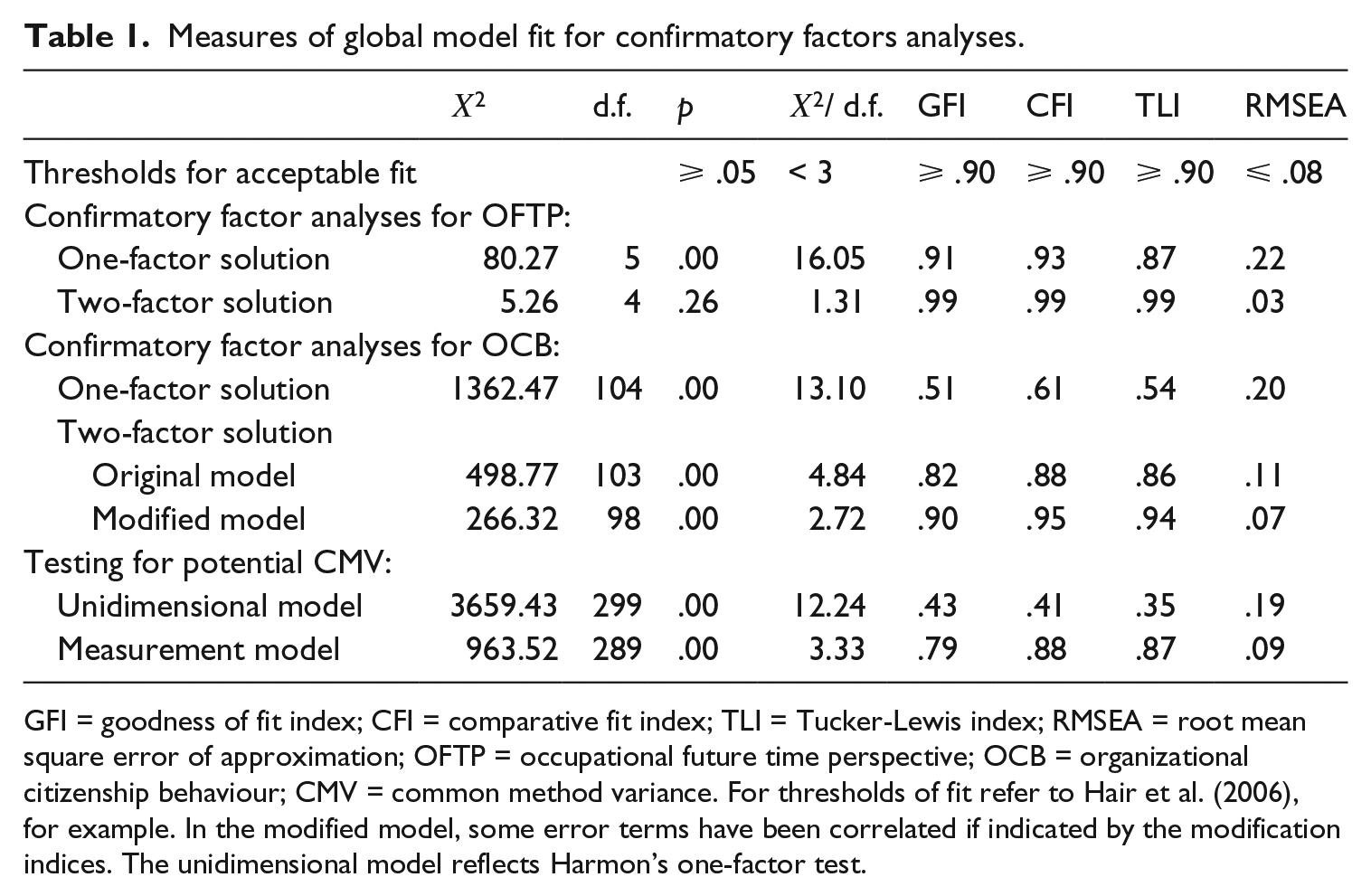
GFI = goodness of fit index; CFI = comparative fit index; TLI = Tucker-Lewis index; RMSEA = root mean square error of approximation; OFTP = occupational future time perspective; OCB = organizational citizenship behaviour; CMV = common method variance. For thresholds of fit refer to Hair et al. (2006), for example. In the modified model, some error terms have been correlated if indicated by the modification indices. The unidimensional model reflects Harmon’s one-factor test.
To test Hypotheses 1 and 2, we calculated a mediation model with OFTP as the independent variable, the difference score of OCBO and OCBI as the mediator, and job satisfaction as the dependent variable. Therein, we controlled for age, gender and education. To test Hypotheses 1a and 1b, we examined the effect of OFTP on the difference between OCBO and OCBI, which is represented by path a in either mediation model. To test Hypotheses 1b and 2b, we tested the indirect effect of OFTP on job satisfaction through the difference between OCBO and OCBI, which is represented by path ab in either mediation model. To determine whether the indirect effect was significant, we calculated confidence intervals for the indirect effect by bootstrapping from 5000 subsamples. We preferred the bootstrapping method to other methods, for two reasons. First, this nonparametric resampling method does not assume normality of the sampling distribution (Preacher and Hayes, 2008). Second, the bootstrapping method has more power than the causal steps approach or the Sobel test (MacKinnon et al., 2002, 2004). We conducted this analysis with the SPSS mediate macro developed by Preacher and Hayes (2014). To establish mediation and to determine the type of mediation, we followed the recommendations made by Zhao et al. (2010), who proposed that only the indirect effect (path ab) has to be significant to establish mediation, whereas the direct effect (path c) does not have to be significant, as originally proposed by Baron and Kenny (1986). 4
Results
Descriptive statistics and intercorrelations
Table 2 shows means, standard deviations, reliabilities and correlations of study variables. The mean scores for OFTP, OCB and job satisfaction were above the midpoint. Consistent with previous findings (Zacher and Frese, 2009, 2011), age was moderately negatively related to remaining time and weakly negatively related to remaining opportunities. Furthermore, with increasing educational degree, remaining time was perceived to be somewhat more open-ended, and more remaining opportunities were perceived. The perception of remaining time and remaining opportunities correlated moderately positively. Moreover, the greater the remaining opportunities perceived, the slightly higher the job satisfaction and OCBO became. However, the perception of remaining time was not associated with job satisfaction or OCBO. OCBI and OCBO correlated positively, and both OCBI and OCBO were positively associated with job satisfaction.
Means, standard deviations, reliability and intercorrelations of study variables.
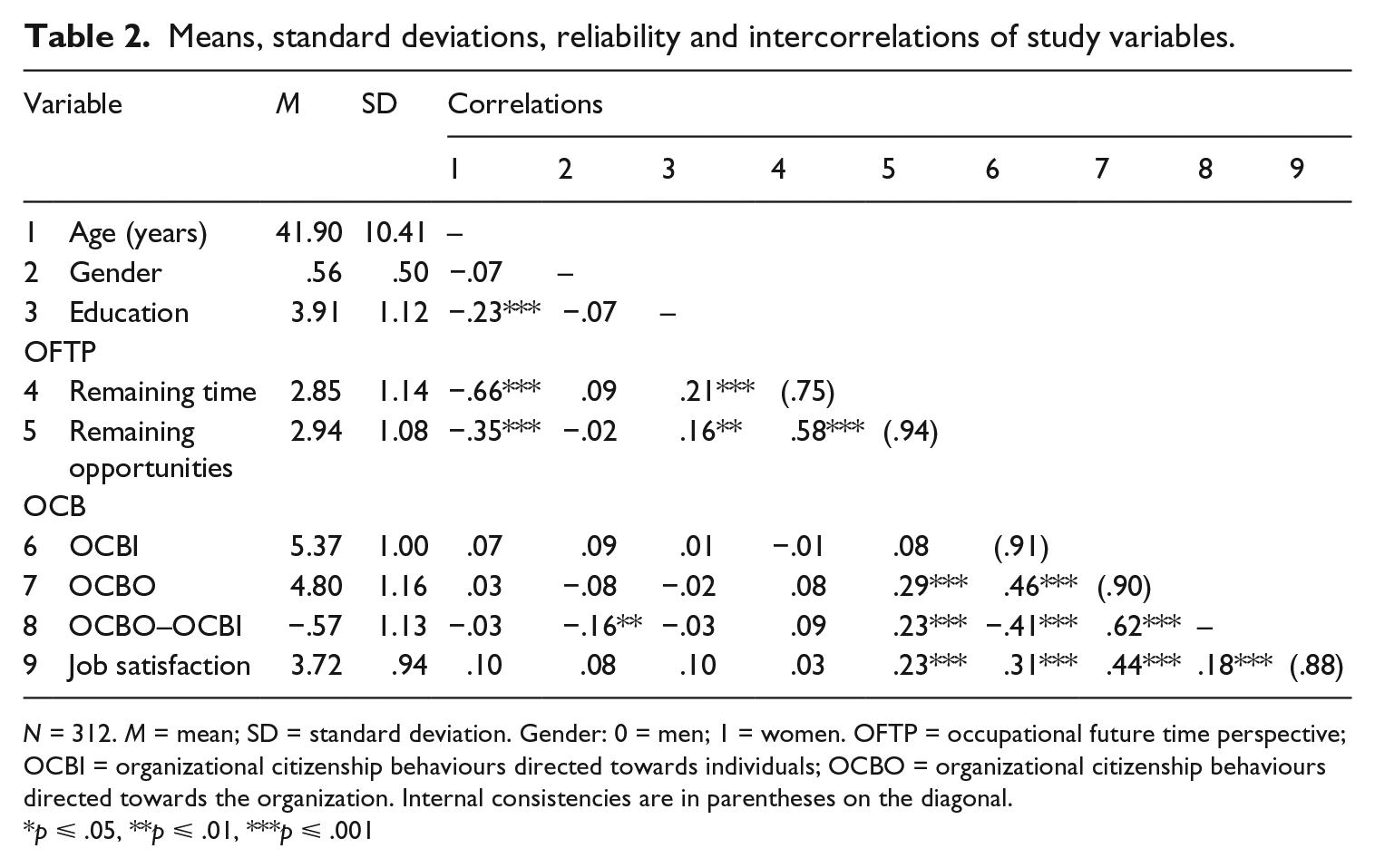
N = 312. M = mean; SD = standard deviation. Gender: 0 = men; 1 = women. OFTP = occupational future time perspective; OCBI = organizational citizenship behaviours directed towards individuals; OCBO = organizational citizenship behaviours directed towards the organization. Internal consistencies are in parentheses on the diagonal.
p ⩽ .05, **p ⩽ .01, ***p ⩽ .001
Occupational future time perspective predicting organizational citizenship behaviour
Hypothesis 1b posited that people show more OCBO than OCBI the more open-ended they perceive their remaining time in an occupational future. The effect of remaining time in occupational future on the difference score between OCBO and OCBI (path a1) was not significant: b = –.01; p = .88. Thus, Hypothesis 1b was rejected (Table 3). Hypothesis 2b predicted that the more remaining opportunities in their occupational future people perceive, the more they show OCBO than OCBI. This hypothesis was upheld because remaining opportunities in occupational future significantly predicted a person’s difference between OCBO and OCBI: b = .26; p < .001 (Table 3).
Mediation analyses of OCB on the relationship between OFTP and job satisfaction (Hypotheses 1 and 2).
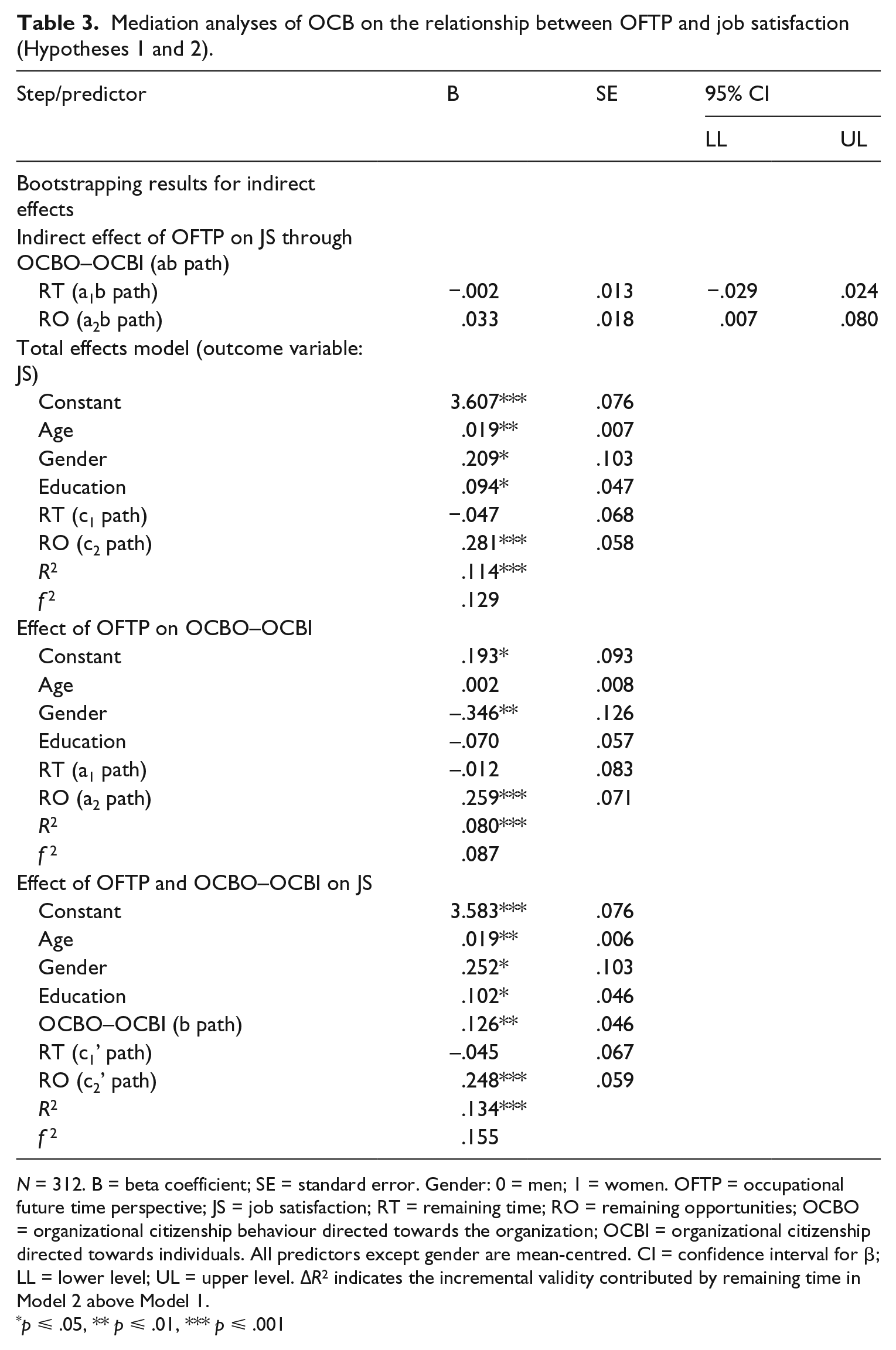
N = 312. B = beta coefficient; SE = standard error. Gender: 0 = men; 1 = women. OFTP = occupational future time perspective; JS = job satisfaction; RT = remaining time; RO = remaining opportunities; OCBO = organizational citizenship behaviour directed towards the organization; OCBI = organizational citizenship directed towards individuals. All predictors except gender are mean-centred. CI = confidence interval for β; LL = lower level; UL = upper level. ∆R2 indicates the incremental validity contributed by remaining time in Model 2 above Model 1.
p ⩽ .05, ** p ⩽ .01, *** p ⩽ .001
Organizational citizenship behaviour as mediator in the relationship between occupational future time perspective and job satisfaction
With respect to Hypothesis 1c, the indirect effect of remaining time on job satisfaction through the difference score between OCBO and OCBI (path ab) was not significant because the confidence interval contained zero: LL 95 percent, CI = –.03; UL 95 percent, CI = .02. Furthermore, the direct effect of remaining time on job satisfaction was not significant: path c1: b = –.05; p = .50. Thus, the difference between OCBO and OCBI did not mediate the relationship between perceived remaining time and job satisfaction (no-effect mediation: Zhao et al., 2010), so Hypothesis 1c was not supported (Table 3).
With respect to Hypothesis 2c, the indirect effect of remaining opportunities on job satisfaction through the difference score between OCBO and OCBI (path ab) was significant because the confidence interval did not contain zero: LL 95 percent, CI = .01; UL 95 percent, CI = .08. Furthermore, the direct effect of remaining opportunities on job satisfaction was significant: path c2: b = .28; p < .001, and the indirect and direct effects had the same sign. Taken together, the difference score of OCBO and OCBI partially mediated the relationship between perceived remaining opportunities and job satisfaction (complementary mediation: Zhao et al., 2010) (Table 3). That is, the perception of remaining opportunities in occupational future affects job satisfaction directly as well as indirectly through the difference between OCBO and OCBI: the more remaining opportunities are perceived in occupational future, the more satisfied people are with their jobs. Furthermore, the more remaining opportunities are perceived in occupational future, the more OCBO rather than OCBI is shown (path a2: b = .26; p < .001), which results in job satisfaction (path b: b = .13; p = .007) (Table 3). 5
Discussion
General discussion
To the best of our knowledge, this study is the first to test the influence of occupational future time perspective (OFTP) on organizational citizenship behaviour (OCB) and job satisfaction. Based on socioemotional selectivity theory (SST: Carstensen, 1995, 2006), we examined whether people who perceive themselves as having open-ended instead of constrained remaining time and many instead of few remaining opportunities in occupational future show more OCBO than OCBI. Furthermore, we explored whether people who perceive themselves as having an open-ended OFTP and who therefore show more OCBO than OCBI to fulfil knowledge-oriented goals will be more satisfied with their jobs.
Regarding Hypothesis 1b, people who perceive themselves as having open-ended instead of constrained remaining time in occupational future did not show more OCBO than OCBI. Regarding Hypothesis 2b, people who perceive themselves as having many instead of few remaining opportunities in occupational future indeed showed more OCBO than OCBI. In conclusion, SST’s predictions are partly supported in the area of extra-role behaviours: if employees perceive themselves as having many remaining opportunities in their occupational future, they put greater emphasis on OCBO than on OCBI. Hereby, we address Finkelstein and Penner’s (2004) recommendation to offer employees the opportunity to display the type of OCB (i.e. OCBO or OCBI) that is most rewarding for them. Showing OCBO may be a way for employees to fulfil their knowledge-oriented goals at work: by keeping up to date with developments in the organization, employees may enhance their knowledge about the organization or industry. By expressing ideas to improve the organization’s functioning, employees may promote their career because they indicate to their employer that they are valuable and committed. Bolino (1999), for example, showed that people with a careerist orientation selectively show OCBs that are visible to powerful others to enhance their professional success. Showing OCBO, in particular, may be an opportunity to advance one’s official professional status because OCBO is visible to supervisors, whereas OCBI may only be visible to colleagues (Ilies et al., 2009). This interpretation corroborates the findings reported by Whiting et al. (2008), who showed that voice behaviours positively affect appraisal decisions. Furthermore, this finding is consistent with previous results pertaining to the positive effect of an open-ended general future time perspective on growth motivations and status striving (Kooij et al., 2013). Altogether, OCBO may be more driven by impression management than is OCBI.
By studying the effect of OFTP on different types of OCB, we can also challenge scientific knowledge on extra-role behaviours. For example, our findings contradict the findings of Bal et al. (2010), who found a negative relationship between general FTP and citizenship obligations among post-retired workers. Please note that our approach differed from that used by the aforementioned authors to conceptualize citizenship behaviours. In the study by Bal et al. (2010), citizenship behaviours described an employee’s felt obligation towards his or her employers to work flexibly in terms of time and content. In contrast, we conceptualized citizenship behaviours as voluntary and discretionary behaviours that go beyond working flexibly (Organ, 1997). We assume that post-retired workers who perceive themselves as having an open-ended general FTP do not rely on working flexibly because they can either exit the workforce or change the employer, which might explain the differences between the results obtained by Bal et al. (2010) and those obtained in our study.
As perceived remaining time in occupational future neither directly nor indirectly affected job satisfaction through the difference between OCBO and OCBI, these results resonate with studies on age and job satisfaction that have found no link between chronological age and job satisfaction (Baird et al., 2010; Diener and Suh, 1997; Lieberman, 1970): remaining time per se – determined by chronological age or psychological time perception – is not crucial to being satisfied with one’s job. Furthermore, the remaining time people perceive does not affect people’s extra-role behaviours in the workplace (i.e. neither OCBO nor OCBO – see Table 2). Kooij et al. (2013) studied the relationship between general future time perspective and work engagement. An open-ended general future time perspective was positively associated with work engagement, whereas a constrained general future time perspective was not associated or negatively associated with work engagement. That is, if an open-ended occupational remaining time is (almost) equally positively associated with both OCBO and OCBI, the relationship between an open-ended occupational remaining time and the difference between OCBO and OCBI would be (near) zero. If a constrained occupational remaining time is (almost) equally not or negatively associated with both OCBO and OCBI, the relationship between a constrained occupational remaining time and the difference between OCBO and OCBI would also be (near) zero. Thus, the effects of occupational remaining time on the difference between OCBO and OCBI may have levelled, which is perhaps why we did not find a relationship between occupational remaining time and the difference between OCBO and OCBI in our study. Furthermore, Kooij et al. (2013) found that work-related motives are the direct antecedent of work engagement. Hence, we also recommend assessing people’s motives for OCB as these motives may mediate the relationship between OFTP and OCB.
Regarding Hypotheses 2a and 2c, SST provided a useful theoretical framework for explaining the effects of remaining opportunities and OCB on job satisfaction. People will be more satisfied with their job if they perceive themselves as having many remaining opportunities in occupational future. This finding agrees with that reported by Zacher and Frese (2011), who described the focus on many remaining opportunities at work as a contextualized form of optimism that may result in higher job satisfaction. In addition to this direct effect, people who perceive themselves as having many remaining occupational opportunities are also more satisfied with their jobs if they show relatively more OCBO than OCBI compared with people who perceive themselves as having few remaining opportunities. This finding is consistent with SST: people who perceive themselves as having many opportunities in their future work life strive for knowledge-oriented goals, which can be fulfilled by showing OCBO; and fulfilling one’s goal at work is associated with higher job satisfaction. This reasoning is in line with findings on self-determination theory (Deci and Ryan, 2000) such that fulfilling one’s needs through daily activities is associated with well-being (e.g. Reis et al., 2000). Moreover, our findings corroborate current research on motive fulfilment and OCB as employees will keep on showing OCB if they can fulfil their primary motive or goal (Finkelstein, 2006).
In sum, our results enable a better understanding of extra-role behaviours and well-being at the workplace by considering people’s OFTP – especially people’s perceived remaining opportunities – because it determines people’s behaviours. If people can fulfil their particular goals by showing specific forms of OCB, they are satisfied with their job and are more likely to continue showing volunteer behaviours at the workplace. We recommend that further studies should be conducted to incorporate SST into future research on volunteer work behaviours.
Practical implications
We encourage employers to provide employees with many remaining opportunities across their whole occupational life to foster extra-role behaviours directed towards the organization (i.e. OCBO). To provide employees with many remaining opportunities in their occupational future, Zacher and Frese (2011) suggested redesigning jobs or offering employees advanced training. Concerning job redesign, the authors showed that providing employees with high-complexity jobs increases their perception of having many remaining opportunities in their occupational future. Concerning advanced training, the authors recommend that employers equip employees who have a low-complexity job with knowledge about selection, optimization and compensation strategies (Freund and Baltes, 1998). By autonomously selecting and prioritizing goals as well as by compensating for missing resources, employees could perceive themselves as being more autonomous (self-determination theory: Deci and Ryan, 2000). As a result, employees may perceive more remaining opportunities in their occupational future.
Callanan and Greenhaus (2008) suggested providing all employees, regardless of their age, with career management assistance and developmental programs. By offering employees many remaining opportunities in occupational future, organizations can kill two birds with one stone: perceiving many remaining opportunities results in showing more OCBO than OCBI and ultimately higher job satisfaction. Satisfied employees, in turn, are less likely to leave the organization, and show higher task performance (Cotton and Tuttle, 1986; Iaffaldano and Muchinsky, 1985; Ryan et al., 1996; Taris and Schreurs, 2009; Tett and Meyer, 1993). Furthermore, satisfied employees are likely to attract new employees because they will advocate for the organization, which underlines the conclusion drawn by Truxillo et al. (2012: 355), who stated that ‘[c]onsidering job design from a lifespan perspective could be an opportunity to improve work performance, as well as the satisfaction and engagement of workers in organizational settings’. In conclusion, providing employees with an open-ended OFTP across their whole occupational lifespan may be one part of a worthwhile human resource strategy in the face of demographic changes and increasing shortages of skilled labour.
Limitations and directions for future research
A methodological limitation of the present study is that we relied on self-reports of OFTP, OCB and job satisfaction by the same person. To remove and control for common method bias, we implemented one procedural and one statistical remedy. Concerning the procedural remedy, we temporally separated the measurement point of all predictor and criterion variables to minimize the probability of inflated correlations between the study variables. This remedy represents the most effective one for defending against common method variance (Johnson et al., 2011). Concerning the statistical remedy, we conducted a Harman one-factor test, which revealed that our findings were not prone to common method variance. Moreover, our mediation model was more complex than bivariate correlations. Increased model complexity results in deflated rather than inflated interactions, rendering false positive results less likely (Harrison et al., 1996). It would even be possible to measure OCB via other-report; for example, by asking an employee’s supervisor or colleague, Ilies et al. (2009) found in their meta-analysis on personality, job satisfaction and OCB that the results are unaffected by whether different sources or a single-source provided the OCB rating. If anything, other-reports should underestimate OCB because supervisors are unable to assess all facets of OCB (especially OCBI) sufficiently and accurately (Ilies et al., 2009). Furthermore, there are no good alternatives to assessing job satisfaction via self-report as job satisfaction depicts one’s attitudes towards work and thus is an individual judgment (Bamundo and Kopelman, 1980; Brayfield and Rothe, 1951; Pavot and Diener, 1993). The same applies to assessments of OFTP.
The use of difference scores as dependent variables has been criticized (Edwards, 1995, 2001), which is why we also analysed Hypotheses 1a and 2a (when OCB was the dependent variable) with alternative methods proposed by Edwards (1995, 2001) (i.e. separate regression analyses for OCBO and OCBI). The results of these analyses showed that only remaining opportunities was a significant predictor for OCBO as well as OCBI. In this case, the effect of remaining opportunities on OCBO was larger and surpassed a higher significance threshold (β = .39***; p < .001) than the effect of remaining opportunities on OCBI (β = .13, p = .039) (see supplementary material). These results resonate with those obtained using the difference score between OCBO and OCBI. Concerning the mediation model, please note that the difference score between OCBO and OCBI is simultaneously a dependent variable (for OFTP) and an independent variable (for job satisfaction). We retained the difference score in the interest of parsimony for several reasons. First, to the best of our knowledge, there exists no alternative method to the use of difference scores in this case, in which the variable of interest is an independent and a dependent variable at the same time. Second, the results for Hypotheses 1a and 2a were not affected by building the difference score. Third, although different values of OCBO and OCBI can result in the same difference score, we were interested in the relative extent of OCBO and OCBI, which is also most consistent with socioemotional selectivity theory such that people have both emotion-oriented goals and knowledge-oriented goals, but their relative importance changes according to future time perspective. Fourth, other studies published in top-tier journals have used difference scores for the same reason (e.g. Grant, 2008).
Please note that OCBI correlated with neither the control variables nor OFTP, and people scored quite high on OCBI (M = 5.4; SD = 1.0; range: 1.4–7.0) compared with OCBO (M = 4.8; SD = 1.2; range: 1.3–7.0), possibly indicating a ceiling effect. From a statistical point of view, the possible ceiling effect for OCBI does not threaten the validity of our results because we grand-mean-centred OCBO and OCBI, leading to mean values of zero for OCBO and OCBI. Moreover, Lee and Allen (2002) reported a similar mean value for OCBI (M = 5.3; SD = .8) even though their sample only consisted of nurses. As the sample had tenure for 10 years on average, they should have known most of their (close) colleagues for quite a long time. Thus, they were able to show much OCBI, in the sense of being interested in their colleagues’ (non)work matters, because they had already built an emotional commitment towards their colleagues. Additionally, we should note that high scores on OCBI might result from viewing OCBI as socially desirable behaviour, which must be tested in the future. Moreover, perceived remaining opportunities explained 5.2% of the variance in the difference between OCBO and OCBI, which initially seems low. The relationship between the difference between OCBO and OCBI and job satisfaction might be greater if job satisfaction is assessed by a cognitive instead of an affective measure (Moorman, 1993). Therefore, the amount of variance explained might have been underestimated in this study.
OCBO and OCBI capture behaviours that can be applied in highly different work situations and almost all occupations and branches (e.g. protect the organization’s image, improve the organization, or offering coworkers help in (non)work issues). Using an occupationally diverse sample of employees from all walks of life, who hold very different jobs, who work in a wide range of industries, and who work in organizations that differ in size of enterprise represents one of the strengths of this study. Hence, the sample considered should equally have had the possibility to show OCBO and OCBI. Moreover, OFTP may be determined not only by individual differences (e.g. one’s occupation or age) but also be affected by organizational aspects such as organizational time (How long will I work for the organization? Do I have a temporary or permanent contract?) and organizational opportunities (Which opportunities for advancement, for example, will my organization offer me?). The effect of organizational aspects on OFTP (see interactionist perspective) should be taken into account in future research on OFTP.
The results of this study were obtained from a German-speaking sample. The cultural background of employees could affect how often OCBO and OCBI are typically shown. In contrast to those in individualistic cultures, employees with a collectivistic cultural background could show more OCBI in general because they appreciate collective above individual efforts. In cultures with paternalistic leadership styles, for example, it may be more typical to show OCB in general because an employee feels the obligation to give something back as the supervisor takes care of and shows a sense of responsibility for the employee (for an overview, see Gelfand et al., 2007). Although a different base rate of OCBO and OCBI in different cultures does not necessarily alter the relationships between the difference between OCBO and OCBI and other variables (e.g. OFTP and job satisfaction), we recommend replicating this study in other countries and cultures.
Although we temporarily separated the measurement of OFTP, OCB and job satisfaction, and measured OFTP prior to OCB and OCB prior to job satisfaction, future experiments must establish causal relationships between OFTP, the difference between OCBO and OCBI, and job satisfaction. Experimental research would also contribute to the discussion about the causal direction of OCB and job satisfaction (Bateman and Organ, 1983; Organ and Ryan, 1995). Nevertheless, the literature provides strong hints that need fulfilment leads to job satisfaction and not vice versa. Schaffer (1953: 3) notes that ‘job satisfaction will vary directly with the extent to which … needs of an individual which can be satisfied in a job are actually satisfied; the stronger the need, the more closely will job satisfaction depend on its fulfillment’. Additionally, we recommend studying the motives underlying OCB in future research on OFTP and OCB to empirically strengthen the assumption that OCBI fulfils emotion-oriented goals, whereas OCBO fulfils knowledge-oriented goals within the context of SST (see OCB motives questionnaires by Bourdage et al., 2012; Rioux and Penner, 2001). In addition, future research on OFTP should also control for a person’s regulatory focus. Zacher and de Lange (2011) showed that a person’s chronic regulatory focus (promotion versus prevention) influences future time perspective: a promotion focus promotes a focus on opportunities, and a prevention focus promotes a focus on limitations.
Conclusion
Lifespan aspects deserve further attention in work and organizational psychology. How people perceive their remaining opportunities instead of their remaining time in their occupational future predicts their preference for showing OCBO or OCBI: people who perceive themselves as having many remaining opportunities show more OCBO than OCBI relative to people who perceive themselves as having few remaining opportunities in their occupational future, in agreement with SST. Furthermore, people who perceive themselves as having many remaining occupational opportunities are generally more satisfied with their jobs; in addition, they are also more satisfied with their jobs if they show more OCBO than OCBI relative to people who perceive themselves as having few remaining occupational opportunities. In sum, employees’ extra-role behaviours change depending on their perception of remaining opportunities in their occupational lifespan, whereby the share of OCBI is expanding and the share of OCBO is shrinking. We recommend future research to incorporate person–organization fit, and developmental theories such as SST to better understand employee behaviours and to advance human resource management across occupational life.
Footnotes
Funding
This research received no specific grant from any funding agency in the public, commercial or not-for-profit sectors.
Notes
 ) is Professor of Occupational and Consumer Psychology, University of Freiburg in Germany. Her research focuses on web-based data collection, market psychology and strain at modern workplaces. She also consults with international clients regarding design, programming and implementation of web surveys. She has published over 80 peer-reviewed article. She is co-editor of Zeitschrift für Arbeits- und Organisationspsychologie A&O and associate editor of Social Science Computer Review. [Email: