




Abstract
This article investigates the interactive effects of extrinsic value orientation and competence supportive feedback on the work outcomes of in-role and extra-role performance, and employees’ subjective well-being at work. Two studies are presented with samples consisting of a cross-section of employees and, for Study 1, their managers. In keeping with established theory and findings, competence supportive feedback demonstrated positive and significant main effects. In support of this article’s unique predictions, these relationships were amplified (in-role and extra-role performance) and attenuated (subjective well-being) at higher levels of individual extrinsic value orientation. Findings for well-being were more closely examined with the second sample, and an underlying mechanism of experienced work demands was identified. Thus, it seems that motivational sensitivity to the instrumental value of competence supportive feedback, in addition to its recognized psychological value, may drive work engagement all too well. Implications for future research and performance management are discussed.
Keywords
Individuals differ in their predilection for extrinsic workplace rewards such as money and recognition (Amabile, 1990; Amabile et al., 1994; Vansteenkiste et al., 2007). Though this innate individual difference is reasonably well established, in order to understand the role of traits in job performance it is critical to also consider workplace cues that trigger the actual relevance and expression of a given trait (Tett and Burnett, 2003). At the same time, performance management practices are often treated uniformly in application and expected results without sufficient attention to employee differences (Bowen and Ostroff, 2004; Nishii et al., 2008). The present article melds these two research imperatives by examining extrinsic value orientation (EVO) in interaction with the established performance management practice of competence supportive feedback. Indeed, as seminal reasoning in psychology has long alluded (Cronbach, 1957, 1975; Lewin, 1936), motivated workplace behavior is better understood through examination of contextual and dispositional motivational influences jointly rather than in isolation (Barrick et al., 2013).
One specific aim of the present set of studies is to examine whether competence supportive feedback, a performance management practice known to typically motivate employee performance, has varying effects based on individual differences in EVO. Predictions rely on self-determination theory (Deci and Ryan, 2000) and broader competence-relevant motivational processes identified as distinct but potentially complementary to the role that the need for competence holds in self-determination theory (Elliot et al., 2002). In short, I conceive that those higher in EVO are more prone to desire satisfaction of competence needs through work, but only act on this tendency when workplace triggers make competence salient. Invoking trait activation theory (Tett and Burnett, 2003), I suggest that competence supportive feedback serves as such a trigger.
An additional and potentially more intriguing aim of this research is to examine the interactive effect of competence supportive feedback and EVO on subjective workplace well-being. Experiencing competence is widely associated with enhanced well-being (Ryan and Deci, 2001). However, if performance management effects on motivated workplace behavior are stronger for employees with higher extrinsic values, the job demands experienced may also be commensurately greater—to the potential detriment of employee well-being. Research suggests that employees and organizations alike tend not to recognize the subtle negative effects of sustained high performance on well-being and sustainability of human capital in general (Ehnert, 2009; Merriman, 2014; Perlow and Porter, 2009; Ryvkin, 2011).
Empirical research has identified high-performance work systems, in particular, as potential sources of job demands that, under certain contextual circumstances, correspond with increased employee anxiety, role overload and turnover intentions (Jensen et al., 2013). Thus, I am not the first to empirically examine a link between otherwise favorable performance management practices and employee well-being. However, the current investigation is unique in its focus on the moderating role of EVO and the concurrent outcomes of work performance and well-being. Two samples are employed to investigate the relationships described and the potential intervening variable of experienced work demands in a test of mediated moderation. The full conceptual model is depicted in Figure 1.

Conceptual model.
Understanding for whom and how performance management practices may, in a sense, motivate all too well is a timely consideration as companies increasingly recognize employee overwork and well-being as something to manage for sustainability of human capital. For instance, various banking firms known for their long work hours, including J.P. Morgan Chase & Company, Citigroup, Goldman Sachs Group and Bank of America, recently initiated policies to reduce weekly work hours and ensure regular time off (Glazer and Huang, 2016; Raice, 2014; Surowiecki, 2014). The findings presented subsequently should therefore have value for both research and practice.
Conceptual development and hypotheses
Competence supportive feedback
Although performance feedback may take various forms, the question of whether the feedback facilitates the experience of competence for employees is important for motivational purposes—particularly for the ‘quality’ of extrinsic motivation, as discussed shortly (Deci and Ryan, 2000). Characteristics of competence supportive feedback may include performance information that is positive (Harackiewicz et al., 1992) and relative to a normative standard or the performance of others (Sansone, 1986). However, information pertaining to positive task outcomes alone does not equate to competence support if it lacks a means from which to infer individual ability level. For example, correct answers on standardized tests convey little in the way of competence until raw scores are transformed via national norms (Sansone, 1986). Further, feedback pertaining to outcomes may provide competence validation, whereas feedback pertaining to the process is generally more supportive of competence development (Earley et al., 1990). Negative feedback, the absence of feedback, and the absence of a sense of ownership over one’s performance are considered to undermine the experience of competence for employees (see Deci and Ryan, 2000: 234–235; Ryan and Couchman, 1999).
Competency can be inferred from contextual events in the workplace other than specific feedback (Ryan and Deci, 2000: 70). However, work effort in contemporary work environments is often temporally separated from relevant contextual cues such as ultimate task completion and rewards. This makes interim performance feedback a critical and necessary means of satisfying the innate human need for competency information (Martin, 1999). Further, it is up to managers to provide the encouragement and support necessary so employees feel competent in the desired behavior (Sheldon et al., 2003). Therefore, this study focuses on the degree of competence feedback provided to an employee by their manager and, given the wide-ranging form such feedback may take, interprets it from the feedback receiver’s (i.e. employee’s) perspective.
Main effects of competence supportive feedback
Upon initial consideration and before turning to differential effects, there is established rationale to suggest competence supportive feedback would have a positive influence on in-role and extra-role job performance, and employees’ subjective well-being within the workplace. In relation to in-role performance, feedback informs ways to achieve performance outcomes (Weibel, 2007) and, in keeping with goal-setting theory, is considered essential for continuous goal-striving (Locke and Latham, 1990). Competence supportive feedback in particular may enhance individual cognitions regarding self-efficacy, which, in turn, increases interest and persistence in the respective activity (Bandura, 1982, 1989). In addition, individuals are believed to hold a very basic social-psychological need for regular feedback, to know that they are progressing towards their goals and that their effort will ‘pay off’ (Martin, 1999). Martin (1999) posits, with some preliminary experimental support, that individuals function optimally when this need is met, and otherwise divert attention to the inherent uncertainties in their social environment (also see Martin et al., 2004).
In relation to extra-role performance, it is widely accepted that individuals have an inherent psychological need to experience competence (Deci and Ryan, 1985). Self-determination theory positions satisfaction of competence needs as an antecedent to self-regulated forms of motivation (Deci and Ryan, 2000). In contrast to externally controlled motivation, under self-regulated motivation work values are internalized and work is performed volitionally because the behavior is integrated with one’s sense of self. Therefore, to the extent that competence supportive feedback satisfies competence needs, it also facilitates a quality of motivation that goes beyond extrinsically prescribed job duties and, it seems reasonable to suggest, may align with extra-role work performance.
Finally, also in accordance with self-determination theory, a number of studies have found that satisfaction of competence needs to have a positive main effect on various facets of subjective well-being (e.g. Baard et al., 2004; Deci et al., 2001; Reis et al., 2000). Thus, by facilitating progress towards goals and by satisfying an innate and universal need to experience competence, competence supportive feedback is expected to result in higher levels of in-role and extra-role job performance, and subjective workplace well-being for employees in general, all else equal:
Hypothesis 1a: Competence supportive feedback has a positive relationship with in-role performance.
Hypothesis 1b: Competence supportive feedback has a positive relationship with extra-role performance.
Hypothesis 1c: Competence supportive feedback has a positive relationship with subjective workplace well-being.
Moderating role of extrinsic value orientation
In-role performance
In addition to the basic and universal need to experience competence and progress towards goals as described above, there is a potentially concurrent competence-relevant process pertaining to task performance that has been investigated by research. Labeled competence valuation, it represents the degree to which a person cares about doing well in particular activities, distinct from the belief that they can do well or have done well (Elliot et al., 2000; Harackiewicz and Manderlink, 1984; Harackiewicz et al., 1985). That is, even though all individuals may indeed need to experience competence, they may not seek to satisfy that need through all activities or specifically through work activities (Elliot et al., 2002). Below I conceive that those higher in EVO are more prone to desire satisfaction of competence needs through work, but that this tendency manifests behaviorally only when activated through workplace triggers such as competence supportive feedback that make behaviors associated with demonstrating competence salient.
Trait activation theory presents personality traits as only propensities to behave in identifiable ways; manifestation of trait behaviors occurs only when triggered by trait-relevant situational cues (Tett and Burnett, 2003). However, the framework stipulates that in order for there to be discernable differences in behaviors across individuals, these cues must not be so strong as to extract the same behavior from all. For instance, the assignment of employees to office space that is in disarray would be sufficient to activate observable trait behaviors associated with orderliness for individuals in which the latent trait already resides, whereas a threat of firing employees with messy desks would likely prompt orderliness behaviors among all and thereby restrict observable differences in these behaviors (Tett and Burnett, 2003). Individual orientations, such as EVO, are considered less stable than personality traits and their activation even more reliant on situational cues (e.g. Button et al., 1996; cf. Maynard et al., 2012).
Experimental research has identified certain cues as relevant to individual competence valuation: whether performance goals relying on skills and ability are salient (Sansone, 1986; Sansone et al., 1989); the presence of rewards (Sansone et al., 1989: 918); and the receipt of competence feedback itself (Elliot et al., 2000; Sansone, 1989). However, whereas these cues were sufficiently salient in lab settings, they are to some degree invariant features of actual work settings and therefore, I suggest, are not so strong as to extract the same behavior from all. Instead, I pose that competence supportive feedback meets the conditions put forth by trait activation theory to permit discernable differences in behaviors across individuals. That is, competence supportive feedback will serve as a situational cue of competence valuation for those already inclined to value and respond to workplace recognition (high EVOs), without unduly regulating behaviors of those individuals not so innately inclined:
Hypothesis 2: EVO amplifies the relationship between competence feedback and in-role performance such that a positive association will be comparatively stronger for those higher relative to lower in EVO.
Extra-role performance
The above hypothesis primarily speaks to individual differences in the quantity of motivation, yet the quality of motivation may also influence job performance. As described earlier, self-determination theory distinguishes qualitative differences in extrinsic motivation based on the degree to which individuals have internalized motivation (Deci and Ryan, 2000). Extrinsic motivation is said to range from completely externally controlled (e.g. performing work tasks primarily to gain reward) through fully internalized based on individuals’ identification with their work role. An interim level of internalization occurs when people identify with the value of a behavior for their own self-selected goals; in turn, people feel such behavior is relatively self-determined because it is more congruent with their personal goals and identities (Gagné and Deci, 2005: 334). Competence supportive feedback, to the extent that it satisfies the fundamental human need to experience competence, contributes to such self-regulated forms of motivation. However, beyond the satisfaction of universal competency needs, I posit that competence feedback aligns in an additional and unique way with the individual values of those higher in EVO based on EVO’s emphasis on recognition and the dictates of other people.
This logic is consistent with a model developed by Barrick et al. (2013), which theorizes that personality traits determine the broad purpose that individuals ascribe to their work and lead to experienced meaningfulness when the work context is perceived to be in concordance with these self-determined motivational strivings. In turn, this experienced meaningfulness is posed to lead to a greater degree of dedication and absorption in one’s work role (Barrick et al., 2013). Such self-regulated motivation may contribute to in-role performance, adding further rationale for the earlier prediction, but is especially consistent with extra-role performance that relies more heavily on discretionary effort. For instance, empirical field studies that were focused on fit, though not specifically considering a motivational explanation, found that strength of performance pay was positively related to extra-role performance for employees’ high relative to low in value alignment with their organization (Deckop et al., 1999), and for risk-preferent (a value aligned with performance pay) relative to risk-averse employees (Deckop et al., 2004):
Hypothesis 3: EVO amplifies the relationship between competence feedback and extra-role performance such that a positive association will be comparatively stronger for those higher relative to lower in EVO.
Well-being
Following the value-alignment rationale presented in relation to predictions of extra-role performance, it would seem at first glance that higher levels of EVO may enhance the beneficial effects of competence feedback for well-being. Indeed, experimental findings show beneficial moderating effects for the financial facet of extrinsic orientation in determining a positive association between subsequent income and subjective well-being (Malka and Chatman, 2003). But it is important to note that the number of hours worked per week was controlled in the study by Malka and Chatman. I speculate that although those higher relative to lower in EVO are more motivated to intensify their work effort in response to competence feedback, this simultaneously reduces their time for satisfaction of other basic psychological needs, and their time available for human regeneration. Thus, controlling for hours worked in predicting subjective well-being may inadvertently mask EVO’s posed moderating effect.
Indeed, it has been suggested that leisure time is more likely to be forgone in favor of work time when extrinsic work outcomes are made psychologically salient (Merriman, 2014). Further, Elliot et al. (2002) suggest that though the need for competence is a positive source of motivation, when taken too far it can interfere with optimal self-regulation. They state: In addition to the need for competence, individuals possess a need for relatedness (Baumeister and Leary, 1995; Ryan, 1995), and to the extent that attending to the need for competence precludes sufficient attention to the need for relatedness, well-being will suffer. (Elliot et al., 2002: 378)
A similar argument was supported regarding the dispositional need for power and its association with negative affect despite satisfaction of this need (Zurbriggen and Sturman, 2002).
Altogether, I pose higher levels of EVO to have an attenuating effect on the anticipated positive relation between competence feedback and subjective well-being owing to a corresponding higher level of experienced work demands. Said another way, in the context of competence supportive feedback, EVO manifests as increased in-role and extra-role work efforts; the more work effort put forth, the greater amount of actual work demands experienced and thus the greater the potential for depletion or disregard of other needs essential to well-being:
Hypothesis 4a: EVO attenuates the relationship between competence feedback and subjective well-being such that a positive association will be comparatively weaker for those higher relative to lower in EVO.
Hypothesis 4b: EVO’s attenuating effects on the relationship between competence feedback and subjective well-being will be mediated by experienced work demands.
Two studies follow to investigate the posed relationships. Study 1 establishes the main effects of competence supportive feedback for in-role and extra-role performance and subjective well-being (Hypotheses 1a through 1c), and examines EVO as a moderator of these relationships (Hypotheses 2 through 4a). Study 2 employs an additional sample to examine the intervening variable of experienced work demands in relation to subjective well-being (Hypothesis 4b).
Study 1
As noted, the primary purpose of Study 1 is to test EVO as a moderator of the effects of competence feedback on the outcomes of in-role and extra-role performance (assessed by employees’ direct managers) and subjective well-being (as reported by employees themselves).
Method
Sample
Data were collected via a two-part written survey directed to a cross-section of working adults and their direct managers. Participation was solicited through direct organization contact and through graduate business courses within a part-time MBA program. Managers provided data on their respective employee’s in-role and extra-role performance. The employee survey provided data for the remaining measures. Participant confidentiality and anonymity was assured through separate administration of employee and manager surveys, with matching based on pre-coded identifiers. A total of 192 employees participated. After list-wise deletion of missing data, the actual sample size was 187 employee cases and 93 matched employee–manager dyads.
Respondents worked at their organizations an average of over 5 years. Occupationally, 3.3% of respondents identified themselves as office/clerical, 5.4% sales, 19.6% technical, 33.7% professional, 26.6% managerial, 1.1% service and 10.3% other. Earnings ranged from less than $40,000 to over $115,000 per year; the modal category selected was $56,000 to $70,000, followed closely by $41,000 to $55,000. In terms of demographics, 75% of respondents identified themselves as white (non-Hispanic). Females comprised 45% of the sample. The average age was 34 years. Demographics for the matched and non-matched portion of the sample did not differ substantively.
Measures
Items are assessed on a scale of 1 (strongly disagree or never) to 5 (strongly agree or always) unless otherwise noted. Scale reliabilities are reported in Table 1.
Study 1 means, standard deviations and correlations.

n = 93 owing to listwise deletion of missing data. M = mean, SD = standard deviation. Coefficient alphas reliabilities are reported in the main diagonal.
p< .05. **p < .01. ***p < .001.
Extrinsic value orientation: EVO was measured using the work preference inventory developed by Amabile et al. (1994) because it focuses specifically on extrinsic values in the work context and has demonstrated temporal stability in tests across multiple samples ranging from six months to over four years in duration (Amabile et al., 1994). The EVO scale encompasses preferred orientation towards money, recognition, competition and the dictates of other people in the workplace. Example items include: I am strongly motivated by the money I can earn. I want other people to find out how good I really can be at my work. Twelve of the original 15 items were used to capture all facets of the construct while reducing redundancy of items and thereby risk of respondent survey fatigue (Stanton et al., 2002). The items removed were also reverse-scored items, which have been suggested to impair response accuracy for psychological measures and lack evidence of any clear benefit for acquiescence response bias (Schriesheim and Hill, 1981).
Competence feedback: Competence feedback was measured using a 10-item scale developed by Cirka (2000) and based on the work of Deci and colleagues (e.g. Deci and Ryan, 1985). It assesses the degree to which manager feedback supports employee feelings of competence. Example items include: The feedback I get from my manager often makes me feel I do my job well. My manager gives me information that helps me improve my performance.
In-role performance: In-role performance of the employee, as rated by their manager, was measured with a four-item scale from Merriman and Deckop (2007), adopted from the earlier seven-item scale by Williams and Anderson (1991). The former represents the higher loading items from William and Anderson’s original scale. An example item is: This employee fulfills the responsibilities specified in his/her job description.
Extra-role performance: Extra-role performance of the employee, as rated by their manager, was measured with an 18-item scale from Deckop et al. (2004) that assesses employee citizenship behaviors towards their organization, supervisor and co-workers. The scale was originally developed and validated by Moideenkutty (2000) in his dissertation research, which drew from measures developed by Moorman and Blakely (1992), Van Dyne et al. (1994) and Williams and Anderson (1991) to represent a comprehensive range of targets for extra-role behaviors. Sample items include: This employee defends the organization when other employees criticize it. This employee does work beyond what is required.
Workplace subjective well-being: A seven-item composite measure of subjective well-being was drawn from three existing scales (Keller, 1984; Lait and Wallace, 2002; Macdonald and MacIntyre, 1997) in order to represent the full affective and cognitive components of the construct, which are defined as presence of positive affect, absence of negative affect and satisfaction (Diener, 2000; Kashdan, 2004). Example items are, respectively: I feel good about my job. I am discouraged about my work (R). Overall, I am satisfied at work.
Results
Correlation coefficients and reliabilities (Cronbach’s alpha) of the study variables were examined and found to be within appropriate range (Table 1). Intercorrelations between the independent variables were non-significant. Variance inflation factors for all three models were less than 1.2, far below the suggested cutoff for multicollinearity concerns (Kutner et al., 2004). Preceding the analyses, the factor structure of workplace well-being was examined. A principal components analysis with oblique promax rotation indicated a single factor based on an eigenvalue threshold of 1. The single factor explained 57% of the variance. Factor loadings ranged from .66 to .90. Confirmatory factor analysis using SEM also suggests that the conceptual measurement model is consistent with the observed data. Testing a single factor, all factor loadings were significant and model fit was satisfactory (χ2 = 75.37, d.f. = 14, RMSEA = .15, CFI = .91). Full results are available upon request.
Hypotheses 1 through 4a were tested using hierarchical regression analyses, entering the interaction term as a second step in each analysis to isolate the additional variance explained (Aiken and West, 1991). The interaction term was calculated using mean-centered variables in order to reduce the threat of multicollinearity and improve interpretation of the regression coefficients. Interaction results were plotted to further facilitate interpretation. Hypothesis 4b will be addressed in Study 2. Power analyses were conducted using a .24 estimated effect size based on reported meta-analytic results for the research domain of interest (Paterson et al., 2016). An a priori test indicates that a minimum sample size of 50 is required to reach a statistical power level of .80 for a model with three predictors (p = .05). The sample sizes associated with the given models indicate power levels ranging from .997 to 1, suggesting that a type I error is not an undue threat. Further, Study 2 will conduct a replication of the subjective well-being regression with a larger sample to confirm similar findings.
Hypotheses 1a through 1c predicted positive main effects for competence supportive feedback in relation to in-role performance, extra-role performance and subjective well-being. Hypotheses 2 and 3 predicted that the posed positive relation between competence feedback and in-role and extra-role performance, respectively, would be amplified for individuals higher relative to lower in EVO. Hypothesis 4a predicted attenuation of the posed positive relation between competence feedback and subjective well-being for individuals higher relative to lower in EVO. Main effects for competence feedback were indeed significant and positive for all three outcomes. Further, EVO did not independently predict any of the three outcomes. However, consistent with predictions, the interaction between EVO and competence feedback was significant in all three models, explaining additional variance in in-role and extra-role performance, and subjective well-being. Supporting statistics are provided in Table 2.
Study 1 Regressions for in-role performance, extra-role performance and subjective well-being.
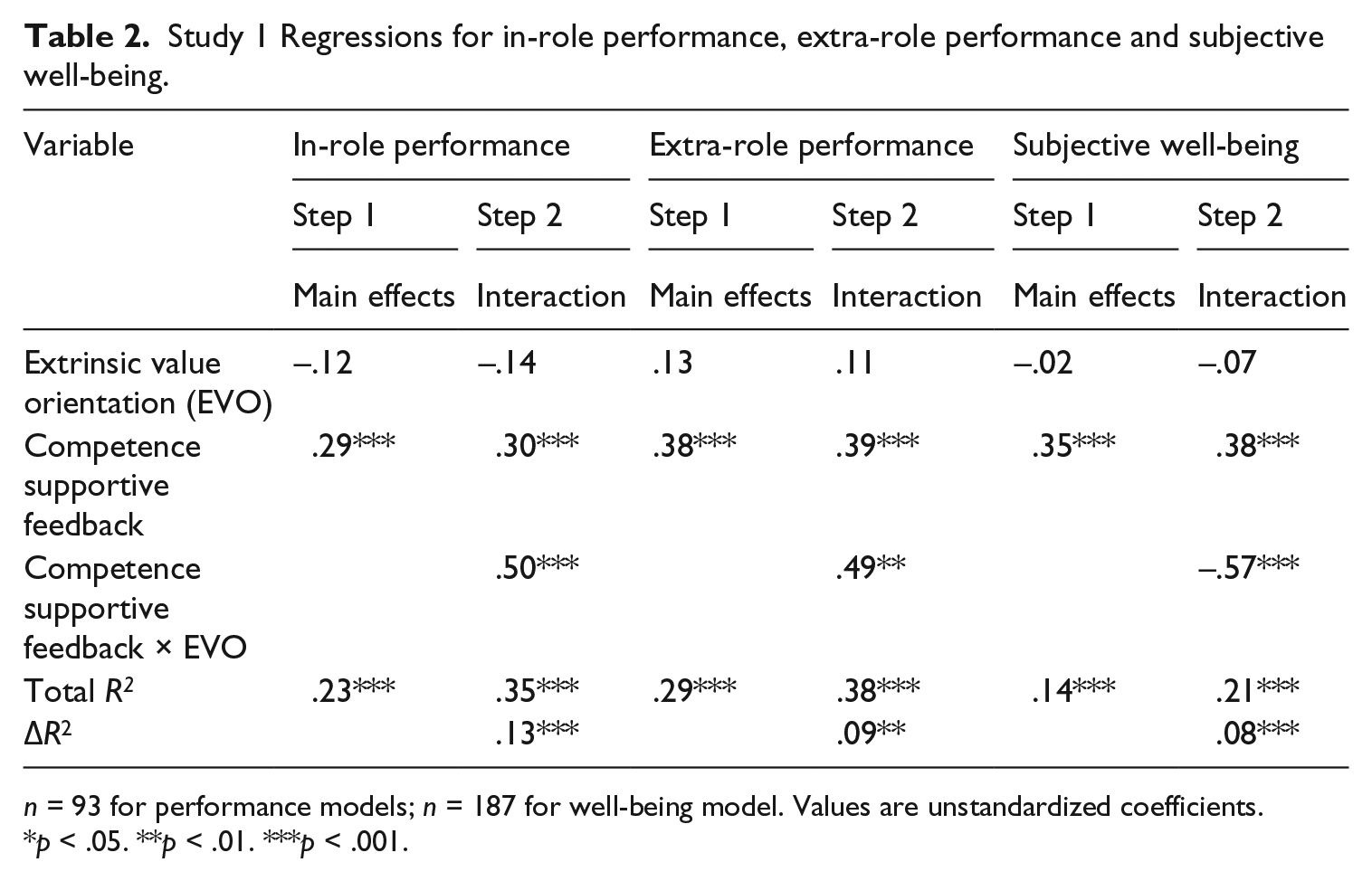
n = 93 for performance models; n = 187 for well-being model. Values are unstandardized coefficients.
p < .05. **p < .01. ***p < .001.
To interpret the interactions results, I computed and plotted the simple slopes for each relationship of interest at one standard deviation above and below the mean (see Figures 2 through 4). Competence supportive feedback was positively associated with in-role performance when EVO was high (β = .52, p < .001), but not when EVO was low (β = .08, p = .26). Competence supportive feedback was also positively and strongly associated with extra-role performance when EVO was high (β = .60, p < .001) and only moderately so when EVO was low (β = .17, p = .03). Finally, the positive association between competence supportive feedback and subjective well-being was non-significant when EVO was high (β = .06, p = .52) versus significant when EVO was low (β = .58, p < .001). These findings provide support for Hypotheses 2 through 4a. As predicted, for employees that are higher relative to lower in EVO, competence supportive feedback’s positive association with in-role performance and extra-role performance is amplified, and competence feedback’s positive association with subjective well-being is attenuated.
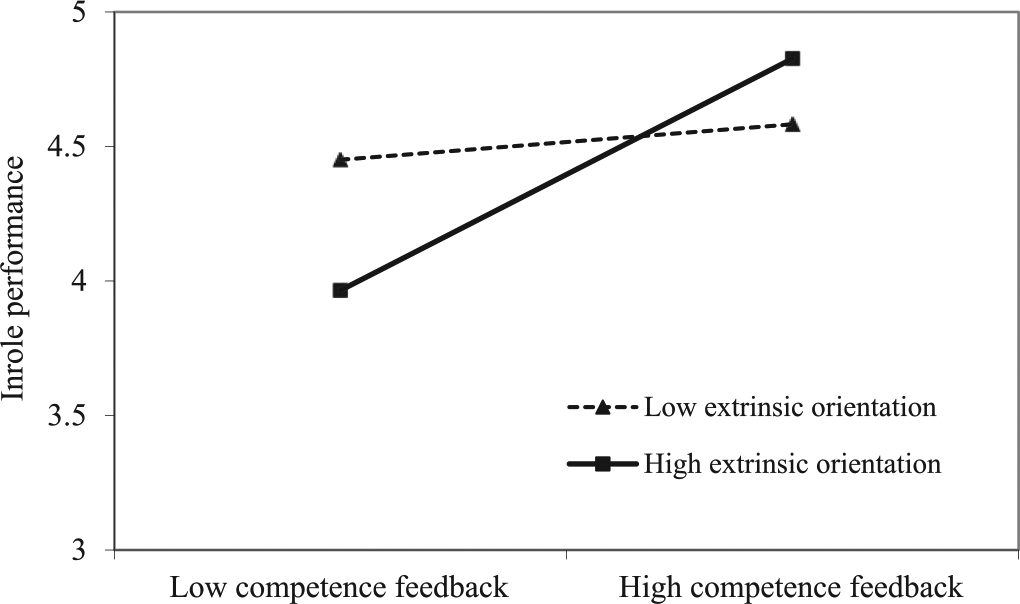
Study 1 regression slopes for in-role performance.
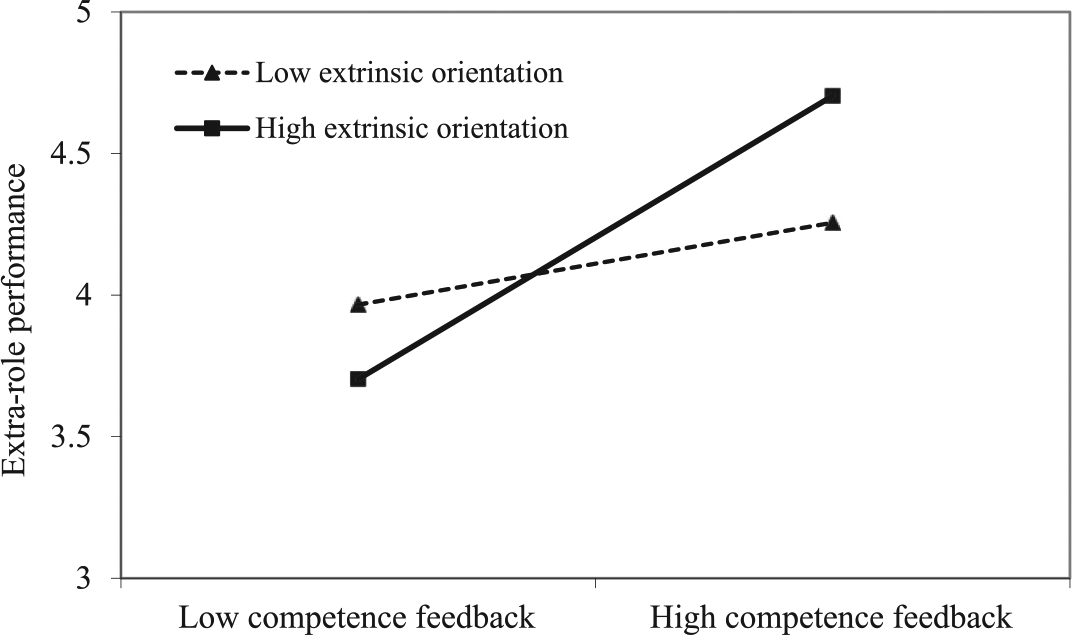
Study 1 regression slopes for extra-role performance.
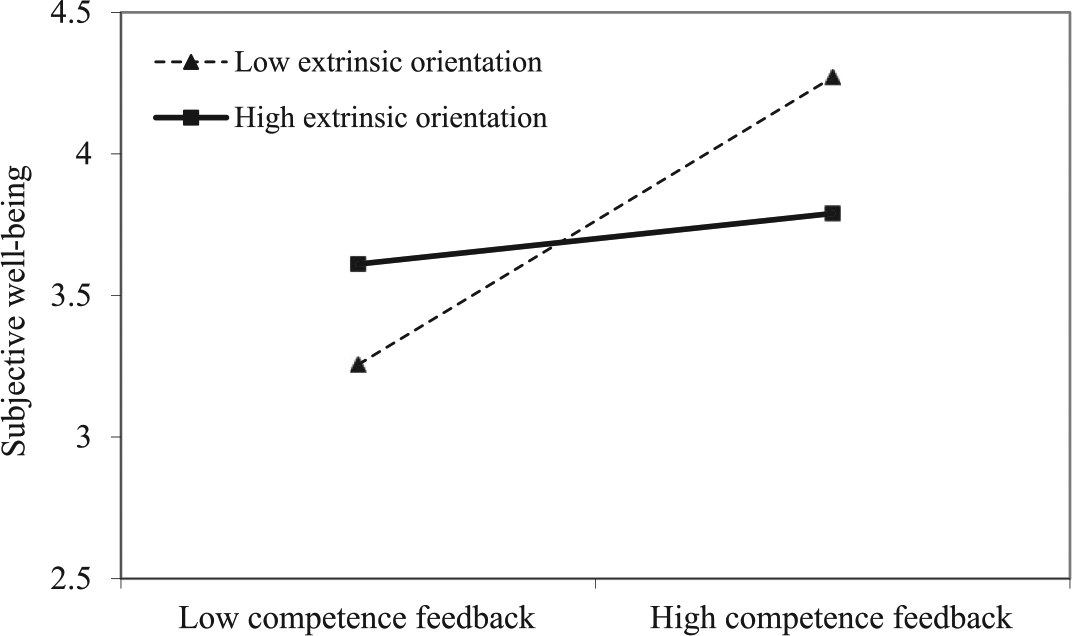
Study 1 regression slopes for subjective well-being.
Study 2
The purpose of Study 2 is to examine a potential underlying causal mechanism for the attenuation of subjective well-being. Specifically, I will examine whether the posed intervening variable of experienced job demands mediates the interactive effects of EVO and competence feedback on subjective well-being as predicted by Hypothesis 4.
Method
Sample
Participants for Study 2 were solicited through a research panel comprised of a wide cross-section of the United States population and attained through Zoomerang (now SurveyMonkey). Screening criteria assured that participants were working adults from a variety of employment positions and industry sectors. A total of 440 cases were retained out of 477 responses after removal of incomplete cases. The panel was recruited and maintained by an organization that certifies unique and qualified responses through the use of digital fingerprinting, extensive validation of prospective panelists’ identity, and measurement of survey-taking time and response patterns to remove non-serious participants. Surveys were administered online.
Respondents worked at their organizations an average of 6.4 years, and 92% were employed full time versus part time. Occupationally, 22% of respondents identified themselves as office/clerical, 8% sales, 10% technical, 17% professional, 14% managerial, 10% service worker and 18% other (comprised of a variety of blue- and white-collar occupations). Earnings ranged from less than $40,000 to over $115,000 per year; the modal category selected was less than $40,000, followed by $41,000 to $55,000. In terms of demographics, 87% of respondents identified themselves as white (non-Hispanic). Females comprised 58% of the sample. The average age was 39.5 years.
Measures
EVO and subjective well-being were assessed using the same measures described in Study 1. Experienced job demands, the posed mediating variable, was assessed from the employee perspective using a measure from Van Yperen and Hagedoorn (2003). Nine of the original 11 items were used in order to capture all facets of the construct while reducing redundancy and thereby risk of respondent survey fatigue (Stanton et al., 2002). The items removed were also reverse-scored items, which have been suggested to impair response accuracy for psychological measures and lack evidence of any clear benefit for acquiescence response bias (Schriesheim and Hill, 1981). The items included were: (1) Do you have to work fast? (2) Do you have too much work to do? (3) Do you have to work extra hard to finish a task? (4) Do you work under time pressure? (5) Do you have to rush? (6) Do you have to deal with a backlog at work? (7) Do you have problems with the pace of work? (8) Do you have problems with the workload? (9) Do you wish you could work at an easier pace? Perceived demands are considered more predictive than objective demands because personal thresholds to accommodate demands vary across individuals. For instance, Kasser and Sheldon (2009) found that individual perceptions of their own time affluence do not correlate with actual hours worked. Scale reliabilities are reported in Table 3.
Study 2 means, standard deviations and correlations.
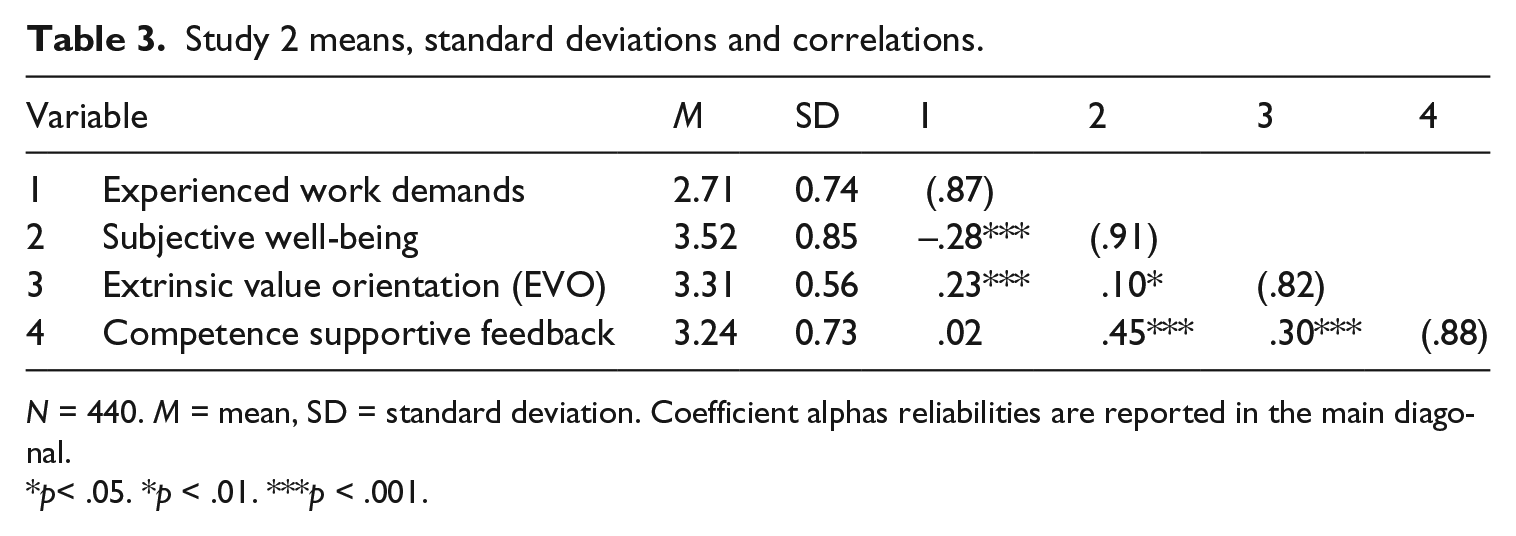
N = 440. M = mean, SD = standard deviation. Coefficient alphas reliabilities are reported in the main diagonal.
p< .05. *p < .01. ***p < .001.
Results
Correlation coefficients and reliabilities (Cronbach’s alpha) of the study variables were examined and found to be within appropriate range (Table 3). Variance inflation factors are below 1.2, and thus again far below the suggested cutoff for multicollinearity concerns (Kutner et al., 2004).
The first step of the analysis was to replicate Study 1 findings regarding attenuation of the positive relation between competence supportive feedback and subjective well-being at higher relative to lower levels of EVO. The same analytical procedures were followed: hierarchical regression analyses, calculation of the interaction term using mean-centered variables, and plotting of the interaction results to facilitate interpretation. The observed power for the interaction regression in this case was .99, which suggests that a type I error is not likely. The findings, as reported under model 1 in Table 4, were consistent with Study 1. The main effect for competence feedback was again significant and positive. The main effect of EVO was not significant. The interaction between EVO and competence supportive feedback was significant in predicting subjective well-being and, based on an interpretation of the simple slopes at one standard deviation above and below the mean of EVO, also similar to Study 1 findings in direction and relative level. The positive association between competence feedback and subjective well-being was again comparatively smaller when EVO was high (β = .45, p < .001) than when EVO was low (β = .63, p < .001). Though the attenuation demonstrated was not as strong as that found in Study 1, the pattern was still evident.
Study 2 regressions for subjective well-being, experienced work demands and mediated moderation.

N = 440. Values are unstandardized coefficients.
p < .05. **p < .01. ***p < .001.
The next step was to test Hypothesis 4b, which predicted that experienced work demands would mediate the interactive effect of EVO and competence feedback on subjective well-being. This conceptually represents a model of mediated moderation or is also referred to simply as a conditional indirect effect (Muller et al., 2005; Preacher et al., 2007). Preacher et al. suggest that conditional indirect effects may be probed for significance using methods directly analogous to those used to probe significant interaction effects in regression (Preacher et al., 2007: 195). Similarly, Muller et al. (2005) suggest that three related criteria be satisfied. First, the interaction of competence supportive feedback and EVO—the independent variable and its moderator—must significantly predict the dependent variable, subjective well-being. This criterion was satisfied, as detailed above. The same interaction term must significantly predict the mediator, experienced work demands. This condition was also met (Table 4, model 2). Next, the mediator must significantly predict the dependent variable while controlling for the interactions between the moderator and independent variable, and the moderator and mediator. This condition was met; experienced work demands significantly predicted subjective well-being while controlling for the two interaction terms (Table 4, model 3). Thus, there is empirical support for experienced work demands as a mediator of the relationship in question, as predicted by Hypothesis 4b.
The conditional indirect effect was also examined using bootstrapping procedures via the PROCESS macro for SPSS developed by Andrew Hayes (Hayes, 2013). The standardized regression coefficient between the interaction term of competence supportive feedback and EVO and the mediator of experienced demands was statistically significant (β = .15, p < .05), as was the standardized regression coefficient between experienced demands and subjective well-being (β = –.34, p < .001). Unstandardized indirect effects were computed for each of 1000 bootstrapped samples. The bootstrapped conditional indirect effects of competence supportive feedback on subjective well-being at values of one standard deviation above and below the mean of EVO were .051, 95% CI [.005, .119] and –.005, 95% CI [–.056, .045], respectively. Thus, the conditional indirect effect was statistically significant at lower but not higher levels of EVO.
A finer-grained understanding of the intervening process may be gleaned by plotting the interaction effects for experienced work demands. Figure 5 presents the simple slopes for employees at one standard deviation above and below the mean of EVO. The association between competence supportive feedback and experienced work demands was non-significant when EVO was high (β = .01, p = .81) and both significant and negative when EVO was low (β = –.15, p = .02). It seems that a high level of EVO deprives one of the beneficial effects of competence supportive feedback for alleviating work demands, which the earlier conceptual reasoning would suggest is owing to the greater work effort put forth by high EVO employees in the context of competence supportive feedback. Thus, this pattern is largely consistent with the reasoning leading to Hypothesis 4b.
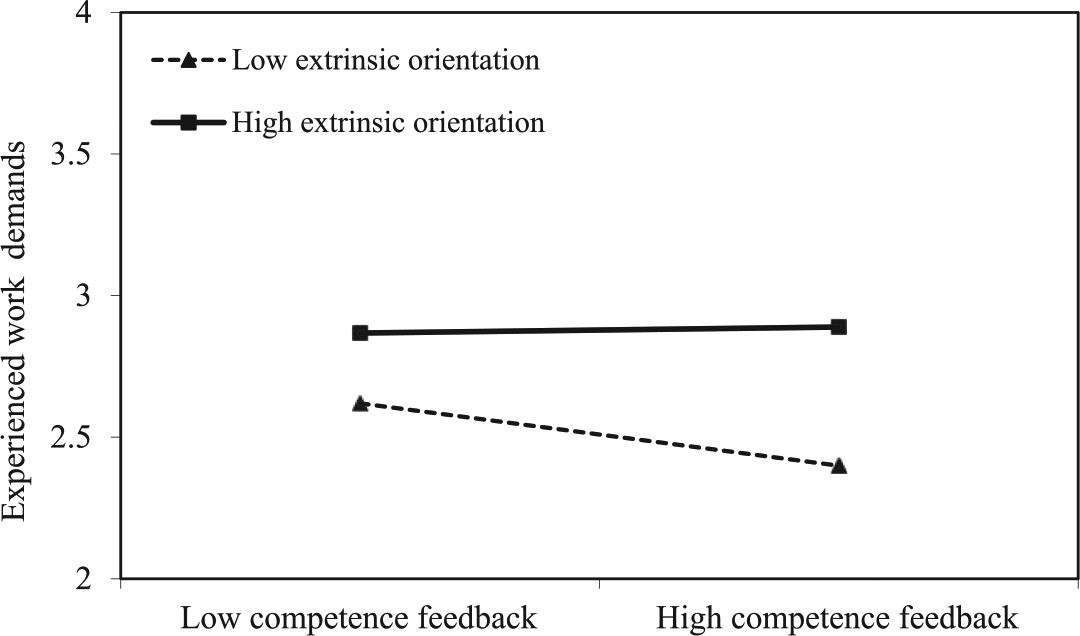
Study 2 regression slopes for experienced work demands.
Discussion
The preceding examined EVO (dispositional preference for extrinsic aspects of work such as money and recognition) as a moderator of the beneficial effects of competence supportive feedback on employee performance and subjective well-being. As predicted, EVO was found to amplify the positive relation between competence feedback and both in-role and extra-role performance, and attenuate the positive relation between competence supportive feedback and subjective well-being. A second and broader sample of employees supported the conceptual reasoning put forth for the relation with well-being. Specifically, a test of mediated moderation confirmed experienced work demands as a mediator. Employees that are innately more extrinsically orientated towards work appear to respond to competence feedback with greater work effort than employees who are comparably less extrinsically orientated. At the same time, they experience higher work demands that, in turn, mitigate the benefits of competence supportive feedback for well-being.
There is an additional subtlety to glean from closer examination of the interaction effects parsed one standard deviation above and below the mean of EVO. Whereas I focused predictions and interpretation of results on high levels of competence supportive feedback, the same pattern of findings in reverse can be seen at low levels of competence feedback. That is, the lowest levels of in-role and extra-role performance are evident when EVO is high and competence feedback is low. High EVO employees appear amotivated at low levels of competence feedback and hypermotivated at high levels of competence feedback. The work performance of employees lower in EVO, on the other hand, does not significantly vary in relation to competence feedback. This lends some support to the trait activation rationale posed earlier. EVO represents the propensity to behave in a certain way, but in accordance with trait activation theory (Tett and Burnett, 2003) its activation relies on situational cues that are sufficiently strong, though not so strong as to extract the same behavior from all.
These findings can also be interpreted in light of the extant literature surrounding extrinsic incentives and motivation. In general, extrinsic incentives are viewed as positively and strongly related to performance (see Shaw and Gupta, 2015 review of meta-analyses) and the quantity of performance in particular (see Cerasoli et al., 2014 meta-analysis). Based on my findings of higher in-role performance, it would seem that competence supportive feedback takes on the motivational properties of an extrinsic incentive for those higher in EVO based on the resulting higher level of performance. Yet at the same time, based on my findings for higher extra-role performance and consistent with self-determination theory, competence supportive feedback also seems to simultaneously promote a more internalized and autonomous form of motivation that is more akin to intrinsic motivation (Deci and Ryan, 2000; Ryan and Couchman, 1999). Indeed, extrinsic incentives and intrinsic motivation can coexist as long as the incentive is not directly controlling of performance (Cerasoli et al., 2014; Deci et al., 1989; Frey, 1997; Frey and Jegen, 2001). This suggests that competence supportive feedback encourages a higher level of overall motivation for those higher relative to lower in EVO, rather than a pitting of extrinsic against intrinsic motivation. This is a particularly important point because intrinsic motivation empirically explains more unique variance in quality of performance (Cerasoli et al., 2014), so ideally organizations would encourage employees to hold both extrinsic and intrinsic (or more internalized) forms of motivation. For example, universities generally seek to encourage both a quantity and quality of research publications among faculty.
In fact, Cerasoli et al. (2014) suggest that researchers pay closer attention to the additive rather than competing nature of extrinsic and intrinsic sources of motivation in predicting performance. Extending these points, the attenuation of competence supportive feedback’s positive relationship with well-being for those higher in EVO seems to stem more from too much motivation rather than the ‘wrong’ form of motivation (i.e. extrinsic vs intrinsic). Though employees may autonomously choose to put forth more work effort, the likelihood of feeling ‘overemployed’ (i.e. working more hours than you prefer) increases with long work hours and directly predicts lower levels of subjective well-being (Angrave and Charlwood, 2015).
Strengths, limitations and future research
These findings must be viewed in light of the study limitations. As noted under the description of measures, the scales items for EVO and experienced work demands were modestly reduced, which can nonetheless result in underestimated effects (Smith et al., 2000). Extra-role behaviors were modeled as a form of discretionary work performance; however, these acts may have been seen by employees as indirectly rewarded (e.g. influential for promotion and raises) and thus less discretionary for those higher in EVO for which extrinsic rewards particularly matter. Further, the use of manager ratings of extra-role performance, as done in the present article, means the performance was observable by management and therefore potentially instrumental and a means of impression management on the part of the employee. The sample for Study 2 was composed of panel participants and thus not necessarily representative of the population at large in terms of motivation for survey completion. Finally, evidence of causality requires a longitudinal or experimental design. An advantage of the present cross-sectional approach, however, is its generalizability to a wide range of actual work settings. And even though common method variance is a potential concern under cross-sectional survey research, interaction effects are not subject to the same concern (Evans, 1985; Siemsen et al., 2010: 456).
Proffered strengths of this research include its focus on EVO specifically in relation to the workplace, and its integration of well-being and performance outcomes within the same model. Studies examining innate motivational orientations often focus outside of the workplace and tend to emphasize the advantages of intrinsic orientations. Although such findings are worthwhile in their own right, they do not fully inform management theory and practice. In order to understand motivation for activities that are not necessarily pursued out of pure intrinsic interest, the dynamics surrounding extrinsic motivation must be considered (Deci and Ryan, 2000). In a similar vein, research that overly focuses on the dysfunction of EVO, say for well-being, or the functional utility of EVO, say for performance gains, risks overlooking potential counteracting effects for organizational performance and implications for long-term organizational sustainability.
Future research can build directly on the model developed herein by considering other variables in the work context that inadvertently interact with an EVO to create ‘too much’ motivation. For example, a sense of relatedness with coworkers is likely to enhance intrinsically oriented forms of motivation, in keeping with self-determination theory, but may simultaneously interact with the EVO tendency to value the opinion of others. Additional work outcomes should also be considered, particularly those workplace behaviors logically connected to experienced work demands such as absenteeism, turnover, ethical behavior and workplace accidents.
Future research might also expand on the independent variable within the present model by isolating the predictive value of specific facets of EVO or additionally incorporating intrinsic work value orientation. Intrinsic and extrinsic work value orientations are essentially orthogonal (Amabile et al., 1994). Therefore, each may explain unique variance within an expanded model or may have explanatory value when considered in relative terms (e.g. Van den Broeck et al., 2015; Vansteenkiste et al., 2007), though a sensitivity analysis conducted for Study 1 indicated that controlling for intrinsic value orientation did not influence results, and the variable was therefore excluded from the analysis and left out of the Study 2 survey.
Practical implications
The findings shed light on a subtle form of ‘collateral damage’ connected to the otherwise positive performance management practice of competence supportive feedback. The practice seems to especially engage performance for high EVO employees, but at the same time appears to increase this group’s experienced work demands and detract from their workplace well-being. Thus, it is questionable whether this level of performance is sustainable. For instance, research points to a performance-regeneration paradox in that sustained high performance ultimately erodes individual ability to sustain high performance (Ehnert, 2009). In a longitudinal study examining the effects of long work hours on subjective well-being, Angrave and Charlwood (2015) found that the indirect effect on well-being was negative and, though recoverable in the short run, tended to have lasting effects on well-being for those who remained ‘over-employed’ for two years or more, though this study also makes clear that over-employment is subjective based on individual preference for the number of hours worked. In a similar vein, meta-analytic results distinguish negative job stress (hindrance stressors) from positive job stress (challenge stressors), though even positive job stress increased work strain—but it seems people are motivated to muscle through the strain and maintain high performance under challenge stressors (LePine et al., 2005). Yet this motivation to maintain high performance may be the very thing that, ultimately, insidiously erodes subjective well-being.
The solution is not necessarily to reduce the level of competence feedback. After all, the findings also suggest that competence feedback significantly enhances well-being for low EVO employees. A more productive approach could entail requiring regular time off, a practice that is empirically linked to performance benefits for already high-performing employees (Perlow and Porter, 2009). Angrave and Charlwood (2015) also conclude from their study described above that policies focused on reducing long work hours are likely to benefit aggregate levels of well-being among the workforce. Further, feelings of time affluence (not feeling that one’s life is rushed and hectic) has been found to have a positive relation with well-being for all types, even those with a high need for achievement (Kasser and Sheldon, 2009). Thus, assuring a degree of time affluence through work policies pertaining to time off, while at the same time providing competence supportive feedback to maximize motivation, may optimize both workforce performance and well-being.
Conclusion
As initially stated, motivated workplace behavior is better understood through the examination of contextual and dispositional motivational influences jointly rather than in isolation. The findings reported herein support this point by identifying for whom and how competence supportive feedback may, in a sense, motivate all too well. In addition, this research speaks to the need to consider sources of motivation and related outcomes more holistically (Cerasoli et al., 2014) and offers insights to continue this scholarly dialogue.
Footnotes
Funding
This research received no specific grant from any funding agency in the public, commercial, or not-for-profit sectors.
 . [Email: