




Abstract
Meta-analysis has proved increasingly popular in management and organization studies as a way of combining existing empirical quantitative research to generate a statistical estimate of how strongly variables are associated. Whilst a number of studies identify technical, procedural and practical limitations of meta-analyses, none have yet tackled the meta-theoretical flaws in this approach. We deploy critical realist meta-theory to argue that the individual quantitative studies, upon which meta-analysis relies, lack explanatory power because they are rooted in quasi-empiricist meta-theory. This problem, we argue, is carried over in meta-analyses. We then propose a ‘critical realist synthesis’ as a potential alternative to the use of meta-analysis in organization studies and social science more widely.
Keywords
Introduction
According to Bornmann and Mutz (2015) the quantity of published research doubles every nine years. This increases the appeal of methods that facilitate the integration and synthesis of existing research. Recently, social scientists, especially those working in management and organization studies (MOS), have developed three basic methods to synthesize existing research: systematic review, meta-interpretation and meta-analysis (MA). This article adds to a significant body of literature dedicated to critically evaluating MA. To date, critical evaluation has, primarily, engaged with the technical, procedural and practical problems of MA, and has, implicitly, presumed that resolving these problems is both necessary and sufficient to make MA more effective. Whilst these debates are welcome, they do not address the meta-theoretical underpinnings of MA, which is the focus of this article. Our argument is that MA is of limited use in explaining the kind of social or organizational phenomena of interest to readers of Human Relations – and cognate journals. This is not owing to technical, procedural and practical problems in the application of MA, but owing to the flawed meta-theory underpinning MA. Instead, we propose an alternative that we refer to as ‘critical realist synthesis’ (CRS), rooted in an entirely different meta-theory – a term we use to include methodology, ontology, epistemology, aetiology, and concepts of explanation, prediction and theory.
To make this argument, we start with an overview of MA, and provide a brief synopsis of some extant criticisms or what we term its ‘known problems’. We then provide a critical realist 1 critique of the meta-theoretical underpinnings of MA by drawing on two highly-cited recent pieces of MA to illustrate our argument. By way of contrast, we then outline CRS and argue, whilst it ostensibly provides less ‘certainty’ than MA, CRS generates greater explanatory power, and is based on more realistic ontological premises.
What is meta-analysis?
MA first appeared in the field of medicine in 1904 as a method of aggregating data
from experimental research. After the Second World War it expanded into the fields
of psychology, education and social science research. The primary aim of
contemporary MA is to compute a weighted mean of effect size between phenomena; the
secondary aim is to identify moderating (and mediating) variables. Let us take a
closer look: Meta-analysis, literally the statistical analysis of statistical analyses,
describes a set of procedures for systematically reviewing the research
examining a particular effect, and combining the results of independent
studies to estimate the size of the effect in the population . . . The
outcome of a meta-analysis is a weighted mean effect size which reflects the
population effect size more accurately than any of the individual estimates.
(Ellis, 2010:
94–95) [M]eta-analysis is . . . a method that estimates an overall ‘effect-size’ of
a range of studies from the individual effect sizes of each individual
study, thus giving greater ‘power’ to the overall statistic. It does this by
calculating a mean of means of means: in the original study, a mean is taken
of the effects of a particular variable for all points in a study, then
variables are averaged to provide an overall effect size (mean) for that
study, and then the effect sizes of a number of studies are averaged in the
MA procedure. (Weed,
2005: 80–81) An effect can be the result of a treatment revealed in a comparison between
groups (e.g., [medically] treated and untreated groups) or it can describe
the degree of association between two related variables (e.g., treatment
dosage and health). An effect size refers to the magnitude of the result as
it occurs, or would be found, in the population. (Ellis, 2010: 4, 6–7)
‘Effect size’ is a measure of the association or relationship between two variables across a range of carefully selected studies. Such analysis presumes that values of independent variables will be related to, or associated with, values of dependent variables if they are observed to regularly occur together with sufficient frequency, with statistical techniques being deployed to identify this association and its properties. On the presumption that the association is causal, independent variables are thought to have a (causal) effect on dependent variables. The term ‘effect size’, then, refers to the magnitude of the association between independent and dependent variables. This then forms the basis for testing meta-hypotheses.
If the MA fails to explain an (arbitrary) 75 percent of the variance, or we know in
advance that there are significant differences in effect sizes across studies, then
a moderator analysis can be conducted: Moderation represents the idea that the magnitude of the effect of an
antecedent (e.g., organizational structure or strategy) on firm outcomes
depends on contingency factors, such as the uncertainty and instability of
the environment . . . [M]oderation refers to the conditions under which an
effect varies in size, whereas mediation refers to underlying mechanisms and
processes that connect antecedents and outcomes. (Aguinis et al., 2016: 1–2)
MA assumes that the effective aggregation of information creates greater statistical power than that derived from any single study, and that results from individual studies are generalizable to a larger population: in order to for example, ‘translate statistical relations into successful recipes for individual organizations’ (Hodgkinson and Rousseau, 2009: 539). The ability to determine causes and effects is ostensibly enhanced as the population grows (as more studies are added to the MA) and inconsistencies between results are quantified and assessed. Moderators and mediators can also be included in an attempt to ‘explain’ variation between results and the presence of forms of bias.
These benefits have been asserted in some sections of the MOS field, wherein the
value of MA has even expanded beyond the realm of synthesis, and towards claiming
the generation of new knowledge: Beyond overcoming difficulties associated with individual studies such as
sampling error, measurement error and restriction of range, MA enable an
analyst to synthesise the findings of primary studies to test hypotheses
that were not testable in those studies. (Eden, 2002: 841)
Having outlined the basic premise of MA, we now briefly outline the known technical, procedural and practical issues with the practice of MA, before moving on to our realist critique.
Known problems
The many technical, procedural and practical (i.e. collection of source data) challenges involved in conducting MA have been detailed by a number of authors. First, there is a lack of agreement on the basic methods to assess effect size, which in turn produce significantly differing results. Whilst calculating effect size requires the subtraction of the mean of the control group from the mean of the experimental group and dividing the difference by the standard deviation, there is no agreement on how this standard deviation is calculated (see Glass, 2000; Hough and Hall, 1994).
The practical task of constructing a sample also provides a number of issues for MA. The MA literature seldom discusses inclusion criteria for data (Rousseau et al., 2008: 491), despite the fact that these cannot be generalized across MA. Inclusion criteria are thus ultimately judgement calls that vary by the research topic and researcher preferences, yet they impact clearly upon the calculation of effect sizes as they define the source material that constitute the analysis. This leads to a problem with publication bias, as published results tend to be those that show strong statistical outcomes (Rousseau et al., 2008). Thus, MA tends to over-represent positive results whilst dramatically underreporting those that are null. This has led some to argue that results reported as statistically significant may have inbuilt exaggeration bias (Rossi, 1987).
Relatedly, the validity of effect sizes is a function of the homogeneity of included studies (Miller, 1987). This poses a paradox as studies with large sample sizes are privileged, which mitigates against the possibility of pooling sufficient homogeneity in terms of research foci, especially in social science research. Whilst on the face of it, greater inclusion seem to follow the internal logic of MA by increasing the scope and sample size of the analysis, Coyne et al. (2011: 224) show that including very small scale research in MA is likely to lead to ‘overestimate effects’ that statistical techniques cannot correct.
The extent to which source studies can be combined is also dependent upon the degree of similarity (in terms of definitions, interpretations of key variables, and the deployment of data capture techniques) between studies (Linden and Priestley, 2009). However, the codification of the process through which this is achieved is often significantly truncated or even omitted in publication. Similarly, the nuanced way in which theories and concepts inform the design and operationalization of the original studies is crucial. Data from original studies require manipulation and tabulation to perform MA and, given that these were generated for alternative purposes, it is problematic to match the theoretical perspective of the meta-analyst and the original research, if the original data is even accessible at all (Cowton, 1998). The consequence of this is that effect size analysis may therefore amalgamate statistical findings based on differing interpretations of the theoretical hypothesis as well as differentially operationalized constructs of study.
A further challenge for MA relates to the quality of source data: any given range of source data is likely to display variability in terms of the extent to which they possess internal (elimination of bias) and external validity (Franke, 2001). The MA analyst takes for granted that what the original analyst did to code the data into concepts is reliable, so one’s measures could be very different across studies. This means that the extent to which the results can be generalized to their target population is at best questionable. Moreover, ‘method variance is pervasive, ubiquitous, almost invariably in social and behavioural science, each array of measurements . . . contains variance associated with the method. Any obtained relationship between two such units can be due to method variance’ (Fiske, 1982: 82).
Generalization on the basis of studies with reliability issues will therefore accentuate rather than reduce, or correct for, error, and may reflect manipulations of non-comparable independent variables and their effects on non-comparable dependent measures.
A critical realist critique of meta-analysis
Whilst the technical, procedural and practical issues with MA are notable, our critique is not based upon these. Indeed, even if these problems were resolved, our critique, which is meta-theoretical, would remain. To the best of our knowledge, no meta-theoretical critique of MA has been undertaken (although, see Pawson, 2004). Let us start with establishing some basic terms and ideas that will inform the rest of the article.
First, we use the term ‘causal mechanism’ generically, to refer to things like ‘social structures’, ‘cultural structures’, ‘institutions’, ‘conventions’, ‘norms’, ‘rules’, and so on. A human resource management (HRM) practice, or a discourse, could, for example, be a causal mechanism. The term ‘mechanism’ carries no connotations of simple additive effects or determinism. It simply refers to a thing that has causal powers or, in layperson’s language, the ability to affect things. A causal mechanism is causal in virtue of the powers it possesses as derived from its properties. The causal powers of any social mechanism only become enabled when enacted by human agents. When, therefore, we refer to a mechanism causing this or that, we always have in mind an agentially enacted mechanism.
Second, we use the term ‘quantitative empirical studies’ to refer to those studies employing quantitative data and statistical research techniques, typically regression analysis. They should not be confused with qualitative empirical studies such as ethnographies, case studies, in-depth interviews, participant observation and such like. 2
Third, for critical realists (CRs), the objective of social science is not to predict but to explain. This is achieved by identifying, and theorizing: an appropriate (qua relevant) agent (A); an appropriate causal mechanism 3 (M); how agent (A) interprets, and enacts mechanism (M), generating tendencies (T) towards outcome (O); and other mechanisms, often referred to as ‘the context’ (Mc), which dispose agent A to interact with M and not (say) N. Any putative explanation can then be empirically substantiated – that is, successfully tested, which does not mean simply testing quantitative hypotheses. We refer to this as generating theoretically informed and empirically substantiated explanations.
Fourth, quantitative empirical studies, which provide the source material for MA, are rooted in a meta-theory we call ‘quasi-empiricism’ 4 and comes with a ‘chain of meta-theoretical concepts’ (Fleetwood, 2014: 182), especially ontology, epistemology, methodology, aetiology, and concepts relating to open and closed systems, theory, prediction and explanation. 5 Let us look a little closer at this chain of meta-theoretical concepts.
Ontology
Observed (empirical) events or states of affairs are the ultimate phenomena about which quasi-empiricists collect data – for example, size of organizations; presence of teamwork; being female; employee performance. If these events are observed (or proxied) in terms of quantity or degree, they become variables – that is, quantified events. The ontology consists, therefore, of observed events or states or affairs that are unique, unconnected or atomistic.
Epistemology
Whilst quantitative empirical researchers are probably aware that the variables they measure represent causal mechanisms, broadly conceived, their focus is always on the events these mechanisms generate. 6 If, as presumed, particular knowledge is gained through observing events, more general or ‘scientific’ knowledge is gained only if these events manifest themselves as regularities in the flux of events or states of affairs. 7 This is usually styled ‘whenever event x1….xn then event y’ or y = f(x1….xn).
Together, this ontological and this epistemological position implies a ‘flat’ ontology – the assumption that all that exists are events (or actions) and people’s perceptions of these events (Table 1).
A ‘flat’ ontology.

Methods
The method of quasi-empiricism seeks to generate predictions, typically in the form of hypotheses to be refuted or supported via the collection of quantitative data. The only phenomena that feature in quantitative empirical research are those capable of being transposed into variables – that is, the quantified expression of events. What cannot be quantified adequately is omitted.
Aetiology
The notion of causation pre-supposed by quasi-empiricism is referred to as the regularity view of causation. As its ontology is of observed atomistic events, its concept of causality cannot be conceived of in terms of anything other than events and their regularity. As the epistemology of quasi-empiricism is reliant upon identifying event regularities, its conceptualization of causation requires knowledge of event regularities. To know the cause of increased organizational performance is, for example, to know that it is regularly preceded by the introduction of a bundle of HRM practices. More generally, to know the cause of event y, requires us to know (no more than) that event x, or events x1, x2…xn, is/are regularly conjoined to event y.
It is worth adding that conclusions are often, usually implicitly, given a universal and general ‘twist’, along with a spurious precision. For example, in their analysis of performance related pay (PRP) (Gielen et al., 2010: 291) write that: ‘PRP increases productivity at the firm level by 9%’. It is not clear if this is understood as a ‘one off’, or whether this is supposedly generalizable to all firms. If the latter, the ‘9%’ looks to be an example of spurious precision.
Open and closed systems
The quasi-empiricist commitment to causality as regularities in the flux of
events requires that social or organizational systems are theorized or modelled
as if they are closed systems, defined thus: Parts of
the socio-economic world characterized by regularities in the flux of events
(or states of affairs) of the form ‘whenever event x then event y’, or y =
f(x) are closed systems, and parts of this world not so characterized are
open systems (see Bhaskar, 1978; Fleetwood, 2016; Lawson, 1995). Crucially, statistical
techniques like regression analysis not only presuppose, but only work in,
closed systems. Methodologically speaking, quantitative empirical researchers of
organization studies must ‘engineer’ closed systems (only in theory, because a
real open system such as an organization cannot be closed) so they can write
things like: Hypothesis 1: Empowerment-enhancing bundles [of HRM
practices] will be positively correlated with business outcomes. (Subramony,
2009: 748)
This translates to ‘whenever empowerment-enhancing bundles (EEB), then business outcome’, or ‘outcome = f(EEB)’ and, by definition, this describes a closed system. Variations in regularity are generally specified probabilistically or stochastically, as random processes occurring in the ontic domain. Probability is a measure of the likelihood of an event occurring. The re-conceptualization of stochastic event regularities using the concepts of probability, might be styled ‘whenever event x, then on average event y’, or y = f(x + ϵ) or more accurately, ‘whenever the realized value of the (independent) variable measuring event or state of affairs x, then the conditional mean 8 of the (dependent) variable measuring event or state of affairs y’. The error term (ϵ) presents random influences on the dependent variable y and consequently converts the mathematical model linking y to the x into a stochastic or statistical model representing the population of interest (Downward, 2016: 210). If an empirical researcher managed to identify a stochastic event regularity (perhaps over a restricted space/time) then s/he will have identified a stochastically closed system. Henceforth, we use the phrase ‘event regularities, probabilistically specified’, to refer to the kind of associations identified by statistical techniques such as regression analysis and MA (Fleetwood, 2016).
Theory
A theory is often said to have a predictive dimension containing statements delivering predictions such as ‘y will follow x’; and an explanatory dimension containing statements delivering ‘explanation’ that amounts to the same thing. ‘Theory’, then, becomes reduced to a set of statements designed to enable predictions, usually, in the form of hypotheses. We describe this as ‘theory’ – that is, with scare quotes – because, in our example, a ‘theory’ that explains an increase in organization performance is reduced to a statement to the effect that ‘a bundle of HRM practices were introduced’. Whilst other information, perhaps identifying the relevant causal agentially enacted mechanisms, is sometimes included, it is, strictly speaking, not necessary. This is sometimes referred to as ‘ultra-empiricism’ or ‘measurement without theory’.
Prediction and (lack of) explanation
Prediction for quasi-empiricism is based upon induction from past regularities in the flux of events. This conflates prediction and explanation. This illicit conflation is commonly referred to as the ‘symmetry thesis’, whereby the only difference between explanation and prediction relates to the direction of time (i.e. if x predicts y, then x is said to ‘explain’ y). For example, if the introduction of team-working was found to predict an increase in profitability, then the former would be said to ‘explain’ the latter. This conflation manifests itself in the way independent variables are commonly referred to as ‘explanatory variables’, and/or ‘predictors’ of the magnitude of dependent variables. This is, however, a misconception. Imagine that a regression analysis identifies an association between the introduction of team-working and an increase in profitability, or put another way, imagine that the introduction of team-working predicts the increase in profitability. Is anything explained by this? The answer is no. A prediction, even a successful one, explains nothing. A regression analysis, even one that successfully identifies an association between independent and dependent variables, does not reveal why the association comes about and, therefore, lacks explanatory power.
Summary
The lack of explanatory power in individual quantitative empirical studies, rooted as they are in quasi-empiricist meta-theory, is the result of their commitment to the particular chain of meta-theoretical concepts – that is, an ontology of events or states of affairs; causality as event regularity; epistemology based upon identifying event regularities probabilistically specified; a method of building theoretically closed systems to engineer the event regularities that generate predictions to be tested qua hypotheses; and theory as sets of statements that ‘set up’ the event regularities as predictions, which are then conflated with ‘explanations’. As these studies cannot generate explanations, they cannot generate theoretically informed and empirically substantiated explanations either. Unfortunately, this problem is not restricted to individual quantitative empirical studies but, as we will see below, carries over into MA more generally.
We envisage two potential responses from advocates of MA. First, they might find,
demand, or carry out individual studies, including quantitative studies, which
do have explanatory power, or insist on them being used as the appropriate basis
for MA. Second, they might counter-argue that MA does not lack explanatory
power. All MA has sections referred to as ‘theory’, ‘literature review’,
‘hypothesis building’, or some such, and it is in these sections that
theoretically informed and empirically substantiated explanations can be found.
Unfortunately, these responses will not work. Apropos the first response, whilst
qualitative empirical research is essential in the search for theoretically
informed and empirically substantiated explanations (Ackroyd and Karlsson, 2014; see also
Edwards et al.,
2014), it is precisely this material that is excluded from MA: . . . weed out all those papers that do not report data . . . as well as
those studies that are based on the analysis of qualitative data (e.g.,
ethnographies . . . and case studies). Getting rid of these types of
papers is straightforward. (Ellis, 2010: 98)
Furthermore, in order to find or carry out quantitative studies that do have explanatory power, they would have to be rooted in an alternative meta-theory, one not committed to the chain of meta-theoretical concepts noted above. Yet, quantitative empirical researchers cannot just abandon their commitment to this or that meta-theoretical concept, because these concepts only ‘work’ as a complete package. The alternative, which we propose later, is that we should abandon this entire chain of meta-theoretical concepts, and replace it with an alternative.
Illustrating the meta-theoretical problems with meta-analysis
To illustrate our critique, we have selected two recent, highly-cited examples of meta-analyses, published in top ranked journals in the authors’ areas of interest. In the first article, Reichl et al. (2014) explore the relation between work–nonwork conflict and burnout by conducting a MA of 86 relevant studies, which allows for an analysis of 220 coefficients. In the second, Subramony (2009) explores the relationship between bundles of human resource (HR) practices and specifically defined organizational outcomes. This is achieved through a MA of 65 relevant studies, which allows for an analysis of 239 separately reported effect sizes. Both are examples of ‘best practice’ MA and the criticisms we raise apply to all the examples of MA we are familiar with.
Reichl et al. (2014)
First, in a (half-page) section entitled ‘theoretical framework’, Reichl et al. mention ‘several theoretical reasons to expect relations between work–nonwork conflict and burnout’ (2014: 982–983). After a very short theoretical discussion they refer the reader to six sources where, presumably, the theoretically informed and empirically substantiated explanations informing their MA might be found. Further inspection, however, reveals this not to be the case. One study is just another MA; two are ‘standard’ quantitative studies seeking empirical regularities; three offer theoretical insight, but are not qualitative empirical studies, and two are extremely dated. Their ‘theoretical framework’ section, then, offers little or nothing in the way of theoretically informed and empirically substantiated explanation.
Second, Reichl et al.’s MA tells us that work–nonwork conflict was correlated with emotional exhaustion and cynicism, but these relations were moderated by gender, age, family characteristics and cultural norms. They are aware of ‘important gaps in our knowledge about underlying processes [i.e. causal mechanisms] and moderating variables’ (p. 980), and their remedy is to obtain ‘theoretically derived moderators’ – that is, to theoretically derive the moderating causal mechanisms. Whilst this looks like a potential source of theoretically informed and empirically substantiated explanation informing their MA, further inspection reveals this not to be the case. Apropos the moderator variable gender: one study is a theoretically informed quantitative analysis; four are ‘standard’ quantitative studies, despite one having ‘multi-method’ in the title; and two are dated. Concerning the moderator variable family characteristics: two are ‘standard’ quantitative studies and two are meta-analyses. For the ‘age’ variable, there is only a ‘standard’ quantitative study. Apropos the moderator cultural norms: four studies are ‘standard’ quantitative studies; one is another MA; and two are overviews/reviews. None of these references offer the kind of theoretically informed and empirically substantiated explanation that would be needed to derive the moderating causal mechanisms. This point is developed in more detail later.
Subramony (2009)
Let us turn our attention now to the other example of MA: Subramony’s article on
HRM bundles and firm performance: [HRM] bundles consisting of multiple complementary practices are
typically considered superior to individual best practices in
influencing firm performance. This study investigates the relationship
between three such bundles (empowerment, motivation, and
skill-enhancing) and business outcomes . . . Although it makes
conceptual sense to categorize individual HRM practices into these
bundles, there is insufficient empirical evidence regarding both
their proposed synergistic properties and the magnitude of bundle
effects on firm performance. I propose to bridge this gap
in the strategic HRM literature by investigating the relationship
between empowerment, motivation, and skill bundles and various business
outcomes; clarifying the synergistic properties of these
bundles by comparing their effects to those of individual
HRM practices; and demonstrating the usefulness of these bundles in
relation to high-performance work systems (HPWSs). (Subramony,
2009: 745–746, emphasis added)
To say that there is insufficient empirical evidence regarding (π), the proposed synergistic properties of bundles of HRM practices, is entirely correct. Subramony’s observation that there is insufficient empirical evidence regarding (Ω), the magnitude of bundle effects on firm performance, has valid and invalid elements. It is invalid in the sense that there are actually many quantitative empirical studies seeking to identify the magnitude of bundle effects on firm performance. It is, however, valid in the sense that what evidence there is does not support the existence of the statistical association he believes exists. Subramony proposes to ‘bridge this gap’ by (a) investigating the relationship between these bundles and business outcomes; (b) clarifying the synergistic properties of these bundles by comparing their effects to those of individual HRM practices; and (c) demonstrating the usefulness of these bundles in relation to HPWS. Notice, however, that there are two ‘gaps’ – that is, (π) and (Ω). At best MA can deal with (Ω) by engaging in (a) and (c). What MA cannot do, however, is deal with (π) via (b). It cannot bridge the gap of insufficient empirical evidence regarding the proposed synergistic properties of bundles of HRM because to do this would require theoretically informed and empirically substantiated explanations of why empowerment, motivation, and skill-enhancing HRM practices cause increased performance. MA cannot get anywhere near delivering explanations of this kind.
This said, as with Reich et al., Subramony’s MA is not entirely devoid of
theoretically informed explanations – although few of them are empirically
substantiated. He writes: The combination of multiple empowerment-enhancing practices . . . is
likely to be synergistic because of the potential complementarities
among these practices. For instance, allowing autonomous work teams to
manage the production of a component or provision of a specific service
can enhance employees’ sense of responsibility and autonomy within the
constraints of their work role. Additionally, the provision of voice and
upward feedback mechanisms can help employees view themselves as part of
a larger organizational system, leading them to engage in discretionary
behaviors, including suggesting improvements to the products, services,
or work processes; assuming increased responsibilities; and volunteering
(e.g., serving on joint management-worker task forces). Also, the
presence of multiple empowerment-related practices is likely to signal a
coherent organization wide commitment to employee empowerment, which is
likely to result in reciprocation in the form of in-role and extra-role
behaviors. (Subramony, 2009: 748)
Subramony’s brief explanations for the existence of synergies are not unreasonable, but any competent researcher in this field could come up with reasonable explanations about dis-synergies. The fact is, we do not really know which is the case because there are insufficient theoretically informed and empirically substantiated explanations of the proposed synergies. Moreover, MA brings us no closer to obtaining these explanations because it focuses our attention on identifying statistical associations, such as that underlying ‘Hypothesis 1: Empowerment-enhancing bundles [of HRM practices] will be positively correlated with business outcomes’ (Subramony, 2009: 748).
Let us consider an example of how statistical techniques used in MA can often
lead us further into obscurity: By calculating the composites of relevant effect sizes within each study,
I created the empowerment, motivation, and skill bundles. For instance,
if a given study provided correlations between training and productivity
and selection and productivity, a single composite score was created to
reflect the combined effect of both the skill-enhancing practices of
training and selection on productivity. (Subramony, 2009: 753)
Subramony takes past research showing correlations between training and productivity, and selection and productivity, and combines them into a single composite score reflecting the combined effect of training and selection on productivity. Whatever the advantages of doing this are, they have to be weighed against the dis-advantages. And the main disadvantage is this; to know that there are correlations between training and productivity, and selection and productivity, is not to explain anything – that is, we remain in the dark as to why these correlations come about. But then to combine them into a single score reflecting their combined effect on productivity leaves us with an even more complex statistical association about which we actually understand even less. We are moving further away from generating theoretically informed and empirically substantiated explanations, not getting closer to them.
Note that this has nothing to do with missing moderating or mediating variables. Indeed, if it turned out that additional moderating or mediating variables were needed, the problems would get even worse: we would end up with yet more variables, and yet more associations between them, and be no closer to deriving theoretically informed and empirically substantiated explanations.
Moreover, what can be done, practically, with Subramony’s argument that: . . . firms can benefit from the adoption of high-performance HRM
practices . . . as long as these practices also are complementary. Thus,
instead of simply increasing the number of HRM practices . . . firms
could derive positive returns by enhancing synergy among these
practices. (Subramony, 2009: 759)
The only way this finding could be of substantive, or practical, use would be if it enabled a HR manager to successfully predict (solely on the basis of past event regularities) that the implementation of a bundle of complementary high-performance HRM practices would be followed by increased organizational performance in some future period. Even if a HR manager was prepared to implement the bundle, s/he would need to know a great deal more about how exactly to ‘enhance synergy among these practices’ than can be provided in such research. For the practitioner, therefore, these exhortations require a peculiar leap of faith that diminishes their own insight, experience and expertise. The implication is that the HR manager should sacrifice any experienced insight as to why certain HR practices may, or may not, work in their own context, and instead follow the numbers. One is left feeling that the HR professional might be usefully replaced with an algorithm.
Summary
The ‘A critical realist critique of meta-analysis’ section established that the lack of explanatory power that characterizes individual quantitative studies, rooted in quasi-empiricist meta-theory, is the result of its commitment to a particular chain of meta-theoretical concepts. Unfortunately, this problem carries over into MA. Despite MA having dedicated ‘theoretical’ sections, the latter carry little in the way of explanation and, therefore, can offer little prospect of theoretically informed and empirically substantiated explanations. The explanations contained in MA are as lacking in explanatory power as the individual quantitative studies upon which they are based. Allow us to make the point more forcefully: if one individual quantitative study lacks explanatory power, then synthesizing scores of them does not increase the explanatory power.
Does this mean that all attempts to synthesize existing research are doomed to failure? We think not, but only if we turn to an alternative approach, CRS, which is rooted in an entirely different meta-theory. It is to this that we now turn.
A critical realist alternative 9
In order to see exactly where CRS differs from MA, we present CR’s chain of meta-theoretical concepts, in the same format as we did for quasi-empiricism above.
Ontology
As well as the actual and the empirical (Table 1), CRs recognize the existence of the ‘deep’ (Table 2). This stratified ontology is also emergent, meaning that entities existing at one ‘level’ are rooted in, but irreducible to, entities existing at another ‘level’. For example, the social is rooted in, but irreducible to the biological, which is rooted in, but irreducible to the chemical, which is rooted in, but irreducible to the atomic, and so on (Elder-Vass, 2010). Social reality is also transformational; Agents reproduce or transform a set of pre-existing mechanisms. Society continues to exist only because agents reproduce or transform the mechanisms that causally condition their social actions.
A stratified or laminated ontology.

In a social world, characterized by stratification, emergence, transformation and, typically, configurations of interacting causal mechanisms, it is unsurprising to find partial, approximate, rough-and-ready regularities or patterns in the flux of events. Following Lawson (1997; 2003: 81–83 and 105–107), we refer to these as ‘demi-regs’, which can be styled as ‘whenever event x, then sometimes, but not always event y’; for example, ‘women sometimes, but not always, look after children more than men’. A system wherein demi-regs predominate, is an open system. Thus, whilst any explanations CR generate should ‘fit’ with the statistical record, the statistical record explains nothing in itself (see also Porpora, 2015).
Epistemology
With the recognition that events do not often manifest as regularities and that something must govern an irregular flux of events, the emphasis of CR investigation switches from the domains of the empirical and actual to the deep: to the causal mechanisms that govern the flux of events. For example, we noted the claim that the introduction of PRP increases productivity at the firm level by ‘9%’ (Gielen et al., 2010: 291). CRs might re-focus attention towards the mechanisms by which the relationship might occur: the motivation of some, but not all, individuals to increase their effort towards those metrics that are being measured, or the impact of labour relations on such motivation. In weighing up explanations, CRs accept the possibility of judging between competing claims because they reject the claim that to accept epistemic relativism is to accept judgemental relativism. That said, there is no gainsaying the difficulty involved with this, especially when such judgement requires far more than simply carrying out statistically-based hypothesis testing to see which competing theories have greater explanatory power. 10
Aetiology
The parts of the social world not characterized by event regularities (i.e. open systems) are still governed by something. This something cannot be a law as this would produce constant regularities. So instead, CRs use the term tendency to depict the (transfactual) way of acting of a thing (or things) with properties (Fleetwood, 2009). A tendency is not an empirically observable pattern, as a tendency can be in play and yet not manifest itself empirically, as it can be counteracted by other mechanisms (Fleetwood, 2012: 248).
To illustrate causation, CRs seek what Fleetwood and Hesketh (2010) refer to as ‘thick explanation’ – that is the kind of explanation that requires hermeneutic information – that is, information relating to a range of human cognitive activities such as understanding, intention, purpose, meaning, interpretation, reason and so on. We do not, however, know what the cause of the action is, one does not understand it, until we know the intention that underlies it; that is, until we know why the agent did what s/he did. If, to explain an action is to give a causal account of it, then to explain an action is to give an account of why the actor did what s/he did. Whilst exploring motivations is always difficult, these can be explored using interviews. Sims-Schouten and Riley (2014) and Smith and Elger (2014) show, for instance, how interview-based research facilitates the probing of agent’s own understandings of causal relations in organizational contexts.
Method
As the social world is an open system, mechanisms cannot be induced or deduced, but must instead be retroduced. Retroduction ‘consists of a movement . . . from the conception of some phenomenon of interest to a conception of some totality or thing, mechanism, structure or condition that is responsible for that given phenomena’ (Lawson, 2003: 145). It usually involves asking a specific kind of question: ‘What thing, if it existed, might account for the existence of P?’ and might end up identifying Q as the thing in question. Retroduction is used when we are relatively ignorant about the mechanisms in operation that are causing the phenomena under investigation. When there is little or no existing theory to act as a guide, we must take a voyage of discovery, make hypothetical conjectures, requiring the ‘scientific imagination’ (see Lewis, 1999). We use what we do know to explain what we do not know.
Open and closed systems
In open systems, theoretically informed claims must be framed in transfactual terms. Transfactual claims cannot, however, be empirically substantiated by testing quantitative hypotheses. Consider two hypotheses: the first is typical of quasi-empiricism and the second is transfactual:
Hypothesis 1: Workers assembled into a team increase profit.
Hypothesis 2: Workers assembled into a team tend to increase profit.
The intuition underlying Hypothesis 1 is something like ‘workers assembled into a team raise the probability that profit will increase’. This presumes the existence of a (ontic) stochastic regularity, which can be re-conceptualized probabilistically, between assembling workers into a team, and the resulting increase in profit. Hypothesis 1 can be tested using ‘normal’ statistical techniques. In complete contrast, the intuition underlying Hypothesis 2 is something like ‘workers assembled into a team have the causal power to raise profit, but sometimes this power is actualized and sometimes it is not’. This gives rise to a demi-regularity, rather than a stochastic regularity, and thus cannot be re-conceptualized probabilistically. Hypothesis 2 cannot be tested using the ‘normal’ statistical methods rendering quasi-empirical methods such as MA unsuitable for open-systems theorizing.
Prediction and explanation
CRs hold that, in open systems ‘thick’ explanation is probably our only guide to the future. If, for example, one can uncover, and explain, the causal mechanisms (e.g. HR practices) that, when drawn upon by workers and managers, increase organizational performance, then one has an explanation of the increase in performance. Such an explanation would allow one to understand the tendencies generated when workers and managers engage with HR practices. If one understands these tendencies one can make tendential predictions.
Importantly, and in contrast to the empiricist tradition, which focuses only on what actually happens, powers or tendencies for CRs are transfactual, and therefore point to the potential of entities. Thus, given the appropriate context (i.e. products, production regimes, labour relations systems), one mechanism may have more potential to increase performance than another, even if this potential is continually negated by countervailing tendencies. This is important because, unlike MA, it points to theorizing the possibilities of future social events, caused by agentially enacted mechanisms, even if these events have not occurred in the past.
Theory
For CRs, theory consists of statements that deliver causal explanations. We can illustrate this by returning to our previous example: if we want to explain the tendency for team-working to increase productivity, we might look to existing theory about the relations within teams, seeking to develop new insights about (i) exactly how teams (as bundles of causal mechanisms) raise productivity; (ii) how agents are engaged with them; and (iii) the complex set of interactions between the bundles themselves and between the agents.
Summary
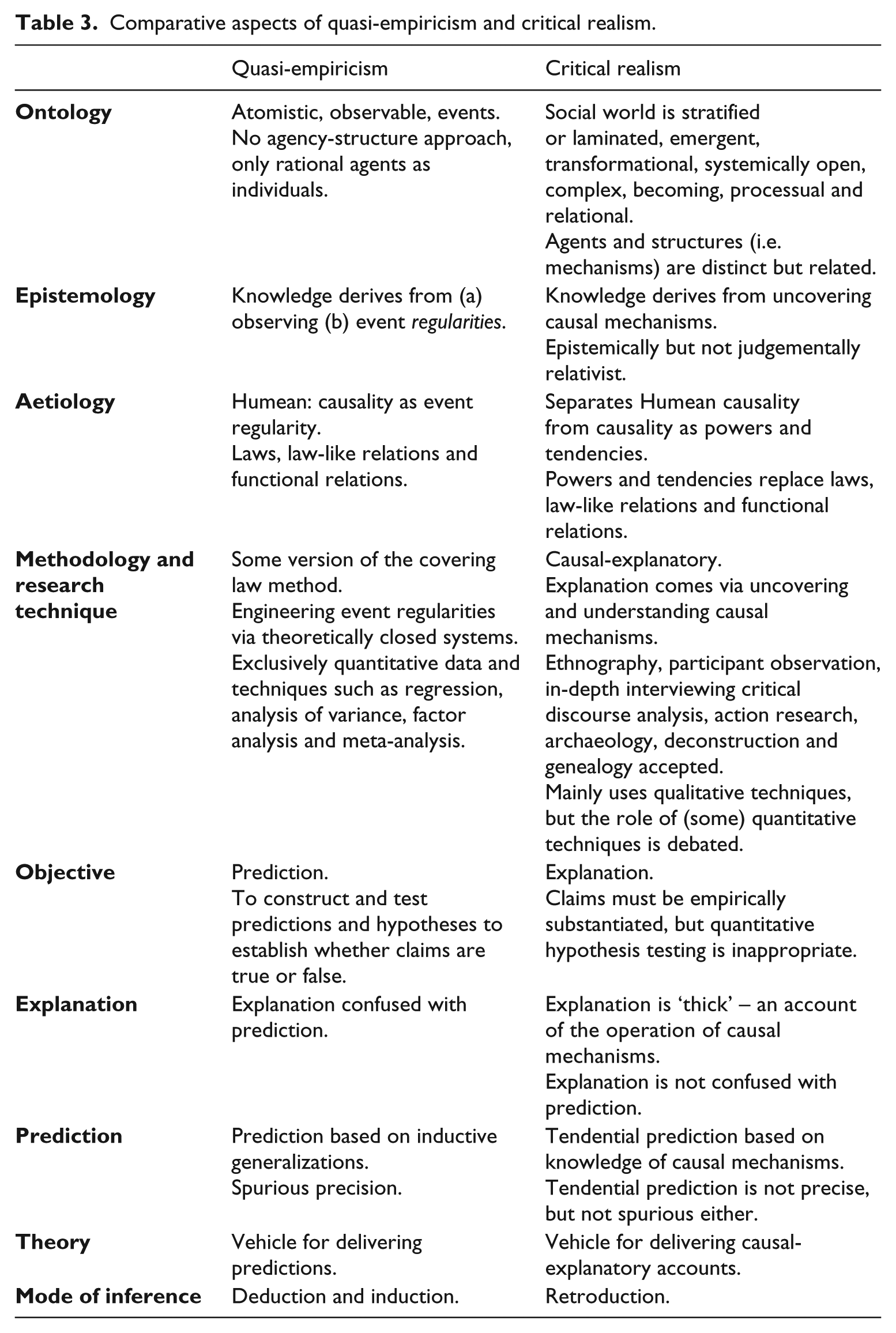
In sum, a CR chain of meta-theoretical concepts can be contrasted to that of quasi-empiricism in which MA is rooted (Table 3).
Comparative aspects of quasi-empiricism and critical realism.
With the meta-theoretical framing completed, we can now take the first tentative steps to show how the above CR meta-theory might be used to guide CRS.
Critical realist synthesis
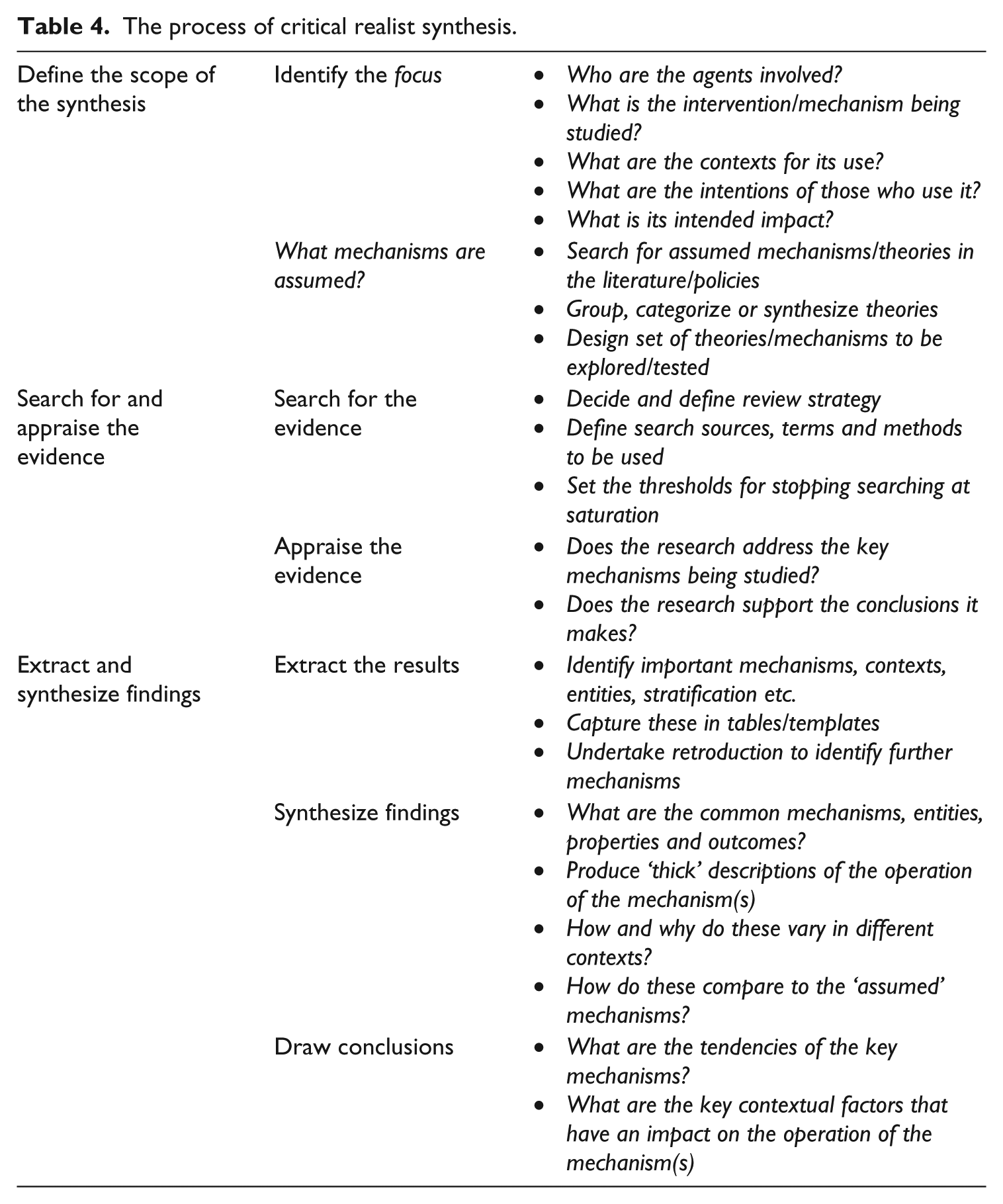
In order to help generate theoretically informed and empirically substantiated explanations, we have amended Pawson’s (2004) realist review process, designed for policy interventions, to deal with synthesis more generally (Table 4). 11 As one’s approach to CRS will vary considerably depending on its purpose, the steps in this table are not meant to be sequential, compulsory or exhaustive, but instead provide a broad steer that is intended to guide CRS. We now explore each step in more detail.
The process of critical realist synthesis.
Define the scope of the synthesis
The scope of CRS will often be in the form of a question like: ‘how does mechanism M, when enacted by agent A, tend to alter outcome O?’. This approach will also work for clarification questions, such as ‘what are the properties of mechanism M?’ or ‘why does outcome O often occur in context P?’. As CRs accept systemic openness, CRS is not only restricted to providing a ‘thick’ explanation of the agentially enacted mechanism, but also of the different contexts in which the mechanism might generate a tendency to O – or qualitatively different versions of O – as well as the unintended consequences of mechanism M’s tendency. This also permits consideration of the ways in which the outcome might react back, in a later time period, on mechanism M and agent A.
In clarifying the purpose of the review, it is also useful to know the mechanisms that are claimed or assumed in the relevant literature or policy. For example, in exploring the question do bundles of HRM practices improve performance?, it might be useful to identify the assumptions that are made, or theories that are drawn upon, when this is presumed to be the case, as these provide a focus for the review that can be explored systematically later. This step is not always necessary.
Search for, and appraise, the evidence
As CRS focuses on identifying agents and mechanisms, it need not restrict itself to statistical studies or indeed studies from any specific discipline, including CR. For example, O’Mahoney (2011) reviews the social constructionist identity literature, much of which explicitly rejects realism, to retroduce the entities, powers, and mechanisms involved with identity construction. Indeed, the ecumenical nature of CR’s review of the literature allows it to use this breadth to identify similar causal mechanisms working in a variety of contexts. Moreover, as Ackroyd and Karlsson suggest, the CR researcher is marked by their ‘eclecticism’ when it comes to matching innovative methods to collect new data indicative of the existence and character of causal mechanisms (2014: 22). For example, Pawson (2002) – which is expanded upon below – seeks to understand the impact of ‘public disclosure’ on recalcitrant behaviour (i.e. does ‘naming and shaming’ work?). To investigate this, he drew on a wide range of public disclosure policies, from Megan’s Law and school league tables, to hospital star ratings and naming prostitute’s clients. This allows exploration of similar mechanisms but in very different contexts, permitting the identification of the particular contexts that were more likely to generate a tendency for disclosure to affect behaviour.
In collecting studies, quantitative work (e.g. those using regression analysis to identify statistical associations) should be treated with caution. Instead of dismissing them, however, we would check to see if, in addition to the (non-explanatory) statistical data, there is something that might help us to create theoretically informed and empirically substantiated explanations. Instead, we are far more favourably disposed to past qualitative empirical research. In both cases (and recalling the ‘A critical realist critique of meta-analysis’ section) we would be asking ourselves: does this past research help us deepen our understanding of the appropriate agents and mechanisms, how agents and mechanisms interact, and the other mechanisms (i.e. ‘the context’) that dispose this agent to interact with one mechanism and not another?
CR accepts that different disciplines may use different terms to describe similar mechanisms – though where these terms differ they may be more or less accurate. For example, ‘enculturation’, ‘socialization’, ‘institutionalization’, ‘indoctrination’, ‘learning’, and ‘disciplining’, might be used in different traditions to describe the ways in which societies inform and (re)create the individuals that inhabit them. Such terminological diversity should always be critically appraised, as such terms are not apolitical, and, for example, can range from strong managerialism (‘workers can learn to be more efficient’) to critical (‘workers are indoctrinated through induction programmes’). However, such diversity should also be embraced as providing potentially useful alternative perspectives on how the agentially enacted causal mechanisms operate and relate. More specifically, terms captured in the review may operate at different (sometimes emergent) levels – for example, socialization and learning may be different (and related) forms of indoctrination.
In short, then, a CR review of a subject should cast its net wide, searching not only for key words (such as HRM, bundles and performance) but also examining historical texts, and different disciplines for similar mechanisms that may have operated in different contexts. Thus, for the literature review, the search terms and sources would usually be wider than we might expect in a standard structured literature review (Tranfield et al., 2003). Once the relevant literature has been collected, and this would usually be an ongoing process, it needs to be appraised, both in terms of ensuring the research actually addresses the mechanism(s) under study, and its internal validity – that the data actually supports the conclusions it makes.
Extract and synthesize findings
The purpose of a CRS analysis is to identify the agentially enacted causal mechanisms by reviewing extant literature. In CR-oriented studies, these mechanisms will often (though not always) be explicit. However, when reviewing non-CR-oriented literature the analysis can often proceed in two steps. The first is to identify the agentially enacted mechanisms stated within the literature, and the second is to retroduce further conditions of possibility for these. It is important to note that CRS does not require a rejection of any research that is not CR in orientation. Let us consider two examples of this latter point.
First, O’Mahoney’s (2011) review, mentioned above, takes the statements of ostensibly anti-realist authors concerned with identity construction to identify the key agentially enacted mechanisms involved. For example, he draws upon an article by Thomas and Davies (2005) that details how Kate, a personnel manager in the police service, draws on discourses of femininity and parenthood to resist performative employment discourses. O’Mahoney’s first step is to identify the context stated explicitly by the authors, including Kate herself, her job, the police, and the various discourses that, for CRs, are causal mechanisms. The second step is to retroduce implied mechanisms and powers, such as the power of the police service to employ and discipline workers, and terminate contracts, and the (agential) power of Kate to learn skills and reproduce them. We also learn much about discourses – for example, that they can be resisted, that some discourses (such as femininity) exist in tension with others (such as masculinity), and that individuals exercise some form of free-will in choosing to engage with or resist them. This allows O’Mahoney to argue that, contrary to the anti-realist protestations of social constructivists, their research can contribute towards the kind of theoretically informed and empirically substantiated explanations sought in CRS.
Second, in seeking to understand the impact of ‘public disclosure’ on recalcitrant behaviour Pawson (2002) examines the policy literature to identify the mechanisms at play in the literature when culprit behaviour is worsened and policies fail (Figure 1).

Mechanisms of public disclosure on culprit resistance (simplified from Pawson, 2002).
He then reviews the history and operation of the various disclosure policies to
identify when the mechanisms lead to positive outcomes (Figure 2). For example, he notes that: Megan’s Law swept onto the statutes following the enormous public outcry
at the brutal death [of a child]. The courts responded to the wave of
sentiment that ‘something must be done’ and were thus able to brush
aside the constitutional challenges forwarded by minor lobbies. (Pawson, 2004:
39)
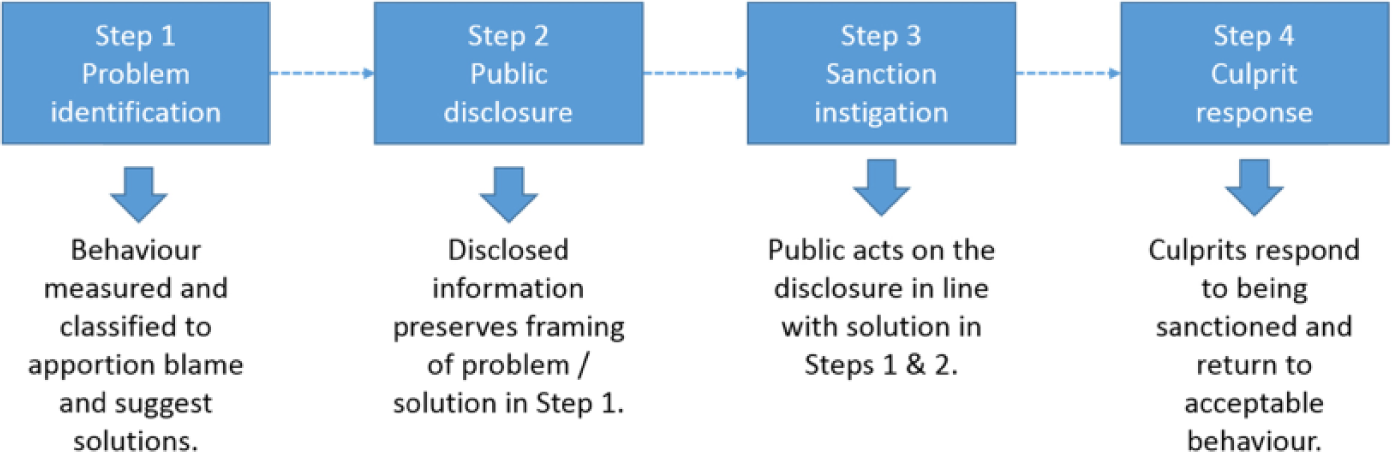
When disclosure policies lead to successful outcomes (simplified from Pawson, 2002).
Here, Pawson uses contrastive theory building to identify patterns rather than
laws (we would say ‘demi-regs’) about the potential of public disclosure
policies to achieve their aims. The more tentative and less certain language
here is also worth noting, especially in contrast with the ‘9%’ of MA detailed
earlier: Although popularly known as ‘naming and shaming’, public disclosure
outcomes in these cases do not seem to depend, in the long term anyway,
on the dishonour of the culprits . . . Public disclosure is meant to
change behaviour – but seems effective only in relation to what
organises that behaviour in the first place. What is more, in each of
the [cases], it is the information providers rather than the public who
are the key agents of change. (Pawson, 2004: 44)
In terms of synthesis, Pawson takes a comparative approach to identifying the mechanisms that link X and Y, and provides a ‘thick’ description of how and why these work in different circumstances.
Whilst no-one has yet carried out an explicit CRS, some CRs have implicitly started to go down this route. Three can be cited as examples. First, Fleetwood’s (2014, 2016) attempt to build a CR-oriented alternative model of labour markets draws upon a body of existing theoretical and empirical research, which he refers to as ‘the socio-economics of labour markets’. The key point to note is Fleetwood’s rejection of existing quantitative empirical research that is rooted in quasi-empiricism because it contributes little or nothing to the generation of theoretically informed and empirically substantiated explanations of the way labour markets work. In contrast, Fleetwood accepts the ‘socio-economics of labour markets’ because it consists of existing qualitative empirical research that contributes to the generation of theoretically informed and empirically substantiated explanations of the way labour markets work. Whilst implicit, Fleetwood’s work on labour markets might be thought of as a rudimentary CRS.
Second, Vincent’s (2011) work, in this journal, focuses attention on emotional experiences at work, the organization control mechanisms that seek to influence these experiences, and how different contextual conditions (Mc) affect both organizational control systems and worker experiences. Whilst the article is not explicitly either CR or CRS, it offers a form of analysis that is highly consonant with the approach outlined here. The article maps the structural conditions and agential dispositions that affect emotional displays at work, and how these combine to explain experiences. It highlights, in particular, how employers’ regulation and rewarding of workers’ emotional displays interacted with workers’ conformity (or not) with organizational interests and rule systems. The article then considers the contextual conditions that impel different types of control system and experience, for example, by highlighting the circumstances in which workers are rewarded for specific emotional displays at work. Overall, this article contributes by developing theoretically informed and empirically substantiated insights about the way emotions are managed, experienced and enacted at work, offering another rudimentary CRS.
Third, Dirpal (2015) starts from the position that past quantitative empirical research on the HRM-Performance cannot explain why HRM practices are linked to performance. He re-theorizes HRM practices to develop the concept of an ‘HRMechanism’ (i.e. HRM practice + causal mechanism) before applying qualitative research techniques to investigate what would normally be considered a quantitative research programme. Thus, he offers a (meta) theoretically informed piece of qualitative research into six HRMechanisms: team-working, corporate culture, empowerment, work–life balance, performance appraisal and reward. What makes Dirpal’s research interesting for our purposes is how he uses past qualitative empirical research as a quasi-CRS. What he lacks, initially, is a sophisticated understanding of exactly how HRM practices may or may not work to influence organizational performance. He turns to the existing literature to glean any theoretically informed and empirically substantiated insights, and uses them to frame his interviews. He finds that team-working, performance appraisal and work–life balance, generate powers/tendencies to increase organizational performance, whereas corporate culture, empowerment and rewards generate neutral powers/tendencies vis-a-vis organizational performance. Moreover, he generates causal explanations of exactly what these HRMechanisms do to generate these powers/tendencies.
Aligning critical realist synthesis and critical realism
CRS is built upon the meta-physical claims of CR detailed in the ‘A critical realist alternative’ section. In this section, we provide more detail about the alignment of our approach with specific methodological and theoretical applications of CR, namely Bhaskar’s (1998) RRRE approach (see below), and Lawson’s contrastive explanation approach.
The aims of CRS are of course compatible with CR empirical or applied research. Bhaskar’s (1998: 129) RRRE model, for example, suggests the following four steps for undertaking such work:
Resolution of a complex event into its components (causal analysis).
Redescription of component causes.
Retroduction to possible (antecedent) causes of components via independently validated normic statements.
Elimination of alternative possible causes of components.
According to Collier (1994: 163), ‘RRRE has redescription as its second stage, indicating the presence of an already established stock of concepts, well enough defined . . . to justify using them for revisionary description’. We would add that the second and third step definitely, and perhaps the first and fourth also, would be impossible to take without existing knowledge and, therefore, without drawing upon existing research.
There are, however, two potential problems that we want to eliminate before proceeding. First, are we not simply ‘making a virtue out of a necessity’? After all, RRRE or otherwise, almost all empirical researchers start with existing research. What sets CRS apart, however, is that a great deal of meta-theoretical thought goes into identifying precisely the kinds of existing research that will be accepted and rejected; not anything ‘goes’. Second, the same could be said of MA: not anything ‘goes’ for meta-analysts either. Indeed, they accept existing quantitative research, and reject existing qualitative research. This is not, however, because meta-analysts hold that quantitative research delivers theoretically informed and empirically substantiated explanations, but simply because only quantitative research can be analysed with meta-analysts statistical toolkit. Thus, CR eliminates research that it holds to be theoretically flawed (and for other reasons) whereas MA is driven by a desire to employ specific set of statistical techniques. With these potential problems dealt with, we can turn to the issue of illustrating how CRs might use CR methods to guide CRS.
Those new to CR often complain about the abstractness of retroduction, and so it is important to consider how we can more easily deploy this approach to extract new understanding in the context of CRS. In our view, and whilst far from being a point of departure, those wishing to employ CRS can aim towards Lawson’s (1997, 2003, 2009) contrastive method. This approach compares ostensibly similar cases (e.g. specific countries, such as the UK or China; old or young workers; corporations or charities) to identify different or surprising demi-regs, generated by similar causal mechanisms, but calling attention to specific contextual features (Mc) that interact to affect outcomes differently in otherwise similar circumstances. Thus, rather than explaining a single outcome (set of events En), the objective is to account for some contrast ‘Pn rather than Qn’ and to use retroduction to identify the particular conditions that drove the outcome in a particular direction. Arguably, by identifying our analytical target in terms of particular forms of difference, in worlds that are otherwise similar, the process of working out the particular mechanism that is causal, in one instance or another, becomes much simplified. This way, knowledge of causal mechanisms can develop incrementally by reflecting on unexpected contrasts in the existing stock of research.
Whilst contrastive explanation offers a viable strategy for knowledge development, as it focuses attention on the particular, getting any CRS inspired project to the point at which a contrastive strategy is possible typically involves a lot of ground-work (as illustrated in Table 4). However, as any CRS project assimilates the existing body of knowledge, in CR compatible terms, and approaches the point of analytical saturation (when the review exhausts what we know), it becomes increasingly possible to deploy a contrastive explanatory method. At this point, the project will understand the stock of related qualitative described cases and examples and the different conditions that explain demi-regs within these. As a consequence, CRS scholars will find themselves in a position to explain novel causal mechanisms that give rise to unexplained and unexpected events.
Conclusions
The appeal of methods that allow for an integration and synthesis of existing research to produce more robust and, even, novel findings is obvious. It is in this context that MA has grown in popularity. Yet, even on its own terms, MA has a number of technical, procedural and practical problems that can limit its usefulness. More significantly for our argument, the meta-theoretical foundations of MA, which have attracted little, if any, critical comment, are flawed. We have argued that the lack of explanatory power that characterizes individual quantitative studies, rooted in quasi-empiricist meta-theory, is the result of their commitment to a particular chain of meta-theoretical concepts. Unfortunately, this problem carries over into MA, meaning the explanations contained in MA are as lacking in explanatory power as the individual quantitative studies upon which they are based.
What then is left for MA? We have argued that regression analyses, and thus MAs, are not suitable for the open, emergent systems that typify organizational studies, or indeed, the social world generally. This is because the interaction of complex, emergent mechanisms in different contexts does not give rise to regularities in relations between events. Yet, for CRs this does not mean jettisoning MA altogether. Two alternatives are proposed here. The first is that if MAs are not suited to open systems, then they are suited to closed systems, such as information technology or the physical sciences, where empirical regularities between events exist. This raises an interesting question as to ‘whether some disciplines can be classified as “less open”/“more closed”’ on the basis that they concern themselves with simpler or less emergent systems. The answer to this question is contested and cannot be explored in detail here, but Fleetwood (2016) provides an overview of the key issues, arguing that systems are either open or closed.
The second approach is implied by Porpora (2015: 62): ‘Demoting regression analysis and other statistical techniques from explanation to evidence, critical realism has no reason to reject them as such . . . Statistics are employed to indicate the contingent operation of a mechanism in a particular context’.
This shift in the framing of MAs implies that well-designed regression analyses (and therefore MAs) can provide indications that causality may be at work, or at least that phenomena require investigation. For example, research claiming to identify a statistical association between bundles of HRM practices and improved organizational performance, have prompted authors to carefully investigate the mechanisms and contexts that might sustain such an association (Fleetwood and Hesketh, 2006). Importantly, subsequent investigation can, and sometimes does, undermine claims deriving from these statistical associations. In the MOS literature, for example, quantitative research claiming to have identified an association between HRM practices (e.g. TQM, BPR or Lean) in high performing organizations, have been exposed by qualitative studies revealing flawed assumptions. Some qualitative research, for example, has suggested that reporting of these practices has been exaggerated by respondents (e.g. Collinson et al., 1998).
Our critique of MA led us to develop an alternative, CRS, which is driven by the objective of creating theoretically informed and empirically substantiated explanations. CRS, rooted in CR meta-theory and predicated upon the claim that the social world is characterized by demi-regs, requires a conception of causality that is not exhausted by regularities in the flux of events, but is understood at the relative push and pull of powers or tendencies. As we demonstrate above, this allows CRs to make tendential predictions and, thereby, generate substantive implications. We explained how CRS allows for insights to be incorporated from the widest possible source material, including qualitative research, social constructionist-oriented research and, with caution, some quantitative, empirical research. CRS resonates with work on systematic reviews by other realist scholars, such as Pawson, and thus contributes to debates already existing in social science, more generally, about how realist philosophical commitments might shape analyses.
Although we hold that CRS is a superior approach to that of MA, we note here that CRS does have a number of problematic features. First, the method of CRS is less formulaic than that of MA, putting more emphasis on the intuition (via retroduction) of the researcher. Moreover, the outcome of CRS is more complex than the single number generated by MA, and perhaps therefore less attractive to some managers or policy makers. We would hope, however, that our proposal places an emphasis on the expertise and experience of these people in helping understand the complexities of the world in which they are embedded. Second, tendential predictions are only that. As Pawson et al. (2005: 21) note: ‘social interventions are so complex that there is little hope of reproducing them, and even if one could, they are so context specific that the same “assemblage” may go onto misfire’. Third, although we have pointed to examples of good practice in parts of a CRS (e.g. Fleetwood, 2014; O’Mahoney, 2011; Pawson, 2005; Vincent, 2011), and explained how we would approach a CRS, we have not found an example of a complete CRS. This is a gap that we would urge researchers to explore.
Footnotes
Acknowledgements
The authors would like to thank Alena Audzeyeva and Margarita Mooney, who commented on an early draft; the anonymous reviewers for their helpful comments; and the Editor, Paul Edwards, for encouraging contributions in this area of research and for his expert handling of the editorial process.
Funding
This research received no specific grant from any funding agency in the public, commercial, or not-for-profit sectors.