




Abstract
How do corporations attempt to regulate the ways middle managers draw on discourses centred on ‘effectiveness’ and ‘ethics’ in their identity work, and how do these individuals respond? We analyse the discursive struggle over what it meant to be a competent manager at Disneyland, where middle managers were encouraged to construe their selves in ways that emphasized ‘being effective’ over ‘being ethical’, and managers responded with identity work that positioned them as searching for the practical wisdom (phronesis) to make decisions that were both effective and moral. The theoretical contribution we make is twofold. First, we analyse processes of identity regulation and identity work at Disneyland, highlighting divergences between corporate injunctions and middle managers’ appropriations of them, regarding what it meant to be a practically wise manager. Second, we discuss a phronetic identity narrative template, contestable both by organizations and managers, in which people are positioned as questing for the practical wisdom to make decisions that are both moral and effective, and phronesis as an image by which scholars may analyse identities and identity work. This leads us to a more nuanced understanding of middle manager identities and the scope they have to constitute their selves as moral agents.
How do corporations seek to discipline the ways middle managers draw on discourses centred on ‘effectiveness’ and ‘ethics’ in their identity work, and how do these individuals respond? Organizational control is accomplished in part through processes of identity regulation in which employees’ identities are disciplined by officially sanctioned discourses (Alvesson and Willmott, 2002; Foucault, 1977). Often, these discourses emphasize that managers ought to ensure they are effective in their roles (Fayol, 1949; Mintzberg, 1973; Taylor, 1911). Increasingly, however, it is recognized that managers are caught in webs of relationships and contingent choices that require them to make judgements informed by practical moralities (Holt, 2006; MacIntyre, 1981). We analyse the discursive struggle over what it meant to be a competent manager at Disneyland (Paris), where middle managers, when faced with equivocal circumstances, were encouraged to construe their selves in ways that emphasized ‘being effective’ over ‘being ethical’ – and managers responded with identity work that positioned them as searching for the practical and prudential wisdom (phronesis) to make decisions that were both effective and moral (Dunne, 1993; Nonaka et al., 2014). Drawing on and complementing research on narrative identities (Giddens, 1991), authored through processes of identity construction (Sveningsson and Alvesson, 2003), we analyse Disney’s attempts to regulate managers’ identity work, and the self-narratives these efforts evoked.
Our study is important for three sets of reasons. First, although considerable attention has been devoted to identity regulation, less explored is how organizations attempt to mould managers’ identities so that they emphasize being ‘effective’ over ethical considerations. There is, as Watson (2003: 168) asserts, a need for in-depth studies that highlight the relations of power and control in which managers are embedded to examine further ‘the extent to which the manager in a modern corporation has scope to act in a way informed by personal, as opposed to corporate, moral criteria’ (see also Hales, 1999). Second, despite recognition across the social sciences that identities may be construed through narratives (Holstein and Gubrium, 2000; McAdams, 1993; Ricoeur, 1991), Ibarra and Barbulescu (2010: 135) nevertheless argue that ‘narrative forms of expressing and claiming identity have not received adequate attention in organizational research’. Certainly, few studies have focused specifically on how middle managers, who are often confronted ‘with irreconcilable conflicts of value or morality’ (Watson, 2003: 171), draw on discourses of ‘effectiveness’ and ‘ethics’. Third, although the concept of phronesis (Flyvbjerg, 2001; Flyvbjerg et al., 2012; Holt, 2006) and the phenomenon of identity work (Brown, 2015; Ybema et al., 2009) have both separately attracted attention, scholars have not yet discussed systematically phronesis, identities and identity construction.
We analyse how middle managers responded to a specific corporate-sponsored programme designed to produce them as competent agents who privileged effectiveness, and how managers engaged in discursive identity work (Kuhn, 2006; Tracy and Trethewey, 2005) that positioned them as questing for the practical wisdom to make what they described as both effective and moral decisions in equivocal circumstances. The theoretical contribution we make is twofold. First, we analyse processes of identity regulation and identity work at Disney, highlighting divergences between official–corporate injunctions and middle managers’ appropriations of them, regarding what it meant to be a practically wise manager. Second, we outline a phronetic identity narrative template, contestable both by organizations and managers, in which people are positioned as questing for the practical sagacity to make decisions that are both moral and effective, and discuss phronesis as an image by which scholars may analyse identities and identity work. The utility of recognizing phronesis as a type of narrative identity and as an image is that it focuses attention on, and assists analyses of, how people say that they draw on discourses relating to ethics and effectiveness in self-construction. This leads us to a more nuanced understanding of middle manager identities and the scope they have to constitute their selves as moral agents.
Identity regulation, middle managers and phronesis
Identity regulation
One strand of theorizing regards identity work, that is, ‘the mutually constitutive processes whereby people strive to shape a relatively coherent and distinctive notion of personal self-identity’ (Watson, 2008: 129 [emphasis in original]), as strongly imposed upon by work organizations (Mumby, 2005; Townley, 1993). Managers’ identity work has been shown to be structured through systems of appraisal, socialization and training that result in identities that have been described as ‘regulated’ (Alvesson and Willmott, 2002), ‘engineered’ (Kunda, 1992) and ‘disciplined’ (Foucault, 1977). Drawing in particular on Foucault’s concept of disciplinary power, considerable attention has been paid to how employees are ‘fabricated’ through organizational processes of surveillance and normalization that render them docile and constitute them as ‘subjects’ (Gabriel, 1999; Thornborrow and Brown, 2009). This stream of research emphasizes how individuals are coerced to produce themselves through ‘technologies of the self’, in the form of self-examination (which constitutes the self as a measurable object) and avowal (by which the self is constituted as a subject to be verbalized, judged and improved). By these means people are led to accept the official discursive resources for identity work made available to them and ‘transform themselves’ to attain a notional ‘state of happiness, purity, wisdom, perfection, or immortality’ (Foucault, 1988: 18).
Yet, most scholars recognize that individuals have scope to ‘agentially play’ (Newton, 1998: 430) with discursive resources. Rather than ‘ascribed’, managers’ identities are best described as ‘crafted’ in local contexts that permit reflexive actors variously to accept and accommodate but also adapt and contest organizational prescriptions (Fleming and Spicer, 2003). As Kuhn (2006: 682) has argued, people have the capacity for ‘reflection, resourcefulness and resistance’, and it is important that in analysing employees at work scholars account adequately for ‘the active, choice-making subject’. Indeed, considerable theorizing supports the idea that people are ‘(co)authors of their subjectivities’ (Kuhn, 2006: 684) able to creatively appropriate narrative identities from locally available multiple and fragmented discourses (Kuhn et al., 2008).
What is at stake in these struggles are the preferred identity narratives that employees work on. Through processes of identity work, people craft identity narratives – accounts that make an important point about the narrator – and these are both expressive and constitutive of individuals’ identities (Giddens, 1991; McAdams, 1993; Ricoeur, 1991). Identity narratives are constituted within discursive regimes (Alvesson and Willmott, 2002), reflexively organized (Giddens, 1991), continually revised both through personal soliloquy (Athens, 1994) and social interactions (Goffman, 1959), and rather than stable or unified tend generally to incorporate tensions and to be fluid (Gergen, 1991). Organizational researchers have relatively recently but increasingly turned their attention to narrative identities in the workplace that are ‘productive of a degree of existential continuity and security’ (Alvesson and Willmott, 2002: 625–626; Down and Reveley, 2009; Hoyer and Steyaert, 2015; Watson, 2009). One stream of research aims to identify and analyse distinct (narrative) identities (Collinson, 2003; Gabriel et al., 2010; Knights and Clarke, 2014; Thornborrow and Brown, 2009). Relatedly, scholars such as Alvesson (2010) have identified a number of key images used to frame identities, including surfers, strugglers, stencils, self-doubters, soldiers, strategists and storytellers. Our study contributes to this theorizing by (i) identifying a specific type of narrative identity that we label ‘phronetic’, and analysing divergences at Disney between corporate and employee conceptions of it, and (ii) highlighting phronesis as another image that scholars may use to analyse identities and identity work.
Middle managers
Since Dopson and Stewart (1990: 3) posed the question ‘What is happening to middle management?’, extensive attention has focused on these workers (Balogun and Johnson, 2005; Harding et al., 2014). Consensus that managerial work is often fragmented, reactive and interrupted (Mintzberg, 1973) has been complemented by analyses of how managers deal with conflicting and ambiguous corporate prescriptions (McCabe, 2010). Characterizations of middle manager identities as ‘increasingly problematic’ (Thomas and Linstead, 2002: 72), precarious and vulnerable (Sims, 2003), insecure, fragile and angst-ridden (Watson, 1996), but also sometimes enriched and empowered (Currie and White, 2012) are indicative of their ‘equivocal positions’ in organizations (Willmott, 1997: 1337). Moreover, ‘surprisingly little is known about how organizational actors practically manage the tensions resulting from the concomitant search for profit and social responsibility’ (Ghadiri et al., 2015: 594), making middle managers particularly interesting for studies of identity such as ours.
One discourse, relating not just to middle but to all managers, and that is prominent in both scholarly debates and work organizations, suggests that they are (or should strive to be) effective (Delmestri and Walgenbach, 2005; Mintzberg, 1973). Effectiveness is, of course, a contested concept, and has been construed differently in distinct streams of theorizing. Early ‘scientific management’ descriptions of managers focused on the importance of rationality, neutrality, task-focus, systemic thinking and resource-optimizing (Fayol, 1949; Taylor, 1911). ‘Human relations’ theorists emphasized soft skills such as leadership, motivation and communication (Herzberg, 1968). Recent theorizing insists that managers empower subordinates and encourage entrepreneurialism (Pendleton, 2003). All, however, position managers as required to work effectively to ‘make decisions and allocate resources’ (Gosling and Mintzberg, 2003: 8) and to aspire ‘to achieve … mastery – in talk and in “reality”’ (Clark and Salaman, 1998: 152). In this discourse, managers are often morally ‘mute’ (Bird and Waters, 1989), forced ‘to bracket, while at work, the moralities that they might hold outside the workplace’ (Jackall, 1988: 6), and who in their practices have no moral responsibilities or concern for substantive questions of the good (MacIntyre, 1981). Many scholars, however, decry those who act as ‘exploitative agents of capital’ (Hales, 1999: 339) driven by instrumentalism (March, 2003: 205).
Increasingly, concern with ‘effectiveness’ has been complemented, sometimes challenged, by the rise of a discourse centred on corporate social responsibility (CSR) (Crane and Matten, 2007; Matten and Moon, 2008) and ethics in management more generally (Jackson, 2001). The increasing prominence of ethical issues has in part been fed by vigorous debates on what constitute appropriate HR practices and the rights of employees at work (McWilliams and Siegel, 2001). This multi-perspectival discourse insists on the role of ethics in managers’ practices (Holt, 2006) and their work identities (Kornberger and Brown, 2007), and recognizes that the denial of personal morality at work is so difficult that only ‘the most brutalized or fanatical of managers’ are ‘capable of consistently denying personal involvement in, and a degree of responsibility for, the decision[s] that he or she takes’ (Knights and Willmott, 1999: 1350). Quite what it means in practice to ‘be ethical’ is hotly contested by scholars who favour moral accounting systems based on deontology (focused on rules, duties or principles), consequentialism (concerned with the outcomes of actions) and virtue ethics (which emphasize moral character) (Singer, 2011). There is, though, increasing consensus that moral ‘imperatives’ are not ‘a “bolt-on” convenience’ (Holt, 2006: 1661) but intrinsic to processes of identity work, and both constrain and enable managers’ actions. What is less clear is how managers are disciplined by corporations’ local identity regulatory practices regarding discourses relating to effectiveness and ethics, and how managers respond to such exhortations.
Ethics, managers and phronesis
At a micro-level, post-structural sensibilities that insist that in matters of morality ‘there are no right views, just a number of perspectives’ (Duska, 1993: 235), combined with empirical studies that show that ‘organizational practice … has a complexity that the moral theories cannot capture’ (Nyberg, 2008: 588), have led to a focus on individuals’ situated decision-making (Holt, 2006; Shotter and Tsoukas, 2014). Debates on managers’ applied moralities are associated with calls for ‘more attention … to be paid to the notion of practical wisdom’ (Weaver, 2006: 358), and, in particular, the concept of phronesis. As Clarke et al. (2009: 328) argue, managers seek ‘the necessary homeopathic sensitivity and reflexive maturity to make “good” decisions subject to their own judgement’.
Phronesis, together with episteme (universal truth or validity) and techne (technique, technology or art), is one of three classes of intellectual virtue Aristotle (1985) describes in the Nichomachean Ethics. Defined as a form of ‘prudential judgement’ (Nonaka et al., 2014: 368), ‘practical wisdom’ (Shotter and Tsoukas, 2014: 235) or ‘sagacity’ (Holt, 2006: 1661), considerable attention has focused on phronesis as a kind of knowledge that juxtaposes ‘knowing why’ with ‘knowing how’ and ‘knowing what’ (Nonaka et al., 2008: 54) in order to facilitate the realization of the ‘collective common good’ (Flyvbjerg, 2001; Flyvbjerg et al., 2012; Nonaka et al., 2014: 369). There is, moreover, agreement that phronesis is developed and applied by people in context with reference to particular circumstances and events involving character, learning, intuition and competence, ratiocination and emotion, and is cultivated through experience and in relation to others (Nyberg, 2008: 590). It is, thus, directly relevant to the question of how ‘practically thinking agents, embedded in social practices’ say they ‘act in complex circumstances, in which the alternatives available to them are at first not clear?’ (Shotter and Tsoukas, 2014: 228).
Discussion of phronesis in organization studies has generally been in relation to ‘praxis’ (Dunne, 1993), ‘capacities’ (Shotter and Tsoukas, 2014), and practices of leadership and management (Holt, 2006; Shotter and Tsoukas, 2014). This said, theorists have not infrequently observed that the concept of phronesis needs also to be understood in relation to issues of self and identity (Clarke et al., 2009; Dunne, 1993) and, in particular, how the practically wise agent, phronimos, is constituted in relation to others (Holt, 2006). Phronesis has been described as a self-cultivating form of action (Dunne, 1993: 244–246), which ‘expresses the kind of person one is’ (Nonaka et al., 2014: 369) and ‘an aspect of “who” one would like to be’ (Shotter and Tsoukas, 2014: 1674). These observations have their roots in Aristotle’s initial formulation of the concept that ties morality to personhood: ‘we cannot be really good without practical wisdom, or practically wise without virtue of character’ (Aristotle, 1985: 118). However, these links to identity are yet to be explored in detail, and there has been little consideration of phronesis as an identity type or image and how locally available versions are embedded in disputes involving identity regulation and identity work.
Research design
This interpretive study was conceived to analyse the identities of middle managers (termed locally ‘managers’) working at Disneyland (Paris). The study is embedded in the ‘linguistic turn’ in the social sciences (Alvesson and Kärreman, 2000) and focuses on individuals’ practices of talk that ‘systematically form the objects of which they speak’ (Foucault, 1972: 49). From this perspective, talk is an important form of social action, people’s ‘realities’ are linguistic constructions, and such verbalizations are not accoutrements to but constitutive of their local worlds (Austin, 1975; Searle, 1969; Wittgenstein, 1967). Consonant with ‘trends away from monolithic … and … essentialistic views on identity’ (Sveningsson and Alvesson, 2003: 1164), we analyse how embedded agents actively deploy language to author their identities through processes of ‘identity work’ (Clarke and Knights, 2015; Down and Reveley, 2009; Knights and Clarke, 2014; Kuhn, 2006, 2009; Sveningsson and Alvesson, 2003). Although these constructions may serve rationalization or impression management purposes (among others), this does not render them in any sense unimportant. People’s talk may be interpreted by a researcher as, for example, a rationalization for who one is, but that talk is, nevertheless, both identity work and identity-constitutive (Ybema et al., 2009).
Case context
The decision to study identity work issues at Disney was influenced by prior research that has noted its culture of uniformity, close official attention to how language is used, and emphasis on hierarchy (Van Maanen, 1992). Other studies concerned with power and control have analysed the ‘exploitation, privilege, domination, power, discipline, and control practices of this storytelling organization’ (Boje, 1995: 1008; Smith and Eisenberg, 1987). These were strongly suggestive to us that Disneyland (Paris), which is reputedly a close copy of the American original, would be an appropriate organization to research how identities are construed locally through language.
Opened in April 1992, Disneyland (Paris) welcomes 1.6 million tourists per annum. The largest cadre of workers are termed ‘cast members’. These are supervised by 1300 ‘team leaders’ who report to nearly 500 ‘managers’ (from which cohort our interviewees were drawn). The managers we interviewed had responsibility for up to four team leaders and dozens of cast members (the mean was approximately 30), functioned in a wide range of contexts (e.g. attractions, hotels, theatres), performed a variety of activities (such as casting, human resources, risk management and finance) and were in charge of employees engaged in diverse jobs, including phone operators, waiters, stage performers and clean-up crews. ‘Managers’ reported to ‘senior managers’, who formed part of a chain of command that culminated in board members.
In 2002, French law was amended to emphasize organizations’ responsibilities for their employees’ mental health. Over the next few years, media attention on occupational mental health issues, and especially work-related suicide, began to intensify (Lerouge, 2010). In this context, in 2009, Disney’s Occupational Health and Safety Department (OHSD) launched a project for reducing psychosocial risks, with (from 2012) the aim of training 200 managers per annum. 2 Further momentum for this initiative was generated in February 2010, when two suicides and one attempted suicide committed outside of the workplace but in quick succession led the company to send an internal ‘management newsflash’ calling on managers to be vigilant and to listen carefully to their cast members.
Data collection
The data for this research, which were collected over 12 months from December 2010 by one of the co-authors of this article, were of three broad types: interview, observational and documentary. Fifty semi-structured interviews were conducted with 29 individuals: three OHSD staff responsible for the conception and delivery of the programme, an executive from Disney’s Corporate University, a senior manager involved in the design of the programme, and 24 managers (see Table 1) who participated in it (21 of whom were interviewed twice 3 ). The managers were initially interviewed approximately four weeks after they had attended a training session and then again four to six months later. The interviews were conducted in French in managers’ offices and varied in length from 40 to 100 minutes, with a mean duration of 60 minutes. 4 We asked a broad range of questions that focused primarily on managers’ self-identity and also some more specific questions regarding their experiences dealing with ‘problematic’ subordinates. For example: how would you describe yourself as a manager? What did you learn from the programme? How have you changed your management practices as a result of the programme? All interviews were audio-recorded and fully transcribed to yield a total dataset of 418,000 words.
Middle managers interviewed.
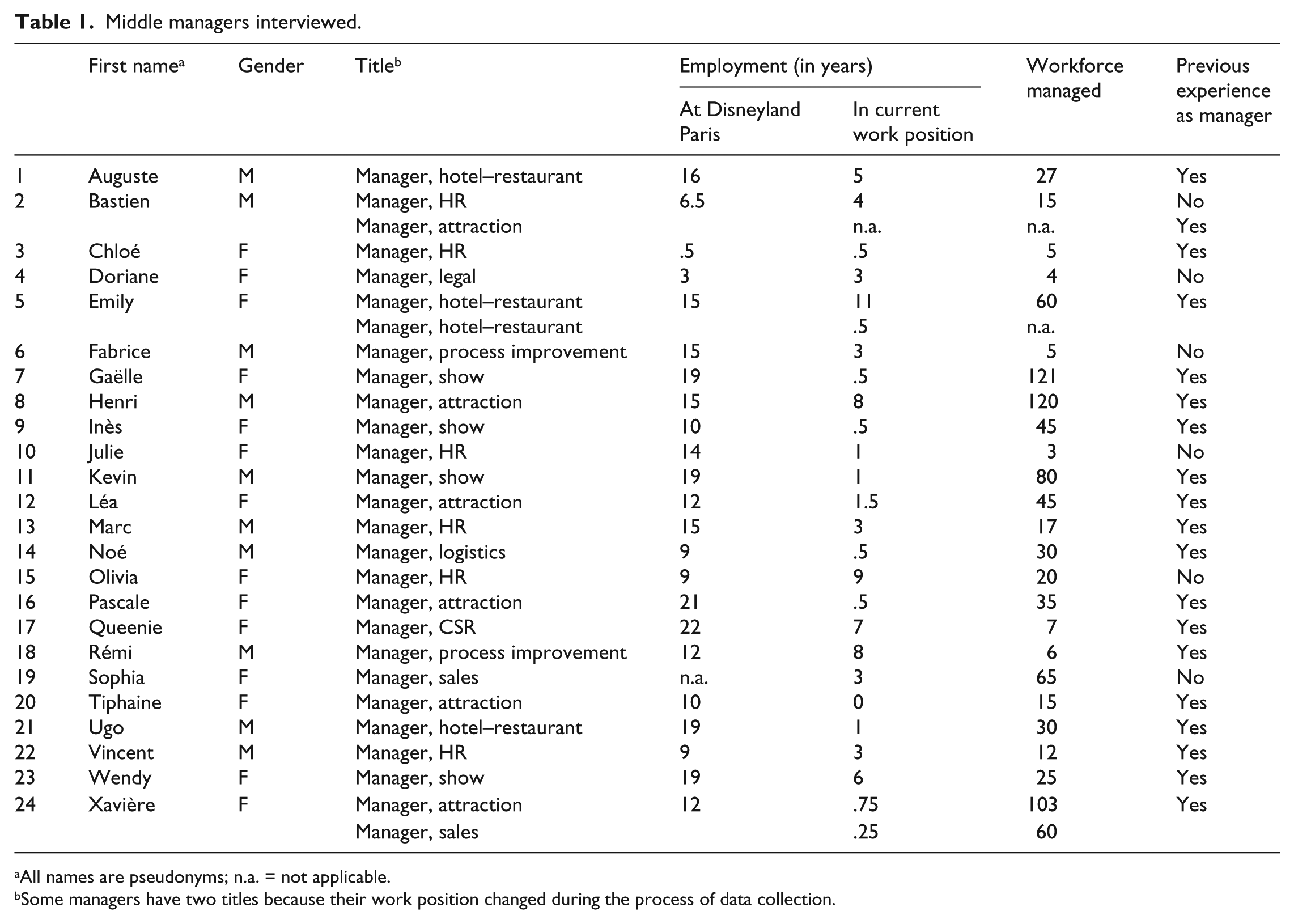
All names are pseudonyms; n.a. = not applicable.
Some managers have two titles because their work position changed during the process of data collection.
In addition, the primary researcher attended two of the two-day training sessions and three coffee managers’ meetings about how best to deal with challenging subordinates, during which extensive notes (e.g. regarding timing, the exercises used, participants’ reactions, interactions between the managers and the trainers, and the managers and trainers’ talk as well as the managers’ stories) were taken. We also collected secondary data from Disney’s web site, all 16 newsletters sent to managers, all supplementary documents related to the training sessions, and other documentation relating to the programme.
Data analysis
Our approach to data analysis was based ‘upon a critical, poststructuralist epistemology’ (LeGreco and Tracy, 2009: 1520) and on theorizing that suggests power and control are exercised through language (Fairclough, 1999), and identities are created through discourse (Ybema and al., 2009). The focus of our analysis was Disney’s attempts to regulate managers’ identities and the identity practices evident in middle managers’ self-narrations. Our mode of analysis aligns with other studies that have analysed interviewees’ identities as practical, discursive, fluid accomplishments that are co-constructed with researchers (Bardon et al., 2015; Clarke et al., 2009; Kuhn, 2006, 2009; Watson, 2009). This meant identifying both explicit identity work (e.g. ‘I am a decisive manager’) and other forms of talk where participants ‘said’ something where identity was clearly importantly at stake (e.g. ‘When you are a manager, you have to be fair’).
With the data loaded into NVivo10, the process of data analysis involved searching for patterns of meaning articulated by participants centred on identity construction processes linked to dominant official discourses. Our evolving interpretations were made in collaboration with our research participants, with whom the primary researcher was in close contact, and to whom preliminary findings were presented in two formal feedback sessions. From an early stage, it became clear that the most interesting themes in our data related to how ‘official’ discourses at Disney prescribed that in dealing with ‘problematic’ subordinates managers should be both effective and ethical but emphasized being effective, and how managers appropriated these injunctions in their identity work. This emergent framework was refined over a period of several months as we engaged in iterative processes whereby our data, emerging interpretations and themes were confronted, juxtaposed, discarded and refined until our empirical data were exhausted. Through continued reading and discussion between all three authors of this article, we identified the key components of the discourses relating to effectiveness and ethics: three prescribed guidelines that emphasized the importance of being effective (rules are rules, protection of collective interests and self-protection), and identity work in which managers appropriated these discursive resources in their quest for phronesis.
Our procedures, although systematic, must be understood in the context that the authorial choices we have made reflect our methodological predilections regarding what constitute interesting and meaningful data, and preferences in terms of representational strategies: that is, the results presented in the next sections are the emergent products of our prejudices concerning what is most important in the data (Watson, 1994: 78).
Discipline, identity work and phronesis
The purpose of these sections is twofold. First, we demonstrate how Disney sought to discipline the identity work of managers by specifying what it meant to be ‘effective’ and ‘ethical’, and advising managers that it was practically wise to focus on effectiveness when circumstances required. This meant that (i) rules should be followed, (ii) collective interests protected, and (iii) managers ought to privilege their well-being over that of their ‘problematic’ subordinates. Second, we analyse how individuals authored versions of their selves as questing for the practical wisdom to make good decisions by (i) ‘sensibly’ drawing on official discursive resources and conforming to Disney’s prescriptions to privilege being effective, and (ii) creatively constructing themselves as both effective and ethical in ways that were not aligned with corporate prescriptions.
Disciplining identity work
The programme went live on 14 December 2010, and was run by three OHSD staff: a team leader, a psychologist and a principal trainer. Its major components were two-day training sessions for all managers (8 to 10 individuals per session) during which a variety of videos, written case studies and other exercises were used to ‘educate’ managers regarding how they should respond to ‘problematic’ (as defined by the managers who participated in the programme) subordinates. The workshops were followed up with monthly coffee managers’ sessions (from March 2011) during which managers were given the opportunity for 90 minutes to share problems they had with their subordinates and to be provided with advice from OHSD staff and their peers on how best to solve them. In addition, managers were sent monthly newsletters that included minutes of the coffee managers’ sessions:
[Q: Are you attending the coffee managers?] Yes, because it is a little bit like … I was going to say like a confessional! This is not exactly that but it is the only opportunity to … share the problems you have, the problems as well as the success we could say, you see, to expose your troubles and, together, to help the manager to find a solution. (Xavière)
Being effective. The programme emphasized the importance of managers being effective in the performance of their roles. Managers were invited to regard themselves as enactors, that is, independent, proactive entrepreneurs who should not be afraid to take the initiative and to find creative solutions as they discharged their responsibilities: ‘When a situation presents two or five paradoxical problems, if you remain passive, you can’t act nor think. The manager’s role is to take action’ (Trainer, Coffee Managers no. 1).
In official discourse, key to being effective was the capacity to communicate, and managers were exhorted to embrace their roles as communicators, that is, to listen, persuade, motivate, provide feedback and explain matters to their staff, in order to achieve corporate goals:
Today, a manager, a leader in Disneyland Paris, must be both a communicator and a leader, a communicator is … someone who can put information into perspective, who is able to listen, to give sense to others, it is the communicator in this sense. (Disney University Executive)
Additionally, the programme highlighted the importance the corporation attached to managers being mindful, which meant managers should stand back from events, assess and correct their own assumptions and seek ‘to envisage all possibilities’ (Newsletter no. 15) in their quest for objectivity:
When confronted with a busy daily professional life, it is sometimes difficult for us to take a step back, to analyse our environment; and in terms of team management, the adage ‘you hurry slowly’ is really important to remember as situations can become very complex. (Newsletter no. 9)
Being ethical. In addition to the OHSD programme’s focus on managerial effectiveness, it highlighted the need for managers to be ethical. Managers were encouraged to be humane in their dealings with subordinates – that is, to be emotionally intelligent, to take into account team members’ personal circumstances, and to demonstrate that they cared about them:
We have to cultivate together our emotional intelligence … for raising awareness/trust among our cast members, for them to know that they can, safely, allow themselves to talk with us about their feelings, their bad feelings and their professional or personal difficulty. (Newsletter no. 4)
The programme discourse encouraged managers to be helpful to their subordinates, to act as advisors to people with problems, mediators in conflict situations, and solution-generators for the uncertain or confused: ‘Managing, whatever the level of the people supervised, means succeeding in being the boss while being at the same time an older brother, an advisor, a mediator’ (Senior Manager).
Being ethical meant also that managers should be fair in their treatment of personnel – that people ought to be considered equally and without undue favouritism: ‘The manager had to put the teammate in his place and this helped him to reassure his team that he was fair’ (Newsletter no. 15).
Emphasizing being effective over being ethical. Managers were told that although they should be ethical, yet it was practically wise to ensure that work objectives were fulfilled (i.e. be effective), and this meant that rules should be followed (‘rules are rules’): ‘You have to be sure that your personal attachment with them does not bias your judgement and when you are clear about who is responsible for the situation, you need to sanction him’ (Trainer, Training Session no. 2).
Ultimately, they were informed, there were situations where it was sensible to downplay being humane and observe rules:
At some point, you have to enforce the rules. It’s not a failure when you have tried to solve the situation by other means, because when this has gone on for far too long, it is difficult to step back. (Trainer, Training Session no. 2)
The programme encouraged managers to realize that although they ought to help subordinates in distress, it was nevertheless judicious to consider the ‘big picture’ in order not to compromise the work interests of their team and the company (i.e. ‘protect collective interests’):
I have a person in my team that does not want to do his job and it perturbs his teammates, it creates huge tensions that are not good. How do I deal with that? … I related this situation during the training and the trainer told me something interesting [she read the sentence she had noted down]: ‘At a given point when a team-member is detrimental for the team, you have to get rid of him and not feel bad for that because the health of others is at stake’ … This training helped me to put things into perspective and if I had to do that, I will regret it for the person, but at one point you have to give priority to the well-being of the group. It helped me to unlock the situation even if it was unpleasant. (Ines)
Managers were informed that, in those instances where subordinates were particularly needy, it was also prudent to restrict the empathy and assistance they provided to them in order to protect themselves (‘self-protection’). That is, the official discourse highlighted the importance of managers being able to remain sufficiently detached from their staff to be effective: ‘It is really important to step back, and despite subordinates’ potential difficulties, to say “no” or “stop” to the employee concerned; managers do not have to take everything on their shoulders’ (Newsletter no. 2).
This prescription was also relayed during coffee managers’ sessions:
Chloé: How far can I go to help him? Should I spend five or seven hours a day with him because he cries and does not feel good in his work. I had to escort him to the occupational doctor because of his crying spell. A fellow manager attending the programme: I am not comfortable because I feel that you are taking over everything, his job, his problems and I am afraid that you’re putting yourself in danger. Chloé: How long will it last? Three or four months more? I can continue to do some of his job but what can I ask him to do? Trainer: I suggest that you … limit the amount of time you give to him each day … You force him to choose: either he leaves or he stays but if he stays, he can’t do only 10% of his job. (Coffee Manager no. 1)
In sum, insisting managers narrate their own difficult experiences with ‘problematic’ subordinates in front of their peers and the trainer, the programme acted as a technology of power with panoptic qualities in which participants were objectified and made visible. It provided them with a defined set of discursive resources for their identity work in relation to ‘problematic’ subordinates, and coerced them into providing accounts of how they had dealt with difficult situations, and these versions of the self were then corrected in group discussions led by the trainers. Talking through multiple examples often led managers to work on their selves in conformity with official Disney prescriptions.
Managers’ conformist identity work
During our interviews, the managers frequently described themselves in line with official discourse, construing themselves as striving to be effective performers of their duties who communicated well and were thoughtful:
I always try, always, always, always, to be as clear as possible, to always give examples … I’ve never given someone feedback without giving him a clear image and say, ‘OK, you know what you have in your hands now, and how you can do it’. (Emilie) Is there a real risk? I try to put things in perspective. Is it serious or is it not? This is one of the main questions that I’m asking myself all the time. (Noé)
Managers also frequently constructed versions of themselves using official discourse relating to ethics, and how they sought to be empathetic, helpful and fair:
To be a manager means … managing people, you have to understand them and to be with them … Last week, one of my employees wanted to speak with me about some changes in his team … he told me that I was more humane than team-leaders. (Léa) When you are a manager, you have to be fair, if you punish someone for something, you have to punish everyone who does the same thing. (Ugo)
Further, managers readily agreed that ‘rules are rules’ and that ‘sometimes you have to take decisions’ (Rémi), meaning that they considered it reasonable that work goals override the wants and needs of individual team members:
So the first week [after his sick leave], he arrived four times late and was absent one day. As a manager, you know, there are rules in terms of discipline. And, you know, I have 29 other people who are not late so there is no reason for me not to sanction him. I gun him down! (Noé)
All managers recognized that there were occasions when it was best to privilege the needs of the group rather than individuals (protection of collective interests):
It’s exactly the same as if you have a gangrenous finger. It’s better to cut it … in the professional context … you have to privilege the group! (Ines) I can’t spend all my time to deal with her, I also have to keep time for my 89 other cast members. (Xavière)
The managers also agreed that they were occasionally confronted by team members whose personal issues were actually or potentially threatening to their own welfare, and in general fashioned themselves as knowingly aware how to safeguard their well-being (self-protection): ‘At one point, I told him, “It’s really well beyond my competencies, I cannot help you anymore, sorry … either you call the occupational doctor, or the psychological support unit, or go back home”’ (Chloé).
In these instances of talk, it is clear that managers have engaged in processes of self-examination, asking themselves what kind of managers they are, and ‘chosen’ to construe their identities using the language of the OHSD programme. Typical of the identity-related narratives that managers told in conformity with Disney’s prescriptions regarding what it meant to be a practically wise manager was that of Julie, an HR manager:
5
Following a reorganization my staff have now to train managers whereas previously they only made presentations to junior staff. Two of the trainers rose to the challenge but the third was limited in her skills. I met with her and I tried to understand but evidently she had a deep emotional block and frequently had tears in her eyes. As a short-term fix I gave her minor tasks to get on with, but these were below her salary grade, and this created other problems in the team. The case was difficult because this was a person with good will. She did attempt one training session but the feedback was not good. This was hard for her to hear, and she then refused to undertake any more training sessions. During the OHSD programme, we had to tell a personal story of a situation involving psychosocial problems and I chose to talk about this one. I received really good advice from other managers as well as from the trainer. They kind of shook me and it was really helpful, allowing me to put things into perspective, and to become more decisive. I subsequently made an appointment with our HR Manager so that I could have a fresh look at this person’s situation. It is important to be humane, and I was very patient with this person and as flexible as I could be, but we are in a company and I can’t be the Good Samaritan. Ultimately, working with my manager and HR, this individual was offered an administrative role which better suited her (the psychosocial symptoms have disappeared) and the organization: it’s indeed a success.
In this narrative, Julie draws on official discourses to author herself as someone who is both effective (proactive, a good communicator and mindful) and, to an extent, ethical (humane, helpful and fair). She relates how she sought initially to solve the issue by allocating minor tasks to this subordinate but that she quickly realized this was only a short-term ‘fix’ because these duties were not commensurate with the subordinate’s salary grade (i.e. against the rules), and also that it was damaging the team (i.e. not protecting collective interests). However, she did not act rashly or insensitively, but patiently and flexibly pursued a compromise that satisfied both the individual and the corporation. She credits the OHSD programme and notably the discussions she had with the trainer and the other managers as being helpful, not just in the process of finding a solution to this work issue, but in ‘correcting’ her behaviour, thus making her a ‘better’, that is, more decisive, manager. Julie’s story thus attests to the programme’s role in regulating her identity work and her reflexive appreciation of these processes. This is an identity narrative in which Julie constructs herself as a practically wise manager: she tells how she drew astutely on official discourses relating to both effectiveness and ethics, taking into account guidelines regarding rules and team interests, and ultimately made a ‘good’, contextually appropriate, decision that suited her subordinate and benefited Disney.
Managers’ creative identity work
Managers, however, said that they had some latitude to make decisions as they saw fit, and did not merely define themselves in accord with Disney’s prescriptions. Although they almost never made statements that directly contested Disney’s official discourse, nevertheless they maintained, for instance, that there were circumstances in which it was judicious to bend or subvert rules, for instance to assist people in distress. In many instances they were concerned, when subordinates experienced problems, to act prudently so as not ‘to worsen the situation’ (Doriane). Pascale gave the example of a serially absent team member who had suffered a personal loss a year previously:
The words you use can be hard on them and it can aggravate the situation. You frequently hear ‘pull yourself together, everything is fine in your life’ but this discourse cannot be heard by people like her who are in a bad way.
Tiphaine said that her concern for the life chances of a subordinate’s family had in the past led her to disregard entirely Disney’s established protocol:
What I did was completely illicit. This guy was living with a girl and they just had a baby. They lived in a trailer; that was nonsense! In the middle of the winter they were short of money for the heating system. I went to the ATM (laughs). I went to the ATM to withdraw 1000 francs at the time and I told him: ‘Take it, I really don’t care about you, but I care for your wife and your daughter’. (Tiphaine)
In particular, managers were sceptical regarding the efficacy of the rules associated with the annual review process that problematized people with (transient) personal issues and could exacerbate their problems. For instance, Marc claimed:
As part of the management team of the company, we must be there for our people in critical times … I think about disease, depression, family crises that have strong consequences. These are life hazards that a manager should take into consideration, for example when we assess our people’s performance. (Marc)
That is, rather than simply enacting official ‘rules are rules’ prescriptions, managers constituted themselves as seeking to make contextually ‘wise’ decisions that brokered the demands of dominant discourses. This quest for wisdom also appeared in the assessment of their past behaviour during exchanges with peers during the training sessions:
I tried to talk to him, to help him, to give him some tools but he rejected all this … he left for another job within the company eight months ago … But if I had to deal with this again, I would act differently. Xavière [another manager attending the training program] asked me ‘did you suggest to him training to improve his competencies, did you do your maximum to explore all possibilities?’ And I could have done more. I don’t know if it would have solved the situation but at least I should have tried to find something else, to think out the box. (Noé)
Managers also said that they experienced considerable doubt and anxiety in their attempts to protect team and corporate interests while treating individuals fairly and humanely. Wendy, for example, was adamant that ‘part of our role’ is ‘we try to help them’ [individuals]. Managers insisted that there were exceptional cases, notably where people had experienced significant trauma in their lives, which made it apposite to tailor solutions to their specific needs, notably regarding work schedules:
And now, we have a cast member who is exhausted, exhausted, exhausted. Why? Because, her mother is sick … And she goes to her mother’s house every day, yes! … Driving four hours in the morning when you start at 8:00am, it means that you have to go at 4:00 in the morning … We can make you a more convenient planning, with more regular hours, something better defined, more convenient. (Henri) She’s [a subordinate] not well because her husband threatened to kill her. It was serious because it went to court, you know what I mean … I managed to make her speak to me about what was happening … And I told her that if she needed an adjustment in her planning, we would make it for her without asking her questions. (Pascale)
Even those managers who acknowledged a need to protect themselves, at times spoke of their willingness to disregard corporate recommendations to ‘stand back’ from their subordinates and instead to devote themselves to helping individuals, especially those facing difficult problems or emergency situations:
We have some cases, if you can’t help them, well, we must find another job. I am sorry but if we can’t help our cast members … I’m talking about emergencies. If we can’t help them in this situation, we have to find another job. Because it is our role … especially when the mental health of the person is at stake. Don’t worry, these are exceptional cases. But in these cases, we need to entirely devote ourselves. (Wendy)
Many managers said that they felt a ‘closeness’ (Pascale) with their subordinates for whom they were intensely concerned ‘to do good’ (Emile) and that such work was in itself rewarding:
It may sound pretty lame but at a personal level, it is rewarding, for my humane side I mean. When I succeed to manage the problem of a cast member, a psychological problem, a difficult problem or an incident such as an aggression or that sort of thing, it’s true that it’s demanding but when you go home, you tell yourself that it is worth doing it. (Tiphaine)
Tiphaine’s comment is particularly interesting because it shows how an element of the official ethics discourse (‘being humane’) was employed creatively by managers to explain and to justify their behaviour. In short, managers said that they were engaged in ongoing struggles to work out how best to do their jobs, ensure their personal well-being, and care adequately for their staff.
We end with an example of an identity-related narrative in which a manager (Ugo) creatively appropriated official discourses to make what he considered a practically wise decision.
6
She [a subordinate] began to make lots of errors and her motivation took a nosedive. During several informal and more formal meetings I tore her off a strip, but it was useless; I then organized a disciplinary interview to officially sanction her. During this interview, she began to cry … I told her that I needed to know what was happening because I was her manager, but she began to talk about really embarrassing things. She told me that she had a sexual problem with her boyfriend and that they fought all the time because of this. I told myself ‘God! I am not supposed to hear that, I am only her manager’, I was really embarrassed … but I encouraged her to speak. I decided not to sanction her due to the circumstances – it felt inappropriate. It was a difficult decision because there was a risk that my team would not understand. I told them that it was a special case that I am taking care of it, that they should trust me. I didn’t want to lose my credibility as a manager but I could not give them details. In parallel, I told her to go to a gynaecologist and I also sent her to the occupational physician. I talked to her regularly on an informal basis to support her. Now, she feels better and her performance has improved. I didn’t blame her or problematize her. I did the right thing.
This is an identity narrative in which Ugo constructs himself as a practically wise manager by contravening officially sanctioned guidelines and privileging ‘being ethical’ in order to be effective. In this narrative, Ugo relates how he initially sought to solve the issue by organizing a disciplinary interview (i.e. following the rules). However, during this interview, he comes to recognize that the subordinate is in genuine distress and encourages her to talk to him (i.e. being humane, helpful). Even though he is uncomfortable, and the underlying issue not germane to his formal position as a manager (i.e. not protecting himself), he decides to suspend the disciplinary process (i.e. not follow the rules). Further, he was conscious that not sanctioning the subordinate may jeopardize his credibility as a manager because his team might regard his action as not protecting collective interests. In order to retain his authority as a manager he ensured his team knew what he was doing (i.e. was an effective communicator and enactor). Finally, he asserts that he took the morally and pragmatically ‘right’ decision that led to an improvement in the subordinate’s well-being and work performance, and thus was effective by ‘being ethical’.
Discussion
In this section, we consider how our study contributes to extant literature, in two principal ways. First, we discuss further how Disney sought to regulate managers’ identities and identity work through the OHSD programme and how the managers responded to these efforts. Our case highlights the discursive struggle between Disney and its staff regarding what it meant to be a practically wise (phronetic) manager. Second, drawing on our case, we discuss both a phronetic identity narrative template in which people are positioned as questing for the practical wisdom to make effective, moral judgements, and phronesis as an image by which scholars may analyse identities and identity work. The value of recognizing phronesis as a type of narrative identity and as an image is that it focuses attention on, and assists analyses of, a particular set of identity activities; that is, how people say that they draw on discourses relating to ethics and effectiveness in processes of self-construction. This leads us to reflect on middle manager identities more generally, and the scope they have to constitute their selves as moral agents.
Identity regulation, identity work and phronesis
The OHSD programme functioned to regulate managers’ identities through three sets of – intimately related and overlapping – disciplinary processes. First, participants were offered a particular understanding of what it meant to be a practically wise manager; that is, someone who drew on discourses associated with effectiveness and ethics but who, when circumstances required, ‘sensibly’ focused on being effective. This template for competence was presented as an ‘ideal’ that the managers were encouraged to integrate into their narratives of self. Second, the programme provided an opportunity for senior staff to monitor, assess and adjust managers’ self-narratives. Managers’ accounts of how they had dealt (and were currently dealing) with so-called ‘problematic’ subordinates were ‘confessed’ to the trainers (and their peers), who then sought to ‘correct’ managers’ self-narratives, by highlighting the importance of formal rules, attending to collective interests, and protecting their own psychological well-being. Third, throughout the formal training days, and subsequently by means of newsletters and follow-up coffee managers’ meetings’, managers were encouraged to work on their selves through processes of self-assessment and avowal. Fundamentally, the programme was designed to encourage managers to engage in technologies of the self, to introspect and appraise themselves against Disney’s official views on what being a competent manager entailed, and, if they discovered discrepancies, to refashion their identities to better conform to corporate requirements.
This analysis sheds light on one means by which work organizations attempt to regulate employees’ preferred identities by defining what it means to be a practically wise manager, and shows how entwined are individuals’ self-disciplining and institutional disciplinary processes. The programme, and, in particular, the conception of practical wisdom it championed, was, arguably, a means for taming individuals, of rendering them docile through processes that Foucault refers to as ‘dressage’. It made individuals ‘calculable’, that is, susceptible to being evaluated, compared and corrected, with the objective of normalizing them. In part, this was accomplished by insisting that participants talk about specific ‘problem’ cases, rendering visible their views regarding what it meant for them to be a competent manager, which trainers could then work on and ‘perfect’ according to official guidelines. Managers themselves were placed in an invidious position where they were invited to ‘confess’ to having problems that they required help to address, and this vulnerability instigated ‘a search for constant reaffirmation of identity, to secure the acknowledgement, recognition and confirmation of self in practices confirmed by others [trainers and peers] as desirable’ (Thornborrow and Brown, 2009: 370). 7
Managers, however, were not merely the passive consumers of the programme’s discourse, and they also appropriated corporate strictures to constitute versions of their selves as practically wise in ways that, contra Disney, jointly emphasized the importance of being both effective and ethical. Although we have no data on individuals’ motivations, scholars interested in managers’ performances of their selves at work might interpret this discursive work as a form of impression management designed to defend themselves from criticism by presenting themselves as ‘good’ people (Goffman, 1959), or perhaps to mitigate against intra-psychic conflict. From our perspective, what is important is that managers were able to draw on other resources (their personal codes of ethics) and fashioned their selves from this unstable, contingent ‘array of discursive possibilities’ (Kuhn, 2006: 1354). Notably, this phronetic identity work was not the result of internal soliloquies (Athens, 1994) performed by isolated individuals but occurred through interactions with others within the specific web of relationships in which people were embedded. The opinions and advice of significant others – including senior managers, HR staff members and peers – were regarded by managers as important discursive resources both in making appropriate decisions in equivocal circumstances and, concomitantly, in constructing themselves as phronetic (i.e. as practically wise) agents.
Our findings confirm other studies that have found professionals to have ‘room for manoeuvre for mediating … contradictions and discontinuities’ between the official discourses to which they are subject within organizational settings (Iedema et al., 2004: 17), although, rather than overtly contradicting normative injunctions, managers insisted that they were effective but in ways that maintained or promoted the interests of their people: for managers, effectiveness was ‘a distinctively moral concept’ (MacIntyre, 1981: 71). Indeed, one of our most notable findings was that, despite not being heavily surveilled by their seniors and thus having considerable day-to-day discretion in the conduct of their roles, middle managers very rarely directly contested Disney’s rules and guidelines for conduct. In their identity work, managers drew largely on official discursive resources, melding them to fashion versions of their selves that suited them, and there was little evidence that they regarded such reformulations of official discourse as a form of ‘resistance’. As Burrell (1988: 226) has observed, however tactical, makeshift and creative managers consider their identity work to be, they are always ‘already caught in the nets of “discipline”’. Arguably, at Disney, managers’ understandings of what it meant to be a practically wise manager were framed within a matrix of possibilities that were tilted in favour of acceptance and conformity.
Phronesis, middle managers and identity
Centred on the concept of phronesis, our findings contribute to considerable prior research on types of work–life narratives (Gabriel et al., 2010; Knights and Clarke, 2014) and images for the analysis of identities and identity work (Alvesson, 2010; Brown, 2015). Recognition of phronesis as both a type of narrative identity and an image for analysis usefully focuses attention on the important but rarely specifically addressed issue of how practicing managers draw on discourses centred on ethics and effectiveness in their identity construction processes. This study also addresses calls for scholars to investigate ‘what it is to be a moral agent’ (Weaver, 2006: 341), with reference in particular to the identities and identity work of middle managers.
Our case suggests that there is a phronetic identity story-type or template, and that different versions of it may be favoured by different constituencies in organizations. Arguing inductively from our data, a phronetic identity is a narrative in which an individual describes him or herself as questing for the wisdom to make appropriate decisions in ambiguous and equivocal situations driven by the desire to do what is (notionally) right and good. It is a narrative that features (i) a desire to determine and enact prudent situation-specific decisions guided by a consistent, personal ethical sense, and also (ii) accounts of how an individual confronted with moral complexity, where there are no obviously ‘right’ answers, has grappled with such difficulties (usually putatively effectively) and learnt to make ‘good’ judgements. Such an identity is never fully achieved – the narrative can never be finalized – but is a project that must continually be worked on in each set of uncertain circumstances a manager faces. It is the dynamic and fluid nature of these (and other) narrative identities that means that they are always open (potentially) to manipulation by others, not least senior managers and official organizational dictates regarding what is ‘right’ and ‘good’, and what constitutes ‘effective’ action.
Recognizing that middle managers authored identities in ways that parallel Aristotle’s account of phronesis leads us to suggest this as another ‘image’ by which scholars may analyse identities and identity work. In contrast to the seven images outlined by Alvesson (2010), none of which are concerned especially with identities in relation to ethics, phronetic identity work positions the self in relation to contextually specific notions of morality – of good and bad, right and wrong. It pertains to the authoring of accounts of how an individual has sought to act prudentially, relying not merely on official guidelines but on tacit and dispositional knowledge, to promote both the individual and the collective good consonant with their personal sense of what is right in those situations; it is work that shows the individual to be sophisticatedly reflexive: as Nyberg (2008: 597) notes, ‘Phronesis is about questioning the “right” way of doing things to make sure the “good” way of doing things is performed’; and such work is not cold, rationalistic or intellectually detached, but informed by a strong emotional attachment to people: as our study shows, for phronetic managers to be resourcefully responsive requires them ‘to be moved emotionally by the situation at hand’ (Shotter and Tsoukas, 2014: 235).
Finally, our findings contribute to ongoing debates on middle managers faced with the realities of working in a contemporary for-profit organization in which senior managers exert significant control over the discursive context in which they operate. One dominant view is of middle manager identities as precarious and vulnerable (Sims, 2003), insecure, fragile and angst-ridden (Hales, 1999: 343; Watson, 1996: 339), sites for ‘contradictory discourses’ (Sveningsson and Alvesson, 2003: 1183), and as evincing ‘an ambivalent, fluctuating, ironic self, at war with itself and with its internalized images of self and other’ (Kunda, 1992: 221). This study has (to an extent) confirmed but also enriched this perspective by shedding light on how managers talk about their selves in relation to discourses relating to ethics and effectiveness. Our findings also support theorizing that contends ‘that managers are capable of developing a moral character’ (Holt, 2006: 1661) and that a manager ‘will necessarily become a moral actor in their job’ (Watson, 2003: 173). Middle managers said that they were able to use their judgement, their sense of what was right informed their decision-making, that they were not wholly constrained by official dictates, and that they took satisfaction in improving the lot of their subordinates while ensuring their (Disney’s) work objectives were met. This suggests that a more nuanced understanding of middle managers’ identities is required that blends awareness of their internal conflicts and self-doubts with comprehension that these can co-exist with a sense of achievement they gain from finding – through phronesis – satisfactory solutions to workplace problems that confirm them (in their eyes) as being ‘good’ people.
Our study is particularly important at a time when middle managers are subject increasingly to intense and potentially incompatible CSR/ethics and HR/economic discourses. They are required to meet ambitious business objectives while demonstrating sensitivity to workers’ rights (McWilliams and Siegel, 2001; Matten and Moon, 2008), and not only to assume responsibilities (e.g. for workers’ welfare) that have traditionally been performed by HR specialists, but also ‘lead the way in fully integrating HR into the company’s real work’ (Ulrich, 1998: 125–126). Now, more than ever before, middle managers are caught between competing agendas that require them both to support and nurture yet also exploit their staff to achieve short-term and strategic objectives (Whittaker and Marchington, 2003). Our research, that investigates how corporations regulate the ways middle managers draw on discourses centred on ‘effectiveness’ and ‘ethics’ in their identity work, is, thus, particularly relevant for the understanding of changing middle manager roles in contemporary organizations and also their ‘heightened sense of indeterminacy, freedom and responsibility that is typical of modernity’ (Willmott, 1994: 109).
Limitations and implications for further research
This study has several limitations that indicate the need for additional research. Most notably, our theorizing is based on the discourse of a cohort of European middle managers (and trainers) employed by a single company who organized and participated in a unique in-house management development programme. Additional research is required that examines phronetic identities and identity work in different contexts and settings, focuses on resources other than language (e.g. physical objects such as IT equipment, uniforms, jewellery etc.), and targets other categories of workers. There is, in particular, a need for research on phronesis that examines forms of action other than talk to investigate whether managers do as they say. Researchers may also wish to attend to gender issues and analyse whether in other organizational settings male and female managers differ in terms of their emphasis on issues of care, responsibility, rights and rules in constructing their identities and in their ethical practices.
A discursive approach to the study of identities and identity regulation such as ours is open to the charge that it neglects how talk and text connect with other categories of action and have material (non-linguistic) consequences. Moreover, although our discursive perspective has led us to focus on how middle managers construed their identities through discourse, our concern with language should not, therefore, be taken as a form of what Mumby (2005) refers to as ‘text positivism’, which insists that ‘organizations are nothing but text’; we need always to be aware that ‘discourse gets played out in, and constitutes, a world that affects social actors at the level of the everyday’ (Mumby, 2005: 39). That is, although our study represents an initial attempt to analyse middle managers, identities and phronesis, further research using different ontological and epistemological assumptions from other perspectives is required that focuses specifically on how talk is translated into practices of management. Complementarily, research on identities, effectiveness and ethics designed specifically to feed into organizations’ occupational health and other management development programmes might be valuable to practitioners. Such studies could, perhaps, do more to assist senior executives to appreciate the sensitivities involved in, and practical trade-offs between, issues of effectiveness and morality that middle managers have frequently to make, and the implications of these for people’s mental health.
Conclusions
In this article, we have analysed how Disney sought to regulate the identity work of a cohort of middle managers on an OHSD programme. We showed that managers appropriated normative strictures to author identities that emphasized locally defined conceptions of ‘effectiveness’, preferring instead to construct their selves as seeking to make decisions that were both effective and moral. Middle managers, we have argued, cannot be regarded simply as agents of capital and are not impelled merely ‘to act in ways dictated by the wider imperatives of rational technical efficiency or of capital accumulation’ (Hales, 1999: 339). Rather, managers construe themselves as seeking continuously for the practical acumen to draw wisely on ethics and effectiveness discourses in ways akin to Aristotle’s, and later commentators’ descriptions of phronesis as ‘the pursuit of ethics in practice’ (Nyberg, 2008: 587). Middle managers, we have argued, are not merely effects of disciplinary power, but morally engaged and agentic, and take satisfaction in resolving work problems. Drawing on these findings, our contribution to theory has been to outline a phronetic narrative identity template and to suggest that phronesis might be a useful image for scholars to consider the distinctive kinds of phronetic identity work by which such identities are authored.
Footnotes
Acknowledgements
We wish to convey our thanks and appreciation to Caroline Clarke, Alison Hirst and David Knights for their comments on earlier drafts of our article, to Dr Tim Kuhn, Associate Editor, for his editorial direction, and to the three anonymous reviewers.
Funding
This research received no specific grant from any funding agency in the public, commercial or not-for-profit sectors.