



Abstract
What realities do questionnaires and surveys, designed to measure stress and suffering at work, bring to light? What realities do they conceal? In this research, we consider self-assessment scales and questionnaires as techniques of visibility that contribute to the construction of knowledge on the ‘suffering subject’ at work. We conducted a qualitative analysis of the questionnaire and survey report conducted by the consulting firm Technologia for France Telecom Orange, after a spate of suicides in 2008–2009.
The results show that: (1) the questionnaire used to measure suffering at work views the subject as someone reflective yet rather passive, and their suffering as resulting from an unbalanced relationship with the work environment, (2) the report further restricts this understanding of suffering to the administrative position of the individual, (3) as a consequence, the political, strategic, ideological dimensions and the economic power struggles affecting work are silenced.
Relying on Foucault’s approach to knowledge (savoir), we interpret this narrow concept of the subject and their surroundings as resulting from an assemblage between scientific discourses and visibility techniques; a compromise that conceals debates on the strategic orientation of the firm.
Introduction
Whether considered the scourge of the century, a passing problem or debilitating illness, suffering in the workplace is a phenomenon whose knowledge is still, today, in full evolution (Lhuilier, 2010). Considering the accelerated restructuring experienced by enterprises – downsizing, reliance on outsourcing, and temporary work contracts (Cooper et al., 2001), in particular within a context of economic crisis – researchers are encouraged to investigate the processes that result in individual suffering on the job.
In recent years, this interest has been greatly disseminated by different public and private actors in France as a result of the media coverage of a number of suicides in two large French companies: Renault in 2006 and 2008, and France Telecom in 2009. In March 2008, the then Labor Minister announced an annual inquiry on stress in companies. In October 2009, he inaugurated an emergency plan for the prevention of work stress essentially concerning companies of more than 1000 employees. The companies affected were obliged to implement tools to measure psychosocial risks and the stress experienced by their employees, to identify the causes in order to follow up with the appropriate policy levers and, finally, to assess their effects.
To do this, companies often hire consulting firms expected to have the necessary resources and skills. These firms conduct investigations with a quantitative component and use questionnaires that usually rely in part on suffering measurement scales developed by social scientists (the scales of Karasek [1979] and Siegrist [1996], for example).
Companies and researchers are thus becoming increasingly involved in the issue of suffering at work: its causes and its consequences. Particular attention is paid to mental, moral or psychological suffering 1 at work using a variety of paradigms and disciplines. 2 Through these three qualifiers, a historically constructed set of phenomena has been specified (Lhuilier, 2010) including nervous exhaustion, stress, depression or burnout – a set that today is grouped under the term of psychosocial risks. These different denominations bear witness to a change in the way in which suffering at work, as well as the work itself, has been understood by social sciences and medicine over time.
Although the subject of a growing body of research, exactly how the notion of suffering is constructed, in particular with the use of measurement instruments such as the various scales designed to assess it (e.g. Karasek, 1979; Siegrist, 1996), remains little questioned. However, the way questionnaires are developed and the knowledge built on the concept of suffering have been the subject of critical analysis, especially in the health field. On the one hand, occupational health researchers (Fujishiro et al., 2010; Hoppe et al., 2015) underline that questionnaires are not adequate measurement tools for workers having limited English skills (for surveys conducted in England or the United States), low literacy, cultural differences and who perform specific jobs (e.g. personal care occupations). Multidisciplinary, bilingual research teams are then necessary to respond to these issues and adapt measurement scales. On the other hand, critical analyses in health studies highlight the blind spots and invisibility of large epidemiological investigations led by national and international organizations. They emphasize that mental health and, in particular, stress (see Payne, 1999) are defined and studied within narrow constraints. Often reducing work to paid employment, these epidemiological investigations ignore the broader socio-political context within which the work is exercised, neglecting in the case of women, for example, the complexity and diversity of factors at work in perceived stress.
Critical research in management has primarily studied the effects of management methods, whether it be techniques (methods of selection or evaluation of personnel, for example see Townley, 1993, 1995), styles of organization or activity (the widespread use of management control methods, see Ezzamel et al., 2008; ‘team management’, Knights and McCabe, 2003), standardization of behavior and subjugation of personnel to managerial discipline (Knights and Willmott, 1989; McKinlay and Starkey, 1998), and feelings of insecurity, fear and suffering in the workplace (Knights and McCabe, 2003).
However, the question of how companies and researchers ‘see’ or objectify (Veyne, 1996: 151) this suffering and the suffering employee, particularly through the measurement instruments used, has been neglected. It is, in particular, this lack of debate, this silence, which we will examine in this research. We rely on a Foucauldian conception of knowledge, and consider that, following Townley (1993), psychometric tests (of which measurement scales of suffering at work are a part) contribute to the creation of knowledge about people in organizations.
Foucault (1969, 1991) insists that discursive formation or savoir is not exclusively defined by the ‘things said’. Discourse forms knowledge or savoir to the extent that it is governed by specific rules of statements, and because it is related to what he calls ‘extra-discursive formations’. These designate the material conditions that make a specific discursive formation possible, in particular: ‘the criteria used to designate those who received by law the right to hold a [medical] discourse’ (i.e. who has the right to talk?), the ‘scale of observation’ that help designate the object of discourse (i.e. where and how does one look?) and the ‘mode of recording, preserving, accumulating, diffusing and teaching … discourse’ (Foucault, 1991: 67).
Following this perspective, the questionnaires and scales measuring suffering help companies, consultants and researchers to develop knowledge about suffering and the subject who suffers. More specifically, measurement scales, and the questionnaires that use them, constitute visibility techniques (Deleuze, 1986; Lilley, 2001), allowing some aspects of reality to be ‘seen’, to come to our attention and be objectified, while other aspects remain hidden or masked. They stem from what Foucault (1975) called examination techniques: methods of scientific observation permitting the quantitative measure of individuals, the different aspects of their states of suffering and their determinants, to prioritize them, to make these differences visible so that suffering, like other dimensions of the individual (Townley, 1993: 535), can be calculated and managed. In this perspective, questionnaires and survey reports, like other techniques of visibility (e.g. accounting techniques, see Ezzamel et al., 2008) contribute to a normative order whereby particular distinctions and hierarchies (e.g. the normal vs the deviant; the utile vs the non-utile) can be drawn among social entities (see Raffnsøe et al., 2016: 280).
Knowledge (or savoir) is then an assemblage between discourses governed by specific rules that define what can be said and material practices among which are the techniques of visibility that authorize, influence and are influenced by what is said; a set of complex relationships between discursive and non-discursive practices (Foucault, 1969), between what Deleuze (1986) called ‘the articulable’ and ‘the visible’.
This set of interrelated practices through which knowledge and objects, such as psychosocial risks, are created, is influenced by and has an influence on power practices; that is, the practices of organization, distribution in space and time, surveillance, incitation, correction and control by which one seeks to influence the behaviors of others (Foucault, 1975), to ‘conduct [the] others’ conduct’ (Foucault, 1984b: 338; 2001: 1401 3 ). Together, when activated, knowledge and power practices constitute what Foucault called a dispositive (2001: 299); that is, a heterogeneous set of relations between disparate elements such as ‘discourses, institutions, architectural forms, regulatory decisions, law, administrative measures, scientific statements, philosophical, moral and philanthropic propositions’ (Foucault, 2001: 299). Dispositives (the disciplinary dispositive, Foucault, 1975; the liberal dispositive, Foucault, 2004), emerge to serve a strategic function (e.g. imprisonment answers the problem of criminality in the disciplinary dispositive) and then to define a particular normative order, but at the same time they create unwanted side-effects (e.g. the constitution of delinquency in prison, Foucault, 2001: 300; see also Raffnsøe et al., 2016).
While it is beyond the scope of this research to characterize the dispositive in which questionnaires and surveys on suffering at work participate, we follow this perspective (on knowledge and power) and consider that: (1) scales designed to measure suffering at work, and the questionnaires that employ them, contribute to the constitution of knowledge about suffering at work; and (2) this knowledge supports and is supported by power relationships. Focusing on questionnaires rather than discourses on suffering at work enables us to approach the specific ‘way of structuring light, the way in which it falls, blurs and disperses, distributing the visible and the invisible, giving birth to or “disappearing” objects which are dependent on it for its existence’ (Deleuze, 1992: 160; 2003: 317 4 ).
The aim of our research is to study the visibility and invisibility of questionnaires designed to measure suffering at work and the surveys that are based on them; that is, to understand the performativity (Espeland and Stevens, 1998) of these instruments. What realities of suffering, and of the subject, do these instruments bring to light? What aspects are left in the shadows? What conceptions of suffering, of the individual and his/her environment do they convey?
We qualitatively study the questionnaire and subsequent investigation report written in response to the wave of 2009 suicides at France Telecom Orange, former French public telecommunications operator.
The contribution of our research is threefold. We show that: (1) the questionnaire, behind its apparent neutrality, conveys a particular conception of the subject, his/her environment and suffering; (2) the report restricts this concept even more, reducing the suffering subject to its position and role in the organization; (3) the political, strategic, ideological aspects of the individual and its suffering, and the economic power struggles at stake in the organization, are silenced.
Our article is structured as follows. We initially discuss the context of the survey, then, in the methods section, the questionnaire and Technologia report are presented, as well as the methods of analysis used. The results of analysis carried out in terms of visibility, on the one hand, and invisibility, on the other hand, are then presented. We discuss these results questioning, in particular, the concept of the subject and its environment that the survey conveys.
Research context
The questionnaire on stress and working conditions was completed by France Telecom employees in October/November 2009. The realization of this investigation of such an exceptional scale – 80,080 employees respond to the questionnaire out of a total of 102,843 employees in 2009 in France – is implemented following the widespread media coverage, in the spring of 2009, of a number of suicides by employees of France Telecom.
Beyond the various debates around these numbers and their meaning, it is the work organization and company management that was implemented in 2006 that are denounced. France Telecom is the number one telecom company in France. As the incumbent in the field, France Telecom acquired financial independence from the Ministry of Posts and Telecommunications, becoming a company under public law in 1990 and then became a limited company in 1995 in order to meet European requirements of openness to competition in the telecommunications market in 1998. The company thus engaged in major strategic changes, marked by a wave of acquisitions with the goal of achieving international importance. The acquisition of Orange, a young British mobile phone company, in 1999, is emblematic of the strategic rupture.
In 2002, the group faced major debt, mainly owing to the numerous acquisitions effected. The company then sold off various assets, without renouncing its international and commercial ambitions. Launched in June 2005, the NExT program (New Experience in Telecommunications) 2006–2008, is organized around four themes: ‘the convergence of networks and services, a shift toward the Internet, the rise of new growth activities and the internationalization of the Group under the Orange brand’ (Activities Report, 2008: 27–28).
From 2005 to 2008, revenues grew from €45 to €47.7 billion, while the number of employees decreased from 203,000 to 173,000 (source: 2006 and 2009 activity reports). Even if all the financial and business indicators had improved since 2005, Didier Lombard, then CEO, still bemoaned the company’s lack of productivity. The NExT plan aimed to increase productivity by 15% from 2006 to 2008.
According to a labor inspection report in April 2010, the NExT program planned to, and will, eliminate 22,000 jobs, move 10,000 employees to other positions and hire 6000 people. Ultimately, France Telecom employees (in France) are further reduced from 161,700 to 103,000 between 1996 and 2009.
The labor inspection report also disclosed that the elimination of these 22,000 positions were supposed to have been implemented with an aggressive management policy targeting employees’ voluntary departure. In addition, a number of employees, former engineers or technicians, were offered a ‘mobility constraint’ package, moving them into sales positions or telephone support. These proposals could be rejected by the employees in the private sector, but not by those in the public domain.
In May 2009, the newspaper France Soir noted concerns expressed by the Stress Observatory, an organization created at the initiative of two France Telecom unions in 2007, when confronted with the figure of 17 suicides in 15 months in the company. During the summer and, more particularly, in September 2009, this information was broadcast by other media. The emotion aroused in public opinion encouraged top management to propose (to their unions and other personnel representative bodies) an audit on psychosocial risks within the enterprise.
The Technologia firm was hired to carry out the audit. France-Telecom’s trade-union representatives chose this consulting firm among three firms proposed by management. A steering committee composed of representatives from all the trade unions, top management and Technologia was set up. While the survey was criticized by some researchers who saw the risk of conducting ‘psychological autopsies’, participants unanimously welcomed the questionnaire and its results. One trade union underlined that the results ‘confirm[ed] prior trends revealed by the Stress Observatory’ and another underscored that it ‘corroborate[d] all that the CFTC [a Christian trade-union] ha[d] denounced in this company’; the CEO perceived the report as ‘an uncompromising picture, but with no surprise, which confirm[ed] prior observations’ (Le Monde, 16 December 2009).
Technologia conducted a wide ranging survey by questionnaire as well as an analysis of 48 expert reports requested by the CHSCT (Committee on Hygiene, Security and Work Conditions) from 2005 to 2009. Our analysis focuses on the quantitative part of the study (the survey and its report), which was the only one to be mediated in the press.
Methods
Our research analyzed Technologia’s questionnaire and survey report for France Telecom Orange. The questionnaire, through its varying items or questions, was designed to bring to light suffering at work and its main factors, thereby creating specific visibilities, but also invisibilities. The analysis of the survey report complements that of the questionnaire by describing how specific results are highlighted and how others are silenced, showing the prismatic vision deployed as part of this large-scale survey.
Data
The documents analyzed are the following: the questionnaire administered to employees of France Telecom Orange and published by Le Figaro on 19 October 2009; the report ‘France Telecom, Status report on stress and working conditions, First questionnaire analysis’, dated 14 December 2009. This latter document, containing 75 slides, was published on Le Figaro website. 5 In order to document the research context, we also analyzed France Telecom activities report, the report of the work inspection authority and press articles.
Questionnaire analysis
The analysis of the questionnaire borrowed from a qualitative method called theme analysis. Almost all items or questions 6 were subject to categorization on two levels:
Initially, an a priori categorization (Miles and Huberman, 1994): we classified the items and questions depending on which of the following themes they referred to: (1) ‘relationships with things’ (e.g. events, work environment, compensation, status), (2) ‘relationships with others’ (e.g. with colleagues, superiors, clients), (3) ‘relationships with oneself’ (e.g. feelings, health, tension, values). These three themes refer to various ‘practical systems’ as defined by Foucault (1984a: 48–49; 1985: 4) in his analysis of experience and the constitution of the subject; three axes or ensembles of practices that correspond respectively to: ‘1) the formation of sciences (savoirs) …, 2) the system of power, 3) the forms within which individuals are able, are obliged to recognize themselves as subject of [sexuality] a particular experience’ (Foucault, 1985: 4).
In categorizing the questions or items of the questionnaire, it appeared that an important number of questions involved a relation to time. This fourth dimension was thus added to the original three. Once the classification of items and issues was stabilized, each theme was defined with a view toward facilitating and ensuring its reliability.
Following that, an a posteriori sub-categorization: to deepen our understanding of the general themes, we re-grouped the questions or items according to their degree of similarity or difference of meaning (see Glaser and Strauss, 1967), forming categories within the themes. These different categories have been named, seeking to realize the individual characteristics or traits that are conveyed by the items or questions.
This dual categorization was initially conducted independently by each author. We then systematically compared our groupings and definitions of categories. It was on this occasion that the theme of relationship with time was added to those initially selected. Disagreements on the grouping of items and definitions of categories were taken as opportunities to discuss the meanings of the items and of the categories, and then to clarify and converge on their interpretation. After this first round of coding and discussion, each author independently revised their categorization, before comparing their interpretation once again and finally arriving at agreement on the definition of the themes, categories and grouping of the items.
Report analysis
We analyzed the 75 slides of the analysis (hereinafter referred to as ‘the report’) focusing on both the overall structure of the document and on the main results that were presented. We paid particular attention to the results that were extracted from the 172 questions of questionnaire, how they were presented (words, graphs, colors) and which aspects of these results were brought to the forefront (in the introduction, intermediate and final conclusions). This analysis underscores which results have been highlighted among the many that could have been chosen; and, in so doing, the interpretation of the individual and its suffering that were made visible. By contrast, we identified those dimensions of the environment and of the individual that were missing in the questionnaire and the report – what we have called the invisibilities of the survey.
Visibilities of suffering at work
Highlighting suffering at work: The questionnaire
The first part of the questionnaire relies on Karasek’s scale for measuring job demands and control (1979) as factors of occupational stress, but the questionnaire also comprises numerous specific, ad hoc questions. In short, the questionnaire interrogates the individual on its psychological or physical condition, on the one hand, and its relationship to the environment, on the other. It builds or conveys a relatively homogeneous, dual concept of the individual, whose suffering is understood as a consequence of his/her immediate environment.
Accountable suffering
The questionnaire addressed the suffering of the subject mainly through items on the relationship to oneself. This category is a set of items or questions through which the individual is asked to account for themselves. This accounting implies that the individual can evaluate the following dimensions (see Table 1): level of tension or stress; emotions (sadness, fear, for example) and the subject’s capacity to control them; state of health; the consequences of work on the individual’s emotions or health; the compatibility between one’s values and beliefs and that of work and organizational practices.
Categorization of items or questions 7 indicating a relation to oneself and to time.

The concept of relationship with self in this framework assumes that the individual is capable of evaluating the different dimensions of self. It therefore requires that the individual can reflect on who they are and what they do, in other words, can view themselves as an object of evaluation. The ‘self’ in question here consists of an entity that can assess and reflect on its health status, tension, emotions, values and beliefs.
The individual is thus not viewed as a whole (as in etymology), but as a set of dimensions that can be assessed independently of each other. As these different categories imply, suffering is not limited to stress, contrary to what the title of the questionnaire indicates (i.e. ‘questionnaire on stress and work conditions’). Rather, it is understood as involving a set of varying emotions (e.g. fear, despair, anger, loneliness, sadness and boredom), health/body symptoms (e.g. fatigue, memory lapse), moral sense and their consequences on the individual’s behaviors (e.g. sick leave, taking drugs). Through all of these aspects, the individual appears as a dual figure, being at the same time reflective yet passive. Even though asked to assess the morality or quality of one’s work and the organization, the subject is not considered as being able to resist or influence work or organizational practices: it is led to do things that it does not morally share (item 45), sees decisions or practices that hurt its personal values or conception of one’s work (items 46, 42).
This duality is also present in the assessment of time or the environment. Most of the items questioning the individual require a temporal assessment on the part of the respondent. This temporal appreciation is condensed to four principal dimensions (see Table 1): an evaluation of the stress or pressure that time represents; a quantitative or qualitative (e.g. it often happens that …) assessment of frequency or duration, sometimes over a given period of time, be it a short and recent period (last week, last month) or a longer one (one year, five years); a comparison of the current situation faced with a non-specified past: a ‘before’, ‘usually’; an appreciation of variability in time (duration, rhythm).
Through these various aspects, the questionnaire assumes that the individual keeps account of the events that affect themselves and their state of being, so that they are able to realize its frequency over time, compare the latter with a previous situation and assess its weight (time pressure). Time is thus indirectly understood as an objective dimension in which it is easy to position oneself (week, month, the last year), which can be weighed (through the frequency, pressure or resource it represents), whose data can be recorded and restored, but on which one has no control or influence. Taken together, these characteristics of time and the individual assume cognitive (save, process and restore the information) and evaluative capacities of the kind that the individual, its psychological, tension and health or moral states are calculable; dimensions also very present in items or questions relating to relationships to things and others in questionnaire.
In a restricted environment
The questionnaire assumes that the individual can report on its relationship with the environment, which is conceived as all things and all others that could affect its psychological state. The assessment of the relation that the individual has with things comes in six dimensions (see Table 2): work requirements (e.g. workload, work complexity, level of concentration, effort); margin of freedom or associated autonomy and potential influence on one’s work; work’s interest (e.g. creativity, variety); balance between the material or symbolic rewards received and the efforts rendered; the material (i.e. the job’s physical environment including temperature and noise levels) and immaterial (e.g. skills, training, status, organizational procedures) resources necessary to accomplish one’s work; change in work conditions and one’s ability to predict it.
Categorization of items or questions indicating a relationship to the environment.

These aspects are seen as external to the individual, an exterior with which the subject maintains a transactional or give-and-take relationship: one evaluates requirements, and the resources at one’s disposal to accomplish work, understands the effort provided and compares the rewards received against these efforts. Only marginally is work considered as a means to achievement. Three items only deal with the work’s interest or the development of one’s skills out of a possible 86 items related to the relationship to things. In the same vein, while some items consider that the individual can influence its work, the questionnaire does not take into account that one can control its environment or take part in its change. The environment is experienced as a constraint that the individual is subjected to.
Items or questions relative to a relationship with others also reflect the significance of a rather passive relationship to the environment. Items or questions grouped in this category refers to an assessment by the individual of its relationships with others, be they considered as a potential factor of suffering or discomfort or as a variable affected by the state of the individual’s own suffering. With a view very similar to that characterizing the relationship to things, the relationship to others takes form in the following dimensions (see Table 2): an evaluation of the work, actions and skills of others; an assessment of the contributions received by the individual in relation to the effort provided (by ‘contribution’, we mean the support, respect, consideration or even friendship, indifference or hostility the superiors or colleagues have for the individual); more marginally, an assessment of the impact of the work accomplished or the individual’s condition on others.
Through these different aspects, the individual maintains a dual relationship with others. The individual is capable of ascribing meaning to relationships or others’ behaviors and assess their effects on one’s work, yet is rather passive, considering the other either as a source of support or cooperation or as a source of hostility and violence.
On the whole, items concerning the relationship to things and others build a concept of an individual who can appraise its environment in terms of constraints, resources or rewards but has no control or influence on it. The environment is restricted to a few dimensions within the immediate working environment: its requirements, received awards, the events and changes that affect the work; superiors, colleagues and, rarely, clients. Suffering is then seen as a consequence of an immediate environment made up of things and others that are beyond the subject’s control but that directly influence its work. The survey report confirms this concept and limits the understanding of suffering even more, restricting its causes to the individual’s position in the organization.
Restricting the causes of suffering at work: The report
After an analysis of the response rates to the questionnaire, the report exhibits five histograms that show a decrease in pride and sense of belonging to France Telecom, a degradation of work conditions, stress, health and satisfaction. Relying on Karasek’s (1979) model, the report then shows 12 histograms and figures demonstrating that civil servants, undereducated or non-certified staff and people in non-managerial positions and/or working in customer services, are more exposed to jobstrain compared with private employees, those belonging to support functions, managers and/or certified staff. These differences in scores according to the organizational members’ status (civil servant vs employee working under private law), roles (manager vs non-manager) and occupation (support function vs customer service) are outlined through the use of different colors and the choice of the graph scale 8 that dramatize differences, and the representation of the same results; that is, results are presented both as figures and histograms (see Figures 1 and 2 below).
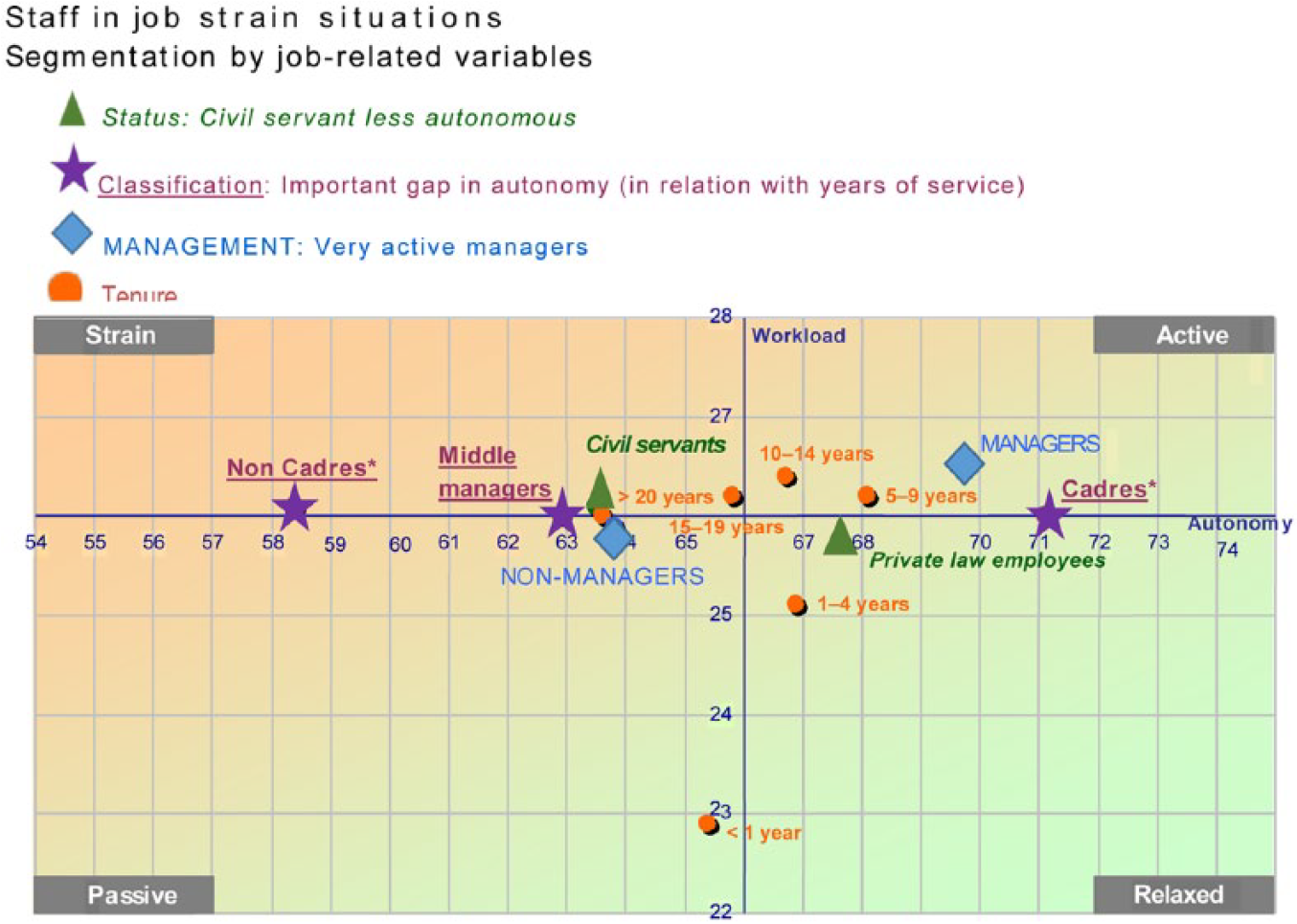
Slide presenting job strain situations.

Slide presenting job strain situations.
One finds a similar emphasis on status, roles and occupation in the analysis of the ‘complementary factors’ of suffering at work. Slides 49 to 65 show statistics and graphs that compare figures of ‘difficult working conditions’, ‘professional discrepancies’ and ‘degraded social relations’ (three aggregates of some of the questionnaire items) of civil servants (vs employees under private law), non-managers (vs managers) and customer service employees (vs support function staff); thereby confirming that these different groups are exposed to ‘higher risks factors’. Reducing the understanding of suffering to the individual’s status and role in the organization may, in fact, help France Telecom’s top management to prioritize and target its corrective actions toward the staff segments that suffer the most at work. However, pointing out particular segments is liable to differentiate and stigmatize some groups: ‘relaxed’ managers on the one hand, and civil servants who lack job fit and adaptability on the other.
Contrasting with this analysis, which mainly focuses on staff roles, status and occupation as ‘explanatory factors for job strain’ (p. 39), the report also analyses nine ‘complementary factors’: (1) workload, (2) lack of autonomy (in Figure 2, called ‘jobstrain’), (3) impact of mobility, (4) organizational dysfunction, (5) pressure from colleagues, (6) managerial pressure, (7) supervisory difficulty, (8) unsuitability for the position and (9) tensions owing to the work environment; factors that are condensed to three dimensions through a multiple correspondence analysis (see Figure 3 below).

Slide presenting the complementary factors in suffering at work.
The ‘three identified directions’ coming from this analysis are difficult working conditions, professional discrepancy and degraded social relationships. Highlighting the immediate environment of the subject as a set of important factors in suffering can alert the managers and the staff to their potential detrimental effects on well-being at work. Specific organizational policies, such as mobility measures, are also pointed out as a potential source of suffering. Again, the analysis gives clear and direct guidelines for improving work conditions in the short run.
While the concluding slides show how pride and sense of belonging have decreased over time, the major reorganizations that followed France Telecom’s strategic change are not mentioned. Instead, the report concludes that roles, status and occupation are ‘particularly relevant for segmentation’; that is, for highlighting suffering at work at France Telecom.
On the whole, while the Technologia questionnaire brings to light an emotional, psychological and moral being moving in a rather narrow environment and maintaining a transactional yet passive relationship with this environment, the report focuses understanding of the individual’s suffering even more, restricting it to the person’s status and role in the organization and the immediate environment. Although not absent, the psychological, moral, health and even task aspects of suffering at work are blurred or underweighted behind administrative terms, so that suffering is mainly constructed as resulting from one’s position in the organization.
Invisibilities of suffering at work
While helping France Telecom to identify and better target its action plan, the survey creates gray areas of invisibility – dimensions that, because they are not seen, are not discussed, remain silent: the economic, strategic and ideological environment of the individual, on the one hand, and the political, cultural and active dimensions of the individual, on the other.
An economic, strategic and ideological environment
By limiting the working environment to its immediate sphere, the questionnaire circumscribes this environment to persons with whom the individual interacts either daily (the chief, colleagues, customers or users) or occasionally (HR, for example). In this perspective (that can be described as psychosocial) the economic, ideological, strategic aspect of the job, whether applied to the environment within the organization, or the region, country or sector where the work occurs, are not taken into account. There are no items on wage conditions, the strategy of the organization, the economic situation of the country, the protection that the employees have through legislation, law or policies that combat unemployment. However, in 1978, Beehr and Newman stressed that macroeconomic variables, particularly those referring to socio-technical, economic or legislative changes, contribute to stress and suffering in the workplace.
It would be unrealistic to try to identify the all too numerous factors of stress or suffering at work. Taking into account their combined effects in quantitative models, from a statistical point of view their explanatory power would be reduced. In contrast, retaining a small number of factors (or always retaining the same factors) potentially increases their power yet may reduce the relevance of the model since it could obscure equally important factors. In addition, large studies (epidemiological surveys, for example) cannot systematically combine (or take into account) multiple environmental factors (such as organizational strategy, organizational climate, constraints of location or the relationship with unions) and, as a result, work situations and organizations are not easily comparable on these dimensions. Thus, very often, the interaction between the individual and the environment boils down to the lowest common denominator among the organizations studied (Beehr and Newman, 1978), namely the quality of the relationship with the manager and with colleagues.
However, it is surprising that the Technologia questionnaire did not ask employees about the changes made by France Telecom, especially as it was deployed after the company’s substantial organizational and strategic changes in addition to the broad media coverage of the wave of suicides. It is also surprising that the report remained silent on these strategic and political aspects, although the questionnaire comprises some items – very few – on the morality of organizational practices, decisions and communication policies. Prior research on organizational justice (Greenberg and Colquitt, 2008) and change in organizations (Balogun and Johnson, 2004, 2005) clearly points out that situations of change are most likely to give rise to feelings of uncertainty (especially when change is ambiguous) or perceptions of discrepancy in situations, between people, groups or in time; dimensions that greatly contribute to a sense of injustice, itself a factor of stress for employees (Fox et al., 2001; Greenberg, 2004). In this perspective, recent surveys on organizational justice and employees’ commitment during corporate change (e.g. merger and acquisition) incorporate items assessing the employees’ perceptions of the organization’s strategic decisions (see Melkonian et al., 2011 on the merger of Air France and KLM). While injustice is mentioned in the France Telecom questionnaire (item 27), it is not analyzed as such in the report.
Taking into account the firm’s strategy and its effects on its employees could also contribute to arbitrate between strategic priorities. It would also recognize that strategy is not the prerogative of the top managers but that it affects the employees’ work and psychological conditions.
A cultural, political and active individual
While the questionnaire does recognize that the individual has a body, emotions and values, the report restricts its understanding to one’s status, occupation and role in the organization. The individual suffers because they do not have enough resources, rewards or support to meet increasing requirements. Contrasting with the individual ‘entrepreneur of self’ that Foucault (2004) described in his analysis of neo-liberal economic theories, the France Telecom - Technologia individual has no control on environment or destiny. One must, above all, adapt to external requirements and cannot want anything other than what is expected (be sympathetic toward customers, for example) or other than what is rewarded (recognition by superiors, for example). The cultural, political and strategic aspects of the individual are then kept silent. On the whole, the areas of invisibilities contribute to create an individual that cannot actively participate or resist the strategic orientations of the firm and debate past and present policies of the State regarding France Telecom. In the following section, we summarize our main results and discuss research contributions.
Discussion
This research aimed to study certain performativity of a questionnaire and survey measuring suffering at work. The analysis of the questionnaire and the report of the investigation conducted following the wave of suicides at France Telecom Orange in 2009 shows that:
Above all, the questionnaire, as a visibility tool for reality, constructs the suffering subject as a dual individual who is capable of self-reflection and reflection on their environment but who maintains a passive, give-and-take relationship with that environment – an environment that is restricted to the immediate work sphere (colleagues, superior). Suffering, in this perspective, is understood as the result of an imbalance between what the individual has to do and what it receives from its immediate environment. While a person is able to reflect on their emotions, health and values, it has little, if no, influence on the work and larger environment.
The survey restricts this understanding even more by focusing on the status and role of the individual in the organization, thereby reducing him/her to a cog in the administrative machinery.
The active, political and policy dimensions that may participate in the definition of the subject are, in counterpart, neglected. Correspondingly, the political and economic context of the organization, its policy on wages, and the more general environment (economic growth, living conditions, ideological, ecological) are hidden.
These results contribute to better knowledge and understanding of the instruments used for measuring suffering at work in three directions that have, until now, been overlooked: first, they underscore a dual concept of the individual that departs from the active self as shown by prior research; second, our results show that the environment of the subject is understood in restricted terms, an aspect that has been ignored so far; finally, we suggest that the questionnaire and report be seen as the result of a compromise between scientific practices and social forces. We discuss these contributions in more length in the following paragraphs.
First, our research shows that behind their apparent neutrality, measurement instruments convey a reflective yet passive conception of the subject and its suffering. Of course, both the questionnaire and the report examined in this research display the subject/object duality conveyed by modern human sciences in which man is both subject or agent of knowledge creation, as well as an object of science (Foucault, 1973; see also Knights 2002: 587): the individual is at the same time capable of making sense of itself, its environment, work, or colleagues, and susceptible to scientific scrutiny. These results however depart from previous works following a Foucauldian perspective, which have highlighted that discourse and knowledge within management sub-disciplines ‘perform’ a rather active and teleological concept of the subject: a ‘rational’ subject who is autonomous, able to take risks and master, at least in part, the environment for strategic management (Knights and Morgan, 1991); an ‘accountable’ subject (Townley, 1993, 1995) for human resources, meaning that, at the same time a subject who is ‘calculable’ (i.e. can appreciate the value of the dimensions specified in advance) and ‘responsible’ and able to account for their actions, results and him/herself; a ‘free’ individual whose desires should be channeled and directed via budgeting processes, so that their behavior contributes to the organization’s goals for management control (Miller and O’Leary, 1987). On the whole, previous studies have shown that management discourses and knowledge consider the individual as a desiring subject whose desires and energy should be oriented so that they will contribute to organizational goals (see also Karlsen and Villadsen, 2008; Valverde, 1996 for similar results on liberal technologies of government). Yet none of these studies have, up until now, studied in-depth, the measurement instruments used to make the subject themselves visible (Lilley, 2001). Contrasting with previous studies focusing on management discourses, our research shows that the questionnaire and survey studied convey a rather narrow concept of the individual who cannot desire something other than performing its work. In this perspective, while the individual is capable of reflecting on their emotions, health or thoughts, they are not considered as having personal objectives that could conflict with organizational ones, and/or lead one to resist or initiate organizational change.
Further research would be needed to explore the gap between the different concepts of the subject as conveyed by management discourses and measurement instruments, to see whether this rather passive and narrow concept of the individual is specific to the context of our study or if, following Beehr and Newman (1978), this view is a hallmark of the vast majority of quantitative studies on suffering at work. In this perspective, the opportunity to create new, specific measurement tools that invite people to assess the strategies and larger environments of their organizations, should be seriously considered (see Hoppe et al., 2015, for a similar argument for personal care occupations).
Second, our results show how the questionnaire and the resulting survey report convey a limited concept of the subject’s environment; an aspect that has been overlooked by previous research, even those following a Foucauldian approach. Our research outlines that the questionnaire and survey report create visibilities and invisibilities, both of which may help to target particular staff segments and to define action plans; yet, they also limit, if not impede, debates on the effects of some important aspects of work: the strategy of the organization, its mission and the way benefits are shared among stakeholders are concealed as if they do not have any influence on work conditions, sense of pride and belonging (two dimensions that were, however, investigated in the questionnaire). While research following a Foucauldian perspective has particularly addressed the relation of the individual with oneself and its environment (see Knights and McCabe, 2003; Knights and Morgan, 1991, 1995; Rose, 1999; Townley, 1995), further research is needed to investigate how this environment (e.g. its political, economic, social, ecological etc. terms; its frontiers, malleability, temporality) is delimited and understood in management disciplines.
Finally, our results bring to the fore the compromise and power struggles that the questionnaire and the report were subject to. The survey has been conducted under pressure from the French government and the media after a spate of suicides at France Telecom, which may explain some of the leaps and blind spots of the report. Yet, both top management and the trade unions who participated in the steering committee seemed to welcome the conclusions of the survey. In this perspective, the report can be interpreted as the result of an assemblage between scientific practices that construct suffering as a consequence of work conditions, and political antagonist forces and interests that agree to see roles and status as explaining factors of work suffering. These various forces include top management (which put out the fire lit by the media coverage of the suicides), the trade-union representatives (who saw in their participation an occasion to come back as a major socio-political force both in the organization and in France after years of silence on the issue of work conditions) and the consulting firm (appearing as an expert on stress and suffering at work). Resulting from a complex dispositive articulating both scientific practices and diverging social forces, this compromise is not without side effects. First, in outlining a narrow, administrative view of suffering at work, the report stigmatizes certain groups of employees. On the one hand, (middle) managers, through lack of support coupled with pressure from top management, are seen as a major factor of deterioration in work conditions. On the other hand, civil servants, in contrast with employees under private law, and staff working in customer support service departments, are singled out as not well-adapted, insufficiently prepared and insufficiently trained for job change. Second, the compromises involved in the construction of the survey tend to silence the employees’ voices regarding the firm’s strategy as if that were the sole prerogatives of top managers, trade-unions and the consulting firm. On the whole, in creating specific scapegoats (managers for the trade-unions, civil servants for top management), the survey satisfies the main stakeholders while keeping silent on other important power struggles: those of employees opposing top management when it suppressed 22,000 jobs; civil servants and final users with the state when it decided to abandon the original public service mission of France Telecom and transform the users into customers.
These elements invite researchers to seriously question their measurement tools not only to better adapt them to new populations and forms of work (Hoppe et al., 2015), but also to consider, if not prevent, that behind their apparent neutrality their tools contribute to disguise (Porter, 1996) power struggles and issues at stake around work conditions in contemporary organizations. In using scientific measurement scales (such as Karasek’s) of stress, in relying on the expertise of a consulting firm, and in being led by a steering committee composed of top managers and trade-unionists, the survey may appear as a neutral, if not objective account of suffering at work. Although our research needs replication, we suspect that similar processes and power struggles are not uncommon in the construction of knowledge about suffering at work.
It is thus imperative that researchers question the meaning that measurement instruments of suffering convey, that they discuss the underlying assumptions, interests and limitations and that they inform those in companies that use them. These considerations also call for the training of managers and future human resource managers in the knowledge and appropriate use of instruments and investigative reports so that they are able to question them. This research invites us to break the silence around the compromise that measurement instruments of suffering at work are subject to.
Postscript
In July 2016, a prosecutor recommended that the CEO and some members of the executive team during the 2006–2009 period be put on trial for moral harassment. At least 39 victims are mentioned – 19 who committed suicide, 12 who attempted to do so, and eight who have endured deep depression – but many more could be involved. If a trial is held, it would be the first time that such an important company is prosecuted for moral harassment on such large scale in France.
Footnotes
Acknowledgements
We are very grateful to Human Relations associate editor, Heather M Zoller, and the anonymous reviewers for their comments and suggestions, which have greatly contributed to deepening our theoretical framework and contributions. Our language editor, Andi Simon, was of invaluable help in editing our manuscript.
Funding
This research received no specific grant from any funding agency in the public, commercial or not-for-profit sectors.