



Abstract
Analytics is heralded as an important, new and increasingly widespread organizational function, and one that promises new approaches for generating value from organizational knowledge. What is not yet clear is how analytics may affect how organizations work with data, or how organizations can realize the benefits of analytics. Analytics, envisioned as not just a technical skill but a reconceptualization of data’s place in the organization, may improve, challenge or undermine existing processes and procedures. Building upon scholarship on expert collaboration and multidisciplinary knowledge work, this study reports a mixed-methods investigation of the implementation of analytics at a Fortune 500 financial services company. The findings make multiple contributions, including (a) confirming the importance of relationships among organizational experts in analytics work; (b) exploring specific communicative strategies employed by practitioners in those relationships; (c) demonstrating that the functioning of those relationships may differ depending on the type of analytics work (i.e. the degree to which it involves requesting, collaborating or commissioning); and (d) indicating that analytics practitioners need autonomy, as well as technical acumen, to question entrenched ideas about organizational data and problems. The findings contribute to practice by identifying problems that may be common in implementing analytics and strategies employed to address them.
Analytics, metrics, data mining, dashboards, big data, data science: these are just a few of the watchwords of the ‘datafication’ of work (Davenport and Patil, 2012; Hanusch, 2016; Lycett, 2013). Proponents contend that organizations teem with data, and that the right analysis, algorithm or visualization will bring a wealth of value and meaning (e.g. Accenture, 2013; Davenport and Harris, 2007; Henke et al., 2016). Applications of analytics and data mining are as varied as they are prevalent. They promise to coach executives’ public speaking (Abrahams, 2016), reduce criminal recidivism (Haugh, 2016), cull neglected library books (book-saving librarians notwithstanding, Ruiter, 2016), and optimize the selection of pizza toppings (Holmes, 2017). In practice, however, it is not yet clear what these trends mean for the work of organizations, or how to realize the promise of analytics while avoiding its pitfalls (Barton and Court, 2012; Davis, 2014; Liberatore and Luo, 2010; McAfee and Brynjolfsson, 2012; Marchland and Peppard, 2013).
Of course, the prominence of data in organizations is not a recent phenomenon (Canary and McPhee, 2011; George et al., 2014). The need to confront and process information is a hallmark of post-industrial organizations (Huber, 1984). The study of organizations’ efforts to implement analytics can therefore speak to fundamental concerns about how organizations use data while also helping to explain the implications of changes in the volume, velocity and variety of data available (Chen et al., 2012; McAfee and Brynjolfsson, 2012), the rapid development of novel analysis technologies and approaches (Kantardzic, 2011; Tanweer et al., 2016), and the explosive growth in organizations’ interest in analytics (Davenport and Patil, 2012; Liberatore and Luo, 2010). Investigating how organizations accomplish knowledge-intensive work in this contemporary context can reveal what analytics might mean for existing organizational processes involving data and the implications of analytics for relationships among organizational members.
For example, stories about analytics often involve conflict between those who ‘crunch the numbers’ and those who make the decisions. The book, Moneyball (Lewis, 2003), is a good example. It is a story of the application of analytics to the selection, management and development of professional baseball players. It is also a story of how the use of data was at odds with the authority of seasoned, expert talent scouts and veteran personnel. The pervasiveness of the idea is reflected in the ‘Moneyball-ing’ of everything from healthcare (Chase, 2012) to publishing (Alter and Russell, 2016), to higher education (Parry, 2011). These stories are commonly presented as a tension between analytics and existing forms of authority. The tension revolves around challenges associated with how knowledge and data should underpin decisions, who has the authority to make them, and the organizational relationships involved.
Speaking to the theoretical value and practical importance of analytics, this study reports, as an exemplary case, the efforts of FSC to implement analytics. Drawing on survey and interview data from FSC, a Fortune 500 financial services firm, we conceptualize analytics as a form of multidisciplinary knowledge work, a collection of practices aimed at creating insight from organizational data. We investigate how analytics work involves practitioners’ autonomy in data-intensive projects and their collaboration with organizational experts. This article makes contributions to research on the theorizing of expert collaboration in analytics work, as well as the practical understanding of associated challenges. These contributions underscore the importance of communication and relationships in analytics, and demonstrate that analytics work necessitates distinctive forms of expertise and communication.
Analytics and expert collaboration
The recent interest in analytics notwithstanding, a key preliminary question is how, or even if, the practice of analytics is a novel or distinct form of work. Davenport and Harris (2007: 7) defined analytics as ‘the extensive use of data, statistical and quantitative analysis, explanatory and predictive models, and fact-based management to drive decisions and actions’. Analytics can be discussed as related to ‘evidence-based management,’ the application of management science to organizational problems, in that it involves efforts to change the bases for organizational decisions, to make them more insightful and effective, and to transform management practice (Rousseau, 2012). Analytics is also related to organizational interest in ‘big data,’ the increasing volume, velocity and variety of data available to organizations; the ambient collection of massive data sets as a part of the increased computerization of work; and the increased availability of computational tools for massive data sets (Chen et al., 2012).
Analytics work differs in important ways from the generic utilization of data in organizations. A distinction can be made between analytics as a set of particular skills, competencies, or techniques and analytics as a movement. For example, discussions of big data have emphasized the development of innovations in analysis and inference (Chen et al., 2012; George et al., 2014; McAfee and Brynjolfsson, 2012). Analytics, in contrast, has been forwarded as a movement that involves ‘extensive use,’ of existing and new techniques. Discussions of analytics center on the organizational implementation and diffusion of data-intensive practices, which involves transforming ideas about the evidence needed for decisions throughout organizations (e.g. Accenture, 2013; Davenport and Patil, 2012; Davis, 2014; Henke et al., 2016).
Proponents of analytics have argued that analytics is not just a faddish rehashing of already existing technical competencies in organizations, but the emergence of a new function, a novel clustering of related organizational tasks, akin to finance, sales or human resources (Liberatore and Luo, 2010). Though many functional areas, such as finance and marketing may rely heavily on analytical ability to complete tasks, these areas use data to solve problems specific to their needs. Actuaries fathom risk; market researchers understand customers; and so forth. Analytics may involve changing the locus of data in organizations: A key difference between traditional forms of data-driven decision making in organizations and analytics may be its suffusion throughout the organization, not just in traditionally data-savvy areas.
This diffusion can involve problems of collaboration among people in different organizational units (Hanusch, 2016). The increasing size and complexity of data available to organizations can make communicating about data sets and developing shared understandings of them more difficult (Tanweer et al., 2016). Analytics may also change how organizations work together, or may require contact between units that do not typically work together at all. Research on organizational knowledge has emphasized strategies for its extraction, commodification and use through existing organizational relationships (Canary and McPhee, 2011; Empson, 2001; Leonardi and Treem, 2012). The suffusion of analytics throughout the organization may push leaders to change existing relationships and create new ones.
Analytics, conceived of in this way, is also a form of multidisciplinary knowledge work. It depends on the sharing and interpretation of data among a variety of organizational experts, and the infusion of findings back into various business units (Chen et al., 2012; Davenport and Harris, 2007; Liberatore and Luo, 2010). By necessitating multidisciplinary knowledge work, analytics may complicate existing expert relationships and organizational processes for making sense of and using information. Research has demonstrated that efforts to facilitate expert collaboration can help, but that working across disciplines and domains presents many challenges. Under the right circumstances, expert collaboration can help develop and produce innovative products, bolster creativity, contribute to knowledge management capabilities, translate knowing into action, and manage difficult technical and political problems (e.g. Barbour and James, 2015; Barley et al., 2012; Cross and Sproull, 2004; Fu, 2015; Hargadon and Bechky, 2006). At the same time, multidisciplinary knowledge work can be complex and difficult to manage, because it involves the negotiation of differences in professional identity (Barbour and James, 2015; Barley, 1996); difficulties of impression management (Leonardi and Treem, 2012); problems of interpretation, translation and meaning making (Barley, 2015; Carlile, 2004); and organizational politics and struggles for legitimacy (Alvesson, 2001; Treem, 2012).
Multidisciplinary knowledge work also involves conceptualizing and labeling the very problems being addressed (Carlile, 2004; Cross and Sproull, 2004; Kuhn and Jackson, 2008). Problem defining is particularly relevant when data are being repurposed to generate insights about organizational processes and outcomes, as is common in analytics (Kantardzic, 2011; Liberatore and Luo, 2010). Leaders may be reluctant to invest in relevant tools or resources that are not easily integrated into existing organizational processes (Barton and Court, 2012). Although existing scholarship points to the multidisciplinary, knowledge-intensive nature of analytics, the specific challenges faced in analytics work and its possible benefits need further study (Chen et al., 2012; Davenport and Harris, 2007; Hanusch, 2016; Liberatore and Luo, 2010).
Analytics and optioning
The promise of analytics, according to its proponents, is the identification insights in a glut of data (Accenture, 2013; Chen et al., 2012; Davenport and Harris, 2007; Henke et al., 2016). Sorting through data involves making interpretations, and data can typically be interpreted in multiple ways. In this study, we focused on optioning, referring to the generation of multiple readings or interpretations of organizational data or problems. This use of the term optioning echoes similar concepts in previous research. For example, Cross and Sproull (2004) focused on the importance of information relationships in defining or redefining problems. Optioning reflects processes that involve divergent thinking as in Tsoukas’s (2009) theorizing of reinterpretation and reconceptualization, two processes of invention that are dependent on dialogue characterized by relational engagement. Mom et al. (2015) found that relational capital could support exploration activities such as ‘searching for new possibilities’ or ‘evaluating diverse options’ (p. 817). They argued for the importance of these activities in creating organizational knowledge and facilitating organizational change.
If the goal of analytics is to pursue new questions or ask those questions in novel ways (Accenture, 2013; Davenport and Harris, 2007; Henke et al., 2016; Liberatore and Luo, 2010), then defining problems, reconceptualizing, reinterpreting and exploring are key to its success. As such, a key goal of this project was to ask:
Research question 1(RQ1): How do practitioners of analytics conceptualize their work with data and optioning in particular?
We also sought to understand the role of expert collaboration and relationships in analytics of the sort identified in previous research (e.g. Cross and Sproull, 2004; Mom et al., 2015; Tsoukas, 2009), and we argue in the following sections that the negotiation of those relationships likely involves (a) access, (b) trust and (c) connection.
Access
Collaboration among experts depends on their meaningful access to each other. Recognizing access as a prerequisite acknowledges the relational nature of expertise. Organizational knowing emerges in problem solving communication among organizational members (Canary and McPhee, 2011; Cross and Sproull, 2004; Kuhn and Jackson, 2008). Experts are not experts just because of what they know but because of what other team members think they know, and being an expert involves the practice of expertise in front of different audiences (Barbour et al., 2016; Leonardi and Treem, 2012; Treem, 2012). Expert relationships are not merely a basis for information exchange, but knowledge-intensive work depends on them being able to reach each other and exchange information and ideas (Carmeli et al., 2015; Fu, 2015; Hollingshead and Brandon, 2003).
Trust
Trust in others’ expertise is also integral to collaboration among organizational experts (Huang et al., 2013; Sankowska and Söderlund, 2015). In fact, disincentives for sharing information (Hollingshead et al., 2011), such as fears that knowledge shared may be unacknowledged or misused, suggest that collaboration among organizational experts is fragile (Empson, 2001). Exploration, reinterpretation, reconceptualization and the like involve not just having access, but also relationships that are thought to be to be close and trustful (Mom et al., 2015; Tsoukas, 2009).
Connection
Likewise, relationships with organizational experts should enable opportunities to engage in rich conversations. We conceptualized connection as the ability to have difficult conversations and develop shared meaning that should in turn enable organizational learning (Barge and Little, 2002). Tsoukas (2009) argued that relational engagement in dialogue involves a suspension of assumptions that leaves actors open to influence and thereby supports the conceptual combination, expansion and reframing needed for knowledge creation. Robust connection should make possible the sort of generative jamming that Eisenberg (1990) argued is rare, valuable and can result in novel approaches to problems.
In summary, we expected that the rigor of participants’ interaction with experts and the trust they held in them would enhance their ability to generate interpretations of data. We hypothesized that:
Hypothesis 1 (H1): Access to, trust in, and connection with organizational experts would be positively related to optioning.
Furthermore, we expected the effects of these relationships to compound one another such that connection and trust would increase the strength of the relationship between expert access and optioning. We therefore hypothesized that:
Hypothesis 2 (H2): Trust and connection would moderate the effects of access on optioning.
To explore the functioning of these relational dimensions in practice, we also asked:
Research question 2 (RQ2): How do practitioners marshal relationships to address problems emergent in analytics work?
Project autonomy
Traditional uses of data allow organizations to make decisions within particular functions or units (e.g. finance, R&D, marketing), thereby also establishing managerial control over those units’ decisions. Suffusing analytical capability across functional boundaries has the potential to throw this control into disarray (Liberatore and Luo, 2010). Functions with important data or data acumen may be asked to work on new problems where they have not previously had authority to make decisions. Units without data or data acumen may need to seek them from sources where they have no authority or influence. For example, in a study of the use of analytics in news rooms, Hanusch (2016: 13) found instances of useful application, but also ‘signs of accelerating processes of functional differentiation within journalism’ that also involved changing journalistic practice and audience news values.
Conceptualizing analytics as a new organizational function, brings to the fore the practice of analysts who have a distinctive expertise (Treem, 2012) and identity (Alvesson, 2001) that centers on mastery of the professional work associated with doing analytics well (Davenport and Patil, 2012). Like other professionals, these analysts may need freedom to exercise their professional craft as they see fit, and doing so would be in part what would mark them as having distinctive organizational expertise (Leonardi and Treem, 2012; Treem, 2012). Data analysts may need to be able to look at data in ways that are guided by their own judgment—to explore (Mom et al., 2015; Tsoukas, 2009). They may need to be able to ask questions and make calls that other parts of the organization may see as unorthodox or risky (Davenport and Harris, 2007). We conceived of this freedom in this study as project autonomy, namely, the extent to which individuals could exercise their own judgment in their work with data and ask what might seem like unorthodox or unusual questions. We hypothesized that:
Hypothesis 3 (H3): Project autonomy would be positively related to optioning.
Furthermore, relationships with experts should also support optioning in part by enabling project autonomy. For example, Cross and Sproull (2004) found that information relationships supported the validation and legitimation of particular approaches to problems. Carmeli et al. (2015) found that relational information processing supported ideation and creativity especially when it fostered openness and acceptance, creating space for unorthodox questions. Relationships with experts should allow for optioning in part by allowing the participant the freedom to approach organizational problems as they see fit. We hypothesized that:
Hypothesis 4 (H4): Access, trust and connection would have indirect effects on optioning, mediated by project autonomy.
and we asked:
Research Question 3 (RQ3): How would autonomy be negotiated in practitioners’ analytics work?
Analytics at FSC
This study focuses on FSC’s implementation of analytics. At the time of data collection, FSC sold and managed financial products for millions of customers. FSC was a Fortune 500 company in operation for decades with annual revenues exceeding $50 billion. FSC employed over 50,000 people internationally, with most employees in the United States, spread across a national headquarters campus with over 30 buildings, thousands of smaller satellite offices, dozens of regional management offices, and multiple call centers. As part of their normal business practices, FSC collected data about current and prospective customers, product performance, employee productivity and well-being, and research and development (R&D), as well as customer transaction data. Many departments and people played roles in data gathering, including sales associates; their managers at regional offices; marketing and human resources professionals at offices in regional centers; and marketing, human resources, product analysis and R&D professionals at headquarters. FSC had a robust infrastructure to manage data, and with the exception of publically available reporting, all data required credentials to access. For example, FSC’s transactional data were highly confidential and, thus, heavily secured, placing limits on who had direct access to them. Other, less sensitive data were more widely available.
At the time of the investigation, FSC was in the early stages of making a concerted effort to shift to being a more data-driven organization. Because work with data was already so much a part of their business and their industry, FSC executives believed they had many untapped resources needing only to be harnessed. This shift towards being more data-driven included messaging from senior FSC leadership, the addition of data-related competencies to leadership expectations and evaluations, technology and infrastructure investments, and investments in training and development in data-related skills. This study occurred in the broader context of FSC’s development of centralized data querying and analysis tools, organization-wide conversations about metrics for key FSC outcomes, and the development of algorithmic predictions of customer behavior and product success.
As part of FSC’s effort to implement analytics, they identified individuals in leadership positions who would complete special projects to make novel and insightful use of organizational data. This, in turn, was seen as a way to develop a core of data-savvy leaders throughout the organization. These individuals were invited to participate in a broader program on data, analytics, technology and decision making. The invitation represented recognition of the individuals’ potential for additional leadership responsibility. Their special projects, completed as part of the program, were high stakes for two reasons. First, in completing the projects, they hoped to derive competitive advantages that could improve the performance of their units and their own performance metrics. Second, at the end of the project, they would present their recommendations to leadership, which would inform their status and reputation.
The individuals identified were upper-to-middle-level leaders who had significant operational and budget responsibility. They had varying numbers of direct reports, but for the most part, they were at least two levels removed from the frontline. Most were already responsible for using data in the course of their work. This usage tended to focus on tracking the performance of people and products using metrics dashboards. The individuals represented a diverse cross-section of the FSC’s operations. They included leaders in sales management, product support functions, as well as leaders from marketing, human resources and R&D. They were subject matter experts in their own right, though their expertise tended to focus on their own domains versus the technical aspects of data collection or analysis per se.
The participants in the program were tasked with formulating strategic business questions that could be answered using available organizational data. Their special projects were intended to be related to their day-to-day work and thus their domain-specific expertise, with a focus on generating significant competitive advantage for the organization, not just marginal improvements in the quality of their day-to-day work. As such, although most had some data and technical professionals within their own teams, they would need to reach out to other parts of the organization to get the data needed to address these broader, more strategic questions. For example, they could call on the sales-focused divisions for data about customers or product performance; human resources for data about employees; and marketing and R&D for data on prospective customers, the industry as a whole, or proprietary data about their products. For most participants, this project was their first attempt to use data with such a broad scope though most had experience working with data within their own functions.
Each leader attended one of four two-day workshops with about 20 participants each. The workshops focused on analytics where the participants developed and received feedback on business questions they could use data to address. Afterwards, they had 45–60 days to find and analyze data, and make a recommendation to their leadership based on the answers to their business questions. Most participants required all the available time. Most projects included a recommendation for solving an organizational problem based on analyses of data that crossed organizational boundaries. In a few cases, FSC did not have the data needed, and those projects provided a recommendation as to what future data would need to be collected. The participants’ experience with these projects, and their work with data in general, provided a rich opportunity to study an organization that was embracing and wrestling with analytics.
Methods
We collected data from FSC using a mix of interviewing and surveying. Mixed-methods were essential in this case to capture participants’ perceptions of their analytics work, and reflections on their specific projects. The use of mixed methods allowed us to check hypotheses about the relational dimensions of their work with data while also shedding light on what those relationships entailed (e.g. the problems they confronted, whom they talked to and why). That is, mixed methods were particularly useful in this study, because we sought to understand the relational dimensions and the communicative strategies employed by practitioners in their work with data. These methods provided more opportunities to study the participants across their ongoing implementation of analytics and to check the findings, mitigating the limitations of any one approach and helping explain unexpected findings.
We organized the research around the four workshops and the associated analytics projects that were completed by the participants. The four workshops were facilitated by the third author and attended by the first. Typically, the third author presented and facilitated discussions, and the first author observed, periodically asking questions. During the projects, the participants could ask follow up questions, and they tended to direct their inquiries to the third author. The first author was also included in follow-up discussions.
Procedures
Survey
Survey data collection occurred in four waves, fielded at the completion of each set of projects. Approximately two-thirds of participants (N = 54) responded to the surveys (68.35%, 54 of 79). The response rate varied by wave (nwave1 = 91.30%, 21 of 23; nwave2 = 80.00%, 16 of 20; nwave3 = 47.83%, 11 of 23; nwave4 = 46.13%, 6 of 13). After completing the informed consent process, participants responded to a brief, 50-item questionnaire. To measure specific behaviors, the questionnaire prompted participants to respond to items in terms of the analytics project they had just completed. Most of the items were Likert-type measures. The questionnaire also included space for open-ended comments about their work with data. Unless otherwise indicated, the response scale for all measures ranged from one (strongly disagree) to six (strongly agree).
Measures of optioning and project autonomy
Optioning focused on the generation of interpretations of data. We operationalized optioning using a single-item measure that read, ‘I was able to develop options for interpreting information for the project.’ Project autonomy focused on the freedom participants experience in their work with the data. We operationalized project autonomy using a four-item measure (i.e. I had the freedom to ‘take risks in my work on this project,’ ‘ask what might seem like odd questions about this project,’ ‘address the project in the ways I felt appropriate’ and ‘exercise my own judgment in this project’).
Measures of access, trust and connection
To focus on the participants’ efforts to engage experts outside of their immediate team, questions regarding contact with experts were each given twice and framed in terms of either ‘people within my team’ or ‘other experts in the company.’ This analysis focused only on responses for other experts in the company as we were interested in the cross-functional interactions. Access focused on the responsiveness of these other experts in terms of providing information and answering questions. We operationalized access using a two-item measure (i.e. ‘I had access to the highly specialized knowledge I needed for the project from [other experts in the company]’ and ‘[Other experts in the company] responded effectively to my questions about my project’). Trust focused on participants’ perceptions of the experts’ knowledgeability. We operationalized trust using a two-item measure (i.e. ‘I trusted [other experts’ in the company] knowledge’ and ‘I was confident relying on the information from [other experts in the company]’).
We conceptualized connection as being able to have productive conflict, to work across domains but still understand information provided, and to suspend assumptions enough that participants could let other experts contribute not just access to data, but ideas about the project itself. In other words, these items are not just about the accessibility of the information (e.g. could I get what I wanted?) or trust (e.g. could I trust them?), but focused on the connections made with experts about the project (e.g. could I understand what they sent, accept their suggestions about the project, and disagree with them if need be?). We operationalized connection using a three-item measure (i.e. ‘I was comfortable accepting suggestions from [other experts in the company] about the project,’ ‘The information I received [from other experts in the company] was easy to understand’ and ‘I was able to confront [other experts in the company] when I disagreed with them’).
Measures of covariates
The goal of this study was to focus on how relationships with experts were related to project autonomy and optioning. To do so, we controlled for other related factors. First, we controlled for data accessibility, because we conceptualized it as a structural necessity for analytics work, and we wanted to focus on analytics as about more than having data or not. We measured data accessibility with a two-item index (i.e. the data needed were ‘readily available to me’ and ‘easy to access’). Second, we controlled for the time available for doing the project. Successful project work depended on getting access to the data and doing so in a timely fashion. Using items from Ballard and Seibold (2006), we measured time scarcity using two items (i.e. ‘In doing this project, I would describe my time as limited’ and ‘as scarce’). We also measured the frequency of communication to control for it. We adopted a single-item measure from previous research (Barbour and Lammers, 2007), which read, ‘To complete this project, how much did you typically communicate with other experts within the company?’ and response options included never, daily, 4–6 times a week, 2–3 times a week, once a week, 2–3 times a month, once a month, and just once or twice during the project. Responses were recoded to approximate frequency per year for analysis and reporting. Controlling for the frequency of communication focused the analyses on the qualities not quantity of interaction. Finally, research has also found that realizing the benefits of specialized experts working together depends on the underlying necessity of coordinated work to accomplish tasks (Hollingshead, 2001). We controlled for task interdependence, which we measured with a single item adopted from previous research (Huang et al., 2013): ‘My performance on this project depended on connecting with [other experts within the company].’
Reliability and validity
To facilitate reliable and valid measurement, existing measures were used when appropriate, and new measures were used with careful attention to relevant theory. Furthermore, early drafts of the questionnaire were reviewed by leaders at FSC and by a pair of scholars and practitioners familiar with FSC and analytics. FSC senior leadership limited the number of questionnaire items as a condition of access, but the reliability indicators for the multiple item measures reached orthodox requirements (see Table 1). The use of mixed methods also provided a useful check of the validity of the measurement approach.
Descriptive statistics.
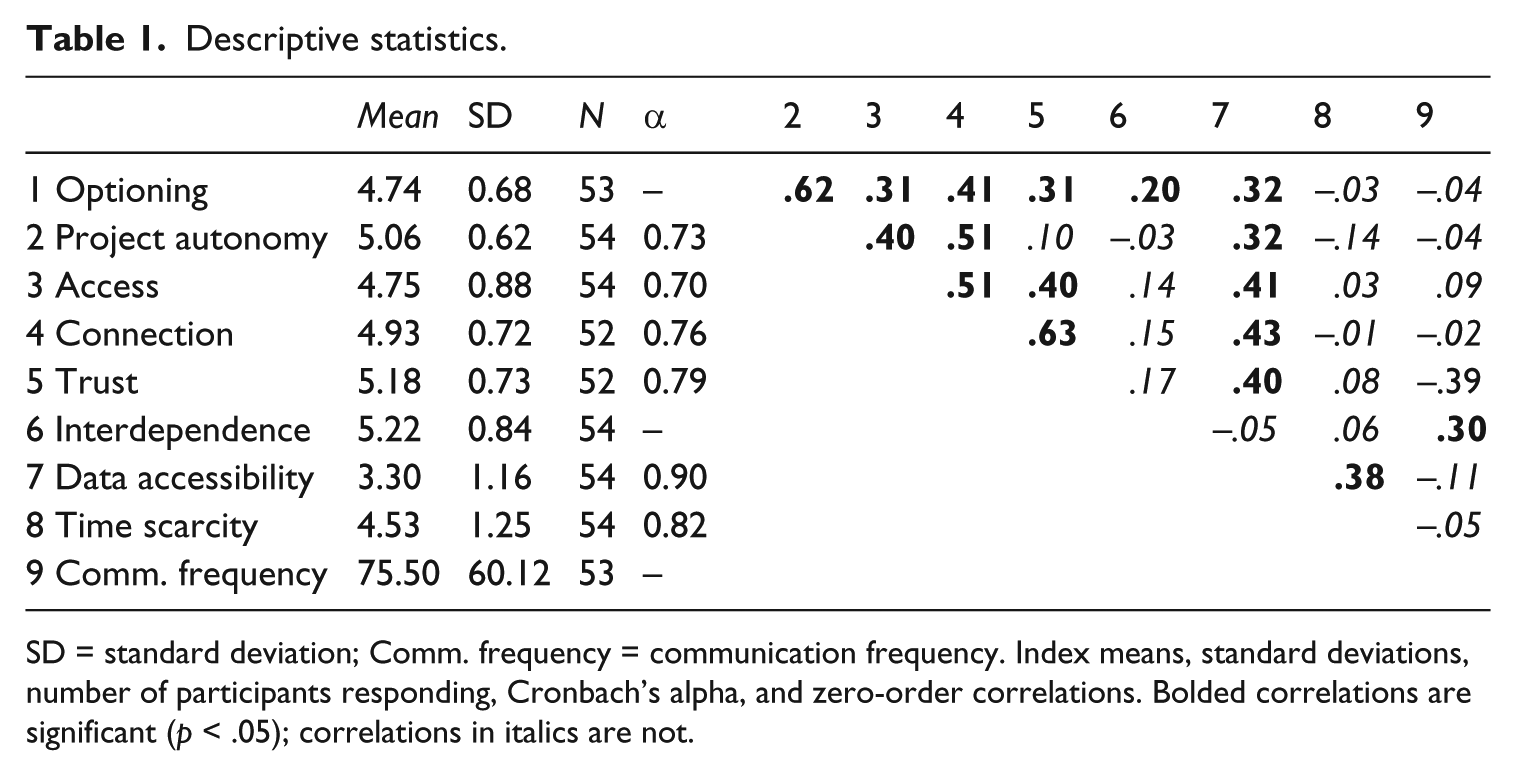
SD = standard deviation; Comm. frequency = communication frequency. Index means, standard deviations, number of participants responding, Cronbach’s alpha, and zero-order correlations. Bolded correlations are significant (p < .05); correlations in italics are not.
Interview data
After the completion of the second wave, the first author conducted follow-up, in-depth interviews with the participants from the first and second waves. The interviews took place approximately seven months after the survey data collection had concluded. All participants from the first and second waves were contacted by phone and email to participate in follow-up conversations about their work with data. Twelve individuals (27.9% of waves 1 and 2) participated in these interviews. Participants in the third and fourth waves were not available to the research team for interviewing. Interviews from the first and second waves were scheduled after participants completed the questionnaire to avoid effects on the survey results and to help make the survey data collection procedures consistent across waves. As a condition of research access, recording the interviews was not permitted. Instead, the interviewer took notes to capture responses and key phrases, verbatim when possible, and notes were later elaborated with the goal of reflecting the responses as completely as possible (Emerson et al., 2011).
To protect the identities of the participants and FSC, we used pseudonyms for participants, organizational divisions and FSC; replaced specific descriptions with more generic language; and obscured details that might be revealing. Throughout each wave and during interviews with participants, the first author took notes (15 handwritten pages during observations and 42 pages during interviews). The interviewer asked participants to reflect on their work with data in general and on the specific projects that were the focus of the survey.
The semi-structured interview guide consisted of three open-ended questions (‘How do you use analytics in your work?’, ‘What are the dilemmas you experience in this work?’ and ‘How do you address those dilemmas?’), and during discussions each question was accompanied by follow-up questions designed to elicit abstract and narrative accounts of their experiences with data. We ceased recruitment efforts when we observed a sharp decline in novel accounts of problems and strategies. Interviews lasted approximately an hour (median ≈ 57 minutes), and ranged from 40 minutes to more than two hours.
The structure of the interview questions was meant to reflect a focus on problems and dilemmas in their work with data, their strategies for solving problems, and their reasoning on why a particular strategy would address a given problem (Craig and Tracy, 1995). This approach, in combination with the survey data, was designed to shed light on how, participants employed communicative and relational strategies, techniques or formats in their collaboration.
Analysis approaches
The hypotheses were tested using the survey data. We used procedures detailed by Hayes (2013), specifically, ordinary least squares (OLS) regression with bias-corrected bootstrap resampling. For hypotheses focused on direct relationships, we report the zero-order correlations and the coefficients from the most complex conditional process modeling. For the tests of mediation, we report bootstrapped coefficients, standard errors, 95% confidence intervals (CIs), and the R2 of the model of direct and indirect effects to indicate explanatory power.
To address the research questions, we conducted an iterative analysis of the interview data, using open and focused coding procedures. Guided by the research questions, the first rounds of open coding identified participants’ accounts of the problems participants experienced in working with data and in the special projects under study and then strategies they employed to address them (Craig and Tracy, 1995). The first author presented these open codes with examples to the research team, and in concert with the results of the hypothesis testing. Through discussion, the research team categorized these codes by comparing each example with the emerging categories, adding categories as needed until the open codes had all been assigned. Throughout this discussion, the first and third authors contributed additional observations from their experiences working with the participants. During the discussions, the first author took notes about emerging themes, and later produced research memos describing the categories of problems, strategies and the underlying ideas about analytics and communication implied in their responses. The research team met again to discuss the logic underlying the relationships between problems and strategies in the data, and the first author produced another research memo capturing that conversation. The team discussed and elaborated upon the memos in an additional analysis meeting, and with these research memos in hand, the fourth author reviewed the notes looking for negative cases and alternative examples. Given that the quantitative analysis preceded the qualitative analysis, a distinct effort was made to seek data that would challenge the results, in order to help account for any selection bias that may have existed in the coding. The team reviewed and refined the memos to answer the specific research questions and to elaborate and clarify the survey results.
Results
RQ1: Working with data and optioning in analytics
Overall, most participants agreed that they had been able to develop options for interpreting information in their projects (Moptioning = 4.74, SD = 0.68, see Table 1). They reported engaging with organizational experts in this project work (approximately 6–7 times per month, Mcommfrequency = 6.29 times per month; SD = 5.01), and tended to agree that this work depended on connecting with organizational experts (Minterdependence = 5.22, SD = 0.84). Thus, there was evidence that optioning was a facet of analytics work and occurred through interactions with experts across the organization. In describing the work involved in analytics, the participants highlighted challenges they encountered in their work with data for their specific projects and in general, including the accessibility of data, the volume and complexity of data, the pace of their work with data. They also mentioned dilemmas that were interwoven with autonomy in particular such as existing agendas for data collection and analysis, hierarchies and data ownership, and legal and regulatory frameworks relevant to their work with data.
These points are illustrated by some of the specific quotes captured during the interviews. For example, analytics work could not occur if relevant data were inaccessible. As Charley explained ‘data is the latest buzz around here,’ but he later added that before asking any questions or conducting analysis, ‘there’s gotta be data . . . Some don’t exist . . . we’ve never asked for it. Some we won’t collect.’ Participants’ accounts confirmed the importance, but also the difficulty, of getting to data in the first place (Mdataaccessibility = 3.30, SD = 1.16). Participants described the problem of accessibility in terms of the absence of data and of difficulty locating or retrieving existing data from ‘legacy systems’ only understood by a few. Walter explained, ‘The data is out there, but you have got to ask for it.’ Accessing data required participants to find and communicate with organizational members outside of their respective business units, and with whom they were unfamiliar. This effort could be problematic because there were not always people dedicated to answering such requests, and, as Alex commented, seeking data from another unit or finding the owner of data was viewed as ‘extra work.’
Participants also explained that having voluminous data could itself be problematic. Weber noted, ‘we have too much data, and most of it is useless. We get lots of reports that are interesting, but I can’t use them to change behavior.’ He explained that sales managers ‘have access to a lot of data, but they don’t use it.’ Even in instances where they were accessible in a material sense, data could be functionally inaccessible if workers could not interpret, organize or apply them. Rebecca recalled meetings with one department where they enthusiastically told her that they have a ‘ton of stuff,’ but then added that accessing the data required a particular technical skill. Later in the interview, she told the story of a program that had been generating data for 10 years, but with a glitch: ‘It took a skilled person six weeks to diagnose the problem . . . she’s since retired . . . when you pull data from so many sources, there will be misfires.’ Even when they could access the data, there were challenges of interpretation and application.
Another obstacle participants confronted in their analytics work was the existence of hierarchies, siloes and feelings of data ownership that made working with data more difficult. FSC has many thousands of employees, and is an organization of staggering complexity. Participants explained that hierarchies made finding the right person and getting access permission more difficult. Data were housed in many places across the organization, and different business units had different approaches to data collection. Participants noted that differences emerged because (a) the units wanted answers to related but slightly different questions, (b) they used different language for the same data, and (c) reconciling differing approaches involved organizational politics.
Given this context, analytics work and optioning involved digging deeper into data to move beyond straightforward readings of analyses and to see business problems in new ways. Weber explained that one reason standard data reporting units ‘cannot produce useful information,’ is because ‘some people don’t know what they want.’ He felt that part of his job was to see problems beyond a single unit. Analytics work required communicating about a problem in a way that other business units could understand. Tyler recalled that when he picked up a data-intensive project from his predecessor, after a few missteps, he ‘met with [the business partner] to find out what they really needed . . . what they needed was not the trend but the [reason for the trend].’ Optioning involved not only initial approaches to problems, but also the ability to rethink problems as data access shifted. Describing his work on a special project, Walter explained that ‘[a]s we got more and more data, we realized [our initial way of seeing the problem] was not necessarily true.’ His work was dependent upon the ability to alter initial assumptions and potentially redefine the problem they were addressing.
Optioning did not occur in isolation, but within a context where workers were aware they depended on others for data provision and interpretation. Therefore, individuals conducting analytics needed to communicate about problems in a way that would minimize conflict with others in the organization. Frank explained he ‘had to do the problem defining work with the experts,’ because they might not know him, might not think he knows what he is doing, and might not understand his part of the business. He had to work with them on making sense of the problem to dig deeper and to develop a shared understanding of the questions to be answered.
In summary, analytics work at FSC required more than just getting access to data and analyzing it to come up with straightforward answers to business questions. Participants described doing this sort of more straightforward work, but they also described needing to define the problem, identify the relevant data, make the case for using it, and finally to perform the appropriate analyses. Optioning was critical in analytics work because it allowed individuals to adjust the conceptualization of problems based on the accessibility and usability of data. They used the analysis of data and interactions with experts to redefine and evolve problems as needed. The responses also indicate that obstacles existed that could limit optioning, and the ability of individuals to engage in optioning was influenced by relationships with others.
H1 and H2: Optioning and communicative relationships with organizational experts
H1 held that access to, trust in, and connection with organizational experts would be positively related to optioning, and H1 was supported. Optioning was positively related to expert access (r = 0.31, p = 0.02), connection (r = 0.41, p < 0.01) and trust (r = 0.31, p = 0.03). These relationships held in the final conditional process model, which controlled for data accessibility, task interdependence, communication frequency and time scarcity (see Table 2). H2 further posited that connection and trust would moderate the relationship between access and optioning. H2 received mixed support. We tested each two-way interaction discretely and in combination. For optioning, we found support for the interaction between expert access and connection (ΔR2 = 0.13, F[1,41]=14.193, p < 0.01); however, the moderating effect was not as expected. We expected the quality of connection to compound the positive effects of access. In fact, higher levels of connection produced more optioning when access was lower, but higher levels of access and connection combined to reduce optioning.
Conditional process modeling of project autonomy and optioning.
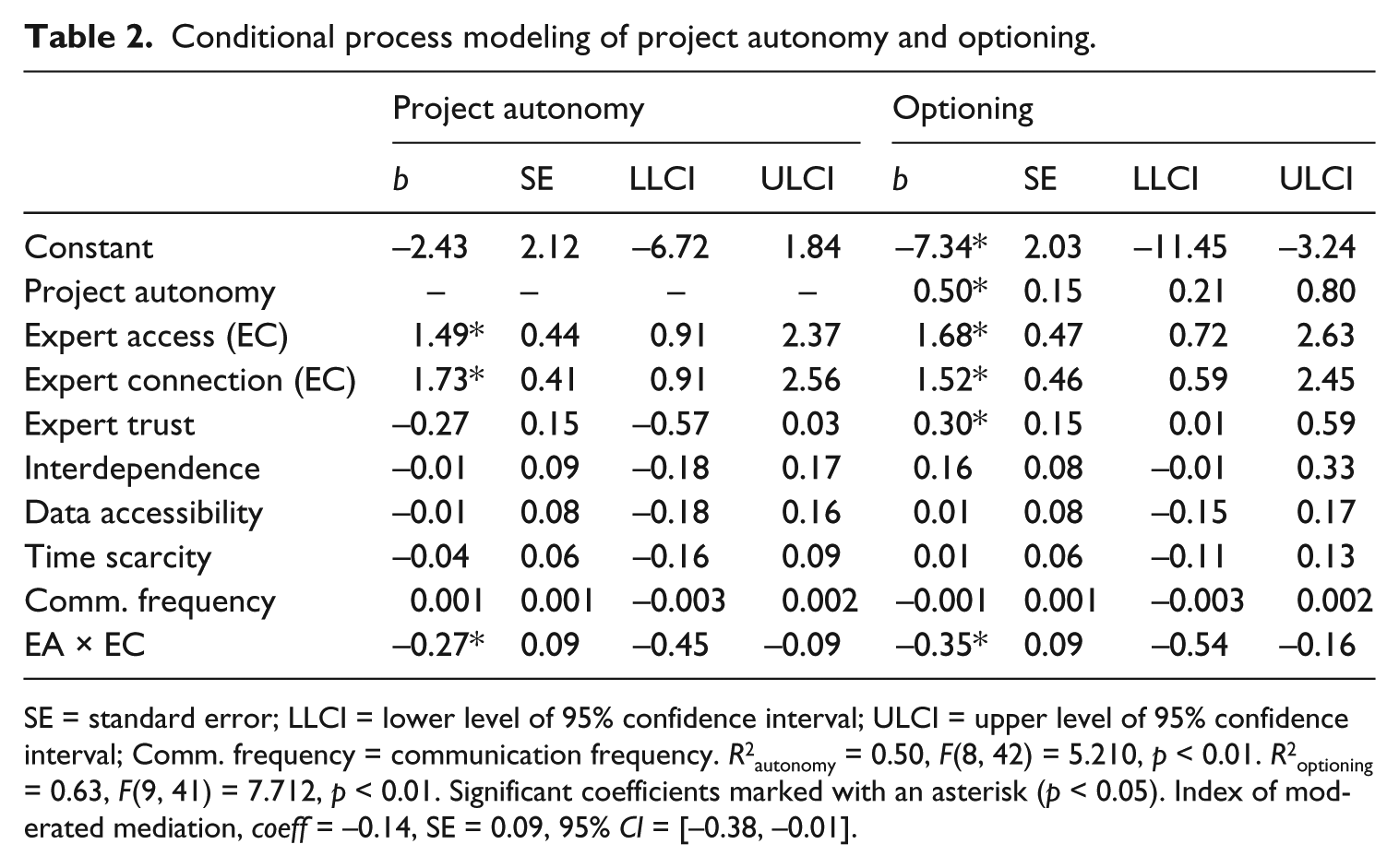
SE = standard error; LLCI = lower level of 95% confidence interval; ULCI = upper level of 95% confidence interval; Comm. frequency = communication frequency. R2autonomy = 0.50, F(8, 42) = 5.210, p < 0.01. R2optioning = 0.63, F(9, 41) = 7.712, p < 0.01. Significant coefficients marked with an asterisk (p < 0.05). Index of moderated mediation, coeff = −0.14, SE = 0.09, 95% CI = [–0.38, –0.01].
RQ2: Marshalling relationships to address data problems
The interview data may help explain this unexpected finding regarding the relationship between expert access and connection. Taken together, the findings may indicate that these processes are not merely multiplicative, but that they involve different mechanisms altogether. Participants’ work placed them in the roles of producer and consumer of analysis. They analyzed data and presented results to more senior FSC executives, and they received information and insights from their own teams and other units within the organization. Participants described strategies associated with how they requested data and how they presented the data to others (e.g. internal partners and peer executives, sales leaders they coached, their leadership, their own teams). At times, participants were drawing on other organizational experts for insight and data to help them conduct and deliver an analysis. At other times, they were asking the other organizational experts to complete and deliver that analysis to them so they could pass it along.
At FSC, if access and connection with other organizational experts operated differently than we expected, they may have also involved different strategies for doing analytics work. This finding would be consistent with the high degree of variability in how frequently participants communicated with other experts (see Table 1). Though they reported needing to get access to data and analysis from others in the organization, in some cases, doing so involved little interaction, and in others it involved a great deal. According to the survey data, under circumstances where participants reported lower levels of access to experts, connection acted as expected. It was related to higher reported optioning. Connection might help participants and the other organizational experts to develop interpretations of data together despite their limited access to them (i.e. increasing optioning). Higher access, but lower connection might have involved repeated requests for data that participants then would analyze (i.e. increasing optioning). Higher connection and access together might have allowed them to more clearly direct the other organizational expert to provide a specific answer to their question (i.e. delegating the analysis, reducing optioning). Understanding the problems participants encountered in analytics work and how they marshalled relationships with other organizational experts to address them can help explain this finding by comparing how participants described analytics problem-solving strategies involving access and connection.
Access to other organizational experts
Participants reported using a number of strategies for reaching other organizational experts in terms of getting access to data—that is, managing problems of data accessibility, volume and complexity while dealing with time constraints. For example, Wanda mentioned that in locating individuals to help sort through the massive amount of data available, there was no ‘map of what is out there.’ For her special project, a particular unit within the organization knew where the data she needed were stored, but, she explained, they would not have been successful ‘if not for one of the members of our team who spent time [with that unit] who knew who to ask.’ The volume and function-specific nature of data at FSC meant a limited number of people were likely to be familiar with a single data set. Blake noted that only individuals familiar with information ‘know where all the noise is,’ and can assist in ‘catching shifts in the data.’ Existing relationships were useful in part, because of their informality. As Blake commented regarding his method for seeking help with data, ‘I know who to call. I don’t rely on formal paths,’ which would take too long or involve too many permissions. Asking existing contacts allowed participants to navigate the volume and complexity of data, and work around the hierarchy to get to those who really knew the data.
Participants also reported that the pace of their work made analytics more difficult, and participants reported experiencing time scarcity in doing their project work, though not uniformly (Mtimescarcity = 4.53, SD = 1.25). Rebecca explained, ‘we can get that [report], but can we get it as fast as we need it?’ There were limits on the time available for sorting through data and its complexities, which could also preclude the sort of collaborative problem solving that connection might enable. Instead, existing relationships and understanding might enable workers to access what they need quickly. Tyler explained, ‘what usually happens is that someone comes in with a question, we’re seeing X—what is causing that? Oh, and we need it by 3:00 PM.’ Tyler explained that ‘anticipating through experience’ helped him manage the time pressures and fast pacing of analytics work. Instead of ‘scrambling,’ he argued, ‘I get ahead of it, because I know it’s coming.’ Tyler needed to be able to respond to regular requests quickly, and developing relationships with experts provided more efficient ongoing access to data.
Connection
Whereas access seemed to be about targeting the right person with the data, connection would involve deeper, richer engagement with organizational experts. Though knowing who to ask and knowing what to ask allowed participants to make the best of the mess of data available to them, participants also spoke of cultivating relationships to anticipate data needs in the future. This seemed to go beyond regular requests for data. Blake looked for opportunities to cultivate these sorts of relationships, explaining, ‘I called [the department] and asked them for what I needed’ as a way to find ‘someone I can build a relationship with.’ These relationships were needed, he explained, because ‘I want to have a richer conversation.’
Participants also reported working with other organizational experts after they had access to data to sort through the information provided and address emergent problems. Sidney explained that ‘asking questions could help cut through the clutter,’ and that they would keep pushing until they found the right data. Frank gave an example of working with an internal compliance unit that was holding up work because they were struggling to see the relevance and applicability of the organizational problem being addressed. He recalled, ‘So, I painted a scenario based on the real world,’ which simplified the language, because ‘[the unit’s] language was obfuscating the real issue. It lacked context.’ His ability to communicate with the unit and work through these different views allowed them to reach a shared understanding of the problem and move forward. Whereas access seemed to be about delegating and making requests for data, connection seemed to be about collaborating to understand, frame and solve problems.
Delegation and collaboration in flux
This joint reading of the quantitative and qualitative findings is consistent with the view that while FSC tried to implement a vision of analytics that would encourage collaboration among units with varied data, more orthodox ways of working with data did not go away. The implementation of analytics was not complete, but ongoing, in progress and uneven. The locus of data in the organization had not shifted, but was in the process of shifting. Participants also felt that they still needed leadership support to continue this shift. For example, a number of participants indicated that leadership needed to communicate not just a general push for analytics, but direct messages to the units that could help. A participant commented in the survey, ‘It would be helpful to have each [technical division’s senior leadership] on alert that they may be approached to help supply data to us for a very time sensitive project.’ Another participant wrote, ‘I felt especially that the internal resources in [research and development] may not have been given a clear understanding of how much they would be asked to help as they also had many other projects and deadlines.’ These comments reflect an organization in transition.
Participants also described their efforts to help others manage this shift. Wanda argued that early trends dashboards offered ‘all these different reports.’ She took a ‘stair step’ approach to help ‘deal with the ton of data out there.’ This filtering also helped them, because their audiences could at times also get access to these data themselves, and there was concern they might be overwhelmed. Bryan recognized that in instances where individuals could gather their own data they needed a ‘hard shift as we move from running reports to teaching them to run reports.’ They were working to coach their audiences to be more sophisticated with data, and to generate interpretations on their own, even as they were sharing the results of their own analyses.
Participants described problem-solving that involved requesting data to analyze on their own, working with experts to make sense of data, and requesting analyses from other organizational experts. Tyler’s experience highlights the distinction. He reported that he found getting data was easy. The real difficulty was getting in contact with the people who controlled and understood it to get them to package it for him. He told the story of seeing a strange pattern in the data set, only to find out later that the person he had requested it from had ‘pasted it wrong.’ Tyler argued that he had ‘no access to raw data without effort,’ because most of the time, his coworkers were resistant to sharing raw, unfiltered data across units. Pushing for raw data in requests was one way to deal with this difficulty, and getting the raw data would be useful when participants were undertaking the analysis themselves—not just requesting an answer from another unit.
Another way the importance of collaboration was revealed was in the distinction between first and long term encounters with the experts. Bryan noted that early encounters would be ‘tentative’ and hedged, prompting questions like ‘wouldn’t we also need to have X,’ but later conversations could be ‘more pointed’ including questions like, ‘I’m not seeing it. Could you tell me about how you got there?’ He argued that ‘to ask the challenging questions, you have to have a relationship.’ Early in these relationships, Bryan makes more tentative requests for data, and later more robust relationships allow him to do the thinking work with the other organizational experts. Dealing with problems related to access and connection both depended on the existence of established relationships or cultivating new ones, but those relationships served different ends and involved differences in the communicative strategies they used in their analytics work. The locus of data in the organization was not only in shifting in terms of who was doing the analytics work and with whom, but, as the following sections indicate, participants were also negotiating issues around the authority to request data, analyze them and act.
H3 and H4: Project autonomy and optioning
H3 posited that project autonomy would be positively related to optioning. H3 was supported (r = 0.62, p < 0.01). The relationship held controlling for covariates (e.g. communication frequency, time scarcity, interdependence and data accessibility) and independent variables (e.g. access, trust and connection). In the most complex conditional process model (see Table 2), a positive relationship between project autonomy and optioning remained (b = 0.50, SE = 0.15, t = 3.45, p < 0.01, 95% CI = [0.21, 0.80], R2 = 0.63).
H4 further posited that the measures of expert relationships would have indirect relationships on optioning mediated by project autonomy. To investigate this hypothesis, we first looked at the degree to which the measures of expert relationships had direct relationships with project autonomy. Project autonomy was positively related to related to access (r = 0.40, p < 0.01) and connection (r = 0.51, p < 0.01), but not trust (r = 0.10, p = 0.48). These relationships held in the final conditional process model (Table 2). We found an interaction between expert access and connection on project autonomy (ΔR2 = 0.11, F [1,42] = 9.298, p < 0.01), such that the quality of expert connection moderated the influence of expert access on project autonomy such that the quality of connection mitigated the effect of lower expert access controlling for other factors. To address H4 building on these analyses, we considered the mediation of each indicator and the degree to which the indirect effects of expert access on optioning through autonomy would be moderated by expert connection.
H4 was partially supported. Controlling for the other factors, expert trust did have a direct relationship with optioning, but not an indirect one mediated by project autonomy (coeff = -0.16, SE = 0.11, 95% CI = [-0.49, 0.01], R2 = 0.52). The results did indicate the moderated mediation of an indirect effect of expert access and connection on optioning through project autonomy (index of moderated mediation, coeff = -0.14, SE = 0.09, 95% CI = [-0.38, -0.01], R2 = 0.63, see Table 2). As access improved, the indirect relationship between connection and optioning through project autonomy diminished (indirect effects of connection on optioning through autonomy by access coefflowaccess = 0.34, SE = 0.16, 95% CI = [0.08, 0.79], coeffmediumaccess = 0.22, SE = 0.13, 95% CI = [0.05, 0.63]), coeffhighaccess = 0.10, SE = 0.11, 95% CI = [-0.07, 0.46]).
This finding is consistent with the analysis above (i.e. H2 and RQ2) that drew a distinction between access for requesting data and connection for collaborating to generate interpretations of data together. Project autonomy might not be as relevant in circumstances marked by higher levels of access, but lower levels of connection. Simply requesting data and analyses would not require project autonomy. Under circumstances marked by higher levels of connection, project autonomy might be useful, because working with other organizational experts would involve their own hierarchies and agendas that might constrain optioning. Also, as above, participants’ accounts of how they managed constraints on their autonomy demonstrated important but differing roles of relationships with other organizational experts.
RQ3: Marshalling relationships for project autonomy
Participants argued that individual and organizational agendas, hierarchical divisions, and legal and regulatory constraints could make their analytics work difficult, and these problems were difficult in part because they put limits on their autonomy to go after questions and data as they saw fit. For example, agendas included preexisting frames for data or preexisting ideas that would influence the results of analysis. Blake commented that his ‘former leadership didn’t want to know’ what the data might indicate. He told a story of data analysis conflicting with an already accepted decision, ‘data changed the outcome . . . but the [region] makes a different decision in the end . . . we didn’t say they were wrong.’ Among the principal stakeholders, one ‘checked out,’ and another agreed to disagree with the outcome. Recognizing and avoiding obstacles posed by existing agendas was part of analytics work.
In other instances, individual agendas could undermine the usefulness of data for broader organizational use. Weber explained how sales associates understood the systems of evaluation, and might be tempted to ‘game the system’ by entering data in ways that favored them. Blake stated this practice more simply, ‘I’m used to people trying to use numbers to lie.’ Agendas could also result in inefficient uses of available data. Charley referred to a ‘culture of ignoring’ prevalent in parts of the organization and noted data were inaccessible at times because leaders refused to let others access them. Another challenge was that over time particular practices built up inertia, such that units develop vested ways of seeing data. Heather remarked that ‘each [region] has its own data,’ and Weber argued that, even in cases where existing data measured the wrong things, ‘changing the number, [how it is measured] is really hard.’ The entrenchment of hierarchies and respective agenda of units or leaders reinforced divisions in the organization, and in doing so created differences in how groups developed and propagated data.
In the interview data, time scarcity also interacted differently with constraints on workers’ autonomy. Blake argued that analytics could be hard and complicated, and so ‘most people will take a shorter route to town.’ Individuals faced pressure to make decisions quickly, yet there was often more data available for them to potentially consider. Charley commented, ‘At [the organization], we have discomfort deciding based on imperfect data yet it’s all imperfect data.’ He also explained that the pace of the work and the reluctance to act on data with any weaknesses, meant the organization would revert to accepted wisdom or convention to make decisions on time rather than making data-driven decisions. Even if individuals had access to data, or developed the relationships with experts to facilitate work with data, time constraints could stifle the ability to exercise desired autonomy when conducting analytics work.
The presence of existing agendas for data and the hierarchical division of authority over data meant that relationships needed to be established across organizational units and across organizational ranks. The strategies mentioned for addressing these difficulties tended to involve richer engagement with other experts that entailed more than making data requests. Navigating these issues meant needing to know not just who to ask but to know how to communicate with the person they were asking. Blake described needing to ‘guess what their issues are going to be using what I know about them.’ He argued that he needed to ‘make them look good . . . I’m not trying to blindside them . . . seeing their mistakes but not doing gotcha!’ Working through informal channels could help as well. Frank argued, for example, rather than sending ‘memos and PowerPoints,’ he wanted to spend ‘a half-hour at someone’s desk’ where the ‘richness’ of ‘being in the room allows for more influence.’ Formal meetings were a space for rationalizing decisions, but informal interactions were central for gathering the data needed to make decisions. Informal communication with individuals early in projects enabled autonomy to the extent that they brought stakeholders on board during preliminary conversations about the work with data and increased the likelihood they would be invested in the project.
Constraints on project autonomy were not only internal to the organization. Participants explained that legal and regulatory frameworks constrained how they could or had to work with data. Charley mentioned that one reason FSC refused to collect data is that to do so might impose a legal risk—real or perceived. He commented that, ‘because of the law, we can’t measure some of these things,’ and there is risk associated with having data, the ‘danger of knowing.’ FSC dealt with a great deal of litigation and had an entire division dedicated to establishing policy for document management, retention and destruction. Confronted by fears that data that might threaten the organization, he explained, ‘that’s usually where we stop,’ and that they were ‘conservative by default.’ Relationships were useful in helping workers identify and understand the actual requirements and address the unease that data might have legal implications.
In summary, participants described working with other organizational experts to make requests for data, delegate and collaborate about pressing business questions. Strategies useful in dealing with the difficulties of autonomy included (a) cultivating an understanding of and respecting the needs of others and (b) having informal conversations to influence how findings would be received and acted upon and to make sense of the constraints on their work with data. The findings indicate that project autonomy was positively related to optioning, and that project autonomy may play a different role when participants were requesting data or analyses than when they were working with organizational experts to make interpretations of data.
Discussion
The findings make the following contributions to the study of expert collaboration and analytics: First, the findings confirm the importance of relationships among organizational experts in analytics work, and provide an explanation of specific communicative strategies employed by practitioners in and through those relationships. Second, the findings indicate that the communicative dynamics in expert relationships may have involved not only requesting data from organizational experts and collaborating to solve organizational problems with organizational experts, but also a third dynamic that we are terming commissioning, a relationally rich form of delegation that differed from requesting and collaborating. Third, the findings indicate that analytics requires autonomy to support the questioning of entrenched ideas about organizational data and problems. Fourth, the findings also have practical value in that they identified problems that may be common in implementing analytics as well as strategies employed to address them. We discuss each contribution in turn.
Relationships in analytics work
We have conceptualized analytics as a distinct form of multidisciplinary knowledge work that depends on expert relationships. Our findings indicated that in FSC’s efforts to implement analytics, practitioners needed to manage existing relationships or form new relationships with experts who possessed the data they needed, who could help them make sense of them, and who could, at times, collaborate with them to generate interpretations. Optioning and project autonomy were products of a suite of communicative and relational strategies that participants use to overcome challenges related to accessing and integrating data in an environment where existing organizational structures made this difficult.
Related to this first contribution, the findings at FSC demonstrate that analytics did generally involve the relational complications of multidisciplinary knowledge work (e.g. professional identity; impression management; problems of interpretation, translation and meaning making; and organizational politics and struggles for legitimacy). For example, Tyler’s preparations for regular requests were about making the work more efficient and also anticipating the conversations that he would need to have to understand the needs of collaborators and audiences for data (i.e. Barley, 2015). This example, and others like it, demonstrated that to get data, analyze them and communicate recommendations, participants needed strategies for navigating a web of relationships, power structures and existing ideas about what analyses ought to produce.
Building on these ideas, the findings also contribute to research in this domain by highlighting specific communication practices in analytics work that merit attention, and the complex relational dynamics implicated in these practices. For example, practices identified included filtering by audience, holding informal conversations, meeting ahead of meetings and preparing to respond to repeating requests. The findings demonstrated that these communicative practices at FSC depended on a rather nuanced understanding of audiences for data requests and analysis reporting (e.g. knowing who to ask, knowing what to ask for, knowing who is being asked) that went beyond simple maps of who knows what in organizations.
Requesting, collaboration and commissioning
The findings also pointed to relational differences involved in analytics work at FSC that we had not anticipated. We found that participants’ work with organizational experts may be thought of as involving requesting, collaborating and also an idea we are calling commissioning. In some cases, participants requested data, and in others they collaborated with experts to make sense of data. Participants may have also engaged in a relationally rich sort of delegation, commissioning, that would explain the finding that higher levels of access and connection were associated with reduced optioning. In commissioning, participants’ rich engagement with organizational experts (higher access and connection) may have allowed them to have robust conversations that defined the questions at hand, thus enabling the expert to simply go and find the answer. The participants in these cases delegated the analysis to the expert, after richer initial discussions about the work to be done. After receiving the findings they commissioned, participants could then decide what action to take based on the other organizational experts’ conclusions.
This insight is important, because commissioning may depend on the robustness of relationships in ways not consistent with requesting or collaboration. Commissioning would differ from simply making requests for data (i.e. transferring information from one part of the organization to another), because it requires greater depths of access, trust and connection. Commissioning would also differ from collaboration in that it may shortcut or shift processes of analysis and insight generation. Requesting, collaborating and commissioning may involve distinct mechanisms, and future research should consider the extent to which commissioning involves communication strategies and relationships in ways that differ from those involved in requesting or collaborating. For example, commissioning may depend on existing expert relationships developed through previous work to reduce the time needed to address questions at hand (e.g. Majchrzak et al., 2012). Although existing research points to the need for rich relationships in knowledge-intensive work like analytics, in practice, the same relationships may also support what may seem like straightforward exchanges but are not. Distinctions between requesting, collaborating and commissioning may also have implications for autonomy in analytics work.
Autonomy
At the outset, we argued that the implementation of analytics as a new organizational function would require practitioners to have a distinctive expertise and identity, and to be able to exercise their professional craft with discretion, and, as such, optioning would be related to project autonomy. Our findings at FSC confirmed that being able to develop options for interpreting information was related to: having the freedom to take risks, asking what might seem like odd questions about a project, addressing the project as they saw fit, and exercising their own judgment. Project autonomy had a direct effect on optioning, and it mediated the indirect effects of expert relationships on optioning as well. The findings help us understand autonomy in working with data as intertwined with the communicative and relational negotiation of work with other organizational experts.
Requesting, collaborating and commissioning may also differ in the degree to which they allow for and constrain autonomy. When making straightforward requests for data, project autonomy may be less relevant. Participants may not need to rely on organizational experts to provide input on how the data are analyzed and interpreted. In instances of collaboration, autonomy may be important so that analysts can work with other organizational experts without being constrained by collaborators’ agendas and priorities. In commissioning, the need for autonomy may actually shift to the other organizational experts doing the analysis work.
The findings also suggest that the practice of analytics itself requires the possession and application of distinctive expertise and knowledge. This expertise involves not only analytical acumen, but also navigation of complex relationships while maintaining autonomy. This combination of expertise and knowledge is not associated with any specialist function in the organization, but instead requires expertise with interactions across disciplines, as well as expertise in processing, interpreting and utilizing diverse sets of data (Treem and Barley, 2016).
Navigating the practical difficulties of analytics work
The findings also make contributions to the practice of analytics by providing examples and insights related to challenges faced during implementation. For example, implementing analytics will require leaders to improve their understanding of organizational data constraints, quality, ownership, accessibility and interpretability. The increasing complexity and volume of data available may complicate these problems by making the process of developing shared understandings of data more fragile (Tanweer et al., 2016). This study suggests that in implementing analytics, organizations have to cope with relational, communicative, as well as technical problems. The findings indicate organizations may be able to address these problems by helping practitioners (a) know who to ask for data but also know more about the person they are asking, (b) consider audiences in filtering and focusing work with data, (c) prepare in advance for recurring requests and problems, and (d) work through informal relationships to define problems and identify workarounds.
Failing to recognize and account for these dimensions of analytics work may short circuit the sort of exploration required by the practice of analytics (Marchland and Peppard, 2013). Although research suggests that processes like optioning can improve the outcomes of knowledge-intensive work (Cross and Sproull, 2004; Mom et al., 2015; Tsoukas, 2009), for participants at FSC, optioning was not the end unto itself. They did not simply want options; they wanted the answer. At FSC, when a simpler solution was available, it was hard to justify taking time to explore other options. Practitioners of analytics should also be ready to make the case for ways of looking at data that seem unusual or unorthodox. Informal relationships, meetings ahead of meetings and anticipating the needs of partners may be useful in doing so.
The findings also rebuke an outdated vision of analysts and technical professionals as set apart from and misunderstood by organizational leaders. Instead, they point to fundamental difficulties of differences in expertise (Kuhn and Jackson, 2008). Participants’ accounts of their strategies positioned them as data-savvy problem solvers but also political operators who communicated informally with others prior to planned meetings, who carefully selected the audiences in their work with data, and who made use of visuals and stories to help audiences make sense of analytics in the context of what they knew and believed (Barley, 2015).
Accounting for the complicated functioning of analytics and expertise in organizations suggests the need to suffuse not just data acumen but autonomy. To the extent that organizations treat the possession of information and data as key, business units that own data may, for example, hoard it to maintain their power and importance in the organization. By restricting access, business units could retain the right to analyze the data themselves. Such secrecy may actually create an illusion of expertise: Data hoarders may seem to be the ones who produce valuable, data-driven insights simply because others cannot access the data to discover for themselves. As such, the push for analytics in organizations may actually exacerbate such problems, because units see analytics as a way to set themselves apart. Research needs to consider how the development of analytics capabilities may disrupt existing power structures. Negative, unanticipated consequences like data hoarding may be avoided by fostering the relational and communicative capabilities documented here.
Limitations and caveats
These contributions need to be understood within the context of the particular limitations of this study. Although the measures using multiple items met orthodox requirements for reliability (see Table 1), the analyses depended on single-item measures. Moreover, many of the measures were used for the first time in this study. We did adopt previously-used measures where possible, and we grounded the development of new measures in theory, assessing validity with input from FSC and a community of scholars and consultants familiar with analytics work. We also had to collect data in multiple waves, and although we cannot point to any specific change at FSC that may have affected data collection, the context almost certainly varied over time. Our work with a group of leaders that FSC selected as central to the implementation of analytics narrowed the sample available for this study. Not only was the sample smaller, but also we were not able to survey or interview participants’ teams or the organizational experts with whom they worked. Likewise, though the geographic spread of FSC necessitated that some of these relationships were mediated (e.g. via email, phone and video conferencing), we did not collect data about how their use of communication technologies may have influenced their work with data. Given these limitations, the findings should be read with all due caution.
The use of mixed methods in this study helped mitigate these shortcomings to a degree. Triangulating and integrating the analysis made the findings less dependent on any one approach. Mixed methods helped manage, for example, problems of common method variance, and provided a richness that prompted transferrable questions for future research in this domain, even though generalizability is limited. As such, we cannot, and do not, offer these data as a definitive account of how organizations work with data or how they collaborate with experts in general, but rather as a useful exemplar of one organization’s efforts to implement analytics.
Conclusion
The proliferation of analytics in organizations has increased apace (Hanusch, 2016; Liberatore and Luo, 2010), yet too little is known about how analytics is practiced in organizations or its implications for how organizations use data. Concerns about the coming shortage of data scientists (Davenport and Patil, 2012) and the creation of new roles such as the ‘chief data officer’ (Accenture, 2013) center on trying to understand how to create organizational structures and processes to realize the potential of analytics. The findings of this study shed light on the practice of analytics in organizations and suggest that changing the way organizations work with data is not straightforward. Our research with FSC showed that they were in transition—shifting how they used data to solve problems, caught between existing structures and processes that had served them well enough, and new approaches they hoped to employ in the future. This study demonstrates that analytics is not merely a matter of accessing or aggregating organizational data to solve organizational problems. It is about determining how data can be effectively brought to bear within complex webs of organizational relationships.
Footnotes
Acknowledgements
The authors wish to thank LPC, Dr Robert Husband and Dr Shirley Faughn for their insight, input and expertise in support of this research.
Funding
This research received no specific grant from any funding agency in the public, commercial or not-for-profit sectors.
