




Abstract
The contemporary career literature or ‘new career’ theory emphasizes the importance of individual agentic career management processes in which individuals manage their careers to achieve career satisfaction by flexibly adjusting to the dynamic environment. There is limited research, however, on how individuals strategize their careers as they age, by utilizing or balancing organizational career management factors, including developmental human resource (HR) practices and organizational support. This study, therefore, documents how age, career self-management and organizational career management factors interactively influence career satisfaction, integrating conservation of resources (COR) and socioemotional selectivity (SES) theories. Using time-lagged data collected from 364 Japanese employees, the results supported the predicted three-way interaction effects. For young employees, the positive relationship between career self-management and satisfaction was stronger when developmental HR practices and organizational support were high, and thus a synergistic effect was salient. For middle-aged employees, the positive relationship was stronger when these factors were low, and thus a compensatory effect was manifested. Interestingly, middle-aged employees who perceived a lack of developmental practices or support showed marked improvements in career satisfaction by engaging in career self-management behaviors. We discuss the changing nature of career management strategies across an individual’s lifespan from both vocational and managerial viewpoints.
Keywords
Introduction
Career satisfaction, defined as ‘workers’ cognitive and affective evaluations of their career-related achievements’ (McKenna et al., 2016: 82), has been gaining considerable attention among researchers and practitioners (e.g. Armstrong-Stassen and Ursel, 2009; Ng and Feldman, 2014; Spurk et al., 2015). Research has shown that career satisfaction directly or indirectly predicts various forms of individual and organizational outcomes, including happiness (Pan and Zhou, 2013), retention (or reduced turnover intentions; see Armstrong-Stassen and Ursel, 2009; Chan and Mai, 2015), organizational culture and capability development (Fleisher et al., 2014), and customer service orientations (Sundstrom et al., 2016). Moreover, it is generally accepted that career satisfaction constitutes a crucial component of subjective career success (Hall and Chandler, 2005; Heslin, 2005; Zhou et al., 2012). Traditionally, career researchers have tended to view career success ‘objectively’ or ‘externally’ with a focus on such tangible facets as wages, promotions, and occupational status. However, in recent years, researchers have become increasingly interested in and aware of the ‘subjective’ or ‘internal’ aspect of career success. This rise in interest in, and importance of, subjective career success seems quite rational given the changing organizational structures (i.e. restructuring, downsizing, mergers and acquisitions, etc.) and unstable social contracts between employers and employees now found in many organizations across the globe.
Parallel to such structural and societal changes, many career theorists have contended that the individual, rather than the organization, should be the active and primary agent of his or her career, generating new conceptualizations like the boundaryless career (Arthur and Rousseau, 1996), protean career (Hall, 2004), multidirectional career (Baruch, 2004) and kaleidoscope career (Mainiero and Sullivan, 2005). Although these ‘new career’ models are conceptually and empirically distinct (Sullivan and Baruch, 2009), they have ‘moved beyond organizations to focus on more flexible, individual models’ (Baruch and Peiperl, 2000: 347). In this context, individual career self-management (De Vos and Soens, 2008; King, 2004), or ‘human capital’ factors (Ng et al., 2005), are considered crucial sources of subjective career success. Recognizing the necessity of such an ‘individual-as-career-agency’ perspective in a changing world, however, reveals important gaps in the career literature that should be explored.
First, as shown by the recent career literature (Baruch, 2006; Baruch and Vardi, 2016; Inkson et al., 2012; Tams and Arthur, 2010), there is a lack of theorization and empirical work on whether (and if so, to what extent) organizational career management factors contribute to subjective career success (Rodrigues and Guest, 2010). Much of the debate has overemphasized personal or independent career management factors that should determine subjective career success (Rodrigues et al., 2013). This may partly be owing to the fact that existing career management theories (e.g. King, 2004) and the empirical reports supporting them (De Vos and Soens, 2008; Raabe et al., 2007) rely exclusively on a self-regulatory model that assumes individuals are capable of exercising full control over their career (Seibert et al., 2013). However, some recent studies have called for investigations that incorporate the ‘balanced’ (Baruch, 2006; Baruch and Vardi, 2016) or ‘interdependent’ (Tams and Arthur, 2010) view of individual and organizational career management factors. In particular, developmental human resource (HR) practices and organizational support programs have been viewed as crucial organizational resources (Baruch, 2003, 2006; Sullivan and Baruch, 2009; Wheeler et al., 2013).
Another—perhaps more significant—gap is the lack of scholarly knowledge regarding whether (and if so, how) individual and/or organizational career management is effective similarly across individuals’ lifespans. In particular, we know little about whether people, as they grow older, should or should not change their career self-management strategies for enhancing subjective career success by flexibly adjusting to their organizational career management environment. Traditionally, chronological age or career-stage differences in individuals’ career aptitudes have been the central focus of the career development literature (Savickas, 2002; Super, 1957; Super et al., 1988). Although Super’s early theory incorporating a lifespan view provided ample insights into how individuals develop careers with changes in their (vocational) self-concept, little discussion has centered on the changing nature of both individual and organizational career management strategies as people grow older. The contemporary career literature and ‘new career’ theory, on the other hand, look into more dynamic and proactive aspects of an individual’s career competence, and thus place strong emphasis on ‘individual differences,’ as can be observed in boundaryless and protean career arguments (Ballout, 2009; Briscoe and Finkelstein, 2009; Gubler et al., 2014). The assumption that individual career self-management matters across the lifespan, irrespective of age, may be an underlying assumption of the new career theory (Gubler et al., 2014). In addition, the role of organizational career management in creating subjective career success remains vague in general, and the way in which the organizational role changes as people age is not clearly articulated. As such, limited knowledge exists to explain how individuals of different ages in organizations maximize career satisfaction by utilizing or balancing individual and organizational career management.
To fill these knowledge gaps, the present study attempts to utilize a lifespan perspective to empirically investigate the effectiveness of both individual and organizational career management in achieving individual career satisfaction. Specifically, by integrating two relevant theories—conservation of resources (COR) theory (Hobfoll, 1989, 2002) and socioemotional selectivity (SES) theory (Carstensen, 1991, 1995)—we will first delineate the mechanism through which age, individual career self-management (CSM) and organizational career management factors, including perceptions of developmental HR practices (PDHRP: Kuvaas, 2008; Youndt et al., 1996) and perceived organizational support (POS: Eisenberger et al., 1986, 2001), interactively predict career satisfaction. Then, the proposed model will be tested using time-lagged data derived from 364 young and middle-aged employees working for privately owned firms in Japan. COR theory was originally proposed as a theory of human motivation and stress, but in recent years, it has been applied in the career management field, particularly for understanding resources that feed into subjective career success (Grimland et al., 2012; Ng and Feldman, 2014). SES theory explains age-related differences in individuals’ social activities and emotional experiences, helping explain lifespan changes in the career management strategies of young and middle-aged employees (Carstensen, 1995).
This study makes two main contributions. First, it will contribute to the ongoing debate on the balance or interdependence of individual and organizational career management factors in the career literature (Baruch, 2006; Baruch and Vardi, 2016; Inkson et al., 2012; Tams and Arthur, 2010) by demonstrating the effects of both individual (i.e. CSM) and organizational (i.e. PDHRP and POS) variables upon the core indicator of subjective career success (i.e. career satisfaction). In particular, we attempt to integrate the existing agentic career management framework, which emphasizes the role of CSM (De Vos and Soens, 2008; King, 2004), with the organizational HR management and support factors in the form of PDHRP (Kuvaas, 2008; Youndt et al., 1996), and POS (Eisenberger et al., 1986, 2001), respectively. These concepts are central to strategic human resource management (SHRM), where human-centered organizations, created through a developmental or supportive approach rather than a hard or controlling way of managing HRs, should gain sustained competitive advantages (O’Reilly and Pfeffer, 2000; Whitener, 2001). Thus, we expect this empirical study to further career management research, which has so far exclusively focused on the vocational perspective instead of the management perspective (Inkson et al., 2012).
Second, by going beyond the general or universalistic perspective to consider the saliency of individual and/or organizational career management resources, this study will offer insight into the way in which individuals of different ages change (or do not change) their career management strategies to gain satisfaction from their careers by optimizing their personal and organizational career management resources across their lifespan. As such, this will perhaps represent an important step forward by adding a ‘developmental’ and ‘contingency’ view to an individual agentic career management process combined with the organization’s managerial assistance (Rodrigues et al., 2013). We believe that findings will help researchers and practitioners see how individuals would be able to self-manage their careers and to achieve success by flexibly adjusting to both their organizational support environments and their own aging, particularly from the early to middle stages of their life course.
Theory and hypothesis development
Theoretical background
People have different career-related goals and needs that vary in terms of income, advancement and development to overall career goals (Spurk et al., 2015). Individuals are satisfied with their careers when they are engaged in the fulfillment of their career needs or attainment of such goals. As such, the mechanism by which one experiences career satisfaction can be largely explained by the motivational process of the individual—particularly one that includes gains (or losses) of various resources (e.g. organizational support, career development opportunities, etc.) that drive individuals to invest additional or alternative resources to fulfill their career needs. Thus, COR theory should be a useful framework for understanding the mechanisms by which employees achieve their career satisfaction (Halbesleben et al., 2014).
According to COR theory, ‘individuals behave as a function of resources’ (Wheeler et al., 2013: 172). Resources can be anything that ‘hold[s] value to the extent that [it is] perceived to help one achieve his or her goals’ (Halbesleben et al., 2014: 1340), and they can be attached to the person, group, organization and/or society (Hobfoll, 1989, 2011). Given the scope of this study, we focus on personal and organizational resources that are instrumental to individuals’ accrual of career satisfaction.
Essentially, COR theory posits that humans are by nature motivated to protect existing resources and acquire new ones to hedge against the future risk of losing resources (Hobfoll, 1989). This suggests that although the perceived risks of future resource losses are an important driver of individuals’ drive to preserve and obtain resources, those who obtain greater resources tend to show higher satisfaction. In addition, people ‘invest resources in order to protect against resource loss, recover from losses, and gain resources’ (Hobfoll, 2011: 117). Individuals often invest their personal resources in the form of engaging in self-regulatory behaviors or making efforts toward specific goal attainment, enabling them to gain additional valuable resources or to compensate for the lack of existing resources, such as support from their organizations (e.g. training and learning opportunities).
SES theory (Carstensen, 1991, 1995), on the other hand, formulates age-related changes in individuals’ social behaviors and their emotional experiences. The theory is considered to be useful, particularly when we understand the age-related changes in their focus of resource gain (maximization) and loss (minimization) as well as their motives in resource investment as people grow older. In particular, SES theory identifies two types of change in an individual’s goal orientation across his or her lifespan. First are changes in the saliency of resource gains and losses (Ng and Feldman, 2013). As people age, their primary goals tend to shift ‘from maximizing [resource] gains to minimizing [resource] losses’ (Ng and Feldman, 2013: 504). As evidenced by Ebner et al. (2006), young people (≤31) are more oriented towards achieving growth goals, whereas middle-aged to older adults (≥40) are more concerned with preventing resource losses.
Second are the changes with a developmental focus (Carstensen, 1995). Young people tend to strive to acquire new knowledge, build new networks and seek out new opportunities, whereas middle-aged people are more interested in regulating their emotions and preserving existing social contacts and partners familiar to them (Carstensen, 1992, 1995). For example, Carstensen (1992) found that people up to age 30 were likely to seek out new contacts through whom they could source information and find opportunities for their personal growth, whereas those over 30 tended to prioritize interactions with close friends, long-term colleagues and acquaintances through whom they regulated their emotions. Moreover, a meta-analysis conducted by Wrzus et al. (2013) demonstrated that the size of social networks increased up to around age 30, but declined steadily thereafter. According to SES theory, these age-related changes happen because, as people grow older, ‘their time horizons narrow from almost limitless to highly limited’ (Ng and Feldman, 2013: 504). Empirical reports consistently show that age is associated with a decline in (open-ended) ‘future time perspective’, defined as individuals’ perceptions of their remaining time to live (Kooij et al., 2014), which then leads to a decline in their growth/developmental motives (Kooij and Van De Voorde, 2011; Kooij et al., 2014). These studies observed such relationships even after controlling for gender, occupational group and/or self-reported health (Kooij and Van De Voorde, 2011; Kooij et al., 2014). SES theory, therefore, advocates that, emanating from age-related changes in individuals’ future time perspective, people’s priorities shift from knowledge-acquisition or network-building goals to emotionally meaningful goals as they advance in age (Carstensen, 1992, 1995).
The present study combines COR and SES theories to serve as a theoretical lens to see the interplay among age and personal and organizational career management factors leading to career satisfaction. Figure 1 depicts our analytical model.

Conceptual framework on the relationships among age, career self-management, perceptions of developmental HR practices, perceived organizational support and career satisfaction in the present study.
Career self-management (CSM) and career satisfaction
From the COR theory perspective, individuals can enhance their career satisfaction through resource investment and gain processes based on their personal resources (Grimland et al., 2012; Hochwarter et al., 2006). Personal resources in this research context refer to ‘individuals’ sense of their ability to successfully control and impact their environment’ (Hobfoll et al., 2003: 632). Given this definition of personal resources, we propose that CSM is one of the most important personal resources available to employees to obtain career satisfaction. CSM refers to ‘the proactivity employees show with respect to managing their careers’ (De Vos and Soens, 2008: 450). Individuals reporting high CSM have a strong desire for control over their careers in setting goals and strategies to achieve them (De Vos and Soens, 2008; King, 2004). In particular, CSM involves ‘networking activities, aimed at cultivating influential contacts at work, and visibility activities, aimed at drawing attention to one’s achievements at work’ (Sturges et al., 2002: 733).
According to COR theory, individuals invest personal resources by engaging in CSM behaviors (i.e. networking and visibility activities). This behavioral investment may occur because individuals want to gain, and protect against losses of, career-related resources, which include the feeling that they are successful and/or that their life is meaningful (Hobfoll, 2011). Therefore, it is likely that people feel greater career success or satisfaction when they strongly invest and engage in CSM behaviors in terms of both intensity and frequency. Supporting this notion, Wolff and Moser (2009: 197) explained that CSM behaviors ‘facilitate access to resources such as task-related support, strategic information, or career success.’ Thus, we hypothesize the following:
Hypothesis 1: Career self-management (CSM) is positively related to career satisfaction.
Organizational career management factors and career satisfaction
In addition to personal resources, COR theory posits that individuals also gain key resources from work and non-work social support (Wheeler et al., 2013). In particular, previous studies have found that social support resources from work sources are more effective in enabling individuals to achieve work- or career-related goals than social support resources arising from non-work sources (Halbesleben, 2006). This distinction has been attributed to the observation that ‘support most effectively helps employees manage the COR process to the extent that the context of the support and the context in which the resources are being managed match’ (Wheeler et al., 2013: 174). These organizationally attributable support resources are called ‘organizational-based support resources,’ and include HR practices fostering employee development and support (Wheeler et al., 2013). Therefore, based on COR theory, we propose that PDHRP and POS are important organizational career management factors that can be characterized as an essential part of organizational-based support resources.
First, we focus on PDHRP, defined as ‘the degree to which employees perceive that their developmental needs are being supported by the organization’s HR practices’ (Kuvaas, 2008: 4). In the management literature, an organization’s developmental HR practices are viewed as part of high-performance, high-commitment work systems and regarded as ‘best practices’ to enhance employees’ abilities, motivation and opportunity utilization (Jiang et al., 2012; Piening et al., 2013). Recent SHRM research points to the importance of ‘perceptions’ of HR practices because employees’ perceptions are more directly linked to their attitudes and behaviors than actual HR practices (Nishii et al., 2008: Piening et al., 2013). This point is particularly relevant given the increased importance of the subjective aspect of career success in the contemporary career literature in general, and the use of career satisfaction as a core indicator of subjective career success in this study in particular. Thus, we adopt PDHRP, which is operationalized at the perceptual level of developmental HR practices.
According to COR theory, PDHRP belongs to a class of organization-based support resources (Wheeler et al., 2013) that are specifically relevant to the pursuit of an individual’s career goals (Wayne et al., 2007). When individuals perceive their organization as providing social and material support for their goals within an HR system of formal developmental programs, they are likely to be satisfied with their career (Lent and Brown, 2006; Ng et al., 2005). Conversely, the absence of such support is likely to impede goal progress and reduce satisfaction. In line with this reasoning, Ng et al.’s (2005) meta-analysis provides empirical evidence that an organization’s career sponsorship, together with its training and development opportunities, is strongly related to employee career satisfaction. Therefore, we hypothesize the following:
Hypothesis 2a: Perceptions of developmental HR practices (PDHRP) are positively related to career satisfaction.
Second, we focus on another organization-based support resource—the concept of POS defined as the individual’s ‘general belief that their work organization values their contributions and cares about their well-being’ (Rhoades and Eisenberger, 2002: 698). Perceptions of being valued and cared about by their employing organization enhance employees’ belief that the organization will recognize their contributions and provide targeted rewards formally/informally and tangibly/intangibly (e.g. praise, mentoring, promotion, salary increases, learning opportunities, etc.).
One corollary of COR theory states that ‘those with greater resources are less vulnerable to resource loss and more capable of orchestrating resource gain’ (Hobfoll, 2011: 117), suggesting that those who obtain greater resources tend to show higher satisfaction. Specifically, when individuals receive a variety of supportive resources (e.g. technology, funding, training, career assistance, etc.) from their organizations (i.e. resource gain), they are more willing to invest resources to safeguard against future resource loss. This resource gain and investment cycle should enable employees to achieve greater career success and satisfaction. Supporting this notion, some preliminary empirical studies reported a positive relationship between POS and career satisfaction (e.g. Armstrong-Stassen and Ursel, 2009; Erdogan et al., 2004). Thus, we hypothesize the following:
Hypothesis 2b: Perceived organizational support (POS) is positively related to career satisfaction.
Age differences in the relationships among CSM, PDHRP and POS predicting career satisfaction
An important tenet of COR theory is that individuals ‘must invest resources in order to protect against resource loss, recover from losses, and gain resources’ (Hobfoll, 2011: 117). This principle suggests two motives for resource investment by individuals, namely (i) to gain additional valuable resources, and (ii) to compensate for a lack of resources. In one scenario, people invest resources when they already have resources to achieve more success (i.e. in a resource-gain situation), whereas in the other scenario, people invest resources when they lose resources in order to recover from the resource loss (i.e. in a resource-loss situation). Given this assumption from COR theory, we expect to find two possible patterns of interaction for the effects of personal resources and organization-based support resources on career satisfaction. One is the synergistic effect, in which personal resources and organization-based support resources together exert a multiplicative, accentuating effect on career satisfaction. Because people invest their personal resources (in the form of engaging in CSM behaviors) to maximize outcomes (i.e. career satisfaction) even in a situation where the organization-based support resources are available (i.e. high PDHRP and POS), both personal and organizational resources combined bring about more than the additive effect.
The other possibility is the salience of a compensatory effect, in which personal resources compensate for a lack of organization-based support resources to influence career satisfaction. When people have few organizational-based support resources available (i.e. low PDHRP and POS), they should invest their own personal resources by engaging in CSM behaviors to make up for the lack of the organizational support resources and to obtain better outcomes or career satisfaction. This situation is explained by the notion of ‘resource substitution’ (Hobfoll, 2001: 351), whereby people invest personal resources that may substitute or compensate for the loss of organizational resources.
We assume that age-related differences should exist in the primacy of resource investment motives; young people are more likely to follow resource-gain motives, whereas middle-aged people tend to be guided more by resource-loss motives (Ng and Feldman, 2013). This age-related-gap assumption cannot be well explained only from COR, as COR theory itself does not cover aging effects. SES theory, however, provides key information regarding changes in motivational focus as people advance in age.
In particular, drawing on SES theory combined with COR theory, we propose that for young employees, the positive relationship between personal resource investment (i.e. engagement in CSM behaviors) and career satisfaction strengthens when organization-based support resources are well-provided (i.e. in a resource-gain situation). In contrast, the positive relationship strengthens for middle-aged employees when organization-based support resources are threatened (i.e. in a resource-loss situation). Specifically, this study predicts synergistic effects of CSM and PDHRP, and of CSM and POS, among young employees (≤30 years old), and compensatory effects of CSM and PDHRP, and of CSM and POS, among middle-aged employees (31 to 45 years old). As mentioned earlier, SES theory posits that, as individuals age, they strategically change how they invest their time and energy across the variety of activities in which they engage (Bajor and Baltes, 2003; Carstensen, 1995; Lang and Carstensen, 2002). Such selective behavioral choices occur because, according to SES theory, young people perceive time as open-ended whereas middle-aged people see time as limited, albeit to varying degrees.
Young people are, therefore, more likely to maximize resource gains rather than minimize resource losses (Ng and Feldman, 2010, 2013), and thus are more predisposed to invest their personal resources (i.e. engagement in CSM) in the expectation of further resource gains or career success even when they have already enjoyed some success through utilizing organization-based support resources. In particular, SES theory contends that young people are motivated by personal development and information-seeking goals that advance their future career (Carstensen, 1995; Kanfer and Ackerman, 2004). These developmental goals can be partly achieved through employees perceiving the provision of support resources by their organization (i.e. high PDHRP and POS). But owing to younger adults’ focus on maximizing resource gains, young employees feel much more comfortable and satisfied when they personally seek out additional developmental opportunities or new personal networks through engagement in CSM. Thus, the synergistic effects, rather than compensatory effects, of CSM and PDHRP (or POS) should capture the goal orientations of young employees that characterize the maximization of resource gains and personal development.
Middle-aged people, on the other hand, tend to seek to minimize or prevent resource loss (Ng and Feldman, 2010, 2013), and thus are more apt to invest personal resources by engaging in CSM behaviors when they perceive a lack of organization-based support resources (i.e. low PDHRP and POS). Any arguments on age-related behavioral tendencies may not be completely free from some situational factors, such as differences in terms of time, generation (Parry and Urwin, 2011) and culture (Egri and Ralston, 2004). Recognizing this constraint, however, SES theory offers the notion that middle-aged people are ‘less’ concerned with seeking information or building new social networks because they already have stores of information and social contacts (Carstensen, 1995). Instead, the primary aim shifts to emotion regulation, and middle-aged people are highly selective of social partners, albeit to a varying degree. For example, middle-aged employees are more likely to focus on existing work relationships (e.g. longtime colleagues) rather than seek out new relationships within a work context. As evidenced by Carstensen (1992), this tendency becomes salient when adults turn 30. Employees over age 30 are thus more susceptible to resource losses, particularly lack of support from employing organizations, that threaten their social life. As such, when their career outlook is damaged by perception that they work for an unsupportive organization, middle-aged employees will be motivated to invest personal resources by engaging actively in CSM behaviors in order to compensate for or recover from the loss of organization-based support resources like PDHRP and POS. Accordingly, we expect compensatory effects, rather than synergistic effects, to be salient among middle-aged employees such that CSM increases career satisfaction when organizational-based support resources (PDHRP and POS) are low. These arguments, formulated using COR and SES theories combined, lead us to hypothesize the following:
Hypothesis 3a: For young employees, the positive relationship between career self-management (CSM) and career satisfaction becomes stronger when perceptions of developmental HR practices (PDHRP) are high than when PDHRP is low (i.e. the synergistic effect is salient). For middle-aged employees, the positive relationship becomes stronger when PDHRP is low than when PDHRP is high (i.e. the compensatory effect is salient). In essence, a three-way interaction effect exists among age, CSM and PDHRP in predicting career satisfaction.
Hypothesis 3b: For young employees, the positive relationship between career self-management (CSM) and career satisfaction becomes stronger when perceived organizational support (POS) is high than when POS is low (i.e. the synergistic effect is salient). For middle-aged employees, the positive relationship becomes stronger when POS is low than when POS is high (i.e. the compensatory effect is salient). In essence, a three-way interaction effect exists among age, CSM and POS in predicting career satisfaction.
Method
Research design
To test our hypotheses, we conducted a questionnaire survey in Japan at two different points in time. This time-lagged survey design was intended ‘to create a temporal separation by introducing a time lag between the measurement of the predictor and criterion variables’ (Podsakoff et al., 2003: 887). In particular, we measured different variables at different times to reduce the risk of a significant common method bias. In the initial wave of the survey, we measured respondents’ CSM, PDHRP and POS, which serve as predictors and moderators. Six months later, the second wave of the survey assessed the career satisfaction of the same respondents, which serves as a core indicator of subjective career success (Hall and Chandler, 2005; Heslin, 2005; Zhou et al., 2012).
When administering the first-wave questionnaire, we targeted randomly selected samples of full-time, white-collar employees who worked in Japan for privately owned manufacturing firms with more than 100 employees. Our sample was limited to a single industry to control for any possible bias that might stem from recruiting from a variety of industry sectors. We were also concerned about firm size, and sought to ensure that our respondents worked for firms that were most likely to have formally established HR systems that included employee training and development programs (Collins and Smith, 2006).
We limited our sample population to individuals between 20 and 45 years old, thereby targeting young and middle-aged groups and covering two important life stages (the late twenties to early thirties and the early forties)—stages of ‘transition’ (Levinson, 1986). 2 In line with Carstensen’s (1992) empirical evidence directly supporting SES theory, we regard the age of 30 as an adequate cutoff point between the young and middle-aged groups. Carstensen’s work demonstrated that after people turn 30, they exhibit a tendency to reduce interactions with casual acquaintances from whom they had previously sourced information. The study also revealed that after people turn 30, they become more selective of the social partners with whom they maintain stable and close relationships. Because our three-way interactive hypotheses are developed based on SES theory, the above empirical evidence, combined with many other studies that adopt the age-30-as-turning-point criteria in career research (De Lange et al., 2010; Finegold et al., 2002; Levinson, 1986; Pogson et al., 2003), provide strong evidence supporting the age cutoff in this context. Individuals pass through specific stages during their lives, including their working lives, and people at the same stage (i.e. in the same age group) tend to have similar needs and expectations (Levinson, 1986; Super, 1980).
The questionnaires for both waves were written in Japanese. Because all existing survey instruments used in the study were available only in English, we had to translate them. Following recommended methods (Schaffer and Riordan, 2003), we performed a translation and back-translation procedure with two individuals who were fluent in both English and Japanese. Any differences between the original and back-translated versions were discussed until agreement concerning the most appropriate translation was reached.
Sample
To recruit participants that met our criteria described in the previous section, we used an online survey company in Japan that has a broader range of potential interviewees. The use of the online recruitment platform gave us direct ‘access to groups of people that might otherwise be inaccessible’ (Briones and Benham, 2017: 321). Because we intended to collect large-scale, time-lagged data with specific age-group samples that were constrained to the aforementioned industry and firm size backgrounds, we chose the web-based survey method to reach these target samples. The survey company identified 13,520 potential pools of samples that matched our criteria. For the initial wave of the survey, administered in 2011, we randomly sampled 10% from the pools using the registration ID numbers that the survey company assigned to each individual, and then sent questionnaires to the 1,352 eligible individuals. At Time 1, a total of 664 usable surveys were returned, representing a response rate of 49.1%. Of these respondents, 202 were women (30.4%) and 462 men (69.6%). This gender ratio matched the male-to-female ratio in the Japanese manufacturing industry sector (Japan Statistics Bureau, 2014). The mean age was 30.6 years (SD = 4.6). These demographics of the respondents did not significantly differ from those of non-respondents: gender (70.0% for male non-respondents: χ²(1) = .04, p = .85) and age (MAge = 30.9 years, SD = 4.8 for non-respondents: t = .25, p = .42).
Six months later, the Time 2 survey was sent to the 664 respondents who had completed the first survey; 383 surveys were returned, representing a response rate of approximately 58%. However, 19 responses were unusable because the respondents concerned had changed organization since the first wave of the survey. The valid responses (N = 364) were from 86 women (23.6%) and 278 men (76.4%). Their mean age was 30.7 years (SD = 4.4) and, on average, they had worked for their current organization for 7.5 years (SD = 5.2). As in the first wave, a majority of the respondents (80.1%) had had a college education.
In order to check for possible attrition bias, we compared individuals who participated in both surveys with those who dropped out after the Time 1 survey using a multivariate analysis of variance. The results showed no significant differences between respondents and non-respondents in terms of CSM, PDHRP and POS [F(3, 660) = 1.9, p = .13]. In addition, statistically non-significant differences were found between them in the key demographic variables: age (t = .59, p = .55), tenure (t = 1.45, p = .15), education level (χ2 = 3.37, d.f. = 2, p = .19) and position rank (χ2 = 3.04, d.f. = 1, p = .08). Gender (χ2 = 17.58, d.f. = 1, p < .001) was an exception. The percentage of females was lower among respondents (23.6%) than non-respondents (38.7%).
Measures
With the exception of questions concerning age and the control variables, respondents answered using a seven-point Likert scale (1 = strongly disagree; 7 = strongly agree). All measurement items used in this study are listed in the Appendix.
Age group.
As mentioned above, following the convention adopted by prior research on the life-stage model (cf. De Lange et al., 2010; Finegold et al., 2002; Pogson et al., 2003) in general and the empirical evidence related to SES theory (Carstensen, 1992) in particular, we divided employee age into two categories (setting an age of 30 as a cutoff) and created a binary age-group variable: young employees (1 = 20 to 30 years old) and middle-aged employees (2 = 31 to 45 years old). The young group contained 194 participants (MAge = 26.8 years, SD = 1.8; 22.6 % female) with 4.5 years of work experience (SD = 2.8) on average; 83.0% had had a college education. The middle-aged group consisted of 170 participants (MAge = 35.1 years, SD = 2.4; 24.7 % female) with 11.0 years of work experience (SD = 5.0) on average; 72.4% had had a college education.
Career self-management (Time 1).
We assessed CSM using eight items from the individual career management scale developed by Sturges et al. (2002). We used items that are generally considered important indicators of CSM behaviors—those related to networking and drawing attention (De Vos and Soens, 2008). The Cronbach alpha was .88.
Perceptions of developmental HR practices (Time 1).
We measured PDHRP using 13 items from the 21-item high-performance work systems (HPWS) scale developed by Takeuchi et al. (2007). The original HPWS measure includes a broader range of HR practices, including recruitment and selection, training and development, developmental performance appraisal, compensations, and so forth. Kuvaas (2008) operationalized developmental HR practices as including not only formal training and development practices but also practices relevant to promoting opportunities for employee development (e.g. performance appraisals fostering feedback and communications). Although the global HPWS items as a set are known to be development-focused (Takeuchi et al., 2007), some practice items may go beyond the definition of PDHRP. After carefully reviewing each item and discussing them with three HR managers, we deleted eight items related to recruitment, wages and fringe benefits. We used the remaining 13 HR practice items. The Cronbach alpha was .87.
Perceived organization support (Time 1).
We measured POS using six items developed by Eisenberger et al. (2001). The Cronbach alpha was .86.
Career satisfaction (Time 2).
We assessed career satisfaction using Greenhaus et al.’s (1990) 5-item career satisfaction scale. The Cronbach alpha was .94.
Control variables.
We controlled for several variables that might affect our independent, dependent and/or moderator variables. Specifically, we controlled for gender (1 = male, 2 = female) because prior studies (e.g. Jung and Takeuchi, 2016; Ng et al., 2005) suggested that gender could explain variances of organization-based support resources and subjective career success. We also added several variables related to human capital (McArdle et al., 2007), including education level (1 = high school, 2 = junior college, 3 = undergraduate degree or higher), organizational tenure (self-reported in years), position (1 = non-managerial employee, 2 = managerial employee), and interorganizational mobility (self-reported as the number of times an individual has switched organization—the minimum of interorganizational mobility is 0 if a respondent has never changed company since joining the current company). These human capital variables, which represent individuals’ personal and professional experiences (Becker, 1975), have been found to be related to individuals’ chronological age and career attainment and success (e.g. Ng and Feldman, 2010; Ng et al., 2005). Finally, we controlled for firm size (1 = 100–299 employees, 2 = 300–999 employees, 3 = 1,000 or more employees) because firm size can be a proxy for the organizational capacity to afford employee supportive resources, which might influence employees’ perceptions of organizational support and training received as well as their subjective career success (e.g. Ramaswami et al., 2010). Table 1 reports the means, standard deviations and correlations of the study variables.
Means, standard deviations and correlations among variables used in this study.
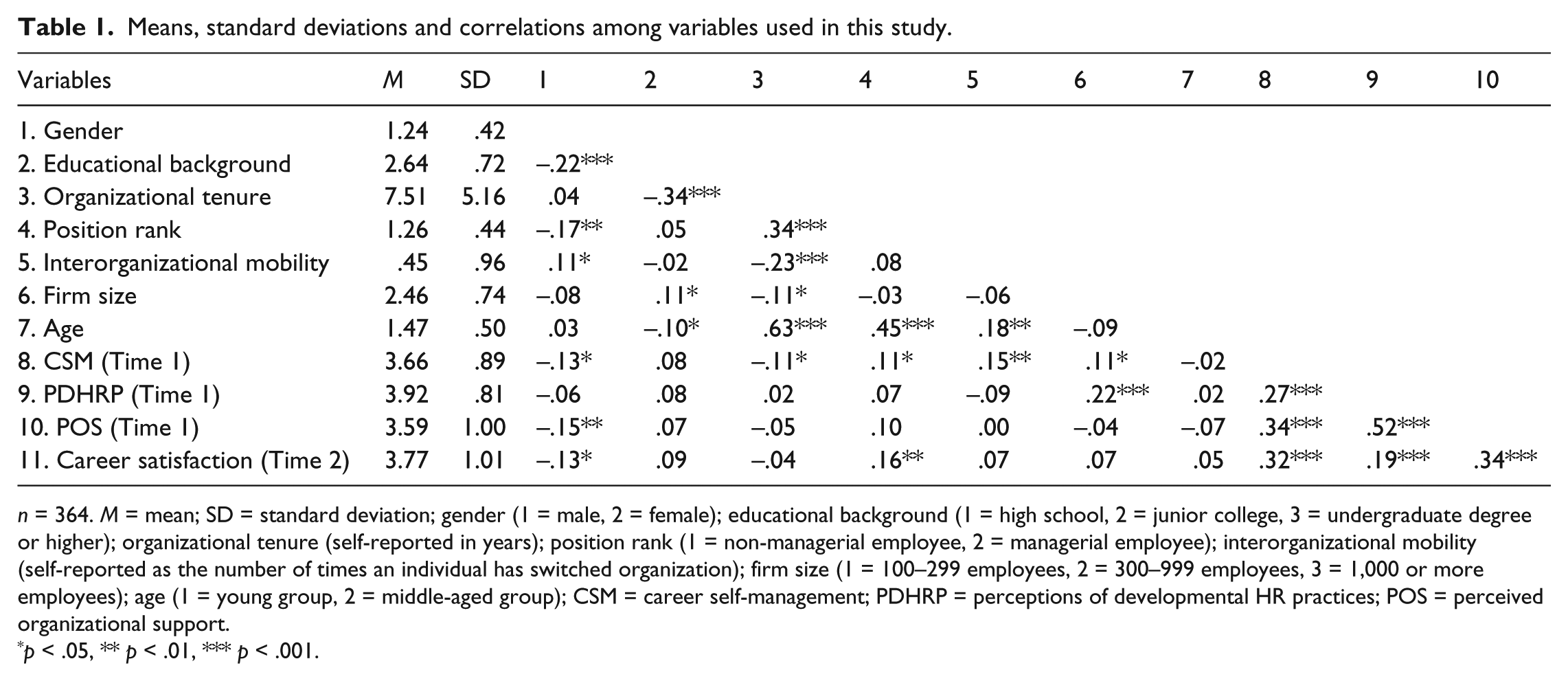
n = 364. M = mean; SD = standard deviation; gender (1 = male, 2 = female); educational background (1 = high school, 2 = junior college, 3 = undergraduate degree or higher); organizational tenure (self-reported in years); position rank (1 = non-managerial employee, 2 = managerial employee); interorganizational mobility (self-reported as the number of times an individual has switched organization); firm size (1 = 100–299 employees, 2 = 300–999 employees, 3 = 1,000 or more employees); age (1 = young group, 2 = middle-aged group); CSM = career self-management; PDHRP = perceptions of developmental HR practices; POS = perceived organizational support.
p < .05, ** p < .01, *** p < .001.
Results
Confirmatory factor analyses
Before testing our hypotheses, we performed confirmatory factor analysis (CFA) to examine the distinctiveness of each construct used, because they may have had some conceptual similarities. The CFA of a hypothesized four-factor model—consisting of CSM, PDHRP, POS and career satisfaction—yielded fit indexes within an acceptable range (χ2 = 860.90, d.f. = 456, CFI = .93, RMSEA = .05). We compared these results with those of four alternative models: (i) alternative model 1 combined PDHRP and POS into one factor; (ii) alternative model 2 combined CSM and career satisfaction into one factor; (iii) alternative model 3 combined PDHRP and POS into one factor and combined CSM and career satisfaction into one factor; and (iv) alternative model 4 combined all four variables (CSM, PDHRP, POS and career satisfaction) into one factor. The alternative models had significantly worse fit than the hypothesized baseline model, as can be seen from the model fit indexes (Table 2): nested chi-square difference tests indicated that the hypothesized baseline model was a better fit than Model 1 (Δχ² = 447.75, Δd.f. = 3, p < .001), Model 2 (Δχ² = 940.28, Δd.f. = 3, p < .001), Model 3 (Δχ² = 1388.39, Δd.f. = 5, p < .001) and Model 4 (Δχ² = 2564.72, Δd.f. = 6, p < .001). Taken together, these results verified that the four variables used in our study can be considered distinct constructs.
Confirmatory factor analysis tests of all the measurement items used in this study.
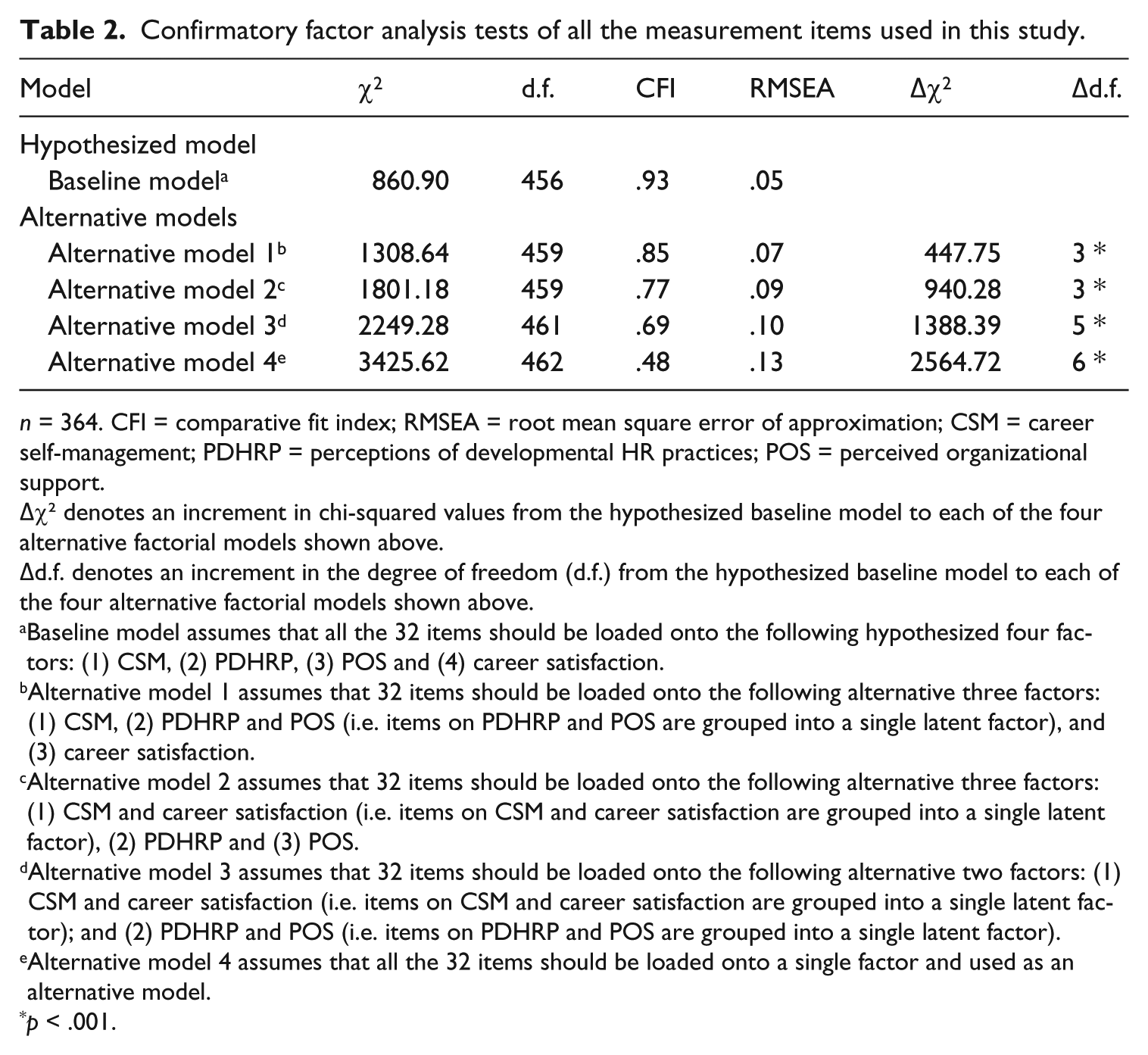
n = 364. CFI = comparative fit index; RMSEA = root mean square error of approximation; CSM = career self-management; PDHRP = perceptions of developmental HR practices; POS = perceived organizational support.
Δχ² denotes an increment in chi-squared values from the hypothesized baseline model to each of the four alternative factorial models shown above.
Δd.f. denotes an increment in the degree of freedom (d.f.) from the hypothesized baseline model to each of the four alternative factorial models shown above.
Baseline model assumes that all the 32 items should be loaded onto the following hypothesized four factors: (1) CSM, (2) PDHRP, (3) POS and (4) career satisfaction.
Alternative model 1 assumes that 32 items should be loaded onto the following alternative three factors: (1) CSM, (2) PDHRP and POS (i.e. items on PDHRP and POS are grouped into a single latent factor), and (3) career satisfaction.
Alternative model 2 assumes that 32 items should be loaded onto the following alternative three factors: (1) CSM and career satisfaction (i.e. items on CSM and career satisfaction are grouped into a single latent factor), (2) PDHRP and (3) POS.
Alternative model 3 assumes that 32 items should be loaded onto the following alternative two factors: (1) CSM and career satisfaction (i.e. items on CSM and career satisfaction are grouped into a single latent factor); and (2) PDHRP and POS (i.e. items on PDHRP and POS are grouped into a single latent factor).
Alternative model 4 assumes that all the 32 items should be loaded onto a single factor and used as an alternative model.
p < .001.
Tests of hypotheses
As Table 3 shows, we tested Hypotheses 1–3 using hierarchical multiple regression analyses. First, we tested the main effect of CSM on career satisfaction (Hypothesis 1) and found that CSM at Time 1 was significantly and positively related to career satisfaction at Time 2 (β = .25, p < .001 in Model 1 and β = .20, p < .001 in Model 3). We then estimated the main effects of organizational factors, including PDHRP and POS, on career satisfaction (Hypotheses 2a and 2b). As shown in Model 1 of Table 3, PDHRP at Time 1 was significantly and positively related to career satisfaction at Time 2 (β = .11, p < .05). In the same manner, as shown in Model 3 of Table 3, POS at Time 1 was significantly and positively related to career satisfaction at Time 2 (β = .26, p < .001). These findings indicate that both an individual career management factor (CSM) and organizational career management factors (PDHRP and POS) play key roles in predicting individuals’ career satisfaction. Thus, Hypotheses 1, 2a and 2b were supported.
Results of hierarchical multiple regression analyses for testing the interactive effects of age, career self-management, perceptions of developmental HR practices and perceived organizational support on career satisfaction.
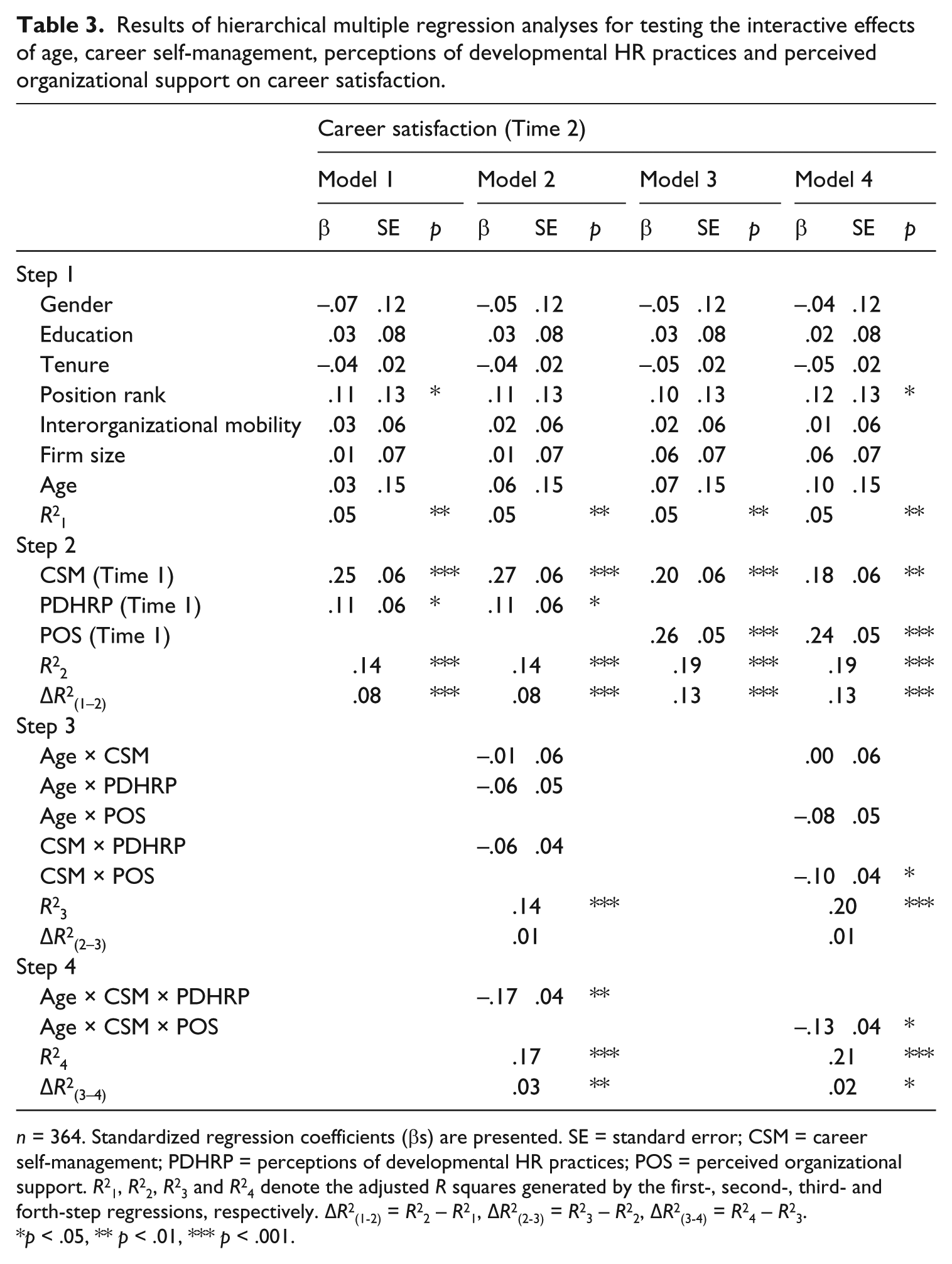
n = 364. Standardized regression coefficients (βs) are presented. SE = standard error; CSM = career self-management; PDHRP = perceptions of developmental HR practices; POS = perceived organizational support. R21, R22, R23 and R24 denote the adjusted R squares generated by the first-, second-, third- and forth-step regressions, respectively. ∆R2(1-2) = R22 – R21, ∆R2(2-3) = R23 – R22, ∆R2(3-4) = R24 – R23.
p < .05, ** p < .01, *** p < .001.
Next, we investigated Hypotheses 3a and 3b using a statistical test of three-way interactive effects (age × CSM × PDHRP; age × CSM × POS). We controlled for all two-way interaction effects of each component of the focal three-way interaction in Step 3 and entered the three-way effects in Step 4. As per Model 2 of Table 3, the results showed a statistically significant and negative three-way interaction effect between age, CSM and PDHRP at Time 1 on career satisfaction at Time 2 (β = −.17, p < .01). As shown in Model 4 of Table 3, we also found a significant and negative three-way interaction effect between age, CSM and POS at Time 1 on career satisfaction at Time 2 (β = −.13, p < .05).
To show the patterns of interaction effect visually, these findings are graphed in Figures 2 and 3. As shown in Figure 2, the positive relationship between CSM and career satisfaction was significantly stronger among young employees perceiving a high level of PDHRP (simple slope test: t = 3.52, p < .001) than among those perceiving a low level of PDHRP (simple slope test: t = 1.52, p = .13). In contrast, the relationship was significantly stronger among middle-aged employees with a low level of PDHRP (simple slope test: t = 4.55, p < .001) than among those with a high level of PDHRP (simple slope test: t = .24, p = .81). In the same way, Figure 3 shows that the positive relationship between CSM and career satisfaction (Time 2) was significantly stronger among young employees with a high level of POS (simple slope test: t = 2.29, p < .05) than among those with a low level of POS (simple slope test: t = 1.47, p = .14). In contrast, the relationship was significantly stronger among middle-aged employees with a low level of POS (simple slope test: t = 3.64, p < .001) than among those with a high level of POS (simple slope test: t = −.38, p = .71). These findings indicate that CSM and organizational factors (i.e. PDHRP and POS) exert (i) synergistic effects on career satisfaction among young people and (ii) compensatory effects on career satisfaction among middle-aged people. Therefore, these results fully support Hypotheses 3a and 3b.
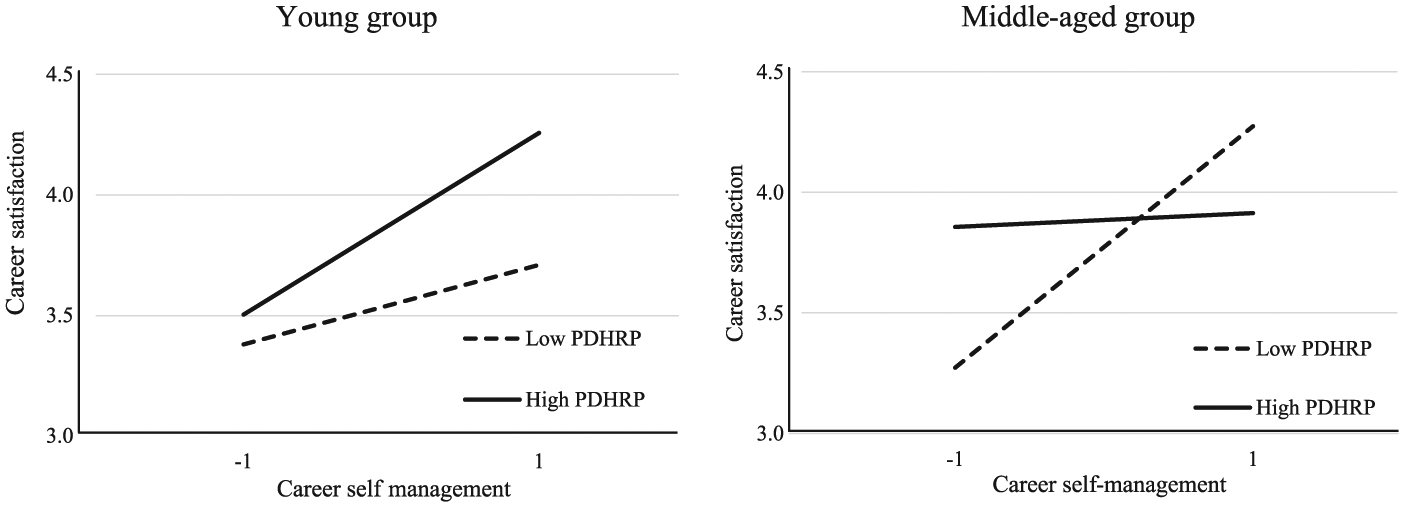
Three-way interaction between age, career self-management and perceptions of developmental HR practices predicting career satisfaction for the young and middle-aged group.

Three-way interaction between age, career self-management and perceived organizational support predicting career satisfaction for the young and middle-aged group.
Discussion
Our study generated two important findings: (i) both individual (i.e. CSM) and organizational (i.e. PDHRP and POS) career management factors were positively related to individual career satisfaction; and (ii) a synergistic effect of individual and organizational career management factors was salient among young employees, whereas a compensatory effect of the two factors was manifested among middle-aged employees. These findings provide general support for our proposed hypotheses developed from COR and SES theories, thereby making theoretical and practical contributions.
Theoretical and practical implications
First, a key theoretical contribution of our study to the career literature is the introduction of a managerial perspective into an extant subjective career success model, in which the individual’s agentic career management process in pursuit of career satisfaction has been emphasized, primarily from a vocational perspective (Baruch, 2006; Baruch and Vardi, 2016; Inkson et al., 2012; Tams and Arthur, 2010). Some recent career researchers have called for both theoretical and empirical endeavors that may help define the role played by organizational support and HR practices in co-shaping individuals’ career management strategies (Baruch, 2006; Inkson et al., 2012). This line of thinking has led Sullivan and Baruch (2009: 1562) to suggest ‘[t]he effectiveness of different organizational strategic human resource management decisions, policies, and programs on the attitudes and behaviors of employees enacting different types of careers … should be investigated.’ Drawing on COR theory (Hobfoll, 1989, 2002), we proposed that individuals achieve greater career satisfaction not only when they invest their personal resources to achieve success by engaging in CSM behaviors, but also when they gain ‘organization-based support resources’ (i.e. PDHRP and POS; Wheeler et al., 2013). Supporting our hypothesis, two organizational constructs, namely, PDHRP and POS, were found to predict career satisfaction even when an individual agency factor of CSM was incorporated in the same regression model. This finding provides important evidence as it signals the salience of ‘balanced’ (Baruch, 2006; Baruch and Vardi, 2016) and ‘interdependent’ (Tams and Arthur, 2010) perspectives that emphasize both personal and environmental factors as contributing to individuals achieving career goals and success. Moreover, our study is one of the few that attempts to theoretically explain and empirically demonstrate effective career management resources for enhancing career satisfaction in view of COR theory.
Second, by combining COR and SES theories, this research offers another significant perspective on the contemporary career literature, which has not yet uncovered the flexible nature of an individual’s career management strategies across their lifespans (Rodrigues et al., 2013). Despite the increased scope for an individual to navigate and self-direct his or her own career, many personal and environmental factors may nonetheless condition, or even constrain, a person’s career management strategies and behaviors. Guided by both COR and SES theories, we proposed that individuals should enhance or maintain their career satisfaction by flexibly adapting their CSM behaviors to both organization-based support resources (i.e. PDHRP and POS) available at work and their own life-stage changes. Specifically, because young adults focus on maximizing resource gains (Ng and Feldman, 2013), young people tend to exhibit greater career satisfaction by engaging in personal CSM, even when organization-based support resources (PDHRP and POS) are available. On the other hand, middle-aged people tend to focus on minimizing or preventing resource losses (Ng and Feldman, 2013); therefore, they may recover from lower career satisfaction by increasing their engagement with CSM, which works primarily when they experience scarcity of PDHRP and POS. Supporting such predictions drawn from COR and SES, our findings demonstrated that synergy (between CSM and organization-based support resources) was manifested among young employees, whereas compensability was observed among middle-aged employees. These findings extend previous studies that simply demonstrated ways in which personal resources interact with situational resources in individuals’ work- and career-related attitudes (Grimland et al, 2012; Hochwarter et al., 2006) by clarifying when the interaction of CSM and PDHRP (or POS) has a synergistic or compensatory effect. Such theory-based evidence is valuable as it takes an important step forward, going beyond a ‘universalistic’ perspective of an individual’s agentic career management and satisfaction to theorize a ‘developmental’ and ‘contingency’ view that can envision ‘life trajectories in which individuals design and build their work careers’ (Savickas et al., 2009: 241) with more situational contingencies. As suggested in some recent literature, possible situational factors that likely influence this process include not only organization-bound factors, but also ‘socially-embedded’ factors such as social and cultural backgrounds (Rodrigues et al., 2013), labor market conditions (Rodrigues and Guest, 2010) and regulative institutional contexts (Piszczek and Berg, 2014).
Third, an intriguing finding was observed (Figures 2 and 3) in which middle-aged individuals who perceived limited organizational support resources tended to show marked improvements in their career satisfaction via engagement in CSM behaviors. Their level of career satisfaction went beyond those experienced by young and middle-aged individuals in high-support and high-CSM situations. There may be two possible interpretations for this overshooting effect. The first explanation involves consideration of midlife and mid-career crises. In general, as people grow older, particularly as they move into the late period of middle age, their career opportunities outside an organization tend to diminish. Thus, the loss of organization-based support resources during that stage of their careers may contribute to a significant part of their ‘mid-career crisis’ (Van Der Heijden, 2006). However, Cate and John (2007: 187) suggest that middle-aged professionals may overcome such a crisis situation, or discover new possibilities of personal growth, if they ‘see future as a time of opportunities rather than as a time of limitation.’ This suggests that for middle-aged professionals, experience of a career crisis is a strong driver motivating them to be engaged in self-regulatory behaviors related to their careers, resulting in much greater career satisfaction than they otherwise would have experienced.
The second possible explanation related to the overshooting effect is the influence of some context-specific factors of Japan, where the current research was conducted. In particular, Japanese labor market conditions, as well as employment practices that generally constrain the mobility of people (especially mid-to-older employees) across organizations, may be potential reasons for the upswing. Specifically, Japanese employment practices have been described as centering on three core concepts called ‘the three Imperial Regalia’: (i) long-term employment systems, (ii) seniority pay and promotion systems and (iii) enterprise or house unions (e.g. Lam et al., 2009). In particular, long-term employment was respected even during the prolonged recession that began in the late 1990s (Genda et al., 2010). The existence of such a traditional internal labor market structure, fostered by the firms’ long-term employment practices, constrains external employment opportunities as employees age. As such, compared with employees in countries with more flexible internal labor market structures, middle-aged employees in Japan could be more susceptible to the loss of organization-based support resources (i.e. PDHRP and POS), and thus engage more actively in CSM to compensate for the low support, which in turn results in a dynamic boost in their career satisfaction.
According to recent labor statistics (OECD, 2015), the average service length of employees (aged 25–54) in a single organization in Japan (11.5 years) is comparable to those in many European countries, such as Germany (10.6), Belgium (10.9), France (11.6) and Italy (11.6). On the other hand, employees in many other countries generally have shorter lengths of service than that found in Japan (USA: 5.3, Korea: 5.9, Denmark: 7.6, Sweden: 8.8 and UK: 8.9). Although this is a single statistical indicator that characterizes a partial aspect of labor market conditions, several European countries may experience similar labor market situations (Rodrigues and Guest, 2010) to which the findings of this study may apply. North America, the UK and Nordic countries demonstrate a tendency for greater labor mobility across organizations; therefore, the findings of this study may not be realized to the same extent in these countries. Such differences may shape one important direction for future research, which may incorporate more upper-level institutional differences beyond those of the organization (e.g. regions, countries, etc.).
Finally, our findings offer not only theoretical and empirical contributions but also practical implications. First, given the findings that organization-based support resources generally enhance employee career satisfaction, organizations are strongly encouraged to adopt developmental HR policies, practices and career development support to enhance employees’ career satisfaction. Career satisfaction is important not only for an individual’s well-being and happiness but also for a wide array of organizational outcomes, including lower turnover rates (Armstrong-Stassen and Ursel, 2009; Chan and Mai, 2015), organizational culture and capability development (Fleisher et al., 2014), and enhanced customer-service orientation (Sundstrom et al., 2016). Moreover, our findings demonstrate the importance of an employee’s ‘perceptual’ aspect of organizational HR practices that influence their career satisfaction, which are in line with recent HRM literature undertaken from a social cognitive view (Bowen and Ostroff, 2004; Nishii et al., 2008). This line of inquiry suggests that employees’ perceptions of organizational practices or support are more directly linked to their work attitudes and behaviors than actual organizational programs (Bowen and Ostroff, 2004; Nishii et al., 2008). Interestingly, our results showed that POS had a stronger impact on career satisfaction than PDHRP. This was also confirmed by an additional post hoc analysis by entering both PDHRP and POS into the same regression equation for predicting career satisfaction (after controlling for all control variables and CSM). Then, we found that PDHRP became statistically insignificant (β = –.03, p = .57), whereas POS remained significant and positive (β = .28, p < .001). This suggests that not all employees perceive developmental HR practices as organizational support resources. As Bowen and Ostroff (2004: 206) noted, ‘[a]ll HRM practices communicate messages constantly and in unintended ways … whereby two employees interpret the same practices differently.’ In order for employees to perceive developmental HR practices as useful resources for generating career satisfaction, both HR and line managers in the organization need to clearly and consistently communicate to everyone in the organization detailed information about the company’s development HR practices (Boon and Kalshoven, 2014). For example, they should provide updated information regarding availability of all relevant practices in an organization and how each would be useful and supportive to employees, particularly regarding future career development and advancement.
Furthermore, our findings suggested the importance of CSM, particularly in the absence of organization-based support for middle-aged employees. Although CSM is a type of self-regulatory behavior, which tends to depend on personality factors, recent studies suggest that CSM ‘is not an innate trait, but (at least partly) malleable’ (Verbruggen and Sels, 2008: 325) and can be improved by individuals obtaining career counseling (Verbruggen and Sels, 2008) and career support from mentors (Okurame and Fabunmi, 2014). As such, provision of career counselling and support service opportunities available outside the employing organizations (e.g. public or government agencies, consulting companies and/or educational institutions) specializing in middle-aged individuals may potentially help those who experience limited organizational support in acquiring the knowhow and knowwhy of career self-development (DeFillippi and Arthur, 1994).
Limitations and future research
Our study has several limitations that shape future research directions. First, although we attempted to integrate and assess the effects of organizational career management factors in our hypothesized model for predicting career satisfaction, our focus on PDHRP and POS as organizational factors might have some limitations. In particular, on the basis of COR theory, we considered PDHRP and POS as organization-based support resources that can assist individuals to attain their desired careers. However, some studies suggest that emotional and non-task-related supports from co-workers (Tews et al., 2013) and supervisors (Thomas and Lankau, 2009) also lead individuals to obtain positive career outcomes. Organizational practices that facilitate work–life balance are considered to be possible predictors of subjective career success (Martins et al., 2002). Furthermore, beyond the level of organization-bound factors, a number of influential factors are embedded in ‘institutional contexts’ (Piszczek and Berg, 2014). For example, laws and public policies (i.e. regulative institutions) related to the interaction of work and family roles should determine the quality of working people’s lives and career satisfaction (Piszczek and Berg, 2014). On a related note, future research should also consider exogenous structural factors, such as industry type and geographic region, that potentially influence individuals’ careers (Bozionelos, 2004).
Second, although use of a time-lagged design and testing for interaction effects minimized concerns about common method bias, the design might have introduced other limitations. In particular, we were unable to make inferences about dynamic career processes as they unfold over time. For example, the CSM behavior scores might have changed if we had repeated this question in a third wave of data collection. Furthermore, young employees’ ideas about their careers were comparatively naive; this might have led to a difference between younger and middle-aged employees in terms of the interaction effects of individual and organizational career management factors on their career satisfaction. In order to examine the trajectories of such changes, Ployhart and Vandenberg (2010) recommended repeated measures for at least three time points. Therefore, more data-collection waves are needed to model—using more appropriate analytical techniques such as latent growth modeling—changes in career orientations and behaviors over time (Ployhart and Vandenberg, 2010). In addition, to test the causal relations among CSM, PDHRP, POS and career satisfaction, future research should continue to explore temporal sequences using time-lagged designs that cover longer periods and alternative experimental designs.
Third, the age differences observed in our time-lagged research design are difficult to separate from cohort effects that reflect common experiences unique to the particular historical period in which a worker is born (Kanfer and Ackerman, 2004). We cannot exclude the possibility that historical differences in the experiences of the different cohorts account for the differences between the age groups (Folkman et al., 1987). In other words, it may be that middle-aged employees and younger employees have a similar CSM. Regardless of age, today’s workers live in an era when, globally, most workers have no choice but to take control of their own careers because they enjoy lower employment security compared to their counterparts in previous eras. Hence, a cohort explanation might be as valid as an aging explanation.
Despite the aforementioned limitations, this study takes an initial step towards understanding the lifespan changes in individuals’ flexible career strategies both from the vocational and managerial perspectives. In particular, our findings offer insights into the mechanisms by which individuals enhance their career satisfaction by flexibly adjusting their own career management strategies to their organization’s support environment as they advance in age. To generalize our findings, further research is encouraged to empirically extend our research model to different cultural/national contexts. Further, we strongly recommend that more research is undertaken to theoretically advance our model to explore any hidden mechanisms in the lifespan changes in people’s career-related behaviors and success, which could be affected by multiple boundary conditions at multiple levels that range from individual, group, organizational, industry and institutional ones.
Footnotes
Appendix: Measurement items used in the present study
Acknowledgements
The authors are extremely grateful to the special issue editors, Professors Peter Berg (the editor in charge of this article), Jennifer Tomlinson, Marian Baird and Rae Cooper, as well as the three anonymous Human Relations reviewers for their insightful feedback on earlier drafts.
Funding
This study was supported by funding from JSPS Grants-in-Aid for Scientific Research (grant numbers 17H02564, 16KT0124, 15K13042 and 26285091).