



Abstract
Researchers have recently begun to take a person-centered (profile) approach to investigate how the affective, normative and continuance commitment mindsets combine within the three-component model of organizational commitment. The meaningfulness of the profiles identified in this research depends, in part, on evidence that similar profiles emerge across samples, particularly those drawn from a common population. We conducted a particularly stringent test of similarity by comparing profiles for samples of employees drawn from a large Turkish conglomerate prior to (N = 346) and following (N = 797) a major economic crisis. Using procedures recently introduced by Morin et al., (2016) we found similarity in the number (seven) and structure of the profiles before and after the crisis; only the distribution of individuals across profiles (i.e. the relative size of the profiles) differed. We also found similarity in the patterns of relations with theoretical antecedent, correlate, and outcome variables, suggesting that a common set of principles might be operating regardless of major differences in the work environment. In addition to providing strong evidence for the meaningfulness of commitment profiles, this study is one of the first to investigate the impact of an economic crisis on employee commitment.
Keywords
It has long been recognized that employees can experience commitment to their organizations in different ways. According to the three-component model (TCM: Allen and Meyer, 1990; Meyer and Allen, 1991), commitment can be characterized by three distinct mindsets: a desire to remain with the organization (affective commitment: AC), an obligation to remain (normative commitment: NC), and the perceived cost of leaving (continuance commitment: CC). Importantly, it has been found that these mindsets matter, with AC generally having the strongest positive link to both organization- (e.g. retention, job performance) and employee-relevant (e.g. well-being) outcomes (Meyer and Maltin, 2010; Meyer et al., 2002). Relations with NC are generally positive but weaker, and relations with CC are weaker still, and sometimes negative. Relations with CC have been found to depend in part on whether the perceived cost reflects a ‘lack of alternatives’ (CC:LA) or the ‘high sacrifice’ (CC:HS) associated with leaving (McGee and Ford, 1987; Meyer et al., 2002).
To date, most research examining the implications of employee commitment has focused on relations involving the individual mindsets using a variable-centered approach (e.g. correlation or multiple regression). More recently, an alternative person-centered approach has been applied based on the argument that it is better suited to address the potentially more complex impact of various configurations of AC, NC and CC (Meyer and Morin, 2016; Meyer et al., 2013b; Morin, 2016). The application of person-centered analytic techniques such as cluster analyses and latent profile analyses (LPA) allows researchers to identify subpopulations of individuals with distinct ‘commitment profiles’ reflecting different levels of the three basic mindsets. These profiles are arguably characterized by more nuanced mindsets than those originally identified by Allen and Meyer (1990; Meyer and Allen, 1991).
One of the challenges in person-centered commitment research is to demonstrate that mindset profiles are meaningful and have practical value. This requires a program of research to document the construct validity of the profiles, including evidence of consistency in (a) the profiles that emerge across samples and conditions, and (b) the ways these profiles relate to other theory-relevant variables (see Marsh et al., 2009; Morin et al., 2011). Such consistency is beginning to emerge across studies (Kabins et al., 2016; Meyer and Morin, 2016), across subsamples from the same population (Meyer et al., 2013a), and within samples over time (Kam et al., 2016). In one of the most stringent tests of consistency to date, Kam et al. (2016) found that the same profiles emerged prior to and during an organizational change. Moreover, profile membership remained highly stable over time. Interestingly, the small amount of change that did occur could be explained in part by perceptions of management trustworthiness.
Our study extends existing person-centered commitment research, and the Kam et al. (2016) study in particular, in at least three important ways. First, we examined profile consistency over time during an economic crisis in Turkey. This crisis arguably created greater turbulence than was the case in the organizational change investigated by Kam et al. Indeed, Kam et al. noted that very few employees transitioned across profiles during the change, perhaps because the change was generally viewed quite positively. In contrast, the crisis that hit Turkey in 2001 had a major impact on the country’s overall economy and on the conglomerate under investigation. Indeed, the effects were not unlike those witnessed in the aftermath of the 2008 global economic crisis (Sinclair et al., 2010). Second, we included a wider range of antecedent, correlate, and outcome variables to evaluate the construct validity of the profiles. Finally, we conducted a more thorough investigation of different types of profile (in)consistency by applying a set of analytic procedures recently introduced by Morin et al. (2016) and not available at the time Kam et al. conducted their study.
In sum, the economic crisis that struck Turkey during data collection provided the opportunity for a natural quasi-experiment (Grant and Wall, 2009) that could contribute in several important ways to demonstrating the construct validity, and practical value, of commitment profiles. The study also serves as one of the first investigations of the effects of an economic crisis on commitment (Markovits et al., 2014), and the only one to take a person-centered approach.
A person-centered approach to the study of organizational commitment
In the original formulation of their TCM, Allen and Meyer (1990) proposed that employees can experience each of the three basic commitment mindsets to varying degrees. That is, each employee has a commitment profile reflecting the relative strength of his/her AC, NC and CC to the organization. A decade later, Meyer and Herscovitch (2001) offered propositions concerning the development and consequences of eight hypothetical profiles reflecting high or low scores on each of the three mindsets. An early strategy used to test these propositions involved grouping employees based on whether their scores on AC, NC and CC fell above or below the sample mean/median (e.g. Gellatly et al., 2006; Markovits et al., 2007). These studies provided mixed support for Meyer and Herscovitch’s propositions but, more importantly, revealed that relations between each of the basic mindsets and other variables varied as a function of the strength of the other two mindsets. For example, Gellatly et al. found that NC was associated with lower levels of turnover intentions and higher levels of discretionary effort when combined with strong AC than with strong CC and weak AC. They proposed that NC might be experienced as a moral imperative (i.e. desire to do the right thing) in the first case, but as an indebted obligation (i.e. the need to meet social obligations), in the second. Thus, AC, NC and CC can combine to form profiles reflecting more nuanced mindsets.
The midpoint split approach has limitations, including the fact that the groups it identifies may not correspond to those occurring naturally, and tend to miss the identification of profiles with moderate scores on one or more of the mindsets (Meyer et al., 2013b; Morin et al., 2011). Consequently, other researchers have used cluster analyses (e.g. Sinclair et al., 2005; Somers, 2009, 2010; Wasti, 2005) or latent profile analyses (LPA: e.g. Kam et al., 2016; Meyer et al., 2012, 2013a; Stanley et al., 2013) to identify naturally occurring profiles. In recent reviews, Meyer and Morin (2016) and Kabins et al. (2016) noted that, despite some variability across studies, several profiles emerge quite consistently, including uncommitted or weakly committed (low scores on all three components), CC-dominant, 1 AC/NC-dominant, and fully committed (i.e. high scores on all three components). Other common profiles are AC-dominant, CC/NC-dominant, and AC/CC-dominant. Following Meyer, Becker and Van Dick (2006), Kabins et al. (2016) assigned profiles to three broad categories: (a) value-based, reflecting shared values and desire to remain (i.e. fully committed; AC/NC-dominant; AC-dominant); (b) exchange-based, reflecting social or economic contingencies creating a need or obligation to remain (i.e. NC/CC-dominant; CC-dominant); and (c) weak (i.e. low or moderate overall levels of commitment). For simplicity, we use this classification hereafter except when within-category distinctions are necessary.
Although most profile studies to date (e.g. Kam et al., 2016; Meyer, et al., 2012, 2013a) have measured CC as a unidimensional construct (as it was initially conceptualized: Allen and Meyer, 1990; Meyer et al., 1993), others (e.g. Meyer et al., 2015; Stanley et al., 2013), distinguished CC based on a lack of alternatives (CC:LA) from CC reflecting the sacrifices one would need to make in order to leave (CC:HS). The latter studies provided some evidence that this distinction was worth making. For example, Stanley et al. (2013) found that CC:LA and CC:HS were both quite strong in the CC-dominant profile, but that scores on CC:HS were considerably higher than those on CC:LA in the AC-dominant profile. This suggests that, under some conditions, CC:HS might reflect economic costs associated with loss of one’s job, whereas under others it could reflect the loss of positive work conditions. In the present study, we distinguished CC:HS and CC:LA because, as we discuss below, an economic crisis like that experienced in Turkey is likely to have a greater effect on the availability of employment alternatives than on the sacrifices associated with voluntary turnover.
Profile similarity and its implications for meaningfulness
As noted above, demonstrating consistency in profile structure and relations with other variables is an important part of the construct validation process (Marsh et al., 2009; Morin et al., 2011). To date, most evidence for consistency is based on visual comparison. It is only recently that Morin et al. (2016) introduced a more systematic analytic approach to evaluating different forms of profile (in)consistency. Here, we describe the taxonomy of tests of ‘profile similarity’ introduced by Morin et al. and illustrate how they have been, or can be, applied in person-centered commitment research.
The first two forms of profile similarity identified by Morin et al. (2016) are configural, referring to the number of profiles, and structural, pertaining to the shape (mean levels of the mindsets) of the profiles. The findings reported above suggest that the number and shape of profiles is similar but not identical across studies. This can be expected given that each study might draw its sample from a distinct population operating under different conditions (e.g. military personnel; health care workers). Higher levels of profile similarity might be expected across samples drawn from the same or similar populations, and indeed this appears to be the case. Meyer et al. (2013a) found identical profiles in two samples drawn from the same military organization, and Morin et al. (2016) found strong evidence of profile similarity for comparable samples of employees from the US and France. Finally, Kam et al. (2016) found the same profiles for a sample of employees surveyed on two occasions eight months apart during a large-scale organizational change.
Assuming configural and structural similarity, two additional forms of profile similarity can be assessed: dispersion (similarity of the within-profile variance around the mindset means observed in each profile), and distributional (similarity in the relative proportions of individuals corresponding to each profile). To date, only Morin et al. (2016) formally evaluated these two forms of similarity. They found evidence for dispersion similarity but not for distributional similarity. Thus, although the profiles for their US and French samples were very similar in number, shape and variance, some profiles were more common in France, whereas others were more common in the US. It is important to note that configural and structural similarity are most relevant to the assessment of profile meaningfulness. Finding differences in dispersion or distribution does not undermine meaningfulness, but simply indicates that individuals deviate slightly more from the prototypical profiles in one sample than they do in the other (dispersion dissimilarity), or that the proportion of individuals corresponding to these prototypical profiles differs across samples (distributional dissimilarity). Indeed, if these differences can be explained, and ultimately predicted, their existence can actually be taken as support for meaningfulness.
Two final tests of similarity pertain to the antecedents (predictive similarity) and outcomes (explanatory similarity) of profile membership. Again, only Morin et al. (2016) conducted formal evaluations of explanatory and predictive similarity to date. They found that demographic variables and perceptions of human resource management (HRM) practices related similarly to profile membership in the US and in France, and that profile membership predicted turnover intentions and work exhaustion similarly in both countries.
Economic crisis and commitment
The present study provided a particularly stringent test of profile similarity by using data obtained prior to and following an economic crisis, arguably one of the most challenging management issues of the current era (Datta et al., 2010). The only other investigation of the effects of economic crises on commitment of which we are aware was a variable-centered study conducted by Markovits et al. (2014). It is useful, therefore, to consider the findings of this study for purposes of comparison.
Markovits et al. (2014) measured commitment in samples of employees obtained prior to (2004–2007) and during (2011–2012) the Greek economic crisis. They found lower levels of both AC and NC during the crisis than before, but CC levels did not differ across the two time periods. Although they did not compare differences in relations between work conditions and commitment prior to and during the crisis, they found that changes in job satisfaction paralleled those for AC and NC, and that satisfaction with job security was lower during the crisis. To explain the lack of difference in CC, despite lower job security, they speculated that there may have been counteracting forces involving internal regulatory processes. However, additional explanations might be that they examined CC in isolation using a variable-centered approach, and that they failed to make the distinction between CC:LA and CC:HS. It is possible for the two facets of CC to be differentially affected by the economic conditions, possibly in opposite directions. We explored these possibilities in the present study by taking a person-centered approach and measuring both facets of CC.
The present study
The data for this study were collected as part of an organizational survey administered within a large conglomerate in Turkey. In February 2001, part way through the data collection, Turkey was hit by a major economic crisis. Unlike the participants involved in the pre-crisis data collection, those in the post-crisis condition were exposed to hiring freezes, layoffs and restructuring (see Method section for more detail). Thus, as noted previously, the crisis created conditions for the conduct of a natural quasi-experiment (Grant and Wall, 2009). Our primary research questions were whether the conditions created by the crisis would have implications for profile structure as well as relations between profile membership and potential antecedents, correlates and outcomes.
Recall that Kam et al. (2016) found evidence for profile consistency within a sample over time under conditions of organizational change. Unlike the present study, the change was planned and was generally viewed positively by the company and its employees. Nevertheless, the Kam et al. findings, in combination with other evidence for profile consistency reviewed above, suggest that commitment profiles within a sample are relatively robust and may well reflect meaningful variations in employees’ natural proclivity to form commitments. Kabins et al. (2016) argued that those profiles that do emerge regularly are likely to reflect the operation of basic principles, including reciprocity and social exchange principles (e.g. Gouldner, 1960) for value-based profiles, and job mobility principles (e.g. Becker, 1960) for exchange-based profiles. Therefore, we expected to find both configural and structural similarity across our pre- and post-crisis samples. That is, the number and basic shape of the commitment profiles were expected to be the same. We did not make any predictions regarding dispersion similarity, but this form of similarity has little bearing on the meaningfulness of commitment profiles or their implications (Morin et al., 2016):
Hypothesis 1: Analysis of pre- and post-crisis commitment data will identify multiple profiles, and these are likely to include: weakly committed, CC-dominant, AC-dominant, AC/NC-dominant and fully committed.
Hypothesis 2: A model with the same number (configural similarity) and shape (structural similarity) of profiles will be found to fit the data obtained prior to and following the economic crisis.
Although we did not expect the profiles themselves to change, we expected that conditions following the economic crisis might be sufficient to create distributional dissimilarity. That is, as a reaction to the crisis and its effects on the economy (e.g. increased unemployment) and the employers involved (e.g. hiring freezes; layoffs), we expected that the distribution of the various commitment profiles might differ prior to and following the crisis. However, the precise nature of the distributional differences is difficult to predict because it might depend on each individual’s circumstances resulting from the crisis and their employer’s reaction to it. For example, if work conditions within the organization are adversely affected by layoffs or restructuring, we might expect a decrease in the number of employees with value-based profiles, and an increase in exchange-based or weak commitment profiles. However, if conditions are maintained despite the crisis, and/or survivors appreciate having survived the cuts, the number of individuals with value-based profiles might stay the same or even increase. Therefore, rather than making specific predictions regarding distributional similarity, we addressed it as a research question:
Research Question 1: Will the distribution of employees across profile groups differ, and in what ways, before and after the economic crisis?
In addition to commitment, the survey included measures of several variables that have been identified as theoretical antecedents, correlates or outcomes of commitment (Mathieu and Zajac, 1990; Meyer et al., 2002). This allowed us to test hypotheses regarding relations between these variables and profile membership, and to evaluate both predictive and explanatory similarity (Morin et al., 2016) across the pre- and post-crisis samples. Relations between the commitment mindsets and many of these antecedents (e.g. high-performance HRM practices: Kooij et al., 2010; cultural values: Fischer and Mansell, 2009; job security: Kooij et al., 2010), correlates (i.e. job satisfaction: Tett and Meyer, 1993; job stress: Meyer and Maltin, 2010) or outcomes (i.e. withdrawal and turnover intention: Meyer et al., 2002) have been well-established in previous variable-centered research. Underpinning these relations are theories of social exchange (Gouldner, 1960), need satisfaction (Ryan and Deci, 2000), regulatory focus (Higgins, 1998), job mobility (Becker, 1960), cultural values (Hofstede, 2001), among others (for more detailed discussion, see Johnson et al., 2010; Meyer et al., 2004; Meyer and Herscovitch, 2001; Wasti and Önder, 2009). Thus, considerable theory and empirical evidence support the prediction that, within the pre- and post-crisis samples, high performance HRM practices, collectivist values and job satisfaction will relate positively, whereas job stress and job insecurity will relate negatively, to membership in value-based profiles. The opposite pattern of relations can be expected for exchange-based profiles, particularly those with strong CC:LA, or weak profiles.
Although we expected that the direction of relations with antecedents, correlates and outcomes would remain the same, it is possible that the strength of the relations might differ pre- and post-crisis. For example, high performance HRM practices might predict membership in value-based profiles prior to and following the crisis, but the relation might be strengthened following the crisis if employees become more sensitized to conditions that they previously took for granted. Similarly, job (in)security might become a stronger predictor of membership in exchange-based commitment profiles because of its increased salience, and membership in these profiles might correspondingly become better predictors of turnover intention. Therefore, for our purposes, we predicted that relations between profile membership and the measured antecedents, correlates, and outcomes would be similar in direction prior to and following the crises, but left the issue of (dis)similarity of degree open as a research question:
Hypothesis 3: Membership in value-based commitment profiles will relate most positively to high performance HRM practices, collectivist values and job satisfaction, and most negatively to job stress, withdrawal and turnover intention, followed by exchange-based commitment profiles and weak commitment profiles, respectively.
Research Question 2: Will the strength of the relations between commitment profile membership and the antecedent, correlate and outcome variables differ prior to and following the economic crisis?
Method
Study setting
This study was conducted in one of largest industrial and financial family conglomerates in Turkey. The data collection began in December 2000, and continued until the end of November 2001. At the time, the conglomerate controlled 44 companies with operations in sectors such as finance, automotive, energy, cement, textiles, chemicals, food, telecom, hotels, paper and tobacco. Despite this diversification, HRM practices (e.g. training and development, career and succession planning, compensation and benefits) were centralized.
Of critical importance to this study, during data collection, on 19 February 2001, Turkey was hit by its deepest economic crisis in modern times (Öniş, 2009; Yeldan, 2006). During the course of the year, Turkey’s Gross National Product declined by 9.4% (Central Bank of Turkey, 2001). Unlike previous recessions, highly educated and skilled employees also lost their jobs in large numbers (Öniş, 2009). Based on the Household Labor Force Survey results, the rate of unemployment increased from 6.3% in the last quarter of 2000 to 10.6% in the corresponding period in 2001, with the rate increasing further to 11.8% in the first quarter of 2002 (Şenses, 2003). A sharp rise in interest and exchange rates was accompanied by a large increase in the rate of inflation, with the Consumer Price Index rising by 68.5% in 2001, as opposed to 39.0% in 2000 (Central Bank of Turkey, 2001). Even large conglomerates like the one involved in this research were hurt by the contracting economy (Öniş, 2009). Its net profit before tax fell from US$ 1.2b to US$ 870m, and its investments dropped from US$ 455m to US$ 380m (‘Sabancı’nın 2001 cirosu’, 2002). More specifically, this conglomerate underwent major restructuring activities, including hiring freezes and factory closures with lay-offs reaching close to 40% in some sectors.
Participants and procedure
A total of 1143 respondents from different parts of the conglomerate completed the survey. Pre-crisis data were collected in December 2000 to February 2001, and post-crisis data were collected in July to November 2001. In cooperation with the HR departments, surveys were distributed and collected in sealed envelopes with a cover letter stating the purpose of the study and assuring employees that their responses would remain confidential. Participation was voluntary and unpaid.
The pre-crisis sample (n = 346) included mostly male employees (76.9%) and 78% of respondents were between the ages of 18 and 35. Approximately half (51.5%) of the respondents were high school graduates, and 29.2% had at least a Bachelor degree. Most of the respondents were blue-collar workers (36.4%) or technical staff (44.2%). Fourteen percent were office workers, and 5.3% had supervisory or managerial responsibilities at various levels. The average organizational tenure of this sample was 2.9 years.
The post-crisis sample (n = 797) was also mostly male (85.8%) and 71.4% of the respondents were between the ages of 18 and 35. Over one-third (39.4%) of the sample were high school graduates, and a similar percentage (38.2%) held at least a Bachelor degree. A majority were either blue-collar workers (44.7%) or technical staff (31%). Sixteen percent held supervisory or managerial responsibilities and the rest (8.3%) were office workers. The average organizational tenure of these employees was seven years.
Measures
The Turkish versions of most instruments used in this study were previously validated (e.g. Wasti, 2003; Wasti et al., 2000). The only instruments used for the first time in Turkish were those pertaining to respondents’ perceptions of HRM practices (decision making/empowerment, training opportunities, performance appraisal, teamwork). These measures underwent an independent translation back-translation process (Brislin, 1980) by three bilingual experts. Each measure is identified below as a predictor, correlate or outcome based on their treatment in theory and previous research (e.g. Mathieu and Zajac, 1990; Meyer et al., 2002). Unless indicated otherwise, all measures used a five-point Likert-type response scale ranging from strongly disagree (1) to strongly agree (5).
Organizational commitment (profile indicators)
Employees’ commitment to the organization was assessed using items from Allen and Meyer’s (1990; Meyer et al., 1993) instrument as adapted for international research by Meyer et al. (1996). We used three items each to measure AC (α = .696 2 ; e.g. This organization has a great deal of personal meaning for me), NC (α = .676; e.g. I would feel guilty if I left this organization right now), CC:HS (α = .678; e.g. If I decided to leave this organization, too much of my life would be disrupted) and CC:LA (α = .644; e.g. I feel that I have too few options to consider leaving this organization).
Demographic variables (control)
Demographic (gender, age, tenure, education) information was collected for descriptive purposes, and included as control variables in tests of predictive similarity (see Analysis section).
Empowerment (predictor)
Six items from the Empowering Leadership Questionnaire (Arnold et al., 2000) were used to measure empowerment (α = .840). These items (e.g. In this company, workers’ ideas and comments have an impact on their supervisors’ decision making) assess the degree to which supervisors empower their subordinates in terms of decision-making, goal setting and voice.
Training opportunities (predictor)
The availability of training opportunities was assessed using a six-item scale (α = .859; Robert et al., 2000). The items (e.g. My company encourages me to learn new things about my job) assess respondents’ perceptions of the company as a place where continuous training and acquiring job-related experience is emphasized.
Performance appraisal (predictor)
Performance appraisal was measured with six items (e.g. Your supervisor communicates your job performance to you in formal meetings) developed for the current survey to assess the degree to which performance is formally appraised and linked to other HRM decisions (e.g. pay, training; α = .776). The full set of items is reported in the online-only supplement.
Teamwork (predictor)
Teamwork was measured with four items (e.g. This company provides training about how to work together in teams) developed for the current survey to assess the degree to which the organization supports teamwork and links it to other HRM practices like team training or team pay (α = .761). The full set of items is reported in the online-only supplement.
Job insecurity (predictor)
Three items from the Job Security Index (JSI; Probst, 2003) were used to measure respondents’ perceptions of job insecurity (α = .858). Respondents indicated on a three-point response scale (Yes, Undecided, No) the extent to which the three adjectives (i.e. unpredictable, unknown, uncertain) described the future of their job.
Individualism/collectivism (predictor)
Individualism and collectivism values were assessed at an individual level using items adapted from INDCOL (Singelis et al., 1995). Four items (α = .660; e.g. I feel good when I cooperate with others) were used to assess respondents’ levels of collectivism, and three items (α = .622; e.g. My personal identity is very important to me) were used to assess respondents’ levels of individualism. These items were selected based on their psychometric properties as assessed in previous cross-cultural research (Sivadas et al., 2008; Wasti and Erdil, 2007).
Job stress (correlate)
Job stress was measured with eight items from the Stress In General scale (α = .802; Smith et al., 1992). Respondents rated how well a set of adjectives (e.g. frantic) described their jobs using a three-point scale (Yes, Undecided, No).
Job satisfaction (correlate)
Job satisfaction was measured with the abbreviated versions of the Work (nine-item; α = .822), Supervisor (eight-item; α = .874), and Coworker (nine-item; α = .855) satisfaction scales of the Job Description Index (JDI; Smith et al., 1969) as revised by Roznowski (1989). Respondents indicated whether a set of descriptors applied to their work (e.g. gives a sense of accomplishment), supervisor (e.g. hard to please) and coworker (e.g. slow), using a three-point scale (Yes, Undecided, No).
Work withdrawal (outcome)
Work withdrawal was measured with the nine-item scale (α = .693) developed by Hanisch and Hulin (1990, 1991). Respondents indicated the frequency of withdrawal behaviors (e.g. Making excuses to get out of work) using an eight-point scale ranging from ‘never (0)’ to ‘more than once a week (7).’
Turnover intention (outcome)
Turnover intention was operationalized with two items from the Job Withdrawal scale (i.e. How often do you think about quitting; What is your likelihood of quitting?) and three items from the Work Withdrawal scale (i.e. Thinking about quitting your job; Looked for a different job; Asked people you know about jobs) developed by Hanisch and Hulin (1990, 1991) (αtotal = .851). Responses to the first two items were made on five-point Likert-type scales ranging from never (1) to constantly (5) and very unlikely (1) to very likely (5), respectively. Responses to the remaining three items were made using eight-point response scales ranging from ‘never (0)’ to ‘more than once a week (7).’
Analyses
Preliminary analyses
As a starting point, preliminary measurement models were estimated and factor scores from the best fitting model (estimated in standardized units with M = 0, SD = 1) were used as input for the main analyses. To ensure that the measures used in both samples remained fully comparable, these factors scores were saved from invariant measurement models (Millsap, 2011). Details on these preliminary analyses are reported in Appendix A of the online-only supplement.
Latent profile analyses (LPA)
All models were estimated using the Mplus 7.31 (Muthén and Muthén, 2015) robust maximum likelihood estimator (MLR). All LPA were conducted using 3000 random sets of start values and 1000 iterations, and the 100 best solutions were retained for optimization (Hipp and Bauer, 2006). These values were increased to 6000, 1000 and 400, respectively, for the multi-group models. LPA were first estimated separately in both samples using the four commitment factors as profile indicators to determine whether the same number of profiles would be extracted in each sample. For each sample, we examined solutions including 1 to 10 latent profiles in which the means and variances of the commitment factors were freely estimated in all profiles.
The procedure that we followed to select the optimal number of profiles present in each sample is presented in Appendix B of the online-only supplement. These sample-specific solutions were combined in a multi-group LPA model (Morin, 2016; Morin et al., 2016). We then applied the sequential strategy proposed by Morin et al. (2016) to test the similarity of LPA solutions. The first step examines whether the same number of profiles can be identified in each sample (i.e. configural similarity) and corresponds to the sample-specific LPA. In the second step, the structural similarity of the profiles is verified by including equality constraints across samples on the means of the profile indicators (i.e. the commitment factors) to test whether the profiles retain the same shape across samples. If this form of similarity holds, then the third step tests the dispersion similarity of the profiles by including equality constraints across samples on the variances of the profile indicators to determine if the within-profile variability is consistent across samples. Fourth, the distributional similarity of the profiles is tested by constraining the class probabilities to equality across samples to ascertain whether the relative size of the profiles is the same across samples. The relative fit of these models can easily be compared using the aforementioned information criteria, and Morin et al. (2016) suggested that at least two indices out of the Consistent Akaïke Information Criterion (CAIC), the Bayesian Information Criterion (BIC), and the sample-size Adjusted BIC (ABIC) should be lower for the model including added constraints for the hypothesis of similarity to be supported. This sequence was then extended to tests of predictive and explanatory similarity to investigate, respectively, whether the associations between the profiles and their predictors and outcomes remained the same across samples.
Covariates of profile membership
Following recommendations by Meyer and Morin (2016), potential covariates of profile membership were classified as antecedent, correlate outcome or control variables, and treated accordingly in analyses. Relations with the antecedent (training opportunities, teamwork, empowerment, performance appraisal, perceived job insecurity, individualism, collectivism) and control (age, gender, education, organizational tenure) variables were investigated using multinomial logistic regression. All predictors (i.e. antecedents and controls) were simultaneously allowed to predict profile membership in both samples. In multinomial logistic regressions, each predictor is associated with k-1 (with k being the number of profiles) regression coefficients related to the comparison of each profile to each possible referent profile. These coefficients represent the relations between the predictors and the log-odds of the outcome (i.e. the pairwise probability of membership in one profile versus another in logarithmic units) expected for a one-unit increase in the predictor. Odds ratios (OR) are also reported to reflect changes in the likelihood of membership in a target profile versus a comparison profile for each unit increase in the predictor. Two alternative models were contrasted. First, relations between predictors and profile membership were freely estimated across samples. Second, these relations were constrained to equality across samples.
Although correlates (job stress, satisfaction with coworkers, satisfaction with supervisor, satisfaction with work) are typically compared across profiles using an AUXILLARY approach that does not assume directionality, this is not possible in the application of Morin et al.’s (2016) analytic framework for multi-group comparison. Rather, this framework requires direct integration of the covariates into the model. In the analysis of outcomes, this was accomplished by including turnover intention and work withdrawal as profile indicators. Because this approach provides the desired comparison of mean levels across profiles, it was also applied in the analysis of the correlates. Predictors, correlates, and outcomes, were included in a model defined a priori using the parameter estimates from the final multi-group LPA as recommended by Morin et al. (2016).
Results
Preliminary analyses
The models estimated for the two samples (see Appendix A in the online-only supplement) revealed latent mean differences that were consistent with the notion that the economic crisis was affecting the conglomerate and its employees. Indeed, when latent means were fixed to 0 for identification purposes in the Pre-Crisis sample, the latent means identified in the Post-Crisis sample (expressed in SD units), were: (a) significantly higher for CC:HS (+.251 SD, p ≤ .01), CC:LA (+.622 SD, p ≤ .01), job insecurity (+.790 SD, p ≤ .01), individualism (+.254 SD, p ≤ .01), job stress (+.466 SD, p ≤ .01), intentions to leave the organization (+.166 SD, p ≤ .05) and work withdrawal (+.214 SD, p ≤ .01); (b) significantly lower for perceptions of training opportunities (–.741 SD, p ≤ .01), teamwork (–.424 SD, p ≤ .01), empowerment (–.717 SD, p ≤ .01) and performance appraisal (–.823 SD, p ≤ .01), as well as for satisfaction with coworkers (–.512 SD, p ≤ .01), supervisor (–.441 SD, p ≤ .01) and work (–.298 SD, p ≤ .01); (c) non-significantly different for AC, NC and collectivism.
Latent profile solution
In both samples, the results from the sample-specific LPA were found to support a seven-profile solution (see Appendix B in the online-only supplement). The fit indices from the final sample-specific LPA and for all multi-group LPA are reported in Table 1. Next, a two-group LPA model of configural similarity was contrasted to a model of structural similarity. This second model resulted in lower values on the CAIC and BIC, thereby supporting the structural similarity of the solution. The next model also resulted in a lower value on all information criteria, thus supporting the dispersion similarity of the profiles across samples. Finally, the model of distributional similarity resulted in higher values on all information criteria, leading to its rejection. This suggests that the size of the profiles differed across samples. The model of dispersion similarity was thus retained for interpretation and for the next stages of analysis, and is illustrated in Figure 1 (the exact within-profile means and variances are reported in Table S8 of the online-only supplement).
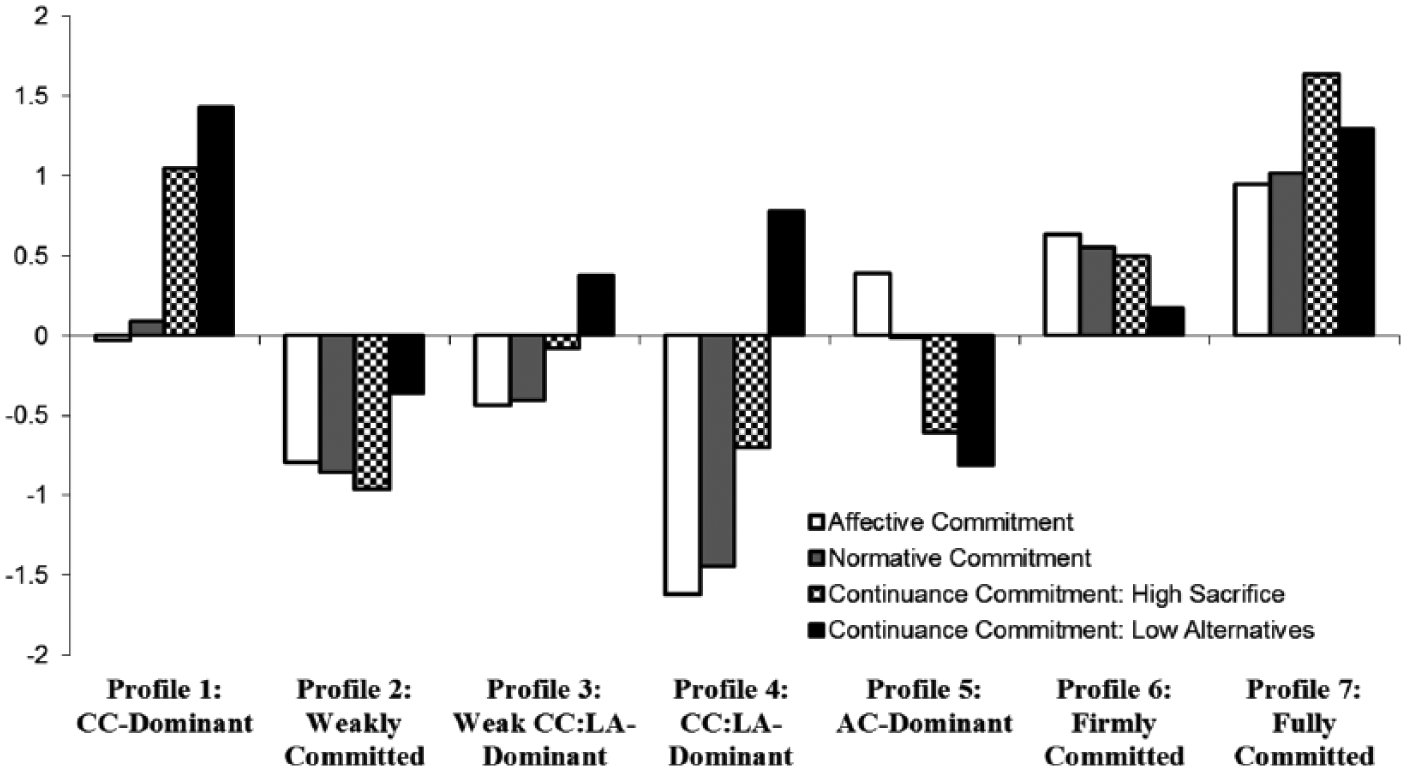
Final seven-profile solution identified in this study across both samples.
Profile 1 presented high levels of CC:HS and CC:LA, and average levels of AC and NC. Whereas this CC-Dominant profile characterized a relatively small proportion of participants in the Pre-Crisis sample (5.22%), it described a much larger proportion of participants in the Post-Crisis sample (17.34%) where it was the third largest profile. Profile 2 displayed low levels on all commitment mindsets, suggesting only weak ties to the organization. Interestingly, the relative size of this Weakly Committed profile was reduced by half in the Post-Crisis (5.65%) relative to the Pre-Crisis (10.14%) sample. Profiles 3 and 4 were both characterized by low (Profile 3) or very low (Profile 4) levels of AC, NC, and CC:HS, but by high (Profile 3) or very high (Profile 4) levels of CC:LA, suggesting that an entrapment process might be at play for employees lacking alternative employment opportunities. The Weak CC:LA-Dominant profile (Profile 3), for which this entrapment pattern was less marked, characterized the second highest proportion of employees in the Pre-Crisis sample (24.64%), and remained equally prevalent in the Post-Crisis sample (23.62%) where it was the largest profile. In contrast, the more differentiated CC:LA-Dominant profile (Profile 4) was relatively rare in the Pre-Crisis sample (5.51%) and considerably more prevalent in the Post-Crisis sample (15.08%).
Profile 5 presented moderately high levels of AC, average levels of NC and low levels of CC:HS and CC:LA. This AC-Dominant profile characterized employees whose relationship to the organization reflects an emotional attachment and was the third most frequent profile in the Pre-Crisis sample (19.42%), but was far less prevalent in the Post-Crisis sample (6.78%). Finally, the last two profiles presented moderately high (Profile 6) or high (Profile 7) levels of commitment across mindsets. The less extreme Firmly Committed profile (Profile 6) characterized the largest proportion of employees in the Pre-Crisis sample (30.72%). Although it was the second largest in the Post-Crisis sample (19.35%), its prevalence was more than 10% lower than in the Pre-Crisis sample. Finally, the Fully Committed profile (Profile 7) characterized a small proportion of employees in the Pre-Crisis sample (4.35%), but a larger proportion of employees in the Post-Crisis sample (12.19%).
Predictors of profile membership (predictive similarity)
As shown in Table 1, the model of predictive similarity resulted in the lowest values for all information criteria when compared with the alternative model, and was thus retained. The results from the multinomial logistic regression estimated in this model are reported in Table 2. Note that Table 2 includes a comparison of demographic variables across profiles. However, these variables were simply included as controls and are not described here.
Results from the latent profile analyses.
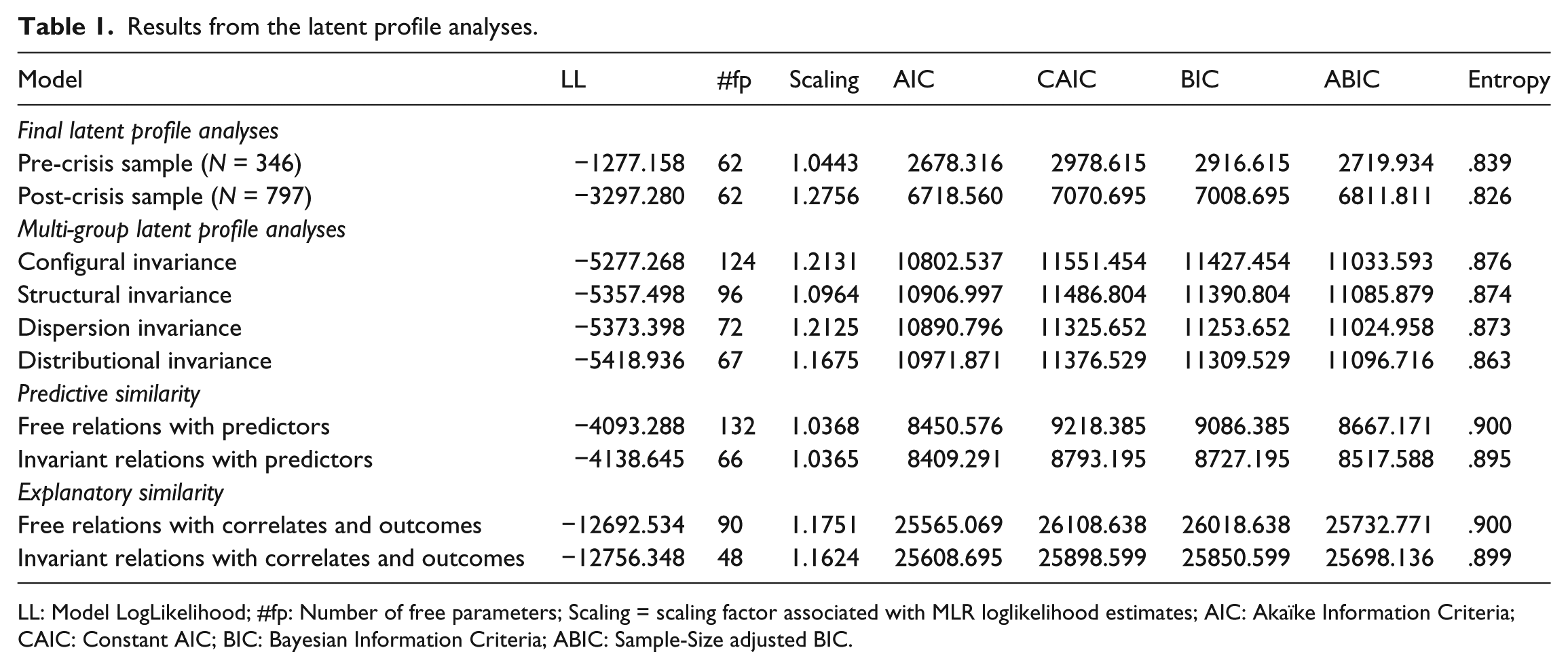
LL: Model LogLikelihood; #fp: Number of free parameters; Scaling = scaling factor associated with MLR loglikelihood estimates; AIC: Akaïke Information Criteria; CAIC: Constant AIC; BIC: Bayesian Information Criteria; ABIC: Sample-Size adjusted BIC.
Multinomial logistic regressions for the effects of the predictors on profile membership.

p < .05; **p < .01; SE: standard error of the coefficient; OR: Odds Ratio. The coefficients and OR reflects the effects of the predictors on the likelihood of membership into the first listed profile relative to the second listed profile; Profile 1: CC-Dominant; Profile 2: Weakly Committed; Profile 3: Weak CC:LA-Dominant; Profile 4: CC:LA-Dominant; Profile 5: AC-Dominant; Profile 6: Firmly Committed; Profile 7: Fully Committed.
Employees’ perceptions of their organization’s HRM practices showed a pattern of association with profile membership that varied across practices. Employees’ perceptions of the organization’s performance appraisal practices showed no association with profile membership, whereas their perceptions of training opportunities only predicted a greater likelihood of membership in the CC:LA-Dominant (4) profile relative to the Fully Committed (7) profile. In contrast, the other practices predicted clearer differences between profiles. Importantly, employees’ perceptions of teamwork practices predicted a greater likelihood of membership in the Fully Committed (7) profile relative to all other profiles, as well as in the Firmly Committed (6) profile relative to the Weak CC:LA-Dominant (3), CC:LA-Dominant (4) and AC-Dominant (5) profiles. Interestingly, teamwork also predicted a greater likelihood of membership in the CC-Dominant (1) profile relative to the Weakly Committed (2), Weak CC:LA-Dominant (3), CC:LA-Dominant (4), and AC-Dominant (5) profiles, suggesting that teamwork might be a condition that some employees consider costly to lose. Perceptions of teamwork also predicted a greater likelihood of membership in the Weak CC:LA-Dominant (3) profile relative to the CC:LA-Dominant (4) profile. Finally, employees’ perceptions of their organization’s empowerment practices predicted a greater likelihood of membership in the AC-Dominant (5) profile relative to the CC-Dominant (1), Weak CC:LA-Dominant (3), CC:LA-Dominant (4), Firmly Committed (6) and Fully Committed (7) profiles. It also predicted a greater likelihood of membership in the Weak CC:LA-Dominant (3), Weakly Committed (2) and Firmly Committed (6) profiles relative to the CC:LA-Dominant (4) profile.
Employees’ feelings of job insecurity predicted a greater likelihood of membership in all profiles relative to the AC-Dominant (5) profile, as well as in the CC-Dominant (1), Weak CC:LA-Dominant (3) and Fully Committed (7) profiles relative to the Firmly Committed (6) profile. Job insecurity also predicted a greater likelihood of membership in the CC-Dominant (1) profile relative to the Weakly Committed (2) profile. Finally, collectivism mainly predicted a greater likelihood of membership in the Fully Committed (7) profile relative to most of the other profiles, with the sole exception of the AC-Dominant (5) profile, as well as in the AC-Dominant (5) relative to the Weak CC:LA-Dominant (3) profile. In contrast, the effects of individualism appeared more widespread. Thus, higher levels of individualism predicted a greater likelihood of membership in the Fully Committed (7) and CC-Dominant (1) profiles relative to the Weakly Committed (2), Weak CC:LA-Dominant (3) and AC-Dominant (5) profiles, in the CC:LA-Dominant (4) relative to the Weakly Committed (2) and AC-Dominant (5) profiles, and in the Firmly Committed (6) profile relative to the Weakly Committed (2) profile.
Correlates and outcomes of profile membership (explanatory similarity)
As shown in Table 1, the model of explanatory similarity resulted in the lowest values on the CAIC, BIC and ABIC criteria when compared with the alternative model, and was thus retained. The within-profile means of each correlate and outcome are reported in Table 3 and graphically illustrated in Figure 2.
Associations between profile membership, the correlates and the outcomes.
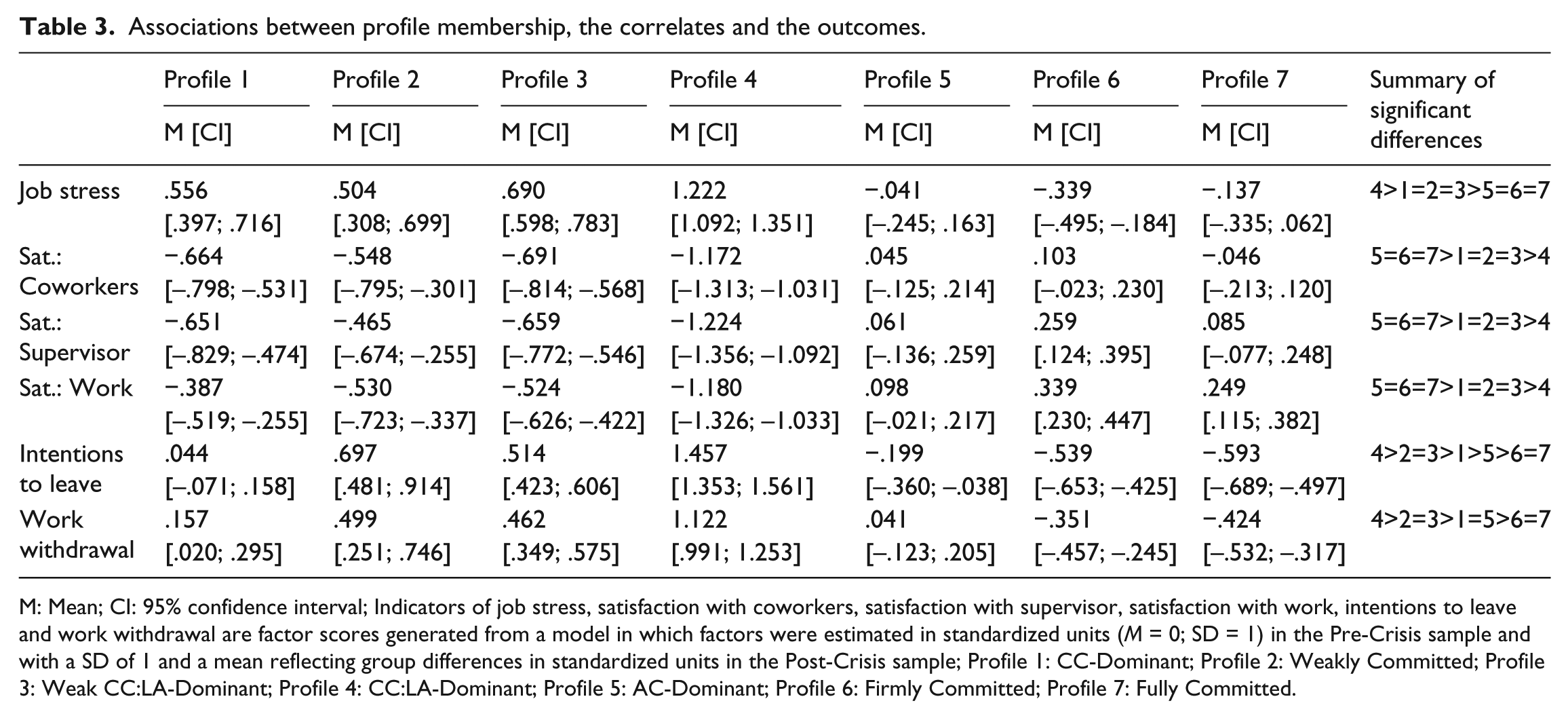
M: Mean; CI: 95% confidence interval; Indicators of job stress, satisfaction with coworkers, satisfaction with supervisor, satisfaction with work, intentions to leave and work withdrawal are factor scores generated from a model in which factors were estimated in standardized units (M = 0; SD = 1) in the Pre-Crisis sample and with a SD of 1 and a mean reflecting group differences in standardized units in the Post-Crisis sample; Profile 1: CC-Dominant; Profile 2: Weakly Committed; Profile 3: Weak CC:LA-Dominant; Profile 4: CC:LA-Dominant; Profile 5: AC-Dominant; Profile 6: Firmly Committed; Profile 7: Fully Committed.
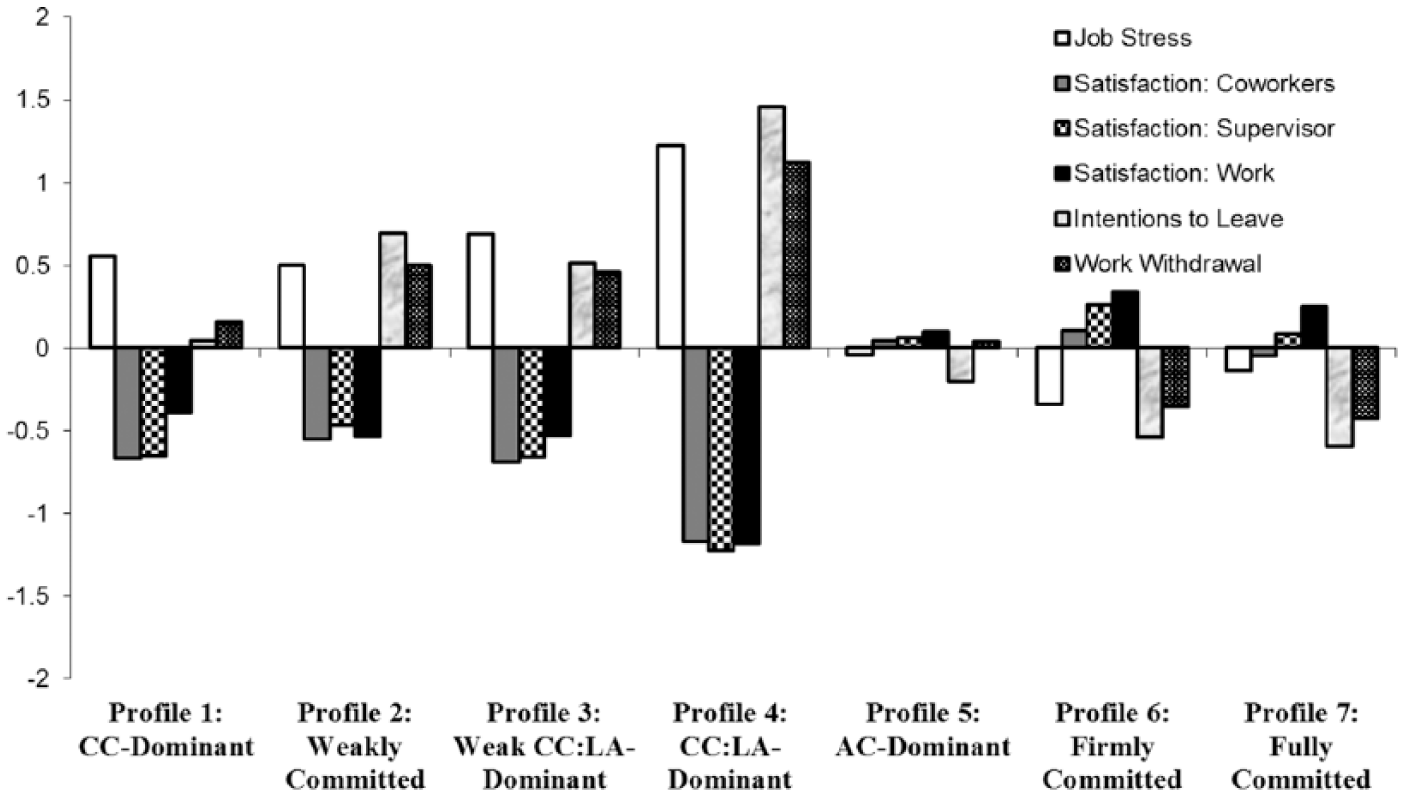
Outcome levels associated with the final seven-profile solution identified in this study across both samples.
The correlates showed a consistent pattern of associations with the profiles, with the most desirable levels on all correlates (lower levels of job stress, and greater levels of satisfaction with coworkers, with the supervisor and with work) being observed in the AC-Dominant (5), Firmly Committed (6) and Fully Committed (7) profiles. In contrast, the least desirable levels of correlates were observed in the CC:LA-Dominant profile (4), with intermediate and equal levels observed in the CC-Dominant (1), Weakly Committed (2) and Weak CC:LA dominant (3) profiles.
The outcomes followed a similar pattern, but showed a clearer differentiation between profiles. Thus, the profiles presenting the lowest (and equal) levels of intention to leave and work withdrawal were the Firmly Committed (6) and Fully Committed (7) profiles, followed by the AC-Dominant (5) and CC-Dominant (1) profiles. It is noteworthy that, although these last two profiles (5 and 1) presented similar levels of work withdrawal, intentions to leave were lower in the AC-Dominant (5) relative to the CC-Dominant (1) profile. The next highest (and equal) level of intentions to leave and work withdrawal were observed in the Weakly Committed (2) and Weak CC:LA dominant (3) profiles, whereas the overall highest levels were observed in the CC:LA-Dominant profile (4).
Discussion
We used data obtained prior to and following an economic crisis in Turkey to investigate the different forms of profile similarity identified by Morin et al. (2016). Although evidence for configural and structural similarity are accumulating (Meyer et al., 2013a; Morin et al., 2016), only one study to date has demonstrated similarity under conditions of change (Kam et al., 2016). The crisis in Turkey arguably introduced more turbulence, both within the conglomerate under investigation and in the broader economy, than did the planned change investigated by Kam et al. Consequently, our findings provide particularly strong evidence that commitment profiles are meaningful and reflect distinct patterns of relationship between employees and their organizations. Even though the distribution across profiles was different, the same basic profile structure fit the data well prior to and following the crisis.
Further support for the meaningfulness of the profiles comes from evidence of predictive and explanatory similarity across samples. The similarity in relations between probability of profile membership and predictors, correlates, and consequences was obtained despite significant changes in mean levels on many of the variables involved (e.g. perceived HRM practices, facets of job satisfaction, job insecurity, turnover intentions), and dissimilarity in the distribution of employees across profiles. Thus, the evidence for predictive and explanatory similarity suggests that a common set of principles (e.g. social exchange, need satisfaction) likely operates in the formation, maintenance and consequences of commitment regardless of the level of stability or turbulence in the environment.
Economic crisis and commitment profiles
Like the variable-centered study conducted by Markovits et al. (2014), our study documents the negative impact that an economic crisis can have on employees (e.g. reduced job satisfaction and increased stress and job insecurity). Our findings extend those of Markovits et al. by demonstrating that perceptions of HRM practices, including training opportunities, teamwork, performance appraisal and empowerment, were less favorable following the crisis than before. We also included measures of turnover intention and work withdrawal and found higher levels of both following the crisis.
Despite the similarities, our findings also differ from those of Markovits et al. (2014) in several notable respects. First, unlike Markovits et al., we did not find that AC and NC levels were lower following the crisis than before. Second, whereas Markovits et al. found no differences in the level of CC, we found that CC:HS and CC:LA were both higher after the crisis than they were before. Although we cannot provide a definitive explanation for these differences, they may be linked to the differences in analytic strategy (variable- versus person-centered), and the operationalization of CC.
By using a person-centered strategy, we were able to detect potentially offsetting shifts in the basic mindsets. For example, conditions created by an economic crisis can contribute to a shift toward a CC-dominant profile and away from a fully committed profile, both of which are characterized by high levels of CC. This might help to explain Markovits et al.’s (2014) failure to find the expected change in CC. The fact that we did not find an overall difference in levels of AC and NC prior to and following the crisis might be explained by offsetting shifts we observed toward a fully-committed profile and away from the AC-dominant and firmly-committed profiles. If this is indeed the explanation, then it provides further evidence for the potential benefits of using a person-centered approach.
Another important difference between the two studies is that we measured two distinct facets of CC—CC:HS and CC:LA, whereas Markovits et al. (2014) treated CC as a unidimensional construct. We found that both facets of CC were elevated in the CC-dominant profile, whereas CC:LA was stronger in the CC:LA-dominant profile and CC:HS was stronger in the fully-committed profile. The latter differences are masked when CC is treated as a unidimensional construct. Moreover, the possibility of offsetting shifts across these profiles during an economic crisis might also help to explain why Markovits et al. failed to find the expected change in CC following the Greek economic crisis. However, with only two studies to compare, it is impossible to draw any firm conclusions with regard to differences in findings. Therefore, we focus here on the findings of our person-centered study.
Given the differences we observed in job satisfaction, stress, job insecurity and perceived quality of HRM practices, it is not surprising that we found a difference in the distribution of employees across commitment profiles prior to and following the crisis. More specifically, compared to the pre-crisis sample, more employees in the post-crisis sample were likely to be represented by CC-dominant and CC:LA-dominant profiles, and fewer by the AC-dominant profile. However, we also found that the proportion of employees represented by the weak commitment profile before the crisis was almost twice that following the crisis. One explanation might be that the crisis helped to increase the salience of employees’ relationship with their employer and led to the elevation of one or more of the commitment mindsets based on their assessment of that relationship. Arguably the most surprising finding was that the proportion of employees represented by a fully-committed profile after the crisis was approximately three times greater than before the crisis.
Unfortunately, we were not able to track profile changes for individual employees across time in this study. Nevertheless, the pattern of findings suggests that, among the weakly committed employees, there may have been a bi-modal response to the crisis. Some employees may have become more aware of the costs associated with job loss and therefore transitioned to a CC-dominant or CC:LA-dominant profile. However, others may have developed a deeper appreciation for their jobs and/or been impressed by how the crisis was managed by their employer and therefore transitioned to a fully-committed profile. Kam et al. (2016) also found movement toward and away from the more desirable profiles during an organizational change, and that movements in both directions were predicted in part by shifts in perceptions of management trustworthiness. These findings suggest that organizations might have some control over how changes are perceived and influence employee commitment, hence the importance of considering covariates of profile membership.
Covariates of profile membership
Our findings regarding covariates were largely as expected and consistent with theory and previous research. One notable exception was that work withdrawal and intentions to leave were greatest for the CC:LA-dominant profile. This unexpected finding aside, some might summarize the general pattern of findings by arguing that value-based profiles are more desirable than the exchange-based or weak commitment profiles. Those with a variable-centered orientation might go further and argue for the overriding importance of AC because it tends to be dominant in the value-based profiles and weak in the exchange-based and weak profiles. However, there are nuances in the findings that challenge such interpretations and, in so doing, help to illustrate the benefits of taking a person-centered approach.
One such finding is that team-oriented HRM practices were associated with both value-based (fully- or firmly-committed) and exchange-based (CC-dominant) profiles, suggesting that for some employees an emphasis on teams might create a sense of moral duty (strong AC and NC), whereas for others it is perceived as a benefit that would be lost if one were to leave. Another example is that, unlike team-oriented practices, empowerment-oriented practices are associated more with an AC-dominant profile than with a fully-committed profile. It might be that empowerment has an individual focus and contributes to a desire to remain. In contrast, team-oriented practices foster a desire to remain (AC), but also strengthen employees’ sense of social obligation (NC) as observed in the fully-committed profile.
The unexpected finding regarding the CC:LA profile and turnover intention also attests to the benefits of taking a person-centered approach. The fact that turnover intention was greatest for the CC:LA-dominant profile, and among the lowest for the CC-dominant profile, suggests that these profiles might be characterized by quite distinct mindsets. Employees with a CC-dominant profile (including high scores on CC:HS) seem to recognize the tangible costs of leaving and are therefore less inclined to do so. In contrast, those with a CC:LA-dominant profile appear to focus more on the lack of alternatives, yet are apparently quite willing to leave. Of course, having stronger intentions to leave does not mean that these individuals will do so, particularly during an economic crisis. However, it suggests that, with few other ties to the organization, some may continue to actively search for alternate employment opportunities and leave if such an opportunity arises. Others might see the situation as an occasion to further their education while waiting for a change in economic conditions, or possibly retire, depending on their career stage. Regardless of their intentions, it is noteworthy that employees with a CC:LA-dominant profile also tend to withdraw from work and are unlikely to do more than meet minimal requirements.
The fact that we found evidence for predictive and explanatory similarity across samples suggests that there may be a core set of principles operating in the formation and consequences of commitment regardless of the economic conditions. What appears to differ across conditions is the direction in which individuals are ‘pushed’ as a function of these principles. However, few studies have included measures that allow for direct investigation of these principles. In one such study, Meyer et al. (2012) compared levels of satisfaction of the three psychological needs identified in self-determination theory—autonomy, competence and relatedness (Ryan and Deci, 2000)—and found higher levels of satisfaction among employees with value-based compared with exchange-based or weak commitment profiles. Thus, the relative satisfaction of needs prior to and after the crisis might serve as one explanation for the distributional dissimilarity we observed in this study.
In the current study, we included measures of collectivist and individualist values, thereby allowing us to draw on culture theory (e.g. Hofstede, 2001; Wasti and Önder, 2009) for another set of principles that might be operating. We found that employees with strong collectivist values were more likely to have a fully-committed profile than any other profile apart from AC-dominant. This was true both before and after the crisis and is consistent with the notion that collectivists are more likely to focus on their moral duty to the collective. In contrast, employees with strong individualist values were as likely to have a CC-dominant or CC:LA-dominant profile as they were a fully-committed profile, and more likely to have one of these profiles than all others. Thus, individualists may be more sensitive to their own needs and, although capable of experiencing a sense of moral duty, may become particularly focused on perceived costs under some conditions.
Finally, we noted earlier that Kam et al. (2016) found that perceptions of management trustworthiness could predict profile membership and change in profile membership. Trust, is another basic principle about which we know a great deal (Dirks and Ferrin, 2002; Mayer et al., 1995). However, these are simply examples of relevant principles. Other principles might be derived from regulatory focus theory (Johnson et al., 2010), social identity theory (Meyer et al., 2006), and organizational justice theory (Bobocel and Mu, 2016), to name a few. The benefits of focusing on basic principles is that they are much more likely to generalize across conditions than are specific management practices. Therefore, we encourage greater emphasis on discovering the operation of underlying principles in future person-centered commitment research.
Limitations and future directions
Our investigation took advantage of a naturally occurring event that would be impossible to manipulate. This allowed us to survey employees under very different conditions, but we had no control over how the crisis impacted different parts of the conglomerate or how they responded. We also collected our data from different groups of employees prior to and following the crisis, and were therefore unable to conduct latent transition analyses to monitor actual changes in profile membership (see Kam et al., 2016, for an example). Although economic crises are difficult to predict, future studies might benefit from collecting data prior to and following other planned changes that are similarly disruptive (e.g. changes in governments that have wide-ranging implications for public sector employees). Finally, we had access only to employees’ perceptions of work conditions rather than direct measures of the HRM practices being used and/or changes in these practices.
These limitations have little bearing on our findings regarding the configural and structural similarity across samples. To the contrary, the more extensive and diverse the differences across conditions the more stringent the test of similarity becomes. Therefore, we can be confident that the profiles that emerged were very representative of what we might find in the population of Turkish employees. The profiles we identified are also similar to those reported in previous person-centered studies (see Kabins et al. [2016] and Meyer and Morin [2016] for reviews), thereby adding to our confidence in the meaningfulness of commitment profiles in general. Recall, however, that ours is one of the few profile studies to date that included both facets of CC. This puts some limits on our ability to compare profiles with those reported in other studies. Nevertheless, differences in labeling conventions aside, several of the profiles found in our study (e.g. AC-dominant; CC-dominant; fully-committed, firmly/moderately committed, weakly committed) were also observed in one or both of the previous studies that included the two facets of CC (Meyer et al., 2015; Stanley et al., 2013). Importantly, these earlier studies both found profiles where scores on CC:HS and CC:LA were similar in strength (e.g. CC-dominant), as well as profiles where the scores were quite differentiated. As in the present study, the latter included profiles where AC and NC were elevated, and CC:HS scores were higher than CC:LA scores. Thus, although there are still only a few studies available, there appears to be considerable convergence in the findings.
It is our findings of distributional dissimilarity and of predictive and explanatory similarity that are most likely to be affected by the methodological limitations of our study and that should be the focus of future investigations. The generalizability of our findings regarding antecedents, correlates, and consequences of profile membership is addressed to some extent by evidence of predictive and explanatory similarity, but there remains some question as to whether employee perceptions reflect the reality of the conditions that existed prior to and following the crisis.
Implications for practice
The implications of our research for practice derive largely from the added support for the construct validity of commitment profiles. As noted elsewhere (Meyer et al., 2013b; Morin et al., 2011; Zyphur, 2009), people (managers included) are likely to find results pertaining to categories of people more appealing and easier to understand than relations among variables. This is particularly true when relations become complex (e.g. four-way interactions). In person-centered research, these interactions are reflected in differences across a set of recognizable ‘types’ of employees (e.g. weakly-committed, trapped, fully-committed).
Perhaps the greatest contribution of our findings for practice comes from the demonstration of predictive and explanatory similarity. These findings suggest that a common set of principles might be operating to shape commitment profiles and their consequences. This does not mean that managing commitment is simple. To the contrary, an employee’s commitment profile may depend on complex combinations of environmental factors (e.g. HRM practices; economic conditions) and individual differences (e.g. individualism and collectivism). However, the evidence for predictive and explanatory similarity sets the stage for future investigations of the core principles that help to explain them. Like profiles, principles help to smooth out complexity. For example, knowing that employees are more likely to develop a value-based commitment profile if their basic needs are satisfied, if they view HRM policies and practices as just, or if they hold stronger collectivist values, is arguably more useful than a matrix of meta-analytic correlations between the commitment mindsets and a myriad of specific HRM practices or work conditions (Mathieu and Zajac, 1990; Meyer et al., 2002). There have already been many well-established principles found to underlie workplace attitudes and behavior (e.g. Locke, 2009) that would be good candidates for consideration in studies of commitment profiles. An important next step for person-centered research, therefore, is to include measures that allow for more direct investigation of how these principles operate to explain the fairly stable pattern of findings that appears to be emerging.
Footnotes
Funding
This research was supported by funding from the University of Illinois Center for Human Resources Management.
Notes
References
Supplementary Material
Please find the following supplemental material available below.
For Open Access articles published under a Creative Commons License, all supplemental material carries the same license as the article it is associated with.
For non-Open Access articles published, all supplemental material carries a non-exclusive license, and permission requests for re-use of supplemental material or any part of supplemental material shall be sent directly to the copyright owner as specified in the copyright notice associated with the article.
