




Abstract
How do employees of dynamic consulting firms deal with their demanding professional environment, where they must be accessible, responsive and flexible seemingly around the clock? This case study of a large consulting firm explores employee experiences of flexible working through the lens of paradox. It finds that flexible working far exceeds the set of approved flexible work arrangements and practices enshrined in formal HR policies. Rather, individuals develop varied perceptions, expectations and ways of organizing flexible working, which emerge and evolve as they accumulate experience in a context where client-focused responsiveness is key. The article argues that flexible working is part of the deeper psychological contract between professional employees and the firm. This allows us to better understand how the paradoxical tensions that characterize workplace flexibility are experienced as evolving combinations of contributions and inducements. Employees manage these tensions in different ways, including vacillating between polar opposites and integrating contradictory elements, creating an overall mental picture of their flexible working experience.
Keywords
Introduction
This article draws upon the psychological contract as a theoretical lens to investigate employee lived experiences of ‘flexible working’ to shed light on how employees manage the paradoxical tensions that are embedded in this experience. Workplace flexibility is increasingly popular, its advantages being advocated by international institutions, national governments, professional, managerial and employee organizations alike (Acas, 2015; Kersley et al., 2006; Plantenga and Remery, 2010). Much focus has been placed on researching the outcomes of flexibility, finding contradictory and opposed results (de Menezes and Kelliher, 2011). This is partly the result of studies looking at flexibility with a binary approach (Martinez-Lucio et al., 2000), considering it either as an organization-oriented or an employee-oriented, HR-defined and -delimited practice (Kerkhofs et al., 2008; Reilly, 1998). By viewing flexible working with such an either-or lens, such studies overlook that employer and employee-oriented flexibility are simultaneous phenomena embedded in the way work is conducted (Lewis, 2000) and that employees have an active role in constructing and interpreting flexible working (Cooper and Baird, 2015). Indeed, recent literature has suggested that flexible working is characterized by paradoxes and involves tensions in its enactment (Putnam et al., 2014), and that individual rationalities can play a substantive role in its construction (Wilkens and Nermerich, 2011).
Existing studies primarily focus on formalized flexibility policies and approved practices (Avgoustaki, 2016), and have yet to depict a comprehensive picture of employees’ experiences of flexible working (Bailey and Kurland, 2002; de Menezes and Kelliher, 2011; Kossek et al., 2010). There is a lack of evidence regarding the mechanisms individuals deploy to manage the tensions emerging from flexible working (Putnam et al., 2014). In order to contribute to this literature, this article draws on the lens of the psychological contract to consider flexibility as a part of the employment relationship, instead of as a set of defined HR-designed practices. It seeks to answer the following two main questions. How do employees experience and define flexible working? How do individuals live, process, manage and stabilize the paradoxical tensions generated by flexible working?
The research reported is a qualitative case study conducted within the Spanish branch of a large international consultancy firm. The characteristics of consulting jobs make flexibility a crucial aspect of people management (Carvalho and Cabral-Cardoso, 2008). In addition, a particular controversy appears to exist with regard to how flexible working is understood and practised in this context (Donnelly, 2015; Whittle, 2005). On the one hand, some claim that professional image and career progress in professional services such as consulting are associated to employees being highly flexible towards the firm (Smithson et al., 2004). On the other hand, some argue that knowledge work is characterized by more progressive forms of work that enable greater flexibility for employees (Huyer and Hafkin, 2007; Perrons, 2006). An international consultancy firm is thus an ideal setting in which to acquire a better understanding of professional employees’ experiences and contribute to this debate.
The article is organized as follows. The next section reviews the literature on workplace flexibility, highlighting the limitations of its current conceptualization and the research gap in relation to empirical studies of employees’ experiences of flexible working. The third section justifies the choice of the psychological contract (Conway and Briner, 2005; Rousseau, 1995) as an appropriate analytical lens. Section four describes the research background and the methods used. Section five presents the qualitative data, organized analytically around the tension between flexible working experienced as an inducement and as a contribution. The final section provides a discussion and describes the limitations of the study.
Perspectives on flexibility
The investigation of workplace flexibility has been approached from dissimilar angles with contrasting assumptions. Some studies depict flexibility as one of the keys to success and survival in competitive and technologically challenging environments, as a tool to be deployed by the organization to match its changing needs (Blyton, 1992; Dastmalchian and Blyton, 2001, Hoge and Hornung, 2015). Others argue that flexibility involves empowering employees and giving them control over certain aspects of their jobs (particularly work duration, timing and location) (Hill et al., 2008; Pitt-Catsouphes and Matz-Costa, 2008; Russell et al., 2009). In this sense, contrasting understandings of flexibility co-exist because studies look at it from the perspective of different actors: either the firm or the employees (Zeytinoglu et al., 2009). Whereas firms seek flexibility to increase their adaptability to market conditions and ultimately improve performance, the workforce uses flexibility to achieve work–life balance or improve their well-being (Reilly, 1998).
Some authors have engaged with the study of this duality by emphasizing the importance of actors’ contrasting perspectives or interests. Using data from the European Establishment Survey of Working Time, Kerkhofs et al. (2008) discern six flexibility profiles characterized by different bundles of flexible working practices. Those profiles are built by categorizing the level of flexibility (high, intermediate and low), and the content of the practices implemented by the firms as worker-oriented or firm-oriented. Their analytical procedure is in line with Fleetwood’s (2007: 387) argument that ‘some flexible working practices are employee-friendly and sought by employees … [whereas] other practices are employer-friendly sought by employers, primarily to pursue profit’. However, this categorization of work practices as stable and determined notions, which are either ‘flexible’ or ‘rigid’, either ‘for the employee’ or ‘of the employee’, suggests that flexibility is a contest between two mutually exclusive and contradictory sets of interests and ends.
Another stream of literature puts this approach into question. Martinez-Lucio et al. (2000: 279) criticize the flexibility debate having ‘developed in a binary manner’, posing questions that are responded to with yes or no answers. For these authors, the way forward in investigating the complexity of flexible working is to adopt a framework that relies on the analysis of paradoxical tensions and dialectics. Paradoxical tensions are ‘cognitively or socially constructed polarities that mask the simultaneity of conflicting truths’ (Lewis, 2000: 761), incorporating contradictory but interwoven concepts that exist simultaneously and persist over time (Schad et al., 2016; Smith and Lewis, 2011). Dialectics refers to the unity and synergistic capacity of opposite poles (thesis and antitheses) and their ongoing, dynamic interconnection (Putnam et al., 2016). Dialectics prove paradoxical when, notwithstanding synergies, latent tensions remain (Schad et al., 2016: 12). In this sense, ‘dialectics surfaces as a way of incorporating process dynamics into the study of paradox’ (Putnam et al., 2016: 75). From a paradox perspective, work arrangements involve a mixture of flexibilities and rigidities for employees and of employees that are not independent, but interrelated concepts (Martinez-Lucio et al., 2000). ‘Flexibility of employees’ and ‘flexibility for employees’ should therefore be studied as simultaneous phenomena that interact and co-evolve.
Taskin and Devos (2005) take a paradox approach to confront individual versus collective interests in flexibility: although flexibility accommodates individual needs (such as childcare), it can clash with collective demands (for instance, projects that require people to share time and space to develop teamwork). Putnam et al. (2014) review the workplace flexibility literature and highlight paradoxical outcomes resulting from tensions between three dialectics: variable versus fixed arrangements, supportive versus unsupportive work climates, and equitable versus inequitable implementation policies. These tensions elicit ‘either-or’, ‘both-and’ and ‘more than’ responses (Putnam et al., 2016). The ‘either-or’ category includes approaches such as selection (denying the existence of one of the poles). Alternatives like vacillation (shifting back and forth between poles over time) or integration and balance (taking an in-between approach) are ‘both-and’ approaches. Reframing (situating the poles in an alternative pole), connection and dialogue (engaging opposites in a dynamic interaction) or serious playfulness (reflecting on emotions instead of rational arguments) are ‘more than’ types of responses.
A paradox perspective thus provides an opportunity to explore the simultaneity and interdependence of seemingly contradictory views of flexibility (Lewis, 2000), and can contribute to overcome bipolarities that are frequent in its analysis (Putnam et al., 2014; Taskin and Devos, 2005). For instance, it may be the case that a flexible practice oriented to primarily benefit the employee (such as flexitime) ends up benefiting the employer (through the intensification of work) (Kelliher and Anderson, 2010; Lewis et al., 2007). On the contrary, overtime, which is generally labelled as an employer-oriented practice (Kerkhofs et al., 2008), can potentially serve the interests of certain employees by boosting their careers (Anger, 2008). These phenomena are not opposed; they suggest the existence of a highly complex reality (Smith and Lewis, 2011), and highlight the need to understand employees’ interpretations. What is evident is that contrasting experiences of flexible working are not necessarily mutually exclusive, and each can potentially contribute to the other. Whether or not this is the case is an empirical question that remains largely unexplored. This article aims to develop theory on flexible working by exploring employees’ experience and management of these paradoxical tensions, through the lens of the psychological contract.
Exploring employees’ experiences, perceptions and understandings of flexibility is essential to portraying a holistic picture of flexible working beyond policies and practices (Kossek et al., 2010). Researchers interested in HR processes (Kehoe and Wright, 2013; Piening et al., 2014), have called for more insights on employee experiences, indicating that there may be gaps between intended practices (as designed by HR professionals), implemented practices (as put in place by line managers and team leaders) and experiences (as lived and interpreted by employees) (Ehrnrooth and Björkman, 2012). Roehling et al. (2000: 313) advocate that flexibility should be viewed as a ‘two-way street’, arguing that reciprocal flexibility is a key element of new employment arrangements. Nonetheless, these authors’ conclusions rely on the content analysis of primarily managerial practitioner-oriented publications. Their work does not study how such reciprocal exchange is constructed and what the employees’ experience in travelling such a two-way street might be like. Kelliher and Anderson (2010) provide some insights into this process, suggesting the existence of reciprocation among reduced hours and remote workers who work more intensely in exchange for being offered access to specific flexible work practices. However, they categorize employees as flexible workers or non-flexible workers a priori, limiting the exploration of what employees understand by flexible working. Therefore, interpretations of flexibility are constrained to remote working and reduced hours, closing the door to alternative employee understandings. For instance, Kossek et al. (2010: 12) argue that ‘time off work for sickness, leaves for care giving …, time to exercise or engage in preventative care to improve … health’ could also be considered flexibility, but are largely disregarded.
Overall, the literature has not convincingly studied employees’ roles in constructing and enacting flexible working on a continuous basis (Bailey and Kurland, 2002; Cooper and Baird, 2015). This article seeks to partly fill this gap, starting from the assumption that flexible working is part of the employment relationship. At its most basic level, this relationship has been understood as an exchange of effort and wages (Marsden, 1999), but recent accounts support the emergence of new features that have become essential to it, including flexibility (Coyle-Shapiro and Kessler, 2000; Vidyarthi et al., 2014). Moreover, the employment relationship has been argued to have a paradoxical nature (D’Art and Turner, 2006), because it entails a ‘problematic mix of dissent and accommodation, conflict and co-operation’ (Blyton and Turnbull, 2004: 41). As such, flexible working can be understood as an inherent aspect of the employment relationship (Roehling et al., 2000) and not simply as a defined set of HR policies and approved practices. From this perspective, workers’ experiences of flexible working and its tensions (Putnam et al., 2014) are not bounded by adherence to defined HR policies and practices.
In addition, work arrangements are increasingly de-commoditized (D’Art and Turner, 2006), and idiosyncratic deals have become frequent (Rousseau et al., 2006). The flexibility literature points towards the increasing importance of arrangements whereby flexibility is not negotiated formally with HR, but informally with managers (de Menezes and Kelliher, 2017; Eaton, 2003). This enlarges the employees’ role in the organizing of flexible working. It can be argued that the psychological contract thus gains relevance as a framework for analysing flexible working because it draws on individuals’ understanding of the employment relationship (Rousseau et al., 2006; Tietze and Nadin, 2011; Wilkens and Nermerich, 2011). By framing flexibility within the psychological contract approach, this article constructs an understanding of flexible working that emerges primarily from employee accounts of their actual experiences and is not limited to prior specifications of flexible work practices.
In sum, this study advances the existing literature in two ways. First, it explores flexible working as an aspect of the employment relationship (Roehling et al., 2000), as an evolving phenomenon naturally prone to paradoxical tensions (Smith and Lewis, 2011), rather than as a defined and limited set of practices with a predominant beneficiary (Hill et al., 2008; Hoge and Hornung, 2015; Reilly, 1998). Drawing on the lens of the psychological contract, it seeks to answer the question: how do employees experience and define what working flexibly means? Second, by delving into employees’ multifaceted experience of flexible working, it explores and develops a better understanding of the complex realities involved. In particular, it contributes to understanding the paradoxical tensions generated by flexible working and how these are lived, processed, managed and stabilized by individuals (Lewis, 2000).
Analytical framework: The psychological contract
The literature on psychological contracts (e.g. Conway and Briner, 2005; Rousseau, 1995) builds upon administrative theory to consider the employment relationship as a cooperative system (March and Simon, 1958; Simon, 1951). In this system, equilibrium is achieved through the combination of contributions and inducements (March and Simon, 1958) as these are perceived by employees (Seeck and Parzefall, 2008).
The psychological contract encompasses the employee’s ‘individual beliefs, shaped by the organization, regarding terms of an exchange agreement … [and] is potentially idiosyncratic and unique to each person who agrees to it’ (Rousseau, 1995: 9–10). It can be characterized as the employee’s mental scoring of the employment relationship; it is the mechanism that helps them keep track of their contributions to their employer organization and the inducements the organization offers them (Rousseau and Wade-Benzoni, 1994).
Participants in organizations make certain contributions or ‘payments to the organization’ (March and Simon, 1958: 85), which can be organized as in-role performance and extra-role performance behaviours. The former include basic expectations such as minimal work absenteeism and satisfactory task performance. The latter normally fall outside of formal job requirements, but are still expected from employees because they contribute to a better functioning of the firm. Accepting to be flexible in adapting to environmental circumstances and being available to work whenever and wherever necessary, is a growingly extended, but rarely specified, managerial expectation (Roehling et al., 2000).
Inducements are ‘job rewards available to workers’ (Kalleberg and Reve, 1993: 1113). They are primarily meant to provide workers with a stream of income (wages) that is stable (through job security) and are sometimes designed to elicit individual performance (for example, profit-sharing or other performance-related pay schemes). They can also include social, intrinsic and intangible elements (meaningful inherently rewarding work, voice, personal development, work–life balance etc.). Given the latest changes in workforce demographics and work values, offering employees flexibility to meet their personal and work goals simultaneously is nowadays a very relevant incentive (Roehling et al., 2000).
The psychological contract is a helpful lens through which to look at flexible working, for two main reasons. First, it helps address questions pertaining to expectations and perceptions of the employment relationship (Kalleberg and Rognes, 2000). Employment contracts incorporate some detail of what is explicitly required, but many things that are not explicitly written in the contract can be ‘legitimately expected or fulfilled by the contracting parties’ (Cooke et al., 2004: 280). In fact, most contributions and inducements are not clearly spelled out, which means there is room for employees to have different understandings of the employment relationship (Wright and Nishii, 2007). For this reason, the psychological contract has been described as a particularly valuable perspective to analyse how highly skilled flexible workers make sense of their work arrangements and understand their relationship with their employer (Wilkens and Nermerich, 2011). Moreover, the psychological contract has been argued to be a potentially useful lens to explore paradoxical tensions regarding flexibility (Putnam et al., 2014). If flexible working is seen through the lens of the psychological contract, it can be analysed as a feature of the overall employment relationship, affecting all employees to different degrees, and not only with regard to HR-designed flexibility practices utilized by some employees.
Second, this study’s interest in the psychological contract resides in its dynamic essence. Employees continuously perceive and process messages sent by the organization, pertaining to obligations they owe their employer and to the incentives they will receive in return for fulfilling these obligations (Tietze and Nadin, 2011). They develop their psychological contracts through interactions with their organization (Rousseau and McLean Parks, 1993), which means the contracts are constantly evolving on the basis of unfolding events and interpretations of these events. This intrinsic ‘on-goingness’ is a distinctive and essential part of their nature (Conway and Briner, 2005: 32). Although social exchange theory can also offer dynamic insights to investigate flexibility (Kelliher and Anderson, 2010), it places less emphasis on employees’ knowledge of the specific details of the exchange. When one party does something for the other, reciprocation is expected, but its concrete terms are not always evident to the employee. On the contrary, the psychological contract assumes employees create a full mental picture of their relationship with the organization, being aware of both the contributions they must provide and the inducements they are offered (Conway and Briner, 2005). It thus provides a better lens to explore the individuals’ understanding and management of the tensions between flexibility for and flexibility of employees. Overall, the psychological contract offers a rich analytical framework for interpreting flexible working as a fluctuating, on-going and potentially paradoxical individual experience.
Methods
This article draws on qualitative interview data gathered in the Spanish branch of Minerva, 1 a large global consulting firm. Familiarity with the organization and its HR practices was first developed through the analysis of annual HR reports, HR policies, internal HR communication documents and informal interviews with Minerva HR staff. The author observed two employee forum meetings, and spent two days at the two main offices of the firm in Madrid. A sense of the workplace context was developed, which contributed to understanding the experiences participants described in the interviews.
A consulting firm was chosen for this study because consultants are often considered the archetype of knowledge workers, having a strong influence over their jobs, their careers and the success of their firms (Swart, 2008), the growth of which can be linked to the increasing reliance on flexibility and knowledge (Donnelly, 2008). However, the understanding of flexibility in consulting appears to be controversial (Donnelly, 2015). Some claim that professional image and career progress in this context are strongly dependent upon employees being highly flexible towards the firm (Smithson et al., 2004). The boundaries of consulting jobs are often described as fuzzy and imprecise (Leonard and Sensiper, 1998), leaving a door open to eventual exploitation. For instance, there is a high level of discretion regarding working hours, making overtime a common practice (Carvalho and Cabral-Cardoso, 2008). A certain normative acceptance of very high work intensity can be argued to exist (Gallie, 2005). At the same time, consultants appear to enjoy high levels of autonomy (Frenkel et al., 1999; Swart, 2008). As scarce assets, they can better manage their work arrangements because of their capacity to bargain. Indeed, some authors believe that knowledge jobs are characterized by work systems that enable flexibility for employees (Huyer and Hafkin, 2007; Perrons, 2006). This uncertain situation with regard to the nature of flexibility is likely to raise particular tensions for individuals, constituting an interesting setting in which to develop a better understanding of flexible working, which in turn may provide insights relevant to other knowledge-focused occupations.
Primary data were collected in 41 semi-structured interviews, held with the HR director and 40 employees. Purposive sampling was used to select participants who would have valuable and diverse views of the phenomenon under investigation (Charmaz, 2006). The HR Director provided a preliminary list of potential participants, and then, using snowball sampling, each interviewee gave the names of at least three colleagues to interview. They were asked to explain why these colleagues could provide new and possibly contrasting insights for the research. On the basis of this explanation and the characteristics of the potential participants, both professional (department and hierarchical category) and personal (gender, marital status, parenthood etc.), people considered more likely to have differing experiences of flexible working were chosen to be interviewed, to ensure that as many emerging issues of interest as possible were revealed. To mitigate self-selection bias and avoid having solely participants who were highly interested in the research, interviewees were requested to send an introductory email to these colleagues, asking them to participate in the study.
The final sample (see Table 1 for a summary) included 26 women and 15 men, aged between 26 and 51 years (
Interviewee profile.
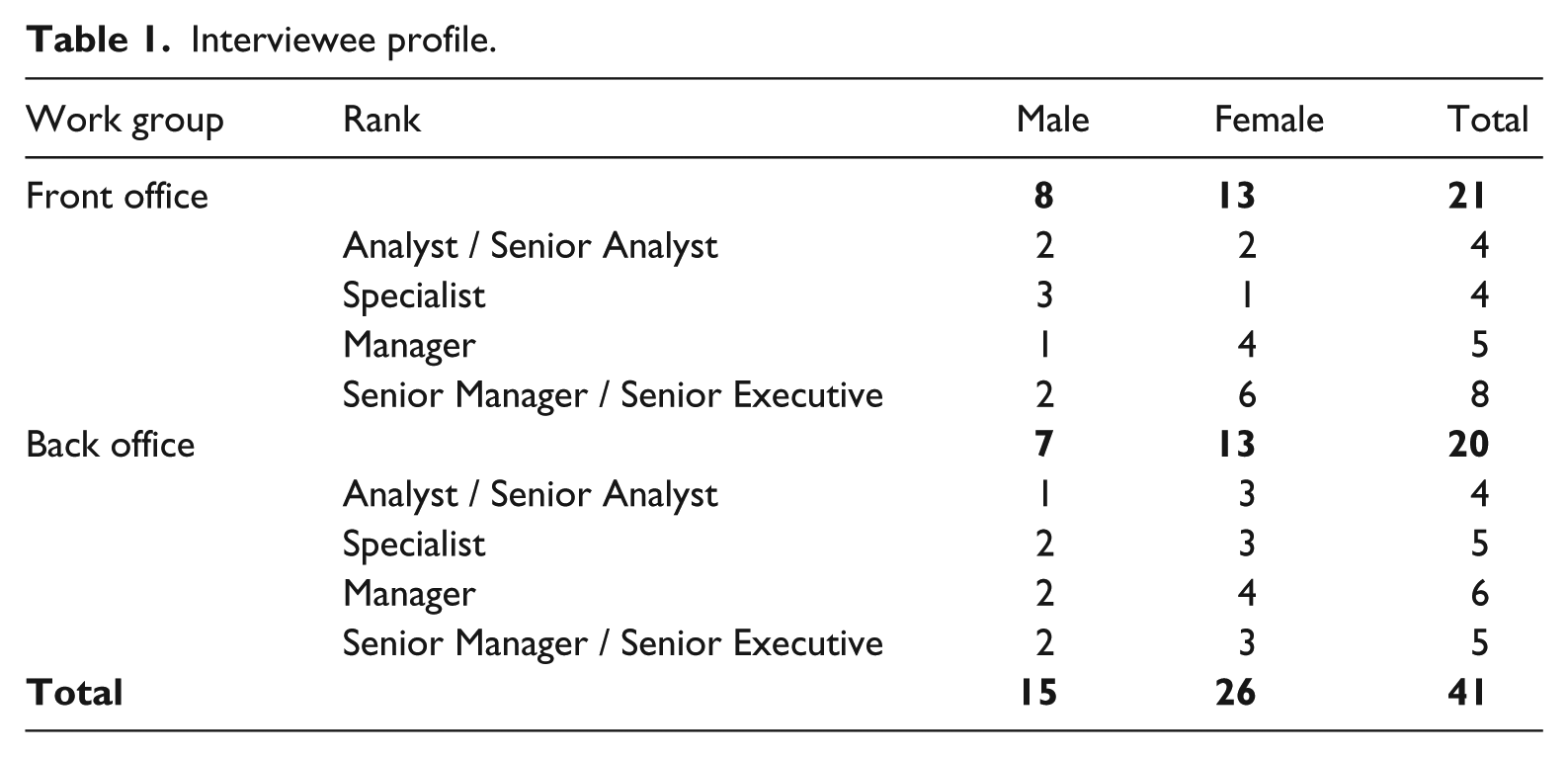
This article reports on the results of three main interview questions: (i) What does flexible work mean to you? (ii) What is your experience of flexible working in this firm? (iii) How would you characterize this experience? These questions were used as a starting point, but each interview followed a fairly different path depending on the interviewees’ experiences. By using open questions, informants were invited to give spontaneous descriptions of their experiences of flexible working that were only minimally influenced by the researchers’ preconceptions. These descriptions reveal thoughts, feelings and actions that are sometimes hidden in ordinary discourse (Charmaz, 2006). The interviews lasted an average of 45 minutes and were recorded and transcribed. Data were managed and coding was supported using NVivo. As all interviews took place in Spanish, translations of the quotes reported in this article were reviewed by two native English speakers with fluent Spanish and two native Spanish speakers with fluent English.
Although the aim was to build empirical evidence through theoretically informed inductive analysis, the interview data were initially coded following an open coding logic (Glaser and Strauss, 1967). In total, 11 codes reflecting different accounts of flexible working emerged. These codes were then synthesized into themes, explaining larger portions of data.
Taking the initial open code ‘working time’ as an example, the following account exemplifies the coding process. Time spent working was one of the core ideas that interviewees discussed when asked about the meaning of flexibility. It was therefore a major aspect of the grounded theory analysis. At first, participants’ accounts were coded as ‘working time’, for example, when interviewee 12 said: At 10 pm I am talking with the US. No one likes to work from 10 pm to midnight, but I do the math and I say: even if I work at 10 pm, it gives me the flexibility to leave the office at 6 pm because I have my own things to do or pick up my son.
As the coding progressed, it became evident that the ‘working time’ code had to be split into a number of different codes to capture the full diversity and meaning of the interviewees’ experiences. In that sense, the previous quote was recoded into two separate codes: ‘working overtime’ (‘At 10 pm I am talking to the US’) and ‘autonomy over work hours’ (‘if I work at 10 pm it gives me the flexibility to leave the office at 6 pm because I have my own things to do …’). At the same time, with this analysis, relations between codes started emerging. In this particular case, there seemed to be an exchange between overtime work and autonomy over work hours. This code refining process (Urquhart, 2013) led to the development of six codes related to working time, namely: working overtime; adapting to changes in schedule; being available; changing start and finish work hours; autonomy over work hours; and taking time off (for specific examples of verbatim quotes for each of these codes, see Tables 2 and 3). Although all these codes were related to the idea of time spent working, they reflected highly different experiences of flexibility. The first three reflected experiences of flexible working that employees understood as demands that the firm placed upon them. Conversely, the last three were impressions of choices around working time made by employees. As such, these six open codes were organized into two dimensions: time demands and time choices.
Flexibility as a contribution: Open codes and quote samples.
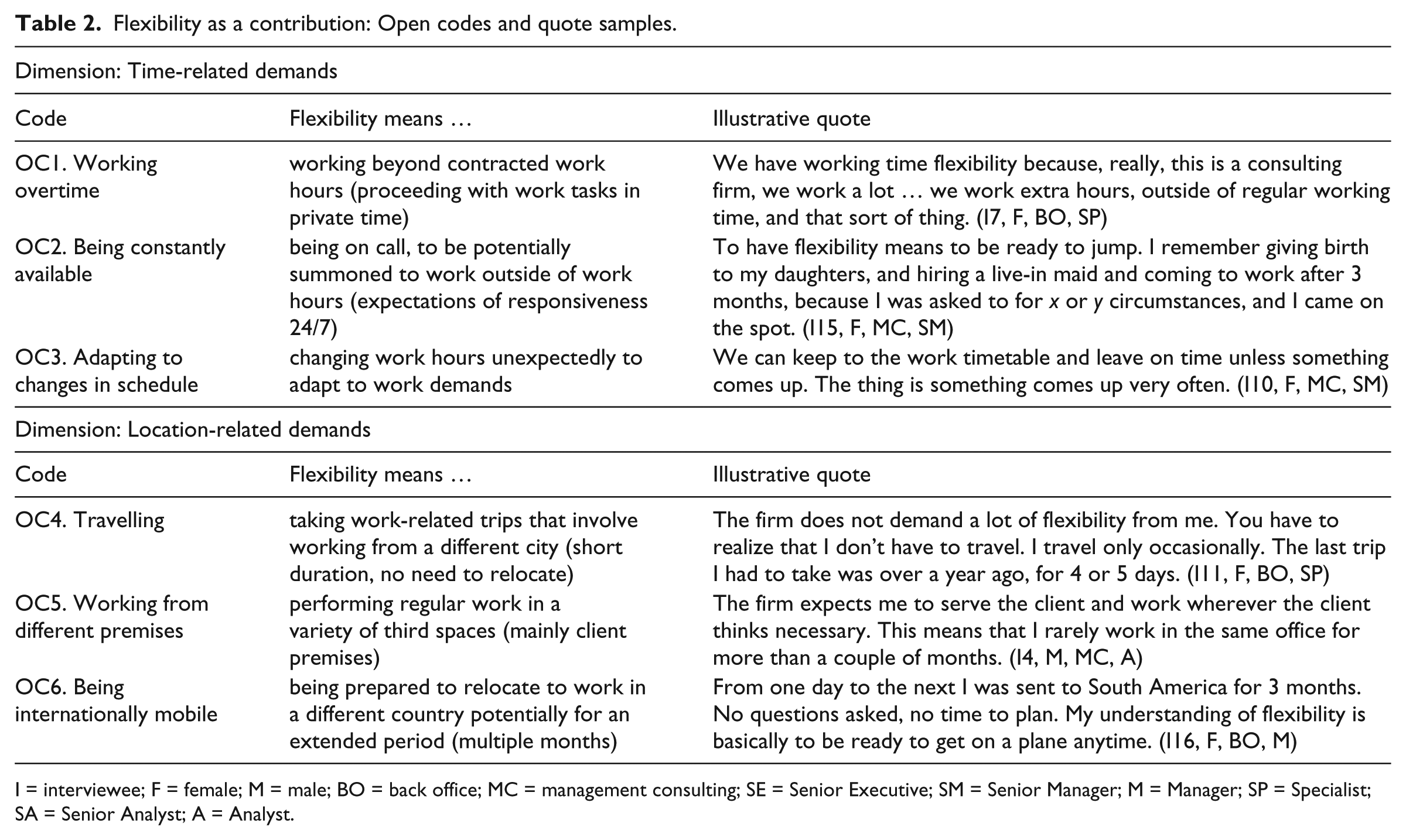
I = interviewee; F = female; M = male; BO = back office; MC = management consulting; SE = Senior Executive; SM = Senior Manager; M = Manager; SP = Specialist; SA = Senior Analyst; A = Analyst.
Flexibility as an inducement: Open codes and quote samples.

I = interviewee; F = female; M = male; BO = back office; MC = management consulting; SE = Senior Executive; SM = Senior Manager; M = Manager; SP = Specialist; SA = Senior Analyst; A = Analyst.
The use of the psychological contract and its premise that the employment relationship involves a perceived exchange of contributions and inducements, led to framing and organizing open codes and dimensions into two larger themes: flexibility as a contribution and flexibility as an inducement. Figure 1 provides a summary of this coding process. As this example shows, keeping initial coding open-ended does not mean that the researcher holds no prior ideas and skills. Rather, a middle-range approach to coding was followed (Dey, 1993): in a first-step, the data suggested the open codes; when linking these into larger categories or themes, such themes were derived from both the data and the literature.
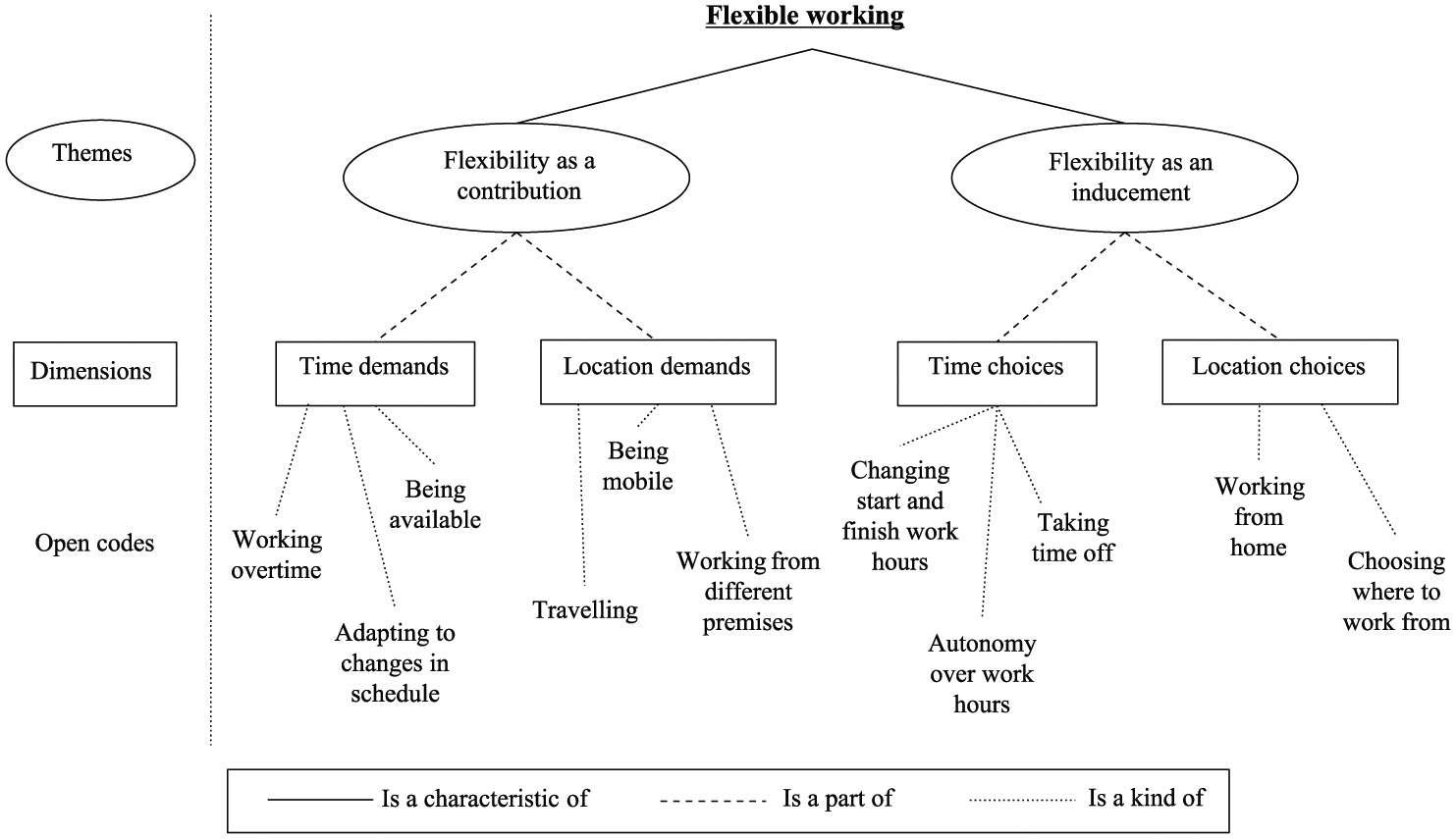
Integrative diagram on the meaning of flexible working for Minerva employees.
Data and analysis
All the interviewees indicated that flexible working is an important element of the employee–organization relationship at Minerva. An employee in the HR team acknowledged that flexibility is one of the features that is monitored and systematically looked for in the recruitment and selection process: ‘This is a company that looks for flexible people. It is a necessity that we have. We try to recruit people who accept changes in working hours and patterns’ (I2, F, BO, M). 2 Similarly, a consultant linked flexibility to the organization’s identity by portraying it as being ‘in the firm’s DNA’ and highlighting that ‘all employees are familiar with flexible work’ (I10, F, MC, SM).
Understanding flexibility as a contribution and as an inducement
Early in the course of the interview process, it became clear that flexible working in Minerva was experienced as an informal but routine way of working. A senior manager provided a typical explanation when asked about flexible working: If you want a complete inventory you need to ask HR because the truth is we get a thousand emails and I don’t know any more what things we have and what things we don’t … I think there is an explicit flexibility, that is those HR practices, and there is another flexibility which is implicit and that we live through every day in the way we work. (I3, M, MC, SM)
This senior manager uses the word ‘implicit’ to depict how flexibility is embedded in his work experience and is intertwined with job characteristics. Other accounts coincide in highlighting the importance of what are often informal arrangements. For instance, although front-office employees do not officially have the possibility to telework, numerous interviewees in this work group mentioned working from home or other locations of their choice as a form of flexible working. One specialist said: We work a lot remotely … If one day we need to stay home for whatever reason, we work from home, take the laptop and that’s it. If we need to work from a train or the airport or wherever, it works too. Once, I spent the morning queuing to get tickets for a concert and I was on my laptop working the whole time. (I39, M, MC, SP).
Flexibility is here depicted as contributing towards the functioning of the organization and as allowing employees to experience autonomy and judgement to make choices, underlining how flexible working can be experienced both as a contribution and as an inducement. Figure 1 illustrates what flexible working means for Minerva employees, which is then described in detail in the following subsections.
Flexibility as a contribution
All participants described the organization as needing flexibility for its functioning. Their accounts illustrate how they understand flexibility as a contribution they are expected to provide, which can take different forms for different people.
(a) Time-related demands
Flexibility as a contribution can take the form of time-related demands, a dimension that includes three understandings of flexibility. The first is working longer than official work hours (OC1). For instance, an employee said: ‘Flexibility sometimes enables overtime. I come in at 8 to leave early, but at the end I don’t leave early. The fact of having a flexible schedule can intensify the workday’ (I10, F, MC, SM).
All employees indicated in different ways that they understood working beyond contractually established work hours as a form of flexibility with which they contribute to the firm. The second understanding in this dimension is being constantly accessible and available to attend to work issues (OC2). This does not necessarily involve working overtime, but being on call to be potentially summoned to work outside of work hours. For example, a manager said: ‘If there is a meeting at 10 pm with Americans that is going to take 2 hours, I have to do it, wherever I am, even if I am on vacation’ (I17, F, MC, M).
The accounts included in this code indicate that flexibility involves 24/7 responsiveness, which can sometimes lead to working overtime and is thus connected to OC1. The third understanding is adapting to recurrent changes in the way work is organized (OC3). A specialist explained: We deal with a lot of last minute things and you need to adapt. Client comes first. Flexibility is there to serve them: if there are changes, you absorb them, reconfigure and continue. I may come into work thinking that I’ll do X in the morning, then meet a colleague for lunch then work until 8. But at 10 something happens so I have to skip lunch, meet my colleague at 7, then work from home until late. (I13, M, BO, SP)
Like many other interviewees, this specialist highlights that flexibility means adapting his schedule to attend to unexpected work demands.
(b) Location-related demands
Flexibility as a contribution can also take three other forms, which can be labelled as location-related demands. The first is regular business travelling (OC4), as noted, for example, by interviewee 3 when saying, ‘What requires more flexibility is trips. So far this month, I’ve been on 14 flights’ (I3, M, MC, SM). The second is itinerant workplaces (OC5), as exemplified in interviewee 27’s quote: ‘I have been affected a lot, in terms of my day to day life, to move workplaces all the time. That requires flexibility’ (I27, M, MC, M). This type of flexibility is more present among junior front-office employees’ accounts (analysts, specialists and managers) because they very often work from the clients’ premises. This is also the case for the third form of location-related demands, mobility to relocate upon request (OC6). For instance, a senior manager said: A problem that a lot of people have with this job is mobility. You have to have mobility. Being flexible is not simply pushing yourself harder than anyone else and slaving at the desk until 11 pm. Many times, it requires following your client wherever they go. For example, I was in Chile for a while and that’s not something everybody copes with well because with families and mortgages and all of that, it’s not easy at all. (I12, F, MC, SM)
Definitions for each code and more examples of interview quotes are provided in Table 2.
Flexibility as an inducement
All participants also understood flexibility as an inducement that is provided to them. In this sense, flexibility is perceived as granting agency to manage work responsibilities autonomously. Employees enact flexibility by making choices related to where and when they work:
(a) Time-related choices
This experience comprises three understandings of flexibility. The first is being able to change start and finish work hours (OC7). A manager described: ‘I have work time flexibility. In the mornings, I go to the gym or run errands and I arrive here around 9.45 and there is no problem. This is a policy I make use of and then I leave late’ (I35, F, MC, M). The second involves deciding on work hours autonomously (OC8). A manager said: I have total flexibility to manage my schedule. I don’t leave very late. On my own account, I work on the weekends. If I am not very tired and I don’t need to, I don’t go on holiday … I have a lot of responsibilities … I decide how to organize myself. (I5, M, BO, M).
This autonomy goes beyond the ability to change start and finish work hours shown by OC7. An employee explained this in the following manner: Officially, I start work from 8 to 9.30 and finish between 6 and 7.30 but there is flexibility because if I need to leave for whatever reason, there is no problem. This is based mainly on having work up to date and getting results. (I17, F, MC, M)
The interviews appear to indicate an evolution in time from employees having the ability to change start and finish work hours, to getting full autonomy over their schedule. Indeed, the code OC8 is less present among the more junior employees with less tenure. This sort of flexibility as an inducement appears to require the trust of superiors, which needs to be built over time.
The third understanding included within time-related choices is deciding to take time off (OC9). In a representative quote a manager said: ‘children get sick and that’s inevitable. Working flexibly means that if one day I miss work to stay with them, no one makes a big deal. They know I work a lot, that I will make up the time by far’ (I17, F, MC, M).
(b) Location-related choices
Location-related choices encompass two more understandings. The first is being able to work from home (OC10). Many employees described how they benefit from formal or informal arrangements to regularly work from home a certain number of days per week. For example, an analyst said: ‘Teleworking is the big flexibility thing. The firm offers me to telework 2 days a week. This allows me to avoid traffic and to have time to go to the gym twice a week’ (I34, F, BO, A).
Another way to understand flexibility is choosing from where to work independently (OC11), as illustrated by a specialist in the following quote: Today’s situation is a good example of flexibility. I told my supervisor I had this interview at this location, which is not my regular work establishment; therefore, I decided to work at home in the morning, and will work remotely from this office after we finish. (I13, M, BO, SP)
The experiences of flexibility as an inducement included in this understanding are different to OC10 (working from home) because, as illustrated by the quote, they are irregular, opportunistic and generally unplanned. Code definitions for flexibility as an inducement and more illustrative quotes can be found in Table 3.
These findings indicate that two types of factors influence different aspects of flexibility. Demand factors are job requirements, which employees feel they have to satisfy by being flexible towards the firm. Choice factors, on the other hand, reflect the employees’ capacity to arrange work on their own terms. If factors leading to perceptions of flexibility as a contribution and flexibility as an inducement are distinct, it is possible for employees to experience both high flexibility as a contribution and high flexibility as an inducement.
At the same time, all interviewees provided vivid accounts suggesting that flexibility as an inducement and flexibility as a contribution were intertwined experiences and difficult to separate. For instance, a manager said: In my 11 years in this company … I have noticed that there is lots of flexibility because you can organize yourself even if you work a lot. The company requires you to be 24/7 and to travel and to come and go and to have availability … but this means you can also choose: today I stay or today I leave later or, I go to the doctor and no one is going to ask for an explanation, in that sense the company is very flexible. (I29, F, MC, M)
Her words illustrate how flexible working experiences combine contradictory qualities. Freedom to exercise autonomy to organize oneself entails the potential increase in efficiency, which, whilst it allows room for personal discretion, also paves the way for intensification of work, for example in the form of heightened productivity. Flexibility experienced in such ways as both an inducement and a contribution can therefore be understood as constituting a paradoxical tension. The following section delves into how employees make sense of and manage this tension.
Managing the tension: The construction of flexible working
Although some respondents talked about the intertwined, and at times paradoxical, nature of flexible working in relation to specific events, the existence of paradoxes and tensions was more commonly discussed in terms of a balancing of accounts or ongoing series of trade-offs. Flexibility is described as an ambivalent experience, generating mixed feelings. The two aspects of flexibility are distinct, but not mutually exclusive, watertight compartments. For most participants, flexible working is associated with high demands that they need to abide by, but also elicits comments related to making choices to match their needs. To make sense of this tension, employees construct an overall understanding of flexible working, combining their experiences of flexibility as an inducement and flexibility as a contribution. The findings suggest the existence of two simultaneous construction mechanisms: (i) vacillation and ongoing exchange and (ii) integration.
Vacillation and ongoing exchange
On the one hand, employees make sense of the tension between flexibility as an inducement and as a contribution by separating the two and swinging from one to the other to construct a sense of exchange. Most participants portrayed flexibility as combining contributions and inducements that are traded over time, swaying like a pendulum. In some cases, the vacillation results from periodic changes in workload: There are many peaks, starting the year tariffs are negotiated, there are lots of pending decisions. At the beginning of the year there are always more peaks and then monthly closings approach. The first days of each month, there may be lots of peaks so people in general work overtime, like even from 8 am till midnight or 1 am … That is one side of flexibility but outside of those days, we can … have time for ourselves if we need to … sometimes getting in late to do paperwork or leaving a bit earlier to go to the gym, or stuff like that. (I7, F, BO, SP)
This employee’s account underlines how flexible working can involve additional workflow-related contributions at certain times of the year or the month, when demands are particularly high. In exchange, employees feel they are granted flexibility to make choices at other less busy times. For instance, an interviewee expressed how perceptions fluctuate through the succession of different periods: There are periods in which you live for the client and, of course, there flexibility doesn’t benefit me because it only serves to attend to the client. I get called? I take it. I don’t get called? I’m alert in case I do. But it is not like this all the time. (I6, M, MC, SP)
The timing of this exchange varies for departments and roles. For instance, the first quote (I7, F, BO, SP) highlights more predictable monthly or yearly workflow patterns, which are predominant among back-office employees. For client-facing consultants, there is volatility in demands within projects, juxtaposing days that require absolute availability and relatively off-peak periods. In addition, an employee working for a client requiring high levels of flexibility for six months can expect to be assigned to a less demanding project afterwards.
Other employees come to construct a sense of exchange through singular but noteworthy events. For example, a senior manager said: In this firm, flexible work means total dedication. Total means that you can work any weekend, any Christmas holiday, at 1 am you may be sending emails and a colleague replies and you get online [on the internal communication system], and everybody is there! … For me, things are not like I’ve been working like a dog so now I take 3 days off or I work from home because I want to or something like that, but if I really need flexibility for me at some point, the firm responds … Years ago I went through a very bad emotional period, but here no one sidelined me. I didn’t need to get a sick leave, I made use of a programme to extend holidays from 1 to 3 months, and I kept a large part of my salary. (I30, F, MC, SM)
This senior manager’s story shows how employees willingly absorb the demands of the organization because they have an emotional confidence that they will also benefit from flexibility. A consultant provided another example: My father passed away 4 years ago. Legally I had 2 days off but I took 4 and no one said anything to me. I didn’t have to discount it from my holidays. This was very meaningful for me … Believing that you’ll get what you need when you need it is one thing, but actually getting it … you see that flexibility is not just a myth … They demand dedication but then they rise to the occasion … Weighing everything up, it balances out. (I8, M, MC, SP)
What these examples have in common is that although employees describe their experience of flexibility primarily as a contribution, events entailing exceptional but significant experiences of flexibility as an inducement create a sense of reciprocity. Being granted flexibility to attend to exceptional circumstances is perceived as a major inducement and plays a significant role in developing a sense of vacillation: sometimes flexibility is an unavoidable contribution; at other times it is a gratefully received benefit that operates as an inducement.
Integration
On the other hand, the findings suggest employees also integrate their experiences. In this sense, they manage the tension by understanding their perceptions in relation to one another, as part of a whole. For instance, when asked about what flexible working meant for him, a manager said: ‘This is a global firm. If I have a call at 10 pm, I have to take it’ (I5, M, BO, M). A little later in the conversation, the same manager added: I drop my daughter at school at 9 am, I drive my wife to her job which is fairly close and make it to work myself around 9.20–9.25 and there is absolutely no problem with that. This is basically the only flexible-working measure that I use. What I value most in the world is being able to drop my daughter at school. To me this is a huge incentive. (I5, M, BO, M)
At the end of the interview, he summarized: ‘In general terms, this [flexibility at Minerva] works very well for me’ (I5, M, BO, M). This employee’s characterization of flexible working shows it is not a well-delimited, concrete practice, systematically oriented towards the employer or the employee. In this employee’s experience, flexible working time conceals an underlying demand to be available to answer work-related calls any time of the day. At the same time, he depicts time-related flexibility as his own capacity to protect a part of the day that is important to him. Moreover, as indicated by the third quote, this employee does not consider that bringing his daughter to school is an exchange for taking calls at 10 pm. Rather, both activities merge in his mind as constituting a flexibility that works for him.
His explanation illustrates how often the experience of flexibility as a contribution is inherently connected to the experience of flexibility as an inducement. For example, time-related flexibility enables individuals to have both increased autonomy to decide when to work (OC8) (flexibility that is interpreted as an inducement) and to adapt their schedule to firm requirements (OC3) (flexibility that is interpreted as a contribution). However, individuals do not consciously separate these experiences, which they see as a whole.
Another example emerges from the experience of telework that appears to often be connected to longer working hours. On the one hand, when they stay at home, employees take advantage of avoiding transportation to start work earlier or finish later. A specialist said: ‘[When I telework] I definitely work longer because I use the time that I’d be commuting for work’ (I34, F, BO, A). Another employee said: I come to work in the company’s shuttle so I’m bound by the shuttle’s schedule … When you choose to work at home you don’t have that problem because if you need to stay an hour longer, or two, or whatever time, you are at home and it’s much easier. (I9, M, BO, A)
On the other hand, being at home, employees are willing to work at unsocial hours to match company needs: Having people in different time zones, we need to be flexible. We are not going to be in the office at 1 am. You stop at a normal hour, go home and work from there, and the next day you stay home comfortably and you might do some personal errands or pending stuff for a little while. (I25, F, MC, SM)
These quotes suggest that working overtime emerges naturally from working from home (cf. quotes I34 and I9) and telework renders working late possible (cf. quote I25). These flexible working experiences coexist, being interdependent of one another: they are two sides of the same coin.
These representative employee accounts indicate that they do not perceive flexibility as an inducement and flexibility as a contribution as opposing phenomena, but rather as experiences that interact and co-evolve. Although, they might appear contradictory, benefiting either the employee or the employer, their concurrence and inherent connection to experience make them interwoven. For instance, an interviewee said: ‘We have a very flexible schedule for better or worse … when I need to stay longer, I stay longer, but if I have to come in late, I come in late’ (I16, F, BO, M). Another employee said: I love flexibility because many days I can do my job wherever I want. My family is not from Madrid, and working from airports or trains helps me see them more often. At the same time, the company sends me wherever I’m needed with very short notice because they know I am productive on the move and I can prepare for stuff quickly while I travel. (I38, M, BO, M)
These quotes show that, rather than negating one another, perceptions of flexibility as an inducement and flexibility as a contribution are entangled in employees’ experiences and integrated in their minds. This integration process allows employees to make sense of the paradoxes embedded in flexible working and manage the tensions that can emerge.
Development of an overall mental picture
The two construction mechanisms (vacillation and integration) help employees create an overall understanding of flexible working – a mental picture of their flexibility. Many interviewees described this idea in a similar manner, using phrases such as ‘in general I feel flexibility is …’ or ‘in global terms I’d say my flexible work arrangement is …’. The findings indicate that employees in both back-office and front-office roles internalize their multiple experiences and build an overall image of flexible working. Although singular experiences may fluctuate, this overall perception appears to temporarily stabilize the understanding of flexible working. An analyst said: ‘I guess I have a global picture of what things are like. One day, one thing, doesn’t … change my view. It’s kind of the sum of things that I look at’ (I37, M, MC, A). An executive described flexibility in the following terms: ‘Flexibility changes every day. Some days I take and others I give, but on average I think I have a general feeling that things are balanced’ (I1, F, BO, SE). Her description shows how experiences, over time, create a global mental picture or ‘general feeling’ of flexibility, that is durable enough to withstand the fluctuating circumstances that also characterize the responsiveness required in professional occupations such as consulting.
It must be noted that the fact that employees develop this overall mental picture does not imply that tensions are resolved and disappear. On the contrary, a push and pull dynamic between flexibility as a contribution and flexibility as an inducement exists that is continually unfolding. Creating an overall perspective of flexible working that stabilizes the experience helps employees cope with such ongoing tension.
Discussion
This article has explored how employees understand and experience flexible working in the context of a global consulting firm. The article started by discussing two existing approaches to the concept of flexibility that, when examined together, appear paradoxical. On the one hand, flexibility has been studied as an employer-centric practice that allows organizations to adapt to competitive needs (Blyton, 1992; Hoge and Hornung, 2015). On the other hand, flexibility is increasingly analysed as an employee-focused practice that enables employees to make choices about their work arrangements and a genuine contributor to work–life balance (Grzywacz et al., 2008; Hill et al., 2008; Pitt-Catsouphes and Matz-Costa, 2008; Russell et al., 2009). In line with Martinez-Lucio et al. (2000), this study has argued that the way forward in unpacking the intricacies of flexible working is to explore employee experiences beyond established HR practices (Kossek et al., 2010; Piening et al., 2014) and to embrace the existence of paradoxical tensions (Putnam et al., 2014) as simultaneous interwoven phenomena (Lewis, 2000; Smith and Lewis, 2011).
The analysis presented in this article suggests two main findings. First, in line with the literature on the paradoxical tensions of flexibility (Putnam et al., 2014), I find that individuals elaborate a mixed mental picture of flexible working in which perspectives that are traditionally considered as employer or employee-centric can instead be seen to co-exist and interact. The participants in this study did not understand flexible working as clearly defined practices that either support operational needs or individuals’ work–life balance (Reilly, 1998). Instead, it was apparent that flexibility was a perception that employees developed as a combination of contributions and inducements through their interpretation of unfolding experiences.
Many interviewees had no specific knowledge of HR-designed flexibility practices or said those did not apply to them, but still described flexible working experiences. Thus, flexibility cannot be simply understood as a practice designed and implemented by HR, but more as a phenomenological experience (Grzywacz et al., 2008) generating meanings that overflow the official framing. In this sense, flexible working can be understood as a psychological contract (Rousseau, 1995), always being ‘in a state of ongoing formation’ (Conway and Briner, 2005: 132). Flexible working fluctuates through unfolding events and is constantly being shaped. Therefore, a priori considerations of whether practices are employee- or firm-oriented (Kerkhofs et al., 2008; Reilly, 1998) can be limiting.
Second, contrasting experiences of flexibility as an inducement and flexibility as a contribution can generate tensions and an ongoing dialectical push and pull process (Putnam et al., 2016) that individuals stabilize and manage by constructing an overall perception of flexible working. Two construction mechanisms emerged from the data: vacillation and ongoing exchange, and integration. On the one hand, employees at Minerva make sense of the tension between their perceptions of flexible working demands and choices by differentiating the two and vacillating between them to develop a feeling of ongoing exchange. This iteration between opposites is an effective way of ‘holding both poles together, meeting antithetical goals’ (Putnam et al., 2016: 124). On the other hand, they integrate their experiences by understanding their perceptions of flexibility as an inducement and flexibility as a contribution as an entangled whole. In this sense, employees combine and balance their experiences, developing a compromise – a way to meet competing demands and work through the tensions (Putnam et al., 2016). This balancing act is a common process in organizational contexts in which paradoxical tensions are persistent (Schad et al., 2016: 37).
The identification of these mechanisms reinforces the finding that flexible working is constructed and enacted through individual-level processes. In this respect, the article points towards the need to further explore informal flexible work arrangements as i-deals, which have yet seen little study (de Menezes and Kelliher, 2017; Eaton, 2003; Hornung et al., 2008). Indeed, in professional occupations, individual interpretations of flexible working are likely to have an influence in the way informal arrangements are negotiated and put in place.
Moreover, these findings indicate that consultants use what Putnam et al.’s (2016) label ‘both-and’ responses to manage paradoxical tensions. According to these authors, such mechanisms provide a short-sighted approach to managing organizational paradoxes and are likely ineffective in the long run. Indeed, the findings suggest that the construction of an overall perception of flexibility does not resolve the tensions. Rather, it is a temporary stabilization that employees construct to make sense of flexible working. The ongoing push and pull dynamic between flexibility as a contribution and flexibility as an inducement remains and evolves over time. In this sense, flexible working implies a dialectical relationship which, owing to lack of resolution, proves paradoxical (Schad et al., 2016). A longitudinal analysis of the ways in which the overall perception of flexible working fluctuates and evolves could provide interesting insights. Future research could explore if these responses to paradoxical tensions are sustainable or if, as suggested by Putnam et al. (2016: 128), ‘more than’ responses, such as transcendence or connection, should be applied to ‘seek energy from tensions and sustain the ongoing interplay between opposites’.
This article adds to the literature by offering a framework to understand flexible working as part of the employment relationship, to unpack the paradoxical tension existing between experienced flexibility contributions and inducements and explore how employees manage such tension (Lautsch et al., 2009; Putnam et al., 2014). From a practical perspective, it is important to know that flexible working experiences are more complex than what could be understood from HR policy documents and practices. The existence of formal policies does not necessarily drive flexible working experiences and how flexibility is put into practice. In this sense, understanding how individuals build perceptions of flexible working and manage the tensions it generates can help managers create effective flexible working contexts.
From a theoretical perspective, seeing flexibility as part of the employment relationship, and analysing it through the lens of the psychological contract, offers an avenue to explore these complex experiences as being embedded in the way work is conducted and organized. Therefore, it is possible to transcend the paradoxical tension between flexibility as a contribution and flexibility as an inducement. As noted above, future work can further study how actors participate in the ongoing enactment of this tension. From an empirical perspective, it must be noted that, although most of the individual interpretations of flexibility discussed by Minerva employees are already present in the existing literature (such as telework or overtime), the aspect of mobility as flexibility as a contribution is new and has not been identified as flexibility yet. Its analysis would thus require further exploration.
The focus on developing a rich understanding of how flexible working is experienced and interpreted by employees also answers calls made by authors in the HR discipline to put aside the analysis of HR content and devote more attention to the process aspects of HRM systems (Piening et al., 2014). The consideration of flexibility as a process opens the door to further investigating the management of tensions throughout the lifetime of the employment relationship. Whether the evolution of flexibility and the tensions that it generates is connected to organizational or individual-level mechanisms, and whether they operate differently depending on tenure would be interesting aspects to further analyse. Besides, if flexibility is both an inducement and a contribution, it follows that it can be negotiated. Studying how such negotiation takes place would provide insights to both theory and practice. For instance, it would be necessary to develop further theory on the role supervisors play in this negotiation and in managing the implementation of flexibility (Lautsch et al., 2009), particularly in the case of informal arrangements (de Menezes and Kelliher, 2017).
Overall, this article has contributed to developing the understanding of flexible working. Figure 2 depicts three different approaches to understanding flexibility. The bipolar approach looks at flexibility either from the perspective of the employee (e.g. in Hill et al., 2008) or of the employer (e.g. in Hoge and Hornung, 2015), making the two independent of one another. The ends of a continuum approach see flexibility as a scale that can lean towards the interests of the employer or of the employee, and take the two options as opposed and incompatible (e.g. in Fleetwood, 2007). The paradox approach points out that flexibility should be seen as a complex, ambivalent experience, entailing ongoing tensions (e.g. Putnam et al., 2014). Drawing on previous representations of paradox, this view is illustrated by the Taoist symbol of Yin and Yang (Lewis, 2000; Smith and Lewis, 2011), which represents how apparently contrary forces may really be complementary, interlinked and interreliant. This article has presented an understanding of flexibility based on the emergence of meaning constructed through lived experience. This view allows for simultaneity of employer- and employee-focused approaches to flexible working and the study of their interdependence, providing broad support to the paradox approach (Martinez-Lucio, 2000; Putnam et al., 2014; Taskin and Devos, 2005), albeit contextualized within the psychological contract and the employment relationship. The article offers new insights to help clarify the controversy that exists with regard to how flexibility is practised and experienced in the context of consulting organizations (Donnelly, 2015; Whittle, 2005), with likely implications for other professional service firms (Lupu and Empson, 2015). It also contributes to the development of a further explanation of the apparent tensions identified in the literature on specialized knowledge workers (Perrons, 2006; Smithson et al., 2004). Notwithstanding these contributions, this research has limitations. First, the initial six interviews were suggested and organized by HR. The HR director contacted employees who were potentially interested in participating in the study. These individuals may have been inclined to provide answers favourable to or not critical of the firm and its HR policies. This procedure may also have reduced trust in the promise of confidentiality. Second, a possible limitation is participant self-selection bias. It could be argued that solely participants that are more attracted to flexible working would accept being interviewed. To mitigate this issue, interviewees were asked to introduce me to two or more colleagues that could have a different view on the phenomena under investigation. This also reduced the HR director’s initial influence over interviewee selection. Third, the case study method has limitations. Some results may be related to the particular characteristics of this organization. Moreover, professional services firms organize work in ways that may not be transferable to other companies. Still, this case offers relevant insights, mainly for other organizations employing knowledge workers – a growing part of the economy (Miozzo and Grimshaw, 2006).

Three approaches to flexibility.
Conclusion
This article has investigated how flexible working materializes in everyday individual work experience by stepping into employees’ shoes to grasp their interpretations of the phenomenon. As this study has demonstrated in the case of Minerva, employees’ experiences of flexible working exceed what could simply be read off from formal HR policy documents and approved practices. Analysing employees’ accounts of flexible working indicates that flexibility is stabilized in a continuous manner, based on employees’ accumulated and evolving experience of flexibility as inducements offered by and contributions provided to the firm. Overall, the article has advanced a perspective of flexibility based on the existence of a paradoxical tension between such perceived contributions and inducements. Flexible working is thus understood and interpreted by employees as a process that is integral to the employment relationship.
Footnotes
Acknowledgements
I would like to thank Richard Woolley, David Marsden, Alexandra Beauregard and the three anonymous reviewers for their helpful comments on earlier versions of this article. I am also grateful for Associate Editor Matthew Sheep’s comments and guidance throughout the manuscript’s review process.
Funding
This research was supported by funding from Fundación Ramón Areces.