




Abstract
Developing-world rural migrants provide crucial labor for global supply chains and economic growth in their native countries. Yet their high turnover engenders considerable organizational costs and disruptions threatening those contributions. Organizational scholars thus strive to understand why these workers quit, often applying turnover models and findings predominantly derived from the United States, Canada, England or Australia (UCEA). Predominant applications of dominant turnover theories however provide limited insight into why developing-world migrants quit given that they significantly differ from UCEA workforces in culture, precarious employment and rural-to-urban migration. Based on multi-phase, multi-source and multi-level survey data of 173 Chinese migrants working in a construction group, this study adopts an identity strain perspective to clarify why they quit. This investigation established that migrants retaining their rural identity experience more identity strain when working and living in distant urban centers. Moreover, identity strain prompts them to quit when their work groups lack supervisory supportive climates. Furthermore, migrants’ adjustment to urban workplaces and communities mediates the interactive effect of identity strain and supervisory supportive climate on turnover. Overall, this study highlighted how identity strain arising from role transitions and urban adjustment can explain why rural migrants in developing societies quit jobs.
Keywords
Introduction
Employee turnover has become a global phenomenon as more economies enable employees to freely change jobs as a result of loosened labor laws and reduced state intervention in labor markets (Lee and Kofman, 2012). Given that workforce mobility occurs worldwide and affects organizational functioning (Park and Shaw, 2013), scholars increasingly explore why people quit in a wider array of cultures and economies (Allen and Vardaman, 2017). All the same, international researchers often apply turnover models developed in the United States, Canada, England or Australia (UCEA) (Maertz et al., 2003), presuming their universal applicability (Chen et al., 2016; Posthuma et al., 2005). Although Allen and Vardaman (2017: 169) recently concluded that ‘turnover models and processes . . . generalize quite well across cultural contexts’, other scholars dispute their direct ‘context-free’ transferability (Tsui et al., 2007), especially to societies differing from UCEA countries in terms of culture and economic development (Maertz et al., 2003; Peltokorpi, 2013).
Responding to perennial calls to explore turnover outside UCEA societies (Peltokorpi, 2013), we investigate turnover among developing-world (DW) ‘precariats’ (Lee, 2016), who assume precarious employment lacking job security and benefits in construction or export-oriented manufacturing (Chih et al., 2016; Loess et al., 2008). Because these individuals differ greatly from UCEA workforces in culture, precarious employment and rural-to-urban migration, their scrutiny rigorously tests the generalizability of prevailing models. Despite pervasive journalistic and qualitative reports (Choi and Peng, 2015; Romero and Cruthirds, 2009), empirical scrutiny of DW precariat turnover remains sparse (Chen et al., 2016; Miller et al., 2001; Qin et al., 2014). This scant empirical evidence is surprising given that DW precariats surpass the UCEA labor force (Cirera and Lakshman, 2014), dominate global manufacturing (The Economist, 2015), and exhibit extreme turnover (e.g. 60% in the People’s Republic of China [PRC]; Fallows, 2012). Such attrition causes labor shortages while boosting costs and production shortfalls in manufacturing, construction and other industries vital for emerging economies (Du et al., 2006; Jiang et al., 2009).
Apart from scarcity, empirical studies mainly focused on how working conditions (including attitudes toward ‘3-D’—dirty, demanding and dangerous—jobs) and job prospects impel DW precariat turnover (Chen et al., 2016; Miller et al., 2001; Qin et al., 2014; Smyth et al., 2009). While confirming UCEA theory promulgating movement desirability and ease (March and Simon, 1958), this focus neglects turnover causes arising from transition stress plaguing these subsistence farmers (e.g. 252 million Chinese; Mozur and Orlik, 2012), who leave behind home and family in the countryside to enter distant urban labor markets. That is, predominant applications of dominant turnover theories overlook how the twin challenges of adapting to unfamiliar work and living environments impel rural migrants to quit. DW migrants endure cultural shock when adapting to urban society, while being separated from their family in remote villages (Qin et al., 2014). Thus, provincial migrants’ poor adjustment to urban roles likely compel them to exit urban workplaces.
To close a conspicuous gap in prevailing accounts of DW migrants’ turnover, we adopt an identity strain perspective to clarify why they quit jobs, contextualizing this model to enhance its applicability (Lee et al., 2017). Adapting self-verification and identity-strain theories (Burke, 1991, 2006; Tajfel and Turner, 1986), we contend that migrants’ decision to leave urban jobs hinges on how well they transition from old to new role identities (i.e. ‘country folk’ to ‘urbanite’). When entering urban environments, they undergo sensemaking, prompting them to form new ‘situational identities’ based on their urban work and lifestyle (Cable et al., 2013). However, many migrants maintain their provincial identity, regarding village roles in farming, family and civic leadership as central to their self-concept (Paik, 2014). Such rural identification creates identity strain when their identity lacks urban affirmation. As a result, they adjust poorly to cosmopolitan employment and lifestyle and thus leave.
Our model further recognizes the critical role that migrants’ supervisors play in their rural-to-urban transition. We follow Bakker and Demerouti’s (2007) job demands-resources model, positing that job resources attenuate the harm incurred by job demands. Specifically, we submit that supervisory supportive climate—or ‘general availability to work unit members of key object, energy, and social resources provided by their supervisor’ (Wang et al., 2011: 317)—buffers against identity strain. Given weak union and labor protections (Lee, 2016), supervisors are dominant authorities who can supply precariats various resources that can alleviate identity-strain duress. We examine supervisors’ collective support given that collectivist developing countries extol homogenous paternalistic leadership rather than differential support that can undermine group harmony (Nishii and Mayer, 2009).
In sum, we propose that DW migrants’ identity strain (sustained by rural identity) jeopardizes their urban adjustment, in turn prompting their quits, while noting that a supportive supervisory climate can ameliorate this effect. To test our model (see Figure 1), we conducted a multi-phase, multi-source and multi-level field study among 173 PRC migrants. By so doing, we advance turnover and identity literatures in several primary ways. First, we answer the call for more inquiries into workforces outside UCEA societies by investigating a culturally dissimilar DW precariat workforce, thus providing a rigorous generalizability test. Second, we deepen insight into DW migrant exits by identifying a salient but overlooked turnover driver arising from rural-to-urban transitions. This study not only helps explain the high turnover rate in emerging economies but also enriches predominant turnover theories by highlighting how drastic work and extra-work role transitions evoke identity strain that can culminate in leaving. We elaborate on these and other contributions in the discussion section.
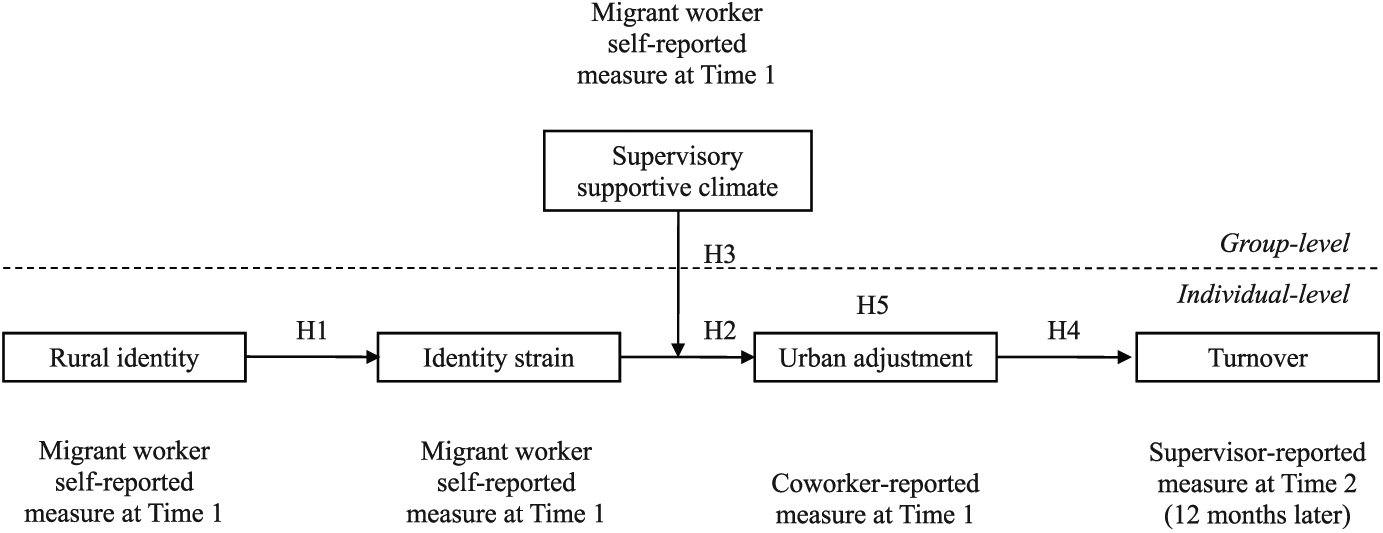
The theoretical model about how rural identity and identity strain influence turnover.
Theoretical grounding and hypothesis development
Rural identity and identity strain
Burke (1991, 2006) identifies three mechanisms underlying how extant identities invoke identity strain (Kraimer et al., 2012). One mechanism is the standard or setting of a certain identity—or ‘set of meanings defining who one is’ (Burke, 2006: 82). In rural China, migrants form a provincial identity standard (e.g. ‘I am a peasant’) as they have deep ancestral ties to farming (Silverstein and Cong, 2013). Their ancestors tilled the same soil for centuries, while they continue to have farming and residential rights to ‘their’ land, where they also maintain a homestead (Friedman and Lee, 2010; Qin et al., 2011). Home visits during Chinese New Year and regular mobile phone calls to family reinforce their rural identity standards (Xu, 2016), as do local networks of migrants from the same home province (laoxiang) who preserve native customs in the destination society (Liu, 2015; Yue et al., 2013). Burke’s (1991) other mechanisms include ‘input from the environment or social situation (including one’s reflected appraisals)’ and the ‘process that compares the input with the standard (a comparator)’ (p. 837). These mechanisms are ‘tightly linked and involve a self-verification process wherein individuals seek to validate their identity by seeking input from their environment to determine whether their current social position is consistent with their own “identity standard”’ (Kraimer et al., 2012: 403).
However, Chinese migrants have trouble validating their provincial identity when working and residing in cities. As Burke (1991) puts it, they receive inputs from their urban environment (including reflected appraisals) that conflict with rural identity standards. When confronting such discrepancies, migrants experience identity strain (Kraimer et al., 2012) that activates a variety of reactions, including anxiety and depression (Liao et al., 2015; Naeem et al., 2015). To illustrate, migrants may encounter negative stereotypes from urbanites who see them as ‘country bumpkins’ doing menial work (Gu et al., 2007; Kim, 2015; Siu, 2017) or even as vagabonds (Swider, 2015). These stereotypes clash with migrants’ identity standards as versatile and respected farmers. They may also feel stigmatized as second-class citizens as they lack official household registration in cities (hukou) (Lee and Kofman, 2012), denying them affordable housing and other residential amenities (Loyalka, 2012; Swider, 2015). Because migrants’ self-concepts are neither affirmed nor verified (Cable et al., 2013), they may then feel identity strain and emotional distress (Liao et al., 2015; Myerson et al., 2010; Zhong et al., 2016).
Beyond this, the stronger the migrants’ rural identity, the higher the mismatch between rural identity and urban inputs, which worsens identity strain (Burke, 1991). Chinese migrants adhering to rural identities may persist in their pattern of provincial thought and behavior in urban societies. After all, they ‘[regard] land as the most fundamental security, [take] agriculture as main work and [work] in cities as byline, and [deem] the countryside as their final destination’ (Gu et al., 2007: 3). By clinging onto rural identities, PRC migrants become less receptive—if not antagonistic—to urban customs, norms and values. They thus face more difficulty integrating into urban life and forging a new identity as ‘city people’ (Frenkel and Yu, 2015). As Kraimer et al. (2012: 411) explain, ‘old identities get carried over to new positions and contexts and continue to influence how individuals see themselves in their new roles’. Based on the foregoing rationale, we thus hypothesize:
Hypothesis 1: Migrant workers’ rural identity is positively related to identity strain.
Identity strain and urban adjustment
When leaving rural homelands, Chinese peasants must adapt to unfamiliar factory regimes and urban lifestyles (Zhou and Sun, 2011), including forming a new situational identity (Cable et al., 2013; Yue et al., 2013). Migrants initially attempt to reduce identity strain through a cyclical process of self-verification, whereby they continually seek input from the social environment to ascertain whether ‘meanings implied by [their] ongoing behavior in the situation’ match previous identity standards (Burke, 2006: 82). Migrants with weak provincial identities may feel less identity strain (or can better lessen it) because they sense a closer ‘fit’ with living and working in cities and thus readily adapt to their new lifestyle. Those harboring strong provincial identities (Gui et al., 2012), on the other hand, do not feel this fit. In particular, the former eagerly adopt urban values, believe that cosmopolitan lifestyles are instrumental for achieving the ‘Chinese dream’ (Chan, 2013: 95; Loyalka, 2012), and master the knowhow and skills to find and keep urban jobs (Liu, 2015). They also form social ties with local residents within and outside workplaces, which help them acculturate and solidify their urban identity (Yue et al., 2013). By interacting with urban residents, rural laborers also resolve uncertainty (Zhu et al., 2016) and learn appropriate behaviors for work and community contexts (Aycan, 1997; Zhong et al., 2016). Their adoption of urban habits and lifestyles also elicits acceptance by city dwellers (Tharenou and Caulfield, 2010), enhancing urban adjustment.
Unburdened by identity strain, Chinese migrants may also freely substitute activities enjoyed in the countryside with urban activities, again facilitating local adjustment (Shaffer et al., 2006). After all, ‘cultural flexibility’—or receptivity to substitutes—eases expatriates’ adaptation abroad (Shaffer et al., 2006) as they find alternative outlets for socializing, recreation and educating children (Tharenou and Caulfield, 2010). In the same manner, PRC migrants feeling little identity strain (or managing it better) may readily find lifestyle substitutes, such as broader mating options, liberation from patriarchal control (Myerson et al., 2010), and higher-paid non-agrarian work (Loyalka, 2012). Consequently, securing gratifying substitutes promotes urban assimilation.
By comparison, rural-urban migrants grappling with identity strain (given large identity-input discrepancies that they cannot close; Burke, 1991) express an attitude of separation and act in culturally inappropriate ways, which can undercut relationships with local inhabitants (Aycan, 1997). These migrants dislike, disavow or avoid their surroundings (Stryker, 1987; Thoits and Virshup, 1997), thus hampering city adaptation. As migrant laborers cannot withdraw completely from urban society given their and their family’s dependency on urban employment for subsistence (Lee and Kofman, 2012; Zhong et al., 2016), their sustained use of avoidant strategies is maladaptive (Aycan, 1997; Herman and Tetrick, 2009), causing dissatisfaction, felt marginality and psychosomatic symptoms (Liao et al., 2015). In short, the self-verification cycle breaks down for rural migrants who can no longer ‘influence the way others behave toward, label, or treat [them]’ (Burke, 1991: 841). When migrants repeatedly fail to lessen identity strain, they may feel unable to adapt to urban life. Based on the preceding logic and evidence, we thus propose that low—rather than high—identity strain expedites provincial migrants’ adaptation to urban environments.
Hypothesis 2: Migrant workers’ identity strain is negatively related to urban adjustment.
Supervisory supportive climate as a moderator of identity strain effect
Long regarded as some of the most influential people in workplaces affecting employee well-being and attachment (Waldman et al., 2015), supervisors hold enormous sway over DW migrants’ shop floor conditions (Kopinak, 1996; Ngai and Huilin, 2010). Given weak labor laws, poor union representation and a high–power distance culture (Friedman and Lee, 2010; Gu et al., 2007; Xu, 2013), they enjoy ‘uncircumscribed power’ (Yu, 2008: 518) overseeing DW precariats, rewarding or punishing them, and allocating them resources (Chen et al., 2002; Kim, 2015; Lee, 2016). Indeed, Siu (2017: 543) noted that ‘most of the rank-and-file operators felt the line leaders had the greatest impact on their factory lives,’ including the discretion to ‘open up a back door’ for them.
In DW factories or construction sites, a supervisory supportive climate—or how a supervisor supports his or her entire collective of subordinates (Bacharach and Bamberger, 2007; Wang et al., 2011)—can emerge and can help mitigate identity-strain effects. DW precariat workers often experience homogeneous supervisory treatment (e.g. monitoring, production pressures) as they are physically confined to a common workspace for long working hours. Taylorist industrial regimes also induce supervisors to behave uniformly toward precariats, even when interacting with them individually (Choi and Peng, 2015; Yu, 2008). After all, manufacturing or construction supervisors must ensure that all subordinates meet demanding production goals by performing routinized tasks according to strict time schedules and comply with a host of regulations through constant surveillance, exhortations or sanctions for infractions (Chan et al., 2013; Siu, 2017; Yu, 2008). To illustrate, a Foxconn assembly worker recounted how line leaders ‘lecture us on maintaining high productivity, reaching daily output targets and keeping discipline’ during roll calls (Chan, 2013: 88). Given common supervisory encounters, DW precariats may share interpretations about their supervisor’s benevolence (or lack thereof) during interactions, which converge and yield consensual views of the supervisory supportive climate over time (Kozlowski and Klein, 2000; Morgeson and Hofmann, 1999). Perceptual agreement is further reinforced through precariats’ ongoing interactions after work shifts as they often live together in company housing (Swider, 2015). Attesting to its role as a group-level resource, studies reveal how supervisory supportive climate dampens the impact of workplace stressors and mistreatment (Bacharach and Bamberger, 2007; Bacharach et al., 2008; Wang et al., 2011).
Further, supervisory supportive climate may more effectively buffer against identity strain than perceived supervisory support (an individual-level construct) because it represents a collective resource available to all workers. In collectivist societies, differential supervisory support (like leader-member exchange [LMX]) creates tension and resentment in work groups (especially among ‘out-groups’) (Erdogan and Bauer, 2010; Hooper and Martin, 2008; Nishii and Mayer, 2009). When a migrant worker receives high personal supervisory support, he or she may incur the wrath or antipathy from other group members (Seo et al., 2018), especially those from the same home province (laoxiang) as they are expected to care for one another. The ‘privileged’ (in-group) worker may also feel anxiety or guilt for receiving supervisory support that other group members do not receive. They may even refuse special treatment to avoid alienating their peers. Meanwhile, other group members may regard their supervisor’s benevolence toward them (though less than that accorded to in-groups) less favorably as they envy what favored members get (Kim et al., 2010). Further, DW precariats may deem supervisors less competent if they fail to live up to implicit theories about team-oriented (Dorfman et al., 2012) or paternalistic leadership (Liao et al., 2017), which is dominant and valued in developing collectivist countries. Such culturally prescribed leadership requires leaders to promote team collaboration, team solidarity (instead of disharmony), and family-like consideration toward subordinates. Consequently, when such leadership is absent, workers may question the value of supervisory resources they do receive, such as a supervisor’s advice about how to handle identity strain.
We thus contend that supervisory supportive climate—rather than personal supervisory support—ameliorates identity strain’s detrimental effects by offering material resources, emotional support, and uncertainty-reducing information (Bakker and Demerouti, 2007; House, 1981). In supportive climates, migrants receive more resources that alleviate worker duress, including identity strain (Kraimer et al., 2001). For example, supervisory supportive climates encourage workers to express their authentic selves (including rural identities; Cable et al., 2013) and enhance diversity-inclusive environments within work units (McKay et al., 2009) rather than marginalizing workers based on rural background or dialect (Liu, 2015; Peng and Choi, 2013). Moreover, supervisors can furnish expressive resources enabling rural laborers to cope with the anxiety and distress incurred by identity strain (Lazarus and Folkman, 1984). To illustrate, Qin and Xu (2013) observed supervisors socializing with migrants, such as taking them to dinners or outings, in addition to helping them adapt to urban life by teaching them to drive. Supportive supervisors also encourage subordinates to form peer friendships and comfort distressed peers, including those afflicted by identity strain (Zhong et al., 2016). Nishii and Mayer (2009) thus attest to how leaders expressing high LMX toward all followers can sustain camaraderie among followers. They noted that as ‘more employees feel validated [by high group-mean LMX] and therefore more comfortable behaving authentically, interpersonal interactions should improve’ (p. 1415). All told, supervisory supportive climate likely lessens identity strain’s adverse impact on migrants’ urban adaptation.
In contrast, when migrant workers belong to work groups bereft of such climates, they receive less expressive or instrumental assistance that help them manage identity strain. For them, high identity strain directly translates into urban maladjustment. In line with this notion, Lazarova et al.’s (2010) job demands-resources (JD-R) account of expatriate adjustment holds that expatriates lacking resources have trouble meeting expatriation demands and thus poorly cope abroad. Mahajan and De Silva (2012) further build on JD-R theory and assert that host-country nationals’ social support weakens how unmet role expectations impair expatriate adjustment. We therefore deduce the following:
Hypothesis 3: Supervisory supportive climate moderates the negative effect of migrant workers’ identity strain on urban adjustment, such that this effect is weaker when supervisory supportive climate is high rather than low.
Urban adjustment as a proximal antecedent of voluntary turnover
During international transitions, adjusting to novel living or working circumstances can be so taxing that it weakens expatriates’ resolve to stay abroad (Aycan, 1997; Bhaskar-Shrinivas et al., 2005). Likewise, PRC migrants may have difficulty adjusting to the city because they are appalled by the cramped living quarters, expensive cost of living, and air pollution there (Wong et al., 2007; Zhong et al., 2016). Additionally, they may have trouble befriending city inhabitants as they cannot speak the local dialect (Gouttefarde, 1992; Liu, 2015; Yue et al., 2013) nor have the time or energy to socialize externally (Swider, 2015). Describing the struggles for migrants aspiring to become urbanites, Zhong et al. (2016: 3) thus observed that ‘rural and urban people are radically different in terms of etiquette, manners, festival folk customers, eating habits, wedding customs, religious ceremony, funeral systems, and the ceremony of sacrificing ancestors’. Rather than the autonomous and seasonal agrarian labor they are used to, these former farmers are confined to assembly lines or construction sites for long periods, where they must achieve steep production goals according to strict deadlines and face harsh penalties for goal failures (Zhou and Sun, 2011; Kim, 2015; Zhong et al., 2016). In short, urban adjustment reflects the entirety of how well rural migrants adjust to urban living (e.g. finding affordable housing and edible food) and working conditions (e.g. ‘endless assembly line toil, punishing work schedules, harsh factory discipline’; Chan, 2013: 91).
When PRC migrants fail to fit local conditions or form local links, they may quit more than those acclimating there (Tanova and Ajayi, 2016). That is, some of those who have not adjusted well to urban life may quit to go to another job where they might find better working and living conditions (e.g. joining workplaces employing more hometown natives). Or else, they may relocate to other urban centers where they might better adjust (e.g. locales physically closer or culturally similar to provincial homes; Qin et al., 2014). Others may return home temporarily (resuming factory work later) or permanently (e.g. farming or caring for dependents; Chang, 2009; Zhou and Sun, 2011), although the latter option is increasingly foreclosed as migrants cannot earn sufficient income (Choi and Peng, 2015; Lee and Kofman, 2012; Swider, 2015) nor can farm if their land has been expropriated by local government or leased to agribusiness (Lee, 2016). All told, urban maladjustment may engender various forms of voluntary turnover, including relocations.
Expatriate studies support our thesis that urban adjustment reduces PRC migrant departures. For example, Tharenou and Caulfield (2010) found that expatriates poorly embedded in host countries more often pursued alternative employment. Conversely, Ren et al. (2014) reported that expatriate adjustment diminished withdrawal cognitions (e.g. ‘I intend to search for another teaching position so I can leave this school’). Like expatriates, PRC migrants who inadequately cope with urban life may quit, whereas those adapting well will find satisfaction in their new living and working environments and thus remain (Kim et al., 2016; Torbiorn, 1982). Based on the foregoing theory and research, we thus propose the following:
Hypothesis 4: Migrant workers’ urban adjustment is negatively related to turnover.
Hypothesis 3 specifies that supervisory supportive climate moderates how migrant workers’ identity strain affects urban adjustment, whereas Hypothesis 4 states that migrants’ adjustment influences their decisions to leave. Logically, it follows that adjustment mediates the interactive effect of identity strain and supervisory supportive climate on turnover (i.e. mediated moderation; Edwards and Lambert, 2007). Put differently, we envision a weaker positive indirect effect of identity strain on turnover via adjustment for workers in high supervisory supportive climates but a stronger positive indirect effect for workers in low supervisory supportive climates. Accordingly, we put forth the following:
Hypothesis 5: Migrant workers’ urban adjustment mediates the interactive effect of identity strain and supervisory supportive climates on turnover.
Pilot study
Given nonexistent measures of migrant workers’ rural identity and identity strain, we conducted a pilot study to develop and validate new measures of these constructs. In particular, we adapted Kraimer et al.’s (2012) measures of repatriates’ identity and identity strain. Both our work and theirs examine role transitions. Kraimer et al. (2012) focused on repatriates returning home, whereas we considered domestic migrants’ transition from farmers to urban workers and dwellers. Specifically, we adapted their expatriate identity and identity strain scales by rewording items to better fit migrant workers (see Appendix). 1
We next surveyed 178 Chinese migrant construction laborers to assess our scales’ psychometric characteristics. Among this pilot sample, 93% were men and their average age was 33.6 years. They also averaged 10.0 years of education and 1.4 years of tenure in their current organization. For both pilot and main studies, we translated measurement scales originally written in English (including new rural identity and identity strain scales) into mandarin Chinese, which we also back-translated (Brislin, 1980). 2 Internal consistency reliability estimates (α) for rural identity and identity strain measures were .74 and .83, respectively. Further, we examined these constructs’ nomological network (Bagozzi et al., 1991; Hinkin, 1998), assessing how they relate to years of farming, work-family conflict and turnover intentions. Specifically, because rural identity emerges over a lifetime of countryside experiences (Qin et al., 2011), we expect that years of farming to positively correlate with rural identity. In addition, because identity strain decreases migrant workers’ ability to adjust to urban work and life, we expect identity strain to positively co-vary with work-family conflict and turnover intentions. 3
To validate our scales, we first conducted confirmatory factor analyses (CFAs) among rural identity, identity strain, work-family conflict and turnover intentions. A four-factor measurement model fitted data well (χ2 = 207.95, d.f. = 113, p < .001; Root Mean Square Error of Approximation (RMSEA) = .07, Comparative Fit Index (CFI) = .92, Tucker Lewis Index (TLI) = .91; Coovert and Craiger, 2000) and significantly outperformed all other alternative models (these results are available from the authors). These tests indicated high convergent and discriminant validity for our newly adapted measures.
Correlations further revealed that years of farming positively related to rural identity (r = .24, p < .01) and had a positive but not significant relationship with identity strain (r = .02, NS). Identity strain was positively related to work-family conflict (r = .20, p < .01) and turnover intentions (r = .17, p < .05), whereas rural identity was marginally significantly and positively related to work-family conflict (r = .14, p < .10), but not significantly related to turnover intentions (r = .08, NS). These results additionally validated our rural identity and identity strain scales. The main study next examined how and when rural identity and identity strain affect migrant turnover.
Main study method
Participants and procedures
To test our hypotheses, we collected multi-source and multi-phase data from a large Chinese construction group. We confined the sample to a large organization to control for potential organizational variance (e.g. insuring consistent human resources policies across workers). This approach also facilitated the collection of multi-source and multi-phase data. A large proportion of rural migrants work in construction: 22.3% in 2014 (National Bureau of Statistics of China, 2015). This employer assigns migrant laborers to different teams handling different construction specialties. Within each team, members typically perform the same tasks in collaboration with teammates. Each team has one direct supervisor. At six construction sites, the authors personally administered surveys to 265 migrant workers who received a small gift (e.g. toothpaste, soap) for survey participation. To encourage candid answers, we promised respondents that their answers would remain confidential as only our research team would have access to their survey data and that we would only report aggregated statistics in future publications. This survey assessed migrants’ rural identity, identity stain, supervisory supportive climate, demographics and control variables. All participants were literate enough to read and answer the questionnaire. A year later, we asked supervisors about respondents’ employment status.
To reduce common method bias (Podsakoff et al., 2012), we solicited one of the survey respondent’s co-workers to rate the focal respondent’s urban adjustment. To identify this informant, we initially asked supervisors to name three co-workers who could observe and have first-hand knowledge of the focal participant’s attitudes and behaviors. After all, PRC workers live together at construction jobsites and thus should be familiar with each other’s adjustment—both on and off the job (Swider, 2015). To reduce potential selection bias, we then randomly invited one of the named co-workers to rate the focal migrant’s adjustment. We obtained 205 usable surveys with matched co-worker ratings (for a response rate of 77%). A year later, we contacted study participants’ supervisors to identify which participants had voluntarily quit. We ascertained the employment status of 173 migrants for a response rate of 84% or a final response rate of 65%. To evaluate potential sample selection bias, t-tests comparing the final sample with the initial survey respondents revealed no significant demographic differences (e.g. gender: t = 0.44, NS; age: t = 0.45, NS; marriage status: t = −0.23, NS; education: t = −0.24, NS; tenure: t = −0.79, NS; these results are available from the authors). Among respondents, 92% were male, and 85% were married. Their average age was 37.6 years. They averaged 9.1 years of education and 2.2 years of firm tenure. On average, they accumulated 13 years of work experience. They belonged to 31 work groups, whose mean group size was six, ranging from three to 14. They were mostly welders, carpenters, steel fixers, formwork fixers or bricklayers.
Measures
Unless otherwise noted, all scales used a five-point Likert format from 1 = Strongly disagree to 5 = Strongly agree.
Rural identity
We measured this construct with the scale developed in the pilot study (α = .77).
Identity strain
The scale developed in the pilot study assessed this construct (α = .82).
Supervisory supportive climate
In line with Wang et al. (2011), we assessed this construct with Bacharach and Bamberger’s (2007) four-item scale. We adapted these four items to refer to ‘team members.’ That is, migrant laborers reported how often (1= Never to 5 = Always) their supervisors exhibited the four supportive behaviors toward the entire team. An example item is ‘How often does your supervisor go out of their way to do things to make the team members’ work-life easier?’ (α = .78). We aggregated their perceptions to form supervisory supportive climate. We first checked for sufficient within- and between-group homogeneity to determine whether aggregation was viable. The rwg (j) statistic (Chan, 1998; Glick, 1985; James et al., 1984) was chosen to measure within-group homogeneity. It ranged from .74 to 1.00 with a median value of .91, indicating relatively high within-group agreement. An F-test and intraclass correlation coefficients ICC[1] and ICC[2] further assessed between-group homogeneity (Bliese, 2000). Both the F-test and intraclass correlations produced acceptable values (F(30, 142) = 1.59, p < .05; ICC[1] = .10; ICC[2] = .37). It is worth noting that, even though the ICC[2] values should ideally exceed .70 (Kozlowski and Klein, 2000), a low ICC[2] value does not prevent aggregation if the rwg (j) is high and group variance is significant (Chen and Bliese, 2002). Our ICC[2] value was also comparable to aggregated statistics reported in previous research (e.g. Liao and Chuang, 2007; Ou et al., 2014). Thus, we aggregated individual-level perceptions of supervisory support to form supervisory supportive climate, bearing in mind that ‘the relationships between the aggregated measures with low ICC[2] and the other study variables might be underestimated’ (Liao and Chuang, 2007: 1012).
Urban adjustment
Following expatriate studies (e.g. Shaffer et al., 2006), we adapted Black and Stephens’ (1989) 14-item expatriate adjustment scale to assess migrants’ urban adjustment. This scale is often used to assess individuals’ adjustment in new environments or cultures (Herman and Tetrick, 2009). A knowledgeable co-worker described the focal participant’s level of adjustment to 14 urban features (1 = Strongly unadjusted to 5 = Strongly adjusted). An example is ‘Entertainment/recreation facilities and opportunities’ (α = .94).
Turnover
From participants’ supervisors, we learned that 62% of our study participants had quit in the year following our survey (0 = stayed; 1= quit), all voluntarily. As noted above, we seek to explain voluntary turnover and thus assessed employees’ withdrawal from an employing organization rather than a geographical locale.
Control variables
Following Bernerth and Aguinis’s (2016) recommendations, we measured sex (0 = female; 1 = male), age (years), marital status (0 = single; 1= married), education level (years), tenure (years), years of work experience, number of children under 18 years, working with spouse (0 = single or married and the spouse did not work at the construction site; 1= married and the spouse worked at the construction site), work category (0 = unprofessional jobs; 1 = professional jobs, such as welders, carpenters, blasters, etc.), hours worked per day, local dialect proficiency, job satisfaction, perceived job alternatives and job embeddedness owing to their established relationships to turnover (Boon and Biron, 2016; Griffeth et al., 2000; Griffeth et al., 2005; Jiang et al., 2012; Mitchel, 1981; Rubenstein et al., 2018; Steel and Griffeth, 1989; Yan, 2006). We controlled for daily work hours as it represents a type of job demand that can trigger turnover (Angrave and Charlwood, 2015; De Croon et al., 2004). Expected to enhance adjustment (Ren et al., 2014), local dialect proficiency was measured by a question: ‘How fluently do you speak the local language?’ (1 = Cannot speak to 5 = Very proficient).
Following prevailing practice to establish incremental validity for new turnover determinants (see Mitchell et al., 2001), we thus controlled for antecedents central to turnover theory (i.e. movement ease and desirability; March and Simon, 1958) and newer job embeddedness theory (Lee et al., 2004). For movement desirability, we measured job satisfaction with the question: ‘In general, how satisfied are you with your job?’ (1 = Strongly dissatisfied to 5 = Strongly satisfied). This single-item question can have validity comparable to multi-item scales (Wanous et al., 1997). We captured movement ease with Griffeth et al.’s (2005) desirability-of-movement subscale, which assesses the prospects for landing better jobs (e.g. ‘If I looked for a job, I would probably wind up with a better job than the one I have now’; α = .88). We measured job embeddedness with Crossley et al.’s (2007) seven-item global measure of job embeddedness. An example item is ‘I feel attached to this organization’ (α = .92). The results of omitting these control variables (Becker, 2005) from hypotheses testing were qualitatively identical (including regression coefficients and significance levels) to those shown below (these results are available from the authors).
Analytical strategy
Because employees are nested in teams (Bryk and Raudenbush, 1992), we conducted hierarchical linear modeling (HLM) analyses to test Hypotheses 1, 2 and 3, while using hierarchical logit model analysis to test Hypotheses 4 and 5 as turnover is a binary variable (French and Finch, 2010; Wong and Mason, 1985). For our analyses, we chose group-mean centering approach when estimating the cross-level interaction between identity strain and supervisory supportive climate (Liu et al., 2012). To more validly test cross-level interaction, our analyses controlled for group-mean identity strain and the group-mean identity strain × supervisory supportive climate interaction to avoid confounding cross-level and between-group interactions (Enders and Tofighi, 2007; Hofmann and Gavin, 1998). We also used grand-mean centering to improve interpretability, control individual-level effects when testing effects of group-level variables, and lessen multicollinearity in group-level estimation (Hofmann and Gavin, 1998).
Main study results
Table 1 presents the means, standard deviations and correlations for study variables. We used multi-level CFAs to test the discriminant validity of desirability of movement, job embeddedness, rural identity, identity strain and supervisory supportive climate. Multi-level CFA tests revealed that the five-factor measurement model fitted the data better (χ2 = 312.09, d.f. = 220, p < .001; RMSEA = .05, CFI = .94, TLI = .93) than a four-factor model (rural identity and identity strain were combined; χ2 = 449.80, d.f. = 224, p < .001; RMSEA = .08, CFI = .85, TLI = .83; Δχ2 = 137.71, Δd.f. = 4, p < .001), a three-factor model (desirability of movement, rural identity and identity strain were combined; χ2 = 711.05, d.f. = 227, p < .001; RMSEA = .11, CFI = .68, TLI = .64; Δχ2 = 398.96, Δd.f. = 7, p < .001), a 2-factor model (desirability of movement, rural identity and identity strain were combined; job embeddedness and supervisory supportive climate were combined; χ2 = 856.34, d.f. = 229, p < .001; RMSEA = .13, CFI = .58, TLI = .54; Δχ2 = 544.25, Δd.f. = 9, p < .001), and a one-factor model (all the five variables were combined; χ2 = 1087.14, d.f. = 230, p < .001; RMSEA = .15, CFI = .43, TLI = .37; Δχ2 = 775.05, Δd.f. = 10, p < .001) (Coovert and Craiger, 2000). Multi-level CFAs thus revealed that these five constructs were distinguishable.
Means, standard deviations and correlations of study variables. a .
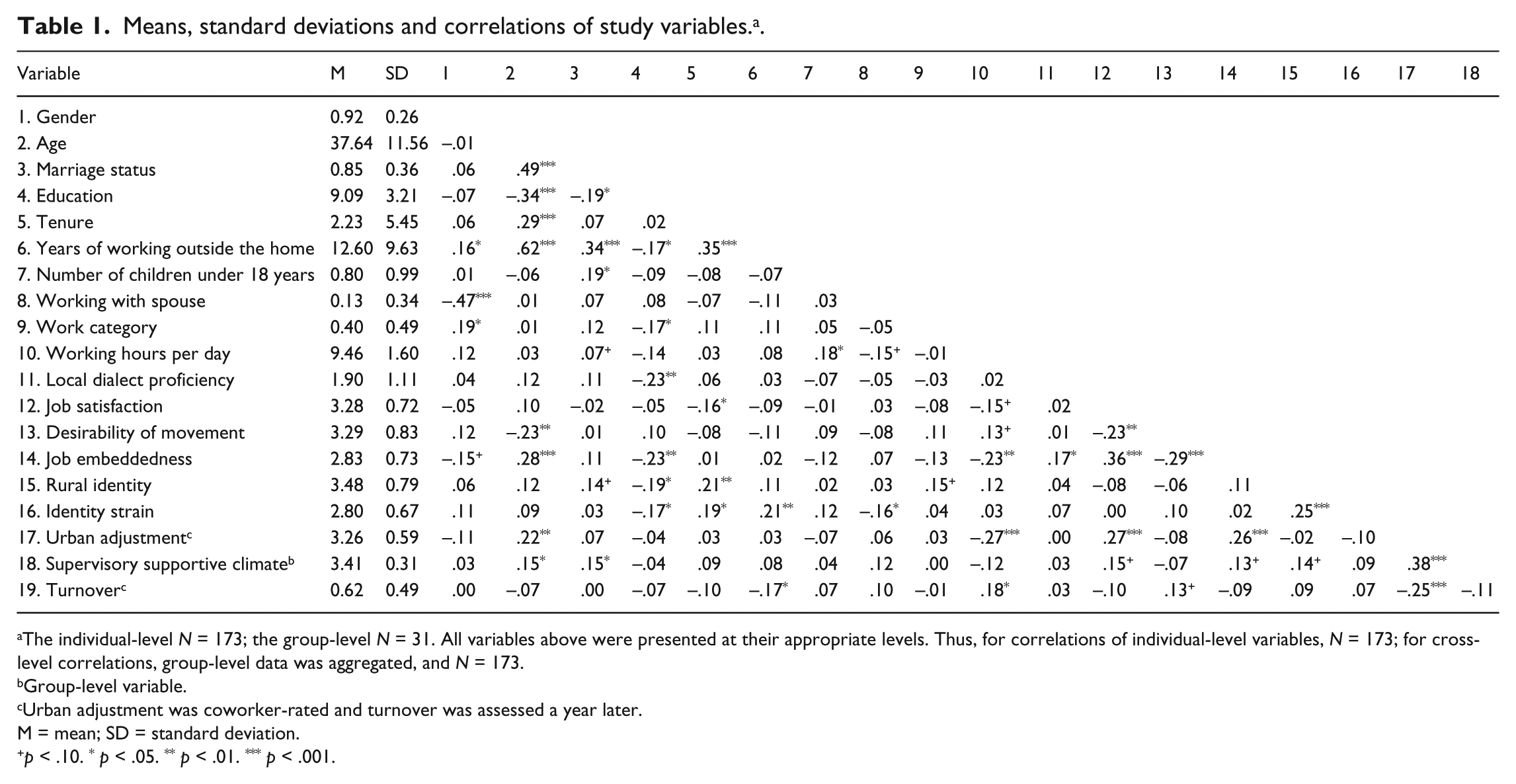
aThe individual-level N = 173; the group-level N = 31. All variables above were presented at their appropriate levels. Thus, for correlations of individual-level variables, N = 173; for cross-level correlations, group-level data was aggregated, and N = 173.
Group-level variable.
Urban adjustment was coworker-rated and turnover was assessed a year later.
M = mean; SD = standard deviation.
p < .10. * p < .05. ** p < .01. *** p < .001.
Tests of the hypotheses
Hypothesis 1 posits that migrant workers’ rural identity is positively associated with identity strain. As Table 2 showed, the test of Model 2 revealed that migrant workers’ rural identity was positively related to their identity strain (
Hierarchy linear model results for Hypothesis 1: The effect of migrant workers’ rural identity on their identity strain. a
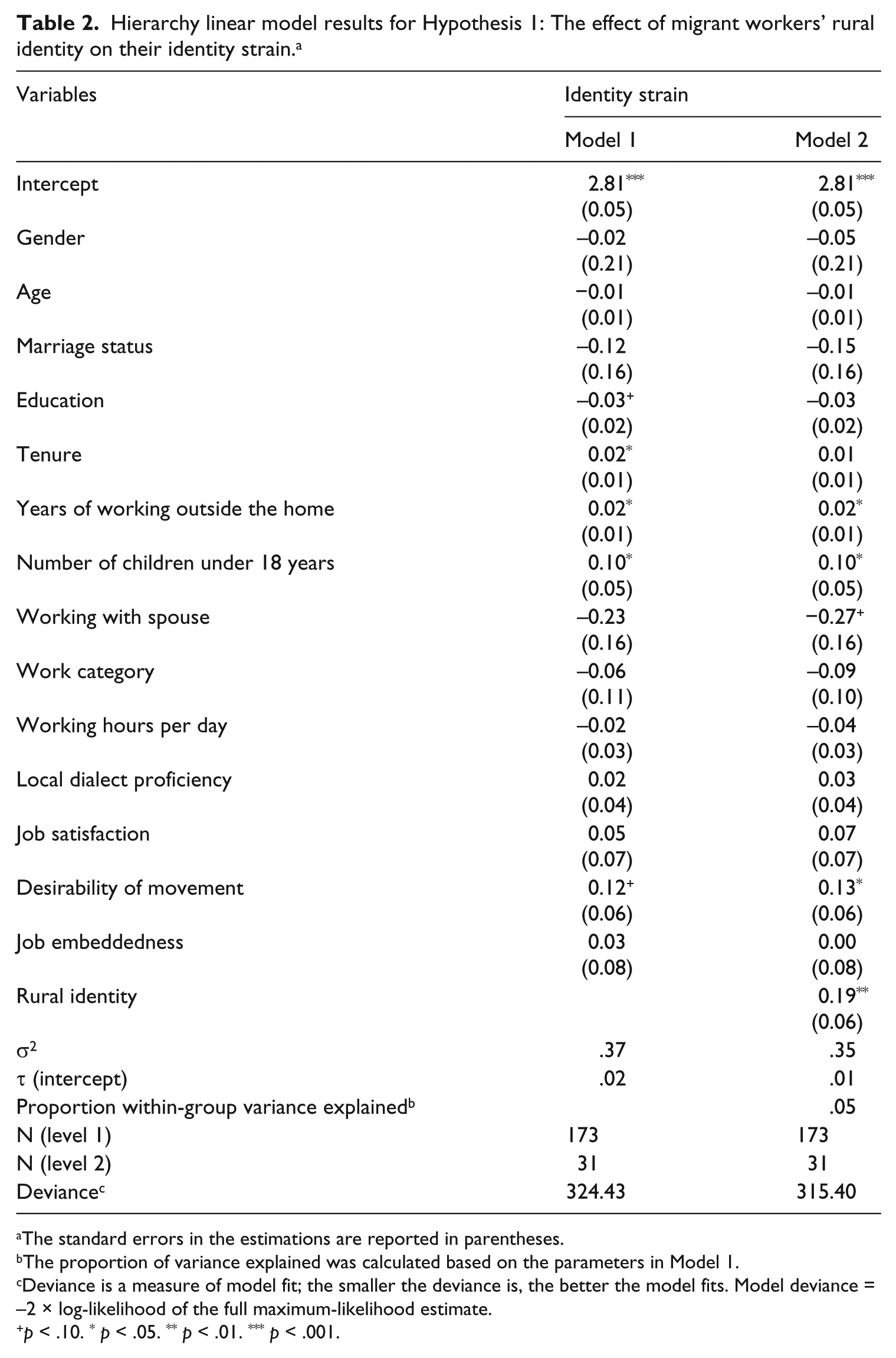
aThe standard errors in the estimations are reported in parentheses.
The proportion of variance explained was calculated based on the parameters in Model 1.
Deviance is a measure of model fit; the smaller the deviance is, the better the model fits. Model deviance = –2 × log-likelihood of the full maximum-likelihood estimate.
p < .10. * p < .05. ** p < .01. *** p < .001.
According to Hypotheses 2 and 3, migrant workers’ identity strain is negatively related to urban adjustment, while supervisory supportive climate attenuates this negative relationship. Similarly, in Table 3, all control variables and rural identity were first entered in Model 1. Group-mean identity strain and identity strain were next added to Model 2, and the test of this model indicated that identity strain was not significantly related to urban adjustment (
Hierarchy linear model results for Hypotheses 2 and 3: The effect of migrant workers’ identity strain on their urban adjustment. a

aThe standard errors in the estimations are reported in parentheses.
The proportion of variance explained was calculated based on the parameters in Model 1.
Deviance is a measure of model fit; the smaller the deviance is, the better the model fits. Model deviance = -2 × log-likelihood of the full maximum-likelihood estimate.
p < .10. * p < .05. ** p < .01. *** p < .001.

The moderating role of supervisory supportive climate on the relationship between identity strain and urban adjustment.
Hypothesis 4 proposes that migrant workers’ urban adjustment is negatively related to their turnover, while Hypothesis 5 predicts that migrant workers’ adjustment mediates the interactive effect of identity strain and supervisory supportive climate on turnover. As shown in Table 4, we estimated this cross-level interaction after including control variables, rural identity (Model 1), group-mean identity strain and identity strain (Model 2), and the between-group interaction between group-mean identity strain and supervisory supportive climate (Model 3). The test of Model 3 indicated that the cross-level interaction was significantly and negatively related to turnover (
Hierarchy logistic model results for Hypothesis 4 and 5: The effects of migrant workers’ identity strain and urban adjustment on their turnover. a
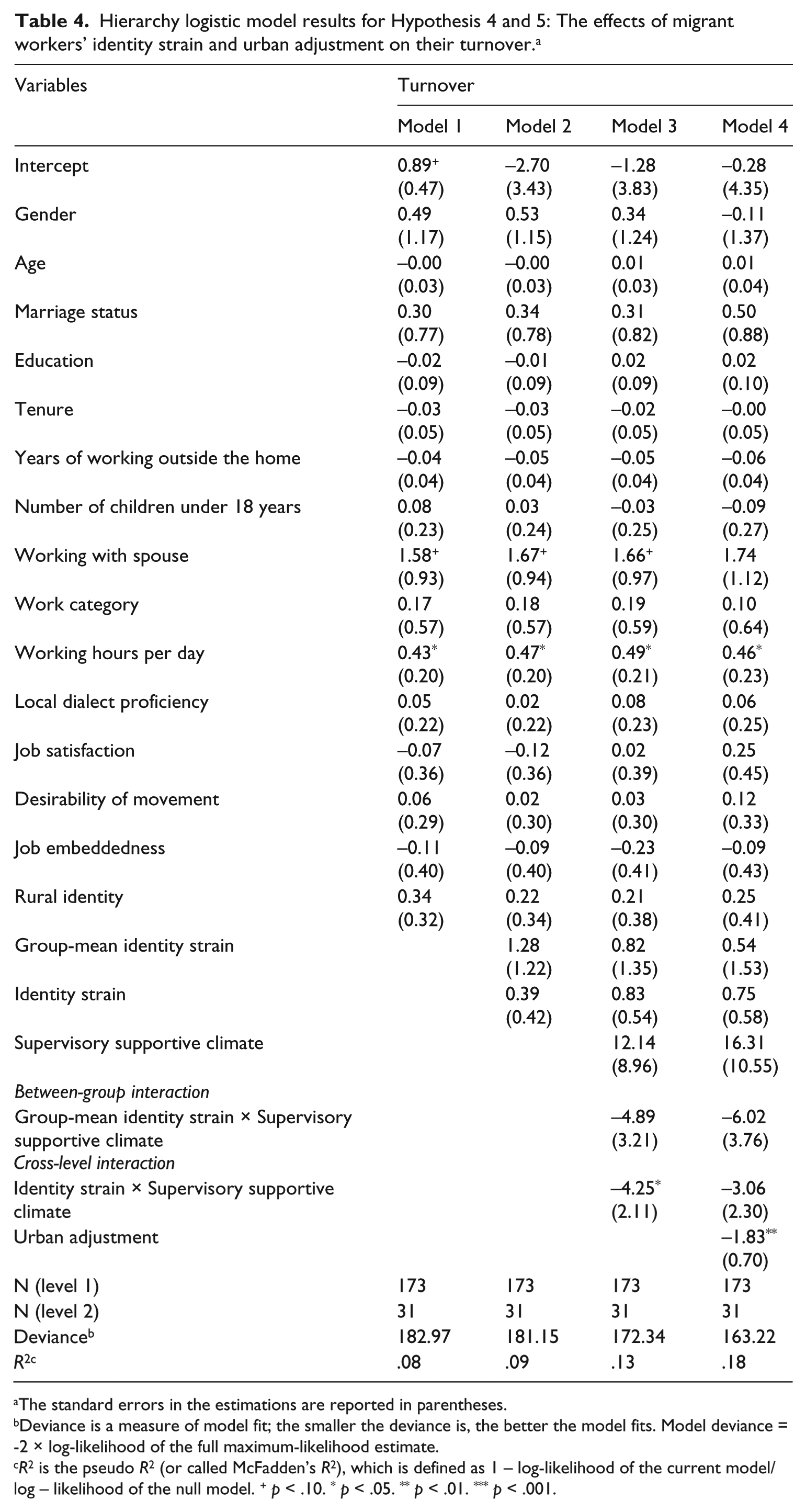
aThe standard errors in the estimations are reported in parentheses.
Deviance is a measure of model fit; the smaller the deviance is, the better the model fits. Model deviance = -2 × log-likelihood of the full maximum-likelihood estimate.
R2 is the pseudo R2 (or called McFadden’s R2), which is defined as 1 – log-likelihood of the current model/log – likelihood of the null model. + p < .10. * p < .05. ** p < .01. *** p < .001.
Discussion
Many international scholars and journalists are documenting exorbitant attrition among rural migrants in emerging economies, who are essential for economic development of their societies through their employment in export-oriented manufacturing and domestic infrastructure (Beamish, 2006; Zhou and Sun, 2011; Harney, 2010; Staelens and Louche, 2017). Yet the available UCEA turnover literature furnishes an incomplete understanding about why they quit jobs as they are so unlike UCEA workforces in culture, precarious employment and rural-to-urban transition (Lee, 2016). Contributing to the scant and narrow research on DW precariat turnover, we adopt an identity strain perspective to provide a fuller explanatory account of why Chinese migrants quit. Using a two-wave, multiple-source and multi-level research design, we found that peasant laborers harboring strong provincial identities feel identity strain that induces them to quit, especially when they lack supervisory supportive climates. We further demonstrated that urban adjustment mediates the interactive effect of identity strain and supervisory supportive climate on migrant turnover.
Implications for theory
Our findings offer several important theoretical contributions. First, we broaden the scope of current inquiries into DW precariat attrition by identifying identity strain as a pivotal turnover driver. Existing empirical studies in emerging economies focus on migrants’ workplace conditions or job opportunities but neglect how other influences arising from challenging role transitions and urban adaptation can underpin leaving (Chen et al., 2016; Miller et al., 2001; West, 2004). Such preoccupation with ‘movement desirability and ease’ (March and Simon, 1958) as explanatory constructs reflects their prominence in classic and modern turnover theories (Bluedorn, 1982; Hom et al., 2017; Lee and Mitchell, 1994; Price and Mueller, 1981) as well as the well-documented plight of DW migrants who assume 3-D jobs to escape rural poverty (Friedman and Lee, 2010; Maertz et al., 2003; Ngai and Huilin, 2010; Xu, 2013). By contrast, our study demonstrates that identity strain can be a salient trigger of rural migrants’ turnover. We propose that migrant workers’ role transitions—from peasants in rural villages to wage workers in metropolises—evoke psychological strain that initiates their leaving urban workplaces. Our research thus extends longstanding scholarship on how work-related identification deters leaving (Mael and Ashforth, 1995; Riketta, 2005). Organizational identification studies rarely—if ever—scrutinize how other identification targets (e.g. prior occupation or lifestyle) interfere with employees’ identification with a current employer (Shapiro et al., 2016) and induce leaving by creating identity strain.
Second, we established that supervisory supportive climate, serving as a job resource, can lessen identity strain’s deleterious effects on job loyalty. Our findings thus sustain a key JD-R tenet that holds that resources can attenuate the adverse impact of job demands on employee welfare or performance (Bakker and Demerouti, 2007; Qin et al., 2014). For migrants in teams exposed to poor supervisory supportive climates, high identity strain boosts their quit likelihood. In comparison, high supervisory supportive climates can mute how identity strain impels workers to quit. As role transitions and identity strain tend to increase turnover, identifying factors counteracting their effects are noteworthy.
Third, we identify urban adjustment as a central mechanism underlying the interactive effects of identity strain and supervisory supportive climate on turnover. That is, high identity strain diminishes urban adjustment, and such diminution is greater when peasant laborers belong to groups subject to poor supervisory supportive climates. Poor urban adjustment thus triggers turnover. Prior research suggests identity strain owing to expatriate-repatriate role transitions directly boosts quits (Kraimer et al., 2012), yet our inquiry reveals that adjustment in new challenging contexts, such as unfamiliar host country or urban locale, is a heretofore missing intervening mechanism.
Finally, we improve upon burgeoning scholarly inquiries into DW precariat quits by using multiple sources to assess model components, while estimating their ability to predict rural migrants’ actual turnover independently of its well-established fundamental antecedents (Mitchell and Lee, 2013). Past studies on DW precariat attrition mostly regressed quit intentions or past quits onto antecedents (Jiang et al., 2009; Qin et al., 2014; Smyth et al., 2009; Tello et al., 2002; Tiano, 1994). Besides common method bias, their failure to use the ‘standard’ time-lagged or longitudinal research design to forecast turnover behavior (Hom et al., 2017) overstates predictive validity as such criteria poorly proxy future behavior (Vardaman et al., 2015). What is more, the few time-lagged tests fail to assess both movement ease and desirability (March and Simon, 1958), essential for establishing predictors’ incremental validity or verifying even rudimentary turnover models (Chen et al., 2016; Linneman and Blau, 2003; Miller et al., 2001).
Implications for practice
A shortage of migrant workers now looms in China, exacerbating the turnover problem (Choi and Peng, 2015; Siu, 2017). As noted above, excessive migrant attrition adversely affects organizations (Beamish, 2006; Harney, 2010), such as decreased organizational efficiency and profitability (Park and Shaw, 2013), and may even undermine a nation’s development model (especially one ‘predicated on surplus and cheap migrant labor’; Lee, 2016: 325). Our findings yield several suggestions for abating migrant turnover. First, managers must recognize that migrant workers’ provincial identity can engender identity strain and turnover. Organizations can take measures to facilitate their rural-to-urban adaptation, preventing identity strain from progressing into departures. Alternatively, employers might recruit migrant workers not only on the basis of technical competence but also on their rural identity and interpersonal adaptability using employment testing and interviews (Gui et al., 2012). By so doing, new recruits may better assimilate to the workplace and community at large (Aycan, 1997). Because of their flexibility in relating to people, interpersonally adaptive migrants may more readily forge intimate ties to urbanites and develop greater felt belongingness in the new urban environment (Zhong et al., 2016).
Like cross-cultural training for expatriates, we also suggest providing new hires—especially new migrants to urban centers—with realistic previews about urban work and community roles (Hom et al., 1998). Such work and lifestyle previews would forewarn them about upcoming urban challenges in employment (e.g. adapting to assembly-line work rules) and living circumstances (e.g. urban noise and crowds; Howard, 1965; Zhong et al., 2016). Moreover, such previews might explicitly address the prospects of identity crisis and offer psychological techniques on how they might cope with identity conflicts (e.g. self-management tips; Hom and Griffeth, 1995). What is more, employers can instruct new migrants on local dialect, customs and culture and expand their social networks to include urban natives (Liu, 2015; Yue et al., 2013). Employers might also encourage more contact with urbanites by sponsoring outings, hosting social events involving urbanites, or reducing work hours or days so that peasant workers can socialize with community members (Swider, 2015; Zhong et al., 2016).
Organizations may also provide migrant workers with mentors from their hometown with whom they more easily communicate and more readily develop rapport (Liao et al., 2015; Liu, 2015). As in the situation of expatriates, Feldman and Bolino (1999: 55) suggested that ‘mentors not only play an important part in helping expatriates learn their new organizational roles, but are also critical in helping them adjust to new national cultures as well’ (p. 55). Employers may also furnish benefits denied to migrants because they lack urban hukou, such as housing and medical care, or help them acquire official temporary residential permits (Kim, 2015; Zhong et al., 2016). By so doing, firms reduce the stigma of second-class citizenship and thus encourage migrants to identify with local residents—perceiving that they and city residents are ‘all Chinese’ (Zhong et al., 2016: 10). Greater identification can induce migrants to form social ties with urbanites.
Finally, our results suggest that supervisors play a vital role in whether migrants’ identity strain translates into higher turnover. Organizations can enlarge resources for supervisors and train supervisors on how to offer instrumental and expressive support to help migrants handle this distress. Specifically, they can offer emotional comfort to migrants struggling with identity conflicts or enlist their co-workers who had effectively resolved identity strain to provide social support (Kraimer et al., 2001). Along these lines, we further suggest that supervisors avoid excessive LMX differentiation in their dealings with subordinates (Seo et al., 2018) to promote a supervisory supportive climate.
Strengths, limitations and future directions
Using multi-phase, multi-source and multi-level data, the current research adopts an identity strain perspective to investigate why peasant laborers quit. Going beyond prior studies of developing-world precariat departures, our predictive research design established that urban adjustment (reflecting the interaction between identity strain and supervisory support climate) explains unique variance in turnover behavior after controlling key turnover determinants. Despite its multiple methodological strengths, our test suffers from several shortcomings that future research might address. First, this research studied only supervisory supportive climate as a buffer against identity strain. Conceivably, resources a worker personally receives from the supervisor (i.e. perceived supervisory support, an individual-level construct; Eisenberger et al., 2002) may act as a similar buffer (though differential support may backfire; Seo et al., 2018). Future research might thus assess perceived supervisory support as well as other resources, such as supervisor justice treatment (Qin et al., 2017b), and families or friends relocating to the same urban community who can help migrants adapt to urban work and life. Some job demands (e.g. abusive supervision, Qin et al., 2017a) that may exacerbate the detrimental effects of identity strain also warrant further investigation. Moreover, our demonstration of the mediating role of urban adjustment does not preclude other mediators that further inquiry might identify. Further, our test yielded limited evidence for causality. We thus prescribe future longitudinal research designs to strengthen evidence for theorized causal directions, such as assessing variables’ change trajectories and their dynamic relationships.
Future research may identify the etiology of precariats’ rural identity. For example, having close family members (e.g. parents and siblings) still living in the home village may preserve rural identity. Including such antecedents can deepen understanding of migrants’ identity strain and turnover. Furthermore, apart from rural identity, subsequent research might assess how much migrants identify with the host urban society to more fully decipher the origins of identity strain (Gui et al., 2012). After all, acculturation scholars conclude that integration of immigrants’ home-country identity and new-country identity is the optimal adaptive mode of acculturation and most conductive to well-being (Gui et al., 2012; Phinney et al., 2001). In our research, we presumed a linear, bipolar model whereby rural and urban identification represent a bipolar continuum such that strengthening one identity entails weakening the other. Yet Gui et al. (2012) corroborated a two-dimensional model among PRC migrants who can exhibit both strong or weak rural and urban identification. Future inquiries might explore how identity strain and its turnover effects vary across different identification profiles, such as high rural and urban identities or high rural identity but low urban identity.
Although incorporating well-established turnover causes (i.e. job satisfaction, perceived alternatives and job embeddedness; Hom et al., 2017) and demographic predictors (Rubenstein et al., 2018), our theoretical framework may benefit from additional explanatory constructs. For example, future conceptual refinements may include family embeddedness (Ramesh and Gelfand, 2010) as families hold great sway over turnover decisions, especially when they rely on workers’ wages for subsistence (Myerson et al., 2010), and turnover contagion, as high turnover in this workforce induce more turnover (Maertz et al., 2003). Psychological contract fulfillment (Chih et al., 2016) is another potential addition because labor contractors often violate psychological contracts by failing to pay workers or paying them less than initially promised (Ngai and Huilin, 2010; Swider, 2015). Also, as revealed in Tables 3 and 4, we found that longer working hours per day were associated with poorer urban adjustment and higher turnover. Thus, combining work characteristics and psychological factors may deepen insight into precariat turnover.
Furthermore, future scholarship might identify where migrant workers go (Hom et al., 2012), such as other jobs in the same locales or relocations to other cities or home. Conceivably, migrants may stay in the city or move to another city but better resolve identity strain in other companies without returning home. They may receive superior resources (e.g. tuition aid for children’s local schooling, factory housing) from other firms that help them transition to urban work and life environments. By relocating to cities nearer rural homelands, they might find more fellow villagers employed in the same workplace—that is, their native community ‘embedded’ within the workplace (Mitchell et al., 2001). Finally, we sampled only PRC migrant workers in a construction group. While focusing on one company controlled organizational variability in human resource practices and allowed for more rigorous data collection, it limited our findings’ generalizability. Also, although we believe that our findings are somewhat generalizable for precariat rural migrants, we concede that China differs culturally and institutionally from other countries, while construction work is especially hazardous and offers unstable pay (unlike other industries; Swider, 2015). We thus urge future replications in other developing countries and other industries.
Conclusion
Our research sheds new light on why rural migrants in emerging economies quit. We found that migrant workers’ identity stain—intensified by strong rural identity—increases turnover for those belonging to work groups with poor supervisory supportive climates, and that urban adjustment mediates the interactive effect of identity strain and supervisory supportive climate on turnover. Our study thus reveals how the rural-to urban transition—and the identity strain it evokes—underlies DW migrant turnover. This research expands the limited scholarly inquiry into extra-work or noneconomic forces driving DW laborers to quit. As Ramesh and Gelfand (2010) showed, greater insight into why workforces in societies outside UCEA countries leave may even enrich and extend prevailing turnover theories.
Footnotes
Appendix: Scale items for rural identity and identity strain
Author’s note
All authors contributed equally to this article.
Funding
We would like to thank the National Natural Science Foundation of China (grant numbers: 71502179 and 10901010), a Fulbright Scholarship, the support from Center for Statistical Science in Peking University, and the Key Laboratory of Mathematical Economics and Quantitative Finance (Peking University), Ministry of Education.