



Abstract
A number of leadership theories have highlighted the positive impact that a leader’s vision can have on follower outcomes. Although significant research has examined the impact of vision, our understanding of the mechanisms underlying this relationship is incomplete. Here, we use self-concept-based theory (Shamir et al., 1993) to explore how the strength of the vision being propounded and the way that it is expressed by leaders influence collective work beliefs. Using a matched sample of teachers and principals, we observe that inspirational visions are positively associated with group affective tone and that future-oriented visions are positively associated with collective efficacy and group affective tone, with all relationships mediated by visioning behaviour. Thus, employees whose leaders exhibit strong visions feel more collectively capable (higher levels of collective efficacy) and happier (higher levels of group affective tone) than employees whose leaders exhibit weak visions, especially when messages are delivered in an emotionally positive way. We conclude that visions contain distinct vision strength themes that differ in terms of their motivating capacity and offer important practical implications and suggestions for future research.
I have a dream that one day this nation will rise up and live out the true meaning of its creed: ‘We hold these truths to be self-evident: that all men are created equal.’
Visions, defined as an overarching and enticing view of the future that directs effort towards a desirable outcome that is ‘never fully achieved in practice’ (Kirkpatrick and Locke, 1996: 37), are viewed as an essential aspect of exemplary leadership and are considered a key predictor of group-level outcomes (e.g. Taylor et al., 2014). Vision is at the core of numerous leadership theories. Notably, theories of both transformational and charismatic leadership have highlighted the positive impact that a leader’s vision can have on follower outcomes (Bass, 1985; Conger and Kanungo, 1987). These theories, however, focus on examining what we refer to as ‘composite’ leadership styles, wherein vision is but one, albeit important, component. In general, these theories do not tease apart the various components of leadership behaviour and thus do little to inform scholars and practitioners about how to implement more granular behaviours (e.g. van Knippenberg and Sitkin, 2013). Indeed, recent articles have highlighted the importance of looking at separate components of more established and generic leadership styles, such as transformational leadership (e.g. Stam et al., 2014). In this study, we answer this call by dissecting an essential aspect of effective leadership – vision – and build on previous research to argue that vision should be studied as a separate entity (e.g. Berson et al., 2016). To do so, we rely on literature investigating the role of vision strength and its impact on collective work beliefs (e.g. Berson et al., 2001).
Vision strength is defined as the motivational potency that characterizes the content embedded within a leader’s vision (Berson et al., 2001). Attempts to delineate aspects that constitute a persuasive vision (e.g. Berson et al., 2001; Sosik and Dinger, 2007) have developed a similar list of common characteristics and themes, including an emphasis on shared meaning (e.g. Baur et al., 2016) and the use of vivid imagery (e.g. Berson et al., 2016), along with a focus on idealized (Awamleh and Gardner, 1999), future-oriented (e.g. Berson et al., 2015), and, to a lesser extent, attainment-focused (Berson et al., 2001) messages. It is the variability of these characteristics entrenched within the leader’s vision that influences followers to contribute to the realization of shared objectives (Mumford, 2006; van Knippenberg and Stam, 2014). The excerpt of Dr King’s famous ‘I have a dream’ speech above clearly contains inspirational (… this nation will rise up and live out the true meaning of its creed … that all men are created equal), future-oriented (… one day this nation will rise up …), and instrumental (keeping a promise) themes. In other words, strong and effective visions are, first and foremost, inspirational and future-oriented, and may also include instrumental (e.g. specifying goals) themes (see Berson et al., 2015 for a review). Thus, we posit that visions that emphasize a more distal or abstract outlook (i.e. inspirational and future-oriented) are likely to have a stronger influence on collective work beliefs compared to visions that emphasize a more proximal (i.e. instrumental) outlook (Berson et al., 2015; Shamir et al., 1993).
As vision strength is embedded within the broader construct of leader visions, it is equally important to consider how such visions are communicated via the skilled transmission of information (Antonakis et al., 2016; Awamleh and Gardner, 1999). In our view, vision strength and vision communication must be operationalized separately, but it is important to examine their interaction. Indeed, some leaders may exhibit strong visions that are not delivered in an effective manner, whereas others may articulate a weak vision persuasively, such as King George VI’s radio address following the United Kingdom’s declaration of war in 1939. Because the extant literature has paid scant attention to the differentiation between the two constructs (e.g. van Knippenberg and Stam, 2014), little is known about the interaction between vision strength and vision communication. Clearly, these two constructs are intimately linked when a vision is expressed in practice; thus, we propose a model in which the interaction between vision strength and vision communication is examined.
In the current study, we develop an integrated model grounded in self-concept-based theory – a theory that highlights the centrality of visions in the development of follower self-concepts (Shamir et al., 1993). We present our theoretical model in Figure 1. We add to the existing literature by specifically defining characteristics of vision strength, combining it with a vision communication component, and investigating its link as an independent predictor of followers’ collective work beliefs. The current investigation is the first of its kind to extend beyond a controlled classroom setting (e.g. Sosik and Dinger, 2007), and uses a multi-method and multi-source field study to better understand how leaders craft and articulate strong visions in daily interactions.
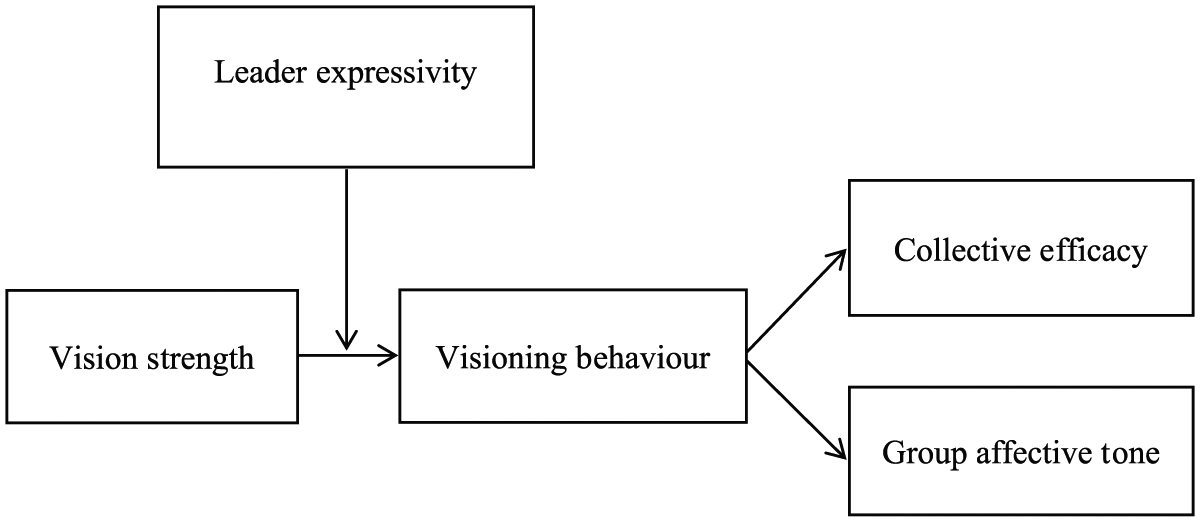
Conceptual study model.
Self-concept-based theory and vision strength
Thus far, the literature on leadership theories that features vision as a prominent component has focused largely on documenting the effectiveness of composite leadership styles in promoting follower performance (van Knippenberg and Stam, 2014). Implicit in this literature, however, is a suggestion that such leadership styles should also promote organizationally desirable collective outcomes. Additionally, because the focus has been on broad leadership styles rather than their associated behaviours, it has been difficult to establish motivational mechanisms behind each of these isolated behaviours (Shamir et al., 1993). Nevertheless, this endeavour is essential for scholars to further refine their understanding of the effects of vision and offer guidelines to practitioners on implementing these in the most effective way to achieve desired outcomes.
In this study, we investigate the ability of vision strength to tap into a collective sense of follower efficacy and group affective tone. Collective efficacy refers to shared perceptions about the capability of a group to accomplish a specific task (Bandura, 1997), and group affective tone is defined by the consistent or homogeneous level of pleasure and arousal experienced within a group (George, 1990). Collective efficacy has a cognitive basis, whereas group affective tone is a parallel affective outcome. Thus, together, these two variables are complementary.
Although both collective efficacy and group affective tone are collective outcomes that reflect team members’ reactions to group conditions and have a meaningful impact on follower motivation and performance (e.g. Chi et al., 2011; Goddard et al., 2004), they differ in their conceptualization. On the one hand, in Chan’s (1998) terms, collective efficacy is categorized as a referent-shift consensus model where the referent is the group, and examines group members’ perceptions of their group’s capacity to succeed. On the other hand, group affective tone is categorized as a direct consensus model because we verify the presence of homogeneity of individual affect within the group itself; here, the referent remains the individual.
Self-concept-based theory (Shamir et al., 1993) is particularly well suited to explain the effects of vision on collective work beliefs such as collective efficacy and group affective tone. Indeed, this theory proposes that leaders are able to transcend the inherent self-interest of followers for the sake of the group by linking their vision to valued facets of the follower’s self-concept. In turn, this method motivates followers to exert long-term effort by tapping into followers’ collective identity (see also Shamir, 1991a, 1991b), which will likely lead followers to feel an increased belief in their capacity to succeed.
Self-concept-based theory also states that strong leader visions tap into followers’ positive emotions, suggesting a link between vision strength and followers’ individual positive affect. As George (1990) demonstrated, groups can develop consistency in their affect, termed group affective tone. Groups accomplish this through various processes, notably socialization. According to George (1990), socialization serves to signal important goals and values to newcomers. Similarly, vision strength would serve to communicate optimism and positive emotions to followers, signalling expectations and leading to consistency in positive affect among group members. To return to Chan’s (1998) conceptualization of collective variables, then, self-concept-based theory helps explain how, through vision strength, individual affect becomes more homogeneous over time.
Relationship between vision strength and leader visioning behaviour
We build on self-concept-based theory (Shamir et al., 1993) to propose that followers’ perceptions of their leader’s visioning behaviour act as a mechanism by which vision strength contributes to collective work beliefs. This phenomenon occurs because articulated visions are a representation of intentions (see Sosik and Dinger, 2007) and may not necessarily be translated into practice. Thus, leaders must craft a strong vision, but they must also ensure that their message is effectively modelled to followers in order to realize the collective benefits associated with this form of message. Indeed, in a formal test of Shamir et al.’s (1993) self-concept-based theory, Shamir et al. (1998) found that overt leader behaviours that emphasize the collective, such as verbal and symbolic behaviour, improved the effectiveness of the leader’s vision to increase the salience of group outcomes. Thus, leaders who reinforce their message via overt behaviours that are aligned with their vision are likely to strengthen the motivational impact of vision strength on followers.
To test the alignment between vision strength and actual leadership behaviour as perceived by the followers, we rely on Yukl et al.’s (2002) ‘Hierarchical taxonomy of leadership behavior’. This taxonomy, grounded in prior theory and research on effective leadership, classifies 15 discrete, observable leader behaviours that are applicable to leaders regardless of industry or organizational hierarchy (Yukl, 2012; Yukl et al., 2002). We selected ‘envisioning change’ as the leadership behaviour most clearly reflective of visioning behaviour because it mirrors actions focused on vision attainment. These behaviours, which include demonstrating enthusiasm and optimism in the vision and linking it with member values and ideals, are expected to build follower confidence and increase collective work beliefs (Yukl, 2012). We expect that leaders who exhibit strong visions would be perceived by their followers as engaging more in visioning behaviour. Together, these arguments lead to the following hypothesis:
Hypothesis 1: There is a positive relationship between vision strength and leader visioning behaviour.
The mediating role of leader visioning behaviour
According to self-concept-based theory (Shamir et al., 1993), leaders enhance collective beliefs by connecting their message to follower self-concepts in an effort to engage followers in attaining their vision (e.g. Naidoo and Lord, 2008; Schippers et al., 2008). By crafting a strong vision, leaders encourage followers to look beyond their own self-interest to align themselves with the needs of the collective (Shamir et al., 1993; van Knippenberg and van Kleef, 2016). One way in which leaders persuade followers to look beyond their own interests is to align individual and collective needs through behaviours that articulate and reinforce the leader’s vision (van Knippenberg and Stam, 2014), which is accomplished through the use of verbal and symbolic behaviours that increase the salience of shared identities (e.g. Kark and Shamir, 2002). These behaviours increase the meaning associated with vision attainment and forge stronger communal bonds (House, 1977), which in turn contribute to increased collective work beliefs (Shamir et al., 1993).
Visions themselves must be translated into leader behaviour in order to contribute to follower outcomes. In other words, the simple fact that a leader is able to articulate a strong vision on demand would not in itself lead to positive follower outcomes. Rather, we expect that vision strength is related to collective work beliefs through leader visioning behaviour. That is, employee perceptions of visioning behaviour serve as a key explanatory mechanism for understanding how leader visions result in improved collective efficacy and group affective tone:
Hypothesis 2: Leader visioning behaviour mediates the relationship between vision strength and (a) collective efficacy and (b) group affective tone.
The moderating role of leader expressivity
Shamir et al.’s (1993) self-concept-based theory of leadership is grounded in the belief that leaders motivate follower outcomes through the conveyance of a clearly articulated and optimistic vision that links followers’ self-concept to the collective. Leaders who reinforce these messages through visionary behaviours are likely to increase the salience of these values and identities when leader expressivity is high (e.g. Gooty et al., 2010). Leader expressivity, defined as the ability for leaders to transmit emotional messages that can influence the emotional states of followers (Riggio, 1992), has been described as an essential behavioural component that amplifies the effects of visionary leadership (Groves, 2005; Venus et al., 2013). Thus, the present research aims to be one of the first studies to test Shamir et al.’s (1993) theory on affect-related outcomes (e.g. Epitropaki et al., 2017) through an examination of whether differences in leader expressivity influence the relationship between vision strength and collective efficacy and group affective tone.
Past studies have found that leaders differ in their ability to express emotions outwardly, and leader expressivity serves to moderate the relationship between leader vision and perceived leader effectiveness (e.g. Groves, 2006). Similarly, visions high in leader expressivity are more likely to create an emotional connection with followers, prompting excitement and amplifying commitment to shared beliefs such as collective efficacy (Groves, 2006; Shamir et al., 1993) and group affective tone (Chi et al., 2011). Following this logic and the tenets of self-concept-based theory (Shamir et al., 1993), we propose that leader expressivity strengthens the positive relationship between vision strength and collective efficacy and group affective tone via visioning behaviour:
Hypothesis 3: Leader expressivity moderates the indirect relationship between vision strength and (a) collective efficacy and (b) group affective tone via leader visioning behaviour such that the indirect effect is stronger when leader expressivity is high than when leader expressivity is low.
Method
Sample
The sample consisted of 204 teachers (176 women, M = 40.35 years, SD = 10.81) and their 33 elementary school principals (21 women) from one English and one French school board in a large Canadian city. The principals’ average age was 47.09 (SD = 8.24). The principals’ overall tenure as principal was 6.47 years (SD = 4.97) and their positional tenure was 3.77 years (SD = 2.44). Each principal had an average of 24.44 teachers (SD = 9.50), 23.19 support staff (SD = 14.68) and 396.23 students (SD = 173.69) under their purview. The teachers had an average tenure of 8.04 years (SD = 6.60). Approximately 79% of the participants responded in French.
Procedure
After receiving consent from the two school boards, the principal from each school was approached to complete a short questionnaire with demographic and personal affect items and to take part in a semi-structured interview during which they were asked to describe their long-term vision for their school and plan to achieve it. This interview protocol was adapted from Wofford et al. (1998), who elicited leaders’ visions. Specifically, the principals were asked three questions regarding their vision (adapted for the school context): ‘How would you describe the overall purpose of your work?’, ‘How would you describe the educational success plan of your school?’ and ‘State the main objectives that you think your school will achieve during the next year.’ Then, questionnaires in English or in French (based upon the participant’s preference) were distributed to all teachers at the participating schools. These questionnaires focused on the school context, teacher perceptions of their principal, and the teachers’ collective efficacy beliefs and group affective tone. This study was part of a larger study exploring leadership in educational institutions.
Measures
Vision strength
The principals’ responses to the semi-structured interview were coded by two trained research assistants with no prior knowledge of the study’s hypotheses, using the 12-item coding scheme initially developed by Berson et al. (2001). Each interview was evaluated using a modified 3-point scale (0 = definitely not present, 1 = somewhat present, 2 = definitely present) based on the work of Sosik and Dinger (2007). Upon independent completion of the coding of interviews, the coders met to compare scores. Inter-rater agreement in coding was evaluated at 82% pre-discussion and 94% post-discussion, indicating adequate inter-rater reliability. Consistent with Berson et al. (2001), the coders’ evaluations of each item were averaged to create an overall score. Table 1 presents the means and standard deviations of each item from the coding scheme.
Descriptive statistics and factor loadings of principal vision strength statements.
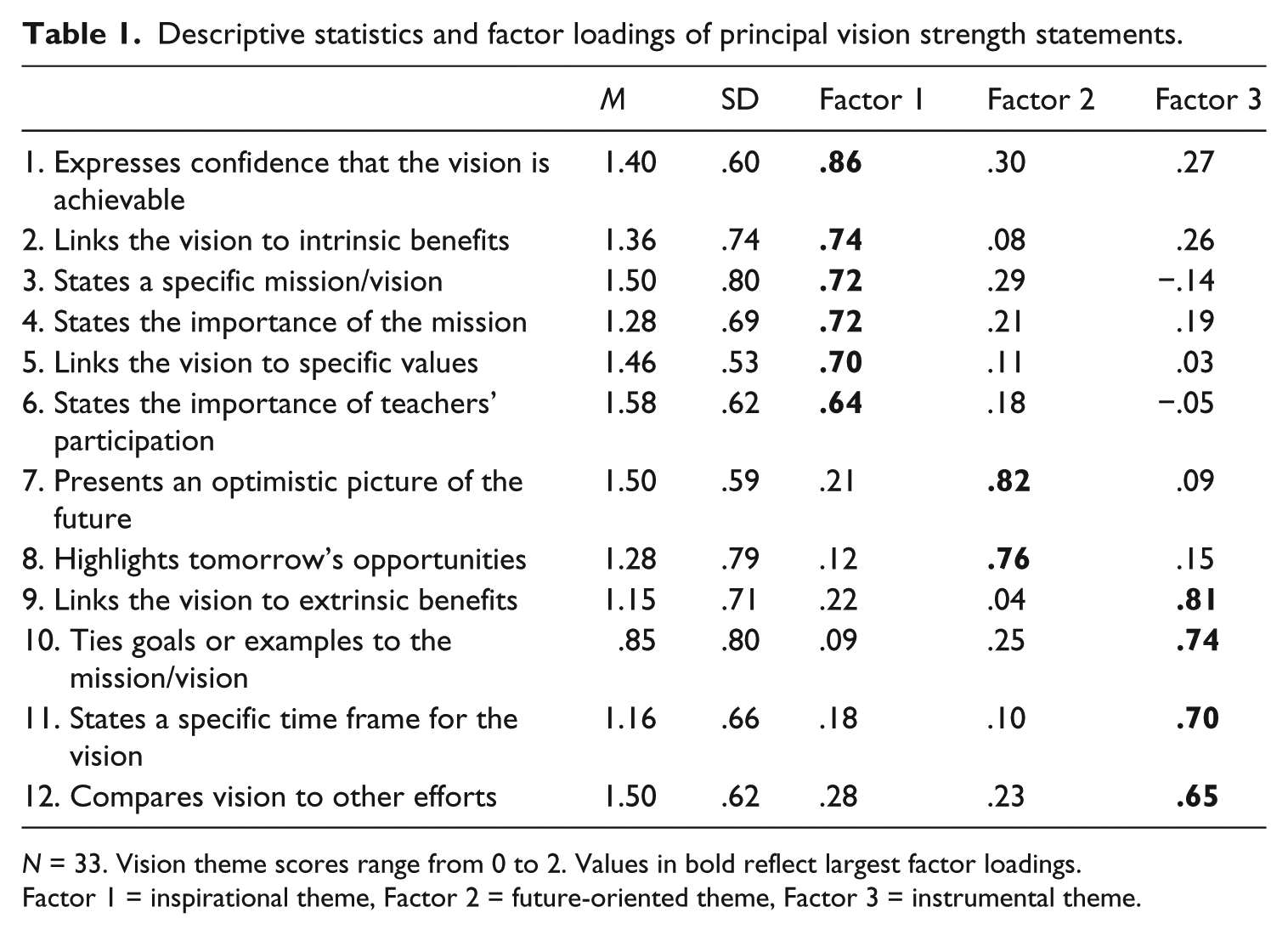
N = 33. Vision theme scores range from 0 to 2. Values in bold reflect largest factor loadings. Factor 1 = inspirational theme, Factor 2 = future-oriented theme, Factor 3 = instrumental theme.
A principal components factor analysis using varimax rotation yielded a three-factor solution (see Table 1 for factor loadings). The first factor, which we term the inspirational theme, accounted for 32% of the total variance. The second factor, or the instrumental theme, accounted for 23% of the total variance. The third, future-oriented, theme accounted for 15% of the total variance. The factor scores were aggregated and used as variables in the current study.
Leader expressivity
The interviews were evaluated using Linguistic Inquiry and Word Count (LIWC; Pennebaker et al., 2007), a computerized text analysis tool that has been used in the leadership literature to measure positive emotional expressivity (e.g. Bono and Ilies, 2006). This approach resulted in a score for each principal based on the percentage of the principal’s responses that were positively worded (e.g. happy) using validated French and English LIWC dictionaries (Kahn et al., 2007; Piolat et al., 2011).
Visioning behaviour
Teacher evaluations of the extent to which principals engaged in behaviours that supported the enactment of their vision were assessed using the envisioning change subscale from the Managerial Practices Survey (Yukl et al., 1990). The participants responded to this 4-item measure using a 5-point scale ranging from 0 (not at all) to 4 (frequently, if not always). Sample items include my school principal ‘shares exciting new opportunities for the school’ and ‘describes the educational success plan for the school with great enthusiasm and conviction.’ Agreement within schools was assessed using ICC(1), which refers to the presence of group-level effects, ICC(2), which reflects the reliability of group means, and rWG, which represents inter-rater agreement for a group (Bliese, 2000; James et al., 1984). Although there is no established cutoff for ICC(1) values, conventions suggest that to justify aggregation, ICC(2) values should exceed .60, and rWG values should exceed .70 to indicate a group-level effect (James et al., 1984). For this variable, ICC(1) = .14, ICC(2) = .74 and rWG = .88 suggested that aggregation was appropriate.
Collective efficacy
The perceived collective efficacy of the teachers was measured using the 12-item short version of the Collective Efficacy Scale (Goddard et al., 2000) using a 6-point scale: 1 (strongly disagree) to 6 (strongly agree). Sample items include ‘Teachers in this school are able to get through to difficult students’ and ‘Teachers here are confident they will be able to motivate their students.’ Aggregation to the school level using a referent-shift consensus model (Chan, 1998) was justified, with aggregation values in the acceptable range: ICC(1) = .09, ICC(2) = .67 and rWG = .84.
Group affective tone
Group affective tone was measured using the 20-item Job Affective Well-being Scale (van Katwyk et al., 2000). The teachers were asked to rate the frequency with which they experienced positive and negative emotions at work over the last 30 days using a 5-point scale: 1 (never) to 5 (extremely often). Sample positive items include ‘content’ and ‘pleased’, and sample negative items include ‘discouraged’ and ‘anxious.’ All the negative emotions items were reverse coded and added to all the positive emotions items to form a composite group affective tone average such that high scores indicated a high level of group affective tone. Following the definition and operationalization of the construct (e.g. George, 1990) and previous research (e.g. Sy et al., 2005), we tested the within-group agreement of group affective tone using a direct consensus model to aggregate this measure to the school level (Chan, 1998). The ICC(1) = .10, ICC(2) = .66 and rWG = .84 values provided evidence that aggregation was appropriate.
Control variables
Based on the guidelines set forth by Bernerth and Aguinis (2016), we controlled for principal-reported affect using the same measure as teacher affect reported above (van Katwyk et al., 2000), to account for the alternative explanation that principals’ emotions may influence our results (e.g. Sy and Choi, 2013). In addition, we controlled for the socioeconomic status (SES) of each school using the proportion of families in the school’s catchment area whose income is near or below the low-income cutoff threshold. Families are considered to be under this threshold when they devote 20% more income than an average family to essentials such as food and shelter (Statistics Canada, 2015).
Results
Table 2 presents the descriptive statistics and the intercorrelations among the variables in this study. Using the three previously defined vision strength factors, the inspirational (r = .52, p < .01), instrumental (r = .42, p < .01) and future-oriented (r = .66, p < .01) themes were all positively related to collective perceptions of leader visioning behaviour. Hypothesis 1 thus received support.
Means, standard deviations and correlations for study variables.
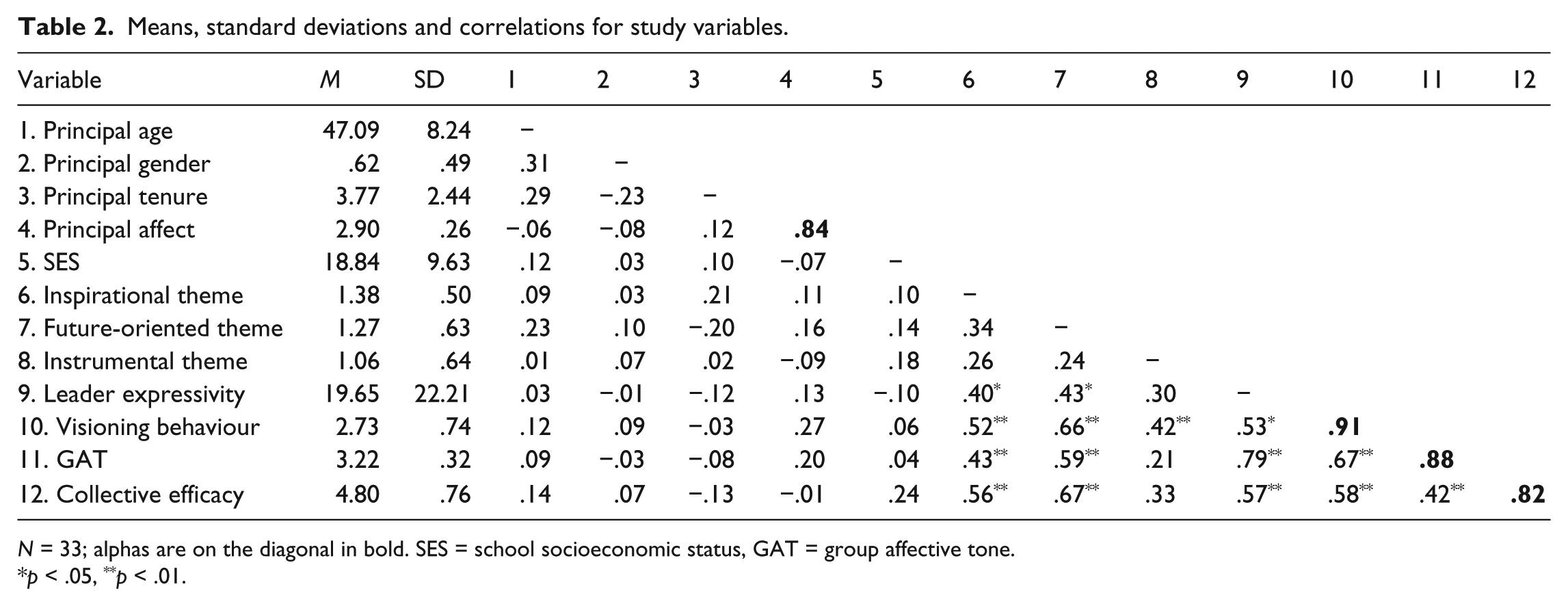
N = 33; alphas are on the diagonal in bold. SES = school socioeconomic status, GAT = group affective tone.
p < .05, **p < .01.
We proposed that, after controlling for principal affect and school SES, leader visioning behaviour mediates the relationship between vision strength themes and collective efficacy and group affective tone. We assessed mediation based on 95% bias-corrected confidence intervals (CI95%) constructed through 5000 bootstrapped samples (PROCESS, Hayes, 2013). The indirect effect of the inspirational theme via leader visioning behaviour on collective efficacy (indirect effect = .29, SE = .15, CI95% [.007, .681]) and group affective tone (indirect effect = .12, SE = .06, CI95% [.025, .264]) was significant in both cases. For the future-oriented theme, the indirect effect via leader visioning behaviour on collective efficacy (indirect effect = .35, SE = .17, CI95% [.066, .723]) and group affective tone (indirect effect = .23, SE = .10, CI95% [.107, .515]) was statistically significant for both outcome variables. Finally, no significant relationship was found for the indirect effect of the instrumental theme via leader visioning behaviour on collective efficacy (indirect effect = .20, SE = .19, CI95% [–.088, .668]) or group affective tone (indirect effect = .09, SE = .09, CI95% [–.029, .347]). These results provide partial support for Hypotheses 2a and 2b.
We assessed our group-level first-stage moderation model (Edwards and Lambert, 2007) using Hayes’ (2013) PROCESS (Model 7). This approach allowed us to obtain mean-centred bias-corrected confidence intervals using 5000 bootstrapped samples (Aiken and West, 1991). After controlling for principal affect and school SES, the interaction term of vision strength and leader expressivity was statistically significant for both the inspirational and the future-oriented themes (see Table 3). Simple slope tests revealed that the relationship between the inspirational theme and visioning behaviour was stronger when leader expressivity was high (t = 2.11, p < .05) than when leader expressivity was low (t = 1.20, p = ns) (see Figure 2). Additionally, the future-oriented theme to visioning behaviour relationship was stronger when leader expressivity was high (t = 2.45, p < .01) than when leader expressivity was low (t = 1.57, p = ns) (see Figure 2). Finally, no effect was found for the instrumental theme when leader expressivity was high (t = .76, p = ns) or low (t = .48, p = ns).
Regression results for the three vision strength factors.
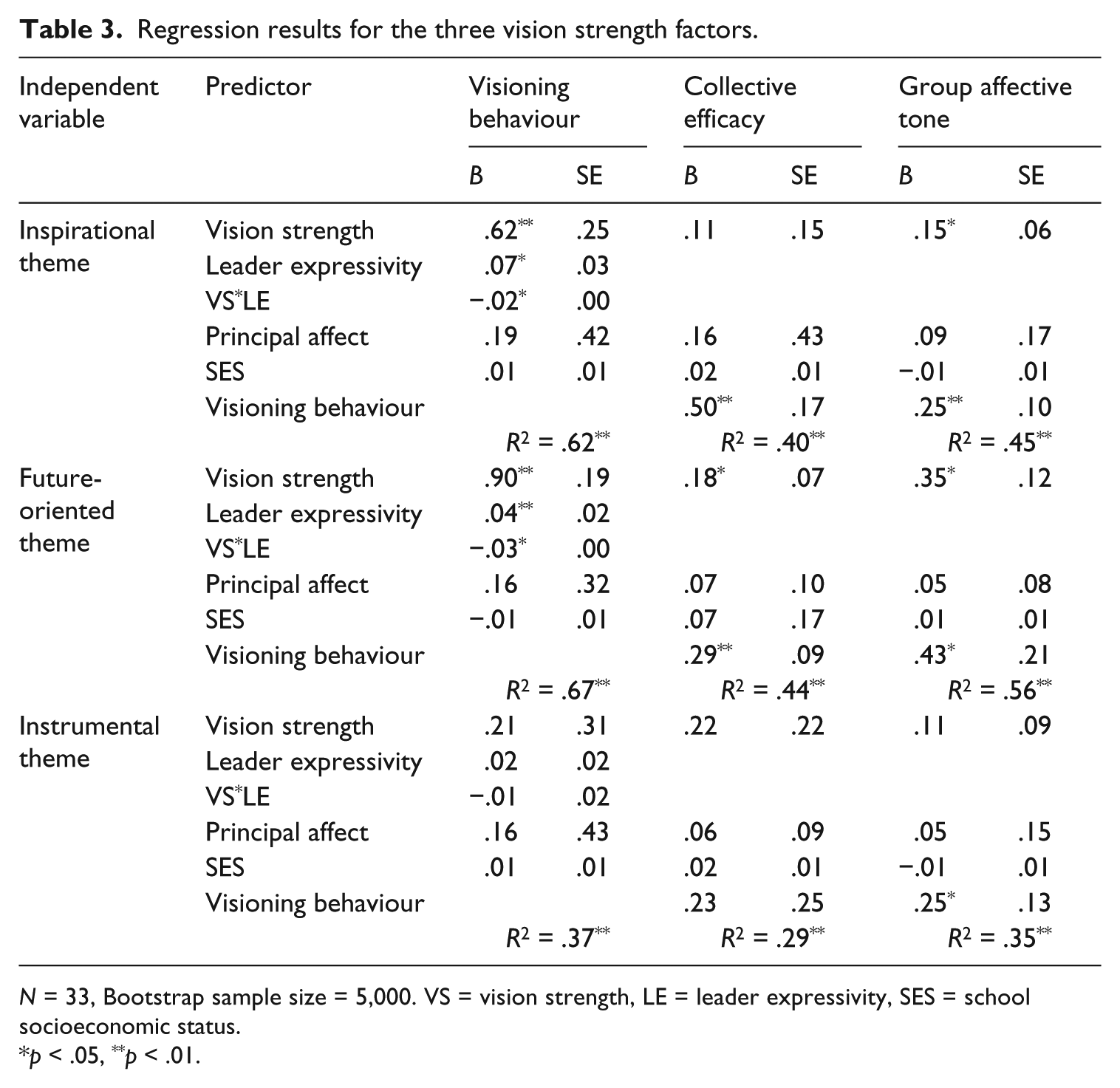
N = 33, Bootstrap sample size = 5,000. VS = vision strength, LE = leader expressivity, SES = school socioeconomic status.
p < .05, **p < .01.
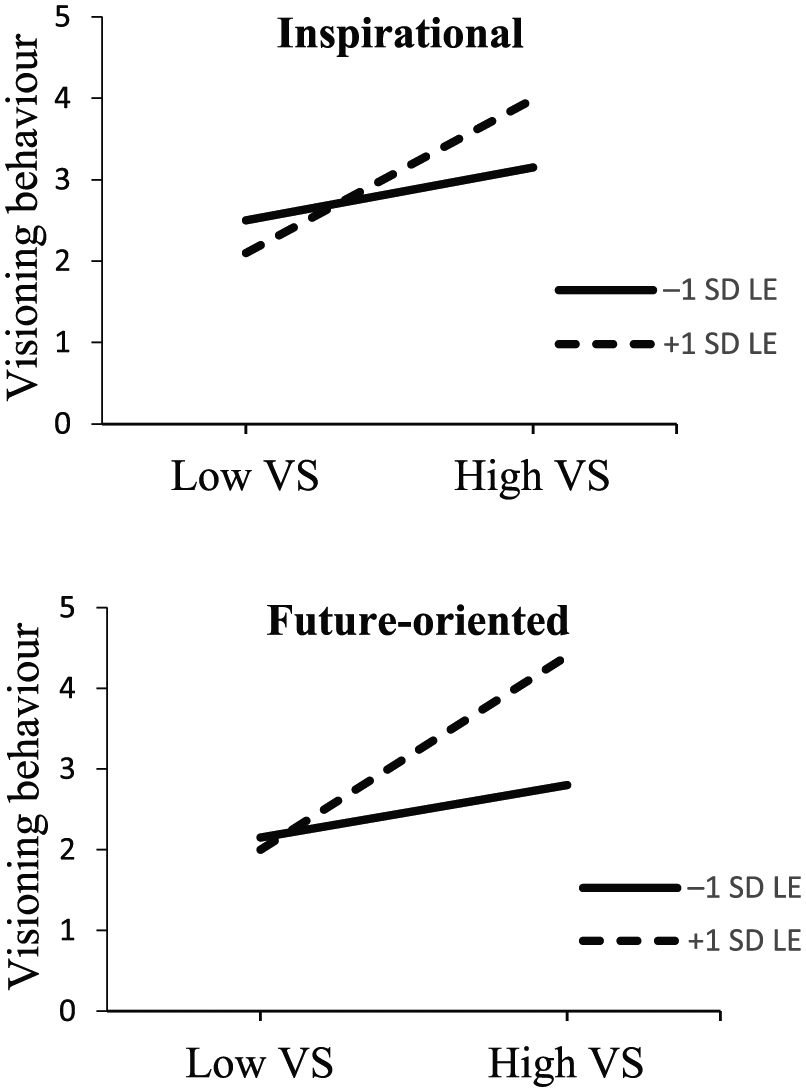
The effect of the inspirational and future-oriented vision strength themes on visioning behaviour as a function of leader expressivity.
The conditional indirect effect of vision strength on collective efficacy and group affective tone via visioning behaviour was examined. The conditional indirect effect for the inspirational theme via visioning behaviour was significant when leader expressivity was high (+1 SD) but not when leader expressivity was low (–1 SD) for group affective tone only. The conditional indirect effect for the future-oriented theme via leader visioning behaviour was significant when leader expressivity was high (+1 SD) but not when leader expressivity was low (–1 SD) for both collective efficacy and group affective tone (see Table 4). Finally, no significant relationship was found for the instrumental theme for both outcomes. Again, this provides partial support for Hypotheses 3a and 3b.
Estimates and bias-corrected bootstrapped 95% confidence intervals for the conditional indirect effect of vision strength on collective efficacy and group affective tone (via visioning behaviour) at ± 1 standard deviation of leader expressivity.
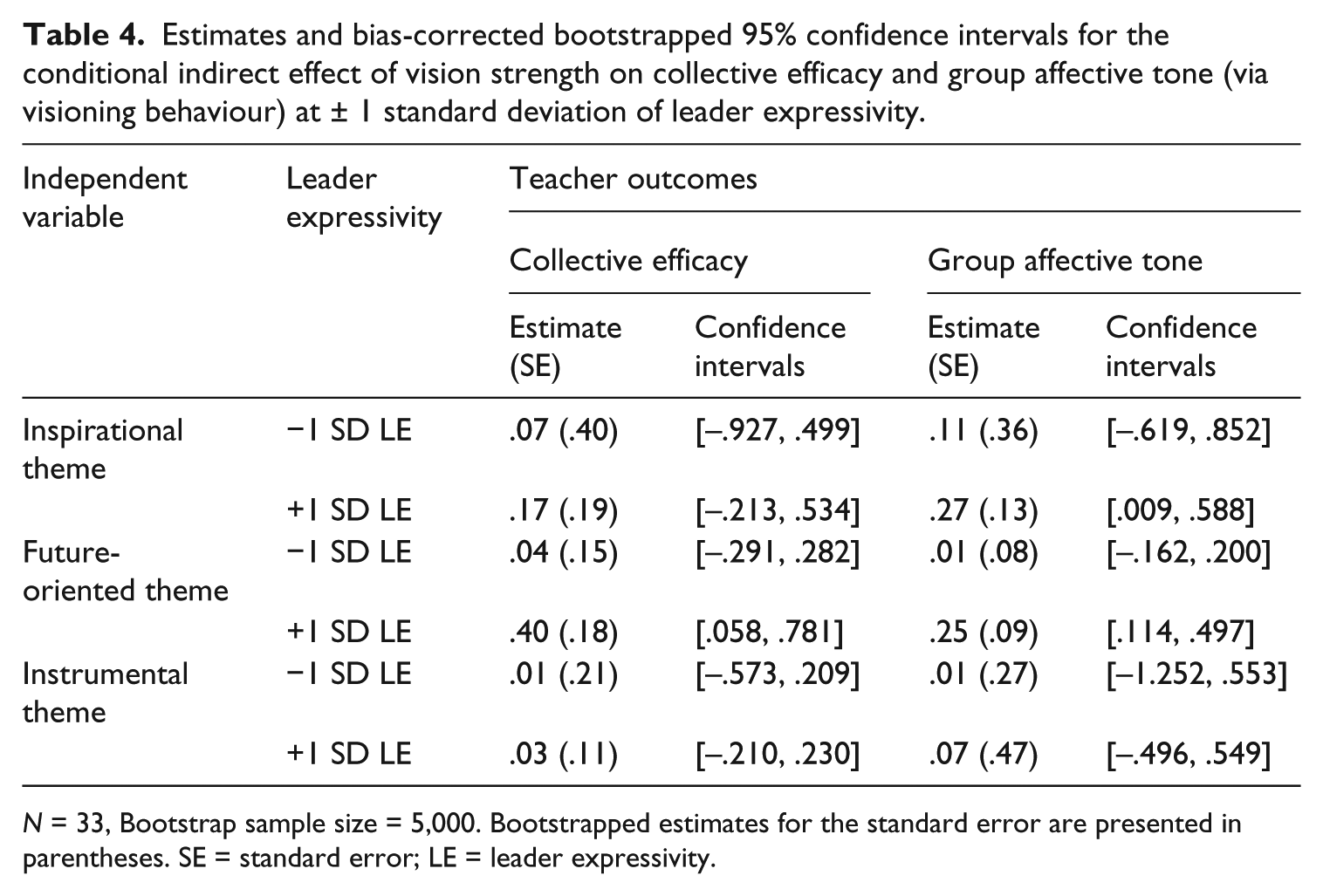
N = 33, Bootstrap sample size = 5,000. Bootstrapped estimates for the standard error are presented in parentheses. SE = standard error; LE = leader expressivity.
Discussion
The current study is the first of its kind to use a multi-method approach (e.g. survey, qualitative interviews and computerized text analysis) and a multi-source (i.e. matched samples of principals and teachers) field study to examine the effects of vision strength on cognitive and affective collective work beliefs. Consistent with self-concept-based theory (Shamir et al., 1993), we demonstrate that principals who express inspirational and future-oriented vision strength themes contribute to teacher perceptions of group affective tone via leader visioning behaviour. Furthermore, the future-oriented vision strength theme was also related to collective efficacy beliefs via leader visioning behaviour. Visions with strong instrumental messaging, however, were not related to either collective work belief outcome. We further observe that leader expressivity moderates these aforementioned relationships such that for leaders who demonstrate high leader expressivity, they have a greater effect on followers’ collective work beliefs through increased visioning behaviour as compared to leaders who demonstrate low levels of expressivity. These findings reinforce the view that followers take a number of cues from their leader’s visions and demonstrate that employees are highly sensitive both to the themes expressed in a vision and to the way in which visions are communicated.
Theoretical implications
The findings from this study advance the prior research on vision strength and self-concept-based theory (Shamir et al., 1993) more generally by providing further insight into the process by which a leader’s vision improves follower collective efficacy and group affective tone (Chi et al., 2011; Densten, 2005). Whereas the majority of research on leader vision has focused on charisma as a primary means for leaders to convey their message (e.g. Stam et al., 2014), we provide evidence of the dual importance of vision strength and leader expressivity. Furthermore, we build on previous theorizing by suggesting that although attraction to the leader has been shown to be an important predictor of follower emotions (e.g. Bono and Ilies, 2006), there is an alternative means by which leaders can influence collective beliefs: harnessing the emotions surrounding both inspirational and future-oriented visions.
Second, by delving into the construct of vision strength, we build on self-concept-based theory (Shamir et al., 1993) to demonstrate different pathways for exhibiting a strong vision, which have differential impacts on follower collective work beliefs. First, leaders can focus on the inspirational qualities of their message whereby the importance of the vision and the intrinsic rewards associated with it are emphasized. Second, future-oriented visions can direct followers’ attention to long-term outcomes and opportunities. Finally, we observed no relationship between instrumental themes and collective efficacy and group affective tone. This finding provided additional evidence that vision should not be viewed as a unitary construct.
We observed that when prompted to provide a vision of their school’s future, some principals elected to focus on instrumental themes whereby extrinsic rewards are a primary emphasis point. This finding in many ways is paradoxical, as recent conceptualizations of vision argue for a stronger differentiation between inspirational (i.e. distal goals) and instrumental (i.e. proximal goals) themes (Berson et al., 2015), a sentiment that is echoed in a seminal review of the literature by van Knippenberg and Stam (2014) and in Berson et al.’s (2001) original work. However, when asked to express a vision, it is plausible, and indeed confirmed by Berson et al. (2001), Sosik and Dinger (2007), and the present study, that leaders use instrumental themes. Our findings demonstrate that when leaders define their visions in instrumental terms, they are crafting a distinctive message that is less effective in its impact on collective efficacy and group affective tone compared with inspirational and future-oriented visions (Berson et al., 2015). Overall, these findings are consistent with previous research, suggesting that visions may be formulated and described in various ways (Strange and Mumford, 2005). Future research can explore whether visions high in instrumental themes contribute to different outcomes that focus on defined end-states, such as the equal distribution of resources (e.g. van Knippenberg and Stam, 2014).
Of particular note, our observed vision strength themes share similarities and differences with the two previous vision strength studies. Our findings identified similar inspirational and instrumental themes from the research of Sosik and Dinger (2007) along with a modified version of the future challenges and opportunities factor from Berson et al. (2001). These differences in vision strength may be attributed to differences in coding and training or to the samples from which they were obtained. In both previous studies, the coding scheme was scored in slightly different ways. In addition, the participants were drawn from specialized university leadership training courses in which they were prompted to develop an inspirational vision as part of a capstone project, whereas the current study collected data from a sample of educational leaders at their place of work. Thus, differences in scoring, where the vision was crafted, and the spontaneity of the request to articulate their vision, may have influenced how visions in the current study were articulated (Johns, 2006). This finding suggests that context may play a role in how vision strength is interpreted by followers. We build on both previous studies to provide a more natural context from which to observe the visions of individual leaders.
Practical implications
Considering the importance of directing and focusing collective effort, an implication of this research is an increased understanding of how leaders can exhibit strong visions that enhance collective work beliefs. Based on our findings, we identify two avenues for leaders to achieve these objectives. Consistent with neo-charismatic leadership theories (Bass, 1985; Conger and Kanungo, 1987), leader visions that inspire or generate an optimistic view of the future are most likely to be perceived as associated with vision strength.
Similarly, our research emphasizes the importance of communicating one’s vision in an emotionally expressive way. This concept is highlighted by our results whereby leader expressivity served to reinforce the relationship between vision strength and collective work beliefs via visioning behaviour. Finally, we were able to demonstrate the links between vision strength, leader expressivity, and collective efficacy and group affective tone after controlling for the socioeconomic status of the school and the principals’ own affective state. This finding, in itself, leads to an interesting practical implication. That is, to have a positive impact on collective efficacy or group affective tone, leadership training initiatives should focus on the systematic formulation and expression of an inspirational and future-oriented vision, and encourage leaders to avoid instrumental and extrinsic-based messaging.
Limitations and future directions
Although we present a number of interesting findings, our study is not without limitations. While we specifically examined leader visioning behaviour as one potential mechanism underlying the relationship between vision strength and our focal outcomes, we did not explicitly address other potential factors that may influence these relationships. Future research in this area should take further steps to investigate whether other leader characteristics, such as physical appearance, contribute to our understanding of the relationship between vision strength and employee collective work beliefs (e.g. Reh et al., 2017). In addition, future research in this area might also examine how vision strength translates into objective group performance and how existing organizational-level variables, including previous performance, may influence these relationships.
The observed relationships in this study, particularly those between visioning behaviour and the two focal outcomes, may have been inflated as a result of common-method bias (Podsakoff et al., 2003). Although we recognize that this may play a role in our study, we made several attempts to reduce this potential. Specifically, we carefully separated study variables between leaders and followers, acquired data using various methods, and created psychological separation with our vision strength measure because the principals were unaware that their responses would be evaluated using an existing vision strength assessment tool (e.g. Podsakoff et al., 2012). While necessary, these procedural remedies resulted in making certain assumptions in how we interpreted our results. For example, we relied on the principals’ interviews to derive our vision strength and leader expressivity measures. Thus, we presumed that vision strength and leader expressivity in the interview were parallel to the way in which the principals’ visions were communicated to followers on a daily basis. Although our findings provide initial support for the validity of this assumption, we are cautious about making causal inferences. Future research is needed to replicate these findings in different contexts and to better understand potential boundary conditions using additional procedural and statistical common-method bias remedies (Podsakoff et al., 2012). In addition, future research could extend our findings by examining the impact of follower knowledge or understanding of the leader’s vision and leader–follower value congruence on both vision strength perceptions and collective beliefs (e.g. Brown and Treviño, 2006).
Future research should also continue to examine the benefits of a well-constructed and communicated vision beyond organizational functioning and the stability of the vision strength measure developed by Berson et al. (2001). As our results suggest, vision strength is associated with collective efficacy and group affective tone. As such, an intriguing extension of the current research would be to examine the impact of vision strength on various forms of group climate in different organizational contexts. For example, research could examine whether vision strength is interpreted in a consistent manner across industries and whether a relationship exists between instrumental themes and outcomes outside the purview of the current study, including those focused on more defined end-states such as perceptions of stability or equity.
Finally, we investigated our proposed model in a bilingual Canadian educational context. Although the majority of research views leader vision as a ubiquitous facilitator of leadership effectiveness regardless of culture (e.g. House et al., 2004), more research is needed to tease apart why this is the case. The fact that our results were derived from teachers whose primary language was either French or English provides some confidence as to the replicability of the findings from the current study to other contexts, as research has shown that French and English Canadians are characterized by different cultural and personality traits (Gibson et al., 2008). The current study also points to the importance of educational leadership regardless of the language of instruction (Leithwood and Riehl, 2005). Nonetheless, future research should examine whether these results extend beyond a Canadian bilingual educational context to other countries and work contexts.
Conclusion
Given the importance of leadership in many organizational contexts, improving our awareness of how strong visions translate into follower collective beliefs is critical to understanding organizational effectiveness. The current study has attempted to shed new light on this phenomenon by providing evidence regarding the underlying processes by which vision strength is converted into improved collective efficacy and group affective tone. Overall, the results highlight the impact of leader vision at the school level and demonstrate that not all visions are created equal. Thus, in addition to its contribution to theory, the current study provides evidence to both practitioners and researchers about the inherent variation in leader visions and how they can impact collective work beliefs.
Footnotes
Acknowledgements
The authors wish to thank Isabelle Goulet for her help coordinating this project, and Dr Jane Howell, Dr Alyson Byrne, and WW for their input on earlier versions of this manuscript.
Funding
This research was supported by funding from the Government of Canada: Social Sciences and Humanities Research Council of Canada (grant number: 410-2005-1571).
