



Abstract
For better or worse, contemporary society places immense value on achievement and performance. What are the consequences of this emphasis on (if not obsession with) performance for people’s sense of self, and relatedly, their mental health and well-being? We develop a theoretical lens for exploring such questions by introducing the concept of performance-based identity—a form of identity that we propose arises when performance (at work or in another setting) becomes personally meaningful to the extent that it acts as a basis for self-definition. We argue that many individuals are likely to develop performance-based identities in a world where performance is increasingly emphasized as important, and where other identities (e.g. those derived from particular groups, organizations, and cultures) are being destabilized by fundamental shifts in the nature of work and society. We explain the similarities and differences between performance-based identity and related constructs, present a theoretical account of how people construct performance-based identities, and discuss how acknowledging and studying performance-based identities could yield valuable new insights into how people experience their work and life in general.
Keywords
Extensive research has shown that people can derive identities from various work-related sources (Ramarajan, 2014), including professions (Ibarra, 1999; Pratt et al., 2006), organizations (Ashforth and Mael, 1989), workgroups (Vough, 2012), colleagues (Ashforth et al., 2016), and work relationships (Sluss and Ashforth, 2007, 2008). Much research has also shown that these work-related identities can impact a range of important outcomes (Ashforth et al., 2008), including motivation and job performance (Van Knippenberg, 2000), stress (Mühlhaus and Bouwmeester, 2016), and well-being (Haslam et al., 2009). Clearly, identities are important for understanding people’s experiences at work, and thus, the continued interest in understanding the impact of specific identities on work outcomes is certainly justified.
An equally important issue to consider, though, is whether we are accounting for all relevant forms of self-definition in our research. This issue requires continuous examination, since people construct identities around those dimensions deemed meaningful by society (Blumer, 1969; Mead, 1934), which can shift over time. In recent decades, for instance, sexual orientation, diet, and consumption patterns have emerged as prominent social issues, leading individuals to define themselves in unprecedented ways (e.g. as ‘bisexual,’ ‘vegan,’ or ‘minimalist’). In the domain of work, an emphasis on innovation has led to a new scholarly focus on creative identities (Karnowski, 2016). These examples highlight the ongoing need for scholars to not only understand the work-related impact of identities, but also to ensure we account for all forms of identity that workers might live with at any point in time (Ramarajan and Reid, 2013).
Motivated by the above considerations, in this article we explore how performance at work—a crucial concern for most people in today’s organizations—can act as a source of identity. Specifically, we propose that under certain conditions, people not only identify with what they do for work (i.e. occupational/professional identity; Pratt et al., 2006), where they work (i.e. organizational identification; Ashforth et al., 2008), and the relationships they develop at work (e.g. relational identification; Sluss and Ashforth, 2007), but also with how well they generally perform at work—resulting in the development of what we term a performance-based identity.
Several developments in modern societies prompt consideration of performance as an increasingly likely basis of identity. Traditional social groups, and thus, the identities sourced from such groups, are becoming increasingly vague and unstable in today’s individualized society (Bauman, 2001; Giddens, 1990). For instance, the rise of contract-based and distributed work arrangements limits employees’ opportunities for meaningful social interactions with one another (Rockmann and Pratt, 2015), and generates more ‘nonstandard’ employees, whose organizational identifications tend to be fractured (Smith, 1998) and weaker relative to those of more conventional employees (Bartel et al., 2012). The prominence of downsizing and restructuring practices in today’s organizations has also led many individuals to see their identifications with work-related groups (e.g. teams and organizations) as temporary and ‘until-further-notice’ (Bauman, 2001), as has the normalization of boundaryless careers—where individuals form fleeting attachments to, and switch between multiple organizations and social networks throughout their lives (Arthur and Rousseau, 1996). Beyond the domain of work, globalization is challenging conventional cultural identities, resulting in both identity confusion (Arnett, 2002) and ‘relocated’ identities, even for those who do not leave their home country (Caprar, 2011). Ultimately, these changes mean that traditional identity sources might provide people with less reliable answers to the ‘who am I?’ question (Brown, 2001), leaving them wanting for meaningful alternatives.
Data from the most recent wave of the World Values Survey (2014), which surveyed 89,567 individuals across 60 countries, suggests that work itself is a major source of meaning for many people, with 62.6% of respondents rating work as a ‘very important’ part of their lives. With this sociocultural emphasis on work has come an associated emphasis on excelling at work (Duina, 2010), as evidenced by the ubiquity of performance-based awards and rankings in nearly every field (Frey, 2006), the potentially life-changing financial and social benefits afforded to the ‘winners’ in a given occupation (Frank and Cook, 2010), and the admiration and celebrity status granted to those who succeed in claiming a ‘top spot.’ This emphasis on performance has inevitably permeated both management research and practice as well, with job performance being the quintessential dependent variable in organizational behavior research (Heath and Sitkin, 2001), and performance management systems becoming a pervasive, identity-relevant feature of organizational life (Alvesson and Kärreman, 2007). Performance, then, while always an important consideration, is arguably now important to more people, and to each more intensely, than ever before. Thus, inasmuch as today’s society makes identification with traditional social groups more challenging, it also presents performance as a meaningful path for self-definition.
Although recent shifts in modern societies make it more likely that people will identify with their performance, the phenomenon itself has arguably always been part of human psychology. Over a century ago, the eminent sociologist Max Weber (2001) conceived of the Protestant work ethic as a religiously-rooted psychological force that drove many people to derive personal significance from hard work and occupational success. Furthermore, early research on job involvement approached it as a multidimensional construct, and recognized a dimension reflecting the extent to which an individual ‘considers his [or her] performance important to his [or her] self-worth’ (Saleh and Hosek, 1976: 223; see also French and Kahn’s [1962] notion of ‘ego-involved performance’). More recently, Adler and Adler (1989) proposed the notion of ‘the gloried self’ as a means of capturing the phenomenon of identification with celebrity status derived from top performance. These longstanding lines of research have all alluded to the possibility of self-definition through performance, but, to date, our review of the relevant literatures indicates that this phenomenon has not been formally conceptualized, let alone subject to focused and substantive empirical study.
Our proposed focus on performance-based identity does not mean that established forms of identity are no longer valid or important in explaining people’s behavior at work, since individuals have multiple identities that each affect their lives in different ways (Ramarajan, 2014; Ramarajan and Reid, 2013). Yet as we will show, recognizing and exploring overlooked forms of identity, such as performance-based identity, could provide new ways of understanding how people experience today’s world of work. Focused exploration of performance-based identity is likely to be particularly helpful for deepening understanding of the mental health issues and existential insecurities that are increasingly of concern in society (OECD, 2012), and which are known to have a range of adverse personal, economic, and social consequences (McManus et al., 2016). As we show later, when individuals feel they are defined by how well they perform at work, changes in their performance—and especially severe declines that seriously threaten or indeed invalidate their performance-based identity—are likely to affect them at a deeply existential level, potentially leading to the debilitating psychological outcomes (e.g. anxiety, depression) that often accompany experiences of identity threat and loss more generally (Petriglieri, 2011).
Finally, it is important to highlight that owing to our focus on the subjective (though socially influenced) phenomenon of identity, our interest in this article is on job performance as subjectively defined and evaluated by the individual. This subjective focus contrasts with more conventional approaches to the job performance construct in management research, which tends to direct attention to those behaviors and achievements valued by the organization, or some third-party evaluator other than the ‘performer’ (e.g. Motowidlo, 2003; Viswesvaran and Ones, 2000). However, as we will show in this article, focusing on the subjective dimension of job performance and its implications for the self is valuable for deepening understanding of various aspects of organizational behavior.
We begin by defining performance-based identity, and, in pursuit of construct clarity, explaining how it relates to similar existing concepts. We then develop theoretical insights about why and how individuals might construct performance-based identities, and highlight the theoretical usefulness of the performance-based identity concept to management and organizational studies by theorizing about its key potential work-related outcomes. We conclude by outlining a research agenda for further theoretical development and empirical investigation of performance-based identity, and its role in organizations and the lives of individuals.
What is performance-based identity?
Defining performance-based identity
Various approaches to understanding and defining identity exist, each with different assumptions about the nature of identity and the self (Alvesson et al., 2008). The more common approaches in social and organizational psychology are grounded in either social identity theory (Tajfel and Turner, 1979) or identity theory (Burke and Stets, 2009; Stryker, 1968), which together trace their roots to the seminal work of Mead (1934) and Cooley (1902). Despite their differences, both approaches conceive of identity as having self-knowledge at its core, with this self-knowledge stemming from one’s self-perceived membership in a particular social group (in the case of social identity theory), or internalization of a particular social role (in the case of identity theory) (Hogg et al., 1995; Stets and Burke, 2000). Self-knowledge alone, however, is insufficient for identity to form—an individual must also value this knowledge and deem it to be a meaningful part of who they are (Ashforth et al., 2008; Deaux, 1993; Tajfel, 1982).
Drawing on the above perspectives, we define performance-based identity as knowledge about oneself as a particular type of performer in a certain achievement setting, together with the personal meanings this self-knowledge holds for the person. The key premise here is that when a person’s knowledge about their performance in a certain achievement setting (e.g. work, a certain sport, or creative pursuit) takes on broader personal meanings (Deaux, 1993), it becomes a core part of their self-concept. People often judge themselves to be particular types of performers (e.g. a ‘top consultant,’ or ‘the best soccer player’), but this self-knowledge is not always meaningful in a self-defining way. Given the appropriate circumstances, however, performance self-knowledge can become a means of self-definition for certain individuals. By self-definition, we mean that an individual deems performance self-knowledge and its associated meanings to be essential to ‘who they are,’ such that if this self-knowledge was lost or destroyed, they would no longer feel completely themselves. Through its self-definitional function, performance-based identity—like other identities—facilitates social validation (Turner, 1991), gives insights into what behaviors one should (and should not) undertake (Swann, 2011), and who one should socialize with (Blumer, 1969).
Across those who hold performance-based identities, there is likely to be variance in the valence of such identities, a dimension that Sluss and Ashforth define as an identity’s ‘perceived attractiveness or desirability, where positive valence reflects desirability and negative valence reflects undesirability’ (2007: 18). The valence of any given performance-based identity will primarily be based on the nature of the self-knowledge at its core, with identities based on self-knowledge that one is a ‘high’ or ‘top’ performer being more positively-valenced 1 than identities based on self-knowledge that one is an ‘average’ or ‘low’ performer. Thus, although it is unlikely that individuals will integrate negative self-knowledge into their self-concept by choice (Ashforth and Kreiner, 1999), we propose that negative performance-based identities are still possible under certain conditions (see also Swann et al., 1992). Specifically, individuals living and/or working in social environments that deem performance to be highly meaningful are likely to experience immense social pressure to define themselves along performance-based lines—even if they know they are not particularly good performers. In such situations, most individuals are likely to try and resist the external pressures to define themselves negatively (Sedikides and Gregg, 2008) by, for instance, discounting the importance of performance, crafting a personalized definition of performance that allows them to see themselves positively, or actively rejecting the idea of being defined by performance. As such, individuals might neutrally identify (Elsbach, 1999) with performance (i.e. self-define as someone who is indifferent to performance), or even disidentify (Elsbach and Bhattacharya, 2001) with performance (i.e. rejecting identification with performance by actively self-defining as someone who is not defined by performance; see also Kreiner and Ashforth, 2004). When such resistance efforts fail or are otherwise ineffective, however, it seems plausible that an individual could develop a negative performance-based identity.
A final important issue to clarify in defining performance-based identity is whether it constitutes a personal or social identity. Personal identities primarily serve the function of making a person feel unique relative to others (Brewer and Gardner, 1996), and typically develop around a distinctive trait, attribute, or consistent pattern of behavior (e.g., identifying as ‘creative’ or ‘reliable’). By contrast, social identities are derived from self-perceived membership in a social group or category, and make an individual feel ‘the same [as in-group members] and different [from out-group members] at the same time’ (Brewer, 1991: 477). We propose that performance-based identity can be construed as both a social and a personal identity. Consider the example of a self-identified ‘top performing’ marketing executive: at an exclusive function for high-performing executives, his or her performance-based identity would likely foster a sense of belonging to the broader group of ‘top performers’ in their industry, but during an average work day, this same identity is likely to prompt the executive to feel individually distinct from his or her (relatively average or poor performing) colleagues. As this example illustrates, performance-based identity can fulfill one’s needs for both social belonging and personal distinctiveness (see also Brewer, 1991; Vignoles, 2019).
How performance-based identity relates to other constructs
The idea that aspects of work can provide a basis for how people define themselves has already been explored in management via concepts like professional identity and organizational identification, while in social psychology, substantial research attention has been devoted to understanding the performance-related concepts of self-efficacy and self-esteem. As we show next, performance-based identity both complements and connects with these existing concepts, while also focusing attention on a phenomenon that these lines of research have implicitly alluded to, but not directly explored.
Other work-related identities
Two work-related identities of clear relevance to performance-based identity are professional identity, 2 which refers to self-definition based on one’s work activity (e.g. Ibarra, 1999; Kreiner et al., 2006a; Pratt et al., 2006), and organizational identification, which refers to self-definition based on organizational membership (Ashforth et al., 2008). While people usually evaluate performance in relation to a particular activity or role (e.g. people tend to think of themselves as ‘top engineers’ or ‘top Apple employees’ rather than ‘top individuals’), this does not mean that performance-based identity is merely a variant or sub-component of other identities. We argue that performance-based identity captures a qualitatively different phenomenon, because the crucial element it develops around is the type of performer one perceives oneself to be in respect of an activity or role (e.g. one’s profession or organization), not the activity or role itself. Performance-based identity therefore allows us to more fully explain the experiences and behavior of certain individuals beyond what would be possible with only the professional identity and organizational identification constructs, making it a valuable additional conceptual lens.
We emphasize, though, the need to consider performance-based identity as potentially connected to these other identities. Consistent with the idea that an individual’s network of identities follows a nested structure (Ashforth and Johnson, 2001), and as illustrated in the examples provided thus far, performance-based identity will likely often arise as a supplement to an established professional identity or organizational identification. This supplementation will occur when existing identities do not sufficiently fulfill one’s basic psychological needs (e.g. for self-esteem), and when identifying with performance provides a viable solution for dealing with this deficiency. For instance, individuals in ‘dirty work’ occupations (e.g. Ashforth and Kreiner, 1999), or who belong to stigmatized organizations (e.g. Pratt, 2000) would seem especially likely to develop performance-based identities if they perceive themselves to be top performers, as defining themselves in this way would provide a desirable identity, despite working in a job or organization with negative connotations. Even when an individual already derives what they deem to be a positive identity from their profession or organization (e.g. if they work in a high-status profession or for a prestigious company), for some individuals, excelling in these roles might be what truly matters to them, with this personal valuing of performance leading them to develop a performance-based identity. In addition, the more central a professional identity or organizational identification to one’s self-concept (see Sluss and Ashforth [2008] for further detail on the centrality dimension of identities), the more likely one is to construct an associated performance-based identity, and conversely, the emergence of a performance-based identity will likely increase the centrality of any associated professional identity/organizational identification.
We must also consider the possibility that performance-based identity might sometimes evolve to constitute a standalone identity that exists independently of other work-related identities. This evolution to standalone status seems most likely when an individual finds such intense personal meanings in the knowledge that they excel that they shift from defining themselves as a high-performing professional or organizational member, to self-defining more generally as a ‘top performer’ (e.g. not just a ‘top consultant’ but an elite individual). In reality, they may or may not be exceptional performers across several life domains, but what matters to them is the knowledge that they are ‘top performers,’ with the domain(s) from which they derive this status being less personally significant.
Finally, it seems likely that performance-based identity, professional identity, and organizational identification will each explain unique variance in a similar range of work-related outcomes. This unique explanatory power stems from the different psychological mechanisms through which each identity operates. Specifically, professional identity is likely to impact outcomes such as motivation and job performance because it instills within an individual desire to conform to their representation of the professional prototype (e.g., Mühlhaus and Bouwmeester, 2016), while organizational identification is likely to positively impact such work-related outcomes because it spurs the individual to help the organization prosper and achieve its goals (Ashforth et al., 2008). Performance-based identity, however, is likely to impact motivation and job performance by driving one to verify or indeed enhance their identity as a particular type of performer (Sedikides and Gregg, 2008; Swann, 2011).
Self-efficacy
Self-efficacy is typically defined as ‘people’s judgments of their capabilities to organize and execute courses of action required to attain designated types of performances’ (Bandura, 1986: 391), and it has often been positively linked to performance (McNatt and Judge, 2008; Stajkovic and Luthans, 1998), though some negative associations have also been reported (Sitzmann and Yeo, 2013; Vancouver et al., 2001; see Beck and Schmidt [2012] for an attempted reconciliation of these mixed results). At a broader level, general self-efficacy (Chen et al., 2001) has been defined as an individual’s ‘perception of their ability to perform across a variety of different situations’ (Judge et al., 1998: 170).
We see self-efficacy and performance-based identity as closely related but nevertheless distinct. Unlike self-efficacy, performance-based identity is necessarily self-defining, being comprised of self-knowledge that has been imbued with personal meanings. Bandura has acknowledged that, ‘within the network of efficacy beliefs, some are of greater import than others. The most fundamental self-beliefs are those around which people structure their lives’ (1997: 43). Yet neither he nor others have gone as far as proposing that self-efficacy beliefs can take on personal meanings and become a fully-fledged identity. We therefore see performance-based identity as a logical and useful extension of existing theory on self-efficacy, in that it highlights how self-perceived performance can take on personal meanings, and thus become self-defining.
While the self-definitional nature of performance-based identity is what primarily distinguishes it from self-efficacy, the cognitions at the core of these constructs also differ. Self-efficacy refers to a person’s belief in their capability to perform a certain behavior, or set of behaviors (‘what you believe you can do with what you have under a variety of circumstances’ [Bandura, 1997: 37]), while the self-knowledge at the core of performance-based identity reflects what kind of person one believes oneself to be as a result of their achievements. Consider the example of an injured but highly successful professional tennis player. Given her injury, she would likely be dubious about her capability of winning future tournaments (i.e. her tennis self-efficacy would be low relative to her past self-efficacy and her competitors’ self-efficacy). Yet it is still possible and indeed likely that—despite her injury and associated low self-efficacy—she would still proudly self-identify as a ‘world-class’ tennis player, having developed this performance-based identity over a career of exceptional performance.
The distinction between the cognitions at the core of each construct also impacts their relative stability over time. Bandura (1986) maintains that verbal persuasion by others, and even one’s emotional state at any given moment can alter self-efficacy, suggesting it is fairly changeable over short timespans. Performance-based identity is unlikely to have this same degree of short-term variability—though, as we discuss later, changes in performance-based identity over longer timeframes (e.g. months or years) are certainly possible.
Finally, on account of the fact that self-efficacy is a belief and performance-based identity a form of self-definition, these phenomena will perform quite different psychological functions for individuals, and thus predict quite different outcomes. Self-efficacy serves many important self-regulatory purposes, allowing individuals to estimate their chances of success, establish optimal goal levels, and decide when to persist or give up on an activity (Bandura and Locke, 2003). Performance-based identity is also likely to be useful for such purposes, but its most important function is existential in nature. People construct identities to better understand their place in a complex social world (Vignoles et al., 2006), and thus reduce subjective uncertainty (Hogg and Abrams, 1988). Furthermore, as we show next in our discussion of self-esteem, identities are an important driver, if not the cornerstone of an individual’s sense of self-worth (Ashforth et al., 2008). It is in these kinds of existential capacities (e.g. uncertainty reduction, boosting self-esteem, providing a sense of continuity about oneself over time) that performance-based identity is likely to have its most significant psychological impact. Thus, while self-efficacy might be important for predicting motivation and actual performance (though as mentioned earlier, the evidence on this issue is somewhat mixed), performance-based identity is likely to explain additional variance in such outcomes on account of its connection with well-being.
Self-esteem
As illustrated by the following often cited definition of self-esteem, the concept itself is somewhat ambiguous (Baumeister et al., 2003): . . .the evaluation which the individual makes and customarily maintains with regard to the self: it expresses an attitude of approval or disapproval, and indicates the extent to which the individual believes the self to be capable, significant, successful and worthy.
In essence, though, self-esteem refers to an individual’s subjective appraisal of their worth. As with self-efficacy, scholars generally agree that self-esteem can exist as both a global attitude towards oneself, and as an attitude towards a more domain-specific facet of one’s self-concept (e.g. organization-based self-esteem; Pierce and Gardner, 2004).
Performance-based identity differs from self-esteem in that the former is grounded in self-knowledge about one’s general level of performance in a given achievement setting, while the latter is an evaluation of one’s worth—be it in general or in a given domain. For many individuals, their sense of worth might be closely tied to how well they perform in a particular achievement setting, but, as highlighted by Crocker and Wolfe’s (2001) notion of contingencies of self-worth, it could also be rooted in other sources. For instance, an individual’s sense of worth might vary based on how well-liked by their colleagues they believe they are, and/or how much autonomy or power they feel they have in their job. Past performance is therefore a necessary antecedent of performance-based identity but not of self-esteem.
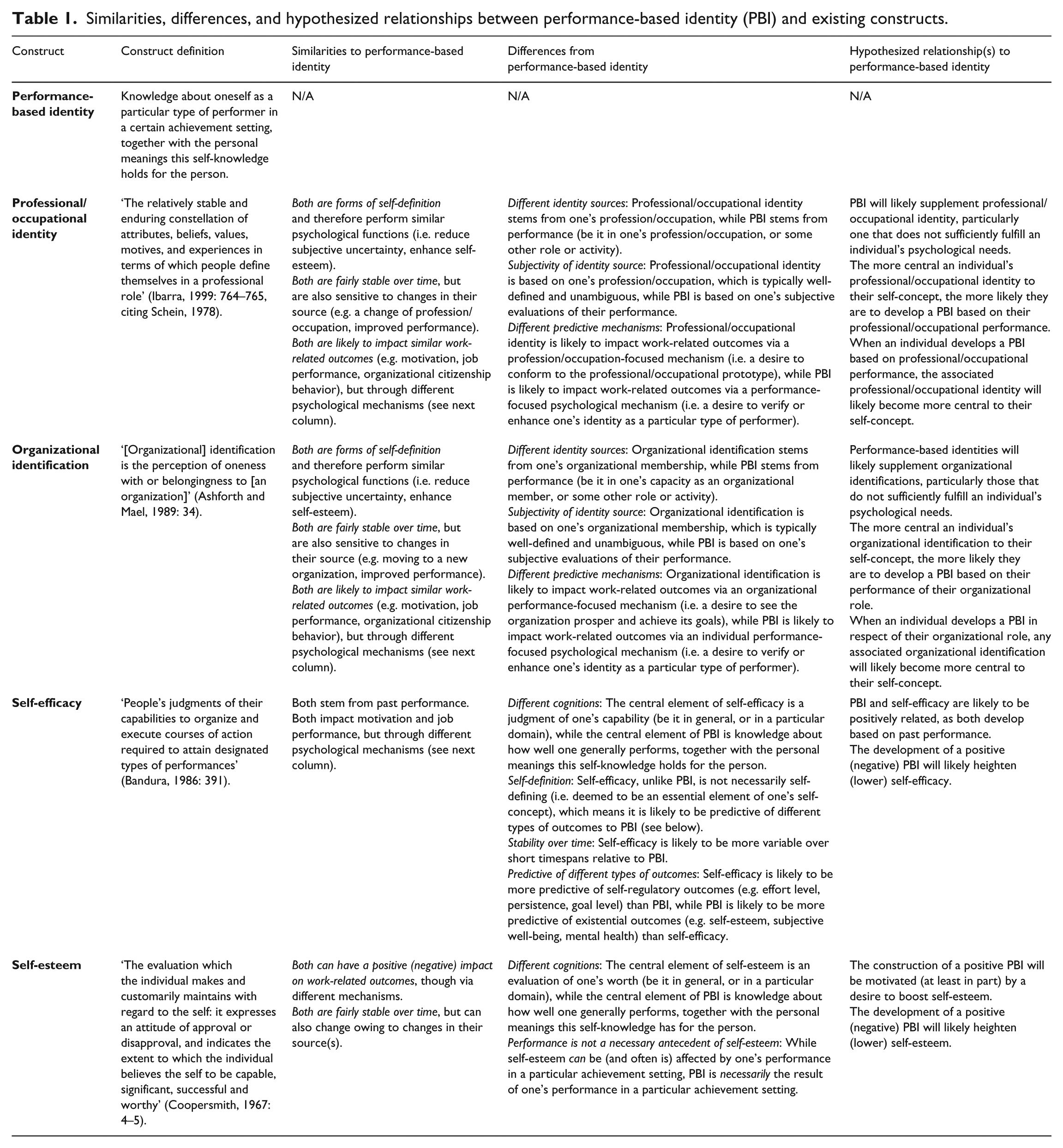
Although distinct, performance-based identity and self-esteem are also likely to be closely related. Boosting self-esteem (i.e. self-enhancement) is a major motive for the construction of identities in general (Vignoles et al., 2006). Thus, the construction of a positive performance-based identity is likely to be motivated in large part by a desire to enhance self-esteem. The construction of negative performance-based identities, however, will not be driven by the self-enhancement motive: it is inconceivable that an individual would self-define as some variant of ‘below average’ in order to feel more worthy. Rather, the development of a negative performance-based identity is likely to be driven by the aforementioned motive to reduce one’s subjective uncertainty 3 and better understand one’s ‘true place’ in the world (Hogg and Abrams, 1988), even if this self-knowledge is unfavorable. Finally, we expect the formation of a positive (negative) performance-based identity to increase (decrease) an individual’s self-esteem. Table 1 summarizes our positioning of performance-based identity in relation to the constructs discussed above.
Similarities, differences, and hypothesized relationships between performance-based identity (PBI) and existing constructs.
The construction of performance-based identity
Most conventional work-related identities have a clearly defined source or target (e.g. a particular organization or team). An identity based on performance, however, is slightly more complex, as performance itself is sometimes an ambiguous phenomenon. While job performance can be formally defined as ‘scalable actions, behavior, and outcomes that employees engage in or bring about that are linked with and contribute to organizational goals’ (Viswesvaran and Ones, 2000: 216), in everyday life, different individuals often define performance in different ways, and arrive at different conclusions about their own and others’ overall performance level. Given this relatively ambiguous and complex source, it is important to consider the specific processes through which performance-based identity is likely to develop. We begin by exploring how people develop performance self-knowledge from more specific internal performance evaluations, each of which arises by interpretively comparing a specific achievement with one’s internalized performance standards. We then examine how imbuing performance self-knowledge with personal meanings causes it to evolve into performance-based identity. These identity construction processes occur in the context of a host of factors (Blumer, 1969; Mead, 1934), some external to the individual (e.g. situational, organizational, or sociocultural factors), and others internal (e.g. personality traits and psychological needs). We therefore explore how these contextual influences affect two critical stages of the performance-based identity construction process—the internalization of performance standards, and the emergence of personal meanings associated with performance self-knowledge. To aid our discussion, we provide a visual blueprint of our theorized performance-based identity construction process in Figure 1.

A blueprint of performance-based identity construction.
Performance self-knowledge
Performance self-knowledge, a person’s own knowledge that they are a particular type of performer, is the cognitive foundation of performance-based identity. Because performance self-knowledge is ultimately a person’s subjective generalization about what level of performance they typically demonstrate in a certain achievement setting, it can differ from how others categorize the person performance-wise, or what more objective performance measures might indicate. Performance self-knowledge develops through an interpretative process, which begins with an individual comparing results and feedback they receive about their performance with internalized performance standards. Each such instance of interpretive comparison results in what we refer to as an internal performance evaluation. As individuals accumulate internal performance evaluations, they develop more general self-knowledge about what type of performer they are. This performance self-knowledge will likely be fairly fluid until its holder has developed a reasonably rich and substantive set of internal performance evaluations to undergird it, and even once crystalized, it can be further shaped by subsequent internal performance evaluations that arise. We further detail each of these specific concepts and sub-processes next.
Results and feedback
Results and feedback are cues from a person’s external environment that indicate the extent to which one has achieved something. We use the term results to refer to data obtained via some measurement process. In most jobs there are generally accepted ways of measuring performance (Viswesvaran and Ones, 2000). For instance, the dollar amount made in sales by a car dealer, or the number of gadgets produced per week by a factory worker are not perfect measures of performance, but often used and accepted as objective indicators of it. Beyond quantitative indicators or statistics, other examples of results include ratings, grades, and ranks. Socially-derived feedback is another key input to the formation of performance self-knowledge. Such feedback arises through social interactions, which we use in a broad sense here to refer to one’s interactions with other people, groups, organizations, and institutions. This means that feedback can come in many different forms, including explicit praise/criticism, awards, job offers, and inclusion in certain performance-based collectives. Individuals compare results and feedback with their own internalized performance standards (discussed next), which leads them to their own conclusions about whether their performance in that particular instance was ‘good’ or ‘bad,’ ‘high’ or ‘low,’ and so on.
Performance standards
In accord with the key tenets of symbolic interactionism (Blumer, 1969), performance standards stem from one’s social environment, and are learned through social interactions with other individuals, organizations, and institutions. However, simply knowing that most others regard a particular achievement as ‘good’ performance is not equivalent to taking this external standard as a meaningful personal reference point (Kahneman, 1992; see also Higgins’s [1987] notions of ‘other’ and ‘own’ standpoints on the self). Individuals therefore have some agency in deciding which external performance standards they internalize as their own, with the fundamental question involved in this internalization process being ‘what does ‘good’ performance look like to me?’ Similar to the notion of identity play (Ibarra and Petriglieri, 2010), individuals (and particularly those who are new to a certain activity or occupation) might temporarily ‘try on’ certain external performance standards in an effort to test them for personal meaningfulness and achievability, and discard those that fail such tests. It is also important to clarify that individuals can attach much significance to a certain performance standard for purely instrumental reasons (e.g. because the standard is linked to a pay rise), but not actually internalize it at a deeper, identity-relevant level.
Internal performance evaluations
By comparing a particular result or piece of feedback with internalized performance standards, an individual forms an internal performance evaluation—a personal interpretation of the extent to which the specific achievement encoded in the result or feedback received represents ‘good’ or ‘bad’/‘high’ or ‘low’/‘best’ or ‘worst’ (and so on) performance. Identity theory posits that individuals’ compare information they receive about their behavior to identity-linked standards, with these internal comparisons subsequently playing an important role in regulating one’s behavior, and also shaping one’s identities (Burke, 1991; Burke and Stets, 2009). Similarly, internal performance evaluations (‘how well did I perform in this instance?’) are the raw material out of which more general performance self-knowledge (‘what type of performer am I in general?’) is formed. Note that individuals are likely to treat negative and positive internal performance evaluations in quite different ways. Much research has shown that individuals subject information about themselves to significantly more psychological scrutiny when it threatens their self-esteem (e.g. Caprar et al., 2016). Because negative performance evaluations threaten self-esteem, we would generally expect individuals to avoid (or strongly resist) drawing on such evaluations in the early stages of developing performance self-knowledge, and conversely, be quicker to generalize from positive performance evaluations. Of course, if an individual is repeatedly confronted with only (or mostly) negative performance evaluations, they will likely have little choice but to accept these evaluations as the basis of their (negative) performance self-knowledge.
Personal meanings of performance self-knowledge
People know many things about themselves, but not all such knowledge is deemed a core, self-defining part of who they are (Tajfel, 1982). Performance self-knowledge, like any other form of self-knowledge, becomes self-defining when it acts as a powerful way for an individual to understand themselves and their relationship to their broader social milieu. For one person, knowing they are a top performer could become self-defining because they see a link between this self-knowledge and social status, or for another, because they associate this self-knowledge with making a positive impact on the lives of others. A third person might not deem performance self-knowledge meaningful (or strive to dismiss it as meaningful) when they perceive that their level of performance is unfavorable, though as mentioned earlier, even unfavorable self-knowledge can take on personal meanings and subsequently evolve into a negative performance-based identity under certain conditions.
How exactly does performance self-knowledge become imbued with personal meanings? Burke and Stets (2009) propose that the initial meanings associated with any identity arise through social learning, direct socialization, and reflected appraisals. Consistent with this framework, most individuals in contemporary societies are socialized early on to believe that being ‘good’ at what one does is desirable, and these beliefs are continuously refined and reinforced throughout life via various social mechanisms. Once an individual actually starts to develop performance self-knowledge, however, the meaning-making process is likely to accelerate significantly: at this point, performance self-knowledge is no longer just information, but rather information linked to important consequences for the individual, which tells them something not just about their performance, but more fundamentally about their place, purpose, and possibilities in life.
Contextual influences on performance-based identity construction
As with identity construction in general, sociocultural factors, situational factors, and individual differences are likely to be influential at nearly every stage of the performance-based identity construction process. There are two parts of the process, though, where this influence is likely to be especially strong: the internalization of performance standards (‘what does good performance look like to me?’), and the development of personal meanings associated with performance self-knowledge (‘what are the consequences of being this type of performer for my understanding of who I am and how I fit in the world?’). Below we detail some of the most significant and likely influences, and later, when discussing future research directions, we outline what additional factors might be important to consider.
Sociocultural factors
The personal meanings associated with one’s performance self-knowledge are partly attributable to the sociocultural environments one has experienced throughout life. Cross-cultural studies have identified variations in the extent to which work is central to people’s lives in different societies (MOW-International Research Team, 1987) and the extent to which performance is emphasized as important. The well-known GLOBE studies, for instance, define the cultural dimension of ‘performance orientation’ as the degree to which a society encourages and rewards individuals for performance improvement and excellence (House et al., 2004). We expect that societies or cultural groups with high work centrality and high performance orientations will be more likely to instill in individuals a focus on their performance at work than countries that generally score low on these dimensions. It is also important to note, though, that an increased focus on performance is spreading across societies owing to globalization: along with products and services, international businesses also ‘export’ new attitudes towards work and life in general (Caprar, 2011). As a result, current and future work cohorts all over the world are arguably more likely to find personal meaning in excelling at work than previous ones. Finally, sociocultural factors will also bear on what performance standards a person internalizes. If an individual is constantly told (implicitly or explicitly) by significant others, colleagues, or managers that a certain type and/or level of achievement constitutes ‘good’ performance, they are likely to internalize this performance standard as a meaningful benchmark for evaluating their own performance (see Ibarra [1999] for an empirical illustration of this).
Situational factors
Specific circumstances will also impact the personal meanings people attach to performance self-knowledge, and the performance standards they internalize. Employees are particularly likely to attach personal meanings to performance self-knowledge when important outcomes, such as pay and promotion, are linked to performance, as this self-knowledge reduces subjective uncertainty (Hogg and Abrams, 1988) by signaling the extent to which one can expect to receive such outcomes. In these situations, employees will also likely internalize the standards required to achieve such outcomes. Career stage is also likely to be an important factor: individuals at early- or mid-career stages are more likely to find significance in performing well at work, and thus attach personal meanings to performance self-knowledge than those at later stages, or those still exploring potential career options (see Cron and Slocum [1986] for further detail on these stages and their links to job attitudes).
Individual differences
Finally, the personal meanings a person attaches to performance self-knowledge, and the performance standards they internalize, are also likely to be influenced by certain traits and dispositions. Goal orientation is a particularly important variable in this regard. People are known to vary at both state and trait levels along three dimensions of goal orientation: learning (the extent to which one is concerned with developing competency), performance approach (the extent to which one is concerned with being and thus appearing competent to others), and performance avoid (the extent to which one is concerned with avoiding being and thus appearing incompetent to others) (Porath and Bateman, 2006). Because individuals who are primarily performance approach-oriented find personal significance in being competent, we would expect them to internalize more challenging performance standards than those who are not, and to be more likely to attach personal meanings to positive performance self-knowledge. By contrast, individuals who are primarily performance avoid-oriented will likely internalize less challenging performance standards than those who are not. Furthermore, because such individuals fear being incompetent, they would likely be highly sensitive to self-knowledge that confirmed this fear had been realized, and therefore be more likely to develop negative performance-based identities relative to individuals who are not primarily performance avoid-oriented. Finally, individuals who are primarily learning goal-oriented would seem less likely than those who are not to develop a performance-based identity, given their focus on development rather than performance outcomes. In addition to goal orientation, being relatively high on certain other performance-related traits will increase the likelihood of an individual attaching personal meanings to performance self-knowledge, as well as the types of performance standards they internalize. Specifically, we would expect those who are high on conscientiousness (Roccas et al., 2002), competitiveness (Graziano et al., 1997), need for achievement (Phillips and Gully, 1997), and/or self-oriented perfectionism (Hewitt and Flett, 1991) to be more likely to construct performance-based identities around positive performance self-knowledge, and also more likely to internalize higher, more challenging performance standards, than individuals who are comparatively lower on these traits.
Work-related outcomes of performance-based identity
Identities are not only products but also producers of individuals’ thoughts, feelings, and behavior (Mead, 1934; Swann, 2011). As such, performance-based identities are likely to impact those who develop them in significant ways, many of which relate to work and organizational life. Next we explore some of the potential positive and negative work-related outcomes of performance-based identity, with a specific focus on outcomes that extant research commonly associates with identities in general; motivation (Van Knippenberg, 2000), feedback responses (e.g. Sedikides and Gregg, 2008; Swann, 2011), and subjective well-being (e.g. Thoits, 2009). Of course, performance-based identity is likely to have implications for many other work-related phenomena as well, but we focus here on the three outcomes that best highlight its predictive and explanatory value.
The ‘upside’ of performance-based identity
Research on self-verification has shown that people typically strive to behave in ways that verify and strengthen their identities, especially those that are most central to their self-concept (Swann, 2011). In work contexts, then, we would expect individuals with positive performance-based identities to be more motivated to demonstrate high levels of performance relative to those who have negative performance-based identities, as well as those who do not relate to performance in a self-defining way. Furthermore, amongst those who have a positive performance-based identity, we would expect the positive effect of this identity on motivation to become stronger as the identity itself becomes more positive and/or more central to the individual’s self-concept.
The motivation to verify one’s performance-based identity could also have an intriguing influence on how employees with such identities respond to negative feedback. The general consensus in the feedback literature is that feedback focused on how an individual performs a task is typically better for improving subsequent performance than feedback focused on personal attributes and abilities (Kluger and DeNisi, 1996). While this is generally sound advice, people do sometimes respond to personal criticism with heightened effort and motivation. Performance-based identity, when considered in conjunction with research on self-verification (Swann, 2011), might help to explain such constructive responses to negative feedback. When a person senses someone else has mistaken one of their identities, they will (given certain conditions) undertake compensatory behavior (e.g. ‘acting up’ the identity, verbal persuasion) in order to bring the focal person’s view of them into line with their own self-view (Swann and Brooks, 2012). From this perspective, performance-related criticism might be construed as an identity threat (Petriglieri, 2011) by individuals with positive performance-based identities, which catalyzes them to simultaneously prove their critic(s) wrong, and verify their performance-based identity through exerting more effort and ultimately enhancing their performance.
Performance-based identities might also positively impact individuals’ well-being via the aforementioned connection with self-esteem, as well as the broader mechanisms by which identities influence well-being in general (e.g. Sharma and Sharma, 2010; Thoits, 2009). Such positive relationships seem most likely when individuals have a performance-based identity that is both positive and certain (i.e. when individuals are highly certain about what type of performer they are; see Baumgardner [1990] and Pelham [1991] for overviews of the certainty dimension of identities). For one, a positive and certain performance-based identity is likely to allow individuals to remain resilient in the face of failure, as this identity would lead them to feel confident that they are indeed good at their jobs, and that any unfavorable instances of performance are mere anomalies on their overall performance record. In addition, on account of their strong motivation to perform at a high level, individuals who are certain of their identities as ‘top performers’ might also find themselves well-regarded and respected by colleagues and managers for their dedication to excellence, thus enhancing the levels of social support they receive. Finally, by virtue of knowing they are ‘top performers,’ individuals with a positive performance-based identity that they are highly certain of might also feel a sense of obligation to help others who are less competent, with the resultant helping efforts leading them to form new, or strengthen existing social and relational identities, which are known to have positive consequences for health and well-being (Haslam et al., 2009).
The ‘dark side’ of performance-based identity
The motivation to verify a positive performance-based identity described above might not always lead to the most functional outcomes. Rather than causing individuals to exert effort and perform at a high level, the desire to maintain a performance-based identity might instead cause individuals to abstain from helping their colleagues perform or improve their abilities, so as to preserve one’s ‘top performer’ identity. This type of behavior seems most likely to arise in work contexts where job performance has a zero-sum or ‘winner take all’ quality (Frank and Cook, 2010), because an improvement in the performance of one individual necessarily impedes the performance of another. Moreover, although a positive performance-based identity could positively impact one’s motivation through a self-verification mechanism, such an identity might also leave a person feeling as though they have ‘nothing left to prove,’ and subsequently reduce their work motivation. This identity-induced complacency would seem most likely when an individual is overly certain of their performance-based identity—a hypothesis consistent with the ‘too-much-of-a-good-thing’ effect (Pierce and Aguinis, 2013), which posits that ostensibly positive antecedents can have dysfunctional outcomes at extreme levels.
Under certain conditions, performance-based identities might also lead to less constructive feedback responses than the ones described earlier, especially when an individual has a performance-based identity that they are uncertain of. In such cases, individuals may become highly defensive and combative in the face of criticism of their performance, because such feedback constitutes a very real threat to their performance-based identity, which is less likely to be the case if the individual were more certain of it (see Baumeister et al.’s [1996] notion of ‘threatened egotism’). The potential for psychological distress in the face of feedback seems even more likely when an individual not only has a positive and uncertain performance-based identity, but also holds an entitative implicit theory of ability (more colloquially known as a ‘fixed mindset’ [Dweck, 2016]), as such individuals would not only be distraught about potentially not being the ‘top performers’ they believed themselves to be, but also by their belief that there is little they can do to become one.
Finally, while performance-based identities might often have positive consequences for well-being (and consequently the many other factors that well-being affects), such identities could in some cases be detrimental to well-being and mental health. Individuals with positive but uncertain performance-based identities might experience unpleasant feelings of self-doubt when faced with periods of poor performance or failure at work, which could in turn lead to chronic anxiety or depression. Even individuals with positive and certain performance-based identities might experience such adverse psychological consequences when they find themselves in an environment that constantly fails to validate (or even invalidates) their identity (e.g. when they move to an organization that judges performance against different standards to those they have internalized, or requires them to perform work they perceive as inconsistent with their ‘top performer’ identity). Costas and Kärreman (2016), for instance, describe how the management consultants they studied came from top universities, and (presumably) saw themselves as ‘elite individuals’ entering an ‘elite environment’ when they were first hired, but many were adversely affected by the realization that the actual work they undertook was radically inconsistent with such ‘elite’ identities. Another (though likely rare) condition under which performance-based identity might have negative outcomes for well-being is when the identity is grounded in negative performance self-knowledge. When individuals define themselves as poor performers, maintaining this identity is likely to take a significant toll on their self-esteem. As such, understanding the conditions under which individuals develop performance-based identities (and of what nature) is important, but only possible if we first acknowledge that identification with performance is indeed possible.
Discussion
We began by proposing that, owing to recent changes in the nature of both work and society, along with a growing sociocultural emphasis on performance generally, performance is increasingly likely to act as a source of identity for today’s workers. We then defined performance-based identity as knowledge about oneself as a particular type of performer, together with the personal meanings this self-knowledge holds for the person, and showed how it connects with and complements related constructs. Next, we provided a theoretical account of how individuals might construct a performance-based identity, and finally, discussed some of its likely work-related outcomes. We now turn to discuss the theoretical and practical relevance of performance-based identity and areas for future research on what we see as an important phenomenon in contemporary workplaces.
Theoretical contributions
Performance-based identity as a concept expands our knowledge of identity in the context of work in several ways. First, the concept allows us to make sense of how people relate to their performance by encouraging exploration of the deeper, more existential connections between self-perceptions of performance and the self-concept. We see performance-based identity as a construct that captures a phenomenon that many workers are likely to experience in today’s performance-focused and individualized society (Bauman, 2001; Duina, 2010): identification not only with the work they do, but also with the level at which they generally perform it. By harnessing our focus on this phenomenon, the concept updates our understanding of the psychology of contemporary workers.
Second, performance-based identity emphasizes the reciprocal nature of the relationship between identity and job performance. To date, scholars have mostly approached this relationship in a unidirectional way, assuming that identification with work-related collectives leads one to exert more effort to achieve the collective’s goals, and thus demonstrate superior job performance (Ashforth et al., 2008). Performance-based identity encourages us to explore the reverse possibility—that job performance leads to a particular form of identity in its own right—and in this way, sketches a more complete picture of the reciprocal, dynamic relationship between people’s identities and their work (Burke and Reitzes, 1981). Relatedly, performance-based identity also highlights the two-way connection between identities and behavior in general. While behavior tends to be seen as an outcome of identities, performance-based identity emphasizes that behavior is also a source of identity, with individuals not only ‘thinking and feeling’ their way into identities, but ‘acting’ their way into identities as well (Ashforth et al., 2008: 331).
Third, performance-based identity is a helpful reminder of the dynamic nature of the social/personal identity distinction. Performance-based identity is likely to function psychologically in a social capacity under certain conditions (e.g. by making an individual feel part of a broader group of ‘top performers’), and in a personal capacity under others (e.g. by making an individual feel unique relative to many others). In this way, the construct promotes a dynamic, function-based view of the social/personal identity distinction, where identities are not seen as inherently and enduringly social or personal based on their apparent content (e.g. Ashforth and Mael, 1989; Turner, 1982), but rather as having the potential to function in both social and personal capacities (e.g., Brewer, 1991; Vignoles, 2019).
Finally, performance-based identity allows us to revisit important work and organizational topics from an identity perspective, which pushes scholars to make fresh connections and articulate insights that have been alluded to in the literature, but not clearly specified. For instance, we have long known that job performance matters to people, but acknowledging that it might matter so much that it triggers a process of self-definition allows for a sharper focus on the phenomenon, and the use of a broader base (i.e. the identity literature) for theorizing and empirical exploration of this topic. As another example, we have discussed how performance-based identity might act as a supplement to other work-related identities—a potential inter-identity connection that, to our knowledge, has been implied but not fully explicated in the identity literature. Such an inter-identity connection highlights how multiple identities can operate in tandem to fulfill an individual’s psychological needs and influence their behavior, beyond what any single identity would on its own. Finally, the new perspective offered by performance-based identity might also help to resolve existing debates or puzzles in the identity and organizational behavior literature more broadly—the most significant of which we explore below as possibilities for future research.
Future research directions
Refining the concept of performance-based identity, and better understanding its dynamics
We see several intriguing avenues for further expanding our theoretical blueprint about the nature, construction, and consequences of performance-based identity. Some of the most important questions future research could explore include: how positive/negative must performance self-knowledge be in order to become a self-defining identity, can people have multiple performance-based identities derived from different aspects of their work (e.g. an academic simultaneously identifying as a ‘top performer’ in terms of teaching, but a ‘low performer’ in terms of research) and indeed, different aspects of their life (e.g. their profession, hobbies, family life, etc.), how (un)stable are performance-based identities over time, and relatedly, what does it take for an individual to lose a performance-based identity or have it erased by failure/poor performance, and what factors (e.g. personality traits, cultural values) might facilitate or inhibit this process of identity loss? Perhaps the most intriguing part of the performance-based identity construction process is the qualitative shift from mere performance self-knowledge into identity: how exactly does this occur, and is this something managers or individuals in general could (or should) influence? In addition, while we have focused mostly on the construction of (new) performance-based identities, future research could also seek to explore how individuals maintain (existing) performance-based identities: what forms of identity work (Brown, 2014; Sveningsson and Alvesson, 2003) do individuals use to protect positive performance-based identities from negative results or feedback? How do individuals with negative performance-based identities deal with the apparent tension between the motive to verify such identities (Swann et al., 1992) on the one hand, and the motive to enhance their self-esteem (Sedikides and Gregg, 2008) on the other? While a wide range of approaches are likely to help in addressing the questions outlined above, we see much promise in exploratory qualitative methodologies, which capture people’s detailed interpretive processes and allow for unanticipated findings to emerge.
Work-related outcomes
An empirically-grounded conceptualization of performance-based identity paves the way for quantitative studies of the relationship between this identity and a range of work-related outcomes. Building on our earlier theorizing, researchers could examine whether or not, and if so, to what extent the development of a performance-based identity impacts an individual’s self-esteem, work motivation, responses to feedback and failure, resilience, and subjective well-being. Amongst those who do identify with their performance, researchers could also explore how variation across these individuals in certain dimensions of performance-based identity (e.g. valence, centrality, certainty) moderates any such relationships. The various investigations described above require a valid and reliable way of both (a) identifying whether or not any given individual actually has a performance-based identity, and (b) capturing variation in the nature of such identities across those individuals who hold them. In respect of the first requirement, an approach akin to the widely-used ‘twenty statements test’ (Kuhn and McPartland, 1954) could be useful, where participants are asked to provide free-flowing responses to the question ‘who am I?’ If a person provided a performance-based statement in their responses (e.g. ‘I am a top performer at work’), the individual could be deemed to have a performance-based identity. Researchers could then ask further questions of such individuals to more precisely assess and understand their performance-based identities by, for instance, using scales aimed at measuring the identity’s centrality, or capturing the breadth of the performance self-knowledge at the core of the identity (e.g. some individuals might self-define broadly as a ‘top performer,’ while others might self-define more narrowly as a ‘top consultant,’ ‘one of the best employees at Google,’ etc.). It would also be useful to qualitatively capture the personal meanings each individual attaches to their performance self-knowledge (e.g. by providing an open-ended response option that asks ‘why does it matter to you to be this kind of performer?,’ and then coding the responses into broader categories), as different meanings might differentially relate to particular outcomes.
Relationships with other identities
Another interesting question for future investigation is how individuals accommodate a performance-based identity as part of their broader identity set. One of the most important questions to subject to empirical study is whether or not, and if so, under what conditions performance-based identity exists as a supplement to other identities versus a standalone identity (i.e. leading an individual to define themselves as a ‘top performer’ in general, rather than a ‘top performer in/at X’). In the latter case, research could also explore how, if at all, an individual maintains an identity as a top performer generally despite low performance in certain life domains. In terms of the link between performance-based identity and specific work-related identities, it would be useful to investigate whether individuals who identify strongly along performance-based lines also identify relatively more or less along organizational lines, and what combinations of the two identities are most desirable from an organizational and individual performance standpoint, and in relation to other relevant outcomes like turnover intentions and organizational citizenship behavior. Furthermore, heeding Ramarajan’s (2014) call for integrative research on multiple (not just pairs of) identities, it would be fruitful to explore how individuals manage the boundaries (e.g. Kreiner et al., 2006b) and relationships between cultural, professional, organizational, and performance-based identities. For example, a person’s cultural identity may place a premium on not seeing oneself as better than others, putting this identity in conflict with a performance-based identity developed in a work context where top performance is highly valued. Exploring such relationships between identities would not only help with understanding the dynamics of performance-based identity, but also with understanding how multiple identities operate in work contexts.
Identity discrepancy, asymmetry, and deficit
As mentioned earlier, because performance-based identity is necessarily a subjective generalization about oneself, there is scope for it to differ quite substantially from external reference points, such as the type of performer one actually is (i.e. a discrepancy between performance-based identity and actual average performance) or is seen to be by others (i.e. a discrepancy between performance-based identity and reputation). This second type of discrepancy is also likely to manifest in the form of internal identity asymmetries—where individuals ‘come to believe that how they are seen by colleagues is incongruent with who they really are’ (Meister et al., 2014: 488). All such self-discrepancies are especially likely with performance-based identities given the aforementioned subjectivity inherent to its construction, and potential cultural norms (e.g. modesty about expressing one’s achievements), which limit people’s opportunities to accurately account for how others view them, and for others to fully grasp how a person sees themselves performance-wise. Moreover, not everyone can be a top performer, but everyone is encouraged to become one in today’s world, meaning there is a high likelihood of performance-based ‘identity deficit’—a ‘misfit between who one is and who one wants to become’ (Pratt, 2000: 467). Indeed, given that (objectively-defined) top performers are necessarily a minority in any organization (Aguinis and O’Boyle, 2014), it may be the case that most individuals in an organization actually experience performance-based identity as an ideal or aspirational identity (Higgins, 1987), and subsequently experience a chronic state of performance-based identity deficit. The above considerations all raise a number of important questions worthy of empirical research: what are the consequences, for both individuals and organizations, of consistency and inconsistency between people’s performance-based identities and how well they actually perform, or their reputation? How do individuals go about resolving internal identity asymmetries or identity deficits, and when (and for whom) are such experiences functional or dysfunctional?
Practical implications
For management practitioners, performance-based identity emphasizes that job performance can in many cases be a highly personal matter for people. This basic sentiment is sometimes overlooked in contemporary discussions of how to best manage employees’ job performance. If performance is a source of identity for an individual, they will inevitably link feedback about their performance not only to what they do, but more profoundly—to who they are. The need to carefully deliver constructive feedback to employees is already well recognized. However, an identity perspective on performance makes a powerful case for the importance of sensitive evaluative interactions, and explains why preventing performance management activities from ‘turning personal’ is sometimes challenging for managers.
A second important consideration for practitioners is that while performance-based identities can act as healthy motivational resources, there is also potential for people to go too far and ‘overidentify’ (Kreiner and Ashforth, 2004) with their job performance. When a person’s sense of self becomes dominated by an extremely central performance-based identity, their overall self-esteem also becomes highly contingent on this identity (Crocker and Wolfe, 2001). Employees who overidentify with performance might risk becoming severely depressed when their performance-based identity is threatened or lost (e.g., when they experience significant failure). For example, there is empirical evidence to suggest that, following significant failure, the most successful athletes are often more likely to perform worse (Marr and Thau, 2014), experience depression (Hammond et al., 2013), and at the tragic extreme, commit suicide (Rao et al., 2015). Thus, while star performer employees may entail a wealth of benefits (Aguinis and O’Boyle, 2014), on account of overidentifying with performance, they may also be more sensitive to failure, less likely to experiment (unless experimentation is recognized as ‘good performance’), and more likely to incite conflict when their overly-central performance-based identity is not validated by others. At the other extreme, individuals who have repeatedly failed may have developed a negative performance-based identity, and therefore need help shedding this identity before efforts to boost their performance are effective.
Conclusion
In any workplace, it is common for people to categorize others along performance-based lines. Yet once these kinds of performance-based categories are used to define others, they also inevitably become available for defining ourselves. The concept of performance-based identity allows scholars to recognize this phenomenon, and revisit a range of work-related issues with a fresh perspective; it also helps management practitioners better comprehend how people relate to their performance at work, which has important consequences for well-being, performance management, and work practices in general. The conversation we have sparked in this article has the potential to expand our understanding of people’s psychological and social experiences in work contexts, and we hope others will be inspired to stoke this conversation through further theorizing and empirical exploration of the links between performance, identity, and the self.
Footnotes
Acknowledgements
We wish to thank the following colleagues for their helpful feedback on this article at various stages of its development: Jean Bartunek, Veronica Benet-Martinez, Marilynn Brewer, Eliana Crosina, Elizabeth George, Peter Heslin, Amirali Minbashian, Michael Pratt, Roy Suddaby, and Heather Vough. We also wish to thank Matthew Sheep for his expert editorial guidance, and the three anonymous reviewers for their consistently constructive and insightful feedback throughout the review process.
Funding
Completion of this work was supported by an Australian Government Research Training Program Scholarship.
