



Abstract
Due to demographic changes, age diversity is growing in the workplace, creating a potential challenge to social integration. However, who is most affected by working with colleagues of different ages and when is being dissimilar in age from others more likely to hinder organisational identification? Drawing on relational demography and on the social identity approach, we suggest that certain individual and contextual conditions can lead employees to react to greater age dissimilarity by reducing their psychological attachment to the organisation. We propose that negative age stereotypes and perceived age-related treatment affect the salience of age as a social category for employees and threaten their age group identity, thereby creating conditions in which age dissimilarity might hinder organisational identification. We therefore examine the moderating effects of negative age stereotypes and perceived age-related treatment on the relationship between age dissimilarity and organisational identification in a sample of 434 schoolteachers from 16 schools in Italy. Findings show that age dissimilarity per se is not sufficient to hamper employees’ identification with the organisation. However, it has detrimental effects when employees hold negative age stereotypes and/or perceive an unfair organisational treatment towards their own age group. Implications for research are discussed along with practice implications.
Keywords
Introduction
Increasing age diversity in the workplace is one of the major workforce trends that most regions of the world are witnessing due to declining birth rates and rising life expectancy. Indeed, at an organisational level, one of the implications of the longer working lifespan is that very young employees must work together with considerably older colleagues and vice versa, making it important for organisations to manage age differences effectively. Despite the growing relevance of this phenomenon, research on the implication of age diversity in the workplace is still much less developed than that on race and gender (Profili et al., 2017).
In order to contribute to filling this gap, this study draws on the relational demography approach (Chattopadhyay et al., 2004; Tsui et al., 1992) to shed light on the effect of age dissimilarity on organisational identification. As proposed by Ashforth and Mael (1989: 34), we treat organisational identification as a specific form of social identification consisting of ‘the perception of oneness with or belongingness to’ an organisation. We focus on organisational identification as previous research has shown this construct to be associated to several individual outcomes that are beneficial for both organisational performance and employee well-being (Chattopadhyay, 1999; Edwards and Peccei, 2010; Tsui et al., 1992).
Drawing on social identity theory (SIT) (Tajfel and Turner, 1986) and self-categorisation theory (SCT) (Turner, 1987), initial studies on relational demography have shared the premise that, for a variety of reasons, being demographically dissimilar to others in a social unit/organisation negatively affects individuals’ work attitudes and behaviours (O’Reilly et al., 1989; Tsui et al., 1992). However, empirical evidence has not produced a clear and consistent pattern of results in this respect (Riordan, 2000), leading scholars to seek to refine and expand the theory of relational demography. One of the most important findings in this respect is that status differences attached to demographic categories (e.g. female or minority employees vs male or white employees) are key to explaining the asymmetrical effects of demographic dissimilarity on individuals’ work outcomes found in several studies (e.g. Chattopadhyay, 1999; Tsui et al., 1992).
Moreover, scholars have noted that initial work on relational demography has often made only partial use of SIT and SCT, resulting in the formulation of over-simplified models of dissimilarity-related effects (Chattopadhyay et al., 2004; Hogg and Terry, 2000). As such, recent studies have made significant progress in proposing more complex theorising on the relationship between demographic dissimilarity and individuals’ work outcomes. For instance, Chattopadhyay et al. (2004) formulated a model that explains why the strength and direction of demographic dissimilarity effects may vary depending on employees’ use of different social identity enhancement strategies. Using regulatory focused theory, Chattopadhyay et al. (2016) developed a theoretical framework that combines the cognitive and affective outcomes of dissimilarity to explain why individuals may respond differently to dissimilarity from their co-workers. In a similar vein, Goldberg et al. (2010) prompted researchers to examine both contextual factors and individual differences that may explain when to expect negative, null or even positive reactions to demographic dissimilarity. Further, scholars have noted that previous research on work-related outcomes of demographic diversity and dissimilarity has largely ignored the role of salience and of identity threat (Guillaume et al., 2017; Van Knippenberg et al., 2004), two key factors that set in motion social categorisation and social identity-related processes (Ellemers et al., 2002; Hogg and Terry, 2000) and are therefore central to a deeper understanding of when and how age dissimilarity may affect individual outcomes of interest.
Responding to this call, the present study extends research on relational demography by incorporating salience and identity threat as key theoretical mechanisms for explaining the effect of age dissimilarity on organisational identification. More specifically, we propose that negative age stereotypes (NAS) and perceived age-related treatment (PAT) are two influential factors that affect the salience of age for social categorisation and the perceived threat to employees’ age group identities, creating the conditions in which age dissimilarity hampers organisational identification.
We define NAS as individual beliefs about negative characteristics of other employees based on their age (Posthuma and Campion, 2009). Since research has documented significant individual-level variation in NAS, we expect this to be an important individual moderator in the age dissimilarity–individual outcomes relationship (Liebermann et al., 2013). We suggest that employees with strong NAS are more likely to perceive age as a salient social category and to react negatively to age dissimilarity, responding with reduced identification to greater age differences.
We define PAT as individuals’ perceptions of the extent to which the organisation values and treats people of their own age group fairly and respectfully. Research has pointed out the existence of subjective differences in perceptions of fairness in organisations, notably among members of demographic minority groups (Mor Barak et al., 1998). We argue that PAT conveys important contextual cues that influence employees’ reactions to age dissimilarity. We expect that when employees perceive that the organisation treats members of their own age group with little respect and/or unfairly they are more likely to perceive a value threat to their age group identity and, hence, to identify less strongly with the organisation in the face of greater age dissimilarity from other organisational members.
Drawing on the social identity approach, we first develop hypotheses on the moderating role that NAS and PAT each play in the relationship between age dissimilarity and organisational identification, testing the two-way interactions. We then propose that NAS and PAT jointly interact with age dissimilarity to predict the impact of age differences on organisational identification, testing the three-way interaction.
In doing so, we make four distinct contributions to the extant literature. First, we shed light on the effects of age dissimilarity while, with few exceptions, previous research has mostly focused on gender and race dissimilarity (e.g. Chattopadhyay, 1999; Tsui et al., 1992; Wagner et al., 1984). Addressing this gap is important since age not only is a growing source of dissimilarity in the workplace, but – as we discuss in greater detail later – it may not be associated with clear-cut status differences in the same way as gender and race. Therefore, we do not know whether findings about the effect of gender and race dissimilarity can be extended to illuminate the relationship between age dissimilarity and individual work outcomes.
Second, the present study adds to the age dissimilarity literature in that extant research in this area has not yet explicitly examined the relation between age dissimilarity and organisational identification. This is surprising, since prior research has focused on a variety of other individual outcomes which are supposed to be affected by age dissimilarity through identification, such as employees’ intention to stay (Tsui et al., 1992), individual turnover (O’Reilly et al., 1989; Wagner et al., 1984; Wiersema and Bird, 1993) and citizenship behaviours (Chattopadhyay, 1999; Riordan and Shore, 1997). Focusing specifically on organisational identification, therefore, directly contributes to this strand of research.
Third, this study extends and refines the relational demography approach by proposing and testing NAS and PAT as two relevant individual and contextual conditions that may activate age salience for social categorisation and signal a threat to the employee’s age group identity, thereby inducing the individual to react to greater age dissimilarity with reduced identification with the organisation. Finally, while most previous research on the effects of diversity has been conducted at the group and organisational levels with a compositional approach (Guillaume et al., 2012), this study focuses on the individual level through the lens of relational demography.
In order to make the above contributions, we test our conceptual model using multilevel regression analysis on a sample of 434 teachers from 16 secondary schools in Italy. This occupational group is of particular interest for a number of reasons. In terms of demographic change, education is one of the sectors where age dissimilarity has become most accentuated (OECD, 2016). Furthermore, the school context is characterised by low status and power differences among schoolteachers and few extrinsic motivators. As Van Dick and Wagner (2002) noted, this implies that psychological variables, such as identification, are particularly important to explain individual work outcomes. Indeed, recent research has shown that the organisational identification of teachers is associated with higher levels of job satisfaction and lower intention to take early retirement (Gumus et al., 2012). Moreover, Christ and colleagues (2003) have found that teachers’ identification with the school explains significant differences in their work performance and extra-role behaviours.
Age, age dissimilarity and self-categorisation
Relational demographers often associate age with gender and race because they are all examples of chronically accessible categories that are likely to be used by people because they have been socialised into using these categorisations throughout their life (e.g. students in schools are generally categorised and grouped together on the basis of age). However, from the perspective of social categorisation processes, age also has several distinctive features that are noteworthy. Indeed, although potentially any individual trait can be used as the basis for social categorisation, attributes characterised by high visibility, stability and salience are more likely to foster categorisation (Turner, 1987). In this regard, whereas gender and race are highly visible dimensions, age is to some extent a less apparent and less objective dimension as people that are born in the same year may have different self-perception of age that reflects how old an individual feels, looks and acts (Kaliterna et al., 2002). Most importantly, age is not a stable dimension but continuously changes over time, so that any single person will belong to different age groups throughout his/her life (e.g. young, middle-aged and old). These peculiarities have relevant implications as ‘the variability and subjectivity of age … also limit the classification of people into groups or categories. There are no clear boundaries for being young or being old …’ (Boehm and Dwertmann, 2015: 43).
Moreover, in the broader social context, the meaning of age is constantly evolving along with new patterns in the timing of major life events (e.g. parenthood in the late 40s and 50s, delayed retirement from the 50s to the 70s), new definitions of age groups (e.g. the so called ‘young-old’ as opposed to the ‘old-old’) and new inconsistencies in what is considered age-appropriate behaviour (Neugarten and Neugarten, 1996). Therefore, at organisational and societal levels, the lines between age categories are blurring and so are the status and power hierarchies associated with age (Cowgill, 1974). On the one hand, in most industries, senior employees constitute a large portion of the workforce and tend to occupy the highest ranks in the organisational hierarchy and receive better remuneration (Burtless, 2013). On the other hand, economic and social trends associated with modernisation (e.g. globalisation and digital transformation) reinforce ‘the cult of youth’, threatening the status of middle-aged and older workers in the labour market and in managerial ranks. It is indicative that CEOs in the United States, for example, are entering their executive role at an increasingly younger age (Todaro, 2003).
An important implication is that, as compared with gender and race, age categories may be associated less automatically and univocally with status differences in the workplace. This is important as extant studies suggest that demographic dissimilarity differentially affects the work attitudes and behaviours of employees with high categorical status from those with low categorical status (Chattopadhyay et al., 2004). While this approach has produced relevant insights in terms of the effect of gender and race dissimilarity, it may be less powerful in explaining the effect of age dissimilarity given that age is not associated with clear-cut categorical status differences and that age groups are not univocally demarcated along the age continuum. In this respect, Chattopadhyay (1999) justified the unexpected finding that age dissimilarity was positively associated to positive-based self-esteem, altruism and peer relations among lower status younger workers, arguing that this counterintuitive result was possibly due to the permeability of age group boundaries. Given these peculiarities, we argue that individual and situational factors that bring age into active use making it a salient category in the work context are key to shaping and understanding the effect of age dissimilarity on organisational identification.
The influence of negative age stereotypes on the age dissimilarity–organisational identification relationship
Relational demography has initially assumed that individuals in organisations or work units compare their own demographic characteristics (e.g. age, gender, ethnicity) with those of other members, and that the extent of perceived similarity enhances identification with the organisation or unit. However, to date, research provides only indirect evidence about the association between age dissimilarity and organisational identification. Several studies have explored a variety of work outcomes linked to organisational identification, such as citizenship behaviours and turnover intentions and behaviour, generally reporting some mixed findings (for a review see Riordan, 2000). For instance, while some studies supported a negative impact of age dissimilarity on exit rates (O’Reilly et al., 1989; Wagner et al., 1984), other studies did not find any significant relation with individual turnover (Wiersema and Bird, 1993). Additional work indicated that age dissimilarity had differential effects for younger and older employees on altruism, organisations-based self-esteem and peer relations (Chattopadhyay, 1999). Moreover, at least one study found that age dissimilarity may positively influence individuals’ behaviours (e.g. Ferris et al., 1991).
This inconsistent pattern of results suggests the need to go beyond simple main effects for testing the impact of relational demography (Riordan, 2000). Indeed, organisational identification is not an automatic process that merely depends on the degree of demographic similarity/dissimilarity (Hogg and Terry, 2000). According to SIT and SCT, in order to affect organisational identification, dissimilarity on a specific demographic dimension must elicit social categorisation processes. In other words, it must affect the likelihood that individuals will use that demographic dimension to perceive and categorise themselves and others in distinct social groups (i.e. in-group vs out-groups). However, in most work contexts, employees may simultaneously compare self and others along several demographic and social categories (e.g. gender, race, age, professional groups, etc.), and not all of these are necessarily meaningful for the individual. Some dissimilarity dimensions are more likely to be influential in a given situation and this depends on the category salience in the social context (Hogg and Terry, 2000; Oakes et al., 1994; Turner et al., 1987).
Based on this argument, in order to predict when people will define themselves and others in terms of age differences, we need to understand when age becomes a salient category for the individual in the social context. Normative fit, which refers to the extent to which the categorisation makes sense in relation to the individual’s cognitive frame of reference, is one of the mechanisms that increases category salience (Oakes et al., 1991). For instance, when the perceived characteristic and/or behaviour of a young employee matches someone’s expectations of how a typical young employee looks or behaves, there is normative fit. Since a stereotype is the cognitive structure containing these expectations, normative fit is affected by the stereotypes that the individual holds about a category. This suggests that as the perceived stereotype differentiating the group members grows stronger, the salience of that category is likely to increase (Maddox and Chase, 2004; Stangor et al., 1992).
Empirical evidence suggests that age categories are often associated with stereotypic attributes in work settings (Hassell and Perrewe, 1995; Posthuma and Campion, 2009). Several characteristics have been identified in the literature that people attach to both younger and older workers, and most of them tend to be negatively coloured, especially in relation to elderly people (Posthuma and Campion, 2009). In particular, older workers are expected to have lower job performance (Cuddy and Fiske, 2002) and lower motivation to learn. They are also commonly expected to be harder to train and less adaptable (Chiu et al., 2001), less flexible and more resistant to change when compared with their younger counterparts. Research has also documented the existence of negative stereotypes against young workers (Finkelstein et al., 2013), such as being less trustworthy, less loyal to organisations and less likely to exhibit organisational citizenship behaviour (Truxillo et al., 2012).
Given their widespread relevance in the workplace, we propose NAS as an important moderator in the relationship between age dissimilarity and organisational identification. Specifically, we expect that the more an individual looks at people of different ages through the lens of negative stereotypes, the more strongly age is likely to be associated with meaningful differences in his or her mind and, hence, the greater the normative fit and salience of age for that individual in the work context. Importantly, individuals who hold strong NAS are not only likely to be more sensitive to age differences at the workplace, but are also likely to experience and react to such age differences more negatively than individuals who either have more positive age stereotypes or who do not hold strong age stereotypes and for whom age, therefore, is not a salient social category. Indeed, according to SIT, people have a need for a high level of self-esteem and are, therefore, motivated to identify with social categories having positive characteristics and that can increase their self-identity, and thus, their self-esteem (Hogg and Turner, 1985). Therefore, we can expect that individuals with strong NAS are less motivated to identify with an organisation consisting of age dissimilar colleagues that they perceive as a less attractive social identity that decreases rather than enhances their self-esteem (Tajfel and Turner, 1986). In other words, it is the negative nature of age stereotypes, and not just age stereotypes per se, that is important for understanding the way in which individuals may react to age dissimilarity at the workplace.
Based on the arguments outlined above, we propose the following NAS-related moderation hypothesis:
Hypothesis 1: Negative age stereotypes (NAS) moderate the relationship between age dissimilarity and organisational identification, such that this relationship will be more negative when individuals have stronger negative age stereotypes.
The influence of perceived age-related treatment on the age dissimilarity–organisational identification relationship
According to SCT, category salience not only depends on individual factors (characteristics that a perceiver brings to a context), such as individual stereotypes, but also on situational factors (Maddox and Chase, 2004; Oakes et al., 1991).
We propose that when employees believe the organisation treats members of their own age group with little respect and/or unfairly, PAT conveys situational cues which increase age identity salience and signal a social identity threat to the group value. According to SIT, social identity threats to the group value – also called value threats – can take different forms and occur whenever the individual perceives that his/her own group is evaluated negatively or is unfavourably considered in the social context, either in absolute terms or in relative terms through an explicit or implicit comparison with a relevant outgroup (Ellemers et al., 2002). According to basic postulates of SIT, the individual will attempt to react to a threat to group value with perceptual, affective and behavioural responses in order to protect the self. However, as Branscombe and colleagues (1999: 46) argued, the kind of defensive responses and coping strategies to threats to the group’s value may take different and quite opposite forms depending on individuals’ level of identification with the threatened group. Low identifiers may be more likely to distance themselves from the ingroup while high identifiers are more likely to close ranks, by perceiving the ingroup as even more cohesive or homogenous, displaying greater ingroup favouritism and derogating the outgroup (Branscombe et al., 1999).
This is relevant for understanding how the identity threat conveyed by perception of a negative age-related treatment may contribute to shape the effect of age dissimilarity on organisational identification. Based on the principle of group distinctiveness, SIT posits that people will typically identify more strongly with distinctive groups (Simon and Brown, 1987). In particular, distinctiveness has been defined both in terms of the relative size of the group (e.g. minority group status) and of the relative dissimilarity on some category/dimension (e.g. individual level of age dissimilarity compared to co-workers) (Branscombe et al., 1999). Scholars have reported increasing evidence of the tendency for the smaller group to stand out and become more salient, also showing that as the size of the individual’s ingroup decreases, the individual is likely to become more biased in favour of the ingroup (Mullen, 1991). Therefore, based on this evidence, we would expect more age dissimilar employees to identify more strongly with their own age group than less dissimilar employees because, in the latter case, the age ingroup lacks adequate distinctiveness.
Combining the principle of distinctiveness with theorising on individual responses to identity threat, we can now examine how perceptions of age-related treatment affect the relationship between age dissimilarity and organisational identification. In doing this, following Chattopadhyay et al. (2004), we argue that the age ingroup and the organisation can be seen as two potential targets for employee identification and that, depending on different contextual conditions, age dissimilarity may render the age group and the organisation compatible or alternative targets of identification for the employee. Specifically, when PAT is low (more negative), more dissimilar individuals – who are also high identifiers with their age group – are more likely to cope with the identity threat by increasing their identification with the ingroup. Moreover, age dissimilar employees are also more likely to experience greater psychological dissonance between the two potential foci of identification: their age ingroup and the organisation, which is the implicit source of the identity threat. Therefore, under conditions of more negative PAT, age dissimilar members are more likely to respond to the perceived identity threat by increasing their identification with the age ingroup at the expense of their psychological attachment to the organisation.
Conversely, when PAT is high (more positive), the employee experiences an identity-affirming cue signalling that people of his/her age are respected and treated fairly by the organisation. Therefore, in the absence of identity threat, no defensive response of any kind is evoked, and more age dissimilar individuals can continue to strongly identify with their age ingroup and, at the same time, also feel psychologically attached to the organisation. Indeed, as Chattopadhyay and colleagues (2004) argued, two categories (i.e. the age ingroup and the organisation) can be simultaneous targets of identification to the extent that individuals can perceive themselves as sharing a common fate with members of both target groups without experiencing cognitive dissonance.
Following this line of reasoning, we expect that, at low levels of PAT, the age ingroup and the organisation are alternative targets of identification and, thus, the greater individuals’ age dissimilarity, the greater the identification with the age ingroup, and the lower the organisational identification. Conversely, at high levels of PAT, the age ingroup and the organisation can be compatible targets and age dissimilarity does not necessarily hinder organisational identification. Therefore, we propose the following moderation hypothesis:
Hypothesis 2: Perceived age-related treatment (PAT) moderates the relationship between age dissimilarity and organisational identification such that this relationship will be more negative when perceived age-related treatment is less positive.
The joint interaction of negative age stereotypes and age-related treatment on the age dissimilarity–organisational identification relationship
We propose a three-way interaction between NAS, perceived age-related treatment and age dissimilarity in their relationship with organisational identification. More specifically, we expect the association between age dissimilarity and organisational identification to be most negative when the individual holds strong negative age stereotypes (high NAS) and he/she perceives that the organisation treats people of his/her age unfairly and disrespectfully (low PAT). Under these conditions, we posit that as an extension of hypotheses 1 and 2, and in line with the arguments outlined above in support of these two hypotheses, NAS and PAT reinforce each other’s negative moderating effect on the age dissimilarity–organisational identification relationship.
In contrast, based on the above arguments, when NAS and PAT are both high or both low, we expect the association between age dissimilarity and organisational identification to be less negative. As an illustration, we exemplify the expected outcomes when the two moderators are both low. Under these conditions, the individual does not hold NAS but perceives the organisational context to be unfair towards people of his/her age. Consequently, the negative moderation will be determined only by the contextual factor through the defensive response to the identity threat conveyed by low PAT. Therefore, we expect the negative moderation to be weaker as compared to when both moderators concur to strengthen the negative effect of age dissimilarity on organisational identification. A similar pattern of results should be expected when the two moderators are both high. Indeed, in this situation, the contextual factor will not be influential on the association between age dissimilarity and organisational identification given the lack of situational cues that convey an identity threat.
Finally, under conditions of low NAS and high PAT, both individual and contextual factors will contribute to make age dissimilarity less meaningful for organisational identification by reducing the salience of age and removing potential cues of identity threat. Therefore, age dissimilarity may remain unnoticed and fail to become significant for employee identification with the organisation. In this case, therefore, we do not expect age dissimilarity to have much of an effect, either positive or negative, on organisational identification.
Putting these various arguments together, therefore, we propose the following overall three-way interaction hypothesis:
Hypothesis 3: The relationship between age dissimilarity and organisational identification will be most negative when negative age stereotypes are stronger (higher NAS) and perceived age-related treatment is less positive (lower PAT).
Method
Participants
The study involved 517 teachers from 16 secondary schools located in central Italy. Participants were assured anonymity and guaranteed that their responses would be reported as an aggregate score only. Complete valid responses were obtained from 434 teachers, 66% of whom were women, confirming the female predominance in education. On average teachers’ age was 49 years, with a minimum age of 26 and a maximum age of 71 years. Age was distributed as follows: 2% of teachers were less than 30 years old, 15% were between 30 and 39 years old, 31% were between 40 and 49 years old, 38% were between 50 and 59 years old, and 14% were 60 years or older. Teachers had an average of 10 years of tenure in the current school, and 20 years practising as a teacher. These demographic characteristics were similar to those of the secondary-level school teachers’ population in Italy reported in recent studies (OECD, 2016).
Measures
Perceived age-related treatment (PAT)
We conceptualised age-related treatment as an individual-level variable designed to capture teachers’ subjective perceptions of the extent to which their school treats people of their own age group fairly and respectfully. We measured this variable with four items (Cronbach’s alpha = 0.75) adapted from McKay et al.’s (2008) measure of the fairness dimension of their general diversity climate scale, which also overlapped with some of the items included in the organisational fairness subscale developed by Mor Barak et al. (1998). A noticeable feature of our scale is that the items were adapted and reworded in order to explicitly measure perceived treatment towards one’s age group and not towards all demographic groups in the organisation. Indeed, for certain outcomes, such as social categorisation, individuals’ perceptions of the extent to which the organisation is fair towards people of their own age may be more important than a general and overall perception of fair treatment towards all employees. All items for this scale and for all the other measures used in the analysis are reported in the Appendix.
Negative age stereotypes (NAS)
We measured NAS related to both older and younger teachers with items adapted from the age stereotype scales of Chiu et al. (2001) and Hassell and Perrewe (1995). The most appropriate items were selected in consultation with three expert scholars and four senior school teachers to take into account the specific characteristics of our sample. The scale includes seven negatively worded items (see Appendix), which reflect the most commonly cited examples of NAS with respect to both older and younger workers (Posthuma and Campion, 2009; Truxillo et al., 2014).
We conducted an exploratory factor analysis on the seven items and results suggested a two-factor structure; one factor measuring age stereotypes related to older workers (Cronbach’s alpha = 0.67) and a second factor capturing age stereotypes related to younger workers (Cronbach’s alpha = 0.73) (detailed results available from the authors). It is important to bear in mind, however, that our concern in this study is with negative stereotypical beliefs associated with age in general. Hence, we were interested in measuring the extent to which individuals look at people of different ages (any age) in stereotypical terms, regardless of whether their stereotypes are related to old or young individuals. Consequently, following Coltman’s (2008) recommendation on formative measures, and consistent with previous studies on ethnic stereotypes (Wilson, 1996) and age stereotypes (Hassell and Perrewe, 1995), we adopted a formative measurement to compute the NAS scale. Formative measurement is appropriate when the research focus is on a theoretical construct that combines different dimensions/indicators that are conceptually distinct rather than interchangeable facets of the same construct, and not necessarily correlated with one another (Coltman et al., 2008). The overall composite scale of negative age stereotypes was computed by summing the two factors measuring NAS related to older and younger teachers respectively. Higher scores on this composite summative measure indicate stronger NAS.
Organisational identification
This was measured with six items from Mael and Ashforth’s (1992) scale (see Appendix). The Cronbach’s alpha for this scale was 0.77.
Age dissimilarity
Following O’Reilly and colleagues (1989) and Tsui and O’Reilly (1989) we computed the Age Dissimilarity Index as the difference between an individual’s age and the ages of all other individuals in his/her school. The index was calculated as the square root of the summed squared differences between an individual’s age and the age of every other individual in the same school, divided by the total number of respondents in the unit.
Control variables
We included the following control variables that previous studies found to be related to our outcome of interest: age (number of years), gender (0 = male, 1 = female) and organisational tenure (number of years).
Analysis procedures and preliminary analysis
The data collected for this study had a hierarchical structure (i.e. teachers nested within schools). Thus, although we couched and tested all our hypotheses at the individual level, we used a multilevel regression model with maximum likelihood estimation to do so. The reason for this is that a multilevel approach is more appropriate than standard regression methods when a complex data structure is involved since it takes into account the nested nature of the data and does not give rise to biased estimates and standard errors. Specifically, as part of the multilevel analysis we tested all our hypotheses at the individual level (N = 434 observations), treating individuals as the first level in the analysis and the 16 schools in which individuals were nested as the second-level grouping variable. The second level of analysis was included to take account of the possible non-independence of observations within schools because of the nested nature of our data. As noted, all variables were measured at the individual level (level 1) and, except for gender, were standardised for the main analysis.
Prior to conducting the main analyses, we ran a null model to check the proportion of the variance in the dependent variable that resided at the school level. We obtained an Interclass Correlation Coefficient (ICC) of 0.05 indicating that around 5% of the variance in organisational identification was due to differences across schools, with the remaining 95% attributable to teacher differences.
Prior to the main analyses we also conducted a confirmatory factor analysis (CFA) to establish the factorial validity and independence of all the main measures in our study, including organisational identification and PAT, as well as the negative age stereotype measures for older and younger employees respectively. As part of the CFA we examined standard goodness-of-fit indices and compared a main four-factor model where all the items for the four measures loaded on their respective hypothesised factors, to three alternative models: (1) a three-factor model similar to the four-factor model but where the items for the two negative age stereotype measures for old and young workers were made to load on a single factor; (2) a two-factor model where the items for organisational identification and age-related treatment were made to load on one factor and the items for the two negative stereotype measures were made to load on a second factor; and (3) a one-factor model where all items were made to load on a single common factor.
The CFA results are shown in Table 1. As can be seen, the four-factor model provided a good fit to the data (χ2 = 206.09; d.f. = 113; RMSEA = .04; CFI = .95, TLI = .94; SRMR = .04). Importantly, as the model comparison results in the last column of Table 1 show, the four-factor model fit the data significantly better than any of the other alternative models, thereby providing support for the distinctiveness of all the main measures used in our study. Note, however, that, as explained above, to capture the overall notion of NAS the two measures relating to stereotypes for older and younger workers were combined into a composite summative negative age stereotype scale for use in the main analysis.
Measurement model comparisons: Confirmatory factor analysis (CFA) results.
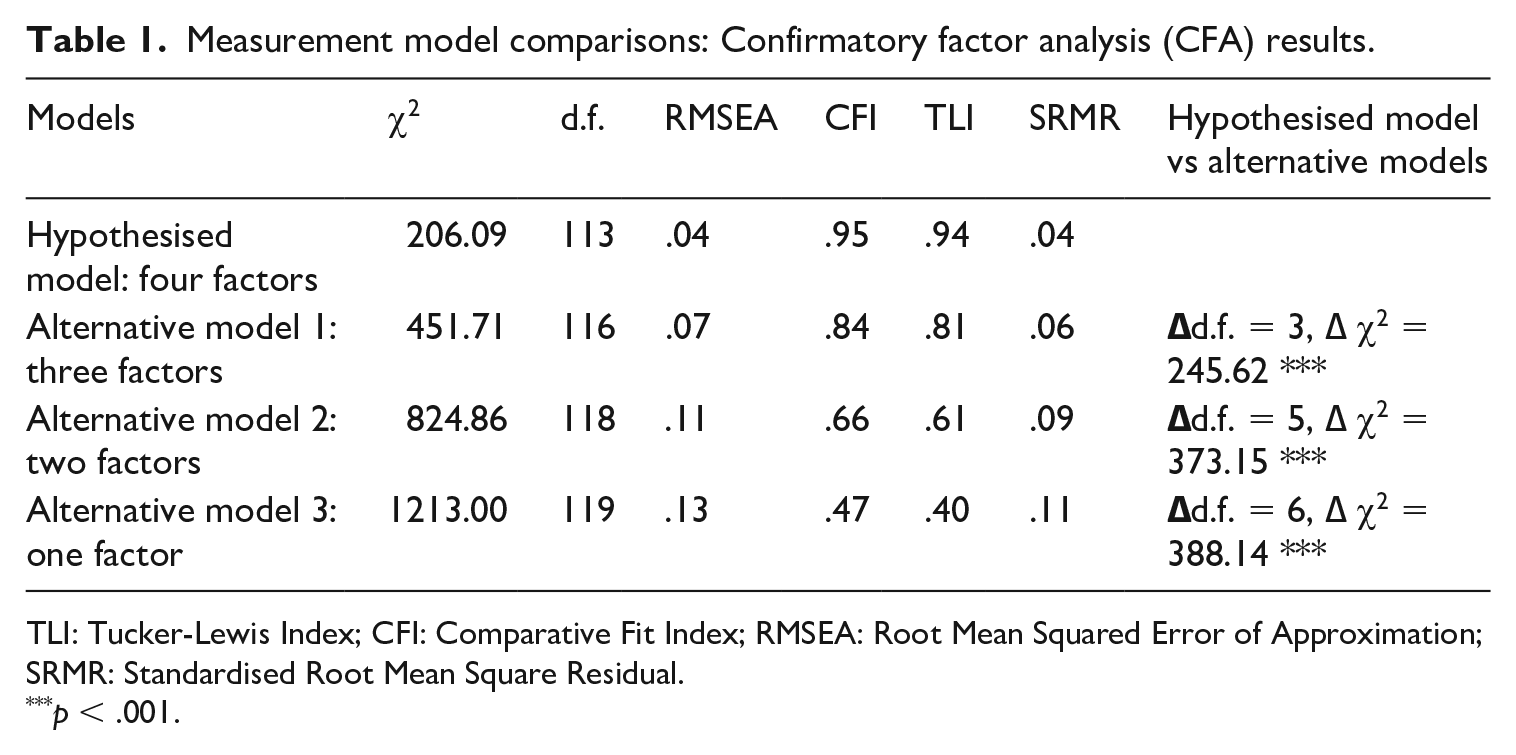
TLI: Tucker-Lewis Index; CFI: Comparative Fit Index; RMSEA: Root Mean Squared Error of Approximation; SRMR: Standardised Root Mean Square Residual.
p < .001.
Results
Table 2 shows the means, standard deviations, correlations and internal consistency alphas for all the variables in the analysis. While PAT was positively and significantly associated to organisational identification, neither age dissimilarity nor the negative age stereotype variable was significantly related to identification. Consistent with empirical evidence from previous studies, the control variables were all significantly correlated with our outcome of interest, with women, older and more tenured teachers all exhibiting higher levels of organisational identification.
Mean, standard deviation and correlations among variables.
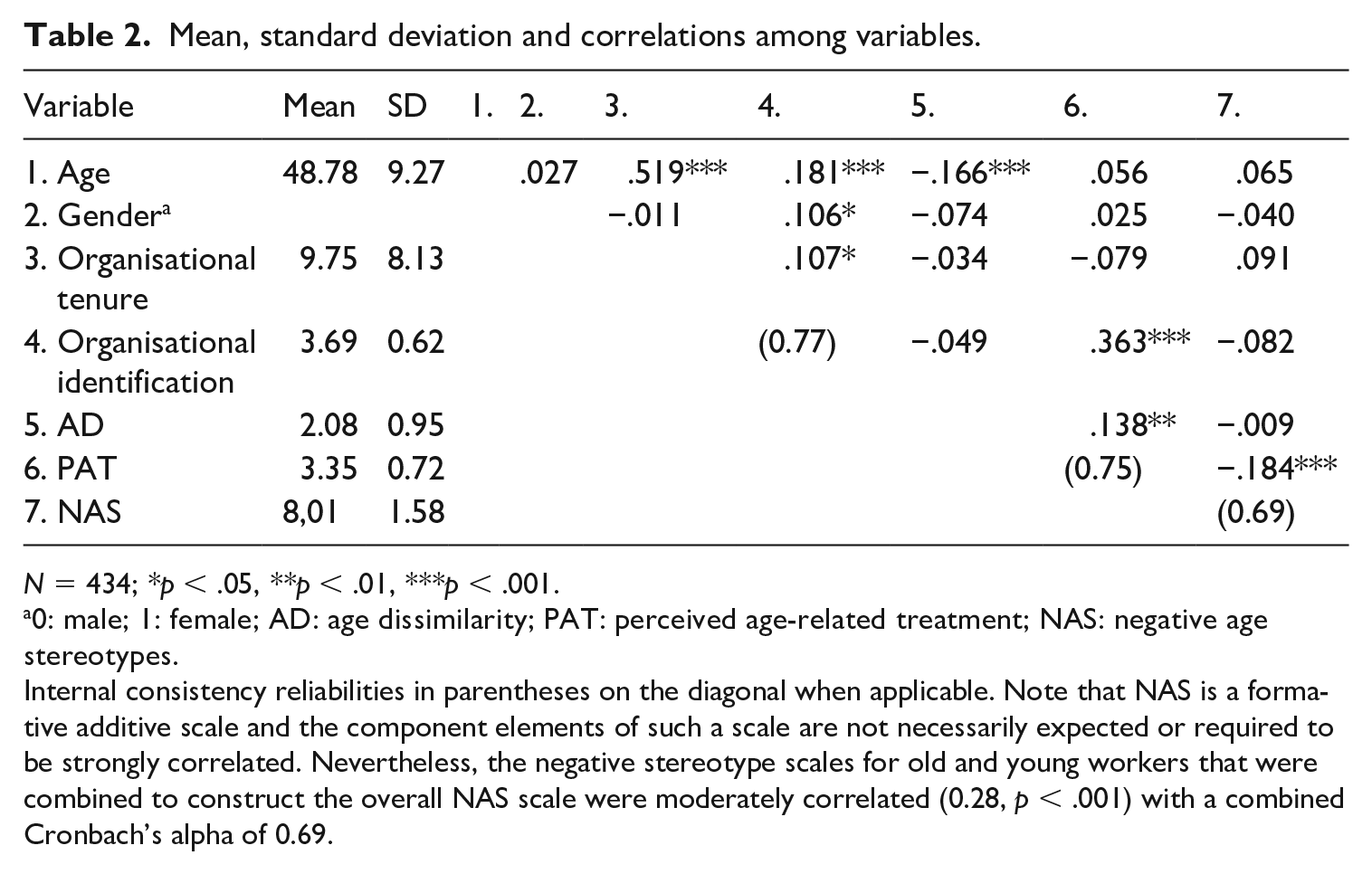
N = 434; *p < .05, **p < .01, ***p < .001.
0: male; 1: female; AD: age dissimilarity; PAT: perceived age-related treatment; NAS: negative age stereotypes.
Internal consistency reliabilities in parentheses on the diagonal when applicable. Note that NAS is a formative additive scale and the component elements of such a scale are not necessarily expected or required to be strongly correlated. Nevertheless, the negative stereotype scales for old and young workers that were combined to construct the overall NAS scale were moderately correlated (0.28, p < .001) with a combined Cronbach’s alpha of 0.69.
The results of the main analysis are shown in Table 3. Model 1 shows the results of the regression designed to test hypothesis 1 concerning the moderating role of NAS. In addition to the controls and the age dissimilarity, NAS and perceived age-related treatment main effect variables, this regression also includes the age dissimilarity x NAS interaction term. Consistent with hypothesis 1, the results show that NAS significantly moderated the relationship between age dissimilarity and organisational identification (β = −.066, SE = .030, p = .031). To gain further insight into the nature of the interaction effect involved, we plotted the result showing the effect of age dissimilarity on organisational identification one standard deviation above and one standard deviation below the mean of the moderator variable, respectively (Aiken et al., 1991) (see Figure 1). We followed the same procedure for all the other significant interactions reported below. Simple slope tests indicated that, in line with hypothesis 1, at high levels of NAS, the relationship between age dissimilarity and organisational identification was negative and significant (t = −2.901, p = .004). At low levels of NAS, on the other hand, the age dissimilarity–identification relationship was no longer significant (t = .290, p = .772).
Tests of hypotheses: Multilevel analysis results.
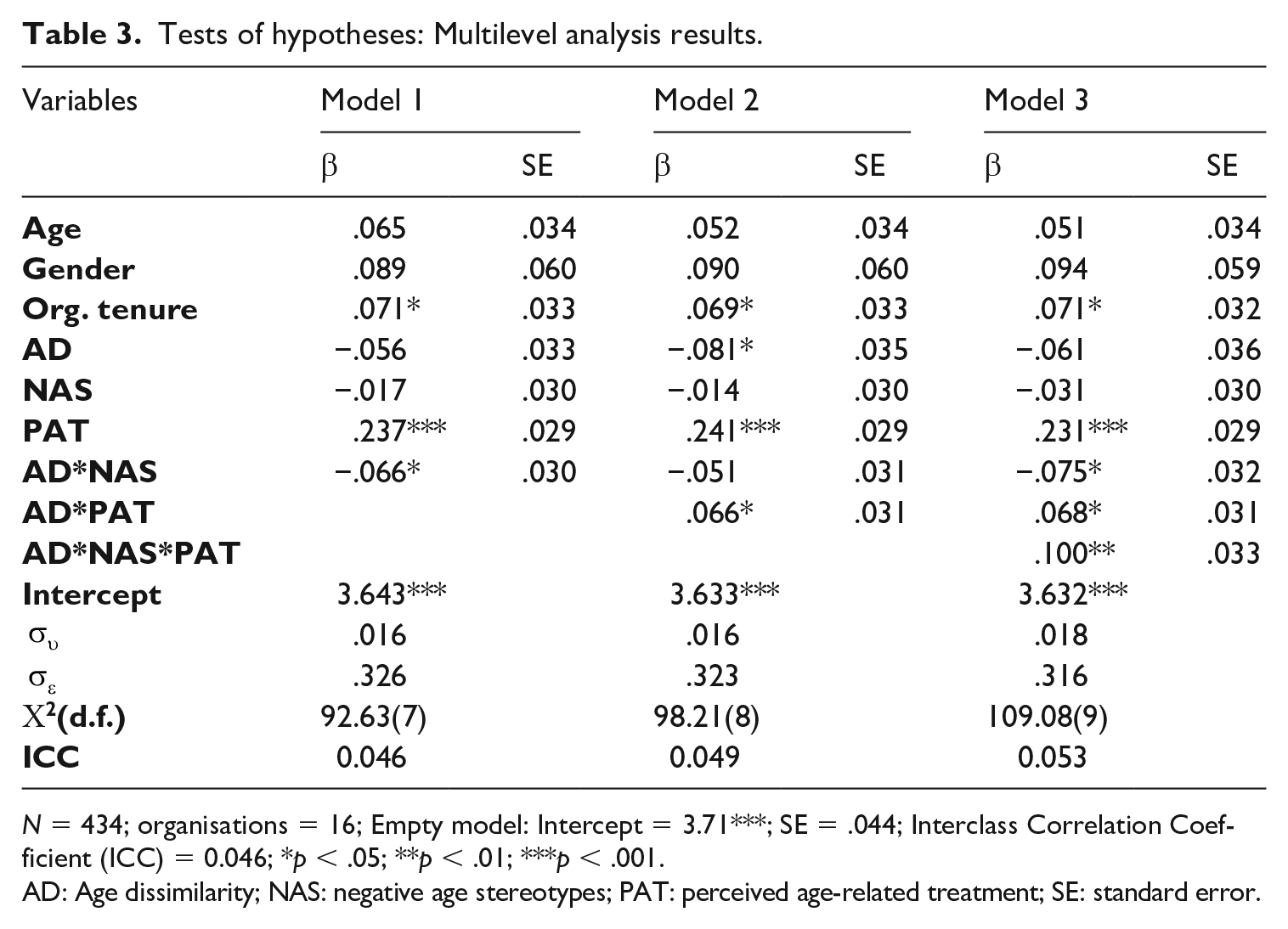
N = 434; organisations = 16; Empty model: Intercept = 3.71***; SE = .044; Interclass Correlation Coefficient (ICC) = 0.046; *p < .05; **p < .01; ***p < .001.
AD: Age dissimilarity; NAS: negative age stereotypes; PAT: perceived age-related treatment; SE: standard error.
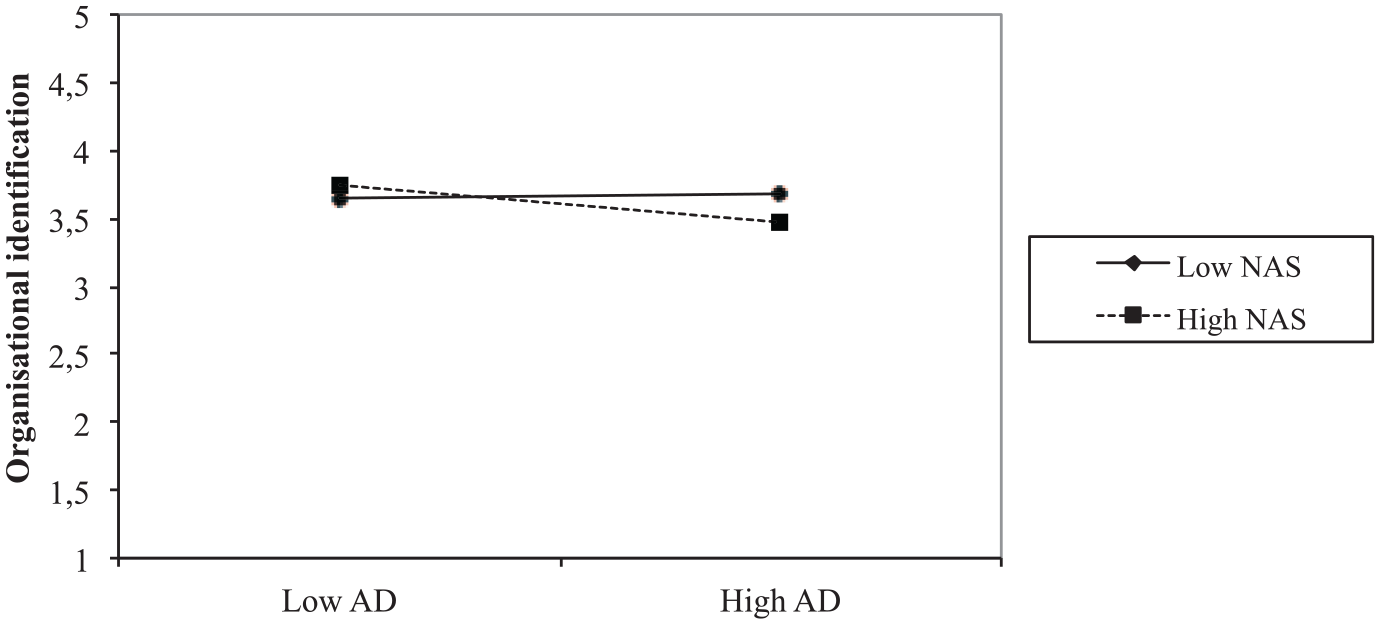
Two-way interaction between negative age stereotypes (NAS) and age dissimilarity (AD) in relation to organisational identification.
The results of the age dissimilarity x PAT interaction designed to test hypothesis 2 concerning the moderating role of the treatment variable are shown under model 2 in Table 3. As hypothesised, PAT significantly moderated the age dissimilarity–organisational identification relationship (β = .066, SE = .031, p = .033). The precise nature of the interaction is shown in Figure 2. A simple slope test indicated that, in line with hypothesis 2, at low levels of PAT the relationship between age dissimilarity and organisational identification was negative and significant (t = −2.391, p = .017). In contrast, at high levels of the moderator, the age dissimilarity–identification relationship was not significant (t = .194, p = .846).
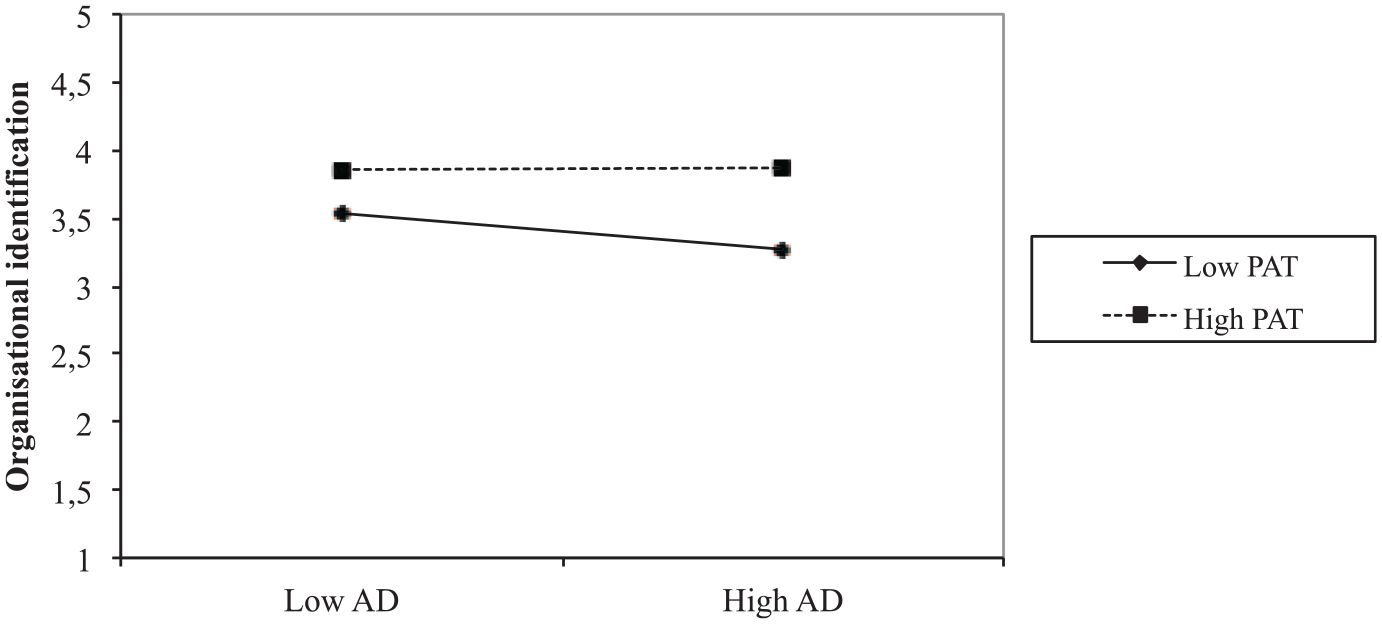
Two-way interaction between perceived age-related treatment (PAT) and age dissimilarity (AD) in relation to organisational identification.
The results of the three-way interaction between age dissimilarity, NAS and PAT (hypothesis 3) are presented in Model 3. The three-way interaction effect is positive and statistically significant (β = .100, SE = .033, p = .003). Most importantly, the graphical plotting of the results shows that, in line with hypothesis 3, when NAS are strong (higher) and PAT is low (more negative) the effect of age dissimilarity on organisational identification is negative and significant (t = −4.416, p = .000). In contrast, as expected, for all the other three combinations of the moderators, the relationship between age dissimilarity and organisational identification is non-significant (see Figure 3). Further, we also calculated slope difference tests. The results show that slope 2 (strong NAS, low PAT) differed significantly from slope 1 (strong NAS, high PAT; t = 3.616, p = .000), from slope 3 (low NAS, high PAT; t = −3.593, p = .000), and from slope 4 (low NAS, low PAT; t = −3.340, p = .001). Hypothesis 3 is therefore clearly supported by our results.
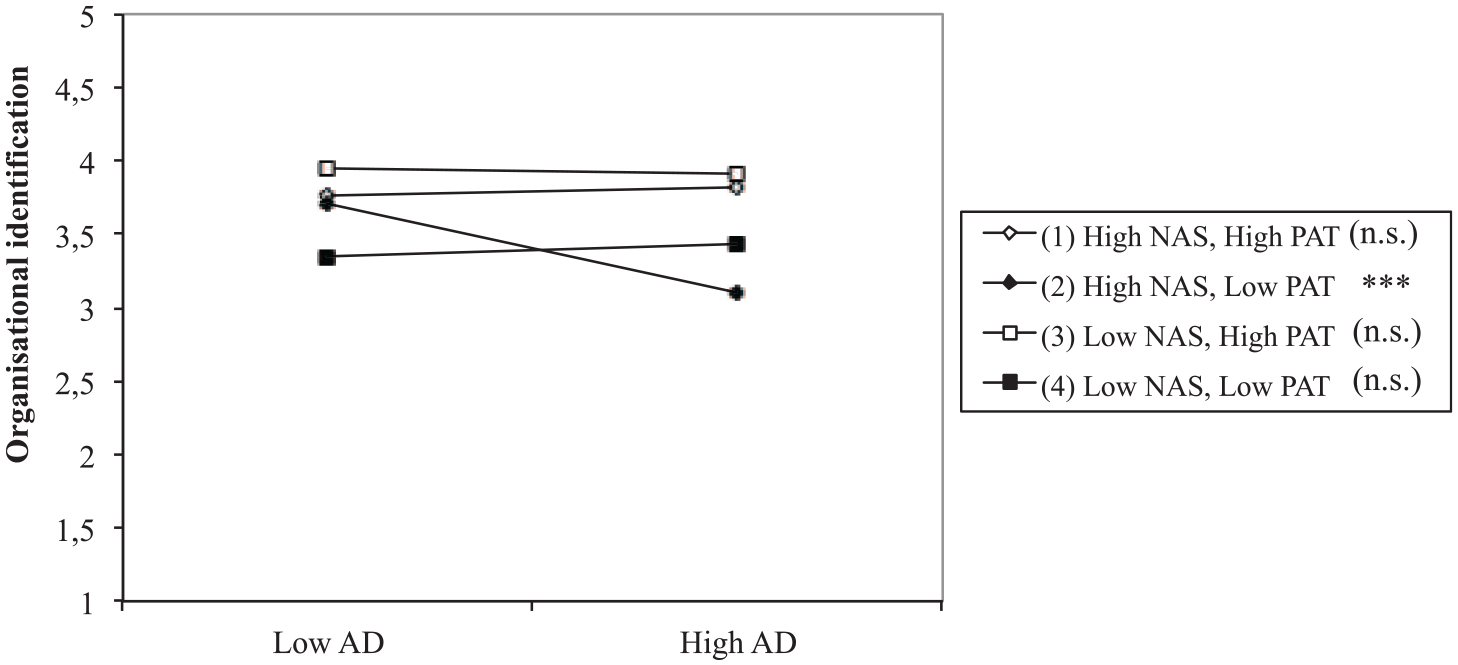
Three-way interaction between perceived age-related treatment (PAT), negative age stereotypes (NAS), and age dissimilarity (AD) in relation to organisational identification.
Discussion
Due to demographic changes the workforce is not only ageing, but also becoming more age-diverse, which creates a challenge that organisations must address in order to ensure the positive outcomes of dissimilarity prevail over the negative ones. In order to provide new insights to tackle this issue, we used theories on social identity and self-categorisation to develop and test a model that examines when individuals’ age stereotypes and perceptions of age-related treatment make age dissimilarity harmful for organisational identification.
First, unsurprisingly, our results indicate that age dissimilarity per se is not sufficient to hamper employees’ identification with the organisation. The lack of a significant direct effect on organisational identification is in line with expectations given the inconclusive findings for age dissimilarity effects found in the extant relational demography literature (Goldberg et al., 2010; Riordan, 2000). Second, our results demonstrate that for employees with strong NAS greater age dissimilarity from other co-workers is associated with lower identification with the organisation. Next, in line with theoretical expectations, we found that when employees perceive that the organisation treats co-workers of their own age group with little respect and/or unfairly, greater age dissimilarity is associated with lower organisational identification. Finally, and most importantly, our study reveals that personal and contextual factors jointly interact to shape the effect of age dissimilarity, producing the most negative effects on organisational identification when teachers hold NAS and, at the same time, perceive that the organisation does not treat employees of their own age fairly. Importantly, the negative association between age dissimilarity and identification disappears when teachers’ NAS are low and/or their perceptions of age-related treatment are positive. Indeed, under these conditions, age dissimilarity has little or no effect, either positive or negative, on organisational identification.
These results advance research on demographic dissimilarity in the workplace in several ways. First, the study adds to current understanding of the contingent effects of age dissimilarity on organisational identification, shedding light on two moderators that help to explain when employees may have negative reactions to age dissimilarity. Second, on the conceptual level, by linking the role of NAS and PAT to the mechanisms of normative fit and identity threat, this study enhances the explanatory power of relational demography theory, providing theoretical explanations for the differentiated individual responses. Moreover, as age stereotypes reflect how each person thinks of age, the proposed model enriches the explanation of dissimilarity effects beyond objective relational demography, showing that individual subjective beliefs about age categories contribute to shape the effect of objective age differences on individual work attitudes.
As an additional contribution, this study builds upon SIT and SCT arguments about the social context as a potential source of social identity threat (Ellemers et al., 2002) by examining the key role that PAT plays in influencing employee reactions to age dissimilarity. By doing so, we also respond to calls to incorporate contextual cues in demographic dissimilarity studies in order to make up for the scant attention that relational demographers have tended to pay to situational factors in extant research (Chattopadhyay et al., 2016).
This study also expands the focus of relational demography beyond explanations based on categorical status. Although this theoretical perspective has generated many valuable insights, it is not easily transferable to the analysis of continuous demographic variables and to dimensions of dissimilarity that are not associated with clear-cut status differences. In this respect, focusing on PAT helps to overcome some of these constraints because it allows one to take into consideration the perceived social structure that characterises the work context even when group boundaries are permeable and status hierarchies cannot be taken for granted, such as in the case of age.
In sum, this study extends current understating of age dissimilarity effects by incorporating personal and perceived situational factors that increase age salience and signal a threat to the group identity, demonstrating the importance of age for social categorisation in the work context. While these factors are key to understanding dissimilarity effects of a non-categorical dimension such as age, we believe that they can be fruitfully extended to the analysis of other demographic attributes, including gender and ethnicity, therefore offering a theoretical and analytical contribution to other areas of relational demography.
In terms of managerial implications, despite the specific nature of the school context, this study offers practical insights to organisations that are experiencing increasing age dissimilarity. The detrimental effect of NAS found in this study would seem to justify the growing impetus on ‘unconscious bias training’ in recent corporate diversity management initiatives. Several well-known companies have engaged in widely publicised training interventions to enhance manager and employee awareness of implicit biases and to prevent negative implications of stereotypes. However, as a word of caution, we acknowledge that some recent studies question the effectiveness of unconscious bias training, as knowing about bias does not necessarily imply enduring changes in related behaviours (Dobbin et al., 2011). Therefore, we encourage companies to address also other levers to minimise employees’ negative reactions to age dissimilarity. In this regard, our results suggest that organisations should devote greater attention to foster positive perceptions of age-related treatment at work. To this end, human resource management (HRM) practices should be carefully reviewed to minimise even subtle discrimination, and employees’ perceptions of the organisational context should be monitored on a continuous basis. Moreover, supervisors should be actively engaged as role models in creating a supportive and respectful work environment for people of all ages.
Limitations and future research
This study has a number of limitations but also suggests directions for future research. First, our concern in this article has been with NAS. Another interesting avenue for future research would be to extend the analysis also to positive age stereotypes. While both negative and positive stereotypes can enhance age salience through normative fit, their moderating impact on dissimilarity might differ depending on the different reactions that positive age stereotypes, as compared to NAS, might elicit from individuals in terms, for example, of self-enhancement motives and affective responses.
Second, our measure of PAT focused solely on perceptions of absolute treatment towards one’s age group. An important direction for future research would be employing a relative measure of PAT to assess whether detrimental effects of age dissimilarity on organisational identification may be accentuated when threat to social identity is engendered by perceptions of a negative social comparison between the ingroup and co-workers of other age groups.
Third, the data for the study were collected from a single source (i.e. teachers) using self-reports, which may increase the likelihood of common method bias. This concern is lessened, however, by several considerations. We created temporal and psychological separations in our survey by locating the items of the scales measuring the key constructs non-consecutively. We also tested a one-factor model which showed a poorer fit to the data as compared to a multifactor solution. Importantly, moreover, one of our predictors – age dissimilarity – is computed as a dissimilarity index and not through a perceptual Likert scale. In addition, all the hypotheses in our study test interaction effects that are less likely to be affected by common method bias.
We also acknowledge that no causal effect could be tested in this study because of its cross-sectional design and that the nature of our sample limits the generalisability of our findings given secondary schools’ specificities as compared to other organisational settings. Future research should be conducted on samples of employees from different sectors and countries using longitudinal designs in order to confirm our results.
Conclusion
This article advances knowledge about relational demography by shedding light on two boundary conditions that contribute – separately and jointly – to shape the effect of age dissimilarity on organisational identification. We have shown that age dissimilarity per se is not sufficient to inhibit employees’ psychological attachment to the organisation. However greater age dissimilarity is associated with lower organisational identification when teachers hold NAS and/or perceive the organisational context as unfair towards people of their own age group. These results suggest that a closer examination of individual and contextual moderators that set the conditions in which demographic dissimilarities are salient and social identities are threatened is a fruitful avenue for advancing research on relational demography effects in the workplace. This study also provides practical insights into organisations on how to prevent potential negative reactions to age dissimilarity that would likely hinder employees’ identification with the organisation and, in turn, become detrimental for its performance.
Footnotes
Appendix
All items were measured on a scale anchored from 1 (strongly disagree) to 5 (strongly agree).
Negative age stereotypes (adapted from Chiu et al., 2001; Hassell and Perrewe, 1995)
Perceived age-related treatment (adapted from McKay et al., 2008, 2009)
Organisational identification (from Mael and Ashforth, 1992)
Acknowledgements
The authors would like to thank Associate Editor Kim Hoque and three anonymous reviewers for their very constructive feedback on earlier drafts of the manuscript. We would also like to express our sincere gratitude to all schoolteachers and school principals who participated in this study.
Funding
The authors received no financial support for the research, authorship and/or publication of this article.
