




Abstract
Leadership is a process where leaders enact certain behaviors to influence followers. Yet, each follower may view the leader’s enactment differently, owing to differences in disposition and context. Here we examine leadership as a property attributed by followers to their leader, influenced by both the leader and followers’ personal attributes and the situation in which leaders and followers interact. Guiding this study, we asked: how do followers’ affect (negative and positive traits), motivation (regulatory focus), and cognitions (identity) and their congruence with their leader’s corresponding attributes influence their ratings of transformational leadership? Participants operated in extreme situations where their lives were often at risk because of exposure to combat. Results based on a sample of 1587 US Army soldiers operating in 262 units show that when there is a higher congruence between leaders’ and followers’ positive affect, promotion focus, relational identity, and collective identity, follower ratings of transformational leadership are higher, whereas a higher level of incongruence between followers’ and leaders’ positive and negative affect predicted lower ratings of transformational leadership. These findings differed based on the soldiers’ time spent in deployment and the level of combat exposure they experienced.
Jago (1982) defined leadership as being both a process and a property. The process of leadership is the use of non-coercive influence to direct and coordinate activities of group members to accomplish collective objectives: “As a property, leadership is the set of qualities or characteristics attributed [emphasis added] to those who are perceived to successfully employ such influence” (Jago, 1982: 315). Other leadership scholars have also emphasized the role that followers’ attributes and attributions play in leadership ratings (e.g. Ehrhart and Klein, 2001; Lord et al., 2020; Martinko et al., 2018; Shamir, 2007). For example, these authors argue that followers view leadership through the lens of their implicit theories of leadership and prototypes (Shondrick et al., 2010), including how much they like their leader (Ehrhart and Klein, 2001; Hansbrough et al., 2015; Martinko et al., 2018). Livi et al. (2008) analyzed data from seven published experimental studies and showed that approximately 10% of stable and 5% of unstable variance in leadership ratings was associated with rater attributes, with other research also showing how follower personality (e.g. Bono et al., 2012) and positive affectivity (Bono and Ilies, 2006; Martinko et al., 2018) influence ratings of leadership.
Though prior research has emphasized the importance of follower attributes in leadership ratings (Hansbrough et al., 2015), it has not examined how the congruence of leaders’ and followers’ attributes together influence ratings of leadership, nor how those relationships are influenced by the context wherein leadership is enacted. The key contribution of our study involves examining how follower and leader attributes, their level of congruence, and their interaction in context, together influence ratings of transformational leadership.
Examining the followers’ role in rating transformational leadership
Bass (1985) built on and operationalized Burns’s (1978) original conceptual work on transforming leadership by defining how such leadership enhances followers’ motivation, development, and performance. Bass (1985) defined four components of transformational leadership to include role modeling high standards for ethical conduct, inspiring followers, challenging followers to think differently, and encouraging followers to develop into leaders (Bass and Bass, 2009).
We build on this literature in two ways. First, as transformational leadership is one of the most consequential styles of leadership, determining how follower and leader attributes and their congruence relate to ratings of transformational leadership has broad implications for theory-building and practice. Though research has examined the impact of transformational leadership on person–person and person–organization congruence (e.g. Colbert et al., 2008; Hoffman et al., 2011; Jung and Avolio, 2000), the effects of leader–follower attribute congruence on transformational leadership ratings has yet to be examined. Examining such congruence will help inform the emergence of this consequential form of leadership. Second, transformational leadership should be a more salient leadership style when leaders and followers operate in extreme contexts wherein followers look to leaders to provide reassurance, inspiration and moral purpose, and expect them to act in idealized ways to guide them through the ethical and life-threatening challenges that characterize these contexts (Hannah et al., 2009). Supporting this claim, Tepper et al. (2018) found employees sought transformational leadership when there was greater challenge and uncertainty in their work. In sum, we seek to not only understand how follower and leader affective, motivational, and cognitive attributes interact to influence ratings of transformational leadership, but also how these ratings are impacted by varying degrees of extreme context exposure.
We are guided by leader categorization theory (Lord, 1985) and implicit leadership theory (ILT) research (Lord et al., 2020) in proposing and testing how congruence and incongruence between leader and follower prototypical (i.e. consistent with transformational leadership) and antitypical (i.e. inconsistent with transformational leadership) attributes affect leadership ratings. Leadership ratings are derived from the behavior followers expect of their leaders, what they actually observe, and how they perceive and interpret those behaviors (Hogg, 2001; Lord and Emrich, 2000). We use categorization theory and ILT research to explain how followers form expectations of their leaders, thus influencing the way they evaluate those leaders in part based on their own personal attributes and the extent those attributes are congruent (lower or higher in level) with those held by their leaders. For example, transformational leadership has been associated with being developmentally oriented, positive, open to new ideas, and being focused on the individual’s and group’s needs, while also reinforcing followers’ identities. To the extent that a follower and leader are both shaped by high levels of positive affectivity, regulatory promotion focus, and/or relational and collective identities, we expect the follower to provide higher ratings of transformational leadership (Platow and van Knippenberg, 2001). Supporting this claim, Rush and Russell (1988) suggested that followers who have prototypes tied to similar attributes as the leader would be more likely to rate their leaders in similar ways to other raters.
One key aspect of leader categorization theory is that the type of leadership seen as being prototypical is based on followers’ expectations of what they view as being effective in line with the demands of the situation, as well as the congruence they have with their leaders’ attributes/behaviors (Lord and Emrich, 2000). Such leaders are, as Haslam and Platow (2001) put it, perceived to be “one of us” and “doing it for us,” which should be enhanced when follower and leader attributes are more congruent and relevant to the context. Lord et al. (2020: 57) stated, “there is considerable evidence that prototypes change with context, allowing perceivers to flexibly use their ILTs” to guide their perceptions and expectations. Therefore, we also explore to what degree followers’ total deployment time in a combat zone, and their personal exposure to combat, moderate the relationship between leader and follower affective, motivational, and cognitive attribute congruence and ratings of transformational leadership.
The main contributions of our research therefore include examining how the level of congruence (and incongruence) between relatively stable leader and follower attributes, together with the context in which they interact, influence transformational leadership ratings. We chose these constructs to examine because they have been theoretically linked to and compatible with what constitutes transformational leadership.
Prototypical and antitypical attributes of transformational leadership
ILT research has the dual focus of (a) “explaining the leadership perception/emergence process” and (b) “understanding why behavioral ratings reflect rater’s cognitive structures as well as actual leader characteristics and behaviors” (Lord et al., 2020: 50). According to leader categorization theory, when evaluating leaders, perceivers compare the target leader against attributes they hold of an abstract or ideal leader prototype (Lord et al., 2020). Chronic attributes can impact these prototypes. For example, followers’ conscientiousness, agreeableness, neuroticism, openness, extraversion, self-monitoring, trait self-esteem, and self-construal have all been shown to impact the rater’s conceptualization of an ideal leader (Ehrhart and Klein, 2001). In personality research, traits have been conceptualized as, “a stable system that mediates how the individual selects, construes, and processes social information and generates social behaviors” (Mischel and Shoda, 1995). In sum, leadership evaluations reflect the raters’ leadership schema and leaders’ behaviors, where both are influenced by their chronic attributes.
When considering how follower and leader attribute congruence and incongruence impact transformational leadership ratings, we first examine which attributes may most affect a follower’s transformational-leadership-like schema and a leader’s transformational leadership behavior. Transformational leaders are described as uplifting the morale, motivation, and morals of their followers by inspiring them to go beyond their self-interest to identify with and internalize their organization’s goals, values, and beliefs (Bass and Bass, 2009). As such, in the following sections, we first identify the affective (positive and negative), motivational (promotion and prevention regulatory focus), and cognitive or identification (individual, relational, and collective identity) attributes most prototypical (i.e. congruent) and antitypical (i.e. incongruent) of transformational leadership.
Positive and negative affectivity and transformational leadership
One’s overall affective experience with another person provides a framework within which behaviors are encoded and stored (Foti et al., 2014). Individuals with high positive affectivity (PA) show greater resting brain activation in left mid-frontal compared with right mid-frontal areas (Davidson, 2003)—areas that are associated with positivity, competence, and engagement with the individual’s environment (Watson et al., 1999). The negative activation system, which has been linked to greater right mid-frontal brain activation, is associated with avoiding aversive stimuli and is a more vigilant cognitive mode where higher levels of apprehension predominate (Watson et al., 1999).
Heuristic processing is based on a dual-processing model of perception (Fiske and Taylor, 2013), which holds that individuals make automatic judgments guided by an overall impression that matches features or patterns associated with their schemas or attribute-based impressions. For example, individuals with high PA exhibit less detailed processing of information, because they rely more on cognitive heuristics and remembering positively valued events. Foti et al. (2014) suggested that followers high in PA might be more attuned to positive leadership behaviors, where their schemas for ‘good leaders’ include prototypical attributes consistent with transformational leadership, such as inspiring. Individuals high in NA tend to identify with negative behaviors and are more likely to enter into conscious elaboration to find evidence for such negative behaviors, in this case with leaders (Foti et al., 2014). In sum, individuals with chronic positive or negative affectivity invoke schemas that correspond to their affective orientation when encoding and retrieving information, where followers high in positive (negative) affectivity should perceive and rate leaders higher (lower) in the specific forms of behaviors associated with transformational leadership.
We also argue that leaders higher in positive (negative) affectivity should also actually exhibit behaviors more (less) consistent with transformational leadership. Transformational leaders typically express positive expectations for followers and share beliefs that their followers can achieve their best results (Bass and Bass, 2009). Similarly, individuals with high PA search for and receive pleasure from social relations, and perceive positive events as more likely to occur (Mayer and Salovey, 1993). Transformational leaders are also more enthusiastic and optimistic, displaying high levels of psychological capital, such as hope, optimism, resilience, and confidence (Luthans and Youssef-Morgan, 2017). Accordingly, research has demonstrated that leader PA is positively associated with transformational behavior (Rubin et al., 2005). Meanwhile, individuals high in NA experience distress through a variety of negative mood states, including anger, contempt, disgust, guilt, fear, and nervousness (Watson et al., 1988). Because of this negative disposition, high NA has been negatively associated with transformational leadership (Joseph et al., 2015). Therefore, owing to the tendency of followers high in PA (NA) to value (devalue) transformational leadership, and the tendency of leaders high in PA (NA) to exhibit behaviors more (less) in line with transformational leadership, we classify PA as a prototypical attribute and NA as an antitypical transformational leadership attribute.
Promotion and prevention regulatory focus and transformational leadership
Regulatory focus influences how individuals form perceptions and respond to events at work (Ashforth et al., 2016). Higgins (1997) proposed that individuals have two core self-regulatory systems: labeled promotion and prevention systems. People who have a higher promotion focus are motivated to achieve their ideals, while addressing their needs for growth. Individuals who have a prevention regulatory focus are motivated to fulfill obligations and approach goals with vigilance to keep things from changing (Brockner and Higgins, 2001). Thus, individuals with higher promotion orientation would tend to share and value transformational-leadership-type attributes, such as: having an achievement-focus, while also expressing a positive orientation towards change; being more creative in pursuing goals; and setting higher aspirations for performance. In contrast, someone with a prevention regulatory focus would be less aligned with transformational leadership, being more concerned with avoiding punishments and merely fulfilling obligations, while also being oriented to look for threats and negative events in their environment versus opportunities (Kark and Van Dijk, 2007). In a study on regulatory fit between followers’ self-regulatory preferences and leadership styles, promotion-focused followers showed reduced turnover intentions when led by transformational leaders, whereas prevention-focused followers showed reduced turnover intentions when led by transactional leaders (Hamstra et al., 2011). Additionally, promotion-oriented individuals have a more liberal criterion for determining the presence of a target, which, when applied to evaluations of leadership, suggests a propensity or confirmation bias to identify transformational leadership. Prevention-oriented individuals adopt vigilant processing strategies oriented to reduce mistakes (avoiding false detection of targets) and would have a bias to disconfirm the presence of transformational leadership. Given these contrasts, promotion-focused (prevention-focused) individuals should be more (less) likely to have schemas consistent with transformational leadership.
Tseng and Kang (2009) suggested the strategies for engagement promoted by transformational leadership could result from the leader’s own regulatory focus. A promotion-oriented individual pursues “ideals,” sets higher goals for learning and performance, and refers to hopes, aspirations, and desired achievements in the process of setting goals. This orientation is linked to core elements associated with transformational leadership and the positive outcomes they produce (Bass and Bass, 2009), such as forming compelling visions (inspirational motivation), modelling to gain pursuit of collective values (idealized influence), challenging others’ thinking while identifying new perspectives (intellectual stimulation), and setting aspirations for performance based on followers’ needs and capabilities (individualized consideration).
In contrast, prevention regulatory focus is inconsistent with transformational leadership, such as being concerned with avoiding punishments and failing to meet obligations, and is more oriented towards looking for threats and negative targets in the environment (Kark and Van Dijk, 2007). Individuals high in prevention focus would minimize risks by avoiding change and challenges that may exceed their capacities (Brockner and Higgins, 2001). This is in direct opposition to idealized influence, inspirational motivation, and intellectual stimulation, such as serving as a charismatic role model, articulating an appealing and inspiring change vision, and stimulating creativity by questioning assumptions and challenging the status quo (Bass, 1990).
In sum, followers high in promotion (prevention) focus would tend to form ILTs populated with leader attributes consistent (inconsistent) with transformational leadership, whereas leaders high in promotion (prevention) focus would tend to exhibit behaviors more (less) in line with transformational leadership. We classify promotion focus as a prototypical attribute and prevention focus as an antitypical attribute to transformational leadership.
Individual, relational, and collective identity and transformational leadership
The self-concept is a complex collection of schemas consisting of all information related to the self (Johnson et al., 2006; Lord et al., 1999). Brewer and Gardner (1996) distinguished three ‘levels’ of self-construal. The individuated self-concept involves construing oneself as being a unique entity. The relational self is represented in an individual’s self-concept through role-based interactions and relationships with valued others. The collective self-concept is represented by how an individual internalizes the norms and attributes of a valued reference group.
Sluss and Ashforth (2007) maintain that each construal level affects how we perceive value in and interact with others. A high individual construal connotes a unique being and would be associated with maintaining a positive sense of self versus others (Lord et al., 1999; Sluss and Ashforth, 2007), and have self-interested social motives and judge others more harshly in order to appear comparatively “better” (Brewer and Gardner, 1996). Owing to their greater focus on the ‘I’ and ‘me’ versus ‘we’ and ‘us,’ individuals with a highly individualistic self-construal would be less attracted to, as well as less likely to, exhibit transformational leadership behaviors, which advocate for shared vision and values, cohesion, and collective focus (Bass, 1990).
Sluss and Ashforth defined relational identity in terms of how individuals base their self-conception on “the nature of one’s role-relationship, such as manager-subordinate and coworker-coworker” (Sluss and Ashforth, 2007: 11). Brewer and colleagues state that the value the individual places on a role relationship is incorporated into that individual’s self-concept, suggesting the higher the value placed on the relationship, the higher one’s evaluation (Brewer, 1991; Brewer and Gardner, 1996). Ashforth et al. define this as an opportunity-focused identity where one perceives, “a sense of oneness with another individual thereby internalizing his or her identity attribute(s)” (Ashforth et al., 2016: 33). As Aron et al. (1992) explain, the other becomes part of oneself. This opportunity-focused identity should also be associated with a greater likelihood that the follower would identify with and be more supportive of their leader (Fuchs, 2011), particularly leaders who attend to and support followers’ needs and development. These characteristics are otherwise known as the individualized consideration dimension of transformational leadership (Bass, 1995; Judge and Bono, 2000). Thus, individuals with a dominant relational self-construal would perceive the quality of follower–leader relationships as being more important and salient, and would thus be expected to value and display behaviors more consistent with transformational leadership.
Additionally, in-group members, including leaders, are especially relevant to the self-image of individuals who have a collective self-construal. Because these individuals’ basic social motivations include the welfare and benefit of relevant others (Brewer and Gardner, 1996), highly collective individuals are more motivated to highly rate those leaders who address collective interests. Baumeister and Leary (1995) identified an individual’s fundamental "need to belong" as a driving motivational force behind collective identities. Individuals who strongly identify with a group conform to group-oriented prototypes in defining leadership (van Knippenberg and Hogg, 2018), and for collectively oriented groups, those prototypes would emphasize transformational leadership. Therefore, individuals with collective identities both value and demonstrate qualities that are strongly associated with transformational leadership, namely their ability to connect a follower’s self-concept to the mission and group, such that a follower’s actions for the benefit of the group become self-expressive (Kark and Shamir, 2002; Shamir et al., 1998).
Therefore, owing to the tendency of followers high in relational and collective (individual) identity to value (devalue) transformational leadership and the tendency of leaders high in relational and collective (individual) identity to exhibit behaviors more (less) in line with transformational leadership, we classify relational and collective identities as prototypical attributes and individual identity as an antitypical attribute.
Congruent and incongruent effects of follower and leader prototypical and antitypical attributes on transformational leadership ratings
To summarize the section above, we have delineated prototypical and antitypical attributes of transformational leadership and have proposed that followers and leaders with those prototypical (vs antitypical) attributes would have a higher (lower) propensity to have prototypes related to and act in transformational ways, respectively. It follows that transformational leadership ratings should be higher when leaders and followers are both high in these prototypical attributes and lower when leaders and followers are both low in these prototypical attributes. Transformational leadership ratings should also be lower when leaders and followers are both high in antitypical attributes and higher when both are low in antitypical attributes, which leads us to the following set of congruence hypotheses:
Hypothesis 1: Transformational leadership ratings will be higher when leader and follower prototypical attributes (i.e. positive affectivity, regulatory promotion focus, relational identity, and collective identity) are both high than when both are low.
Hypothesis 2: Transformational leadership ratings will be higher when leader and follower antitypical attributes (i.e. negative affectivity, regulatory prevention focus, and individual identity) are both low than when both are high.
According to ILT research, followers tend to engage in a comparison process whereby they look for a match between their leadership schema and the leadership they are experiencing. Where there is a match, leadership ratings tend to be higher (Lord et al., 2020). For example, ILT research has shown that followers and leaders with similar identities and ILTs experience high-quality leader–member exchange (LMX) (e.g. Coyle and Foti, 2015). Person–supervisor (P–S) fit research has also shown that when both parties have overlapping values and goals, it will lead to favorable outcomes (for review, see Kristof-Brown et al., 2005).
Prototype matching is also a key element of leader categorization theory (Lord, 1985; Lord et al., 2020). Research has generally shown that higher (lower) congruence between followers’ ILTs and leaders’ behaviors results in higher (lower) leadership ratings (e.g. Coyle and Foti, 2015; Epitropaki and Martin, 2005). In other words, if followers have lower or higher levels of a particular attribute than their leaders, the mismatch between follower prototype and leader behavior should result in lower transformational leadership ratings. We propose as followers’ levels of prototypical or antitypical attributes increase towards the leaders’ levels, then such leadership ratings should increase. If followers exceed their leaders in levels of prototypical or antitypical attributes, then leaders would likely not meet the standards set by those followers’ ILT prototypes, which would result in lower transformational leadership ratings.
It may seem counterintuitive that incongruence between leader and follower prototypical and antitypical attributes should have similar effects on transformational ratings. In other words, why would transformational ratings increase as followers’ antitypical attributes (e.g. negative affect) increase toward leaders’ antitypical attributes, given these attributes are incongruent with transformational leadership? ILT research has helped explain how categorical structures can lead to such rating errors (Lord et al., 2020). Traditional leadership scales may inadvertently promote reliance on leadership-related categorical structures, because they require raters to recall leader behaviors over an unspecified period, which consists of multiple discrete events (Shondrick et al., 2010). Categorical structures or leader schemas used to process information may allow for “gap-filling,” where behaviors not necessarily exhibited by a leader are still thought to have occurred simply because the leader’s behavior was consistent with a follower’s prototype of “good leadership” (Phillips, 1984). Therefore, even though negative affect is antitypical to transformational leadership, high-negative-affect followers may rate high-negative-affect leaders higher in transformational leadership compared with followers led by leaders with incongruent levels of negative affect. This is not inconsistent with our hypothesis above, that transformational leadership ratings will be higher when leader and follower antitypical attributes (i.e. negative affectivity, regulatory prevention focus, and individual identity) are both low than when both are high. A meta-analysis and other studies have also shown that person–supervisor (non)fit or (in)congruence on a range of characteristics (e.g. loneliness, personality, values, and goals) resulted in higher (lower) ratings of LMX (Chen et al., 2016; Kristof-Brown et al., 2005). This theorizing is also consistent with the theory and findings of Higgins (Higgins et al., 2003), that regulatory fit increases the value of activities, and people can transfer this value to other objects. We thus propose the following incongruence hypotheses:
Hypothesis 3: Transformational leadership ratings will increase as the follower’s level of prototypical attributes increases towards the leader’s level of prototypical attributes but will decrease as the follower’s level of prototypical attributes exceeds his/her leader’s.
Hypothesis 4: Transformational leadership ratings will increase as the follower’s level of antitypical attributes increases towards the leader’s level of antitypical attributes but will decrease as the follower’s level of antitypical attributes exceeds his/her leader’s.
Exploring the role of extreme context
LePine et al. (2016) assert that transformational leadership improves how followers appraise threats during stressful times, while also modeling confidence and positivity, resulting in followers rising to the challenges associated with the context (Bass, 1990). ILT suggests that shared beliefs about leadership attributes and behaviors can be influenced by the nature of the context and influence what followers encode and recall about leaders (Lord et al., 2020). This suggests that prototypes for leadership categories change based on the context where leader and followers operate. The question one must ask is how much a follower sees their leader matching the prototype for leadership associated with the demands of the context. Moreover, Tepper et al. (2018) assert that changing requirements of the context can also affect the extent to which followers see transformational leadership as being instrumental to their performance.
Hannah et al. (2009: 898), in reference to operating in extreme contexts, state that, “In defining these terms we suggest the presence or threat of one or more extreme events is a necessary, but not a sufficient condition to constitute an extreme context.” The authors hold that the event(s) must: (i) have potential for massive physical, psychological, or material consequences that occur in physical or psycho-social proximity to organization members; (ii) have consequences thought to be unbearable by those organization members; and (iii) exceed the organization's capacity to prevent those extreme events from actually taking place. Hannah and Sowden (2012: 295) state that:
While a combat zone, for example, may be considered an extreme context, one’s deployment there is likely punctuated by a series of extreme events, i.e. episodic periods of direct combat operations. For example, a soldier may rotate between the relative safety of base camp to ‘outside the wire’ to conduct combat missions, and then return to base camp.
Deployed soldiers are exposed to an arduous and potentially dangerous context. They are separated from family and other support structures for long periods of time, all while serving under conditions where they can experience extreme events at any moment while also being constrained by strict rules of combat engagement. Followers’ high dependency on the leader for their safety and well-being in such contexts may enhance the importance to followers that their leader meets their ILT, and if so, the effect of similarity (and dissimilarity) between attributes on transformational leadership described in Hypotheses 1–4 could strengthen. Combat exposure may also affect both the salience of particular self-identities and regulatory foci, such that the dangers of and traumas associated with combat may emphasize the need for a more collective fit. Further, combat exposure may enhance psychological distress (Mental Health Advisory Team IV, 2006), and thereby influence a soldier’s behavior and the ratings of leaders. Thus, combat exposure may also affect how positive and negative affectivity congruence between followers and leaders impact transformational leadership ratings. We thus propose the following research question: Research Question: To what degree do followers’ total deployment time in a combat zone and their personal exposure to combat engagements moderate the relationship between leader and follower affective, motivational, and cognitive attribute congruence and ratings of transformational leadership?
Methods
Participants and procedure
This study was part of a larger research project in which US Army soldiers were surveyed during their deployment in Iraq. To maximize representativeness, we used a sequential sampling approach, starting with approximately 6000 soldiers. First, we selected two brigades at random from each of four Army divisions that were serving in Iraq. Next, two battalions were selected at random from these eight brigades. Finally, we randomly selected three companies from each respective battalion, three platoons from each company, and three squads from each platoon. Participants were drawn entirely from the squad level, with each squad having between 6 and 9 members. Squad leaders served as the referents for squad members’ ratings of leadership. Participation was voluntary, and each participant was assured of confidentiality.
The sample size for squad members was 1804 (including missing data) (89.5% male; Mage = 25.91, SDage = 6.26; Mtenure = 5.10, SDtenure = 4.58). The sample size for squad leaders was 260 (including missing data) (95.4% male; Mage = 30.76, SDage = 6.43; Mtenure = 9.96, SDtenure = 5.31).
Measures
The attributes included leader and follower self-ratings of individual identity, relational identity, collective identity, regulatory promotion and prevention focus, and positive and negative affect. Followers also rated their leaders’ transformational leadership.
Levels of self-concept scale (LSCS)
Three levels of identity were measured using three scales from Selenta and Lord’s (20051) Levels of Self-Concept Scale (LSCS), which we refer to as individual (αindividual = 0.80), relational (αrelational = 0.78), and collective identity (αcollective = 0.82). At the individual level, the scale we chose to use is referred to by Selenta and Lord 1 as Comparative Identity, and it pertains to wanting to see oneself as performing better than others. To assess relational identity, we used the scale referred to as Concern for Others, whereas at the collective identity or group level, we used the scale referred to as the Group Identity scale. Items were rated on a scale of 1 (strongly disagree) to 5 (strongly agree). The LSCS consists of five items (total of 15 items) to assess each self-concept—individual identity (e.g. “I feel best about myself when I perform better than others”), relational identity (e.g. “Caring deeply about another person such as a close friend or relative is very important to me”), and collective identity (e.g. “If I were to describe myself to someone, a large part of the description would consist of the organizations and groups that I belong to”). The LSCS has been shown to be reliable (e.g. Johnson and Lord, 2010).
Positive affectivity and negative affectivity
We used the attribute version of the Positive and Negative Affect Scale (PANAS; Watson et al., 1988). The PANAS instrument consists of two scales: 10 items that assess positive affectivity (PA) (e.g. “interested”, “excited”, and “enthusiastic” (α = 0.91)); and 10 items that assess negative affectivity (NA) (e.g. “distressed”, “upset”, and “guilty” (α = 0.81)). Items were rated on a scale from 1 (very slightly or not at all) to 5 (extremely). Participants were instructed to rate each item based on the “extent you generally feel this way, that is, how you feel on the average.”
Regulatory promotion and prevention focus
We used a shortened 10-item version of the original 18-item scale created by Lockwood et al. (2002) to measure promotion and prevention focus (αpromotion = 0.85 and αprevention = 0.80) (see Appendix A for shortened measure). Respondents indicated the extent to which they endorse items on a scale ranging from 1 (Not at all true of me) to 9 (Very true of me) as applied to promotion focus (e.g. “I frequently imagine how I will achieve my hopes and aspirations”) and prevention focus (e.g. “I am anxious that I will fall short of my responsibilities and obligations”) (see online Appendixes A and B for the full measures and construct validation study details).
Leadership ratings
Transformational leadership was assessed at the individual follower level. Following other research (e.g. Barling et al., 2002; Jung and Avolio, 2000; Kark et al., 2003; Wu et al., 2010), we used a shortened 10-item, unidimensional version of the Transformational Leadership scale from the Multifactor Leadership Questionnaire (Bass and Avolio, 1990), with items representing individualized consideration, intellectual stimulation, inspirational motivation, and idealized influence. An exploratory factor analysis using maximum likelihood with varimax rotation yielded a single factor accounting for 70.3% of the variance. Items were rated from 1 (strongly disagree) to 5 (strongly agree). Sample items included “My leader talks about his/her most important values and beliefs” and “My leader emphasizes the importance of having a collective sense of mission” (α = 0.95).
Time spent in deployment
We measured followers’ time spent in deployment by asking them the number of total months spent in deployment (including the current deployment).
Combat exposure
Although deployed to a combat theater, individuals experience differing levels of exposure to actual combat events (Hannah et al., 2009). We examined each follower’s level of combat exposure using a 9-item scale (α = 0.89) adapted from an instrument developed for combat research (Hoge et al., 2004). Respondents rated the number of times they experienced events, such as “personally seen individuals killed or seriously wounded in theater” or “received direct fire,” on a scale from 0 (“never”) to 5 (“five times or more”).
Controls
Given the low number of female squad members (N = 189 out of 1804) and squad leaders (N = 12 out of 260), we conducted an independent samples t-test comparing gender on our variables of interest (see online Appendix C). Based on these analyses, we controlled for gender in analyses that involved regulatory promotion focus, regulatory prevention focus, individual identity and relational identity, time spent in deployment, and combat exposure. Second, we controlled for the length of time that a follower was assigned to their rated leader for all analyses as dyadic tenure would provide greater familiarity with the leader’s style, and repeated exposure to a person increases liking for that person (Boyd and Taylor, 1998), which research has shown can impact ratings of transformational leadership (Brown and Keeping, 2005). Third, as positive and negative affectivity are conceptually related to regulatory promotion and regulatory prevention focus, respectively (Watson et al., 1999), we also controlled for both followers’ and leaders’ regulatory focus when examining the effect of positive or negative affectivity (and vice versa) on ratings of transformational leadership.
Results
Analysis and preliminary tests
Because respondents were nested in squads, and our leader–follower analyses involved both individual-level and team-level constructs, we used Mplus 8.0 multilevel analysis. Consistent with our theory development, individual differences and leadership ratings were assessed at Level 1, and we accounted for nesting within squads by including the squad-level intercept and error term at Level 2. We assessed leader-self-rated attributes at Level 2. For congruence hypotheses, we scale-centered the leader and follower predictors before conducting polynomial regression analysis by subtracting each observed value with the midpoint of their respective scales to facilitate interpretations of graphs (Edwards, 1994; Jansen and Kristof-Brown, 2005).
Before testing our hypotheses, we conducted variance components analysis to ensure adequate variance existed between squads for our leadership dependent variable to justify the use of multilevel analyses. Variance components analyses showed that within-unit and between-unit variances were 0.96 and 0.129, respectively, and 11.8% of the variance resided between squads. Whereas most variance in ratings of transformational leadership was nested within units, there was sufficient between-unit variance to warrant multilevel analysis.
Prior to hypotheses testing, we also conducted a series of confirmatory factor analyses (CFA) to verify the distinctiveness of our multi-item variables: individual identity, relational identity, collective identity, prevention focus, promotion focus, positive affectivity, negative affectivity, transformational leadership, and combat exposure (Jackson et al., 2006). The hypothesized 9-factor model was tested using list-wise deletion to handle missing variables (N = 1575). Results indicated that the hypothesized measurement model was an acceptable fit to the data (χ2 = 7401.64, df = 1916, p < 0.001; CFI = 0.85; TLI = 0.84; SRMR = 0.06; RMSEA = 0.05), and was a better fit compared with nested alternative models. Though the hypothesized 9-factor measurement model’s CFI and TLI fit indices did not meet the 0.95 cutoff recommended by Hu and Bentler (1999), it did meet their 0.08 cutoff value for SRMR and 0.06 cutoff value for RMSEA. Given that two of the four indices meet conventional standards of good fit, we infer the fit is acceptable based on scholars’ prescriptions for calibrating fit (Hooper et al., 2008; Hu and Bentler, 1999). All confidence intervals excluded 1, suggesting the correlation among the nine factors are less than unity. Finally, standardized factor loadings among the nine factors were at or above 0.4, except for two item loadings on NA (see online Appendixes D and E for factor correlations and standardized factor loading). Table 1 shows the descriptive statistics, coefficient alpha, and correlations among the study variables.
Descriptive statistics, correlations, and reliabilities.
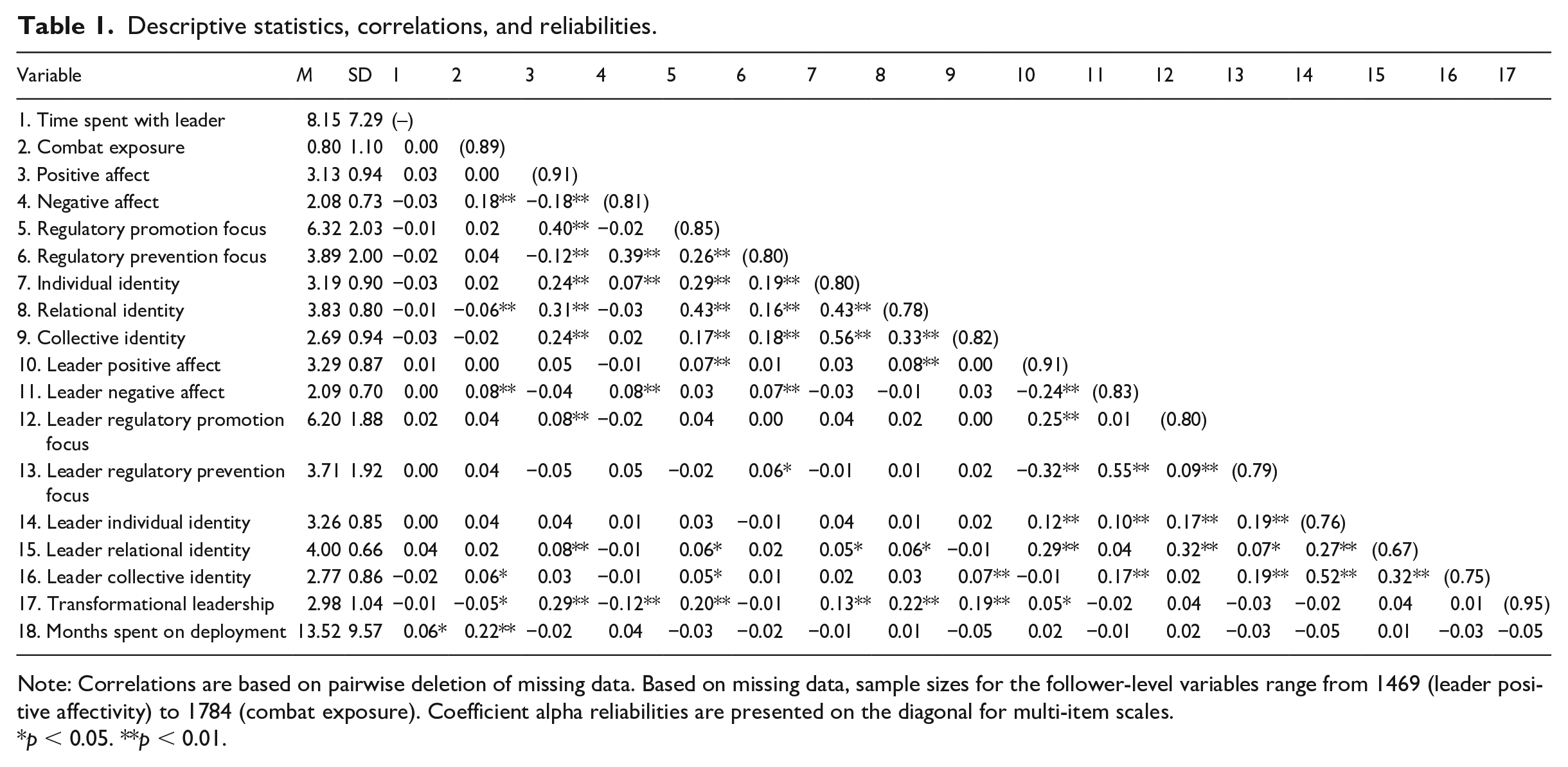
Note: Correlations are based on pairwise deletion of missing data. Based on missing data, sample sizes for the follower-level variables range from 1469 (leader positive affectivity) to 1784 (combat exposure). Coefficient alpha reliabilities are presented on the diagonal for multi-item scales.
*p < 0.05. **p < 0.01.
Hypothesis tests
Because the dataset was multilevel, we used cross-level polynomial regression methodology (Jansen and Kristof-Brown, 2005; Zhang et al., 2012) to examine how levels of attribute congruence and incongruence between a leader and follower related to leadership ratings (Edwards, 1994; Edwards and Cable, 2009; Edwards and Parry, 1993). Because the non-independent variance shared within groups (i.e. several followers reporting to the same leader) can bias standard error estimates and result in type I errors (Bliese, 2002), we analyzed the cross-level polynomial regression models using Mplus with the MLR estimator to control for the shared variance in measures. We estimated the cross-level polynomial regression equations in the online Appendix F (for the sake of simplicity, our control variables are not shown in the equation in online Appendix F but were included in all analyses). If the R2, or variance of the outcome variable explained by the regression equation, was significantly different from zero, we used the unstandardized regression coefficients to plot the equation’s response surface pattern, a three-dimensional visual representation of the data (Edwards, 1994, 2002; Shanock et al., 2010).
We regressed transformational leadership on our control variables and the five fit-related terms for each attribute (e.g. follower PA, leader PA, follower PA squared, follower × leader PA, and leader PA squared) using the equations specified in the online Appendix F. Table 2 shows the fixed-effects estimates of the congruence parameters for all seven attributes. The slope and curvature estimates along the congruence line (the points on which follower and leader attribute values are equal or F = L) and the incongruence line (the points on which follower and leader attribute values are opposing or F = –L) and the statistical significance of each were determined using equations specified by Edwards and Parry (1993). We used response surface methodology (Edwards and Rothbard, 1999) to determine whether our congruent- (Hypotheses 1 and 2) and incongruent-related (Hypotheses 3 and 4) hypotheses were supported. Specifically, we focused on the shape of each surface along the lines of congruence (F = L) and incongruence (F = –L), respectively. The F = L line or line of congruence runs from the near corner, where values of F and L are both low, to the far corner of the plane, where values of F and L are both high. Therefore, the shape of the surface along this line corresponds to Hypotheses 1 and 2. Moving from the left corner to the right corner along the F = –L line, follower attributes increase toward leader attributes and, after the F = L line is crossed, follower attributes exceed leader attributes. Therefore, the shape of the surface along this line corresponds to Hypotheses 3 and 4.
Cross-level polynomial regression results of transformational leadership ratings on leader (L) and follower (F) attributes.
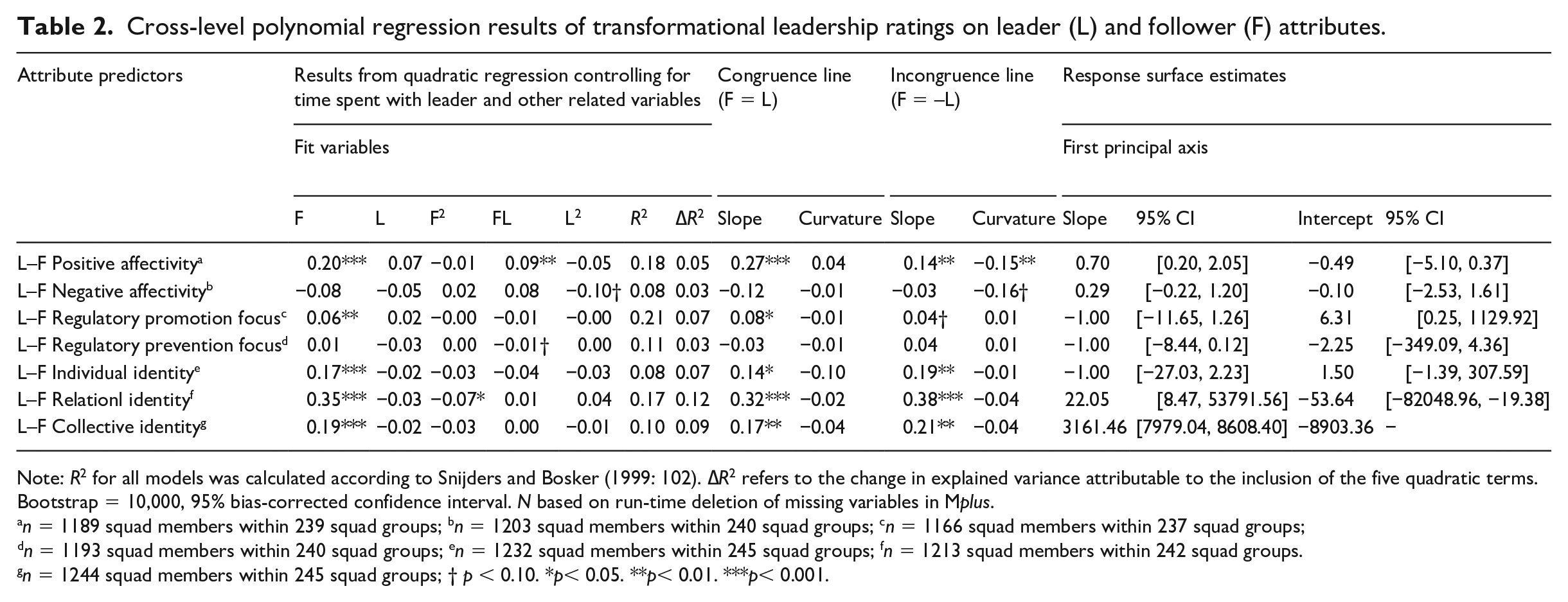
Note: R2 for all models was calculated according to Snijders and Bosker (1999: 102). ∆R2 refers to the change in explained variance attributable to the inclusion of the five quadratic terms.
Bootstrap = 10,000, 95% bias-corrected confidence interval. N based on run-time deletion of missing variables in Mplus.
an = 1189 squad members within 239 squad groups; bn = 1203 squad members within 240 squad groups; cn = 1166 squad members within 237 squad groups;
dn = 1193 squad members within 240 squad groups; en = 1232 squad members within 245 squad groups; fn = 1213 squad members within 242 squad groups.
gn = 1244 squad members within 245 squad groups; † p < 0.10. *p< 0.05. **p< 0.01. ***p< 0.001.
To test our congruence-related hypotheses, Hypothesis 1 (transformational leadership ratings will be higher when leader and follower prototypical attributes are both high than when both are low) and Hypothesis 2 (transformational leadership ratings will be higher when leader and follower antitypical attributes are both low than when both are high), the surfaces’ slope along the line of congruence (F = L) should be significantly positive for prototypical attributes (i.e. positive affect, regulatory promotion focus, relational and collective identity) and significantly negative for antitypical attributes (i.e. negative affect, regulatory prevention focus, and individual identity). Furthermore, the surfaces’ curvature along the line of congruence should be insignificant (Edwards and Rothbard, 1999). The results support Hypothesis 1, because positive affect, regulatory promotion focus, relational identity, and collective identity met all of the requirements. The results do not support Hypothesis 2, as the slope along the line of congruence for negative affect and prevention focus was negative, but not significant. Interestingly, the slope along the line of congruence was significantly positive, rather than negative for individual identity.
Recalling our incongruence-related hypotheses, transformational leadership ratings will increase as the follower’s level of prototypical (Hypothesis 3) and antitypical attributes (Hypothesis 4) increases towards the leader’s level of prototypical and antitypical attributes, but will decrease as the follower’s level of prototypical and antitypical attributes exceeds their leader’s. To find support for Hypotheses 3 and 4, the surface’s curvature along the line of incongruence should be negative for both prototypical and antitypical attributes (Edwards and Rothbard, 1999). We found partial support for Hypotheses 3 and 4 because only positive and negative affect surfaces’ curvatures were significantly and marginally significantly negative, respectively. We also found partial support for individual, relational, and collective identity, given their slopes along the incongruence line were significantly positive; however, their surface’s curvature along the incongruence line was insignificant. This indicates that transformational leadership ratings did increase as the follower’s level of these prototypical and antitypical attributes increased towards the leader’s level of these prototypical and antitypical attributes. However, transformational leadership ratings did not decrease as the follower’s level of these prototypical and antitypical attributes exceeded his/her leader’s level. Rather, transformational leadership ratings continued to increase as the follower’s level of these prototypical and antitypical attributes exceeded their leader’s level. See Figures 1–6 for surface graphs of fit between leader and follower affectivity traits, promotion focus, and identity traits predicting transformational leadership ratings.
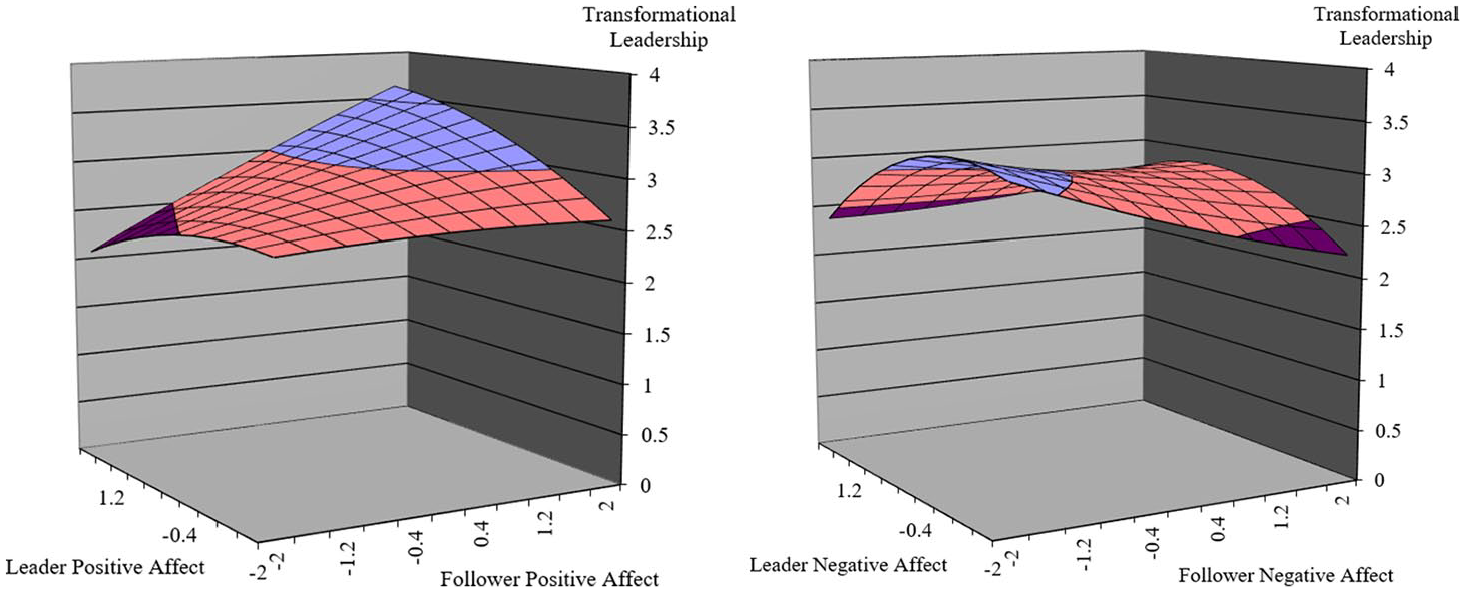
Surface graph of fit between leader and follower positive affectivity predicting transformational leadership ratings (left). Surface graph of fit between leader and follower negative affectivity predicting transformational leadership ratings (right).

Surface graph of fit between leader and follower regulatory promotion focus predicting transformational leadership ratings (left). Surface graph of fit between leader and follower individual identity predicting transformational leadership ratings (right).
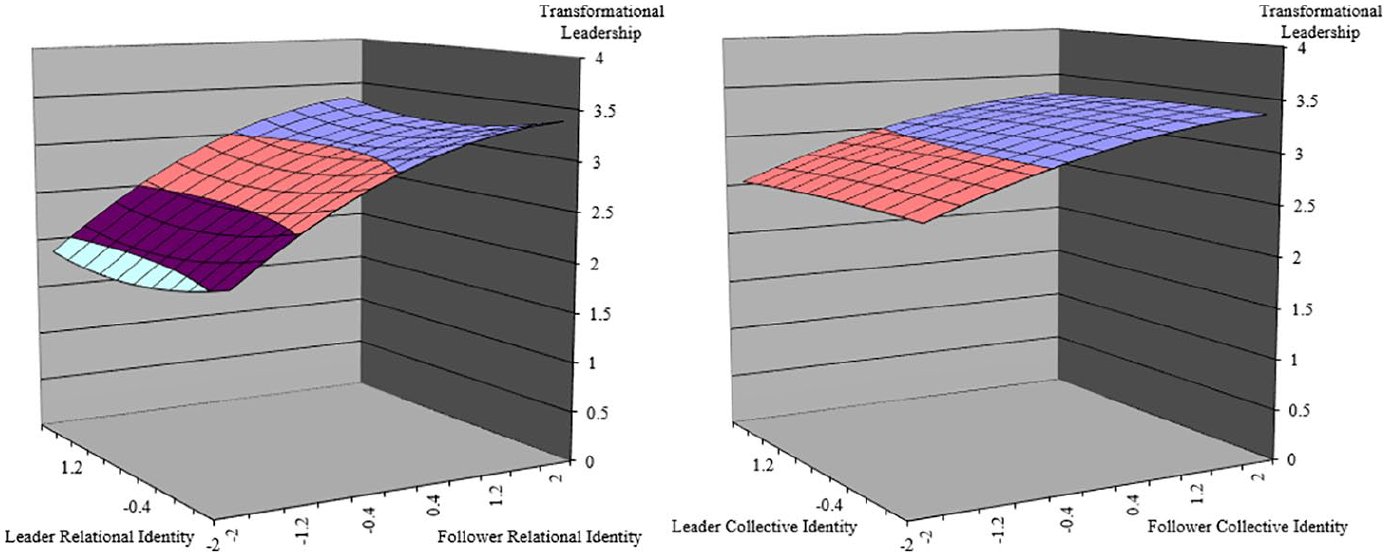
Surface graph of fit between leader and follower relational identity predicting transformational leadership ratings (left). Surface graph of fit between leader and follower collective identity predicting transformational leadership ratings (right).
Time spent in deployment and combat exposure moderating fit effects
We next explored the moderating effect of followers’ time spent in deployment and combat exposure on the relationship between follower and leader attribute fit and transformational leadership ratings, and included all the aforementioned controls. We estimated the cross-level polynomial regression equations specified in our online Appendix G. All Likert-scale predictors, including the moderator of combat exposure, were scale-centered as recommended (Edwards, 1994; Jansen and Kristof-Brown, 2005). However, the moderator, total time spent in deployment, was grand mean centered owing to its wide range of 0 to 62 months.
According to Edwards (2002), moderation of single-level polynomial regression is determined by a significant increase in R2 yielded by the inclusion of the new interaction terms. However, owing to the complexity of multilevel polynomial regression equations, we found ‘negative variance’ amongst some of our models, even when the addition of significant predictors increased the corresponding variance components (Roberts et al., 2011). Therefore, we interpreted the significance of our moderated multilevel polynomial regressions by significant fixed-effect estimates of the moderator interaction terms, rather than a significant increase in R2.
Follower total deployment time
When testing the moderation effect of deployment time on the relationship between leader–follower attribute congruence and transformational leadership, we found that positive affectivity, negative affectivity, and regulatory promotion focus were each significant. We plotted the moderated cross-level polynomial regression models at low, average, and high levels of months on deployment. We summarized these quadratic regression results and response surface estimates in Table 3. See Figures 7–9 for surface graphs of fit between leader and follower positive affect, negative affect, and regulatory promotion focus predicting transformational leadership ratings for soldiers with low, average, and high number of months spent on deployment, respectively.
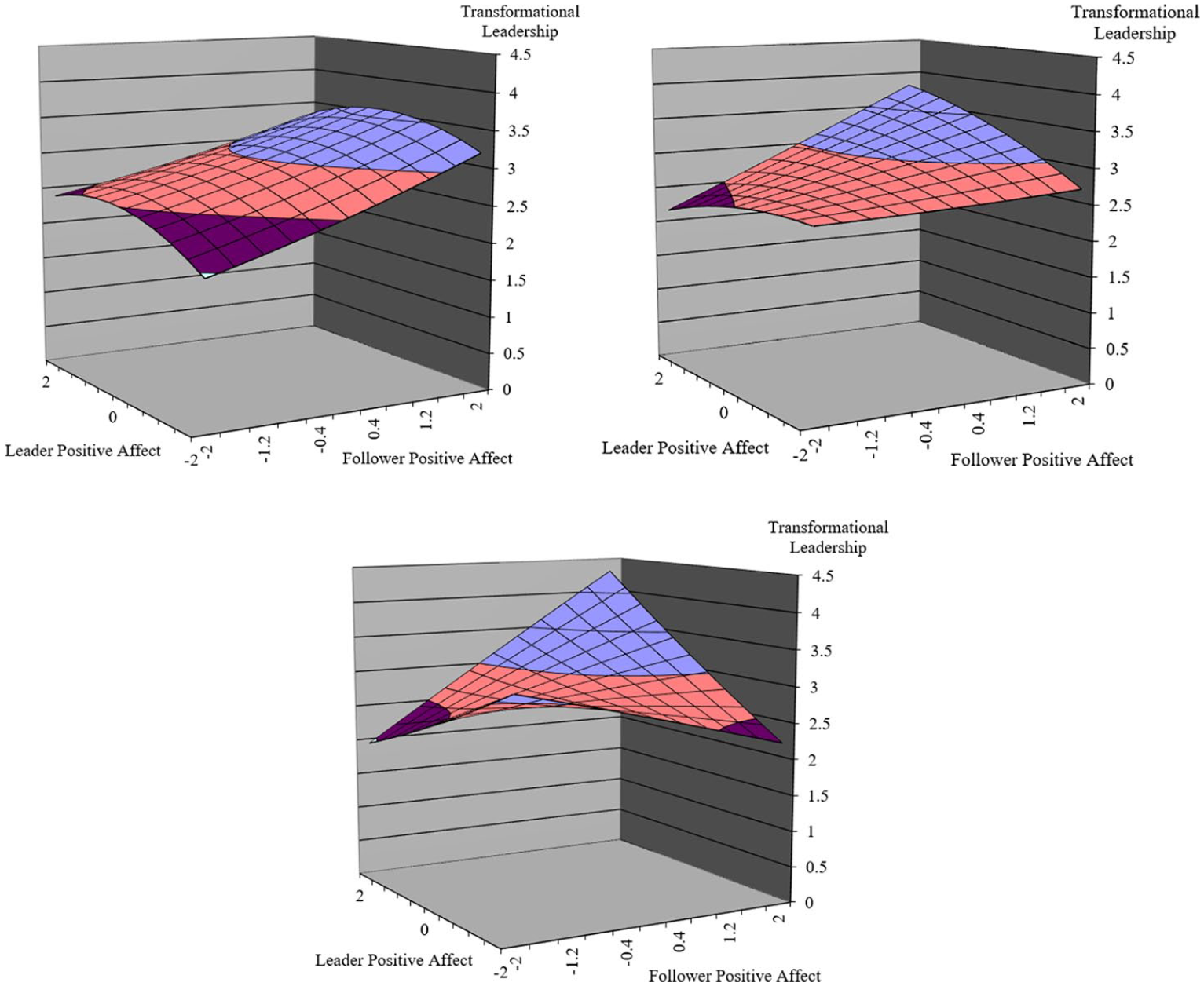
Surface graph of fit between leader and follower positive affect predicting transformational leadership ratings for soldiers with low (–1 SD) (left), average (center), and high (+1 SD) (right) number of months spent on deployment.
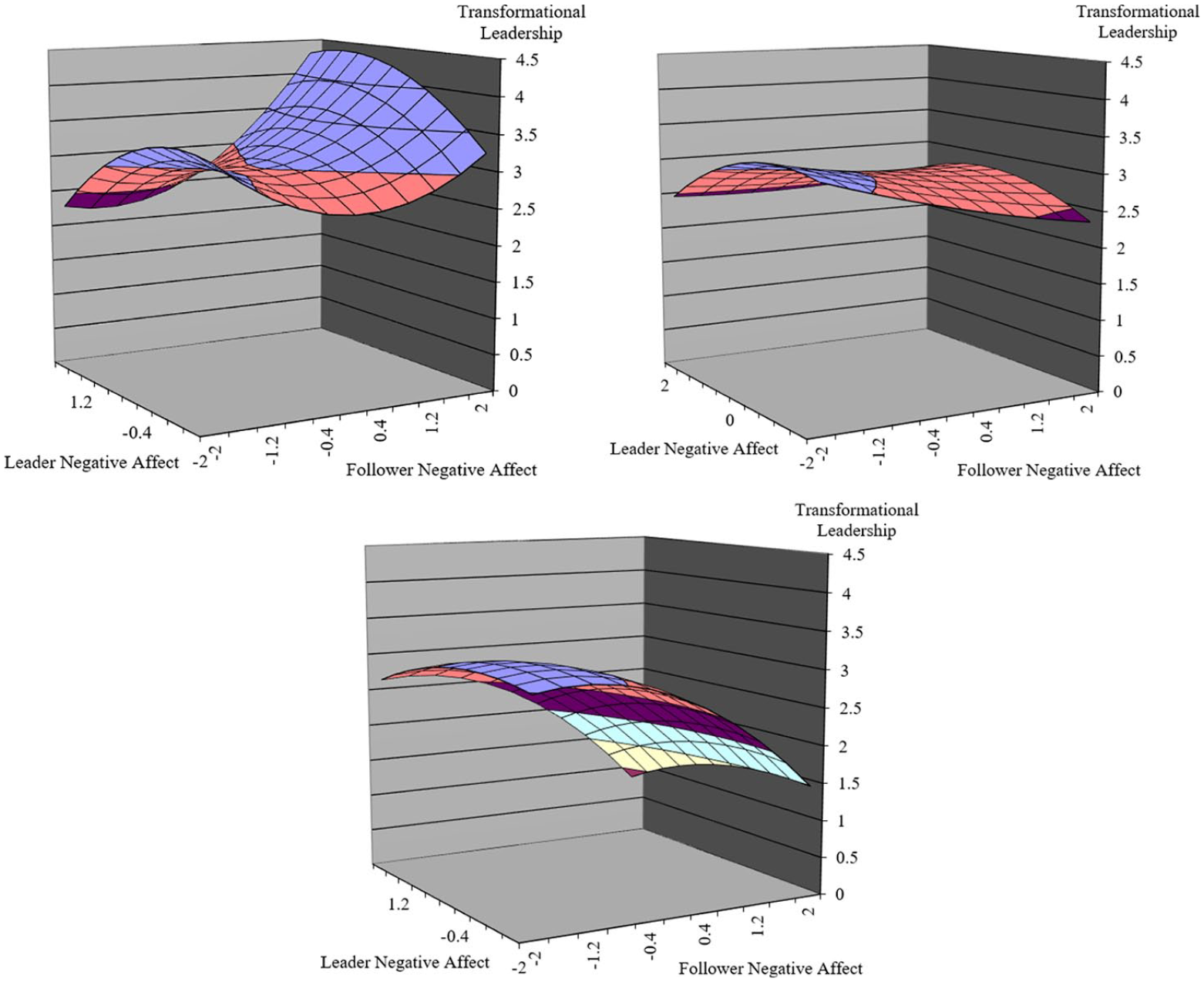
Surface graph of fit between leader and follower negative affect predicting transformational leadership ratings for soldiers with low (–1 SD) (left), average (center), and high (+1 SD) (right) number of months spent on deployment.
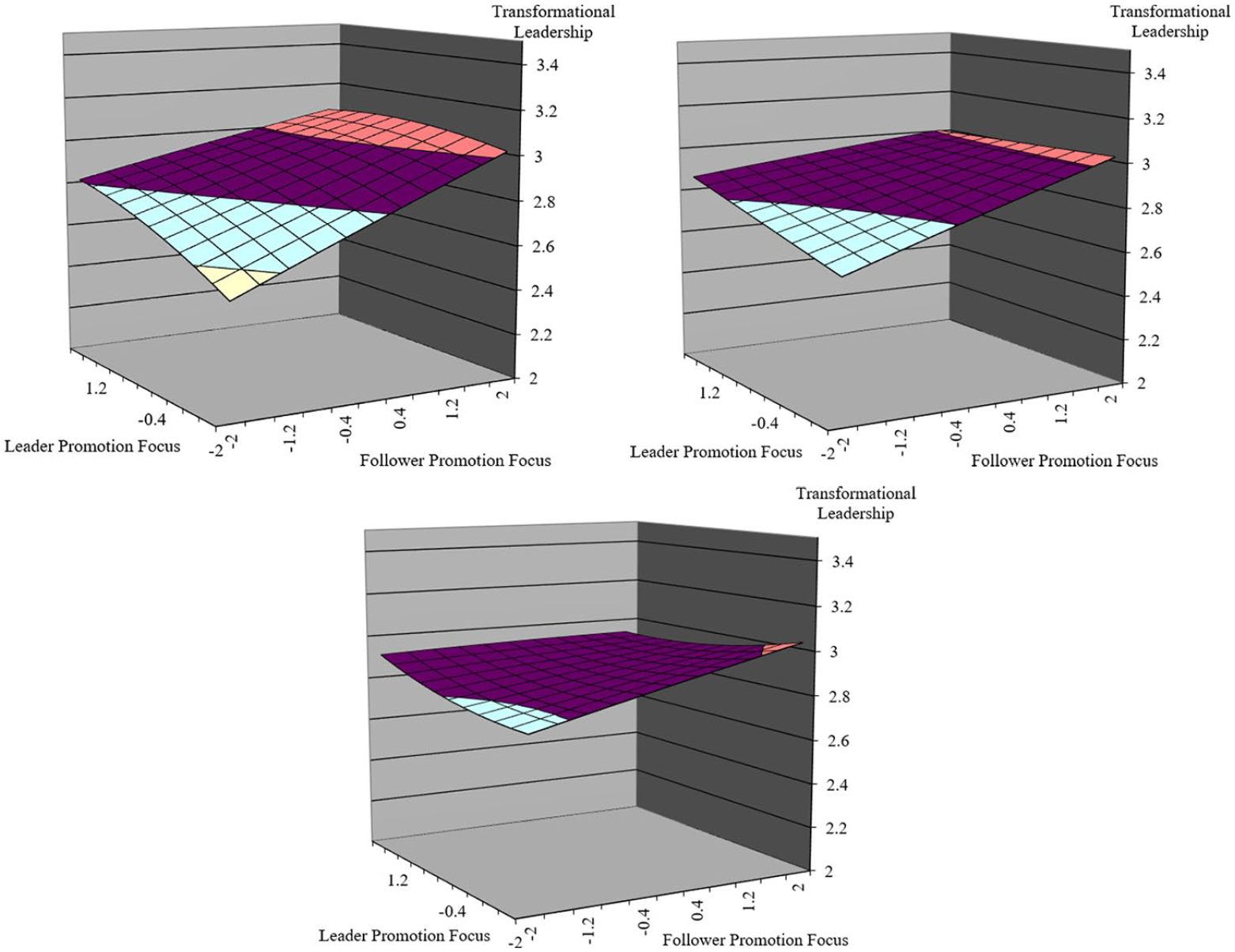
Surface graph of fit between leader and follower regulatory promotion focus predicting transformational leadership ratings for soldiers with low (–1 SD) (left), average (center), and high (+1 SD) (right) number of months spent on deployment.
Cross-level polynomial regression slope and curvature results of transformational leadership ratings on leader (L) and follower (F) positive affect, negative affect, and regulatory focus-promotion fit at low, medium, and high levels of number of months deployed (M).

Note: Bootstrap = 10,000, 95% bias-corrected confidence interval. N based on run-time deletion of missing variables in Mplus. an = 1088 squad members within 238 groups; bn = 1099 squad members within 239 groups; cn = 1075 squad members within 236 groups;
†p < 0.10. *p < 0.05. **p < 0.01. ***p < 0.001.
To support a true congruence effect, three conditions about the response surface features should be tested (Edwards and Cable, 2009): (i) the surface is curved downward along the incongruence line; (ii) the ridge of the surface (i.e. the first principal axis) runs along the congruence line; and (iii) the surface is flat along the congruence line. However, as Edwards and Cable (2009) note, the conditions needed to support this idealized congruence effect are stringent. The first condition must be met in order to claim support for a congruence effect. If the second condition is met, the dependent variable is maximized when follower and leader values are congruent, but failure to support this condition is acceptable as long as the maximum ridge of the surface crosses the congruence line at some point. Finally, if the third condition is rejected but the first two conditions are met, then support for a congruence effect can be inferred depending on whether follower and leader trait levels are low or high.
Results indicated that congruence between leader and follower positive affect played a larger role in transformational leadership ratings as deployment time increased. Specifically, at low levels of deployment time, leader–follower PA congruence did not meet the first condition of congruence; however, at average and high levels of deployment time, leader–follower PA congruence met the first two conditions. Specifically, the curvature of the incongruence line became increasingly negative, and the slopes and intercepts of the first principal axes included 1 and 0, respectively, as deployment time increased. Furthermore, at medium and high levels of deployment time, the slope of the congruence line was significantly positive, indicating that as congruent leader and follower PA values increased, transformational leadership ratings increased accordingly. Finally, at high deployment time, the curvature of the congruence line became significantly positive, suggesting that as values of congruence decreased at the low range of leader–follower PA congruence, transformational leadership ratings increased slightly (but less than for high PA congruence).
Results for the moderating effects of follower deployment time on the relationship between leader–follower NA congruence and transformational leadership ratings showed that none of the slopes or curvatures for the surface along the congruence and incongruence lines were significant at any level of deployment time. However, we continued with our analysis because of the interesting trends and changes in surface plots as deployment time increased. First of all, the curvature of the incongruence line became increasingly negative, which suggested a steeper congruence effect as deployment time increased. Second, the slope of the congruence line shifted from being positive at low levels of deployment time to becoming increasingly negative as deployment time increased. This suggested that at low levels of deployment time, high values of leader–follower NA congruence resulted in the highest values of transformational leadership ratings. However, as deployment time increased, the congruence effect tilted, such that the highest values of transformational leadership occurred at the lowest values of NA congruence. Once again, we interpreted these results cautiously, noting that none of the slopes and curvatures along the congruence/incongruence lines was significant.
Finally, the first condition of leader–follower regulatory promotion focus congruence effects on transformational leadership ratings were not met across all levels of deployment time. However, results show that the slope of the surface relating leader–follower regulatory promotion focus fit to transformational leadership ratings was steeper (i.e. increasingly positive) as levels of deployment time decreased.
Combat exposure
When testing the moderating effect of combat exposure on the relationship between leader–follower attribute congruence and transformational leadership, only collective identity was significant. We plotted the moderated cross-level polynomial regression models for collective identity at low, average, and high levels of combat exposure. We included the quadratic regression results and response surface estimates in Table 4 and Figure 10.
Cross-level polynomial regression slope and curvature results of transformational leadership ratings on leader (L) and follower (F) collective identity at low, medium, and high levels of combat exposure.
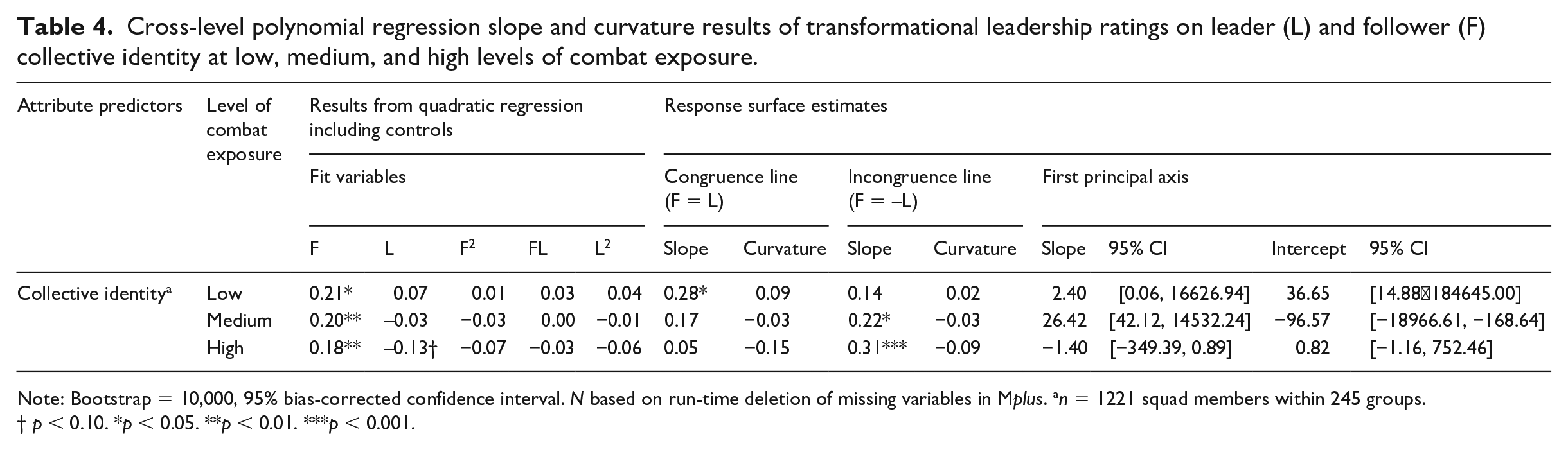
Note: Bootstrap = 10,000, 95% bias-corrected confidence interval. N based on run-time deletion of missing variables in Mplus. an = 1221 squad members within 245 groups.
† p < 0.10. *p < 0.05. **p < 0.01. ***p < 0.001.
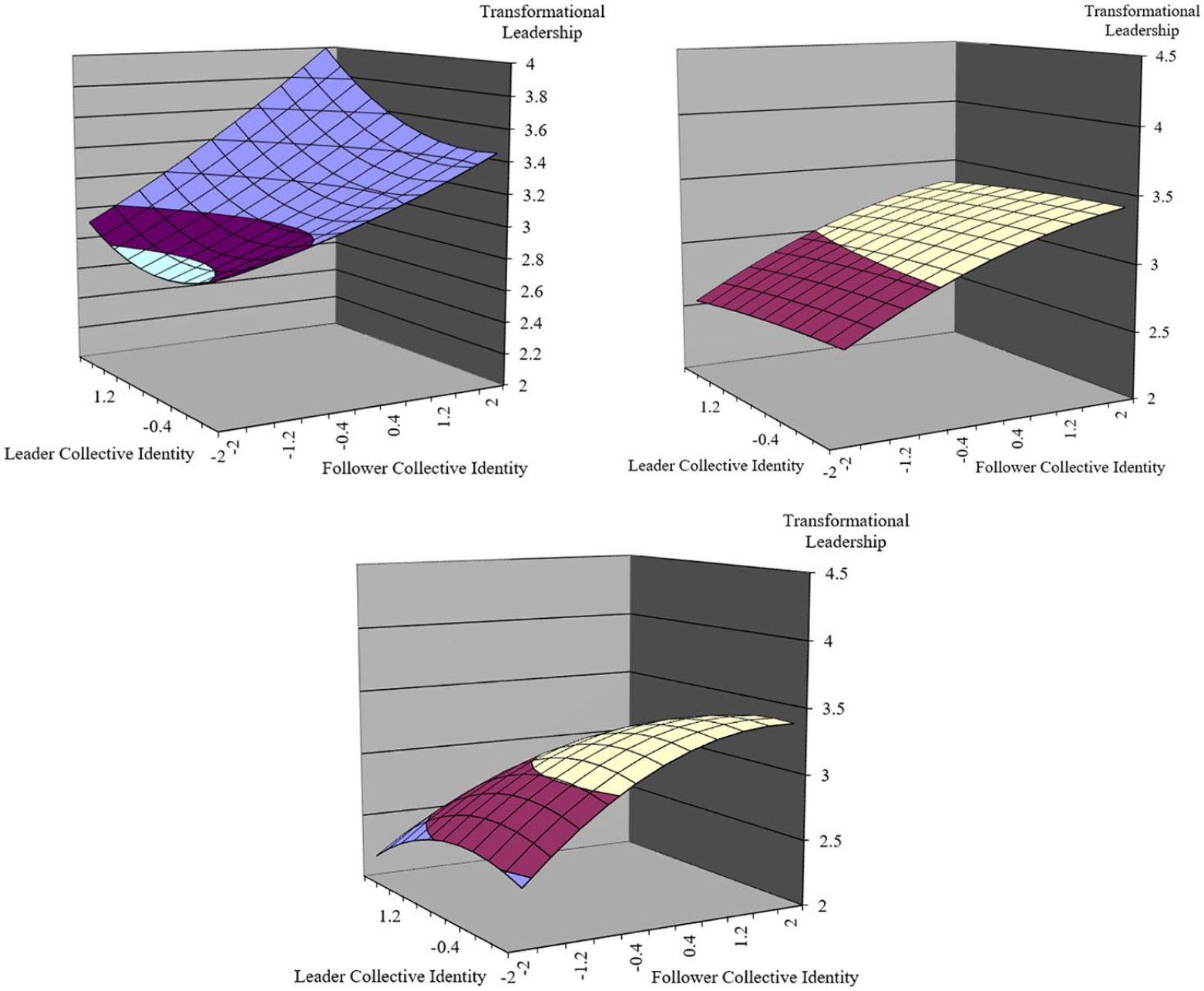
Surface graph of fit between leader and follower collective identity predicting transformational leadership ratings for soldiers with low (–1 SD) (left), average (center), and high (+1 SD) (right) levels of combat exposure.
The first condition of congruence was not met across all levels of combat exposure. However, results indicated that the slope of the surface relating leader–follower collective identity congruence to transformational leadership ratings was steeper at lower levels of combat exposure, such that when combat exposure was low, leadership ratings were highest when leader and follower collective identity were both high. Interestingly, the slope of the surface relating leader–follower collective identity incongruence to transformational leadership ratings was steeper as combat exposure increased. As combat exposure increased, transformational leadership ratings were highest when follower collective identity was high and leader collective identity was low.
Discussion
The current study’s findings suggest several contributions toward leadership theory and research. First, we examined leader and follower attribute congruence and ratings of transformational leadership in a dynamic field setting. As noted, Bass (1990) and LePine et al. (2016) suggested transformational leadership can shape how followers evaluate and respond to stressful demands and events in their operating context. Soldiers may perceive lower threat when their prototypical attributes are more congruent with their leaders, and thus see the leader as more transformational (Lyons and Schneider, 2009). Our findings reinforce the fact that leadership ratings can be linked to followers’ congruence with their leaders’ attributes in predicting leadership ratings, consistent with earlier findings (Martinko et al., 2018). Ratings of transformational leadership were highest when leader and follower positive affectivity, regulatory promotion focus, relational identity, and collective identity scores were both high versus when both were low.
The hypothesized congruence effects for antitypical attributes were not significant. Specifically, the slope along the line of congruence for negative affect and regulatory prevention focus was negative, but not significant, whereas the slope along the line of congruence for individual identity was significantly positive. These findings indicate the surface along the line of congruence for individual identity resembled that of prototypical attributes. This might have occurred in part because in this type of organization there is a great deal of training and attention paid to building out one’s self identity, personal responsibility and ownership for the mission, and in turn those leading others to accomplish the mission. In these more challenging contexts, the sense of one’s own identity may be magnified, as one also considers the need to survive.
Secondly, our findings regarding the incongruence of attributes demonstrated that transformational leadership ratings increased as the follower’s level of positive and negative affect increased towards the leader’s level of positive and negative affect and decreased as the follower’s level of these attributes exceeded his/her leader’s. We also found that length in deployment time strengthened the effect of affectivity congruence on the same leadership ratings. These effects found for affect might have occurred, because affect may be more readily observable through verbal and non-verbal behavior as opposed to one’s identity or regulatory focus. Our findings reinforce that negative affect is not the opposite of positive affect (Cacioppo and Berntson, 1994).
We also found that length in deployment time weakened the effects of promotion focus on transformational leadership ratings. Individuals with a prevention regulatory focus lean towards fulfilling obligations with vigilance and a desire to maintain the status quo (Brockner and Higgins, 2001). Accordingly, our results are not surprising, because soldiers may become more negative about their deployment over time, with their accumulation of high levels of stress and risks associated with combat. Also, Beck et al. (1985) suggested that when the evaluation of a threat exceeds an individual’s personal resources, stress and fear increase. Where such threats persist, individuals may also experience a reduction in their psychological resources that could diminish their motivation to promote and look for new ways to do their work (Kark and Van Dijk, 2007). These negative effects could have reduced the influence of the follower’s promotion orientation on their leadership ratings.
Results for combat exposure indicate that congruence between leader and follower collective identity plays a larger role in transformational leadership ratings at lower levels of combat exposure, such that the effect of high follower–leader collective identity congruence on ratings of transformational leadership decreased as combat exposure increased. As combat exposure increased, follower collective identity also had a stronger positive relationship with transformational leadership ratings versus leader collective identity. At high levels of combat exposure, transformational leadership ratings were highest when follower collective identity was high and leader collective identity was low—a partial incongruence effect.
Differences between collective identity effects on transformational leadership for leaders and their followers may be due in part to followers seeking different levels of transformational leadership when they have experienced greater uncertainty or sustained risk in their work (Tepper et al., 2018). This incongruence effect may be augmented when high collective identity followers feel they lack adequate resources or structure to address the threat, thus signaling their leaders to assume greater leadership authority. Similarly, as combat exposure increases, low collective identity followers with high collective identity leaders give the lowest ratings, because these followers do not value such leader behaviors. Finally, as noted by Lord et al. (2020), followers’ prototypes can change across contexts, such as extreme contexts in comparison with less risky settings, thus influencing leadership ratings. In sum, our findings underscore the importance of taking the attributes of leaders and followers and the context into account when determining how leadership is perceived and rated over time.
Limitations and future research directions
Limitations to this study should be considered. First, we only chose constructs to reflect leader and follower cognitive, affective, and motivational attributes. There are many other attributes and mediating mechanisms that could be considered, especially as we expand this research to analyzing other leadership styles. For example, followers with higher levels of proactive personality may be more predisposed to leaders who encourage them toward higher performance, facilitating the identification, interpretation, and perhaps co-creation of transformational leadership (Shamir et al., 1998). Followers with high moral awareness may be prone to observe and acknowledge the presence of transformational leadership. We should examine mechanisms that link leader–follower attribute congruence to transformational leadership, such as LMX, to help explain our findings.
Owing to the combat context and danger of moving around the battlefield to collect data, we had only one survey opportunity to collect data, exposing our dataset to potential common method variance (CMV). However, Siemsen et al. demonstrate that quadratic and interaction effects cannot be artifacts of CMV; they state, “both quadratic and interaction terms can be severely deflated through CMV, making them more difficult to detect through statistical means” (Siemsen et al., 2010: 456). Therefore, our results, including both quadratic and interaction effects, may be conservative. Finally, research has demonstrated that “liking the leader” can significantly impact ratings of transformational leadership (Brown and Keeping, 2005). We recommend that in addition to controlling for relevant leader and follower attributes and context, future research account for “liking” effects as a mechanism to explain the effects of leadership. This study was conducted in a military setting; the generalizability of our findings should be tested in other extreme settings.
Practical implications and conclusion
Our findings provide evidence for practitioners to consider a broader range of factors when assessing and developing leaders, incorporating how followers view their respective leaders based on their ‘congruence’ with their leader. Simply focusing on the leader and changing their behavior will fall short in fully affecting followers’ ratings of leadership and how they are interpreted when examining 360 feedback. Taking a more in-depth look into leader–follower relationships and the differences leaders and followers each bring to the leadership dynamic seems warranted.
Our findings also suggest that unit/team composition, as far as the presence of individuals with certain attributes or states, can influence leadership ratings. For example, organizations composed of individuals with higher mean levels of promotion regulatory focus may perceive transformational leadership, not just because of the leader but also owing to its being a prototypical group attribute (Hogg, 2001). Our results also suggest that organizational attraction, selection, and attrition processes could shape workforce composition to facilitate or suppress the perception of certain forms of leadership.
In conclusion, our results highlight that leadership is in the ‘eye of the beholder’ and that one has to consider both leader and follower attributes in interpreting how each person rates their leader. Contemporary studies of leadership normally aggregate individual self-reports to the unit level, and thereby remove individual variation. We found that followers’ self-construal, regulatory foci, and affective attributes, their level of congruence with their leaders, and the extremity of the context, all have distinct and theoretically interpretable relationships with leadership ratings. This suggests that these variables are perhaps not just noise, bias, or error, but rather are important to how followers evaluate leadership (Martinko et al., 2018).
Supplemental Material
Supp_mat – Supplemental material for How leader and follower prototypical and antitypical attributes influence ratings of transformational leadership in an extreme context
Supplemental material, Supp_mat for How leader and follower prototypical and antitypical attributes influence ratings of transformational leadership in an extreme context by Bruce J Avolio, Fong T Keng-Highberger, Robert G Lord, Sean T Hannah, John M Schaubroeck and Steve WJ Kozlowski in Human Relations
Footnotes
Appendix A
Acknowledgements
Grateful acknowledgement is made to Sihong Huang for all her help and expertise on the completion of this study. The views, opinions, and/or findings contained in this article are those of the authors and shall not be construed as an official Department of the Army position, policy, or decision, unless so designated by other documents.
Funding
The authors disclosed receipt of the following financial support for the research, authorship, and/or publication of this article. The authors received financial and logistical support for this research from the US Army Center for the Army Profession and Ethic. The third author's research contribution was supported by the grant “Advancing Leadership Research” (W911NF-18-2-0049) US Army Research Institute for the Behavioral and Social Sciences (ARI).

Supplemental material
Supplemental material for this article is available online.
Notes
References
Supplementary Material
Please find the following supplemental material available below.
For Open Access articles published under a Creative Commons License, all supplemental material carries the same license as the article it is associated with.
For non-Open Access articles published, all supplemental material carries a non-exclusive license, and permission requests for re-use of supplemental material or any part of supplemental material shall be sent directly to the copyright owner as specified in the copyright notice associated with the article.
