




Abstract
Although corporate social responsibility (CSR) practices can increase firm attractiveness, this process can be undermined if CSR activities signal the “wrong” motives to job seekers. Yet, how these attributed motives form, and why job seekers are likely to infer favorable or unfavorable causal attributions underlying CSR activity, remain open questions. We draw on Kelley’s covariation model to address this gap. We develop and test an attributional model exploring job seekers’ reactions to distinct CSR attributional configurations derived from job seekers’ perceptions of CSR consensus, distinctiveness, and consistency. Across a multi-trait, multi-method, multi-sample series of four studies, we demonstrate that different CSR attributional configurations are related to discrete causal attributions (i.e. values-driven, strategic-driven, and egoistic-driven), which are associated with distinct perceptions and employment intentions. We address recent calls to open the “black box” of CSR causal attributions, deepening understanding of why job seekers might also respond negatively to CSR, and the (attributional) psychological processes driving these negative reactions.
Keywords
Introduction
Corporate social responsibility (CSR)—“actions on the part of firms that appear to advance, or acquiesce in the promotion of some social good beyond that which is required by law” (Waldman et al., 2006: 1703)—is a driver of organizational attractiveness (Elsbach and Breitsohl, 2016; Rupp et al., 2013; Turban and Greening, 1996; see Table S.1). According to the deontic CSR perspective, CSR is associated with firm attractiveness, not only because it can satisfy instrumental and relational needs, but also because in its own regard “it is the right thing to do” (e.g. Erdogan et al., 2015; Rupp et al., 2013). CSR activity reflects a shift toward progressive social, cultural, and environmental ideals and, because it addresses stakeholders’ moral and ethical needs, can lead to recruiting advantages (Jones et al., 2014; Rupp et al., 2013). However, CSR does not always lead to positive outcomes (Jones et al., 2016). Indeed, against a backdrop of skeptical—even cynical—reactions to CSR claims (e.g. Lyon et al., 2018), it is essential to deepen our understanding of “why people might also respond negatively to CSR, and the circumstances in which this is more likely to occur” (Willness, 2019: 207).
CSR causal attributions have been argued to play a critical role in negative reactions to CSR initiatives (see Gond and Moser, 2019; Gond et al., 2017). Defined as perceptions of firms’ underlying motives, person-centric or micro-CSR research shows that employees’ CSR causal attributions impact associated CSR (e.g. Donia et al., 2017; Rodell and Lynch, 2016; Vlachos et al., 2017). CSR causal attributions have broadly been operationalized as either intrinsic (i.e. other-interested; substantive; values-driven; authentic) or extrinsic (i.e. self-interested; symbolic; egoistic; inauthentic). Employees’ reactions (e.g. job satisfaction; perceived person-organization (P–O) fit; trust; boosterism; employment intent) tend to be positive with intrinsic attributions and either negative or neutral with extrinsic attributions (e.g. Donia et al., 2019; Vlachos et al., 2013, 2017). Jones et al. (2016) recently reported that a substantial proportion of job seekers are unaffected, unmotivated, or unconvinced by CSR claims, positing the valence of CSR-induced attributions as a potential explanation.
Yet, how these attributions form remains an open question (Gond et al., 2017; Jones et al., 2016; Willness, 2019). In light of this theoretical gap, we develop a model of the antecedents to CSR causal attributions by returning to the “basic tenets and principles that comprise attribution theory” (Martinko and Mackey, 2019: 525; see also Hewett et al., 2019). We specifically draw on Kelley’s (1967) covariational model and describe (a) the dimensions of information and (b) the process job seekers use to form favorable or unfavorable CSR-driven causal attributions, with concomitant implications for firm attractiveness and employment intentions. This theoretically grounded model opens the black box of CSR causal attributions, and deepens our knowledge of the cognitive processes by which job seekers form CSR judgments (Gond et al., 2017). This focus follows specific calls for research on the role of employee and job seeker attributions bearing on their (prospective) employer’s motives for investing in external CSR practices (e.g. Jones and Rupp, 2018). As Willness (2019: 208) recently argued, “an important question, then, is what conditions or factors lead stakeholders to attribute self-serving, extrinsic, or disingenuous motives to a company’s CSR practices?” At present, how firms signal/avoid signaling favorable/questionable CSR motivation is unknown. With this focus, we make several contributions.
First, we develop and test a theoretically grounded model bearing on the development of job seekers’ CSR causal attributions. We explain how signals that emerge from covariation of CSR information—what we call CSR attributional configurations—relate to motives attributed to CSR. We examine how configurational variation in information relating to the elements of CSR consensus, distinctiveness, and consistency (Hilton and Jaspars, 1987; Kelley, 1967) signals underlying CSR-induced motivation, with implications for firm attractiveness and employment intent. We propose that job seekers care about “why” firms engage in CSR, and use signals that different CSR attributional configurations send to draw these inferences. This frame also provides a novel account of how job seekers gather and organize CSR information.
Little scholarly attention has focused on individuals’ evaluations of CSR—the “cognitive and affective processes by which people gather and organize information related to organizations’ CSR initiatives” (Gond et al., 2017: 231). We find that how job seekers explain (i.e. attribute) CSR activity depends not only on additive consideration of discrete CSR dimensions, but also on their covariation. We adopt a multi-study, mixed methods approach where we gather both quantitative—and accompanying complementary qualitative data—from job seekers. Results from our analyses reveal that CSR information is represented and organized in job seekers’ thinking as a “multidimensional constellation[s] of conceptually distinct characteristics” (Meyer et al., 1993: 1175), which is then used to explain CSR (i.e. develop CSR attributions) and develop CSR judgments. Gond et al. (2017) depicted this configurational puzzle—the additive or configurational effects of CSR drivers—as a key challenge that, if addressed, would advance micro-CSR theory.
Second, we show that these attributions and judgments do not develop in a “competitive” vacuum. We demonstrate that job seekers account for the CSR activities of other firms, a heretofore unrecognized factor in CSR evaluation models (see Sen et al., 2016 for a specific research call on this issue). Neither of the two most recent domain reviews (e.g. Glavas, 2016; Gond et al., 2017) explicitly examine this factor, suggestive of the importance of additional focus. When job seekers evaluate CSR practices, we find that they consider not only what the firm has done in the past (consistency), or across domains/issues (distinctiveness), but also what the firm has done relative to other firms (consensus).
Third, we contribute to the deontic CSR perspective (e.g. Erdogan et al., 2015; Rupp et al., 2013), which provides that employees evaluate CSR from a deontic (i.e. duty-based ethics) perspective, asking the question: is the firm engaging in CSR for the right reasons? Importantly, whether CSR addresses job seekers’ deontic needs depends on causal attributional processes associated with CSR activity (Hoffmann, 2018). In light of their central role, the relative absence of theoretical or empirical attention in deontic CSR research to attributional process per se has limited development in the domain. Implicit in deontic CSR research has been the assumption that mere CSR engagement/non-engagement reflects deontic engagement, impacting fulfillment of deontic needs. However, the moral “worthiness of a particular action will depend on the motive behind it” (Dunfee, 2008: 348). We explicitly test the deontic argument by examining the processes leading to perceptions of authenticity, rather than simply assuming that CSR automatically addresses deontic needs.
Fourth, we respond to recent calls to leverage attribution theories to explain the connection between human resources (HR) practices and recruitment performance (Hewett et al., 2018, 2019). Because CSR is an HR practice orbiting issues such as work–life balance and diversity (Edwards and Kudret, 2017; Hewett et al., 2018), CSR causal attributions are a special type of HR attribution. We examine not only “what” (i.e. content), but also “how” (i.e. process) individuals form HR attributions in the context of CSR. We show that: (a) job seekers’ causal attributions are important for recruitment because they can affect firm attractiveness and employment intent; and (b) the content of causal attributions is driven by perceived configurational covariation patterns underlying CSR (i.e. consensus; distinctiveness; consistency).
Background and theoretical development
Varied reactions to CSR motives
In an effort to capture employees’ complex reactions to CSR, scholars have increasingly adopted a micro-level perspective (Gond et al., 2017). While positive reactions to CSR have been broadly assumed (e.g. Jones et al., 2014), job seekers likely have a wide range of reactions (Jones et al., 2016). CSR activities are suspicion laden and represent a paradox (Hoffmann, 2018), asking “corporations to work against their natural genetic makeup” (i.e. to be profit-seeking; Devinney, 2009: 51). As a consequence, individuals caring about moral norms likely ask “why is the firm doing this?” (Dunfee, 2008). This question evokes a deontic interpretation process as job seekers attempt to understand the firm’s motives, which can influence labels attached to the firm (Harvey et al., 2014). When CSR reflects genuine other-interest, this is suggestive of an intrinsically motivated, values-driven firm (Bansal and Roth, 2000; Gond et al., 2017; Hoffmann, 2018; Vlachos et al., 2010). In contrast, when CSR reflects market isomorphism and competitiveness motives (Baddache and Nicolai, 2013; Bansal and Roth, 2000; Gond et al., 2017; Vlachos et al., 2010) this suggests a strategically driven firm. Finally, when CSR reflects opportunism and impression management motives, this is suggestive of an opportunistic, egoistic firm (Gond et al., 2017; Vlachos et al., 2010).
Attributions of the causes driving CSR activities
Attribution theories (e.g. Hilton and Jaspars, 1987; Kelley, 1967) can explain how job seekers infer firms’ CSR motives. Causal attributions emerge from the covariation rule, an information processing tenet dictating that attributions depend on information (and/or beliefs; see Kelley and Michela, 1980) relating to the consensus, distinctiveness, and consistency of observed actions. We define CSR consensus, distinctiveness, and consistency drawing on common conceptualizations from the organization sciences (see Harvey et al., 2014; Hilton and Jaspars, 1987; Kelley and Michela, 1980; McArthur, 1972, Orvis et al., 1975).
Consensus is the extent that firms are perceived to maintain similar CSR configurations, representing an interfirm (inter-actor) comparison (Harvey et al., 2014). When CSR activity is perceived as comparable with competitors’, this signals consensus. If these activities are seen as deviating from normative patterns, this reflects lower consensus. For example, while a group of competing firms might be perceived to invest in community engagement, one is seen as engaged in innovative, hard-to-copy, in-kind donations requiring community participation. This reflects lower consensus, as other firms are seen as engaged in easier-to-design, and implement cash donations (i.e. checkbook philanthropy). In contrast with consensus, distinctiveness is fundamentally within-firm (intra-actor) information, but extends across stimuli. If CSR investments are perceived as extending across a range of settings, this signals low distinctiveness. Narrow CSR investments signal high distinctiveness. For example, CSR seen as being focused on emissions reduction, human rights, and diversity reflects low distinctiveness; whereas CSR focused only on community programs, for example, reflects high distinctiveness. Finally, consistency also is within-actor information, but extends across time. Perceived intermittent CSR engagement signals low consistency; whereas regular CSR engagement over time signals high consistency.
According to the inductive logic model of causal attribution (Hewstone and Jaspars, 1987; Hilton, 2013; Hilton and Jaspars, 1987), three specific (perceived) patterns of consensus, distinctiveness, and consistency are prototypical of the causal attributions resulting from covariation or configurational information. These are Low–Low–High (LLH), High–High–High (HHH) and High–Low–Low (HLL) configurations of consensus, distinctiveness, and consistency. These configurations provide theoretical clarity because they generate clear “locus of causality” explanations (Hilton and Jaspars, 1987); whereas the remaining configurations signal multiple motives reflecting ambiguous explanations (Gilbert, 1998). Below, we explain how these configurations are related to actor (firm), stimuli, and circumstance-specific attributions (Hilton and Jaspars, 1987). We then explain how these three generic loci of causality are in turn, theoretically linked to three key causal attributions discussed in the micro-CSR literature: values-driven, strategic-driven, and egoistic-driven (Gond et al., 2017; Vlachos et al., 2010).
Values-driven attributions
When CSR is (perceived as being) differentiated from competitors’ (low consensus), occurs across a broad range of domains (low distinctiveness), and is consistent over time (high consistency) (i.e. an LLH configuration), inductively this should send a signal leading to actor-specific attributions. The CSR activity generalizes across domains, and time, but does not generalize across firms, which inductively means that something about the firm is driving CSR engagement. However, the (inductive) covariation model is primarily a process model. Thus, although it prescribes logical rules bearing on how attributions form, it does not specify, for example, what it is about the actor that drives a specific CSR configuration. We propose that this pattern signals that the values of the actor are responsible for CSR activity, because this pattern signals a free, non-forced choice that reflects authenticity (Reeder et al., 2004).
More specifically, this configuration signals that the firm takes an innovative, broad approach. Because CSR activities are perceived to be consistent over time, this also signals that engagement is a matter of routine. CSR is likely to be attributed to core values because of its unique character relative to other firms, consistency over time, and widespread engagement. The differentiation of CSR activities from competitors and consistent, cross-domain engagement, signals that the firm’s CSR is thus driven by authenticity and core values (Cuypers et al., 2016). For example, TOMS—a firm that markets shoes and apparel and is positioned as a for-profit firm with a social purpose—is likely perceived as a potential employer engaged in low consensus (i.e. given its buy-one give-one social innovation), low distinctiveness (i.e. TOMS’ CSR includes offering shoes, sight, water, safe birth and bullying prevention services), and high consistency (i.e. TOMS has consistently engaged in CSR since 2006).
Strategic attributions
In contrast, when CSR activity is perceived to be similar to competing firms (high consensus), occurs across a narrow range of settings (high distinctiveness), and is consistent over time (high consistency) (i.e. an HHH configuration), inductively this pattern engenders a stimulus attribution. CSR activity generalizes across actors, and time, but does not generalize across domains, which inductively means that something about the domain of CSR (i.e. the stimulus) catalyzes CSR activity (Hilton and Jaspars, 1987).
But what, exactly, is it about the stimulus that drives this pattern? The stimulus likely coincides with the firm’s core business—a stable stimulus. It is something about the specific CSR activity that induces certain industries to invest in them, perhaps the need to minimize negative externalities derived from their core business. The gold mining industry provides an illustrative example. Engagement in local, community-focused, environmentally responsible activities (i.e. a narrow domain coinciding with the firm’s business) is an operational sine qua non because it generates political and social capital that increase local support. All firms in this industry (high consensus), over time regularly engage (high consistency) in highly focused local environmental restoration projects coinciding with their core business (high distinctiveness). Thus, this configuration likely signals strategic motives driven by industry factors and legitimacy pressures (Bansal and Roth, 2000; Campbell, 2007).
Egoistic attributions
Finally, when CSR activity is comparable with competitors’ (high consensus), enacted broadly (low distinctiveness), but only intermittently (low consistency) (i.e. an HLL configuration), circumstantial attributions (i.e. related to a particular situation) are a probable signal. The activity generalizes across firms, and domains, but does not generalize across time. Inductively, it is something about the circumstance motivating CSR, signaling impression management-driven, ceremonial engagement, which emerges situationally. The firm is perceived as being uncommitted to CSR (low consistency), engaging opportunistically with ulterior motives (Reeder et al., 2004). For example, to generate publicity, or “wash away sins”, BP’s response to the Deepwater Horizon disaster (Kang et al., 2016), following an incident of corporate social irresponsibility (CSiR), sends opportunistic signals.
Attractiveness of firms to job seekers
These perceived configurations signal different motives, which differentially impact firm attractiveness. Among job seekers who attribute CSR to core values, these activities are likely interpreted as a reflection of the firm’s identity, directly addressing deontic needs and prosocial identity (Gully et al., 2013). Because association with a values-driven firm can impact anticipated pride (Jones et al., 2014) and job meaningfulness (Aguinis and Glavas, 2019), this configuration should be associated with firm attractiveness. In contrast, job seekers who develop strategic attributions likely interpret CSR to be driven by legitimacy pressures. Failure to match the CSR practices of competing firms could result in social sanctions (Campbell, 2007). Thus, job seekers are likely to interpret strategic engagement as reflective of good management, signaling that their instrumental needs are likely to be met. This pattern is likely to be acceptable to job seekers because it signals that the firm does what has to be done to protect employees’ extrinsic needs (e.g. job security). However, and in light of the intrinsic benefits of associating with a values-driven firm, we expect attractiveness is likely lower than for values-driven firms. Finally, firms that create situational or self-inflicted reputational deficits often experience intense CSR pressure (Kang et al., 2016). Circumstantial attributions are likely to lead to egoistic interpretations, generating cynicism, anger, and embarrassment (McShane and Cunningham, 2012). Job seekers’ instrumental (i.e. expected treatment), symbolic/identity (i.e. organizational prestige), and deontic needs (i.e. P–O values-fit) are less likely to be met, and thus egoistic-driven firms are likely perceived less favorably than strategic-driven or values-driven firms.
Hypothesis 1: Firms engaged in an LLH CSR configuration are more attractive to job seekers than firms engaged in an HHH CSR configuration.
Hypothesis 2: Firms engaged in an LLH CSR configuration are more attractive to job seekers than firms engaged in an HLL CSR configuration.
Hypothesis 3: Firms engaged in an HHH CSR configuration are more attractive to job seekers than firms engaged in an HLL CSR configuration.
Overview of empirical studies
Below, we describe four studies. In Study 1, we ran a conjoint analysis in the USA to examine the impact of CSR attributional configurations on young job seekers’ job application intentions. Study 2 was a replication and extension of Study 1. We again ran a conjoint analysis in the USA and examine the impact of CSR attributional configurations on young job seekers’ perceptions of firm attractiveness, experimentally manipulating and controlling first-party distributive justice. Study 3 also was a conjoint analysis, but run in the UK with seasoned job seekers who responded to conjoint stimuli, while controlling moral identity and job seekers’ attitudes toward CSR (i.e. CSR–corporate abilities trade-offs beliefs). Study 4 was a self-explicated design, also run in the UK, with more seasoned job seekers. The aim in Study 4 was to conceptually replicate key findings from the previous three studies. In Study 4, leveraging quantitative and qualitative methods, we examine CSR causal attributions as a mechanism with the capacity to translate the impact of CSR configurations on job seekers’ intentions to apply.
Study 1
The primary goal of Study 1 was to test theory enhancing understanding of how variation in CSR attributional configurations impacts job seekers’ intentions to apply to a prospective firm. Conjoint analysis is the multivariate approach best suited to address this goal, enabling explicit focus on the consequences of a mix of configuration attributes (Douglas and Shepherd, 2002). This approach has been used to address questions in management contexts (Shepherd et al., 2013), with calls for its adoption in organizational psychology (Lohrke et al., 2010) and recruitment research (Boudreau, 2010). An advantage of conjoint analysis is that it “avoids the use of retrospective and self-report data by collecting information about a decision as that decision is made” (Douglas and Shepherd, 2002: 84). Job seekers are not directly asked about the importance of different attributes. Instead, importance (i.e. utilities of each attribute) is derived indirectly through evaluation of (CSR) configurations that include combinations of levels of attributes presented holistically as bundles; trade-offs between attribute levels are accounted for. Conjoint analysis addresses the question: why do people prefer one alternative over another?
Conjoint data emerge from ratings of hypothetical concepts systematically defined by various attribute combinations or configurations (Shepherd et al., 2013). The primary outcome of conjoint analysis is a part-worth utility (Lohrke et al., 2010), which is computed for each attribute level. Part-worth utilities can be combined to predict preferences for any possible combination of attribute levels (Olson, 2013), which allows the design of simulations to determine which configurations generate more preference shares. The most commonly applied estimation approach in conjoint analysis is dummy-coded regression. Ratings are the dependent variable (Attractivenessij), and CSR attribute levels (e.g. consensus, distinctiveness, consistency) are independent variables (CSRjkm) in the following equation (Lilien et al., 2013):

Part-worth utilities (αikm in equation 1) serve as raw data to calculate aggregate “market” preferences for any configuration. 1 One can: (a) translate intentions data into projected behavioral data; and (b) test which configuration might be more successful in a simulated (job) market. This enables calculation of aggregate preferences for different CSR configurations. To translate job seekers’ preferences or utilities into choices, however, one needs choice rules (i.e. assumptions about how people make choices). Three choice rules are used in conjoint analyses (i.e. Maximum Utility; Bradlet-Terry-Luce (BTL); Logit; Green and Krieger, 1988). For completeness, we estimated all three (see supplemental material for additional information).
Subjects and stimuli
Our focus is on the impact of CSR attributional configurations on job seekers’ intentions to apply to a prospective firm. With this focus, 446 self-identified job seekers from a large research university participated in this study. The sample was 52% male, 21 years of age (SD = .56), and predominantly from the USA (91% were citizens of the USA). Respondents were asked to consider applying for a job from a list of firms offering the same compensation package and benefits, but which differed with respect to CSR configuration. Respondents were asked to evaluate eight company profiles, varying with respect to consensus, distinctiveness and consistency in a full 2 x 2 x 2 factorial design. These profiles were built from the implications of Kelley’s (1967) model to provide direct comparisons of the influence of signals sent by CSR consensus, distinctiveness, and consistency. For example, respondents were asked to react to the following description (HLL): “Other firms also engage in the same pattern of CSR activities”; “This firm engages in a wide range of social and environmental contexts, with no explicit connection with its core business”; and “This firm occasionally engages in CSR activities” (see Table S.2. for all scenarios). Respondents were asked to rate their agreement with the statement “I would definitely apply for work at this company” on a five-point scale ranging from 1 (“strongly disagree”) to 5 (“strongly agree”). A single-item measure was used because the “willingness to apply” dependent variable is specific and definitive. The use of single-item dependent measures is customary, and aligns with research on applicant attraction and organization attractiveness (Highhouse et al., 2007). Finally, conjoint tasks are quite complex and burdensome for respondents, who might react by giving the same ratings to each configuration. Responses with zero variances across profile ratings are uninterpretable (Lilien et al., 2013), which is why dedicated conjoint analysis software automatically removes these cases. A total of 47 responses were deleted for this reason.
Results
We employed the SPSS conjoint command and generated 399 regression equations. Aggregated conjoint results (i.e. that take into account individual differences; see Ostrom and Iacobucci, 1995) are presented in Table 1. Estimated constants are added to single attribute level coefficients on each attribute to predict likelihood of applying for work (Olson, 2013). Pearson’s R was high and significant (.98). CSR consistency emerged as the most important criterion for job seekers (i.e. 58% of the utility range), followed by consensus (28%), and distinctiveness (14%). To test Hypotheses 1–3, we ran 330 preference score simulations. A total of 69 respondents were removed 2 given non-significant Pearson’s R (i.e. correlation between observed and estimated preferences), which indicates consistency in respondent preferences (Olson, 2013). For each respondent, we estimated three intentions to apply for work scores (i.e. a utility/preference score for each type of firm).
Estimated part-worth utilities (Study 1).

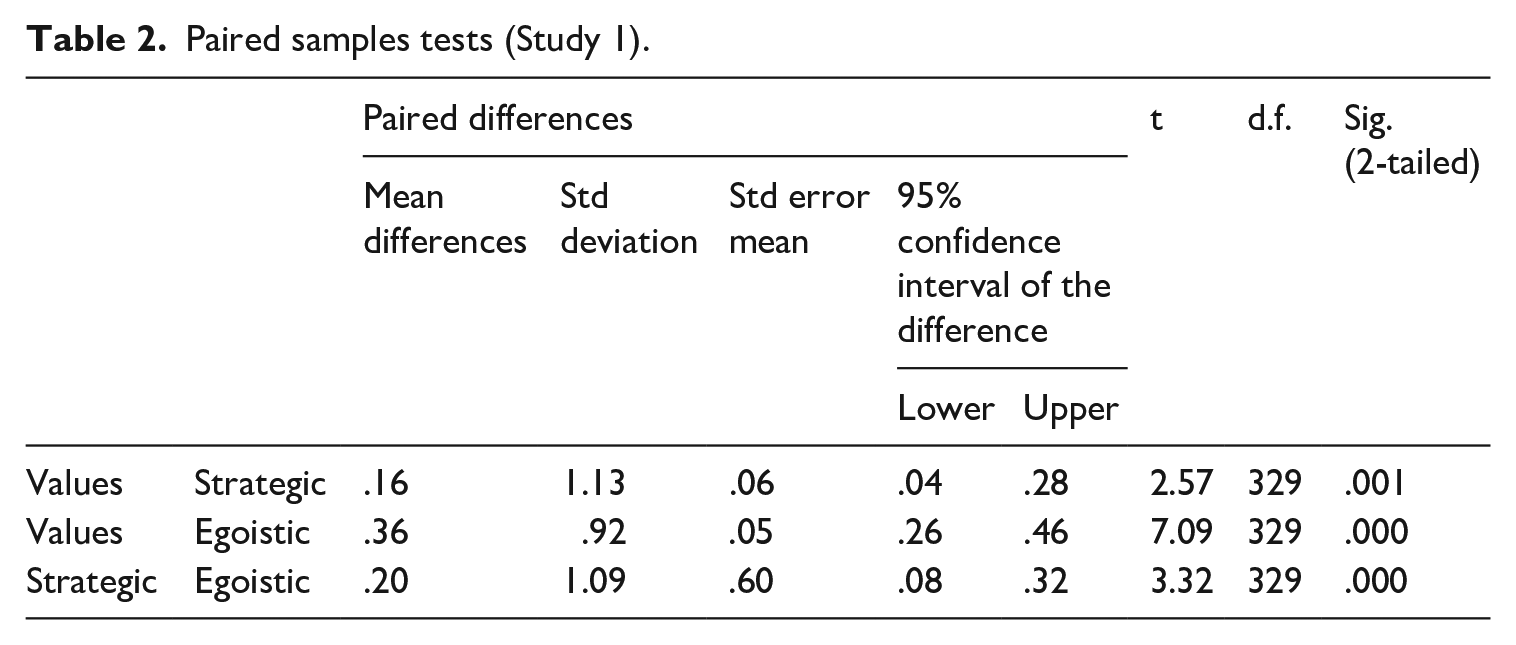
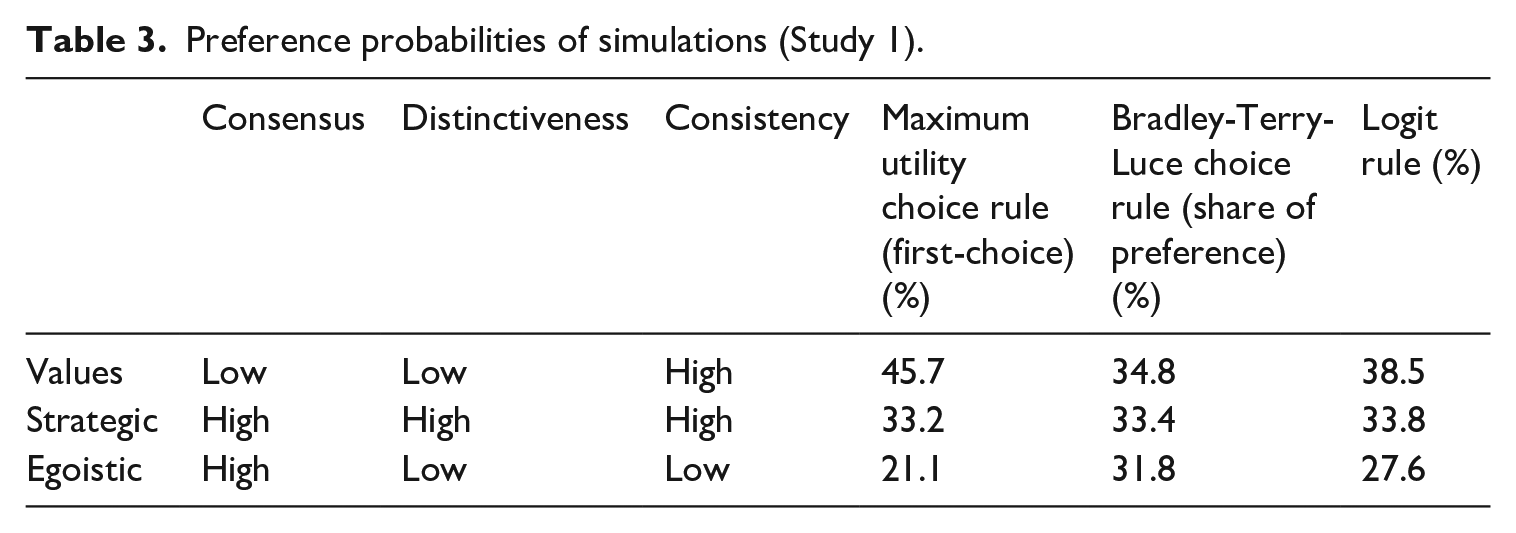
Scores for value-driven firms were recomposed using a low consensus, low distinctiveness, and high consistency configuration (LLH). Scores for strategic-driven firms were recomposed using a high consensus, high distinctiveness, and high consistency configuration (HHH). Finally, scores for egoistic-driven firms were recomposed using a high consensus, low distinctiveness, low consistency configuration (HLL; see Table S.3). Paired samples t-tests provide support for all three hypotheses (see Table 2; for sample statistics see Table S.4). In aggregate, job seekers are more likely to apply for work in values-driven firms compared to strategic-driven firms, providing support for H1 (Mdiff = .16, SE = .06, p = .001). Job seekers also are more likely to apply for work in values-driven than egoistic-driven firms (H2; Mdiff = .36, SE = .05, p = .000). Finally, as predicted, job seekers are more likely to apply at strategic than egoistic-driven firms (H3; Mdiff = .20, SE = .06, p = .000). These results are further supported by job market simulation analyses, which enable translation of intentions to apply into projected behaviors using choice rules, and in turn job market shares (Green and Krieger, 1988). Using the first-choice rule, for example, values-driven firms should receive almost half (45.7%) of available human capital, strategic-driven firms should expect a 33.2% job market share, while egoistic-driven firms should expect a 21.1% share (see Table 3).
Paired samples tests (Study 1).
Preference probabilities of simulations (Study 1).
Discussion
Job seekers appear to prefer firms signaling CSR driven by values over strategic or egoistic motives, because it supports moral/deontic norms. These findings extend the deontic CSR perspective (i.e. that individuals care about CSR for its own sake and not only for self-interested reasons) by explicitly examining the processes leading to perceptions of authenticity (i.e. attributional processes; McShane and Cunningham, 2012), rather than simply assuming that mere CSR engagement automatically addresses deontic needs (see Rupp et al., 2018). This represents a more veridical test of the deontic CSR perspective because individuals “judge the morality of acts based in part on the actor’s intentions, motives, and extenuating circumstances” (Effron et al., 2018: 65). Yet, a more rigorous test of the deontic CSR argument depends on controlling self-interest, reflected in first-party distributive justice perceptions (Rupp et al., 2018: 564). In Study 2, we test whether job seekers still prefer values-driven firms (reflected in the LLH CSR attributional configuration), controlling first-party distributive justice. Study 2 also extends Study 1 by: (1) measuring firm attractiveness judgments, and (2) controlling factors with potential to influence firm attractiveness judgments.
Study 2
Respondents and stimuli
As in Study 1, we employed conjoint analysis. A total of 227 self-identified job seekers from a large research university were asked to participate in a study examining job seekers’ reactions to corporate behavior. The sample was 49% female, 21 years of age (SD = .63), and predominantly American (90% of the sample was composed of US citizens). Respondents evaluated eight company profiles in a full 2 x 2 x 2 factorial design. In contrast to Study 1, in Study 2 these configurations were evaluated using an employer attractiveness item (Turban and Greening, 1996). Respondents also were randomly assigned to one of three distributive justice conditions (competing firms offer a salary 10% lower than the average market rate (unfair); at the average market rate (fair); no treatment). Thus, the full design functions as a 2 x 2 x 2 x 3 factorial. While the first three variables are within-subject conjoint factors, the remaining element of the design is between-subjects first-party distributive justice. We assessed the manipulation with the statement “The salary you would receive at these companies is at the average market rate”. A five-point Likert scale ranging from 1 (strongly disagree) to 5 (strongly agree) was used. Results from the manipulation check were successful (Mmarket rate = 3.47, SD = .95; M10% below market rate = 2.75, SD = 1.22, d.f. = 147, p = .000). A total of 12 responses were deleted given zero variance across profile ratings (Lilien et al., 2013).
Control variables
Drawing from the job search literature (e.g. Lopez-Kidwell et al., 2013), we controlled variables that can affect job seekers’ judgments of firm attractiveness. These included grade point average (GPA), perceptions of recruitment self-performance, work experience, academic major, and national origin. We also controlled job offers because this can affect marketability perceptions.
Results
We employed the SPSS conjoint command, generating 215 regression equations across the three fairness conditions. Using multivariate analysis of covariance (MANCOVA), we examined the impact of distributive justice, which does not influence preferences for different CSR attributional configurations, or inferred motives (F2, 167 = .518; p = .597). 3 Therefore, job seekers do not seem to prioritize self-interest over CSR, or compensate unfair personal treatment with CSR (cf. Rupp et al., 2013). This finding represents a more direct test of the deontic CSR perspective, because it explicitly examines first-party distributive justice concerns. We then tested H1–H3 using repeated measures analysis of covariance (ANCOVA), controlling first-party distributive justice (for estimated marginal means see Table S.5). A total of 26 respondents were removed given statistically insignificant Pearson’s R (Olson, 2013). As shown in Table 4, while the estimated marginal mean for values-driven firms was higher than strategic-driven firms, we do not find support for H1 (Mdiff = .10, SE = .09, p = .263), although the job market simulation analyses (described below) indicate that values-driven firms generate higher human capital shares. In support of H2, the estimated marginal mean for values-driven firms was significantly higher than egoistic-driven firms (Mdiff = .33, SE = .075, p = .000). And, in support of H3, the estimated marginal mean for strategic-driven firms is higher than egoistic-driven firms (Mdiff = .23, SE = .08, p = .006). 4
Pairwise comparisons (repeated measures ANCOVA) (Study 2).
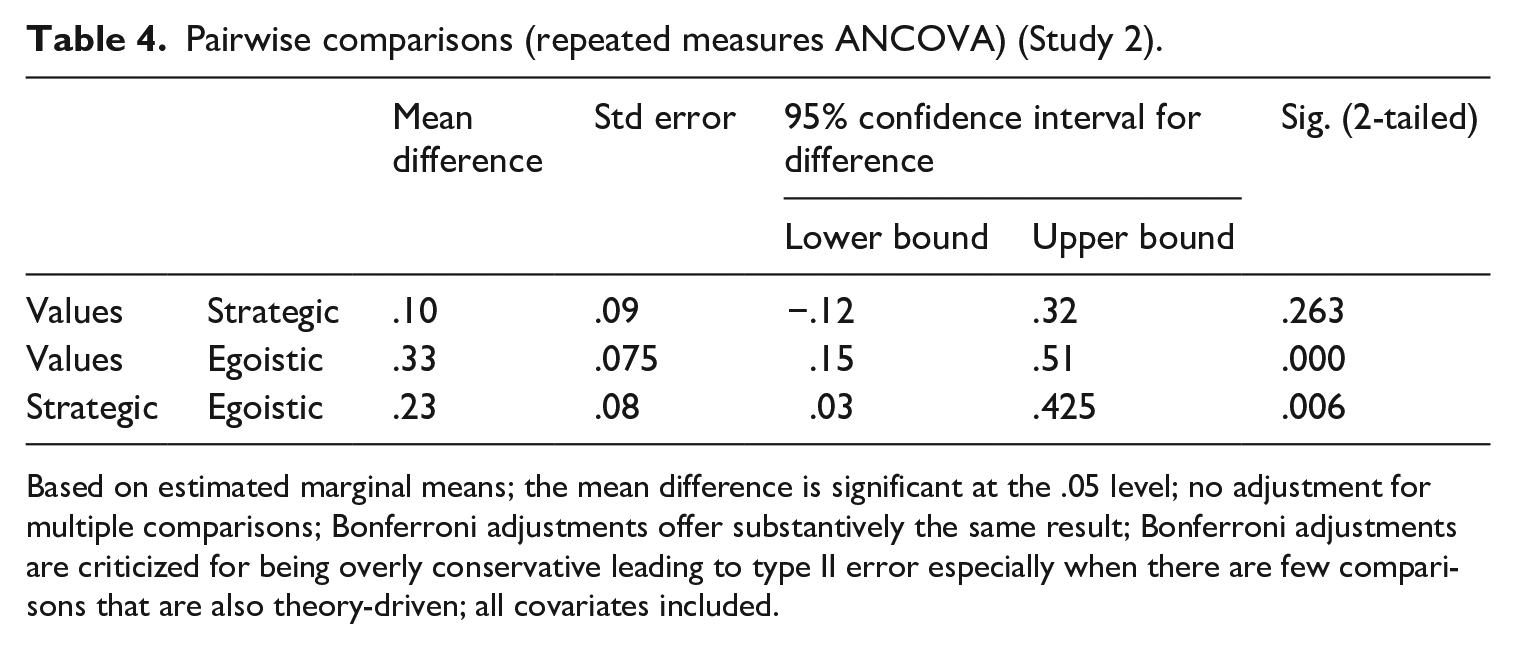
Based on estimated marginal means; the mean difference is significant at the .05 level; no adjustment for multiple comparisons; Bonferroni adjustments offer substantively the same result; Bonferroni adjustments are criticized for being overly conservative leading to type II error especially when there are few comparisons that are also theory-driven; all covariates included.
Consistent with the results from Study 1, aggregated conjoint results (see Table S.6) show that CSR consistency was the most important factor (i.e. explaining 51% of the utility range), followed by consensus (40%), and distinctiveness (9%). Finally, as in Study 1, we designed a job market simulation translating attractiveness scores into projected behaviors. Results show that values-driven firms should expect almost half (46.2%) of available human capital, followed by strategic-driven firms (34.8%) and egoistic-driven firms (19.0%) (see Table 5). These results are substantially the same across choice rules, offering evidence supporting H1–H3.
Preference probabilities of simulations (Study 2).

Discussion
The pattern of results in Study 2 provides support for the CSR attributional configuration model. Although initial analyses did not support the superiority of values-driven firm attractiveness over strategic-driven firms (H1), the job market simulation results do coincide with this expectation. The results for H2 and H3 are consistent across both the ANCOVA, and job market simulation analyses. These results replicate and extend Study 1, providing support for the importance of CSR causal attributions in the presence of job seekers’ first-party distributive justice concerns. This represents a stronger test of the deontic CSR perspective relative to current work because a deontic perspective requires explicit focus on causal attributional processing (Kelley, 1971). We argue that characterization of CSR as a moral activity depends on observers’ causal reasoning. However, although Studies 1 and 2 support our expectations, they were based on: (1) US respondents; (2) younger job seekers; and (3) did not control the potential influence of key micro-CSR individual difference variables. Study 3 addresses these limitations.
Study 3
Respondents and stimuli
As in Studies 1 and 2, we employed conjoint analysis. A total of 178 self-identified job seekers were recruited from Prolific Academic, a professional recruitment firm that connects researchers with their target respondents (Goodman and Paolacci, 2017). We specifically pre-screened for nationality, recruiting respondents from the UK, as research shows that the link between CSR efforts and job seekers’ reactions can differ across countries (Dawkins et al., 2016). The sample was 57% female, 32 years of age (SD = 10.9), with 9.8 years of work experience (SD = 10.1). Respondents again evaluated eight company profiles in a full 2 x 2 x 2 factorial design using an employer attractiveness item. A total of 15 responses were deleted given zero variance across profile ratings (Lilien et al., 2013).
Control variables
First, following Rupp et al. (2013), we controlled moral identity, defined as the extent that being a moral person is central to one’s self-definition. Job seekers higher/lower in moral identity are more/less likely to react in CSR and engage in deontic evaluations (i.e. evaluation of whether the firm engages in CSR for the right/moral reasons; Dunfee, 2008). We measured moral identity with the five-item internalization factor reported by Aquino and Reed (2002) (α = .90). Second, CSR causal attributions can be impacted by the extent that job seekers believe that CSR detracts from a firm’s core business. We controlled CSR–corporate abilities beliefs 5 (CSR-CA beliefs; Sen and Bhattacharya, 2001), which reflect on relationships between CSR, a firm’s ability to make quality products and take care of its employees. CSR-CA beliefs may affect job seekers’ preferences relating to CSR distinctiveness, which is the extent a firm engages in CSR within a narrow domain relating to its core business. For example, Sen and Bhattacharya (2001) reported that customers believing in the CSR-CA trade-off (an external stakeholder group similar to job seekers in many respects) react negatively when the CSR domain is CA-irrelevant (i.e. when perceived CSR distinctiveness is low). Further, higher belief in CSR-CA trade-offs also can influence job seekers’ expectations relating to salary, benefits, and first-party distributive justice. Job seekers who believe there is a trade-off between CSR and CA may be more likely to justify, and accept, a potential employer’s strategic and/or egoistic CSR motives.
If job seekers prefer firms driven by values-driven motives, in the presence of CSR-CA beliefs, this offers additional evidence of the deontic CSR arguments built out in Study 2, which also were examined in the presence of first-party distributive justice concerns (see also Erdogan et al., 2015; Rupp et al., 2018). We controlled CSR-CA beliefs using three items from Sen and Bhattacharya (2001). An example is: “Firms that devote resources toward socially responsible actions have fewer resources available for increasing employee effectiveness” (α = .83). Finally, we also controlled job seekers’ perceptions of the realism of the conjoint scenarios (i.e. “The CSR scenarios concerning the eight companies that I read above are realistic” assessed using a seven-point Likert scale). Job seekers found the scenarios sufficiently realistic (M = 5.25; SD = .94; one sample t-test with the scale midpoint used as the test-value; p = .000).
Results
We employed the SPSS conjoint command and generated 178 regression equations. Pearson’s R was high and significant (.99). We tested H1–H3 using repeated measures ANCOVA, controlling moral identity, CSR-CA beliefs, perceptions of realism of the CSR configurations/scenarios, and key demographics. A total of 15 respondents were removed given statistically insignificant Pearson’s R (Olson, 2013), and a total of 12 respondents with a non-significant Pearson’s R were removed (Olson, 2013; as in Studies 1 and 2, results remain substantively the same). As shown in Table 6 (see Table S.7 for estimated marginal means and covariates), in support of H1, the estimated marginal mean of attractiveness for values-driven firms was significantly higher than strategic and egoistic-driven firms (Mdiff = 1.00, SE = .09, p = .000) and H2 (Mdiff = 1.15, SE = .09, p = .000). While the estimated marginal mean for strategic-driven firms was higher than egoistic-driven firms as expected, we find weak support for H3 (Mdiff = 0.15, SE = .10, p = .067; one-tailed; see Table 6). However, job market simulation results (see Table 7), offer support for H3; strategic-driven attributions for CSR engagement is preferred over egoistic-driven CSR. Further, consistent with H1 and H2, values-driven CSR engagement is preferred over strategic and egoistic-driven CSR. As in Studies 1 and 2, these results also are substantially the same across all three choice rules.
Pairwise comparisons (repeated measures ANCOVA) (Study 3).
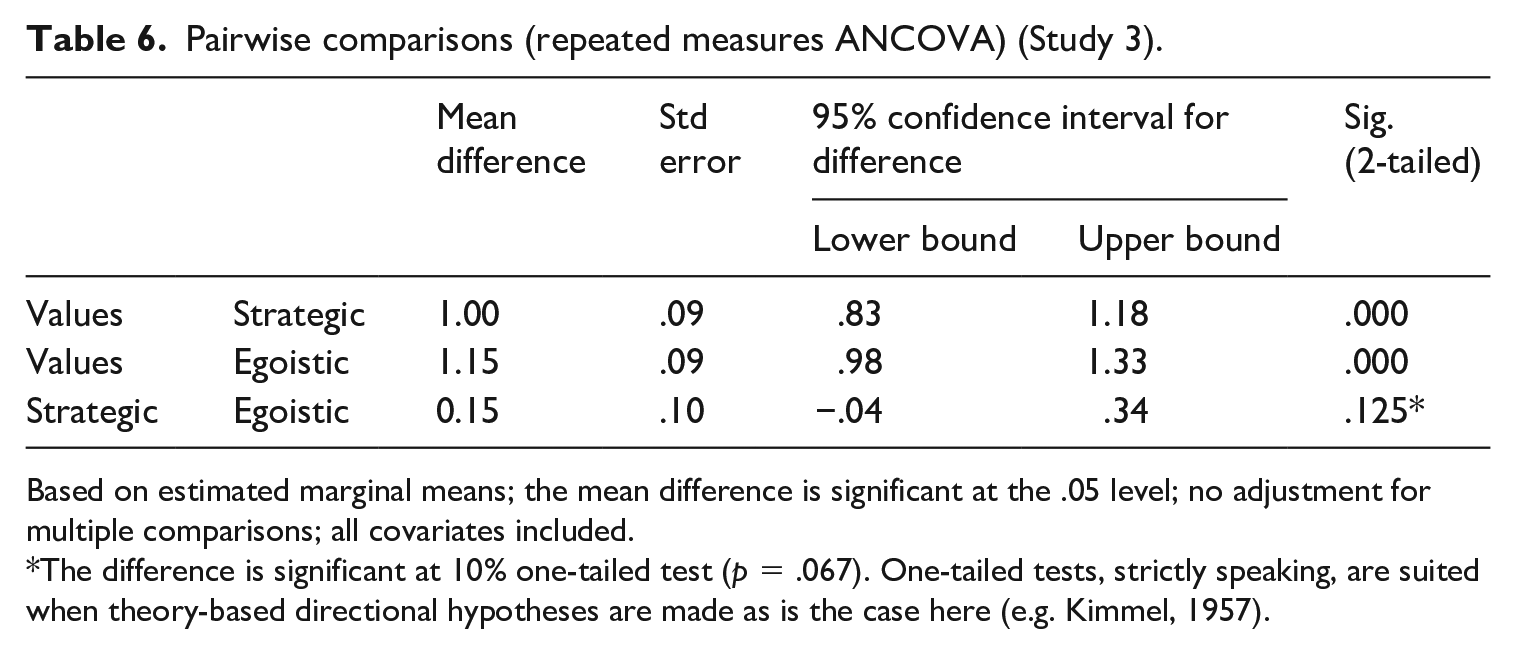
Based on estimated marginal means; the mean difference is significant at the .05 level; no adjustment for multiple comparisons; all covariates included.
The difference is significant at 10% one-tailed test (p = .067). One-tailed tests, strictly speaking, are suited when theory-based directional hypotheses are made as is the case here (e.g. Kimmel, 1957).
Preference probabilities of simulations (Study 3).
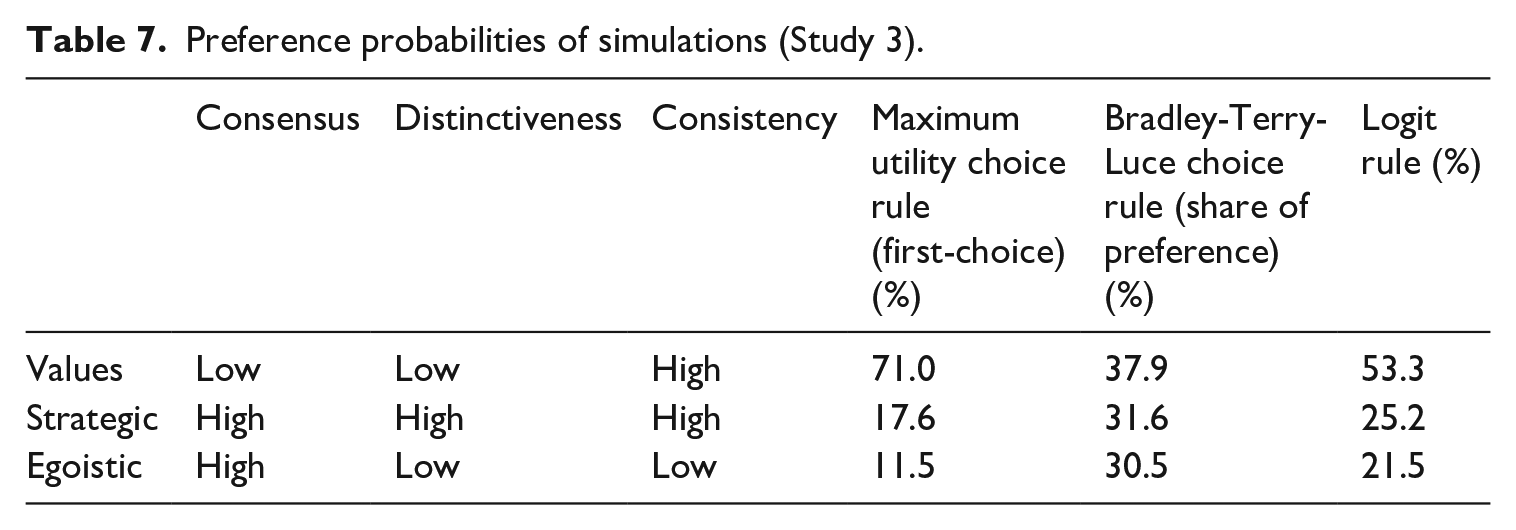
Finally, consistent with Studies 1 and 2, CSR consistency was most important (i.e. 42% of the utility range). However, in this sample, distinctiveness appears to be more important than consensus (34% and 24% of the utility range, respectively), although both seem to be important (see Table S.8). Additional analyses reveal that the higher importance of distinctiveness may be qualified by CSR-CA beliefs. Interestingly, respondents believing there is a trade-off between CSR and corporate abilities’ development are less attracted by values-driven—and more attracted to strategic driven—firms (F (1, N = 151) = 11.44, p = .00; Figure S.1). However, in support of the deontic CSR model, overall, values-driven firms are preferred over strategic or egoistic-driven firms, even when controlling CSR-CA beliefs.
Discussion
While Study 3 replicates and extends Studies 1 and 2, and reveals a pattern of results that provides support for our model, it does not offer direct evidence of the role of CSR causal attributions per se. We designed Study 4 to provide direct evidence of the process role played by job seekers’ CSR causal attributions on intentions to apply. This required adoption of a different approach. Conjoint designs cannot realistically accommodate more than one or two types of ratings, and these would tend to suffer from common method issues. In Study 4, we employed a self-explicated design (Akaah and Korgaonkar, 1983; McArthur, 1972). Job seekers were explicitly asked to evaluate the three CSR configurations (i.e. LLH, HHH, HLL) in relation to values-driven, strategic-driven, and egoistic-driven motives, as well as their intention to apply to firms deploying these CSR attributional configurations. We further collected job seekers’ thoughts/explanations about their evaluations, which resulted in rich qualitative data.
Study 4
Respondents, procedures, and stimuli
As in Study 3, we recruited a new set of respondents via Prolific Academic. A total of 197 self-identified job seekers from the UK (out of 300 initially contacted) were recruited. The sample was 32 years of age (SD = 11.27), predominantly female (54%), and 34% had a bachelor’s degree. Similar to Studies 1 and 2, respondents were instructed to imagine considering applying for a job from a shortlist of three companies. They were told that these companies engage in CSR, and seem to differ regarding aspects of their CSR engagement. The same materials used in Studies 1–3 also were used in Study 4. But, given the goals of Study 4, respondents were exposed only to the LLH, HHH, and HLL configurations, and were asked to perform two tasks.
In the first task, respondents ranked the three types of firms, based on their likelihood of applying for a job at the company. After ranking the firms, respondents were asked to explain their ranking decision (i.e. list their thoughts). The goal was to investigate, in an unsolicited way, whether causal attributional processing—a foundational aspect of our model—emerged as a major explanation for job seekers’ rankings. The second task was designed to examine whether the three CSR attributional configurations are significantly associated with the expected types of CSR causal attributions. Specifically, respondents were presented with three questions. Embedded in these questions were the three types of firms (labeled M, T, and O). The questions asked our job seeking respondents to choose the firm that is more likely to be engaging in CSR because: Question (1) it is genuinely concerned about being socially responsible; Question (2) it is strategically concerned about being socially responsible; and Question (3) it is egoistically concerned about being socially responsible. Respondents then provided basic demographic information, and were asked to evaluate the realism of the CSR scenarios using a seven-point Likert scale (M = 5.41; SD =1.01, one-sample t-test compared with the scale midpoint; p = .000).
Results
Our work builds from three key propositions: (1) the LLH configuration is more likely to be associated with values-driven motives; (2) the HHH configuration is more likely to be associated with strategically driven motives; and (3) the LLH configuration is more likely to be associated with egoistically driven motives. Results from our analyses, depicted in Figure 1, offer strong support for these propositions. As expected, the LLH configuration was significantly more likely to be associated with values-driven motives (χ2 (2, N = 196) = 130.17, p = .000), the HHH configuration was significantly more likely to be associated with strategically driven motives (χ2 (2, N = 195) = 31.97, p = .000), and the LLH configuration was significantly more likely to be associated with egoistically driven motives (χ2 (2, N = 196) = 35.70, p = .000).
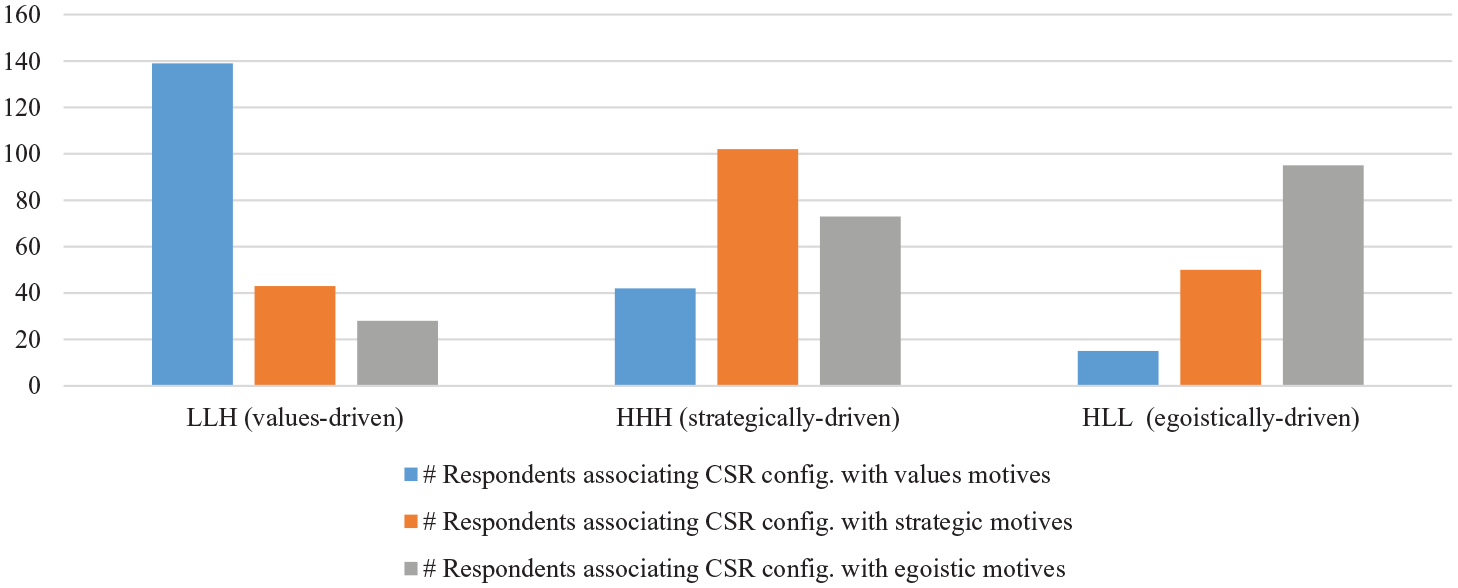
CSR configurations (LLH/HHH/HLL) and likelihood of being associated with CSR-induced motives (Study 4).
The results from the next set of tests bear on firm rankings, and further substantiate the structure of our theoretical model (see Figure S.2). We find that the LLH CSR configuration (i.e. values-driven) ranks first (χ2 (2, N = 175) = 85.04, p = .000); the HHH CSR configuration (i.e. strategically driven) ranks second (χ2 (2, N = 175) = 6.39, p = .041); while the HLL CSR configuration (i.e. egoistic) ranks last (χ2 (2, N = 175) = 63.41, p = .000). Perhaps most importantly, a key untested prediction is that the likelihood of applying to a firm depends on CSR configuration, which reflects different underlying CSR-induced motives. To examine this prediction directly, we associated the firm rankings from Task 1 with the motive probabilities from Task 2. The results from three chi-square tests linking firm rankings and motives probabilities, depicted in Figure 2, provide additional support for our model.
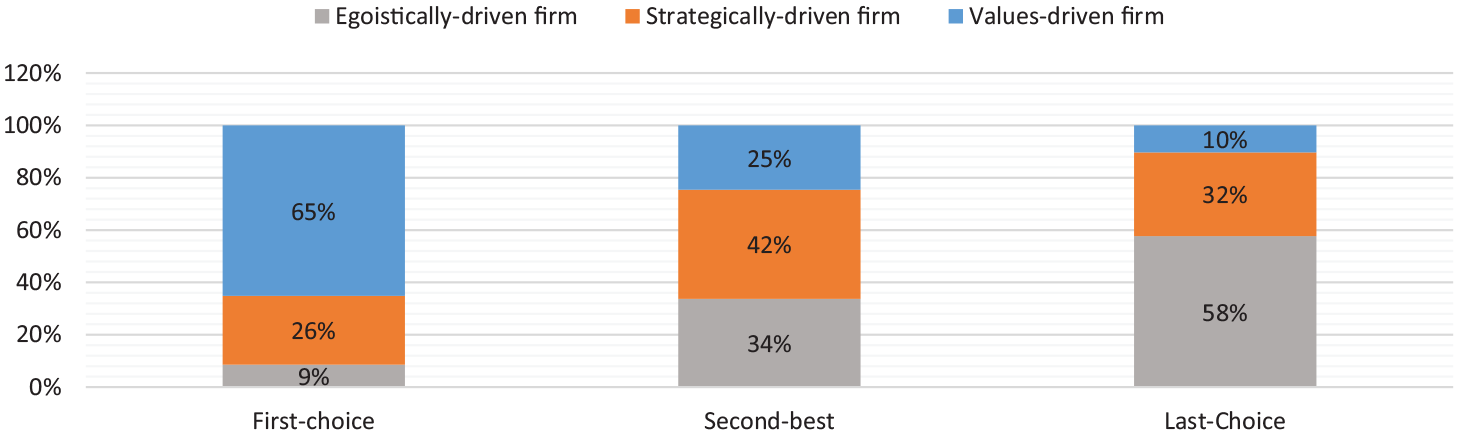
Intention to apply (ranking results) and CSR causal attributions (associated with the HHL, HHH, and LLH CSR attributional configurations) (for example: 65% of respondents rank first the firm more likely to be associated with values-based motives namely the LLH firm) (Study 4).
Intentions to apply (ranking) to the values-driven firm, and the likelihood of this firm being seen as values-driven are significantly associated (χ2 (4, N = 174) = 33.32, p = .000). Similarly, intentions to apply to the strategic-driven firm, and the likelihood of this firm being seen as strategic-driven are significantly associated (χ2 (4, N = 173) = 18.13, p = .000). The intention to apply to the egoistic-driven firm, and the likelihood of this firm being seen as egoistically driven also are significantly (weakly) associated (χ2 (4, N = 174) = 7.11, p = .065; one-tailed).
Finally, respondents were asked to offer thoughts related to their rankings. These qualitative explanations represented an opportunity for participants’ unsolicited causal attributional thinking to emerge. The explanations provided by participants also offer further evidence bearing on the prediction that CSR configurations elicit causal attributional thinking; which in turn affects application intentions. Correspondence between the content of this spontaneous attributional thinking with the values-, strategic-, and egoistically driven CSR causal attributions would constitute qualitative evidence bearing on the mediating role of these attributions in the relationship between CSR attributional configurations and job seeker outcomes (see Bate et al., 2012 and Kim and Rousseau, 2019 for examples/discussion of theoretical mediation). We performed content analysis on participants’ open-ended responses using a human-scored system approach. Coding was aligned with pre-specified categories (e.g. Krippendorff, 2004; Williams and Shepherd, 2017) associated with the attributions of values, strategic, and egoistic-driven firms.
Our methods and results are explained in more detail in the supplemental materials which includes our codebook (Table S.9). Results from this qualitative analysis provide support for our model. Participants’ descriptions for why they chose the firms to which they would apply reflect their attributions. Counts for how participants’ comments are reflected by each category are available in Table S.10.
Participants’ reasons for choosing a firm correspond with the CSR attributions we describe in our model. Participants’ primarily positive comments reflect attributes aligned with authentic or values-driven motives, which were significantly associated with the “care” and “innovative” codes. Participants associated attributes of “care” and “innovative” significantly more when choosing the values-driven firm (Careβ = .77, χ2 = 6.28, p = .043; Innovativeβ = .99, χ2 = 64.505, p = .000).
Participants also elaborated on attributions of strategic-driven motives (with comments reflecting on the firm’s core business) as well as egoistic-driven motives. Here, participants commented on a lack of genuineness or altruism associated with CSR. For example, one participant explicitly outlined how, consistent with our theory, their causal attributions influenced firm choice:
I think no. 1 [i.e. respondent’s higher ranked firm] would seem to be the most selfless firm who don’t appear to be out for themselves, no. 2 is not bad, and no. 3 seems only to be in it for themselves.
In another example, a participant invoked circumstantial-attributions associated with egoistic-driven motives. This respondent noted, “Company M [that engages occasionally] sounds more like a company who does CSR activities for image and PR rather than out of genuine concern or principle”, reflecting more of an egoistic perspective. We provide more examples of participants’ responses in Table S.11. Overall, results from the open-ended listing exercise provide additional support for our conceptual model. Results suggest that job seekers exposed to discrete CSR attributional configurations form attributions reflective of the motives we describe, which affect their likelihood of applying (i.e. a theoretical mediation; Jaccard and Jacoby, 2010; Kim and Rousseau, 2019).
General discussion
Although CSR has been linked to organizational attractiveness and recruitment performance (Jones et al., 2014), recent work shows that job seekers’ reactions to CSR are not always positive (Jones et al., 2016). While CSR causal attributions have been forwarded as an explanation for these reactions, the psychological processes contributing to their development, and insight into how firms can, in turn, affect these causal attributions, have remained unexplored territory in the domain (Willness, 2019). In a series of four studies, we address this theoretical gap, developing and testing a process (and content) model bearing on the formation of CSR causal attributions.
This process model focuses on the attributional cascade emerging from configurational variation in firms’ (perceived) CSR activity. Instantiating the covariation rule (Hilton and Jaspars, 1987; Kelley, 1967), we theorize and find that (archetypal) levels of CSR consensus, distinctiveness, and consistency lead to distinct attributional inferences reflecting the causes—actor, stimulus, circumstantial—perceived to underlie these CSR activities. Integrating and building theory in this space, these causal attributions are uniquely associated with valence ascriptions explaining both firm attractiveness, and intent to apply. We find that actor-attributions are associated with values-driven ascriptions, stimulus-attributions are associated with strategic ascriptions, while circumstantial-attributions are associated with egoistic ascriptions. These ascriptions are differentially associated with firm attractiveness and likelihood of applying for a job. We adopt a robust empirical frame to test our theoretical model, controlling important micro-CSR variables including first-party distributive justice, CSR-CA beliefs, and moral identity. Our model offers important implications that extend the architecture of deontic CSR research, and the evolving HRM literature which has integrated attributions into models linking HRM practices with key organizational performance outcomes.
Theoretical contributions
We develop theory expanding and deepening the evolving micro-CSR landscape by opening the black box of job seekers’ causal attributional reactions to CSR (Gond et al., 2017; Jones et al., 2016; Willness, 2019). We show that both firm attractiveness and anticipated behaviors are subject to variation in patterns of CSR attributional information. What emerges from the current study is that “how” firms are perceived to engage in CSR—not merely whether they engage in CSR or “how much” they engage in CSR—is critical for understanding job seekers’ reactions. Current micro-CSR work has largely ignored the critical role of causal attributions in job seekers’ understanding of CSR. We demonstrate that CSR causal attributions matter, and offer a theoretically grounded model bearing on their antecedents (and consequences). For example, Jones et al. (2016) found that a considerable proportion of job seekers were not only indifferent to, but not attracted to (repelled by) employers with a strong CSR reputation. Why this happens among job seekers remained an open question according to the authors. We show that different CSR attributional configurations send signals impacting the actor, stimulus, and circumstantial causal attributions job seekers make which, in turn, impacts job seekers’ reactions.
Our focus on CSR attributional configurations as antecedents of CSR causal attributions is novel in two additional ways. First, it addresses calls for research explaining the cognitive processes that stakeholders adopt in the collection, organization and actuation of CSR information while developing CSR evaluations (Gond et al., 2017). The current results suggest that job seekers appear to analyze covariation of CSR practices with the actor, the stimuli, and the circumstances underlying those practices by sampling three types of information: consensus, distinctiveness, and consistency. This is organized and used not in a discrete or additive way, but more likely in a configurational way. The potentially discrete consequences of the three types of information are subsumed by their collective, configurational effect. Second, leveraging Kelley’s cube, we address a key gap in the micro-CSR domain, reflected in the broad assumption that CSR evaluations occur in a “competitive” vacuum. In both a conceptual and theoretical departure from established inertia in the domain, we report evidence that the CSR activities of other firms play a central role in stakeholders’ evaluations of CSR.
Further, an explicit causal attributional focus addresses a key theoretical limitation constraining evolution and development in deontic CSR research (e.g. Erdogan et al., 2015; Rupp et al., 2013, 2018). Currently operative in this body of work is the fundamental assumption that job seekers prefer socially responsible organizations, not only for instrumental or relational reasons, but also based on deontic/moral grounds. However, as we have argued, this fundamental assumption rests on the expectation that job seekers make causal attributions that explain why firms engage in CSR in the first place. Nonetheless, the core role played by CSR causal attributions has not received attention in this work. We offer a theoretically defensible conceptualization of the deontic CSR framework.
Finally, our research has implications for evolving HR research exploring causal attributions within the selection and recruitment context (see Hewett et al., 2018). For example, adopting Kelley and Michela’s (1980) framework, Hewett and colleagues (2018) offered that information, beliefs, and motivation can drive HR causal attributions relating to firm engagement in HR practices such as workload management. They urged researchers to extend their content-based attributions model (i.e. focused on “what” information individuals use) with a focus on “how” individuals use information. They specifically called for development of attribution or process-based models leveraging Kelley’s theory. We do so in the CSR context, an HR practice orbiting issues such as work–life balance (Hewett et al., 2018) and diversity (Edwards and Kudret, 2017). It is critical that research continues to advance the process framing we develop, further exploring relationships between the configuration of HR attributional information and the perceptions and behavioral intentions of key internal and external stakeholders.
Practical implications
What emerges from this research is that it is essential that firms adopt a systematic calculus in their deployment of CSR initiatives. Beyond the engagement versus non-engagement dichotomy, it is clear that the patterns of firms’ CSR engagement can send different signals to job seekers. It will be important for managers to recognize that CSR attributional configurations can be a differentiator in the attraction of talent, and should thus adopt a carefully crafted approach in their communication of CSR initiatives. As an example, we urge practitioners to include strategic CSR information in recruitment advertising (e.g. Puncheva-Michelotti et al., 2018), paying special attention, however, to exactly how this is information is communicated.
CSR communications should be structured to reflect CSR consensus, distinctiveness, and consistency depicting—at worst—strategic goals, and—at best—values-driven ascriptions. We demonstrate that a low consensus, low distinctiveness, and high consistency configuration is more likely to generate the best possible returns in terms of attraction and employment intent. It follows that it is critical that firms not only communicate, but also invest, in this kind of CSR configuration. Indeed, embedded in a broader ecosystem defined by ongoing attention to greenwashing and firm CSR-hypocrisy—not “walking the talk” (e.g. Lyon et al., 2018)—it is important to consider the role of industry regulation as well. Configurational consensus, distinctiveness, and consistency can drive not only the ascriptions that job seekers develop, but also how the CSR practices of firms are, perhaps, reported on by regulatory bodies.
Limitations and future research
Despite supportive results, this research has certain limitations. First, we focused on three archetypal attributional (CSR) configurations that correspond to the most common types of explanations in social psychology (Hilton, 2013; Hilton and Jaspars, 1987); namely actor, stimulus, and circumstance attributions. Yet, a wide range of CSR attributional configurations are less immediately distinguishable. Although these archetypal CSR configurations can affect job seekers’ perceptions and behavioral intentions, it is not clear what role more oblique configurations play, or how they may be categorized. For example, our simulation analyses reveal that job seekers also are likely to be attracted to firms deploying the LHH configuration (i.e. innovative CSR, consistently engaged in, coinciding with the firm’s core business).
Specifically, the inductive logic model of causal attributions indicates that this CSR configuration does not generalize across firms and stimuli; it only generalizes across time. Inductively, something about the firm and/or the stimuli drives its pattern of CSR engagement (i.e. perhaps a mixed motive). We encourage researchers to develop theory relating to the effects of this (and other) oblique CSR configurations on job seekers’ reactions. This will be particularly important in light of attribution theories relating to the “discounting principle” (see Hewett et al., 2018) suggesting that “when behavior covaries with more than one potential cause, its actual cause is ambiguous” (Gilbert, 1998: 100). CSR is a politically laden concept, subject to criticism from both poles of the ideological spectrum. As such, an ambiguous perceived underlying motivation carries the potential to appease both left- and right-wing critics of these practices. This speaks to the importance of key individual difference characteristics bearing on preferences underlying CSR motivation. The relevance of this theoretical avenue is magnified in light of evidence that firms with founders with different political viewpoints, CEOs, and directors are more likely to score higher on CSR performance (Di Giuli and Kostovetsky, 2014).
Further, it is clear that in our conceptualization and operationalization of CSR we leveraged a broad anchoring frame. Drawing on El Akremi et al. (2018), it will be important for future research to substantiate the generalizability and general predictive efficacy of our model with a conceptualization of CSR in explicit stakeholder terms, or what El Akremi et al. (2018) termed “Corporate Stakeholder Responsibility”. For example, do the effects of CSR attributional configurations on job seekers (and other stakeholders) differ when examined, for instance, in the context of customer-oriented CSR relative to employee-oriented CSR, and/or natural environment CSR? An important issue for future research will be addressing the question, do job seekers prioritize an LHH configuration and resultant values-driven motives across all potential types of CSR?
Further, while we show that CSR causal attributions represent an important mechanism driving organizational attractiveness and recruitment performance, several other mechanisms have been suggested in the micro-CSR job seeker literature (see Jones et al., 2014). In light of recent calls for more integrated micro-CSR (and HR attributions) models (see Hewett et al., 2018; Wang et al., 2020), it will be important for future research to integrate the three CSR attributional configurations and concomitant CSR causal attributions suggested here with those mechanisms. For example, it will be important to explore how much these CSR attributional configurations affect the mechanisms of: (1) anticipated pride; (2) perceived value fit; and (3) expected treatment (Jones et al., 2014). Further, we have assumed that job seekers will engage in attributional processing with equivalent intensity. We recognize that this is more likely to happen when job seekers are more motivated to do so (Hewett et al., 2019). For example, it will be important to determine if a desire for “significant impact through work” (Gully et al., 2013: 937) moderates the effect of causal attributions on organizational attraction. In light of the regular criticism that CSR engagement is hypocritical (Willness, 2019), it will be important for future research to explore how CSR configurations impact negatively valenced outcomes, such as job seekers’ aversion and cynicism (see Hewett et al., 2019).
Finally, it will be important for future HR attributions research to draw on our conceptual model, testing the effects of different attributional configurations on employees’ causal attributions underlying HR practices. Our findings directly inform research in this space, as the values-driven, strategic-driven, and egoistic-driven causal attributions we describe substantively overlap with the HR causal attributions discussed in Nishii et al. (2008), and recently revised in Hewett et al. (2019). For example, exploitation attributions are similar to what we call egoistic attributions, and the external reporting and trade union compliance attributions (i.e. control-focused HR attributions) manifest strategic-driven attributions. It will be important for future research to examine how different attributional configurations can affect both lower- and higher-order attributional dimensions within the context of HR practices.
Conclusion
Job seekers’ reactions to CSR are not uniformly positive. The valence of these reactions depends on the causal attributions made to explain firms’ behavior. But there is currently only limited understanding of “how” these CSR causal attributions form, and what types of information drive their development. We show that job seekers deontically evaluate CSR activity, and that CSR consensus, distinctiveness, and consistency signal discrete motives with implications for the attraction of human capital assets.
Supplemental Material
sj-pdf-1-hum-10.1177_0018726720971036 – Supplemental material for Does “how” firms invest in corporate social responsibility matter? An attributional model of job seekers’ reactions to configurational variation in corporate social responsibility
Supplemental material, sj-pdf-1-hum-10.1177_0018726720971036 for Does “how” firms invest in corporate social responsibility matter? An attributional model of job seekers’ reactions to configurational variation in corporate social responsibility by Daniel G Bachrach, Pavlos A Vlachos, Kris Irwin and Frederick P Morgeson in Human Relations
Supplemental Material
sj-xlsx-2-hum-10.1177_0018726720971036 – Supplemental material for Does “how” firms invest in corporate social responsibility matter? An attributional model of job seekers’ reactions to configurational variation in corporate social responsibility
Supplemental material, sj-xlsx-2-hum-10.1177_0018726720971036 for Does “how” firms invest in corporate social responsibility matter? An attributional model of job seekers’ reactions to configurational variation in corporate social responsibility by Daniel G Bachrach, Pavlos A Vlachos, Kris Irwin and Frederick P Morgeson in Human Relations
Footnotes
Acknowledgements
The first and second authors, Dan Bachrach and Pavlos Vlachos, contributed equally to the completion of this project, and should be considered co-first authors of the article.
Funding
The authors received no financial support for the research, authorship, and/or publication of this article.

Supplemental material
Supplemental material for this article is available online.
Notes
References
Supplementary Material
Please find the following supplemental material available below.
For Open Access articles published under a Creative Commons License, all supplemental material carries the same license as the article it is associated with.
For non-Open Access articles published, all supplemental material carries a non-exclusive license, and permission requests for re-use of supplemental material or any part of supplemental material shall be sent directly to the copyright owner as specified in the copyright notice associated with the article.
