



Abstract
Critical scholarship has challenged traditional assumptions of entrepreneurship as a ‘neutral’ economic activity, demonstrating instead how entrepreneurship is a cultural phenomenon. In particular, enterprise culture has been exposed as fundamentally masculinist, so that women entrepreneurs are said to be measured against gendered values and ideals. What remains relatively unexplored, however, are the ways the identity performances of women entrepreneurs on social media reflect and reproduce inequalities that extend beyond gender. In this article, we examine how highly privileged Australian women entrepreneurs perform their identities on Instagram. In applying intersectionality theory, our study finds that the entrepreneurs produced idealised feminine identities by leveraging the intersections of white, elite-class, heteronormative, able-bodied power within a broader neoliberal discourse. In doing so, our analysis points to how romanticised ideals of women’s economic empowerment in digital spaces may obscure the perpetuation of systemic and structural oppression.
Introduction
Gender has been a key area of interest within critical theorising of entrepreneurship (Ahl, 2006), which has valuably illuminated how the gendered social order is manifested in the discursive practices of social actors (Bruni et al., 2004a, 2004b). In particular, existing research has demonstrated how the masculinist discourse of entrepreneurship in media, education and policy work perpetuates very specific constructions of entrepreneurs, including attributes such as being risk-taking, daring, innovative, assertive, resilient, autonomous, individualistic, energetic, active, persevering, self-made, visionary and achievement-oriented (Ahl, 2006: 600; Cohen and Musson, 2000: 41). The dissemination of this discourse has shaped normative assumptions about what constitutes entrepreneurship in ways that regulate the identity performances of all entrepreneurs irrespective of their gender identification (Bruni et al., 2004b). This research has suggested that women entrepreneurs are marginalised from dominant discourses and thus their identity performances require certain discursive tactics to navigate this highly gendered field (Ahl, 2006; Bruni et al., 2004a, 2004b; Calás et al., 2009; Tedmanson and Essers, 2016).
As social media have been embraced by entrepreneurs as powerful platforms for communication, branding and identity construction, the production and dissemination of gendered entrepreneurship discourses have become more subtle and complex (see McRobbie, 2016). However, as Martinez Dy et al. (2017: 288) argue, ‘the limited research specifically on women digital entrepreneurs has been based on assumptions of a “neutral web”; thus, the manner in which the phenomenon is gendered, racialised or affected by class position remains underexplored’.
To investigate such intersectional dynamics more closely, we develop an analytical lens grounded in intersectionality theory and critical whiteness studies in order to understand how identity performances are instantiated discursively on social media by elite women entrepreneurs. Specifically, we extend our analysis beyond gender and explore expressions of race, class, sexuality and able-bodiedness in the Instagram identity performances of Australian women entrepreneurs who were able to take advantage of dominant social positions (Moreton-Robinson, 2020). Gender inequality notwithstanding, our study finds that such entrepreneurs perform feminised selves that leverage the intersections of white, elite-class, heteronormative and able-bodied power as a strategy of self-branding (Duffy and Hund, 2015; Genz, 2015; Marwick, 2015). The entrepreneurs in our study appeared neither constrained by the traditional masculinist boundaries of prevailing enterprise discourse (Diaz Garcia and Welter, 2011), nor did they break with traditional status hierarchies in ways that would have rendered markers of difference invisible. We therefore contribute to the critical entrepreneurship literature by showing how performances of entrepreneurial identities on social media may in fact reproduce and reinforce interlocking systems of oppression.
The article begins with an overview of the literature on entrepreneurship in digital culture to show how elite women entrepreneurs’ identity performances on social media are bound up in a range of neoliberal and postfeminist discourses. We then extend this theorising with the emergent analyses of intersectionality in entrepreneurship and consider the ways gendered discourses are inflected by other power structures including race, class, sexuality and dis/ability. The methods of our study will subsequently be outlined, detailing how we collected and analysed the multimodal data of the Instagram profiles of eight Australian women entrepreneurs. Next, we present the three dominant dimensions of the participants’ identity performances from our analysis that conveyed the ways each entrepreneur presents herself as (i) beautiful, (ii) loved and (iii) powerful. In our Discussion section, we examine how these dimensions suggest an idealised femininity that is discursively instantiated through the assertion of white, elite-class, heteronormative and able-bodied power.
Entrepreneur identity performances in digital culture
While early research on women’s entrepreneurship focused on their gender as an essentialist trait and measured its relationship with entrepreneurial growth and performance (Ahl, 2006), the gendered construction of entrepreneurship is now well established (Ahl, 2006; Bruni et al., 2004a, 2004b; Calás et al., 2009; Tedmanson and Essers, 2016). From a constructionist perspective, entrepreneurial identities are performed in specific social and cultural environments, i.e. they are not ‘fixed’ but continuously ‘done’ and ‘re-done’ in situated discursive practices (Bruni et al., 2004a, 2005; West and Zimmerman, 1987, 2002).
Drawing on this understanding, the critical entrepreneurship literature has exposed an ‘epistemological gender bias in the field of entrepreneurship’ (Ahl and Marlow, 2012: 549) that celebrates and normalises masculine traits as central to entrepreneurship, while constructing women entrepreneurs in deficitary terms. In recent years, however, popular discourse has suggested that digital culture offers women new pathways to entrepreneurial activities that are apparently not bound by traditional social (gender, race, class, etc.) inequities. Indeed, ‘entrepreneurialism has become a much vaunted ideal in the creative and digital media industries’ (Duffy and Hund, 2015: 2), supported by the proliferation of how-to resources and self-branding practices designed to help create empowered selves (Duffy and Hund, 2015; Marwick, 2015). The rising popularity of terms such as ‘mum-preneur’ (Ekinsmyth, 2011, 2013, 2014) or ‘blogger-preneur’ (Brydges and Sjöholm, 2019; Duffy and Hund, 2015; Petersson McIntyre, 2020) highlights the appeal of identity options that promise women the apparently seamless blending of the private and the professional. Media studies, in particular, have identified a number of dominant discourses in digital culture that to varying extents shape these new enactments of entrepreneurial identity on social media, including fashion blogs (Brydges and Sjöholm, 2019; Duffy, 2016; Pham, 2013, 2015), Twitter (Marwick and Boyd, 2013) and Instagram (Baulch and Pramiyanti, 2018; Brydges and Sjöholm, 2019; Duffy and Hund, 2015; Petersson McIntyre, 2020).
Firstly, identity performances on social media tend to reference and reinforce global consumer culture by engaging in self-branding (Duffy and Hund, 2015; Marwick, 2015). Self-branding is a marketing approach borrowed from consumer brands and designed to increase online popularity in a media-saturated ‘attention economy’ (Marwick, 2015). Individual users may, for example, represent themselves as having a cosmopolitan, elite-class lifestyle through references to luxury travel, designer goods, fine dining and white-collar careers (Baulch and Pramiyanti, 2018; Marwick, 2015). The aesthetic appeal of these visual references has been found to be associated with an image of professional success, thereby helping to increase the social media followership of entrepreneurs (Brydges and Sjöholm, 2019; Pham, 2013). Effective self-branding on visual platforms such as Instagram may thus lead to some entrepreneurs achieving a status of ‘micro-celebrity’ since users aspire to the elite lifestyle portrayed through the profiles’ visual cues (Marwick, 2015; Pham, 2013). However, as a number of studies have shown, these strategies involve significant aesthetic labour on the part of content producers, requiring time, new media skills, as well as cultural and economic capital (Duffy, 2016; 2017; Martinez Dy et al., 2017; Neff et al., 2005). These findings question the notion that social media offer an egalitarian, more accessible playground for women entrepreneurs, suggesting instead that entrepreneurial success on such platforms is tied to the emulation of traditional social hierarchies (Duffy and Hund, 2015; Marwick, 2015).
Secondly, women entrepreneurs’ identity performances in digital culture tend to be bound up in neoliberal, postfeminist discourses which promote notions of choice and agency as well as demanding constant self-improvement (Gill, 2007b). These discourses promote a ‘new’ confident, powerful and fearless female targeting the mass consumer market (Gill, 2008). Enactments of the traditional ‘housewife’ maintaining a perfect household and family are no longer in opposition to this figure but are being used in staged forms to increase the entrepreneur’s market appeal (Alexander, 2009; Petersson McIntyre, 2020). Indeed, women entrepreneurs’ identity performances on social media appear to ‘embrace femininity but in a calculated, market-oriented fashion that benefits business goals, ensuring that one remains a “good” postfeminist as well as neoliberal subject’ (Adamson, 2017: 314). Thus, the postfeminist ideal of ‘having it all’ (Duffy and Hund, 2015) is in reality a construct of femininity that successfully balances feminised and neoliberal subjectivities.
Finally, and related to the previous issues, a number of studies have shown that authenticity and affective relations tend to be instrumentalised in digital culture in ways that further support entrepreneurial strategies of self-branding (Duffy, 2017; Genz, 2015; Marwick, 2015). Alongside a visual iconography of consumer power and micro-celebrity, ‘realness’ constitutes an important currency in the current media economy (Genz, 2015). This involves complex emotional labour (Hochschild, 1983) where affective relations (e.g. with partners, family, friends, peers and followers) are celebrated alongside more vulnerable expressions, revealing the inner struggles that women aspiring to ‘have it all’ endure (Duffy and Hund, 2015). The result tends to be an ‘appropriately feminised’ entrepreneurial identity (Lewis, 2013) that softens the image of women entrepreneurs (Achtenhagen and Welter, 2011; Iyer, 2009) and restores what Bruni et al. (2004a: 408) refer to as the ‘symbolic order of gender’. Notions of women’s professional accomplishment in the business context are here rendered acceptable by their enactment of motherhood, social bondedness and a ‘sexy’ femininity (Achtenhagen and Welter, 2011; Gill, 2008; Lewis, 2013). In this way, authenticity and affective relations are gendered and commodified in digital spaces in order to increase the economic power of the entrepreneurial self (Brydges and Sjöholm, 2019; Genz, 2015).
Although extant research allows for a more in-depth understanding of the nature of women’s entrepreneurship in general, and in digital cultures in particular, the emphasis on gender in theorisations of women entrepreneurship presents some limitations. With the exception of a small number of studies (Essers and Benschop, 2009; Martinez Dy et al., 2017), the bulk of the entrepreneurship literature focuses unidimensionally on gender, while excluding other intersections of identity and power such as race, class, sexuality and dis/ability (Marlow, 2014: 113). This is problematic as it may obscure the complex power dynamics of elite women entrepreneurs’ identity performances on social media and the ways they reproduce prevailing power structures in enterprise culture. In particular, while a number of studies have challenged the idea of technologically enabled empowerment (Duffy, 2017; Duffy and Hund, 2015; Martinez Dy et al., 2017; Marwick, 2015), we lack as yet a better understanding of the ways in which femininity emerges through the intersection of oppressions and privileges (Crenshaw et al., 1995; Tedmanson and Essers, 2016) in elite women entrepreneurs’ identity performances. This dynamic is particularly relevant in the context of social media use where entrepreneurs seek to act as influencers over ‘imagined’ audiences (Marwick and Boyd, 2013), thereby participating in and co-producing potentially oppressive and/or exclusionary power relations (Fairclough, 1992; Hardy and Phillips, 2004; Van Dijk, 1997).
Intersectionality and entrepreneurship
Intersectionality theory offers a way to understand and explore the ‘structural convergence among intersecting systems of power’ (Collins, 2019: 26) in entrepreneurship as well as the simultaneous and contradictory interaction of these multiple hierarchies within identity performances (Martinez Dy et al., 2014). In more recent years, intersectional research of entrepreneurship has demonstrated the complex heterogeneity of entrepreneurs’ identities as not only how it pertains to women entrepreneurs’ navigation through this masculinised field, but also how gendered power relations are inflected through race, class, sexuality and dis/ability (Agius Vallejo and Canizales, 2016; Essers and Benschop, 2009; Essers et al., 2010; Harvey Wingfield and Taylor, 2016; Martinez Dy et al., 2017). In our study, we apply intersectionality to critically examine the interlocking oppressions and privileges in women entrepreneurs’ identity performances and the ways they shape and are shaped by prevailing power structures in enterprise culture.
Intersectionality is an evolving intellectual and activist project that emerged from women of colour movements in the 1960s and 1970s (Cho et al., 2013; Collins, 2019; Nash, 2011). In particular, Black feminists have long generated knowledge of the interlocking oppressions faced by Black women along gender, sexual, racial and class lines (Davis, 1971; hooks, 1981; The Combahee River Collective, 1977/2010). The term ‘intersectionality’ itself was proposed by Kimberlé Crenshaw (1989) as a metaphor to illustrate the limitations of the law in accounting for the interaction of racial and gender discrimination in ways that marginalise women of colour. Intersectionality has since been immensely influential, travelling from legal studies and sociology into diverse disciplines such as political science, education, nursing, social work and organisation studies (Holvino, 2010; Liu, 2018; Rodriguez et al., 2016). Although intersectionality remains nascent in entrepreneurial theorising, it has proven to be an invaluable framework by which to investigate the connections between entrepreneurial actors and their social, cultural and political contexts (Martinez Dy and Agwunobi, 2018).
Broader examinations of power in the wider context of entrepreneurship have helped to identify barriers faced by marginalised people. Structural barriers at large are often cited as the impetus behind marginalised people’s participation in entrepreneurship in the first place (Knight, 2016). Histories of gendered, racialised and classed oppression can exacerbate the economic precarity of women, people of colour and working-class people in organisations through limited career opportunities and experiences of discrimination (Agius Vallejo and Canizales, 2016; Bell et al., 1993; Kamenou et al., 2013; Sang et al., 2013). At the same time, immigration policies have historically enforced limited sectors such as nursing, domestic and factory work in which migrant workers can find employment (Knight, 2016; Portes and Zhou, 1992; Valdez, 2011; Verdaguer, 2009; Waldinger et al., 1990; Yu, 2016). Although systemic inequality can still produce difficulties for marginalised people to secure financing or gain business experience (Farlie and Robb, 2008; Gold, 2016; Scott, 1994; Uneke, 1996), many have relied on entrepreneurship as a more viable form of income, at least when supplemented by wage labour (Boyd, 2000; Knight, 2016).
Given that considerations of marginalised people’s entrepreneurial participation are well-documented in the literature, this study applies intersectionality to the study of entrepreneurship in a different way to generate new insights. Rather than focusing on the barriers faced by marginalised entrepreneurs, we mobilise intersectionality politically to explore the interactions between structures of oppression in the identity performances of entrepreneurs on social media. Our study focuses specifically on the performances of highly privileged white elite-class heterosexual able-bodied women entrepreneurs so that we are able to take a granular look into how they navigate between the interlocking axes of gender disadvantage and racial, class, heterosexual and able-bodied advantage. Our analysis seeks to connect with intersectionality’s social justice agenda and critique how structural oppressions are reinforced and romanticised in the discourses produced by the entrepreneurs. It should be noted that our critique of power in this article does not seek to assign blame or attribute intentionality to individual actors, nor do we wish to reinforce binary and/or homogenising interpretations. Rather, we hope that our discursive analysis exposes specific power effects and, in line with the traditions of intersectionality theory and critical whiteness studies, helps to show that all of us, irrespective of our social positions and identifications, have much to gain from dismantling interlocking systems of oppression.
Such an approach demands a critical application of intersectionality theory that interrogates the relations of power produced at the intersection of these multiple axes (Collins, 2015; Dhamoon, 2011; Knight, 2016; Liu, 2018). As a consequence, it is necessary to draw on an interdisciplinary body of knowledge to ground our analysis of the identity performances of elite women entrepreneurs. In particular, we follow the critical whiteness studies tradition that has demonstrated how intersectionality can be applied to the study of interlocking privileges in ways that vividly illustrate enduring systems of power (Byrne, 2015; Carbado, 2013; Ferber, 2012; Levine-Rasky, 2011; Salem, 2020; Zingsheim and Goltz, 2011). In critical whiteness scholarship, whiteness is not treated as a biological marker that speaks to any essentialised traits within white people, but as a set of interlinked dimensions that offers material advantages across work and society (Frankenberg, 1993). Specifically, whiteness is simultaneously a location of racial privilege – a standpoint from which to look at oneself, others, and society, and a way of being in the world through taken-for-granted social practices (Essed, 1991; Frankenberg, 1993; Hill, 2009; Sullivan, 2006, 2014).
Theorisations of white femininities in particular have explored its ideological construction as well as the regulatory practices that maintain meanings about white women and their place in the social order. This body of research bears an intersectional recognition that ‘white women’s identities and lives are not only shaped by structures of gender inequality but also by white privilege’ (Carillo Rowe, 2000, 2008; Deliovsky, 2008: 50). Yet under postfeminism (Gill, 2016; Lewis, 2014b; Rottenberg, 2014), the intersectional complexity of femininities is erased through a homogenising aesthetic that compels all women to strive towards a white, elite-class, heterosexual, able-bodied ideal (Collins, 2004; Deliovsky, 2008; Liu, 2019; Markowitz, 2001). The normativity of whiteness in entrepreneurship theorising and practice has meant that insights gained from studies of white women entrepreneurs have been translated into advice for all women (Gill and Ganesh, 2007). Like whiteness, elite-class, heterosexual and able-bodied privileges are secured through their universalisation as the normative, ‘default’ social location and the deflection of serious, sustained critique (Carillo Rowe, 2000). This privileged aesthetic is rarely reflective of the actual bodies of women in any given society and serves instead as a disciplinary inscription of neoliberal white patriarchy (Gill, 2008). In this way, our study does not seek an essentialist understanding of what white women do as though their behaviour stems from traits shared by them as a biological group, but rather, to explore how the identity performances of women entrepreneurs reflect and reproduce intersecting power structures in our society.
As an ideological construction, white femininity is first and foremost imagined through patriarchal ideals of domesticity, cast within fantasies of romantic love, marriage and motherhood (Shome, 2001, 2011). Women of colour, in contrast, are excluded from this domestic imaginary through constructions of them as unfit mothers, objects of prurient straight male fetish, or overly fertile breeders (Collins, 1998, 2004; García, 2009; Hammonds, 1999; Liu, 2020; Vásquez, 2014). Among white women entrepreneurs in the US, their understandings of entrepreneurship perpetuate a colonial fantasy as the rugged and heroic ‘frontiers(wo)man’ of conquering unchartered territories (Gill and Ganesh, 2007). This colonial rendering of white femininity is also acutely felt here in the Australian settler-colony where white elite-class women have been able to remake themselves as victims of male power rather than beneficiaries of colonialism (Moreton-Robinson, 2020). Historically, privileged white women in Australia have deployed civility, respectability and purity as the basis of their power to represent all womanhood. Within this white colonial ideology, Indigenous women along with other women of colour and working-class women tend to be depicted as less feminine and less human (Moreton-Robinson, 2020). The ongoing marginalisation and subjugation of women of colour thus do not occur only via the barriers to their economic participation; rather, their cultural oppression can be maintained through the silencing of racial critique (Carillo Rowe, 2000; Liu, 2020).
Inherent to constructions of femininity is a compulsory heterosexuality (Leblanc, 1999; Rich, 1979). Like whiteness, heteronormativity bears an invisible dominance as the ‘default’ identity, just as able-bodiedness represents a narrow definition of what constitutes a ‘normal’ and ‘healthy’ body (Clare, 2001; Kafer, 2003). Ultimately, femininities upholding the invisible dominance of whiteness, heterosexuality and able-bodiedness are complicit in the patriarchal oppression they often profess to challenge and are, in Carrillo Rowe’s (2000: 76) words, ‘already compromised from the start’.
Although online platforms such as Instagram do provide spaces where femininity is complicated, if not comprehensively challenged, by user-generated content that subverts white heteropatriarchal models (Caldeira et al., 2018; Tiidenberg, 2018), our study suggests that white elite-class heterosexual able-bodied femininity retains much of its power as the apogee of beauty and virtue. Our analysis of the identity performances of elite women entrepreneurs on Instagram will enable us to explore the complex interactions between gender inequality and racial, class, heterosexual and able-bodied privilege, and points towards the ways these interactions maintain oppression in our culture (Collins, 2019; Ferber, 2012; Zingsheim and Goltz, 2011).
Method
This study is positioned within a social constructionist epistemological paradigm that recognises the relational, contextual and discursive nature of social reality (Phillips and Hardy, 2002). From this perspective, identity is not understood as a stable, fixed ‘self’, but rather, as a performance that is fluid, malleable and constantly in the making (Bruni et al., 2004a; Lewis, 2013; West and Zimmerman, 2002). Individuals instantiate identities by drawing on repertoires of socially available and culturally embedded discursive resources (Diaz Garcia and Welter, 2011). Social media, in particular, have become an increasingly prevalent and powerful arena through which entrepreneurs construct and reconstruct the self with a public audience (Brydges and Sjöholm, 2019; Duffy, 2017; Duffy and Hund, 2015).
Like traditional media, social media circulate the shared meanings that constitute our culture, including our ideas about what it means to be an ‘entrepreneur’ (Achtenhagen and Welter, 2011; Iyer, 2009). At the same time, we adopt an approach that recognises the discursive construction of entrepreneurship (Bruni et al., 2004b). In doing so, we understand that the entrepreneurs’ social media profiles present the women’s gendered, racialised, classed, sexualised and able-bodied performances of their identities. In some cases, it is even likely that their performances are mediated by marketing and public relations teams. What we see on Instagram is therefore not an exposé of ‘who they really are’ nor a generalisable representation of entrepreneurs as an essentialised group, but a series of identity performances that reflect the specific sociocultural context in which individuals are located (Cohen and Musson, 2000).
Instagram is a visually driven social media platform that launched in October 2010. It has at the time of this article’s writing approximately one billion active users monthly and generates over 100 million posts per day, making it one of the fastest growing social media networks. Its estimated revenue in 2019 was US$20b (Frier and Grant, 2020). Its users include entrepreneurs, who have touted the potential of the platform to build their brands and foster relationships with their customers (Duffy, 2017). Although web-based corpora in general (and social media in particular) continue to be underutilised in entrepreneurship studies, they offer an important resource to understand enterprise culture and the intersecting power structures that inform it (Cohen and Musson, 2000; Mautner, 2005; Wee and Brooks, 2012).
Data collection
The rise of Instagram among entrepreneurs has been a point of interest in traditional print media, with publications such as Forbes, Huffington Post and SmartCompany regularly profiling prominent Australian entrepreneurs on Instagram in the past few years. We began determining our sample by reviewing entrepreneurs in articles featuring ‘15 entrepreneurs to follow on Instagram’ or ‘10 most inspiring businesswomen to watch’, for example. We chose to focus on Australian entrepreneurs as our familiarity with our own sociocultural context allows us to better analyse the ways intersecting power structures inform identity performances. Comparing the profiled entrepreneurs (omitting small, newly established or defunct accounts that did not have an adequate body of data for analysis) first produced a shortlist of 10 entrepreneurs comprising eight women and two men. However, we decided to focus on the eight women entrepreneurs whose accounts elicited particularly vivid displays of femininity that resonated with the postfeminist literature (Gill, 2008) yet suggested interesting deviations from the research on women’s entrepreneurship (Ahl, 2006). The relative privileges of the entrepreneurs sparked our interest for an intersectional analysis. The sample spans a wide range of industries in contrast to previous research where the ‘variety of entrepreneurial activity in which women are engaged’ has been ‘neglected in favour of a focus on high-tech entrepreneurship’ (Martinez Dy et al., 2017: 288).
We noted at the early stages of preliminary analysis that the eight women exhibited more complex identity performances than what is reported in the entrepreneurship literature. The profusion of highly feminised discourses appeared to contradict previous studies’ findings that women entrepreneurs are pressured to conform to masculinist notions of entrepreneurship (Ahl and Marlow, 2012; Bruni et al., 2004a; Lewis, 2014a; Mirchandani, 1999; Stead, 2017). The complexity of their performances further highlighted the potential value of an intersectional analysis to examine how interlocking systems of oppression and privilege might shape entrepreneurial identities beyond the unidimensional focus on gender advanced in the existing literature. While this interpretation of the data was informed by the second author’s previous theorising around intersectionality, the first author acted as a critical dialogue partner (Alvesson and Kaerreman, 2007), challenging assumptions and encouraging alternate readings.
The entrepreneurs of this study, industries, time spans of their social media presence, number of collected posts, and number of followers at the time of analysis are presented in Table 1 below. In deciding whether to protect their anonymity, we initially considered a number of factors such as the relative vulnerability of the sample being studied, the degree to which the material has already been publicly viewed, and the sensitivity of topics discussed (Whiting and Pritchard, 2018). Given that these criteria checks did not warrant anonymisation, we retained original names during the process of data collection, management and analysis stages of our research (Whiting and Pritchard, 2018). However, for the purposes of publication we decided to follow recommendations that online identities should be treated with the same anonymity safeguards as ‘real’ names (BPS, 2013). Thus, numerical signifiers are used in place of actual names, and we refer to the broader industry rather than specific organisations. In addition, all visuals and quotes included in the article are de-identified as per the conditions of our ethics approval.
Sample of entrepreneurs on Instagram.

Once the sample was decided, we collected every publicly available post the entrepreneur published since opening their accounts until February 2018. We did this by taking a screenshot of each post so that we could analyse not only the image itself, but also interpret the visuals in relation to the verbal descriptions provided with the post.
Data analysis
Although the term ‘discourse’ has been subject to considerable interdisciplinary debate, discourse analytic approaches within organisation studies are broadly concerned with how social reality is constituted through the ‘talk and text’ that appear in language and other symbolic media (Grant et al., 2004). In line with this perspective, we follow those who have defined discourse as a form of social practice that reflects and shapes how we come to understand the world (Fairclough, 1992; Hardy and Phillips, 2004; Jaworski and Coupland, 1999; Van Dijk, 1997). As such, discourse refers to both language use in communicative interaction and wider systems of thought that dominate our views of social reality at any given moment in time (Fairhurst, 2009; Fairhurst and Connaughton, 2014). Integral to this approach is the understanding that discourse is inextricably linked to its (socio-)cultural environment (Fairhurst and Uhl-Bien, 2012; Grant et al., 2004), including here the rise of social media (and Instagram more specifically) alongside broader normative trends around gendered and racialised representations in digital culture.
In order to identify discursive themes or patterns in women entrepreneurs’ identity performances, our study adopts a multimodal approach (Adami, 2014; Champion, 2012), embedded in a long tradition of studies that have included visual methods to offer insights into the emergence of gender and racial stereotypes in visual texts (Gill, 2007a; Harris, 2003; Leavy, 2007; Pérez Huber and Solórzano, 2015; Rose, 2007). Multimodality recognises the interlinked and intertextual nature of the visual and verbal, where neither can be fully understood in isolation; but rather, meaning is made through their interaction (Meyer et al., 2013). This approach is apt since the interaction between the visual and verbal is particularly salient on Instagram, where users typically publish an image and accompany this with a verbal caption. The use of emojis – graphic symbols that convey concepts or emotions – is also prevalent on Instagram and highlights the need for more multimodal approaches to textual analysis in digital spaces (Kralj Novak et al., 2015; Riordan, 2017).
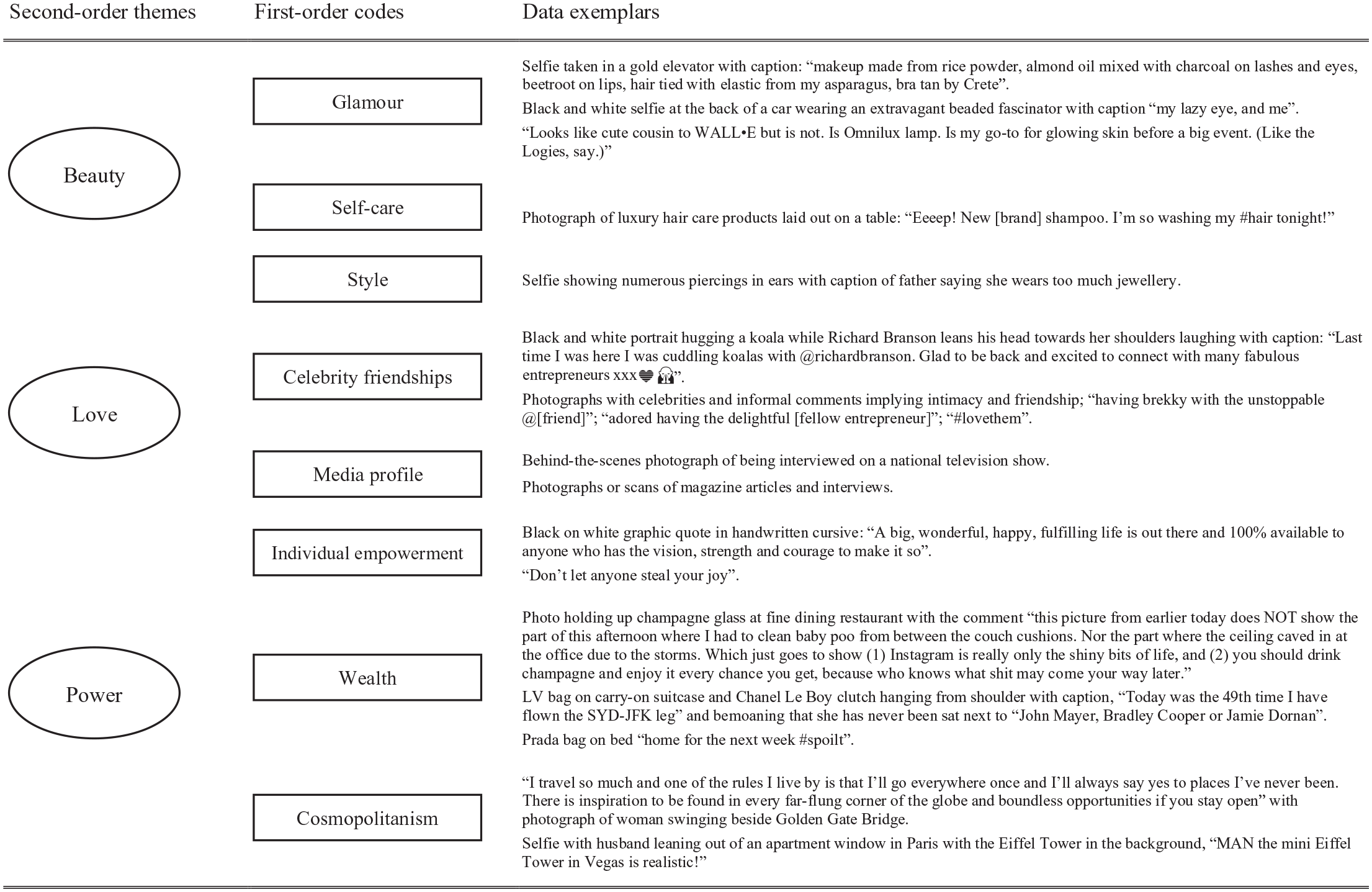
Our analysis examined the themes of the visual devices of the photographs and images posted as well as paying attention to the use of verbal devices (e.g. accompanying descriptions, hashtags and quotes). Akin to other visual methodologies (Brydges and Sjöholm, 2019; Rose, 2016; Tiidenberg, 2018), we considered these sources of meaning in relation to each other (e.g. how does this caption reinforce and/or contradict the image? How does this image relate to other images posted? How do visual and textual elements compare with other accounts?). Our approach considered technical and compositional strategies that shaped the meaning of the posts (e.g. lighting, camera angle, posture, facial expression) as well as the social discourses in which these strategies were bound up (Rose, 2016). By moving iteratively between the data and emergent constructs of identity performances, we identified eight first-order codes which included enactments of ‘glamour’, ‘self-care’, ‘style’, ‘celebrity friendships’, ‘media profile’, ‘individual empowerment’, ‘wealth’ and ‘cosmopolitanism’ (see Figure 1).
Data structure.
These emergent categories highlighted that in addition to the gendered construction of the entrepreneurs’ identities, visual and verbal devices were also shaped by discourses of race, class, sexuality and able-bodiedness. Examination of the intersectionality of women entrepreneurs’ identity performances (Agius Vallejo and Canizales, 2016; Essers and Benschop, 2009; Essers et al., 2010) led us to further aggregate and refine these codes into three second-order themes: beauty, love and power. Throughout the process of analysis, we checked our interpretations with one another to identify blind spots and consider alternate readings. Our data structure is presented in Figure 1.
Idealised femininity among entrepreneurs
Analysing the entrepreneurs’ identity performances from an intersectional and critical whiteness approach illuminated the ways each woman mobilised white, elite-class, able-bodied, and heteronormative privileges (Gill, 2008; Gill and Orgad, 2015; Ussher, 2006). These intersecting privileges enabled them to discursively instantiate an idealised feminine self on Instagram. Idealised femininity is a concept explored in feminist theorising that describes the hegemonic cultural scripts which women are often taught to perform (Ussher, 2006). In contemporary western cultures, these scripts include women as responsible, calm and controlled, physically attractive, confident and nurturing of others (Gill and Orgad, 2015; Ussher, 2006). The entrepreneurs’ performances of idealised femininity suggested complex, multilayered requirements involving both traditional regulation of appearance and deportment along with more extensive demands of how their performance translates across professional, personal and even interior lives (Gill, 2008). The contextualised renderings of idealised femininity among the entrepreneurs suggested the importance of intersecting privileges that are at times invisibilised in the gender and entrepreneurship literature (Martinez Dy et al., 2017).
In the following, we present three dimensions of identity performances that we found to be prominent in our data. While we offer these dimensions to illustrate the performances of idealised femininity by privileged women entrepreneurs, they should not be considered an exhaustive list of separate entities but were (re-)constituted flexibly across different contexts of meaning. At the core of our findings is, rather, that women entrepreneurs’ identity performances draw on idealised feminine discourses along with the mobilisation of socially constructed, dominant social positions. The three dimensions presented here illustrate how particular feminised selves (e.g. white, elite-class, heterosexual, able-bodied) are agentially crafted and made relatable.
Beautiful
Our findings suggest that the body image, appearance and demeanour of the entrepreneurs played a central role in the constitution of idealised femininity (Gill and Orgad, 2015). The identity performances emphasised conformity to traditional white patriarchal able-bodied beauty standards, which was epitomised in a plethora of digital self-portraits (or ‘selfies’) that depicted the entrepreneurs in glamorous makeup and outfits, thereby reflecting Instagram’s micro-celebrity culture (Duffy, 2017; Duffy and Hund, 2015; Marwick, 2015). In Figure 2, the photograph shows a close-up selfie of a health entrepreneur standing in the elevator of a hotel. Warm lighting and a metallic background cast a bronze glow over the image. The entrepreneur is wearing an asymmetrical dress that reveals a pronounced collarbone, but the viewer’s attention is drawn to her facial features. Her skin appears tanned and flawless; her eyebrows are feathered and arched; her eyelashes are long, dark and dramatic, enhanced by the way she has chosen to cast her eyes upwards rather than directly towards her audience so that the selfie almost looks candid; and her straight blonde hair is pulled back in a bun.

DIY glamour.
As a visual, this image may be seen as a manifestation of broader trends in digital culture where ‘an attractive body’ is leveraged as a ‘prop in the display of the consuming and entrepreneurial self’ (Petersson McIntyre, 2020: 63). Yet the entrepreneur’s verbal description of the scene lends a deeper layer of meaning: ‘makeup made from rice powder, almond oil mixed with charcoal (on lashes and eyes, also used to cover greys), beetroot on lips . . . Hair, tied in elastic from my asparagus’. She uses ironic contrast to reconcile her embodiment of the blonde, thin and tanned aesthetic ideal of Australian femininity (Deliovsky, 2008) with a down-to-earth, practical persona. In the presence of her evident beauty, her commentary satirises the elite-class status it conveys (using homemade makeup and an elastic band from her vegetables and leaving the party early). Notably, the professional accomplishments of the entrepreneur are never called into question (the post is about her being a finalist for a national entrepreneurship award), but the ‘confessional’ commentary invites the audience to relate to her on a more intimate level. Ultimately, the post enhances her status. Where her audience may assume that she would be professionally made up and styled for a function, she confesses that her look was in fact low-maintenance, and thus implies that her beauty is more ‘natural’. This strategy of tempering idealised beauty with a sense of ‘realness’ mirrors other findings in the literature suggesting that women entrepreneurs are required to enact ‘authentic’ feminised identities when promoting their business (Brydges and Sjöholm, 2019; Lewis, 2013; Marwick and Boyd, 2013).
Similarly, the entrepreneurs often tempered performances of beauty through expressions of humility (Baulch and Pramiyanti, 2018). In our sample, this tended to be accomplished by offering alternative representations that alluded to more ‘common’ roots (e.g. handling a lawn mower in their parent’s backyard or strolling through the Australian countryside). In this way, the entrepreneurs rendered themselves both more relatable to their audiences (Brydges and Sjöholm, 2019) and promoted the story that ‘anybody can make it from humble beginnings’.
For instance, the fashion entrepreneur featured in Figure 3 is well-known for regularly posting selfies taken through a full-length mirror that showcase her designer outfits and handbags. Through the use of these selfies, the audience is invited into the privacy of the entrepreneur’s bedroom. Here, the entrepreneur’s physical (self-)presentation and other luxury items (e.g. designer handbag, jewellery) stage a ‘glam life’ by leveraging the ‘aesthetics and language of commercial brands’ (Duffy and Hund, 2015: 6). Marwick (2013, 2015) refers to this practice as ‘aspirational production’ where social markers of wealth are emulated to gain the attention of followers and enhance online popularity, yet in this example (Figure 3) the entrepreneur poses in the context of a pub using the tagline:
Red carpets and marquees are great and all but I’m not going to lie to you. I’m a country girl and am, without a doubt, my best self in a dive bar . . . (Not entirely sure Dion Lee designed this frock for a pub pool hall. . .  ).
).

Country girl.
While elite-class identity performances appeal to the escapist desires of a wide followership, the entrepreneur additionally uses humour and satirical contrast to render her identity performance likeable and ‘within reach’. Nevertheless, the casual mention to her designer dress reminds followers of her glamorous style, hidden within a mischievous conjecture about the designer that constructs Dion Lee as a high-fashion figure ‘up there’, while positioning herself closer to her followers as a salt of the earth ‘country girl’ who would rather spend time at a pub than a celebrity function. Additionally, feminised markers (i.e. hunched shoulders, legs turned inwards, bright smile) render the representation more vulnerable and playful, thereby restoring the ‘symbolic order of gender’ (Bruni et al., 2004a).
Loved
The notion of being popular and loved constituted a second prevalent dimension in the entrepreneurs’ identity performances. This aspect was reflective of a more widespread ‘dual presence’ of masculinised and feminised spaces of signification (Bruni et al., 2004a). Women entrepreneurs were never solely ‘in charge’; rather, they were affirmed in their positions of power by their teams, friends, families and significant others.
Figure 4 shows a media entrepreneur posing beside Richard Branson while cuddling a koala. The photo shows closeness and friendship to a celebrity (and thereby, her own proximity to fame) (Marwick, 2015). Her caption explains that she has travelled to Noosa for a ‘speaking gig’. She highlights her popularity and influence in the industry but uses her location as a vehicle for reminiscence that enables her to repost an old photograph of her with Branson. Thus, by ‘aligning their personas with established celebrities’ (Duffy and Hund, 2015: 6), the entrepreneurs were able to enhance their social status and imply that they are ‘in demand’.

Celebrity friends.
Like with constructions of beauty, this dimension is rarely presented directly and on its own. Rather, constructions of the entrepreneurs’ popularity are feminised through discourses of gratitude. After the brief allusions to her upcoming lecture and celebrity friendship in this example, the entrepreneur quickly affirms that she is ‘glad to be back’ and ‘excited to connect with many fabulous entrepreneurs’ as well as thanking the host of the event for her invitation. In doing so, she positions herself on the same level as her followers, shining the limelight on the attendees of her lecture as ‘fabulous entrepreneurs’ in their own right. Thus, the entrepreneurs not only continuously and profusely thanked their followers for the support they had received – thereby conveying a sense of accessibility (Marwick, 2015) – but also constructed this as a form of mutual empowerment (e.g. ‘immense amounts of gratitude for the outpouring of love!! Thank you for supporting me to create more time and space to step further into my purpose. This is just the beginning. I’ve got you. Xx’).
Discourses of motherhood (Ekinsmyth, 2011, 2014) and heterosexual partnership (Petersson McIntyre, 2020; Tiidenberg, 2015) were also frequently drawn upon as discursive devices to strengthen idealised femininity among the entrepreneurs. Figure 5 offers an example of the many glimpses into the private world of the entrepreneurs that Instagram enabled. Notable here is the merging of private and business spheres in the entrepreneur’s identity performance that ‘blurs the boundary between the roles of “mother” and “businesswoman”’ and portrays perfect ‘work–life harmony’ (Ekinsmyth, 2011: 104). Here, the entrepreneur shares a photograph at her son’s birthday party where the delighted child is surrounded by his laughing parents. The commentary tempers this vision of domestic bliss with self-deprecating humour, suggesting that the couple had put up some ‘shitty decorations’, yet this harsh assessment contrasts with what appears to be a professionally managed and photographed event (the photographer is tagged in the caption). A number of studies have revealed the significant ‘aspirational’ labour and self-branding involved in producing digitally-enabled identity performances that appeal to social media followers (Brydges and Sjöholm, 2019; Duffy, 2016; Duffy and Hund, 2015; Marwick, 2015). Through constructs such as these, ‘the happy (biological) family’ emerges as another facet of the entrepreneurs’ identities, rather than an impediment to professional achievement within the constraints of masculinist enterprise discourse (Diaz Garcia and Welter, 2011).

Happy families.
The blending of the private and business spheres (Ekinsmyth, 2011) is further exemplified in Figure 6, which shows an entrepreneur travelling to a business conference with her infant. The entrepreneur’s smiling face, confident posture and commentary: ‘Getting it done, en route to [redacted] conference on Hamilton Island’ is followed by an enthusiastic audience response: ‘Bloody Wonder Woman! #bossmumma’; ‘Impressive’. In this way, the production of the postfeminist ideal of ‘having it all’ (Duffy and Hund, 2015) is animated and enabled by social media followers’ celebratory rhetoric (Banet-Weiser and Arzumanova, 2013).
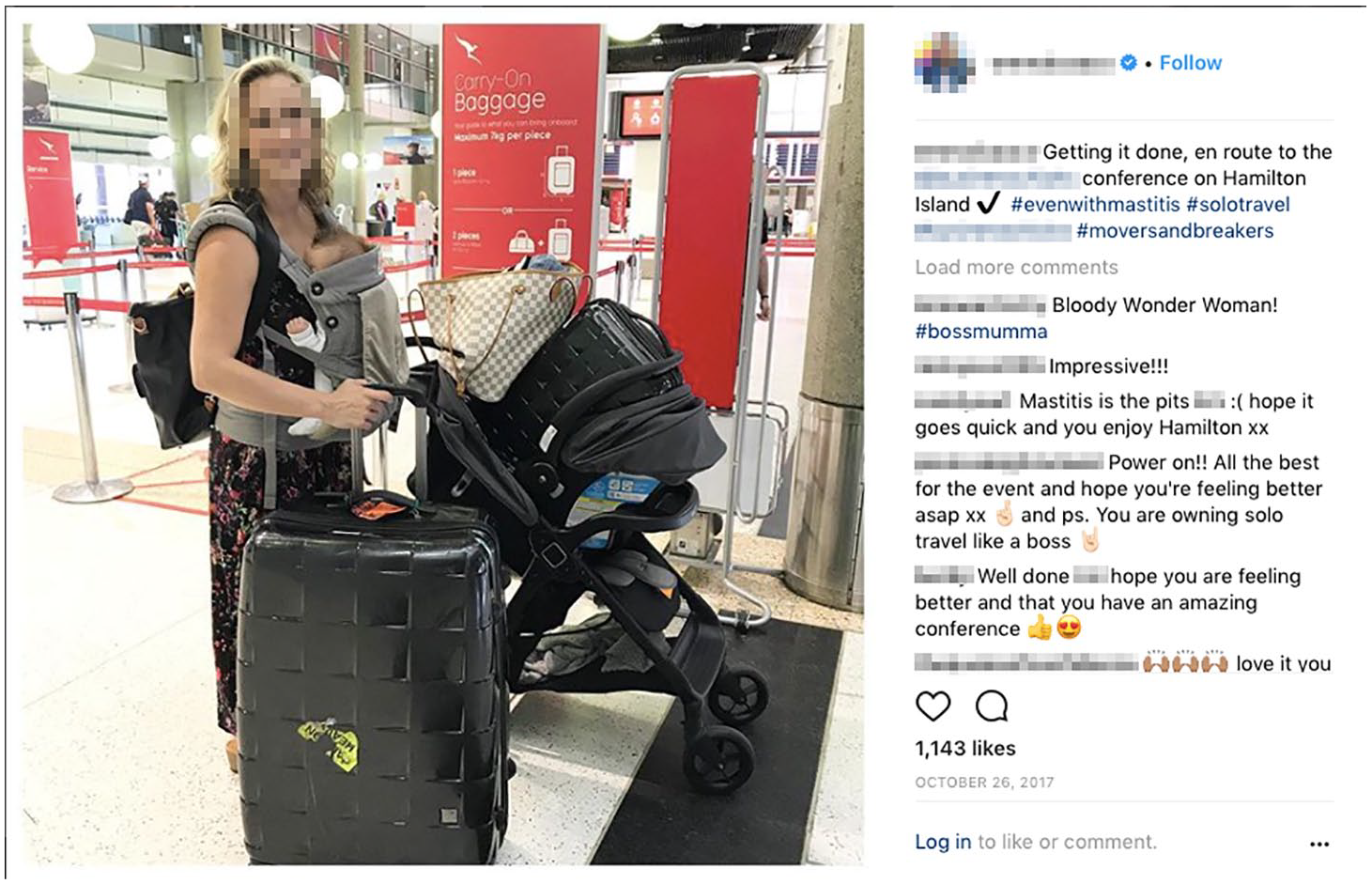
Wonder Woman.
The recurrent posting of travel pictures depicted many entrepreneurs as cosmopolitan business travellers and ‘globetrotters’. Whereas Figure 6 shows how entrepreneurs balanced an active family life with their businesses, Figure 7 portrays how the entrepreneurs highlight the more glamorous side of their travels. Here, the entrepreneur and her partner are dining against the spectacular backdrop of the Shanghai city skyline and appear to be toasting the viewer. She provides the commentary: ‘Blue Sky in Shanghai – this is a bigger deal than most would realise  #worthapicture’, which not only conveys her travels to a modern metropolis, but also models the privileges of a white heterosexual couple that enjoys great fortune at finding clear skies in an otherwise ‘dirty’ developing country (cf. Gill and Ganesh, 2007). Notably, the social and economic capital involved in accessing such privileges is downplayed by the natural intimacy of the scene, described aptly by Duffy (2016) as the ‘myth’ of authenticity.
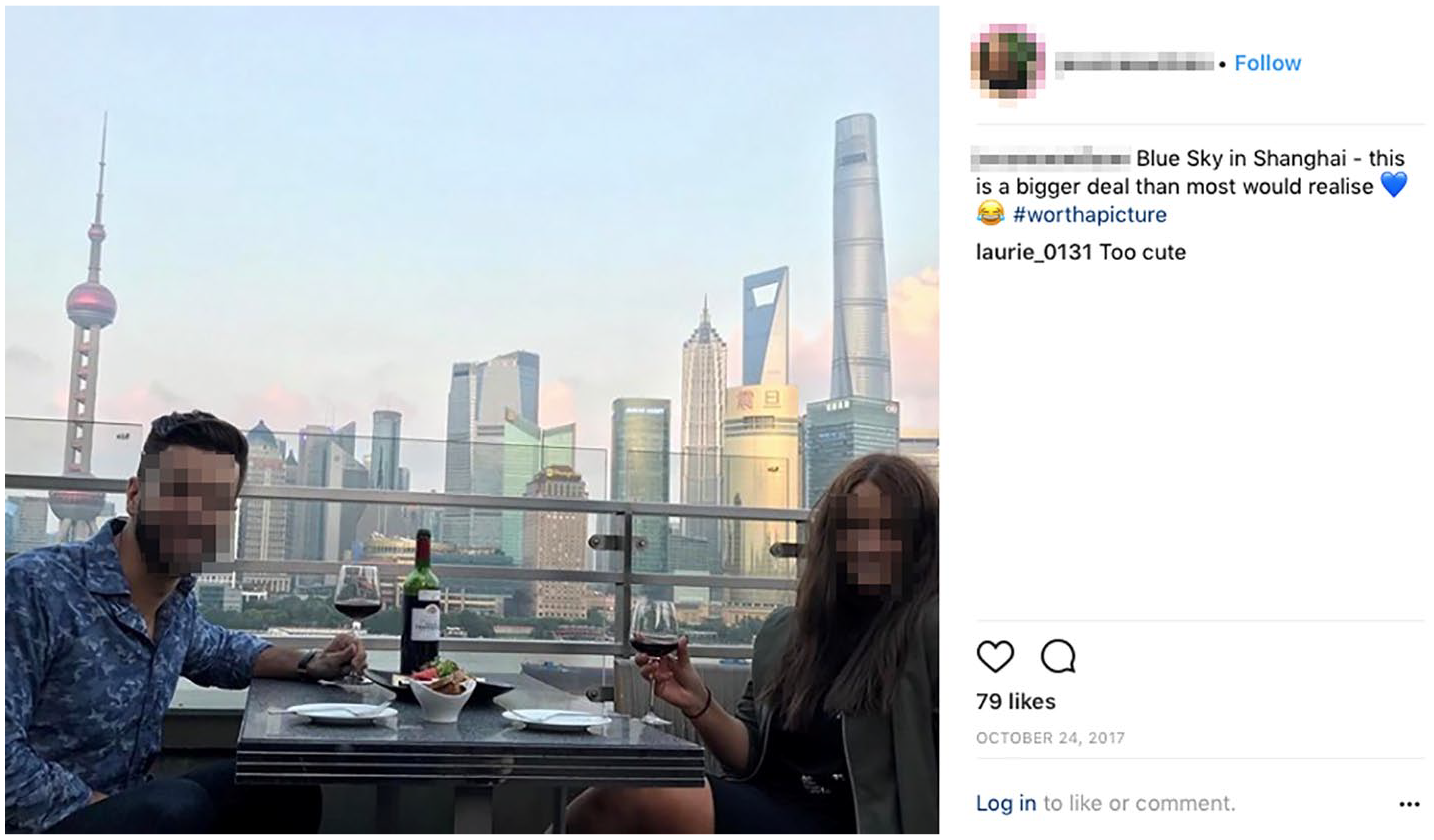
The globetrotter.
Powerful
The third dimension of identity was the construction of women entrepreneurs as powerful and prosperous. By posting motivational slogans and quotes, the entrepreneurs constituted themselves as bold (‘she was never quite ready. But she was brave. And the universe listens to brave’), proactive (‘I stopped waiting for a light at the end of the tunnel and lit that bitch up myself’), individualistic (‘there’s no competition when you’re manifesting your own lane’), resilient (‘the difference between winning and losing is most often, not quitting’) and optimistic (‘be that girl who wakes up with purpose and intent. Be that girl who believes anything is possible’). Visually, posts that showed the entrepreneurs exhibiting advanced yoga poses, joyful air jumps and other ableist ‘body maintenance activities’ (Brydges and Sjöholm, 2019; Clare, 2001; Kafer, 2003) supported a positive and energetic identity performance that was capable of extraordinary achievements (‘I can. I will. End of story.’). These representations were complemented by more explicit self-branding strategies (Duffy and Hund, 2015; Genz, 2015; Marwick, 2015), including photos at speaking events, television appearances, reposts of media coverage and posts of the entrepreneurs’ products (e.g. books, jewellery and cosmetics being the most common products featured). Collectively, these posts reproduced the entrenched association between the thin, muscular, able body with the ‘self-efficacy and self-control’ that is believed to lead to ‘both individual and collective success’ (Guthman, 2011: 53).
The entrepreneurs constituted themselves as empowered leaders in charge of their brands and destinies (‘throw me to the wolves and I’ll come back leading the pack’ and ‘she needed a hero so that’s what she became’). A characteristic of this construction of empowered women is a form of postfeminism (Gill, 2007b, 2016; Rottenberg, 2014) activated through posts of the entrepreneurs wearing T-shirts with feminist slogans and posts of feminine solidarity (e.g. ‘real queens fix each other’s crowns’ with the commentary ‘I so believe in lifting each other up. Feeling the #girlboss love this week’). These discourses of feminine empowerment (as a ‘girlboss’) primarily model neoliberal ideals of individual heroism (Adamson, 2017), but also entail a disciplinary function that attempts to define feminism as being about unconditional support for other women, particularly those aspiring to power (namely, themselves). The invocation of this postfeminist control (Gill, 2016; Lewis, 2014b; Rottenberg, 2014) in the context of social media can serve to shape followers’ behaviours, dictating that the terms of their engagement need to be about reverence and awe as opposed to debate and critique.
Another dominant discourse under the ‘powerful’ dimension was the construction of women entrepreneurs as role models for their followership. Their position of influence was achieved through various discursive strategies, including the use of positive rhetoric, developmental talk and motivational quotes (Figure 8). The key messages conveyed connect again with postfeminist discourses, highlighting the importance of ‘being oneself’ and ‘having confidence in one’s own path’ (Gill, 2007b). For instance, Figure 8 captures the image of a positive, confident and smiling entrepreneur, supported by a close-up, slightly low-angle shot and upward gaze that create the impression of a visionary at work. This is further underscored by the caption, ‘If you hang out with me long enough, I’ll brainwash you into believing in yourself and knowing you can achieve anything’, and the commentary, ‘Anything’s possible. Never forget that. You got this. Xxx. ’ The lexical choice of the term ‘brainwash’ renders the performance light-hearted and yet, at the same time, the post conveys a supreme confidence about the possibilities of individual transformation. In line with postfeminist discourses of empowerment, women are here presented as ‘autonomous agents no longer constrained by any inequalities or power imbalances’ (Gill, 2007b: 153).
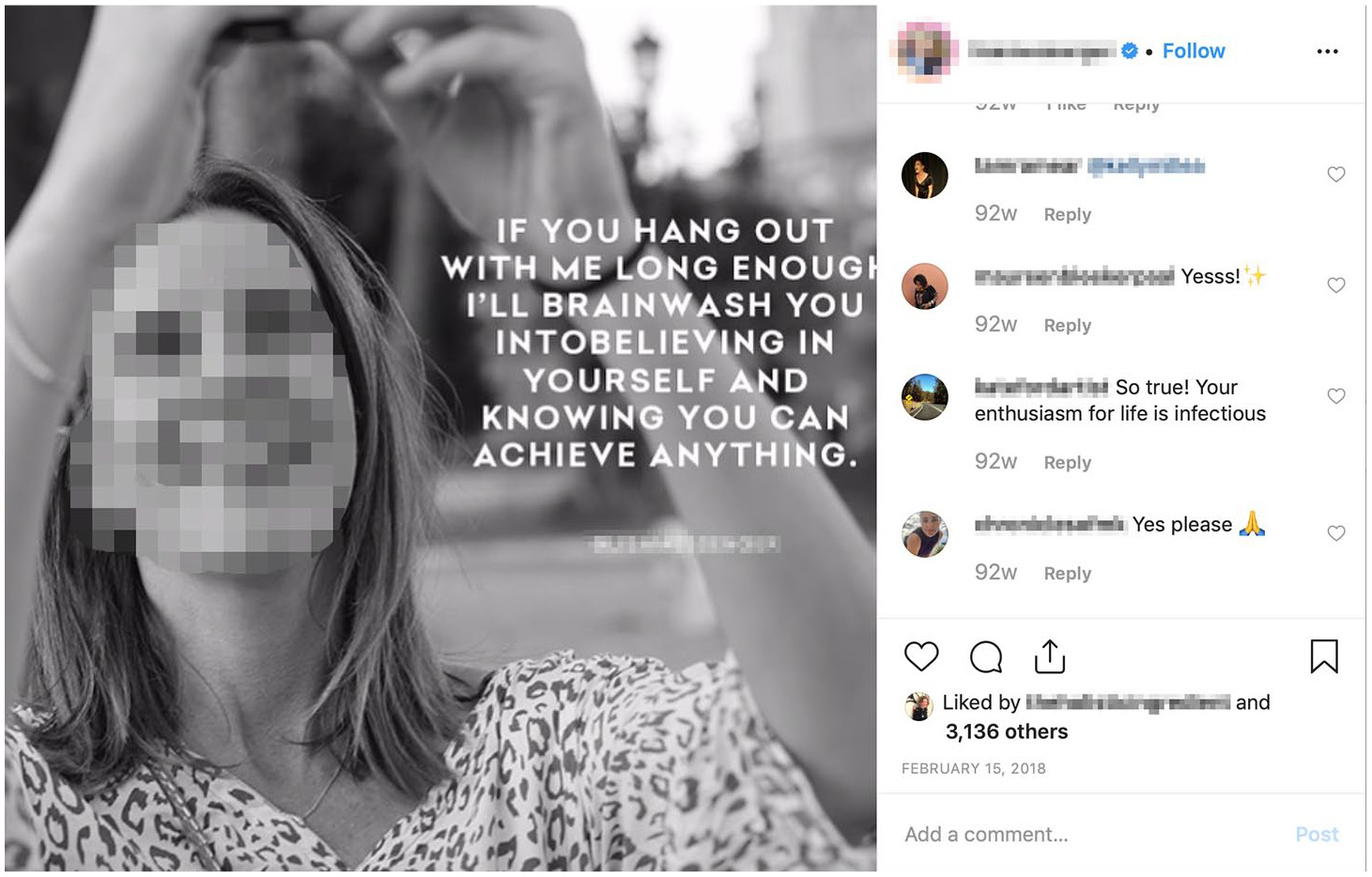
The visionary.
This aspect of the identity performances recalls the historical role of aristocratic women to model behaviour for women of the lower classes. In our data, the ‘powerful’ identity reflected how elite-class women are seen to be paragons of respectability, civility and morality in their communities (Bourdieu, 1984). As such, they played an instructive role, strengthened through the widespread use of motivational quotes that established the entrepreneurs as role models and mouthpieces of feminine empowerment. One image depicts the quote, ‘You have been assigned this mountain to show others it can be moved’, and pairs it with a commentary that strengthens the notion of the self-made, resilient and persevering entrepreneur:
Entrepreneurship is hard. Especially when you’re endeavouring into new playing fields. I’ve had an overwhelming number of people suggest ‘luck’ or whatever reasoning they can come up with is the reason for success. It’s not luck. It’s changing the schedule of your life and putting a vision of what you’re creating first, it’s making mistakes, it’s constantly learning . . . it’s the small wins and the big losses that create character which creates the ability to see opportunities that others might perceive as ‘luck’. All whilst regularly pushing through fear, uncertainty or general discomfort.
At the start of the post, the audience is reminded of the challenges that the ‘journey’ of entrepreneurship entails and the extraordinary heroic capabilities and strength that it requires. But as the post unfolds, the entrepreneur also admits to the feelings that the path exposes (‘all whilst regularly pushing through fear, uncertainty or general discomfort’), thereby engaging with discourses of vulnerability. This strategy of revealing multiple layers of the entrepreneurial experience was common across our data set and worked effectively towards reinforcing the entrepreneurs’ relatability (Brydges and Sjöholm, 2019) and authenticity (Genz, 2015; Lewis, 2013) in order to appeal to their followership.
Discussion
In this article, we have examined how highly privileged women entrepreneurs deploy visual and verbal discursive devices on the social media platform Instagram to perform idealised feminine selves. Extending previous studies that have emphasised the masculinist regulation of women entrepreneurs’ identity performances (Ahl and Marlow, 2012; Bruni et al., 2004a; Mirchandani, 1999; Stead, 2017), our findings highlight how the performances are characterised by feminised discourses that intersect with dominant social positions (Moreton-Robinson, 2020) around race, class, sexuality and able-bodiedness. This complex intersection, we suggest, results in the promotion of an idealised femininity that effectively appeals to wider neoliberal and postfeminist ideologies.
Our study makes three contributions to the critical entrepreneurship literature. Firstly, extant critical research of entrepreneurship has canvassed the subordination of women and femininities in entrepreneurial discourses and practice (Ahl, 2006; Bruni et al., 2004a, 2004b; Calás et al., 2009; Lewis, 2014a; Tedmanson and Essers, 2016). We show that women entrepreneurs with intersecting privileges are able to discursively achieve an idealised femininity by foregrounding constructs of beauty, love and power in their identity performances and presenting these dimensions in traditionally feminised ways. These discursive practices reflect what Bruni et al. (2004a: 424) have termed the ‘dialectical enactment of “ceremonial” and “remedial” work in the gendered construction of entrepreneurship’: the entrepreneurs visibly and forcefully celebrated their individual achievements, yet, their performances also removed any ‘gender threat’ (Ahl and Marlow, 2012: 546) by filtering their self-representations through feminised discourses of humility, gratitude and vulnerability. In this way, the identity performances of exemplarily beautiful, loved and powerful women retained humble, grateful and vulnerable characteristics that reproduced the constraints of patriarchal femininity.
An interesting aspect of this ‘appropriately feminised’ entrepreneurial identity (Lewis, 2013) is that the traditional separation of the public and private spheres in entrepreneurship did not need to be maintained. Indeed, whereas previous research has asserted that masculinist entrepreneurial discourses regulate women into suppressing their private roles as mothers and partners (Ahl and Marlow, 2012; Bruni et al., 2004a; Mirchandani, 1999; Stead, 2017), our data suggest that (at least, on social media) heteronormative discourses of motherhood and partnership are actively drawn upon to strengthen an idealised femininity. Here, the private sphere was not ‘expunged’ (Bruni et al., 2004b: 262), but actively celebrated in the entrepreneurs’ visual and verbal representations.
This form of identity performance counteracted the notion that women tend to ‘underperform’ because of their private obligations (Du Rietz and Henrekson, 2000). Rather, the entrepreneurs’ identity performances moved fluidly and continuously between the masculinised sphere of business and the feminised sphere of the private (e.g. ‘team/family’, ‘business travel/leisure travel’, ‘professional partners/life partners’, ‘leadership/motherhood’). That being said, the joint (self-)representations with partners, children and friends also connected with traditional notions of women as relational and caring (Ahl, 2006; Buttner, 2001), which enabled the social legitimisation of women entrepreneurs.
Fundamentally, the discursive constructions enabled identity performances that combined conventional characterisations of masculine ‘strengths’ such as boldness, resilience, proactivity, drive and individual heroism with feminine ‘strengths’ such as relationality, while leaving the demarcation of essentialist gender differences unchallenged (Ahl, 2006). Collectively, we suggest these hybrid enactments of masculinised and feminised ‘spaces of signification’ (Bruni et al., 2004a: 423) may play a key part in allowing the entrepreneurs to constitute themselves as role models and influencers to a (largely female) followership.
Secondly, our study’s findings contribute to critical studies of entrepreneurship that examine the powerful effects of entrepreneurial discourses in shaping and legitimising particular identity performances (Calás et al., 2009; Jones and Spicer, 2005; Ogbor, 2000; Tedmanson et al., 2012). Thus far, the limited research on women’s entrepreneurship has been shaped by assumptions of a ‘neutral’ socio-political context, while ‘the manner in which the phenomenon is gendered, racialised or affected by class position remains underexplored’ (Martinez Dy et al., 2017: 288).
In adopting an intersectional approach, we contribute to a more complex understanding of entrepreneurship by showing that not all femininities are subordinated equally. In the context of social media, women entrepreneurs are articulated in line with an idealised femininity that is white, elite-class, heterosexual and able-bodied. The markers of idealised femininity in our data (e.g. cosmopolitan travel, luxury lifestyle, being in demand, personal fame, active living, private fulfilment through heterosexual partnership and motherhood) evoked totalising fantasies of privilege across multiple areas of life. This ideal was combined with a neoliberal ethos that suggested this instantiation of entrepreneurship was available to all those who aspired to it, as long as they tapped into their own sources of individual determination, effort and resourcefulness (Ahl and Marlow, 2012).
In this way, other versions of femininities may be not only suppressed but also rendered less legitimate and desirable. Seen through this lens, the entrepreneurs’ adoption of a postfeminist sensibility appears more as a form of ‘window dressing’ that reduces feminism into a neoliberal notion of individual empowerment and material enrichment. What remained unacknowledged in the entrepreneurs’ Instagram posts were the systems of white supremacy, capitalism, heteronormativity, ableism (and ultimately even patriarchy) that their visual and verbal representations, both implicitly and explicitly, reinforced.
Our third and final contribution is a methodological one to the study of entrepreneurial identities by highlighting the insights that can be gained through social media analysis. Our study shows how multimodal discourse analysis can be valuably applied to examine the subtle ways visual and verbal texts interact (both complement and conflict) to assert dominant social positions under the guise of authentic self-expression. What we gained through our analysis was not only the privileged position of our sample of entrepreneurs to constitute themselves in ways that conformed to white, elite-class, heterosexual and able-bodied norms, but also how multimodal discursive practices at the micro-level give rise to the hegemony of these interlocking systems of power.
Our findings show how idealised femininity is crafted through multiple semiotic choices encompassing lighting, camera angle, posture, facial expression alongside verbal captions and emoticons that, collectively, produce situated performances of distinctive and ‘authentic’ identities (Genz, 2015; Lewis, 2013). Authentically-driven entrepreneurial identities were achieved in particular through satirical contrast between image and text, with the photographic portrait conveying a scene of professional and personal achievement (e.g. looking glamourous en route to an international meeting) that was subverted through verbal descriptions conveying humour, reflexivity and vulnerability (as seen in Figures 2, 3 and 5).
Limitations and future research
We focused on women entrepreneurs working in feminised industries (fashion, beauty, etc.), which is partly an effect of Instagram’s female-dominated users and its suitability as a medium for entrepreneurs to connect with their customer base (Duffy, 2017). Future research could explore other industry and national contexts, particularly those that may elicit a more diverse range of entrepreneurs.
We would like to thank one of our anonymous reviewers for pointing out that some of the most popular accounts on Instagram reveal racially and sexually diverse celebrities. Under capitalism, we can observe a growing trend where carefully cultivated differences can sometimes be commodified (Leong, 2012; Ward, 2003). Instagram thus offers a fascinating site where the reproduction and subversion of sociocultural norms play out with each other (Caldeira et al., 2018; Tiidenberg, 2015, 2018) and future research could investigate these processes through the public profiles of people of colour, LGBTQIA+ people, working-class and disabled people. Indeed, white femininity is not essentialised within white women, so other entrepreneurs who do not identify as white or female may still provide interesting insights into the performances of idealised femininity (Liu, 2020). For example, future research could explore how entrepreneurs who identify as men may perform femininity and the effects of this gendered identity performance.
A further limitation is that our study focused on the multi-modal discursive practices of the entrepreneurs without empirically considering the social interactivity among entrepreneurs and their followers. Future research on entrepreneurs’ identity performances in social media could thus extend our theoretical framework to study how the social interactions between entrepreneurs and their followers co-construct idealised femininity.
Conclusion
We contribute to the critical entrepreneurship and identity literatures by making visible how idealised femininity in enterprise culture is the result of identity performances that leverage intersectional power in ways that may obscure the perpetuation of systemic and structural oppression. Our analysis shows how the entrepreneurs’ identity performances enact expressions of idealised femininity that work to privilege versions of women’s entrepreneurship steeped in neoliberal and postfeminist ideologies. The idealisation of white, elite-class, heterosexual and able-bodied feminine selves through the entrepreneurs’ Instagram accounts simultaneously reflects the entrenched and persistent marginalisation of non-white, working class, queer and disabled people in our society. More broadly, it also signals the growing invisibility of those who reject capitalism and its ongoing production of entrepreneurial selves.
Footnotes
Funding
The authors received no financial support for the research, authorship and/or publication of this article.
