




Abstract
Does top management team (TMT) regulatory focus impact firm environmental misconduct (FEM)? If so, how and when? Integrating upper echelons theory with regulatory focus theory, we examine how regulatory focus, as one of the most direct and important psychological characteristics of TMT, impacts FEM. Additionally, we explore how this relationship is moderated by external and internal environmental dynamism from the perspective of regulatory fit. Based on a sample of Chinese listed firms from 2011 to 2017, we conduct computer-aided content analysis to quantify TMT regulatory focus. Results show that TMTs high in promotion focus are more likely to engage in FEM, whereas TMTs high in prevention focus are less likely to misconduct. Moreover, external environmental dynamism strengthens (weakens) the positive (negative) relationship between promotion (prevention) focus and FEM. Internal environmental dynamism strengthens the positive relationship between TMT promotion focus and FEM. By examining this motivation-based psychological characteristic of TMT, the findings suggest the need to consider TMT regulatory focus when analyzing the antecedents of FEM.
Keywords
Introduction
Certain factors, values, and changes shared among top management team members are better predictors of organizational outcomes than those elements in CEOs considered singularly. (Daily and Schwenk, 1996: 188)
Firm environmental misconduct (FEM) events arouse global attention from scholars and managers (Flammer, 2013). For example, to pursue the goals of growth and saving costs, the top management team (TMT) of Volkswagen repeatedly took the risks of rejecting proposals to upgrade auto emission controls, thus leading to an FEM accident (Lian et al., 2020). FEM refers to firm environmental behaviors that are judged by a social-control agent to cross a line separating right from wrong (Greve et al., 2010). Although FEM may help firms save costs and solve immediate problems in the short term, it not only endangers ecosystems and public health but also incurs huge losses (e.g. reputation and legitimacy damage) for firms (Flammer, 2013; Lee and Xiao, 2020). Firms engaging in FEM face serious punishment. 1 However, FEM events remain frequently reported. Then, why do firms engage in FEM?
Some scholars have explored the antecedents of FEM from the perspective of external factors, such as government and media (Marquis and Bird, 2018; Tang and Tang, 2016). Other scholars have focused on internal factors, particularly top managers’ demographic and psychological characteristics, based on the perspective that ‘FEM is generally a reflection of top managers’ (Salaiz et al., 2020). Top managers often work in teams instead of working alone, and they make common goals for firms together. They discuss, coordinate, acquiesce, and shoulder the primary responsibility for misconduct behaviors, including FEM (Khanna et al., 2015), especially when they have great motivation to achieve goals (Gino and Margolis, 2011; Zhang and Jia, 2013). Thus, upper echelons theory (Hambrick, 2007: 334) suggests that ‘the characteristics of the TMT will yield stronger explanations of organizational outcomes than will the customary focus on the individual top executive (CEO) alone’. Early studies have focused on how FEM can be predicted by TMT demographic traits (Salaiz et al., 2020). Nonetheless, demographic traits cannot fully explain actual psychological and social processes that drive FEM (Hambrick, 2007). Hence, scholars on strategic leadership have repeatedly called for incorporating top managers’ psychological traits into firm environmental research (Salaiz et al., 2020; Zhang et al., 2020a) because these traits help open the black box between demographic traits and firm behaviors (Hambrick, 2007). Particularly, motivation-based psychological traits are found to have the most direct and powerful effect on behaviors (Gamache et al., 2015), especially those related to misconduct (Gino and Margolis, 2011). Motivational traits (e.g. regulatory focus) directly reflect teams’ strategic inclination toward achieving goals instead of capturing more general dispositions; these traits usually serve as the outcomes of personality (e.g. big five personality) and self-concept (e.g. hubris) (Gamache et al., 2015; Gino and Margolis, 2011). Hence, the motivation-based psychological traits of TMT may have great potential to predict FEM. However, to the best of our knowledge, limited attention has been paid to this question.
In this study, we seek to explore how FEM can be predicted by a key motivational trait—regulatory focus of TMT. Regulatory focus theory (RFT) proposes two motivational systems (Higgins, 1997, 1998), explaining how individuals/teams view their goals, employ strategies (eagerness vs vigilance), and take tactics (risk-seeking vs risk-averse) to achieve goals through promotion focus and prevention focus (Scholer and Higgins, 2008). Regulatory focus can be chronic or situationally induced, and it is applied to multilevel phenomena (Higgins and Pinelli, 2020). When people are in a team, they may behave differently from how they act as individuals to achieve goals (Faddegon et al., 2008). Through interactions, team members create a shared understanding of their values to regulate behaviors to achieve collective goals by promotion or prevention focus, which is called collective regulatory focus (Faddegon et al., 2008). Particularly, the leadership of a firm is a shared activity. TMTs coordinate the direction, intensity, and persistence of efforts to achieve firm goals, and set the tone for promotion or prevention focus to affect firm phenomena (Johnson et al., 2015). Thus, scholars on strategic leadership have extended collective regulatory focus to management teams, and they have examined its effect on the bright side of firm behaviors, such as new product innovation (Spanjol et al., 2011) and firm innovation (Tuncdogan et al., 2017). Unfortunately, this field almost ignores the role of TMT regulatory focus on the dark side of firm behaviors, such as FEM. Exploring this question is vital because motivation serves as a dominant factor leading to firm misconduct, and TMT regulatory focus may play an important role in impacting FEM (Gino and Margolis, 2011). Moreover, FEM involves risk and eagerness, which relates to the nature of TMT regulatory focus. Also, scholars call for research to explore the effect of TMT regulatory focus on misconduct like FEM (Baron et al., 2018). If such effect exists, how and when does TMT regulatory focus impact firms’ engagement in environmental misconduct?
To answer the ‘how’ question, we integrate upper echelons theory with RFT to unveil the black box between TMT regulatory focus and FEM. Specifically, drawing on RFT (Higgins, 1997, 1998), teams with different regulatory focus may employ distinct strategies (eagerness vs vigilance) and take varying tactics (risk-seeking vs risk-averse), which may lead to diverse behaviors (Higgins and Pinelli, 2020; Scholer and Higgins, 2008). We apply this perspective to the firm context. On the basis of RFT (Higgins, 1997, 1998), as well as upper echelons theory (Hambrick, 2007), which posits that psychological traits of TMT considerably affect firm behaviors, we propose that TMTs high in promotion focus are likely to engage in FEM—a typical eager problem-solving and risky behavior (Flammer, 2013; Xu et al., 2019). By contrast, TMTs high in prevention focus are less likely to engage in FEM.
To answer the ‘when’ question, we ground in RFT to explore the contingent factors between TMT regulatory focus and FEM. According to regulatory fit (Ahmadi et al., 2017; Gamache et al., 2015; Higgins, 2000), the effects of promotion and prevention focus are strengthened when a fit between regulatory focus and the characteristics of operating environment exists. Firms are operating in connection with external and internal environment (Tang et al., 2015), thus, we attempt to investigate the contingent factors by considering the moderating roles of external and internal environmental dynamism. Based on these arguments, we empirically examine hypotheses using a longitudinal empirical analysis of Chinese listed firms in pollution industries, which provides us with a comprehensive research setting to test the direct effects and environmental dynamism boundaries of TMT regulatory focus on FEM.
Our research contributes to the literature on FEM, upper echelons theory and RFT in three ways. First, from the lens of strategic leaders’ motivation-based psychological micro-foundation, we enrich FEM literature by first linking TMT regulatory focus to FEM studies. Second, different from previous upper echelons research on the psychological traits of CEO, we enrich upper echelons research on top managers psychological orientations by exploring collective regulatory focus of TMT, whose predictive power on firm behaviors is higher than that of the CEO (Hambrick, 2007). Moreover, we echo the call by Johnson et al. (2015) to rely on computer-aided content analysis to capture TMT regulatory focus with the help of modern developed technical equipment. Third, we broaden RFT by extending collective regulatory focus to the upper echelons level, particularly the TMT level, to explain the relationship between TMT regulatory focus and FEM (the dark side of firm behaviors). We also explore its boundary conditions by shedding light on external and internal environmental dynamism altogether.
Theory and hypotheses development
RFT
RFT (Higgins, 1997, 1998) is a motivational theory explaining how individuals/teams self-regulate behaviors to achieve goals through two regulatory foci: promotion focus and prevention focus, which are represented by approaching positive outcomes and avoiding negative outcomes. Promotion focus and prevention focus are orthogonal rather than the two ends of a continuum (Johnson et al., 2015). For example, an individual (or a team) can exhibit high (collective) promotion and (collective) prevention focus simultaneously, only one focus, or neither focus (Shin et al., 2014). Regulatory focus can be chronic orientation or temporary situationally induced (Higgins and Pinelli, 2020). Not only an individual but also collective bodies such as teams can have regulatory focus, which is called collective regulatory focus (Faddegon et al., 2008). Collective regulatory focus means by interacting with one another, team members create a shared understanding of the needs and values of the team to regulate behaviors to achieve collective goals by promotion/prevention focus (Johnson et al., 2015).
Collective regulatory focus shares similar consequences with individual regulatory focus (Johnson et al., 2015). Generally, collective regulatory focus operates at three independent levels: system level (goal for growth vs safety), strategic level (eagerness vs vigilance), and tactical level (risk-seeking vs risk-averse) (Scholer and Higgins, 2008). Specifically, first, the system level closely maps the motivational goals or desired end-state preferences of teams. Promotion focus is concerned with the desired end-state of growth (improving the status quo ‘0’ to a better state ‘1’), such as the attainment of aspirations, advancement, and accomplishments (Higgins and Pinelli, 2020). Conversely, prevention focus deals with the desired end-state of security (maintaining the status quo ‘0’ against a worse state ‘–1’), such as attaining safety, stability, responsibilities, and avoiding dangers (Higgins and Pinelli, 2020). Second, the strategic level emphasizes the general means for goal pursuit in each regulatory focus such that teams high in promotion focus prefer eagerness strategies (moving toward the desired end-state by approaching matches to it) because of the goals for growth and achievements (Spanjol et al., 2011). While teams high in prevention focus prefer vigilant strategies (moving toward the desired end-state by avoiding mismatches to it) owing to their goals for safety (Spanjol et al., 2011). Third, given the differences in system levels, teams with different regulatory focus show distinctions at the tactical level. Teams high in promotion focus usually choose a risky option, whereas teams high in prevention focus choose a conservative option (Tuncdogan et al., 2017). In summary, the system level refers to ‘why’ teams do what they do (goals), and the strategic and tactical levels describe ‘how’ teams achieve goals (Kark and Van Dijk, 2019).
Strategic leadership scholars study how CEO regulatory focus impacts firm behaviors and recently extend regulatory focus from CEO level to TMT level (Johnson et al., 2015). Specifically, based on a new product decision-making experiment with undergraduate seniors, Spanjol et al. (2011) posit that when promotion focus is prevalent in a TMT, members employ eagerness strategies by showing preference to introduce new products, and do so quickly, whereas when prevention focus is evoked in a TMT, members prefer vigilance strategies. Similarly, based on a survey of 748 managers of a firm, Tuncdogan et al. (2017) find that management team’s use of decentralization and connectedness mediates the relationship between TMT regulatory focus and organizational exploratory innovation. However, both studies focus on the bright side of firm behaviors and neglect the dark effect of TMT regulatory focus. As such, we seek to extend this line of research by linking TMT regulatory focus to one typical dark side of firm behaviors—FEM. In Table S1 in the supplemental material, we summarize the three levels of regulatory focus. In Table S2 in the supplement material, we review and summarize relative empirical studies.
TMT regulatory focus and FEM
As the ‘makers of meaning’, top management members frame goals for firms and influence the type of regulatory focus that emerges among the TMT (Johnson et al., 2015). Through interaction, social comparison, embodying the identity of the team, and emotional and social contagion, the differences in system level (goal for growth vs safety) will lead TMTs with different regulatory focus to employ diverse strategies (eagerness vs vigilance) and take varying tactics (risk-taking vs risk-averse), which in turn significantly impact firm behaviors (Kark and Van Dijk, 2019). Considering that the implementation of firm environmental behaviors require the TMT’s insights in budgeting, feasibility, and deliverables (Reimer et al., 2018), we propose that TMT regulatory focus may play an important role in FEM.
First, at the strategic level, owing to the goals for growth such as achievements, accomplishments, and aspirations, TMT promotion focus usually concerns eagerness strategies (e.g. accomplish tasks quickly) (Spanjol et al., 2011). In general, promotion focus tends to make teams view situations as opportunities (Higgins and Pinelli, 2020). Based on the belief that ‘missing opportunities is far worse than making mistakes’, TMTs with high promotion focus prefer eagerness strategies to explore new opportunities quickly to maximize achievements or ‘hits’ (Owens and Hekman, 2016). Particularly, to avoid missing opportunities, they prefer strategies that can solve problems immediately and may not pay much attention to details and waste time waiting (Spanjol et al., 2011). Conversely, owing to the goals for safety, a strong prevention focus emphasizes responsibility, accuracy, and quality over quantity (Owens and Hekman, 2016). When a collective prevention focus is evoked in a TMT, members are afraid of making mistakes and prefer to engage in vigilance strategies (e.g. avoid errors) (Spanjol et al., 2011). Indeed, they rather miss opportunities than make mistakes. Hence, TMTs high in prevention focus usually spend extra time with increased accuracy and quality to avoid mistakes (Shin et al., 2014; Tumasjan and Braun, 2012). Given that FEM is a quick strategy that may solve immediate problems and improve performance in the short term, but it causes considerable damages to society as well as firms (Flammer, 2013; Xu et al., 2019). For example, according to the report on British Petroleum (BP) oil spill event, in pursuit of growth and profits, BP repeatedly engaged in eagerness strategies such as cutting corners to save time and improve performance in a short time, which led to the notorious FEM event. 2 When considering FEM, the goals for growth may lead TMTs high in promotion focus to employ eagerness strategies by identifying FEM opportunities quickly and minimizing errors of omission. To the contrary, the goals for safety may lead TMTs high in prevention focus to engage in vigilance strategies by missing FEM opportunities instead of making mistakes.
Second, at the tactical level, similarly, given the goals for growth, TMTs high in promotion focus are inclined to adopt risk-taking tactics and give more weight on potential gains rather than losses when making decisions (Spanjol et al., 2011). By contrast, TMTs high in prevention focus are risk-averse owing to the goals for safety, and they pay much attention to losses rather than gains and create a sense of security by adhering to rules and conventional routines (Tuncdogan et al., 2017). FEM is a typical risky behavior that may bring potential profits for firms; however, it can also lead to huge losses (e.g. reputation losses and fines) and cost much to repair such damages if caught (Flammer, 2013). For example, after the emission testing scandal broke out, Volkswagen suffered from a huge sales crash in 2015. Volkswagen was forced to pay more than €25b in fines and settlements in the United States since 2015. 3 As a result, the goals for growth may lead TMTs high in promotion focus to concentrate more on the potential profits of FEM and engage in risky tactics such as FEM. Conversely, the goals for safety may lead TMTs high in prevention focus to be sensitive to the cost of FEM and show less tendency toward misconduct. Thus, we put forward the following hypotheses:
Hypothesis 1a: TMT promotion focus will be positively related to FEM.
Hypothesis 1b: TMT prevention focus will be negatively related to FEM.
The moderating role of environmental dynamism
If TMT regulatory focus is related to FEM, the next question is, what factors set the boundary conditions for this effect? Although it is challenging to directly measure the mechanisms (eagerness vs vigilance; risk-seeking vs risk-averse) of TMT regulatory focus on FEM, it’s possible to identify factors that may strengthen or weaken the mechanisms (Tang et al., 2015). RFT (Higgins, 2000) posits that regulatory focus is malleable and can be shaped by situational factors. In the firm context, a key situational factor is environmental dynamism, which refers the extent to which a firm is faced with an unpredictable, unstable, and uncertain environment (Dess and Beard, 1984). Firms are connected with external (e.g. industry-level) and internal environment (e.g. firm-level), which play important roles in the effect of top managers on firm behaviors (Tang et al., 2015). Thus, we expect external and internal environmental dynamism will moderate the relationship between TMT regulatory focus and FEM.
The moderating role of external environmental dynamism
External environmental dynamism captures the uncertainty, unpredictability, and the rate of change in the industry where a firm operates, which is characterized by eagerness and high risk (Dess and Beard, 1984). For example, external environmental dynamism increases the ambiguity of information and leads firms to face rapid changes in regulations, competitors, customers, and industry innovation (Engelen et al., 2015). Such an environment not only requires TMTs to employ eagerness strategies to take actions swiftly but also leads them to face high risks in making the right decisions (Hmieleski and Baron, 2008).
According to regulatory fit (Gamache et al., 2015; Higgins, 2000), ‘when the traits of the situational factors are congruent with regulatory focus orientation, regulatory fit phenomenon occurs’ (Ahmadi et al., 2017: 214). 4 Under the condition of regulatory fit, team members feel motivationally activated and ‘feel right’ about what they intend to do (Higgins, 2000). Conversely, when mismatch occurs, members experience weakened motivational strength. In our context, drawing upon regulatory fit (Ahmadi et al., 2017; Gamache et al., 2015; Higgins, 2000), TMTs will feel motivationally activated to pursue goals when they find themselves in an external environment, whose traits fit their regulatory focus. For TMTs high in promotion focus, they may feel motivational activated under condition of high external environmental dynamism. The rapid-changing and risky nature of external environmental dynamism align with their eagerness strategy and risky tactic, and thus, they may engage in more FEM. Specifically, first, the eagerness strategy of promotion focus fits with the eagerness nature of external environmental dynamism. For example, adapting and reacting swiftly is imperative in the absence of external environmental dynamism because previously developed resources, capabilities, and routines may not take effect (Hmieleski and Baron, 2008). In this respect, the eagerness trait of external environmental dynamism will push TMTs high in promotion focus to act quickly and not to miss the FEM opportunities. Second, the risky tactics concerning promotion focus matches the risky trait of external environmental dynamism, which is characterized by high risks because uncertain market demands and unpredictable success probabilities of tasks exist (Engelen et al., 2015). In such an environment, TMTs high in promotion focus feel motivationally activated, thereby increasing engagement in risky behaviors such as FEM. In summary, according to regulatory fit (Ahmadi et al., 2017; Gamache et al., 2015; Higgins, 2000), when faced with high external environmental dynamism, TMTs high in promotion focus will be more motivated to take increasingly eager and risky methods such as FEM.
Conversely, for TMTs high in prevention focus, the eagerness and risk nature of external environmental dynamism are at odds with their vigilance and risk-averse focus, which in turn decreases motivation to avoid FEM. Specifically, first, vigilance strategy, as an inclination of prevention focus, is not aligned with the eagerness nature of external environmental dynamism, thereby serving as a countering force for TMTs high in prevention focus. Their motivation to employ vigilance strategies, such as avoiding FEM, will be decreased. Second, the risk-averse tactic of prevention focus does not fit with the risky nature of external environmental dynamism. This inconsistency leads TMTs high in prevention focus to experience decreased motivation and weakens resistance to risk-taking behaviors such as FEM. Grounded in RFT (Ahmadi et al., 2017; Gamache et al., 2015; Higgins, 2000), for TMTs high in prevention focus, external environmental dynamism reduces their engagement in vigilant and risk-averse actions such as avoiding FEM. Therefore, this logic leads us to the following hypotheses:
H2a: The positive relationship between TMT promotion focus and FEM is moderated by external environmental dynamism, such that the relationship is stronger when external environmental dynamism is high.
H2b: The negative relationship between TMT prevention focus and FEM is moderated by external environmental dynamism, such that the relationship is weaker when external environmental dynamism is high.
The moderating role of internal environmental dynamism
TMTs not only pay attention to external environment but also concentrate on internal environment such as firm financial outcomes (Adams et al., 2005). Internal environmental dynamism describes the instability of performance or income across time periods, thereby generating high risks and pressures for managers to employ eagerness strategies (Dess and Beard, 1984; Pearce and Patel, 2018). Particularly, TMTs are concerned with internal environmental dynamism, which is highly related to their vocational development and firm future (Pearce and Patel, 2018).
Drawing upon regulatory fit (Ahmadi et al., 2017; Gamache et al., 2015; Higgins, 2000), TMTs will feel motivationally activated to pursue goals when there is a fit between the type of their regulatory focus (promotion/prevention focus) and the characteristics of internal environmental dynamism. For TMTs high in promotion focus, the eagerness and risk-oriented nature of internal environmental dynamism are consistent with their eagerness strategy and risk-taking tactic. This consistency may sensitize them to engage in increased FEM. Specifically, first, the eagerness strategy of promotion focus is consistent with the eagerness nature of internal environmental dynamism. In the presence of internal environmental dynamism, TMT’s ability will be doubted by critical stakeholders (Fu et al., 2017; Pearce and Patel, 2018). To gain support, TMTs may be myopic and engage in eagerness strategies, which helps solve immediate problems (Fu et al., 2017). Thus, the eager trait of internal environmental dynamism leads TMTs high in promotion focus to increase motivation to employ eagerness strategies such as FEM. Second, the risk-seeking characteristic of promotion focus fits with the risky nature of internal environmental dynamism. Internal environmental dynamism is a key source of risks, which not only leads firms to experience performance (e.g. cash flow and income) uncertainty, but also significantly generates risks from stakeholders such as suppliers and employees (Miller and Chen, 2004; Pearce and Patel, 2018). In such an environment, TMTs high in promotion focus may feel motivationally activated and increase engagement in risky behaviors such as FEM. To sum up, according to RFT (Ahmadi et al., 2017; Gamache et al., 2015; Higgins, 2000), internal environmental dynamism is a reinforcing element for TMTs high in promotion focus, which motivates them to take eager and risky actions such as FEM.
However, for TMTs high in prevention focus, the vigilance strategy and risk-averse tactic go against the eager and risky traits of internal environmental dynamism. This inconsistency may decrease motivation to avoid FEM. Thus, we put forward the following hypotheses:
H3a: The positive relationship between TMT promotion focus and FEM is moderated by internal environmental dynamism, such that the relationship is stronger when internal environmental dynamism is high.
H3b: The negative relationship between TMT prevention focus and FEM is moderated by internal environmental dynamism, such that the relationship is weaker when internal environmental dynamism is high.
Research design and methodology
Data and sample collection
We construct a longitudinal dataset consisting of Chinese A-share listed firms in pollution industries from 2011 to 2017. China offers rich grounds to test our model. During the past few decades, China has enjoyed rapid economic growth at the expense of environmental sustainability. As the world’s factory, Chinese firms are under severe environmental pressure, so studying factors affecting FEM is urgent. Following prior research on FEM (Jia et al., 2016; Tang and Tang, 2016), we focus on firms in pollution industries for two reasons. First, firms in pollution industries are the primary source of toxic pollutants, and these firms are under similar external pressure, providing us with a good way to analyze the distinct response of FEM across firms (Jia et al., 2016). Second, China is at an initial stage of the disclosure of firm environmental information, and FEM of pollution industries is relatively authoritative and complete since 2011. 5 In this way, we can have a longitudinal research of Chinese FEM.
We employ multiple sources to construct our dataset. First, following Tang and Tang (2016), we manually collect information on FEM from the Institute of Public and Environmental Affairs (IPE). 6 IPE is the relatively authoritative and thorough database providing FEM information in China, and it is used by prior research to study Chinese firm FEM (e.g. Jia et al., 2016; Tang and Tang, 2016; Zhang et al., 2020a). Ministry of Environmental Protection issues detailed guidelines and laws to restrict FEM. Local Ministry of Environmental Protection will expose FEM records online if firms are detected. IPE, which is a Chinese nonprofit organization, collects and discloses FEM records through real-time monitoring and publishes them on IPE website. Second, similar to Nadkarni et al. (2016), we use Management Discussion and Analysis (MD&A) in annual reports to collect information on TMT regulatory focus. Third, external and internal environmental dynamism information is obtained from the China Statistical Yearbook and the China Stock Market and Accounting Research (CSMAR) database, respectively. Fourth, we hand-collect religion information via Chinadataonline.org, a website operated by the University of Michigan (Jia et al., 2019). We obtain corporate social responsibility (CSR) information from an independent rating agency—Rankins CSR Ratings. Other financial data and corporate governance information are obtained from CSMAR, Wind database, China Environment Yearbooks, and firm annual reports.
During data analyses, we exclude observations missing key explanatory variables and winsorize the top and bottom 1% of each variable to control the influence of extreme observations. After deleting missing variables, we obtain an unbalanced panel dataset of 5947 firm-year observations, within which there are 1322 FEM records. The distribution of the FEM records of firms are presented by industry and year in Table 1.
FEM sample distribution by industry and year.

This table shows the FEM record settled by industry and year, and only firms that engage in pollution are included.
Measures
Dependent variable
According to the definition, FEM is judged by a social-control agent to be wrong (Greve et al., 2010). As a nonprofit organization in China, IPE discloses FEM records such as misconducting firms, time, location, event, and affiliated firms detected by Ministry of Environmental Protection. However, FEM information disclosure is at an early stage in China, and complete information such as misconduct types and patterns are not available (Tang and Tang, 2016). Thus, following prior research on FEM (Lee and Xiao, 2020; Tang and Tang, 2016) and firm financial misconduct (Zorn et al., 2017), we conduct a binary variable to measure FEM. A firm that is reported by IPE to engage in FEM in the year equals 1; 0, otherwise. To further consider the degree of FEM, we consider FEM frequency during one year in the robustness checks.
Independent variables
TMT regulatory focus is measured by content analysis of MD&A in the annual reports 7 . Given that text and language are the reflection of individuals’ understanding of the cognition process and their surroundings, content analysis is effective to measure individuals’ psychological traits through textual information (Short et al., 2018). Prior studies conduct content analysis to study top managers’ traits such as CEO extraversion (Malhotra et al., 2018), CEO temporal focus (Nadkarni et al., 2016), management deception (Hope and Wang, 2018), TMT modesty (Ridge and Ingram, 2017) and TMT tone (Feldman et al., 2010). Individuals generally lack full awareness of motivational orientation; thus, content analysis of textual information may provide us with an effective method to capture TMT regulatory focus (Gamache et al., 2015).
Recent western studies rely on earning conference calls and MD&A included in the annual reports to capture TMT characteristics, values, and cognitions. Following Nadkarni et al. (2016) and Audi et al. (2016), we use MD&A to construct TMT regulatory focus for the following reasons. First, MD&A provides a good platform for TMTs to convey firm information to external stakeholders, which signals their cognition and views on firms (Feldman et al., 2010). According to Chinese corporate law, TMTs are required to certify market shares, financial information, detailed explanation about important changes, and future prospects in MD&A. Second, literature on economics and accounting demonstrates the readability and facticity of MD&A (Feldman et al., 2010). MD&A is one of the key documents created by TMT members, who prepare this section with care to ensure accuracy, authenticity, and completeness (Audi et al., 2016). Moreover, TMT members sign their names at the end of MD&A. Listed firms are strictly monitored by China Securities Regulatory Commission (CSRC). Thus, TMT bear individual and joint legal liability if firms are caught with false records, misleading statements, and major omissions in MD&A. Additionally, making clear assessments of future prospects is difficult for public relations staff members who are unfamiliar with the firm (Gamache et al., 2015). Third, the consistency of MD&A format required by CSRC ensures the comparability of text content across firms. MD&A is regularly disclosed and can help avoid retrospective biases, which is suitable for longitudinal research (Nadkarni et al., 2016). Considerable progress is made on the use of content analysis on MD&A to capture TMT innovation attention, tone changes, and temporal focus (Feldman et al., 2010; Nadkarni et al., 2016). Thus, using the MD&A to gain information about TMT regulatory focus is appropriate.
Consistent with previous research, we measure TMT regulatory focus by calculating the percentages of promotion-oriented and prevention-oriented words in MD&A according to the keyword dictionary developed by Gamache et al. (2015). Given that MD&A in our sample is in Chinese, constructing key words is challenging. Thus, following Zhang et al. (2020b), our TMT regulatory focus variable is constructed via a five-step content analysis procedure. First, we delete all the punctuation marks, figures, function words, and characters in MD&A. Second, we divide Chinese sentences into Chinese words. Unlike English sentences with spaces between each word, Chinese sentences are difficult to divide into words. Therefore, using a content analysis software such as Linguistic Inquiry and Word Count (LIWC) to analyze Chinese words is difficult (Zhang et al., 2020b). Therefore, we rely on 1363 stopping words and the Python Jieba module, which is widely used in management research, to segment words (Zeng et al., 2018). Python is an emerging computer-aided text analysis technique whose machine-learning and natural-language programming can help extract textual information to capture individuals’ psychological traits (Hope and Wang, 2018; Short et al., 2018). Third, similar to prior research on the content analysis of Chinese firms (Jiang et al., 2019; Zeng et al., 2018; Zhang et al., 2020b), we translate an English dictionary consisting of 27 promotion-oriented words and 25 prevention-oriented words developed by Gamache et al. (2015) into Chinese. Chinese words are unique compared with English words, thus our vocabulary list covers all translated words and corresponding homonyms if an English word corresponds to more than one Chinese word (Zeng et al., 2018). We invite PhD students who major in psychological research and English language research, and two experts who are familiar with corporate strategy management research to participate in the translation. Finally, we build a Chinese dictionary of 121 promotion-oriented words and 120 prevention-oriented words. Fourth, similar to LIWC, we automatically search for key words in MD&A by Python (Guo et al., 2017). Finally, according to Gamache et al. (2015), we calculate the percentages of promotion-oriented and prevention-oriented words in each MD&A, respectively.
To justify the validity of TMT regulatory focus, following prior research (Malhotra et al., 2018), we recruit two psychological research assistants and train them to evaluate TMT regulatory focus tendency. Specifically, first, an author randomly selects 100 annual reports and extracts the MD&A sections. Second, the two assistants are trained to read the MD&A, assess TMT regulatory focus based on the management teams’ regulatory focus scale (Tuncdogan et al., 2017). 8 Importantly, the scale is constructed according to the items concerning leadership behaviors of the management team that indicate promotion and prevention focus (Tuncdogan et al., 2017). The validity analyses confirm the reliability of the scale. In practice, the scale is evaluated and improved by managers during interviews (Tuncdogan et al., 2017). From the two assistants, we obtain 100 usable ratings of TMT regulatory focus. The Intraclass Correlation Coefficients for promotion focus and prevention focus based on the two-way model are 0.85 (p < 0.01) and 0.81 (p < 0.01), respectively (p < 0.05), indicating the high agreement between the two assistants. Moreover, the correlation coefficients between the average rating for each TMT promotion/prevention focus and the contextual-based analyses are 0.84 (p < 0.01) and 0.82 (p < 0.01), respectively, showing the reliability of our content analyses of TMT regulatory focus.
Moderating variables
External environmental dynamism
External environmental dynamism captures the variance in industry sale characteristics (Dess and Beard, 1984). According to Dess and Beard (1984), first, we regress Three-Digit Standard Industry Classification (SIC) industry sales against time and calculate the standard errors of the regression slope coefficients. Second, consistent with Engelen et al. (2015), 3 years’ data are used for each regression (e.g. industry sales from 2010 through 2012 are used to predict dynamism in 2013). Third, external environmental dynamism is calculated as the value of the previous results divided by the mean sales of the past 3 years. This method is widely used in the strategic management field (Engelen et al., 2015).
Internal environmental dynamism
According to Dess and Beard (1984), similarly, we measure firm internal environmental dynamism by considering the variance in firm sale characteristics. It is calculated by regressing firm sales against time and dividing the standard errors of the regression slope coefficients by the mean sales over the past 3 years (Engelen et al., 2015).
Control variables
Our study includes a series of top managers-, firm-, and regional-level factors that may affect FEM. Firms with good corporate governance generally make decisions in the best interest of stakeholders. Hence, we consider TMT size, which is calculated as the natural logarithm of the number of top managers (Nadkarni et al., 2016). Duality represents the power of executives and equals 1 if the chairman and CEO are the same person (Zhang et al., 2020a). We also control for the effect of political tie, which may influence FEM (Zhang et al., 2020a). Political tie equals 1 if the CEO holds or previously held an appointment at the provincial-level, the national-level People’s Congress, or the Chinese People’s Political Consultative Conference, and 0 otherwise (Jia et al., 2019). Moreover, ownership concentration allows owners to monitor effectively and thus to affect environmental practices. Hence, Top 1 represents the power of the largest shareholders, which equals the percentage of shares held by the largest shareholders (Liao et al., 2015).
We control for firm-level characteristics. Older firms in China focus more on reputation built and are less likely to engage FEM, thus, firm age is measured as the number of years since its establishment (Zhang et al., 2020a). Furthermore, firm ownership plays an important role in firm environmental strategies (Zhang et al., 2020a). A state-owned enterprise (SOE) is coded as 1, and 0 otherwise. In addition, large firms attract scrutiny and attention from external stakeholders such as the media and the government (Marquis and Bird, 2018). Therefore, large firms are less likely to engage in misconduct and thus we include firm size, which is measured as the natural logarithm of total assets (Chen et al., 2015). Additionally, we use return on assets (ROA) to measure firm performance, and leverage controls for the effect of the monitoring role of the creditor (Liao et al., 2015). Following Wang et al. (2018), we include the effect of CSR disclosure. A firm that discloses a CSR report in the year is coded as 1, and 0 otherwise.
We include regional factors that may influence FEM. Local governments formulate policies to regulate FEM. However, government monitoring varies in per region owing to differences in regional development. Consistent with Wang et al. (2018), we measure government monitoring by calculating the logarithm of the number of personnel working in environmental monitoring stations in the province where a firm operates. We also incorporate the pollution information transparency index (PITI). PITI is developed by the Natural Resources Defense Council and IPE, signaling local governments’ environmental disclosure transparency (Li et al., 2018). Moreover, religion around the firm plays an important role in influencing firm environmental action (Du et al., 2014). For example, the two dominant religious ideologies in China—Buddism and Taoism advocate human beings should live in harmony with nature, and require individuals to participate in responsible work that has little negative social and environmental impact. Therefore, following Jia et al. (2019) and Du et al. (2014), we measure religion by calculating the natural logarithm of the number of religious temples surrounding the firm headquarters with the radium of 200 kilometers.
Estimation methods
The likelihood of FEM is a binary variable in our main test; thus, we employ a logit regression model with robust standard errors to estimate our hypotheses. FEM is also a low-rate occurrence event, which results in the lack of variance in the dependent variable. Fixed effect model will drop numerous observations; so it is unsuitable for our model (Zorn et al., 2017). Moreover, given that our sample is a cross-level panel dataset (multiple years of annual reports for each firm), the standard errors will not be independent. For example, the residuals of a given firm may be correlated across year, and the residuals of a given year may be correlated across different firms (Jia et al., 2019). Hence, the traditional logit method may be biased. To deal with these problems, similar to Jia et al. (2019) and Blankespoor et al. (2017), we conduct a double cluster procedure by using ‘logit2’ stata program to run our model. ‘logit2’ program is developed by Petersen (2009) to deal with the problems such as non-independent standard errors, autocorrelation, heteroskedasticity, and cross-sectional dependence of standard errors in the panel datasets. 9 Blankespoor et al. (2017) use the double cluster procedure to study the effect of CEO on firm performance. Furthermore, we include year dummy variables and industry dummy variables to control for potential time effects and possible industry differences. In addition, to minimize the potential reverse causality problem, following Cook and Glass (2018), there is a one-year lag between all independent and dependent variables. Besides, we center all the interaction terms to avoid potential collinearity problems.
Results
Table 2 provides the descriptive statistics and a correlation matrix of all the variables. Overall, the mean value of promotion focus is 2.30, and the mean value of prevention focus is 0.41. Moreover, the mean value of FEM is 0.21, which means that 21% of firms in pollution industries engage in FEM in China. Several explanatory variables such as firm size, and ROA are also significantly correlated. Therefore, we calculate variance inflation factors (VIFs) and find that the highest VIF is 1.64, which is significantly below the cutoff of 10 (Ryan, 1997). This result means that multicollinearity does not pose a serious problem in this research.
Means, standard deviations, and correlation.

N = 5947; *significant at the 0.05 level.
Table 3 shows the results of the regression. Models 1 to 3 show the results of regulatory focus on FEM. Model 1 only includes control variables, and Model 2 includes control variables and regulatory focus. Model 3 is the full model, including control variables, regulatory focus, moderating variables, and interaction terms. Pseudo R 2 measures the proportion of data variation explained by independent variables in logit model. Model 3 in Table 3 shows pseudo R 2 is 0.112, indicating that about 11.2% of the data variation are explained by logit model.
Regression results predicting the relationship between TMT regulatory focus and FEM.

This table reports the regression results of main test. ***, **, *, + indicate significant at 0.1%, 1%, 5%, and 10%, respectively.
Hypothesis 1a proposes a positive relationship between TMT promotion focus and FEM. Model 3 in Table 3 shows that the positive coefficient between promotion focus and FEM is significant (β = 0.214, p < 0.01). This result suggests that TMTs high in promotion focus are more likely to misconduct, which is consistent with Hypothesis 1a. Hypothesis 1b predicts that TMTs high in prevention focus are less likely to engage in FEM. As Model 3 in Table 3 shows, the negative coefficient between prevention focus and FEM is significant (β = − 0.783, p < 0.001), suggesting a negative relationship exists between prevention focus and FEM. Thus, Hypothesis 1b is supported.
Hypotheses 2a and 2b predict that external environmental dynamism strengthens the positive relationship between promotion focus and FEM while weakens the negative relationship between prevention focus and FEM. Model 3 in Table 3 shows that the positive coefficient of the interaction of promotion focus and external environmental dynamism is significant (β = 1.191, p < 0.001). Moreover, the positive coefficient of the interaction between prevention focus and external environmental dynamism (β = 3.737, p < 0.05) is also significant. These findings suggest that in the presence of external environmental dynamism, TMTs high in promotion focus and prevention focus are more likely to engage in FEM. Furthermore, to fully consider the nature of this relationship, we employ Johnson-Neyman technique and plot the conditional effect of TMT regulatory focus on FEM in Figure. 1 (Hayes and Matthes, 2009). Johnson-Neyman technique can identify regions in the range of the moderator variable in which the effect of the independent variable on the dependent variable is significant/insignificant (Hayes and Matthes, 2009). As shown in Figure 1, the solid line indicates the marginal effect of TMT promotion focus on FEM, while the dotted lines show the 95% confidence intervals (CI), with the conditional effect be significant only when both confidence interval bounds lie either below or above zero. Hence, we can find that when external environmental dynamism is above -0.067, the effect of TMT promotion focus on FEM increases significantly with environmental dynamism going up. The 95% confidence interval does not include zero at 53.96 percentile of external environmental dynamism. Similarly, Figure 2 shows that when external environmental dynamism is below 0.077, the effect of TMT prevention focus on FEM is negative. However, when external environmental dynamism is above 1.739, the effect of TMT prevention focus on FEM is significantly positive. For external environmental dynamism between 0.077 and 1.739, this effect is insignificant. The 95% confidence interval does not include zero at 88.84 percentile of external environmental dynamism. Consequently, Hypotheses 2a and 2b are supported.
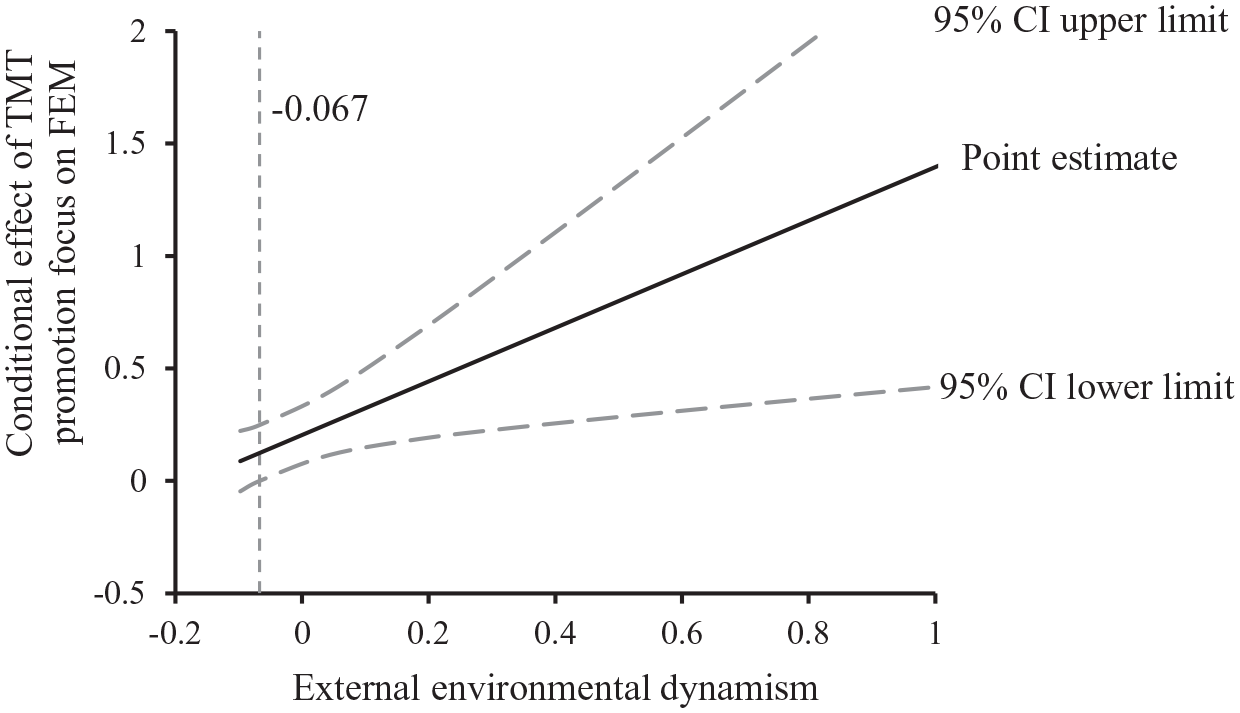
Moderating effects of external environmental dynamism on the relationship between TMT promotion focus and FEM.
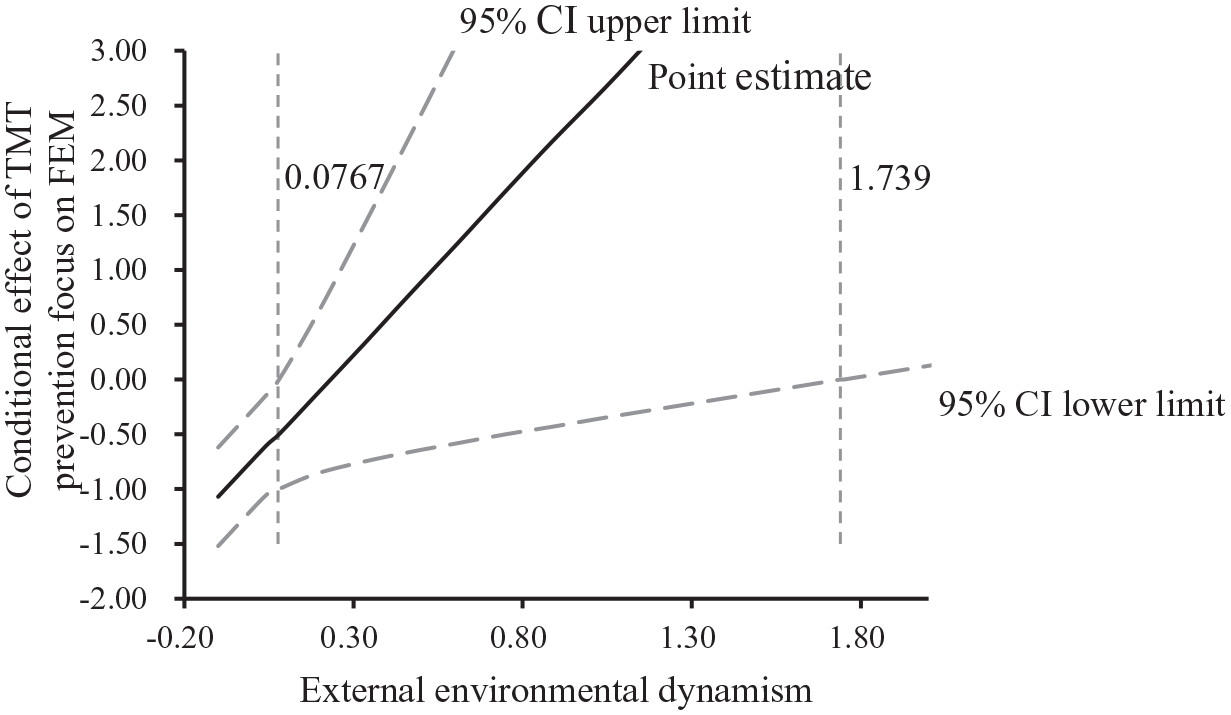
Moderating effects of external environmental dynamism on the relationship between TMT prevention focus and FEM.
Hypotheses 3a and 3b propose that internal environmental dynamism strengthens the positive relationship between promotion focus and FEM while weakens the negative relationship between prevention focus and FEM. The positive and significant coefficients (β = 1.717, p < 0.01) in Model 3 in Table 3 show that TMTs high in promotion focus are likely to engage in FEM under condition of internal environmental dynamism. Also, we use Johnson-Neyman technique to estimate the region of significance. As displayed in Figure 3, the conditional effect of TMT promotion focus on FEM is significant when internal environmental dynamism is above -0.0428. The 95% confidence interval does not include zero at the 62.01 percentile of internal environmental dynamism. These results are consistent with Hypothesis 3a. However, the coefficient of the interaction between internal environmental dynamism and prevention focus is insignificant, thereby failing to support Hypothesis 3b.
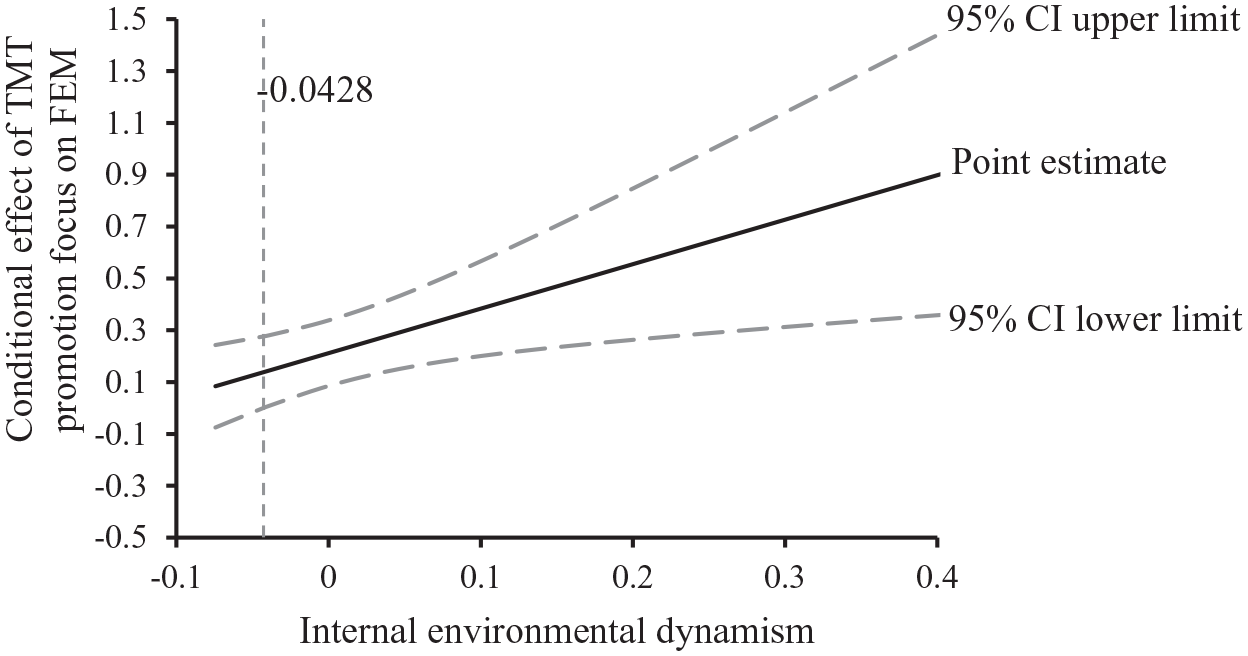
Moderating effects of internal environmental dynamism on the relationship between TMT promotion focus and FEM.
Robustness test
First, we incorporate an alternative measurement of FEM by considering FEM frequency, which is calculated as the number of times a firm engages in FEM in a year (Zhang et al., 2020a). Considering the count nature of FEM, we should use count model such as Poisson and negative binomial regression. The preliminary exploratory analysis of the data using the Lagrange Multiplier test rejects the pure Poisson model in favor of a model in which the variance is proportional to the mean (Berrone et al., 2013). Thus, negative binomial regression model is more appropriate. The Hauseman test is insignificant and thus the random effect estimation is suitable. Results of robustness test 1 in Table S3 in the supplemental material are highly consistent with main tests.
Second, we explore several possible endogeneity issues. For example, firms with certain characteristics (e.g. risk-taking firms) prefer recruiting TMTs with promotion focus. Following Malhotra et al. (2018), we conduct a two-step method to consider endogeneity concern of TMT promotion focus and prevention focus. Specifically, (1), we conduct a pooled sample regression model to test the determinants of TMT promotion/prevention focus as the dependent variables, respectively. (2), we predict TMT promotion/prevention focus based on statistically significant determinants. (3), we include the predicted value of TMT promotion/prevention focus as endogeneity control variables in the second-step estimation. Table S4 in the supplemental material shows that the results of robustness test 2 support our hypotheses after the TMT selection problem is controlled.
Third, we incorporate an alternative measurement of external environmental dynamism. In the main test, we use Three-Digit SIC to identify and measure external environmental dynamism. Here, following Tang et al. (2015), we account for Two-Digit SIC to measure this variable. Results of robustness test 3 shown in Table S5 in the supplemental material still support our hypotheses.
Discussion
Regulatory focus is important for strategic leadership research, because promotion and prevention focus impact firm behaviors. We extend literature on RFT (Higgins, 1997, 1998) by providing empirical evidence on the direct relationship between TMT regulatory focus and FEM in China. We further suggest that this relationship is contingent on firm external and internal environmental dynamism, which play key roles in strategy-making processes.
We formulate and examine three hypotheses. By using panel data from the Chinese A-share stock market between 2011 and 2017, we find TMTs high in promotion focus are more likely to engage in FEM, whereas TMTs high in prevention focus are less likely to misconduct. Also, we find external environmental dynamism strengthens (weakens) the positive (negative) relationship between promotion (prevention) focus and FEM. Also, internal environmental dynamism strengthens the positive relationship between promotion focus and FEM.
Theoretical contributions
We contribute to the literature on FEM, upper echelons theory, and RFT in three ways. First, from the perspective of strategic leaders’ psychological micro-foundation, we enrich FEM literature by first linking TMT regulatory focus to FEM. Most studies on the antecedents of FEM concentrate on institutional- or organizational-level factors rather than microfoundational level factors (Tang and Tang, 2016). Firms consist of individuals, and FEM is generally a reflection of key figures, such as top management members (Salaiz et al., 2020). Thus, an increasing number of scholars have recently suggested look ‘toward and downward’ to account for the microfoundational role of strategic leaders (e.g. strategic leaders’ psychological traits) in firm environmental behaviors (Salaiz et al., 2020). Doing so would provide us with a way to bridge the macro–micro divide regarding theories of strategic leadership, which plays an important role in moving the management field forward (Gond and Moser, 2019; Shea and Hawn, 2019). Although Zhang et al. (2020a) have recently explored the effect of CEO hubris on FEM, they have largely overlooked the role of TMT. Generally, CEOs do not work alone, and they often interact, discuss, and cooperate with TMTs when making misconduct decisions (Khanna et al., 2015). Thus the predictive power of TMT on firm misconduct behaviors is more likely to be stronger than that of the individual CEO (Khanna et al., 2015). More importantly, Gamache et al., (2015) have suggested that hubris is found not to be so proximal and powerful to firm behaviors as motivational traits (e.g. regulatory focus). To be specific, hubris is a self-concept, and it refers to the beliefs or evaluation involving the self; moreover, it only impacts goal setting process by shaping the difficulty and content of goals (Gamache et al., 2015). Its impact on behaviors is found to be mediated by regulatory focus—which directly reflects strategic inclination of individuals/teams toward goals achieving process (Gamache et al., 2015; Lanaj et al., 2012). Thus, we focus on the more proximal and powerful driving force of firm behaviors—regulatory focus of TMT—and examine its impact on FEM. By going beyond CEO hubris and exploring the relatively new antecedent of FEM—TMT regulatory focus—as an important motivational trait, we can better understand how and when FEM occurs.
Second, our study enriches the upper echelons research on top managers psychological orientations by exploring TMT regulatory focus with the help of computer-aided text analysis. Hambrick (2007) emphasizes the importance of incorporating top managers’ psychological traits into upper echelons research and the necessity to obtain such data. Although an emergent stream of studies have explored how the psychological traits of CEOs impact firm behaviors, the difficulty of constructing and obtaining data on top managers has limited the attention paid to the role of TMTs, who are recognized to have greater association with firm behaviors than the CEO (Hambrick, 2007). To date, only a few studies have investigated the effect of collective psychological traits of TMT, such as modesty on firm behaviors (Ou et al., 2018; Ridge and Ingram, 2017). However, these insightful works only provide partial knowledge of TMT psychological traits. Our research enriches this line of research by shedding light on another proximal behavior psychological trait—regulatory focus of TMT—which is found to have the most direct and powerful effect on behaviors (Gamache et al., 2015). Additionally, existing work on management team regulatory focus collects data either by survey or experiment, we apply a relatively new method by analyzing TMT regulatory focus through computer-aided text analysis of MD&A. This emergent method may be more rigorous and objective than other existing methods (Kark and Van Dijk, 2019). Doing so, we also respond to the call by Johnson et al. (2015) to conduct computer-aided text analysis to measure TMT regulatory focus.
Third, we enrich RFT literature (Higgins, 1997, 1998) by extending collective regulatory focus to the upper echelons level, particularly the TMT level, to explain the relationship between TMT regulatory focus and FEM. Different from prior research investigating the regulatory focus of top managers at the individual level, such as CEOs, we add to the literature on collective regulatory focus by analyzing the TMT as a whole (Johnson et al., 2015). Particularly, collective regulatory focus is in its initial stage, and it is mostly applied to the field of organizational behaviors to study team performance, creativity, and vision pursuit (Kark and Van Dijk, 2019). Yet, very few scholars have extended collective regulatory focus to the TMT level. Only two studies have concentrated on the bright side of firm behaviors. One explores how TMT regulatory focus impacts new product innovations of the firm (Spanjol et al., 2011), and the other investigates how TMT regulatory focus impacts firm innovation (Tuncdogan et al., 2017). However, both works ignore the other side of the story, namely, how and when TMT regulatory focus may lead to the harmful behaviors of the firm. Addressing this gap is critical because the bright and dark firm behaviors are generally impacted by TMT, especially firm misconduct, which requires the discussion, coordination, support, or acquiescence of top managers (Khanna et al., 2015). Consequently, we jump to the dark side of firm behaviors by exploring how FEM can be predicted by TMT regulatory focus. In doing so, we also answer the recent call for further investigations on TMT regulatory focus (Higgins and Pinelli, 2020).
Additionally, we enrich RFT research (Higgins, 2000) by identifying the boundary conditions of external and internal environmental dynamism of firms altogether. Different from previous leadership literature focusing on the regulatory fit between leaders and followers, we shift our insights into how TMT regulatory focus fits with the environment. Apart from Wallace et al. (2010) and Hmieleski and Baron (2008), few studies have explored contingency factors from the perspective of firm environment when linking top managers regulatory focus and firm behaviors. However, these two studies only focus on the external environmental dynamism of firms and ignore the internal environment in which firms operate, which is just as important as the external environment (Tang et al., 2015). Thus, we extend this line of research by not only considering external environmental dynamism but also taking internal environmental dynamism into consideration. Furthermore, Boyd et al. (2011) suggest that exploring the impact of top managers on firm behaviors alone may result in controversial conclusions. Thus, accounting for contingent factors may help mitigate this problem. By considering external and internal environmental dynamism together, we show a complete picture of how TMT regulatory focus impacts FEM.
Practical implication
This research offers significant insights for Chinese policymakers to mitigate environmental problems. To reduce risk, more and more firms try to learn about psychological traits of strategic leadership to identify those TMTs who will govern responsibly. This research provides strong evidence that a positive (negative) relationship exists between TMT promotion (prevention) focus and FEM. Our results do not mean that it is not good to have TMT with promotion focus. We suggest that a mechanism to limit TMTs high in promotion focus from damaging environment may include additional layers of scrutiny. In practice, board members, regulators, analysts, and auditors should strongly monitor TMTs high in promotion focus to judge their FEM, especially in the presence of external and internal environmental dynamism.
Limitation and future research
We acknowledge that this research has certain limitations that warrant further research. First, although the significant advantages of content analysis enable us to analyze TMT regulatory focus using secondary data for longitudinal analysis, MD&A in our sample is in Chinese, constructing keywords may not be easy. There are two main challenges. (1) Prior western research relies on LIWC to conduct dictionary-based coding, segment words, and compute word frequency. However, LIWC may be less applicable to Chinese-language transcript because Chinese paragraphs are difficult to divide into words, and Chinese-language based dictionaries are not compatible in LIWC (Jia et al., 2016). To solve these problems, following Zeng et al. (2018), we incorporate the Jieba module in Python to segment words and calculate word frequency. Prior research such as Guo et al. (2017) also analyze firm transcript with the help of Python, which is suggested by Short et al. (2018) to conduct content analysis. With the continued development of programming skills and technologies, further research can improve the algorithm in LIWC or explore other new methods to conduct content analysis in China. (2) Consistent with prior studies on Chinese content analysis (Jiang et al., 2019; Zeng et al., 2018; Zhang et al., 2020b), we translate the English dictionary of regulatory focus developed by Gamache et al. (2015) into Chinese. Although we perform validity checks by hiring two psychological research assistants to measure other-report TMT regulatory focus based on the scale, it will be interesting for further research to encourage TMT members to participate in experiments for collection of self-reported TMT regulatory focus. Similarly, further research can consider collecting TMT regulatory focus for longitudinal analysis by using survey data.
Second, our research only includes Chinese listed firms in pollution industries owing to data limitation. Different from western databases, which may provide detailed FEM information such as misconduct type and patterns, the disclosure of FEM information is at an early stage in China. Unfortunately, we have no access to such data in China (Tang and Tang, 2016). As such, we try our best to incorporate a binary variable to consider whether or not a firm engages in FEM in a given year, and consider the times that a firm engages in FEM in one year to capture FEM frequency. With the increasing attention that government pays to FEM, we hope there will be more databases to help measure FEM in China.
Third, we only study one specific type of corporate social irresponsibility (CSIR)—FEM for two reasons. Conceptually, different dimensions of CSIR vary from one and another in concept, and each aspect deserves research attention (Wang et al., 2016). Particularly, FEM brings significant adverse impact to the natural environment, and studying the antecedents of FEM may help mitigate the environment deterioration problems to an extent. Methodologically, although some independent agencies such as Kinder, Lydenberg, Domini, and Co. (KLD) invite experts to evaluate and score firm CSIR every year, such scores are subjective. However, FEM is an objective and real event, which is detected by the Chinese Ministry of Environmental Protection. Extending this research to other dimensions of CSIR/CSR, or the CSIR/CSR as a whole will be interesting.
Fourth, drawing upon RFT, this study explores the mechanisms (eagerness vs vigilance; risk-seeking vs risk-averse) underlining the association between TMT regulatory focus and FEM. However, we do not collect archival data to measure these mechanisms directly. Although most top managers in listed firms are unwilling to submit themselves to scholarly probing (Hambrick, 2007), in future research, we strongly encourage the scholars to directly measure the underlying mechanism by means of either surveys or experiments.
Conclusion
Integrating upper echelons theory with RFT, this study provides new insights into the relationship between TMTs regulatory focus and FEM. The results show that TMTs with promotion (prevention) focus tend to engage in more (less) FEM. Furthermore, our study could be particularly informative to human resource management to monitor TMTs high in promotion focus to better prevent corporate environmental illegality.
Supplemental Material
sj-pdf-1-hum-10.1177_0018726721997531 – Supplemental material for How and when does top management team regulatory focus influence firm environmental misconduct?
Supplemental material, sj-pdf-1-hum-10.1177_0018726721997531 for How and when does top management team regulatory focus influence firm environmental misconduct? by Zhe Zhang, Mijia Gong and Ming Jia in Human Relations
Footnotes
Funding
The author(s) disclosed receipt of the following financial support for the research, authorship, and/or publication of this article: This study was funded by grants from National Natural Science Foundation of China (Grant Nos. 71672139; 71932007).

Supplemental material
Supplemental material for this article is available online.
Notes
References
Supplementary Material
Please find the following supplemental material available below.
For Open Access articles published under a Creative Commons License, all supplemental material carries the same license as the article it is associated with.
For non-Open Access articles published, all supplemental material carries a non-exclusive license, and permission requests for re-use of supplemental material or any part of supplemental material shall be sent directly to the copyright owner as specified in the copyright notice associated with the article.
