




Abstract
Can an exploration of managers’ real-time organizational talk make way for a profoundly revised theory of reflexivity? Indeed, our analysis of the reflexivity literature reveals four significant points of contestation – the subject/object distinction, temporality, representation and agency – all of which revolve around the interplay of an ‘I’ (at least one reflexive agent) and an ‘it’ (something to be reflexive about). The focus of this inquiry lies in how the ‘I’ and the ‘it’ are constituted communicatively and what generates, sustains and animates them in interaction. Such interactions are sourced from a post-experience master programme for practising managers, thus providing naturally occurring data amendable to a ventriloquial analysis. We identify and demonstrate three types of reflexive moments: conflating, bifurcating and animating. We subsequently theorize these as instances of ventriloquial reflexivity, using the terms conflating, bifurcating and animating to express the different moments in which speakers co-orient to the communicative constitution of the ‘I’ and the ‘it’. Ventriloquial reflexivity allows us to explore reflexivity as an interactional and situated accomplishment, thus further pointing to how reflexive practices can be understood and enhanced.
Keywords
Introduction
Reflexivity – in its most inclusive sense, ‘the circularity of social knowledge’ (Giddens, 1991: 153) – appears to be endemic to late-modern work life. For example, reflexivity can foster knowledge exchange (Monks et al., 2016), advance ethics (Cunliffe and Jun, 2005), account for actions in shared contexts (Yamauchi and Hiramoto, 2016), extend and emancipate thinking (Hibbert, 2013), as well as elucidate the social constructedness of reality (Cunliffe, 2003). Although reflexivity purportedly shines a bright light on so many issues, the reflexivity literature has been accused of failing to approach its own core concepts reflexively and critically, instead remaining fixated on ‘drawing on individualized perspectives which cannot adequately address complex organizational and political processes’ (Vince and Reynolds, 2009) and restricting itself to ‘conceptualizing the method rather than . . . researching how efforts to mobilize it fare in real-life scenarios’ (Cotter and Cullen, 2012: 243). In this inquiry, we seek to directly redress both preoccupations by conducting a situated and processual exploration of reflexivity right at the point of interaction.
A desire to make sense of the sprawling and often bewildering reflexivity literature provided both the starting point and the impetus for this exploration. An initial mapping of that terrain revealed four recurring points of contestation: (1) the subject–object distinction, (2) temporal orientation, (3) representation and (4) agency. Taken together, these points encompass various debates addressing the focus or gaze of reflexivity (subject/object distinction), the sequence or timing of reflexivity in relation to action/experience (temporality), whether it is reflective or constitutive (representation) and its attribution to individual, collective or beyond-human agents (agency). Notably, at each point of contestation the interplay between the ‘I’ (the who of reflexivity) and the ‘it’ (the what) appeared to offer a rare theme that recurred across the plurality of approaches and reflexivity schools, and so became our point of inquiry. Kuhn et al. (2017) provide us with a dual analytical concept, as they speak about ‘the complex, swirling, and often precarious matrix of relations (e.g., grammatical rules and embodied practices of speaking and writing) that generate and sustain “I” and “it” as demarcated units, subject and object’ (Kuhn et al., 2017: 32). Accordingly, our analysis makes orienting to this generation – of ‘I’ and ‘it’ – the cornerstone of reflexivity.
To better explicate the web of relations in which we are locating reflexivity, we probe four specific tensions (researcher- versus research-oriented, retrospective versus in-the-moment, reflective versus constitutive, and individual versus collective) located at each of the four broader points of contestation outlined above. These tensions point us to the ‘lived’ complexities of the reflexivity terrain and thus to each tension’s two poles, with the poles on the right side being aggregated into what we call ‘the right-hand column’ and those on the left into the ‘left-hand column’. In the right-hand column, the ‘I’ and the ‘it’ are considered to be dialogically related, emergent in action and experience and constituted through a plenum of agencies. In the dominant left-hand column, on the other hand, the ‘I’ and the ‘It’ are understood as entitative, separate, sequential and primarily the responsibility of the reflexive individual. Although not intended to fully resolve the four broader points of contestation, our analysis of the associated tensions listed above is an attempt to create ‘a map of how existing ideas in the literature work together’ (Collins and Stockton, 2018: 5). Such maps can be likened to ‘spotlights’ through which to ‘organise and connect the data’ (Collins and Stockton, 2018: 4). Both in constructing the map and in identifying our empirical interest, we are seeking to answer the calls ‘to interrogate and find strange the process of representation as we engage in it’ (Macbeth, 2001: 43) and thereby to elucidate the ‘notion of learning-in-practice’ (Antonacopoulou, 2005) as well as ‘an ability to engage in and to overcome obstacles to ongoing practice’ (Kuhn and Jackson, 2008: 456 2014: 456).
Unlike a preponderance of the research to date, we assume that most reflexive interactions in organizations are of the right-hand-column variety, in which case research should do more to enhance the understanding of right-hand-column reflexivity. To this end, we turn to reflexivity as it occurs naturally in interactional practices in a leadership training context, specifically analysing three such situated, interactive and communicative episodes that can provide empirical insight.
To meet the challenges of tracking a phenomenon’s movement and direction across real-time processes, we have adopted a communicative relationality as in the communicative constitution of organizations (CCO) approach. Being ontologically flat, a relational ontology reorients the observer to surfaces, signs and streams rather than to the foundational, hidden meanings and imperatives to which depth ontology is oriented. Such reorientation enables one to pay attention to ‘vectors of ordinary practice’, where the focus shifts to what ‘is done rather than discovered – or done as discovered’ (Kuhn et al., 2017: 33). Consequently, we aim to shine a light on the accomplishment of reflexivity by posing ‘how questions’ and ‘asking about the concrete activities through which particular realities are generated, sustained, and changed’ (Kuhn et al., 2017: 41). We contribute three different moments of ‘how’ – bifurcating (separating the ‘I’ and ‘it’ from each other), conflating (condensing the ‘I’ and ‘it’ together) and animating (the ‘I’ animated by the ‘it’) – thus providing three significant points of reference for those researching, practising and wanting to facilitate more reflexive interactions in the midst of organizational activities.
We employ the CCO construct of ventriloquism (Cooren, 2010, 2015) to explicate this accomplishment. This approach highlights how speakers make present ‘other-than-human’ beings (Cooren, 2020; Cooren et al., 2006), such as policies, persons or objects, and are conversely moved and animated by these, thereby enabling us to unpick the constitutive actions involved in accomplishing reflexivity. We thus offer ventriloquial reflexivity as a contribution that relocates reflexivity research within the emerging conversation of communicative relationality.
The rewards of better engaging with how people tangibly do reflexivity can be profound. Macbeth reminds us of its ubiquity, which he terms ‘an inexhaustible practice’ fundamental to ‘the organization of everyday life’ and indeed ‘the heart of the socially constructive exercise’ (Macbeth, 2001: 55). As such, although letting organizational actors in on the workings of reflexivity as ‘best practice’ could be deemed an inarguable imperative, doing so is impossible ‘without offering much enlightenment on the mechanics of how this can be achieved’ (Gray, 2007: 495). Consequently, we are seeking to position reflexivity research ‘less on introspection and more on intervention’ (Bucholtz, 2001: 181), where the site of a reflexivity intervention – interaction – can be developed as ‘a craft, trade, or even art unto itself – a social task that is also technical’ (Rennstam and Ashcraft, 2014: 11, emphasis in original).
With this in mind, we have structured this article into four parts. First, we explore reflexivity literature focused on the four tensions outlined above. We then seek out the CCO perspective, specifically accounting for ventriloquism, figures, vents and co-orientation, as these are the CCO constructs we deploy in our analytical engagement with reflexivity. After outlining our overall empirical approach, we analyse three exemplary excerpts from a leadership training context, using our insights to cumulatively fashion a framework of moments of ventriloquial reflexivity that depicts how different reflexive moments can be detected in the executive students’ dialogues. By working from naturally occurring data, we hope to speak directly to the practice of reflexivity and thus to offer strategies and practices for enabling real-world, real-time reflexive work.
Four tensions in reflexivity studies
Reflexivity is ‘a central and yet confusing topic’ where ‘it can be difficult to establish just what is being claimed’ (Lynch, 2000: 26), so it comes as no surprise that studies into reflexivity exhibit ‘definitional confusion’, ‘conceptual diversity’ and ‘a multi-layered nature’ (Cotter and Cullen, 2012: 228). This necessitates the assertion that not just one, but many reflexivities exist (Alvesson et al., 2008). Faced with a plenitude of such research-literature-based reflexivities, we – as both researchers into and facilitators of groups interested in crafting an intentional reflexive practice – sought a means of shaping, organizing and mapping the literature in a way that allowed us to work with reflexivity empirically. In this section, then, we provide an account of this mapping, both to set out a conceptual framework for the empirical work to come and to aid others grappling with this prolific and multi-directional literature. Here, we would like to underline that we oriented our conceptual exploration at framing up the empirical work and not at seeking to engage in theorizing in and for itself.
Our systematic analysis of the literature brought four recurring points of contestation to light, which we have called the subject/object distinction, temporality, representation and agency. Still a central concern of classical and modern philosophy, the subject–object distinction distinguishes between the knower (in this case the reflexive agent) and the known (that which occasions the reflexivity). This is a distinction of gaze, visibility and attention that manifests itself in the reflexivity literature through scholars’ choice to focus on ‘the who’ versus ‘the what’ or, as we will spell out below, the ‘I’ versus the ‘it’. The second point – the temporal orientation – concerns time, place and distance, with the central point of contestation being the positioning of the ‘I’ as pre-existing or concurrent with the ‘it’. Representation reflects different stances on ‘it’s nature, meaning and orientation, where the ‘I’ and the ‘it’ can be treated as either entitative (separate and mutually independent) or co-constituted (mutually constitutive and conceptually entangled). Finally, agency speaks to the nature and source(s) of authority attributing reflexivity to individual, collective and/or other-than-human agents.
Taking one core tension from each of the four contested terrains discussed above, we explore the associated literature in some depth. Of course, we do not highlight all the accompanying tensions associated with each contestation – such as student/participant and text/journal in terms of the subject/object distinction, retrospective versus prospective reflexivity in terms of temporality, and human versus other-than-human agency in terms of agency. The four core tensions that we do explore are: (1) researcher- versus research-oriented, (2) retrospective versus in-the-moment, (3) reflective versus constitutive and (4) individual versus collective. An exploration of each tension reveals the nature of the broader contestation and the range of deep assumptions at play across each tension, as well as illustrating the dynamics between the ‘I’ and the ‘it’.
Tension 1: Researcher- versus research-oriented
Given reflexivity is commonly understood and practised as a vehicle by which the researcher or research process is made visible and explicitly scrutinized, the first and most recognizable tension can be likened to a simple choice between focusing on the ‘I’ (in this tension the researcher) or the ‘it’ (in this tension the research). In this same vein, reflexivity has been identified with ‘a process of reflecting on the mirror’s mirroring’, with the researcher being the ‘I’ ‘who holds the mirror’ (Gemignani, 2017: 190; see also Knudsen, 2016). What the mirror sees when the researcher becomes the subject and object of reflexivity is any combination of experiences, memories, associations, preferences, priorities and traits that the researcher deems relevant to the research process. Reflexivity thus becomes a self-positioning of the researcher in their research and thereby ‘a way for researchers to inform their audiences about their perspectives as well as to manage their subjectivities’ (Morrow, 2005: 250). Such a positioning has been called a Foucauldian type of confession (Gemignani, 2017: 188), with the self as ‘a human instrument’ (Guba and Lincoln, 1985: 83). Given the evocation of confessions and instruments, such a reflexivity unsurprisingly carries associations of disciplining, declaring, bracketing, managing and controlling the even unintentional impact of the ‘I’ in research.
Such an accusation might equally be levelled at the research-oriented pole of this tension, namely, reflexivity aimed at the research itself (what we are terming the ‘it’). In this instance, reflexivity is ‘conceptualized as an epistemological practice that emphasizes intellectual critique’ (Barge, 2004: 70), with an author’s textual process or methodological choices being the most common focus. One well-known characterization of such reflexivity is that of ‘research that turns back and takes account of itself’ (Alvesson et al., 2008: 480), which essentially investigates the constitutive elements of research, including its ontological, epistemological, methodological and theoretical choices. Alvesson et al. (2008) identify four sets of reflexive practices in such an endeavour: multi-perspective practice, which intentionally juxtaposes different perspectives; multi-voicing practices, which seek to moderate the voice of the researcher (author) and amplify that of the participants (others); positioning practices, which position the researcher within the conventions of their scholarly community; and destabilizing practices, which seek to deconstruct, problematize and question the authority of established research. Perhaps their most telling metaphor comes as a plea for a reflexivity that is less ‘a dead end rather than a route to more thoughtful and interesting research’ (Alvesson et al., 2008: 498), thus framing ‘I’-focused research as the ‘dead end’ and ‘it’-focused research as a ‘route’ somewhere ‘thoughtful and interesting’.
Tension 2: Retrospective versus in-the-moment
When inquiry, understanding and meaning-making come after an action, the reflexive norm has traditionally been to separate a performance or action from a participant’s account of it. Such a separation recreates the ‘I’ as an observer, self-examiner and critic, and reflexivity as inherently retrospective in relation to an ‘it’ that is already in the past. At this pole of the tension, the ‘I’ clearly precedes the ‘it’. Retrospective reflexivity essentially concerns ‘an individual looking back as a way of making improvements’ (Reynolds and Vince, 2020: 134), and how to do that most effectively has become a persistent subject of debate for those studying reflexivity in research, work life or learning and development.
This reflexivity, which is predicated on a ‘turning back’, has a number of dimensions. The first breaks the flow of routine, often articulated as the ‘experience of “being struck” or “noticing”’, which then ‘triggers’ subsequent self-examination (Hibbert et al., 2010: 55). This process can lead to ‘a critique of habitual practices’ (Cunliffe and Jun, 2005: 226), a recognition and testing of assumptions and, ultimately, the ability to ‘reconceptualize’ experience (Cotter and Cullen, 2012: 234). Initially predicated on a retrospective review of something that has happened, reflexivity then takes an overall direction that emphasizes changing and embedding alternative ways of paying attention and acting. For example, in moral reflexivity ‘the moment of reflexivity comes later when the dust settles, and they look back at the scene’, which can then facilitate ‘a stance with respect to a moral through conscious reflection, analysis, and deliberation’ (Shadnam, 2020: 12). The image of dust settling encapsulates the core belief underpinning the ‘retrospective’ nature of reflexivity, that is, that the ‘clearest’ reflexive moment is distant to the moment of action and detached from its embodiment, emotion, reactiveness and messiness.
Absolutely conversely, reflexivity as an in-the-moment phenomenon originates in ethnomethodology, where the understanding and meaning of any social actor (the ‘I’) are represented and observed as part of their action (the ‘it’). This is evidenced in the co-actors’ interpretation and projection of next action, as members make their activities ‘visibly-rational-and-reportable-for-all-practical-purposes, which is to say, “accountable”’ (Garfinkel, 1967: vii). Put simply, ‘the understanding of this action is not separated from the action’ (Yamauchi and Hiramoto, 2016: 1474), and any such action is accountable not through any explanation or retrospective examination of it, but through the recognition and responsiveness of others. Hence, research applying this meaning of reflexivity focuses on the usually tacit understanding displayed in the reflexive accomplishment of any practice itself (Best and Hindmarsh, 2019; Llewellyn, 2010). Yamauchi and Hiramoto (2016) analyse a series of routine customer interactions that occurred in a high-end sushi bar where chefs and customers performed occasionally divergent understandings of the service routine, but reflexively responded to the differences in order to take action and accomplish service. This study is important to our inquiry because it offers the insights that reflexivity is performed in the very interaction itself, rather than in prior or retrospective accounts of it; that reflexivity is inherently inter-subjective – in other words, performed in relation to others; and that any shared understanding comes from performing and reconciling different definitions in the situated moment. What remains the challenge, of course, is how ‘real-time reflexivity’ or ‘insight into change as it happens’ (Perera, 2020: 144) could be not only researched but also disseminated and practised – a challenge this article is trying to address.
Tension 3: Reflective versus constitutive
The metaphor of a simple ‘mirror image’ (Hibbert et al., 2010: 47) captures the reflective pole in this tension and reflects an objectivist ontology or ‘the idea that there is an original reality we can think about and separate ourselves from’ (Cunliffe and Jun, 2005: 226). At this end of the tension, the ‘I’ and the ‘it’ are separate and clearly demarcated entities. This makes reflection predominantly a matter of calculative thinking, which Heidegger describes as ‘a form of thinking that moves towards closure because it is concerned with understanding, categorizing, and simplifying phenomena in order to plan, organize, act, or theorize’ (Cunliffe and Easterby-Smith, 2004: 32). Adriansen and Knudsen (2013) articulate such reasoning as playing a largely instrumental role in, for instance, one’s choice of possible solutions to a problem. The simple mirror image rests on the assumption that the one doing the reflecting (the ‘I’) is a priori stable and in control of what they are reflecting on (the ‘it’). This assumption is predicated on a division between inner and outer worlds where one’s ‘consciousness is always the medium through which the research occurs’ (Stanley and Wise, 2002: 157), meaning that ‘the researcher’s self is understood as transparently visible to analysis’ (Rose, 1997: 309). As such, the notion that reflexivity is predominantly a reflective process relies on a realist ontology stipulating that the person reflecting and what that person is reflecting on can actually be separated, plus that the ‘I’ can be distinguished as an analytic category. Such assumptions are, of course, challenged head on at the other end of this tension.
For reflexivity to be constitutive as opposed to reflective entails a shift in paradigm (to social constructionism), but also a fundamental redefinition of reflexivity and the different agents involved in it. Constitutive reflexivity is most commonly associated with radical reflexivity, which positions reflexivity ontologically as a critical exploration of representation (Lynch, 2000), or what Cunliffe (2003: 986) terms a ‘step back from the process of construction’ or ‘one step up’ (Pels, 2000). Such a positioning centres on epistemology itself and the social construction of knowledge, with the objective being to recognize and disrupt assumptions that privilege certain constructions and meanings over others. Radical reflexivity thus becomes both a constructionist and a deconstructionist activity involving ‘a constant interplay of presence/absence’ where ‘what is not said is as important as what is said’ (Cunliffe, 2003: 987) and where reflexivity enables ‘forgotten choices’, ‘hidden alternatives’, ‘epistemological limits’ and ‘subjugated voices’ (Lynch, 2000: 36) to emerge and be encountered.
If reflexivity is constitutive, then no separation between reflecting (the actions of the ‘I’) and being reflected on (the ‘it’) exists, as both construct each other in that very moment. Neither is there any stable a priori ‘I’ or stable a priori ‘it’ – given both are in continuous movement – nor does any clear visibility of the many ‘I’s present or absent exist, at least not in light of the complex interplay of shifting voices, subjectivities and texts at play here.
Tension 4: Individual versus collective
Our final tension picks up on one of the most enduring characterizations of reflection and reflexivity – the reflective practitioner (Schön, 1983). The reflective practitioner is the supreme example whereby the object of reflexivity is located within the individual and the individual is elevated to the principal subject of reflexivity. This tension either affirms or erodes the centrality of the ‘I’, of course, but furthermore raises the question of who owns the ‘it’. Gemignani represents individually oriented reflexivity as akin to ‘a sort of cartographic exercise to draw a map’ of the self (Gemignani, 2017: 191). Reflexivity thus ‘situates the individuality and humanness of the researcher at the core of the process of inquiry’ (Gemignani, 2017: 190). Although there are multiple, paradigmatically diverse versions of individually oriented reflexivities, ranging from reflection to critical reflection and self-reflection, all ‘are largely rooted in psychological processes of individual growth’ (Gray, 2007: 497).
At the other end of this tension, reflexivity is understood as a relational and collective process. This does not automatically mean – although it can – that others will be directly involved in reflexivity processes, but it does mean that reflexivity marks a ‘transition from an individual to a collective, social level’ and hence incorporates some form of input from others (Hibbert et al., 2010: 55). Any growth or change, either individual or collective, ‘is effected through participation’ (Hibbert et al., 2010: 53).
Collective forms of reflexivity are deemed not only quantitatively different (more than one actor involved) but also qualitatively different in terms of what they orient towards and how they normatively locate themselves. For instance, Cotter and Cullen (2012: 235) argue that collective forms of reflexivity are better suited than individual forms to ‘take into account how social, political, and cultural considerations influence the way in which organizational decisions are made and enacted’. Similarly, Vince and Reynolds (2009) propose that more collective forms of reflexivity enable reflexivity to be applied to real-world organizational practices in a more situated and contextualized manner. Collective forms of reflexivity thus appear better placed to ‘assist[s] inquiry into actual and current organizational projects and projections’ (Vince and Reynolds, 2009: 94), as studies of learning at the workplace have demonstrated (Boud et al., 2006). Any ‘I’, after all, is necessarily in relation to other ‘I’s, and any ‘it’ generally involves multiple ‘it’s.
Mapping tensions in the reflexivity terrain
As discussed previously, we offer these four tensions as a way of locating reflexivity research and practice amidst broader contested debates, especially in order to position the complex movements of the ‘I’ and the ‘it’. We bring them together in Table 1.
Tensions in the reflexivity literature.
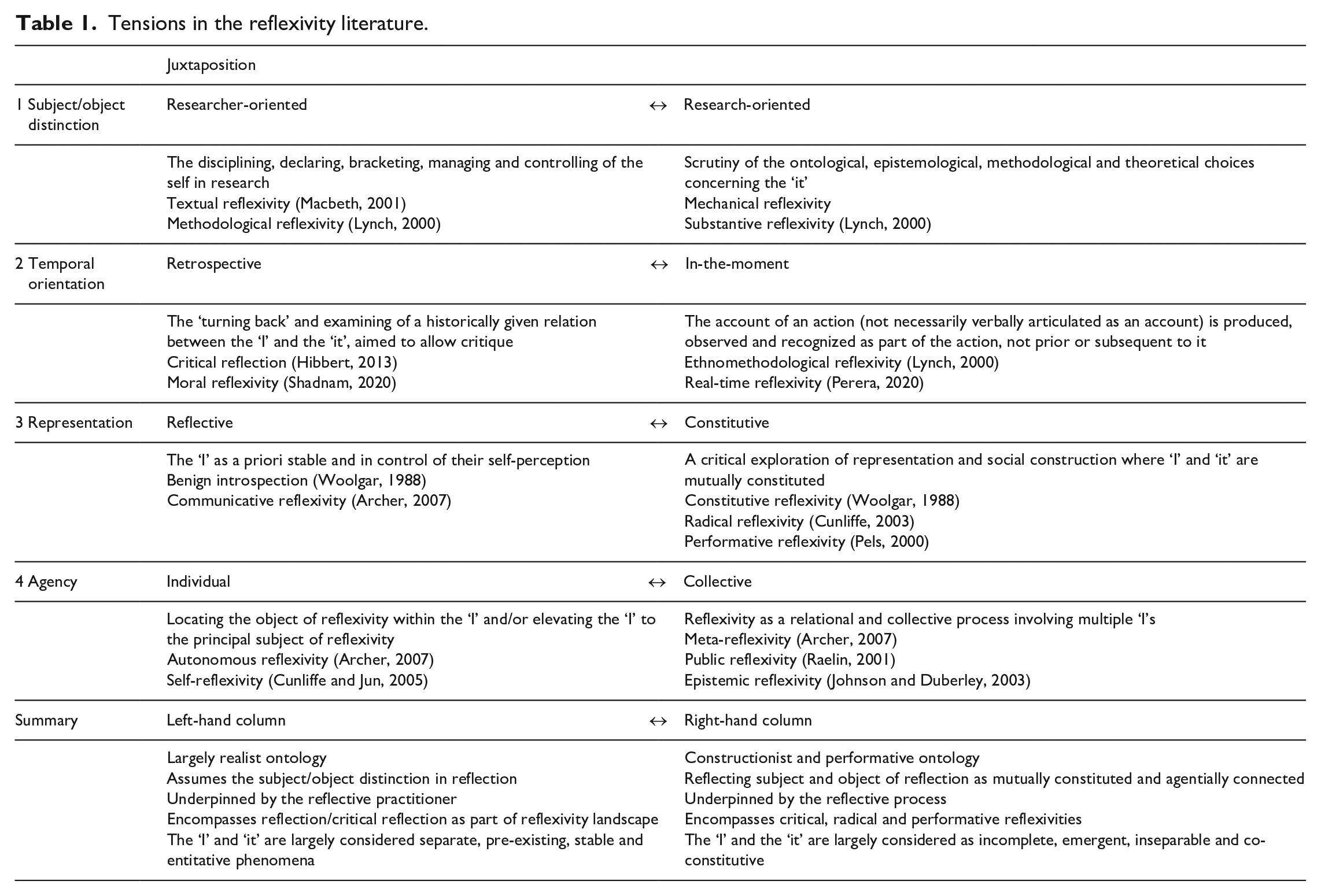
First, we note how, across each of the four tensions, the dimensions in each column inter-connect meaningfully: ‘researcher-oriented, retrospective, reflective and individual’, at their very extreme, represent a largely realist, functionalist and mainstream approach to reflexivity, whereas at the other extreme, ‘research-oriented, in-the-moment, constitutive and collective’ reflect a more social constructionist and potentially critical stance. Second, we note that the four dimensions on the left dominate the practical, organizational sphere, as the retrospective, predominantly cognitive, individually focused and intentional dimensions of reflexivity tend to be more visible and teachable in a formal workspace. However, as previously acknowledged, even if successfully ‘learnt’, reflexivity will be practised through largely tacit, in-the-moment and relational/collective interactions.
As such, we agree with Ann Cunliffe (2004), a foremost pioneer of organizational research into the learning of reflexivity, when she criticizes the emphasis on content (definitions and typographies) as so strong as to neglect process (how reflexivity actually unfolds), and research and development as thus failing to approach reflexivity as a relational, embodied, ethical and dialogical practice. Cunliffe’s own research has in turn been critiqued for being ‘moored mainly at the conceptual level concentrating on developing a theoretical frame’ (Cotter and Cullen, 2012: 236) in lieu of bringing processual dimensions to light. Hence, we wish to pursue reflexivity as a processual and relational practice in this study, exploring and explicating the reflexivity of the right-hand column.
An important caveat lies in Dick Pels’s account of performative reflexivity (Pels, 2000), as he engages with the risks intrinsic to the right-hand column of our table. Pels recommends a constrained operation of reflexivity – ‘one step up’ – which adds one, and only one, level of self-reference to ‘hold both representer and represented fully in view, continually monitoring their similarity and distance, their connectedness and tensionful difference’ (Pels, 2000) – or, in our language, holding the ‘I’ and the ‘it’ fully in view. To this end, we turn to communicative relationality (Kuhn et al., 2017), where human and other-than-human agencies interpenetrate materialism, on the one hand, and ideation on the other. This programme promises to resist reducing the symbolic/material dimension of any phenomenon by demonstrating how communication ‘constitutes working and organizing by bringing together a multiplicity of agencies in the production of meanings’ (Kuhn et al., 2017: 69). In the next section, we account for one of the most fully developed strands of communicative relationality – ventriloquism – concluding the section by specifying how a ventriloquial analytical framework allows one to observe the entire tensional field of reflexivity mapped above while steering clear of reductionism, whether it leans towards the materialist or the semiotic (Pels, 2000).
Ventriloquism in the tensional terrain of reflexivity
Conceived by François Cooren (2010, 2012, 2015, 2016), ventriloquism subscribes to the idea that any organized phenomenon is constituted in and through communicative events (Boivin et al., 2017; Cooren et al., 2011; Schoeneborn and Vásquez, 2017). It addresses how speakers in conversations stage figures as well as their potential for agency, and how, as agents, such figures may themselves be understood to animate speakers in conversation. For instance, a speaker may say, ‘As a veteran, I feel lonely’. Two figures are raised here, that of the veteran and of loneliness, with the latter animating the former. Moreover, these two figures correspond to what we term the ‘I’ (the veteran) and the ‘it’ (the loneliness). The Garfinkelian ethnomethodology (Cooren, 2009, 2010) underpinning this correspondence holds that an interaction reflexively and continually constitutes this ‘relationship between singular actions and the relevant specifications of identity, place, time, and meaning implicated by the intelligibility of those actions’ (Lynch and Peyrot, 1992: 114). Any action comes with scenic detail that allows an interactant to ‘assemble’ the ordinary social scene, moment to moment (Lynch and Peyrot, 1992: 114). Ethno-methods are precisely those methods by which this scene is assembled – in our case, specifically, how the ‘I’ and the ‘it’ are assembled. In this sense, ventriloquism at the outset inherits the right-hand-column position of Tensions 2 and 4 in Table 1, thus affirming in-the-moment, non-mentalistic reflexivity oriented towards ‘meaningful action-in-context’ (Lynch and Peyrot, 1992: 114).
Ventriloquism acquires its peculiar name metaphorically from the well-known stage act where a comedian, or vent, makes a puppet, or dummy, appear to speak, and the two (apparently) converse (Cooren, 2010). Similarly, when ventriloquizing, interactants make figures present, thus populating the interactional scene. A figure is anything made present that may count in an exchange, that is, make a difference (Cooren, 2004). Cooren and Fairhurst (2008) speak of the ‘dis-local’ character of interactions, namely that
‘their local achievement is always mobilizing a variety of entities—documents, rules, protocols, architectural elements, machines, technological devices—that dislocate, i.e., “put out of place” (Webster’s New Encyclopedic Dictionary, 1993: 289) what initially appeared to be “in place,” i.e., local’ (Cooren and Fairhurst, 2008: 123).
When analysing interactions, one can use figures to simultaneously focus on the local and dis-local, by which we mean that interactions are ‘the very nexus where beings with variable ontologies come to be incarnated and re-presented, made present’ (Cooren, 2010: 80).
Let us take a closer look at how this unfolds in an example. At a budget follow-up meeting, the CFO might quote the quarterly earnings, the ‘it’, thereby making the budget present or ventriloquizing it, but also – reflexively (Clifton, 2017) and implicitly – positioning herself, the ‘I’, as the authoritative leader. This, in turn, may animate the sales director to explain his poor quarterly results, whereby he acknowledges not only that the budget makes a difference, but also that the CFO has the prerogative to make him accountable for his results. Importantly, by ventriloquizing the budget, the CFO obligates not only the sales director but also herself to be accountable for quarterly results as well as for the entire budget. The budget can thus be said to ventriloquize the CFO, making her the dummy, the voice of the budget. This example demonstrates a continuous oscillation (Cooren, 2010) between the ventriloquist and the dummy, between staging a figure and becoming animated, moved but reflexively constrained by it, as any figure becomes an agent in its own right, no longer entirely under the vent’s – the original speaker’s – control. The ventriloquial analysis highlights ‘how our attachments to figures constitute who we are, what we believe, and how we act, as well as how figures can extend or transcend what their ventriloquists say and do’ (Long et al., 2018: 237). Ventriloquism offers a way of understanding how these key elements of the scenic detail are assembled in the interaction, thus making – as we will develop in this article – reflexive orientation towards this assembling conceivable.
The approach outlined here also illuminates how one’s agency is hybrid, shared with other agents. Latour analytically decentres the human subject as the sole agent to hold accountable to actions, maintaining that ‘when you exert power others are performing the action and not you’ (Latour, 1984: 265). Indeed, the ventriloquial approach aims to unfold the otherwise unified speaking human subject, to uncover that a plenum (Cooren, 2006) of agents take part in any action, and thereby reveals a relational concept of agency in which agency does not rest with any single agent. Agency here ‘is in constant formation through action, rather than stable, personified units with, or in prior procession of, agency’ (Kuhn et al., 2017: 38). We maintain that through communicative actions the ‘I’ and the ‘it’ are in constant formation, as is their mutual relation.
Because ‘orienting to’ is integral to our understanding of reflexivity, we need to conceptualize it. Ventriloquism understands co-orientation (Taylor and Robichaud, 2004; Taylor and Van Every, 2000, see also Cooren, 2010) as a dialogic practice implying that multiple actors relate or orient to each other through a common object of concern, the task at hand. Such a practice therefore involves at least three parties: two or more organizational actors and a particular outcome they need to produce – their objective (Mengis and Hohmann, 2014). If we return to the above example, the CFO and the sales director may be concerned with revising the budget so that it projects a more realistic yearly revenue with lower sales figures. Co-orientation makes interaction specifically organizational insofar as the members are or perceive themselves to be accountable to this task. Yet this task is not simply an exogenously given entity but is ‘negotiated and constructed in communication and allows accommodation of the collaborators’ multiple interests, skills, and objectives’ (Mengis and Hohmann, 2014: 268). Within our framework of the ‘I’ and the ‘it’, co-orientation can be said to imply that the interlocutors relate to how the ‘I’ and the ‘it’ are assembled, problematized and engaged with in conversation. Co-orientation is central, as it anchors reflexivity in the conversation, thus preventing it from slipping back into introspection and individualism.
This last point prompts us to take more comprehensive stock of how ventriloquism recasts the reflexivity tensions shown in Table 1. In the subject/object distinction, a ventriloquial approach will align with the right-hand side of the table in the sense that the researcher is ‘a body, a face, a voice that we all learned to recognize . . . but it is also all the things that this person embodies or incarnates: hope, fear, power, authority, diversity, smartness, expertise, wisdom’ (Cooren, 2010: 151). In fact, assembling the ‘I’ is in principle no different from assembling the ‘it’, which, in the words of Latour, should be approached symmetrically (Latour, 1993). Indeed, both processes invite a ‘scrutiny’ of the communicational choices made. In the second tension, retrospective versus in-the-moment, ventriloquism positions itself on its ethnomethodological terra firma of interaction, that is, exclusively in-the-moment, even if its dis-local character allows events and people from the past or future to become involved in assembling, or, in the words of Hacking (2004), in making up the ‘I’ and the ‘it’. In the third tension, reflective versus constitutive, ventriloquism specifically explicates the communicative constitution of any phenomenon, and any entity, any ‘I’ and any ‘it’, will have to be realized ‘for another next first time’, in Garfinkel’s (1967) apt expression. Likewise, in the final tension, individual versus collective, ventriloquism’s commitment to communication situates it unapologetically in the collective column. Also here, of course, ventriloquism can account for what is usually understood as ‘individual’ as effects of communicative processes – say, the leader (Clifton et al., 2021) or the student (Meier and Carroll, 2020).
At this stage, we can articulate the knowledge interest of this study. Applying our understanding of reflexivity as co-orientation to the communicative constitution of the ‘I’ and the ‘it’, we wish to understand how managers engaged in organizational conversations practically do reflexivity and how analysing these as communication processes allows us in turn to revise the terrain of reflexivity.
Data and analytical strategy
The data for this study are drawn from a flexible Master of Public Governance programme offered by a university consortium of which the first author is part. The programme seeks ‘to qualify and develop the public manager’s capability to conduct professional management in a politically directed public-sector context with the aim of strengthening the public manager’s competence in reflecting on and further developing his or her own management practice’ (Copenhagen Business School, 2015). The participants are thus all practicing managers in charge of anything from a few employees to – occasionally – several thousands, and the majority of the participants are aged between 35 and 55 years.
The course in question spans six months, with six full seminar days, and is organized around a student-directed leadership project comprising three phases: focusing, experimenting and reflecting. The course includes a one-on-one coaching session with an instructor, but also peer-to-peer dialogue sessions, which are our focus here. In these sessions, five to six participants gather for two hours and take turns interviewing each other on which leadership challenges they work with and how this work unfolds. Although perhaps discreetly entering the room to offer guidance, instructors play no central part. In the lecture hall, theoretical texts and lectures are provided on topics as diverse as personal growth, communication, power, change management and ethics. According to the programme objectives, the course should strengthen ‘the performance of tasks in the student’s organization via experiments with, insight into and reflections upon the personal leadership’.
We applied a focused and materially oriented ethnography (Goodwin, 2000; Knoblauch, 2005; Pink and Morgan, 2013) for this study, which is to say that we entered the field guided by a stated knowledge interest in how agents – human or other-than-human – interact when constructing and elaborating leadership challenges. The settings selected for analysis include four peer-to-peer sessions of student work groups – each of about two hours in length – in which participants were instructed to interview each other with a view to developing practical, current leadership challenges appropriate for the course. This empirical entry point corresponds to what Castor and Cooren call ‘problem formulation’, an organizational activity that they regard as significant because agents are selected, as a cause or a solution (Castor and Cooren, 2006: 593).
To limit the observer effect, we had students themselves handle the audio-recording equipment for these sessions, so no researchers were present. We chose peer-to-peer sessions to prevent instructors from dominating the interactions, and selected sessions at the beginning of the course because at that point participants were still struggling with understanding how they were implicated in their leadership challenges. The data are exclusively naturally occurring in the setting of leadership development programmes (LDPs; Alvesson, 1997) as opposed to being experimental or based on research interviews. As the below exemplary analyses evidence, naturally occurring data also elucidate the very mundane character of talk in LDPs. The set of four audiotaped peer-to-peer sessions was transcribed in full, amounting to approximately 300 pages of conversation.
Nathues et al. (2021) have recently responded to calls to explicate and systematize the methods applied in CCO analysis (e.g., Boivin et al., 2017) by devising a stepwise process for conducting Ventriloquial analysis, which we have adapted as follows. In Step 1, we coded – on the original Danish transcripts – a specific type of those interactions in which students debated leadership practice challenges, specifically those in which the focal student (the ‘I’) and her problems (the ‘it’) were articulated together, within the same stretch of talk, or what we call a ‘moment’ in the flow of communication (cf. Heath and Luff, 2012: 299). This coding excluded, for instance, long stretches of general leadership talk, disconnected from the focal person’s practice. In Step 2, we identified and coded which vents and figures were recognized by subsequent speakers. This ensured the analytical selection of candidates that ‘appear to be recognized and accepted by the interlocutors’ (Cooren, 2010: 138). This resembled an idea in conversation analysis regarding a next-turn proof procedure, which is to say that the understanding of what is done in any given turn is displayed by what is done in the next (Sacks et al., 1974: 729). Crucially, for an action-oriented approach like ventriloquism, in Step 3 we asked the question: ‘which action do the agents accomplish here?’ For instance, if a speaker picked up on a previously staged figure like ‘incompetence’ in the face of ‘complex demands’ and thus personalized the root of the organizational problem, the co-orientation was coded as ‘bifurcation’ of the ‘I’ versus the ‘it’.
Last, in Step 4, which follows Nathues et al. (2021)’s framework, we selected illustrative conversational moments with a high density of the specific ventriloquial effects of articulating the ‘I’ and the ‘it’, our aim being to show how voices manifest themselves and how the different moments are accomplished in interaction. For these analyses, we translated the selected excerpts into English and presented them in a simplified Jefferson format, detailed in the online Appendix 1. Both authors then jointly and iteratively analysed the translated excerpts.
Types of moments in ventriloquial reflexivity
In Table 2, we elucidate what we call ventriloquial reflexivity, namely the different and interchanging moments in which speakers co-orient to the communicative constitution of the ‘I’ and the ‘it’ of the matter at hand. In our case, the matter at hand is leadership challenges in which the relation between the manager and her challenges is articulated. These moments, we find, appear in three varieties with three distinct effects: bifurcating, conflating and animating with regard to the articulation of the ‘I’ and the ‘it’. In the table, we juxtapose the three different moments identified empirically through three analytical entries. The first moment bifurcates the ‘I’ and the ‘it’, by which we mean that speakers articulate the ‘I’ and the ‘it’ as separate-yet-related beings by staging such figures as the focal person, leadership theory and personality tests. Bifurcating is an agential cut that ‘generates a separation between, for instance, “subject” and “object” and posits a relationship between the elements’, as argued by Kuhn et al. (2017), drawing on Barad. Co-orientation accomplishes bifurcation through analysis, personalization and problematization, and is slightly more prevalent in the data, appearing in 57% of the coded instances. The next column describes the type of moment in which speakers in co-orientation conflate the ‘I’ and the ‘it’, by which we mean they produce an integrated whole that does not differentiate the two. This production happens when figures such as an organization, results, top management and organizational theory, are invoked, as co-orientation synthesizes, organizes and connects the ‘I’ and the ‘it’ as if they were one entity. This moment occurs in 35% of the coded instances. The last type of moment – in the third column – concerns how the ‘it’ ventriloquizes the ‘I’, thus showing how the ‘it’ moves or animates the ‘I’. Such moments indicating the speaker’s commitments occur in only 8% of the instances. Vents associated with this effect include ideals and values, emotions and management theories, and the moment is accomplished through a co-orientation to how vents – various instantiations of the ‘it’ – ventriloquize the speaker, and motivate as well as move the ‘I’. These three moments of bifurcating, conflating and animating are reflexive (cf. Table 1) because interlocutors co-orient to the constitutive and agentially connected process from which incomplete accounts of the ‘I’ and the ‘it’ emerge.
Ventriloquial reflexivity.

In the next section, we offer three exemplary analyses illustrating how each of the three types of reflexive moments plays out in our data.
Three reflexive moments: Bifurcating, conflating and animating
First moment: Bifurcating the ‘I’ and the ‘it’ in a case of leadership
Not long ago, Sara was appointed to head a central government agency within national security with 1200 employees, thus advancing from a position of managing just 20 people. Sara’s LDP peers, and at times even Sara herself, treat this shift as somewhat unimaginable, and they all orient to this change. When mentioning ‘the inside’, participants deploy a concept used in this LDP referring to personal defaults, preferences and shortcomings. In contrast, ‘the outside’ means the organizational task facing the focal participant. The reflexive phenomena in this excerpt centre on the interactants’ attempt to understand the problem Sara seems to be facing – the ‘it’, how Sara herself may be implicated in the problem – the ‘I’, and how to handle the two in relation to each other. We chose this excerpt to demonstrate how bifurcation is accomplished. As we will show, theory plays an important role in this accomplishment:
Mike: But=I=think if there are any weaknesses (0.5) then what is the obvious
inside to this↓
Tim: Yes that’s it (0.5) what is
Sara: Ok but I think (0.5) a lot of different things actually=because I think that
some of what I haven’t tried before that is to lead leaders↓ so there’s
something on the inside that is about that↓ about strengthening my ability to
lead through leaders↓ and I think that somehow it should also be expressed
in relation to how I organize my leadership in this leadership team (0.5)
Mike: [Uhm
Sara [Erh=but otherwise I thought actually a lot that=is=apart from that because it
has always exposed me that you talk about this ((change of voice)) you
don’t have experience with leading leaders and therefore you’re
not experienced enough to get this position and stuff like that (0.5) at any rate
It’s something that takes a front seat when you make these kinds of transitions
that I’ve made so I think that is an area in which I have no experience right
now but exactly in relation to this then I think of what you talked about
before commitment and (0.5) e:hm direction that is set a joint dir- e:hm
my ability to set a direction together with this leadership group↓
In Line 1, Mike evaluates Sara’s previous talk in light of how he understands the requirements of the programme, as he asks Sara to account for how her problem incorporates the personal dimension, for this purpose staging the programme concept ‘inside’. We could call this theoretical figure a programme proxy for the ‘I’ (Line 2). Sara recognizes this figure by staging the figure of experience against the demand of her new leadership position and identifies this contrast as ‘something on the inside’ (Line 6). As Sara makes this contrast, she becomes ventriloquized by the conceptual language of the programme, which is helping to bifurcate the ‘I’ (Sara’s abilities) and the ‘it’ (leading through leaders). Theory, in other words, makes a difference, that is, it acts (Cooren, 2010). Thus couched, the solution is to strengthen her ‘ability to lead through leaders’ (Line 5), but the ‘I’ staged here needs ‘strengthening’ to be able to do so. Mike acknowledges Sara’s thoughts by saying ‘Uhm’ (Line 9), and Sara continues to explore the ‘I’. In so doing, she literally – as if in a theatre – stages the figures of other leaders, hearable as competitors for her position, speaking their lines as they describe the ‘I’ they see, that of Sara. However, the change of voice (Line 11), is hearable as mockery or irony, as if she is questioning such an affiliation or identification with her colleagues (Cooren, 2010: 55). Sara conveys an ambivalent relation to the figure of her experience, the ‘it’. Interestingly, against this backdrop Sara stages the theory of shared direction, becoming animated by a rather frequent vent, a central concept from a main theoretical text used in the programme, Drath et al. (2008)’s well-known article, ‘Direction, alignment, commitment’.
In this excerpt, we notice how the ‘it’ – the problem and, not least, its possible solutions – gradually emerge in the evolving interaction. Bifurcation is accomplished as the co-orientation subtly shifts back and forth to explore how the ‘I’ may be different from, yet related, and even attached to the ‘it’. The ‘I’ becomes assembled with the figures of lack of ‘experience’, ‘ability’ and ‘something on the inside’, and the ‘it’ with figures like ‘leading leaders’, ‘direction’ and ‘commitment’. Theory plays an active role, in a rather analytical way, thereby facilitating a deeper engagement with the details of the ‘I’ as well as the ‘it’ – also by organizing how Sara may think of both.
Second moment: Conflating the ‘I’ and the ‘it’ in a case of communication
Matt is in managing eldercare in a large municipality, and the excerpt plays out at the end of his slot in the group talk, during which the group discusses how Matt might communicate the municipal mission to large groups of more than 400 employees. Matt prefers elaborate videos to fallible face-to-face communication but cannot entirely escape the latter. We use this excerpt to exemplify how the relation between ‘I’ and ‘it’ becomes conflated, by which we mean that the ‘it’ – the problem (in this case messaging the organizational story) – is articulated with the ‘I’ in terms of an integrated whole:
Matt: But if I have to round it off then I want to say that what I think could be
exciting to practice, it’s also about finding something that’s specific then it can
be this about (.) succeeding (.) in formulating those
ones (0.5) so you don’t run around in all your complexity and say all sorts
of nonsense.
Alba: Yeah.
Matt: But actually tell some stories that
linguistic impact so it's something people can remember and tell about (.) and
it makes sense to people (0.5) it's gonna be sitting
Alba: And you have to
Matt: You have to
go and say the same thing and in that way we’re all parrots for the
city council right↑ so (.) so well (0.5) what are the
get yourself to articulate them and (.) get the whole organization to go
and tell it (0.5) what should the story be (0.5) what the heck shouldn't it be↓
In Line 3, Matt stages the figures of the organizational mission and messages and the problem (the ‘it’) of formulating these ‘consistently and clearly enough’ as well as of ‘sticking to the same ones’. All but absent in Matt’s turn, the ‘I’ is only mentioned somewhat derogatorily in the case of deviations from the message, where people ‘say all sorts of nonsense’ (Line 5). As such, the ‘I’ is subsumed by the message or ‘stories that make sense’ (Line 8). In this moment, the ‘it’ and the ‘I’ are constructed as a unity defined by the intents of corporate messaging, and the ‘I’ appears as an anonymous vehicle or simply another element of the same entity – consistent messaging. As Alba utters in her turn, the ‘I’ is even requested to ‘believe in it too’, which Matt also echoes in his next turn. He thus even normatively synthesizes the ‘I’ into the figure of consistent messaging, thereby making the ‘I’ an extension of the ‘it’. Scaling up to his entire organization, Matt needs to have all his managers align, as all of them are ‘parrots for the city council’ (Line 13). We notice here a lay ventriloquial insight that an element of political leadership is to parrot – literally to be ventriloquized by – the words of the political leadership.
Conflating does not necessarily identify the ‘I’ with the ‘it’ but organizes the two as parts of a larger whole. We might say that the whole – ‘corporate messaging’ – is the other-than-human agent forcefully and successfully enrolling everything and everybody. Conflating often makes for decisive further action, because the elements comprising potential action are already organized and ordered with regard to each other as well as the larger whole. However, conflating may be less helpful to the participants when it comes to identifying and exploring separate elements of that whole, for which reason we turn to the final type of reflexive moment.
Third moment: When the ‘it’ animates the ‘I’ in a case of conflict
Ann, a high-level manager at another central government agency, enjoys a close relation with her CEO and therefore wonders what her actual leadership challenge might be. She contemplates focusing on how she handles conflicts in the workplace. As we enter the conversation with her working group members, Lou and Owen, she narrates how on one occasion she avoided addressing a conflictual relation to her organization’s IT manager. In the exemplary analysis, we demonstrate how Ann accounts for and enquires into what motivates and animates her. To do this, she has to uncover where her present occupations originate, the vents of which can be said to ventriloquize her. In other words, to reveal motives and values, we set out to demonstrate how vents are co-oriented to. In terms of our analytical pair of the ‘I’ and the ‘it’, we can say that animation explores how the ‘it’ moves the ‘I’, that is, the ‘I’’s attachments:
Ann: So:o strictly speaking I could dig into
him I perhaps should have had half a year ago
Lou: Yeah (3.0)
Owen: e::h (1.0) yes (1.) e::h is it because yo:u better have (.) a better gut
feeling yourself if you became better at resolving conflicts or is it because
you think the results you would accomplish would be better
[it’s just mo:re to get the who
Ann: [No but it’s (.) I really think (.) I tell myself that (.) I did what made things work
in practice↓ and what the ((NEO PI-R)) test possibly hints at is that that
I choose the solution (0.5) I have a
Owen: h:m (.) h:m
Ann: because I don’t
Crosstalk: Yeah.
Owen: [which is necessary at times
Ann: [So perhaps it would have been=had solved the problem faster if I
had taken the discussion
Owen: Hmm
Ann: and
by not taking it
Owen: Hmm
Ann: And=and
have
As we enter the conversation, Ann and her interlocutors are singling out the conflict with the IT manager as the focal problem by staging the figure of conflict. Simultaneously, she addresses a solution to the conflict by raising the implicit figure of conflict resolution, ‘that conversation’, in Line 1. Observing this exchange as the conflict is ventriloquizing Ann, one sees that it appears to be acting, calling forth its own resolution. The conflict, which Ann gives voice to, animates her to resolve it – rather than to, say, evaluate it or explore its dimensions. Following Lou’s acknowledgement token – ‘Yeah’ – Owen in Line 4 directly orients to what animates Ann to address this lingering conflict: is it either the better ‘gut-feeling’ or the better ‘results’ she wants to accomplish?
As it happens, Owen is right: Ann acknowledges that she tells herself she ‘did what made things work in practice’ (Line 8), thereby hinting at a possible self-deception, as the ‘test’ – the NEO PI-R personality profile administered to participants at the beginning of the course – implied that she was motivated by her ‘preference’ (Line 10). In this particular and complicated interaction, the test ventriloquizes Ann, thereby staging a scene in the organization where Ann is motivated to dodge conflicts because of her psychological make-up. The test thus retroactively stages another, perhaps less honourable, motive for Ann’s conflict-avoiding behaviour, thereby serving to show that other-than-human agents evidently make a difference (Cooren et al., 2006; Meier and Carroll, 2020). In simpler terms, the psychological make-up of the ‘I’ takes part in assembling the ‘it’ – the conflict avoidance – and the reflexive co-orientation in Line 12 reveals that she does ‘not
Orienting to how the conflict, the ‘it’, animates Ann represents our third reflexive moment. Ann, it turns out, is implicated in the conflict while also being attached to it by her organizational results, and all these agents animate Ann in conflicting and dilemmatic ways. This third exemplary analysis demonstrates how orienting to animation may be less straightforward, yet should be included in any reflexive repertoire, as the motives, values and passions take part in what may be problematic to anyone.
Moments of/in ventriloquial reflexivity
Our literature review showed several tensions marring reflexivity studies, and we now return to these tensions to assess whether we can revise the terrain of reflexivity in the light of our newly acquired understanding of how managers engaged in organizational conversations practically do reflexivity. Ventriloquial reflexivity, we maintain, offers new ways of exploring practices of reflexivity yet unaccounted for, as these are described in the right-hand column of Table 1. We will discuss how central the three moments we have identified – conflation, bifurcation and animation – are to the accomplishment of reflexivity, here understood as a co-orientation to how the manager, her problems and the relation between them as ‘particular realities are generated, sustained, and changed’ (Kuhn et al., 2017: 41). Ultimately, we argue that ventriloquial reflexivity offers a language and processual series of movements for reflexively engaging with events as if ‘for another next first time’, to borrow again from Garfinkel (1967).
In terms of the first tension described in Table 1, the subject/object distinction, ventriloquial reflexivity complicates current understandings of reflexivity, which see it as either the need to inform audiences about researcher subjectivity or the researcher’s requirement to manage her own subjectivity. Indeed, the sovereign subject who can account for herself and her relation to her research in, say, a research text is simply untenable, as such a practice of reflexivity operates on several different assumptions. These include that the ‘I’ is the central reflexivity actor, that the ‘I’ exists a priori to the research being done, that a researcher is or can become aware of the factors within herself that might influence her research, that this ‘I’ can be represented meaningfully in a research text and that such reflexivity enhances the reading and analysis of research.
Barad accuses such ‘I-centric’ reflexivity of being ‘caught up in geometries of sameness’, where both the ‘I’ and the ‘it’ become ‘trapped’ in assumptions that privilege ‘stability, continuity, and familiarity’ (Barad, 2007: 72). We concur that such a picture of the researcher privileges ‘stability, continuity, and familiarity’ (Barad, 2007: 72), both extending and substantiating Barad’s critique in our analysis. Accordingly, we demonstrate how the ‘I’ (e.g., the researcher) and the ‘it’ (e.g., the research) both emerge communicatively by means of a bifurcation arising from a sustained co-orientation that occurs through a series of conversational turns. We present this finding as an empirical exploration of what Alvesson et al. (2008) envision as a ‘productive’ reflexivity, which enables us to conduct a ‘pragmatic rather than an idealistic engagement with reflexivity’ (Alvesson et al., 2008: 497). Following Sara’s attempt to handle the heavy demands of her new position, we demonstrate the reflexivity of Sara, Mike and Tim’s conversation as integral to not only forging a solution, but indeed also exploring who Sara can be in it. Ventriloquial reflexivity is precisely a processual, pragmatic engagement with the situation at hand, thus analysing, personalizing and problematizing (or other instances of co-orienting to) who exactly ‘I’ become as ‘I’ face how exactly this is articulated.
In terms of the second tension in Table 1 – that is, temporal orientation, or more specifically retrospective versus in-the-moment reflexivity – ventriloquial reflexivity is evidently a real-time phenomenon (Perera, 2020) as opposed to a retrospective account given when the dust settles (Shadnam, 2020). The retrospective understanding is arguably the predominant conception of reflexivity, understood as ‘an individually performed looking back’ to make improvements (Reynolds and Vince, 2020: 134) and thus as something detaching reflexivity from its reactiveness and messiness. Unlike retrospective understanding, ventriloquial reflexivity is not performed post hoc, but adheres to ethnomethodological positions presented within participants’ performances (Yamauchi and Hiramoto, 2016) in situated interactions. Although fully acknowledging the inherent messiness of interaction, we maintain that interaction is the site of reflexivity and that ventriloquial reflexivity contributes to this interaction by allowing practitioners as well as analysts to explicate reflexivity as it happens. The three moments we identified in the analysis are a first take on the mechanics (Gray, 2007) of such reflexivity.
The moment of animation is crucial to this mechanics, because when described in this way, an interaction includes the attachments, the passions, that matter to the focal person as the ‘it’ passes, so to speak, through and animates the ‘I’. Indeed, any retrospective discussion needs to happen ‘in the moment’, which is to say that looking back at one’s experience will need to happen within an in-the-moment interaction. In other words, ventriloquial reflexivity shows the idea of reflexivity as looking back to be a false distinction and hence unhelpful in our attempt to understand reflexivity. Further, how this past is presented – how the relevancies of the past are made present now – is subject to the needs of the present (Boden, 1994; see also Cooren and Fairhurst, 2008). Although we maintain that ventriloquial reflexivity draws its significance from the right-hand column of Table 1, the retrospectivity registered in the left-hand column is shown here as a special case of ventriloquial reflexivity. The takeaway for researchers is thus that reflexivity exists in a domain that does not concern ‘what researchers discover or impose but what participants themselves present within their performance’ (Yamauchi and Hiramoto, 2016: 1496).
Turning towards representation (the third tension in Table 1), that is, the reflective versus the constitutive, we claim that bifurcation constitutes rather than represents objects through the painstaking, turn-by-turn interactional work exemplified in the excerpts, which accordingly positions ventriloquial reflexivity in the right-hand column. Ventriloquial reflexivity is thus by its very definition a critical exploration of representation (Lynch, 2000) that nevertheless lies in the hands of the conversation participants. Here, ventriloquial reflexivity aligns with the intentions of radical reflexivity in inviting interactants to explore the epistemological limits of their own voices (Lynch, 2000: 36), as the conversation problematizes and even undermines objective commitments, thereby ‘exposing uncertainties and “messy” contingencies’ (Lynch, 2000: 36).
Ventriloquial reflexivity significantly helps us ‘disaggregate’ the constitutive process. Our excerpts affirm Rose’s (1997: 316) language of ‘fractured spaces’, ‘fragmented selves’ and ‘complex, uncertain, incomplete glances’. In the first excerpt, for instance, Sara engages with a leadership space that becomes fractured between leadership within a team (something she has ‘inside’ experience of) and leading leaders (something she ‘is inexperienced in’). Experience and inexperience co-exist as central figures in the communicative constitution of Sara’s leadership ‘I’, ultimately offering the ‘it’ that the theory seems to demand (direction, alignment and commitment). In the third excerpt, Ann subjects herself to multiple concurrent ‘complex, uncertain, incomplete glances’ when she makes visible an ‘I’ seemingly poised to invite a conflictual conversation with her manager – that is, an ‘I’ exposed by a psychometric test and who makes decisions to support the preferences she is most comfortable with, as well as an ‘I’ who admits to ‘fooling herself’ that she could ever have confidently survived such a conversation. Although such ‘I’s are not resolved (or in our language, conflated) in this excerpt, at least in being given a voice and animated, they offer a number of alternative strategies for engaging with the ‘it’. The end result frames reflexivity as ‘a much more uncertain space, webbed across gaps in understandings, saturated with power, but also, paradoxically with uncertainty: a fragile and fluid net of connections and gulfs’ (Rose, 1997: 317). These connections and gulfs are perhaps best illustrated in the second excerpt with Matt, who appears to reject the invitation to ‘run around in all your complexity’ in favour of sublimating the ‘I’ to become one ‘parrot’ amongst many in giving voice to the ‘it’ (the politically authorized story of what the organization is and is not). Ventriloquial reflexivity foregrounds the ongoing uncertainty and precarity that constitute the ‘I’ and the ‘it’ and that therefore belie any seeming stability and completion with which they can be framed.
Finally, we address the contestation around agency and how it manifests in the fourth tension, individual versus collective. Although reflexive processes can be seeded or catalysed by and for individuals, any individual ‘becomes absorbed into the patterns of collective thinking offered by the other, or joins with them to develop a new understanding’ (Hibbert et al., 2010: 55). We see such collective thinking in all three excerpts. In the first excerpt, Mike, staging a theoretical figure, suggests co-orienting to ‘the obvious inside’, only to be given a ‘but’ by Sara when she cannot locate ‘the obvious inside’ as opposed to ‘the fractured self’ discussed earlier. In the second excerpt, Alba stages ‘belief’ that could have acted as a counter to Matt’s identification with the organizational story, given that this staging begins with a ‘but’. However, Matt instead seizes upon the belief to intensify his identification with the ‘it’. In the last excerpt, Owen poses an interpretive challenge between the possible instinctual and strategic dimensions of Ann’s leadership, which appears to legitimate her own ‘fragile and fluid’ reconciliation between an ‘I’ who understands conflictual conversations as necessary and even desirable and an ‘I’ who is under-confident about her own capacity to cope with them. The above exemplifies how reflexivity is generated between and beyond interactants – that is, collectively – rather than within any one of them. Moreover, the conversational gestures offered by participants appearing in the excerpts (prompts, assents, fillers, propositions, reflective comments) afford critical points that first invite the ‘I’s and ‘it’s into visibility and then motivate the interplay that constitutes each vis-a-vis the other(s).
Bifurcation, conflation and animation provide, we claim, the moments that generate, sustain and animate the ‘I’ and ‘it’ in these interactions. Our broader data pool demonstrated conversations with sequences of such moments where conflation would follow bifurcation (and vice versa) and where animation, rarer but impactful, could re-route the entire conversation. We want to resist standardizing the three but note the following patterns: bifurcation appears to engender conversational episodes characterized by analysis, personalization and problematization; conflation to bring about episodes characterized by synthesizing, organizing and connecting; and animation to catalyse exploratory, affective and motivational episodes. We would argue that all three are necessary, as bifurcation catalyses diversity and complexity, conflation affords an action orientation, and animation calibrates the motives and values mobilizing this orientation. Although our excerpts show the effects of each in interaction, we can understand the three as methods by which members assemble the ordinary social scene (Lynch and Peyrot, 1992). In this light, ventriloquial reflexivity is an ethno-method, a members’ practice, in which members can use co-orientation to explore ‘the flattened relations across surfaces, phenomena, events, connected by the multiplicity of agencies implicated in complex sociomaterial practice’ (Kuhn et al., 2017: 194). This is a reflexivity observant of how relations form the very things we attend to as they are communicatively formed.
Theorizing animation may contribute knowledge to the points of contestation and their exemplary tensions, but it also makes a contribution in itself. As such, the moment of animation, which indicates how the ‘I’ is animated, motivated or affected by the ‘it’, represents our third theoretical contribution. The quantitative findings indicate how rarely these animating effects are oriented to, even in a seemingly appropriate context like the one studied here. The moment of animation within ventriloquial reflexivity enquires into by what, by whom or from where the ‘I’ is affected in relation to the ‘it’ – when, for example, Owen discreetly and supportively uncovers how Ann’s insistence on understanding other, ulterior motives, such as her psychological profile, complicates her attachment to results. Or when Sara ironically stages – as if in a theatre – the figures of competing colleagues talking about her lack of experience, Mike might have oriented to her tone of voice, asking how Sara relates to these colleagues’ evaluation of her. Grasping the moment of animation demands a certain serendipity, a level of attention to unsolicited, yet valuable openings – and perhaps more so than in the cases of bifurcation and conflation.
Serendipity may promote well-timed inquiries, but when identifying and understanding ‘reflexive dialogical opportunities’ (Cunliffe, 2002: 49, emphasis in original), one should not presume that participants understand a specific model of reflexivity as a normative ideal for future communication (Van Woerkom, 2010). Being based on how members communicate, ventriloquial reflexivity does not presume to provide a position any more privileged, enlightened or emancipated than other reflexivities (Lynch, 2000). Unlike other reflexivities, however, it details how humans – thrown into the flow of action – account for, understand, describe and report their ‘conducts and practices’ (Cooren, 2010: 61), to put it in ethnomethodological terms. The distinction between bifurcation and conflation, on the one hand, and animation, on the other, is practically helpful when one seeks to distinguish between a tangible and productive reflexivity as opposed to one with an affective, even compassionate orientation. Our framework does not replace the different terminologies of the ‘reflexivities’ discussed earlier, but rather offers a much-needed language and a set of concepts for the process of doing reflexivity. By developing an empirically grounded framework, we further address Gray’s call for ‘enlightenment on the mechanics of how [reflexivity] can be achieved’ (Gray, 2007: 495).
Conclusion
Ventriloquial reflexivity makes it possible to co-orient to a focal person’s talk in different ways during the flow of conversation. Bifurcation and conflation pertain to composing and executing ventriloquial work, to recognizing how agents – how the ‘I’ and the ‘it’ – are conflated and respectively bifurcated, thus uncovering who is acting. Animation, in contrast, pertains to how interlocutors are moved or influenced (or quite frequently not) by what is being ventriloquized, including the speakers themselves, and aids in revealing how agents relate to and affect the speaker. As a productive practice available to members and analysts alike, ventriloquial reflexivity means co-orienting to selected figures and vents in any given conversation. Accomplishing ventriloquial reflexivity means staying in motion, observing and questioning how ventriloquizations populate and animate the interactional field and accomplish its actions (or not). The dis-local lens of ventriloquial reflexivity enables one to follow how agents and agencies originate, from where they animate and affect us. Ventriloquial reflexivity is neither a ‘step back’ (Cunliffe, 2003) nor a ‘step up’ (Pels, 2000), but rather a step along, inquiring into the multitude of agents with which we move.
Supplemental Material
sj-docx-1-hum-10.1177_00187267221078493 – Supplemental material for Ventriloquial reflexivity: Exploring the communicative relationality of the ‘I’ and the ‘it’
Supplemental material, sj-docx-1-hum-10.1177_00187267221078493 for Ventriloquial reflexivity: Exploring the communicative relationality of the ‘I’ and the ‘it’ by Frank Meier and Brigid Carroll in Human Relations
Footnotes
Acknowledgements
The authors would like to thank Associate Editor Helena Liu and the team of stellar reviewers, who all, through sustained and insightful contributions, are very much part of this article. Earlier versions have benefited immensely from comments at EGOS as well as from the OT Publishing Seminar at the Department of Organization, Copenhagen Business School.
Funding
The authors received no financial support for the research, authorship and/or publication of this article.

Supplemental material
Supplemental material for this article is available online.
References
Supplementary Material
Please find the following supplemental material available below.
For Open Access articles published under a Creative Commons License, all supplemental material carries the same license as the article it is associated with.
For non-Open Access articles published, all supplemental material carries a non-exclusive license, and permission requests for re-use of supplemental material or any part of supplemental material shall be sent directly to the copyright owner as specified in the copyright notice associated with the article.
