



Abstract
Academics working in the neoliberal university embody a key tension. They enjoy substantial occupational freedoms and yet endure formidable levels of control. The two attributes are not necessarily opposed. Michel Foucault’s concept of biopower explains why. Unlike disciplinary power (modelled after the prison, factory, school, etc.), biopower operationalizes significant freedoms in order to render workers productive. Studies examining how employers achieve this have several limitations that this article seeks to remedy. Biopower does not frame or subjectify employee agency but pivots it instead. I develop the concept of ‘pivoting mechanisms’ and illustrate its utility with respect to academic labour in the neoliberal university. This provides a more nuanced explanation of how biopower can infiltrate professional autonomy and sheds light on its troubling effects in higher education today.
Introduction
Organizational scholars have recently turned to Michel Foucault’s later works (1975–1984) to theorize paid employment. Particularly prominent is the concept of biopolitics (as a regime of government) and biopower (its attendant techniques) (see Ahonen et al., 2013; de Souza and Parker, 2022; Fleming, 2013, 2014; Moisander et al., 2018; Moonesirust and Brown, 2021; Munro, 2012; Norbäck, 2021; Walker et al., 2021; Weiskopf and Munro, 2012). Foucault examines biopolitics as a novel form of governmentality or ‘art of government’ that emerged in the late 18th century, evolved in the 19th century and matured in the 20th century (Foucault, 1978, 2003, 2007, 2008). As individual freedom prefigured an indirect style of liberal statecraft (or ‘government from a distance’), new statistical sciences appeared on the scene to track the status of populations (i.e., birth rates, susceptibility to disease, longevity, mortality, etc.). Unlike disciplinary power (as famously depicted in Discipline and Punish [Foucault, 1975/1977]), biopower does not enclose, sequester or sculpt behaviour. Human volition is exploited instead to get things done. As such, these ‘power relations are possible only in so far as the subjects are free’ (Foucault, 1984/1997: 294).
When studying biopower in the contemporary workplace, researchers emphasize the same point about agency. With respect to the gig economy, for example, Moisander et al. (2018: 379) remark that biopower ‘operates through the management of freedom, deploying various technologies of biopower that leave the subject free to choose within an economized matrix’. Worker independence – customarily treated with suspicion in the factories and bureaucracies of yesteryear – is now an indispensable human resource (Hanlon, 2007). By the same token, employers must still somehow nudge this freedom towards productive ends, otherwise it might be used to avoid or even resist management. How exactly is this done without undermining freewill in the process? Current answers to this question are inadequate. According to extant research, biopower steers this autonomy by:
Placing a socio-economic frame around it. This influential spatial metaphor was developed by Weiskopf and Munro (2012: 687): biopower ‘defines the frame within which choices can and must be made. It is associated with a specific type of organization, which allows freedom of movement but channels that movement and its flows in specific directions’.
Subjectifying or inculcating employees with entrepreneurial identities, as in the gig economy, for instance. Consequently, workers automatically (and ‘freely’) act in the interests of employers and self-regulate accordingly (Moisander et al., 2018; Moonesirust and Brown, 2021; Norbäck, 2021).
Both explanations fail to capture the nuances of Foucault argument. The ‘frame’ metaphor remains suggestive of containment and restraint (i.e., freedom within a policed boundary), which Foucault sought to downplay after he lost interest in disciplinary power, whereas ‘subjectification’ implies that biopolitical freedoms are psychologically conditioned, subjective and somewhat illusory. Foucault was insistent, however, that biopower is insidious precisely because the agency it operationalizes is real and practical, not imaginary (Foucault, 2008; Lorenzini, 2018).
This article aims to remedy these shortcomings by positing the concept of pivoting mechanisms. It permits a more complex description of how biopower aligns concrete a priori occupational freedoms with managerial control. I demonstrate this by using the academic labour process (in the neoliberal university) as an illustrative example. What has come to be called ‘critical university studies’ offers numerous insights relevant to this problem. Academics enjoy substantial occupational freedoms. Yet they are also highly controlled through an array of techniques that interlink bios – life itself – with fixed performance targets. The example allows us to investigate biopower beyond the gig economy (a central focus in management studies) and in work settings that do not brashly tout the virtues of entrepreneurship (another salient theme in recent research). Although entrepreneurial aspirations certainly pervade the neoliberal university and may abet the functioning of biopower, it is not essential to biopolitical regulation per se.
The article is structured as follows. First, I introduce the notion of biopower and its recent applications in management studies. Next the concept of pivoting mechanisms is developed to theorize how occupational freedoms are regulated in ‘biopolitical organizations’. I then draw on the example of academic labour to illustrate this. The discussion outlines five implications for extending our understanding of biopower and freedom in contemporary workplaces. Important here is the question of resistance, especially when ‘freedom is inextricably linked to dominant socio-economic conditions’, as noted in the call for papers for this special issue (Andersson et al., 2020: 1042). If freedom and regulation unite in biopolitical organizations, working together to squeeze more labour from employees, then how can workers effectively fight back? Studying biopower in the neoliberal university, the conclusion argues, yields a number of avenues.
Biopower and freedom at work
Foucault defines biopower by contrasting it with medieval sovereign power (the power of death over life exercised by a monarch) and disciplinary power (confinement, training and surveillance in prisons, factories, schools, etc.). Biopower does not suppress action but utilizes certain modes of individual agency, exerting a ‘positive influence on life that endeavours to administer, optimize and multiply it’ (Foucault, 1978: 136–137). Biopower therefore refers to: . . . a new art of government of mechanisms with the function of producing, breathing life into, and increasing freedom, of introducing additional freedom through additional control and intervention. That is to say, control is no longer just the necessary counterweight to freedom, as in the case of panopticism: it becomes its mainspring. (Foucault, 2008: 67)
Importantly, biopower does ‘not simply do away with the disciplinary technique, because it exists at a different level, on a different scale, and because it has a different bearing area, and makes use of very different instruments’ (Foucault, 2003: 242). That different bearing area is individual agency, the things people can do (within predetermined contexts) as opposed to cannot. This is no celebration of libertarian freewill, however. Foucault is deeply suspicious of liberal individualism, including its classical and neoclassical variants. Personal freedom, or at least a putative form of it, becomes instrumental for effectively controlling populations. Nor are these freedoms the product of ideological conditioning, as Marxian critiques aver: ‘power is not a function of consent’ (Foucault, 1982: 788). Biopower proceeds with the assumption that freedom is an a priori characteristic of actors and thus possibly unpredictable.
The idea is elucidated in Foucault’s famous 1979 lectures on neoliberalism, The Birth of Biopolitics (Foucault, 2008), which is the go-to text for management scholars studying biopower. Foucault argues that neoclassical concepts like Human Capital Theory assume people manage themselves as independent micro-businesses. Homo oeconomicus is a consummate ‘entrepreneur of himself’, living and breathing the marketplace day and night (Foucault, 2008: 226). Biopower enlists ‘the individual’s life itself – with his relationships to his private property, with his family, household, insurance and retirement – [making] him into a sort of permanent and multiple enterprise’ (Foucault, 2008: 241). However, the 18th century incarnation of homo oeconomicus (‘who must be left alone . . . an atom of freedom in the face of all conditions . . .’) differs markedly from his or her neoliberal counterpart. Why so? Because the latter: . . . appears precisely as someone who is manageable, someone who responds systematically to systematic modifications artificially introduced into the environment. Homo oeconomicus is someone who is eminently governable . . . [the] correlate of a governmentality. (Foucault, 2008: 270–271)
Hence the purpose of this article. The question of how individual freedom (agency, choice, autonomy, etc.) both maintains its practical status (as freedom) but is nevertheless directed by biopower is crucial to fully understanding it. Towards this end, scholars have presented a number of analytical tools. Weiskopf and Munro (2012: 696), for example, argue that biopower establishes an environment in which ‘selves are allowed to unfold their potentials and entrepreneurial creativity within a specific frame’. In addition, biopower ‘allows space for discretion; however, it defines the frame within which choices can and must be made’ (Weiskopf and Munro, 2012: 687).
This metaphor of a ‘frame’ has been further developed in empirical investigations, helping researchers pinpoint the biopolitical mechanisms that ally freedom and institutional control. Moisander et al. (2018) examined biopower in a large sales firm – ‘CloudNine’ – that treated workers as independent business owners: ‘by biopower, we understand here a “nondisciplinary” form of power that targets the lives of free individuals’ (Moisander et al., 2018: 377). Unlike conventional organizational hierarchies, biopolitical ‘techniques of managerial control allow the enterprising capacities of subjects to freely unfold, take their shape, and produce their effects, but also direct and channel these processes’ (Moisander et al., 2018: 380). Although CloudNine mainly used self-employment contracts to frame agency, it also actively socialized workers, shaping their identities and attitudes The goal was to
. . . enhance and deploy people’s possibilities of agency in ways that turn their desire to govern their own conduct freely into a productive force and organizational resource . . . these techniques are deployed to enable the distributors to make sense of themselves and their interests as entrepreneurs.
(Moisander et al., 2018: 377) As a result, workers were persuaded to celebrate their precarious condition like entrepreneurs, misinterpreting it as a liberating experience rather than an exploitative one.
Norbäck’s (2021) investigation of Swedish freelance journalists presents a similar interpretation of biopower at work. She argues that employee freedom is framed through the discourse of entrepreneurship. Journalists ‘are made to embrace a subjectivity that enforces competition, personal responsibility and autonomy’ and ‘the self becomes an entrepreneurial subject defined and ruled by the ideas of personal responsibility and value maximization, combined with a fundamental understanding that these aspects are empowering and liberating’ (Norbäck, 2021: 428). The approach is echoed in Moonesirust and Brown’s (2021) account of Volkswagen (VW/Wolfsburg) and its corporate culture. For them, biopower frames employee agency via the discourse of entrepreneurial self-reliance: ‘the modern notionally “free” individual is compelled to produce themselves through and within such relations of power that dictate how the self under such systems should “be”’ (Moonesirust and Brown, 2021: 507). VW/Wolfsburg deployed biopower to circumscribe the choices available to workers. As a result, this: . . . produced individuals who were ‘entrepreneur[s] of the self’ . . . acting within forms of ‘regulated freedom’ and making economic and social decisions that advanced the objectives of the entire apparatus of VW/Wolfsburg. The homo oeconomicus of neoliberal contexts is an economic subject who is ‘eminently governable’, being given autonomy to shape its self and its life within constraints imposed by dominant discourses and practices that insist on who one should be. (Moonesirust and Brown, 2021: 518)
Although this research is useful, I suggest further theorization is required, for reasons I now explain.
Pivoting mechanisms and biopolitical organizations
When it comes to conceptualizing how biopower correlates employee freedom with the economic objectives of employers, current research overlooks important details of Foucault’s original argument. Two limitations are salient. The first stems from the ‘frame’ metaphor introduced by Weiskopf and Munro (2012). This has been influential. Biopower establishes fixed ‘parameters’ within which employees make decisions (Moisander et al., 2018: 380); biopower permits freedom within the ‘constraints imposed’ by dominant discourses and identities (Moonesirust and Brown, 2021: 518) and so on. Foucault (2008) refers to frameworks – a multidimensional and modifiable juridical/legal system that regulates freedom in a productive fashion – but not an imposed frame, like we see around a picture or painting. The difference is subtle but important. A frame signals what we cannot do as much as what we can, designating a discernible border, whereas biopower foregrounds what employees can do, mobilizing their autonomy rather than delimiting it. This is why biopower resonates with liberalism and security (Foucault, 2007). There is always the chance that these a priori freedoms might be enacted against power rather than with it, a prospect authority seeks to minimize.
Foucault (2003, 2007) suggests that biopolitics is not about policing who people ‘are’ or precluding decisions they may make, but regulating the ones they do make ‘so as to optimize a state of life’ (Foucault, 2003: 246). The term ‘regulation’ is noteworthy. Foucault gleans it from liberal and neoliberal political economy and its approbation of movement, mobility and the circulation of capital, labour and commodities. Biopower is not a process of ‘establishing limits and frontiers or fixing locations’ but ‘making possible, guaranteeing and ensuring circulations’ (Foucault, 2003: 38). Regulation (as opposed to discipline) solves a central conundrum for liberal governmentality. How can power appear laissez-faire and yet direct people’s lives in a decisive and continuous fashion? Regulate and even enhance individual freedom rather than constrain it, stressing desirable outcomes or ‘events’ over unwanted ones (Foucault, 2003: 249). This is why biopower is not interested in moulding individuals or preconditioning their agency. It entails too much work. Better to govern a target milieu so that certain ‘events’, consequences and effects are more likely than others (Foucault, 2003: 249; 2007: 21).
The second limitation pertains to the reliance on social identity and sculpted selves to explain why individuals orientate their agency towards managerial goals rather than elsewhere. The ideology of entrepreneurship is especially pronounced in these studies. No doubt entrepreneurial ideation does occur in some cases, but it implies that biopolitical freedom is mainly a subjective outlook, residing in people’s heads (through their consent, identification, etc.), and therefore a chimera. The Orwellian motto ‘freedom is slavery’ comes to mind. However, Foucault did not conceptualize biopower as a method of subjective constitution or internalization but a technology of administration. His work on ‘subjectification’ and ‘technologies of the self’ came later and is not considered part of the biopower project (see Dreyfus and Rabinow, 1982; Foucault, 1982/1988). 1 We thus require a more materialist appreciation of biopolitical freedom, adapted to situations that may not coax workers to visibly identify as Richard Branson-like entrepreneurs.
To overcome these limitations, I suggest the metaphor of a pivoting mechanism can help. In mechanical engineering, a pivot refers to a central point, ball or pin on the end of which something turns, rotates or oscillates. Multi-arm pivots allow for several extensions to turn on the central fulcrum. Applying the metaphor to biopolitical organizations, we can observe how pivoting mechanisms establish an axis or orbit around which occupational freedoms are assembled and put to work. Combined, these mechanisms consist of a biopolitical regulatory framework.
By occupational freedom, I mean the comparative autonomy and discretion (vis-a-vis other occupations) employees practice regarding how, where and when they work. Given the constraints of the modern employment relationship, these freedoms are never unconditional. But as studies of job autonomy indicate, some professions offer more leeway than others, constituting a continuum (Muzio et al., 2013; Pichault and McKeown, 2019). And building on Foucault’s (2003, 2007) core argument, these occupational freedoms often precede their subsequent exploitation, making them concrete, practical and real. I define biopolitical organizations as those that conspicuously enrol such occupational freedoms to regulate the productive capacities of its workforce, invariably eroding the work/life boundary as a result. Of course, many organizations do not do this, perhaps even the majority. The ones that do, however, embrace biopower either out of necessity (e.g., jobs that simply cannot be managed in a strict nine-to-five fashion, such as academia) or by design (e.g., using gig economy contracts to replace standard jobs). Regardless, this does not mean that coercive managerialism disappears – often the contrary, a topic we shall return to. I propose that biopolitical organizations vouchsafe greater occupational freedoms owing to their emphasis on outputs over inputs, echoing Foucault’s (2003, 2007) argument about ‘events’. Input controls predetermine what flows into the production matrix, including timing (when the work is done), content (what work is done), method (how the work is done) and effort (how much work is done and to what intensity). This is the forte of traditional management systems. Output controls instead focus on outcomes and results, typically measured by targets, project completion deadlines, end-user service quality, etc. (also see Ouchi [1977, 1979] and Snell [1992] regarding this input/output distinction).
All organizations use a mixture of input and output administration, of course. But the greater emphasis on outputs in biopolitical organizations fits well with the self-directing worker that biopower exemplifies. Once employers have established what the work will be, then inputs largely manage themselves in a hands-off fashion. The gig economy is undoubtedly relevant here, but a range of other occupations also rely on self-organization and the embodied competencies of workers. Analysts use terms like immaterial labour (Hardt and Negri, 2009; Lazzarato, 2004; Terranova, 2000) and affective labour (Cockayne, 2016; Dowling, 2007; Gregg, 2009) to describe this: that is, the free evocation of professional discretion, emotional intelligence and cognitive/communicative aptitudes in and around paid employment. These capabilities are inherent to employees and cannot just be switched off at the end of a shift. Nor can they be formally possessed by employers. But they can be tapped and harnessed, which is where the concept of biopower enters the picture.
Illustrative example: Academic labour in the ‘neoliberal university’
There are a number of reasons why I chose the neoliberal university to gain a more comprehensive understanding of biopolitical pivoting mechanisms. To clarify, I am not presenting a first-hand empirical study, but a theorization based on existing research about the changing nature of academia. A growing body of scholarship therein draws on Foucault’s biopolitical perspective, which I think is useful for extending our conceptualizations in management and organization studies also. Furthermore, the university presents a fairly straightforward professional workplace, broadening our analytical scope beyond the gig economy. And finally, like most readers, I am an academic. Investigating biopower in this context may help uncover important features of our own working lives during these troubling times.
The neoliberalization of higher education in western countries was triggered by major shifts in government policy towards fee-paying mass education, the use of ‘research excellence’ frameworks, New Public Management and its emphasis on taxpayers’ value for money. Sector-wide initiatives like national/international league tables soon followed. A domain of research called ‘critical university studies’ has closely investigated these changes. This literature is now vast and cannot be adequately summarized here: suffice it to say that what has been dubbed the ‘corporate university’ (Aronowitz, 2000; Collini, 2012), ‘academic capitalism’ (Slaughter and Rhoades, 2009), the ‘toxic university’ (Smyth, 2018) and even ‘The Great Mistake’ (Newfield, 2018) has been fiercely condemned. Issues include autocratic management hierarchies (at the expense of collegially) (Deem et al., 2007; Ginsberg, 2014); the use of coercive performance metrics in publishing, teaching and career progression (Bottrell and Manathunga, 2019; Lorenz, 2012); the conversion of students into customers (Collini, 2017); the rapid expansion of casual employment contracts (Childress, 2019); and labour intensification, overwork and its associated mental health problems (Morrish, 2019).
In light of these transformations, talk of occupational freedom in the neoliberal university may seem out of place. But that is the curious part, as it remains an important facet of the profession (Cannizzo, 2015, 2018a; Olssen, 2005, 2006), which is why Foucauldian applications of biopower are apt. Besides the digital mobility encouraged by email, these occupational freedoms largely predate neoliberalization, as genealogies of higher education indicate (Hook et al., 1974; Newfield, 2011). This is important to note because biopower does not necessarily manufacture occupational autonomy ex nihilo. It captures and instrumentalizes freedom instead, giving this form of regulation a somewhat parasitical flavour. The pivoting mechanisms used to do this have been touched upon also, although not systematically in this literature. For example, Gill’s (2009) powerful feminist critique of higher education highlights responsibilization as a significant mechanism (also see Bansel and Davies, 2010; Jankowski and Provezis, 2014; Peters, 2013). This is where professional conscientiousness and our intrinsic love of reading/writing are meshed with performance metrics, leading to ‘endless self-monitoring, flexibility, creativity and internalisation of new forms of auditing and calculating’ (Gill, 2010: 241). Even if disgruntled as a result, academics need little direct supervision and ‘can be accorded the autonomy to manage herself in a manner that is a far more effective exercise of power than any imposed from above by employers’ (Gill, 2010: 233).
Raaper (2016) also stresses self-auditing as a biopolitical mechanism. In a supersaturated metrics environment, the academic labour process is transformed into a competitive enterprise (e.g., vying for better publications and student evaluations, more grants, etc.) (also see Bansel, 2014; Hamann, 2009). The ‘illusion of freedom and a responsibility for one’s success’ consequently imbues the profession with a mood of desperation (Raaper, 2016: 189; also see Raaper, 2018). Morrissey (2015) notes this too in his study of biopower at the National University of Ireland, Galway. After relentless rounds of auditing, academics pessimistically view themselves as lone enterprises that either perform or perish. From the university’s perspective, the economic rationale is obvious: ‘linking the autonomous performing individual to the performing institution is a strategy that is clearly driven by a strong desire to be competitive, productive and integrated in a broader neoliberal economy’ (Morrissey, 2015: 620).
One limitation of these studies is the tendency to rely on ‘subjectification’ (derived from Foucault’s final ‘hermeneutics of the subject’ period) as a blanket explanation for why academics (albeit unhappily) synchronize their autonomy with managerial objectives: ‘neoliberalism gets into our minds and our souls, into the ways in which we think’, Ball (2012: 18) argues. Once reconditioned into neoliberal subjects, academics may be frustrated, but continue to misrecognize their servitude as freedom nevertheless. This is probably why Raaper (2016: 189), Davies (2006: 427) and Morrissey (2015: 620) dismiss those freedoms as ‘illusory’.
I take a different position. Biopower is effective in the neoliberal university because the freedoms it operationalizes are concrete and real (not imaginary), often involving a priori sources of volition. Furthermore, to function successfully, biopower is not contingent on academics reimagining themselves as entrepreneurs, although this may still occur.
I will now illustrate the argument by examining four types of occupational freedom in the neoliberal university. They correlate with specific pivoting mechanisms that regulate the academic labour process, squeezing as much time and effort out of it as possible. This is how bios is put to work. For each category, I describe: (a) the specific mode of occupational freedom involved, (b) the biopolitical activity that pertains to it, (c) the managerial pivoting mechanisms deployed to steer this freedom towards university objectives and (d) the intended outcomes the institution seeks. Together they form a biopolitical regulatory framework (see Table 1).
Biopolitical regulatory framework in the neoliberal university.
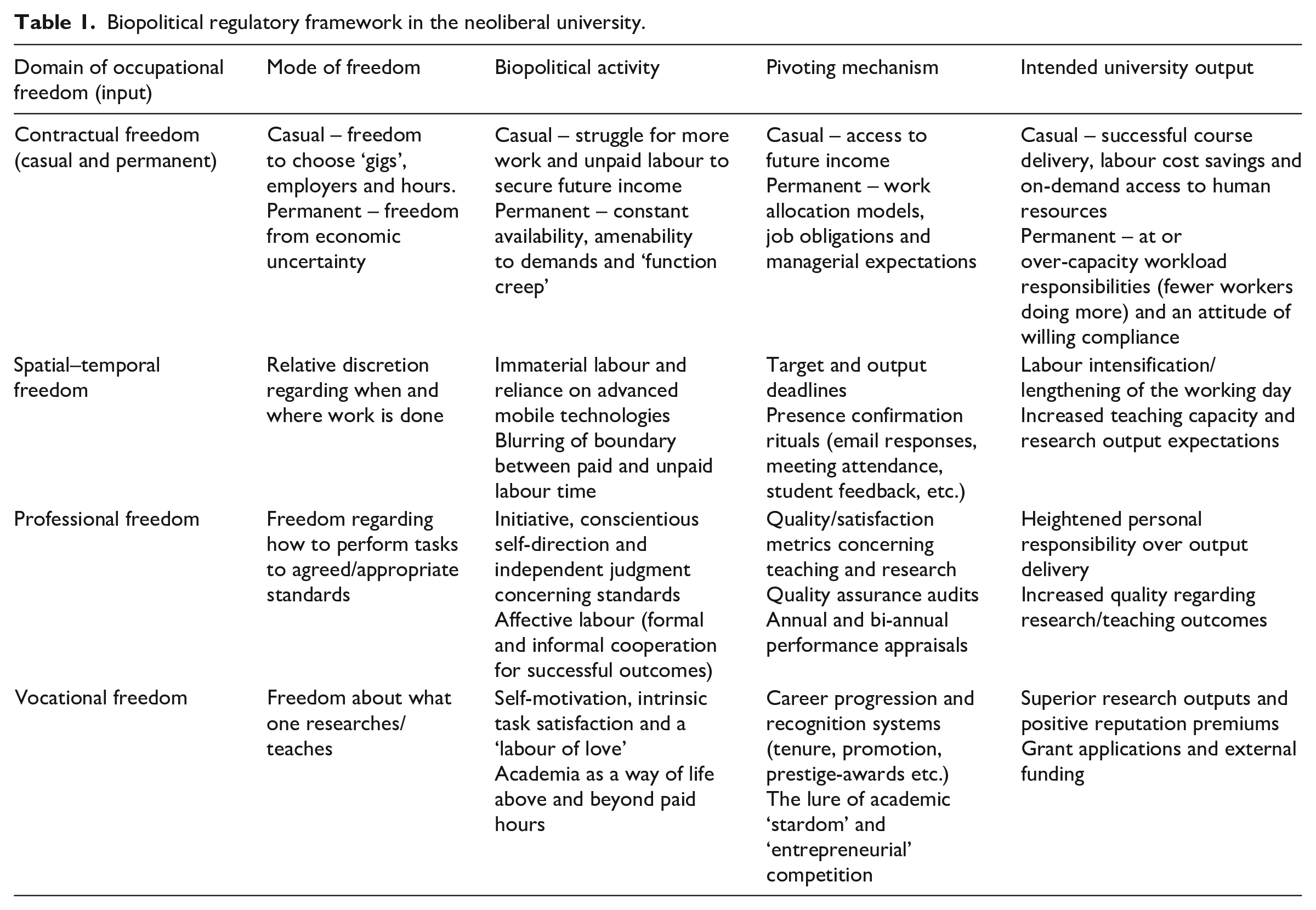
First is contractual freedom. For all the discussion about academic identity and selfhood, analysts sometimes forget that income (and its contractual obligations) is an essential tool for aligning self-governance with managerial targets/goals. The neoliberal university’s controversial use of adjuncts is a case in point (Childress, 2019; Kezar et al., 2019). Casual academics are technically ‘free’ to choose their jobs, switch between multiple employers and determine their own workload. The biopolitical activity evident here is the struggle for more work and continuous self-monitoring to avoid wage theft, which frequently spills over into private life, as Gill and Donaghue (2016) and Kezar et al. (2019) demonstrate. Undue stress and anxiety usually ensue (Loveday, 2018; Morrish, 2019). This contractual freedom is pivoted towards managerial goals by offering/withholding future income, depending on past quality and future demand. The intended outputs are successful course delivery, labour cost savings (i.e., pensions, holiday pay, etc.) and on-demand access to human resources.
Tenured academics enjoy a guaranteed salary, which significantly reduces their contractual autonomy compared with casual employees. They are ‘free from’ economic insecurity, which would not be noteworthy apart from the rapid growth of insecure jobs. But this type of freedom still engenders biopolitical activity I propose. As Gorz (2012: 91) remarks, the floating salariat is ‘paid for their availability and their capacity to intervene, not the actual work done’. This expectation of availability can easily see academics voluntarily working beyond paid hours, being contactable whenever supervisors call, and so forth (Gill and Donaghue, 2016). Together with the other mechanisms discussed below, this can precipitate what Gregg (2009) terms function creep, where formal duties inexplicably multiply (also see Wright and Shore, 2018). Indeed, some tenured academics find it more difficult to say ‘no’ than adjuncts given how their availability is perceived to be open-ended (Alexander, 2020; Gannon, 2020). This contractual autonomy is pivoted towards institutional objectives via departmental workload allocation models and supervisory expectations of availability/cooperation, which is meticulously documented in annual performance reviews (Lorenz, 2012; Shore, 2008).
Second is spatial–temporal occupational freedom. Notwithstanding the controlling climate of the neoliberal university, academics remain comparatively free to decide when and where they work, within limits, of course (Cannizzo and Osbaldiston, 2016; Nikunen, 2012). The COVID-19 pandemic saw universities leverage this mobility as private residences were converted into de facto lecture halls. But even before the crisis, advanced communication technologies had routinized remote working in higher education (Woodcock, 2018). Like other professions, academics experience this as a mixed blessing, with spatial–temporal autonomy often protracting rather than shortening the working day, as Gill (2010) observes. It is more likely that lifestyle patterns are tapped and/or sacrificed to support one’s capacity to work, including personal resources and family networks. According to Gill, the highly cognitive characteristics of academic labour make it susceptible to this presence bleed. Digitalization means that work can literally be undertaken anywhere, anytime. Building on the notion of ‘immaterial labour’ and research demonstrating how paid employment increasingly colonizes personal time, Gill refers to academia without walls: ‘alongside the intensification of work in academia, we are also experiencing its marked extensification across time and space’ (Gill, 2010: 237, also see Jarvis and Pratt, 2006). The COVID-19 pandemic obviously amplified this ‘extensification’ and its concomitant anxieties (Gewin, 2021), underscoring the negative bodily effects of cognitive labour in the neoliberal university today (like ‘stomachs churning’ and ‘hearts pounding’, as Sparkes [2007: 522] notes).
Extensification is not an automatic process, however. It requires pivoting mechanisms to ensure that academics use their spatial–temporal autonomy to meet organizational expectations rather than simply disappear. The managerial focus on outputs (instead of inputs) is essential once again, assisted by the so-called ‘digital leash’ of email and Microsoft Teams. Task and target deadlines (for grading exams, submitting journal articles, completing programme delivery objectives, etc.) take precedence, typically accompanied by sanctions for noncompliance (Kallio et al., 2015). The neoliberal university has become notorious for ramping up these output expectations (e.g., farming out more classes, more marking, etc.), with excessive work hours now pervasive. A recent study found that UK academics regularly work two unpaid days per week, with professors working 56.1 hours per week and Principal Research Fellows 55.7 hours (Grove, 2016). Astonishingly, one in six academics under the age of 25 work 100 hours per week.
I have heard anecdotal evidence from colleagues about additional methods universities use to regulate academic spatial–temporal freedoms. For instance, what we might term presence confirmation rituals see supervisors monitor email response intervals and issue roll calls for online meetings. Overall, universities gain considerable outputs from this type of occupational freedom, including a lengthened work day, labour intensification (with personal life invariably conscripted to contribute) and increased teaching capacity.
Third is professional occupational freedom. Academics typically have discretion over how they perform their jobs well, drawing on collective knowhow and judgment apropos norms of best practice (Ibrahim et al., 2012; Kenschaft, 2008). Importantly, these professional standards are community-based and may circumvent the technocratic templates imposed by administrators. Informal cooperation, knowledge sharing and workaround solutions epitomize this (Harney and Moten, 2013; Raaper, 2016). Think also of the goodwill and effort involved in journal reviewing/editing, which is indispensable to the profession yet seldom recognized by employers. According to Gregg (2009), this unsettles the stereotypical image of the solitary scholar striving alone. While academic professionalism certainly requires individual proficiency, interpersonal or ‘affective labour’ is vital too. Metrics measure none of this, of course. In any case, spurred on by email and performance expectations, professional diligence can absorb ever greater swathes of selfhood; as one professor admitted to Gregg (2013: 126): ‘I think I’m a bit too either addicted or compulsive about it or obsessive about it . . . I worry that I’m going to miss something that I ought to be attending to.’
The biopolitical activity manifest here is the independent use of professional judgement, discretion and collegiality to ensure that tasks are completed properly (which may not always occur, of course). As studies of professionalism have shown more generally, this kind of freedom is particularly important in knowledge-intensive occupations where contingences arise and require self-organization (Maravelias, 2003; Muzio et al., 2019). The mechanisms deployed to pivot professional freedom are now a familiar refrain of lament: the surfeit of quality metrics that scrutinize teaching/research outputs (e.g., student satisfaction scores, journal rankings, article citation ratings, etc.) (Butler and Spoelstra, 2012; Macdonald and Kam, 2007; Mingers and Willmott, 2013; Willmott, 2011). Digitalization and big data have recently entered this realm too, as the growing use of ‘performance dashboards’ indicates. Interestingly, senior management may also evoke the language of professionalism to enforce this metrification, referring to quality assurance standards, benchmarking and compliance. More often than not, however, this only grates with academic professional norms, as metrics are construed as a proxy for (conformity to) managerial authority rather than best practice (Cannizzo, 2018a; Morrissey, 2015). This is especially so if overseen by administrators who have never taught a class or written a research article in their lives.
Fourth is vocational freedom. Most academics are free to pursue research topics that personally interest them. Teaching too will often reflect these interests (Ekman, 2016). The term ‘vocation’ derives from the Latin vocare or ‘to call’ (Robbins, 1993). Like other professions, an academic calling is more than just a source of income. Reading, research and teaching are intrinsically rewarding, involving a sizeable investment of time and energy (Barcan, 2018; Elangovan and Hoffman, 2021). Scholars may also personally identify with their vocation, viewing it as an extension of ethico-political commitments (Gill, 2010).
Academics often bracket this vocational autonomy from the technocratic machinations that otherwise structure their jobs, viewing it as a kind of intellectual sanctuary. This explains why Osbaldiston et al. (2019) observed early-career scholars declaring that they hated their jobs (e.g., enduring excruciating performance appraisals, etc.) but loved their work (e.g., reading, teaching and research). 2 However, mentally separating our vocational passion from this painful milieu is fraught with problems, according to Cannizzo (2018b). His study revealed employers implicitly stoking this ‘labour of love’ sentiment among faculty. It is a tremendous productivity booster, after all. Gregg (2009: 211) suggests this explains ‘the extraordinary ability of academics to excavate working hours from a range of times in the day’.
The biopolitical activity identifiable here is the voluntary effort academics dedicate to advance their scholarly area (Davies, 2005; Lawless, 2018). This frequently involves extra-contractual activities like self-training and deep study outside office hours (Clarke et al., 2012; Edwards, 2020). Universities pivot this vocational freedom towards measurable outputs by pegging it to recognition and prestige rewards (also see Labaree, 2017, 2018). Tenure confirmation, promotion and various achievement accolades serve this purpose. We might also include the lure of academic ‘stardom’ that has recently appeared in the profession, supercharged by social media and the university’s obsession with positive publicity. Here, the ideology of entrepreneurship may indeed feature as a pivoting mechanism, as academics compete to enhance their ‘personal brand’. At any rate, incorporating these recognition premiums into individual career paths was a rather shrewd tactic for enrolling academic agency. The flipside, of course, has been the normalization of performance anxiety and insecurity within the profession (Clarke and Knights, 2015). The intended university outputs are superior research and broader reputational kudos, which may attract lucrative endowments and external income.
On the end(s) of freedom at work
When bios is put to work, three interrelated effects are observable: the vertical extension of productive activity ‘within’ individuals (whereby immaterial and largely unquantifiable cognitive, affective and social capabilities are marshalled); the horizontal extension of productive activity beyond contracted hours (in which personal spaces/resources and/or social networks are enlisted to accomplish tasks); and the reliance on self-organization within the workforce. Pivoting mechanisms are the managerial levers that coordinate these effects, synchronizing freedom and labour intensification, autonomy and institutional control, discretion and zealous overwork. By drawing on management/organizational and critical university studies to gain a deeper appreciation of how this happens, five implications are pertinent for future research.
Firstly, we can overcome the limitations of the ‘frame’ metaphor used in management/organization studies. Occupational freedoms are not enclosed but aligned via a regulatory framework. Pivoting mechanisms allow employers to do this in a laissez-faire yet assertive fashion because the actor him or herself mainly directs the action (to meet externally imposed output expectations, or ‘events’, to use Foucault’s terminology). Occupational freedoms thus retain their practical integrity even when enmeshed in a tight network of governmentality. This is observable in the academic labour process. Contractual, spatial/temporal, professional and vocational freedoms are set into orbit around the university’s production hub. This is a dynamic process that tilts bios towards rigidly monitored outputs, as depicted in Figure 1.

The biopolitical pivoting of academic labour.
Secondly, this approach does not rely on ‘subjectification’ as a catchall explanation for why academics sometimes enact their autonomy in self-exploitative ways, which I have problematized in the literature. In management/organization studies, a related difficulty emerges. Biopolitical workers are frequently viewed as brainwashed advocates of the marketplace – homo oeconomicus – who happily identify with the ostensible freedoms that neoliberalism engenders. Although some workers resist, most have internalized the mythos of enterprise. Critical university studies offers an important counterpoint here. Empirical research finds very few academics feeling liberated or enthusiastic about the realities of higher education today. Even the most ambitious careerists complain of exhaustion, anxiety and runaway managerialism (Clarke and Knights, 2015). This is the dark side of biopolitics, where an unhappy consciousness prevails. Individuals may therefore be regulated by biopower even if they dis-identify with neoliberalism. I am not arguing that subjectivity is unimportant, of course. But employers do not need to expend resources on cultivating it to have the desired biopolitical effect.
The third implication is related. Most examinations of biopower in management/organization studies concentrate on how employees are recast as self-reliant entrepreneurs, especially in the gig economy. One motivation for this article is to broaden the applicability of biopower beyond gig workers and the discourse of entrepreneurship. No doubt the motif of entrepreneurship has indeed penetrated higher education (also see Edwards, 2020; Peters, 2005), but do academics really model themselves after entrepreneurs? Some senior university managers would like to think so. Imperial College Vice Chancellor Alice Gast revealed this when asked about the tragic suicide of Professor Stefan Grimm: ‘professors are really like small business owners, it’s a very competitive world out there’ (BBC, 2015). And as Styhre (2017) argues, economic precarization has steadily pushed professional jobs in this direction more generally, with doctors acting as sales reps, lawyers becoming social media personalities, and so forth.
Some scholars do buy into the fantasy of entrepreneurism with respect to grants, competitive individualism, self-promotion or what Sparkes (2021) sardonically calls ‘making a spectacle of oneself’. But I think this article reveals a more understated dynamic. The transformation of academics into self-organizing agents of the neoliberal university has not needed to trumpet the virtues of entrepreneurship. What has transpired instead, I believe, is that the concrete logic – if not the discourse – of homo oeconomicus has been embedded into the occupational praxis of the academy, prompting a transition from traditional professionalism to biopolitical professionalism. Pre-existing forms of occupational autonomy, discretion and freedom have been integral to this shift, proving fertile ground for the four pivoting mechanisms theorized above – hence why established and secure academics are now managed this way as much as precarious ones, and why even the most vociferous critic of academic capitalism finds themselves ‘playing the game’ with respect to journal rankings and rampant careerism (Butler and Spoelstra, 2012; Knights and Clarke, 2014) . . . and biopolitically managed accordingly (Raaper, 2018; Webb, 2018). It is this more materialist interpretation of biopower that I believe has wider purchase for researchers.
Fourthly, the role of coercive managerialism in biopolitical regulation deserves further consideration. In the case of academia, we ascertained that workers are responsible (up to a point, at least) for regulating inputs, whereas output controls are the remit of administrative hierarchies. Failure to meet performance targets can provoke a Stalinesque response from employers (Brandist, 2014; Jones et al., 2020). But what if this micromanagement were directed towards inputs too (represented by the broken line in Figure 1) – for example, tracking office attendance, monitoring internet content or even vetting research topics (as Critical Management Studies scholars recently experienced at Leicester University)? Such regulation of input freedoms would disrupt the biopolitical process in significant ways and begs the question of how academics might react. Those feeling aggrieved may ‘work to contract’, for example, restoring the life/labour boundary and short-circuiting biopower as a result. And if that occurred, would it not be yet another example of what critics of managerialism have long noted, namely, its proclivity to ‘kill the golden goose’ and succumb to the seductions of total administration? (Hanlon, 2015).
The fifth implication concerns resistance. Biopower is difficult to oppose because its central idiom is ‘freedom’, and how does one resist that? Studies of biopolitics in the gig economy reveal a striking paucity of defiance in this respect, with the exception of Norbäck (2021). She observed freelancers attempting to resist biopower by denaturalizing the entrepreneurial subjectivities it encouraged, intentionally reducing work hours and sabotaging quality. But rather than improve their situation, these tactics only eroded future income and made matters worse. Norbäck (2021: 441) pessimistically concludes that resistance to biopower is ‘ambiguous, ambivalent, and contradictory, and often practiced at a personal cost’.
This bleak observation imbues investigations of biopower in the neoliberal university too. For Docherty (2016: 22), academics are now ‘among the most conservative, ineffectual and disorganised of workforces’ in the post-industrial economy. According to Davies and Petersen (2005) and Webb (2018), the defeat of collective dissent ought to be considered a significant output accomplishment of biopolitical regulation (see Figure 1), for it confers substantial socio-economic advantages to employers. Biopower thwarts opposition in several ways. For example, academics are empowered through ‘responsibilization’ to self-organize and improvise, sometimes transgressing managerial rules while doing so. But this often results in targets being met nonetheless, sometimes more so. Raaper (2016: 178) empirically observed this when administrators commandeered longstanding faculty assessment protocols. In response, angry academics sought to ‘modify and resist the dominant policy discourses’ by ‘manoeuvring within the regulatory context and flexing the rules’. This made little difference and probably helped the new system. According to Bansel and Davies (2010), much academic resistance is problematic because it aims to protect freedoms that are now hallmarks of biopolitical regulation. This ironically signals obedience to the corporate university, ‘not through a love of neoliberalism, but through a love of what neoliberalism puts at risk’ (Bansel and Davies, 2010: 144).
One reason why researchers see little hope for resistance is because they have not fully considered the input/output distinction discussed in this article. By viewing biopower as primarily input discretion, analysts conclude that academics must curb their own freedoms, which they rightly surmise is unlikely. For example, Raaper (2016: 187) argues (echoing Davies 2006: 436):
. . . it might be difficult to express one’s resistance if it is not completely clear who and what to resist, especially if academics might have to resist their own internalized understandings in relation to themselves and their work in a neoliberal university.
Similarly, for Ball and Olmedo (2013: 93) resistance ‘is about confronting oneself’. But this misses the main issue. There is a clear focal point for those wishing to oppose biopower – the managerial monopoly over how organizational outputs are defined and enforced, which has relegated academics to mere bystanders in their own profession.
Conclusion
Foucault’s concept of biopower holds much promise for developing a unique and counterintuitive understanding of emergent management practices in contemporary workplaces. Building on two rich research seams – management/organizational and critical university studies – I hope the concept of pivoting mechanisms further elucidates the relationship between freedom and control in organizations today. Biopower does not frame or subjectify employee autonomy but pivots it instead. Consequently, the notion of biopower overcomes a number of ingrained theoretical dualisms. Regulation and freedom are not diametrically opposed as often assumed, displacing enduring beliefs about social emancipation and political liberty. Life and labour may seem like separate spheres, as Marx, Weber and others argued. But biopower weds them, enrolling bios into a sometimes unforgiving economic machine.
The example of academia is interesting in this respect. It is tempting to assume that biopower has always been present, as academic autonomy largely predates the neoliberal university. Historical research indicates, however, that previous higher education institutions did not employ the same kind of input/output matrix we have discussed, which sees autonomy and control locked into a mutually reinforcing embrace (see Hook et al., 1974; Newfield, 2011). As the neoliberal university matured, I argue, biopower entered the scene and requisitioned important legacy norms associated with flexibility and self-governance. Once repurposed into a vehicle of regulation, resistance aiming to protect those norms is mostly self-defeating.
The situation is made even more complex by the fact that this is no straightforward management versus workers struggle. Deans and senior administrators face significant pressures from industry actors, including state agencies evaluating ‘research excellence’, international accreditation organizations, fickle student markets, ranking bodies and public funding ministries. These external forces manage universities too, defining the outputs of academic labour and their value. Although this article has focused on biopower at the institutional level, broader strategies of governmentality are imperative as well. Academics seeking to resist biopower – especially in public universities – must therefore wage their struggle on multiple and potentially formidable fronts.
That may seem like an overwhelming undertaking. So beginning locally, in individual universities, is probably the best course of action. My analysis reveals a clear avenue in this regard, sidestepping the counterproductive effects of much academic dissent today. We now know that biopower regulates workers by permitting them to decide (sometimes subversively so) where, when and how they work . . . but only in so far as the guiding socio-economic framework (i.e., output performance targets, etc.) remains uncontested. If resistance is to be successful, it must fight for the meta-freedom to redefine this framework in contemporary universities. Power to determine the ultimate ends of our shared labour – rather than only its means – is central, reconstituting academic freedom as a collective problem rather than an individual one. In some respects, this is not such a tall order, as we (our bodies, aptitudes, cognitive skills and social connections) are the academic means of production. Effective opposition simply implies repossessing what we already are and developing new steering mechanisms. Regardless, I am convinced that the concept of biopower offers a powerful tool for those interested in alternatives to the current regime.
Footnotes
Acknowledgements
I would like to thank the Action Editors and anonymous reviewers for their excellent feedback on this article.
Funding
The author received no financial support for the research, authorship and/or publication of this article.
