



Abstract
Does everyone around you seem to be juggling the work and family roles more successfully than you? This research examines the influence of social comparison of work–family balance in the work role overload to emotional exhaustion relationship through two paths – a spillover path to both job and family emotional exhaustion for the job incumbent and a crossover path to the spouse to their own family emotional exhaustion. Further, we examine whether the personality trait of social comparison orientation exacerbates these processes. We used matched responses over two time periods from 403 dual-earning, married couples living in the United States to test our hypotheses. We found support for all our hypothesized relationships. Social comparison plays a role in individuals’ perception of work–family demands, which may contribute to undesirable consequences for both the job incumbent and the spouse.
I know I am burdening my spouse with my work problems when I make comparisons to my coworkers. (Study participant)
The process of comparing oneself with others to gain knowledge about the self (i.e. Social Comparison Theory, SCT, Festinger, 1954) can take place across a host of dimensions and domains (Buunk and Gibbons, 2007). In today’s world of social media, the tendency and ability to look at others’ lives for information about how to think, feel, and act is perhaps more prevalent than ever (Baldwin and Mussweiler, 2018). The proliferation of information that is shared is likely to result in a multitude of social comparisons occurring in different domains of life. Two of the most notable domains for social comparisons are work and family lives. Perceptions of others being more successful than yourself, in any domain, can elicit negative emotional responses (Tesser, 1988). While this notion of social comparison has been explored in many different settings, it has yet to be applied to the way in which people manage their work and family interplay. Thus, the focus of this research is an examination of how social comparisons, a widespread human experience (Buunk and Gibbons, 2007), impact work–family balance (WFB) through spillover and crossover processes. This is particularly important because it answers the call to consider other situations in which social comparisons may be prevalent and having an effect (Buunk and Gibbons, 2007), in this case within the work–family interface. Thus, by examining social comparisons in the work–family interface as an explanatory link, we provide a more comprehensive view of what drives the assessment of resources in the work–family dynamic and expand our perspectives on the different dimensions upon which employees may be comparing themselves beyond the work domain.
Individuals are motivated to maintain positive self-evaluations and often seek to make such evaluations by comparing themselves with relevant social referents (Festinger, 1954). In that way, individuals’ self-worth is influenced by how they see themselves in relation to others and then act accordingly (Wood, 1989). Additionally, extant research has demonstrated that people’s well-being largely depends on how they perceive their situation compares with others (Tan et al., 2020). A specific context in which comparison others can emerge is among coworkers. Interestingly, an area in which employees may compare themselves with coworkers is how each is managing their work–life interface. Thus, the comparison of WFB can shed light on how workers experience this phenomenon by means of social comparison and its implications for both work and family. While WFB has historically been examined by simply documenting the experience of it, incorporating a social comparison process can shed nuanced light on how WFB social comparison occurs when individuals compare how they are juggling the demands of life with a comparison other at work.
In this study, we investigate how employees’ social comparisons of their work demands (work role overload (WRO) social comparison) and WFB social comparison ultimately influence their emotional exhaustion. Researchers argue that to truly understand emotional exhaustion, “attention has to be paid to the way individuals perceive, interpret, and construct the behaviors of others at work” (Buunk and Schaufeli, 1993: 53–54), which can occur through the comparison process. Indeed, emotional exhaustion is developed primarily in a social context (Schaufeli and Buunk, 2003), and the ways that individuals make sense of behaviors of others at work can elicit emotional exhaustion (Buunk and Schaufeli, 1993). While previous research has examined SCT along with stress when considering relationships at work (Buunk et al., 2001b; Vardaman et al., 2016), we extend this focus by incorporating the work–family interface. Specifically, by integrating SCT (Festinger, 1954) with the stress framework of Conservation of Resources theory (COR, Hobfoll, 2001), we provide unique insights into how the work–family interface plays a role in the social comparison process by looking at dual paths through which the work demands to emotional exhaustion relationship may play out: a spillover path for the job incumbent and a crossover path to the spouse.
In the spillover path (see Figure 1A, top half of the model), we examine WRO social comparison on both job and family emotional exhaustion, which is defined as being depleted of one’s emotional resources owing to the job and family respectively, through the assessment of resource deficit represented by experiences of WFB social comparison and subsequent self-evaluations of WFB self-efficacy. Given the focus of this research is on the spillover of stress from the work domain to the family domain, the comparison of one’s work demands relative to the work demands of their coworker was the most relevant to the current study. When the incumbent’s WRO social comparison is unfavorable (i.e. incumbent perceives more overload than his or her comparison other), he or she believes there are fewer resources to adequately balance work and family demands relative to the comparison coworker thus driving this resource assessment. This unfavorable WFB social comparison proves detrimental to one’s ability to believe he or she can effectively achieve WFB, which culminates in greater emotional exhaustion in both the work and family domains. Similarly, the crossover path (bottom half of the model) suggests that as the assessment of resource depletion is experienced through social comparisons with others, the poor self-evaluation experienced by the job incumbent will cross over to impact the spouse’s WFB and ultimately the family emotional exhaustion experienced by the spouse. Finally, we expect that each of these paths will be magnified when the job incumbent has a propensity to engage in social comparisons (i.e. social comparison orientation, Gibbons and Buunk, 1999), an individual difference that is especially pertinent when considering the effects of social comparisons (Buunk et al., 2001a).

Study model – panel A: hypothesized model – panel B: standardized path loadings.
This research makes a number of contributions to the goal of understanding the role of social comparison in the work–family interface. First, we integrate SCT and COR theory to expand past research that has examined the role that work demands play on job emotional exhaustion (Demerouti et al., 2001). While Hobfoll (2001: 338) posits that “the encounter of the self with stress is primarily situated in a social context or involving social consequences”, little is known of how individuals can see their resources in comparison with others with whom they work (Hobfoll et al., 2018). Our study addresses this notion by highlighting the nuanced process in which employees experience resource losses owing to social comparisons of their WRO and WFB, which contributes to their WFB self-efficacy and job emotional exhaustion. We introduce a novel construct of WFB social comparison to capture the resource assessment that considers a wide range of work and family demands. By elucidating the role that social comparison plays in the depletion of resources, this study helps demonstrate a way that individuals assess their work–family situation, via social comparisons, in order to form judgments about it.
Second, we extend prior work by exploring how the social comparison process can be used to explain the spillover and crossover effects on the family domain. While it is evident that the integration of SCT and organizational behavior research needs further investigation (Greenberg et al., 2007), the idea of social comparison in the work–family interface and its implication for the family domain has yet to be explored. Thus, this study broadens the understanding of the work–family interface by uncovering the impact that social comparison has on family emotional exhaustion for both the job incumbent and the spouse. This also demonstrates the far-reaching effects of the social comparison process beyond just a single domain so that we more completely understand what is at play.
Finally, we examine social comparison orientation as a boundary condition to determine the role of personality, WFB self-efficacy, in exacerbating the impact of WFB social comparison on perceptions of balance. While previous research has examined the impact of the big five personality traits regarding conflict (Allen et al., 2012; Michel et al., 2011), the personality dimension of social comparison orientation has not yet been considered in the work–family arena. This research explores an important personality trait to consider when examining evaluations of how individuals are managing work and family demands relative to their peers: social comparison orientation. Thus, as a boundary condition it is critical as it helps illuminate how this process works for those prone to comparing themselves with others.
Theoretical foundations
Social comparison theory is based on the idea that individuals are motivated to evaluate their opinions and abilities by comparing them against an objective standard. If such a standard does not exist, they compare themselves with others (Festinger, 1954). Additionally, the social comparison process involves identifying a similar other with whom to compare (Festinger, 1957). The comparisons can take place across various domains (Buunk and Gibbons, 2007; Wood, 1989) and often lead to a realized divergence in opinions, behaviors, or values, that then motivate feelings and behaviors aimed at reducing the realized inequity (Festinger, 1954). Extant research has shown how performance (Cohen-Charash, 2009) or personal attributes (Cohen-Charash and Mueller, 2007) can be influenced by social comparisons. For example, when people acknowledge they are being outperformed by a coworker, they can reduce their own self-evaluations (Quade et al., 2019).
Integrating SCT with COR theory helps elucidate the role of social comparison in the work–family interface. COR theory postulates that individuals are motivated to protect, procure, and preserve resources such as objects, states, conditions, and personal characteristics, and those who have fewer resources likely experience a resource loss spiral (Hobfoll, 2001). This theory suggests that as work demands increase and resources are lost, or are inadequate to meet demands, emotional exhaustion occurs (Hobfoll and Freedy, 2017). We incorporate the social comparison perspective to examine this loss process through two paths in which the work demand comparison is carried, spillover and crossover, to help shed light onto how this resource loss, as explained by COR theory, works (Bakker and Demerouti, 2013; Halbesleben et al., 2014). Spillover is an intra-individual process that examines the role that experiences in one domain have in another domain, while crossover is an inter-individual process that examines the role that experiences of one individual have on another individual (Bolger et al., 1989). We answer the call to look beyond stress of resources (Hobfoll et al., 2018) by integrating SCT with COR theory to incorporate a new and unique perspective in which resources may be impacted. Doing so allows us to provide an expanded understanding of the role of social comparison in the resource loss process through spillover and crossover.
Spillover path: Work role overload and work–family balance social comparison
We take a novel, social comparison, approach to theorizing WFB and examining how it is affected by the social comparison of WRO. WFB social comparison is a nuanced construct that broadly incorporates the work and family dynamics and is applicable across family structures. WFB social comparison stems from WFB, defined as the “accomplishment of role-related expectations that are negotiated and shared between an individual and his or her role-related partners in the work and family domains” (Grzywacz and Carlson, 2007: 458). This construct is in line with COR theory as positive relationships between family members are resources (Hobfoll, 2001). Indeed, extant research has demonstrated that WFB is a resource that can provide benefits for incumbents in the work domain (Carlson et al., 2009, 2013) as well as the family domain (Carlson et al., 2009; Ferguson et al., 2012). According to SCT, employees likely compare work role characteristics (Brown et al., 2007) or resources (Bégue, 2005) to those of their coworkers. We contend they are also prone to compare how they balance work and family demands relative to their coworkers (WFB social comparison). We consider WFB social comparison an active process of comparing one’s accomplishment of shared and negotiated work- and family-role-related expectations compared with the coworker’s accomplishment of such expectations. Much like other social comparisons that are made without complete, objective information and are perception-based (Festinger, 1954), employees are given a glimpse into coworkers’ WFB via information gathered from conversations with and observations of those coworkers as well as potentially even their social media. Notably, perceptions can provide effects that are similar to those that result from objective information (Jussim, 1991). WFB social comparison captures more than the roles they are in but considers home structure, partner work demands, housework, and childcare, all of which are likely changing and evolving regularly.
We anticipate that WRO social comparison is a critical factor influencing WFB social comparison. The demands involved in occupying multiple roles in a domain is a key construct in the work domain that can be used for comparison purposes. Role overload in the work domain occurs when an individual has more demands at work than resources available to satisfy them (Coverman, 1989). SCT, as it relates to COR theory, would suggest that individuals look to those around them in the workplace to seek information and determine perceptions regarding personal experiences with role demands relative to those of their coworkers (Festinger, 1954, 1957; Wood, 1996). Individuals who feel their WRO is greater than their comparison coworker are likely to feel they are at a resource disadvantage. More specifically, employees who perceive they are more overloaded in their work role than their comparison coworker would be said to be making an unfavorable WRO social comparison. In line with COR theory and the idea of spillover, as individuals perceive that their work role is overloaded and they cannot meet demands in their existing role, they recognize that they have limited resources available. The resource depletion accentuated from social comparison in the work domain may spill over into the family domain (Bakker and Demerouti, 2013). In our model, the spillover mechanism from work to family within a person is captured by WFB social comparison.
Since the workplace is a competitive environment and a source of uncertainty for employees (Kay et al., 2004) and because there is more information available about the referent in the work domain (Goodman, 1974), we argue a main antecedent to WFB social comparison will be comparisons with coworkers on a dimension in the work domain, in this case WRO. As noted above, WFB is a resource that will benefit job incumbents’ life domains, and we further argue that social comparison is the driver of the incumbents’ assessment of this resource. That is, incumbents who perceive they have fewer resources to expend in the family domain than their comparison coworkers will believe they have less WFB than those coworkers, because they are more overloaded in the work domain as compared with those same coworkers. Thus, we argue that WRO social comparison will influence WFB social comparison as it represents an assessment of resources by which employees can balance work and family roles. More specifically, we predict that when individuals perceive unfavorable WRO social comparison (i.e. they believe they are more overloaded than their comparison coworker), they will perceive unfavorable WFB social comparison (i.e. they believe they have less WFB than their comparison coworker), owing to their perception of having fewer resources available to meet work–family demands, relative to their comparison coworker. As such, unfavorable WRO social comparison contributes to unfavorable WFB social comparison.
Hypothesis 1: Work role overload (WRO) social comparison is negatively related to work–family balance (WFB) social comparison.
Spillover path: Through work–family balance self-efficacy to job and family emotional exhaustion
WFB self-efficacy is a reflective judgment by a job incumbent on his or her capability to meet the demands of work and family (Chan et al., 2016). As such, it is “a belief that a person can effectively balance work and family roles simultaneously” (Basuil and Casper, 2012: 630). Although self-efficacy is regarded as a generalized construct, self-efficacy beliefs are also contingent on specific contexts (Bandura, 1977). Extant research has examined self-efficacy in the work–family context (e.g. Clayton et al., 2015; Lapierre et al., 2016). As individuals compare their WFB with coworkers, their perceptions of their WFB relative to those coworkers are likely to influence their judgments about their ability to maintain balance effectively. In line with COR theory (Hobfoll, 2001), the more diminished individuals’ resources are to meet the negotiated demands between the work and family domain (i.e. lower WFB), the less likely they are to believe they could effectively maintain WFB (i.e. WFB self-efficacy).
Thus, we contend individuals’ WFB self-efficacy will be indirectly influenced by their WRO social comparison through WFB social comparison. Extant social comparison research has consistently shown that favorable comparisons induce positive, self-inflating responses, such as pride or self-esteem (Klein, 1997; Tesser, 1995). Meanwhile, unfavorable comparisons result in negative, self-threatening responses (Dunn et al., 2012), such as reduced self-efficacy (Maslach, 1993). In this case, as individuals compare their work demands with others and recognize being at a comparative disadvantage (i.e. believing they experience more WRO than their coworkers), it will translate into less favorable WFB social comparisons (i.e. believing they have less WFB than their coworkers) and subsequently a diminished belief in one’s ability to achieve that balance (i.e. WFB self-efficacy). Therefore, we predict that WFB social comparison mediates the relationship between WRO social comparison and WFB self-efficacy, such that unfavorable WRO social comparison (i.e. the incumbent is more overloaded than his or her comparison coworker) leads to lower WFB self-efficacy through WFB social comparison.
Hypothesis 2: Work–family balance (WFB) social comparison mediates the negative relationship between work role overload (WRO) social comparison and WFB self-efficacy.
Research on stress and social comparison contributing to job emotional exhaustion has received considerable attention (Buunk and Schaufeli, 1993). In our research, we focus on the emotional exhaustion dimension of burnout, which entails being depleted of one’s emotional resources (Maslach et al., 2001). Emotional exhaustion is the state of feeling emotionally drained because of stress. In particular, we are interested in the resource drain that occurs from WRO social comparison and how it eventuates in job emotional exhaustion. Further, we also consider the family domain by examining the influence the social comparison process regarding work and family domains has on family emotional exhaustion. This extension from work stressors to the notion of family emotional exhaustion has only recently been considered (Thompson et al., 2020). We build on previous work to further consider the important outcome of family emotional exhaustion, as the experience of emotional exhaustion has been shown to play a critical role in individuals’ health and well-being (Maslach et al., 2001).
Research suggests that beliefs regarding individuals’ self-efficacy contribute to their choice of behaviors and affective states (Bandura, 1997). Consistent with the notion of resource depletion in COR theory, self-efficacy has been linked to emotional exhaustion as efficacy is viewed as a resource that, when diminished, makes emotional exhaustion more likely (Hobfoll, 2001; Schwarzer and Hallum, 2008). Further, when individuals perceive a state of diminished resources relative to a coworker, they may view the perceived deficit as a failure or lack of competence to manage WFB relative to that same coworker. Indeed, unfavorable social comparisons are threatening to an individual’s self-image (Cohen-Charash and Mueller, 2007; Tesser et al., 1988). This lowered sense of self-efficacy can cause people to lose motivation and has been negatively associated with health outcomes such as depression and anxiety (Holden, 1992) and work outcomes such as performance (Stajkovic and Luthans, 1998). This pattern of diminished outcomes is likely to hold for WFB self-efficacy, as when this resource is depleted, there are fewer resources to manage the work or family domains and emotional exhaustion is likely to ensue.
Extant work suggests one potential path through which resource loss occurs is the interface of work and family, as diminished resources owing to WRO in the work domain limit the resources available in the family domain, leading to job emotional exhaustion (Bacharach et al., 1991; Carlson et al., 2019). This perceived depleted state of resources, captured through unfavorable WRO social comparisons, and which eventuates in job emotional exhaustion, works through unfavorable WFB social comparisons and the subsequent evaluation of WFB self-efficacy. Further, the link of work stressors to family emotional exhaustion suggests that as resources are drained, individuals are unable to contribute to family demands and likely experience family emotional exhaustion (Thompson et al., 2020).
Hypothesis 3: Work–family balance (WFB) social comparison and WFB self-efficacy serially mediate the positive relationship between work role overload (WRO) social comparison and job emotional exhaustion.
Hypothesis 4: Work–family balance (WFB) social comparison and WFB self-efficacy serially mediate the positive relationship between work role overload (WRO) social comparison and family emotional exhaustion.
Crossover path: Through spouse’s work–family balance to family emotional exhaustion
Crossover occurs when demands and the strain from those demands cross over between two individuals (Westman, 2001). This involves inter-individual transmission of strain across individuals (e.g. spouses) owing to the fluidity of boundaries between work and family (Bakker et al., 2005). Experiences of one person crossing over to influence the experiences of another in a different domain is a common occurrence (Bakker and Demerouti, 2013; Carlson et al., 2011).
The beliefs that the incumbent has about how well he or she manages work and family duties, as captured by WFB self-efficacy, are likely to influence the spouse’s own perceptions of balancing work and family demands. Extant research has demonstrated how the self-efficacy of one partner can cross over to influence the other partner’s experiences at work and at home. For example, previous research demonstrated one partner’s self-efficacy in the workplace crossed over to the other partner’s work engagement through factors such as vicarious experience and verbal persuasion (e.g. Neff et al., 2013). Additionally, the self-efficacy beliefs of one parent’s parenting abilities were shown to cross over to work–family conflict as perceived by the other parent (Cinamon et al., 2007). Thus, in line with prior research and crossover theory (Westman and Vinokur, 1998), we believe that in the crossover process the spouse’s resulting experience of WFB is the linking mechanism that will subsequently play a role in their own strain. Based on these findings, we suggest that the incumbent’s WFB self-efficacy will likely play a role in the spouse’s WFB.
Hypothesis 5: Work–family balance (WFB) social comparison and WFB self-efficacy serially mediate the negative relationship between work role overload (WRO) social comparison and the spouse’s WFB.
As WFB is a sense of having satisfactorily met the demands of work and family accomplished through a series of shared negotiations between partners, the balance of one partner can impact the other partner’s experiences in the family domain (Grzywacz and Carlson, 2007; Valcour, 2007). Thus, we argue the negative impact of unfavorable WRO social comparisons through unfavorable WFB social comparisons on the job incumbent’s perception of his or her own WFB self-efficacy may cross over to impact the spouse’s subsequent personal experience of WFB and family emotional exhaustion. In other words, if the job incumbent is experiencing stress from reduced resources owing to being more overloaded than his or her coworkers and then having trouble balancing work and family because of the diminished resources, this will impact the spouse’s ability to manage his or her own demands as he or she has fewer resources in the family domain to address such demands. Some studies have documented that if a partner in a dual-earner couple finds it hard to handle work stressors or increasing conflict from work to family, the stress will cross over to the partner and impair his or her experiences juggling work and family demands (Xu et al., 2019). Thus, we seek to understand the emotional exhaustion that occurs in the family domain, which has only recently been explored within a crossover experience (Thompson et al., 2020). When job incumbents believe they have fewer resources in the workplace than their coworkers, making them feel less able to balance their own family demands, they will perceive less favorable WFB than their coworkers. This diminished capacity of the job incumbent, in the form of reduced WFB self-efficacy, results in an increased burden being experienced by the spouse that likely diminishes their own family balance and likely becomes a source of stress that contributes to family emotional exhaustion for the spouse.
Hypothesis 6: Work–family balance (WFB) social comparison, WFB self-efficacy, and spouse’s WFB serially mediate the positive relationship between work role overload (WRO) social comparison and family emotional exhaustion for the spouse.
Social comparison orientation
While most agree that social comparisons are made by most people, researchers have shown that the extent to which people do so varies considerably between individuals (Gibbons and Buunk, 1999; Schneider and Schupp, 2014). As such, social comparison orientation is an individual’s psychological disposition to compare one’s own opinions and abilities with those of others (Gibbons and Buunk, 1999). Those high in social comparison orientation base their self-evaluation on how they think others are doing, how they tend to relate what happens to others to themselves, and how they are interested in gathering information about the standing of others in similar circumstances (Buunk et al., 2005). Research has demonstrated that individuals high in social comparison orientation generally have three features (Buunk and Gibbons, 2007). First, social comparison orientation individuals have a high chronic activation of self, such that they are particularly aware of themselves around others and reflect on this comparison (Stapel and Tesser, 2001) making them more likely to engage in social comparisons and to emotionally or behaviorally respond to the perceptions of those social comparisons (Buunk et al., 2001b; Van der Zee et al., 1998; Vogel et al., 2015). Second, they are characterized by a strong interest in what others feel and are generally sensitive to the needs of others (Buunk and Gibbons, 2007). Third, those high in social comparison orientation have an uncertainty of self and often have poor self-perceptions and low self-esteem (Buunk et al., 2003; Vogel et al., 2015).
Conservation of Resources theory considers personal traits as key resources, which “provide an explanation for why some people are better than others in coping with stressful circumstances and in collecting new resources” (Ten Brummelhuis and Bakker, 2012: 550). Here, we argue low social comparison orientation indicates a high level of personal resources, because individuals are less likely to evaluate themselves through the lens of social comparison. High social comparison orientation, however, suggests a low level of personal resources as people are inclined to compare with others to understand themselves, making them more vulnerable to be influenced by external surroundings. Thus, people with fewer personal resources (i.e. high social comparison orientation) tend to experience stronger resource loss mechanisms of social comparison. Therefore, we predict social comparison orientation, representing a low level of personal resources in COR theory, will exacerbate the negative influences of unfavorable WFB social comparisons on WFB self-efficacy. More specifically, when those who perceive unfavorable WFB social comparisons are also high in social comparison orientation, the ramifications of perceiving a WFB deficit relative to coworkers will be compounded by this self-defeating mindset (Thau et al., 2007) that is marked by chronic uncertainty (Gibbons and Buunk, 1999). This is owing to those high in social comparison orientation, who are prone to making comparisons, being more negatively influenced by self-confirming evidence of how they are deficient relative to others (Van der Zee et al., 1998; Vogel et al., 2015). Thus, high social comparison orientation is likely to contribute to lower perceptions of WFB self-efficacy that result from unfavorable WFB social comparisons.
Hypothesis 7: Social comparison orientation moderates the work–family balance (WFB) social comparison to WFB self-efficacy relationship such that the effect will be stronger when social comparison orientation is high.
Put together, we expect the moderating effect of social comparison orientation to hold for the spillover path to job and family emotional exhaustion as well as the crossover path to family emotional exhaustion for the spouse. We draw these hypotheses based on COR theory, which argues that people who lack personal resources (high social comparison orientation in the study) are more susceptible to stress and strain. Thus, we anticipate the resource loss spirals (Heath et al., 2012; Neto et al., 2016) between WRO social comparison, WFB social comparison, WFB self-efficacy, emotional exhaustion of work and family tend to be stronger when employees’ social comparison orientation is high.
Hypothesis 8: Social comparison orientation moderates the serial mediation from work role overload (WRO) social comparison to (a) job emotional exhaustion, (b) family emotional exhaustion for employees through work–family balance (WFB) social comparison and WFB self-efficacy, and (c) family emotional exhaustion for the spouse through WFB social comparison, WFB self-efficacy and spouse WFB such that the effects will be stronger when social comparison orientation is high.
Method
Participants and procedures
The data were part of a larger data collection effort and were collected at two points in time from 403 dual-earning, married couples who worked full-time and lived in the United States. We advertised on Facebook to recruit interested participants. Facebook advertisements included a link for potential respondents to register for the study. For inclusion in the study, respondents had to be married, have a spouse who worked full time, and live in the United States.
The first job incumbent survey was sent via email to the 634 respondents who qualified for the study. We received 562 completed surveys and removed 11 responses that included failed attention check items (Meade and Craig, 2012) for an initial response rate of 89%. One month later, the second job incumbent survey was sent to the 551 remaining job incumbent respondents and a separate, individualized survey was sent to the 551 spouses. We received 516 complete job incumbent surveys (retention rate of 92%) and 511 complete spouse surveys at Time 2. However, four job incumbent and six spouse responses were removed owing to failed attention check items. The remaining valid job incumbent and spouse surveys were matched, resulting in 403 spousal dyads (79% matched response rate). All 403 job incumbents in the final sample were paid with an Amazon gift card.
The couples in the final sample had been married an average of 8.58 years and had on average 1.6 children living at home. The job incumbents averaged 35.26 years of age, while the spouses’ average age was 36.54 years. Of those who identified their gender, 74% of the job incumbents were female and 70% of the spouses were male. The majority of our respondents were Caucasian (82.1% of job incumbents and 80.4% of spouses). Approximately 33.3% of the job incumbents and 31.8% of the spouses held supervisory positions. Job incumbents’ average organizational tenure was 6.78 years and spouses’ was 6.51 years. Job incumbents worked an average of 39.83 hours per week and their spouses worked an average of 40.85 hours.
Measures
At the beginning of the survey study participants were asked to identify, by first name only, “a person in your organization with whom you work frequently who is in a comparable position, has a similar educational background, and has approximately the same organizational tenure”. This prompt follows extant social comparison research (Cohen-Charash and Mueller, 2007) and helps ensure respondents compare themselves to similar others, per the theory (Festinger, 1954). Unless noted, the response scale for all items was 1 = strongly disagree to 5 = strongly agree.
Job incumbent Time 1 measures
Work–family balance social comparison
We used Carlson et al.’s (2009) six-item WFB scale to capture WFB social comparison (α = .92) by asking incumbents to answer when thinking about a specific coworker. This scale was validated in a pilot study across two samples (see Appendix 1). Respondents read the following prompt “When considering [coworker], how much more or less likely are you to experience each of the following than him/her?” before answering the WFB items. The response scale used was 1 = much less likely compared with [coworker] to 5 = much more likely compared with [coworker] (Quade et al., 2019). A sample item is “I am able to negotiate and accomplish what is expected of me at work and in my family.”
Work role overload social comparison
Respondents were asked to respond to three WRO social comparison items developed by Bacharach et al. (1991) using the same instructions and response scale as WFB social comparison and considering the same comparison coworker (α = .83). A sample item is “not have time to finish the job”.
Social comparison orientation
We used Schneider and Schupp’s (2014) six-item scale to measure social comparison orientation (α = .80). A sample item is “I am the type of person who compares often with others.”
Job incumbent Time 2 measures
Work–family balance self-efficacy
To measure WFB self-efficacy we employed Lapierre et al.’s (2016) six-item scale (α = .90). After reading the prompt (“I feel confident that I will”), participants responded to items such as “succeed in fulfilling my responsibilities both at work and at home”.
Job emotional exhaustion
We used the three-item scale (α = .90) developed by Maslach et al. (1986) to measure job emotional exhaustion. A sample item is “I feel emotionally drained from my work.”
Family emotional exhaustion
We adapted the Maslach et al. (1986) job emotional exhaustion scale to capture family emotional exhaustion (α = .91). For example, “I feel emotionally drained from my work” was changed to “I feel emotionally drained from dealing with my family.”
Spouse Time 2 measures
Spouse’s work–family balance
We used the five-item measure by Valcour (2007) to capture the spouse’s experience of WFB (α = .92), using anchors of 1 = very unsatisfied to 5 = very satisfied. A sample item is “how well your work life and personal life or family life fit together”.
Family emotional exhaustion
Spouses completed the same family emotional exhaustion scale that was used for job incumbents (α = .92).
Control variables
We employed five control variables in our analyses to rule out alternative explanations for our findings. We controlled for the respondent’s gender, which we coded as 0 for male and 1 for female, marital length measured in years, the number of hours worked per week, organizational tenure in years, and number of children, as these variables have been shown to potentially play a role in job or family emotional exhaustion (Aryee, 1993; Livingston, 2011; Reilly, 1994). For the spouse, we included gender and hours worked.
Analyses
We began our analyses with a CFA using MPLUS 7. Results from the CFA were used to determine whether our scales captured distinctive constructs and performed as expected. Once the measurement model was established, we tested our hypothesized model shown in Figure 1A. The hypothesized model was compared with an alternative way to test the model (partially mediated allowing the independent variable to directly go to the dependent variable) to determine whether the fully mediated model was the best fit to the data. To test our mediational hypotheses, we evaluated the indirect effects by constructing 10,000 bootstrapped, bias-corrected 95% confidence intervals (e.g. Mooney and Duval, 1993; Shrout and Bolger, 2002).
Results
Means, standard deviations, and correlations of the variables appear in Table 1. As can be seen there, our control variables were significantly related to at least one of our dependent variables. Our first step was estimating a measurement model in MPLUS 7. The eight-factor measurement model had good fit (X2(601) = 1049.97, p < .001; CFI = .95, TLI = .94, RMSEA = .04). For comparison purposes, we estimated a seven-factor measurement model in which WFB social comparison and WFB self-efficacy were combined into one factor. This model had unacceptable fit (X2(608) = 2355.02, p < .05; CFI = .80, TLI = .78, RMSEA = .09) and the chi-square difference test was significant (X2 diff (7) = 694.95, p < .001) suggesting a distinction between these two scales. Additionally, we estimated a six-factor measurement model using just the scales from the job incumbent. This model produced good fit (X2(120) = 155.52, p < .05; CFI = .99, TLI = .99, RMSEA = .03). Next, we added paths to the original eight-factor measurement model to test the mediational paths shown in Figure 1A, including our control variables. When estimating this model, we constructed 10,000 bootstrapped, bias-corrected 95% confidence intervals to examine the indirect effects. This model produced good fit (X2(318) = 599.69, p < .001; CFI = .95, TLI = .95, RMSEA = .05).
Correlations, means, standard deviations, and reliabilities for variables of interest.

N = 403 job incumbent–spouse dyads. WRO: work role overload. WFB: work–family balance. JI: job incumbent. Gender coded 0 = male, 1 = female. Cronbach alphas on the diagonal. *p < .05, **p < .01, ***p < .001.
Prior to accepting the hypothesized model as the best representation of the indirect effects, we estimated a partially mediated model in which WRO social comparison was allowed to load on the three dependent variables, job emotional exhaustion and family emotional exhaustion of the job incumbent and family emotional exhaustion for the spouse. This model fit significantly better (X2(315) = 549.82, p < .001; CFI = .96, TLI = .96, RMSEA = .04, X2 diff (3) = 49.87, p < .001) than the hypothesized model and two of the three added paths were significant. Thus, we accepted the partially mediated model as the better fitting model and proceeded to test our mediational hypotheses with the results from this model. It is important to note that support of the hypotheses would have been the same whether the hypothesized model or the partially mediated model were used. We elected to use the partially mediated results as this is a more stringent test. Results for the accepted model are shown in Figure 1B. We do not offer the results for the control variables in Figure 1B as only number of children was significant for two of the three outcomes (job emotional exhaustion .09 (.04), p < .05 and spouse family emotional exhaustion .17 (.04), p < .001). We also ran the model with no controls and found no difference in the significance levels of our relationships of interest.
Direct and indirect effects
Hypothesis 1 was supported as WRO social comparison and WFB social comparison were negatively related (–.41, p < .001). Hypothesis 2 was supported as WRO social comparison was negatively indirectly related to WFB self-efficacy through WFB social comparison (–.18, p < .001; 95% CI = –.265, –.099). Hypothesis 3 was supported as WRO social comparison was positively indirectly related to job emotional exhaustion through WFB social comparison and WFB self-efficacy (.08, p < .001; 95% CI = .038, .117) even after controlling for the direct effect of WRO social comparison on job emotional exhaustion. Hypothesis 4 was also supported as WRO social comparison was positively indirectly related to family emotional exhaustion for the job incumbent through WFB social comparison and WFB self-efficacy (.05, p < .01; 95% CI = .014, .077) even after controlling for the direct effect of WRO social comparison on family emotional exhaustion.
With regard to crossover effects, Hypothesis 5 was supported as WRO social comparison was negatively indirectly related to the spouse’s WFB through WFB social comparison and WFB self-efficacy (–.06, p < .01; 95% CI = –.103, –.026). Also, Hypothesis 6 was supported as WRO social comparison was positively indirectly related to family emotional exhaustion for the spouse through WFB social comparison, WFB self-efficacy, and spouse’s WFB (.02, p < .05; 95% CI = .005, .029) even after controlling for the direct effect of WRO social comparison on family emotional exhaustion.
Conditional effects
We then tested the interactive effect of social comparison orientation by adding it as a moderator to Figure 1B. Once again, only the control variable of number of children was significant (job emotional exhaustion β = .09 (.04), p < .05, job incumbent family emotional exhaustion β = .09 (.04), p < .05, and spouse family emotional exhaustion β = .17 (.04), p < .01). We found support for Hypothesis 7 as the path between WFB social comparison and WFB self-efficacy was significant when social comparison orientation was high (β = .67 (.13), p < .001), but not when social comparison orientation was low (β = .15 (.16), p > .05). More importantly, the difference between these two values was significant (β = .52 (.26), p < .05). Finally, when social comparison orientation is high, the slope of the line is stronger (t = 7.32, p < .001) than when social comparison orientation is low (t = 2.82, p < .01), and, as indicated above, the slopes are significantly different (Robinson et al., 2013). These relationships are plotted in Figure 2.
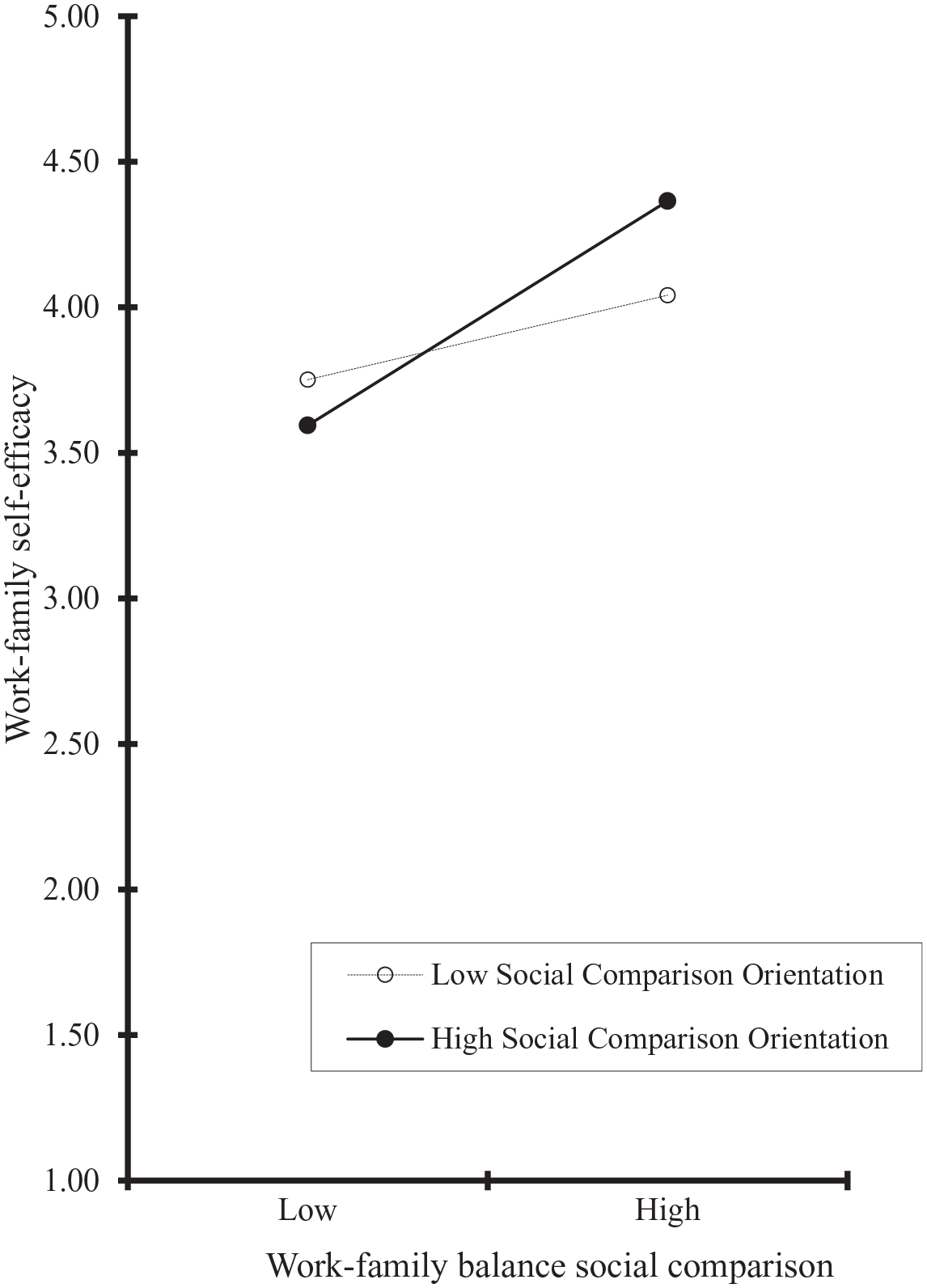
Interaction of work–family balance social comparison and social comparison orientation on work–family balance self-efficacy.
Hypotheses 8a, 8b, and 8c predicted moderating effects for the mediational chains predicted in Hypotheses 3, 4, and 6 described above. The specific predictions are that the indirect effects will be stronger when social comparison orientation is high. Results support these hypotheses as the beta for the indirect effect is significant when social comparison orientation is high as the 95% confidence intervals do not contain zero [(8a: .12 (CI = .049., .191); 8b: .07 (CI = .024., .106); 8c: .02 (CI = .005, .034)], but the confidence intervals do contain zero when social comparison orientation is low [8a: .03 (CI = –.030, .083); 8b: .01 (CI = –.020, .049); 8c: .00 (CI = –.006, .015)]. Further, the index of moderated mediation, which was created in MPLUS using the model constraint option where we multiplied the paths in the mediational chain when the moderator was high and low, subtracted these two values, and then tested whether this difference was significant (Robinson et al., 2013), indicates that differences between these pairs of values were significant for 8b (β = .05, p = .043) and marginally significant for the others (8a: β = .09, p = .071; 8c: β = .02, p = .062).
Discussion
The purpose of this study was to explore the role that social comparisons and the work–family interface play in the work demands to emotional exhaustion process. To better understand the broader context of social comparisons, we looked to COR theory (Hobfoll, 2001) in collaboration with SCT (Festinger, 1954) and found those who perceived they were more overloaded in comparison with their coworkers had subsequent perceptions of experiencing less WFB compared with the same coworkers. This then lowered their perceptions of their ability to successfully balance work and family demands and related to both job and family emotional exhaustion. We also found that these effects crossed over to the spouse’s own experience of WFB, which related to the spouse’s experience of family emotional exhaustion. Finally, we examined the moderating role of the incumbent’s social comparison orientation and found that in both the spillover and crossover processes the paths could be exacerbated when social comparison orientation was high.
Theoretical contributions
This study makes contributions to both the social comparison and work–family literatures by demonstrating the critical role of social comparison in both the spillover and crossover context. Scholars have noted that social comparisons are deeply embedded in organizational life (Greenberg et al., 2007), and existing studies primarily focus on work consequences, such as job performance (Vidyarthi et al., 2010), citizenship behaviors (Spence et al., 2011), and turnover intentions (Eddleston, 2009). Although social comparisons are a pervasive feature of everyday social interactions (Dijkstra and Buunk, 2018), previous research has not applied SCT to better understand its influence in the work–family interface. Work–family scholars have asserted that what happens to other coworkers affects one’s attitude and behavior (Barnett, 1998). In addition, WFB is theorized as a social construct that takes on meaning outside of an individual (Drobnič and Guillén, 2011; Grzywacz and Carlson, 2007). This extant work highlights that social influences deserve more attention in work–family studies. Thus, we contribute to the work–family literature by measuring the influence of social comparisons and demonstrating the exacerbating effects it has on the experience of WFB and emotional exhaustion of both job incumbents and spouses. In doing so, our work shines a light on one way in which employees assess their work–family situation, through a comparative lens with coworkers, and how those comparisons result in personal judgments about their own work–family dynamics.
Further, we extend prior work by examining the effect that WRO social comparison has on family emotional exhaustion through both spillover and crossover paths. Prior research has suggested that “social comparison process(es) within work units may contribute to the development of burnout” (Buunk and Schaufeli, 1993: 65). Our study adds nuance by testing and supporting the idea that WRO social comparison has both spillover and crossover effects on dual-earner couples’ role emotional exhaustion through the work–family interface. Moreover, while previous literature has examined the spillover and crossover of work stress to the family (e.g. Carlson et al., 2011), family emotional exhaustion has received less attention. However, it is believed that family emotional exhaustion is likely a critical variable in overall well-being (Maslach et al., 2001). It seems, therefore, that identifying antecedents to family emotional exhaustion is a vital task for work–family scholars to undertake as it provides an extension to our understanding of the influence work has on the family domain (Carlson et al., 2019). We build on recent research by demonstrating that WRO social comparison works through the work–family interface to contribute to family emotional exhaustion for both the job incumbent as well as crosses over to the spouse (Thompson et al., 2020).
Our findings also shed light on the application of COR theory. We do this by building on the work demands to job emotional exhaustion relationship as developed in COR theory (Hobfoll, 2001) and demonstrated empirically in previous research (Halbesleben and Buckley, 2006). In particular, we found that employees experienced resource loss when they evaluated that their work role overload was higher than their colleagues. We provide a finer-grained understanding of COR in the work–family context and reveal a nuanced mechanism of resource depletion and assessment that is owing to social comparison processes in the workplace. Thus, our findings demonstrate that WRO social comparison works through WFB social comparison, a novel construct for explaining this relationship, and WFB self-efficacy to contribute to experiences of job emotional exhaustion above and beyond a direct effect. This work provides an expansion for the COR theory, SCT, and work–family interface literatures, answering the call to incorporate other theories with COR (Hobfoll et al., 2018). These findings demonstrate that social comparisons are important to consider in examining the stressors in the work domain as well as the critical role that social comparisons can have in the work–family interface.
Finally, we examined the role that an individual difference that would be likely to influence social comparisons (Buunk et al., 2001b), social comparison orientation, has on this process. We extend previous research on personality in the work–family arena (Michel et al., 2011) by considering how the individual identity of social comparison orientation plays a role in the work–family interface and specifically on how social comparisons within the work–family interface impact evaluations of WFB self-efficacy. Since social comparison orientation is one of the salient individual differences that shapes social comparison processes (Buunk and Gibbons, 2007), more evidence of how social comparison orientation affects individual functioning at work is needed (Buunk et al., 2005). Our study contributes in this way by integrating COR theory and demonstrating the influence of social comparison orientation across two distinct societal cultures, such that for those who were high in social comparison orientation (i.e. more likely to compare themselves to others), the effects of the model were exacerbated. These results suggest that social comparison orientation is important to consider in understanding the stressor-to-burnout process, especially when considering social comparisons within the work–family interface. Additionally, understanding how high social comparison orientation, which is marked by uncertainty, anxiety, and neuroticism (Gibbons and Buunk, 1999), can inform work–family dynamics, and can chart a course for future investigations of these personality differences.
Practical implications
There are also practical implications of this research. Social comparisons are thought to be an “almost inevitable element of social interaction” (Brickman and Bulman, 1977: 150). As such, managers must realize that employees will compare their work roles with those around them. Furthermore, as is shown in this research, unfavorable comparisons of one’s workload have negative implications for employees in the form of emotional exhaustion at work and at home. Managers must realize that discrepancies among coworkers in their role responsibilities, whether real, or in this case perceived, are being considered and will lead to negative outcomes. We know that people will place more weight on social comparisons, even over objective information that suggests they are better than average (Seta et al., 2006). Thus, in order to diminish perceptions of inequity in work role overload, it is critical that managers are transparent in their role distribution and are as equitable as possible (Ambrose et al., 1991; Folger and Cropanzano, 1998). Additionally, intervention efforts by organizations could be made to train employees to interpret social comparisons at work in a more functional way.
This research proves, yet again, that experiences in the workplace have a lasting impact in the family domain. How employees internalize their work experiences and thereafter see them influence their family experiences, ultimately can lead to adverse consequences for organizations. Additionally, work stressors adversely impacting the family domain have resulted in decreased job satisfaction, commitment, and organizational citizenship behaviors (Carlson et al., 2019). Thus, managers stand to benefit from putting policies and procedures in place, both formal and informal, that clearly signal organizational support offered that can help employees better integrate their work and family lives (Thompson et al., 1999). Such an environment within an organization would surely support employees’ desire to lead balanced lives (Carlson et al., 2009). Ultimately, if managers can help employees balance their work and family demands in a way that employees find acceptable, it may help reduce perceptions of inequity (or imbalance). Thus, HR managers and practitioners would do well to increase transparency with employees regarding their workload and work–family benefits to limit perceived inequities and assuage their ill effects.
Future directions
As with all research there are opportunities for improvement. First, we did not examine the specific ways in which people compare their experiences of juggling work and family demands. More specifically, it is beyond the scope of this article to know how they are gathering information to make these work- and family-domain comparisons. While this is consistent with other social comparison research that does not get into the source of the information being used to make comparisons (Brown et al., 2007; Quade et al., 2019; Spence et al., 2011), it does present a potential avenue for future research. More specifically, scholars could apply the broad range of work on the role of social media into the social comparison process to better understand the work–family interface (Nesi and Prinstein, 2015; Vogel et al., 2015).
Second, the focus of this research was to examine the social comparison of the work–family interface on two forms of emotional exhaustion, but other outcomes also should be considered. For example, work domain attitudes and behaviors that have been shown to be influenced by the work–family interface, such as job satisfaction, commitment, and OCBs (Carlson et al., 2019) also may be relevant in light of these types of social comparisons. Additionally, we considered emotional exhaustion because we were focused on the depletion of emotional resources and emotional exhaustion is most relevant to the social comparison process and our focus on the resource loss spirals of COR theory. However, other dimensions of burnout may provide a broader perspective of this process as the reduction of personal accomplishment may result when goals are not achieved. Further, family emotional exhaustion is relatively new to the organizational literature and the role it has for organizations has yet to be considered, which could be an additional avenue for future research.
While this research focuses on married couples in order to capture the crossover of the social comparison context to the spouse, the impact of the spouse’s WFB on the job incumbent could also play a role on the resources available and as such the bi-directional nature of this relationship should be more fully modeled in future research. Further, future research could benefit by examining more non-traditional families such as unmarried couples with children. This research on crossover is likely generalizable to non-traditional family arrangements as crossover is simply a dyadic process between two people (Westman and Etzion, 2005). Furthermore, future research could benefit from exploring the role of these idiosyncratic arrangements and how these could be used to reduce work role overload and burnout perceptions, and boost WFB self-efficacy (Anand and Mitra, 2022; Las Heras et al., 2017; Rosseau, 2005). As individuals learn to bargain and explore their own best way of managing WFB, the role of social comparison may play less of a role. We also encourage scholars to investigate our model in other family dynamics such as cohabitation, foster parenting, and multiple generations living together (Anand and Mitra, 2022), which would enrich our understanding of social comparisons in the work–family interface.
Finally, while the focus of this research is on the work domain and comparison with a coworker, future research could benefit from incorporating the family domain into this complex work–family interface. We could understand the phenomenon more holistically by also considering demands outside of work as well as other individuals in the family structure’s ability to meet the demands. Further, comparisons of WFB may stretch to close familiar others (e.g. spouse, sibling) as well as nonwork friends. Incorporating differences in both the professional and personal domains may provide a more holistic view of WFB social comparison.
Conclusion
In conclusion, our research integrated SCT with COR theory and revealed that WRO social comparison in the work domain followed a spillover path through the work–family interface to WFB social comparison and WFB self-efficacy to contribute to both job and family emotional exhaustion for job incumbents. The indirect path of WRO social comparison to WFB self-efficacy also crossed over to impact the spouse’s own WFB and subsequent experience of family emotional exhaustion. Both processes were moderated such that job incumbents high in social comparison orientation experienced significantly more deleterious effects. This research demonstrated the important role that social comparison plays in understanding the impact of work demands on emotional exhaustion in the work–family interface.
Footnotes
Appendix 1
Funding
The authors received no financial support for the research, authorship, and/or publication of this article.
