



Abstract
With organizations working together more readily than ever before, it is becoming increasingly common to have teams of individuals from different organizations. These “alliance teams” bring together people across organizations to achieve collaborative outcomes. There is a lack of consensus among researchers on how to conceptualize an alliance team and fragmentation of the research across fields and theoretical perspectives has inhibited the development of a coherent body of knowledge on alliance teams. We aim to bring greater conceptual clarity and integrate the research on alliance teams by analyzing existing definitions of alliance teams to inductively arrive at a conceptualization of alliance teams along three key dimensions: factionalism, team scope of responsibility, and team entitativity. We then systematically review the diverse literature and derive three key research foci: diversity, goal ambiguity, and team connectivity to other teams. Our review shows that the three-dimensional (3D) conceptualization opens up valuable research opportunities and stimulates research across dimensions and foci when examining alliance team functioning and effectiveness. We use alliance team leadership, a critical topic in alliance team research, as an illustration of how the 3D conceptualization can help integrate and advance research on alliance teams. We conclude by providing a future research agenda.
Keywords
Teams composed of individuals from multiple organizations are increasingly common. We refer to these teams as alliance teams; they bring together people, expertise, and resources across organizations to achieve collaborative outcomes (Das and Teng, 2000; Schopler, 1987). Examples include, joint venture management teams (e.g. Büchel, 2000; Salk and Shenkar, 2001), buyer–supplier partnership teams (e.g. Potter and Lawson, 2013), and inter-organizational new product development teams (e.g. Bstieler and Hemmert, 2010). Alliance teams occupy a space in between partner organizations and face challenges that are uncommon to other teams. For instance, their teamwork is underpinned by a contract (Faems et al., 2008), they deal with concerns over confidentiality and knowledge leakage (Dyer and Nobeoka, 2000), and there is no common hierarchy or unilateral authority to delineate and enforce their activities (Espinosa et al., 2003). Alliance team outcomes are crucial to strategic alliances and the partner organizations’ competitive advantage and success (Hambrick et al., 2001; Hogg et al., 2012). While alliance teams have attracted considerable academic attention because of their practical relevance, the literature on alliance teams has developed in separate research areas and is only loosely connected. Therefore, and in response to calls for more integrative approaches on the topic (Kale and Singh, 2009; Maloney et al., 2016), we set out to review the diverse literature on alliance teams.
We uncovered two fundamental barriers to the paradigmatic development of alliance teams: (1) ambiguity in how researchers define the “alliance team” and (2) fragmentation of the research across fields and theoretical perspectives. Since the early foundational articles on inter-organizational groups by Sims (1983) and Schopler (1987), scholars have been using various terms to refer to groups of people working across organizational boundaries; for example, virtual cross-value-chain collaborative creative teams (Malhotra et al., 2001), factional teams (Li and Hambrick, 2005), or project alliances (Love et al., 2016). More importantly, even when authors used the same terms, they often meant different things. For example, the term “alliance team” has been used to describe executives in joint venture management teams (e.g. Büchel, 2000), teams working on collaborative research projects (e.g. Iseke et al., 2015), and multi-organization crisis response teams (e.g. Beck and Plowman, 2014; Drnevich et al., 2009). A shared understanding of a core concept’s meaning has significant implications for a field’s capacity to formulate problems and develop solutions (Knight et al., 2020; Pfeffer, 1993).
Alliance team research is also highly fragmented across fields and theoretical perspectives and remains only loosely connected. Research on alliance teams has proliferated in fields ranging from strategy, organizational behavior, and more applied contexts such as new product development (Potter and Lawson, 2013), supply chain collaboration (Boddy et al., 2000), project management (Pitsis et al., 2003), and radical innovation (Malhotra et al., 2001). While the research addresses overlapping questions, it relies on different theoretical perspectives and methods. For example, one subset of studies has focused primarily on behavioral processes (e.g. Du Chatenier et al., 2009; Li et al., 1999; Rockmann et al., 2007), whereas others have focused on alliance team design (e.g. Doz, 1996; Pearce, 2001), or the alliance teams’ broader organizational linkages (Drach-Zahavy, 2011; Stock, 2006). As a result, there is little consensus, meaningful comparison of findings, or testing of rivalling theoretical arguments, all of which are required to advance research on alliance teams.
To unify the fragmented research and provide a common platform for future research, we review the literature and present future research directions. We start by reviewing existing definitional statements of alliance teams and analyzing the variety across these statements to arrive at a three-dimensional (3D) conceptualization of alliance teams, encompassing: (1) factionalism, (2) team scope of responsibility, and (3) team entitativity. These dimensions form a framework to position alliance teams and allow systematic theoretical comparison. Second, we review the extensive literature on alliance teams and organize the research around three essential foci: (1) team member diversity, (2) team goal ambiguity, and (3) team connectivity to other teams. We then apply the 3D conceptualization to the topic of “alliance team leadership” to show how it can integrate past research and add to our current understanding. From there, we provide directions for future research on alliance teams.
This review offers insights into the teams that drive alliance relationships. By focusing on the team as the unit of analysis, our review differs from previous alliance reviews that discussed alliance-level governance mechanisms such as alliance management (Kale and Singh, 2009), inter-organizational collaboration dynamics (Majchrzak et al., 2015), coordination networks within and across organizations (Gittell and Weiss, 2004), and joint venture management (Beamish and Lupton, 2009). Approaching alliances from the alliance team level complements the macro-level governance research that currently dominates the alliance field. We make three significant contributions to the literature.
First, the 3D conceptualization of alliance teams reconciles terms, definitions, and associated meanings. It facilitates cross-fertilization and dialogue beyond alliance team typologies. Second, it furthers the understanding of how alliance teams differ from intra-organizational teams by focusing on the inter-organizational characteristics of alliance teams. Third, our work provides an integrative platform for future research. The review shows that most research occurred within the three research foci rather than across them. So far, also, the application of theory to alliance teams has mainly stemmed from research on intra-organizational teams, which has limited potential to explain the unique characteristics and challenges of alliance teams. Therefore, we propose a future research agenda that spans research foci and strongly builds on the unique inter-organizational nature of alliance teams. We further suggest that future research on alliance team functioning and effectiveness would benefit from dynamic approaches across levels of analysis and a firm grounding in specific alliance contexts.
Alliance teams: A 3D conceptualization
To uniformly conceptualize alliance teams, we identify dimensions that alliance teams have in common yet vary on in meaningful ways (Hollenbeck et al., 2012; Knight et al., 2020). Rather than typifying joint venture teams, buyer–supplier teams, and inter-organizational new product development teams as distinct types of teams, pinpointing these teams on the same conceptual dimensions allows for more precise theoretical understanding and prediction than categorical approaches (Hollenbeck et al., 2012). In addition, dimensions make it easier to empirically describe teams that often do not fit the “either–or” approach of strict categories. Altogether, a dimensional approach builds on the multiplicity of alliance teams while establishing a common knowledge base for meaningful integration.
To advance a coherent conceptualization of alliance teams, we conducted a systematic literature review (see online supplement for details on the scope of the review, list of articles included in the review and the coding of these articles). Next, we conducted an inductive analysis of the definitional statements in the selected articles to arrive at meaningful dimensions (see Hollenbeck et al., 2012; Kirkman and Mathieu, 2005; Knight et al., 2020; and online supplement). A definitional statement is any statement that describes the characteristics of alliance teams. Our analysis resulted in three dimensions, which we labelled “factionalism”, “team scope of responsibility”, and “team entitativity”. This section presents this 3D conceptualization (see Figures 1(a) and 1(b)).
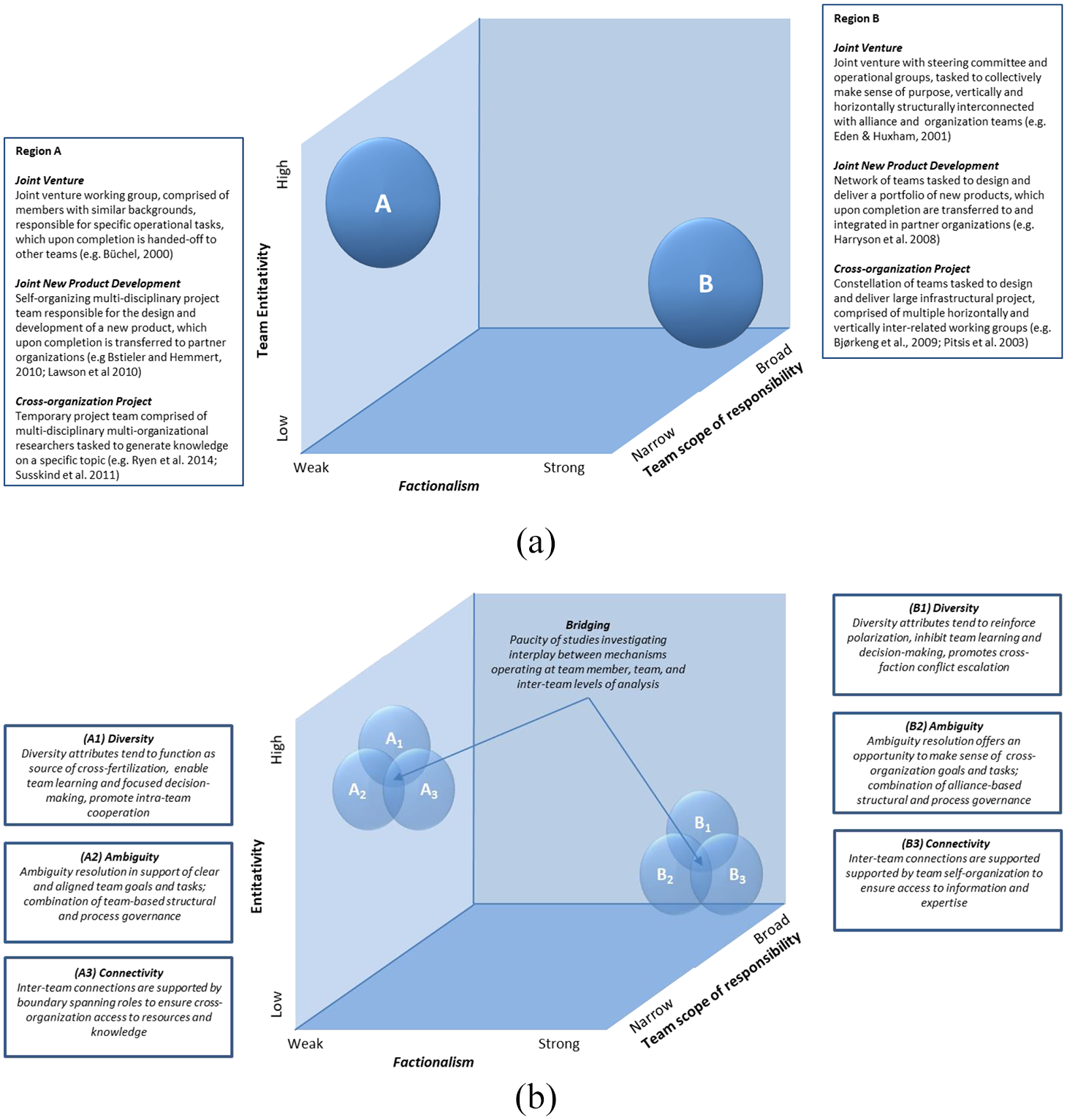
The alliance team landscape: A 3D conceptualization.
Dimension 1: Factionalism
The first dimension that our analysis of existing definitions revealed is that of factionalism. Factionalism is the extent to which interests compete between (groups of) partner representatives in relation to finite resources, such as materials, authority, and status within the team (Carton and Cummings, 2012; Li and Hambrick, 2005). Most articles in our review agree that alliance teams consist of representatives from different organizations (e.g. Hambrick et al., 2001; Stock, 2014) who work across organizational boundaries to access resources and knowledge that are not available within their boundaries (e.g. Badir et al., 2012; Frost et al., 2010; Van Der Meer et al., 2013). In addition, team members often have vested interests because they generally depend on their parent organizations for their salary, bonuses, careers, and sense of achievement and belonging (Pearce, 2001). Therefore, alliance team members must strike a balance between protecting the interests and resources of their parent organizations while also serving the interests of the alliance overall (Hambrick et al., 2001; Kale and Singh, 2009). However, a review of the alliance team definitions unveils that the extent to which interests compete or align between factions differs across alliance teams.
The definitional statements suggest that factionalism in alliance teams can range from weak to strong. Definitions pointing to weak factionalism do not emphasize the competing interests between representatives and suggest, for example, that alliance teams are “temporary organizations that the owner, designer, construction team, and other stakeholders form to deliver a project” (Solis et al., 2013: 379). Another example is that these teams are “comprised of individuals from partner organizations, engaged in a project requiring inter-organizational coordination” (Walker and Stohl, 2012: 451). Therefore, in alliance teams with weak factionalism, team members represent different organizations whose competing interests are not salient. For instance, Potter and Lawson (2013) showed how engineering staff from two British manufacturing organizations collaborated on new product development and worked as a unified team rather than as opposing factions.
However, other statements have revealed strong factionalism. For example, Li and Hambrick (2005: 794) labelled alliance teams as “factional groups” and defined them as “groups in which members are representatives, or delegates, from a small number of, often just two, social entities and are aware of, and find salience in, their delegate status”. The salience and complexity of the delegate status became clear in other definitions. For example, Drach-Zahavy (2011: 90) studied alliance teams where “members act on behalf of organizations or constituencies such as organization of origin, consumer groups, professional associations, and employee unions”. Other studies have focused more on how team members represent their organization’s competing values, beliefs, and attitudes (Pearce, 2001; Salk and Brannen, 2000; Salk and Shenkar, 2001). So, in alliance teams with strong factionalism, team members simultaneously represent the – often opposing – interests of two or more organizations and often different industries, and professional disciplines.
Dimension 2: Team scope of responsibility
The second dimension of alliance teams we identified from the definitional statements is the team scope of responsibility. Scope of responsibility includes the range of team tasks and the responsibility and decision-making authority that come with these tasks over functions, people, processes, and resources across the alliance and partner organizations (e.g. Harryson et al., 2008). Compared with intra-organizational teams, alliance teams operate in inter-organizational contexts with no pre-existing hierarchy, systems, or processes (De Man et al., 2010; Espinosa et al., 2003; Zoogah et al., 2011). In addition to the team task, alliance teams must manage multiple employers, multiple constituencies, multiple power levels, and align opposing organizational procedures, all with limited authority over the partnering organizations (Sims, 1983). This means that, like any intra-organizational team, alliance teams are responsible for resource coordination and task execution; yet it also means that they need to shape the context in which this happens through political maneuvering and design of structures and processes across organizational boundaries (Badir et al., 2012; Drach-Zahavy, 2011), although the extent to which this is required varies.
We view the team’s scope of responsibility as a dimension that ranges from narrow to broad. One group of definitions indicates that a narrow scope of responsibility typically consists of a clearly defined task, with relatively few resources to integrate, and where the team is guided by policy and contracts. For example, consider the narrow scope of responsibility of an alliance team that collaborates from within its existing organizational structures on a well-defined contract to develop machinery (Maurer, 2010) or to sell a product and offer customer service (Stock, 2006). The task of this team is relatively well defined and, apart from resource coordination, there is little work required to align structures and processes across the partner organizations.
On the contrary, a broad scope of responsibility includes structure building, and resource integration in-between and across organizations. Often it also means greater autonomy and independent strategic decision making, a variety of complex, ill-defined tasks, and a broad range of resources to integrate. For instance, consider the broad scope of responsibility of the team that managed the construction of a significant piece of Sydney 2000 Olympic infrastructure across a wide range of partners. While the scope of responsibility can vary from simple clearly defined buyer–supplier relationships to new product development (e.g. Potter and Lawson, 2013), innovation, or shared research (e.g. Iseke et al., 2015; Webb, 2017), most studies have focused on the top management teams with broad scopes of responsibility, including establishing “governance” (Szentes, 2018: 125), “linking strategy and operations” (Willis, 2012: 168), and “coordinating norms” (Malhotra et al., 2001: 233) across organizations.
Dimension 3: Team entitativity
The third dimension we identified is that of team entitativity. Team entitativity can be defined as the property of a group, resting on clear boundaries and clear internal structure, and making a group “groupy” (Hogg et al., 2007: 136). The perceived oneness of a group as well as the actual compositional unity of the team in terms of where team boundaries lie dictate team entitativity. Unlike intra-organizational teams, alliance teams interact across multiple organizational and team boundaries. Moreover, these boundaries are permeable and can regularly shift, influencing the perception of who is on a team and who is not. Some alliance teams resemble symbiotic networks or negotiated temporary systems where team boundaries are purposely vaguely defined, and membership can rapidly change. Other teams have more strictly defined boundaries through formal arrangements, alliance design, or contracts. Take a joint venture’s contractually defined team structure or relatively small buyer–supplier teams with bounded and stable team membership.
Based on the definitional statements, we view team entitativity as a dimension (Hogg et al., 2012; Knight et al., 2020) that ranges from “low” to “high”. An alliance team with high entitativity is a strongly bounded group. It is clear to everyone who is, and who is not on the team. For instance, in their seminal work, Schopler (1987) conceptualized alliance teams much like intra-organizational teams; as small groups with clear boundaries that meet periodically and aim at a fate proper to the group. Typical examples of alliance teams with high entitativity are joint new product development teams (e.g. Bstieler and Hemmert, 2010) and cross-organizational project teams (e.g. Susskind et al., 2011). These teams are often appointed to work closely together from within the boundaries of their partner organization and are recognized by the partner organizations as proper entities.
In contrast, low entitativity refers to alliance teams that are fragmented and ill-bounded entities consisting of differentiated and interconnected subunits (e.g. individuals or teams), often across two or more partner organizations. These “teams” are loosely connected networks of people across organizations who operate collegially. However, they would not be seen as one team, for instance, collaboration within business clusters such as Silicon Valley (Volkoff et al., 1999) or in health promotion inter-organizational teams (Drach-Zahavy, 2011). Rather than being a clearly demarcated group, these studies conceptualize alliance teams as (part of) a “meta-organization” (Solansky et al., 2014: 1008), a “symbiotic network” (Volkoff et al., 1999: 64), an inter-organizational “team-based organization” (Evangalista and Hau, 2009: 66), or “multi-team structure” (O’Sullivan, 2003: 94). At this end of the spectrum, alliance teams are no longer comparable to small groups but more to a collection of collaborating individuals and groups across two or more organizations. Low entitativity can result from the design of the alliance, such as in open-source style projects where people and teams contribute but do not really know the other contributors. In other situations, the many organizational and team boundaries, complex team member identification, or the sheer size of the alliance blur the view of who is on a team and who is not. With low entitativity, dynamics between groups become highly relevant. An example of an alliance team with low entitativity is a loosely connected network of teams involved in a large-scale short-term project organizations (Bjørkeng et al., 2009).
Positioning alliance teams in the 3D landscape
Because the three dimensions are conceptually distinct, alliance teams can be positioned anywhere in the 3D landscape based on their attributes. Thus, the 3D conceptualization plots alliance teams on meaningful continuums and compares them within and across the dimensions (see Figure 1(a)). For example, the 3D landscape can conceptually distinguish a joint venture working group (Region A in Figure 1(a)) from a joint venture management team (Region B in Figure 1(a)). Joint venture working groups often have pre-defined short-term tasks (narrow scope of responsibility), team members with aligned interests (weak factionalism), who work together coherently in an entity on its own (high entitativity). However, a joint venture management team, can be defined by vested interests between representatives (strong factionalism) who face a range of complex and ill-defined tasks across organizational boundaries (broad scope of responsibility) as part of a larger constellation of teams (low entitativity). A cross-organizational project team also typically fits in Region A. This team works on relatively small short-term tasks, has aligned interests, and is operating as a proper entity. Based on this, the performance drivers of a joint venture working group might have more similarities to a cross-organizational project team than to a joint venture management team. The 3D conceptualization stimulates the comparison of teams that have previously been seen as unrelated, leading to insights and theoretical developments that go beyond team typologies.
Reviewing past research on alliance teams
Next, we review the research on alliance teams. Based on our review coding (see online supplement for the review method and comprehensive list of all articles included), we clustered prior research around three research foci: (1) team diversity, (2) goal ambiguity, and (3) alliance team connectivity. Not surprisingly, these foci show a strong connection with the dimensions in the 3D conceptualization. When investigating a relatively new topic, researchers often start uncovering the effects linked to the primary defining characteristics of the phenomenon, in this case, alliance teams. Aligning with the dimension of factionalism, one cluster of articles focuses on the effect that team member diversity has on alliance team functioning and effectiveness. A second cluster aligns with the team scope of responsibility and investigates goal ambiguity and its implications on alliance teams. A third cluster aligns with the dimension of team entitativity and accounts for the impact of the alliance team’s connectivity with other teams in the alliance. In general, the level of analysis between these foci differed: diversity studies mostly occurred at the team-member level, ambiguity studies at the team level, and connectivity studies at the inter-team level. From here, we present our review findings for each of these research foci (see also online supplementary Tables S-1a, S-1b, and S-1c).
Diversity as a focus of past research
Most of the research on alliance teams builds on team member diversity and team composition and approaches this topic from a team-member level of analysis. Like in other types of teams, alliance team members may differ in many ways, such as their nationality, cultural values, social norms, gender, age, and expertise (online supplementary Table S-1a). However, alliance teams are different in that the diversity attributes of alliance team members tend to align between representatives of the partner organizations (Li et al., 1999). In international joint ventures (IJVs), for instance, systemic differences in the social and economic institutions of the partners’ home countries can lead to significant differences on other demographic dimensions such as age, education, functional background, and international experience of the IJV managers (Li et al., 1999). Research has shown that diversity can either contribute to alliance team effectiveness or detract from it (e.g. Du Chatenier et al., 2009; Hambrick et al., 2001). We discuss these implications under the following headings: social identification, knowledge exchange and communication, and conflict (see online supplementary Table S-1a).
Social identification
Owing to their different backgrounds and orientations, alliance team members do not always strongly identify with the team nor operate as a unified “team” (Li et al., 1999). Social identification is the extent to which an individual feels connected to a social entity (Rockmann et al., 2007; Salk and Brannen, 2000). Alliance team members have many social entities to relate to, such as the parent organizations, the alliance team (Rockmann et al., 2007), or even the country of origin in international alliances (Salk and Brannen, 2000; Salk and Shenkar, 2001). Studies indicate variety in the social entities that alliance team members identify with. For instance, Salk and Shenkar (2001) reported on a case study of a British–Italian joint venture and found that identification with national identities dominated over organizational identification, both parent and JV. However, a survey study found that commitment to the IJV management teams was higher than commitment to the parents’ organizations and that this situation intensified over time in a US–Canada IJV (Johnson, 1999). Prior research suggests that a variety of factors influence social identification. Group faultlines – which refers to the alignment of multiple diversity attributes between potential subgroups – can reduce the identification of alliance team members with the team (Rockmann et al., 2007). Strong identification with parent organizations is hard to overcome and can lead to subgroup formation along the organizational divide (Li et al., 2002; Salk, 1997; Salk and Shenkar, 2001). Therefore, Li et al. (1999: 63) recommend intentionally diversifying alliance teams to achieve “cross-cutting categories” and minimize faultlines. Interestingly, observable nationality and gender diversity are particularly detrimental to alliance team effectiveness (Li and Hambrick, 2005; Zoogah et al., 2011). Visible diversity attributes, more than less visible attributes, hinder interactions and cohesion.
Knowledge exchange
Sharing and integrating knowledge relates directly to the purpose of strategic alliances and is therefore essential for alliance teams. Knowledge sharing contributes to innovation, shared problem solving, team learning, and time efficiency in new product development teams (Bstieler and Hemmert, 2010; Potter and Lawson, 2013). Without pre-established processes, alliance teams must continuously negotiate and agree upon processes that support learning and knowledge sharing. Most reviewed articles have noted that alliance team member diversity, especially functional and job related, contributes to knowledge creation and exchange (e.g. Du Chatenier et al., 2009; Zoogah et al., 2011). Informational diversity, which results from function, experience, education, and expertise, is believed to increase the number of unique viewpoints, and therefore contribute to new knowledge development, innovation, and learning. However, information diversity can make it harder to interpret, combine, and share knowledge by increasing the cognitive distance between team members with different viewpoints (Du Chatenier et al., 2009). Considering this tension, future research can, for instance, focus on team learning and examine how cultural diversity fosters learning yet hampers knowledge integration (Lunnan and Barth, 2003).
Conflict
The studies in our review show inconsistent results regarding the influence of diversity attributes on conflicts and the performance implications of conflicts in alliance teams. Some studies have found that informational diversity in particular (Zoogah et al., 2011) leads to conflicts that make team members consider various alternatives and solutions (Hambrick et al., 2001) and enhance decision making. Other studies have found that conflicts create tension and irritation among team members owing to inconsideration, differences in perspectives, and lower personal affinity (Büchel, 2000; Frost et al., 2010; Julian et al., 2009; Li et al., 1999). Consider the differences among venture managers in the public health sector responsible for food and nutrition, rehabilitation services, and medical and surgical products. These managers required extensive relationship management skills (such as challenging others without being confrontational, dealing with resistance and diffusing difficult situations) (Knight et al., 2001) to see and understand their different priorities and effectively manage supply. Conflict also commonly arises from the incompatibility of partner organization processes (in decision making, for example), leading to mistrust within alliance teams (Li and Hambrick, 2005; Li et al., 1999). A lack of unilateral authority makes it difficult to prevent conflict escalation and can lead to the alliance’s overall failure.
However, conflict does not always have to be detrimental to alliance team effectiveness. An action research study found that conflicts can enhance team learning in alliance teams (Willis, 2012). Following a survey study, Julian et al. (2009) found that decision making benefits from conflict, while team trust and cohesion often suffer. Also, a qualitative study by Iseke et al. (2015) found that demographic attributes (such as nationality) that cross-cut the organizational faultline, stimulate communication and reduce conflict in R&D alliance teams.
Concluding note
A stand-out feature of our review is the co-existence of both positive and negative implications of team diversity on alliance team effectiveness. Another stand-out feature is that most studies apply “traditional” team concepts such as group faultlines and team conflicts to alliance teams, without accounting for the fact that they cross organizations. Our 3D conceptualization offers alternative ways of approaching diversity while accounting for the uniqueness of alliance teams (see Figure 1(b): regions A1 and B1).
Applying the dimension of factionalism to this research focus exposes research gaps and opens up new avenues for research. The review suggests that, in teams with strong factionalism among representatives of distinct organizations, social and informational diversity further increases polarization (Hambrick et al., 2001; Maurer, 2010) unless certain attributes cross-cut the factions. However, in teams with weak factionalism, informational diversity tends to be a valuable source of new perspectives and cross-fertilization (Bstieler and Hemmert, 2010; Potter and Lawson, 2013). Most research on identification has focused on teams with strong factionalism, where vested interests play a significant role. Future research could investigate identification processes in alliance teams with weak factionalism, where competing interests among factions are less likely (Smith et al., 2018). Also, the interaction between types of diversity and social identification requires further research attention. For instance, is social category diversity more likely to lead to subgroup formation or informational diversity, and if so, under what circumstances? How teams respond to shifts in factionalism or prevent and manage conflict in teams with high factionalism would benefit from further study.
Approaching diversity through the 3D conceptualization also raises questions around how the scope of responsibility and the level of entitativity may influence the performance implications of diversity. For instance, team diversity could serve alliance teams with well-defined missions where the exchange of ideas and expertise and mutual learning can be precisely canalized (Iseke et al., 2015). However, it is likely to become more challenging when the team’s scope of responsibilities extends (Julian et al., 2009). Regarding low entitativity, team diversity fosters boundary spanning and knowledge exchange (Drach-Zahavy, 2011). However, further research is warranted to better understand how diversity impacts performance in alliance teams with high versus low entitativity.
Goal ambiguity as a focus of past research
Managers in alliance teams must deal with goal ambiguity that results from incompatible or non-aligned partner objectives, incomplete contracting, and ongoing bargaining and political maneuvering (Fong and Lung, 2007; Malhotra et al., 2001; Pearce, 1997). IJV managers, for instance, need to accommodate diverse – and often contradictory – demands and preferences of policymakers in each parent company and stakeholder groups within the joint venture (Li et al., 1999). Our review suggests that alliance teams contain the seeds of behavioral contradictions: cooperation and competition (Das and Teng, 2000; Lumineau et al., 2015). Cooperation occurs when people act together in a coordinated way to pursue shared goals. The opposite – competition – emphasizes winning and outdoing others because the parties believe that one’s goal attainment interferes with the other’s goals (Argyle, 1991). For example, a team working on open innovation must find ways to be good partners, share information openly, and prevent free-riding and undesirable spillover of strategic information (Dyer and Nobeoka, 2000). As shown in Table S-1b (online), studies that address how to deal with goal ambiguity in alliance teams fall into two main categories: structural and process governance. The studies in this research focus often are at the team level of analysis.
Structural governance
Here, we assemble research with the aim of understanding how alliance team governance can help deal with goal ambiguity. First, structural governance pertains to the control mechanisms that steer the alliance team toward its goals; they include formal processes, contracts, and team member roles (Faems et al., 2008; Pearce, 1997). Each partner would typically like to exert more control over the alliance team than the other by having its people occupy critical positions (e.g. Li et al., 1999). A case study shows formal role distribution among a joint steering council, a joint working committee, and an administrative committee with a subordinate project bureau (Inkpen and Pien, 2006). Another option is where two managers – one from each partner – fill the same position in the team; for example, general manager and deputy general manager. According to Li et al. (1999: 59), such a “dual chain of command” is ineffective for joint venture teams. However, equal representation and power distribution among team members can be effective for buyer–supplier teams (Stock, 2006).
Second, findings show that clear and measurable reward structures facilitate goal alignment within alliance teams (Adobor, 2004; Maurer, 2010). Such reward structures enhance perceptions of distributive fairness and stimulate inter-team member trust. Adobor (2004) pointed to the options that partner organizations have to reward alliance teams to establish a good fit between partners. Tying remuneration to alliance team performance promotes achieving common goals and increases team effectiveness (Adobor, 2004).
Third, the review shows that high task interdependence stimulates “the unity of effort” that crosses organizational boundaries and brings partners to effectively address goal ambiguity (Fong and Lung, 2007; Luvison and Marks, 2013: 8). Li et al. (1999) argued that interdependency should be created in terms of communication and collaboration tasks so that managers must work together to solve problems. The greater the task interdependence, the greater the need for coordination, joint problem solving, and mutual adjustment (Badir et al., 2012; Li et al., 1999; White, 2005).
Process governance
Previous studies have investigated how alliance teams deal with goal ambiguity by crafting processes to compensate for the lack of organizational structures or unilateral authority. These means of governance, which are often social and relational, include trust building, learning, willingness to collaborate, communication, socialization, and addressing feelings (Comi and Eppler, 2011; Donati et al., 2020). Studies have explored topics such as how learning and relational quality that are gained over time reduce goal ambiguity across distinct alliance development stages (e.g. Büchel, 2000; Eden and Huxham, 2001; Ness, 2009). Interpretations of goals are cyclical by nature and triggered by critical events and will therefore lead to divergence and convergence between team members (Büchel, 2000). Several authors have noted how the alliance development stages force the reevaluation of collaborative goals. For instance, the ongoing willingness to collaborate depends on the clarity and rationale of task handovers between teams as the alliance develops (Luvison and Marks, 2013). Doz (1996) theorized a learning cycle in which alliance team members evaluate the alliance’s efficiency, equity, and adaptability. This evaluation leads to adjustments of processes and structures, and a new learning cycle.
Other studies have explored how leaders’ communication, socialization, and guidance support goal setting and achievement. For instance, team psychological safety contributes toward learning goals, but not toward efficiency goals, and management direction contributes to efficiency goals, but not learning goals (Bstieler and Hemmert, 2010). Similarly, joint venture teams are best formed by listening to and understanding the cultures involved and being open and friendly (Li et al., 1999). Effective leaders rely on the support, cooperation, and approval of many people to set and achieve the JV’s goals.
Concluding notes
We infer from the review that goal ambiguity is not intrinsically detrimental to alliance team effectiveness. The review clarifies that goal ambiguity exists to varying extents in all alliance teams. The level of ambiguity evolves along with the alliance development phases and, when high, calls for changes in structures and processes. Instead of a “one-size-fits-all” approach to ambiguity, we found that the fit between the governance mechanisms and the characteristics of the alliance team determines how to manage goal ambiguity successfully. Therefore, future research could investigate the fit between the level of goal ambiguity and governance for alliance teams at different positions on the three dimensions (see Figure 1(b): regions A2 and B2).
Applying the dimension of team scope of responsibility to goal ambiguity reveals new avenues for research. We found that teams with a narrow scope of responsibility usually have less goal ambiguity, which means that they engage in relatively little structural and process governance on top of their alliance team task. On the contrary, alliance teams with a broad scope of responsibility often face more goal ambiguity, which means they must develop and manage many structures, processes, and relationships in addition to their alliance task (Pearce, 1997). This raises questions regarding how teams that already have a broad scope of responsibility can best manage goal ambiguity and if there are diminishing returns as the scope increases. Informal socialization mechanisms such as social events worked well for teams that have a broad scope or responsibility (Lawson et al., 2009). However, does this mean that alliance teams with a broad scope of responsibility should prefer informal governance over formal governance?
The lens of the 3D conceptualization also highlights new directions for the effects of factionalism and entitativity on goal ambiguity management. The review suggests that alliance teams with strong factionalism should rely more heavily on “softer” governance approaches characterized by inter-personal contact across factions (Li et al., 1999). These approaches include lean communication (Rockmann et al., 2007), shared problem solving, caring behavior, and team psychological safety (Bstieler and Hemmert, 2010). They can induce a sense of oneness and trust and help diminish negative feelings between representatives of partnering organizations. In alliance teams with weak factionalism, formal governance mechanisms such as contractual arrangements and operating procedures are more suitable for dealing with goal ambiguity (Büchel, 2000). However, the boundary conditions of these approaches are not clear. Concerning entitativity, O’Sullivan (2003) and Estrada et al. (2013) found that crafting formal mechanisms across teams can foster learning, creativity, and innovation in teams with low entitativity. But less is known about how these mechanisms would unfold in teams with high entitativity or how they might reduce some of the benefits of informal and loosely structured networks.
Connectivity to other teams as a focus of past research
The third focal point in past research on alliance teams pertains to interactions with teams in the alliance and with teams in the partnering organizations outside the alliance. Given the multiple organizations involved and the lack of a common hierarchy and authority, the way in which interactions emerge and take place over time is particularly critical to alliance team functioning and effectiveness (Estrada et al., 2013; Luvison and Marks, 2013). Formal alliance contracts can fully or partially describe ways of interacting. Inter-team interactions can complement or substitute contractual agreements, which are, by their nature, incomplete according to the alliance literature (Pearce, 1997). In particular, two connectivity-related factors stand out from the review as critical for the performance of alliance teams: boundary-spanning activities and teams’ (members) position in networks inside and outside alliance teams.
Boundary spanning
Alliance teams bridge organizational partners and offer a place where organizations meet, transfer information, and create knowledge. As part of a system of interdependent and interfacing teams, alliance teams need to identify and address various stakeholder needs (Luvison and Marks, 2013). Boundary-spanning activities are the “team processes that are necessary for the task at hand and that are directed to reach over the team’s boundary and engage with external agents in the team’s focal environment” (Drach-Zahavy, 2011: 92–93). Studies have distinguished the various functions that boundary spanning fulfils in the team, such as scouting, ambassadorial, and coordinating boundary spanning (Drach-Zahavy, 2011). Boundary-spanning activities differ along the alliance life cycle. For instance, in the alliance formation phase, alliance management teams set objectives and help build the general understanding of acceptable and expected behaviors across teams (Büchel, 2000). Other boundary-spanning functions of alliance management teams are to overcome learning barriers between teams, provide leadership and facilitation, and to align systems, structures, and processes (Inkpen and Crossan, 1995). Lunnan and Barth (2003) argued that the more profoundly and broadly the “bridging” team connects other teams, the greater the opportunities are for exploration-oriented learning.
Team networks
Research investigating network characteristics of alliance teams shows how network positions and ties impact knowledge integration, learning, and innovation (Van Der Meer et al., 2013; Volkoff et al., 1999). Advice centrality determines how effectively joint venture directors can manage task-related information flows and social cohesion (Salk and Brannen, 2000). Also, team leaders who have non-redundant contacts (often personal relations and from previous positions) and cover structural holes have access to unique information (Susskind et al., 2011). In engineering alliance teams, non-redundant contacts influence task communication and increase accessible resources, shaping collaboration over time (Walker and Stohl, 2012). Our review also suggests that, in alliance teams that resemble loosely connected networks of teams, team members are task-focused and less concerned with developing relationships; hence, networks and trust become more depersonalized (Walker and Stohl, 2012).
Besides team members’ positions in the network, research has also addressed the role of informal linkages and the size of the network. For instance, Inkpen and Crossan (1995) found that informal linkages across teams are essential for learning in international joint ventures teams because knowledge often passes in an ad hoc and informal manner rather than through institutional knowledge-transfer mechanisms. The size of an alliance multi-team system also matters, determined by the number of executive teams, alliance management teams, and support teams in a network. Luvison and Marks (2013) theorized that the more extensive the network, the less willing the teams will be to cooperate actively and the greater the propensity for competition among teams.
Concluding notes
Research on how alliance teams are (best) connected to other teams is still in its early stages. Our review has provided us with a good overview of alliance teams at different levels of the organization (executive, management, operational, etc.) and the functions they fulfil within a network of teams (such as coordinating resources, facilitating communication, and providing leadership). This stream of research informs when teams need to connect, about what, and which people are in the best position to fulfil boundary-spanning activities. The review clarifies that the 3D conceptualization can also provide new inroads for future research on connectivity-related studies (see Figure 1(b): regions A3 and B3).
Teams with high entitativity have relatively well-defined boundaries, which makes defining boundary-spanning roles more straightforward and accessing information outside the team easier (see Figure 1(b)). Pitsis and colleagues (2003) found that rather than relying on contracts, alliance teams with low entitativity are better off with a shared culture across suppliers that supports multi-team collaboration and project performance. However, for teams with low entitativity, the question remains as to which boundary-spanning practices are most effective. Should boundaries be defined, and boundary-spanners appointed? Should all team members have boundary-spanning skills so that team members can collaborate more organically across organizations? Or should boundaries be removed as much as possible?
New research directions also arise when accounting for factionalism and scope of responsibility in relation to team connectivity. For instance, our review highlighted that, in alliance teams with strong factions, appointing a “bridging” team can provide formal guidance to achieve knowledge integration and learning across organizations (Lunnan and Barth, 2003). From the recovery effort after the Columbia space shuttle disaster, we learned that alliance teams with weak factions can spontaneously and successfully self-organize themselves. The relative strangers from 130 volunteer agencies did this without a designated leader or existing structure (Beck and Plowman, 2014). These studies suggest that different connectivity practices in teams with weak versus strong factions might be effective. However, their boundaries, effectivity, and generalizability still need to be further established. Davis and Eisenhardt (2011) suggested that in teams with a broad scope of responsibility, neither collaborating organization should take a dominant leadership role, and should instead alternate decision control and leadership. Again, more research is required here, specifically on the narrow scope of responsibility.
Research bridging the foci
We want to highlight the studies that have bridged the research foci by stipulating boundary conditions (that is, moderators) or building integrative models using rich case descriptions. Most bridging studies are in the diversity focus, but also the goal ambiguity and connectivity foci have some exciting studies.
Researchers have included moderators or mediators related to goal ambiguity in diversity studies. For instance, team communication media (Rockmann et al., 2007), the extent of shared experience and repeated interactions (Salk and Shenkar, 2001), team incentives and rewards (Li et al., 1999), and time spent in the alliance team (Adobor, 2004; Johnson, 1999) all affect team member identification with the alliance team. Also, governance mechanisms such as team efficacy (Du Chatenier et al., 2009), trust gained from a stable team membership and objective project reward criteria (Maurer, 2010), visual aids (Comi and Eppler, 2011), a sense of relationship equity (White, 2005), and a safe, supportive, challenging, and engaging environment (Bstieler and Hemmert, 2010) all stimulated knowledge exchange in highly diverse alliance teams. Finally, team governance mechanisms such as personal contacts between opposing groups (Li et al., 1999), equal representation of team members stemming from partnering organizations and equal distribution of power (Stock, 2006), and team building (Gardiner and Simmons, 1998) have reduced the impact of team diversity on conflicts.
Minimal scholarly attention has been paid to possible interactions between the first and the third research focus, with most research being qualitative. Researchers such as O’Sullivan (2003) and Estrada et al. (2013) have shown that alliance multi-team systems benefit from standardized work processes and outputs, intensive scheduling, integrative work patterns, shared governance, shared physical space (O’Sullivan, 2003), and from an alignment of human resource practices (Estrada et al., 2013). Governance-related contingencies such as leadership (Volkoff et al., 1999) and trust (Beck and Plowman, 2014) have also been investigated as contingencies in conceptual frameworks at the inter-team level.
Although the studies that have bridged research foci are insightful, few have explicitly opted for or developed multi-level theories (Salvato et al., 2017). Considering our observation that the foci broadly differ in their level of analysis, this presents a great research opportunity. A notable exception is the qualitative study of the Volvo C70 development by Harryson et al. (2008), which explicitly accounted for the three different levels of analysis to explain inter- and intra-organizational knowledge transfer and learning. Another exception is an inductive longitudinal case study by Büchel (2000) that showed how team members’ social embeddedness and the alliance life cycle affect intra-joint venture relations and boundary group relations over time. Studies like these bring the levels of analysis and research foci together and provide rich insights into the dynamics specific to alliance teams. Alliance team research would greatly benefit from more explicit multi-level theories and methodologies.
Alliance attributes
No studies in our sample explicitly investigated the effects of alliance attributes such as partner characteristics (e.g. vertical versus horizontal partnerships), governance forms (e.g. equity versus non-equity joint ventures), or alliance objectives (e.g. learning alliance versus product development partnership) on the alliance team effectiveness and functioning. Yet, we can infer from our review that these attributes critically influence the positioning of the alliance team in the 3D framework and the theoretical mechanisms associated with diversity, goal ambiguity, and inter-team connectivity.
A comprehensive review of alliance attributes falls beyond the scope of this review, so we address some prominent attributes featured in the reviewed articles. It is, for instance, essential to determine how the types of organizations involved in an alliance, such as buyers and suppliers (Bstieler and Hemmert, 2010; Shi and Liao, 2013), public and private organizations (Eden and Huxham, 2001; Van Der Meer et al., 2013), and international partners (Li et al., 2002), shape alliance teams. International alliance teams, for example, consist of team members from different organizations and countries who bring different values, beliefs, attitudes, and languages to the team. Differences in cultural background and working practices make it more challenging to establish and maintain alliance teams (Hambrick et al., 2001; Salk and Shenkar, 2001). Partners’ equity stakes in the alliance may also affect the functioning of alliance teams. Joint ventures have a shared ownership structure (Büchel, 2000; Inkpen and Crossan, 1995) that aligns with the demarcated organizational boundaries in the team, which can reinforce team conflicts, subgroup formation, and behavioral disintegration (Büchel, 2000; Li and Hambrick, 2005). For non-equity alliances where organizational demarcations are less sharp, team members can generate positive team outcomes when accompanied by relational processes (Stock, 2006) and cross-cutting demographics (Iseke et al., 2015).
In sum, alliance attributes provide a framework for goal setting, timelines, and alliance team tasks, which affects processes within and between teams that work across organizational boundaries. Literature could gain in clearly associating how these attributes can influence the positioning of the alliance on the 3D framework (i.e. level of factionalism, team scope of responsibility, and team entitativity). It can also shed more light on how these attributes frame and affect the influence of diversity attributes, goal ambiguity, and inter-team connectivity.
The 3D conceptualization as a basis for future research: An illustration
We want to inspire researchers and support them in applying the 3D conceptualization to their research interests relating to alliance teams. To do that, we illustrate how the 3D landscape can advance research on alliance team leadership as a prominent topic in existing research. Specifically, our illustration will show that certain leadership practices are likely to be more or less effective depending on an alliance team’s position in the 3D landscape. As such, our illustration explains the fragmented and inconclusive evidence reported by alliance team leadership studies and aids in setting directions for future research (see online supplementary Table S-2). Moreover, it shows that coherent explanations for alliance team effectiveness could originate in theoretical integration across leadership approaches described in the different research foci.
We first assess team leadership practices in Region A of the 3D conceptualization (see Figure 1(a)). Teams in this region typically have weak factionalism, a narrow scope of responsibility, and high entitativity (e.g. Gu et al., 2018; Hu et al., 2017; Susskind et al., 2011). Studies suggest that leaders should stimulate a shared team identity in teams with weak factionalism. A shared team identity enables team members to produce meaning, set direction collectively, and progress (Li et al., 2002; Smith et al., 2018), and prevents the team from breaking along the factions. Shared leadership is further helpful to complete the clearly articulated tasks that are part of the narrow scope of responsibility (e.g. Gu et al., 2018). Such shared leadership empowers team members to make decisions, increases extra-role behaviors, and facilitates quick conflict resolution (e.g. Hu et al., 2017). Research on highly bounded alliance teams (i.e. high entitativity) suggests that leaders could form informal connections outside the alliance team to access new knowledge (e.g. Susskind et al., 2011). This brief overview shows that the 3D landscape brings together a range of leadership practices that were previously unconnected and all apply to teams in Region A and not to teams in other regions. We investigate this further.
Leadership practices suited for alliance teams in Region A are likely less effective for teams in other regions (see Figure 1(a)) where they vary on one or more dimensions. For example, creating a shared team identity likely strengthens “us and them” dynamics when factionalism increases (Hogg et al., 2012). In these teams, the organizational representation has become an integral part of the team members’ self-concept and stimulating a shared team identity might threaten the factional identities (Rockmann et al., 2007). Also, shared leadership is likely to become less effective when the scope of responsibility broadens or when entitativity decreases. When goals, tasks, roles, and resources are (relatively) unknown, the risk of dysfunctional (task) conflicts increases, which cannot be easily resolved through shared leadership (Hu et al., 2017). Also, empowering team members becomes less effective when an alliance team comprises multiple sub-teams or exhibits frequent team member changes. Not all (new) team members will be aware of the long-term team objectives (Badir et al., 2012) and shared leadership routines. Based on a case study, Pitsis et al. (2003) find that just stimulating informal connections in a multi-partner, multi-team construction project (i.e. low entitativity) is not sufficient. In such projects, the leadership team must form and implement cross-team action plans and create a project-wide culture of imagination and accountability. These examples show that the 3D landscape can help unravel the effectiveness of different leadership practices for teams in different regions, something previous research has not yet done.
Accounting for an alliance team’s position in the 3D landscape opens avenues for future research. Future research could draw on the theoretical perspectives associated with the three research foci to investigate alliance team leadership. Drawing on social categorization and identification theory (Crisp et al., 2006), studies could explore the effectiveness of identity-driven leadership approaches at different levels of factionalism. For example, when should leaders promote a shared team or super-ordinate identity (Crisp et al., 2006), or when should they turn to inter-group leadership (Hogg et al., 2012)? Researchers could draw on the alliance governance literature to progress research on team scope of responsibility (Schilke and Lumineau, 2018). This could include investigating how formal mechanisms such as contracts, incentives and procedures (e.g. Li et al., 1999), and informal mechanisms such as collective sense making, trust building, and negotiations (Bjørkeng et al., 2009) influence the team scope of responsibility. Network and boundary-spanning research could inspire research on entitativity. For example, at what level of entitativity does appointing formal boundary agents, gatekeepers, and ambassadors reinforce or undermine the benefits of building informal networks? Alternatively, when and how should alliance team leaders involve external stakeholders and establish new alliance teams (e.g. Pitsis et al., 2003; Solis et al., 2013)?
Future studies could also focus on how leadership develops as alliance teams develop (e.g. Bjørkeng et al., 2009; Smith et al., 2018). This triggers questions such as how leadership would develop within regions (e.g. Kramer et al., 2019) but also as teams transition into other regions in the 3D landscape (e.g. Volkoff et al., 1999). For instance, how and when do different actors in an alliance team assume leadership roles (e.g. Ozorhon et al., 2014)? And, how and when does a change in a dimension invoke new leadership? How are emerging leadership practices integrated and aligned? In a broader perspective, future research could explore how different leadership practices reinforce or offset one another (e.g. Kramer et al., 2019) while considering different and changing positions in the 3D landscape.
Here, we illustrated the general application of the 3D conceptualization to leadership in alliance teams. It is beyond the scope of this illustration to address all possible alliance team positions in the 3D landscape and sets of leadership practices. However, we aim with this illustration to highlight the possibilities and opportunities the 3D conceptualization opens for research on alliance team-related topics. It shows that it is quintessential for researchers to carefully position an alliance team in the 3D landscape and consider that position’s impact on theoretical assumptions, mechanisms, and consequences. This illustration is aimed at helping researchers apply the 3D landscape to budding topics in the alliance team literature. These topics include virtual collaboration (Majchrzak et al., 2000), power and influence (Pearce, 2001), inter-group trust (Currall and Inkpen, 2002), and knowledge creation (Du Chatenier et al., 2009). This illustration has opened specific research directions that inform the broader research directions that we introduce next.
Future research agenda
The 3D conceptualization and systematic review point to significant gaps in our knowledge of alliance teams. Based on these observations, we present a research agenda around four main opportunities. The research agenda sets directions for researchers to differentiate alliance teams from intra-organizational teams (see Table 1), compare alliance teams across the three conceptual dimensions, align levels of analysis, and incorporate the effects of alliance attributes (see Table 2). To advance research on alliance teams, we also provide methodological considerations.
Intra-organizational teams and alliance teams – a comparison.
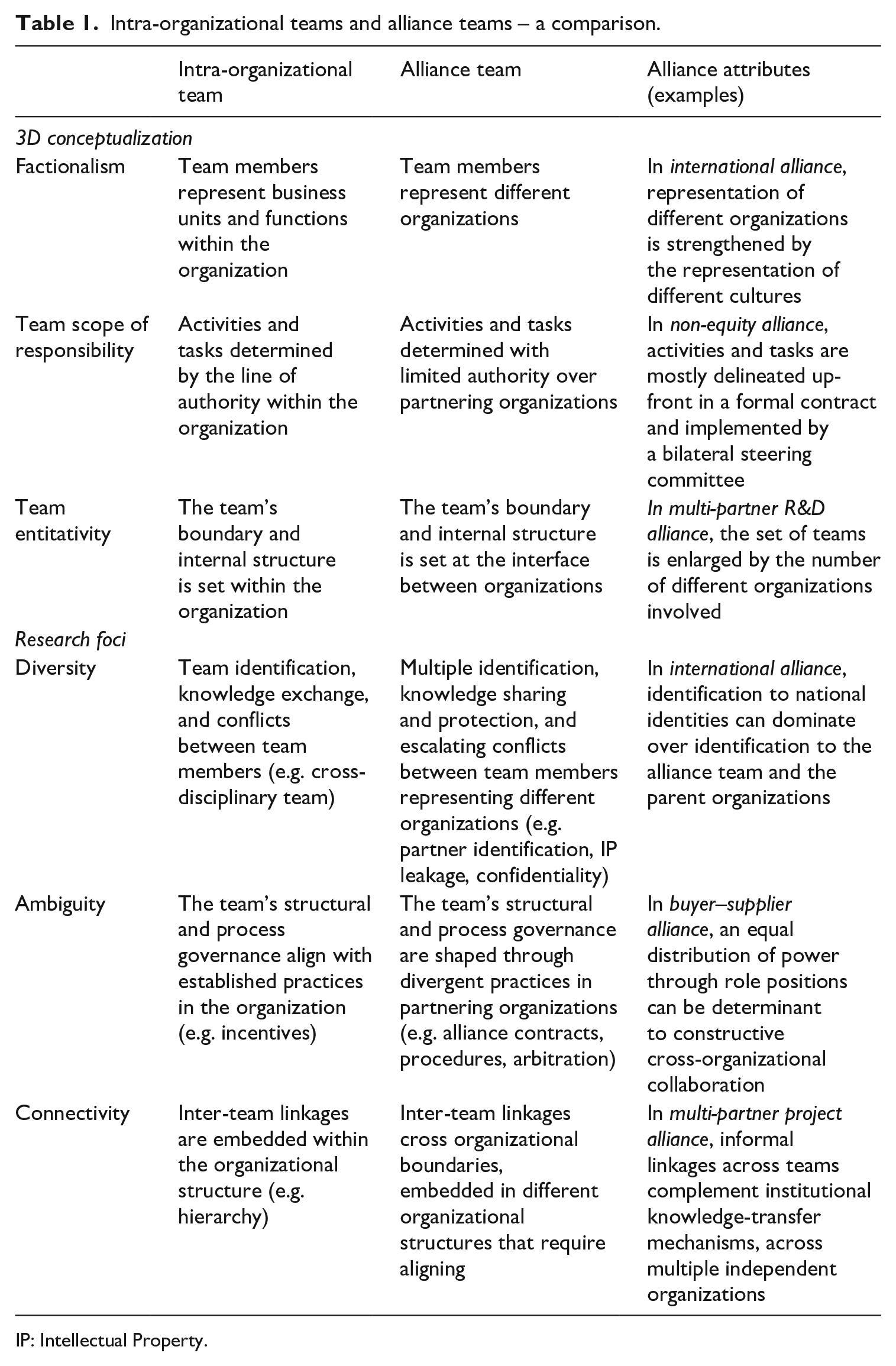
IP: Intellectual Property.
Future research directions.

Opportunity 1: Differentiate alliance teams from intra-organizational teams
The 3D landscape offers an integrated theoretical base and terminology to define alliance teams as a research object in its own right, separate from intra-organizational teams. As shown in Table 1, the 3D landscape reveals that alliance teams have unique characteristics that differ significantly from intra-organizational teams (see Table 1). Even though team members in intra-organizational teams may have different agendas, ultimately, they work toward the interests of their organizationally aligned roles and their organization. In comparison, there are tensions between organizational interests that align between factions in alliance teams. Intra-organizational teams have a scope of responsibility within a clear and often well-developed organizational structure. Alliance teams, however, typically operate in an organizational vacuum where part of their responsibility is building infrastructure between organizations and reconciling collaborative and competitive tensions. Entitativity also differs from the intra-organizational team perspective. Intra-organizational teams operate within organizational boundaries, while entitativity for alliance teams stretches beyond organizational boundaries and is challenged by ongoing changes in the partner organizations. Given these characteristics are unique to the alliance teams, the nature and extent of diversity attributes, goal ambiguity, and inter-team connectivity differ from those observed in intra-organizational team settings (see Table 1). Diversity, ambiguity, and connectivity also bring unique implications on team performance. Specific mechanisms are warranted to overcome and take advantage of these implications (e.g. handling conflicts between separate organizations via arbitration or court, including contractual clauses to protect against knowledge misappropriation).
Future research could explore in more depth how alliance teams differ from intra-organizational teams and where they are similar in order to further our understanding of alliance teams (see Table 2). To extend the diversity focus, future research could draw on social categorization and identification theory (Crisp et al., 2006), including recent inter-group theory (Hogg et al., 2012) to explore team member identification in intra-organizational and alliance teams. Drawing on intra- and inter-organizational learning frameworks (e.g. Holmqvist, 2003), future research may seek to understand how team learning unfolds in intra-organizational versus alliance teams. Alliance governance (e.g. Malhotra and Lumineau, 2011; Schilke and Lumineau, 2018) and team governance (e.g. Friebel and Schnedler, 2011) frameworks could guide future research into the management of ambiguity for either type of team. Furthermore, future research could draw on boundary spanning (e.g. Schotter et al., 2017) and network research (e.g. Provan et al., 2007) for comparisons of boundary agent roles, formal and informal inter-team relations, and team networks within and between organizations. Such systematic comparisons provide insights unique to alliance teams and differentiate them from intra-organizational teams while connecting both research streams.
Opportunity 2: Compare alliance teams in the 3D landscape
Future research could systematically: (1) compare and investigate alliance teams within the same region of the 3D landscape, (2) compare alliance teams between regions, and (3) compare teams transitioning between regions. Such comparisons help to build theory that can explain how relationships operate under the conditions of different regions in the 3D conceptualization (see Table 2).
First, future research may seek to combine and integrate findings in the alliance team literature by conducting studies across teams in the same region of the 3D landscape. For example, studies could draw on (alliance) team conflict research (e.g. Zoogah et al., 2011) to compare the inputs, process, and outcomes of conflicts in teams with similar levels of factionalism, scope of responsibility, and entitativity such as cross-organizational steering committees and joint venture management teams. Alternatively, taking the same teams, researchers could investigate how the joint venture’s CEO and the alliance manager’s trust, learning, and motivations affect goal ambiguity and the team’s choice of governance. Such comparisons would help solidify findings for regions or whole dimensions rather than separating them into fields focusing on particular alliance team types.
Second, studies could compare teams across regions to better understand alliance team inputs, processes, and outputs. While the dimensions are conceptually distinct, we expect that, in practice, some regions are more common than others. In theory, teams can sit anywhere in the 3D landscape. However, future research could address whether, in practice, certain combinations on the dimensions occur more commonly than others. The position of any given team on the 3D landscape is likely to influence how alliance team processes and outcomes unfold. Clarifying the differences and similarities across regions deepens our understanding of alliance teams within and between regions. Future research could, for instance, explore how team diversity and its outcomes differ for alliance teams with weak factionalism, narrow scope, and low entitativity compared with teams with strong factionalism, broad scope, and high entitativity. In the former, diversity is less likely to result in destructive in- and out-group processes (Potter and Lawson, 2013) than the latter (Maurer, 2010). Research could also compare political maneuvering to reduce ambiguity, manage conflicts, or span boundaries. Also, following our illustration, researchers could explore the effectiveness of different leadership approaches across regions of the 3D landscape (e.g. Kramer et al., 2019; Li et al., 1999).
Third, future research could build on the 3D landscape to investigate how, when, and why alliance teams might transition to other regions. For example, as team members change, the level of factionalism may change. Also, team responsibilities could shift, for example, when negotiation teams with goal-setting responsibilities transition into operational teams that focus on task execution (Eden and Huxham, 2001). Furthermore, alliance development can lead to new teams and more complex constellations of alliance teams (Volkoff et al., 1999), which would change the level of factionalism. Therefore, future research should address the origins and consequences of shifts in the 3D landscape, particularly the evolution of alliances and alliance teams over time. Overall, engaging with the 3D landscape leads to research avenues that force us to go beyond singular alliance team typologies to understand the variety between alliance teams.
Opportunity 3: Align the levels of analysis
The three identified research foci direct attention to the multi-level character of alliance teams (see Table 2). The diversity focus is grounded in team member diversity, where ambiguity and connectivity relate to the team and inter-team level of analysis. To date, only a few alliance team studies have explicitly acknowledged the multi-level nature of alliance teams (for exceptions see, Büchel, 2000; Eden and Huxham, 2001; Harryson et al., 2008). More recently, however, we have seen more calls for multi-level approaches in alliance team research (e.g. Donati et al., 2020; Kramer et al., 2019; Luciano et al., 2018; Luvison and Marks, 2013). Studies need to move beyond one research focus to develop and validate multi-level models (Salvato et al., 2017) and reconcile theory tied to specific levels of analysis.
Future research could address how power and political agendas at the inter-team level influence team and team member learning in alliance teams (Du Chatenier et al., 2009). Alternatively, following network studies (e.g. Adobor, 2004; Salk and Brannen, 2000), researchers could address how team members’ network positions, prior ties, or advice centrality affect social identification by team members with the alliance team or the development of alliance teams. Following Iseke et al. (2015), it would be valuable to distinguish between information sharing within and between subgroups, teams, and organizations and how these differ and relate to each other. Alternatively, future research could explore how team dynamics influence inter-team processes and outcomes. For example, we know little about how conflict, trust, or knowledge exchange within alliance teams affect similar dynamics between teams in different partner organizations.
In following this direction, researchers should consider that theories specific to alliance teams are not always applicable to other levels of analysis and vice versa (Klein and Kozlowski, 2000: 213). Therefore, future research needs to prevent cross-level fallacy by specifying how relationships between constructs at the team member level (such as professional identification and individual learning) may differ at the team (e.g. team identification and team learning) and inter-team (e.g. partner identification and inter-team learning) levels (Rousseau, 1985).
Opportunity 4: Incorporate the effects of alliance attributes
We stress the importance of future research systematically investigating how alliance attributes may affect the position of the alliance teams in the 3D landscape (see Table 2). Alliance attributes also make up the alliance context, which conditions alliance team inputs, processes, and outputs.
Alliance attributes, such as being international (Li et al., 2002), cross-industry (Eden and Huxham, 2001; Van Der Meer et al., 2013), underpinned by equity contracts (Pearce, 1997), or being involved in research and development (Lawson et al., 2009; Malhotra et al., 2001), may influence alliance team factionalism, scope of responsibility, or entitativity; as well as the extent and nature of diversity, goal ambiguity, and inter-team connectivity. Compared with domestic alliances, team members’ cultural interests in international alliances could bolster factionalism. Research could also investigate how the type of organizations involved in an alliance such as businesses, government, or not-for-profit organizations may increase factionalism, undermine collective sense making, and determine the number of teams required to attain the alliance goals. Studies adopting a developmental view have suggested that alliances typically progress from formation to ongoing management to termination (Büchel, 2000). Building on the research by Hambrick et al. (2001) and Zoogah et al. (2011), it remains unclear how factionalism in joint venture teams develops as the joint venture moves from its early days to maturation. Future research could investigate how combinations of alliance attributes create different “starting” positions for alliance teams and how these positions evolve as the alliance evolves. Thus, future research may explore how particular alliance attributes influence teams at different positions in the 3D landscape.
Methodological considerations
The review suggests that methodological pluralism has increased the richness of insights on alliance teams but prevented the direct comparison of findings across studies required to increase the validity of conclusions. Out of the empirical studies in our sample, 38 were quantitative, 49 were qualitative, and four were mixed-method studies. Quantitative studies relied mainly on survey studies (Johnson et al., 2002; Li and Hambrick, 2005; Stock, 2006; Zoogah et al., 2011), sometimes complemented with qualitative data (Drach-Zahavy, 2011). Qualitative studies relied on a variety of methods, such as case studies (Newell and Swan, 2000; Salk and Shenkar, 2001), participatory research (Büchel, 2000), action research (Eden and Huxham, 2001), interpretative case studies (Salk and Shenkar, 2001), and grounded analysis (Pitsis et al., 2003).
There is an ongoing need for both qualitative and quantitative approaches to study alliance teams. In-depth and longitudinal qualitative research can help explain the complexity associated with relationships among, for example, team member characteristics, team composition, and alliance outcomes (Smith et al., 1995). In addition, such work can help understand the dynamics and evolution of alliance teams and alliances (Büchel, 2000; Salk and Shenkar, 2001; Walker and Stohl, 2012). Cross-case comparisons can account for contextual variations of different alliances. Quantitative studies may use surveys and experimental designs to collect multi-level data. They could further use hierarchical linear modeling (HLM) to overcome some of the limitations of traditional regression analysis when examining variables located at different levels (Hofmann, 1997). Also, social network analysis has proven a valuable tool to track alliance team functioning (e.g. Ryan et al., 2014).
Based on the review, we identify two main methodological challenges to alliance team research: (1) accessing alliance team data and (2) developing appropriate measurements. It can be challenging for researchers to access reliable alliance team data. Alliance teams and their boundaries can be hard to identify, and public datasets are often unavailable. Moreover, for confidentiality or strategic reasons, organizations may be unwilling or unable to disclose all information related to their alliance partners (Iseke et al., 2015; Zoogah et al., 2011). However, researchers should collect data from multiple (if not all) team members from all partner organizations (Bstieler and Hemmert, 2010). Therefore, researchers should engage in preliminary observations to delineate the alliance team boundaries, composition, and define how to pinpoint the most knowledgeable respondents. Stratified sampling is essential to map team members at different levels (e.g. top management, operations, boundary-spanners) (Bstieler and Hemmert, 2010; Büchel, 2000). Team members’ team perceptions may differ depending on their position inside the team “network”. Researchers should also collect data on the partner organizations’ governance structure and position to control their effects. For instance, belonging to a dominant partner in a JV can influence team members’ perceptions (Li and Hambrick, 2005; Zoogah et al., 2011). Laboratory or quasi-experiments (e.g. vignette studies) with professionals can solve the challenging access to reliable data. Nevertheless, they require a design that allows for further empirical validation.
As a second challenge, we raise the development of measurements and scales for inter-organizational teams. Variables cannot be measured the same way for alliance teams as for intra-organizational teams (see Donati et al., 2020; Du Chatenier et al., 2009). For example, the concept of diversity or cognitive distance at an inter-organizational level involves accounting for the different corporate cultures and organizational structures involved. Unlike with intra-organizational teams, members of alliance teams generally depend on their parent organizations for their salary, bonuses, careers, and sense of achievement and belonging (Hambrick et al., 2001). Asymmetry in compensation structures or career opportunities in the respective organizations involved could be itemized for measuring. Altogether, there is a need for team-related measurements that account for the inter-organizational context.
Concluding remarks
Before we conclude, we note some of the limitations of our work. Other coding and mapping approaches may have yielded different results (e.g. research foci and their implications) and added value in different ways. Furthermore, while the 3D conceptualization helps researchers plot alliance teams on meaningful dimensions and compare them within and across the dimensions, it is warranted to further define the precise criteria that make alliance teams evolve along these continuums (e.g. criteria to assess the intensity of the vested interests among factions, or to assess the boundedness of the team entity). Such criteria can offer a more fine-grained approach of the three dimensions and thereby serve as a springboard for the empirical work we encourage.
Teams are an inherent part of alliances and constitute a critical driver of alliance outcomes. Our review found a literature dispersed across management fields, incoherence in alliance team definitions, and variety in research foci. To enable theoretical advancement and empirical validation, we developed a 3D conceptualization of alliance teams, brought the research together, and suggested directions for future research. We have advanced the research on alliance teams by offering conceptual clarity about alliance teams, unifying terms, and showed why and how alliance teams vary and compare to intra-organizational teams. We provided a framework for further cross-fertilization and integration of alliance team research. A coherent body of knowledge on alliance teams will allow for further theorization and validation of inter-organizational team perspectives and support alliance practitioners.
Supplemental Material
sj-pdf-1-hum-10.1177_00187267221104985 – Supplemental material for On alliance teams: Conceptualization, review, and future research agenda
Supplemental material, sj-pdf-1-hum-10.1177_00187267221104985 for On alliance teams: Conceptualization, review, and future research agenda by Martijn van der Kamp, Brian Tjemkes, Valérie Duplat and Karen Jehn in Human Relations
Supplemental Material
sj-pdf-2-hum-10.1177_00187267221104985 – Supplemental material for On alliance teams: Conceptualization, review, and future research agenda
Supplemental material, sj-pdf-2-hum-10.1177_00187267221104985 for On alliance teams: Conceptualization, review, and future research agenda by Martijn van der Kamp, Brian Tjemkes, Valérie Duplat and Karen Jehn in Human Relations
Footnotes
Acknowledgements
We would like to thank associate editor Kerrie Unsworth and the three anonymous reviewers for their ongoing support and constructive comments. We are grateful for the suggestions from the participants in our presentation at the International Association for Conflict Management. We also thank Marie Christodulaki for her thoughtful and invaluable research support.
Funding
The authors received no financial support for the research, authorship, and/or publication of this article.

Supplemental material
Supplemental material for this article is available online.
References
Supplementary Material
Please find the following supplemental material available below.
For Open Access articles published under a Creative Commons License, all supplemental material carries the same license as the article it is associated with.
For non-Open Access articles published, all supplemental material carries a non-exclusive license, and permission requests for re-use of supplemental material or any part of supplemental material shall be sent directly to the copyright owner as specified in the copyright notice associated with the article.
