



Abstract
The expansion of hybrid and remote work arrangements continues to reshape contemporary work, yet the experiences of early-career professionals within these contexts remain underexplored. Drawing on semi-structured interviews with 16 early-career professionals working across remote and physical settings, this study examines how individuals, at the start of their careers, experience and interpret hybrid work. The findings reveal two analytically distinct yet interconnected premises: experiences of situational detachment associated with feelings of insecurity, alongside the perception of home as a refuge that affords focus and autonomy. Our analysis identifies challenges faced by early-career professionals when working remotely, particularly in sustaining relationships with their immediate managers and colleagues, interpreting expectations and accessing informal learning and developmental opportunities. Together, these findings illuminate how hybrid work simultaneously enables and constrains early-career professionals’ learning, identity formation and sense of belonging. By foregrounding the lived experiences of individuals entering professional roles, the study extends qualitative research on hybrid work and highlights the importance of social interaction, visibility and organisational support in shaping early-career development in hybrid work contexts.
Flexible work arrangements that combine remote and in-person work have become a defining feature of contemporary workplaces, offering benefits such as increased flexibility, reduced commuting and greater autonomy over work schedules (ter Hoeven and van Zoonen, 2015). The COVID-19 pandemic significantly accelerated this shift, and many organisations continue to operate within hybrid models that are largely remote-centric. While these arrangements offer clear advantages, they also present challenges, such as diminished informal learning, social isolation and blurred work–life boundaries that can affect employees in complex ways (Becker et al., 2022; Gutworth et al., 2024; Manroop and Petrovski, 2023).
While a growing body of literature has explored the implications of remote and hybrid work, much of this literature overlooks the significance of career stage in shaping experiences of remote and hybrid work. Prior studies show that remote or hybrid arrangements can limit access to these critical developmental experiences and lead to intensified loneliness alongside other mental health issues (Becker et al., 2022; McCarthy et al., 2026). These issues are particularly salient for early-career professionals, who are still developing their professional identity and often depend on in-person interactions, mentorship and workplace immersion to build confidence and competence. Early-career professionals face distinct challenges as they complete their academic training and become increasingly engaged in professional practice over the course of the first few years of their career journey (Modestino et al., 2019). These challenges are complex and can significantly affect their job satisfaction, professional identity and overall well-being. Despite the growing prevalence of these work models, research on how early-career professionals experience and adapt to them remains limited. Examining how individuals at particular career stages cope with challenges specific to their position can, however, provide valuable insights into career transitions (Kutscher and Mayrhofer, 2023).
The literature on remote work is already extensive; however, a notable gap remains concerning the effects of remote work on individuals with minimal work experience. This gap is particularly significant for early-career professionals, typically those within 1–5 years after graduation, who often use this period to reassess their career aspirations in light of their work experiences and the realities of organisational life (Ahuja et al., 2019; Woo and Acosta, 2024). Unlike more established workers, early-career professionals simultaneously learn how to perform their roles and how to explore themselves as professionals. In doing so, they often rely heavily on workplace interaction, feedback and informal social cues to make sense of organisational norms and expectations (e.g. Huff et al., 2019; Mackay, 2017). However, hybrid work arrangements may fundamentally alter access to these relational and developmental resources by redistributing interaction, visibility and learning opportunities across physical and virtual spaces (e.g. Donald et al., 2022; Hughes and Davis, 2024). For early-career professionals, this reconfiguration is particularly consequential, whereas hybrid work creates a paradoxical situation: it often reduces opportunities for informal contact and socialisation while offering greater flexibility and autonomy. First, from a theoretical perspective, this raises important questions about how career stage dynamics intersect with hybrid work to shape processes of identity formation, meaning-making and insecurity. Indeed, early-career professionals typically learn what it means to be a professional through day-to-day work experiences, including interaction with others, feedback and observation of workplace norms. Hybrid work reshapes how this learning takes place by altering everyday social conditions at work: it reduces informal interaction, limits opportunities for observation and weakens access to reassurance, providing immediate feedback and confirmation that expectations are being met (e.g. Parker and Grote, 2022). Much of the existing remote work literature, however, focuses on experienced workers with established careers and stable professional identities (Hughes and Davis, 2024), and we still know little about how hybrid work shapes early-career professionals’ sense of identity, meaning and insecurity at work.
Second, from a practical perspective, understanding these dynamics has important implications for how organisations support early-career professionals in hybrid work settings. Reduced informal interaction and limited access to everyday reassurance may hinder early-career employees’ learning, confidence development and sense of security in their roles. If left unaddressed, hybrid work may inadvertently disadvantage those entering the workforce for the first time, and can lead to inefficient career planning, subtle but heightened insecurity and, for organisations, weakened workplace culture and even the loss of talent (e.g. Mazzei et al., 2023; Oppong Peprah, 2024).
Hybrid work arrangements offer flexibility and autonomy but also introduce challenges for learning, coordination and social connection. These tensions may be particularly salient for early-career professionals, who stand to benefit from flexible work arrangements while relying on frequent interaction, informal learning and close guidance to develop skills, construct a professional identity and integrate into the organisation (Hughes and Davis, 2024; Mazzei et al., 2023). Indeed, early-career professionals today are often comfortable using digital technologies and can readily perform many tasks remotely; however, such technical competence does not eliminate their reliance on frequent interaction, informal learning and guidance in learning on the job, forming a professional identity and integrating into organisational life (Leonardi et al., 2024; Osorio and Madero, 2025). To better capture such opposing dynamics, we draw on a paradox perspective (Smith and Lewis, 2011), which views paradoxes as persistent tensions between opposing yet interrelated elements, and we conceptualise hybrid work as a context in which such opposing dynamics coexist and must be experienced simultaneously. We therefore view hybrid work as neither inherently positive nor negative for early-career professionals, but rather as a work arrangement that may both enable and limit how well new employees settle into their roles and how emotionally connected they feel to the organisation.
This study presents a detailed and structured analysis of the remote work experiences of 16 early-career professionals who are alumni of a leading Turkish business school in Istanbul. Drawing on a symbolic interactionist and phenomenological orientation, the analysis reveals the dual nature of remote work for early-career professionals, characterised by coexisting experiences of freedom and insecurity that shape learning, socialisation and early professional identity development. We begin by situating the study within the literature on remote and hybrid work, with particular attention to early-career professionals, before outlining the epistemological framework, research questions and methodology. We then present the findings and discuss their theoretical and practical implications.
Early-career professionals in the evolving landscape of remote work
Remote work, defined as the practice of working outside of a traditional office environment, often from home or other remote locations, has received sustained scholarly attention in the human resource management (HRM) literature over the past few decades (Bailey and Kurland, 2002; Donnelly and Johns, 2021; Felstead and Henseke, 2017; Schertler et al., 2024). The practice has become increasingly prevalent across various industries (e.g. Riach and Tyler, 2024), calling organisations to reassess their HRM strategies and remote work policies to ensure employee productivity and well-being (Allen et al., 2021). Research over time has shown that the impact of remote work is influenced by various work-related and individual characteristics, including supervisor relationships, job autonomy, communication and self-discipline (Golden, 2007; Perry et al., 2018; Shockley et al., 2021; Wang et al., 2021).
The transition from student to professional represents a significant phase in an individual’s career journey, involving practical learning, the development of essential skills, adaptation to the professional workplace and the formation of professional networks that are often unavailable through traditional educational pathways (e.g. Frenzel et al., 2023; Fu et al., 2023). The workplace environment is markedly different from the academic setting; it requires newcomers to adapt to unfamiliar social norms and expectations. During this critical early employment phase, which typically encompasses the first few years of a long career journey, individuals transition into their roles as professionals, actively pursuing opportunities for career development (Woo and Acosta, 2024). They usually occupy foundational roles that emphasise skill development, with a focus on essential competencies such as teamwork, communication and problem-solving, which are critical for their career advancement. The challenges they face are multifaceted, including adapting to workplace culture, balancing responsibilities, engaging in hands-on learning, seeking mentorship and building relationships with peers (Benati et al., 2023; Gustafsson and Kärreman, 2024; van Vianen et al., 2018). However, working remotely may reduce the support available from managers and colleagues, intensifying the challenges these individuals face and thereby complicating their adaptation to professional life (Olsen et al., 2023). These challenges are particularly pronounced in today’s rapidly evolving work environment, where remote and hybrid arrangements have become increasingly common. At the same time, advances in intelligent technologies are reshaping how work is organised and experienced. In this vein, employees’ perceptions of future job opportunities are closely linked to mental health, suggesting that well-structured work environments may help reduce burnout and support overall well-being (e.g. Höcker et al., 2024; Rainoldi et al., 2024). Understanding early-career professionals is therefore critically important, as they form a crucial segment of the workforce shaping the future of work. We believe this shift calls for rethinking traditional support structures and developing new strategies to support the integration and career development of those new to the workforce. Accordingly, this study aims to explore the experiences of early-career professionals working in hybrid arrangements that alternate between remote and office-based work, with particular attention to how limited prior workplace experience shapes their engagement with this form of work.
Epistemological framework and research questions
Early-career professionals often face overlapping life transitions, including entering the workforce and forming initial understandings of what it means to be a professional. They must also assume new post-graduation responsibilities, such as managing finances, securing housing and developing personal relationships. Together, these pressures can contribute to career trajectories that are unsettled and uncertain (Anderson and Tomlinson, 2021; Huff et al., 2019). While remote work is increasingly the norm (Gajendran et al., 2024; Walz et al., 2024), it presents additional challenges for early-career professionals, who may lack the preparation and support needed to meet its psychological and professional demands. Early-career development can be particularly fragile in remote and hybrid arrangements, where opportunities for informal learning, observing experienced colleagues as role models and socialisation through physical presence are reduced. How individuals respond to these challenges depends on their personal circumstances as well as the support they receive from their organisation and wider networks. Careers are not merely sequences of roles but dynamic journeys that reflect individuals’ values, aspirations and life circumstances (Gaile et al., 2022). As such, career development involves both objective indicators, such as salary and promotion and subjective dimensions, including fulfilment and a sense of purpose.
Professionals perceive their roles and work environments in different ways, highlighting the importance of understanding how they interpret their capacity to act independently, make choices and derive meaning from their work, and how these interpretations shape their lived experiences (e.g. Berber et al., 2024; Eteläpelto et al., 2013; Tost et al., 2013; Vough et al., 2017). Understanding how such perceptions are formed requires attention to both individual experiences and the broader social conditions in which they are embedded, enabling a deeper account of meaning construction within professional settings.
We first draw on symbolic interactionism to examine how meanings emerge through social interaction. From this perspective, individuals’ interpretations of their social world are shaped by their relationships with others and engagement with culturally meaningful symbols (Brekhus et al., 2024; Schutz and Luckmann, 1974). Through repeated interactions, individuals develop understandings of themselves and their social environments, which together shape their lived realities. This perspective allows us to examine how early-career professionals make sense of their interactions with colleagues, managers and others and how these interpretations differ across office-based and remote work arrangements. In doing so, it sheds light on the nuances of social interaction and meaning-making across work settings. Accordingly, we present our first research question as follows:
RQ1. How do early-career professionals make sense of their interactions with others as they compare their experiences in traditional work settings to experiences they construct while working remotely?
While symbolic interactionism focuses on how meaning is constructed through social interaction, phenomenology complements this perspective by examining how individuals experience their working lives. It directs attention to how people feel, perceive and interpret their work and to the intentions and emotions that shape these experiences (Carter and Fuller, 2016). In remote and hybrid work arrangements, these experiences are closely shaped by the settings in which work takes place. Whether work is carried out at home, in a co-working space or in public environments such as in a café, the physical and social surroundings influence how individuals experience their work and how they make sense of it (Donnelly and Johns, 2021; Leonardi et al., 2024; Petani and Mengis, 2023). For early-career professionals, such experiences are particularly important, as they are still forming understandings of themselves as professionals and of what working life involves. Their early work experiences shape how they interpret their roles, relate to others at work and understand their place within the organisation. Drawing on phenomenology as a complementary element of our epistemological framework, we therefore explore how early-career professionals experience and interpret remote work in comparison with traditional office-based work. This perspective allows us to capture how different work settings shape feelings, perceptions and meanings during the early stages of a career. Accordingly, we present our second research question as follows:
RQ2. How do early-career professionals perceive and manage their psychological and social well-being in remote work settings, compared with traditional office environments?
By integrating these two perspectives into our epistemological framework, we construct a narrative that examines the complex and nuanced lived experiences of early-career professionals. This approach helps us understand how social interactions and personal interpretations shape how they experience work. In doing so, it sheds light on the challenges and opportunities these individuals encounter, as well as the emotions, motivations and situational factors that influence their experiences (Smith and Osborn, 2008).
Method
Research context
As Turkish societal culture is often characterised by high levels of power distance and uncertainty avoidance (Hofstede, 2001; Karakitapoğlu-Aygün et al., 2021), employees may be particularly sensitive to how they are perceived by others, especially those in positions of authority. At the same time, the Turkish socio-cultural landscape is evolving, with individualistic values becoming increasingly salient, particularly among younger generations, who show a declining attachment to inherited collectivist traditions and a markedly stronger orientation towards personal autonomy (e.g. Karakitapoğlu-Aygün et al., 2021; Marcus et al., 2017). This distinction may help explain why participants in our study express discomfort with workplace politics and perceive interactions with senior employees as intimidating. Their tendency to experience home as a refuge may also be linked to high uncertainty avoidance, reflecting a preference for familiar routines and a desire to minimise the stress associated with workplace interactions.
Data collection and analysis
Data collection was carried out through semi-structured interviews, allowing participants to express their thoughts and feelings in their own words while enabling a flexible, conversational approach (Brinkmann and Kvale, 2018: 64–66). A comprehensive interview guide was developed by consensus among the authors to elicit detailed narratives from participants about their lived experiences, focusing on significant events, emotional responses and the meanings ascribed to their roles and interactions with managers and colleagues in both traditional and remote work settings.
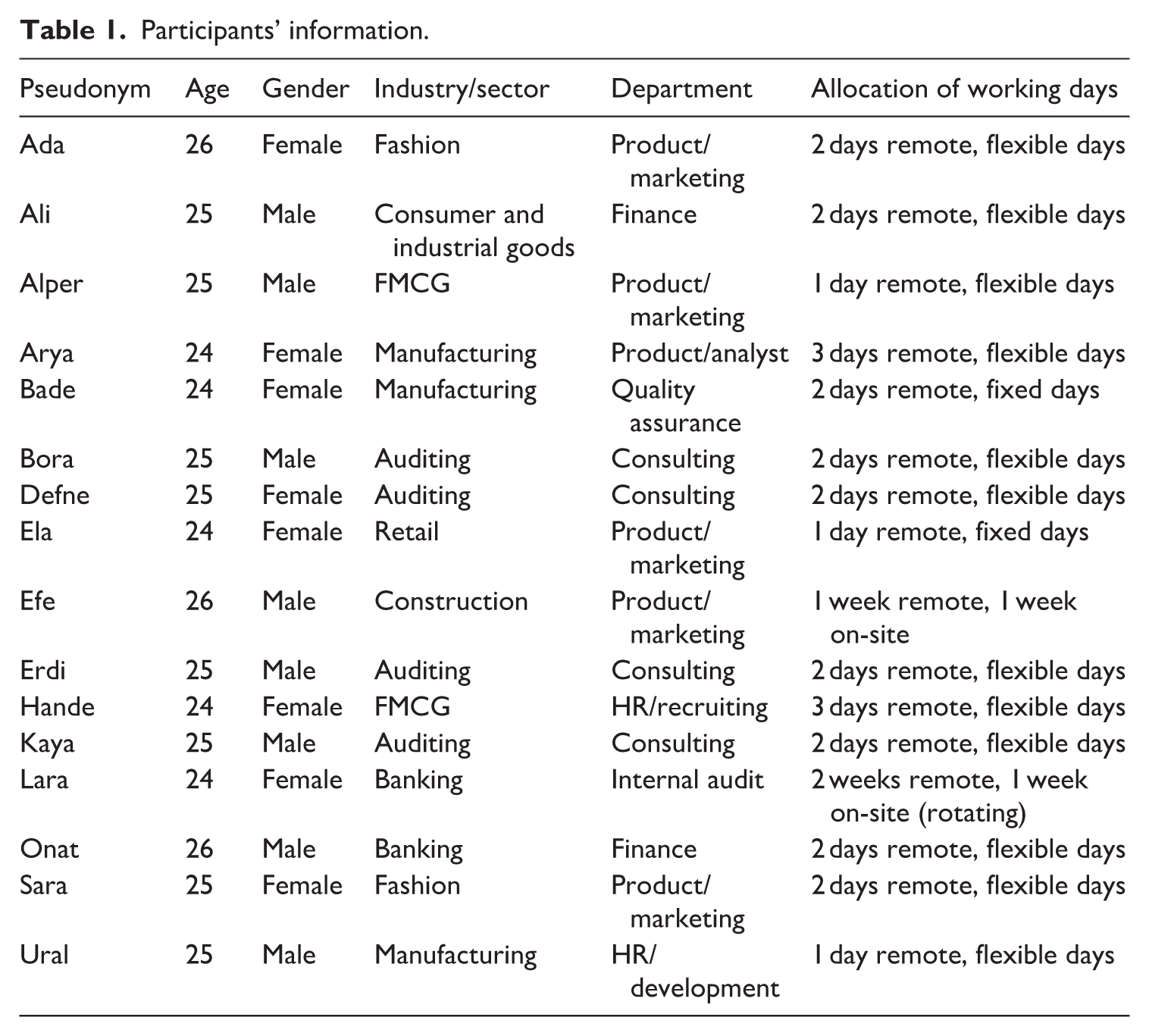
Participants for the study were recruited through the alumni network of a prominent business school in Istanbul, which is renowned for providing various avenues for its graduates to secure employment in diverse industries, including positions in multinational companies within the Turkish business landscape. This accessible network facilitated the recruitment process, with the second author initially approaching volunteers for screening and providing a clear overview of the study’s aim and content. Those selected were subsequently invited for interviews. The participant group consisted of 16 early-career professionals (Table 1), which is a suitable size for phenomenological research, prioritising in-depth exploration of individual lived experiences rather than broad generalisations to develop a nuanced understanding of the phenomenon under investigation (Bartholomew et al., 2021; Berber and Acar, 2021; Larkin et al., 2019; Sim et al., 2018; Smith et al., 2022: 44). In forming the participant group, we employed purposive sampling, which is typical in phenomenological studies, that requires the recruitment of a relatively homogeneous group of participants (Larkin et al., 2006: 103–104); while there were variations in their professional areas, perspectives and circumstances, participants shared key common traits that facilitated a nuanced understanding of their experiences. All participants were recent graduates from the same business programme, possessing professional experience ranging from 1 to 4 years. They were all employed in organisations that implemented hybrid work arrangements in which some participants had a fixed remote work schedule, working remotely on the same days every week (e.g. Mondays and Fridays), while others had more flexible arrangements, with remote days that could change depending on workload, team coordination or personal preference. These hybrid work arrangements provide essential context for gaining insights into how they adapted to their professional roles in both traditional and remote settings and drew comparisons between the two. In light of this, participants were particularly chosen for their strong inclination to use their homes as their preferred workspace while working remotely; indeed, a trend that has been increasingly observed among early-career professionals in recent years (e.g. Allen et al., 2021; Olsen et al., 2023). This approach sought to minimise context-related variations, focus on capturing the unique lived experiences of individual participants in similar circumstances, and attain coherent insights (Larkin et al., 2019; Smith et al., 2022: 44). The second author conducted the interviews, bringing a background and perspective that resonated with the participants’ experiences, which helped to create a comfortable environment that encouraged open sharing and the collection of comprehensive data that captured the nuances of their experiences. The same author also transcribed the interviews.
Participants’ information.
All authors reviewed the transcripts to ensure an in-depth understanding of the embedded linguistic subtleties and contextual nuances. Participants themselves verified the translated versions of their interviews. We recognise that articulating subjective experiences in language is inherently challenging; even those who live through them may find their intended meanings elude straightforward interpretation (van Nes et al., 2010). From our epistemological standpoint, which views meaning as socially and culturally constructed, such experiences demand nuanced readings attuned to their specific social contexts (Wong and Poon, 2010). Accordingly, we employed an interpretive translation strategy aimed at preserving semantic equivalence between source and target texts, focusing on meaning consistency over literal translation, as literal translations can distort nuances (Ho et al., 2019). In this way, our approach privileges the integrity of participants’ narratives over literalism (Polkinghorne, 2005).
We employed a systematic and multilayered analytical framework to gain a comprehensive insight into the experiences of our participants. Each interview transcript underwent a dual analysis process, wherein the data were analysed in response to our two study questions simultaneously. This was followed by a cross-case analysis to identify group-level experiential themes. This approach was grounded in our own epistemological framework, which steered our analysis and aided in the identification of key themes, while also drawing on the insights provided by Charmaz (2014) and Smith et al. (2022). We diligently explored how participants expressed their identities as early-career professionals, placing significant emphasis on the rhetorical devices, such as metaphors and similes, and the linguistic nuances found in their expressions (Gibbs, 2018).
To begin, all authors engaged in open coding to identify descriptive codes and potential themes emerging from the data. Following this, the first author conducted a comprehensive analysis for each interview, organised around two distinct yet interconnected aspects of our epistemological framework. The first round, rooted in symbolic interactionism, provided deep insights into interpersonal dynamics, illustrating how our participants, through specific signs, symbolic meanings, gestures or representations pertinent to their roles and the workplace, such as the desk or the professional attire. The symbolic interactionist perspective guides us with its approach, which posits that individuals act towards objects (whether physical, social or abstract) based on the meanings they assign to them and use language and significant symbols in their communication with others (Blumer, 1969; Carter and Fuller, 2016). Rather than conveying neutral meanings, these objects can become symbols that individuals use to interact with and relate to their environment. From this symbolic interactionist perspective, experience is accessed through its representations, such as performed narratives, discourses and symbolic actions, through which individuals construct and convey meaning about their world (Denzin, 2004: 85). In our context, these interpretations can become especially salient during the transition between physical and psychological places and roles, which often resemble modern rites of passage, involving emotionally charged symbols and ritualised behaviours (Ashforth et al., 2000). In our analysis, we paid close attention to the symbolic significance of signs, boundaries (e.g. between personal and professional space) and rituals (e.g. morning routines) in interpreting these as expressions of how individuals construct meaning in the absence of physical organisational cues. The cross-case analysis, which compared and contrasted themes from each interview transcript, revealed a key group-level characteristic that reflected participants’ experiences with remote work, which serves as our first premise: a shared sense of situational detachment and feelings of insecurity.
The second round centred on phenomenology, delving into the intrapersonal implications by capturing the participants’ lived experiences, emotions and perceptions. This approach revealed how personal experiences informed interactions and contributed to the construction of meanings assigned to particular symbols. The cross-case analysis indicated that participants distanced themselves from workplace distractions and politics by establishing dedicated workspaces at home. This led us to our second premise: the concept of home as a refuge for focus and freedom. Participants collectively acknowledged home as a symbol that transcended physical space; it served as an emotional sanctuary embodying their pursuit of tranquillity and productivity.
Following the identification of these two premises, each author independently reviewed the findings and recorded their observations on key insights. This process sought to leverage the positional reflexivity of all authors, allowing for the integration of varied perspectives and the development of richer themes and more nuanced outcomes. Finally, we undertook another stage of collaborative work to enhance the contextualisation and discussion of our findings within the existing literature (Anderson et al., 2016; Linneberg and Korsgaard, 2019).
We present our findings in two subsections. The first establishes the premise that absence from the workplace can affect early-career professionals’ sense of identity, marked by detachment, insecurity, performance anxiety in isolation and lost chances for informal learning and relationships. The second shows that the home can act as a refuge, with structured, personalised spaces fostering focus, freedom and productivity while easing workplace pressures and blending personal and professional needs. As shown in Figure 1, the two premises are analytically distinct but interconnected, capturing the coexisting experiences of freedom and insecurity in hybrid work. Together, these premises illustrate how hybrid work simultaneously enables and constrains early-career professionals’ everyday experiences across work settings.
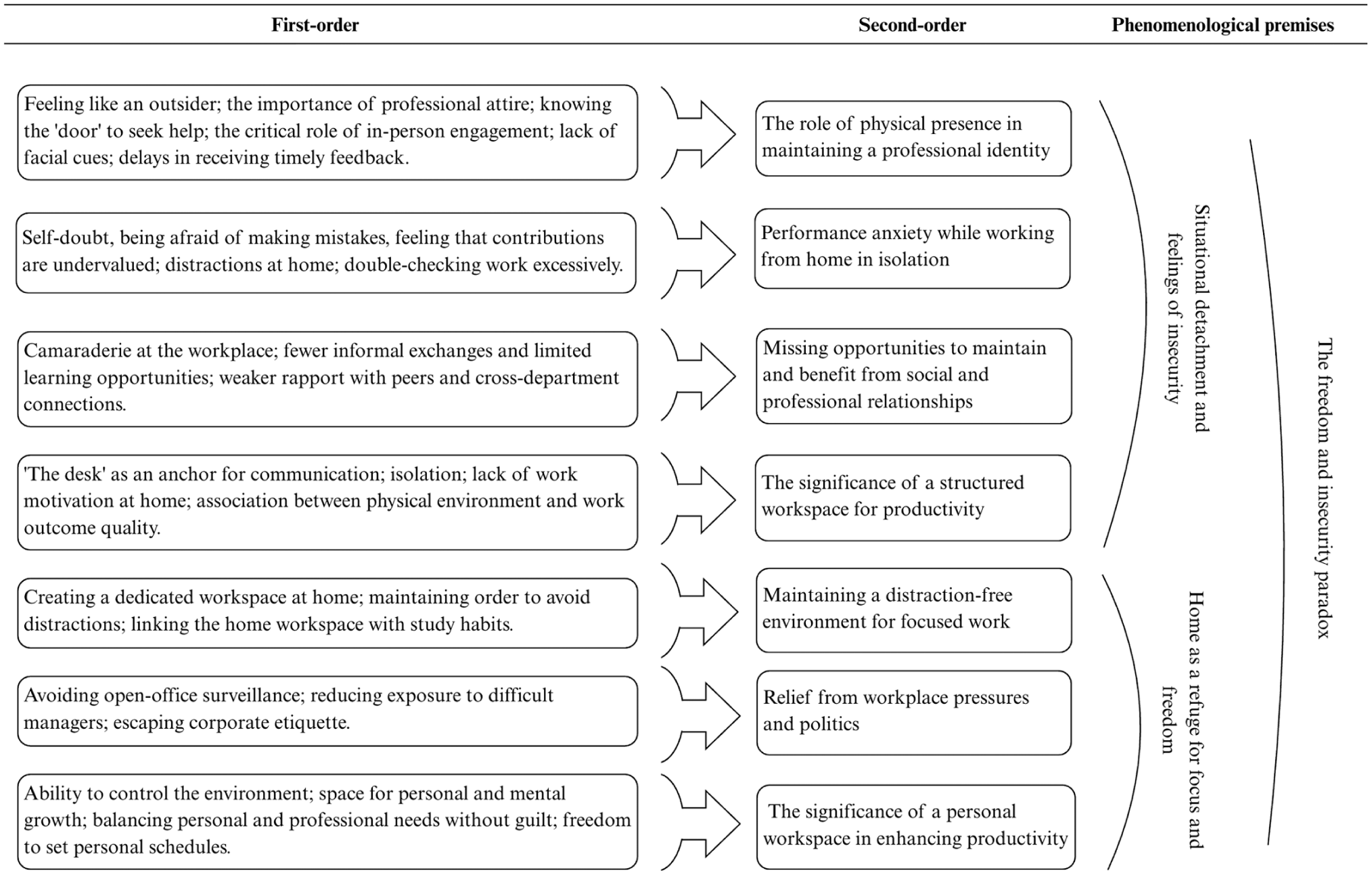
The freedom–insecurity paradox: Interplay between situational detachment and home as a refuge.
Premise 1: Situational detachment and feeling of insecurity
While remote work offers flexibility and convenience, participants, in general, expressed a shared sense of situational detachment from their colleagues and managers. In other words, these early-career professionals felt disconnected when working remotely, experiencing greater engagement and connection in the physical workplace. Their experiences are situational rather than permanent, pointing out the dual nature of remote work.
The role of physical presence in maintaining a professional identity
While remote work provided benefits such as autonomy, it could also lead to feelings of loneliness and a contextual sense of being on the outside within the workplace. For Kaya, being in the same physical space as experienced colleagues is exceptionally stimulating. He highly values acting professionally and making a lasting impression on both his manager and his peers. He was hired for the position while still a university student, and for him, building a career is largely dependent on this aspect: The office is quite different actually. I mean, your attire… You become someone entirely different. You can work in your comfortable pyjamas at home, but in the office… you actually feel better. [. . .] You sit at your desk and listen to the guy [department manager] with utmost attention as if you are breaking the atom into its pieces…
In the workplace, Kaya consciously disconnects from the outside world, firmly establishing himself as a member of his department. Wearing professional attire and sitting at his desk in the office enhances his self-esteem and confidence, facilitating his transition into a professional role and fostering connections with his more experienced colleagues. Although virtual communication with co-workers is possible, being physically present allows for more natural interactions, helping him cultivate a sense of belonging within the workplace community. His strong sense of identity within the department supports him in maintaining relationships with both his colleagues and other departments: A corps-à-corps debate once took place between me and the marketing director over sales figures. In our field [finance], you fail if you can’t defend your opinion well. [. . .] The tone of voice is all you have when you’re talking over the phone, but when you’re talking face-to-face, you get gestures and facial expressions, plus body language.
Here, Kaya refers to a close combat between him and his opponent, a director in a different department. In a martial arts sense, both parties are players in a game, and the aim of corps-à-corps is to win by gaining a position of advantage over the other. In this game, Kaya represents the field (finance) in which he intends to advance his career. In challenging a senior co-worker (the director) in another field (marketing), he seeks to demonstrate his competence and earn the respect of both his peers and the experts within his department. However, the way Kaya positions himself at work is limited at home. Without cues such as facial expressions, gestures and body language, he struggles to convey his ideas and build rapport, leaving him feeling misunderstood and concerned that his contributions may not be taken seriously. Effective communication is also a concern in Hande’s experience: Working from home can be really stressful when you need to explain things to teammates. Instead of just asking the person next to you, you end up making calls, sending loads of emails, and having long chats. It gets overwhelming. In the office, I just turn to my manager and say, ‘How about this?’ and if he says ‘OK’, it’s sorted!
Performance anxiety when working from home in isolation
When performing her task, it is crucial for Hande to receive timely confirmation, support and advice. Sitting next to her manager, close to the source of power, instils confidence in her decision-making; however, she feels a sense of disconnect when working remotely, relying on virtual connections with her colleagues. This struggle with confidence was particularly evident in Ada’s words: But still [. . .] you know, petty mistakes [happen], things I’ve never do normally [in the office]! Actually, that scares me a little bit. I ask myself if I’m not as good as I thought. Am I just making these silly mistakes when I’m working from home, or have I always done them and I’m only realising it because I’m more focused at home?
Ada worries about making minor mistakes and questions her abilities. Her use of ‘you know’ indicates her discomfort with working alone at home, where distractions and errors can easily occur. Consequently, she feels less confident due to the lack of feedback and cues from her colleagues. Kaya faces a similar challenge. He knows that his job is prone to mistakes, and he often finds himself checking his work multiple times, sometimes as many as four or five. He expresses, ‘No matter how well you plan in your mind, you always end up feeling like you’re making a mistake, even if that’s not the case.’ For a recent graduate aiming to become an ambitious and dedicated professional, Kaya thinks, this is not permissible.
Participants, indeed, emphasised the importance of professionalism and decorum typically associated with the office, whereas the more relaxed home environment can make it harder to maintain routines and relationships. Lara benefits from having her own room at work, which allows her to concentrate and limit distractions, while also giving her easy access to colleagues. She can walk over to their desks to ask specific questions about clients and clarify details directly, something she feels unable to do from home, where she often holds back in order not to take up others’ time.
Missing opportunities to maintain and benefit from social and professional relationships
The workplace enhances Lara’s ability to seek the support she requires and connect with the appropriate colleague for assistance; a spontaneous visit to, in Lara’s words, ‘the desk of the person concerned’ (Turkish: ilgili kişinin masası) is usually sufficient to obtain the information she needs. Notably, she places the emphasis on the desk rather than her colleague; the desk symbolises organised work, a reliable source of information and clear communication. Throughout her interview, Lara consistently displayed professionalism, maintaining corporate etiquette and distance with others at work. Yet, her readiness to seek information promptly from colleagues about her clients reflects her self-assured demeanour at work. Her efficiency and ability to prioritise client needs depend on her coordination with relevant ‘desks’ in the office. However, working from home limits her capacity to take immediate action; she struggles to connect with peers, making it difficult to meet clients’ needs effectively and on time. Ada, too, much like Lara, is used to seeking help and support when working in the office, but she struggles to do so when working from home: It’s better to talk face to face. If people don’t see you, they might not even answer your calls. I try to connect, even if we don’t click. They don’t have to like me, but at least might see it only takes a couple of minutes to help. As a junior working from home, I’m at the mercy of people I don’t vibe with, but in the office I can turn to someone I trust.
The significance of a structured workspace for productivity
Ada seeks recognition even from colleagues who see her as not fitting in, yet she struggles to earn trust when working remotely. Departmental and hierarchical barriers make it harder to convey the importance of her requests. While Lara builds formal connections by visiting desks, Ada relies on social skills to foster collaboration. Both, however, find this difficult outside the physical workplace, as do many participants who feel empowered by workplace dynamics and open interactions: Giving a shout to the mate sitting at the desk behind me and email communication at home do not help in the same way. Playing pass-and-receive with teammates is more sincere and way more fluid, and at home, the game is not intense and provides fewer passes. (Bora) I could be the latest to join the department, but I’m likely the one who knows the most people there. One mate sits right at the desk next to mine, and another sits just in front of me. Any time a task comes up, I can sort it out right away, tic tac toe… (Alper)
Once again, the desk serves as a symbol of one’s position in the workplace; however, in this instance, the connections are less formal. The closely situated desks are occupied by ‘mates,’ and Bora and Alper utilise their social skills to cultivate relationships with nearby peers instead of pursuing formal interactions. Bora describes this dynamic as ‘pass-and-receive,’ likening it to a game where two people continuously toss the ball, emphasising the importance of mutual engagement in any interaction. Both parties must contribute something valuable to establish a successful relationship, where this could be knowledge, resources, support or anything else beneficial. Being an entry-level employee, he needs this reciprocity as his interactions are ‘way more fluid.’ Communication between him and his peers is therefore more relaxed and natural, resulting in greater collaboration. In the office, he enjoys the opportunity to learn right on the spot from more experienced colleagues, and in return, he can prove himself an integral part of the team. Meanwhile, Alper prioritises building strong connections in the workplace, showing confidence in his ability to establish rapport with peers who provide support and guidance. He views his tasks at work as problems to be solved, and his use of the term ‘tic tac toe’ suggests a systematic, efficient approach to resolving issues smoothly and without a hitch. This indicates that he may experience work-related stress, as he perceives tasks as challenges that demand resolution: My managers are never helpful [online]… not much. They are like, ‘Problem? Go figure it out yourself’. Result: Slippery slope to failure. Then they are like [in the workplace], ‘Why didn’t you tell me?’ To be honest, my luck with managers isn’t great. Anyway, I stopped asking them. I simply rely on my own communication skills and contact people to sort out my tasks.
The ability to solve problems is absolutely critical to success in marketing, and in Alper’s case, this was no exception. While he is in the early stages of his career development, he, like his more experienced peers in the department, must be able to identify and address any issues or concerns that customers may have in a timely and efficient manner. He relies on his social skills to conduct effective communication in a way that is both informative and engaging, as he says, ‘sometimes I even bring chocolates with me when I visit other departments, especially accounting.’ The office, as in Kaya’s experience, provides him with the stage to explain and convince others through the use of friendly language, facial expressions and small gestures. At home, however, he feels his hands tied up and somehow stressed as he says, ‘[working from home] sometimes means just constantly ringing phones and meetings.’
Defne and Sara also experience the challenges of remote work, albeit in a different way than the other participants. Whenever Defne has questions while working from home, she is not shy about reaching out to anyone she thinks could assist her. ‘There are times when I call people like mad, even those I don’t know,’ she admits, yet she adds that her colleagues have always been patiently helpful, allowing her to successfully accomplish the task at hand: My work environment’s quite dynamic. Most of my peers are my age, and my manager’s only six years older, which helps us get along. Honestly, I think we communicate even better over chat.
Defne is receptive to working from home when necessary, while Sara believes remote work can sometimes be more efficient. Initially uncertain about her career in auditing, Sara’s enthusiasm grew after starting her job, and she appreciates the camaraderie with her colleagues. Thanks to her friendships with colleagues of a similar age, what could feel impossible becomes achievable, creating a supportive environment that boosts mutual understanding and collaboration when working remotely.
For most early-career professionals, working from home can lead to occasional or momentary feelings of loneliness and restriction. ‘There is a different kind of enthusiasm in the workplace,’ says Onat, ‘in the office, there is synergy, and having colleagues around breathing the same air adds excitement.’ Participants often perceive support in the workplace as an ongoing aspect of their interactions with co-workers. The office environment encourages collaboration and a sense of belonging, with colleagues’ physical presence laying the groundwork for meaningful connections. However, working from home can still be effective if early-career employees’ sense of belonging is actively fostered by their more experienced colleagues. In essence, Onat’s words summarise the significance of these interactions: I interact more with experienced colleagues when working from home, which rarely happens in the office; I don’t know why. What matters isn’t being close but having effective communication. With healthy relationships, it doesn’t matter where or how; success follows either way.
Of all the participants, Lara appears to oppose working from home the most. ‘The fact that everyone has a room and a desk cements the perception that we are here to work,’ she says and adds, ‘but the problem is, I don’t have the passion when I work from home.’ In her view, her desk is her true workspace, with home clearly sidelined as a possible alternative to the office: Honestly, I don’t produce high-quality work at home. It’s all based on data and a few phone conversations, and I just piece it together into a dull report. Well, you might say a report is a report [yet] in the office, I can sign it off with my eyes shut, but at home, I know something is always missing.
Premise 2: Home as a refuge for focus and freedom
Particular advantages of working from home were evident in almost all participant accounts, reflecting enhanced productivity while providing a sense of comfort and control. Home was portrayed as a refuge from workplace stressors, enabling participants to distance themselves from workplace pressures and create conditions that enhance their effectiveness.
Maintaining a distraction-free environment for focused work
Bora has long struggled with focus, and as an entry-level auditing employee, his short attention span makes it hard to complete tasks, leading him to isolate himself and listen to music at work. At home, using the same workspace he once dedicated to his university studies gives him greater control and reduces stress. ‘You can easily get absorbed in your work,’ he says, ‘and focus on your own tasks.’ While he feels intense pressure in the office during meetings and when preparing audit papers to professional standards, remote work offers comfort, independence and the freedom to turn his home into a sanctuary: It’s really relaxing; I can get things done faster without leaving my comfort zone. At work, I have to wear a suit and tie, but at home, it’s all about freedom and motivation. I feel I work more effectively, especially at night.
At home, Bora has set up a safe and isolated workspace where he can work at his own pace. He enjoys the flexibility to adjust his hours to when he is most productive without the need to conform to office formality. This freedom, reminiscent of his student days, enables him to elevate his focus on his tasks.
Relief from workplace pressures and politics
Kaya and Ada also perceive home as a safe haven. Kaya occasionally prefers the tranquillity of working from home, where he relishes being all by himself, away from the ‘constant turmoil of the office.’ Similarly, Ada sets rules and boundaries when working from home, treating it as time to focus in a quiet space. Her workspace mirrors a professional environment, as she explains: ‘I can’t start work until everything is in order; even a bit of dust or a tiny drop of coffee on my desk distracts me!’ This organisation gives her the clarity to prioritise tasks and maintain control. While working from home is often lauded for enhancing focus by keeping away the distractions of the workplace, the experiences of some participants revealed a differing perspective on its advantages. Alper, Efe, Onat and Ural viewed remote work not merely as an escape from interruptions and chaos but as an opportunity to alleviate the stress and pressures associated with their jobs. They frequently experience feelings of overwhelm due to the high expectations placed upon them and the constant pressure to perform well. Ural, in particular, grapples with limited work experience and the absence of clearly defined goals in a fast-paced office setting. He often feels surrounded by diligent and highly competitive colleagues, which leads to stress and self-doubt as he questions why he does not match their productivity. For him, home becomes a sanctuary from this pressure as he admits, ‘I don’t feel like I have to push myself at home; I just sit at my desk, turn on my laptop, and get started!’
For Onat, workplace pressure manifests itself in conforming to office politics and etiquette. In his view, his success in maintaining a positive impression relies heavily on his ability to manage the workplace culture. However, he acknowledges that this can lead to hesitation in expressing his thoughts or sharing his ideas, as he feels compelled to remain strictly courteous at all times, given that he is a newcomer to the company.
In the workplace, Onat is cautious and believes understanding company culture is key to success, so he carefully adapts to expectations while looking for career opportunities. Occasional home working offers a break from corporate pressures, giving him peace, space to reflect and the chance to restore his energy and focus. Workplace environments are often designed to encourage collaboration and communication, but Efe admits that the open office, in particular, results in a lack of privacy and personal space, leaving him feeling exposed and vulnerable: There’s still a lot to learn. Truth is, I’m not done making mistakes; I’m still learning. It feels like I’m a student here. [. . .] I can concentrate better at home. It’s less stressful. Nobody’s watching you over your shoulder. You’re not in an open office. [. . .] If you’re bored, you just stand up and walk out… check out a video, or message a friend. All it takes is maybe twenty minutes or so.
Efe finds the open office intimidating, fearing close monitoring as he completes tasks. His account is striking: the sense of being watched ‘over his shoulder’ may come from a colleague, manager, client or even no one at all, creating psychological entrapment. This scrutiny leaves him overwhelmed and hinders his progress. As an entry-level employee, he feels a lack of privacy and an inability to escape constant assessment. Unlike Ada or Kaya, whose confidence falters over minor errors, Efe is most concerned that his work is judged on the spot. Working from home, with the freedom to set his own pace, offers him a vital sense of independence. In contrast to the subtle anxieties that Ural, Onat and Efe faced in their work environment, Alper contended with pressure that was both straightforward and explicit: Being at home helps me work comfortably and confidently. I sometimes have to deal with two very difficult managers [in other departments], not because they’re terrible at their jobs, but because they just don’t get along on a personal level. In the office, I frequently faced stressful situations. You know, moments of stress. Since I got the chance [of working from home] . . . . well, I’ve always been a hard worker, but now my performance has increased by 100%! It’s because I don’t interact with those people and my manager is happy about this as well!
In general, Alper is confident in developing positive relationships within the company. He is determined to safeguard the reputation he has built at work for his social skills, but his entry-level position limits his ability to resolve conflicts effectively and to establish positive relationships with some managers. Working from home helps Alper avoid office politics and the intimidation of senior colleagues, giving him freedom to focus on his work and build a closer bond with his immediate manager. Similarly, while discussing the personal impact of workplace politics, Erdi compares the family home to the workplace: It’s a bit like a family home, right? But honestly, if I lived there full-time at this age, it’d probably be all arguments and drama. But because I just visit now and then, it feels amazing. That warmth, parents, friends, nostalgia. . . You miss all that. And the workplace feels kind of like that, too. If I had to go in five days a week. . . probably arguments, stress, noise… but just two or three days works great!
Erdi notes that limited exposure preserves their emotional value. Just as occasional visits home evoke warmth, part-time office presence offers social connection and structure without daily pressures. Hybrid work, he reflects, helps maintain a healthier balance between connection and autonomy.
The significance of a personal workspace in enhancing productivity
For our participants, the home environment often offered a unique space for focused preparation and self-directed growth, often resembling earlier, more familiar learning experiences. Ali describes: I had a project meeting last week. I was working from home that day, so I blocked off two hours to prepare. I created this focused environment where I was researching and planning my contributions. It felt like I was back in university.
The home supports focused work and a smoother blend of personal and professional needs. For task-based roles, it may also offer autonomy and efficiency, free from the rigid structures of the office. As Arya explained: I work task-based, not time-based. My employment contract is task-based, so my exact start and end times aren’t fixed. When I’m in the office, you’re just there to work until it’s time to leave, even if your tasks are done. When I’m at home, it’s easier to arrange things: sometimes I start really early, like 7 a.m., finish my tasks, then maybe take a break between 10 and 12, and wrap up around 5 or 6, depending on how the day flows.
Arya’s reflection illustrates how the home environment facilitates a more seamless integration of personal and professional responsibilities, in which productivity depends less on being seen or keeping fixed hours, and more on autonomy and what is achieved.
Discussion
Research on remote and hybrid work has largely focused on the drawbacks of working from home, including distraction, blurred boundaries and competing family demands; particularly in earlier studies of remote work and in research conducted during the COVID-19 pandemic. Benefits, by contrast, are more often discussed instrumentally, for example in relation to reduced commuting time or increased flexibility in work schedules (e.g. Gajendran et al., 2024; Hall et al., 2024; Ipsen et al., 2021; Laß and Wooden, 2023; Wax et al., 2022). However, our findings shift attention to the emotional and interpretive dimensions of working from home for early-career professionals. While participants sometimes described home in terms of efficiency or convenience, they more consistently understood it as a psychologically restorative space that offered relief from performance pressures and evaluative scrutiny. For recent graduates, these experiences were closely tied to a sense of continuity with student life (e.g. Huff et al., 2019), through which home retained meanings of safety, familiarity and emotional grounding. In this way, the notion of ‘home as refuge’ extends existing accounts by demonstrating that home is not merely a site of distraction or logistical advantage, but a space that supports emotional regulation and identity continuity during early-career transitions under hybrid work arrangements.
Alongside these restorative experiences, research on hybrid and remote work has also widely documented feelings of detachment, reduced belonging and weakened social ties linked to physical absence from the workplace (e.g. Haun et al., 2022; Rieder, 2025). Whereas the preceding analysis highlights the restorative and stabilising meanings of home, our findings here resonate with these concerns but show that detachment is experienced by early-career professionals as situational and closely tied to questions of identity. Rather than describing detachment as a stable or ongoing condition, participants referred to specific moments of uncertainty related to visibility, feedback and being seen as competent, particularly when working remotely. For those entering professional work for the first time, these moments carried particular weight, as they coincided with efforts to understand expectations and develop a sense of themselves as professionals. In this way, situational detachment points to a process through which hybrid work shapes early-career identity formation, offering a more detailed account of how detachment is experienced and interpreted in early-career contexts. Many participants described difficulties in establishing and sustaining meaningful connections with colleagues and managers when working remotely. These experiences were often accompanied by feelings of helplessness and, at times, doubts about their ability to perform effectively in their roles. Our findings revealed four key areas of concern associated with the experiences of these young professionals: the significance of physical presence in maintaining connections, the challenges of identity formation in remote contexts, the implications of remote work during their transition into professional roles, and the balance between autonomy and the necessity for mentorship.
Participants who had recently embarked on their careers described notable challenges in forming and sustaining relationships with managers, colleagues and others when working remotely. Remote work can lead to greater social isolation and lower organisational identification, particularly for individuals who are new to a role or organisation and have not yet established strong workplace relationships (Biron et al., 2023). While such challenges are common among newcomers, our findings suggest that early-career professionals face particular vulnerabilities. Unlike experienced newcomers, who may already have a stable professional identity and previous organisational experience, early-career professionals are at the outset of their careers, often without established networks, benchmarks for comparison or the confidence that comes from prior employment.
Social interactions help newcomers make sense of their roles and the broader organisational context (Bauer et al., 2025). For early-career professionals, these meaning-making interactions are often limited in remote settings, making it more difficult to interpret organisational norms and practices or to define their emerging professional identities. While newcomers may bring fresh perspectives and ideas (Reissner et al., 2024), early-career professionals may be less equipped to assert these contributions confidently without access to informal mentorship and embodied workplace cues. This is because early-career professionals experience a compound transition, in which individuals are simultaneously entering organisational roles and constructing their initial professional identities (e.g. Leonardi et al., 2024; Osorio and Madero, 2025). Seen in this light, the experiences described by our participants cannot be explained simply by age or organisational tenure. Rather, they reflect the distinctive situation of individuals entering professional work for the first time. In contrast to later-career newcomers, early-career professionals in our study were developing ways of presenting themselves as professionals and learning how to perform their roles while also learning to cope with and adjust to corporate expectations (e.g. Bauer et al., 2025; Gajendran et al., 2024; Ibarra and Petriglieri, 2010; Samnani, 2025). In hybrid work settings, the paradoxical combination (Smith and Lewis, 2011) of increased autonomy and reduced access to informal guidance appears to heighten both feelings of independence and feelings of insecurity related to performance, expectations and belonging.
Participants also frequently described experiences of helplessness and isolation, which made it harder for them to build meaningful professional relationships and to feel integrated within their organisations, which is an essential component of identity development and organisational integration during this formative stage (Trougakos et al., 2020). These findings point to the importance of distinguishing between general newcomer experiences and the specific developmental challenges faced by early-career professionals in remote and hybrid work environments. This pronounced sense of disconnection was especially evident among participants who worked in highly technological and creative roles. When working remotely, participants often felt apprehensive about communicating with peers and managers or seeking immediate assistance, driven by concerns about being perceived as not meeting the expectations of the role. Such feelings are common among individuals at the beginning of their careers and may, as echoed by our participants, lead to emotional sensitivity, unease and self-doubt (Ibarra and Petriglieri, 2010; Liu et al., 2022; Saks and Gruman, 2018). Indeed, remote work can significantly impact employees by amplifying their feelings of loneliness as a result of not being physically present in the workplace, and the lack of regular face-to-face interactions with their peers may diminish their sense of belonging and the support they receive from colleagues and the organisation (e.g. Lautsch et al., 2009; Waizenegger et al., 2020; Wang et al., 2021), which was particularly evident in our participants’ experiences. This challenge became more pronounced when working remotely since they relied heavily on immediate feedback and non-verbal cues to gauge their performance and acceptance within the team (Breuer et al., 2016; Martín-Raugh et al., 2023). Moreover, sharing office space nurtures organic conversations, fosters trust and promotes rapport (e.g. Methot et al., 2021), and our findings suggest that camaraderie developed through shared office experiences may cultivate a collaborative atmosphere, even in a remote context.
When individuals embark on new work roles, they actively engage in identity work to shape their professional identities. This dynamic process involves the construction of identities, wherein individuals define their self-perception in relation to their new roles: it involves adapting to job demands and organisational culture while adopting the communication styles, work ethics and norms valued in their professional community (e.g. Mackay, 2017; Nardon et al., 2021). This is a dynamic journey, and for these individuals, developing the ability to present themselves as competent professionals within their fields becomes particularly important (Ibarra and Barbulescu, 2010). Our participants vividly embodied this journey: one participant felt compelled to advocate for his team against a manager from another department, while a young marketing professional persevered despite experiencing hostility from senior staff. The transition into professional roles is a complicated and dynamic process that requires significant identity work, as individuals strive to align their self-concept with the expectations of their new professional communities. This identity work, involving the formation, maintenance and revision of identities, is crucial for managing the uncertainties that come with new roles (Järventie-Thesleff and Tienari, 2016). The experiences of the participants illustrate this process, as their struggles to advocate for their teams and manage hostility show the extent to which identity must be reshaped to succeed in the workplace.
Historically, the office environment has played a pivotal role in shaping a sense of belonging, with physical spaces and professional attire supporting self-esteem and the development of professional identities (e.g. Chen and Reay, 2021; Sotak et al., 2024). Workplaces, indeed, reinforce social norms and expectations, contributing to the formation of a collective identity that is particularly significant in professional settings. However, the recent shift towards remote or hybrid work arrangements disrupts these dynamics, leading to difficulties in constructing and maintaining professional identities. As employees adapt to alternative working arrangements, they often face challenges to the coherence of their work identity, which may be experienced as a form of identity threat (Chen and Reay, 2021). Individuals who experience feelings of isolation are likely to demonstrate reduced work engagement and lower self-confidence, suggesting that a lack of social interaction impedes their ability to effectively connect with their professional identities (Cook and Zill, 2024; Freeney and Fellenz, 2013). One participant expressed feeling self-confident while seated next to her manager in the office, as the immediate support and guidance enabled her to better understand workplace expectations. However, she experienced heightened stress when working online due to the lack of direct support, which led her to question her abilities. Another participant enjoyed her own office within the larger office setting, which allowed her to concentrate on her tasks fully but also consult colleagues easily for assistance and engage in informal conversations; without this support when working remotely, she felt increased anxiety and found it challenging to perform her role and find ways to enhance her professional identity.
Our participants, recently graduated and at the threshold of their professional journeys, ascribed a distinctive significance to the concept of home within the realm of their working lives. It comes as little surprise that remote work from home was overwhelmingly preferred. The home environment transformed into a sanctuary, offering respite from distractions, office politics and the strains of workplace stress. It provided a sense of psychological security and shielded them from outside scrutiny. The abrupt transition to professional life significantly altered how our participants perceived their home environments, transforming them into multifaceted spaces that began to serve as both living areas and functional workplaces. Home was also experienced as a familiar and supportive environment, where, in some cases, even the presence of others could offer reassurance rather than distraction (e.g. Stollberger et al., 2022). Previous research has outlined the challenges employees faced in adapting their homes for work, noting detrimental effects on engagement and concentration (e.g. Adisa et al., 2022; Kerman et al., 2022; Loignon et al., 2024). However, our study diverges from these findings, revealing that for some participants, their homes evolved into sanctuaries, providing refuge from, in one participant’s words, the ‘constant turmoil’ of the office. This protective aspect of the home environment enabled them to manage their tasks in a more controlled and personalised setting, free from the distractions commonly found in office life (Loignon et al., 2024). Even in the absence of face-to-face interaction with colleagues or a physical presence in the workplace, many recent graduates drew on habits previously developed during periods of independent study at home while at university, which eased their transition to home working. The physical separation from the office facilitated better concentration and created a more conducive atmosphere for task completion. The ability to establish a dedicated workspace at home allowed individuals to design their environments to minimise interruptions and enhance work engagement (Allen et al., 2021).
Our findings indicate that the increasing flexibility and autonomy of remote work may come with an unanticipated consequence: less supervision and mentoring (e.g. Gutworth et al., 2024; Hafermalz and Riemer, 2020; Weinberg, 2019). While this increased autonomy can be liberating, it may also lead to a loss of important relationships and support networks. Our participants, indeed, faced challenges in maintaining the delicate balance between autonomy and the need for guidance. For many, working from home provided increased flexibility; however, they missed out on valuable opportunities for direct, spontaneous interaction with experienced colleagues and managers. This less frequent face-to-face communication meant fewer chances to engage with more experienced professionals and learn or seek advice from them, emphasising the critical need for supervision and mentorship that are often absent in remote work environments. In other words, the increased autonomy associated with remote work may engender a heightened sense of disconnection, as we have seen previously, rendering it more difficult for individuals to seek guidance and feedback from their more experienced colleagues (Peng et al., 2022). Moreover, this limitation may adversely affect immediate work performance and have significant long-term implications for career trajectories, as without frequent access to spontaneous conversations and mentoring opportunities, individuals may hinder their professional development and growth.
Concluding remarks
By centring on early-career professionals, this study contributes to the growing literature on remote and hybrid work by foregrounding career stage as a lens through which these working arrangements are experienced and interpreted. Rather than treating workers as a homogeneous group, our findings show how remote work is experienced as a formative context in which early-career professionals learn how to belong, interpret organisational norms, build confidence and develop professional identities (e.g. Ashforth et al., 2024; Ibarra and Barbulescu, 2010). The study also adds to existing research on home working by emphasising that experiences of home working vary, with home at times supporting focused work and at other times intensifying feelings of isolation for those at the start of their careers (e.g. Tietze and Nadin, 2011).
First, by focusing on individuals at the beginning of their professional journeys, we offer a more nuanced understanding of how remote work intersects with identity formation, organisational socialisation and career development. The findings show that working remotely can often increase feelings of isolation among junior employees, which may weaken their sense of belonging and organisational identification among early-career professionals. This builds upon existing research (e.g. Lundqvist and Wallo, 2023; Marà et al., 2025) by showing that remote work can intensify feelings of isolation for those without prior in-person work experience. For these individuals, being away from the workplace affects more than just their physical presence. It also influences how they think and feel, leading to uncertainty about how to understand workplace norms or seek informal support and mentorship. This distinction is important, as isolation can negatively impact organisational identification; a key element in helping early-career professionals feel integrated and engaged as they try to find their place within a new and unfamiliar workplace culture (e.g. Ahuja et al., 2019; Eberl et al., 2012).
Second, our findings indicate that the process of identity work among early-career professionals is often disrupted in remote and hybrid work settings. We reveal how these individuals engage in ongoing efforts to negotiate their professional identities, attempting to align their self-perceptions with work-related expectations. This process is made more difficult by the limited access to immediate feedback and the absence of in-person professional interactions that are typically available in office environments. These insights contribute to existing theoretical frameworks on professional identity construction by showing how situational context shapes the formation, negotiation and maintenance of identity (Bharatan et al., 2022; Brown, 2022; Garrett et al., 2017; Järventie-Thesleff and Tienari, 2016).
Third, our research advances theoretical understanding by conceptualising the home environment as having a dual function for early-career professionals in hybrid settings. It can foster development and productivity, but it can also introduce challenges and constraints in how they perform their roles. While previous studies often frame the home as a site of autonomy, including a source of distraction (e.g. Tietze and Nadin, 2011), our study shows that individuals with limited prior workplace experience actively make sense of the home, treating it at different times as a workplace, a private space or a blend of the two. This dual-function perspective moves beyond the existing literature by showing that home is not a static setting, but a dynamic and context-dependent workspace. Specifically, while the home may offer comfort, flexibility and psychological refuge, it can also limit access to key developmental resources, such as spontaneous peer interaction, which are more easily found in traditional office settings. By drawing attention to these collaborative and developmental constraints, we add to the existing discourse a more nuanced understanding of how spatial dynamics shape professional identity, learning and performance (Gutworth et al., 2024; Loignon et al., 2024; Wang et al., 2021). By focusing on early-career professionals, our study fills a significant gap in the literature by situating the home within the broader social and career stage contexts that influence how early-career professionals experience and adapt to hybrid work environments. Our study offers a more differentiated view of remote work, one that accounts for the specific vulnerabilities and opportunities faced by early-career professionals. These insights not only extend theoretical conversations but also inform practical strategies for supporting professional development in increasingly flexible and distributed work environments.
Finally, our study points out the importance of organisations actively fostering mentorship and support systems in remote work, particularly tailored to young professionals. While existing literature has called for such initiatives (e.g. Dachner et al., 2021), our research offers a distinct contribution by focusing specifically on early-career professionals. These are individuals at the beginning of their careers who are learning to adapt to professional life without the support of traditional, in-person workplace structures.
In conclusion, this study foregrounds the experiences of early-career professionals to shed light on how hybrid and remote work shape identity formation, socialisation and early professional development. Our findings show how work settings, everyday relationships and emotional experiences matter for how individuals learn what it means to be a professional at the start of their careers. These insights point to the need for organisational practices that better support early-career professionals in flexible work environments.
Practical implications
From an organisational perspective, the findings suggest that supporting early-career professionals requires more than offering flexible work arrangements alone. Organisations may benefit from clearer induction processes that explain expectations around communication, feedback and availability in hybrid or remote work settings, particularly when informal learning is limited. Mentoring (e.g. van Vianen et al., 2018; Weinberg, 2019) that links early-career professionals with more experienced colleagues can provide guidance and reassurance, as well as help them understand how their work is assessed when day-to-day interaction is reduced. Together, these forms of support, along with virtual communities of practice or informal check-ins, can help early-career professionals feel more confident and connected when working in flexible arrangements. HR departments may encourage mentoring arrangements that link early-career professionals with more experienced colleagues and include regular opportunities for communication and feedback in hybrid or remote work settings (e.g. Wang et al., 2021). Such programmes can help early-career professionals feel more connected by providing guidance and support that are often less accessible in remote work settings, where isolation and self-doubt can arise. In addition, organisations may also consider offering basic guidance or resources for setting up home workspaces that support focus and well-being (Newman et al., 2022; Troll et al., 2022).
The findings also have implications for higher education institutions preparing students for early-career transitions in increasingly hybrid work environments. Universities may benefit from placing greater emphasis on helping students understand hybrid professional norms, including remote communication, self-presentation and managing visibility and feedback in digital settings. As remote work becomes more established across industries, educational programmes that develop skills for remote collaboration and maintaining connection in digital contexts may better prepare students for the realities of early professional work (Hafermalz and Riemer, 2020; Hughes and Davis, 2024; Wang et al., 2021).
Limitations and future research
This study is grounded in a sample of recent graduates from a specific geographical and educational background, which may seem to limit the generalisability of our findings across diverse sectors and cultures. Indeed, this is an outcome of our phenomenological approach, as our investigation did not set out to provide a comprehensive overview of the remote work landscape. Rather, our aim was to explore participants’ individual experiences and discern how they perceived their professional journeys within their unique remote contexts. We engaged in a qualitative inquiry that allowed us to appreciate the nuances of their narratives, recognising that each individual’s experience is both personal and intricate, shaped by their unique perspectives and contexts, while also influenced by relationships and the external environment (Smith et al., 2022: 29–31). Using a quantitative approach, future research may broaden the scope of our study by incorporating larger and more diverse samples, including participants from different countries, industries and educational backgrounds.
The data we collected reflect a specific moment within the rapidly evolving landscape of remote work. As technological, social and economic factors continue to reshape work practices, the experiences and perceptions of early-career professionals are likely to shift. To address this limitation, we recommend longitudinal research that follows individuals over time. Such studies could provide valuable insights into how professional identity, organisational socialisation and career development evolve in response to ongoing changes in work environments.
While our study offers insights into the experiences of early-career professionals in remote settings, it does not account for cross-cultural variations in how remote work is experienced or managed. Given the global nature of remote work, cultural norms may significantly influence how individuals interpret organisational cues, seek mentorship or construct professional identities. Future research exploring cross-cultural settings could uncover diverse strategies for fostering inclusion, mentorship and identity development in different cultural contexts.
Finally, our findings point to the challenges of isolation and limited informal interaction. However, we did not systematically investigate specific organisational interventions that might mitigate these issues. Future studies should endeavour to identify effective organisational practices that mitigate feelings of isolation and promote a sense of belonging in remote environments. These practices may encompass structured onboarding processes, regular check-ins, virtual team-building activities and the strategic use of technology to facilitate informal interactions. Understanding which interventions are most effective, and under what conditions, would help organisations better support ‘the individual at work,’ especially those at the start of their careers, in hybrid and remote settings.
Footnotes
Acknowledgements
None.
Funding
The authors received no financial support for the research, authorship and/or publication of this article.
AI usage declaration
The authors acknowledge that they have followed Human Relations’ AI policy. Accordingly, AI was used only for copy editing or proofreading the manuscript.
