




Abstract
Most research on the handloom industry is focused upon the export trade and production for export, and, by extension, upon the Coromandel Coast. This article, by contrast, explores the physical and human geography of weaving for the ‘domestic’ market in the ‘inland’ regions of south India. Using visual sources such as Company paintings, together with archival materials and statistical data, it reconstructs everyday modes of dress and clothing in the early nineteenth century in order to obtain a picture of the ‘kinds’ of cloth produced: this analysis shows that the largest proportion was white or predominantly white, and of coarse to middling quality. It goes on to map different systems of cloth production, and the pattern of weaver settlements, and shows that both were significantly different from those described for the Coromandel Coast. In the inland regions, coarse and durable kinds of cloth were woven almost everywhere by plebeian weavers scattered through the countryside; patterned and fine varieties were woven by specialist, full-time weavers who usually lived in large settlements. The article describes a diversity of markets and production systems, unpicks the meanings of part-time and full-time work, and their significance. The data and analysis serve to complicate the debate on the nature of the textile economy in early modern India.
Introduction
In the historiography on cloth production (and economic development) in south India, textile production for the export market in the seventeenth, eighteenth and early nineteenth centuries has been studied in considerable detail, from many perspectives. Thus we know quite a lot about the kinds of cloths produced, their markets, how production was organised, the involvement of various European companies in trade and production etc. 1 Geographically, too, existing studies have focused upon the Coromandel Coast, where production was oriented towards export. In contrast, hardly anything is known about textile production for domestic markets and for local consumption. 2 I believe that this has gravely skewed our understanding of the structure and functioning of the weaving industry during this period.
Thus, several historians of south India have emphasised, time and again, the intrinsically commercial and market oriented nature of textile production. It has been argued that, unlike other societies where peasants also wove cloth as a part-time occupation, the weaving industry in south India was more ‘highly developed’, involving full-time weavers from specialist weaving castes, usually living in concentrated weaving settlements. Ian Wendt, for example, describes weavers living in ‘specialised spaces where many weavers as well as commercial groups lived and focused their livelihoods on textile production and commerce’. 3 Sanjay Subrahmanyam and Prasannan Parthasarathi argue that, except for a small amount of coarse cloth woven by part-time weavers, the bulk of cloth was produced by full-time specialist weavers. Subrahmanyam describes concentrated, specialised, settlements of weavers, merchants and others involved in textile production, and argues that the rhythm of cloth production did not complement the temporal rhythm of the agricultural cycle. 4 It is acknowledged in passing that some cloth was produced by part-time weavers, often from ‘untouchable’ castes, but this is dismissed as having been insignificant in terms of quantity and quality. 5
In the same vein, historians argue that cloth production by full-time weavers necessitated the involvement of merchants, who provided them with the advances that enabled them to buy yarn, and marketed the finished cloth. 6 This, again, has been taken as a marker of the advanced stage of commercialisation of textile production. Thus there have been discussions about how far a putting-out system had evolved in this period and what its features were. 7 These discussions have played an important role in the broader debate upon the nature and possibilities of the Indian economy in the pre-colonial period, the extent of its monetisation and commercialisation, and whether India was capable of moving towards some form of capitalist development. 8
A growing body of historical research has contested the colonial narrative of the seventeenth and eighteenth centuries as being a kind of dark age, politically and economically. On the other hand, at least as far as textile production is concerned, it is true that many generalisations have been made by studying what was only a small sector of the weaving industry, namely that oriented towards export. Tirthankar Roy is perfectly right in pointing out that the structure and dynamic potential of this sector should not be extrapolated to the industry as a whole. 9 However, his contention that most cloth production was largely for ‘subsistence’ under ‘various types of non-market and barter distribution arrangements such as jajmani’ and for ‘local, rural periodic and other spot markets’, with the implication that the economy was very imperfectly commercialised (commercialisation, in his opinion, took place much later, in the late nineteenth century under colonialism), has not been substantiated through detailed documentation either. 10
I believe that a much closer look at the large and vital sector catering to the domestic market, both local and long distance, is essential in order to make valid generalisations. Thus the aim of this article is to reconstruct the human and spatial geography of textile production for the domestic market. The period covered is roughly the late eighteenth to the mid-nineteenth century as sources dealing with the inland regions of south India are scarce for earlier times. I will map the kinds of textiles produced and their consumers and producers, both in terms of geographical location and social groups, using a variety of archival and visual sources. The evidence, when studied closely, shows quite clearly that weaving was organised in different ways depending on geographical location, availability of raw materials, kinds of cloth produced and consumers/markets. This article will try and provide an outline of these diverse systems. 11 The idea is to add nuance to the rather uni-dimensional pictures that have hitherto been presented of the weaving industry in south India: in one, the so-called specialist weaver (belonging to a few specialist weaving castes) produces cloth for highly commercialised markets under the aegis of merchants; the other is a picture of cloth production largely for local markets, subsistence oriented and insufficiently ‘commercialised’. This article will try to show that the actual picture was more complex.
It is my hope that this reconstruction will also contribute to a more nuanced and differentiated understanding of what has been called de-industrialisation, for different groups of weavers were affected in different ways by the inroads of industrial capitalism. Given the complexity and range of the de-industrialisation debate, I do no more than touch upon it here in the context of my findings (having engaged with it in greater detail elsewhere). 12
Reconstructing Clothing in Early Nineteenth-century South India
A primary reason for the scholarly neglect of cloth production for the domestic market has been the nature of the sources, which are largely records of various European companies involved in the textile trade. Since equivalent records describing cloth produced for domestic markets is very sparse, I have sought to overcome this handicap by trying to reconstruct what people actually wore during this period using unconventional sources, primarily visual, such as Company paintings and specimens from textile collections, and adding to them dispersed data on looms and cloth production whenever available.
While styles of dress or clothing in Europe have been studied extensively by historians, this subject has received very limited attention in India. 13 The emphasis in earlier works, especially in the context of museum displays, was on reconstructing what people wore; later research focused on the role of dress as a marker of identity. 14 In this article, my aim in studying clothing is not to explore its role in the creation of identities, but the more modest one of getting a clearer idea of the kinds of textiles produced for domestic consumption.
Types of clothing and styles of wearing them differed from region to region, sometimes from locality to locality, and amongst different social groups. Often, specific kinds of clothing were produced by particular groups of weavers for sharply defined markets either in the vicinity or further away. To take just one example, large quantities of mundus/veshtis (men’s clothes or dhotis) and tortas/towels were woven for the Kerala market in the Tirunelveli and Madurai regions of modern Tamil Nadu (they were even called Travancore clothes). 15 Similarly Kodali Karuppur was a small village near Kumbakonam whose weavers produced fine cotton cloth for the Maratha nobles of Thanjavur. 16
The Sources: An Appraisal
The normal or everyday clothing of south Indians in the nineteenth century must be reconstructed from descriptions by various observers: the most exhaustive documentation of Indian clothing around the midpoint of the century (particularly in terms of design) comes from Forbes Watson, who collected, classified and documented different kinds of cloth from various parts of the country in two large series of albums of 18 volumes each. 17 For the late eighteenth and early nineteenth century, visual data can be obtained from Company paintings, some of which are very detailed. 18 These comprise different regional sets or series on various castes and occupations from that region, depicting their practitioners (often as a pair or couple—both man and woman). To these can be added written descriptions in personal narratives, travelogues and official records. Before examining these sources, a few things must be said in order to place them in context.
Watson’s collection is not representative of quantities: in other words, it tells us nothing about clothing in terms of yardage. He acknowledges in several places that plain white (often unbleached) clothing or coarse white cloth with minimal decoration/ornamentation was the commonest form of dress, but amongst his samples clothes of this kind are obviously not represented in proportion to the quantities produced. 19 Since his primary interest lay in documenting as many different designs as possible, cloths of intricate design and colour are disproportionately represented. Hence his collection cannot be taken as a representative sample. For example, amongst men’s garments there is a large collection of colourful cloths worn (and woven) by the Lubbays of Tamil Nadu, a very small community. 20 Nevertheless Watson’s albums give a detailed understanding of the sheer variety of cloth produced. They are particularly useful inasmuch as they give dimensions and prices as well as exact locales of production.
Company paintings were paintings commissioned by Europeans, but painted by Indian artists in traditional style or modifications thereof. Thanjavur in south India was one of the places where such paintings were commissioned; the painters were called Moochys. Trichinopoly (Thiruchirapalli) and Madras were other centres in south India. 21 A certain amount of caution must be exercised while analysing these paintings, for as Captain Charles Gold, who commissioned some of them, explained: ‘on the suggestions of Europeans, some of the artists had been induced to draw a series of the most ordinary casts or tribes, each picture representing a man and his wife, with the signs or marks of distinction on their foreheads, and not in their common but holiday clothes’. 22
Several of the paintings are clearly of this description: in them, men and women seem to be dressed in their best clothes, wearing their ‘caste marks’ (supposedly the distinguishing marks of their caste), and posing with implements of work/trade in their hands; many of the women wear jewellery. 23 Here, it should be borne in mind that what people wear (or choose to wear) often depends upon the context and audience. 24 However, a few series depict men and women in working postures and in their working or everyday clothes. Although we have no idea whether the artists who made these paintings worked from models, or used their own knowledge (or gathered information) in order to create composite types, some striking features cutting across different sets can be discovered upon close examination.
It becomes clear, for example, that a large proportion of clothes worn by both men and women were unstitched, that is they came off the loom ready to wear. 25 This was particularly so in the case of south India. 26 The sari, the dhoti and the turban are obvious examples. However, even amongst them there were numerous variations in design and dimensions.
Men’s Clothing: Dhotis, Roomals and Turbans
Most men wore a cloth around the lower part of their bodies, accompanied by a similar piece of cloth worn across the shoulders. The former were usually called Dotras or dhotis and the latter dupattas or shalnamas (Watson calls them ‘loongees’). 27 Often the two parts were woven together with a gap (of only warp threads) left between them where the pieces could be separated. The upper cloth could double up as a sheet during the night. It was also common to cut up piece goods of suitable breadth into dhotis and upper cloths. 28 In the colder climate of the Deccan and the region around Coimbatore, the Cumblee or woollen blanket doubled up as body cloth. 29
Young boys wore a shorter version of the dhoti. 30 Most men also wore turbans (in different styles). Roomals which were shorter in length and square in shape were also used as a head dress. 31 The poorest castes usually wore only the dhoti or a very short loincloth called langotee, being too poor to afford anything else; often they were socially prohibited from wearing turbans, regarded as badges of respectability and social status. 32
Men’s clothing was, to a very large extent, unbleached or white. Hoole, describing a Christian congregation in Madras, writes that the
… men were neatly attired in white cotton cloths … [They] wear turbans. The rest of their dress consists of two cloths, one disposed about the loins, forming something like a pair of loose trousers; the other gracefully thrown across the shoulders.
33
A missionary in Kadapa district described his congregation (assembled for the Christmas celebration) thus:
… [M]en, women and children dressed in their best and gayest clothing, mostly snow white garments but relieved continually by contrast with the brightest of colours—a scarlet jacket or turban, etc.; many of the women wear flowers in their hair and the children have garlands of marigold and chrysanthemum.
34
This pattern seems to have continued until the late nineteenth century when changes began to set in. 35 Another observer described Kapu men (Kapus were the dominant cultivating caste in the Telugu-speaking region of the Madras Presidency) as being dressed in a ‘voluminous white turban…a plain unbleached upper cloth and a pair of drawers (called tsalladamulu), both of very coarse material.’ 36
These descriptive accounts are confirmed by the Company paintings, in which the vast majority of men wear white cloths of differing lengths, with less or more embellishment. For example, in the 1770 series (showing 36 castes and occupations), out of 37 men depicted, 26 (or about 70 per cent) are wearing white clothing. 37 In the 1790 series, about 63 per cent of men wear partly or wholly white clothing. 38 In the 1805 series, about 72 per cent are clothed partly or wholly in white. 39
In actual fact, it is likely that more white clothing was used on a day to day basis than these paintings depict, as most working clothes seem to have been plain, unbleached white. In a 1840 series depicting artisanal occupations, most men and women are shown in working postures: all the men are wearing white dhotis, tucked tightly between their legs. Almost all the turbans are white. While working the upper-body cloth was abandoned, probably for convenience in the hot climate of south India. 40 In comparison, Company paintings from the north show a larger proportion of men wearing the upper cloth or some form of stitched clothing which accords with the much greater seasonal variations in temperature there. 41 Much the same observations about dress can be made in the case of paintings depicting agricultural work.
On the other hand, men shown walking in religious and marriage processions are usually dressed in dhotis and upper cloths with ornamented and coloured borders, and colourful turbans. 42 Men depicted in their ‘holiday’ clothes are similarly dressed. In support of our inference is Watson’s observation that Indian weavers were economical with decoration, which, according to him, was never in excess but highlighted the beauty of the cloth when worn in the right way. Thus, he notes, the ends (or rather one end) of turbans and dhotis was often decorated with coloured bands and silk or gold thread, and borders running along the edge of the cloth were made using coloured cotton thread (or silk or gold thread). 43 Sometimes white cloth was textured with stripes or checks of the same colour. 44 Even very coarse cloth might be decorated with red, brown or blue endings; or borders that became visible depending on the way the cloth was draped: for example, coarse cloths worn by a farming community whom Watson calls Burghers in the Coimbatore region had blue and red borders. 45 Similarly, Togataru weavers produced coarse white cloths with red borders, the staple dress of the poor in the region around Bangalore. 46
In some social groups, men wore coloured clothing as a matter of course. Lubbays, a Muslim community of traders and weavers, wove coloured dhotis usually patterned with checks or stripes. Lubbays in Company paintings are shown wearing these loose and not tucked in between the legs. 47 In the twentieth century, this kind of cloth came to be known as the lungi and passed into common use largely as a kind of dress worn at home (in private spaces rather than public ones). From the 1930s on, it was exported to several countries where Tamil migrants had settled. 48
Coloured clothing was also worn on certain occasions, particularly those of religious significance. A Company painting shows a man going on a pilgrimage clad in an ochre dhoti. 49 According to Buchanan, sanyasi Brahmins who lived in temples or matams (monasteries) usually wore yellow or red cloth. 50 And sure enough in Company paintings sanyasis and religious mendicants are depicted as wearing yellow or ochre clothes. Muslim mendicants are also shown in coloured clothes. 51 Not unsurprisingly, the most striking and embellished clothes in terms of colour and design are worn by members of prosperous and powerful groups. Foreign travellers in India were struck by the attire of rulers and local elites. 52 By the early nineteenth century some of them had declined in wealth and power, and their use of expensive textiles must have fallen proportionately.
Not all men wore dhotis and body cloths. The paintings show that many wealthy individuals and men employed in the bureaucracy and army wore tunics or kurtas. By the early nineteenth century many cultural influences were at work upon clothing. Nayaka rulers (who came from further north), Muslim rulers and nobles, the Marathas and the British successively brought new forms and fashions to south India. The use of stitched clothing increased. All the indigenous names used by Watson to describe stitched tunics come from Urdu or other north Indian dialects, indicating that these costumes were introduced through northern influence. 53
Men of the ruling classes as well as those belonging to immigrant groups from the north (such as Muslim nobles, Marathas and Sikhs) are shown wearing long robes or kurtas/coats with trousers/dhotis. Some of these robes/kurtas are white but most of them are coloured and elaborately patterned; those used by the well-off being heavily embellished with gold. Similarly, the British also exerted their own stylistic influence. According to Hoole, ‘native men, in the service of Europeans, generally wear also a close jacket, of muslin or calico, with sleeves down to the wrist’. 54 Company paintings show dubashes, shroffs, cooks, soldiers, barbers and tailors wearing stitched upper garments. Cooks and soldiers are also depicted in trousers of varying lengths.
Thus styles of dress imbibed new influences from other regions. These changes also affected designs and patterns. South India does not appear to have had a local tradition of tie and dye: this became popular with the coming of the Pattunoolkarar weavers, who arrived in the Tamil country during the reign of the Nayakas. Maratha nobles were said to be particularly fond of tie and dye textiles. 55
Another element of men’s clothing was the turban. It was universally worn, though in present-day south India the custom has almost died out. Turbans were usually of fine texture since they had to be wound many times around the head; they came in varying sizes and were worn in myriad styles, often representative of particular regions and castes. The length of a turban was usually between 15 and 25 yards (but some could be as long as 60); it was about nine to twelve inches broad. 56 Shorter turbans or Roomals (literally handkerchiefs) were widely used.
In the case of turbans too white was the commonest colour. 57 The cheapest turbans had no ornamentation but simple coloured borders, particularly in red. Of coloured turbans, those dyed in red and yellow were the most popular. Printed turbans were also worn. The most expensive mode of ornamentation was the use of gold threads in borders and ends. Coloured scarves and shawls were also worn, often made of silk and embellished with gold. Some men also wore other kinds of head dresses. For example, Brahmins might wear stitched caps made from dyed cotton cloth. 58 Soldiers usually wore caps of various designs.
Women’s Clothing
Most women wore saris, known by different names.
59
Hoole describes the women of a Christian congregation in Madras as being dressed in
…red or blue cloths, of the same material (cotton), or of silk, one piece of about nine yards in length being disposed (without the aid of pins or sewing) into a modest covering of the whole person; one end being drawn over the head, to serve as a veil when they assemble in a public congregation…Some of the hindoo women wear under the cloth a ravvikei, or body-dress, usually of fancy silk, fitting close to the person, and only long enough to cover the bosom; it has short sleeves, reaching half way to the elbow. Many of them have gold or silver bracelets and anklets of large size on their arms and ankles, and an abundance of rings and jewellery about their noses and ears, fingers and toes; they wear no shoes and no head dress.
60
According to Buchanan, women in the Mysore region wore what was called the ‘shiray’, which they ‘wrap around their haunches and then throw over their heads and houlders’. A slightly shorter version of this was the ‘kirigay’, used by girls. In addition, there was the ‘cuppisa’—a ‘little jacket which the women at this place wear’—the cloth for which was woven in long pieces (from which as many as 12 jackets could be made). 61
Saris came in numerous designs and dimensions, each community having its own way of draping it. Some women wore cholis or bodices but most did not. Saris were mostly coloured, though white saris with coloured borders and ends were also common. White clothing predominated in certain regions: a series of Company paintings from the Malabar coast show men and women, including Brahmins and ‘low’ castes, toddy tappers and fisher people, wearing white clothes of varying styles and lengths. 62 In Vishakapatnam district as late as the twentieth century, white saris with coloured borders were reported to be widespread. 63 Togattaru weavers near Bangalore wove white cloth with a red border (worn by both men and women). 64 Mothasaudys (coarse saris) produced in the Ceded districts were also white. 65 In Baramahal, too, white saris were common.
In the Company paintings, the poorest women are usually shown wearing white clothes, often only a waist cloth with the upper body left bare. In three series of Company paintings dating from 1770, 1790 and 1805, women described as grass-cutters, basket makers, Cullers, mud-wall makers, rat-catchers, toddy tappers, tank builders, firewood sellers, jugglers and beggars (a catalogue of the poorest and most menial occupations) are depicted in plain white clothes without borders, with the cloth often reaching only up to the knee. Some of them carry babies in slings made of white cloth partly covering their bodies. In the case of potters, carpenters, weavers, bricklayers, blacksmiths, butchers, bracelet or necklace sellers, washermen, shoemakers, etc., all shown as couples, the women wear white saris with red or blue borders, or else coloured ones: these are artisans, somewhat higher up the social scale. In the 1770 collection (consisting of 36 paintings), of the 32 women depicted, 17 are wearing white. 66 Out of these, if one wearing a fine muslin dress is excluded, about half are dressed in the simplest white clothing. In the 1790 series, about 25 per cent of the women are in white, and in the 1805 series, the percentage rises to 32. 67
In general, it appears that women who could afford to, especially in modern-day Tamil Nadu, south Karnataka and southern Andhra Pradesh, wore coloured saris. Joseph Mullens, a missionary, noted that ‘the women are fond of coloured dresses, which they wear rather short; and often leave the head uncovered out-of-doors: a thing never done in Upper India’. 68 Buchanan wrote that women in the Mysore country generally wore coloured saris. 69 Poorer women used white cloths with red borders. Indigo blue and madder red were the commonest colours. Dyeing in red was easier and cheaper than blue and mostly done by weavers themselves. 70 Dyed saris could be plain with the entire cloth in one colour except for a border and/or end dyed in a contrasting shade. Nearly all saris had borders and some kind of design at the end that was draped across the shoulder, or over the head, or tucked into the waist. 71
Saris could be patterned or ornamented in several ways. The most common method was patterning on the loom whereby checks or squares were created by using threads of different colours. The borders might be intricately patterned with threads of a different dye, sometimes of silk, and interwoven with gold thread. Tie and dye was another method used to create patterns, though this was restricted to a few specialised centres. Madurai was famous for its tie and dye saris in dark red produced by the Pattunoolkarars. 72 Block printing was less common, in the inland regions at least. 73
Though the sari was ubiquitous, other forms of clothing, such as skirts, also existed. Lambadi women wore a petticoat with a kind of blouse or choli. So-called dancing girls are often seen in skirts or petticoats with a choli and dupatta. 74
To summarise: in the early nineteenth century, most men in south India wore traditional clothing consisting of dhoti, angavastram or upper cloth and turban. Sari was the commonest form of clothing worn by women. Stitched clothes were worn to a limited extent. Much depended on the economic and social status of the wearer. Generally speaking, most clothing was coarse and white (or unbleached), with coloured borders and ends. Wealthy men and women wore colourful and patterned textiles. White was prevalent amongst the poor, though less so in the case of women.
Cloth Produced for Other Purposes
Apart from clothing, cloth was woven for many other purposes. Textiles, some very fine and brocaded, were used for decoration and ornamentation in the homes (and palaces) of dominant classes and groups. 75 Jamakalams or carpets of varying quality, in different colours and designs, were widely used. 76 Carpets made of silk were produced for the nobles and rulers of Thanjavur.
But ordinary cloth also had a variety of uses. Far more important for our purposes was the consumption in very large quantities of thick plain cloth known as khadi (presumably the origin of the term later used for handlooms woven from hand-spun yarn as espoused by Gandhi). This was used as clothing especially in colder regions. But it was also used as tent cloth, either plain or printed, and some varieties were used for making sails. Apart from this, khadis were used ‘for packing goods, and as a covering for the dead, for which last purpose a large quantity is employed both by Hindoos and Mahomedans’. 77 The thicker varieties, sometimes called Dungarees, were used for tents and sails. Watson took particular note of the ‘strength, lightness, and other good qualities of the cotton sailcloth manufactured in India’. 78 Cotton tapes were also woven in large quantities for stringing cots. 79
Quality and Quantity
From the evidence marshalled thus far, it seems clear that in south India, most clothing was made of coarse but durable varieties of cloth. Both Company paintings and descriptive accounts reveal that ordinary people wore mostly plain white cloths with minimal decoration. But this tells us nothing about the quality of the textiles in question. One must look elsewhere for the relevant evidence. Some idea can be gathered from the prices listed by Watson. According to him:
Common unbleached fabrics, under names varying in different localities, constitute a large proportion of the clothing of the poor…In Western and Southern India they are known under the more general term of khadi, which includes a great variety in quality of material.
80
The poor as depicted in Company paintings (the generic grass cutter, rat-catcher, basket maker, toddy tapper, etc.) probably wear clothing made out of this kind of cloth. Watson also noted that ‘the quantity of cotton annually consumed in India in the manufacture of sail and tent cloth is very large’. 81 This was again the strong, unbleached cloth known as khadi or parkalla.
More evidence emerges from an extended discussion between the Board of Revenue and the collectors of various districts regarding the abolition of duties on cheap cloth in 1837–38. The collector of Coimbatore estimated that if cloths worth less than 2 rupees were exempted from duty, there would be a fall of 70 per cent in collections, for duties collected on them amounted to ₹38,943 while those on more expensive cloth only came to ₹16,308 or less than half that. He added that
…the piece goods priced at one rupee and four annas, and one rupee form the chief articles upon which the customs [are] levied, being of a description adopted for the trade to the western coast and Bombay, and being in great demand in various markets supplied from thence…The cloths in ordinary use by coolies and daily labourers whose wages do not exceed three or four rupees monthly are chiefly those bearing a value below one rupee.
82
The collector of Thanjavur estimated that cloths valued at 2 rupees or less contributed as much as 11 per cent of aggregate collections (of duties on a total of 36 articles, of which cloth was only one). 83 In South Arcot, however, its proportion was very small compared to more expensive cloth. 84
Estimating that this particular concession would lead to a loss of about one-fourth of the total sayer revenue (derived from all kinds of trade, not just cloth), the collector of Nellore agreed that it would benefit the poorer classes, but added that
…cloths of the value above mentioned (1½ rupees) are not exclusively worn by the poorer classes. Though persons in good circumstances and those generally in the public employ will not use such cloths when they appear in public it is notorious (sic) that they are used by them in their houses.
85
This supports the earlier observation about work and ‘holiday’ clothes. Meanwhile the collector of Thiruchirapalli calculated that 75 per cent of the cloth consumed in two taluks of his district was of the coarsest quality. 86
A rough estimate of the proportion of coarse to fine cloths can also be obtained by analysing different categories of looms. Munro, reporting on the production of cloth in the Ceded districts in 1804, averred that ‘by far the greatest proportion of the looms are employed in the fabrication of the coarser and low priced cloths’. 87 The lowest monthly production of a loom was estimated to be 8 rupees (by value), and the highest 30 rupees: Munro calculated the average to be around 10.5 rupees, a strikingly low figure, which would indicate that looms producing cheaper cloth (or looms worked part-time) far outnumbered those producing more expensive cloth.
Out of 19,626 looms counted, 16,298 produced white cloth: a proportion of 83 per cent. However it should be remembered that some of this cloth may have been dyed later, and a significant proportion may have had borders or other designs. Also, some of the white cloth represented fine varieties of muslin.
When calculated with respect to value, unbleached white cloth accounted for about 72 per cent of total cloth production. The largest number of looms made ‘Kaudie’ (khadi), the coarsest kind of white cloth: as many as 49 per cent of looms producing white cloth and 40 per cent of the total number of looms were given over to it. If the number of looms weaving mothasaudys (coarse white saris) is added to this figure, then the number of looms weaving very coarse cloth rises to 48 per cent. In terms of value, khadis accounted for 40 per cent of white cloth produced, and 29 per cent of all cloth produced. When the value of mothasaudys is added to this, the value of coarse cloth to total cloth becomes 36 per cent. Since its price was low, the figures indicate a much larger quantitative proportion (in terms of yardage). 88
In Thanjavur in 1846, out of 15,955 looms, 12,473 (or 78 per cent) wove cloth estimated to be less than 1 pagoda in value; 3383 looms (or 21 per cent) wove cloth valued between 1 and 5 pagodas; and only 99 looms (less than 1 per cent) wove cloth valued between 5 and 10 pagodas. Looms weaving cloth valued at more than 10 pagodas were located in a single village: Vijayamandapum, which was alienated to the Raja of Thanjavur, and paid no loom tax to the government. 89 In South Arcot in 1844, there were two silk looms, 1,215 fine-cloth looms, but as many as 9,725 coarse-cloth looms. In addition, there were also gunny-cloth looms, mat looms, carpet looms, etc. 90 In Tirunelveli in 1842, the collector reported that of 14,603 looms/weavers, 2,270 (or 15.5 per cent) wove cloths valued above 5 rupees; 5,000 looms/weavers (or 34 per cent) wove cloths valued between 2.5 rupees and 5 rupees; and 7,333 looms/weavers (or 50 per cent) wove cloths valued at less than 2.5 rupees. 91
The cumulative evidence is overwhelming: it seems clear that a very large proportion of cloth produced (and worn) was of coarse quality, often unbleached or white. It was made attractive by sparse but skilful use of decoration. Coloured cloths of varying fineness were woven, especially for women and the emphasis on ordinary cloth should not obscure the very fine and intricately decorated textiles produced by highly skilled weavers. Nevertheless coarse unbleached cloth dominated in terms of number of looms, weavers and, somewhat less significantly, value.
So much for the kinds of cloth produced for the domestic market. In the following sections I will try to show that these different varieties were woven by different kinds of weavers, some working part-time and others full-time; belonging to several castes, both ‘specialist’ as well as ‘non-specialist’; some living in geographically concentrated settlements, others scattered through the countryside; some forming part of long distance trade networks, others catering to local demand. In other words, the range of cloth produced was paralleled by a multiplicity of markets, weavers and methods of production and sale.
The Human Geography of Textile Production in the Early Nineteenth Century
Extant descriptions of weavers and their settlements that we possess are almost exclusively from the Coromandel Coast. Ian Wendt describes whole villages occupied only by them (and others involved in textile production such as spinners, dyers, etc.), which are referred to as weaving villages both in the records of the time and by later scholars. 92
He also notes that many weaving villages had little or no direct connection to agriculture, while others combined cloth production with cultivation. For example, Netramangalam near Nagapattinam, described as a weaving village, had 30 merchants, 48 weavers and 47 cultivators. Padapah, a weaving village near Madras, was almost wholly inhabited by those involved in the trade, namely weavers, merchants and washers, with just a few practicing other occupations. 93 Wendt argues that ‘these rural spaces…were essentially geared toward market production activities, which must radically revise our equation of the rural with the agrarian’. 94
This picture of specialised textile settlements reinforces the orthodox view of weaving as a specialised, full-time occupation, tied to market forces. There is no doubt that weaving was highly commercialised in many areas, particularly along the coast and in some centres in the hinterland, but a closer look at the geography of weaving in the inland districts provides a much more complex and differentiated picture. While there were undoubtedly villages and towns where weavers lived in large numbers and produced specialised varieties of cloth, we also find a great many weavers living scattered across the countryside, a few to each village, producing principally for local consumption, but also for more distant markets. This was especially the case in districts where cotton was grown.
Different communities specialised in weaving different kinds of cloth. Centres of textile production shifted over time for various reasons: migration, famine, changes in demand, political transformations, etc., but certain patterns persisted. The coarsest and strongest kinds of cloth (which, as we have seen, were ubiquitous) were produced everywhere, but particularly in cotton-producing regions (from where they were also exported). Production of fine varieties of cloth, particularly coloured saris for women, was a more specialised affair and there were certain centres and groups of weavers associated with them.
Evidence for these patterns of settlement (and systems of production associated with them) is available in different forms. Some is direct: descriptions of kinds of cloth produced and the weavers involved. But there is also a mass of indirect evidence which can be extracted by an analysis of the distribution of looms, the tax they paid, the value of cloth they produced, etc., which supports this picture. Here, I will examine the data for some districts of the Madras Presidency. To identify the location of places mentioned in the following section please refer to Figure 1.
The Coimbatore–Salem Region
Buchanan reported that many weavers lived in the town of Coimbatore as well as in surrounding villages. Those in the town were predominantly Jadars and Coiculurs (Kaikolars); those in the villages were Bestas, Canara Devangas and ‘Pariahs’ or Parayars. 95 Reports from later periods attest to the presence of a small number of Pattunoolkarars who produced fine silk and cotton cloths. 96 The Jadar made fine cloths of different kinds. 97 The Kaikolar, Parayar and others wove coarse cloth: plain cloth called khadi, plain ‘shirays’ with red borders or blue ends. 98 Forbes Watson collected coarse unbleached cloth with red and blue borders worn by cultivators near Coimbatore. 99 The Parayar were the prototypical ‘untouchable’ caste of the Tamil country and we will see their name crop up repeatedly hereafter in connection with the weaving of coarse cloth. 100
Though the town of Coimbatore was an important weaving centre, most textile production appears to have been dispersed over the countryside. In 1824, the collector reported that
…there are very few large towns, the population is scattered over a large extent of country and in the numerous petty hamlets. In each of these hamlets two or three looms are to be found, the person who has no loom will get his thread manufactured into cloth at the loom of his neighbour.
101
A large proportion of these weavers were Parayars. 102 According to Buchanan, most weavers in Coimbatore wove on their own account or sought help from better off weavers; if they took advances from merchants it was only for a piece at a time, for fear of getting indebted and having to work for a very low rate. 103
The town of Salem, in the Baramahal region adjoining Coimbatore district, was an important weaving centre. It had a settlement of Pattunoolkarars (or Saurashtras), who were also settled in smaller numbers in the villages of Paramapatti and Namakkal. 104 They, along with Jadars, specialised in weaving fine cloth, which was exported to Mysore and the west coast, the Carnatic and Thanjavur. 105 Saliar (Salay) and Seniyar weavers lived mostly in and around the towns of Rasipur and Salem. 106 The Salay produced cloth similar to that woven by the Jadar, while the Seniyar specialised in women’s clothing embellished with colours and stripes. 107
Weaving Loci in Inland South India
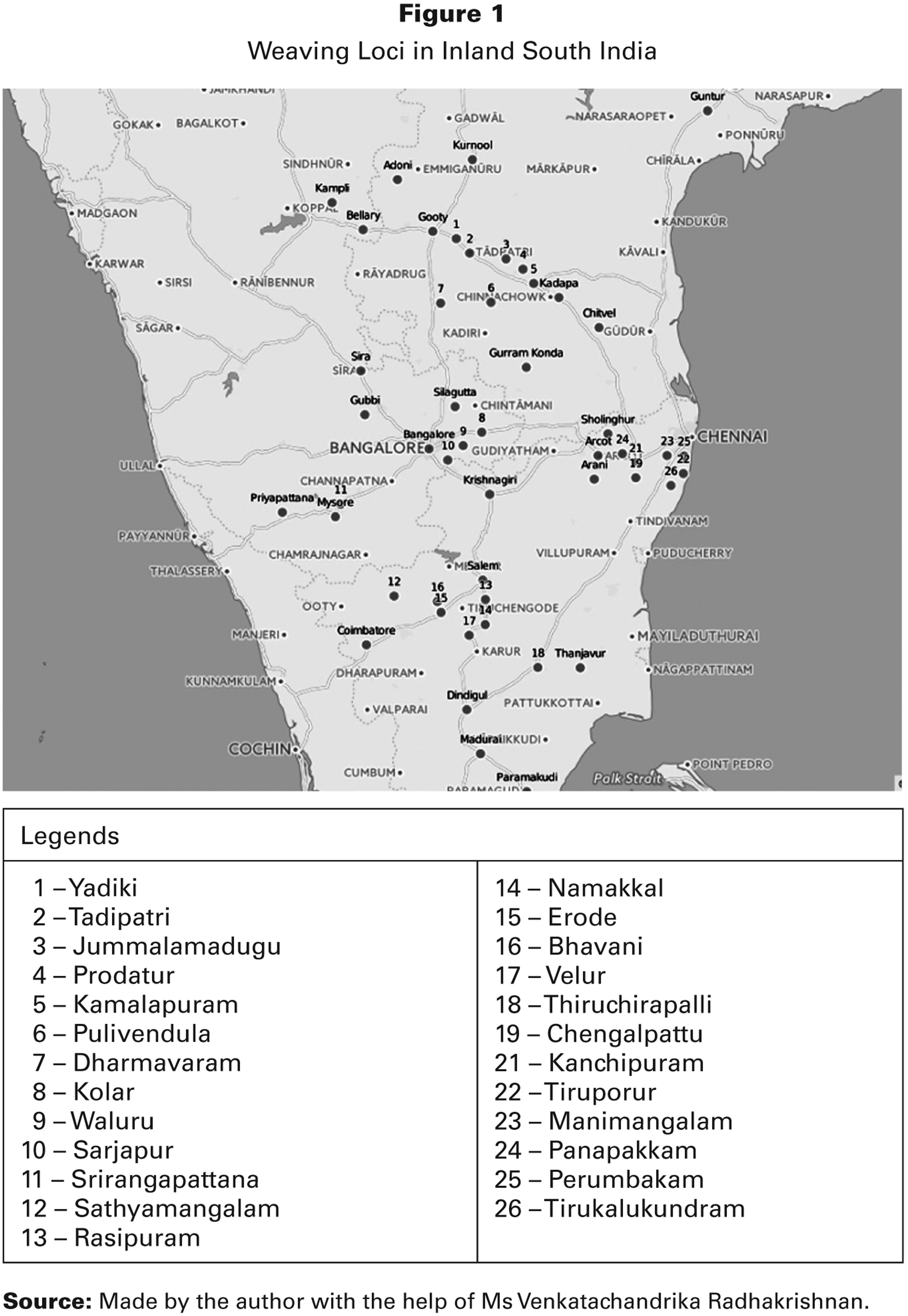
The Salem region had more weavers’ settlements and a larger proportion of cloth was exported. Buchanan noted that merchants lived in villages and collected goods for export. Ammapettai near Bhavani was a village of 40 houses, all inhabited by merchants and weavers. 108 The village of Doddarapalayam had 50 Devanga/Jadar households. 109 Komarapalayam, Puttur (Puthur), Mohanur, Velur, etc. were even larger weaver settlements. 110 Around the town of Sati-mangalam (Sathyamangalam) lived many weavers of the Jadar and Kaikolar castes. 111 Here, according to Buchanan, merchants ‘frequently make advances for the cloth intended for country use’, seeking in this way to draw weavers into debt. Only some weavers could afford to weave ‘on their own account’. 112
At the same time, weavers belonging to other castes such as Kaikolars and Koliars (another ‘untouchable’ caste) were distributed all over the region: they produced coarse varieties of cloth called Mota khadis and parkallas: these were sold in adjoining regions. 113 In some villages lived Chembadavars, who wove similar kinds of cloth; many Manniwars (another ‘untouchable’ caste) lived in the northern part of the Baramahals: they wove fine turbans and body cloths. 114 Merchants provided them with advances (especially once the East India Company began buying up cloth from this region). 115
The Mysore Region
In the region around Mysore, little cotton was grown: here, Bangalore acted as a centre for fine silk and cotton cloths manufactured for export. Otherwise it seems to have been a net importer of cloth (though some coarse cloth was exported to the Malabar region). The finest cloths were woven by the Puttegar and Cuttery. 116 They made them on commission (after obtaining an advance from merchants) but when demand was low they also wove on their own account, borrowing money from bankers or moneylenders to do so. 117
Meanwhile the Shayanagaru and Devanga specialised in coarse varieties of coloured cotton cloth for women. 118 The Shayanagaru (again) and Salay specialised in weaving white muslins. Each kind had several patterns and each pattern had three degrees of fineness. According to Buchanan, all these groups were financed by merchants but also wove cloth on their own account, which they might sell to merchants or on the open market. 119 The Togataru, who were poorer, made coarse, thick, white cotton cloth with red borders: ‘in general [they] receive the thread from the women in the neighbourhood and work it up into cloth, for hire’. 120 A prominent caste was the Whalliaru, also called Deds, whom Buchanan describes as the equivalent of Parayars of the Tamil country. They lived ‘scattered in…villages’, and made a coarse, white, strong cloth called parkalla worn as an upper cloth. 121
There were towns and villages like Waluru, Colar (Kolar) and Sirijapura (Sarjapur) described as weavers’ settlements, but in most places Buchanan that passed through, he found weavers scattered across the countryside. Lacor near Waluru was not a large town, but had many weavers of the Devanga, Padmasalay, Shaynagaru, Togataru and Kaikolar castes. They sold part of their cloth at weekly markets in neighbouring towns, and partly to merchants who came from places like Bangalore, Kolar and Krishnagiri. 122
Weavers in Waluru made cloth both for ‘country use’ and export:
The coarse cloths for the former purpose, they sell at the weekly fairs. The finer kinds they either weave on their own account, selling them to traders at the same places; or they receive advances from merchants to enable them to purchase thread.
123
Kolar had once been an important manufacturing town: it had Devanga and Shaynagaru weavers, who produced white cotton cloth with silk borders, muslins and turbans. These were bought by merchants from places like Gubi (Gubbi), Seringapatam (Srirangapattana), etc. In the surrounding villages, ‘much coarse cloth was made by the Whalliaru’. 124 In Sarjapur, Devangas, Salay and Togataru weavers produced coarse goods (in earlier times they claimed to have been weavers of fine cloth). 125 Here, ‘the merchants…act merely as brokers and the weavers frequently carry their own goods for sale to Bangalore. Purchases are made here by traders from Seringapatam, Sira…Bangaluru, Colar…’. 126 The town of Silagutta had a small settlement of Padma Salays, who produced coarse cotton cloths with red borders. But the bulk of the cloth was made by the Whalliaru in surrounding villages, and some of it was exported: merchants told Buchanan that they made advances only when there was a large demand for it. 127
In Sira, the Billy Muggas wove a coarse thin muslin called Shilla of differing qualities. The Devangas made two kinds of thick coarse cloth: one was khadi similar to that woven by the Whalliaru near Bangalore; the other, with red borders, similar to that woven by the Togataru. 128 The town of Gubi (Gubbi), where a very large weekly fair was held, had no weavers, but ‘the country, for ten or twelve cosses around, produces for sale coarse cotton cloth both white and coloured’. This was woven by Devanga, Togattaru and Whalliaru weavers. 129 In Priyapattana, bordering the Coorg region, most of the cloth was imported from Mysore, but a small quantity of coarse cotton cloth was manufactured by a caste of weavers called Torearu. 130 The Whalliaru could be found everywhere, producing coarse cloth for sale. In the town of Taiuru and its environs, Buchanan reported ‘no commerce; nor any manufactures, except the coarse cloth which the Whalliaru weave’. 131
Thus throughout the Mysore country, we find large groups of weavers living in towns, producing fine varieties of cloth, while in the countryside coarse cotton cloth is produced, mainly by the Whalliaru, but also by the Togataru and other groups, for local consumption. Merchants provided advances in the case of fine cloths, or when there was a considerable demand for certain varieties. Weavers also bought yarn on their own account (borrowing money if necessary) and sold their cloth on the open market or to merchants. They also wove cloth using yarn provided by their customers.
The Madurai–Dindigul Region
The city of Madurai was an important weaving centre. A large number of Pattunoolkarar weavers lived in it. They wove fine white dhotis with patterned borders that might be decorated with gold thread (zari), clothes with silk borders, white and red turbans, fine saris with intricate borders, etc. 132 The finest cloths were woven on commission, on receipt of an advance to buy yarn and zari. 133 Another group of Pattunoolkarars lived in Paramakudi, a large village east of Madurai, on the banks of the Vaigai. 134 But Madurai district also had weavers belonging to other castes, amongst them Parayar. These did not live in the city, but produced much of the cloth used for ordinary wear. 135
In Dindigul, too, fine-cloth weavers were concentrated in the town and larger villages, but there were dispersed looms in almost every village weaving cloth of the coarser kind. It was reported that the town of Dindigul had
…20 kinds of looms, consisting of (sic) about 93 in number, for the manufacture of different sorts of cloth, both fine and coarse, comprising long cloths, muslin, handkerchiefs, turbans, doopetahs, shomens, vaties and various kinds of women’s cloth. Besides the above, there are 146 looms in the villages dependent to (on) the cusbah talook, where coarse cloths are manufactured by parayars, which serve the purposes of the inhabitants in the country.
136
The Ceded Districts
The Ceded districts grew a great deal of cotton. Much of this (40 per cent, according to Munro) was consumed locally. The remainder, along with substantial quantities of thread and cloth, was exported to the Coromandel Coast and Mysore.
The largest number of looms was in the districts of Goorankondah (Gurram Konda), Pooley–Wandrah (Pulivendula), Chittawail (Chitvel), Dummalmudgoo (Jummalamadugu): they produced coarse to middling kinds of cloths. The main staples were khadis of low counts as well as women’s cloths (also of low counts). Thirty-four per cent of the looms in Pulivendula made khadi and 34 per cent made mothasaudys (making a total of 68 per cent producing coarse cloth). Similarly, 38 per cent of the looms in Chitvel produced khadi and 29 per cent mothasaudys. 137 Much of this cloth was woven using yarn provided by the customer. The collector of Cuddapah (Kadapa) reported that ‘the practice of supplying the material and getting cloths made for home use obtains to a great extent in this district’. 138
In contrast, the districts of Bellary, Compli (Kampli), Harpanhally (Harpanahalli), Goottee (Gooty) and Koilhonttah (Koilkuntla) had fewer looms, but produced finer textiles. Silk cloth was produced at only a few places (on a total of 44 looms), namely Kampli, Gooty, Yadhi (Yadiki), Chennumply (Chennampalle), Tarputree (Tadipatri) and Adhoni (Adoni), with Kampli containing the largest number of looms (19). From another source we learn that Kampli was a large town with many weavers. 139 They wove cloth of middling to fine texture. Bellary also produced medium to fine textiles and was an important centre for women’s cloths: 41 per cent of its looms produced red and blue saris. Kamalapuram (further east) was another centre of fine cloth production, this time of very fine dupattas, and women’s cloths (35 per cent of its looms being given over to it). In the late nineteenth century, Uppalur, in Kamlapuram, developed into one of the most important silk-producing centres in the district. 140
Gooty district had an interesting combination of looms: 38 per cent produced khadi; the remainder made different varieties of fine cloths, going up to 32 punjams in some cases. 141 It also had six silk looms and was a centre for women’s cloths (36 per cent of looms made red and blue saris). A lot of coarse chintz (printed and painted) was made around the town of Gooty. 142 Part of the cotton producing (black soil) tracts of the Ceded districts, the district had the usual combination of fine-cloth production in the town and larger villages, and decentralised production of coarser varieties of (largely white) cloth in the countryside.
This broad pattern, of widespread and decentralised production of coarser, white cloths, and clustered production of fine and coloured cloths (particularly women’s clothing) is confirmed by a careful analysis of the kinds of cloths produced in different areas. White cloths, particularly coarser varieties such as khadi, were produced almost everywhere, while the weaving of coloured cloth, and particularly women’s cloths, was much more concentrated. In the Ceded districts, red saris were made mainly in Pulivendula, Gooty, Roydoorg (Rayadurgam), Bellary and Naguldinnah. 143 Blue saris were woven in Gooty, Chennampalle, Rayadurgam, Darmavar (Dharmavaram), Kamalapur, Nauguldinnah, Bellary, Kampli and Koodligah.
Munro’s report provides valuable details about the number of looms and kinds and quality of cloth produced, but not the social composition of weavers. For this we must look elsewhere. One of the largest groups of weavers in this region were the Malas. The social equivalent of the Parayar in the Tamil country, they produced the strong coarse cloth used by poor folk. In Kadapa, Kurnool and Bellary districts lived a great many Malas (though no exact figures exist), whose primary occupation is described as weaving.
According to a missionary source, ‘the Malas are not mere coolies; the majority of them weave with the handloom, and their wives spin thread; some are cultivators, others field labourers’. 144 As late as 1896, an official estimated that in the Deccan districts one third of the weavers were Malas, who wove the coarse cloths ‘worn by the Malas themselves and by the cultivating classes’. 145 Kapus (the dominant cultivating caste of this region) provided Mala weavers with cotton, paid the women for spinning it into yarn, and the men for weaving it into cloth. 146
Other weaving castes reported for Kadapa are Sales (Padma and Pattu), Togattas and Devangas. Togattas and Sales wove silk and fine cotton cloths. 147 A large number of Muslim weavers also lived in this region, mostly in towns like Adoni and Kurnool, and specialised in weaving carpets. 148
Chingelput (Chengalpattu) and North Arcot Districts
In the district of Chengalpattu, out of a total of 3,917 looms, as many as 2,339 were located in the taluk of Conjeevaram (Kanchipuram) and 574 in the taluk of Manemungalum (Manimangalam); some taluks such as Nayer and Teruporoor (Tiruporur) had less than hundred looms each. 149 Another report shows that about half the looms in the district were found in or around Kanchipuram and Arnee (Arani) and that these paid high loom taxes. Looms paying a tax of ₹4 to 4½ were found only in Kanchipuram. Those in Arani paid ₹3 ½ on average. The remaining looms, scattered across the rest of the district, paid from 1 to 2 rupees. 150 Though loom tax rates could vary widely within the same district, often for no discernible reason, a higher tax is usually indicative of fine-cloth production. From Forbes Watson’s collection we learn that Arani was famous for fine muslins, dhotis and saris. 151 Kanchipuram was also an important centre for the production of fine cloth. 152 Thus Chengalpattu conforms to the pattern set out so far: while fine-cloth weaving was concentrated in towns or large villages, the production of ordinary or coarse varieties was dispersed.
This is confirmed by the data on duties paid on different kinds of cloth in the district. Of total duties collected on cloth valued at more than two rupees, no less than half was collected at the Kanchipuram chowki alone. Sixteen per cent came from Arani chowki. 153 Villages around the chowkis of Panapaukam (Panapakkam), Saulavaupum, Tricutehicoonrum (Tirukalukundram), Terooporoor (Tiruporur) and Parumbaukum (Perumbakam) produced cheaper cloth: the collector remarked that if cloth worth less than two rupees was to be exempted from duties, these chowkis could be dispensed with. 154 According to him, ‘cloths of this description are made by the commoner classes of weavers, on their own account and that of others, who make their own thread, and pay the hire of weaving it into cloth’. 155
In North Arcot, weavers producing more expensive cloth lived in the taluks of Cauverypauk (Kaveripakkam), Trivullum (Thiruvallam) and Sholingur (Sholinghur). 156 Here again, cultivators of the ‘lower orders’ were ‘in the habit of preparing the thread, [and] getting the cloths made for their own use’. 157 The collector of Guntur distinguished between two categories of weavers—one, ‘those who are chiefly employed in the manufacture of cloths in ordinary demand among the natives of this and the adjoining districts’; and two, ‘those who made cloths for exportation to the order of Native or European merchants’. According to him, the latter were concentrated in the villages of Mungalaghery (Mangalagiri), Raujahpett (Rajapeta), Peralah (Perala) and Ventapollum (Venkatapalem). 158 Swarnalatha describes the industry in Guntur district as consisting of ‘traditional’ weavers, who lived in the major zamindaris; and Pariah weavers and those of some other castes, who supplied cloth for local consumption, spread all over the district. 159
Thanjavur was a seat of political power and fine cloth production, presumably catering to local notables. Some of the best samples (particularly in silk or a mixture of silk and cotton) in Watson’s collection come from there. 160 Cloths worth more than 10 pagodas were manufactured in a village called Vijayamundapum. 161 A sample of a fine silk sari suggests that Combacconum (Kumbakonam) in Thanjavur district specialised in fine women’s cloths. 162
Thus, unlike the Coromandel coast, large weaving settlements were not the norm in inland regions. In towns and larger villages lived a large number of weavers producing fine varieties and special cloths. But a very large proportion of cloth for ordinary use was produced by weavers scattered in small villages in the countryside. Weavers of certain castes might specialise in particular kinds of cloths. Those weaving coloured/patterned cloths (fine and coarse) and fine varieties of cotton and silk cloth were usually full-time weavers—for example, Pattunoolkarars, the Pattu and Padma Saliar, Devangas and Muslim weavers. These usually lived in towns or larger villages. Most coarse cloth was woven by part-time or full-time weavers scattered in villages: these belonged to castes such as the Kaikolars, Togattas, Devangas, and, above all, Parayars (and other ‘untouchable’ castes such as Malas, Koliars, Manniwars, Whalliaru). And this brings us to the widely accepted definition of weaving as a full-time occupation.
Part-time and Full-time Weavers
In the first place, part-time weaving was not as unusual as has been implicitly assumed in the existing historiography. A large proportion of cloth was woven by part-time, non-specialist weavers, who at other times also worked as cultivators, fishermen, labourers or petty traders. This was especially the case in cotton-producing areas. These weavers belonged to different castes, but the largest number came from the so-called untouchable castes that were usually associated with agricultural labour. Their number was far from negligible, particularly in the case of Parayar weavers.
Thus Chembadavars (also called Cheniwars) were weavers as well as inland fisher folk in the Baramahal region (and other places). 163 The Toreas, also known as Bestas in some places, were weavers: they are also described as farmers, ferry-men, armed messengers, burners of lime, fishermen and porters. 164 Agamudiyars, Velamavamloo, Balijavanloo, Agamadiahs, Pullee, Gollavars and Iendravars—all castes usually identified with cultivation—are also described as weavers though in smaller numbers. 165 Coravurs, a caste of petty traders, possibly nomadic, also wove cloth. Polavurs, Sevyars, Andies were some other castes employed in weaving albeit in small numbers. 166
Nor was land ownership unusual even amongst the so-called specialist weaving castes. The Pattunulkarar, for example, were specialist weavers, making fine varieties of cloth. Yet, in Baramahal at the beginning of the nineteenth century, out of 2200 Pattunulkarars, 550 are listed as cultivators rather than weavers. 167 In 1824, the collector of Nellore reported that many of the weavers in his district owned plots of farmland. 168 In 1844, we find him writing that some weavers of the ‘Salay and Saurtoo castes’ were also cultivators. 169 Around Coimbatore, Buchanan reported that some of the Kaikolar rented land, which was cultivated by others (presumably labourers or sharecroppers). 170 The collector of Coimbatore averred in 1844 that most weaving households in his jurisdiction owed their survival to money earned from agriculture or trade apart from weaving. 171 Some owned land which they cultivated themselves, or rented out to others. Of the Jadar, who constituted the largest group amongst the weavers of Coimbatore, he wrote that ‘many of these persons, if not all, employ half their time in weaving and the other portion in cultivation’. 172
Weavers belonging to a few villages in Thiruchirapalli district paid taxes to the local temple, in return for which they were allowed to cultivate certain plots of land. When the state sought to levy a tax on these plots, they objected. 173 The weavers of South Arcot (of Janmavar/Devangar caste) had large landholdings. 174 Some of the heads of weaving castes in this region also acted as renters of revenue. 175
Thus members of different castes might turn their hands to several occupations, including weaving, in order to make a living. 176 This was especially true of the poorest weavers belonging to the so-called untouchable castes. Malas, Parayars, Whalliaru, Koliars and Manniwars, who occupied roughly the same position in the caste hierarchy, wove large quantities of coarse and durable cloth. This kind of part-time weaving might be pursued for eight months of the year given the intrinsic character of the agrarian economy in regions of dry-land cultivation where only a single crop might be grown. For example, Mala weavers in Kadapa were said to weave for eight months of the year, and do agricultural work for the rest. 177 In some districts, Parayar weavers might constitute as much as one-third to half the total number of weavers. 178 Even if they did not work full-time they produced a substantial quantity of cloth.
Cotton, Yarn and Cloth: A Diversity of (Commercial) Networks
Weavers, whether working part-time or full-time, were part of multiple networks of trade (involving cloth, cotton and yarn), both local and long distance, converging at weekly markets. Buchanan remarked that ‘at all these markets business is carried on by sale; no barter is customary, except among a few poor people, who exchange grain for the produce of the kitchen garden’. Not only that, farmers ‘carry their produce, and sell it, partly to consumers by retail; and partly by wholesale to traders. In the early part of the day they endeavour to sell their goods by retail, and do not deal with the traders unless they be distressed for money’. 179 Much the same could be said of weavers based on descriptions already quoted.
Gubbi in Mysore, was one such weekly market:
The country, for ten or twelve cosses round, produces for sale coarse cotton cloth both white and coloured, blankets, sackcloth, betel-nut…coconuts, jagory, tamarinds, capsicum, wheat, rice, ragy and other grains, lac, steel and iron. Beside the sale of these articles and of those imported for the consumption of the neighbourhood, this is also an intermediate mart for the goods passing through the peninsula.
180
Coarse cloths in the vicinity were made by Devangas, Togattas and the Whalliaru: these sold at two to six fanams for each piece (called shiray). About 100 pieces were sold at each fair. Here came merchants from Coorg, Canara and Malayala (Malayalam country or the west coast), who brought quantities of spices to sell. Merchants from Bangalore and Kolar brought fine varieties of cloth for sale and took back betel nut, black pepper and other spices. Merchants from Salem and Krishnagiri also brought cloth and took away betel nut and pepper. Merchants from Gubbi went to Wallajapet near Arcot (below the Deccan plateau) and brought back cloth and all kinds of goods imported by sea at Madras. 181
Sira was another market village in Mysore. A small amount of cotton was produced in the region, converted into thread and consumed locally. Raw cotton as well as hanks of white and red thread were imported to meet local demand, mainly from around Dharwar and Hubli. Local weavers produced different varieties of coarse cloth: much of it was dyed by ‘Niligarus and Marathas’ and sold locally. In addition to this, coarse and fine cloths were imported from the Maratha region and the Nizam’s dominions. These sold at a higher price, for the colours were better fixed. 182
Cotton, yarn and cloth were transported on the backs of bullocks and mules, often over very long distances, as most roads were unsuitable for carts. According to Buchanan, the best cattle were used in the raw cotton trade and belonged to the ‘Pancham Banijigaru, natives of the country where cotton grows’. 183 They transported cotton from points further north to Bangalore. The carriage and sale of cotton to the Coromandel coast was dominated by Banjaras. 184 Some merchants travelled from market to market buying and selling certain commodities in well-defined circuits of trade. Buchanan describes various mercantile groups—Gosai and Pathan merchants from the Maratha region, Gujarati merchants, Lumbadies, Comatties, the Pancham Banijigaru, etc. Some merchants maintained a presence in different markets to buy cloth through agents: the merchants of Bellary and Adoni in the northern Deccan and those of Krishnagiri and Vanambady (Vaniyambadi) in the south had agents in Bangalore; similarly, merchants from Bangalore kept agents in Wallajapet, below the plateau, and so on. 185
Raw cotton and yarn formed an important part of these networks of trade and exchange. Cotton was grown in large quantities in some districts in the northern Deccan and the deep south. 186 Munro reported that 40 per cent of the cotton grown in Kadapa district was consumed locally: the rest was exported in the form of raw cotton and yarn. 187 From Coimbatore district, cotton, yarn and cloth were exported, mainly across the Palghat gap to Malabar, and from Tirunelveli/Madurai to the Travancore kingdom and Ceylon. 188 A limited amount was grown in other places (parts of the Mysore country, Guntur, Nellore and Krishna districts) for local consumption. 189
Some of the cotton grown in the major cotton producing districts (and most of the cotton in smaller pockets of cultivation) was converted into yarn by farming households. 190 Where cotton was grown in small quantities, almost all of it was consumed by the farmer or cultivator’s household, or locally. 191 Women de-seeded, cleaned and spun the cotton into yarn. 192 Some of this might be given to a weaver who would weave it into cloth for the family. 193 The rest might be sold in local/weekly markets (where women were often active sellers), or directly to weavers. 194
While part of the cotton was cleaned by the household (the preferred option, for then the seed could be used as cattle feed), merchants also bought up cotton with the seed. This was subsequently de-seeded by hired labourers in large cotton markets and transported over long distances to the Coromandel Coast and parts of the Mysore country. 195 Everywhere it was sold in retail and bought in small quantities by spinners, who, in turn, sold the yarn that they spun to weavers. 196
Thus cotton found its way to the spinner through several routes. Women in a farmer’s household might clean and spin cotton into yarn; or it might pass through many hands before reaching the spinner. Spinning was done by women of almost every caste except Brahmins. Most women were part-time spinners, working cotton into yarn during slack seasons or times: their earnings were an important contribution to household income. 197 Only skilled spinners spun full-time, and for the most part these belonged to ‘untouchable’ castes. 198 Along the Coromandel coast they even lived in exclusive settlements.
This thread, in turn, reached the weaver in several ways. Farming households might give him thread spun by its members to work up into cloth. Weavers might buy thread from spinners to weave cloth to be sold on the market: in this way they could be sure of an assured supply of thread, keep track of its quality, and bargain over price. Sometimes weavers even provided advances to spinners to ensure a regular supply of thread. 199 Men and women might carry yarn to weekly markets and sell it to weavers: there is abundant evidence of spinners acting as buyers and sellers in cotton and yarn markets. 200 Yarn was also exported from cotton surplus districts to cloth producing regions where no cotton was grown (here as elsewhere the finest yarns were spun by full-time skilled spinners). Thread merchants were also involved in this trade, and weavers could buy thread from them in weekly markets or shops in towns. 201
Several historians have pointed to the role of spinners in thread markets; however, when it comes to weaving, the general consensus seems to be that merchants provided weavers with cash advances and took back cloth. It has even been argued that the merchant’s advance was essential in allowing the weaver to buy yarn. 202 This argument is, in turn, linked to the belief that weavers in south India were specialist full-time workers with no other source of income.
But the evidence cited in this article clearly shows that weaving organised through merchants was by no means the only system. Merchants advanced money to weavers in major centres of fine-cloth production such as Bangalore, Salem, Madurai; and the system of advances was more prevalent in some places than others. However, there is abundant evidence to show that merchants also bought cloth from weavers at weekly markets. Generally speaking, the practice of advancing money was widespread whenever and wherever the cloth woven was very fine, or when a large demand existed for a certain kind of cloth. Weavers of coarse cloth often wove cloth on their own account, buying yarn with their own (or borrowed) capital, and selling the cloth in local markets. The system of weaving cloth from yarn provided by the customer was also widespread. 203
Cultivators, spinners, weavers and merchants were linked through networks of exchange and markets that might be more ‘commercial’ or less, short distance or long. A poor cultivator or labourer might obtain cloth without entering an actual market space, simply by providing a weaver with yarn spun by members of his household, and paying him an agreed upon wage (in cash or kind). At the other end of the spectrum, merchants provided advances to weavers to make cloth for them. To focus exclusively on cloth production organised through merchants catering principally to long distance markets, or, conversely, to implicitly dismiss any system where the merchant did not play a prominent role in production, or where a clear contract did not exist, as being less or non-commercial leaves us with an incomplete view of the weaving world of the early nineteenth century. Cotton cultivation, spinning and weaving were important economic activities in which cash was generated and exchanged, and formed part of commercial networks that varied in scale.
Conclusion
In this article, I have looked closely at textile production in hitherto neglected regions and sectors with the aim of presenting a more nuanced picture of the textile economy of south India. In order to do so, I have tried, first of all, to obtain a clear idea of the kinds of cloth woven for domestic consumption by reconstructing everyday modes of clothing and styles of dress in the early nineteenth century. This reconstruction shows that a very wide range of clothing was produced and worn, and some of it was indeed very fine. But all clothing worn by the poor, and even the everyday wear of the middling classes, consisted of coarse, strong and durable cloth. Unbleached or white clothing was in wide use (though women’s clothes were more colourful).
I have tried to show how the spatial distribution of weavers and the ways in which weaving was organised in the inland regions of the south differed from those described for the Coromandel Coast. Ordinary coarse cloth was woven almost everywhere, usually by part-time weavers dispersed through the countryside, a few in every village. Finer, more specialised cloth was woven by full-time weavers settled in towns or larger villages. Production was organised in many different ways: weavers wove cloth for customers using yarn provided by them; they made cloth independently, buying the yarn themselves, and sold it in local markets (or to merchants); they took advances from merchants and produced cloth on contract. Weavers, spinners and merchants were connected through multiple commercial networks of varying scales.
Various weaving centres thrived or declined, affected by factors such as wars, famines, changes in markets, etc. Weavers might migrate from one place to another. Patterns of production and the association of certain kinds of cloth with certain groups of weavers also changed. But, on the whole, until the mid nineteenth century, the broad pattern of decentralised weaving of coarse varieties of cloth by plebeian, often part-time, weavers and more centralised weaving of fine and specialised varieties, mostly by specialist weaving castes, persisted. This was to change markedly in the late nineteenth and early twentieth century, but not exclusively due to the effect of market forces.
How does this picture compare with the prevalent views of the handloom industry sketched in the introduction? I believe that it shows a middle ground between two opposing and rather extreme positions. A large part of domestic textile production was subsistence oriented and geared to local markets. In that sense, Tirthankar Roy’s warning against extrapolating from the export sector is valid. However cloth production of this kind was neither primitive nor entirely non-commercial. For one thing, it involved a great many cash transactions even if the amounts involved were small. Munro pointed out that the sale of yarn was an important source of cash for cultivators, enabling them to pay their taxes. 204 Wendt highlights the importance of cash incomes from cotton cultivation, processing, spinning, weaving, etc. 205 According to Buchanan, most transactions in weekly markets were in cash. Cultivators provided weavers with yarn and paid them a wage for weaving it into cloth: in none of the sources is this practice associated with the jajmani system. 206 In this context it may be pertinent to recall David Washbrook’s argument that subsistence and markets were not necessarily inimical, and that a close interface existed between markets and the subsistence economy. 207
The second component of the domestic market was the long-distance trade. Here the level of commercialisation was obviously higher. As yet we do not possess adequate evidence about its scale as compared to the purely local, but the level of trade described in different accounts and the volume of taxes levied on it indicate that it was by no means insignificant.
I believe that this modified picture of the weaving industry of the south has some important implications for the de-industrialisation debate. Recent studies, moving away from the old paradigm of catastrophic decline (or its opposite), have shown that different groups of weavers were affected in different ways by colonialism and the inroads of industrial capitalism. 208 Tirthankar Roy argues that those who wove plain and ordinary kinds of cloth lost out, while weavers of fine and patterned cloths gained by what he calls increased ‘commercialisation’. 209 My own research also shows that the weavers worst affected were those who produced ordinary, coarse kinds of cloth. However, the evidence presented in this article shows that a very large quantity of cloth produced was of this kind and such weavers were far from insignificant in number. 210
I believe that a much clearer understanding of the ways in which weaving was organised and its links to cotton and yarn production on the one hand, and consumer markets on the other, is necessary in order to analyse changes in production organisation in the late nineteenth and early twentieth century and gauge their true effects. Roy has undeniably made an important contribution to this enterprise by highlighting the process of adaptation whereby a section of weavers managed to survive and prosper. However I believe that there are some major difficulties with his explanation for this selective rejuvenation of the industry.
Roy links key changes in the organisation of production (defined as more efficient use of labour, the prevalence of wage contracts, and a steady increase in the extent of wage labour) in the late nineteenth and early twentieth century exclusively to ‘commercialisation’, and, more specifically, to production for long-distance, non-local markets. 211 However, studies on the Coromandel Coast as well as the evidence presented in this article show that commercialisation was not new to the handloom industry, and certainly not a phenomenon that occurred only in the late nineteenth century. It would be truer to say that it had different implications and effects at different points of time.
Production systems in the Coromandel Coast in the eighteenth century with its sophisticated networks of long distance trade were significantly different from those that developed in the late nineteenth and early twentieth centuries—according to Roy, under the impetus of commercialisation. In the first, the weaver retained a great deal of autonomy; in the second, he lost almost all of it. 212 In other words, if markets are taken to be the sole agent of change, they had very different effects in the two cases. Elsewhere I have examined much more closely the rupture of links between cotton, the spinning of yarn and weaving; put briefly, the access of weavers to raw materials (cotton and yarn) and consumer markets changed radically in the late nineteenth century and became far more restricted. This, in turn, had significant effects on production organisation and relations of production. I have also tried to show that market forces did not act in isolation; that other factors, such as state policy and changing equations between capital and labour within the handloom industry played an equally important role in its reconstruction. 213 But in order to assess and appreciate the magnitude of the changes—and their effects upon losers and winners amongst weaving groups—it is necessary to recover and understand the older system in all its complexity—which is what I have tried to do here.
Footnotes
Acknowledgements
I would like to thank Shashank Kela, in particular, for helping to sharpen my arguments and prose over many sittings: the article owes a great deal to his critical gaze. Also Dr Prabhu Mohapatra, who read an earlier draft; and Dr Dilip Menon and the anonymous reviewer of IESHR for their comments.