




Abstract
This article studies a sixteenth-century sufi taz̠kirāt (biographical dictionary), Ak̲h̲bār al-Ak̲h̲yār written by ‘Abd al-Haqq Muhaddis Dehlawi (1551–1642), an ‘ālim (scholar), who was also a sufi. The text is frequently cited as the earliest, most comprehensive and reliable biographical compilation of South Asian sufis and ‘ulamā’ (learned men in religious sciences) from the thirteenth to the sixteenth century. Indeed ‘Abd al-Haqq is best remembered for his scholasticism as a mūḥaddis̤ (a person well-versed in Prophetic traditions) which is also supposed to have made him into a rather staid scholar of Sufism. But what of him in his own society of elite Muslim intellectuals in the early seventeenth century? ‘Abd al-Haqq was networked into the elite circles of the Mughal court, but he stayed away from Mughal patronage, communicating his ambivalence regarding its political experiments by espousing alternative paradigms. My article studies the structure of the Ak̲h̲bār al-Ak̲h̲yār to comprehend how a Muslim intellectual constructed a history of his peer group at a critical juncture in the making of Mughal authority. My article follows a prosopographical methodology to explore the innovative structure of the Ak̲h̲bār al-Ak̲h̲yār and its complex projection of the past of the piety-minded in Hindustan. As I argue, the Ak̲h̲bār al-Ak̲h̲yār is a carefully structured, remarkable history of sufis and their networks, providing them with contexts and significance that questioned both, inherited paradigms of moral authority present in the fourteenth- and fifteenth-century sufi texts as well as those emerging in the statist renditions of the past from the courts of the Mughal emperors Akbar and Jahangir.
Keywords
Introduction
‘If poetry is the “archive of the Arabs”, biography is the archive of the Muslims.’ 1
In Arabic and Persianate literary cultures, the accounts of esteemed Muslims, their piety, normative actions and merits were commemorated in varied literary productions. Literary genres such as sīra (biographical work, especially dealing with Prophet), t̤abaqāt (biographical work organised in generations/kinds of people) and taz̠kirāt (biographical dictionary) recounted the history of pious individuals as they represented the spirit of an idealised Islam. Very often, these texts detailed the life stories of individuals who shared a common spiritual or familial lineage, had specific attributes such as poetic genius and resided at an urbane locale. 2 While the practice of compiling biographies commenced with the isnād (chain of transmitters) tradition in Arabic historiography, in the context of South Asia, the taz̠kira genre was a ‘history of elites by elites’ that sought to commemorate the lives of historical personages both spiritual and political. 3 The taz̠kirāts both reminiscence and communicate about past heroes and range considerably in the amount of detail that they provide regarding their lineage, rank, affiliation and focus on contemporary affairs that provide the context in which the legacies of the past heroes need to be appreciated. Certainly, the focus on individual heroes was subordinated in these taz̠kirāts to the collective imagined history of Muslim public space and Muslim identity in South Asia.
Two biographical encyclopaedias pertaining to poets and sufis, respectively, were produced in South Asia in the twelfth and fourteenth centuries. By the 1530s, another taz̠kirāt was produced and some texts accommodated biographies within the narrative structure of their ta’rīk̲h̲ (history). 4 For instance, the Muntak̲h̲ab al-Tawārīk̲h̲ written in the 1590s by ‘Abd al-Qadir Badayuni carried biographies in a political narrative of history of North India from the thirteenth to the sixteenth century. 5 The biographical details of venerable Muslims enabled Badayuni to track social networks of several individuals and relate their multiple perspectives and abilities outside the ambit of the court. Concurrently, another Mughal courtier, Nizam al-Din Ahmad authored the T̤abaqāt-i Akbarī, a political and military history of India from the thirteenth to the sixteenth century, with brief biographies of poets and sufis who lived in the sixteenth century. 6 By the late sixteenth and seventeenth centuries taz̠kirāt writing was gaining ground and reflected the complex ways in which Muslims over time imagined their space and history of their venerable members. For instance, Amin Ahmad Razi’s taz̠kirāt, Haft Iqlīm was composed in the Mughal court in 1593. 7 It was a topographical, historical and biographical encyclopaedia of poets across regions. Divided into sections according to the geographical regions of the world, it discussed different countries, towns, their histories, biographies of ‘ulamā’ (learned men in religious sciences), sufis and poets. In the early seventeenth century, ‘Abd al-Rahman Chishti’s Mir’āt al-Asrār overshadowed its Persian predecessors and carried the biographies of 23 generations of Indo-Persian sufis from Baba Farid onwards in order to highlight their association with a region that inhered their collective identity. 8
This essay focuses on the Ak̲h̲bār al-Ak̲h̲yār, a late sixteenth-century taz̠kirāt composed by ‘Abd al-Haqq Muhaddis Dehlawi, an ‘ālim (scholar), sufi and mūḥaddis̤ (a person well-versed in Prophetic traditions) whose literary attainments were diverse and complex. 9 The unique aspect of the Ak̲h̲bār al-Ak̲h̲yār appears in a hadīs̤ (authenticated report of the Prophet’s actions or sayings) scholar’s attempt to pen a coherent history of the South Asian sufis and ‘ulamā’ from the thirteenth to the sixteenth century. Unlike the circumscribed contents of the fourteenth-century sufi taz̠kirāt, the Siyar al-Awliyā’, that projected a linear history of the Chishti sufi order alone, the Ak̲h̲bār al-Ak̲h̲yār was the earliest attempt to write a comprehensive history of piety-minded Muslims and the dispersal of sufi settlements from the thirteenth through the sixteenth century in the subcontinent. 10 It was a voluminous, panoptic overview of the pious that earned considerable respect and credibility amongst contemporary and latter-day scholars. Other than its synoptic coverage, it was the reputation of veracity attached to its author, a scholar of hadīs̤, that gained it such renown. In modern historiography, the text has often been mined for information to elicit details about the lives of different sufis and establish the connections between master and pupil so important in recounting the history of sufi orders. 11 However, the narrative of the Ak̲h̲bār al-Ak̲h̲yār was not organised along the silsila (succession/genealogy of mystic saints) of the sufi t̤arīqas (spiritual path); instead, it reported episodes from the lives of the pious in a generational, chronological (t̤abaqāt) format. 12 In this article, I follow a prosopographical methodology to trace the historical imagination that underlined the narrative tone of the text to showcase its uniqueness in the intellectual world of the sixteenth century.
This is important for several reasons. In modern historiography the religious and intellectual landscape of the late sixteenth century is detailed largely in the context of the Akbarid intervention. This was partly derived from the predominant projection of Akbar as the ‘perfect Pādshāh’ (emperor) in the Persian literary productions of the time. 13 Consequently, the dominant narrative in the court chronicles, histories and translation projects centred on dynastic ideology and politics, monarchs and their retinue. 14 Absent in these narratives were references to a coherent history of the Muslim buzurgān (elders) and sufis and their role in the making of the Muslim world—a social history of the Muslim community. Produced at the dawn of the new Islamic millennium, the Ak̲h̲bār al-Ak̲h̲yār was the only taz̠kirāt that sought to present an alternate history of the Muslims and their spiritual models that carried a minimal reference to the state and political sovereigns. Hence, the Ak̲h̲bār al-Ak̲h̲yār showcased rather brilliantly a history of pious Muslims whose lives and actions summed up the perfect practices that Muslims could imbibe in their lives.
In modern historiography the history of sufis and sufi silsilas is read in tandem to produce narratives on the spread of sufi orders in the subcontinent. In his voluminous writings on the history of sufi silsilas in the subcontinent, S. A. A. Rizvi appropriated narratives from different genres of sufi texts, that is, the taz̠kirāt, malfūz̤āt (conversations of a sufi preceptor) and maktūbāt (correspondences) to document the origin, apogee and decline of several sufi silsilas from the thirteenth to the nineteenth century. 15 As Rizvi traced the history of sufism across temporal spaces, the thirteenth and fourteenth centuries were projected as periods of sufi efflorescence, while the fifteenth century was a period of confusion since there was no dominant sufi silsila and a few charismatic sufi preceptors with a vast retinue of disciples and a trans-regional impact. But did the scholars in the medieval period correlate trans-regional influence with an imperial vision? It might be worthwhile to keep the question in mind as we investigate the unique historical imagination present in ‘Abd al-Haqq’s Ak̲h̲bār al-Ak̲h̲yār.
Alternatively, there is also a teleology that marks the study of sufism, Islamicisation and regional identities. For example, by deploying Trimingham’s three-stage development of sufism, Richard Eaton traced the shifts in the roles of sufis of Bijapur from ‘warrior sufis’, ‘reformist sufis’ to ‘literati sufis’ while taking into account the role of Dakhani language and role of sufi folk literature in the Islamicisation of the local populace. 16 Similarly, Nile Green detailed the role of sufi tomb shrines, migrations and textual productions in the development of sufi settlements in the Deccan region. 17 Left ignored in these histories is the self-reflective mode by which Muslims might have narrated their own social histories, a potent recounting of which is present in the Ak̲h̲bār al-Ak̲h̲yār.
As mentioned earlier, most of the sixteenth century litterateurs reported biographies of poets, scholars and people from variegated backgrounds, but ‘Abd al-Haqq was unique as he chose to narrate biographies of sufis and ‘ulamā’ from Hindustan. I wish to delineate the historical imagination inhering in this comprehensive textual rendition of the leaders of the Muslim community. Since the Ak̲h̲bār al-Ak̲h̲yār sampled sufis from diverse sufi orders, how did it communicate the notions of piety and report on their social stature? Does the text have a trans-regional orientation or a region-centric perspective, and how does it account for the sufi diasporas that had so complicated the sixteenth century profile of the sufi silsilas? What was the criterion adopted by ‘Abd al-Haqq for selecting historical personages who were repositories of Muslim glory worthy of being commemorated in the taz̠kirāt? Is there any uniformity in the representation of Muslim identity and in the projection of Muslim community across centuries? What kinds of precepts and practices of the Hindustani sufis and ‘ulamā’ were highlighted in the text? Was ‘Abd al-Haqq, an ‘ālim and mūḥaddis̤, struggling to negotiate sufi precepts with the more textually-oriented sharī‘ati Islamic tenets in the taz̠kirāt? I seek to address these and related questions in this essay to underscore the distinctive contribution of the Ak̲h̲bār al-Ak̲h̲yār amongst the vast constellation of literary productions in the sixteenth century. To contextualise this article better, I wish to draw a correlation between ‘Abd al-Haqq’s training as an ‘ālim and mūḥaddis̤ and the sixteenth century literary world. The next section provides a brief synopsis of ‘Abd al-Haqq’s training as a litterateur and hadīs̤ scholar and his wide-ranging literary productions.
‘Abd al-Haqq Muhaddis Dehlawi, an ‘Alim, Sufi and Mūḥaddis̤, and His Literary Oeuvre
‘Abd al-Haqq was born in the month of Muharram, 958 hijri/1551 CE in Delhi. He was a Qadiri sufi, an ‘ālim and a scholar of hadīs̤, and hence a product of the complex intellectual and religious world of the sixteenth- and seventeenth-century South Asia. He was a teacher at a madrasa (school) in Delhi, a prolific writer who penned about 48 texts and treatises, wrote with equal facility in Arabic and Persian, and had a sound knowledge of Islamic theology, taṣawwuf (Sufism), history and politics. In the current historiography ‘Abd al-Haqq Dehlawi’s name is synonymous with popularising hadīs̤ studies and the honorific epithet of mūḥaddis̤ is usually appended to his name. 18 It is critical to unpack ‘Abd al-Haqq’s transition from being an ‘ālim to a mūḥaddis̤ and correlate the implications of his hadīs̤ training on the rest of his literary productions.
In the sixteenth and seventeenth centuries, Persian litterateurs seldom transcribed their life histories in their textual productions, but ‘Abd al-Haqq demarcated the transitions in his life from the early phase of his youth into the years of his educational training in the k̲h̲ātima (epilogue) of the Ak̲h̲bār al-Ak̲h̲yār fi Asrār al-Abrār. 19 Elsewhere, he noted that an important transition occurred in his life when he left for the Hijaz to receive training in hadīs̤ and sufi practices under the tutelage of Shaykh ‘Abd al-Wahhab Mutaqqi. These details were incorporated by ‘Abd al-Haqq in the Zād al-Mutaqqīn f̄i Sulūk Ṭarīq al-Yaqīn, a taz̠kirāt of two Mutaqqi sufis, namely, Shaykh ‘Ali Mutaqqi and Shaykh ‘Abd al-Wahhab Mutaqqi. 20 Much later in his life, when ‘Abd al-Haqq had earned considerable reputation as a scholar, teacher and mūḥaddis̤, he incorporated an essay on his literary works, Ta’līf-i Qalb al-Alīf be Kutāba Fihrist al-Tawālīf be Shaykh ‘Abd al-Ḥaqq al-Dehlawi, in a text that included short biographies on the literary accomplishments of the poets of South Asia from the thirteenth to the sixteenth centuries, the Taz̠kira-i Muṣannifīn-i Dehli. 21 Concomitantly, ‘Abd al-Haqq also earned citations in the biographies of seventeenth-century taz̠kirāts, and these help us trace the developments in his life as a scholar, sufi and mūḥaddis̤.
The social background of an individual has a diverse and complex relationship with her/his persona and world view. Lineage and educational training had cast a huge impact on ‘Abd al-Haqq’s mind in the mid-sixteenth century. The sufi taz̠kirāt, Ak̲h̲bār al-Ak̲h̲yār, retrospectively recounted his elite lineage to the readers of the text and exhibited the spiritual merits of his family. ‘Abd al-Haqq provided different kinds of details pertaining to his family’s lineage from the thirteenth century: their political position, mystical orientation and the teachings of his father and grandfather. 22
‘Abd al-Haqq reported that his father introduced him to the world of learning and esoteric sciences at an early age which cast a deep impact on his persona. He received literary training at a madrasa as well as under his father’s tutelage, and hence he started learning ‘ulūm (sciences), and would remain busy in z̠ikr (remembrance), taz̠akkur (recollection), bahs (discussion) and takrār (repetition/question), and also received bāt̤inī tarbiyat (esoteric education). He was further initiated in the Qadiri sufi order by his father and subsequently by his sufi preceptor, Shaykh Musa. 23 According to Badayuni, ‘Abd al-Haqq left Delhi and spent a few years in Fatehpur Sikri in his youth, establishing a network with influential people that included Nizam al-Din Ahmad, Faizi, Badayuni amongst other members of the court. 24 However, ‘Abd al-Haqq is largely silent about this phase of his life and ambiguously hinted that he was shielded from getting manipulated by people who had selfish designs. 25 Subsequently, sometime in the early 1580s, he returned to Delhi and started teaching and writing.
‘Abd al-Haqq’s earliest scholarly interventions in the 1580s coincided with a huge spurt in Persian literary production from the Akbarid court. Under royal patronage, a large number of chronicles were produced in the Mughal court narrating the monarch’s political and military achievements. Some of the commissioned histories transcended the geographical limits of South Asia to recount the early history of Islam in the Middle Ages, culminating with the history of the ‘hero of the age’, Akbar. 26 Barring short notices on the lives of elite and piety-minded Muslims in the writings of Badayuni and Nizam al-Din Ahmad, most of the scholars centred their narratives around the monarchs and their retinue. In addition, beyond the Mughal imperium, the fifteenth and sixteenth centuries witnessed production of large number of texts in vernacular languages in the hinterlands such as the premakhyans or Hindawi sufi romances that borrowed vocabulary and themes from Indic and Islamic worlds. Concurrently, the Akbarid chancellery provided patronage to scholars for ‘translations’ of Indic/Sanskrit texts to Persian. This furthered the intellectual contribution of the Mughal court to the multilingual world of the sixteenth century. 27 The wide-ranging debates regarding Islam and other religions in the Mughal court as well as amongst the Muslim elites and the completion of the first Islamic millennium in the 1590s was a moment of reckoning for many Muslims. The Mahdawis were no longer popular, but many sufis exchanged letters with fellow sufis and Muslim elites discoursing on the tenets and true practices of Islam. 28
It is interesting that in this complex intellectual world in the mid-1580s, ‘Abd al-Haqq had started compiling the Ak̲h̲bār al-Ak̲h̲yār. His interventions in the intellectual milieu were directed towards the way Islam was being lived and discussed by sufis, ‘ulamā’ and other Persian literati. While the imperial court largely chronicled the history of the political sovereigns, ‘Abd al-Haqq chose a different trail by narrativising the lives of elite, venerable Muslims. ‘Abd al-Haqq was clearly ambitious and wanted to intervene in the intellectual politics of his age by creating a niche for himself. But as a young scholar, he seems to have also recognised the need to gain more knowledge and experience so that his opinions could carry greater weight. The politics of this decision—recognising the weight of the languages of political Islam—led him to the Hijaz to pursue hadīs̤ studies. ‘Abd al-Haqq left for the Hijaz in 1586/87, received training in hadīs̤ studies and sufi precepts under Shaykh ‘Abd al-Wahhab Mutaqqi, and came back to Delhi in 1591/92, getting engrossed in teaching and writing almost immediately. He produced multitude texts in Arabic and Persian from the 1580s to the 1620s. Table 1 presents a list of the extant texts in Persian.
‘Abd al-Haqq’s training as an ‘ālim and sufi was gradual and wide-ranging, and it was honed by his training in hadīs̤ studies during his visit to the Hijaz. His interventions in the literary world presented him as a complex scholar: he was an ‘ālim who had mastered diverse forms of knowledge and who could reconcile ideas that might appear divergent with considerable erudition. He was also a skilled litterateur with an ability to manoeuvre across literary genres to produce complex texts. His transformation into a mature scholar and commentator on vast collections of hadīs̤ took place in the second half of his life, only in the early seventeenth century. But ‘Abd al-Haqq’s oeuvre of literary productions remained diverse even when he started authoring his commentaries on hadīs̤. As he gained training in hadīs̤ studies, this knowledge permeated his literary works across genres. Unlike many other sufis in South Asia who sought to portray the pīr (preceptor of a religious body) and t̤arīqa as the supreme guiding factor in the lives of their disciples, ‘Abd al-Haqq’s training was oriented towards textual scholasticism. He sought to make the Muslim community conscious about the vast resources of knowledge systems that were available at their disposal in Arabic and Persian that cut through the diverse perspectives in Islam. It was important for him to reconstruct faith that was verifiable and methodologically sound, which could embrace sharī‘at (law of God) and taṣawwuf together. The next section of this article focuses on the earliest comprehensive history of sufis, the Ak̲h̲bār al-Ak̲h̲yār to delineate its narrative structure and detail its projection of sufi preceptors and sufism.
Persian Texts of ‘Abd al-Haqq: Genre and Subject Matter

Recounting the History of the Pious in the Ak̲h̲bār al-Ak̲h̲yār
The Ak̲h̲bār al-Ak̲h̲yār was one of the earliest texts composed by ‘Abd al-Haqq in the late 1580s before he left for the Hijaz in 1587. But it was finally completed in the early 1590s, after he came back to the city of Delhi. The text was subsequently revised again and presented to Jahangir in 1619, when a copy was placed in the imperial library. 29 ‘Abd al-Haqq mentioned in the Ta’līf-i Qalb al-Alīf be Kutāba Fihrist al-Tawālīf be Shaykh ‘Abd al-Ḥaqq al-Dehlawī that initially the text had 15,000 bait (lines), then the intermediate one had 12,000 lines and the final selection had a little over 9,000 lines. Furthermore, he mentioned that it was the first text penned by him that carried histories, discourses and accounts of elders. 30 The text recounts life histories and teachings of 272 individuals associated with and/or descendants of the Chishti, Suhrawardi, Shattari and Qadiri orders as well as ‘ulamā’, ṣulahā’ (just/pious) and other pious individuals from the thirteenth to the sixteenth century. It attempted to present a comprehensive, reliable history of piety-minded Muslims, recollecting multiple visions of the past and values subscribed by differing kinds of sufis and their disciples.
Unlike the taz̠kirāt produced in the fourteenth century, the Siyar al-Awliyā’, for example, that dealt with prominent sufis of one t̤arīqa, the Ak̲h̲bār al-Ak̲h̲yār provided a comprehensive biographical digest of the piety-minded, venerable Muslims. It contains select, didactic passages and excerpts from the textual productions of the sufis from the past, reinforcing the virtuous codes of conduct that Muslims ought to imbibe in their lives, a doxa that was commensurate with the sharī‘at. 31
The Ak̲h̲bār is structured into several sections: muqaddama (prelude)/Āg̲h̲āz-i Risāla (beginning of the treatise) carrying invocation to God and author’s prefatory remarks, followed by an essay containing the biography of Shaykh al-Islam, the revered Qadiri sufi preceptor ‘Abd al-Qadir Jilani. This is followed by the T̤abaqāt-i Auwal (First Generation) that commenced with the biography of Khwaja Mu‘in al-Din Sanjari followed by the biographies of his contemporaries and disciples. T̤abaqāt-i Duwum (Second Generation) commenced with the biography of Shaykh Farid al-Din, his contemporaries and disciples. T̤abaqāt-i Siwum (Third Generation) carried the biography of Shaykh Nasir al-Din Mahmud and recounted attainments of sufis with varied affiliations; a few bionotes on the majz̠ūb (those who are drawn by divine grace and have renounced all worldly concerns) and pious women; a takmila (concluding section) on ‘Abd al-Haqq’s ancestors and a k̲h̲ātima (epilogue) about the life history of the author. A preliminary study of the contents of the text might suggest, as Carl Ernst and Bruce Lawrence had suggested, that the text focuses on the Chishti silsila. 32 But this would be contradicted by a more careful review that would take into account its narrative structure and authorial intervention.
At the outset, the author relates the motives pertaining to the composition of the text. As an ‘ālim, he urged the need to recount the histories of the exemplars of the past as repositories of values and merits for the present generation. ‘Abd al-Haqq reminded the readers that while the life histories of the mashā’ik̲h̲ (dervishes) of the Arabian peninsula and Iran were available in several books, it was imperative to discuss the life histories of the mashā’ik̲h̲ of Hindustan as this country has been the maqām-i k̲h̲āṣṣ (special place of residence) of g̲h̲urabā’ (beggars), muḥibbāna (friends) and dostān (friends [of God]). 33 Further, he argued that many mashā’ik̲h̲, ‘ulamā’, ṣulahā’ and atqiyā’ (god-fearing/devout) were born in the subcontinent after the victory of Islam, and they were famous and venerated in their life time by Muslims and several other piety-minded Muslims settled in this region later. He held that there was a lack of mu‘aiyan (certified) and mubaiyin (illustrative) texts regarding the conditions of the distinguished piety-minded people. While some malfūz̤āt and rasā’il (correspondences) related narratives about the qualities and lives of some mashā’ik̲h̲, there was lack of textual references to the piety-minded who lived in the near contemporary period, that is, fifteenth and sixteenth centuries. 34 One part of ‘Abd al-Haqq’s intent was, therefore, to bridge this gap and connect the conditions of his present with the past. Most significantly, ‘Abd al-Haqq organised his text to cover a swathe of time that began from the lifetime of Shaykh Mu‘in al-Din Chishti until 1000 hijri/1591 CE, the end of the Islamic millennium. This date was of great importance to the Akbarid court and for the glorification of the Muslim monarch, but ‘Abd al-Haqq chose to report on the lives of the ‘ulamā’, ṣulahā’ and atqiyā’ as well as the mashā’ik̲h̲ of Hindustan. 35 The impact of ‘Abd al-Haqq’s intervention in this intellectual milieu is easily verifiable from the large number of citations to his work that start appearing in later scholarship. But the long gestation period in the production of the Ak̲h̲bār al-Ak̲h̲yār had drawn attention of ‘Abd al-Haqq’s peers as well. Indeed, Badayuni was aware of the preliminary recension of the text and mentioned it in his biographical note on ‘Abd al-Haqq in the Muntak̲h̲ab al-Tawārīk̲h̲. 36
In the prefatory statements of the Ak̲h̲bār al-Ak̲h̲yār, ‘Abd al-Haqq explained to his readers the nature of sources cited by him, the methodology and motives behind composing the text. He reported that the aḥwāl (accounts) of awliyā’ (friends of God/sufis), aṣfiyā (just/saints), ‘arfā’ (wise), mashā’ik̲h̲, buzurgān-i dīn and muqtadāyān-i arbāb-i yaqīn (masters of knowledge who are imitable) were collated from the kutub (books), rasā’il and malfūz̤āt of the Chishti sufis as well as other s̤iqāt (confidants) and ruwāt (narrators/reporters) which were upright and excellent. Further, he underscored the authenticity of his narrative by clarifying that these sources were used specifically after careful discernment (tafarrus), examining their credibility (i‘tibār wa imtiḥān) and proofs—an essential requirement from all authors. In addition, he mentioned that he had also reported the conditions of the ‘ulamā’ and ṣulahā’ who were famous, born or settled in Hindustan, as well as those people who were not famous but mumtāz (distinguished) on account of their karāmat (miracles) and walāyat (sanctity). Further ‘Abd al-Haqq related that the accounts of the buzurgān were reported without any exaggeration and excerpts derived from their ta’līfāt (compositions), makātib (letters) and rasā’il pertaining to mu‘āmalāt-i t̤arīqat (domains of spiritual path), and mukāshafat-i ḥaqīqat (revelations of truth of sufis) were cited in the text in order that people could draw naṣīḥat (lessons), irshād (direction) and tarbiyat (education) from them.
However, ‘Abd al-Haqq made a distinction between the stature and import of the teachings of the buzurgān by altering the length of the narratives. The accounts of the pious were not of equal length as at some places the fawā’id (morals) were discussed in detail and at other places it was abridged. 37 Towards the end of his prefatory statement, ‘Abd al-Haqq mentioned that the text intended to benefit the sālikān-i rāh (mystics) and t̤ālibān-i dargāh (learned of the Court [of God]). Without any ambiguity, ‘Abd al-Haqq’s prefatory statements declared the pedagogic intent and his didactic goals in writing an authentic, substantive narrative of historical preceptors. The text was conceived as a social history of the Muslim community of immediate salience at the dawn of a new millennium.
Narrative Structure and Organisation of the Contents of the Ak̲h̲bār al-Ak̲h̲yār
The first biography of the Ak̲h̲bār al-Ak̲h̲yār was a long, commemorative piece on the life of Shaykh ‘Abd al-Qadir Jilani, the founder of the Qadiri silsila, to which ‘Abd al-Haqq was affiliated. 38 By placing Shaykh ‘Abd al-Qadir Jilani’s biography at the onset of the text, ‘Abd al-Haqq sought to underscore his stature amongst the sufis and ‘ulamā’ of Hindustan. This biography contained a large number of anecdotes that detailed the Shaykh’s spiritual prowess, knowledge of Islamic ‘ulūm and karāmat, and citations from his maktūbāt that carried his teachings on ways to earn god’s benefice. The hagiography of Shaykh ‘Abd al-Qadir commemorated his intuitive power and miraculous attributes as a sufi and drew special attention to his knowledge of Islamic praxis. It is interesting to note that this recounting mode was unique and was ‘not’ used by ‘Abd al-Haqq to detail the history of the other sufis of Hindustan.
The subsequent three t̤abaqāts of the Ak̲h̲bār al-Ak̲h̲yār narrativise the precepts and practices of a large number of sufis and ‘ulamā’ from the thirteenth to the sixteenth century. Though most of these hagiographies were reported in sequential order, ‘Abd al-Haqq did not make an overt attempt to associate sufis temporally, with infrequent referencing of death dates for some of his protagonists. Unlike many later taz̠kirāts that carried life histories of past or present heroes with details pertaining to birth, early life, education and spiritual training, and death, ‘Abd al-Haqq provided limited details about each individual. For instance, in the T̤abaqāt-i Auwal, ‘Abd al-Haqq mentioned the dates of the death of only five sufis out of the 21 biographical entries carried in this section. This included Khwaja Mu‘in al-Din Sanjari, Khwaja Qutb al-Din Bakhtiyar Kaki, Shaykh Baha’ al-Din Zakariya, Shaykh Hamid al-Din Suwali and Qazi Hamid al-Din Nagauri. The other sufis were discussed in connection with these people but with no dates assigned to them.
In the T̤abaqāt-i Duwum, ‘Abd al-Haqq mentioned the dates of the death of Shaykh Farid al-Din also known as Baba Farid and Shaykh Nizam al-Din Awliya; other than that he barely mentioned any dates in this section. In the T̤abaqāt-i Siwum, he provided 70 dates of death of personalities, starting with Shaykh Nasir al-Din Mahmud to those who died in the late fifteenth to the late sixteenth century. Hence, in the first two t̤abaqāts ‘Abd al-Haqq provided the dates of only the most prominent sufi preceptors, but changed his approach in the third t̤abaqāt where the biographies of a much larger number of piety-minded Muslims were recounted, some of whom were near contemporaries of the author but perhaps less well known than the early sufi preceptors. Table 2 sifts data pertaining to the piety-minded Muslims cited in the Ak̲h̲bār al-Ak̲h̲yār. Since I want to notice the temporal dispersal of these Shaykhs across the three t̤abaqāts very carefully, I have enlarged the author’s information regarding the death dates of each individual, using information from later Urdu translations. This gives us a chance to appreciate the chronological spaces covered in each t̤abaqāt.
Time Span and Classification of Notables

On the basis of Table 2, it is apparent that none of the t̤abaqāts cater exclusively to any particular century; the first t̤abaqāt largely concerned people who lived in the thirteenth century, but in the T̤abaqāt-i Duwum the number of people who lived in the thirteenth and fourteenth centuries was comparable. T̤abaqāt-i Siwum carried a complex picture with biographies of people drawn from fourteenth, fifteenth and sixteenth centuries, with the largest number from the sixteenth century.
It is interesting to note that the biographies of the sufis and ‘ulamā’ are divided into three t̤abaqāts, somewhat in a generational mode that paid attention to relationships between the preceptor and disciple rather than a hypothetical division based on silsilas or centuries. This was a critical difference between the Ak̲h̲bār al-Ak̲h̲yār and other taz̠kirāts. ‘Abd al-Haqq’s text was organised ‘generationally’, giving primacy to the dominant voices in each time period from divergent silsilas drawing out relationships in different time periods, as well as mentioning contemporaneous pious individuals who were not affiliated to any sufi order. This mode of unpacking the grand, divergent history of the South Asian buzurgān had never been attempted before, nor had the scale of this exercise any precedent in the subcontinent.
To begin with, the usage of the t̤abaqāt form of history writing, that is, division of Muslims according to generations and narration of their biographies, within the taz̠kirāt genre complicated the narrative structure of the Ak̲h̲bār al-Ak̲h̲yār. It allowed ‘Abd al-Haqq to determine the social stature of a buzurg by tracing his social network, his relationship and standing with his contemporaries. The spiritual affiliation of an individual was a critical component of his social and religious stature but no one individual dominated the t̤abaqāt. Take the case of the T̤abaqāt-i Auwal that carried biographies of 21 people, most of whom lived in the thirteenth century, commencing with the biography of Khwaja Mu‘in al-Din Sanjari of Ajmer. ‘Abd al-Haqq referred to him as the founder of the Chishti silsila. He recounted his teachings compiled by Khwaja Qutb al-Din Bakhtiyar Kaki in the form of a malfūz̤, the Dalīl al-‘Ārifīn and also summarised the events of his life: an account of the conquest of Ajmer by Sultan Mu‘izz al-Din Ghur, the Shaykh’s death and construction of his tomb. ‘Abd al-Haqq gave substantial amount of space to the malfūz̤āt of Khwaja Mu‘in al-Din which contained didactic lessons, largely monologues, on love for god, sin, repentance, the qualities of the pious and wise people. 39 This was followed by a biography of Khwaja Qutb al-Din Bakhtiyar Kaki, the k̲h̲alīfā (spiritual successor) of Khwaja Mu‘in al-Din, with a focus on his attainments as a sufi and teachings. ‘Abd al-Haqq mentioned select instances from his life such as his miraculous ability to produce bread, Bakhtiyar Kaki’s marriage and consequent disruption of his daily prayers, complete reliance on God and hence lack of awareness regarding problems faced by family, the transmission of authority to him by his Shaykh, his settlement in Delhi and eventual death after being awestruck while listening to samā‘ (invocatory singing). 40
Despite its account of these two Shaykhs, the T̤abaqāt-i Auwal did not focus solely on the disciples and k̲h̲alīfās of the Chishti silsila as the subsequent biographies detailed select instances from the life histories and teachings of Suhrawardis such as Shaykh Baha’ al-Din Zakariya, Sayyid Nur al-Din Mubarak Ghaznavi, Shaykh Hamid al-Din Suwali (a disciple of Khwaja Mu‘in al-Din), Qazi Hamid al-Din Nagauri and others. ‘Abd al-Haqq reported the exoteric and esoteric attributes of Shaykh Baha’ al-Din Zakariya relating to fasting, faqr (poverty), controlled use of wealth and cited teachings from the book, Majma‘ al-Ak̲h̲bār relating to worship of God, z̠ikr, reliance on god and abstaining from ghair Allāh. This was followed by the biography of Sayyid Nur al-Din Ghaznavi, a disciple of Shaykh Shihab al-Din Suhrawardi. ‘Abd al-Haqq discussed anecdotes that detailed the miracles attributed to him by his contemporaries relating to rain and blessing people. The next biographical note concerned Shaykh Hamid al-Din Suwali, who was a disciple of Khwaja Mu‘in al-Din and a contemporary of the preceding mashā’ik̲h̲. ‘Abd al-Haqq reported that Shaykh Hamid al-Din Suwali had a high stature in mysticism which was acknowledged in the usage of the epithet Sultan al-Tarikin and citations from his letters to Shaykh Baha’ al-Din Zakariya regarding faqr and freedom from material world. In addition, ‘Abd al-Haqq noted the questions and answers elaborated in Shaykh Hamid al-Din’s book ‘Uṣūl al-T̤arīqat relating to sins, penitence, heaven and hell, Day of Judgement, soul and material world were detailed in his biography. The next notice in the T̤abaqāt-i Auwal concerned Qazi Hamid al-Din Nagauri, a disciple of Shaykh Shihab al-Din Suhrawardi, who had close affinity with Khwaja Qutb al-Din Bakhtiyar Kaki; hence, ‘Abd al-Haqq clarified his tomb was located in the same complex as Bakhtiyar Kaki’s tomb. Unlike others, Qazi Hamid al-Din had a great liking for samā‘ and had complete ability over sharī‘at and t̤arīqat, and wrote a book on God’s names. 41
Furthermore, this t̤abaqāt carried short notices on the lives and teachings of other contemporary sufis (both Chishti and Suhrawardi) such as Shaykh Jalal al-Din Tabrizi, Shaykh Nizam al-Din Abu al-Mu’ayyad, Shaykh Shahi Muy Tab, Khwaja Mahmud Muyina Doz, Shaykh Badr al-Din Ghaznavi and a few other pious individuals who are not identified through their spiritual masters but earned a citation on account of their spiritual prowess. Hence, the T̤abaqāt-i Auwal intended to provide a comprehensive picture of the prominent sufis of the thirteenth century. Chart 1 shows the relative position of sufis and their different spiritual affiliations in T̤abaqāt-i Auwal.
The collated information in Chart 1 demonstrates that there was no dominant silsila in the thirteenth century. Unlike the fourteenth century taz̠kirāt, Siyar al-Awliyā’ that sought to project the prominence of the Chishtis amongst the sufis of the subcontinent, ‘Abd al-Haqq was more discreet; he ignored the dominance of any silsila altogether. In most cases, ‘Abd al-Haqq did not identity these sufis as Chishti or Suhrawardi, but used their spiritual affiliation— focusing on the relationship between pīr (preceptor) and murīd (disciple) as an identifier of their social merit and stature. Hence, he provided detailed biographies on the disciples and associates of Shaykh Shihab al-Din Suhrawardi, Qazi Hamid al-Din Nagauri, Shaykh Mu‘in al-Din Sanjari, Shaykh Qutb al-Din Bakhtiyar Kaki along with a few other pious individuals who are not identified through their spiritual masters but earned a citation on account of their spiritual prowess. He called to attention that sufis could have complex relationship with each other that transcended silsila/t̤arīqa affinities. He cited the exchange of letters between Shaykh Hamid al-Din Suwali and Shaykh Baha’ al-Din Zakariya, and anecdotes that demonstrated their admiration for sufis from other silsilas (Shaykh Farid al-Din/Baba Farid used Qazi Hamid al-Din Nagauri’s letter to experience ecstasy during samā‘ and Shaykh Jalal al-Din Tabrizi’s preference for samā‘). Hence, ‘Abd al-Haqq was not trying to put forward a cohesive picture of the ideals of any one silsila, but reported relative fluidity of ideas and people in the thirteenth century. It is interesting to see if this depiction remains in the T̤abaqāt-i Duwum.

The T̤abaqāt-i Duwum recounted biographical details of 43 sufis and ‘ulamā’ who lived in the thirteenth and fourteenth centuries. The first biography in this section narrated several anecdotes pertaining to Shaykh Farid al-Din Mas‘ud Ganj-i Shakar, otherwise known as Baba Farid. His spiritual merits such as faqr, fasting, devotion to god, importance of prayer, non-attachment with family and reliance on god were elaborately discussed. In addition, there were citations from the taz̠kirāt, Siyar al-Awliyā’ as well as narratives related by Shaykh Nizam al-Din Awliya regarding the attributes of Shaykh Farid al-Din. The subsequent biography, the longest note in this section, related select instances from the life and tenets of Shaykh Farid al-Din’s spiritual disciple, Shaykh Nizam al-Haqq al-Din Muhammad Badayuni also known as Shaykh Nizam al-Din Awliya. It discussed his early life, scholastic training, mystical training under Baba Farid, several anecdotes pertaining to karāmat, samā‘, fasting, dedication to namāz (prayer), pīr–murīd relationship and his relation with the political sovereigns of the age from the Siyar al-Awliyā’ as well as other textual sources. Akin to the first t̤abaqāt, the first two biographies in this t̤abaqāt discuss the biographies of Chishti sufis.
In addition, following the t̤abaqāt style of history writing, ‘Abd al-Haqq provided select narratives from the lives of family members of Shaykh Farid al-Din, his disciples, associates of Shaykh Nizam al-Din, some disciples of Shaykh Baha’ al-Din Zakariya and a few others. Hence, ‘Abd al-Haqq cited people who belonged to the same generation and were lineal or spiritual descendants. While detailing the anecdotes from the life of Shaykh Najib al-Din Mutawakkil, Shaykh Farid al-Din’s brother, ‘Abd al-Haqq noted his non-attachment to material world and contentment with poverty. In the same vein, he talked about the spiritual attainments of Baba Farid’s sons: Khwaja Nasir al-Din, for instance, remained busy in prayers; the generosity of Khwaja Ya‘qub and Shaykh Badr al-Din Sulaiman, Baba Farid’s sajjāda nishīn (one who sits on the prayer carpet) was extolled. Several other biographies expanded on the spiritual merits of Baba Farid’s k̲h̲alīfās such as Shaykh Jamal al-Din Hansawi, who produced a spiritual treatise on, amongst other subjects, attributes of faqr; Maulana Dawud Palhi who remained busy in reading namāz; the devotion and piety of Maulana Badr al-Din Ishaq, who was Baba Farid’s son-in-law, k̲h̲alīfā and compiler of his malfūz̤āt, Asrār-i Awliyā’. 42
Many of the biographies in T̤abaqāt-i Duwum were tied together by a common thread of association with Shaykh Nizam al-Din Awliya in various capacities. Shams al-Mulk, Maulana ‘Ala’ al-Din Usuli and Maulana Kamal al-Din Zahid were teachers of Shaykh Nizam al-Din who provided scholarly training to him in his early life and preferred a life of poverty. Shaykh Taqi al-Din was such a pious individual that Shaykh Nizam al-Din reported an anecdote where he did not remember even his name since he remained busy in contemplation and remembrance of God. Shaykh Nur al-Din, according to Awliya, was a perfect wali (friend) and could anticipate Awliya’s thoughts through his nur-i bāt̤in (intuitive knowledge). 43 Likewise, the piety and spiritual merits of several other individuals reported in the Siyar al-Awliyā’ were related by ‘Abd al-Haqq in his narrative. In addition, in consonance with his narrative on sufis of the following generation, ‘Abd al-Haqq related biographies on disciples and family members of Shaykh Baha’ al-Din Zakariya and other sufis who were associates of the Suhrawardi sufi preceptors. Shaykh Sadr al-Din, Shaykh Baha’ al-Din Zakariya’s son, was projected as an epitome of piety as he remained busy in z̠ikr and had firm belief in God’s commandments; his son, Shaykh Rukn al-Din, conversed with his disciples on the need to nurture good exoteric and esoteric attributes; Khwaja Hasan Afghan, another murīd of Shaykh Baha’ al-Din Zakariya, could understand the inner thoughts of any individual through his esoteric prowess. Some other individuals who were not associated with any spiritual master but were venerated members of the society were also cited in the text such as Maulana Nur Turk, whose piety was exceptional though the ‘ulamā’ of the age were jealous of him; Shaykh Qazi Minhaj-i Siraj Juzjani, the Qazi of Delhi received delight from samā‘; and Sidi Muwallih, a sufi who conducted miracles and whose killing by Sultan Jalal al-Din Khalaji led to a maelstrom in the city of Delhi. 44
Chart 2 presents a graphical representation of the distribution of the piety-minded across spiritual affiliations in the thirteenth and fourteenth centuries. As it demonstrates, the sufis mentioned in T̤abaqāt-i Duwum can be primarily classified into four categories: those who were disciples of Shaykh Baha’ al-Din Zakariya and Shaykh Shihab al-Din Suhrawardi, disciples of Shaykh Farid al-Din, disciples and acquaintances of Shaykh Nizam al-Din Awliya and other pious individuals who were not affiliated to any silsila. However, ‘Abd al-Haqq did not make any conscious effort to arrange the biographical notes according to any sufi silsila or trace the history of any silsila; individual biographies are not placed according to spiritual affiliations but are scattered across this t̤abaqāt. By disaggregating the spiritual affiliation of the individual sufis, it can be observed that the Suhrawardis were not predominant in the early fourteenth century compared to the previous t̤abaqāt, and hence fewer bionotes about them were included in this section. The late thirteenth and early fourteenth centuries were dominated by the Chishtis, and the largest numbers of bionotes concern the disciples and family members of Shaykh Farid al-Din. This is followed by the close associates of Shaykh Nizam al-Din Awliya and those who were referred in a venerated manner by Nizam al-Din in his discussions. The longest biographical notices in this section concern Shaykh Farid al-Din, Shaykh Nizam al-Din Awliya and their associates. They constitute close to 70 per cent of all the entries.
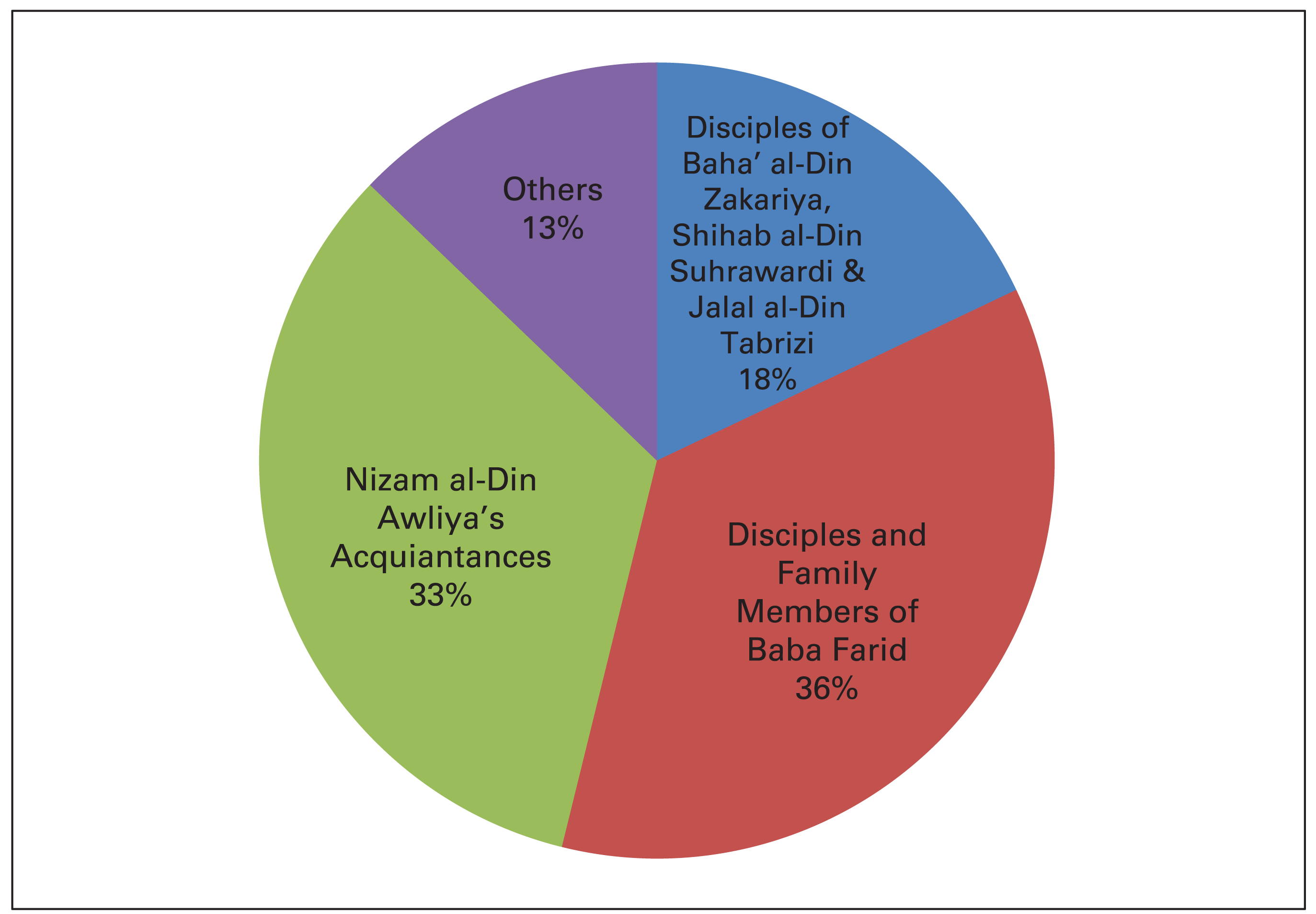
The thirteenth and fourteenth centuries were also marked by the presence of some venerable individuals who were not affiliated to any silsila such as Sidi Muwallih and Maulana Nur Turk, but their conduct was worth commemorating. Hence, from T̤abaqāt-i Auwal to T̤abaqāt-i Duwam there is a transition in the reference to the history of sufis: the seemingly agnostic reference to distribution of sufi shaykhs in the early thirteenth century with minimal reference to their silsila in T̤abaqāt-i Auwal gave way to an overt domination of Chishti sufis in ‘Abd al-Haqq’s account of the late thirteenth and early fourteenth centuries. The T̤abaqāt-i Siwum complicates the picture further as it detailed the transitions and tensions in the stature of the sufis in the fifteenth and sixteenth centuries.
The longest section of the Ak̲h̲bār al-Ak̲h̲yār is the third, the T̤abaqāt-i Siwum which contains biographies of 193 sufis and ‘ulamā’ who lived in the fourteenth, fifteenth and sixteenth centuries. Although the three centuries are clubbed together in one t̤abaqāt, it is relatively clear that internally the t̤abaqāt is organised by generational relationship which then distinguished the fourteenth from the fifteenth and the sixteenth centuries. In my analysis, I have tried to highlight this organisation and framework.
The t̤abaqāt commenced with the bionote of Shaykh Nasir al-Din Mahmud Chiragh-i Dehli and included biographies of several disciples of Shaykh Nizam al-Din Awliya, and subsequently delineated the dispersal of sufis across the subcontinent in the fifteenth and sixteenth centuries. To underline the subtle changes in the portrayal of sufis from one generation to the other, I would discuss these biographies in sequential order from the fourteenth to the sixteenth century. ‘Abd al-Haqq maintained that the fourteenth century was dominated by the disciples of Shaykh Nizam al-Din Awliya, and consequently, the first biographical entry was of the individual that he identified as the chief k̲h̲alīfā of Shaykh Nizam al-Din, Shaykh Nasir al-Din Mahmud. There was no attempt, however, to identify him as the last of the five great Chishti sufis. The ensuing biographies mention 23 disciples of Shaykh Nizam al-Din, starting with Shaykh Nasir al-Din who lived in the fourteenth century. The references to family members of Baba Farid and Khwaja Mu‘in al-Din Sanjari are fewer in number, and there is hardly any reference to the Suhrawardis. But there is an indication to the presence of other sufi orders such as the Firdausis as well as other pious individuals who did not owe affiliation to any spiritual order.
The elaborate biography of Shaykh Nasir al-Din Mahmud contained anecdotes pertaining to his views on fasting, food, charity, faqr, sama‘ and its legality, sharī‘at and Sufism, and how these were applicable to a sālik (mystic) with instances cited from his malfūz̤āt, K̲h̲air al-Majālis. 45 ‘Abd al-Haqq cited biographies of several disciples and k̲h̲alīfās of Shaykh Nizam al-Din Awliya in the T̤abaqāt-i Siwum such as Shaykh Qutb al-Din Munawwar, Shaykh Husam al-Din Multani, Maulana Fakhr al-Din Marwazi, Maulana ‘Ala’ al-Din Nili, Shaykh Burhan al-Din Gharib, Khwaja Ziya’ al-Din Barani, Amir Khusrau Dehlawi, Amir Hasan ibn ‘Ala’ Sanjari Dehlawi and others. The enlisting of attributes and attainments of the disciples and k̲h̲alīfās exhibited their pious conduct: Shaykh Qutb al-Din Munawwar spent time in tawakkul (trust in/resignation to the Divine will) and abstained from accepting land grants from political sovereigns; Shaykh Husam al-Din Multani, another k̲h̲alīfā of Shaykh Nizam al-Din, was a distinguished buzurg, went for ziyārat (pilgrimage) to the holy Ka’ba, sermonised on the merits of fasting, ṣabr (patience) and shukr (returning thanks to God) for a dervish, and followed the sharī‘at. The favourite pastime of Maulana Fakhr al-Din Marwazi was reading the Qur’ān and leading a life of isolation to attain the love of god; Maulana ‘Ala’ al-Din Nili, another k̲h̲alīfā, dressed like the ‘ulamā’ but had qualities of sufis and highly revered the Fawā’id al-Fu’ād (malfūz̤āt of Shaykh Nizam al-Din Awliya) over any other text; Shaykh Burhan al-Din Gharib, another k̲h̲alīfā, was referred in the context of the tensions associated with his receipt of k̲h̲ilāfat (spiritual succession). ‘Abd al-Haqq made a note of several lay disciples and associates of Shaykh Nizam al-Din, especially with regards to their textual productions. This included Amir Khusrau, a poet who received letters from Shaykh Nizam al-Din; Amir Hasan Sijzi, the compiler of Shaykh Nizam al-Din Awliya’s malfūz̤āt, Fawā’id al-Fu’ād; Khwaja Ziya’ al-Din Barani, a courtier who did bai‘at (swearing allegiance) to Shaykh Nizam al-Din and wrote the Ḥasrat Nāma; and Khwaja Ziya’ al-Din Sanami, an associate of Shaykh Nizam al-Din, who talked about the different notions of sharī‘at and was held in reverence by the Shaykh for his sharī‘ati knowledge. 46
Additionally, the buzurgān who lived in the fourteenth century included the k̲h̲alīfās of Shaykh Nasir al-Din Mahmud. These included Sayyid Muhammad and his discourses on death and the legality of samā‘; Shaykh Sadr al-Hakim’s focus on the need to control desires and the importance of offering namāz and keeping roza (fast); and an account of the spiritual training received by Sayyid Jalal al-Din under several sufi shaykhs. In addition, the other key actors in the fourteenth century reported by ‘Abd al-Haqq included Shaykh Rukn al-Din Firdausi, who did not have friendly relationship with Shaykh Nizam al-Din Awliya, and Shaykh Sharaf al-Din Ahmad (Maneri), whose longish bionote carried information on the k̲h̲ilāfat given in the Firdausi silsila and several letters written by him to his disciples regarding importance and power of God, the Day of Judgement and select instances from the lives of several prophets. 47 Several other individuals who are discussed without any reference to any silsila included Khwaja Ahmad, who read namāz diligently and no fear or threat could deter him from his goal; Shaykh Badr al-Din Samarqandi, a murīd of Shaykh Najm al-Din Kubra and k̲h̲alīfā of Shaykh Saif al-Din Bakharzi. He liked samā‘ and came to Shaykh Nizam al-Din Awliya’s majlis (assembly) to listen to it. This section also included Shaykh Hasan, a murīd of Shaykh Muzaffar who related the importance of z̠ikr, roza and control of nafs (breath/inordinate desire), the Day of Judgement and tauḥīd (a belief in unity of God) in his maktūbāt. 48 The details in the Ak̲h̲bār al-Ak̲h̲yār create the impression of a fourteenth century that was represented as an age of the Nizamiyya sufis as they spread out to different regions of the Indian subcontinent (see Chart 3) with tangential reference to the other piety-minded individuals whose conduct was worth emulation.
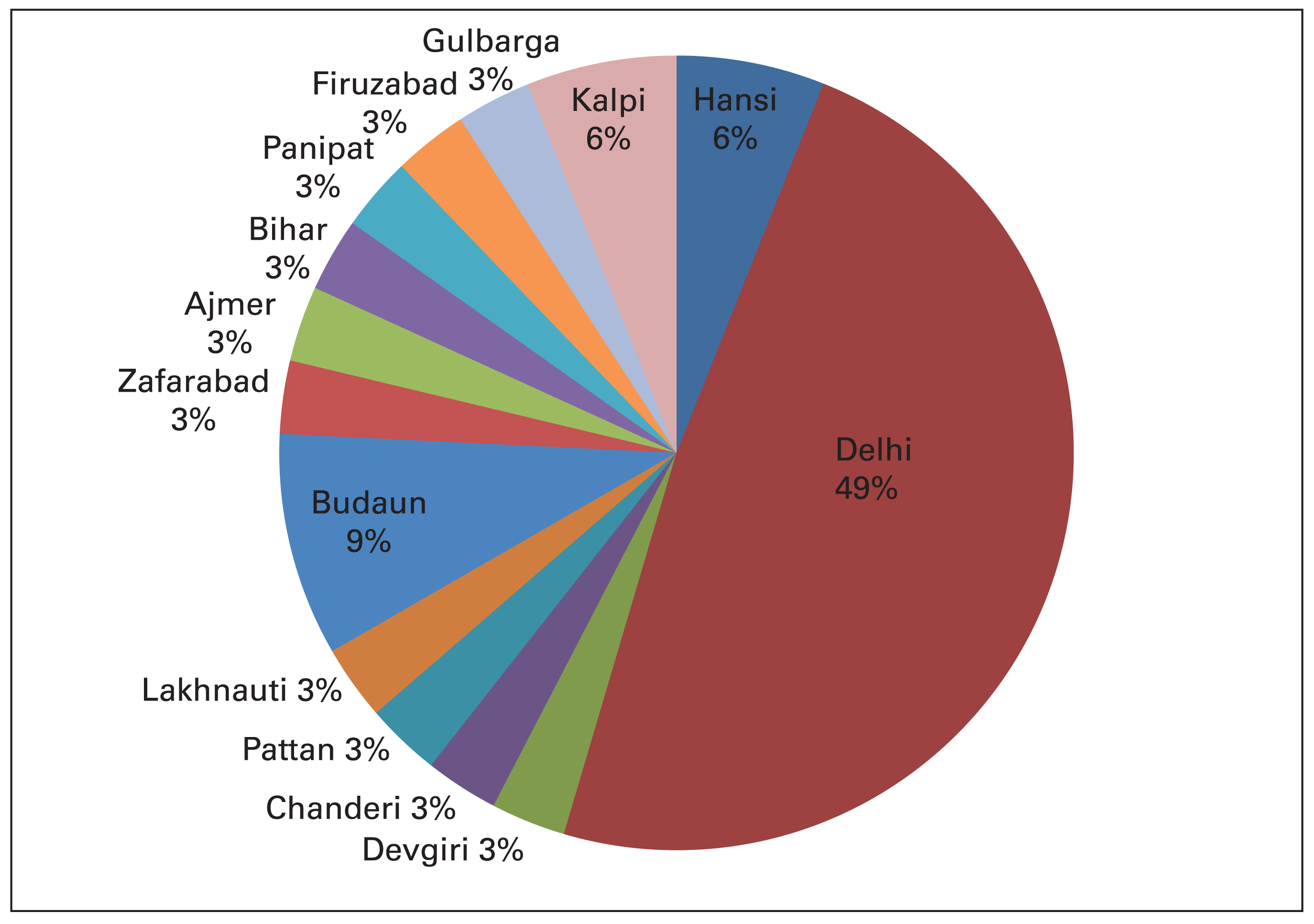
The critical point in these biographies was the reference to regions outside the North Indian heartland. Thus, in addition to the traditional centres of sufis, which included Delhi, Ajmer, Budaun and Hansi, there are references to newer towns and cities such as Gulbarga, Chanderi, Pattan, Devgiri, Bihar, among others. ‘Abd al-Haqq cited these regions to pinpoint the places visited by the sufi preceptors and the location of their tomb shrines. Though not all the sufis or ‘ulamā’ were spatially located, ‘Abd al-Haqq was organising his information quite clearly with an eye to the expanding frontiers of the Muslim community into new regions that were not under the control of a single political sovereign. Hence, the history of piety-minded Muslims offered an alternative narrative to the expansion of the Muslim community that could not be undermined by victory or defeat of the ‘armies of Islam’.
The account of the piety-minded Muslims who lived in the fifteenth century showcases further transitions in the Muslim community. Unlike the thirteenth and fourteenth centuries, the references to the sufi silsilas are fewer in the fifteenth century. The orientation of the Ak̲h̲bār al-Ak̲h̲yār shifts to pīr–murīd clusters dispersed in different provinces of the subcontinent; Delhi ceased to be the focal point of the narrative. Though ‘Abd al-Haqq had used the pīr–murīd relationship to identify sufis in the thirteenth and fourteenth centuries, only select sufi pīrs formed the nucleus—Shaykh Shihab al-Din Suhrawardi, Khwaja Mu‘in al-Din Sanjari, Shaykh Qutb al-Din Bakhtiyar Kaki in the thirteenth century, and Shaykh Farid al-Din and Shaykh Nizam al-Din Awliya in the fourteenth century. During these centuries, ‘Abd al-Haqq suggested that most of the sufis were their associates.
In his organisation of information on the fifteenth century, on the other hand, ‘Abd al-Haqq underlined the dispersal of sufis, when no pīr could be regarded as the axis and no one silsila had a preeminent position in the spiritual world. The pietistic community included the murīds of k̲h̲alīfās of Shaykh Nasir al-Din Mahmud and Sayyid Muhammad Gesu Daraz, but a large number of sufis were locally revered individuals who earned a citation in the Ak̲h̲bār al-Ak̲h̲yār on account of their spiritual merits. Chart 4 showcases the dispersal of sufis in the fifteenth century quite clearly.
The locales mentioned in Chart 4 indicate the spread of sufis and piety-minded Muslims to new regions across the subcontinent. The sense of historical context of the fifteenth century was apparent from the way ‘Abd al-Haqq narrativised clusters of pīr–murīd relationships in his narrative—some of the chains of spiritual transmission lasted a few generations, while others were restricted to two or three individuals. For instance, take the case of Sayyid Yad Allah, Shaykh Piyarah, Shah Jalal Gujarati and Shaykh Muhammad Mullawat. Sayyid Yad Allah, a murīd of Sayyid Muhammad Gesu Daraz, trained his murīds in z̠ikr, later he fell in love with a woman and the couple died soon after their marriage. Shaykh Piyarah, another murīd of Gesu Daraz and later a murīd of Sayyid Yad Allah, was initially in love with a non-Muslim woman, but after receiving spiritual training under his mentors he learnt the path of ḥaqīqī (mystical truth). The discussion of romantic relationship of the sufis is akin to the narratives of romantic liaisons of the warrior ascetics that formed the core narratives of the fifteenth century multilingual texts like the premakhyans. Shaykh Piyarah’s murīd, Shah Jalal Gujarati had both z̤āhiri and bāt̤ini (exoteric and esoteric) knowledge and kept reciting god’s name at the time of his assassination. Shah Jalal Gujarati’s murīd, Shaykh Muhammad Mullawat experienced ecstasy while listening to samā‘ and performed karāmat so that North India witnessed agrarian prosperity.

Not all fifteenth century pīr–murīd relationships had a long chain of transmission; some of them were restricted to just two individuals—the pīr and his k̲h̲alīfā—their biographies carrying a reference to the place of their burial. Sayyid Sadr al-Din Bukhari was the k̲h̲alīfā of Sayyid Ahmad Kabir, and he remained busy in service of people and was buried in Uchch. Mir Sayyid Ashraf Samnani was the murīd of Shaykh ‘Ala’ al-Haqq. He acquired high status in karāmat, extensively discoursed on tauḥīd and īmān (faith) in his maktūbāt, especially about the fate of Pharaoh and the Day of Judgement. Many sufis are mentioned without any spiritual affiliation such as Shaykh Ahmad Khattu, the esteemed Shaykh of Gujarat who received some training under Baba Ishaq Maghribi, went for hajj, had a vision of the Prophet and remained busy in offering namāz and his teachings to his disciples were compiled later in a book. 49 Likewise, there are many references to sufis who resided or were buried in different parts of the subcontinent such as Lucknow, Kalpi, Gujarat, Mandu, Nagaur, Jaunpur, Kanauj, etc. While in the fourteenth century, the dispersal of sufis was a process initiated by the k̲h̲alīfās of Shaykh Nizam al-Din Awliya and Shaykh Nasir al-Din Mahmud, in the fifteenth century, a far greater autonomy regarding sufi settlements was communicated by ‘Abd al-Haqq. Sufi centres were fragmented across the subcontinent and most of the sufi pīrs were locally revered individuals and not affiliated to prominent pīrs or silsilas.
The inclusion of biographical entries of sufis dispersed across the subcontinent was crucial to demonstrate the spread of the Muslim community to different parts of northern and western India. But ‘Abd al-Haqq’s narrative was historically more ambitious in the way it conceptualised the fifteenth century. The Ak̲h̲bār al-Ak̲h̲yār did not carry a hint of the idea of ‘decline’ as Delhi ceased to be the paramount political authority in the subcontinent. Instead, ignoring Sultanate authority altogether, ‘Abd al-Haqq portrayed the robustness of the Muslim community ministered by dispersed sufi shaykhs and their grave sites. ‘Abd al-Haqq sought to demonstrate that even in absence of an overarching political authority located in Delhi, the Muslim community did not witness any degeneration. In fact, this was the remarkable phase in the history of the spread of Islam, as multiple sufi preceptors were able to draw murīds from regions across the subcontinent on account of their spiritual prowess, and hence these sufis emerged as the alternate sources that asserted Muslim presence.
The projection of the sixteenth century in the Ak̲h̲bār al-Ak̲h̲yār is markedly distinct from the fifteenth century as the sufis are listed and identified through multiple modes: affiliation to silsilas, pīr–murīd relationship and pious individuals without any spiritual affiliation. Several sufis are identified as murīds of sufis who were associated with definitive silsilas that were prominent in the sixteenth century, for instance, the Mutaqqis, Qadiris, Shattaris and a few others. The Mutaqqis included Shaykh ‘Ali Mutaqqi and Shaykh ‘Abd al-Wahhab Mutaqqi who migrated from the Indian subcontinent to Medina and engaged in transmission of hadīs̤ studies and training disciples in sufi practices. ‘Abd al-Haqq had received training in hadīs̤ and Sufism under Shaykh ‘Abd al-Wahhab Mutaqqi, and hence he carried detailed biographical entries on the two sufis in the Ak̲h̲bār al-Ak̲h̲yār. ‘Abd al-Haqq underlined the multiple sufi initiations and training in sulūk (mode/rule) and t̤arīqat of Shaykh ‘Ali Mutaqqi under Shaykh ‘Abd al-Hakim Chishti, Shaykh Husam al-Din Mutaqqi, Shaykh Muhammad Sakhawi of the Qadiri silsila, Shaykh Nur al-Din of the Shazili silsila and ‘Abd al-Maghribi of the Madyani silsila. Further, ‘Abd al-Haqq carried details on Shaykh ‘Ali Mutaqqi’s multifaceted textual productions on Sufism and hadīs̤, his engagements in teaching ‘ulūm, doing z̠ikr, reading namāz and directives regarding adherence to the sunnat. Akin to his pīr, Shaykh ‘Abd al-Wahhab Mutaqqi had multiple initiations in sufi silsilas, was expert in ‘ulūm-i sharī‘at and argued that Sufism should be in line with the sunnat. In addition, he held that z̠ikr included z̠ikr-i ilāhi, reading namāz, tilāwat (reading) of Qur’ān and reading ‘ulūm-i sharī‘at. 50 Hence, the biographies of the Mutaqqis showcased that Sufism and sunnat could be harmonised with each other.
‘Abd al-Haqq was initiated in the Qadiri silsila early in his life, and hence he related biographies of the pīr–murīd clusters who were descendants of Shaykh ‘Abd al-Qadir Jilani in the sixteenth century. This included Makhdum Shaykh Muhammad al-Husaini al-Jilani, a direct descendant of Shaykh ‘Abd al-Qadir Jilani and his sons: Makhdum Shaykh ‘Abd al-Qadir Sani who remained busy in offering namāz, healing ailments of people through karāmat and distanced himself from luxury and music; his k̲h̲alīfā and grandson Makhdum Shaykh Hamid who led a simple life, did not accept futūh (charity) from kings and was instrumental in spreading the Qadiri silsila in the subcontinent; and his k̲h̲alīfā Shaykh Dawud, who practiced rigorous prayer schedules and criticised the Mahdawis because they had digressed from the path prescribed by the Prophet. 51 Amongst the Shattari sufis, ‘Abd al-Haqq mentioned Shaykh Yusuf Charyakoti, who used to read poetic verses in z̠ikr and get wajd (being transported in an ecstasy of love) and was held in esteem by the buzurg of the age; Shaykh Baha’ al-Din, a Shattari sufi with Qadiri affiliation, who discoursed on the t̤arīqa of the Shattaris that included practicing tauba (repentance/abstinence from anything that takes focus away from god), zuhd (being given to religious exercises/abstaining from desires of this world), tawakkul (resignation to the Divine will), qanā‘at (contentment/abstinence from the desires of the lower soul), ‘uzlat (resignation and being away from people/self-seclusion), tawajjuh-ilāh Allāh (focus towards God and ending all the desires), ṣabr (patience), riẓā’-i ilāhi (endeavouring to please God) and performing z̠ikr [with sole focus on god]. 52 Also, ‘Abd al-Haqq referred to Shaykh Budhan Shattari, who taught Rizq Allah Mushtaqi (‘Abd al-Haqq’s uncle) the Shattari values and about z̠ikr. 53 Amongst the disciples of the Chishti sufis of the fourteenth century were Mir Sayyid ‘Abd al-Auwal, a disciple of Sayyid Muhammad Gesu Daraz’s murīd, who had knowledge of ‘ulūm-i‘aqlīya wa naqlīya (speculative and practical sciences) and wrote risāla (treatise) about attributes of nafs and attaining ma‘rifat (insight in divine matters or mysteries); Shaykh ‘Abd al-‘Aziz Hasan Tahir, another famous buzurg, who had sound knowledge of the ‘ulūm-i sharī‘at and t̤arīqat and was responsible for the spreading of the silsila in Delhi; and Shaykh Salim, who in his early years kept roza and remained busy in offering namāz, but in his later life, rich and powerful people—including Akbar—started visiting him, and he started performing karāmat and other things that—according to ‘Abd al-Haqq—were not correct according to the tenets of Islam. 54 Therefore, by delineating the teachings and accomplishments of the Qadiris, Shattaris, Chishtis and Mutaqqis, ‘Abd al-Haqq could enlarge how the pious could mediate their commitment to textualised Islamic praxis without compromising the sensibility of their sufi belief.
Furthermore, the spatial spread of the sufis found mention in the individual biographies of the sixteenth century sufis. ‘Abd al-Haqq noted the spread of sufis across the subcontinent in distant places such as Panipat, Jaunpur, Nagaur, Gwalior, Fatehpur, Agra, Bidar, Gulbarga, Burhanpur, Gujarat, Mandu and Delhi. The cluster of pīr–murīds without affiliation to any silsila occupies a substantial portion of ‘Abd al-Haqq’s narrative on the sixteenth century sufis. Their histories had suddenly contracted—most of them had come to the forefront in the fifteenth century, and it was their murīds who continued the pīr–murīd relationship in the sixteenth century. This was evident, for example, in the case of Shah Nur, the murīd of Shah Dawud; Shaykh Sa‘d al-Din Khairabadi, the murīd of Shaykh Mina; Shaykh Hasan Tahir, the murīd of Raji Hamid Shah; Maulana Ilah Dad, the murīd of Raji Hamid Shah; Shaykh Ma‘ruf Jaunpuri, the murīd of Maulana Ilah Dad; and Shaykh Baha’ al-Din Jaunpuri, the murīd of Shaykh Muhammad ‘Isa. 55 Alongside, there was also a sizeable increase in citations of the pious without any reference to their spiritual affiliation such as Sultan Jalal al-Din Quraishi, Mir Sayyid Ibrahim, Shaykh Baha’ al-Din Mufti, to name a few. Hence, the sixteenth century was unique not just because of the dispersal of sufi silsilas but also for the expansion of individuals who were venerated for their piety.
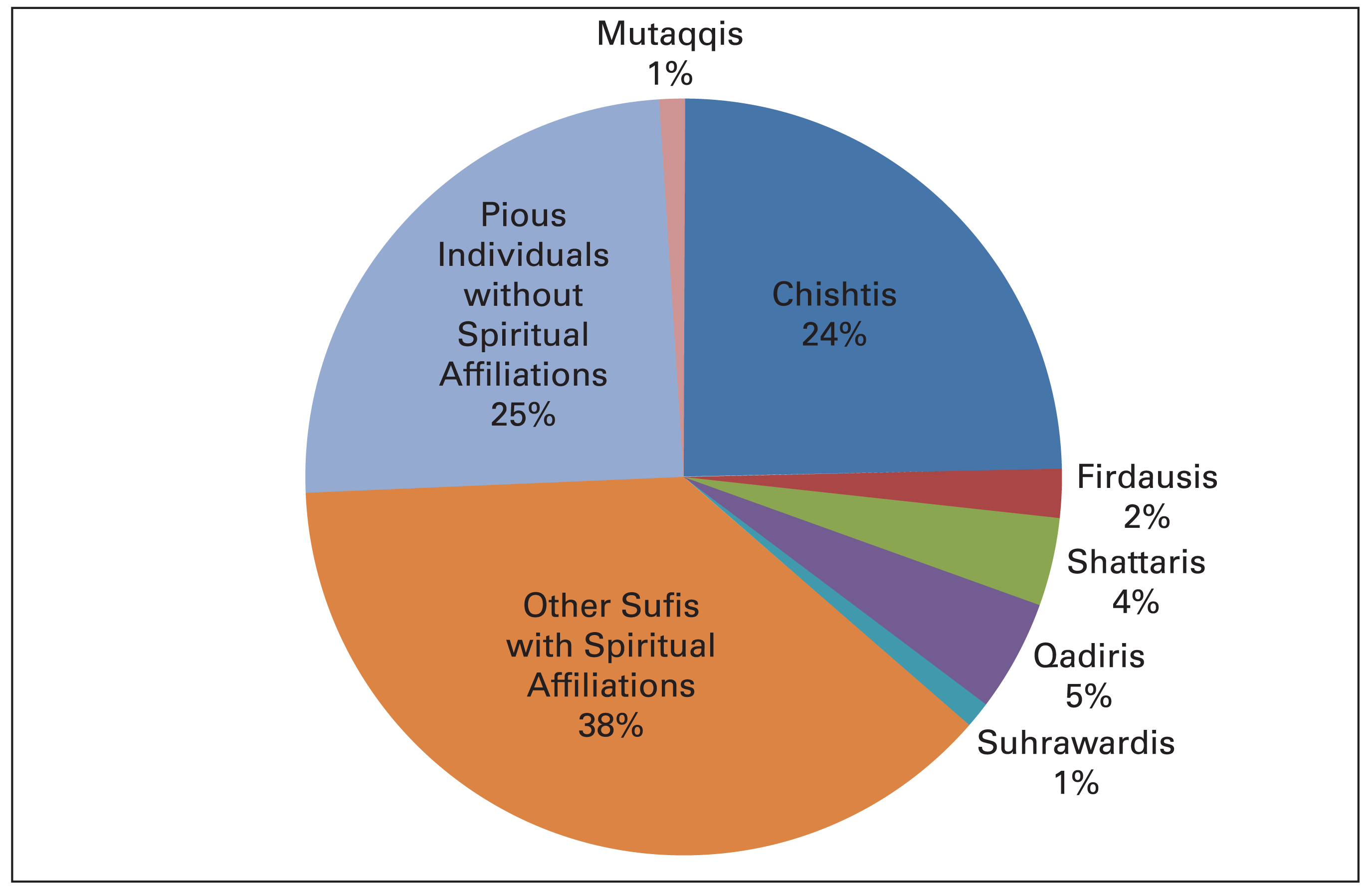
As Chart 5 demonstrates, in the T̤abaqāt-i Siwum, the combined data from fourteenth to sixteenth century indicates that sufi silsilas with long pedigrees were on the wane, a larger number of people were affiliated to the locally revered pīrs. The silsilas that were hitherto relatively marginal—such as those of the Qadiris, Shattaris and Mutaqqis—became popular. In the same way, people without spiritual affiliation came to the centre stage of the pietistic community.
Furthermore, in ‘Abd al-Haqq’s historical imagination of the Muslim past, the majz̠ūb and women sufis were commemorated as venerable members of the Muslim community. The Ak̲h̲bār al-Ak̲h̲yār was an exceptional text as it carried two short biographical sections: one section exclusively focused on the majz̠ūb, those who were carried away by ecstasy, whose conduct was questionable because it was mysterious on so many grounds. The other section discussed the women sufis who were systematically marginalised in the early sufi malfūz̤āt produced in the fourteenth century. Though women sufis were cited in early taz̠kirāts, ‘Abd al-Haqq was unique as he dedicated a separate section to the distinguished and venerable women, elucidating their piety and conduct through anecdotes drawn from their lives.
The majz̠ūb included people who could perform karāmat—whose conduct was not always worth emulating, as well as some dīwāna (insane/lost in ecstatic bliss), who lived from the thirteenth to sixteenth century. These included Shah Abu al-Ghaib Bukhari who used to stay in a state of masti (intoxication) and even when he touched fire, it did not burn his feet; Shaykh Hasan Majzub would put his neck in the fire but not get harmed; Shaykh ‘Abd Allah Abdal Dehlawi, who used to dance in bāzārs (markets), read couplets in Hindawi, played sitar and remained mast (intoxicated); Shah Mansur who predicted that Humayun would be defeated in Gujarat by breaking an arrow. The conduct of these men varied from that of the sufis mentioned in the earlier sections of the taz̠kirāt: many of them were dīwāna and yet had the ability to perform karāmat. 56 The female sufis were relatively fewer in number, but worth noting on account of their piety such as Bibi Fatima Sam. According to Baba Farid, she was a man who had been sent by God in the form of a woman, and a person present in the majlis of Shaykh Nasir al-Din reported that Khadija and Fatima were sent by God to fetch Bibi Fatima Sam to heaven on account of her piety. Bibi Zulaikha, Shaykh Nizam al-Din Awliya’s mother, derived immense pleasure in poverty, and Sultan Mubarak Shah Khalaji was murdered since Nizam al-Din Awliya had prayed at her grave for protection; and Bibi Awliya performed rigorous chilla (forty days of fasting) and hardly ate anything. 57
The inimitable narrative style developed by ‘Abd al-Haqq in the Ak̲h̲bār al-Ak̲h̲yār required careful selection of details from the received body of knowledge. The taz̠kirāt centred on the history of the sufis and ‘ulamā’, used episodes from their lives that illustrated their conduct selectively and cited their teachings from their textual productions. This entailed showcasing the diverse and complex body of literature prescribed by the sufis and making a basket of choices available to the readers about notions of piety. There was no precursor to the Ak̲h̲bār al-Ak̲h̲yār in the volume of information processed or the historical imagination that arranged generations of pious Muslims in various t̤abaqāts to explain the diffusion and making of Muslim society in the subcontinent.
Conclusion
In the recent years, the social history of Muslims in South Asia in the pre-modern times is getting more attention. Research on the textual productions, precepts, practices and life histories of sufis, umarā’ (people holding a rank/distinction), scribal class, ruling elites, ‘ulamā’ and the piety-minded Muslims has proliferated. 58 Although historians such as Richard Bulliet, Michael Chamberlain and Michael Cooperson have drawn attention to potential value of taz̠kirāts, in South Asian history only Rajeev Kinra and Jyoti Gulati Balachandran have systematically used this literature to write on social history. 59 Certainly, under the impact of the new scholarship, the history of sufis is not confined to the linear history of the fraternities, but the complexities that contributed to the making and unmaking of sufi silsilas, and the ways in which the buzurgān of the past were remembered by later generations have all come under sustained interrogation. 60 A careful study of the narrative structures and styles of literary productions of the sufis and scribes has complicated our understanding of Indian Islam in the medieval period.
Amongst variegated literary sources pertaining to the medieval period, modern historians regard the taz̠kirāts as ‘conscious remembrances … [that] are both cultural artefacts and cultural reconstructions’. In addition, Bruce Lawrence argued that from the early sixteenth century, these texts honoured Muslim elites and ‘authenticated Muslim urban spaces’, and hence were ‘memorative communications’ to transmit the legacy of past heroes as idols of the present generation of Muslims. 61 Further, he argued that as Muslims over time imagined their space differently, their sense of identity changed, and hence the manner of organising the taz̠kirāts also changed. Hence, the pre-modern taz̠kirāts created the sense of a Muslim space in South Asia, Islamicising the soil. They marked a new home, new spiritual and intellectual centres and circuits of pilgrimage. 62 The primacy attached to space in shaping Muslim identity in modern historiography requires careful reconsideration. Since the taz̠kirāts narrativise episodes from the lives of Muslim elites—classifying their protagonists in different ways—the historical consciousness that animates these texts requires careful disaggregation.
The careful selection of narratives in the taz̠kirāts and unpacking the role of human agency in shaping the contours of Muslim identity are critical to discern the discursive thrust of the texts. This is apparent in the recent research of Jyoti Gulati Balachandran whose analysis of the fourteenth century sufi taz̠kirāt, the Siyar al-Awliyā’, studied the emplotment of historical personages and highlighted the discursive agenda of the compiler, Amir Khurd, in producing a very carefully conceptualised history of the Muslim and the Chishti community. Through a careful study of pīr–murīd networks that shaped the Chishti order and a study of the biographies of their distinguished disciples, Balachandran argued that the taz̠kirāt created an autonomous political space for the Chishti silsila. On the one hand, it challenged the authority of the state, but, on the other hand, it deracinated the subordinates of the Shaykhs investing primary power with the various pīrs. 63
Elsewhere, Mana Kia has used eighteenth century Persian taz̠kirāts to showcase their role in shaping trans-regional cosmopolitan identities. 64 She notes that Persian poetic taz̠kirāts carried biographies of people from heterogeneous backgrounds, but the act of commemoration at a specific historical moment enabled writers to connect the past and present through a network of social relationships. The entries were usually about people who were contemporaries of the author or whom the author identified as a part of his social community. Despite differences in gender, places of origin and lineage, the authors included diverse people within a dispersed cultural continuum that defined an expansive Persianate community. She points out that in the absence of political confidence in the eighteenth century, many taz̠kirāts sought to commemorate the lives of people who were writing in Persian, although they belonged to different geographical locations. In the context of fractured polities where the state was not critical in cohering or commemorating people across regions, she regards taz̠kirāts as ‘texts of self through community’ where a mobile, learned Persianate elite created the sense of a community, privileging Persian culture with Hindustan as its locus. Through strong contextualisation and by unpacking the discursive agenda of their authors, both Balachandran and Kia moved away from any generic understanding of the taz̠kirāt and could draw our attention to the history and politics involved in the production of texts.
We have to appreciate how this methodology of narrating the past is present in ‘Abd al-Haqq’s endeavour to recount the past of Muslims in Hindustan. It was a critical intervention in the intellectual world of the sixteenth/seventeenth century. During the reign of Akbar, and afterwards, many attempts were made to position the political stature of the Mughals within the larger history of Islam and the subcontinental world. ‘Abd al-Haqq chose to step away from these. He charted a life geared to the acquisition and dissemination of ‘knowledge’, especially Prophetic traditions and theology. The renown he gained from his specialisation as a mūḥaddis̤ leant weight to his interventions in history and Sufism. Much of this was self-reflective; ‘Abd al-Haqq rather proudly narrated his scholastic achievements. But none of this can actually prepare us for the scale of his intellectual achievements or that it remained obscure for such a long period of time. After all, as a mūḥaddis̤, the last thing that was expected from a scholar is dramatic innovation. This (false) assumption was an important reason why his work was not read as creatively as it was compiled.
‘Abd al-Haqq reported several narratives regarding the virtues of the piety-minded Muslims: deep regard for the sharī‘at, rigorous prayer schedules, a concern for the Day of Judgement and the several attributes of god. He recounted the miracles performed by sufis, their approach towards samā‘ and ecstasy, their love for god, their intuitive genius and excerpts from the textual productions of the select sufi pīrs. All of these elements, and not any one of them selectively, constituted the foundations of their spiritual authority and made them socially significant and powerful. The text then highlighted that the sufi precepts were in consonance with the sharī‘at, thus providing a complex picture of Islam. The Ak̲h̲bār al-Ak̲h̲yār was unlike the Siyar al-Awliyā’ or the Siyar al-‘Ārifīn that focused on the pīrs and teachings of a single silsila; while giving primacy to a cross-cutting adherence to the sharī‘at, ‘Abd al-Haqq seamlessly included Suhrawardi, Chishti, Qadiri and other sufi preceptors, ‘ulamā’ and their practices in his text. This was a far more ecumenical and comprehensive view of Islam and Sufism than hitherto imagined, one which envisaged an element of political self-regulation cutting through these centuries where the state was not critical in ensuring the integrity of the Muslim community.
It is necessary to pause and appreciate the point because the expansion of Islam and the Muslim community is very often associated with the military achievements of its monarchs and administrators. But in the Ak̲h̲bār al-Ak̲h̲yār, the political sovereigns and their military success did not cast any significant impact on the expansion of Islam and Islamicisation of the subcontinent. There are contextual references to Sultans and their retinue, but they do not occupy a primary role. Instead, the history of Islam is narrativised in a generational mode with sufis and ‘ulamā’ occupying centre stage. These pīr–murīd clusters get more and more complex in the fifteenth and sixteenth centuries as the k̲h̲alīfās spread to various parts of the subcontinent. Charting the deep and dynamic history of Muslim settlements and their pious leaders for the fifteenth and sixteenth centuries contradicted the Mughal archive; this was a robust and expansive community and not one that was in crisis or stress awaiting Akbarid renewal. The narrative implication of this was huge, especially in the face of the Mughal courtly discourse that argued completely to the opposite. In the Ak̲h̲bār al-Ak̲h̲yār, the huge increase in the number of sufis and settlements in the early sixteenth century stood witness to the robustness of Muslim society in the absence of an intrusive state. It fashioned a genealogy of power which gave precedence to a knowledge of Islam and sufi virtues drawn from the lives of historical personages, organic leaders and participants in the lives of local communities, and these could serve as role models for Muslims.
In the sixteenth century, knowledge formation and its mode of circulation were multifaceted. Many ideas that were part of the larger intellectual milieu were sometimes appropriated by the court. As Muzaffar Alam has demonstrated through a study of the writings of Shaykh ‘Abd al-Rahman Chishti, there were complex ways in which Islam and sharī‘at were projected in the early seventeenth century. Ideas associated with Ṣulḥ-i Kull (absolute civility, as Rajeev Kinra described it) were also used in equally complex ways by the literati to address the religious and social world of the sixteenth and seventeenth centuries. 65 ‘Abd al-Haqq was a product of this world, and his response to his milieu was not restricted by his juridical training. In fact, in the Ak̲h̲bār al-Ak̲h̲yār, compiled close to the completion of the first millennium of Islam and one of his earliest works, ‘Abd al-Haqq provided an unusual history of Islam in the subcontinent. This text does not carry any of the ideas associated with Ṣulḥ-i Kull circulating within Mughal courtly circles. And that is exactly the point. Through a close analysis of the structure of this text, I have tried to clarify the author’s considerable intellectual rigour in synthesising and shaping a huge corpus of information to write a history of Islam that was distant from the court. The genius lay in conceptualising the paradigms on which such a history could be grounded to create an ecumenical world that embraced a range of preceptors who could stand as the past of Muslims in a Mughal world standing on the precipice of the new Islamic millennium. This would achieve the concordance and harmony that a courtly Ṣulḥ-i Kull might have strived [vainly] to achieve.
Footnotes
Acknowledgements
This article is an adapted version of one of the chapters of my PhD dissertation, ‘The World of a Seventeenth Century ‘Alim: ‘Abd al-Haqq Muhaddis Dehlawi, Islam, History and Notions of Piety’, submitted to the Department of History, University of Delhi. I am extremely grateful to the support and advice of my supervisor, Professor Sunil Kumar in the writing of this article and the anonymous referees of the IESHR for their useful comments.