



Abstract
In the north India of 1920s–30s, many first-generation anticolonial communists and Left intellectuals did not see any contradiction in reliance upon religion, ethical traditions and morality in a search for vocabularies of dignity, equality, just polity and social liberation. Through select writings in Hindi of Satyabhakta (1897–85), an almost forgotten figure in histories of communism in India, this article focuses on the entanglement between religion and communism as a way of thinking about the Left in India, and the problems and possibilities of such imaginings. Steeped in a north Indian Hindi literary print public sphere, such figures illuminated a distinctly Hindu and Indian path towards communism, making it more relatable to a Hindi–Hindu audience. The article draws attention to Satyabhakta’s layered engagements with utopian political desires, which, in envisaging an egalitarian future, wove Hindu faith-based ethical morality, apocalyptic predictions and notions of a romantic Ram Rajya, with decolonisation, anti-capitalism and aesthetic communist visions of equality. Even while precarious and problematic, such imaginations underline hidden plural histories of communism and, at the same time, trouble atheist, secular communists as well as the proponents of Hindutva.
The basic purpose of communism is to establish Ram Rajya [the righteous reign of Ram] on earth.
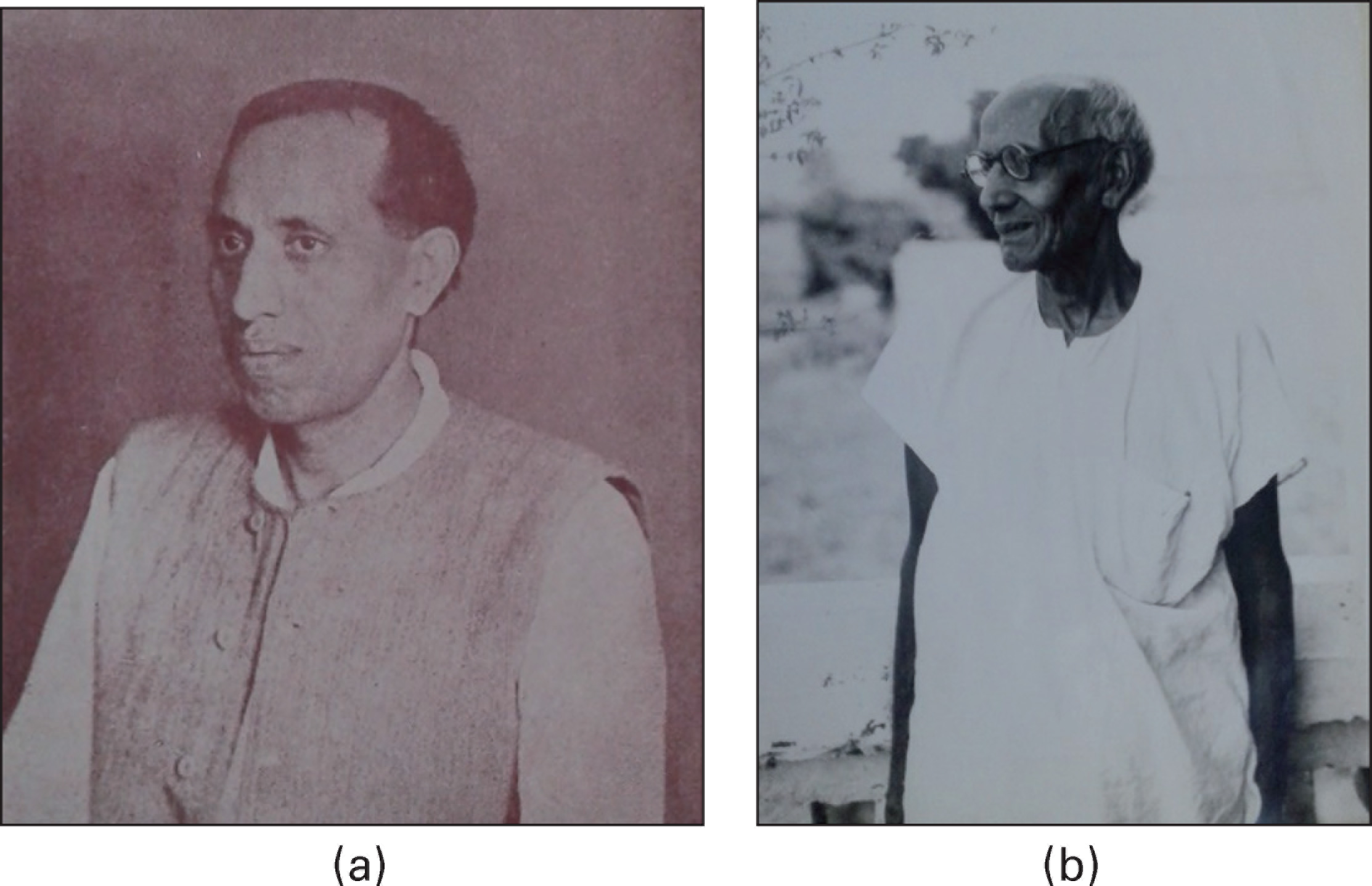
The above-mentioned quote by Satyabhakta (1897–85), founder and organiser of the first Indian Communist Conference at Kanpur on 26 December 1925, exemplifies the inscription of a Hindu communist, who brought on the same page two unlikely ideological companions. Moving away from an atheist Marxist enlightenment, in Satyabhakta’s rendering a pralay (catastrophe, end of the world) was soon to be expected, an apocalyptic warning of an end to both colonialism and capitalism, at the same time presaging the coming of a utopian communist enclave, a romanticised notion of Ram Rajya, and the unfolding of a future satyug (blissful era of truth) for India. Inspired, in part, by Gandhi’s creative use of Ram Rajya, Simone Weil’s Left mysticism, 2 Enrique Dussel’s philosophy of liberation, 3 and Alan Wald’s descriptions of lesser known dissenting communist writers, 4 this article focuses on the imaginative and troubling congruency of communist ideology with a Hindu faith-based ethical morality in the Hindi writings of Satyabhakta, a figure considerably marginalised and maligned in the histories of communism in India (see Figure 1). By recalling this forgotten and fascinating figure of the early Indian Left and analysing his intellectual journey and authored texts, the article attempts to tread the largely unchartered territory of ‘Hindu Communism’. I suggest that without a reflection on this vernacular, Hindi, religious and Hindu sphere, the story and history of communism in India is incomplete. The article further contrasts and critiques some of the prevailing theoretical assumptions of Marxist discourse in India with some of the communist practices on the ground.
Mainstream Marxism and communism, which operate largely in an atheist, materialist, metaphysical and enlightenment framework, are often hostile to religion, regarding it as an ideological deviation. 5 Many Indian communists and secular historians also complement such atheistic assertions, since they uphold a stark separation between religion and politics. Given the meteoric rise of Hindutva politics in India, they have persuasively argued against the use of Hindu religious symbols or values in the political–public sphere, and made a strong case for Marxist secularism. 6 As Neeladri Bhattacharya further observes: ‘To critique the communalist valorization of the religious, secular historians have tried to see in every action only the play of nonreligious interests—either political or economic’. 7 While attempting to dismantle militant Hindutva, the resilience and pervasiveness of religious idioms and Hinduism in India suggest that the counternarratives to communalism may not lie in secularism alone. An alternative may be sought in a range of histories and writings between the two, some of which are based on humanist religious terminologies. 8 No religion is monolithic or singular, and this perhaps holds greater valance for histories of Hinduism. Its diverse texts, doctrines and practices carry connecting and competing voices, which have been historically variable and culturally reconfigured in fluid, pluralistic terms. 9 In spite of various claims of homogeneity, ideals of equality and practices of inequality have jostled with one another, where caste hierarchies have been variously solidified, and yet forms of Hinduism continue to thrive amongst many so-called lower jatis. While Brahmanical scriptures and rituals have upheld and strengthened unequal conceptions of varnashramdharma and patriarchies, many including women, lower caste movements and sects like tantric yoga and bhakti have constantly reshaped meanings of Hinduism and stressed its multivocality. In the textures of lived Hindu lives over centuries, a Manusmriti sits along with a Kamasutra, Shankracharya and Manu rub shoulders with Kalidasa, Meera and Kabir, purity collides with impurities, hardening of religious identities coexist with syncretic practices, and celibacy, asceticism and yogic practices of material detachment comingle with desire, eroticism and karmic practices of sensual attachment. 10 Despite rabid Hindutva chanting, humane, multivocal, contingent and everyday strands of Hinduism continue to find outlets.
Equally, even communism may not be always bound by rules of atheism or shaped by a secular teleology. Liberation theology promoted a fusion between religion and Marxism. 11 However, its focus has been overwhelmingly dependent upon Christianity, and to some extent Islam, Judaism and Buddhism. 12 In comparison, Hindu liberation theology is a neglected field, perhaps because religions like Christianity and Islam have been considered more amenable to Left readings and translations. 13 Way back in 2002, Ruth Vanita thus underscored the continuing presence of the Christian Left and the Islamic Left in different parts of the world, and mourned the lack of a Hindu Left, critiquing ‘secular left’s almost paranoid stance on anything that savored of Hinduism’. 14 Satyabhakta complicates such a standpoint, exemplifying a quintessential figure of this lost ‘Hindu Left’.
Scholars have emphasised the growing nexus between nationalism, communalism, religious rhetoric and aggressive mobilisation in print, public and political spheres in late colonial north India. Especially in the 1920s–30s, there were increasing sectarian conflicts between Hindus and Muslims, and the emergence of a martial Hindu nationalism. 15 Congress propaganda in Uttar Pradesh in the period also increasingly displayed Hindu religious overtones. 16 At the same time, against a background of Hindi–Urdu controversies, there emerged a vibrant vernacular print public sphere, together with a consolidation of conservative Hindi–Hindu literati. This hardened cleavages along fault lines of gender, caste and religious identities. However, there were other tendencies also at work in the period between the two world wars. The Bolshevik Revolution became a major inspirational event for the growth of communism in India. The advent of Gandhi signified a new mass turn in the freedom struggle, while the Khilafat movement also contributed to communist flowering. Paranoid British authorities made serious moves to suppress communist ideas. Cartoons published in Hindi magazines reflected and ridiculed such paranoia (see Figure 2).

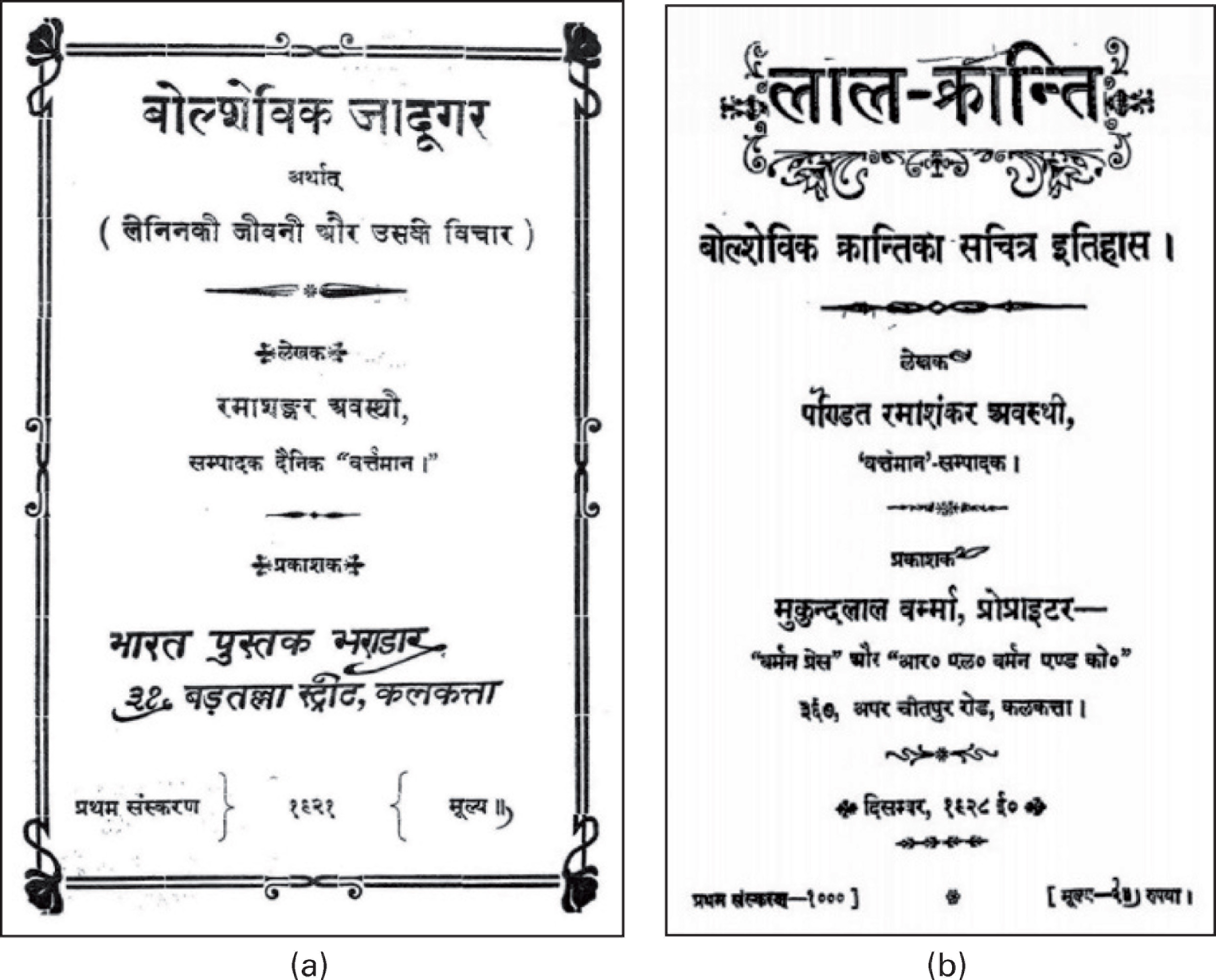
Amidst this background, resurgent religious idioms and cultural traditions were reworked in everyday public life by different constituencies—social reformers, nationalists, Hindu and Muslim organisations, subalterns, peasants, Dalits, women, workers, writers and communists—for very different ends and purposes. In the north India of 1920s–1930s, subaltern movements and a section of progressive Left intellectuals did not see any antagonism in aligning with religion, ethical traditions and morality in their search for inspirations and vocabularies of dignity, equality, just polity and social liberation. The Hindi written world of the early twentieth century was also quite heterogeneous: its amorphous, elastic nature enabled new constituencies to take shape within what was a fractured and complexly diversified print–public sphere that allowed conflicting strands to coexist. Many first-generation anticolonial communists and Left intellectuals writing in Hindi in the early twentieth century framed their utopian projects through a variety of influences. This led to expansive and creative expressions of progressive and political subjectivity. Representing a largely non-English-speaking populace, and firmly grounded in the Hindi print sphere of the time, they attempted to carve egalitarian dreams and meanings of resistance with their robust literary interventions. This bound their admiration for socialism, rationalism and progressive thought together with their commitment to nationalism, Hindu traditions and religious idioms. 17 Simultaneously, they drew on decentralised networks of knowledge, native sensibilities and new vernacular possibilities, and took poetic licence to confront British imperialism and simplify the language of communism. Immediately following the Russian revolution, communist literature began entering India through various channels, inspiring publications in Urdu and Hindi as well. Hindi writers and journalists like Radhamohan Gokul, Krishnakant Malaviya, 18 Ramashankar Awasthi (see Figure 3), 19 Ganesh Shankar Vidyarthi and Satyabhakta sought to create a socialist Hindi print sphere, which nonetheless engaged with the religious traditions and philosophical currents of popular and classical Hinduism; this sometimes had ambiguous implications.
For example, Ganesh Shankar Vidyarthi (1890–1931), editor of the spirited Hindi newspaper Pratap, a journalist par excellence, and a leading light of Kanpur, was himself a bearer of plural and fluid identities. A Gandhian nationalist, aligned with Congress, and inspired by socialist ideas, his writings, speeches and actions revealed a mix of religious rhetoric upholding Hindu concerns, selfless dedication to the interests of workers, poor and the oppressed, a repudiation of communal violence and a firm desire for peace, which resulted in his martyrdom. 20 Radhamohan Gokul (1865– 1935), referred by some as the ‘Charvak’ of Hindi, and editor of the fiery half-weekly Pranvir published from Nagpur, was a revolutionary, a Sanatani, a social reformer and a communist. Steeped in the progressive heritage of Hindu philosophy, although also professing atheism, he was one of the earliest persons in Hindi literature to pour his life into communist dreams, at the same time, assisting many revolutionaries with finances and literature. His books and publications ranged from Desh ka Dhan, published way back in 1906 to Communism Kya Hai in 1927. 21
It is in this wider milieu that Satyabhakta needs to be placed. His thoughts suggest that the meanings of communism, far from being fixed, were much more dynamic, flexible and open to interpretation in the 1920s, as ‘the Left created, appropriated, and translated’ communist idioms in familiar and everyday social, cultural and religious idioms. 22 Aditya Nigam draws attention to the fact that a considerable section of the early communists saw communism as ‘primarily a political imaginary that did not demand a subordination of their spiritual world to the political’ and ‘did not entail the epistemological rupture, the abandonment of old ways of making sense of the world and the adoption of the standpoint of High Rationalism’. 23 Satyabhakta went a step further, as he not only saw no discrepancy between communism and religious spiritualism but also actually regarded them as complementary in conceiving a dream of an egalitarian India. Moreover, in exemplifying a strand of vernacular communism, he and some others moved away from a chaste, Sanskritised Hindi, and, instead, in order to reach a larger audience, adopted a simple, colloquial, everyday people’s language and vocabulary for their writings and journalism. Yet, unlike some others, Satyabhakta was not only a journalist and a writer but also an active contributor on the ground, and he was driven to establish a formal communist party. Even if we consider him a communist amateur, he had the potential to dream, to be alive to organisational possibilities—a party, a journal, a series of pamphlets, a newspaper—to spread communism, though he could rarely continue with them in a sustained fashion. Through some of his writings, this article draws attention to an inextricable relationship between religion and communism as a way of thinking about the Left in India and the problems and possibilities of such imaginings.
Born as Chakan Lal on 2 April 1897 in Bharatpur, Rajasthan, a brief biography of Satyabhakta’s shows his ecumenical upbringing. 24 His father Kundanlal was a teacher in a medical school and a firm supporter of swadeshi. From his early years, Satyabhakta was exposed to the weekly Bharat Mitra, Radhamohan Gokul’s Satya Sanatan Dharm and Pratap. He avidly read books like Desh ki Bat, Anandmath, Japan ka Uday and, later, Underground Russia and Nihilist Rahasya. At the same time, his grandfather often narrated tales of ghosts and Hindu mythology to him. 25 He became well versed in the Puranas, particularly Bhagavata Purana and Garuda Purana, and was deeply attracted towards Ramcharitmanas, considering its impact as widespread as the Bible. 26 Between 1912 and 1916, he was deeply impressed with Satyanarayan, the famous poet who wrote on diverse subjects including sringar, bhakti and nationalism, and also came in contact with Banarsidas Chaturvedi and Narayan Prasad Arora, an association that continued for a long time. Between 1916 and 1920, he was attracted to the freedom movement and Gandhian ideology. He translated some of Gandhi’s works into Hindi and published many Gandhian pamphlets in the ‘Rashtriya Granthmala’ series, and also wore khadi. He was, however, never fully convinced of doctrines of non-violence and some of Gandhi’s other beliefs, and this uneasiness prevented him from being a Gandhian. 27 But he avoided directly critiquing Gandhi all his life, 28 and principles of hard physical labour and a strong work ethic remained with him lifelong. In fact, many revolutionaries and communists in colonial India replicated Gandhian aesthetics of simplicity, austerity and renunciation, which suggested ascetic subtexts and quasi-religious lineages in communist politics. 29 Satyabhakta, too, lived an austere and humble life, never accumulating wealth or property.
More powerfully, he was drawn towards revolutionary ideas and left-wing politics. Changing his name to ‘Satyabhakta’, literally meaning ‘worshipper of truth’, his journey as a Hindi journalist and editor of newspapers and magazines like Bhavishya, Pranvir, Chand and Satyug profoundly reflect his commitment to leftist beliefs. He was particularly active in the Communist movement from 1921 to 1927. As editor of Pranvir in 1923, he wrote and published many articles pro-Bolshevik in tone. Moving to Kanpur in the second half of the year, between 1923 and 1927, he identified with the labour movement, issued socialist pamphlets, ran a socialist bookshop, formed the Indian Communist Party and called for the first Indian Communist Conference. 30 He soon left the party as a result of internal differences, and has remained an understudied figure in the history of communism in India. Though he formally disassociated himself from organised Left politics, he continued a lifelong commitment to communism. He wrote several books, pamphlets, reports and articles in contemporary magazines and newspapers on the subject, some of which were proscribed. At the same time, his many articles in Hindi magazines like Stri Darpan, Maryada, Matvala, Prabha and Chand, as well as around 100 books and tracts, covered diverse subjects and themes, including Hindu customs and beliefs, apocalypse, utopia and biographies, which also strongly hinted at his continuing attraction to communist ideals. He ran a ‘Satyug Press’ and for a short while in 1939 took out a magazine Satyug, which also had affinities with Hindu beliefs. In 1955, facing extreme economic difficulties, poverty and familial–societal marginalisation, he got associated with a religious body, the Akhand Jyoti Institute in Mathura. He continued to live in a room there and died on 3 December 1985.
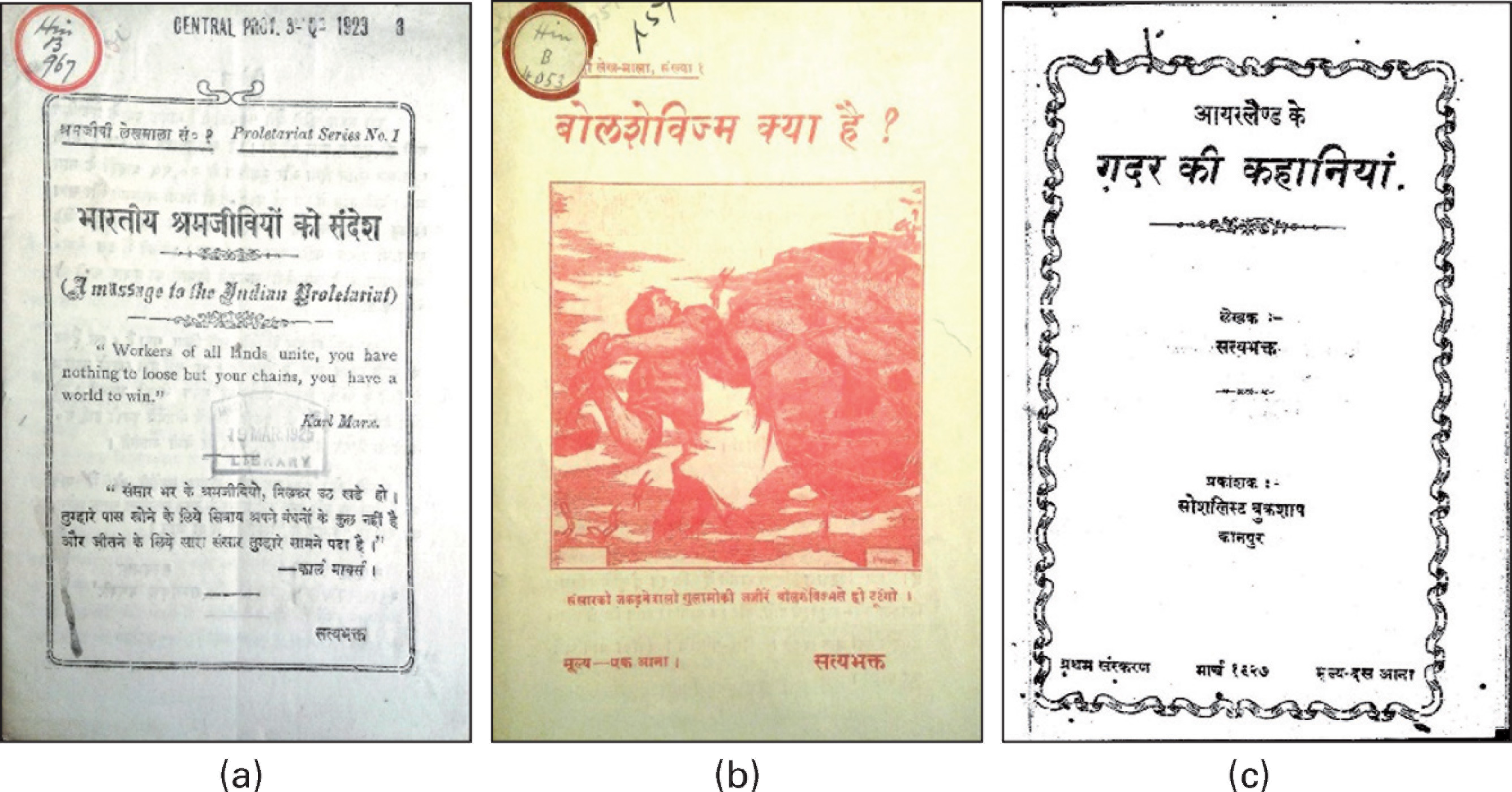
In remembering the self, Satyabhakta’s autobiographies, biographies and interviews continually provide a guide to his explicit communist activities and writings, while they underplay, or even efface, other ‘troubling’ aspects and subjects of his literary activities. Perhaps this was his way to write himself as an active subject in the history of communism in India. I have elsewhere written on Satyabhakta’s direct communist actions and writings (see Figure 4), 31 and the issues therein—his leftist engagements with the Hindi print–public sphere; the internal dynamics of the first Indian Communist Conference; Satyabhakta’s alignment with a national and indigenous, rather than an international, version of communism; his differences with M. N. Roy and his subsequent marginalisation; his privileging of the semantic power of simple, everyday vernacular in his books, booklets and articles to explain communism and its related egalitarian and emancipatory ideas; his extension of meanings of working class; and inclusions of caste and gender. 32
At the same time, almost half of Satyabhakta’s journalistic and literary pursuits were dedicated to the business of death and rebirth, past and future predictions, dystopia and utopia, destruction and creation, pralay and satyug, and offered visionary alternatives for reshaping the world through a utopian Ram Rajya. These professional contributions were not peripheral but central to Satyabhakta’s persona and understandings. A substantial cluster of his writings thus appeared to repudiate his leftist affiliations, and were instead based on apparently depoliticised and culturalist portrayals of past, present and future. However, I argue that even these writings alluded to his communist beliefs and testified that he never quietened his leftist conscience. Paul Eakin talks of the ‘ineluctable temporality of human experience’. 33 It has also been argued: ‘Texts need to be read symptomatically, as representations of repressed political allegiances and buried historical realities around which an author cannot quite wrap his conscious mind: that, in short, there is such a thing as the political unconscious, and it warrants close critical attention’. 34 Accordingly, the grammars and vocabularies of some of Satyabhakta’s writings were infused with Hindu ethics and sensibilities, but their subtexts evoked communist idioms and imprints. This article focuses on these allusions and tendencies in his texts. The first section briefly considers Satyabhakta’s deep interest in questions of life, death, formation of the world and Hindu gods, along with constant comparisons between past and present Hindu customs and superstitions, on the one hand, and beliefs prevalent in other countries, on the other. The second section goes on to show his use of messianic Hinduism in communist writings, where his leanings towards the Left easily coexisted with a social spirit embedded in Hindu sensibilities. The third section deliberates on his obsession with prophecies and predictions of pralay, catastrophe and apocalypse, precursors of revolutionary change. And, finally, the concluding section discusses his utopian political desires that sought a synthesis of modern vernacular communist vision with a wider conceptualisation of Ram Rajya, as he saw both as mutually inclusive.
Satyabhakta’s layered involvement in, organic relationship with, and inscription of Hindu ethics in communist ideas, show how deeply his communism drew politically, socially and culturally, from Hindu traditions, idioms and pasts. Some may regard his writings as a confused and idiosyncratic amalgam of Hinduism and communism. Yet, besides economistic interpretations and class-oriented rhetoric, an interplay of emotional, religious, ethical and social ideas was much more significant for Satyabhakta’s communism than a mere dry determinism and materialism. It was a combination of Hindu spiritualism, catastrophe, decolonisation and communism that shaped Satyabhakta’s apocalyptic warnings and utopian desires. Even when erratic and uneven, his writings suggested a move from dystopia to utopia, from pessimism to optimism, from bondage to freedom, from capitalism to communism. They provide glimpses of dissonant and deviant versions and visions of communism in colonial India, which drew from a Hindu ethical frame to construct a left-wing utopian ideal.
Eclectic Hindu World View
Moving between religion and rationality, belief and scepticism, Hindu myths and scientific temperament, faith and reason, spiritualism and materialism, Satyabhakta embraced both and can be broadly perceived in the rubric of, to borrow a term from Gregg Frazer, ‘theistic rationalism’. 35 Refusing compartmentalisation, his hybrid belief system mixed elements of Hindu religious texts and folk tales with scientific and rational arguments. In this he resembled many social reformers who, debunking traditional–modern dichotomy, framed a dialogue between ‘religious-spiritual’ and ‘scientific-rational’. 36 His affective and engaged religiosity and an eclectic Hindu world view were reflected in his writings that grappled with questions of the formation of the world; Hindu gods, texts, temples and priests; comparative customs of different nations; ghosts and superstitions; and death, afterlife and rebirth. In this process, he was fascinated by, and drew from, the deistic and positivist framework of Herbert Spencer (1820–1903), evolutionary theorist of social Darwinism; James George Frazer’s (1854–1941) comparisons between magical, mythological and religious beliefs around the globe; and the divine and colourful occult findings of the palmist and astrologer Cheiro (1866– 1936).
Intrigued by questions of how the world came about and the evolution of humankind, Satyabhakta’s social Darwinism was influenced, not only by Spencer but also by the Russian communist anarchist Peter Kropotkin’s (1842–1921) idea of cooperation rather than competition as an evolutionary mechanism in human societies. 37 In an article ‘Vishwa Rachna’ (‘World Formation’), Satyabhakta stated: ‘The emergence of any creature on the planet, whether human or animal, did not happen accidentally or in a supernatural way…. To believe in the divine origin of world and its creatures is only possible through blind faith’. 38 In another article ‘Manushya ka Avirbhav’ (‘Emergence of Humankind’), he reiterated that humans are not God’s creations but have evolved through stages and this ‘fact is supported not only by science but also by legends’, and that ‘religious sentiments’ are not so ‘delicate’ that they can be ‘undermined by histories of evolution’. 39 Embracing polytheism and idols, in two continuous articles, Satyabhakta went on, historically and analytically to explain the rise of gods, including Hindu gods, and the growth of mandirs, murtis, pujaris (temples, idols, priests), emphasising that the article was ‘meant to awaken the power of independent thought within human beings rather than blind faith’. 40 Questioning the omnipotence of gods, he showed that often ‘ordinary spirits were transformed into gods’, and Hindu gods of the past were very much like humans: ‘Similar to human beings, the deities of the Hindu Puranas were filled with feelings of jealousy and revenge, and were also scared of other influential humans on many occasions. Many times, these gods were also defeated by humans’. 41
While reformist movements like the Arya Samaj, and the British Orientalists, influenced by Enlightenment perspectives, regarded the Puranic tradition as degraded and corrupt, which had to be replaced with the pristine Vedic knowledge of the classical golden age, Satyabhakta refused to bow to such reformism. He never offered an aggressive defence of Hinduism, maintained a marked distance from organisations like the Hindu Mahasabha and the Arya Samaj, and, marginalising Vedic antiquity, often upheld Puranic ethics. Puranas were authorless texts that incorporated Sanskrit textual heritage and folk religion. Carriers and transmitters of dharma in everyday life, and often performed in the vernacular, their communicative appeal criss-crossed Brahmanical elite and humbler audiences, as they linked ‘Sanskrit and vernacular languages, text and oral performance, local histories and all-India gods’.
42
The early caste vamsavalis of Chamars, written in accessible Hindi in the early twentieth century, for example, drew from itihasa–puranic traditions, and reinterpreted mythical Hindu pasts and Puranic accounts to claim a Kshatriya status and dignity for themselves.
43
Revealing an emotional bonding with the Puranas, its legends and their interplay of truth and falsehood, Satyabhakta defended them for explaining human values in a simple and entertaining language through easily understandable idioms. He went on to state:
Goswami Tulsidas’s Ramayana, which is propagated today in every home, has been largely compiled from the Puranas…. Arya-Samaj often condemns them, calling them the main reason for prevalence of hypocrisy and Gurudom…. But in actuality…there is much historical material in the Puranas, which is not available anywhere else.
44
A recurring theme in Satyabhakta’s writings was the use of a comparative framework between past and present Hindu customs, beliefs and superstitions, and those existing in other parts of the world. Such juxtapositions illuminated the complementarities, similarities, elasticities, fusions, thematic parallels and shared practices among multiple beliefs and religious customs in the everyday life of different regions and communities. Between 1932 and 1934, he wrote a series of such articles in Chand. In one, he chronicled the varied forms of shradh (custom to honour deceased ancestors) ceremony prevalent in different parts of the world. 45 In another, he described the ancient system of marriage in India, connecting it to that existing in other countries, and lamenting that the modern system ‘eliminates the primacy of the woman’, and makes the ‘marriage relationship more rigid, where if a woman tries to use her cohabitation-related ancient rights again, she is far more harshly punished’. Vindicating ancient times, he said that the modern system was not necessarily ‘superior or beneficial’ to that prevailing earlier. 46 In yet another piece, he showed that Hindu customs of grain worship were prevalent in different forms in many countries. 47 Similarly, he marked the congruence of superstitions in different regions. 48 These writings were based on cultures of intimacy, pluralism, cohabitation, reciprocity, syncretism and mutual dialogue, and denied that Hindu customs were sharply differentiated from them. 49 They also undermined the representation of a secular, enlightened, civilised and rationalist West vis-à-vis a backward, superstitious, religious and irrational East. 50
Early in his journalistic carrier, Satyabhakta wrote a three-part series in Stri Darpan in 1918 titled ‘Bhut Rahasya’ (‘Mystery of Ghosts’), where he contemplated and questioned beliefs in ghosts and spirits. 51 Many of his above-mentioned writings also criticised Hindu superstitions on the basis of science, modernity and rationality, and appealed for the eradication of ignorance and illusionary fears. At the same time, he inhabited worlds of many possibilities, and as late as 1947, he wrote the book Marne ke Bad (After Death). 52 It has been argued that a ritual attention to the dead occupies much of Hinduism, 53 as it signals a liberating of the soul. Satyabhakta reiterated his deep interest in and fascination with the mysteries of soul, death, afterlife and rebirth, as he ‘constantly read, pondered over, thought and wrote on the subject’. 54 Marne ke Bad was a collection of his stories on parlok (paradise), punarjanam (rebirth) and spirits of the dead, and betrayed the influence and imprint of the famous occultist Cheiro. The stories allured the readers with magical, transcendental and sublime descriptions of supernatural encounters. The last part of the book attempted to substantiate the claims made in the stories by narrating some ‘true’ incidents of rebirth, and provided supporting opinions from Hindu scriptures, an Indian scientist, and a samadhisth yogi (meditating ascetic). 55 Grappling with the limits of human perceptions, Satyabhakta interwove motifs of fear and dread, on the one hand, and pleasure and wonderment, on the other. Away from a soulless atheistic secularism, and futile binaries, Satyabhakta’s Hindu religiosity carried a shared aesthetic of belief and disbelief and a spiritually rich coexistence of supernatural and natural. Seeking a positive legacy and an ethical praxis of Hinduism, his religious beliefs set the tone for exploring the possibilities of egalitarian convergence between Hinduism and communism.
Indian Traditions and Hinduism in Dialogue with Communism
Satyabhakta’s attachment to indigenous, diverse and ecumenical Hindu values and culture, and his invocation of socio-religious foundations of India, was a part of his constant and continuing present and not a lost past. It was in sharp contrast to dominant communist ideals and to communists like M. N. Roy and Muzaffar Ahmad. In early 1927, mainly targeting Satyabhakta, Ahmad remarked in a letter to Roy that communists were forced to ‘capture’ the First Communist Conference at Kanpur, as many ‘masquerading’ as communists were linked with Hindu and Muslim communal organisations. This ‘insult’ to the communist ideology forced the ‘real’ communists to corner reactionary elements and prevent the launching of a fake organisation. 56 Taunting Satyabhakta’s Hindu leanings, Ahmad further stated that he saw Satyabhakta in Western clothes, with a safa (turban) on his head, which he wore maybe to hide the chutia (knot of hair) on his head. Yet, to dismiss Satyabhakta and his writings as that of a Hindu communal reactionary is to do a disservice to the pluralities and complexities of communist ideologies and to the intelligence of its believers, particularly in the context of colonial India.
Many of the early communists never thought of leaving Hinduism or Islam. In fact, everyday political practices of early Left leaders, organisations and workers drew from Hindu and Islamic religious–cultural traditions while mobilising people. Class conflicts and political ideologies were partially presented through resurgent religious idioms and iconographies even by some of the most radical socialist authors and labour activists, and they had no concept of themselves as anything but non-communal. 57 In Punjab of the 1920s, there was little, if any, contradiction in Akali activists joining the ranks of avowedly socialist and communist bodies, and a fair number were affiliated to both ‘Sikh’ and ‘socialist/communist’ parties. 58 Sahajanand Saraswati saw no contradiction between being a Hindu sanyasi and a peasant leader fighting for justice for the poor peasants. He also gave a theoretical base to his approach by asserting that ‘there is no contradiction between the moral stance of the Gita and that of the Marxists’ in his Gita Hridaya, published in 1948, which provided a Marxist reading of the text. 59 Besides the economics of production and politics of Left organisation, havans (ritual fire offerings), kathas (Hindu tales), chanting of Vedas and distribution of prasad (propitiatory offering) were often popular activities of trade unions to create bonds between workers in late colonial north India, and it did not usually lead to exclusivist positions. 60 In Kanpur, magic lantern demonstrations organised by the Mazdoor Sabha used religious characters, like the mythical tyrant Kansa, to describe British oppression. Sudarshan Chakr, a communist worker and writer based in the region in the 1920s–40s, in his book Communist Katha, replicated the structure of the Ramayana, where its seven chapters like ‘Marx Kand’ and ‘Rus Kand’ were reminiscent of the ‘kands’ of the epic. He also linked Ram and Krishna with Marx and Lenin as great social levellers: Krishna hee Karl Marx ban gaye, vahi Lenin ban kar tan gaye. Vahi the Stalin avatar, gaya jisse Hitler tak har (Krishna only became Karl Marx, he also became Lenin and stood firm. He only was the incarnation of Stalin, against whom even Hitler lost’). 61 Invigorated popular cultural–religious beliefs and practices, in particular their emancipatory motifs, provided familiarity and immediacy to the working class, as well as to early communists to fight for a just socio-economic order in early twentieth century north India.
Creative, if romanticised, inheritances of past traditions were often interwoven by Satyabhakta with nationalist struggles against colonialism on the one hand, and with communist principles of rights of workers, on the other. Putting forth the pros and cons of the precolonial ancient and medieval system of production in India, based on sanghas (guilds) and udyog (manufacturing), and comparing it with the present new vyavsaya pranali (occupational system) of capitalism, Satyabhakta argued that the scales were tipped in favour of the former—‘a flourishing stage of our business that was maintained till the arrival of the British’.
62
Socio-economic traditions of Indian civilisation were fragmentarily absorbed by Satyabhakta to refashion a moral and spiritual critique of capitalism. He appreciated the traditional system, which according to him was fairer in terms of recognition and appreciation of skills; more fairly distributed, where a skilled artisan had the possibility of becoming a master; and where work was closely aligned not so much with profit but was jeevika ka ek sadhan (a way of earning and living). He lamented the modern system which increased the gap between malik aur naukar, capitalists and workers. Contrasting the past karigars (artisans) with the present mazdoors (workers), he wrote:
There is no doubt that the fate of these artisans of the Middle Ages was far better than the workers of the present age…. As long as trade was in the hands of sanghas, the only way to become a master was to gain maximum skill in workmanship. But now in this present new situation, instead of mastery, machines have started being considered as central and the person who has the money to buy them becomes the owner…. With this, the difference between the owner and the artisan has become much more explicit and direct.… The greatest virtue of past practice was that it did not create the kind of inequality in society as we are seeing today.
63
Here Satyabhakta presented an aestheticised, romantic and nostalgic precolonial and precapitalist time of unalienated labour, when wage labour did not dominate work relationships; at the same time, he was criticising its contamination by the colonial, imperial and capitalist division of labour. This harmonious past encompassed not just the ancient Hindu system but also the medieval, Mughal system of urban production and economy. The ‘Hindu leaning’ Satyabhakta, unlike the Hindu nationalists of the era, did not inflame a demarcation and conflict between the self and the ‘other’ by demonising ‘Muslim rule’ for the present decline. Rather, he put the blame squarely on the shoulders of the English, thereby enhancing the creative content of Marxism and providing a language of hope, dignity and rights. As Michael Lowy states, one can draw ‘inspiration from Marxist and messianic sources’, and use ‘nostalgia for the past as a revolutionary method for the present’, as the aim of revolutionary romanticism ‘is not a return to the past, but a detour through the past on the way to a utopian future’. 64
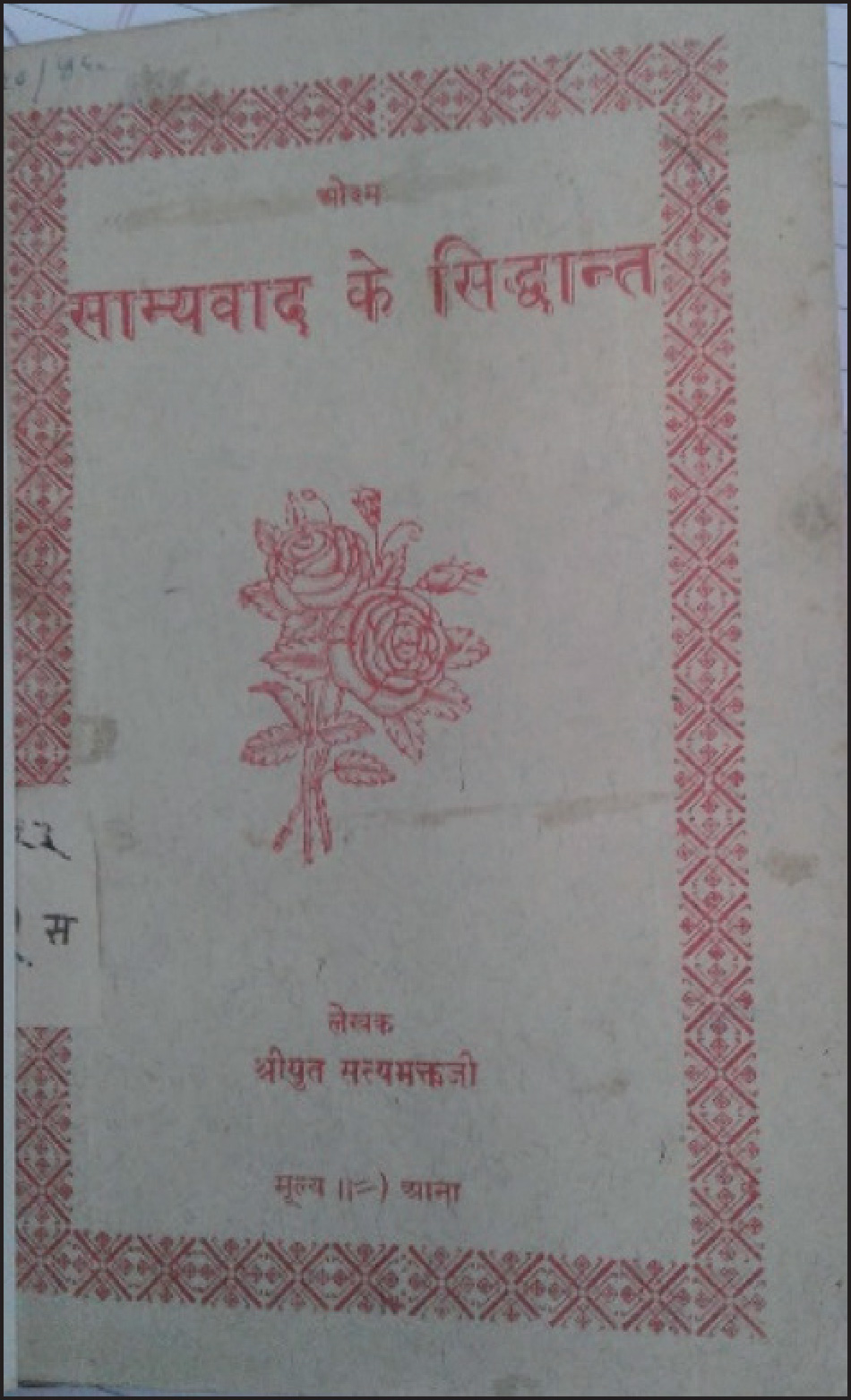
Synthesising two systems of beliefs and values, Satyabhakta saw a congruence between Hinduism and Communism, spiritualism and materialism. Introducing basic Marxist ideas in accessible language, he wrote Samyavad ke Siddhant (Principles of Communism) in 1934. 65 Interestingly, on the cover ‘Om’ was written just above the main title (see Figure 5).
Satyabhakta’s spiritualism and his identity as a Hindu and a nationalist, thus, sat comfortably with his communism. While celebrating Marx and Marxism, Avijit Pathak emphasises that one needs to go beyond and recognise the ‘intuitive music of the soul’, which was visible in Tagore’s ‘aesthetically enriched religiosity’ and in Gandhi’s ‘journey to the inner world’, which transformed ‘politics into an act of love and sarvodaya’.
66
Satyabhakta’s texts are open to such readings, as they render a Hindu faith-based ethical morality to be compatible with a humanist communist ideology, which touches people’s hearts and emotions. He stated:
While working for the promotion of communism, I kept in mind the specificities and specialities of Indianness and characteristics of Indian culture…. If the Indian public is interested in spirituality, then it is not a mistake to keep this feature in the propagation of communism.
67
He felt that the message of communism would be enthusiastically received by people through a framework of Hindu ethics.
Deeply entrenched religious and cultural values, combined with colonial rule, presented a considerable challenge to ideas of communism in practice. Early Muslim leftists like Hasrat Mohani and Maulana Azad Subhani, pioneering figures in histories of labour and Left struggles in urban Uttar Pradesh (UP), constantly used religious symbolism to further radical egalitarianism. 68 For example, Hasrat Mohani regarded himself as a ‘Communist Muslim’, preaching that socialism and Islam were one, as they shared the cardinal principles of anti-landlordism, anti-capitalism and equality. 69 Even the slightly later Muslim litterateurs and intellectuals of the Progressive Writers Association in late colonial north India cannot be simply described reductively as ‘religious’ or ‘secular’, since they actively drew from older Indo-Persian traditions and Islamic religious ethics to articulate anti-imperialist, leftist and feminist politics. 70 In a similar vein, as a Hindu communist, Satyabhakta built on his knowledge of Hinduism to offer a liberation theology of hope, and a communism with ‘Hindu’ characteristics. Recollecting how communism was relatively new for Indians in the 1920s, Satyabhakta began his book Bharat mein Samyavad (Communism in India): ‘As such, in our culture, since ancient times, there was a feeling of unity and harmony, which developed and reached the idea that “all people are spiritual”, but it was mostly confined to the metaphysical-ideological field’. 71 Stressing social and humane concerns of Hindu religion, rather than its theological and metaphysical dimensions, Satyabhakta draped communist social equality in the attire of Hindu morality and traditions, and used it to respond critically and constructively to contemporary political issues. He quoted from shastric (classical) texts to show that the idea of communism was compatible with Hindu cultural pasts: ‘It has been firmly stated in our shastras (religious texts) that not eating one’s own bread and giving it to someone else is a very high characteristic of humanity’. 72 De-emphasising the hierarchies in Hinduism, he chose to affirm its rich potential for motivating and inspiring social concerns, human values and principles of egalitarianism. Quoting from Atharvaveda, he thus stated: ‘All drink water from the same piau (source) and share food with all in a single food-session…. This is the main principle and real ideal of communism’. 73 Selective elements of Hindu theology thus provided Satyabhakta with a messianic hope of liberation and justice which was against oppression and took up the cause of the poor and the exploited. 74
In an attempt to unify his political and religious beliefs, Satyabhakta represented his communism as an epitome of Indianness as well as Hinduness:
Listen to the essence of religion and practice it in your life. What you do not like yourself, do not do it with others. What more could be the principle of communism than this? If we do not want our legitimate money to be taken away by someone else, we should also never think of taking possession of anyone else’s wealth. If we do not want anyone to behave harshly or disrespectfully towards us, then we should also behave sweetly and beneficially. This is the true essence of religion. People who understand religion to mean worshiping of gods, and feeding of food to ants, pigeons and monkeys are at fault.
75
Satyabhakta’s beliefs threw the ‘secular universalism of Marxism into repeated crisis’. 76 Embodying a ‘Left Hinduism’, he selectively took elements of ancient Hindu beliefs and sentiments as models of inspiration, and attempted to reclaim their ethical humane heritage for communism. 77 Categories of Hindu ethics and conceptions of emancipatory ideas derived from Hindu religious metaphors and moral structures had their limitations, as they were often partial, selective and fragmented. There was a sense of alienation among Muslims, and problems of integration ‘on a common platform, especially when a parallel ideology of Islamic socialism and anti-imperialism continued to be equally potent’. 78
Satyabhakta’s obsession with the formation of the world, destruction and creation, death and birth, and the reconciliation of Hindu spiritual devotion with communism, were particularly inventively reflected in his writings on pralay, apocalyptic catastrophes and future prophecies, on the one hand, and on utopian dreams of satyug and Ram Rajya, on the other. These are discussed in the next two sections.
Apocalyptic Predictions and Future Prophecies
The recent calamitous effects of COVID-19 have once again reminded us that apocalypse is an integral part of our myth and history, and one that has shown remarkable resilience. 79 The dystopia of Nazism and the imminent Second World War particularly fuelled the apocalyptic imagination of many modernist writers, as they tried to come to terms with the failures of meanings of civilisation. 80 At the same time, the period between the two world wars also saw the flowering of the Russian Revolution, which engendered dreams of a future world of communism. As a prelude to the emergence of socialist utopias, a period of mass destruction and war was often seen as a necessary precondition, since the carnage would destroy old orders and set up new ones. After all, a considerable part of Marx’s writing, too, was based on a tradition of prophecy. For communist enthusiasts, apocalypse was not necessarily negative, but was rooted in the process of social transformation. Like many other writers, Satyabhakta’s apocalyptic predictions and future political prophecies also captured these moods of the age, as they became a way to give expression to ecological, technological and political crisis, to counter colonialism and capitalism and signal the end of the British Empire, which cleared the way for the hope of a future communism. Simultaneously, he borrowed from Hindu narratives of laws of nature, pralay, periodic and cyclic destruction of the world, and decline in dharma, which would lead to catastrophe and cataclysmic changes.
Satyabhakta was fascinated by, and believed in, constructing the human past, predicting the future, and foretelling what was coming to India and the world at large. He acknowledged: ‘The thing is that from the beginning I had a hobby for political prophecies’.
81
Some of his articles and books like Agle Sat Sal and Samvat Do Hazar were in line with typical tropes of apocalyptic literature.
82
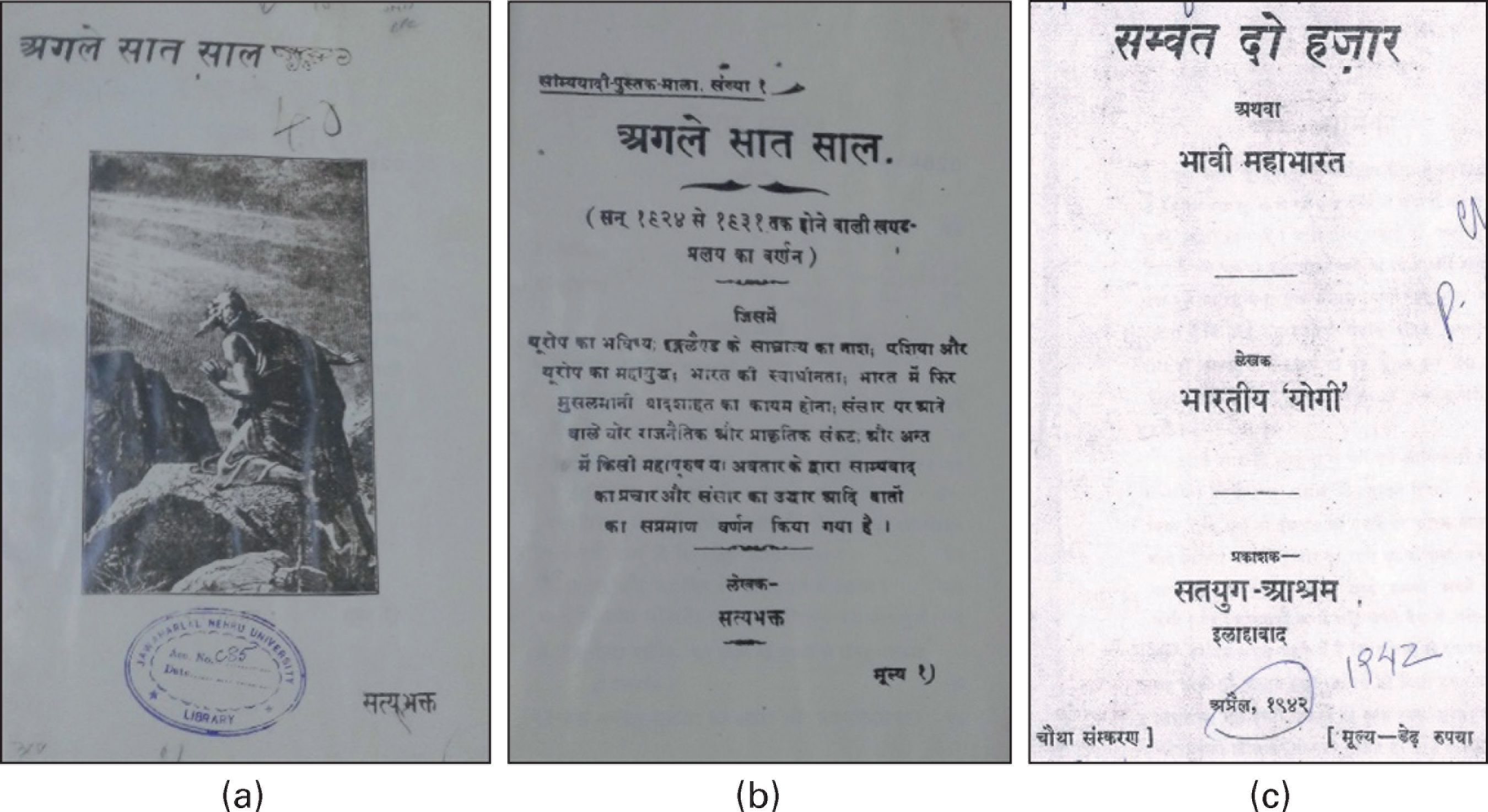
Published as ‘Samyavadi Pustak Mala, Sakhya 1’ (‘Communist Book Series, Number 1’), Satyabhakta wrote Agle Sat Sal: San 1924 se 1931 tak hone wali Khand Pralay ka Varnan (Next Seven Years: Description of Holocaust from 1924 to 1931) in 1924, declaring its summary on the first page itself:
Description of the catastrophe that will take place from 1924 to 1931: in which the future of Europe, destruction of the Empire of England, the great war of Asia and Europe, the independence of India, the re-establishment of Muslim rule in India, the coming of extreme political and natural crisis in the world, and finally the propagation of communism and the salvation of the world by some great man or avatar, is described with proof (see Figure 6).
83
Agle Sat Sal drew its partial inspiration from Reverend Michael P. Baxter’s (1834–1910) Forty Future Wonders of Scripture Prophecy, which was a hugely popular speculative book, first published in 1866, and saw repeated runs with different names like Future Wonders of the World. 84 Drawing from a rich tradition of Christian revelations, 85 Baxter’s book was based on biblical prophecies and apocalyptic predictions of coming perils and pleasures for the years 1867–75. Baxter was a ‘nonconformist minister and philanthropist’, and editor of The Christian Herald, a London-based evangelical weekly newspaper. 86 Creatively moulding Baxter’s book, Agle Sat Sal relied on the conviction that the world, and more pertinently India, had reached a critical juncture, and the coming moments were going to unfold something unique and important, which would have profound implications and creatively transform the future times.
Agle Sat Sal was divided into two parts. The first part gave a summary of Baxter’s book but took full liberties in condensing and moulding it to contemporary situations, and he rewrote it accordingly. Of course, the time period of predictions covered in the two books was completely different. While the first part of Satyabhakta’s book included Baxter’s ‘wonders’ in brief, it also had chapters on the First World War, League of Nations, People’s Red Rule in European Countries, and most interestingly, on the ‘40th wonder’, which was titled ‘Ek Hazar Varsh tak Prithvi par Ram Rajya ya Samyavadi Shasan’ (‘Ram Rajya or communist rule on earth for a thousand years’). There is more to be said on that in the next section. Overall, the first part of the book, while inspired by Baxter’s imagery of Jesus as an apocalyptic figure, insisted chiefly on the brute force of capitalist modernity. It summarised that ‘the present rule of European countries will be destroyed, and in its place communist or Bolshevik (workers’) rule will be established’. 87 Part II of the book carried future predictions from some famous political thinkers, writers, scientists and jyotishis (astrologers), which ranged from Chand Bardai (author of Prithviraj Raso), to foreign literary giants like Tolstoy and Byron, all of whose writings were interpreted to uphold the coming of communism. The final section of the book, titled ‘Bharat ka Bhavishya’ (‘Future of India’), combined Satyabhakta’s own ideas and beliefs with a robust and enthusiastic outlook on the future of communism. Apprehensive about its message of the end of British rule and coming of communism, Agle Sat Sal was soon seized and banned by the British government.
In a similar vein, Satyabhakta’s book Samvat Do Hazar, athva Bhavi Mahabharat (Samvat 2000, or Coming Mahabharat), written in 1936, was based on catastrophic changes in society and predicted the world of 1937–44, again taking a span of seven years. Since his Agle Sat Sal had been proscribed, Satyabhakta published Samvat Do Hazar 88 under the pseudonym of Bhartiya ‘Yogi’ (Indian ‘Ascetic’) from his Satyug Press (see Figure 6). This became his most famous and popular book, and a fourth edition of it came out in 1942. 89 The book, written a little before the Second World War, described in detail the manufacturing of weapons of mass destruction, the horrors of modern warfare, the destructive power of technology and the barbarous cruelty of Nazi Germany; it also relied on astrology. While dealing with the imminence of a nuclear war, the first part of the text took on tones of mourning. However, it went on, like Agle Sat Sal, to describe the coming of a new era after destruction:
Before the beginning of a new era, there is a great degree of turbulence and violence in the world, in which most of the opponents change their views or are eliminated…. At such times natural calamities like earthquakes, storms and famines also erupt in a terrible form, further helping in cleansing the world…. Shri Krishna has also said this clearly in the Gita…. The second thousand of Vikram Samvat is about to end and the third thousand is about to begin, which is a very big event…. Some people say that the Kalki avatar is absolutely certain to appear in Samvat two thousand. 90
The book also described some ‘strange’ recent happenings, signifying a major change, like ‘rain of blood’ in Etawah and mango trees in Allahabad bearing fruits three times in five months.
91
Reviewing the book, The Leader noted on 24 Nov 1936:
The book contains mine of information about military preparations, use of electricity, poisonous gases and other new instruments of destruction…. In the course of his discussion he shows that the predictions contained in the Holy Bible and the Mahabharat as well as the prophecies made by some eminent western and eastern astrologers tend to establish the same truth.
92
Besides these books, in his article ‘Sapt Dwip’ (‘Seven Islands’), Satyabhakta drew from the Puranas to illustrate the concept of pralay, leading to the emergence of something new:
Though human has conquered many natural forces and through them is working for his benefit and pleasure, when nature takes an angry form, human has no power to control it…. Although the work of nature appears cruel from above, in reality it is for the ultimate welfare of human kind, and because of it only this creation is maintained. When the weight of the earth becomes unbearable, and its fertility drastically decreases due to taking constant care of human beings and animals, then nature shows mercy and creates a new fertile earth for the abode of mankind. It immerses the present under water, so that in million years, it can again attain fertility and become habitable for humans. If we think from this perspective, the metaphor of Puranas, in which…the earth takes the form of a cow and goes to Brahma for salvation, is a description of pralay.
93
Satyabhakta wrote another article with the title Pralay, in which he explained it ‘scientifically’ and argued that srishti ke liye pralay ka hona avashyak hai (for the creation of nature, pralay is necessary). 94
Satyabhakta’s fascination with Hindu myths of pralay and catastrophic imaginaries combined images of man-made disasters such as global wars, military invasions, freedom struggles, nationalist protests, domestic upheavals and end of the British Empire, with natural disasters such as floods, earthquakes, volcanic eruptions and climate changes. The immoralities and physical–material extremities of the present were bound to lead to disasters. His fear-inspiring, pseudoscientific observations became all the more pertinent for a colonised nation and became a way to anticipate the end of the British Empire, of capitalist and exploitative regimes, and their replacement by a utopian politics of communist Ram Rajya, for which pralay appeared to be a necessary precondition. It was these apocalyptic fears and desires that made the British swiftly proscribe a book like Agle Sat Sal. Scholars have pointed out that an apocalyptic ‘dystopia places us directly in a dark and depressing reality’, while ‘utopia takes us into a future and serves to indict the present’. 95 Here, too, the immediate calamities and impending disasters served as a road for construction of a long-term wonderful future world of creative possibilities and hope. Satyabhakta’s naming of the self, establishment of ‘Satyug Press’ and publication of the magazine Satyug, further illuminated his deep yearning for a heady mix of truthfulness, spiritualism, future prophecies and the coming of an era of egalitarianism. He stated:
Satyug was also published for this purpose. In that too I used to preach indirectly that how the world will be completely transformed by war, famine, epidemics and other catastrophes, and a new era will begin, which will be based on religion, justice and equality. 96
Giving the impression of an amateur romantic communist, Satyabhakta’s baleful predictions about disasters followed by the triumph of communism failed to come true. Yet, in spite of the various blind spots, they offered significant insight into a form and vision that weaved together an apocalyptic approach to history with a structure of future salvation through communist and Hindu hope. Writing at a time when communism had captured the dreams of many all over the world, and when a remaking of the world seemed imminently possible, Satyabhakta best exemplified this in his romantic vision of a blissful Ram Rajya in conjunction with an Indian communist utopia. These need to be placed in a larger context.
Communism as a Utopian Ram Rajya
Ruth Levitas categorises utopia as the imaginary reconstitution of society (IROS). 97 The genre of utopia often functions ‘as a critique of contemporary society, and often in a transparent way’. 98 As a concept, it often has its ‘religious roots in paradise’ and ‘political roots in socialism’. 99 Moreover, ‘utopian visions are never arbitrary. They always draw on the resources present in the ambient culture and develop them with specific ends in mind that are heavily structured by the present’. 100 Sandeep Banerjee looks at some of the literary imaginations in colonial India, and shows how these ‘counter-colonial spatial imaginaries’ were ‘utopian in their negation of colonialism’ in different, plural and contradictory ways. 101 A necessary corollary of Satyabhakta’s apocalypse was a communist utopian dream, expressed through the idiom of Ram Rajya.
Sheldon Pollock argues that the concept of Ram Rajya aids a ‘construction and representation of reality through a more or less systematic historical fantasy’. 102 Philip Lutgendorf states: ‘Ramraj has been viewed both as a harmonious but hierarchical order, in which the privileged confidently enjoy their status and the dispossessed keep within their limits, or conversely, as a kingdom of righteousness, in which the possibilities of freedom are made accessible to all’. 103 Paula Richman observes how an ancient narrative tradition like the Ramayana, with its conception of Ram Rajya, has served as a central organising political metaphor, aiding a range of discourses and providing an imaginative framework for modern India. 104 Other scholars and historians too draw our attention to how Hindu religious texts and traditions, particularly revolving around the Bhagvad Gita and the Ramayana, furnished the key literary sources that were invoked for Hindu nationalist imagination and the Indian freedom struggle. 105 It was believed: ‘If Indians could live according to the high ideals of this text [Ramayana], they would be able to overcome poverty, untouchability, and foreign rule’. 106 The language of Tulsidas’s Ramcharitmanas, the cult of Rama and the political ideals of Ram Rajya, have a deep resonance with Hindu audiences and readers.
Indeed, the conceptualisation of a Hindu political imagination was on the agenda of many other intellectual nationalist ideologues in the early twentieth century, and this was often developed in response to colonial dismissal of the existence of any political culture in India. They also utilised the concept of Ram Rajya in distinct ways to reinforce their political ideals and views. The term was most effectively and successfully adopted and extended to modern ideologies of nationalism by Gandhi. He stated: ‘If the word Ram Rajya offends anyone, then I shall call it “Dharmarajya”’. 107 He imparted to it a different meaning, squarely equating it with his ideas of freedom, including khadi, refusal to pay the salt tax and swaraj. He declared Ram Rajya to be a ‘moral government based upon truth and non-violence, in other words universal religion’, an ideal social order under which ‘the poor will be fully protected, everything will be done with justice, and the voice of the people will always be respected’. 108 In north India, particularly, Gandhi’s use of Ram Rajya as a just political rule of the people ‘had an almost millenarian impact on the Hindu population’. 109 Baba Ram Chandra, the dynamic leader of the farmers of Awadh in the early twentieth century, also radically interpreted Ram Rajya and Ramcharitmanas to mobilise the peasants against their exploiters. 110 The veneration of Ram became a means of expressing social equality and dignity of labour by some agricultural castes. 111 As Peter van der Veer argues, unlike China, ‘in India traditions were made into resources in the anti-imperialist struggle against a material modernisation that culturally and politically subjected India to Western power’. 112
Keeping the concept of Ram Rajya live and ticking in contemporary times, there have been many celebratory and crude idealisations, which have closely aligned it with Brahmanical and Hindutva politics. 113 For example, in his book Ram Rajya and its Ideals, Kanpur-based Hindutva scholar L. P. Chaturvedi states: ‘During the period of Sri Ram…aspect of town planning was fully developed, medical science and astrology were fully matured…the civilisation of the period of Ram was fully matured in the spheres of goodness and demonic world’. 114 Others like Prem Nath Bazaz have firmly argued that the concept of Ram Rajya is reactionary, communalist and undemocratic. 115
The relationship between imaginings stimulated by Ram Rajya and beliefs in Marxism and communism has been ambiguous, to say the least. In 1957, Karpatri Maharaj (1907–82), a monk in the Hindu dashnami monastic tradition, and founder of the Ram Rajya Parishad, an orthodox Hindu religious political party, wrote a book Marxvad aur Ram Rajya (Marxism and Ram Rajya) of 816 pages, which was published by the famous Gita Press.
116
Reflecting on political theories of Western philosophy and its thinkers, one of the central purposes of the book was to demolish Marxism and communism, and to pronounce that it was completely antithetical to Ram Rajya and Hindu political formulations. Maharaj argued that Ram Rajya could only be based on rules of shastric and Sanatani religion, and that it was the only way in which the will of the people could be ensured. He stated:
The principle of personal property cannot be called a principle of exploitation…. Anarchist communists and socialists are always clamouring for great revolutions and changes. In consonance with scriptures and traditions…Ram Rajya does not wish even an iota of change in the principles of sanatani culture, religion and politics…. Supporters of Ram Rajya consider God, religion and soul as the fundamental base…. A Marxist says that an individual can get freedom only through people’s will…. Believers of Ram Rajya consider the harmonious prosperity of every joyful person or classes as superior. Class-struggle is sheer propaganda…. It does not work for good people.
117
The book was saturated with many such quotes in heavily Sanskritised Hindi, making claims like: ‘rich investors guided by religion were the main reason for the welfare of the nation’; ‘communist movement was dependent on pure malice and jealousy’; ‘due to false class propagandists, principles of class distinction and conflict are being spread’; ‘the wealth of individuals is protected in Ram Rajya’; ‘Marxism directly abducts religion, wealth, life and property’; ‘with nationalisation of personal property, all will be bound forever in the bondage of subordination’; ‘religion is eternal, caste system, faithful and chaste wifehood are also eternal’; and ‘Marxism and theism cannot exist together’. 118 The book also supported sati, child marriage and purdah. In response to Karpatri’s book, Rahul Sankrityayan wrote a trenchant, sarcastic and witty critique Ram Rajya aur Marxvad, which was published by the People’s Publishing House in January 1959, in which he attacked Maharaj’s unequivocal support of exploitative moneyed magnates, his reprehensible views on slavery, caste and women, and his support of Ram Rajya and critique of Marxism. Sankrityayan argued at various places: ‘Karpatriji Maharaj is propagating a pro-capitalist rule in the name of Ram Rajya…. Ram Rajya of Karpatriji is controlled by religion’; ‘Karpatri Maharaj considers monarchy as the ideal rule’; ‘In the view of the Maharaj, communists are not only grave sinners but also terrorists’; and that Maharaj ‘wishes to establish mysticism by refuting Marx’s philosophy’. 119
It is amidst this broader lexicon that Satyabhakta’s much earlier conceptualisation of Ram Rajya should be placed, which is open to ‘appropriation by both power wielding elites and disenfranchised lower orders’.
120
Satyabhakta’s utopia—a new humanity which connected communist ideas of equality and a non-exploitative world to Ram Rajya’s model of happiness—admired both visions, which made communism both more intelligible and more acceptable to a Hindi–Hindu audience. At the same time, from a modernist’s perspective, his utopian idioms were a mixture of religious beliefs and political expediencies that were not confined only to Hindu imaginaries, but were open to drawing from other religions and texts, freely and selectively borrowing from Christian and Islamic asseverations. Writing in 1924, his book Agle Sat Sal listed as 40th wonder the coming of ‘Ram Rajya or communist rule on earth for a thousand years’, where he even gave an exact date of its commencement—2 May 1929 or 9 April 1931! Drawing from Baxter and apocalyptic predictions, and presenting a visionary alternative, Satyabhakta stated in the chapter:
At the end of these seven years, the condition of earth will change completely. Millions of people will be reduced from the population of the earth and the world will look deserted. But after this, when Jesus Christ and his fellow saints will start governing the earth, all miseries and sufferings of people will be removed, and the number of human beings will increase greatly in a few years…. War will stop forever. Everybody will cultivate and do hard work to eat bread…. In this age, the rule will be in the hands of only those whose character will be pure; and those who will be humble, courteous and love the poor.
121
The imagination of an idealised utopian communist Ram Rajya presaged a sublime world without arms, military might, wars, oppression, crime, exploitation, hunger, suffering, pain, poverty and inequality. It was a society in which all would be taken care of, and all their basic needs met. It was also not a singular model of Hinduism, but drew from other utopian religious visions. The chapter was accompanied with the following note:
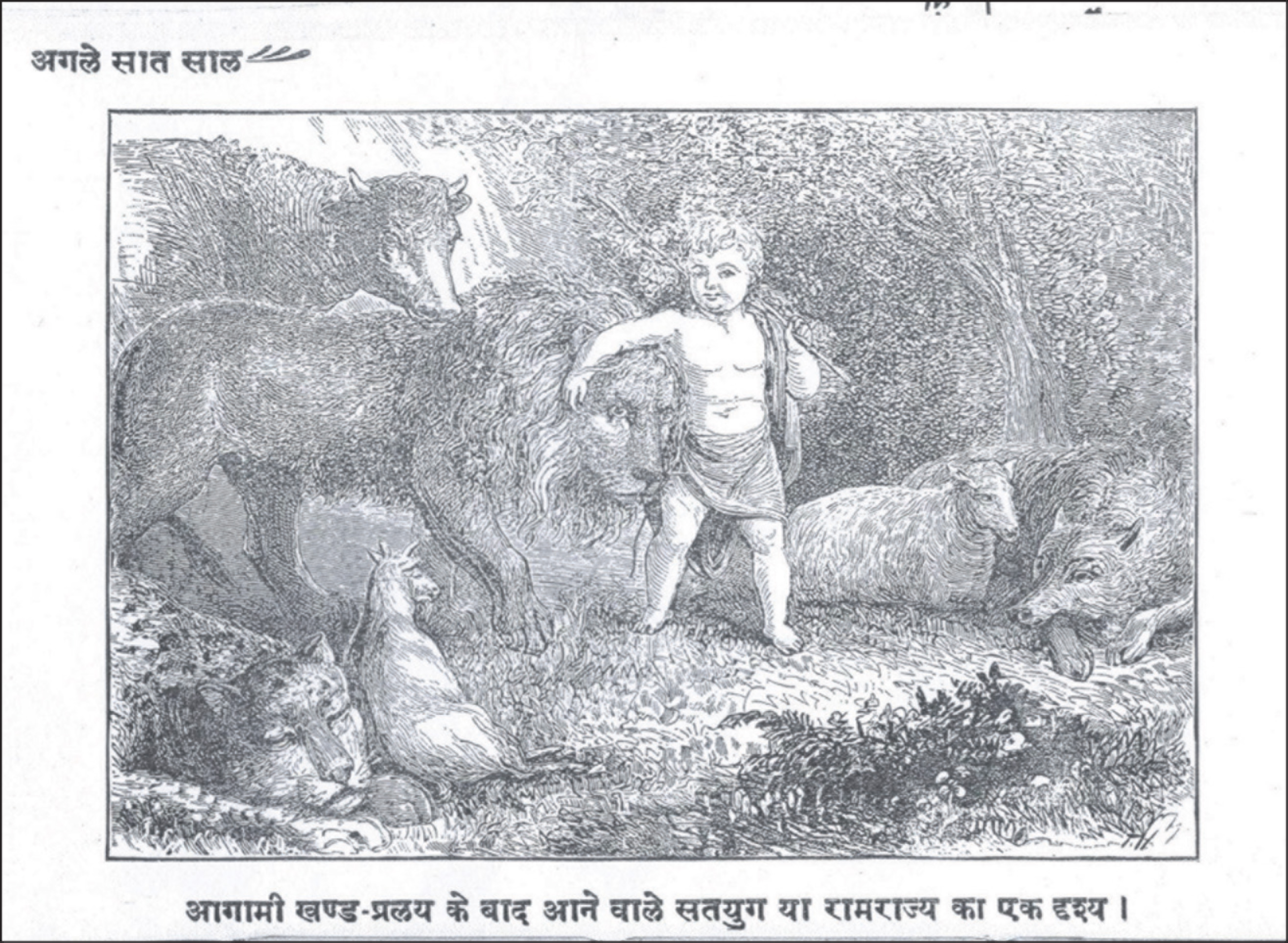
It is written in the Bible that after these seven years, Jesus himself will govern and at that time the lion and the cow will graze together, which cannot mean anything other than communist rule…. These things mean that the rich and cunning men, like the lion of the present time, who fill their stomachs by beating the poor, will…like the poor, have to fill their stomachs through hard work…. The basic purpose of communism is to establish Ram Rajya on earth.
122
Forging a continuity between past Hindu values and a future Indian communist utopia, the spiritual and ethical idioms of a mythical Ram Rajya helped validate and translate communism to distinctly Indian circumstances, both vernacularising it and making it more flexible and inclusive. Drawing from Hindu idioms, the first page of Agle Sat Sal had a picture of a child playing with a lion and other animals sleeping nearby. The title of the picture stated: Agami khand-pralay ke bad ane wale satyug ya ram rajya ka ek drishya (A view of satyug or Ram Rajya coming after the ensuing catastrophe) (see Figure 7).
Satyabhakta presented Ram Rajya not as a return or a reversal of history, but as a renewal of a just and more equal past. This signified a long utopian tradition on which future political hopes of an idealised egalitarian communism could be constructed. In his article ‘Ram Rajya ki Adhunik Kalpana’ (‘Modern Imagination of Ram Rajya’), he reinterpreted Ram Rajya by connecting it directly to Plato’s Republic and Thomas More’s Utopia, and extending it to an egalitarian communist dream.
123
Arguing that communism offered the true and modern meaning of Ram Rajya, and connecting myths of a golden past with possibilities of a golden future, the article widened the scope of utopia by proposing a broader and more pluralist vision.
124
As a starting point of this utopia, Satyabhakta began: ‘The description of satyug found in ancient poetry and Puranas of our country cannot be called anything other than Ram Rajya’.
125
Quoting from Tulsidas’s chaupai, he moved to Plato’s Republic, which had ‘description of a system similar to Ram Rajya’, and shifted to early Christian writers who produced many similar visionary projects. The bulk of the article, however, was a description of More’s Utopia, originally published in 1516,
126
which Satyabhakta supported conditionally, with slight modifications, seeing in it a parallel with his Ram Rajya in the construction of a communist ideal. Satyabhakta dismissed the critique offered by Raphael Hythloday (literally meaning ‘peddler of nonsense’), a mythical character based on a Biblical angel in More’s Utopia. Extending More’s ideas, Satyabhakta’s utopian desire for social harmony did not seek a static, perfect, past place, but a world of contemporary resonances, qualitatively different from present colonial bondage. He ended the essay by stating:
This type of ideal society has not been conceived by Moore alone, but many writers of countries like England, France and Italy have written similar stories. Although the communists of today do not value these stories and consider them merely the imaginations of Sheikh Chilli,
127
we come to the conclusion from his study that even though the tendency of human is often to be selfish towards other people, the seeds of love and fraternity are contained within humanity, which, from time to time, show their glimpses. This is the reason why we see various forms of this [utopian] imagination from a devotee poet like Tulsidas to the Bolsheviks of the present times! When this imagination will be transformed into reality, it cannot be said, but we believe that human society is constantly moving towards it and they will reach their goal at some time or the other.
128
Selectively borrowing from Gandhi’s ideals, but rejecting Hindutva’s exclusivist interpretation, Satyabhakta drew on a classical idea in formulating a language of communism. Ram Rajya was not a symbol of potential alienation or xenophobia, but of hope. Satyabhakta’s leanings towards both—an Indian communist polity and Hindu spiritual ethics—was imaginative and troubling at the same time, since it embodied conflicting messages and ambiguities. While Satyabhakta sensitively addressed issues of caste and Muslims, two contentious issues in the everyday workings of Hinduism in modern India, in some of his overtly communist writings, he floundered in seeing its contradictions in his works on Hindu faith. The Brahmanical scriptural basis of textual Hinduism and its principles of hierarchy and exclusion in the formulation of varnashramdharma, were not clearly addressed by Satyabhakta here. 129 Yet, distinctly different from many Brahmin leaders of the communist movement, Satyabhakta married a Dalit woman, and faced severe social ostracism as a result. 130 While calling Tulsidas’s Ramayana ‘the soul of Hindi’, he stated that ‘just as a rose, in spite of being beautiful, has sharp thorns…an excellent book cannot be free of errors’, and had to be critiqued for its failings. He firmly objected to its stri jati ke sambandh mein anuchit akshep (unwarranted aspersions on women), and naming of them as dhurt aur kapti (sly and insidious). He castigated Tulsidas for this ‘unmerciful attack’, calling it completely ‘unjustified and contemptible’. 131 Furthermore, although extreme economic hardships drove Satyabhakta to spend the last 30 years of his life at the ashram (monastery) of Akhand Jyoti Institute in Mathura, he refused to participate in the daily arti and prayers performed there, despite it being compulsory, echoing his discursive reflexes to Hindu practices. 132
The entanglement of religious idioms with political rhetoric could unleash complex questions of identity and give rise to multivocal meanings open to divergent interpretations—at times progressive, at times sectarian and ethnic. Yet, for Satyabhakta, as a sublime and ideal polity, Ram Rajya offered a lofty and powerful protest against colonial exploitation. It also provided an anticapitalist, aesthetic ‘communist’ enclave of spiritual–political ethics which contained unbounded possibilities for the future. Even though precarious, such a simultaneous creative fusion of religion and communism says much about the everyday terrain of popular plebeian desires and communist dreams, where no neat boundaries separate the religious and secular, and the spiritual and material.
Conclusion
The purpose of this article has not been merely to excavate an eccentric and wrong-headed, but sincere and interesting thinker. Rather, it is to suggest that the intertwining of Communism and Hinduism can provide potentially powerful insights into both, and put fissures in singular, dogmatic understandings. Simultaneously, the article opens up certain normative issues, both directly and tangentially, on meanings of modernity, political idealism and religiosity in India. Neatly defined and circumscribed communist vocabularies of validation and legitimation often perceive the views of figures like Satyabhakta as promiscuous meanderings or distorted versions of communism, as flowing from irrational beliefs, superstitions and religious idioms. It may be argued that people like Satyabhakta were not very sharp intellectually, had ideological limits, and a layperson’s understanding of communism. Satyabhakta’s quixotic apocalyptic prophecies and utopian aspirations often floundered. Yet, his writings elucidate the need to make Eurocentric Marxist structures of Indian Leftist thought more amenable to cultural moorings, which in his case, displayed heavy imprints of cosmologies constructed through ages in the Hindu Puranic world. His thought also suggested that class struggle can coexist with cooperation. Even if fragmented, incomplete and amateur, such understandings did not depend upon borrowed or preconceived notions of communism, but transcended and refashioned them inventively to make them more malleable, and by doing so challenged the criticism that communists were antipathetic to religion.
Although not a Marxist in the conventional sense, people like Satyabhakta were nonetheless deeply influenced by its powerful political impulse. Even when not explicitly dealing with the subject of communism, a matrix and collage of Satyabhakta’s writings show that his philosophy of life and literary sensibilities could never escape their communist embeddedness. Such people bore a potential for the realisation of communism and a dream of social transformation far beyond the constraints of the present. They inhabited a lifeworld filled with hope for a utopia in the making and an imminent egalitarian future. Steeped in a north Indian Hindi literary tradition, they illuminated a path of communism that was both distinctly religious and Indian. Certain themes recur with particular force and vitality—vernacular print cultures; an anticolonial Indian communism; and religious utopian ethics. Such leftist, Indian and Hindu notions of belonging, while problematic, contained vast possibilities.
Satyabhakta represents a Left politics which provided a bridge between Hindu traditions, spiritual devotion, and a creative blend of religious leanings with communist ethics and Left identities. The everyday world of Hindus needs to be differentiated from its caste and varna hierarchical structures, for wider mobilisation and ideological theorisation by Marxists. Rather than reducing religion or scripture to monolithic meaning and praxis, or relying on a Vedic past, single authoritative text and constructed notions of Hindu monotheism, Satyabhakta remained sensitive to the range of possibilities that resided within Hinduism. He distinctly drew upon the rhythms of ordinary life, the daily experience of lived reality and ubiquitous popular Hindu practices, in his excursions into communist ideology. This creative use of two hyphenated terms suggests that the subject of ‘Hindu Communism’ has had, and continues to have, multiple resolutions. The marrying of communism with a reinterpreted ethical and egalitarian Hinduism generated new forms of affect. Troubling the proponents of atheism, secular communism and communal Hindutva, such leftists embodied complex and hybrid social identities that released psychic and emotional energies for change. An intermediary voice between traditional and modern, spiritual and material, communist and nationalist, in Satyabhakta’s interpretations, these were not competing or antagonistic discourses, but complementary to, and mutually constitutive of, each other. Figures like Satyabhakta represent a complexity of layered nuances, hidden transcripts and forgotten histories of communism in north India. Even if flawed and partial, they bequeath cultural and political legacies that suggest the rich and pluralist imaginings of communism, far removed from the monopolistic single-mindedness of its official and dominant practitioners.
Footnotes
Acknowledgements
This research was partially supported by a CAS Travel and Research Grant from the Department of History, University of Delhi. I am thankful to Aditya Nigam, Jeremy Seabrook and Vijay Jha for their references and inputs, and to the anonymous reviewers for their valuable comments, which helped me in revising the article.