




Abstract
During the past three decades, numerous policy changes were made by the policy makers to attract foreign direct investment (FDI) in India. An extensive body of studies using rich firm level panel data have analyzed how foreign firms presence affect the productivity/technology spillovers to domestic firms in India. These studies using recent methodological advancements distinguish between horizontal and vertical spillovers. Empirical analyses of productivity/technology spillovers from foreign firms offer inconclusive results with early studies reporting neutral and negative FDI spillovers, while more recent studies consistently providing evidence of positive vertical spillovers. Therefore, the main contribution of this paper is to review the literature on FDI spillovers in India and explore whether there are any policy lessons from the findings of these firm level studies.
Introduction
Traditionally, foreign direct investment (FDI) was considered as an additional source of investment in the capital-scarce developing economies. The contribution of FDI in accelerating growth was viewed solely from the point of additional finance in the form of foreign savings. However, based on the recent experience of emerging economies, the benefits of FDI are potentially much more substantial. In addition to the employment and revenue generation, it acts a conduit of economic growth indirectly through productivity or technology spillover effects (Figure 1). This has to do with the fact that FDI inflows are associated with advanced technology, superior know-how, management skills and employment opportunities (Navaretti & Venables, 2004). In other words, multinational corporations (MNCs) are increasingly recognised as the carriers of foreign capital and technology. Many developing countries are constrained by the scarcity of resources or carrying out domestic research and development (R&D), paucity of skilled human capital and less advanced domestic technology. Therefore, it is widely accepted that FDI can potentially be an important conduit to the growth process in such economies since it can accelerate technology transfer, technology diffusion and enhance the quality of human capital stock in the host countries. These inherent characteristics of FDI may generate direct and indirect growth effects in host countries. Based on this premise, policymakers in developing countries have been competing to attract MNCs by extending tax holidays and preferential treatment over domestic firms. 1 Therefore, studies related to FDI spillovers are not just relevant for academic research, but the findings of the studies have far-reaching implications for public policy decision-making.
The relative superiority of the MNCs in terms of technology, organisation and managerial practices when compared to host-country domestic counterparts implies that the former will be a direct or indirect source of technological advancement of the latter. The benefits arising out of FDI in host countries are popularly known in the literature as externalities or spillovers. Caves (1974) classified the potential benefits of FDI to the host country in the form of allocative efficiency, technical efficiency and technology transfer. Subsequently, theoretical models have identified several channels through which the spillover mechanism operates: competition, labour mobility, imitation and demonstration effects, exports, and backward and forward linkages (Caves, 2007). In addition, one can argue that spillover effects of FDI can influence the innovative activities and growth of domestic firms in the host country. Based on the accepted notion of positive spillover effects, many countries have designed suitable policy frameworks to attract FDI. The direct and indirect effects of FDI may be seen as justifications for providing increasing incentives to attract multinational firms in both emerging and transition economies (Hanson, 2001). However, there is an absence of consensus in the empirical literature regarding the positive benefits of FDI in the host economy.

What Does the Empirical Evidence Show?
In this section, we provide a brief summary of the empirical evidence on FDI spillovers with special reference to India. The first-generation studies on FDI spillovers were based on the assumption that knowledge and technology will spill over in a similar fashion across countries automatically. However, looking at the voluminous empirical literature on the existence and prevalence of positive FDI spillover effects through horizontal knowledge transfer, backward (from foreign firms to domestic suppliers) and forward linkages (from foreign suppliers to domestic firms) between multinational enterprises (MNEs) and the host country firms are not encouraging, even though it is slightly optimistic in the case of vertical spillovers. In the context of studies failing to find significant spillover effects, Görg and Greenaway (2004) report that these results are not surprising since foreign firms can take measures to prevent leakage of technology since the occurrence of spillovers indicates that the firm has not realised the full benefits of its investment.
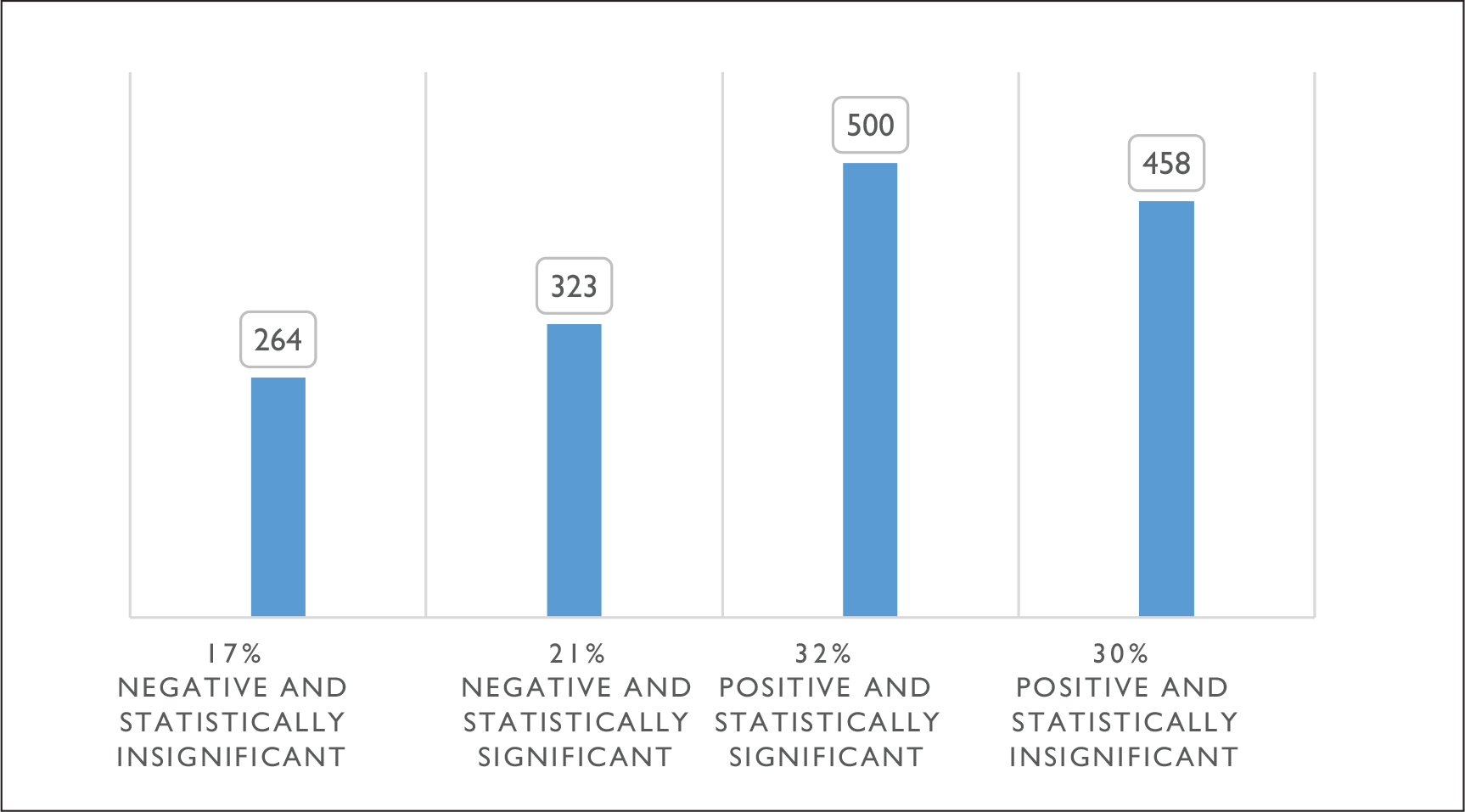
In a comprehensive meta-analysis of 1,545 estimates of spillover parameters from 74 studies dealing with 31 developing countries (Figure 2), Demena and van Bergeijk (2016) find that one-third of the reported estimates finds a positive and significant spillover effect, whereas one in six shows a negative and significant spillover effect. The other 51 per cent report both positive and negative but insignificant effects. Therefore, in spite of the massive body of literature on horizontal spillover effects, there is no consensus about the findings. However, due to the availability of the data and methodological improvements, empirical studies increasingly differentiate between horizontal and vertical spillovers (backward and forward linkages emanating from foreign firms). These studies increasingly show strong evidence of presence of vertical spillover effects, especially through backward linkages (Havranek & Irsova, 2011).
In terms of the empirical difficulties posed to the researcher while identifying spillover effects, Javorcik and Spatareanu (2005) report the following factors. First, in the case of horizontal spillovers, it is often difficult to disentangle the competition effect from the spillover effect. Therefore, the results which are reported in all the studies are the combination of these two effects together. Second, even in the case of vertical spillovers, the MNCs may be involved in cherry picking suppliers, which are already the best ones; therefore, there may not be any spillovers. It is also argued that spillovers may not be widely prevalent, and a subset of firms may be the beneficiaries. Aggregate studies pooling all the firms may underestimate the significance of such effects. However, recent body of work suggests that spillovers are not automatic, and that there may be necessary conditions for spillovers to occur (Castellani & Zanfei, 2006). Studies have increasingly looked at the possibility of additional variables influencing the spillovers. Among them, the most prominent being the ability of the domestic firms to absorb and internalise the potential benefits of technology spillovers (absorptive capacity). Absorptive capacity depends on the firm-level capabilities (Kokko, 1994) and within-country regional institutional differences (Xiao & Park, 2018). Further, some of the other factors identified for the accrual of spillovers to materialise include the level of institutional development, human capital and firm heterogeneity (Blalock & Gertler, 2009; Blalock & Simon, 2009).
Another issue though widely acknowledged by many studies is the absence of distinction between productivity spillovers and technology (knowledge) spillovers. No distinction is made between them, and they are considered as similar, and virtually all the studies captured empirically are simply the productivity spillovers. However as suggested by Perez (1998, pp. 22–23) ‘the former occur whenever the presence of foreign firms on the national territory produces an increase in the average productivity of domestic firms, the latter requires that this increase should be associated with an improvement in the techniques used by local firms’. Ideally, to capture the spillover effect, the measure should be the impact of foreign firms on domestic firms’ innovation activity. Often, this information may not be available, and the researchers typically regress productivity growth (total factor productivity or labour productivity) on foreign presence. Apart from the substantive reasons, there can be methodological issues in the form of absence of sufficient information and incomplete data sets and estimation procedures.
Evidence from India
Much of the research on FDI spillovers in India has been undertaken over the past two decades. These studies are largely based on firm-level panel data provided by the Centre for Monitoring Indian Economy (CMIE), Capitaline. We review studies that focus on FDI spillovers in India (Table 1). We admit that the selection of the studies is somewhat arbitrary as we focus attention on studies using firm-level data. We have tried to include all the studies based on the search using Google Scholar, and we believe that the studies included in this survey by employing a variety of methods and data sources help us in understanding the policy relevance of their findings. Typically, almost all the studies adopt the standard practice of using a log-linear approach, with productivity measure in logs and FDI presence in linear form:

where
LnProdijt = productivity of firm (either TFP or labour productivity);
Horizontal FDIjt = foreign firms’ output (sales income) share. This measure is expected to capture the pecuniary externalities such as market stealing and crowding out of local firms.
Vertical FDIjt = capture the relationship between foreign and domestic firms in the downstream and upstream sectors. This measure is indirectly obtained by using coefficients from input–output tables.
Summary of the Studies on FDI Spillovers in India
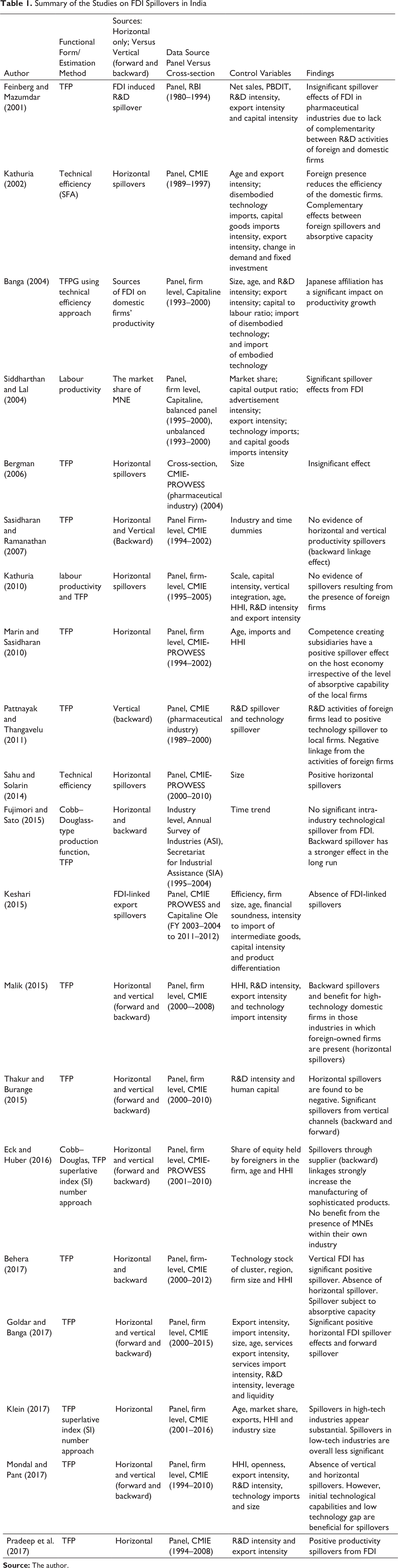
From the summary of the studies presented in Table 1, it is interesting to note that the findings of the studies are varied. In the case of horizontal spillovers, most of the studies find either insignificant or negative effects. Further, the crucial assumption of these set of studies is that the benefits will naturally accrue and be absorbed by domestic firms. Foreign firms are assumed to play no role in the process. This assumption has been recently challenged, and there is increasing evidence, which shows that only technologically active subsidiaries affect the generation of spillover effects (Marin & Sasidharan, 2010). However, this study, in the context of India, is confined to horizontal technological spillovers, leaving a possibility of whether and how vertical technological spillovers vary depending on foreign firms’ heterogeneity. However, in the case of vertical spillover, there is near unanimity about the positive spillover effects through linkages. Further, technological capability of the domestic firms and foreign firms’ heterogeneity are also found to significantly influence FDI-induced spillovers.
More recently, two other factors identified as constraints for the domestic firms to internalise FDI spillovers are the labor market rigidity and financial constraints. It is argued that the movement of personnel from foreign to domestic hinders the spillover possibility through worker mobility. In the case of finance, it is increasingly recognised that absence of finance acts as a serious obstacle to realise productivity improvements, which reduces the possibility of domestic firms becoming suppliers to MNCs. More empirical research is a need in this direction in the context of India, and the findings of such studies will have far-reaching policy implications.
Why Such Conflicting Findings
Research on FDI spillovers suffers from methodological issues, which often lead to conflicting findings. Based on the survey of empirical literature, some of the prominent methodological issues are summarised below.
It is assumed by all the studies that there is a linear relationship between productivity growth and MNCs presence. There exists a possibility that positive effects may prevail for threshold level of foreign presence beyond which domestic firms may not benefit much (Buckley et al., 2007). This factor is not addressed econometrically by the existing studies. Studies have employed numerous measures like share of foreign firms’ sales, output, employment, R&D, assets, capital and equity participation to capture spillovers. Probably, we find such conflicting results due to the absence of a universal measure of foreign presence, while the array of measures employed in the existing studies may capture only a part or certain dimension of spillovers. More recently, studies have pointed to the issue of incomplete data sets (Eapen, 2013). Mostly, the data sets employed is skewed towards large firms, and this is true in the case of India. In the case of firm-level data sources (CMIE-PROWESS, Capitaline) employed to study spillovers in India, firms belong mostly to the publicly listed firms and therefore some privately unlisted firms, including wholly owned subsidiaries and many small firms, do not enter the sample. As a result, almost all the studies suffer from selection problem, which may underestimate the true effect. Therefore, in order to improve the quality of research, emphasis should be on the quality of data.
Policy Perspectives
The findings of the studies reviewed earlier demonstrate that while designing FDI policies, it is necessary to take into account the role of various factors in creating and internalising spillovers. Regarding within-industry effects of FDI on India, studies have mostly found negative or no effect at all. However, in the case of linkage effects (vertical spillovers), there is near unanimity among the studies about positive and significant effect. Based on the findings of various studies on India, we derive certain policy implications relevant for policymakers. Probing beyond the identification of spillovers, some of the studies attempted to understand the transmission of spillover channels. Findings of some of them reiterate the well-known story that domestic firms’ absorptive capacity (R&D) enables them to internalise the potential for spillovers from advanced foreign technology. Therefore, policies should be designed not just to attract FDI but should provide a clear path to improve the absorptive capacity of domestic firms to internalise spillovers. Possibly to benefit and promote spillovers, upgrading skills and knowledge of workforce through training programmes can enhance the absorptive capacity of domestic firms. Specific policies include capacity-building measures for domestic firms to reduce the skill gaps of the workers. Further, policy incentives should be provided to encourage the R&D activities of domestic firms to absorb FDI spillovers.
Another mechanism identified based on the survey of studies for increasing absorptive capacity in domestic firms is promoting domestic linkages to maximise the benefits of FDI. Due to the asymmetry of information and research costs, buyers and sellers find it difficult to forge linkages (Monge-González & Rodríguez-Álvarez, 2013). In the case of foreign firms, identifying a potential domestic supplier is difficult due to the absence of information, and, often, such enterprises are small in size and scale, and domestic firms may not meet the quality requirements of foreign enterprises. Based on the Global Investment Competitiveness Report (World Bank, 2018), the following factors are identified to promote linkages:
creation of supplier databases that contain contact details and details of products offered by potential domestic suppliers; organise trade fairs; support supplier audits; and organise site visits, missions, exhibitions and seminars; policies to improve the capacity expansion of domestic firms (cluster-level programme) and agencies that help enterprises to obtain international quality certification; and Encourage foreign firms to use domestic inputs and tax exemptions for linkage, creating training programmes and joint R&D activities; offer financial incentives for the domestic suppliers for organising training programmes.
Footnotes
Acknowledgment
An earlier version of the paper was presented at a seminar on “FDI: Issues and Policy” at the Centre for Policy Studies, IIT Bombay, February 2018. I thank the participants for their comments and suggestions.
Declaration of Conflicting Interests
The author declared no potential conflict of interests with respect to the research, authorship and/or publication of this article.
Funding
The author received no financial support for the research, authorship and/or publication of this article.