



Abstract
Modernisation theorists reiterate endogenous growth models by acknowledging technological production for a rise in the efficiency of energy-use. Yet, world system analysts blame economic production for causing environmental degradation. As economic and demographic modernisation continue to raise the magnitude of extraction despite their declining economic intensity, the dichotomy draws attention to Jevons’ paradox. Debates ingeminating ‘The End of Cheap Oil’ raise arguments about India’s energy deficit despite measures to raise its energy self-sufficiency. Do policies aiming at reducing energy consumption through efficiency enhancement fulfil their targets or does the reality reverse the objectives of the policy? Focusing on the two pillars of energy policy (efficiency-demand and supply), Ordinary Least Square (OLS) technique and Granger causality have been employed to model the energy efficiency–consumption nexus and other determinants of energy consumption, across sectors. The magnitude of energy intensity effect is stronger in the agricultural sector than the other sectors. This analysis records evidence of Sectoral Rebound effects confirming Jevons’ paradox, whereby the economy’s energy mix which is strongly inclined towards non-renewable resources combined with the demand for green energy and efficiency, clearly supports the government’s recent policy moves in the direction of renewable energy generation and electricity substitution.
Keywords
Introduction
India’s electric power industry has recorded the major proportion of capital expenditure as a share of revenues. The central electricity authority has reported that 69.25% of the aggregate economy’s electricity generation capacity is thermal power by the end of March 2018. However, this generation is heavily dependent on coal inputs. The drop in the cost of installation of solar power plants in 2018 has raised the potential for widespread electric power generation yet, the low-capacity utilisation has raised recent concerns over the need for greater modernisation. The compound annual growth rate (CAGR) of consumption of all energy resources have been higher than the CAGR of production (from 2008–2009 till 2017–2018). The excess consumption has been satisfied by energy imports. The CAGR 2008–2009 to 2017–2018 of net imports 1 of coal stands at 13.68% and of crude oil at 5.20% (MOSPI, 2019). Figure 1 illustrates the economy’s energy mix and the pattern of consumption across renewable and non-renewable resources of energy. India continues to fulfill the mandate of the Paris Agreement on its renewable energy capacity. However, solar, wind and hydro power production remains substantially low (MOSPI, 2019). Then, where is India’s energy policy heading to? Is India revisiting Britain’s Coal question 2 via its experience of the Rebound effect across its sectors?
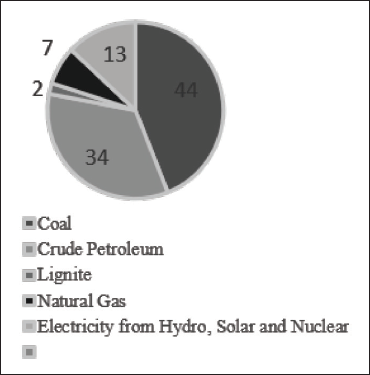
The energy mix indicates an economy wide dominance of consumption of non-renewable resources of energy while renewable energy contributes to only 13% of the total consumption. Though the production and availability of coal have recorded the highest growth among all commercial sources of energy, the fear of energy blackouts remains under concern for sustainable energy consumption.
A technological upgradation results in enhancement of resource use efficiency. Yet, the natural law governing consumption overpowers the productivity benefits of technical progress to ultimately raise the overall rate of that resource consumption. Stanley Jevons’ paradox postulates that the consumption of a resource increases when the efficiency of usage of that resource increases. Efficiency could be tied to technology-induced productivity shocks or government policies and schemes (Jevons, 1866). Thereby, low-cost energy efficient technologies drive up the Rebound effect in energy consumption. Investigating the presence of Jevons’ effect throws light on the sustainability implications of policies that target the energy sector. While Khazzoom–Brookes postulate in particular that micro-level efficiency improvements would induce macro level consumption of that energy resource, a Sectoral Rebound effect draws significance established from Jevons’ paradox that deals with this relationship primarily at the macro level (Khazzoom, 1980).
The rate of consumption of a resource increases with a greater consumer demand for it, while it can get substituted for other resources, on account of its alternative uses. A producer benefits from efficient technologies through lower cost of production which provides benefits of economies of scale. This induces large scale demand, thereby paradoxically leading to an increased consumption of the energy resource. While these are the direct spill-over benefits of efficiency improvement, the indirect benefits are in the form of diffusion of the technology across other industries and boosting aggregate consumption further.
Following the neo-classical theory, depletion of resources that pressurises energy prices upward also stimulates investments in technological developments. However, the paradox fails to materialise the benefits of energy efficiency as Jevons had pointed out at the steam engines. Such efficiency upgradation pushes for a fresh cycle of consumption wherein production units avail the benefits of economies of scale through input substitution as labour saving technologies raise capital intensity. The irreversibility of energy consumption holds the assessment of energy policies significant at different stages of economic development.
With rapid industrialisation, categorised as a semi-peripheral nation aiming at energy self-sufficiency, both economic and demographic expansions have contributed to a high material extraction rate in India since 1980. The impact of population explosion and economic growth on dematerialisation have been significant. However, the per capita extraction has remained below the world average. With an evident revelation of Jevons’ paradox, India and China have recorded high rates of extraction of natural resources (York et al., 2011).
British prosperity has largely been attributed to the Industrial revolution of the eighteenth century. However, this prosperity resulted from the availability of cheap and quality coal from Wales. Coal Question anchors this idea to energy efficiency and economic prosperity. Despite the scarce availability of coal, the consumption rate of coal was strikingly high. The consumption rate of coal was exponential, and with the invention of the more efficient steam engine, coal consumption should have reduced while the observations have pointed otherwise (Jevons, 1866).
The debottlenecking process is crucial to ensure the sustainability of limited resources, especially fossil fuels. Besides coal, extending the connotation of the paradox to other energy resources, adhering to the second law of thermodynamics, consumption of resources lead to environmental pollution and depletion. Efficiency policies assume the form of a loop that reinforces itself due to factors including rising pollution intensity due to increased consumption of natural resources and scarcity of resources which in itself induce more efficient measures to be adopted (Arrobbio & Padovan, 2018).
Adoption of 15 W energy efficient compact fluorescent lamps in the North Dakota region instead of 60 W incandescent light bulb reduced the energy needed, but on the contrary street lights were used for longer evening hours due to cheaper availability of electricity, thereby raising the overall demand (Bandyopadhyay, 2015). The insulation of household policy of Department of Energy and Climate Change by the UK government serves as an example of Direct Rebound effect, accounting for about 15% reduction in energy saving (Freire-González & Puig-Ventosa, 2015).
The distinct impacts of fuel efficiency on the consumption behaviour of different income classes, have been assessed in the US markets. The Energy Information Administration had reported that energy savings that resulted from fuel efficiency were temporary as it were being offset by the rate of vehicle use and ownership. Income effect has been stronger than the effect of gasoline price fluctuations in the personal transportation sector due to the relatively lower share of fuel prices in the overall consumer budget. The low fuel price elasticity of demand for private travel has ruled out the use of price channel to alter fuel consumption behaviour (Munyon et al., 2018).
The discrepancy between the expected and the actual outcomes of energy savings projects is a result of overlooking the behavioural notions of consumption that lead to ‘rebound effects’, thereby overestimating the benefits of efficiency enhancement in the form of energy consumption. This is evident from the efficient lighting projects of the Clean Development Mechanism in India (Gómez-Paredes et al., 2013).
As micro household characteristics of age, household size and employment status of the individuals significantly affect the consequences of vehicle fuel efficiency measured in terms of miles travelled, to what extent can macro sectoral effects of energy intensity and other determinants gain significance in drafting energy policies? While Polimeni and Polimeni (2006) suggest that the degree of Rebound effect varies across sectors and countries, would sector-wise energy efficiency gains degenerate environmental resources?
York has attempted to decouple economic growth from environmental damage by criticising the notion that ecological modernisation is a source of Green gross domestic product. His analysis has provided global evidence of Rebound effects where reduction of CO2 intensity has paradoxically raised the level of emissions (York, 2010). Technological progress and industrial efficiency both have a significant impact on the mitigation of CO2 emissions. However, Organisation for Economic Cooperation and Development countries experiencing excessive technological progress levels, also experience a CO2 rebound. The story of emerging economies reads that rapid growth is accompanied by a substantial rebound (Wang et al., 2014; Wang & Wie, 2020).
Estimating Partial Rebound effects both in the long and short run, in urban China for electricity consumption, has indicated that the response of price elasticity of energy consumption was greater for a decline in prices compared to that of an increase. This result has been attributed to rapid economic growth in China due to a substantial rise in urban incomes and cheaper electricity availability (Wang et al., 2014).
A new type of urbanisation, that is, intensive production while ensuring ecological protection contrary to building huge infrastructure and subsequent population explosion, is becoming prominent in China. A spatial econometric analysis, conducted to measure its environmental impact has identified two diverse paths of impact. One, direct, by adopting new lifestyle changes such as complete household electrification and normalisations of Information Technologies, CO2 emissions increase due to the need for more production. Second, indirect, by using energy-saving technologies, households have their financial pressure reduced, thereby using those technologies for longer hours and in larger quantities. This type of urbanisation has a paradoxical impact on CO2 emissions and the said spatial distribution exhibits clustering in High–High and Low–Low patterns (Wang et al., 2019).
However, could emission rates be the only measure of technical efficiency in production when sectors adopt the output maximisation principle? Can a measure of the level of economic activity, as a proxy for technological improvements (efficiency in production) have an impact on the rate of consumption?
Cross country analyses have highlighted Jevons’ effect across geographically dispersed economies, provided the variations in the limited endowments of non-renewable resources. Asian economies experience Jevons’ paradox on the grounds of their structural transformation. Moreover, they have exhibited a relatively stronger Jevons’ effect when controlled for population (Polimeni & Polimeni, 2006). York and McGee (2015) have revealed that efficient economies have a significantly higher use of energy with conclusions regarding the need for higher energy to support the infrastructure, population and produce energy-efficient technologies. Empirical results establish the possible existence of Jevons’ paradox in India and Bangladesh with significant Backfire Rebound effects in non- renewable energy and coal consumption (Murshed, 2018).
Industrial energy conservation requires adequate study to understand the nature of the problem of energy consumption and the techniques required to preserve the ecological balance, provided its resilience.
Reducing the carbon intensity of gross domestic product (GDP) has been preferred to be cheaper than shifting to cleaner technologies of supply in India. Gupta and Sengupta (2013) have suggested demand-oriented policy instruments for energy savings with focus on the industrial sector’s response to changes in energy prices and technologies that permit inter-fuel substitution. A disaggregated analysis proved significant substitution possibilities between labour and energy and no complementarity between capital and energy. All the seven energy intensive industries have exhibited strong negative own price elasticity of demand for energy. Decomposition of total factor productivity is significantly energy price induced. Hence, tax on individual fuels is preferred over capital subsidies for energy conservation in India, due to insignificant capital price elasticity of demand for energy (Gupta & Sengupta, 2013).
Decomposition of sectoral energy intensity has highlighted low energy efficiency in the agricultural sector, though the aggregate energy intensity has been negative, from 1980 to 1996 (Bhattacharya & Paul, 2001).
Optimisation of industry specific factors has been found to have a significant impact on energy intensity. The positive effects of labour intensity, plant and machinery intensity and the negative effect of technology development intensity have been examined for different groups of industries categorised based on energy intensity (Soni et al., 2017).
Results of inter-state analysis have shown that states with a higher share of manufacturing output in energy-intensive industries have higher energy intensity and labour productivity has a positive relationship with energy efficiency. Power deficit has reduced energy intensity while power reforms have remained insignificant in regulating energy efficiency (Mukherjee, 2008).
The shift from coal traction to diesel and electric tractions in railways and increase in demand for road transport influenced energy consumption patterns (dominant usage of petroleum products) in the Indian transport sector. Energy consumption doubled in 1990 due to fuel efficiency improvements by 30% (from coal based thermal plants) (Ramanathan, 2007).
Transport energy consumption has been decomposed between freight and passenger transportation into energy intensity, transport volume and structural effects (modal shift and private transport demand). The negative intensity effect is stronger than the positive volume and structural effects (Tiwari & Gulati, 2013).
Sinha and Mishra (2019) used the first and second laws of thermodynamics to estimate energy efficiencies in the four sub-sectors of the transportation sector in India. With the sector’s consumption trend being strongly driven by roadways and railways, the overall energy efficiency along with the improvement potential factor have been increasing. Better energy utilisation can be enforced through improved public transportation and prioritising renewable energy sources (as the sector has recorded 78% energy losses).
Then, would India’s broad sectors, when treated as aggregate economic production units also face Jevons’ effect especially since the structural transformation in 1991?
With a structural shift in the agricultural output composition (output diversification from food crops to commercial crops), a rise in the degree of modernisation of farm inputs has altered the technical energy–output relationship in the Indian agricultural sector. Energy intensity and input–output mix differ across different crops and industrial goods. The production of different crops leaves environmental footprints of varied degrees (Polimeni & Polimeni, 2006).
While Green Revolution failed to satisfy the food demands of the population, which the Malthusian theory upheld, current debates about a second Green Revolution have raised questions about the duration of the impact of productivity shocks on the agricultural sector. Input–output analyses and the application of Engel’s curve 3 to the Demand Bias hypothesis in justifying tertiarisation (service-led growth) lay emphasis on the impact of structural changes on energy intensity in the manufacturing sector (Ok et al., 2014; Tandon & Shahid, 2016). Severe air pollution holds private transport demands and vehicular pollution responsible for the worsening of Air Quality Index (Badami, 2006). Failing to comply with its commitment to ‘Carbon Sink’ (Sethi, 2018), India’s persistent consumption of coal, lignite and crude oil imposes serious risks about the optimal allocation of energy across its multitude of purposes as well as sectors. For a predominantly demand driven economy as India, the above three concerns question the sustainability of consumption of energy across India’s agriculture, manufacturing and transport sectors.
Can an evidence of Jevons’ paradox suggest focus on renewable energy resource supply rather than the traditional efficiency improvement approach, as the benefits of efficiency are questioned in the context of a rising deficit 4 in the economy’s energy balance? With the economy’s potential to establish an equilibrium, due to persistent shocks arising due to rapid non-renewable energy depletion, exogenous injections are necessary catalysts to maintain energy sustainability. To hedge the risks of environmental damage from increased extraction of non-renewable energy resources, the economy has to draft policies that suggest alternatives for anchoring economic development.
The Energy Statistics, 2019 report stated that a decline in energy intensity for the aggregate economy has been attributed to faster growth in output rather than energy demand. This association arises from the fact that the growing share of services sector has induced electricity consumption due to a relatively faster growth in the former than the latter (MOSPI, 2019). However, an aggregate measure of energy intensity overlooks the sector-wise experiences of the technical efficiency of energy inputs. While literature has recorded evidences of Jevons’ paradox across energy sources for the aggregate economy, can Sectoral Rebound effects have a significant impact on the economy’s energy policy?
Amidst growing pressures on incorporating the circular economy model for energy production and consumption, the objective of this study is to empirically investigate Jevons’ paradox, individually across the three broad sectors of the Indian economy, namely, agriculture, manufacturing and transport sectors. The models aim at measuring the relative impact of sector-specific determinants of energy consumption and the magnitude of Rebound effects. This comparison across the sectors would facilitate drafting of appropriate energy policies pertinent to the sectors. These three models capture the temporal dimension of energy consumption rather than a spatial dimension due to unavailability of state-wise data on energy intensity and other variables of the three sectors.
Methodology and Data Variables
Three sector-specific models have been constructed, which have been estimated using an OLS technique using EViews software. The three broad sectors that have been chosen for the analysis include, agriculture, manufacturing and transport, as per the classification followed in the Energy Balance, presented in Energy Statistics report by the Ministry of Statistics and Programme Implementation (MOSPI). Energy consumption by these three sectors comprises of 80% of total energy consumption of the economy (excluding household consumption), as energy is treated as a production input. The time period chosen for the analysis covers 1984–1985 till 2016–2017. The variables filtered out from literature as determinants of energy consumption are energy intensity (000 MT per gross value added (GVA)), capital intensity (capital stock per employee), real GVA (at constant 2011–2012 prices), GDP per capita (at constant 2010 US $), crop yield (per hectare of arable land) and machinery intensity (tractors and power tillers per hectare of arable land).
Sector-wise energy consumption has been computed as an aggregate of all major commercial energy resources including coal, lignite, oil and electricity. Consumption of all these resources have been converted into one standard unit of measurement, petajoules. The maximum use of natural gas being in the fertiliser industry, it has not been included in the computation of energy consumption as fertilisers have not been accounted for in the measurement of energy intensity in the agricultural sector. Energy intensity is a proxy for energy use efficiency. A decrease in energy intensity is an indication of improvement in energy efficiency. This analysis attempts to utilise the newly published KLEMS Master Database (July 2019 update) (Erumban et al., 2019). Energy intensity, capital intensity and real GVA have been sourced from KLEMS, GDP per capita and machinery intensity from World Bank and crop yield has been computed by aggregating all food and commercial crop production per hectare of arable land. Data on sectoral consumption of various energy resources have been sourced from the Ministry of Petroleum and Natural Gas and the MOSPI.
Empirical Analysis
This study aims at constructing a neo-classical model for a time-series investigation of Jevons’ effect across three broad sectors, as per the broad classification in Energy Statistics, published by the MOSPI. The model assumes a Cobb–Douglas production function as per the mathematical representation,

Unit Root Test Results
Unit Root Test Results.
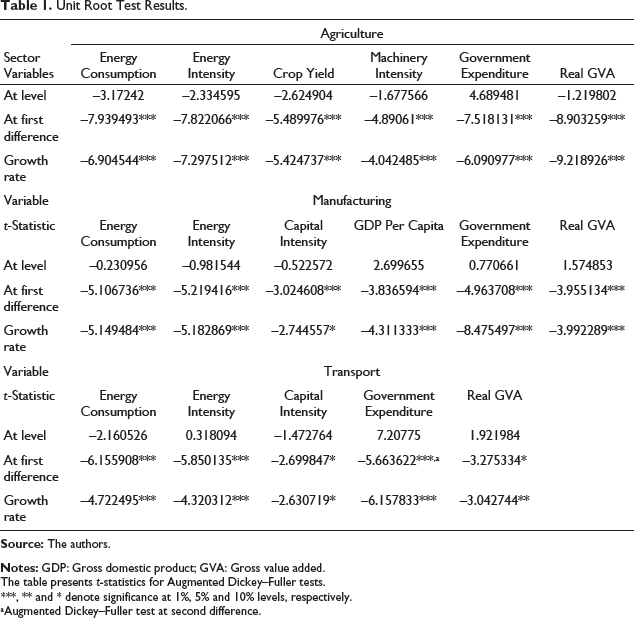
Unit Root Test Results.
The table presents t-statistics for Augmented Dickey–Fuller tests.
***, ** and * denote significance at 1%, 5% and 10% levels, respectively.
aAugmented Dickey–Fuller test at second difference.
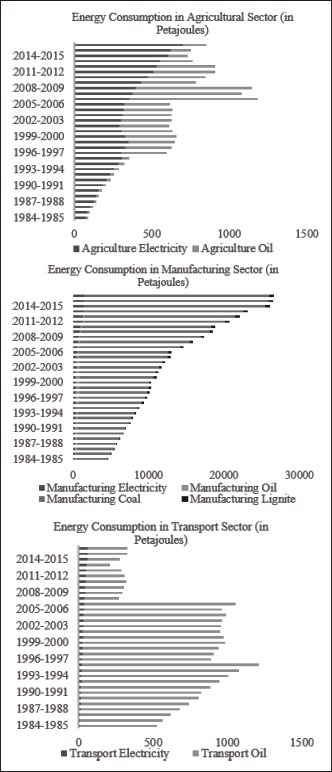
Composition of Energy Consumption Across Sectors
The graphical illustrations presented in Figure 2 denote the composition of renewable and non-renewable energy resources in the three broad sectors. The transport sector and the manufacturing sector consume a greater proportion of non-renewable resources of coal, oil and lignite.
Agricultural Sector
A fundamental graphical analysis is a pre-requisite to understand the trends of the variables of prime importance, energy intensity and energy consumption.
Both energy intensity and energy consumption have recorded a positive upward trend over time as shown in Figure 3. The cultivation of energy-intensive commercial crops has led to a rise in energy intensity in the agricultural sector. The use of commercial energy inputs per hectare of net sown area has increased during 1980–1981 till 2006–2007. The ratio of direct energy inputs remains dominant of the total energy inputs (Jha et al., 2012). Here, only direct energy use in agricultural sector has been taken into account (excluding pesticides and fertilisers).

Developing an empirical model to investigate Jevons’ paradox, the following equation has been estimated through OLS technique.

Estimation Results for Eq. (1).
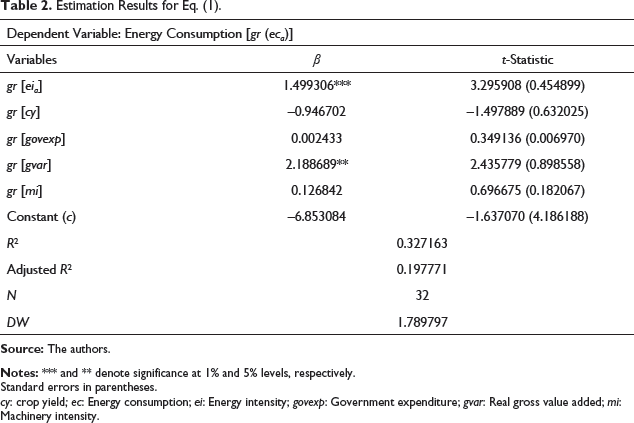
Standard errors in parentheses.
cy: crop yield; ec: Energy consumption; ei: Energy intensity; govexp: Government expenditure; gvar: Real gross value added; mi: Machinery intensity.
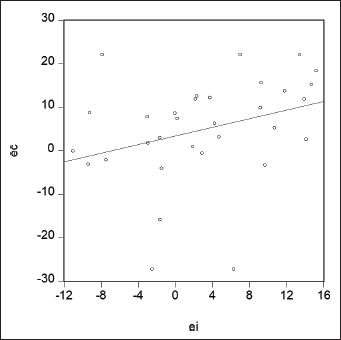
Jha et al. (2012) pointed out that agricultural output has a long run positive, cointegrating relationship with energy consumption, the real GVA has a statistically significant positive impact on energy consumption. Hence, demand for agricultural commodities raises demand for energy consumption in the sector, though crop yield resulting from a higher (increased) factor input productivity (land and labour) does not induce higher consumption of energy sources. The strength of output effect is stronger than the intensity effect.
Government capital expenditure in the agricultural sector has no significant influence on energy consumption. Literature fails to furnish any empirical evidence for the impact of government expenditure while there exist evidences to support correlations between public investments and capital intensity. The Indian agricultural sector suffers from a low research intensity due to lower investments on research and development in the sector. Hence, the demand for water saving technologies and efficient management of natural resources has been on the rise.
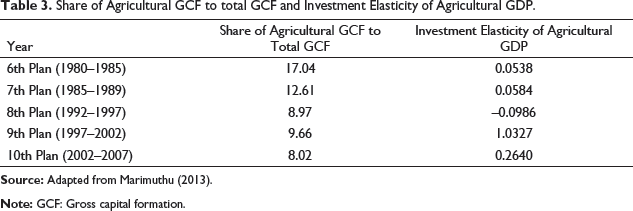
Share of Agricultural GCF to total GCF and Investment Elasticity of Agricultural GDP.
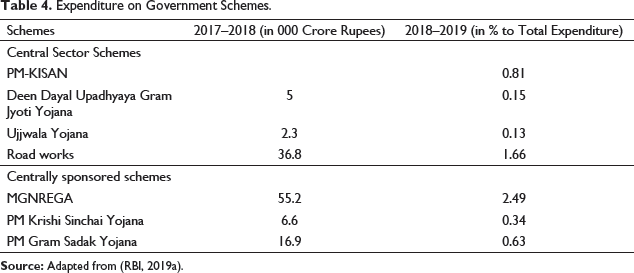
Expenditure on Government Schemes.
Manufacturing Sector
Graphically, energy intensity has been declining while energy consumption has been increasing over time, in the manufacturing sector as shown in Figure 5.

The following model has been estimated to investigate Jevons’ paradox in the manufacturing sector.

Estimation Results for Eq. (2).

gdppc: GDP per capita; kint: Capital intensity. Refer to notes in Table 2.
Variance Inflation Factors.
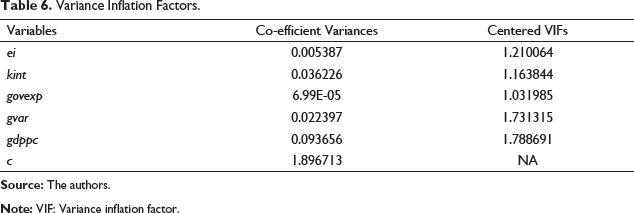
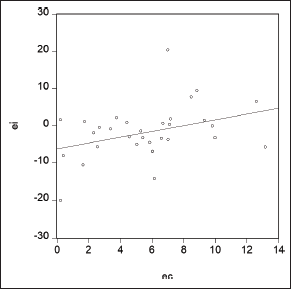
Results indicate that higher government expenditures boost energy consumption in this sector. Government expenditure on social and physical infrastructures (road and rail connectivity) has stimulated a crowding of private investments in the industrial sector. This is a reiteration of the state’s role as highlighted in Hirschman’s theory of unbalanced growth with respect to investments made in high linkage sectors. The capital expenditure growth has been rising especially in the refineries, steel and cement industries. Government policies have been largely targeting the stimulation of economic activity in this sector through Make in India (MII) and the National Manufacturing Policy. The Perform-Achieve-Trade scheme post 2012 has been focusing on energy intensive sectors, which has ultimately led to an increased usage of energy resources in this sector (Goldar et al., 2018). The Ujjala and Uday schemes have predominantly been targeting electrical power efficiency in the industrial sector. A surge in investments following the Auto Fuel Policy and Vision 2025, released in 2003 with focus on fuel quality upgradation (shift to BS V automotive fuel), marked the significant growth in the automobile industry. Further, the relaxation of foreign direct investment (FDI) constraints has also raised the potential of the refineries sector to embark on an ‘Accelerated Transition Path’, contributing to the rise in energy efficiency as presented earlier in the graphical analysis(GOI, 2014).
Transport Sector
A graphical assessment of Figure 7 indicates that both energy intensity and energy consumption have recorded a downward trend.

Empirically testing the paradox, the following model has been estimated through OLS technique.

Capital Expenditure Heads (in ‘000 Crores).
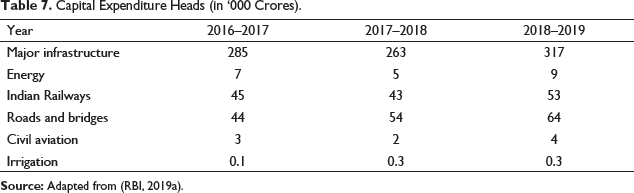

While capital expenditures target capacity expansion and modernisation of physical infrastructure, the pattern of revenue expenditure that is to follow the former also serves as an important determinant of energy consumption. Though capital expenditure raises the demand for energy sources, the proportion of revenue expended on fuel and electricity has remained relatively low while a major proportion is spent on maintenance and operation services (staff), indicating low operating efficiency. This sector has therefore been experiencing a low growth scenario wherein the proportion of capital expenditure is not in par with the operating expenditure (GOI, 2003).
Operating Fuel Expenses of the Indian Railways (in Crore Rupees).
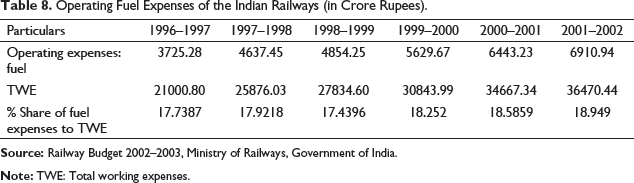
Only 1% of electricity consumption in the economy is by the transport sector (MOSPI, 2019). Capital expenditures in this sector are made ex-ante demand, rather than ex-post. Hence, the actual realisation of traffic determines the degree of capacity utilisation and the subsequent energy demands. Capital expenditures on gauge conversion and rail electrification have been reported as ‘unremunerative’ and hence, remains as underutilised capital (GOI, 2001). Additionally, the persistent dominance of oil as a major energy resource being consumed, leaves the sector vulnerable to fluctuations in energy prices in the world market.
Energy Cost-efficiency and Energy Intensity
Jevons highlighted the cost-efficient productivity benefits from an industry’s adaptation to technological upgradations. Hence, associating energy-use efficacy with cost efficacy, the following graphical illustrations and analysis are complementary to the regression results obtained from the previous model estimations (refer Figure 9).
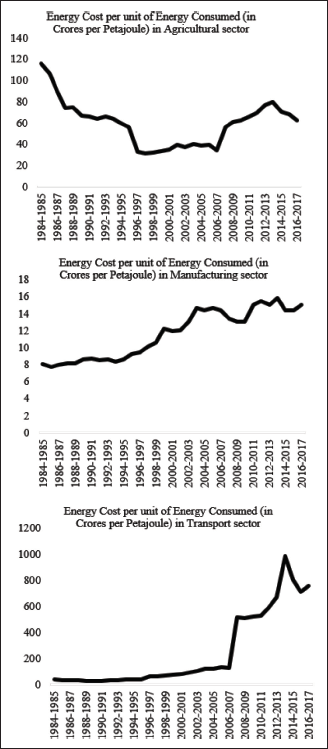
Polimeni and Polimeni (2006) analysed that the real energy price elasticity of energy demand has a significant impact on energy consumption and affects farm profitability due to high diesel and electricity price indices. When an industry experiences technical progress, the cost of production reduces and it enjoys economies of scale. Goldar et al. (2018) studied the impact of a decline in real energy prices on energy consumption whose results highlighted the significant substitution effect which raised energy intensity. Similarly, this real energy prices effect has been measured using energy cost per unit of energy consumed (in crores per petajoules). This adds additional insights to the comparison of empirical results and the graphical trends of energy intensity and energy consumption across the three sectors.
Agricultural Sector
While the estimation of Equation (1) indicates a Backfire Rebound effect, Figure 3 does not significantly indicate the presence of Jevons’ effect. Complying with Jevons’ primary focus on the rate of energy consumption, Equation (1) has quantified the magnitude of Jevons’ effect, while a decline in the energy cost has led to a substitution of energy for capital. This has raised the energy intensity which has exerted an upward pressure on energy consumption. This is further validated by the insignificant impact of machinery intensity on energy consumption (Table 2).
Manufacturing Sector
As represented by the graph in Figure 5, an increase in both energy efficiency and energy consumption clearly signifies the presence of Jevons’ effect. However, the magnitude of the Partial Rebound effect is relatively lower than the other sectors. While an increase in the cost per unit of energy consumption ceteris paribus should have technically reduced energy consumption, the relatively dominant effects of capital intensity and output have stimulated a demand-pull effect on energy consumption.
Transport Sector
Estimation Results for Eq. (3).

Granger Causality
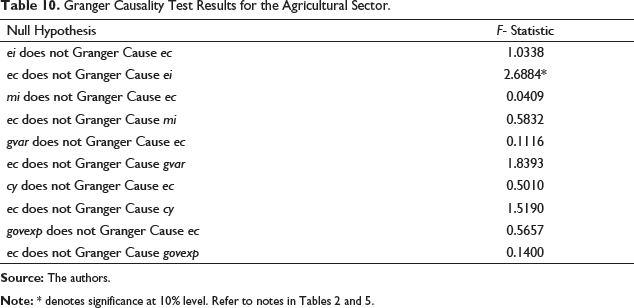
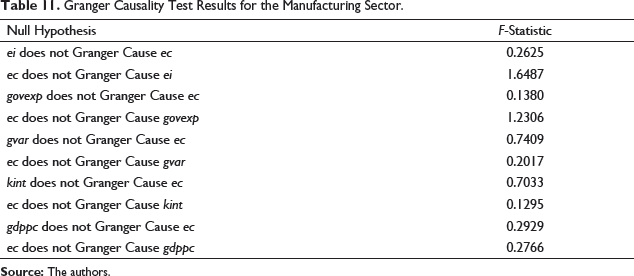
Murshed (2018) has highlighted the absence of long-run causal relationship between energy consumption and intensity variables of primary and secondary energy consumption, in India and Bangladesh, while recording bidirectional causality only for population and FDIs with energy consumption. Granger causality tests were run to investigate the presence of long-run causal association between energy consumption of different sectors and the sector-specific determinants of energy demand.
Granger Causality Test Results for the Agricultural Sector.
Granger Causality Test Results for the Manufacturing Sector.
Granger Causality Test Results for the Transport Sector.
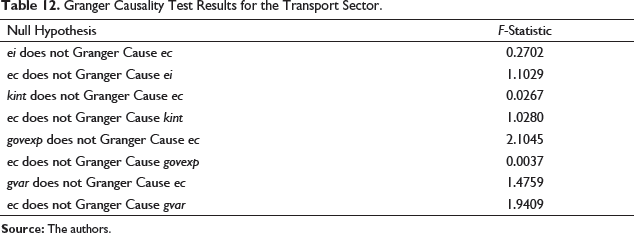
Both the agricultural and the manufacturing sectors have depicted a relatively stronger output effect, in confirmation with the results of literature, regarding the growth in output over that of energy demand post 2010 (Goldar et al., 2018). The manufacturing sector has witnessed the most prominent decline in energy intensity while continuing to remain the largest consumer of non-renewable fossil fuels (coal, lignite and oil). The degree of Rebound effect is higher in the transportation sector than the manufacturing sector. A Backfire Rebound effect experienced by the agricultural sector requires greater policy attention. The rising pressure on agricultural output in the context of the Malthusian theory, and the positive relationship between real output and energy consumption is to be brought under serious concern. Hence, the agricultural sector strongly requires the energy policy to focus on substituting non-renewable fossil fuel sources with renewable energy generation, to meet its demand for growing output and energy requirements. This would be relatively a more sustainable policy shift rather than efficiency enhancement for India to progress in achieving its target of becoming a power-surplus economy.
The portfolio of government expenditure remains inclined towards employment generation, industrial infrastructure and growth, while the expenditure on energy forms only 6% of the total capital outlay on infrastructure. Hence, the focus of the policies should rather be the rate of consumption and a shift in consumption behaviour, which insists on the need for government expenditure. While efficient utilisation of the existing non-renewable resources leads to a higher rate of consumption, a shift to green energy can meet the rising consumption demands while also preventing environmental degradation. This evidence acts as a supplementary support to the New Energy Policy’s objectives of substituting electricity for fossil fuel energy.
NITI Aayog’s draft New Energy Policy (2019) brought the budgetary proposal of electric vehicles under the ambit of MII, thereby continuing to focus on energy efficiency. The policy’s ultimate focus lays on energy transition via channelling domestic investments into electricity generation so as to divert demand away from non-renewable fossil fuel energy sources (Gupta, 2019; Aayog, 2017).
The One Nation, One Grid (2019) policy towards raising the economy’s self- sufficiency in the power sector by centralising power distribution and facilitating regional integration, eventually aims at meeting the rising energy consumption demand (GOI, 2019). Recent trends as reported by the Energy statistics describe the increased rate of consumption of fossil-fuel sources. India continues to witness a service-led growth under pre-mature de-industrialisation wherein the industrial sector remains the dominant consumer of energy, followed by domestic purposes. Consumption of coal and lignite remains the highest in India with the per capita consumption of energy following a constantly increasing trend (MOSPI, 2019).
Limitations of the Study
Despite emphasis laid by Jevons and Polimeni (2008), population (demographic) effects could not be captured in the above models due to methodological constraints.
The low R2 and adjusted R2 estimates have yet been considered for the study, as this study focuses primarily on investigating the presence of Jevons’ effect and not on the estimation of a complete model. Econometric analysis at the firm level has shown that energy intensity is dependent on the size, age, labour, research intensity and various other disaggregated factors pertaining to a firm (Sahu & Narayanan, 2011). This study has only identified major aggregate economic determinants pertaining to the broad sectors as a fundamental empirical analysis of the paradox.
The post 2010 decline in real energy prices has led to a substitution of energy for capital in the contribution to output growth, thereby raising the level of energy intensity. While oil prices have had a significant impact on agricultural farm profitability in India, the models failed to measure the impact of energy prices on the rate of consumption across sectors. The role of the government in investments in the energy sector has only been captured using capital expenditure while it has failed to analyse the legal and institutional effects of tariffs, energy efficiency standards, laws and taxes (emission tax in the transportation sector).
Conclusion
While the graphical illustrations reveal the heterogenous experiences of the three sectors, empirical testing of Jevons’ postulation has used the rate of growth of intensity and consumption rather than the absolute levels. As the neo-classical theory suggests, depletion of non-renewable resources raises its price that attracts investments, which under the assumption of the Embodiment hypothesis, 6 increases the energy resource use-efficiency through a Vintage effect. This continues to raise the consumption of the resource leading to further depletion. Hence, this cycle has to be broken in order to divert resources towards the generation and supply of renewable sources of energy. As efficiency improvements in the consumption of non-renewable resources result in scale effects which diminish environmental resources, a shift to renewable energy enables sectors to avail the short-term benefits of substitution effects, while long run benefits accrue to the aggregate economy in the form of a transition to sustainability. In the light of the ‘exhaustive’ consequences of modernisation, ‘economic development’, which is contained in sectoral growth, should be conceptualised to enhance the quality and sustainability of production rather than the scale of production. Herein, the energy efficiency–energy consumption nexus emerges as the cornerstone of energy policy.
Footnotes
Declaration of Conflicting Interests
The authors declared no potential conflicts of interest with respect to the research, authorship and/or publication of this article.
Funding
The authors received no financial support for the research, authorship and/or publication of this article.
