



Abstract
The role of clean-energy minerals (CEMs) in the modern non-carbon energy technology development is indispensable. The scarcity of CEM resources in India is a severe concern. Almost complete import dependence on CEM-producing countries makes India vulnerable to the supply risk that could arise due to various reasons. For example, for India to do business with countries like the Democratic Republic of Congo (DRC) and China could be challenging given the geopolitical issues India have with China and the internal political and economic crises DRC have within. Situations like this call for securing domestic CEM resources and strengthening the bilateral trade agreements with friendly nations. India needs to focus on investing heavily in the domestic exploration and acquiring overseas leases of CEMs. Research and development promotion are crucial to finding reliable substitutes for priority CEMs such as graphite, lithium and cobalt.
Introduction
Clean energy refers to the energy produced from renewable natural resources without polluting the atmosphere significantly. Few examples of clean energy include electrochemical energy, photoelectrochemical energy, solar energy, hydrogen energy and alternative renewable energy (wind, tide and geothermal energy) (Nowotny et al., 2018). Due to its low carbon footprint in energy production, the Clean-Energy Technology (CET) or Low-Carbon Technology (LCT) thrive on clean energy sources. The World Bank 2020 report on Minerals for Climate Action: The Mineral Intensity of the Clean Energy Transition maintains that though the CET requires more minerals, the carbon footprint of the mineral production—from extraction to end-use—will account for only 6% of the greenhouse gas emissions generated by the conventional fossil fuel technologies (Hund et al., 2020).
Due to the recent COVID-19 pandemic outbreak, mineral-based industries have seen significant disruptions across the world. These disruptions have resulted in considerable losses in fiscal revenues, especially for those countries whose major part of the income comes from mineral exports. Developing countries (e.g., India) generally depend on imports to meet their critical and strategic minerals demand. Such countries will face interruption in the regular supply due to obvious reasons such as change in the geopolitical situation, increased prices controlled by mineral cartels and more importantly, logistical delays after the pandemic outbreak. These factors could severely affect the individual country’s before-pandemic and after-pandemic commitments to climate-smart mining principles. Considering the severity of the problem, developing countries like India need to reassess their mineral base and strengthen the mineral exploration policies and programmes to face the new world challenge of critical and strategic mineral supply caused due to COVID-19. Detailed exploration of land, in terms of its mineral potential, especially clean-energy minerals (CEMs), is very much essential for India (or any developing country) to be self-reliant in producing and supplying CETs.
As part of its climate change mitigation strategy, India is committed to (a) reduce the emission intensity by 33–35% of its gross domestic product by 2030 from the 2005 level and (b) achieve an installed capacity of 40% cumulative electric power from non-fossil fuel-based energy resources by 2030 (Kumar, 2018). It is necessary to shift towards modern LCT applications in thermal power generation, transportation and infrastructure development to realize these commitments.
The so-called developed countries in the world are racing towards achieving a complete CET. India should not fall behind in the race due to lack of supply of CEM resources. To keep pace with the world, India needs to ensure uninterrupted production and supply of CEMs. This study attempts to bring out a clear understanding of the present status, production, demand, issues and possible solutions to uninterrupted CEMs supply in the context of the current Indian economy.
Clean-Energy Minerals
CEMs are the minerals used in developing and building LCT. The CEMs fall into two categories: (a) crosscutting and (b) concentrated (Hund et al., 2020). The crosscutting CEMs are the group of minerals used across a range of LCTs. In contrast, concentrated CEMs are a group of minerals used in one specific technology. Examples of crosscutting CEMs include bauxite and minerals of vanadium, indium, neodymium, silver, titanium, zinc, manganese, lead, copper, chromium and molybdenum; and concentrated CEMs include graphite and minerals of lithium and cobalt.
The concentrated CEMs have a higher supply risk considering the limited number of producers in the world. For instance, two-thirds of the world’s cobalt supply comes from the Democratic Republic of Congo (DRC), a country known for its internal political and economic crises (USGS, 2017). Concurrently, the concentrated CEMs will face the highest-level demand risk, particularly for the producers of these minerals, due to rapid dynamic changes in the energy storage technologies where the concentrated CEMs are in high demand (Hund et al., 2020).
However, due to a gradual shift in the world towards a low-carbon future, the demand for CEMs is expected to increase 500% by 2050. The numbers indicated by Hund et al. (2020) for different CEMs, especially graphite and minerals of lithium and cobalt, shows the urgency for discovering new CEM deposits or sources to ensure their uninterrupted supply.
Considering their importance, McCullough and Nassar (2017) had suggested that CEMs will have the potential to become critical mineral soon. A critical mineral is one that a country essentially needs, whereas a strategic mineral is one for which the country does not have its resources and must depend on imports.
The Indian mineral reserve base data indicate that the country does not have any proven reserves of high-impact concentrated CEMs such as lithium and cobalt minerals. The proved reserves of graphite are negligible as per the National Mineral Inventory (2015). Therefore, these minerals will become critical and strategic by 2030 (Gupta et al., 2016; Kumar, 2018).
Production and Demand Estimates of CEMs
Figure 1 indicates the global scenario of reserves and production estimates of CEMs (graphite, lithium and cobalt). The DRC, China, Chile, Australia and Brazil are the countries that have significant proven reserves of CEMs. However, the DRC, China and Chile control more than half of the total world production of CEMs.
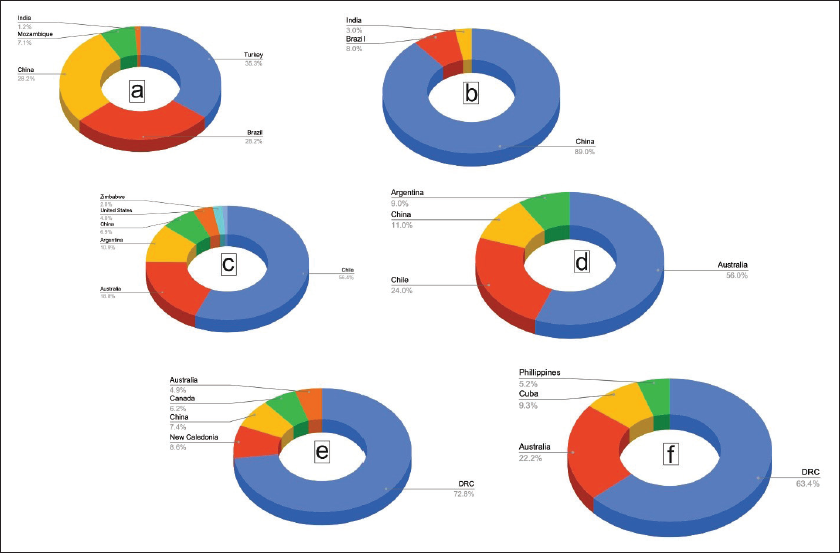
As is the case with any other strategic minerals, there is significant inequality in the distribution of CEMs between producing and consuming countries/states (Gupta et al., 2016; Kumar, 2018, 2019). This inequality creates a significant fluctuation in the global production and demand curve. In the case of India, the country has not discovered significant resources of CEMs. Meanwhile, the Indian CEM industry is tiny but growing at a steady pace in various sectors. (e.g., aerospace, electric vehicles (EVs) and battery technology; Gupta et al., 2016). Demand will augment further in these sectors with the development of domestic non-carbon energy applications. Demand for graphite and lithium in the expanded graphite foil and lithium-ion (Li-ion) battery manufacturing sector are the potential areas that will be the significant drivers in the Indian market by 2050 (Gupta et al., 2016; Kumar, 2018). The demand for Li-ion batteries comes from electric/hybrid vehicles, laptops, smartphones and home/business applications. As far as cobalt is concerned, the demand comes from the Indian aerospace industry, which currently depends on imports. Other major industries that use cobalt are the chemical industry and the rechargeable battery manufacturing industry. Though these plants are negligible in the country, with the increase in non-carbon energy applications, these plants’ number will also increase (Kumar, 2019).
The cost of imports of Li-ion batteries in the year 2019 was Rs 65,000 million, almost 150% of the import cost in the year 2016 (IBM, 2018). India is committed to make itself the largest manufacturing hub for EVs by 2040 and has invested $1.4 billion to realize that dream (Shah, 2019). Transforming into the largest manufacturing hub for EVs means the larger share of this investment goes to procuring raw materials essential for the manufacturing of rechargeable batteries, such as graphite, cobalt and lithium. From the above discussion, it is evident that most of the total world production of CEMs is controlled by countries that are either not in good terms with India (e.g., China) or has internal political instability (e.g., DRC). In both cases, the Indian manufacturing industry will suffer.
Mineral Security
Interestingly, minerals related to CETs, especially those containing energy-critical elements, have not been a primary target of national mineral exploration so far in India. Thus, there is no proper mineral database illustrating the total reserves of CEMs.
Given its geological makeup, India is one of those countries with substantial hidden mineral wealth, especially CEMs (Kumar, 2019). Failure to unlock this hidden mineral wealth will result in extreme dependence on international supply chains. This dependence is perilous, considering the sensitivity of the supply chains to disruptions caused due to a variety of reasons.
The Government of India’s (GoI) most ambitious project, Make-in-India, demands more mineral resources than ever before to achieve a more incredible technological revolution. To ‘Make-in-India’, the country must first ‘Explore-in-India’ (Kumar, 2018). India’s annual global mineral exploration budget (0.3%) is arguably negligible compared with over 19% by Canada, 12% by Australia, 7% by the United States and 4.5% by China (Kumar, 2018). Similarly, the present technology used to explore subsurface deposits in India needs significant improvements to meet international standards. Importance should also be given to the acquisition and revision of the exploration database on a globally comparable basis.
The private sector needs to be permitted and encouraged to explore CEMs in the country using modern concepts and tools to produce a more detailed and accurate database. CEMs, especially graphite, lithium and cobalt, deserve special attention due to their application in energy storage devices. Concurrently, public agencies (such as the Geological Survey of India, state geology departments, universities, research institutes) should be encouraged to perform geoscientific surveys (especially for CEMs) to generate pre-competitive data which could serve as a primary database for commercial mineral exploration.
Geopolitical Constraints
As noted earlier, with the country’s current exploration trend, India will face an acute shortage of CEM, significantly impacting the high-technology product manufacturing sector. The global supply chain of CEMs is currently dominated by only a few countries, viz. China, the DRC and Australia. India’s geopolitical relationship with these countries and the political instability in some of these CEM dominating countries make India highly vulnerable to supply disruptions (Gupta et al., 2016).
Indo-China Trade Relations
The trade and investment relationship between India and China has had its ups and downs because of the bilateral and border sharing issues that have surfaced from time to time (Thomas & Shaijumon, 2020). However, trade between these countries has proliferated over the past quarter of a century (Ghosh et al., 2019). As a result, China has become the third-largest market for India’s exports since 2004, and India has steadily raised to become the seventh-largest market for Chinese exports. Nevertheless, an unhealthy trade relationship between these two countries manifested in India’s growing trade deficit with China accounts for more than 50% of India’s total trade deficit (Ghosh et al., 2019). The Chinese exports are dominated by finished equipment goods, while the Indian exports predominantly consist of intermediate goods that fall between agriculture and manufactures (finished equipment goods). While China’s exports to India are mainly dependent on India’s household consumption expenditure, India’s exports to China correlate to Chinese manufacturing value addition (Ghosh et al., 2019; Qureshi & Wan 2008; Wu & Zhou 2006). Consumer durables such as electronic goods, smartphones, industrial goods, vehicles, solar cells and essential pharmaceutical products are examples of Indian imports from China.
Besides, the recent changes in the foreign direct investment policies of the GoI—requiring investment from any country that shares a land border with India go through a government approval process—will also harm the Indo-Chinese trade relations causing a threat to the CEM supply chain.
Internal Conflicts
India has witnessed a sizeable internal conflict caused by radical movements for various reasons for the past 50 years (Ollestad, 2012). Since most of these radical movements coincidentally fall within the vast mineral resource belts of Southern, Central and Eastern India, there will always be a severe risk in ensuring the uninterrupted supply of mineral resources. For instance, the important mineral (e.g., iron, bauxite and coal) producing states of the country, like Chhattisgarh, Jharkhand and Odisha are frequently witnessing disruptions in local mining and manufacturing operations due to the persistent radical movements (Hoelscher et al., 2012; Kennedy, 2015). Although studies have indicated the positive correlation between the mineral abundance and the probability of radical movements (le Billon 2001; McNeish, 2010; Ross, 2004a, 2004b; Rosser, 2006), Kennedy (2015) suggests that abundant natural resources in India did not mechanically increase the probability of insurgency. Instead, the author suggests, economic policy and social structure played a significant role in the movements that ultimately resulted as a threat to mineral resource exploitation. The GoI must resolve the mining-affected indigenous people’s socioeconomic concerns to control the internal conflicts that pose a more significant threat to the country’s economy (Ranjan, 2020).
Uninterrupted Supply
The increasing importance of CETs in energy security and economic competitiveness remarkably increases the supply-risk, which is a significant threat to national security (De Ridder, 2013). Frequent interruptions in global mineral supply can cause disastrous consequences. The global supply chain of CEMs is exceptionally unpredictable because of the political instability among the source countries. Moreover, pandemics like COVID-19 can completely shut off a country from the rest of the world. Developing secure alternative supply sources, such as recycling and substitution, is essential to protect the domestic manufacturing industries from the disruption in the global CEM mineral supply (OTA, 1985).
Competition
Countries that depend on imports always try to secure an adequate and affordable supply of mineral resources. Surging prices, national unrests in supplying countries and threats to important trade links can hamper the security of supply (Månberger & Johansson, 2019). The resource-rich countries form cartels to dictate the prices and gain high market shares. The risk of supply disruption increases with the increase in demand. This demand results in price hikes which are controlled by the resource-rich countries. Apart from this, certain factors—such as the rapid increase in the demand due to insufficient investment and other political, financial, geological and technical barriers to the exploitation of new mineral reserves—also contribute to the higher prices (De Ridder, 2013).
Currently, India is import-dependent for seven out of 12 strategic minerals, including CEMs and does not have any declared resources for them (Randive & Jawadand, 2019). Most of these strategic minerals are used in the manufacturing of defence goods. Complete dependence on imports of the strategic minerals will increase vulnerability and significantly endangers national security.
Possible Solutions to Resolve the Issues and Challenges
Enhancing the Resource Limits
The most fundamental generic issue faced by the mineral sector, in the past and present (perhaps in the future too), is the physical availability of mineral resources from the Earth. Mineral resources known today to humankind that can be extracted economically with existing technology are tiny compared to the total amount of resources (Ragnarsdottir, 2008). Scientific advances and market forces will replenish the reserves from previously undiscovered resources. Meanwhile, to maintain an uninterrupted supply and reduce dependence on non-consistent sources (a) advances are needed in the technologies used to discover and define deposits and in the organization of the exploration process, (b) advanced beneficiation techniques are needed to develop high-value ores from low-grade high-tonnage deposits, (c) substitute materials are to be identified and (d) recycling on a large scale with zero-waste policy must be encouraged.
Recycling as a Means to Future CEMs Supply: Is it a Viable Option?
Recycling is a process of recovering from waste elements, and it is an evolving process for CEMs. Arguably, recycling may seem satisfactory to meet the ever-increasing demand for CEM raw materials at present. However, for most metals, recycling currently provides 10–20% of demand and less than 1% for critical and strategic elements (UNEP, 2011). Even though the recycling rates are to be increased soon in the country, the critical and strategic mineral resources (e.g., CEMs) residing in the anthropogenic environment are negligible compared to those needed to meet the predicted increase in demand from LCTs (Hund et al., 2020). Therefore, considering the limits of recycling at meeting the immediate future demands, the bulk of the LCT requirements for CEMs will have to be sourced from primary Earth resources.
Need for Research and Development
While it is true that India requires domestic CEM resources, the comprehensive effort to map local reserves of CEM is low. Research and development (R&D) in the CEM sector should cover the entire spectrum of activities from geoscientific survey, exploration, mining, beneficiation and production (Ministry of Mines, 2011). Significant research and innovation are required to reduce the environmental costs of CEM extraction, processing and use, which could pose a significant threat to supply. A significant advantage of minimizing environmental impact is that it allows the working of previously uneconomic ore types and grades, extending the country’s resource base. Investing in research on recycling may seem apt. However, it is essential to note that there is a maximum limit on recycling, determined by the consumption pattern in the past century. Moreover, as mentioned earlier, there is a limit on the number of mineral resources that can be recycled back from the anthropogenic environment. The investment must focus more on the exploration of greenfield (virgin areas) and brownfield (mined areas) deposits for CEMs in order to realize the full potential of the country’s resource base.
Securing Natural Resources and Strengthening Bilateral Trade Agreements
As noted earlier, increasing demand for mineral resources has a general problem related to raw materials’ security. This security is of paramount importance concerning the CEMs that are crucial to develop many new renewable technologies. The problem of the security of raw materials arises due to the uneven geographical distribution of various mineral deposits. This uneven distribution makes the accessibility of the resources difficult due to the different policies of different countries. Consequently, countries lacking mineral deposits required for technological advancement are left behind in the race of economic development.
India is short on proven CEM deposits. There is no domestic production of cobalt and lithium, and the country depends on imports to meet the domestic requirement (IBM, 2018). It is also interesting to note that though India accounts for 1% of graphite’s total world production, it still depends on imports for its domestic requirements (IBM, 2018).
Considering the high import dependence, uncertainty about global supplies and significant industrial applications of CEMs, India must strategically import and stockpile the CEM resources. Additionally, the export of CEMs should be prohibited, and domestic industries should be encouraged to invest in CET products manufacturing.
Diplomatic bilateral trade agreements between India and CEM producing countries will prove profitable in securing a stable and affordable supply of raw materials. Alternatively, India can gain access to mineral-rich countries’ resources by investing in the production chain closer to the mineral extraction stage (De Ridder, 2013). The move from the GoI to acquire mining leases of CEM deposits in mineral-rich, low-income countries trigger the economic and social developments in the mineral-rich countries. India’s quest to secure a stable CEM resource supply opens a new window of opportunity for mineral-rich countries to leverage and link their mining-related industries to develop essential infrastructure services. It is a win–win situation for both countries involved. Further, forming cartels for high-risk items and commodity-based exchange agreements with low-income nations will also help secure diplomatic bilateral trade agreements (Randive & Jawadand, 2019).
Summary and Conclusions
CEMs play a key role in modern non-carbon energy technology development. It plays an indispensable role in the country’s defence, electronic and aerospace industries. Though the country has the geological potential to host the CEM deposits, India lacks proven CEM reserves. This shortfall could significantly affect the mineral industry while adversely influencing the economic growth of the country. India’s import dependence on CEM producing countries could lead to a disastrous impact considering the geopolitical developments taking place post-COVID-19 pandemic. India and China are almost at war on the boundary issue, while the internal politics of DRC is highly unpredictable. Situations like this call for securing CEM resources and strengthening the bilateral trade agreements with friendly nations. Recycling could partially fulfil the needs of the growing mineral-based industries. To meet the country’s current economic and developmental goals for the next couple of decades, India needs to invest heavily in domestic exploration and acquiring overseas leases of CEMs. R&D promotion is crucial to find reliable substitutes for priority CEMs such as graphite, lithium and cobalt.
Footnotes
Acknowledgements
The authors thank the Head, Department of Geology, the Central University of Kerala for providing the infrastructural facilities to carry out this work.
Declaration of Conflicting Interests
The authors declared no potential conflicts of interest with respect to the research, authorship and/or publication of this article.
Funding
The authors disclosed receipt of the following financial support for the research, authorship and/or publication of this article: The research is funded by central university of Kerala.
