



Abstract
The emphasis on enhancing and specialising in technology exports and altering policy environment in Asian economies has been dominant since 2000. The present study is an attempt to empirically investigate the effect of technology exports on enhancing growth of Asian economies during the period 2001 to 2018. To assess the linkages between growth, investments, labour productivity and technology exports, panel least squares with cross section weights is applied for the economies. To assess the relationship between the variables for each individual country ARDL technique is applied. The results indicate long run relationship between low, medium low and medium high technology exports and growth as well as domestic investment and growth. For individual nations, the results indicate varying intensity of technology exports have a different relationship with growth. The results also suggest the need for Government of each nation to enhance its effort on the development of policies which focus on attracting investments and further promoting exports of technology intensive sectors.
Introduction
Productivity of a nation is measured by the value of goods and services produced by the present human capital and natural resources and the ability to mobilise them (Parausic, 2007; Porter et al., 2004). Productivity in recent years saw a change due to adoption of technology which has led to enhancing quality and competitiveness of products globally and thus increasing exports (Porter, 1989). Replacement of low labour cost and export of raw material strategies was also seen during the transition stage by strategies based on research and development for enhancing production (Lall, 2003). The adoption of technology in production is possible only when the macro environment of a nation aligns itself with this goal.
The adoption of technology is based on socio cultural aspects, flexible funding, greater efficiency, low cost, differentiation and further innovation related strategies adopted by a nation (OECD, 2015; Radonjic, 2003). Technology exports require greater investments and preferably FDI due to specialised technological capabilities of the investors. Based on the hypothesis of export led growth, export growth contributes to rise in capital formation and further increase in imports of capital goods (Suryanto, 2016). Economic growth is also supplemented by rise in FDI, technological innovations and involvement of labour force. FDI not only provides capital for production but also adds value to the existing human capital and infusion of technology (Dunning, 1973; Hymer, 1976) thus leading to growth. In case of sector specific impacts of FDI, it has been seen that computer and Software industry contributes maximum to growth and is the major recipient of FDI in Asian countries (Siddiqui & Ahmed, 2017). The level of education of the labour force also plays a major role in enhancing growth of the sector and the country. Human capital not only has an internal but also external effect (Lucas, 1988). Any increase in domestic investment also acts as a catalyst for foreign investment and thus enhancing production together (Clegg & Scott-Green, 1999; Naudé & Krugell, 2007; Obwona, 2001).
Export led and FDI facilitated growth has been a general phenomenon of growth for most of the nations which has led to specialisation in few segments and further rise in income elasticities and adoption of new technologies (Dalum et al., 1999; Fagerberg, 1988). Thus, nations can maintain their competitive position by developing internal factors like adoption of technology and lucrative business environment which is not the case with Asian economies. Asian economies face issues due to political and social stigmas present and resistance to adoption of new strategies. It has been seen that since 2001, the expenditure on R&D as a percentage of GDP has marginally increased for China, Korea, Japan and Singapore as depicted in Figure 1.
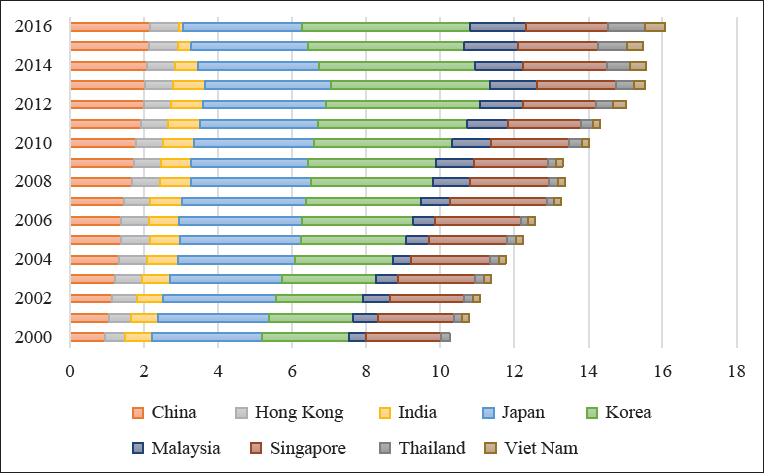
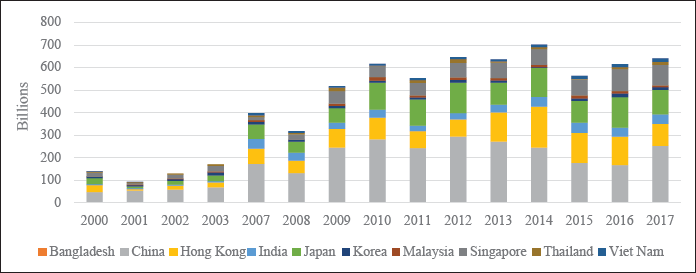
The expenditure on R&D, witnessed a rise at an increasing rate for Republic of Korea and Malaysia while it was stagnant for India and Thailand with no information for Bangladesh and Vietnam (World Bank, 2020). Though Asian economies have been leaders in exports as well as most preferred investment destinations in recent years as depicted in Figure 2, no specific indicators have been assessed pertaining to the intensity of technology products manufactured and either domestically consumed or exported.
The economies have been highly competitive in terms of price but there is a lack of appropriate economic policy for each segment of technology as categorised by OECD as High Technology (HT), Low technology (LT), Medium High Technology (MHT) and Medium Low Technology (MLT) sectors. Manufacturing industries are classified according to technology intensity using the ISIC Rev. 3 breakdown of activity. The classification is based on a ranking that uses data on R&D expenditure divided by value added, and R&D expenditure divided by production as can be assessed from Table 1.
Classification Technology Exports.

In case of Asia, for the top trading nations, the trends in Technology Exports are as depicted in Figure 3. It is seen that Bangladesh has the highest percentage of LT exports, Hong Kong, Korea, Malaysia and Singapore have a high share of HT exports. Japan has the highest share of MHT exports along with Korea. India has the largest share of MLT exports.
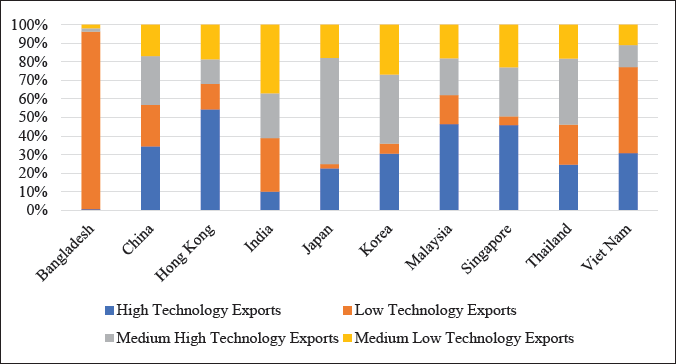
Thus, the present study is an attempt to analyse the relationship of each segment of technology trade to growth of the nation for the top trading nations of Asia namely Bangladesh, China, Hong Kong, India, Japan, Korea, Malaysia, Singapore, Thailand and Vietnam for the time period 2001–2018. For the panel of selected countries as well as individually, it will be assessed that which segment of technology exports contribute maximum to growth and whether the growth is due to domestic or foreign investments.
Trade is vital for the growth of any nation and in recent years advancements in technology have further indicated that technology and trade are interrelated with growth, but the results are mixed both in the long and short run. In case of developing Asian nations, the trade and its variants like trade openness, trade intensity, export shares are positively and significantly related with growth or GDP (Kong et al., 2020; Yanikkaya, 2003). Technology trade and investment also leads to increase in trade and growth by adoption and improvement in technology induced business activities (Weber & Kauffman, 2011). Technology boosts trade from industries in which they are diligently used (Wang & Li, 2017) and also leads to growth of trading economies (Siddiqui & Singh, 2020). Even in developed nations, technological advancements exert positive relationship on foreign trade (Nguyen et al., 2020; Sener & Delican, 2019). In the case of newly industrialised countries, technology was found to be an important catalyst in fostering their spectacular growth (Nelson & Winter, 1982). Developing countries, such as India, have been striving hard to promote technological advancement through indigenous R&D efforts as well as through technology imports and further exports (Basant, 1997). Foreign technologies enter countries through foreign investments and further develop and disseminate through domestic investments also leading to rise in labour productivity (Kathuria, 2013; Lall, 1992).
There are a large number of studies which examine the relationship between Trade, economic growth and technology and it is seen that technology trade plays a significant role in enhancing economic growth and investment inflows. Though theoretically growth is signified by production and usually depicted by the Cobb–Douglas production function (Mankiw et al., 1992), as enumerated in the following:

where Yt is the real domestic output, At is technological progress, Kt is capital stock and labour is Lt.
The Cobb–Douglas function has been extensively used in various studies to investigate the impact of a number of variables on economic growth. For the current study, the Cobb–Douglas production function has been extended to include externalities arising out of technology exports for other non-exporting sectors. Trade openness contributes to growth of a nation by increasing capital formation also simultaneously benefits producers by incentivising them to specialise in specific sectors and thus increase production (Hicks & Hollander, 1977; Kaldor, 1956; Pasinetti, 1977; Samuelson, 1978; Siddiqui & Singh, 2020). Y(t), that is, output of a nation is a combination of X(t) and N(t), that is, the exporting and non-exporting sectors (Feder, 1983). Total exports comprise of exports from various sectors (Ekananda, 2017) as depicted in the following:

where S refers to various export sectors. Thus, exports of a nation is a cumulative function of exports from all sectors in the economy whether actively exporting or not, though production in non-exporting sectors is directly related to volume of exports produced.
The externalities arising between exporting and non-exporting sectors and its relationship with production is as depicted in Equation (3) as a generic production function for externalities effect.

where
In case of exporting sectors, the export production is expressed as in Equation (4).

where
Total productivity in the economy is as per the following equation:

It is assumed that the productivity between export and non-exporting sectors are different and for each export sector productivity is greater than –1 as depicted in Equation (6), which is a transformation of Equation (4):

On transforming Equation (3), the following is obtained:

On substituting Equations (6) and (7) in Equation (5), the following is depicted:

As the base study (Ekananda, 2017; Feder, 1983) considers a linear relationship a linear relationship between average output per worker and marginal productivity of labour, hence the relationship becomes as depicted in the following:

β is the marginal productivity of capital for the non-export sectors and is constant. For the export sectors the externality effect is
For the present study, the exports of a nation are categorised based on technological intensity. The technology intensive exports and its relation with growth and investment is as per the following:

Description of Variables.

Panel data as well as time series techniques of estimation are applied to the present study. The variables are checked for stationarity for the panel of countries by applying Levin, Li and Chu test (Levin et al., 2002) as well as for each country, the stationarity of the series is examined by unit root tests such as Augmented Dickey–Fuller (Dickey & Fuller, 1979). In case of time series, there may be presence of structural breaks and hence the results may be misleading. for the present study, the presence of structural breaks cannot be ignored considering the nature of macroeconomic variables and hence the ADF test with structural breaks is also applied (Perron, 1989).
Once the integration levels are established for the panel and time series variables, it is important to assess the relationship by applying cointegration and regression techniques. For the panel of countries, if the data is found to be stationary at level, cross section dependence test (Breusch–Pagan LM and Pesaran CD) is undertaken and fixed effect model of panel regression is applied. Breusch and Pagan (1980) proposes the Lagrange multiplier (LM) statistics for testing cross-sectional dependence. It is well-known that LM test. Pesaran et al. (2001) proposes the CD statistics. Under the null hypothesis of no cross-sectional dependence, the test statistic is asymptotically distributed as standard normal. Pesaran’s approach has remarkable positive qualities in samples of practically all relevant sizes and remains robust in a variety of settings (Pesaran et al., 2001).
In case of individual time series, once the order of integration is established, cointegration tests are conducted to examine existence of long run relationship between each country’s growth and selected variables facilitating growth. The time series is said to be cointegrated even if it is non stationary but the linear combination between them is stationary (Engle & Granger, 1987). The limitation however is that the test can be applied only if the variables are integrated of the same order. In case the variables are not integrated of the same order, autoregressive-distributed lag (ARDL) bound testing approach for cointegration (Pesaran et al., 2001) can be applied. This test is based on Monte Carlo studies and performs better than traditional cointegration techniques especially for small samples. Thus, the country specific relationships are estimated through Equations (11) and (12) of ARDL (p, q1, q2 … qk) model approach to Cointegration testing:


k is the ARDL model maximum lag order chosen by the user. The F-statistic is carried out on the joint null hypothesis that the coefficients of the lagged variables (δ1Xt − 1 δ1 Yt − 1 or δ1Yt − 1 δ1Xt − 1) are zero. (δ1, δ2) correspond to the long-run relationship, while (α1, α2) represent the short-run dynamics of the model.
The hypothesis that the coefficients of the lag level variables are zero is to be tested. The null of non-existence of the long-run relationship is defined by; Ho: δ1 = δ2 = 0 (null, i.e., the long-run relationship does not exist) H1: δ1 ≠ δ2 ≠ 0 (alternative, i.e., the long-run relationship exists).
The critical values of the F-statistics for different number of variables (K), and whether the ARDL model contains an intercept and/or trend are available in Pesaran et al. (2001). They give two sets of critical values. One set assuming that all the variables are I(0) (i.e., lower critical bound which assumes all the variables are I(0), meaning that there is no cointegration among the underlying variables) and another assuming that all the variables in the ARDL model are I(1) (i.e., upper critical bound which assumes all the variables are I(1), meaning that there is cointegration among the underlying variables). However, if the computed statistic falls within (between the lower and upper bound) the critical value band, the result of the inference is inconclusive and depends on whether the underlying variables are I(0) or I(1). The use of this approach is guided by the short data span. We choose a maximum lag order of 1 for the conditional ARDL vector error correction model by using the Akaike information criteria (AIC). For each application, there is a band covering all the possible classifications of the variables into I(0) and I(1).
Once cointegration is established, the conditional ARDL (p, q1, q2, q3, … qn) long-run model for Growth can be estimated as follows:
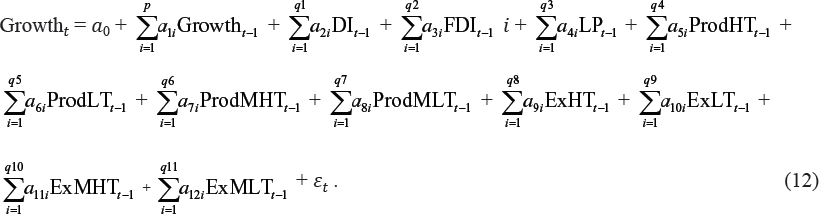
The orders of the ARDL model (p, q1, q2, q3, q4, q5, q6, q7, q8, q9, q10, q11) in the 12 variables are selected by using AIC. Following the studies of Narayan and Smyth (2008), we obtain the short-run dynamic parameters by estimating an error correction model associated with the long-run estimates. The error correction model results indicate the speed of correction or adjustment of the considered model back to the long-run (said) equilibrium following a short-run shock. So, in the final step, we achieve the short-run dynamic parameters by estimating an error correction model associated with the long-run estimates, that is, ARDL (p, q). This is specified as follows:

where
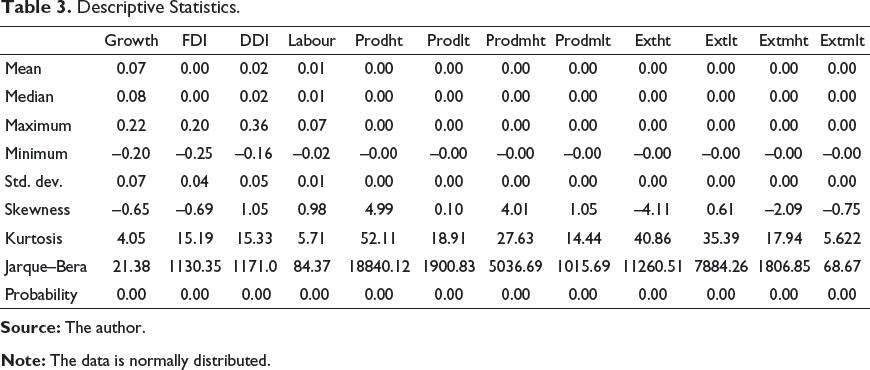
Descriptive Statistics.
Unit Root Test.

Unit Root Test.
Cross Section Diagnostic Test.

Panel EGLS (Cross-Section SUR).
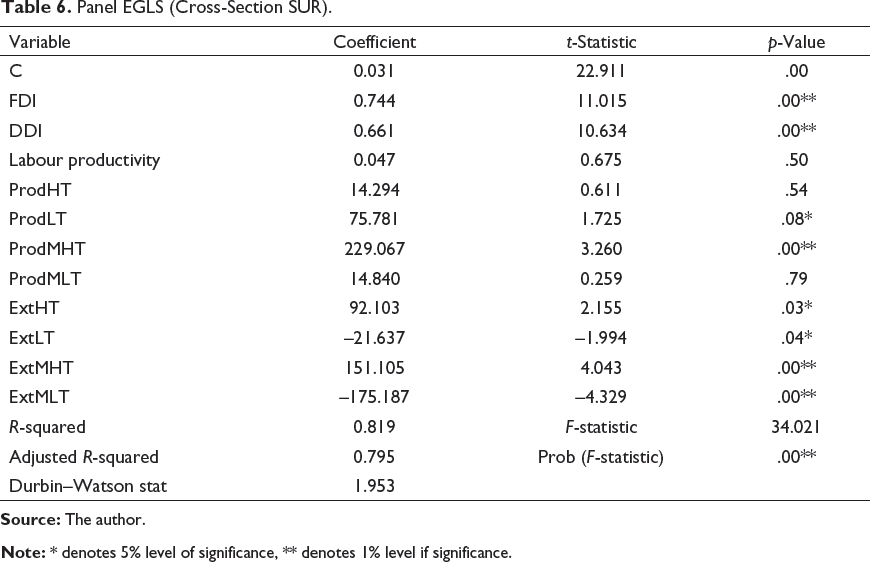
In terms of export externality, the impact is significant for all technology sectors but is negative for LT and MLT exports to increase domestic output. Thus, productivity of the technology sectors except HT and MLT sector promotes exports while domestic output is also enhanced through HT and MHT sectors and not the LT and MLT sector. Thus, it is primarily the LT sector which contributes to exports from these nations and MHT which leads to rise in domestic investment in these sectors.
Country wise Competitiveness of Technology Exports.
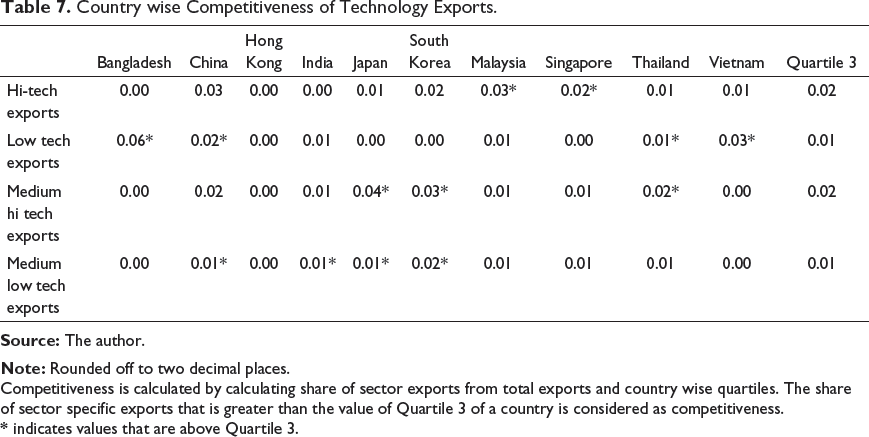
Competitiveness is calculated by calculating share of sector exports from total exports and country wise quartiles. The share of sector specific exports that is greater than the value of Quartile 3 of a country is considered as competitiveness.
* indicates values that are above Quartile 3.
Stationarity for Time Series (ADF Test).
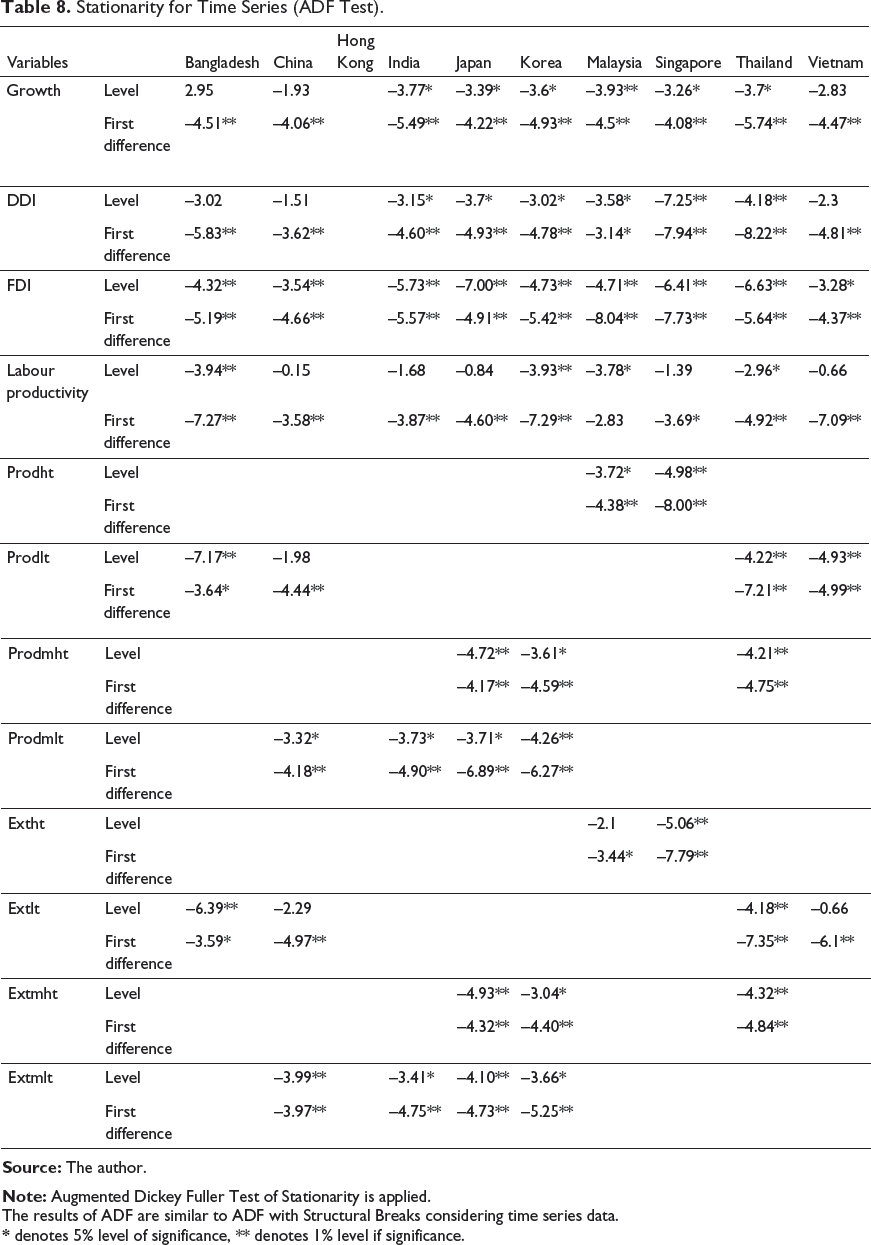
The results of ADF are similar to ADF with Structural Breaks considering time series data.
* denotes 5% level of significance, ** denotes 1% level if significance.
Stationarity for Time Series (Fisher-PP Test).

ARDL Bound Cointegration Test.

ARDL Estimated Long Run Coefficients and Error Correction Term.
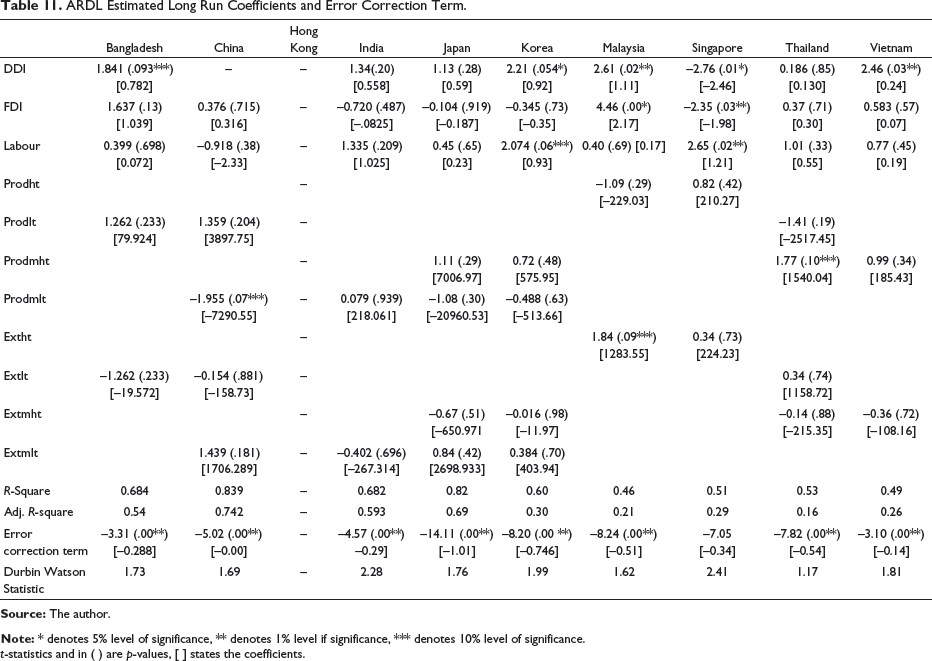
t-statistics and in ( ) are p-values, [ ] states the coefficients.
Serial Correlation LM Test, Breusch-Pagan-Godfrey Heteroskedasticity Test and Ramsey RESET Test.
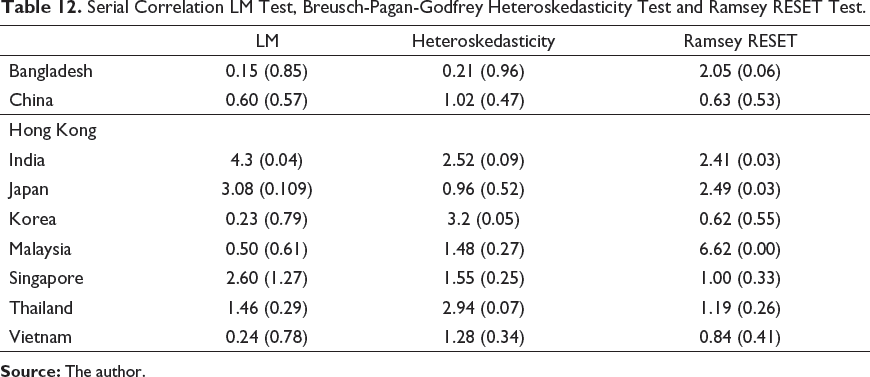
The coefficient of ECM is significant at 10 per cent level for all selected nations and is negative, which implies that the speed of adjustment to equilibrium after a shock is relatively fair. The overall model is robust as value of R-square and Adjusted R-square is moderate and there is no autocorrelation as per the Durbin Watson statistic. The regression for the underlying ARDL Equation (13) fits very well and the model is globally significant. It also passes all the diagnostic tests against serial correlation (Breusch-Godfrey-test) and heteroscedasticity (White Heteroskedasticity-Test) as well as the Ramsey RESET test. All the results of these tests are shown in Table 12. The stability of the long-run coefficient is tested by the short-run dynamics. The estimated long run coefficients for each country suggest that the Government’s liberal policies relating to foreign investments, domestic investments, technology exports and labour productivity influences growth of a nation.
In case of Bangladesh, the government should focus on formulating export led fiscal policies to enhance exports and growth. While in China, it has been seen that over the years exports have shifted towards more technological sectors (Rodrik, 2006; Schott, 2008). There has also been a shift in FDI inflows towards export sectors. Thus, China should focus more towards skill development policies for enhancing labour capabilities and enhancing technology sectors in manufacturing and exports.in case of India, the government introduced a policy on ‘Make in India’ in 2014, which aims at enhancing investments, enhancing research and development, promoting innovation and skill development. In order to enhance exports from the technology sectors, this scheme may be focussed on enhancing production of high-tech sectors through coordinated strategy and strengthening domestic manufacturing. FDI in technology sectors can be promoted through incentives and rebates on taxes and interest rates. Recently, Thailand has emerged as a preferred source of original equipment manufacturing in sectors like automotive, electronics & electrical appliances and processed food. Due to lack of advanced technology, the share of high-tech exports has considerably declined. There is an urgent need for Thailand to shift the manufacturing base towards high value products with greater involvement of technology. A policy directed towards creating a value-based economy and implementing technology with inclusive growth is the need to the hour for Thailand. FDI in Vietnam is largely unfocused (Freeman, 2002; Kokko et al., 2003). Though the Government of Vietnam has invited foreign investments, it has been stated that this has led to trade deficit in Vietnam. It is suggested that Vietnam recognises its place in the value chain and policies to attract investment in sectors which have cost advantage in Vietnam. Policies for skill development need to be formulated which facilitate economic growth by adoption of advanced technologies. It is also suggested that domestic investment should be targeted towards development of infrastructure and education as it will lead to attracting higher FDI and also increasing exports and thus leading to economic growth of Vietnam. In other words, policy makers need to develop strategies that will enhance the country’s absorptive capacity. Singapore has been very successful in this regard and policy makers in Vietnam should consider utilising some of the successful Singaporean strategies in Vietnam. In case of Japan as medium technology exports have a significant impact on growth, South Korea’s exports are low in value content (Dahlman & Andersson, 2000). South Korea has to learn from Japan in order to manufacture world class products with high precision and quality (Shibata, 2006). Policies for quality enhancing manufacturing processes and competitive technologies need to adopted in South Korea. While for Japan, the high-tech sector is the next milestone.
In this article, ARDL bounds test is used to determine whether there is link between growth, investment, labour productivity and technology exports on the selected Asian economies namely, Bangladesh, China, Hong Kong, India, Japan, South Korea, Malaysia, Singapore, Thailand and Viet Nam. It is observed that Domestic Investment LT, MLT and MHT exports are significant and positive for the selected countries with LT exports being most dominant followed by MHT and then MLT exports. Foreign investments and labour productivity are insignificant. In terms of externalities, it is seen that it is primarily the MLT sector which contributes to exports from these nations. Each technology sector is expected to have different impact on economic growth of each selected country depending upon the composition of exports. Thus, it can be inferred that indigenous and foreign investment and manufacturing led growth can be seen in China, Japan, Korea, Singapore, Malaysia and Thailand. In case of Bangladesh Korea, Singapore, Malaysia and Vietnam, domestic investment led growth is observed, with labour productivity being dominant for growth only in Korea. With respect to sector specific technology exports, the impact is significant only for China of MLT exports and Thailand for MHT exports. The results indicate that exports are important in positively affecting economic growth, indicating that economies should formulate policies which promote trade, adopt favourable exchange rate polices, provide greater benefits for exports and implement WTO compliant subsidies. As the externalities for each of the country is insignificant, it can be inferred that primarily production of technology products is for exports rather than for domestic consumption leading to rise in imports as and when demand arises and thus adding to trade deficit. Thus, the Asian economies in totality should focus on devising and implementing economic policies, investment policies, labour reforms and trade promotion policies which lead to strengthening of existing infrastructure and production facilities to create a basis for national development along with strengthening the human capital base.
Footnotes
Declaration of Conflicting Interests
The author declared no potential conflicts of interest with respect to the research, authorship and/or publication of this article.
Funding
The author received no financial support for the research, authorship and/or publication of this article.