



Abstract
Although the monetary policy impact on inflation is deliberated intensively in economic literature, the fiscal policy impact has not gained much interest, particularly in the developing countries. The later issue is theorised as the fiscal theory of price level. This article examines the potency of fiscal factors relative to the money growth in inflation in Sri Lanka for an extended period 1965–2018, and also for the post-reform period 1977–2018. The inflationary impacts of public debt, budget deficit and public expenditure, in association with money growth and a few control variables are assessed rigorously. The results of the vector autoregression model estimations involving different combinations of these variables reveal that fiscal policy instruments are, in general, inflationary while no significant impact of money growth on inflation is found. Besides, the analyses of impulse response functions and variance decomposition of inflation corroborate that the external debt, budget deficit and public expenditure are potent factors amplifying inflation. The impacts of money and control variables are trivial. These findings are invariant over the samples and justify that an active fiscal and a passive monetary policy are operative. Managing the budget deficit and growing dependence on public debt is a critical policy issue in Sri Lanka.
Keywords
Introduction
Inflation impacts the economic growth, employment, investment and welfare level of ordinary people. Controlling inflation is one of the main concerns of macroeconomic policymaking. The economic theory asserts that several factors cause inflation. Historically, the role of money supply in inflation is intensively discussed by the various schools of thought with some controversy. A surge of empirical researches has been carried out to corroborate the controversial views from countries’ perspectives.
Apart from the monetary policy, the role of fiscal policy instruments in inflation variations has attracted the attention of economists since the 1980s. Sargent and Wallace (1981), in their seminal paper, have advocated that the effectiveness of monetary policy in controlling inflation critically depends on its coordination with fiscal policy. More coherently the fiscal theory of the price level, FTPL (among others, Cochrane, 1998, 2001, 2005; Leeper, 1991; Sims, 1994; Woodford, 1994, 1995, 2001), assumes that price level is determined by fiscal policy instruments, such as debt, deficit and the present as well as the future tax-spending arrangement of people, with no direct reference to monetary policy.
The FTPL takes into account monetary and fiscal policy interactions and propounds that fiscal policy may determine the price level even if inflation-targeting monetary policy is operative. It recognises the ‘wealth effect’ of government debt as an additional channel of fiscal policy to affect the price level or inflation. In the short run, when public debt rises, consumers resort to higher spending. They become profligate and consume more with the increased inflow of government borrowing. This increases the demand for goods and services, which, in turn, increases output and employment as prices are sticky in the short run.
Besides, as the marginal propensity to consume is higher than the marginal propensity to save, the private savings fall, and consequently, the real interest rate rises. A higher interest rate in the long run keeps away private investment, which, in turn, leads to lower steady-state capital stock. This may necessitate further borrowings. The overall impact in the long run, therefore, includes smaller total output, lower consumption and higher price level. Besides, a higher level of public debt causes an increase in the present and future money growth and provokes price level. Nevertheless, some critical appraisals of the FTPL can be found from Buiter (2002) and McCallum (2001). Buiter (2002) views the FTPL as a ‘fundamental economic misspecification’. Empirical evidence on the FTPL is inconclusive in countries concerned.
Applied economic research, since the last three decades, has increasingly been giving emphasis to the role of fiscal variables in determining inflation in countries concerned. In the case of Sri Lanka, few studies have examined the role of monetary factors in inflation (Bandara, 2011; Cooray, 2008; Kulatunge, 2017; Maitra & Debnath, 2015; Ratnasiri, 2011). However, the role of fiscal factors in inflation is scantly documented. A few studies provide contradictory evidence of deficit–inflation linkages in Sri Lanka. Kulatunge (2017) finds an inflationary effect on public expenditure. Ekanayake (2012) reports inflation in Sri Lanka is not entirely a monetary phenomenon as budget deficit also amplifies inflation.
Although the country-specific study to reveal the impact of debt, deficit and openness on inflation in Sri Lanka is very limited, few researchers in their panel study to analyse the fiscal impact on price level have included Sri Lanka as a sample country. Among these, Nguyen (2015) studies the impact of fiscal deficit and broad money supply on inflation in nine Asian countries, including Sri Lanka over the period 1985–2012. The study reveals that the fiscal deficit, government expenditure and interest rate are significant determinants of inflation.
Apart from Sri Lanka some significant country-specific studies concentrating on the fiscal impact of inflation, Canzoneri et al. (2001) find that FTPL propositions are rejected in the US data. Subsequently, Creel and Bihan (2006) also have not found evidence to support a FTPL interpretation in the US, Germany, France, Italy and the UK. Bhattarai et al. (2014), based on the theoretical and empirical evidence have concluded that the impact of public debt on inflation depends on the monetary and fiscal policy regimes. The inflationary impact of public debt in India is reported by Maitra and Hossain (2020). The role of fiscal policy instruments on inflation is researched in the framework of panel data by Fischer et al. (2002), Catão and Terrones (2005), Domac and Yucel (2005), Kwon et al. (2009), Faragila et al. (2013) and Lin and Chu (2013). These studies provide mixed evidence.
To the best of our knowledge, research study designed to identify exclusively the impact of fiscal factors, such as the deficit, public debt and public expenditure in inflation variations in Sri Lanka does not get much attention. A study on the fiscal impact in association with money supply and a few control variables on the price level are important in developing countries like Sri Lanka where growing dependence on public debt in a weak fiscal situation is observed (as reported, among others, by Weerakoon et al., 2019; Maitra, 2019). Under this backdrop, this study assesses the inflationary impact of fiscal policy instruments in association with money supply and some control variables. We are motivated by the fiscal theory of price level and attempt to assess how far inflation in Sri Lanka is fiscal-driven. Specifically, the inflationary impact of total debt, as well as its components–external, domestic debt, budget deficit, public expenditure, money growth, foreign aid and trade openness on Colombo consumers’ price inflation (official measure of inflation in Sri Lanka) is explored for an extended period 1965–2018 in general, and the post-reform period 1977–2018 in particular. We believe that an identification of the potency of fiscal factors in comparison to money growth in inflation is a critical issue, particularly to design and implement the appropriate anti-inflationary macroeconomic policy for the economy.
The rest of the article is structured as follows: Section II presents data and methods followed by Section III, which includes the results and discussion. The article ends with Section IV, presenting the conclusion and policy implications.
Data and Methods
Data Description
A dataset of nine variables namely, CCPI inflation (year-on-year),
Time plot of the inflation series is shown in Figure 1. It reveals significant volatility around the mean value of 8.9% over the period 1965–2018. In the post-reform period, inflation is recorded as 10%. The pre-reform period (1965–1977) exhibits a moderate inflation with an annual average of 5.02%, followed by a high inflationary phase seen particularly over the period 1978–2008, where inflation jumps to 22.56% in 2008. However, after the great global recessionary period, 2010–2018, annual inflation comes down significantly. Such a decline in inflation is no doubt a positive development, but the issue is to maintain low inflation for the future. Accordingly, factors impacting inflation and appropriate policy to stabilise inflation need to be specified.

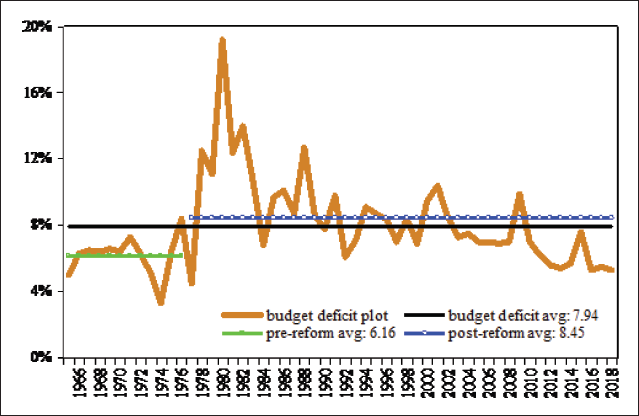
Among the potent fiscal variables, a time plot of the budget deficit is shown in Figure 2. It reveals that Sri Lanka has realised an overall 7.94% budget deficit over the period 1965–2018 which, however, has increased slightly in the post-reform period, and becomes 8.45%. The country has relied on public debt over the last four decades. The growing stock of public debt in a weak fiscal situation of the country put forth pressure on the fiscal, monetary and external sectors policies. We have noticed over the period 1965–2018, the total debt has grown by 6.2% per year, where the external debt grows at the rate of 8.48%, and the domestic debt at 5.38%.
Methods
To assess the causal impact of the fiscal variables along with money and selected control variables on inflation in Sri Lanka, the study involves the vector autoregressive (VAR) model, followed by the analysis of impulse response functions and variance decomposition of inflation. As the estimation of the VAR model requires stationary variables, we have checked the stationary property of the selected variables involving the augmented Dickey–Fuller (ADF) and the Phillips–Perron (PP) unit-root tests. In the event of the stationarity of these variables, we have estimated the VAR model.
To state an estimable form of VAR model, let us consider three fiscal determinants of inflation namely,

In the above equation
The appropriateness of the VAR models is diagnosed involving tests of the functional form, serial correlation and heteroscedasticity of residuals of the estimated equations. 1 An appropriately determined VAR model can identify the ‘Granger causality’ among the endogenous variables. Specification of such causality would identify a theory from several controversial linkages. Nonetheless, the relations between the variables in a VAR are sometimes difficult to see directly from the parameter matrices. To resolve such issues, impulse response functions are often used to portray complete interactions between the variables of the VAR system. Therefore, involving the impulse response analysis, we have captured the variations of inflation due to the fiscal and monetary innovations. Finally, a variance decomposition analysis identifies the relative role of the monetary and fiscal policy instruments explaining inflation variations in the near future.
Results of the Unit-Root Tests.

Results of the Unit-Root Tests.
Representation of the VAR Models.

Inflation Equations of VAR–1 to VAR–4 Models.

Inflation Equations of VAR–5 to VAR–8 Models.

We have found that for the extended period, the growth of public debt in total, with a lag period of 3 years, amplifies inflation. Such impact for the post-reform period significant at the 10% level in the case of VAR–4, 5 and 8 models, and the 5% level in VAR–7; indicates that the impact is rather weak. Importantly, the budget deficit has a substantial inflationary impact. This impact is prominent even across the estimations of each of the sample periods. Besides, the two-period lagged growth of public expenditure also has an inflationary impact. Importantly, in these estimations, no significant inflationary impact of the money growth is observed. Besides, no significant impact of foreign aid and trade openness is found in the estimations for the extended period, while in the post-reform period the inflationary impact of these two variables is noticed. Nevertheless, statistically significant positive estimates of the lagged inflation in a few estimations reveal that inflationary expectations amplify current inflation.
At the outset, we attempt to confirm which component of total debt is stimulating inflation. So, relative impacts of the external and internal debt (with the budget deficit, public expenditure, money growth, trade openness and foreign aid) on the inflation variations for the extended period are studied by estimating VAR–9 to VAR–12 models. Such dynamics for the post-reform period are captured by estimating VAR–13 to VAR–16 models. Table 5 reports the estimated inflation equations for the extended period, while Table 6 reports the same for the post-reform period. Like the previous estimations, a lag-length three is found to be the optimum here. Besides, the results of the diagnostic tests confirm that estimations are appropriate.
In both samples, lagged external debt ‘Granger causes’ and stimulates inflation, while domestic debt fails to exert any appreciable impact. Most of the empirical studies on debt-inflation literature show that high debt is inflationary particularly, in the developing or highly indebted countries (Fischer et al., 2002), and in this respect our finding is reasonable. The budget deficit with a lag period of 2 years causes a rise in inflation in the extended and the post-reform period. Empirically the inflationary impact of the deficit particularly in the high inflation regime is reported by several influential studies like Catão and Terrones (2005), Lin and Chu (2013). Moreover, our study identifies the inflationary impact of public expenditure and also reveals the somewhat inflationary impact of trade openness.
So, the above analyses successfully uncovered an overall significant inflationary impact of public debt accumulation and particularly its external component. Importantly, the budget deficit and public expenditure have also amplified the inflation index, and these impacts are found to be robust across the samples. Nevertheless, inflationary impact of money growth is not found.
Inflation Equations of VAR–9 to VAR–12 Models.

Inflation Equations of VAR–13 to VAR–16 Models.

Further, public debt and deficit may provoke inflation through the interest rate channel. However, such impact is controversial in the theoretical literature. Our findings of inflationary impact of debt and deficit and an insignificant impact of money are the indication of the passive monetary and active fiscal regimes operative in Sri Lanka. Such a notion is elaborated theoretically by Bhattarai et al. (2014) that under a passive monetary and active fiscal regime, a significant impact of public debt is found and fiscal policy matters for inflation dynamics, where inflation deviates from the target set by the central bank.
The Impulse Response Analysis
To corroborate the dynamic impacts of debt, deficit, public expenditure and money growth on the inflation across the sample periods, an analysis of impulse response functions is presented. We have presented the dynamic responses of the inflation with 95% confidence interval lines due to the impulses of each of the fiscal variables and money supply innovations of the estimated VAR–9 to VAR–12 2 for the extended period. 3 The same functions for the post-reform period are obtained from the VAR–13 to VAR–16 models. These describe the evolution of inflation along a longer time horizon after a shock in each of the endogenous innovations of the estimated VAR models.
The Effect of Inflation Innovation
Four impulse response functions of inflation due to its own innovation derived from the VAR–9 to VAR–12 models are presented through Figure 3a–h. These reveal that inflation significantly responds due to its innovation at the impact period which possibly due to the inflationary expectations. Similar impulse response functions for the post-reform analysis done through VAR–13 to VAR–16, as presented in Figure 3e–h, reveal similar pattern of response.

The Effect of Debt Innovation
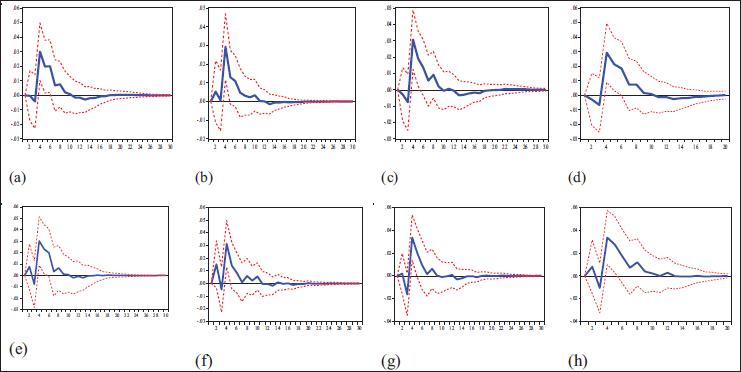
Figure 4a–d show the responses of inflation due to debt innovations. These are derived from the VAR–9 to VAR–12 models respectively. The inflation responds positively to a shock in external debt. Such response in the initial period is weak but reaches the maximum level at the lag period of 3 years. We have found a similar nature of response of inflation in the post-reform period’s analysis, depicted through Figure 4e–h. In short, the external debt innovation produces inflationary pressure in Sri Lanka.
The Effect of Deficit Innovation
The time plot of responses of inflation due to budget deficit innovation for the extended period(based on VAR–9, 11, 12) are presented through Figure 5a–c; while that for the post-reform period (VAR–13, 15, 16) are shown in Figure 5d–f respectively. It is evident from these figures that the inflation responds significantly due to these innovations. Specifically, during period 2, inflation has picked up to the maximum level but falls subsequently and gradually becomes frail. This nature of responses is invariant over the two samples. So, the impulse response analysis corroborates that budget deficit has an inflationary impact.

The Effect of Expenditure Innovation
Inflation is also impacted significantly due to innovation transmitted through the public expenditure channel. Specifically, one standard deviation innovation of public expenditure, as shown in Figure 6a for the extended period and Figure 6b for the post-reform period, pushes-up inflation from the baseline with a lag-period of two, but subsequently becomes frail.

The Effect of Money Innovation
The responses of inflation due to money growth innovation of the VAR–12 (for the extended period) and that of the VAR–16 (for the post-reform period) are presented through Figure 7a, b, respectively. It is evident here that money innovations are frail and could not produce an appreciable impact on the inflation variations (due to high standard errors). This finding re-establishes that the monetary policy is passive to impact inflation.

The Variance Decomposition Analysis
Variance Decomposition of Inflation.

Variance Decomposition of Inflation.

The article explores the inflationary impact of the fiscal policy instruments, in association with money growth in Sri Lanka for an extended period, 1965–2018, and furthers the post-reform period, 1977–2018. Involving VAR model, followed by the analyses of impulse response functions and variance decomposition, the impact of public debt in general and its components, budget deficit, public expenditure, money growth, along with few control variables, on the inflation are assessed.
The results provide comprehensive and robust evidence supporting that the increase in government debt and the deficit is typically inflationary. The growth in external debt is significantly and strongly associated with inflation, while the impact of domestic debt is trivial. The budget deficit and public expenditure are also found to be inflationary, while money growth fails to produce an impact. Besides, the two control variables—trade openness and foreign aid rather aggravate inflation. Estimated impulse response functions trace out the transmission mechanism that a real innovation to debt, deficit and public expenditure, in addition to inflation innovation has a positive and persistent impact on inflation. All of these findings are almost invariant over the extended and the post-reform periods. Finally, the variance decomposition analysis corroborates in the constitution of variance profile of inflation in the near future, where external debt, deficit and public expenditure would play the major role and prove consistent with the impulse response analysis.
In short, the study finds evidence that fiscal policy is active and inflation in Sri Lanka is fiscal dominating. Accordingly, the Central Bank’s control on inflation may be challenging unless the fiscal stance of Sri Lankan government is consistent with the Central Bank’s policy of price stabilisation. Thirty year-long internal conflicts seriously affected Sri Lanka’s fiscal strength. The high fiscal deficit and rapidly accumulated public debt worsen the fiscal scenario. Reducing the deficit and growing dependence on the public debt, particularly external debt, are critical policy issues. Rules-based fiscal policy may be useful to limit the size of budget deficits or debt and could safeguard price stability to some extent.
Footnotes
Acknowledgements
The authors would like to acknowledge and thank anonymous reviewers of this journal for their comments to improve the quality of the article. The usual disclaimer applies.
Declaration of Conflicting Interests
The authors declared no potential conflicts of interest with respect to the research, authorship and/or publication of this article.
Funding
The authors received no financial support for the research, authorship and/or publication of this article.
