



Abstract
Fifty elders of the United Arab Emirates (UAE), recalling life before nationalisation in 1971, were interviewed to gain insight into their attitudes and beliefs as part of an investigation into how those beliefs are reflected in modern priorities of the UAE. The UAE was considered one of the poorest countries in the mid-1900s. Yet, after independence, utilising revenues from newly found oil reserves, a modernisation plan catalysed rapid development. For the UAE, holistic sustainability, encompassing cultural, economic, social and environmental dimensions, became the model for continued economic and political stability in a troubled region. The findings of the study revealed that the elders valued family closeness and education, depending on the contributions of women in society. These concepts carried forward into modern policies and legislation and emphasised by the leadership of the UAE to maintain cultural uniqueness yet thrive in the global social and economic environment.
Introduction
The current study was carried out to address the recommendation of a joint research study (referred to in this report as Job Satisfaction Study) carried out by the researchers belonging to a Federal Higher Education Institution in the UAE and the Ministry of Labour, now known as the Ministry of Human Resources and Emiratisation (MoHRE) utilising a team of Emirati college students (Sharif, Daleure, & Alaskar, 2013). The Job Satisfaction Study investigated whether, and to what extent, job satisfaction contributed to the rising Emirati unemployment in a country in which nearly 90 per cent of the labour force consists of foreign labour and in which the private sector is the fastest growing in the region (The World Bank, 2014).
Findings of the Job Satisfaction Study (Sharif et al., 2013) indicated that, although saturated, Emiratis prefer to work in the public sector for three reasons: (a) salaries were perceived to be higher in the public sector than in the private sector, (b) benefits were perceived to be more generous in the public sector than in the private sector, and (c) most importantly, many Emiratis, especially Emirati women, were dissatisfied with working conditions in the private sector. The main reasons for dissatisfaction are: Western-based business practices used in most private sector companies which are often at odds with Emirati cultural practices and sensitivities. Recent studies by AlAli (2013), Behery (2009), Shallal (2011), Sharif (2013) and Toledo (2013) reported similar findings and added that many private sector employers preferred employing expatriates who were accustomed to Western business practices and perceived to be willing to tolerate in less desirable working conditions than most Emiratis do. Therefore, despite concerted efforts to incorporate Emiratis into the private sector—a practice known as Emiratisation—the number of Emiratis employed in the private sector remained low (around 4% in 2012), while Emirati unemployment, particularly youth unemployment, was estimated at approximately 12 per cent in 2012 (Alali, 2013; Quandl, 2014; Sharif, 2013; The World Bank, 2014).
The current study (referred to here as Ethnography Study) examines the experience, attitudes and beliefs of the elder generation—those with recollection of life before nationalisation in 1971—to understand the basis of the modern Emirati identity, cultural practices and sensitivities. Recent studies including AlAli (2013), Daleure, Albon, and Hinkston (2014), and Daleure, Albon, Hinkston, Ajaif, and McKeown (2013) found that as a society with tribal roots, elders have an enormous influence on important educational, career and employment decisions of young adult members. However, the progressive generations lived during different phases of economic growth and experienced a different set of circumstances. Daleure, Albon, and Hinkston (2014), supported by Ahmed (2011) found that well-meaning older family members, recalling their own experiences, often influenced career decisions of younger family members and ultimately discouraged them from entering private sector employment even when unemployment was the result.
Therefore, the purpose of this study, the Ethnography Study, is two-fold. First, the study explores the ways so that elders’ experience, attitudes and beliefs could be incorporated into the country’s economic and social model as described in the United Arab Emirates (UAE) Vision 2021 (United Arab Emirates [UAE] Government, 2010). It also highlights the ways in which core traditional values have been re-engineered to fit into the modern Emirati social and economic context and identifies ways in which discrepancies in the model and actual practice have impacted the Emirati experience. Second, the study identifies recent policy and legislation that incorporates elements identified in the ethnographic study into creative and timely solutions, bridging the generational gap and counteracting the pressure of global citizenship towards identity loss among the more recent generations.
To understand the attitudes, beliefs and opinions of the elders which may influence the more recent generations, the current study interviewed 51 Emirati elders and constructed individual ethnographic narratives using Spradley’s (1972) multiple layer approach to construct insightful glimpses into the experiences of individual Emiratis who recalled life before nationalisation. The individual ethnographic narratives were then used to construct theme-based composite ethnographic narratives which were analysed using methods set forth by Denzin and Lincoln (2000).
The resulting thematically presented ethnographic composite encapsulated the beliefs, attitudes and opinions of the oldest remaining Emirati generation which are still venerated and exert influence on the lives of the consecutive generations. Excerpts from the individual narratives and the ethnographic composite are presented in the Findings section of this article. By presenting and understanding the experiences of the elders who potentially influence important decisions of the younger generations, policymakers and other stakeholders such as educators, employers and others can develop more effective policies to encourage more holistically sustainable development that are complementary to the Emirati tribal family system rather than contradictory to it.
The UAE Vision 2021 (2010) document emphasises that economic sustainability cannot be achieved in isolation of cultural, environmental and social sustainability exemplifying the holistic sustainability model which is widely accepted by sustainability scholars including Sharma and Ruud (2003). Further, sustainability scholars including Warburton (2003) advocate that holistically sustainable practices encompassing all four dimensions, like those described in the UAE Vision 2021, must be integrated into the corporate environment and be promoted at all levels of the education system for sustainable development to take place.
Emiratization in the UAE Labor Market: Opportunities and Challenges (Daleure, 2017), a recent book, explains that sustainability must include employment of Emiratis in the private sector where most jobs are available, especially as the labour market adapts to the transition from an oil-producing economy to a more diversified economy driven by private sector expansion. Private sector employers must realise that in order to thrive and contribute to the overall economic stability of the region in which they do business, they must employ the indigenous people (AlAli, 2013). Therefore, to achieve sustainable development, the private sector work environment must be made more attractive to Emiratis, and Emiratis of all ages must be educated about the importance of engaging in private sector employment (Daleure et al., 2014).
This article is divided into five sections: Literature review, Methodology, Findings, UAE policy challenge: Bridging the generation gap and rapid global emersion, and Conclusion. The ‘Literature Review’ section presents a brief background of the UAE describing important historical and recent economic and social developments. The ‘Methodology’ section describes the ethnographic method used to gather the data, the procedure for constructing individual ethnographic narratives and the theme-based categorical analysis method used to construct the ethnographic composite. The ‘Findings’ section presents individual and composite results and discusses links to the central themes of the study. The ‘UAE policy challenge: Bridging the generation gap and rapid global emersion’ section identifies recent policy and legislation that utilises the elder perspectives to address modern day issues, at the same time, bridging the generational gaps in UAE society. The ‘Conclusion’ section summarises themes gleaned from the Ethnographic Study and how they have been utilised by policymakers, educators, social service workers and others to enhance policies that can increase the holistic sustainability of the UAE.
Literature Review
The first part of this section provides a brief historical background of the UAE, highlighting important cultural, economic, social and environmental aspects of life before nationalisation in 1971 up to now. The second part of this section discusses the term holistic sustainability, references important ways that holistic sustainability has been incorporated into the UAE context, and identifies potential contextual challenges.
Background
The area, now known as the UAE, has been a regional trading thoroughfare between East and West for several thousands of years (Alsayegh, 2001). Artefacts found in dug sites around the county originated from ancient civilisations of many regions of the world including India, Greece, Rome, Persia, Africa and China (Goulding & McEwin, 2008; Jasim, 2012; Mansour, 2013).
Despite the meagre natural resources available in the harsh desert environment, the inhabitants of this area maintained a relatively healthy living through trade, mainly based on pearling, and income from tolls imposed on traders and travellers using the waterways. However, this scenario changed in the late 18th century when ‘partly out of misunderstanding and partly out of arrogance, the British refused to pay these tolls’, for which the local inhabitants retaliated by raiding the British ships, ‘an act the British considered piracy’ (Onley, 2005, p. 30).
Dr Sultan AlQasimi (1988), the ruler of the Emirate of Sharjah, and a noted historian and author, wrote The Myth of Piracy in the Gulf using official documents of the time illustrating that British captains, political agents and other writers, including Lorimar, Kelly, Wainwright, Bartlett, Warden and others, often reported conflicting and distorted accounts. According to AlQasimi, the goal was to ‘present or rather misrepresent, the Qawasim [local inhabitants] as pirates whose depredations posed a serious threat to all maritime activities in the Indian Ocean and adjacent Ocean’ (p. xv). Onley (2005) concurred that the ultimate British objective was to rule the waterways by ‘informal control if possible, formal control, if necessary’ (p. 33). The goal was achieved when the local rulers were pressured to sign the Perpetual Maritime Truce in 1853 granting the British control of the waterways and creating the British Protectorate called the Trucial States, although the region was often referred to as the Coast of Oman. This was followed by the Exclusivity Treaty of 1892, denying inhabitants of the area ‘any rights to receive representatives from any foreign powers other than the British’ without the British pre-approval (Alsayegh, 2012, p. 253). This policy effectively isolated the Trucial States from the developments occurring in the rest of the world at the time.
One group that was allowed to enter the Gulf region were missionaries from the American Mission, also known as the Arabian Mission, who under the guise of providing much needed medical care and education to the underdeveloped area, intended to ‘infiltrate the Arabian Peninsula and evangelise it on the basis that it was once an important part of the Christian world’ (Alsayegh, 2012). Timothy Harrison, son of Paul W. Harrison, the missionary doctor, remarked that the mission sought to ‘go inland and make converts among the Moslems in central and Western Arabia, …“the goal of our hearts desire”’ (Harrison, 2008). To do this, the Mission employed wives of male missionaries with medical training to gain access to the Arab Gulf society by gaining access to the women (Alsayegh, 2012).
Dr Hoda Elsaadi (2012), an Arab historian, stated that missionary accounts usually portrayed Arabian Gulf women as ‘uneducated, economically inactive and oppressed in ways unknown in the West … shackled by unchanging social norms based on a conservative religion and traditional values’ (p. 151). Dr Amira Sonbol (2012), supported by AlQasimi (2011), Alsayegh (2012) and Elsaadi (2012), maintained that caution should be exercised when using missionary accounts, travel writings and political documents to understand the history of the Gulf. Although helpful in providing detailed descriptions of everyday life of the region, many contain serious biases and contributed to the perception of life in Arabia as backward and uncivilised. ‘Eastern Arabia has been dealt with as an area history-less before the modern period’, so the orientalist imagery, perhaps exaggerated, was eagerly accepted by readers. Sonbol gave the example that when using non-textual representations of events, like period photos or sketches, drawn by an observer, researchers often found ‘surprising results, often in stark contrast to the conclusions reached by the very [person] who told the story’ (p. 8).
Dr Fatima Alsayegh, an Emirati historian, used period documents including missionary reports and political documents to write historical accounts of life in the Trucial States from the 1880s to the early 2000s. Alsayegh (1998) noted that in the early 1900s, despite the isolationist practices of the British, the region experienced an economic boom as the trading hub shifted from the Arab towns on the Iranian side of the Gulf to the emirates of Sharjah and Dubai. To increase the benefits to the region, Shaikh Maktum, the ruler of Dubai at the time, ‘took progressive measures to encourage local businesses and attract foreign trade by abolishing taxes’ (ibid., p. 90). The economic boom attracted ‘great human migrations in the form of labourers and settlers to the area’ (Alsayegh, 2001, p. 18). However, under the protectorate system, all trade was allocated only to ‘local Arab, Persian, and Indian merchants with trading houses’ approved by the British government in India (Onley, 2005, p. 37).
Pearling expeditions were mostly funded by Hindu merchants, as money lending for profit was not allowed in Islamic religion. The Hindu investors settled in their own separate communities along the coastal areas in Sharjah and Dubai. Indian investors and merchants imported products that could not be produced locally, such as textiles, jewellery, spices, tea, other food items and luxury goods, from India and distributed them, along with cash advances, as loans against the pearl receipts at huge profits. According to Alsayegh (2001), ‘Indian influences as imparted on ladies’ clothes, cuisine, and adornment items … all left their mark’ but the two communities did not integrate as they had differing belief systems, history, customs, languages and cultures (p. 19).
The indigenous Arab inhabitants retained their own cultural identity and tribal social structure with each group of extended families supporting each other socially and economically. An elder male was the family leader with less senior males serving important familial functions and women significantly contributing to tribal affairs although ‘mostly from behind the scenes’ (ibid., p. 19). Large families were desired as child mortality by age 4 was high at around 12 per cent, while the average life expectancy was low at approximately 40 years old (p. 21). Marriage was encouraged at the onset of puberty with girls as young as 12 years old marrying boys as young as 17 years old. Divorce was not considered a shame, and multiple remarriages after divorce were common for both men and women. Widowhood was not considered a virtue, with widows encouraged to re-marry after the proscribed waiting period. Polygamy was common among rich men, seeking to secure their social status. Children learned to read Arabic in Quran schools operated by local inhabitants usually in the mosque or under a tree for boys or in homes for girls (Alsayegh, 2012; Elsaadi, 2012).
Although according to local perspectives and Islamic teachings, women were afforded elevated status wielding enormous influence in the home and managing the family during the extended absence of men, women were characterised by female missionaries in the derogatory terms (Alsayegh, 2001; Elsaadi, 2012). One missionary woman remarked, ‘During my stay in Arabia, which was around 16 years, I have not seen a single Arab house in which the relationship between man and woman was such as a Western woman would tolerate’ (Alsayegh, 2012). Such examples sent back to common people in Western countries were designed to elicit a specific negative sentiment towards the region and justify the extended intervention of foreign powers (AlQasimi, 2011).
Life in the prosperous time of the early 20th century was characterised by relative abundance. The income from trade and pearling allowed for the purchase of necessities of life that were not producible in the harsh desert environment (Alabed, Vine, Hellyer, & Vine, 2008). In the cities, commoner women often worked in public alongside the men, while upper-class women managed their households from seclusion with an abundance of servants to perform the routine chores. At this time, most women produced most household items from raw materials found in the environment, such as palm fronds used to make houses, mats and textiles made from camel hair, and food items such as fish and milk products from goats and camels, in a unique, sustainable manner. In the desert-dwelling communities, women and the work they performed were considered essential for the continuation of the tribe as most men were away for up to 6 months at a time every year during the pearling season (Alsayegh, 2001; Elsaadi, 2012).
During this period, wealthy merchants in the commercial centres of Dubai, began to ‘initiate educational development aimed at improving social awareness’ (Alsayegh, 1998, p. 91). For example, around 1903 pearl merchants founded the Taimiyyah traditional school, where students attended at no cost. In the Al-Ahmadiyyah school, featuring proper writing desks and foreign teachers, students paid a small fee. Merchants attended the ruler’s Majlis (Council) and contributed in the decision-making process. Modern medicine, provided mainly by missionary doctors and nurses stationed in Oman, made an appearance for the first time (Harrison, 2008).
According to Alsayegh (2001), in the late 1920s, the economy plummeted in the after-effects of the First World War, the Great Depression and the decreased demand for natural pearls after the Japanese developed a cheaper synthetic alternate. As pearl merchants went out of business, many men, expatriate and indigenous, lost their livelihoods, causing them to leave the country in search of work and ‘stories of women forced to dive in exchange for their dead [or absent] husbands’ debts were reported’ (p. 21). Poverty, illness and illiteracy spread as the economy declined.
In the 1930s, new sources of revenues were found for the rulers of the Trucial States in air concessions with the first air station opening in Sharjah in 1932 (AlQasimi, 2012). Having found oil in the neighbouring countries of Saudi Arabia and Bahrain in the 1932 and 1933, respectively, foreign oil companies paid fees to start searching for oil in the Trucial States. The meagre income generated ‘enabled the rulers to carry out some badly needed social services’ but was not enough to begin building a modern social and physical infrastructure (Alsayegh, 2001, p. 23).
During the Second World War (1939–1945), even this meagre income was stopped as all civilian flights were cancelled, allowing only British military planes to use the Sharjah Air Station for refuelling (AlQasimi, 2011). Oil exploration, and concession fees it produced, also ceased ‘causing severe disruption to the social and economic fabric of the Emirates’ society’ (Alsayegh, 2001, p. 23). Alsayegh (2001) stated that after the Second World War, with worldwide economic recovery underway, oil and air concession revenues resumed, and the development of the first social services structures emerged. Al-Maktum Hospital opened in Dubai in 1949 and Sarah Hosman, an American missionary, set up a modern maternity hospital in Sharjah. Interest was renewed in modern education with a few new schools opening for boys and girls. During this era of development, women educated in the 1950s began working in the 1960s, but concerns over the perceived negative effects of female employment—delayed marriage resulting in fewer children per woman and children being raised by someone other than their mother—caused many women to opt out of employment (ibid.).
In 1968, when the British announced their intention to turn over the protectorate to its inhabitants, the rulers of the individual Emirates led by the Shaikh Zayed Al-Nahyan, ruler of Abu Dhabi, and Shaikh Rashid Al-Maktoum, ruler of Dubai, united to form a federation. After nationalisation in 1971, the leadership set out to establish a modern country that was uniquely Arab and Islamic, yet at the same time modern and integrated into the fabric of the global society (Ahmad, Al Rostamani & Matthew, 2011).
Pictorial and textual accounts bore witness to the early stages of development including The UAE Formative Years 1965–75: A Collection of Historical Pictures by Ramesh Shukla (Bhatia, 1995); The Rise of a Nation: 30 Years in Pictures (Ahmad, Mathews, & Al Rostamani, 2010), Building a Nation: 40 Years in Pictures (Ahmad et al., 2011), Faces of the Emirates: An Arabian Album A Collecton of Mid-20th Century Photographs (Codrai, 2001) and Arabian Sands (Thesiger, 1994). These accounts gave pictorial and textual evidence of the massive number of initiatives intended to develop every aspect of modern physical and social infrastructure, providing municipal services such as electricity, water, sewage and waste collection to individual homes. Transportation systems were built for the use of commercial vehicles and passenger cars. Communications systems were established so that basic telephone and television services were available. Public schools were built in every neighbourhood, and education was made compulsory and free of charge to all national boys and girls up to grade 10. A public healthcare system was put into place, providing basic health care services free of charge to nationals. Other benefits provided to UAE nationals included land granted to qualifying male nationals who entered the workforce and assistance to help cover the cost of marriage, provided both bride and groom were nationals (Ahmad et al., 2010, 2011).
By the late 1990s, UAE citizens had settled into a sedentary rather than transient lifestyle in rural or urban areas to take advantage of the subsidies and benefits of citizenship including housing, education, healthcare and municipal services (Alsayegh, 2001). Public sector jobs were plentiful and offered generous salaries and benefits, requiring short working hours (from 7:30
By the early 2000s, the basic infrastructure was in place, and almost all Emiratis had electricity, running water, air conditioning, a landline phone, access to acceptable transportation and access to basic healthcare and education. By the mid- to late-2000s, technology had been integrated in the Emirati society as most had high-speed Internet access at home, at least one smart phone, at least one computer or iPad per family and at least one car per family (ibid.). At the same time, the public sector had reached its capacity to absorb Emiratis with approximately 80 per cent of all working Emiratis employed in the public sector (Sharif, 2013).
The Demography of the Arab World and Middle East from 1950s to 2000s: A Survey of Change (Tabutin & Shoumaker, 2005) summarises important changes that were occurring in the region as a result of the newfound wealth and prosperity. In the oil-producing Gulf region, healthcare improvements reduced infant, child and maternal mortality rates, producing larger families with less children per woman. In the UAE, the youth population (age 15 and younger) reached more than half (51%) of the total Emirati population and elderly lived longer with life expectancy rising to more than age 70, nearly twice the life expectancy of the previous generation.
Challenges
According to Hassane and Abdullah (2011), these demographic shifts contributed to deep-felt social changes. The average marriage age for female Emiratis increased as women entered college and the workforce in growing numbers, and increasing number of couples chose to live in nuclear families away from parents and elders. The increased use of English in education and business prompted the leadership to officially designate Arabic as the national language and sparked debate about adopting more stringent guidelines regarding the level of Arabic that was expected to be taught in public educational institutions. Finally, according to recent studies including Policing the Internet in the Arab World (Abdalla, 2009), ‘The internet, fixity, and flow: Challenges to the articulation of an imagined community’ (Allagui & Breslow, 2011) and From Tribe to Facebook (Salem, 2013), the use of technology, which in many cases made many aspects of life easier and many processes faster, isolated and confused members of the elder generation who witnessed tremendous changes during their lifetime.
Despite the challenges, forward thinking and inclusive nature of the leadership were noted by Herb (1999) as the main reasons that enabled the governments of the Gulf States, including the Emirates, to not only survive the challenges of rapid development but also to thrive. Herb pointed out that by incorporating the tribal aspects of consensus, negotiation, inclusion, and spreading the wealth to include all citizens, the nations of the region have established peaceful transitions of leadership and have earned the loyalty of their people.
Recent studies (Daleure et al., 2013, 2014) have compared the lives of UAE nationals in four different generational categories according to stages of development each has experienced: youth cohort—not yet graduated high school (less than 16 years old), young adult cohort—college-aged generation (from 16 to 25 years old), mature adult cohort—completed college, likely working, likely married and raising a family (from 35 to 55 years old) and grandparents’ generation—memories of life before nationalisation (older than 55 years old). Table A1 lists the categories and specific attributes of each. Over the lifetime of the eldest generation, social changes have taken place that produced a very different living environment for each consecutive generation.
According to Hussane and Abdalla (2011) among others, the generations are becoming more disjointed. Concerns have been expressed among social service entities that younger Emiratis may be drifting away from the core values that have made the country strong—the values that contribute to the notion of holistic sustainability and that have supported the rapid development. The Ethnography Study captures glimpses of the elders’ lives and recollections, giving clues to past successes and insights into ways to promote future successes.
Methodology
Ethnographic interviews were conducted with more than 50 Emirati elders (people who had recollection of life before nationalisation in 1971) using a semi-structured interview guide designed to explore and extract a rich full description of life before nationalisation. Due to the private nature of Emirati families, family elders were inaccessible to any interviewer who was not already a member of the extended family or close family friend. To overcome this obstacle, the project recruited a team of Emirati college students to collect data for which they earned a grade as partial fulfilment of their summer research courses.
The Emirati research team members were trained as part of the summer course to conduct ethnographic interviews using the method advocated by Spradley (1972) and to use collected qualitative information to write ethnographic narratives under the direct supervision of the lead researcher for the study. Consistent with Spradley’s method, a general interview guide was established by starting with a statement of purpose to prepare the participant and then making a request for information in the most general way. The goal of this type of ethnographic interview is to allow the participant to give the most personally significant information first, and then follow up with extension questions allowing for enrichments and probing for information on topics important for the study.
For each participant, an initial interview was conducted in Arabic, and a narrative summary was submitted to the lead researcher in English. The lead researcher provided feedback on follow-up questions, areas needing clarifications, enrichment topics and suggestions for ways to approach the topic with the participants. In most cases, three interview sessions, one primary followed by two supplementary sessions, were needed to reach the targeted depth to write the final narratives. At last, as suggested by Spradley, student researchers gave their participants a chance to approve the content provided to assure completeness of descriptions and conveyance of appropriate meanings. This also gave the student researchers a way to check their meanings to be sure that their translations of key concepts were accurate. The narratives were then submitted to the lead researcher.
The interview guide consisted of three parts: statement of purpose describing the study and the benefits for participation including contribution to society, the initial broad core question to setting the tone, and follow enhancement questions for clarification, depth and enrichment. An example of the broad question is, ‘Tell me about life when you were young, in the time before nationalization of the UAE’. Initially, the participants were allowed to start with any topic, and if they needed clarification, the follow-up prompt was, ‘You can choose any aspect of your life that is vivid in your mind and important in helping us understand your life at that time’. Enhancement prompts included, ‘that is very interesting can you describe the [whatever needed clarification]’ or ‘Please explain how [whatever needed clarification] was used’ or ‘please describe what was [whatever needed clarification] made from’.
The narratives were then examined using the qualitative techniques described by Denzin and Lincoln (2000) to isolate important and consistent themes. The themes were organised and compiled into a composite ethnographic profile and compared to historical accounts cited in the literature review and reported in the ‘Findings’ section.
Findings
This section contains excerpts, exemplifying the composite ethnographic elements of the Emirati identity and heritage isolating attributes that have been applied in the modern context. The study then discusses how these attributes were applied in the modern context to build a vibrant technologically advanced country in less than half a century.
In a preparatory exercise, the data collection team was asked to write about their knowledge of life in the past before nationalisation and to list the ways they came to know about it. Most students had a vague idea of the past history which was learned in school. None of the data collection team listed family elders as a source of information in the past. In a related question, the data collection team was asked how often they were in contact with family elders and what they discussed when they did have a contact. Nearly all the data collection team members answered that they visited their elders less frequently as young adults than they did when they were children during major holidays being occasions for crossing paths. Topics for discussion usually focussed on present and future issues such as progress in college, marriages in the family, family planning topics and career- or job-related topics most commonly listed.
Most student researchers, in the reflection exercise following submission of the narratives, commented that although they had a general idea of the past of the UAE from school, they had not heard about the lives of their family elders from their own perspective until the research interviews. The level of emotion, detail of recollection and happiness expressed by their elder participants as a result of being asked personally about their lives and having the opportunity to express themselves impressed the student researchers.
The study found that the lives of inhabitants of the region before nationalisation differed in important ways from the descriptions of foreign visitors writing at that time, most of whom predicted that the country would end up in disarray (AlQasimi, 2011; Codrai, 2001). In this section, a brief description of the participants is given followed by narrative excerpts discussed along the lines of the four themes contained in holistic sustainability: environmental, social, cultural and economic sustainability.
Description of Participants
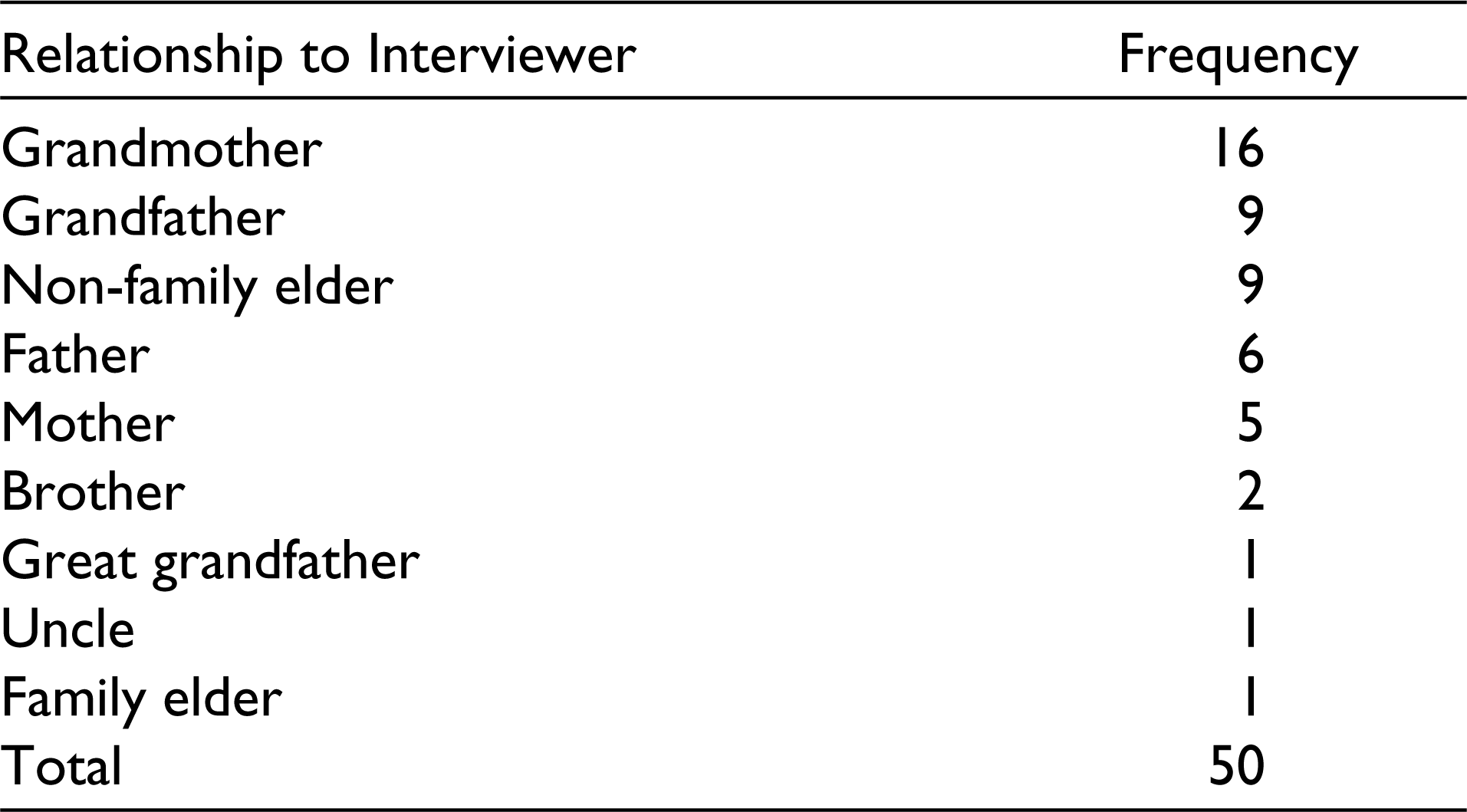
A total of 50 Emirati elders were interviewed with the relationship to interviewer, as shown in Table 1.
Relationships
Relationships
Table 2 shows that grandmothers were interviewed nearly twice as frequently as any other category, although the participants were nearly equally divided between males (26) and females (24). Ages ranged from 41 years old (born in 1973) to 85 (born in 1928). Participants lived in Sharjah, Ajman, Umm Al Quwain, Al Ain, Ras Al Khaimah, Fujairah and Dalma Island.
General Results
As the ethnographic narratives were reviewed, a list compiled of the broad content topics was presented. The preliminary list, along with the frequency of participants who addressed that topic, is presented in Table 2.
Themes Explored

Table 2 shows that nearly half of the participants (23) talked about having less family closeness in the present than in the past, and nearly half of the participants (22) talked about attending informal instruction to read Arabic and, in some cases, basic Math and Science. Other common topics included family closeness in the past (17) and topics related to gender-related work. Next, the individual ethnographic narratives were analysed by the four components of holistic sustainability with excerpts exemplifying each aspect. Individual ethnographic narratives are identified by reference number, that is, ethnographic narrative (EN) followed by number.
In the mostly subsistence economy, most work was unpaid and consisted of making or obtaining food. Duties were arduous for males and females.
I used to go to the sea with my father for fishing every day. The main source of funding for us was the sea, without the sea we might find some difficulties to work (EN4).
My older brother told me about our father who was a trader. He used to travel to other countries nearby to bring foodstuff to sell in Dubai. We used to miss him every time he travelled for a couple of months in his handmade wooden boat. When [the traders] returned, all the family members would be waiting for them. Selling things in the market kept our family going (EN7).
My father was not there most of the time because of his work, so my mom was doing everything for us to survive. She was the “man of the house” as they say today doing things like getting us water, bringing us firewood to warm us and to cook with. She’d wake us up and take us to the sea to wash. She used to feed us dates and she had goats and got milk from them to give us. She’d keep back some of it and put it in a hanging skin and rock it back and forth to make butter from it (EN9). We’d make sweets from milk and corn flour and yellow powder called mahilibia. Every woman had to walk to the sea to wash the clothes since there were no machines in those days like washing machines. Women usually helped men by organizing the work in the home, feeding animals, planting some fruits and vegetables, and sewing clothes (EN12). My grandmother was doing all the work in the house, breeding the goats, cleaning the house, and cooking the food in pottery [earthen pot surrounded with hot embers] (EN16).
Culture
Nearly half of the participants chose to speak about their informal educational experiences learning Arabic and other basic subjects at the local mosques, open areas or in private homes. These educational experiences reinforced the cultural values that are important to the people.
Schools that offered good education, appropriate books, and high quality teachers were hard to find (EN1). [Grandfather] wasn’t in any school or kindergarten, he used to go to the masjid [mosque] to learn Quran, math, Arabic, how to read and write, because there wasn’t any kind of school except for the Mutawaa [person who teaches the children several subjects in a mosque or under trees]. There were some women volunteers who were teaching girls in their homes (EN11). The class was usually after Asr [afternoon prayer] and we’d make a big circle and everyone learned how to read correctly. If the teacher found a mistake she would stop you and correct you. I memorized two chapters of Quran. We relied on our parents’ experience to know more than that. Respect came first, you have to respect everyone, to be humble and honest and that we got from hearing stories from others. They taught us important lessons that if you stay with Allah following His orders … the right way, he will always be with you (EN19).
Teachers were from the neighborhood so they knew the students and the parents well. [My mother] was naughty so she was beaten a lot and her teachers would tell her parents about her every day (EN7).
Society
A recurrent theme in most narratives was the emphasis on family closeness and neighbours, helping each other as exemplified by the following excerpts:
Our life, my son, was something indescribable … we were all in one house and helping each other. It was difficult to live in more than one house so you would find a grandmother, grandfather, father, mother, and children all in one house (EN4). Each neighborhood population did not exceed 20 families and they knew each other well and treated each other as family. The most beautiful thing is that each family gathered together for lunch, no one would start until the whole family was gathered together. Life was simple and uncomplicated for people because they were interested in a secure living. Family members struggled side by side (EN5).
One ethnographic narrative is related to an incident in which a thief stole from a shopkeeper. The shopkeeper demanded the maximum penalty which was removing the hands of the thief and hung the hands over the door of the shop. There was not a single reported act of thievery in the neighbourhood for the next 30 years.
Environment
Several of the narratives mentioned aspects of environmental sustainability in daily life activities. Narratives mentioned that with scarce resources, little was wasted. Water brought from the well and used for drinking water. Water that was meant for washing, and therefore not fit to drink, was used to water the animals. Food was scarce, and much had to be imported, but most families had their own goats and chickens to obtain fresh eggs and milk on a daily basis. The other major food item was seafood caught fresh daily or salted for preservation using traditional methods.
Most of the materials and tools that people used came from palm trees. They make the houses from the long leaves (EN11). They used to ride camels and horses, which was pretty exhausting and tiring to reach their destinations. He told me that once they had to move to a new house and transfer most of the things by camels. It took them a whole month to transfer [everything] (EN3). If I wanted to go from Sharjah to Dubai it took almost four hours, and that’s with a car which only rich people and traders could afford at that time [the same trip today take about 20 minutes if there is little traffic on the highway] (EN8).
Little pollution and waste was generated.
Other topics
Some narratives described how the inhabitants used natural medicines before modern medical care was available in the region. Other narratives related interesting and sometimes humorous stories of being introduced to new things like the first time an elder used a telephone or drove a car.
Summary of Findings
The findings of the study revealed that inhabitants of the region maximised the benefits of the meagre resources available to them, greatly respected education, depended on the contributions of women in society, lived according to a well-developed set of social norms and regulated themselves using their own tribal judicial system. These attributes and others revealed in the study show that through ‘holistic sustainability’, the UAE has been able to maintain cultural uniqueness yet thrive in the global social and economic environment.
With modernisation and development, as described in the ‘Literature review’ section, came changes to the transitory life of the desert dwellers and town dwellers alike. A swelling population of foreign workers arrived to take part in the development of the country bringing with them foreign ways, beliefs, values and ideas. At present, Emiratis make up only about 20 per cent of the population and only about 10 per cent of the workforce.
UAE Policy Challenge: Bridging the Generation Gap and Rapid Global Emersion
Three broad themes, namely family closeness, education and women’s contribution to society, were chosen to examine in greater detail. The themes link elder generation perceptions to modern issues with examples of recent policies, legislation or governmental activities aimed at overcoming the challenges.
The notion of family closeness originating from the tribal nature of society has been carried through UAE development policies. The UAE National Charter 2021, Emirati Families states that ‘the UAE government believes in the family system and that it is the nucleus of society’ (UAE Government, n.d.). This belief was extended to include the following: marriage among Emiratis to facilitate transference of cultural identity from one generation to the next, frequent dialogue among the generations, that is, children, parents and grandparents, position of respect for elders in Emirati families, support for the empowerment of Emirati women grounded in respect for Emirati traditions and protection from discrimination against Emirati women in all spheres of society including the workplace. To monitor the progress towards achieving these objectives, the Ministry of Community Development has developed the Family Cohesion Index, a composite indicator attempting to measure social bonds between family members. In 2013, the index was used for the first time, and the rating was 86.4 per cent, although the aims are to achieve 100 per cent by 2021.
The notion of family closeness was further extended to all Emiratis, enabling all citizens to benefit from the revenues generated by oil. The leadership provides generous benefits to nationals such as healthcare subsidies, housing and land subsidies, marriage expense subsidies, free education in government primary and secondary school and up to 6 years of post-secondary education for eligible nationals. Emerging Emiratization policies have started providing incentives for private sector companies to hire Emiratis. Rulers hold regular Majlis meetings to get a feel of the opinions of the public in their respective regions and tailor policies to maximise effectiveness. Taking the Majlis concept a step further, the UAE has had a parliamentary institution, called the Federal National Council (FNC), since 1972, the year after nationalisation which served to advise the President. In 2005, the FNC was allocated more powers through the Tamkeen [Empowerment] programme, and in 2006, eligible Emiratis experienced voting for the FNC members for the first time. In 2011, several Emirati women ran for FNC and were elected (Salem, 2013).
Education was highly valued in the UAE even as a traditional society in which children, both males and females, were taught by the neighbourhood Mutawaa in informal settings or by ladies in the homes of the girls. Technological development is the focus of the federal post-secondary institutions with innovative practices being rewarded. In most traditional societies, members often do not have even basic math and literacy skills. The respect for education is carried through to modernisation as expressed by the official UAE government website ‘Education is the constitutional right of every citizen. The UAE Government recognises the role of education in building a knowledge-driven economy for the post-oil era’ (UAE Government, n.d.). The UAE leadership has exemplified this by providing education free of charge to nationals and developing educational institutions with separate sex campuses from K-12 up to college to accommodate cultural sensitivities and to assure that females have equitable access to education.
The contribution of women to Emirati society was notable in elder society. Women were acknowledged as the backbone of the family and society with survival attributed to their efforts. This idea has been incorporated into development with special care given to accommodate cultural sensitivities regarding women’s preferences for segregated educational institutions and work environments. According to one international study comparing the well-being and development of women in 134 countries, the UAE scored the highest (UAE Ranks First, 2014). This score was earned again in 2016 in the World Economic Forum (2016, p. 15). Emirati women are afforded generous maternity benefits, reduced workdays when breastfeeding, extended bereavement leave if the unfortunate death of their husband occurs and gender-based salary discrimination is illegal. Emirati women can be seen working in the highest positions including Federal National Council members, diplomats, college chancellors, company directors, or other high-ranking positions.
The elements of Emirati inter-generational experience serve to strengthen society as a whole, yet they may provide unexpected challenges, including youth unemployment. When young people are well-cared for and have so much social support, they may develop a tendency to rely on familial and social support in excess. One initiative to counteract that tendency, compulsory national service for men, optional for women, was instituted in 2014. During national service, Emirati males are not only trained to defend their country but also given additional skills that enhance personal development, develop cultural identity and heighten their sense of responsibility to family and country. Simultaneously, the government began a downsizing and outsourcing programme to reduce government spending and refocus Emiratis on gaining employment in the private sector rather than the public sector. Recent labour law modifications allowing part-time work, reducing minimum working age to 16 years old and granting private sector holidays are encouraging more Emirati women to join the workforce (Daleure, 2017).
Conclusion and Recommendations
The social issues that have arisen especially from the shift from women from home to public, have put stress and pressures on families and society. Initiatives have been put into place to remind youth of their heritage and the sacrifices and the wisdom of the elders incorporating the best of the past with the potential of the future. Using the principles of holistic sustainability, the leadership of the UAE should further develop proactive labour initiatives to enable private sector companies to realise that the people of the region must retain their identity and must be accepted into the UAE private sector workplaces. Private sector companies could be given incentives for creating more culture-friendly work environments to attract Emiratis, especially Emirati women who still bear the burden of family responsibilities and are a well-educated yet under-represented in the workplace.
Business practices that evolved in one area of the world, namely the Western world, may not be applied successfully in other parts of the world, and nor should they be. Opening businesses or branches of multinational companies implies a commitment to the local social, cultural, environmental and economic environment and should not be one-sided, that is, focused on extracting the benefit without also giving back in terms of employment or some other types of local enrichment. This is the essence of holistic sustainability, and with continued efforts in this direction, the UAE can continue to prosper.
Footnotes
Declaration of Conflicting Interests
The author declared no potential conflicts of interest with respect to the research, authorship and/or publication of this article.
Funding
The author received no financial support for the research, authorship and/or publication of this article.
Generational Summary Table
Characteristics of Generational Groupings

| Grouping | Age Range | Characteristics of Experience |
| Grandparents | Around 65 years old or older | • Adults before nationalization (1971) • Experienced harsh conditions before the rapid economic development • Most Emiratis lived transitory lifestyles • Agrarian economy stalled • Obtained public sector jobs with little or no education during the initial infrastructure development stage |
| Parents | Approximately 35–50 years old | • Adults during the high growth phase (1980s–1990s) • Experienced improved lifestyle during rapid economic development • Shift to sedentary lifestyles • Obtained public sector jobs with basic education (mainly military and police) |
| Young Adults | Approximately 16–25 years old | • Coming into adulthood in globalized knowledge economy with stabilizing economic growth (mid-2010s) • Experienced multicultural and technologically rich environment with substantial subsidies for Emiratis • High youth unemployment—preferred public sector saturated yet avoid available private sector employment |