



Abstract
The rapid growth and economic importance of metropolitan cities is a known fact world over. These cities have increased in number over a period of time and have immense economic importance for their countries. They account for more than half of the world’s wealth. Moreover, some of the larger metropolitan cities in South Asia account for one-third and even more of the national GDP. The fast pace of growth of metropolitan cities and their peri-urban areas and the resulting spatial transformation is one of the most striking features of India’s urban scenario. In this context, planning and basic service provisions are the two components that warrant special attention in metropolitan regions for organised spatial, economic and social development. The present paper emphasises on the need for better service provision in peri-urban areas. It recommends a strategy to govern metropolitan regions so that the peri-urban areas can also get equitable treatment in the development process.
Introduction
Cities have long been seen as having a far-reaching developmental impact not only for itself but also for its surroundings, both immediate and distant. The rapid urbanisation is resulting in the complex process of ‘peri-urbanisation’ on the peripheries of the large metropolises in developing countries.
Peri-urban has been defined differently by different scholars but there are certain aspects that come out very clearly while defining a peri-urban area. A peri-urban area, as a place, lies outside the municipal boundary but can be considered as an extension of the cities they surround. As a process, it undergoes continuous transformations with respect to physical, socio-demographic, economic and environmental aspects. As a concept, it is a dynamic mixed space with both urban and rural settlements and activities being carried out. (Based on a study of Aguilar, 2008; Arabindoo, 2005; Cadene, 2005; Dupont, 2005; Kundu, Pradhan, & Subramaniam, 2002; Marshall et al., 2009; Mc Gee, 1991; Moench & Gyawali, 2008; Narain, 2010; Oliveau, 2005; Rohilla, 2005; Shaw, 2005; Webster, 2002).
The accompanying economic developments in peri-urban areas are creating a strong pull force, not only for the population from adjoining districts but also for far-off areas in other poorer states of the country. Providing for the daily needs and service requirements of this additional population and ensuring systematic planning becomes a challenge for metropolitan areas.
Seoul, Jogjakarta, São Paulo and Bangkok are examples of metropolitan economies with a core primate city (central city with dominant demographic and economic position) that has created a number of dormitory, secondary and edge cities into its orbit (Yusuf, 2013). A metropolitan region comprises of the core city/central city (with dominant economic and demographic status) and other urban and rural settlements outside it, which by virtue of being in the vicinity of the core city are experiencing demographic growth, spatial expansion and economic development. The core city has been the primary reason for these transformations in the peri-urban areas. However, these transformations are both positive as well as negative for the peri-urban areas. The positive ones being greater economic opportunities, better connectivity with the core and access to many higher-order services located in the core city. The negative ones are greater exploitation of environmental resources like water and land in peri-urban areas, rapid unplanned development in peri-urban areas, stress on already existing service provision and infrastructure and declining political representation. These negative transformations result in various conflicts and contestations between the core city and the peri-urban areas. This calls for taking a look at the peri-urban areas from a spatial equity perspective or a balanced spatial development perspective. Peri-urban areas thus entail a greater role for the state government to manage, facilitate and regulate the increasing physical, demographic and economic developments.
This necessitates a debate on the governance of metropolitan regions for efficient, cost effective, and equitable provision of services and the way planning needs to be perceived for these peri-urban areas. This paper draws upon the gaps and challenges with respect to service provision and planning in peri-urban areas, based on both, secondary as well as primary sources of data. These are then utilised to build a strategy that can be efficiently applied for better provision of services and planning in peri-urban Chennai in particular, and other metropolitan peri-urban areas in general. The debate on polycentric metropolitan governance versus monocentric metropolitan governance and the concept of ‘Home Rule’ as given by Bahl (1992) and Bahl and Linn (2013) will also be drawn upon to contribute to strategy building for better service delivery and planning of metropolitan areas.
The paper is divided into five broad sections starting with introducing the study area. The second section discusses the polycentric versus monocentric metropolitan governance systems, simultaneously drawing upon the concept of ‘Home Rule’. The third section explains the institutional set-up in Chennai Metropolitan Area (CMA). The fourth section deals with gaps, conflicts and challenges in planning and service provision in CMA. The final section details out the way ahead for planning and service provision in CMA and other metropolitan areas of India.
The Study Area
The CMA comprises of the city of Chennai and the contiguous area around it. It has a population of 4.6 million (Census of India, 2011). It was notified in 1974. It extends over 1,189 sq.km. CMA comprises of Chennai city and areas to an extent of 376.58 sq. km in Kancheepuram district and 639.39 sq. km in Thiruvallur district. According to the 2001 Census, 38.6 per cent of the population of Kancheepuram district and 57.5 per cent of the population in Thiruvallur district live within CMA. Chennai city, which earlier comprised of only the district of Chennai, after the expansion of city limits in 2012 also includes parts of Thiruvallur and Kancheepuram districts. The peri-urban area consists of one cantonment, sixteen municipalities, twenty town panchayats and 213 village panchayats in ten panchayat unions. In December 2011 the limits of Chennai city was increased to annex certain municipalities, town panchayats and villages from the adjoining districts of Thiruvallur and Kancheepuram after which the peri-urban area of Chennai city consists of one cantonment, eleven municipalities, eight town panchayats and 181 villages arranged in ten panchayat unions.
As far as its economy is concerned, Chennai city and CMA has witnessed tremendous growth in its manufacturing, retail, healthcare and IT sectors in the last ten years (Vision Tamil Nadu, 2023). Newer avenues in business and job opportunities in the city lure people from in and around Chennai to come and settle here. A number of big multinationals have already come up in a big way in Chennai and its peri-urban areas.
Polycentric versus Monocentric Metropolitan Governance
A monocentric system of settlements is one with a single dominant centre/city for making decisions. This dominant city is termed ‘Gargantua’ for a metropolitan region (Howell-Moroney, 2008). This is a form of the consolidated governance system for metropolitan regions, whereby only the metropolitan level authority has the power to take decisions with respect to service provision and development for the core city, as well as the peri-urban settlements. In the context of Chennai, the annexation (absorption of territory by a city) carried out in 2012 is a step in this direction. On the other hand, a traditional pattern of governance in a metropolitan area with a multiplicity of political jurisdictions (or settlements, both urban and rural) is termed as a ’polycentric political system’. Either polycentric or consolidated or a mix of both kinds of governance structures can be considered for metropolitan areas for the development of a strategy for planning and service delivery.
The reasons for the development of a polycentric system of settlements within metropolitan regions have been many. Over a period of time with greater urbanisation and globalisation, there has been an emergence of small towns in the periphery of the large metropolitan core areas as new economic hubs, which have resulted in the formation of polycentric functional structures within urban regions (Growe, 2012). The most important reason for the development of polycentric metropolitan regions is the availability of cheaper land sites in the surrounding region of the core city and changes in technology (traffic infrastructure and cost of transportation) and society. This is true for Chennai as well. Various towns and villages that act as economic hubs, like those on IT Corridor along Rajiv Gandhi Salai, electronics and engineering industries in Tambaram, Poonnamalle, Sriperambadur, and so on have developed all around Chennai city.
Polycentric governance brings about the separation of powers creating a system of checks and balances (Laffont, 2009 quoted in Pethe, 2011, p. 189), thus assuring that a metropolitan area does not come under the governance of a single organisation. Polycentric systems are adept and flexible in producing and providing municipal services and a variety of inter-local agreements. However, the presence of municipal boundaries results in various spillover problems, such as segregation of the marginalised and the poor and urban sprawl. These spillovers are problematic as municipalities try to completely avoid these kinds of externalities. Thus, low-income citizens demanding social services and affordable housing are never welcomed by any of the local bodies. Hence, institutional structures tend to create persistent inequities between high-income and low-income local bodies resulting in uneven opportunities.
Concept of ‘Home Rule’ in Developing a Strategy for Service Delivery in Metropolitan Areas: Learning from Examples
The concept of ‘Swaraj’ or ‘Home Rule’ is an old idea propagated by Mahatma Gandhi in the 20th century. Through this concept, he advocated the spirit of democracy from within (Anjaneyulu, 2003; Parel, 1995).
One of the interpretations of the term Swaraj means that a society or nation is ruled by its own people. Taking a cue from this thinking, it is said that a good government is no substitute for self-government. However, if the self-government is not a good government, and conducive to individual and social progress, it can hardly be termed ‘Swaraj’. Good self-rule can only be called as Swaraj (Mishra, 2006).
The concept of Swaraj, as given by Mahatma Gandhi, was more so in the context of India’s freedom and rural areas. The basic idea behind the thinking was decentralisation, bottom-up approach for development and self-rule, which holds true in case of local bodies present in the peri-urban areas of a metropolis as well.
Also, drawing from Bahl’s (2013, p. 91) concept of ‘Home Rule’ that the budget outcomes are driven by people’s representation in a local body it can be said that annexation and a monocentric government hampers citizen’s control over their own resources.
Bahl and Linn (1992) suggest that under a jurisdictional fragmentation approach (polycentric system) many local governments operate in the same metropolitan area with some degree of independence in choosing their financing arrangements. In some cases, there also is an overlying metropolitan government or region-wide special district, but the emphasis in service delivery is on the role of the lower-tier governments. The advantage of the jurisdictional fragmentation model is that it keeps the government close to the people. However, the welfare gains from this home rule model will come at the cost of economies of scale (i.e., large scale production resulting in lower per capita cost of any goods or services) and operating within a set of boundaries that are arguably too small to allow coordinated service delivery. Coordinated service delivery reduces the per capita cost of providing services such as water supply and sanitation.
The jurisdictional fragmentation or polycentric model best characterises governance in most industrialised countries. The traditions of home rule are particularly strong in the United States. Most urban services are delivered by municipalities or counties, that is, by the lower-level local governments. (OECD, 2009 as quoted in Bahl, 2013, p. 88).
For instance, the Kolkata metropolitan area is governed by three municipal corporations (including Kolkata), thirty-eight municipalities and twenty-four rural local governments. The municipal governments are dominant in terms of service provision and revenue generation. The Kolkata Metropolitan Development Authority, an area-wide government, has responsibility for planning and carrying out major infrastructure development in the metropolitan area.
A second approach to metropolitan governance can be that of functional fragmentation, that is, different functions are being carried out by different authorities at the metropolitan level (Bahl & Linn, 1992, p. 67). Under this model, the delivery of a single function such as water supply (or a related grouping of functions) is placed under the control of either a public company or a special district government. The main advantage of functional fragmentation is that the autonomous agency, like Chennai Metropolitan Water Supply and Sewerage Board (CMWSSB), is likely to be more technically efficient because it is specialised. Such bodies, by virtue of being the only entity in the urban area responsible for the function, encounter lesser problems of coordination for that function as against a jurisdictionally fragmented model. The major drawback to this approach is that it is usually under less direct control of local voters (thus not answerable to them) than, for example, an elected municipal council. Political autonomy of these bodies is another factor that needs consideration for their efficient working. Functional fragmentation brings about efficiency in terms of financing metropolitan services as well. Since the services delivered are to be priced for covering their production and delivery costs (e.g., public transportation and garbage collection), user charges provide a base level of revenues. In other cases, the services are partially financed by compulsory transfers from the city budget (OECD, 2007a, p. 45).
Special-purpose agencies can be especially important in managing and financing public service delivery in countries that are not industrialised. India makes use of parastatals, which are public companies operated by various departments within the state government. The twenty-one parastatals operating within Mumbai account for a large share of total infrastructure spending in the metropolitan area and carry out the service delivery function for the metropolitan area.
A third arrangement can be that of a metropolitan government. Under this model most general services are provided by an area-wide metropolitan government. In theory, the metropolitan government would be elected and have significant powers to regulate service delivery and financing. In practice, most area-wide governments share fiscal powers with lower tiers of government or publicly owned companies. The significant advantage of a pure metropolitan government approach is built-in coordination in the delivery of functions. This has the potential for better resource allocation (Bahl & Linn, 1992). On the other hand, this form of governance diminishes the power of local voters to influence the local budget for various services. A second drawback is that metropolitan governance often brings inter-governmental conflict over access to services. It also needs to be financially strong to perform its functions effectively.
Some Canadian metropolitan areas, such as Metropolitan Vancouver, have maintained an emphasis on home rule, that is, a greater number of local bodies, by local jurisdictions but have introduced a mechanism for coordination of service delivery (Bahl, 2013). Home rule and its local voter influence (through the elected representatives in the local bodies) are strongest under a jurisdictionally fragmented system.
There is a requirement of reforms that address the economies of scale that go uncaptured in many fragmented metropolitan areas, address the equity issues with respect to service delivery and reforms that can reduce heavy spillover costs, such as traffic congestion and pollution. The public policy solution lies in finding a way to deliver some services with a degree of local control and financing while delivering others on a region-wide basis and with a broader finance base.
It has been observed in India that at the metropolitan level, the existence of fragmented local governments, along with multiple parastatals having overlapping jurisdictions, gives the governance system the appearance of a ‘polycentric governance system’ endorsed by such scholars as McGinnis (2000), Ostrom (2010) and Ostrom, Tiebout, and Warren (1961). But if we see the case of Mumbai Metropolitan Region (MMR), an area where a Metropolitan Planning Committee (MPC) has also been in place, it is found that the governance system in MMR, although apparently polycentric, is far from being efficient (Pethe, Gandhi, & Tandel, 2011). Barring Municipal Corporation of Greater Mumbai (MCGM) and some municipal corporations, all other Urban Local Bodies (ULBs) are too weak to perform even the basic functions expected of them. Pethe, Gandhi, and Tandel (2011), in examining the case of MCGM and Mumbai Metropolitan Region Development Authority (MMRDA), show that their relationship is characterised not by cooperation or competition but, rather, by contestations and conflicting stakes and a power imbalance that favours the latter.
Apart from territorial limitations, there are also significant problems with respect to core cities having to reach out beyond their boundaries. In metropolitan areas, the sources of water supply to the city are well beyond the jurisdiction of the core city or even the metropolitan region as in Chennai, Bangalore or Hyderabad. The transport connectivity is another area transcending municipal and metropolitan limits. In all these cases the expansion of municipal boundaries or annexation of areas surrounding the core city has not been an answer. The reasoning that such an annexation results in better service provision for the peri-urban areas has also been refuted by the primary analysis carried out as part of the study. However, people do have a perception that service provision will improve once the core city institution takes over (Primary Survey, 2014). Nevertheless, the issue of low representation of people due to the annexation of peri-urban areas in the core city cannot be denied.
Institutional Set-up in Chennai Metropolitan Area
The main aim of metropolitan cities of large size with respect to service provision is based on three factors: efficiency, economy and equity (Howell-Moroney, 2008). It also needs to be mentioned here that the metropolitan region is largely a legal non-entity (Ostrom, Tiebout, & Warren, 1961). In India, post-1991, that is, after the 74th Constitutional Amendment Act, through provision for the creation of MPCs some level of legal status was given to metropolitan areas. However, most of the state governments have shied away from the creation of these committees due to political and economic reasons. This holds true for CMA as well.
The institutional landscape in CMA is as per constitutionally prescribed ULB structure with the municipal bodies at the top. Besides the hierarchy of municipal bodies including municipal corporations (Chennai Municipal Corporation (CMC)) and other municipalities, there are corresponding urban and rural local bodies in town panchayats and village panchayats. The rest of the institutions, especially parastatals such as the Chennai Metropolitan Development Authority (CMDA), 1 the planning authority in CMA and the CMWSSB appear to be the institutional responses to the metropolitan scale of challenges in CMA. In addition to these, there are other agencies and line departments conventionally entrusted with the provision of various services. A metropolitan region thus holds many different territorial and functional entities.
There is a multiplicity of central and state government agencies, urban local bodies, rural bodies and districts level bodies that govern within a metropolitan region. This results in ‘duplication of functions’ and ‘overlapping jurisdictions’. This holds true for Chennai as well where Tamil Nadu Water Supply and Drainage Board (TWAD) and CMWSSB are involved in the provision of water and sanitation facilities (refer Table 1). The local bodies are also looking after the provision of these services in a number of smaller urban and rural constituents of peri-urban CMA. District Planning Committee and CMDA are present for integrated planning; however, there is no provision for a MPC. Also, the District Planning Committee is not making any plan in the CMA region.
Institutions Responsible for Planning and Water Supply and Sewerage in CMA
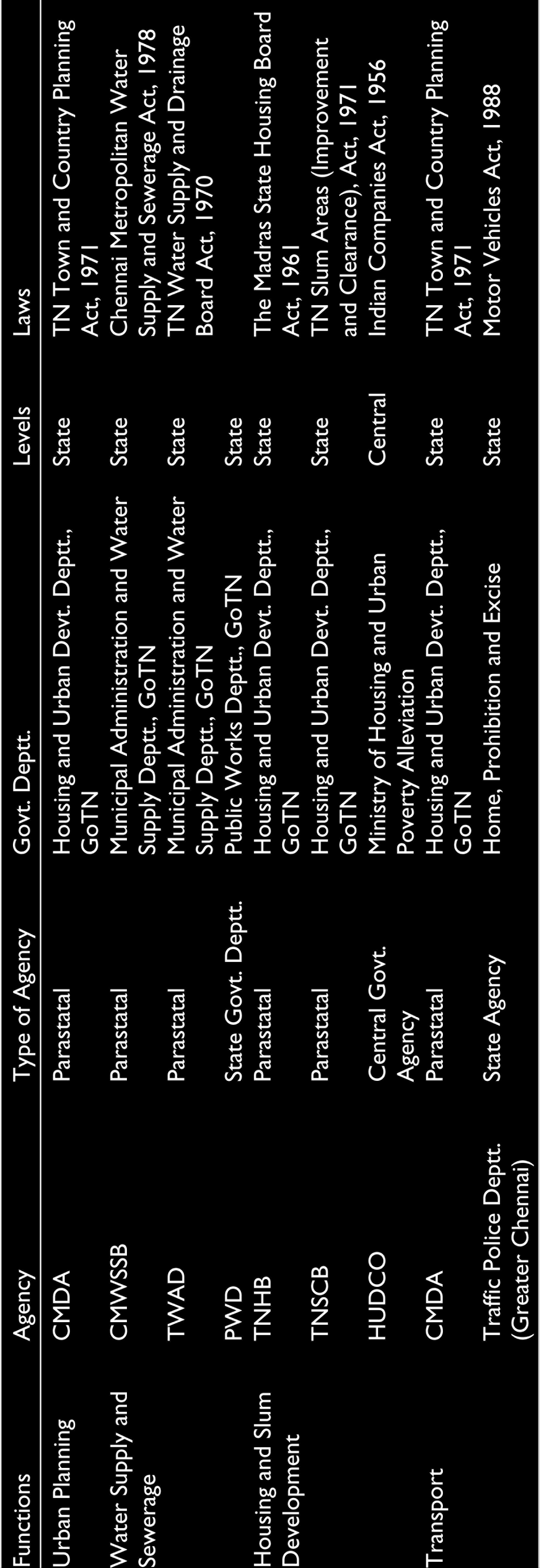
As far as planning is concerned in CMA, CMDA has a kind of unfettered control over the city that is rather unrepresentative of the peri-urban local bodies. Only civic services are being looked after by the local bodies in CMA and not planning function. The set-up of CMDA board clearly depicts the low representation of the local bodies (Primary Survey, 2014). Only four representatives out of twenty-two are from urban or rural local bodies. Moreover, final say with respect to acceptance, changes and rejection of master plan lies with the state government due to its predominant presence on the board. There is an overarching representation of the state in the CMDA board. Although the state government passed an Act regarding the constitution of the ‘MPC’ in 2009, it has not yet been notified. Only civic services are being looked after by the local bodies in CMA and not planning function, as envisaged by the 74th Constitutional Amendment Act.
Going for a Polycentric System of Governance in CMA?
Based on the service in question, a local government may both produce and provide a service or there may be another agency producing or providing the service. This other agency can be a metropolitan level authority or a private agency or a cooperation agreement between the local governments. This kind of flexibility is central to the concept of the polycentric system. What has been observed in Chennai is that though there is an overlapping of jurisdictions, some kind of cooperation agreement also exists as in the case of ULBs near Tambaram for water provision and solid waste management (refer Table 2). Other metropolitan regions have also shown cooperation amongst its local bodies for service provision.
Inter-Municipal Sharing of Facilities (Newly Started and Planned), 2013

Drawing from this it can be said that within a polycentric governance system there can be several scales of service provision, whereby some services are produced and provided at the local body level in a decentralised way and others, either at the metropolitan level or by some arrangement of cooperation amongst the local governments. For example, traffic and transport service, government housing and sourcing of water being provided at the metropolitan level can reduce per capita cost of water provision by capturing economies of scale. The distribution of water at the municipal or village level could be done by the local authority. This approach would help in addressing the economic as well as the equity aspect of service provision.
Planning Metropolitan Regions
The Tamil Nadu Town and Country Planning Act envisages the preparation of a regional plan, a master plan or a new town development plan. All these plans have to be approved by the state government before being notified, which in the process may consult the director of town planning. The Act also requires updating the plan every five years. It is interesting to note here that the state government may vary or revoke a detailed development plan prepared under the Act. The plans in CMA are not being updated every five years (Primary Survey, 2014). One of the reasons for this might be political intervention. A moot question is whether a regional plan, master plan, new town plan or development control plan prepared in accordance with the provisions of a town and country planning acts, which also follow a process of eliciting views from the public should still be subject to the state government’s approval. The Kasturirangan Committee set up to consider a governance framework for Bangalore metropolitan area has expressed the view that it may not be necessary for a plan prepared by a body that partakes a sovereign character to be reviewed by the state government for formal approval. 2
CMDA is the apex planning body in CMA. As far as planning is concerned, for a metropolitan region, it should be integrated planning at the regional level, which should act as broad guidelines for resource identification assessment, environmental aspects, physical spread and economic suitability at the metropolitan level. The local bodies can detail out their respective plans as per the identified agenda that should get integrated at the metropolitan level. The 73rd and 74th Constitutional Amendment Acts also suggest this kind of a bottom-up planning approach. Thus, the existence of a MPC should be made mandatory for metropolitan areas. In Chennai’s case, though there is an integrated plan for the metropolitan region prepared by the CMDA, the local bodies have no role in detailing out their own plans. This is largely due to the lack of plan-making capacity or skill in designing a plan at the local level and also the absence of an MPC.
The Indian Case: Service Provision and Planning
There are two aspects to be considered here, firstly, giving metropolitan regions an identity of their own. Secondly, it is the issue of de-centralisation or home rule due to the complex nature of metropolitan areas with multiple urban and rural local bodies. The creation of development authorities was the first step towards administrative recognition of the metropolitan dimension. Calcutta Metropolitan Development Authority was established in 1970, in Chennai it was in 1972, Mumbai in 1974 and Bangalore and Hyderabad in 1975. There has been a demand for more decentralised governance at the local level since India’s independence. Since the 1950s stress was laid on community development through involvement of the citizens for the efficient provision of services and infrastructure. The demand for decentralised governance got constitutional recognition with the formulation of the 73rd and 74th Constitutional Amendment Acts in 1993. The 74th Constitutional Amendment Act gave provision for the creation of an MPC under Section 243ZE, which addressed both, the issue of metropolitan identity as well as decentralisation within it. However, out of the top five metropolitan regions in India only two, that is, Mumbai and Kolkata have an MPC in place. Chennai, Bangalore and Hyderabad do not have an MPC constituted by the state. MPCs have been set up only in two states—West Bengal (Kolkata) after a delay of five years, and Maharashtra after a delay of sixteen years (Mumbai, Pune and Nagpur). Thus, the legal standing that could have been given to metropolitan areas has largely been denied. Even in the case of Kolkata the MPC has not been reconstituted after elections to the Kolkata Corporation and other municipalities in 2011. In Mumbai the MPC hardly meets and discusses issues at the metropolitan level (Sivaramakrishnan, 2013).
Gaps, Conflicts and Challenges in Planning and Service Provision: CMA
In the absence of an MPC, the agencies with a metropolitan mandate in CMA are state parastatals such as CMDA and CMWSSB. The earlier sections highlighted the need, scope and necessity for addressing metropolitan scale challenges. Most of these are left unaddressed or addressed in an ad hoc manner, or inefficiently by those agencies meant to address them. CMDA, the overall agency perceived to be driving the metropolitan growth functions by planning for the area has several limitations. Moreover, the local urban and rural bodies falling within the metropolitan area do not have any say in the plan-making process of CMDA.
Some of the main limitations or gaps pertaining to service provision and planning in CMA area are as under:
There is a low representation of local bodies in CMDA, the planning authority and CMWSSB, the service providing authority for water and sewerage. The political presence is overarching in both, the CMDA as well as the CMWSSB. The question arises as to why the state has to approve plans even though the said procedures as given in the Tamil Nadu Town and Country Planning Act are being followed for plan preparation. As far as service provision is concerned the vote bank politics comes in picture with such state presence in CMWSSB. Only certain civic services, such as solid waste management, street lighting, water supply, roads, and so on are being looked after by the local bodies in CMA and not planning. While the CMWSSB has the mandate to cater to the entire CMA it is doing so only for the core city and few adjoining municipalities only. DPC exists in Tamil Nadu but is not functional in CMA even in the absence of MPC. This leaves it to the CMDA to plan for the area without giving much consideration to the constituent local bodies. The state has a role to play with respect to the implementation of MPC in compliance with the 74th Constitutional Amendment Act. A Tamil Nadu Metropolitan Planning Committee Act was enacted in 2009, but it has not been notified until now. There is no interaction between the various levels of ULBs in CMA, which would bring about cheaper and efficient service provision. This kind of interaction would facilitate the clustering of local bodies for service provision that would result in the generation of economies of scale (i.e., large scale production/provision resulting in lower per capita cost of any goods or services).
There are certain overlaps and conflicts in the peri-urban areas with respect to various institutions. These are:
There is the presence of a multiplicity of actors in peri-urban local bodies with respect to water, sanitation, transport and industrial development. There is a multiplicity of Central and state government agencies, ULBs, rural bodies and district level bodies that govern within the CMA.
Thus, there is ‘duplication of functions’ and ‘overlapping jurisdictions’ in CMA, for example, ULBs and CMWSSB for water supply and sanitation; District Planning Committee and CMDA for integrated planning.
The level and quality of service provision should not vary amongst the various urban and rural local bodies in the peri-urban areas of a metropolitan region. Legally and constitutionally, they are all at par as far as the quality of service provision is concerned. Any municipal body can stake a claim to any of the 12th Schedule functions as given by the 74th Constitutional Amendment Act.
The Way Ahead: Resolving the Problem
The Planning Regime
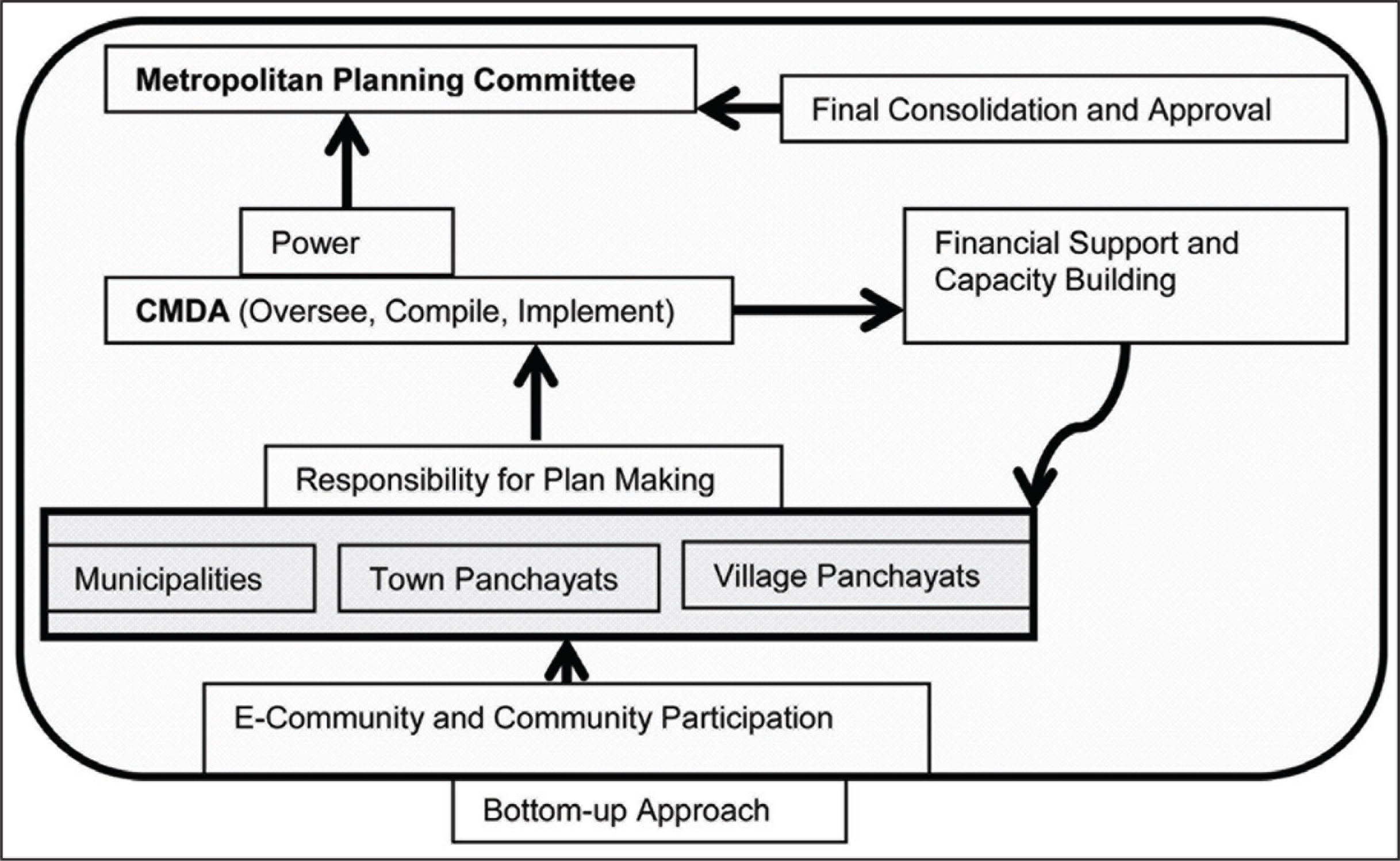
At the metropolitan level, the establishment of a proper planning regime becomes an important task. The core city in metropolitan regions discharges the basic responsibility of building controls and also undertakes some land use planning and zoning within their respective limits. This needs to be suitably amplified and coordinated at the metropolitan level. The coordination of plan preparation, their enforcement and the interpretation and adjudication in the event of conflicting plans should be regarded as important metropolitan level tasks. In some cities, the metropolitan level body also assumes the responsibility of preparing plans where either the municipal body is not available or fails to perform this task. This role of a default planner should be revisited. In the case of Chennai, although a planning department exists for the municipalities and town panchayats they do not undertake any planning function and only jobs like removing encroachments are carried out. In the case of Mumbai, it is seen that many of the municipalities are not inclined to undertake planning even though they are designated as planning authority under the Maharashtra Town and Country Planning Act. Thus, if a metropolitan level planning body, like the CMDA, has to remain true to its central tasks, it cannot be overwhelmed by this ‘default planner’ responsibility. Hence, the capacity and responsibility for spatial planning should be developed at the local body level and CMDA should be entrusted with this function. Even the implementation part should be given out to the CMDA. The MPC should be brought in place and it should act as the final consolidation and approving authority (refer Figure 1).
CMA should work towards having an MPC in place. State agencies planning for metropolitan cities are influenced by political decisions and have a short vision that is limited to the greater economic development of the area without any consideration to environmental and social externalities. The Primary Survey points towards how the people in CMA have been struggling with a shortage of water, pollution and overcrowding in these areas. It is thus required that the final consolidation and approval of plans takes place at the MPC level. The entire responsibility of plan-making should be carried out by the local bodies. Moreover, community participation preferably through the e-community platform should be encouraged (refer Figure 1).
Municipal Consolidation and Service Provision
The next set of metropolitan level tasks relate to the provision of services such as water supply, sanitation, solid waste management, transport, and so on. Here again, the responsibility for reviewing the adequacy of the functional bodies, facilitating the setting up of trans-municipal entities and assisting their operations become an important metropolitan responsibility.
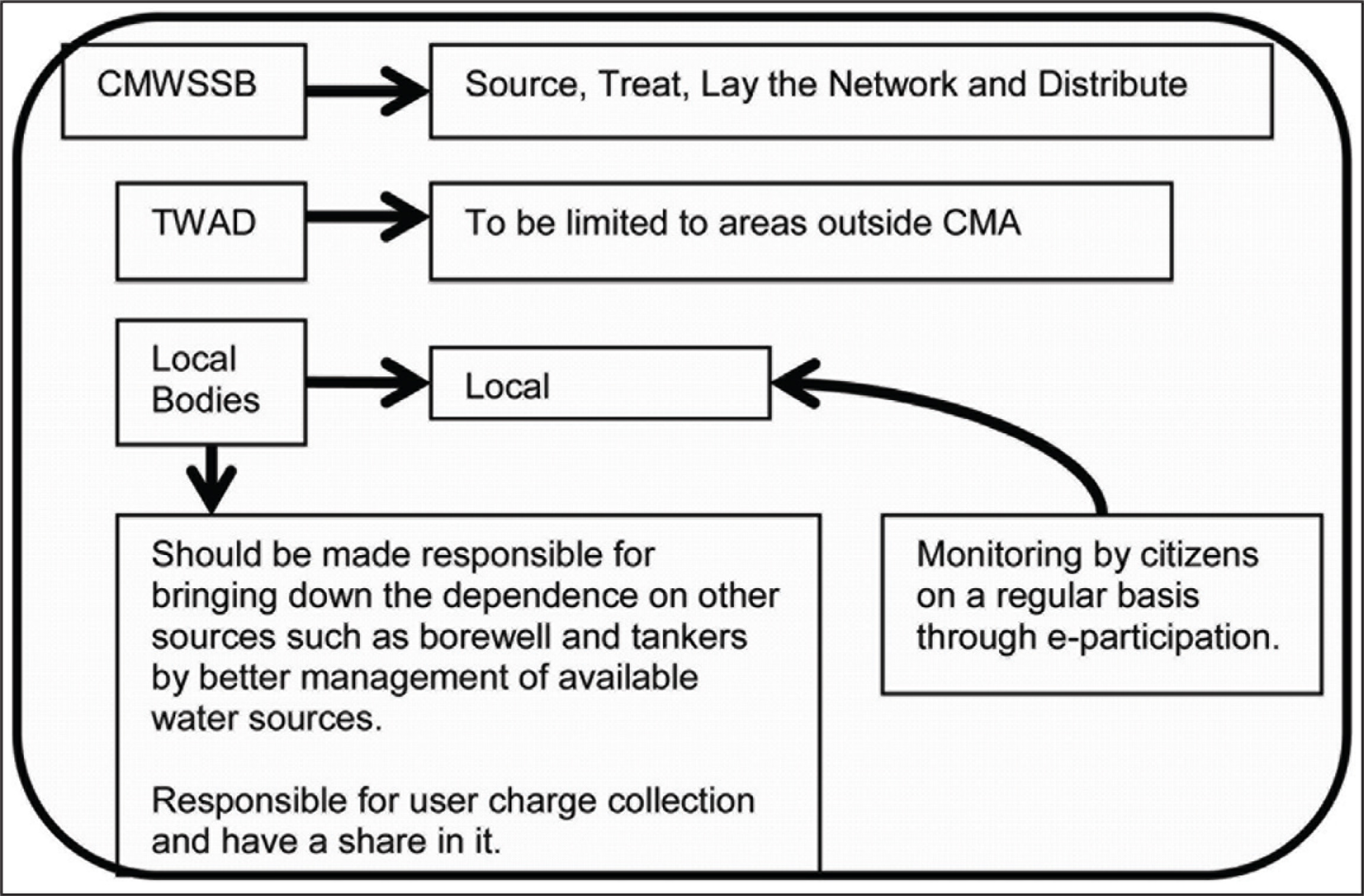
To start with, it is required that the metropolitan areas have some autonomy from the state control so that their development can be guided by forces of economy and decision by the citizens of the peri-urban areas. For better coordination amongst the local bodies, given the fact that the metropolitan areas are large entities and have multiple jurisdictions, some metropolitan level authority such as the CMWSSB (for water supply and sewerage) can be continued with. However, this body needs to be devised in a way that the local bodies in the peri-urban areas have enough say in the matters concerning their fate as far as service delivery, environment, use of land and economic development is concerned (refer Figure 2).
Nevertheless, this does not mean that one has to go back on the issue of functional decentralisation as enshrined in the 73rd and the 74th Constitutional Amendment Acts. The local bodies should have functional as well as financial autonomy. However, there is a lot of disparity when it comes to the financial status of these local bodies because of which the level and quality of service provision vary from settlement to settlement. The metropolitan level body, in this case, the CMWSSB for water supply and sewerage, should be made responsible for easing out these inequalities by way of facilitating equitable resources in the peri-urban areas. Thus, the sourcing, treatment, laying of network and distribution at local body level should be given to CMWSSB (refer Figure 2). TWAD should be limited to areas outside CMA, however, the local bodies adjacent to the CMA should be given some leverage as they will be experiencing a lot of spillover of development from the metropolitan area. The local bodies need to be made responsible for local distribution of water within the local body jurisdiction and also try to reduce the dependence of households on other informal sources, such as groundwater and tankers. Continuous monitoring by the citizens through e-participation should also be encouraged by the local body and CMWSSB (refer Figure 2).
Thus, it is clear that reforms in governance systems are the key to ensuring better outcomes in terms of efficient delivery of public goods and services. A metropolitan system contributes hugely to the state, as well as to the nation as a whole and thus, needs serious attention. The issue is not really a conceptual matter as much as one of political will with respect to the implementation of uncluttered and sharply defined empowered subsystems that work complementarily and cohesively.
Footnotes
Declaration of Conflicting Interests
The author declared no potential conflicts of interest with respect to the research, authorship and/or publication of this article.
Funding
The author received no financial support for the research, authorship and/or publication of this article.