



Abstract
Max Weber coined the term ‘bureaucratic leadership’ to define leadership in government organisations based on a set of predetermined regulations, strict functions and fixed roles under a static hierarchy. Almost all government organisations adhere to these principles including the civil services, but, at the ground level of administration, a rational and workable form has been developed by the civil servants to suit their roles. The post of a Block Development Officer (BDO) in the civil services is assigned to play multiple roles to govern the block effectively. From being a leader who would motivate and facilitate a team of officials in development as well as general administration, a diplomat who would set the right chord with the political functionaries at various levels to settle upon a consensus in every issue, a crisis manager who would rush forward, with limited resources, to face any natural calamity or a serious law and order issue, a strict disciplinarian who would ensure transparency in fiscal matters, an entrepreneur who would motivate the people to become self-reliant with the help of government schemes, a BDO is indeed ‘the cutting edge of administration’. The entire administration depends upon a Block Development Officer to deliver the much needed “public service” to the residents of the Block at all times and under all circumstances. This article is intended to study the practical forms of ‘bureaucratic leadership’ performed by BDOs while discharging their duties efficiently both during crises and in normal circumstances.
Introduction
Max Weber in 1947 proposed the ‘bureaucratic leadership’ theory to explain the efficient functioning of a large organisation based upon predetermined regulations under a hierarchy of authority and having a clear division of responsibility. Its functioning can be best explained as a ‘straight line’ with no room for curves or variations and almost zero flexibility. An employee working under this setup is expected to adhere strictly to all the existing norms, follow the instructions of the superiors unquestioningly, perform the activities in the fixed predetermined manner and stick to her/his role of functioning. This leaves rather limited room for personal creativity but allows for individual competence, and some adaptability to change. All the government organisations in India including the civil services adhere to this theory, but its implementation varies at the Secretariat and field levels due to the peculiar nature of public administration. In this article, we have studied the functioning of Block Development Officers (BDOs) who are at the lowest rung of the hierarchical leadership of the civil services of a particular state of our country. This study intends to find out how ‘bureaucratic leadership’ is practised at the ground level of administration to deliver service and justice to the common man.
The West Bengal Civil Service (WBCS) (Executive) examination is conducted by the Public Service Commission, West Bengal every year to induct a handful of bright and promising aspirants into the state civil service, which is considered to be the premier service among all the state services and ranks just after the judicial service. A WBCS (Executive) officer has to act in multifarious roles during his/her lifetime from that of a BDO to a special secretary to the state government. However, almost every WBCS (Executive) officer fondly reminisces the memories of his Block tenure as it forms the most challenging, eventful and learning experience in his/her entire career. There are 345 Blocks in West Bengal spanning over twenty-three districts of the state, and the Personnel & Administrative Reforms Department is responsible for posting and transfer of the WBCS (Executive) officers.
Significance of the Study
Bureaucratic leadership is the most accepted and practiced theory in government sectors especially when it comes to managing a large and disciplined organisation such as the state administration. The rigid ‘iron and steel framework’ which is existent in the central and state secretariat, comprising the ministries and departments, is apparent from their norms of functioning. An almost similar pattern is followed in the district collectorates in which the district magistrate/collector and a few additional district magistrates/collectors maintain a strict hierarchy and distribution of responsibility. But below the district level, as the administration comes in closer contact with the people and the ground level political functionaries, the leadership theory tends to undergo a radical change. It becomes empathic, rational, flexible and amenable to changes frequently as and when the situation so demands. The procedure of issuing directives and completing targets in time changes radically to give room to diplomacy and persuasion. Matching political interests with service delivery and benefit distribution become the order of the day and this is where we start appreciating the ‘art of public administration’.
This research article gives an insight into the situation which a novice civil servant faces at the beginning of her/his journey and how s/he learns the ‘trick of the trade’ with her/his wit and understanding. This is perhaps the ‘real’ essence of leadership which helps to develop the civil servant as an effective ‘public administrator’ in the future.
Methodology of the Study
This research article is based on real-life experiences and situations faced by civil servants during their tenure as BDOs. Most of the situations faced by them are similar and very little variation occurs with a change in the ruling order at the state level. The demands and aspirations of the people also change gradually and so their attitude remains quite predictable. The only independent variable in this study is the various situations, both familiar and unforeseen, which a civil servant has to face during her/his Block tenure. The author has penned this article through his own experience as an administrator and collected some information from his fellow civil servants. This research article can thus be termed as a first-hand narrative from the pen of a civil servant.
Background
The Block tenure of a WBCS (Executive) officer varies from three to eight years in which the posting is done in 1–3 Block(s). It must be remembered that BDO is the functional post while every WBCS (Executive) officer is a deputy magistrate and deputy collector until they become a sub-divisional officer. Apart from the role of BDO, they are also entitled to perform the role of executive officer of the Panchayat Samiti, Chairman of several committees (Block Level Bankers Committee, Block Monitoring Committee, etc.), assistant registrar of birth and death, assistant electoral registration officer, panchayat returning officer, nodal officer for several line departments (such as land reforms, social welfare, fisheries, agriculture, backward classes welfare, women and child development, youth services and sports, school education and mass education, self-help group [SHG] and self-employment, etc.) at the Block level. They are advised to report directly to the sub-divisional officer under whose jurisdiction her/his block falls but most often they receive direction from the additional district magistrates who act on behalf of the district magistrate/collector. In extreme situations, one may even receive calls from deputy or joint secretaries of different departments.
While joining WBCS (Executive), a civil servant has to mandatorily undergo a rigorous training schedule for 18 months which includes the following steps, outlined in Table 1.
After undergoing the training mentioned in Table 1, the civil servant proceeds to join a Block as BDO and remains in the said post until withdrawn by the Personnel & Administrative Reforms Department of the state government.
Training Schedule of West Bengal Civil Service (Executive) Officers.

Role as Head of General Administration in the Block
After joining a Block, a BDO heads a team of 15–20 officials and staff strength ranging 50–100 depending on the size of the Block. She/he heads the establishment and is responsible for the day-to-day administration as well as the personnel-related matters. This is where ‘bureaucratic leadership’ comes into play in practice as s/he is expected to perform all functions following the rules and regulations as scripted in the various government manuals and orders and directives as issued by the state government from time-to-time. As a drawing and disbursing officer, s/he submit the salary and other expenditure/contingency bills to the treasury and also initiate the pension files for the staff who are nearing retirement. S/he is the controlling authority to sanction leave, write Annual Confidential Report and take punitive action against the errant staff. The BDO has two tiers of functionaries at the Block level: officers who report directly to her/him (such as joint BDO, panchayat development officer, panchayat audit & accounts officer, sub-assistant engineers, assistant programme officer (NREGA), inspector of backward classes welfare, Block Disaster Management Officer (BDMO), fisheries extension officer, industrial development officer, savings development officer, block welfare officer, block youth officer, etc.) and officers who are responsible to her/him but not directly under her/his control (such as block land & land reforms officer, block medical officer of health, Block Livestock Development Officer (BLDO), Assistant Director of Agriculture (ADA), child development project officer, minimum wages inspector, sub-inspector of schools, extension officer of mass education, cooperative inspector, etc.).
There are two kinds of staff under her/his direct control: at the Block level (such as senior head clerk, upper division clerk, lower division clerk, panchayat clerk, accountant, nirman sahayak, SHG supervisor, peon, group-d staff, etc.) and those at Gram Panchayat level (such as deputy secretary, executive assistant, gram sahayak, gram panchayat karmee, Village Resource Persons (VRPs), Integrated Child Development Service [ICDS] workers, etc.). Indeed, this is the very reason why a Block is sometimes termed as ‘a mini-collectorate’ as it performs almost all the functions performed in a district collectorate, although at a smaller scale. A BDO has to constantly motivate and guide his team in all situations and is expected to lead from the front as the ‘face of administration’. In practical terms, they are exposed to the maximum possible human resource intervention from the very beginning of the career to develop the traits of leadership and learn several skills of administration through first-hand practical experience. They have to defend the officials and staff in the face of adversities while performing their duties with integrity and dedication according to the rules and regulations. They are expected to maintain a human face of administration to those officials or staff who face any personal or health problem and help them in every possible way.
Some senior bureaucrats have justly opined that a BDO with over 3 years of experience has notionally completed her/his master’s in human resource administration in the most practical sense of the degree and can face any challenge or adverse situation in the future when it comes to personnel management. As mentioned earlier, a BDO also acts as the drawing and disbursing officer for the Block establishment which means that they have to check every bill/financial matter before placing the bill to the treasury for reconciliation. Any irregularity noticed while carrying out this function will be treated as gross misconduct similar to financial inappropriateness even though it might have been done unintentionally. This adds a further responsibility on the BDOs to maintain the financial sanctity of all the bills passed by them during her/his tenure. In this context, it must be mentioned that a fresh civil servant who joins the post of BDO is perhaps the youngest officer in the Block, and almost all the staff and most of the officials have completed more years of service life than their age. This is the very reason why s/he should get a firm hold on the administrative functionalities as well as develop a small and yet informative core group of officials and staff from whom s/he would get the required guidance and knowledge. However, it is noteworthy to say that one must be intelligent enough to percolate the truth and essence of every information and apply intuition to derive the best possible results.
Leadership During Natural Disasters
A disaster may be natural or man-made and leads to sudden disruption of normal life, causing severe damage to life and property to an extent that available social and economic protection mechanisms are inadequate to cope. The International Strategy for Disaster Reduction (ISDR) of the United Nations defines a hazard as ‘a potentially damaging physical event, phenomenon or human activity that may cause the loss of life or injury, property damage, social and economic disruption or environmental degradation’. Vulnerability is defined as ‘the extent to which a community, structure, service, or geographic area is likely to be damaged or disrupted by the impact of a particular hazard, on account of their nature, construction and proximity to hazardous terrain or a disaster-prone area’ (IGNOU, 2013). Figure 1 presents a way of meeting a disaster in a developmental way.
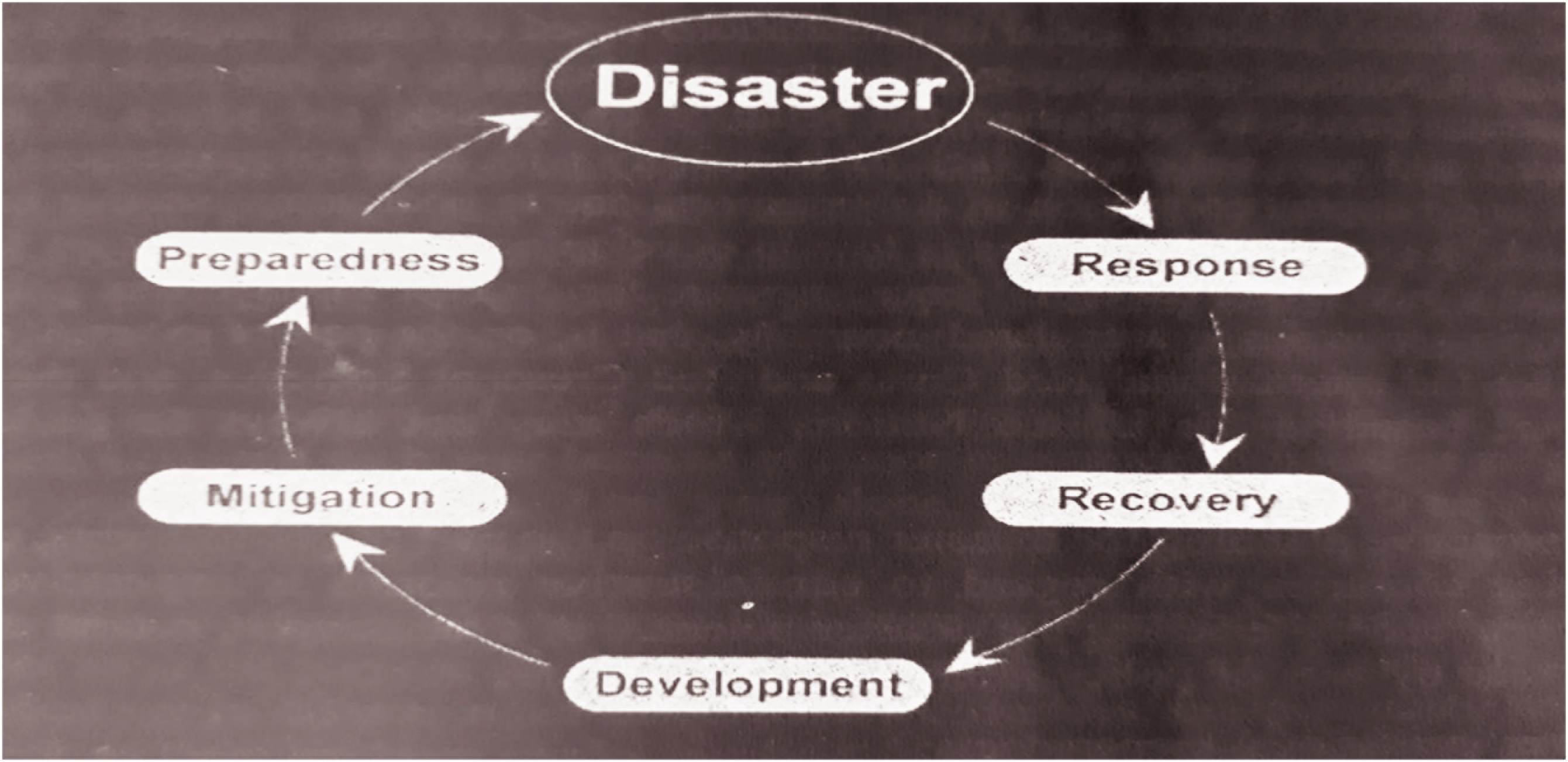
In the state of West Bengal, natural disasters are seasonal and mostly in the form of floods and cyclones. Added to it are the landslides which take place in the eight hill Blocks of Gorkhaland Territorial Administration (GTA). Apart from these, there are man-made disasters in the form of fire incidents, gas leakage and water pollution from industries, and wild spread of endemic diseases. The BDO has a small team comprising the BDMO and Civil Defence Volunteers (CDVs) who make the vulnerability mapping of the entire Block and keep stock of equipment and relief items in each Gram Panchayat for emergency purpose. S/he also forms a Quick Response Team (QRT) comprising civic volunteers, ASHA (Accredited Social Health Activist) workers, and panchayat staff for every Gram Panchayat. Let us understand how the Block administration deals with both natural and man-made disasters through a few case studies:
The District Disaster Management Control Room, which receives predictions from the Meteorological Department, sends early warning messages to the BDO in case of any impending natural disaster like heavy rainfall and rise of water level in the rivers and dams or any cyclone. The BDO immediately directs the concerned panchayat/s to evacuate the inhabitants to the nearest flood relief camp and arranges for a makeshift/gruel kitchen for providing food. The concerned primary health centre is also provided with the necessary stock of medicines to tackle the crisis. A QRT is rushed to the spot with necessary pieces of equipment such as small boats, lifeboats and jackets, ropes and tarpaulin sheets. The police authorities are also directed to keep a close watch on the proceedings. A block control room is immediately activated with some senior-level officials to work 24 hours and report to the district. The BDO along with a group of officials and staff move to a place close to the affected area along with another set of relief and rescue materials. During the occurrence of the event, BDOs remain in constant touch with the CDVs present at ground zero and provide the necessary directions. After the event, the BDO rushes to the spot with the medical team. S/he also assists the NDRF or SDRF team to carry out their search and rescue operations. The Gram Panchayat staff and VRPs provide them the necessary support to rescue the stranded people, if any, and assist them in repairing the dams/embankments to prevent further water-logging. Necessary arrangements are made to restore road communication and electricity in the affected areas at the earliest. The BDMO and his/her team make an assessment of the damage and prepare a list of affected persons with the help of panchayat staff and distribute primary relief items such as foodgrain, medicines, tarpaulin sheets, baby food and clothing for immediate need. The ADA assesses the damage caused to agriculture while the BLDO assesses the cattle and poultry loss. Meanwhile, all the information is constantly sent to the district control room while the block control room is busy preparing the action taken report as well as a compilation of assessment of losses and list of affected families. The entire exercise could take more than a month and the entire Block administration looks upon the BDO to deliver the best even in extremely adverse situations. However, the only consolation for a BDO is the folded hands and tears in the eyes of the affected inhabitants who have no other way to express their gratitude. The situation is a bit tricky for the BDOs for the hill Blocks as they are under the constant threat of landslides and small tremors (or even mild earthquakes) almost all over the year with little or no predictions or no communication network with the distant and vulnerable Gram Panchayats. These BDOs have to prepare a mitigation and rescue plan well ahead and also keep a close liaison with the General Reserve Engineering Force and Border Roads Organisation officials who look after the road network and are responsible for their maintenance and clearing the debris. The resources in the form of relief materials and medicine are also scarce in these regions and so careful prior planning has to be made to ensure optimum availability at the time of need. The QRTs are advised to form a human network for sending news through local messengers at the time of distress. A pool of vehicles has to be kept at hand for the movement of stranded inhabitants as well as medical personnel from and to the affected areas. Finally, the engineers of the Public Works Department (both civil and electrical) should be consulted while preparing the earthquake and landslide mitigation plan. The situation is even more testing for a BDO when it comes to the occurrence of man-made disasters such as fire and gas leakage, as there is no prior intimation and so assessment or vulnerability mapping could be done beforehand. It requires a high presence of mind, steel nerve and a cool head to tackle such a situation as the casualty is heavy and the response is required almost ‘at the speed of light’. Every single moment counts and every decision and direction should be clear and precise. The BDO is expected to rush to the spot with her/his team of officials, staff and QRT as early as possible and activate the medical team and police authorities immediately to minimise the damage. All the rescued and displaced persons should be provided with immediate shelter, food, medicine and essential items by the Block administration.
In all the above examples, it is evident that the BDO acts as the epicentre of the decision-making, and all the officials and staff act as per her/his direction. The BDO has to coordinate the actions smoothly and maintain a level of communication with all levels so that the best possible outcome is evident in such an hour of crisis. In most cases, the official cell phone of the BDO itself acts as the ‘control room number’ and process has to receive and make calls from and to all the stakeholders during the entire crisis period.
Leadership During the Political Crisis
The BDO acts as the liaison officer between the district administration and the member of parliament (MP)/member of legislative assembly (MLA) and is expected to work in unison with the elected members of the Panchayat Samiti and direct the elected Gram Panchayat members in their functioning. However, more often than not, the BDO faces a hostile Panchayat Samiti and extremely unruly Gram Panchayat members, and worst of all, the MP, MLA, and Panchayat Samiti are represented by different political parties. Added to the woe is the constant inter-group rivalry among the extremely corrupt members, a few of whom may be from criminal backgrounds. Being the Chairman of the Block Monitoring Committee, a BDO has to finalise the proposals made by the MP and MLA regarding the spending of MP Local Area Development (MPLAD) Fund, the MLA Local Area Development ( MLALAD) Fund schemes, respectively, and forward them to the district. As the executive officer of the Panchayat Samiti, the BDO has to chair the meetings of the various standing committees, and it is extremely painstaking to reach a consensus on any issue. It requires even more diplomacy and smartness on the part of the BDO to make the errant Gram Panchayats implement the schemes as most of those bodies consist of members of separate political parties having conflicting interests.
A BDO has to face deputation on several issues both from the ruling party and the opposition on several issues, and, unfortunately, in most of the cases, these deputations turn abusive and violent and may even result in physically heckling or causing damage to the office property. In this context, the role of the police authorities is extremely important. But it is unfortunate to note that in most cases, the police authorities tend to side with the ruling party due to their interest, and the BDO is left at the mercy of the personal equation with the political fraternities. In certain cases, even the district authorities tend to move away from the BDO which makes the matters even more complicated for them to handle.
The Block team led by the BDO must prove their neutrality by maintaining fairness in relief distribution as much as possible even in the face of adversity and political pressure from the ruling party. Generally, most of the BDOs begin their Block tenure with a certain zeal for development and social service with honesty and dedication but the hostile situations and constant political, as well as administrative pressures, tend to make them short-tempered and less focused after some time. This is where the civil service fails to nurture the best of talents and many positively spirited officers get disheartened and continue the service with a lesser spirit.
Leadership During Law and Order Issues
A Block has a population of about 100,000–300,000 persons belonging to different religions, castes and tribes. There are several types of law and order problems faced by the Block administration such as:
Incidents of riots based on religious grounds or ethnic clashes Political clashes Mass resistance to land acquisition or to some other government decision
Religious riots are one of the most sensitive problems faced by a BDO and even though the district administration immediately rushes to the spot on getting the information, the primary duty of a BDO is to minimise the loss and restrict the unrest to a smaller area. A BDO has to immediately rush to the spot with the senior officials and hold meetings with both the warring sections after taking them into confidence. Peace marches may be organised along with the police authorities and the victims should be immediately rescued. A BDO should always remain impartial under such situations and maintain a stern and composed posture so that both parties are gradually coaxed to return to the path of normalcy. It must be remembered that such an incident leaves an indelible mark in the minds of the inhabitants long after it is over and so the BDO should take adequate steps to build mutual trust and confidence among them. On joining a Block, a BDO should develop interpersonal relationships with some key stakeholders such as religious leaders, social workers, Non-Governmental Organisations (NGOs), businessmen, teachers, union leaders and even some anti-social elements who would provide her/him prior intimation about some mishap and s/he may be able to contain it much earlier before it is blown out of proportion. Such persons also act as moderators during the key dialogue process to douse the flame of anger among the rival groups and increase the trust of the people in the administration.
Political rivalry among different parties is a normal part of democracy until it remains a competition of thoughts and principles not when the same becomes a virtual war and threat to the administration, resulting in arson and looting and even loss of life and property. As politics is losing its ethical character and gradually becoming a den of criminals, the BDO, being the leader of the administration in the Block, faces immense political pressure in the form of threats and verbal abuse as soon as s/he tries to stir the hornet’s nest. It is indeed difficult to root out corruption and favouritism from the entire administration which is nurtured and guarded even by a section of the officials and staff of the Block itself. The common people are deprived of their rightful benefits as a good portion goes to fill the coffers of the political leaders and the corrupt staff. Almost all the BDOs try to get rid of this malpractice at the very beginning of their tenure, but those few who are successful must receive unconditional support from the political top brass cutting across political lines and a section of honest Block officials.
Another form of political clash takes place during the elections, especially the 3-tier Panchayat elections (at the village, mandal/samiti, and district levels), where the BDO acts as the returning officer at the first two levels and has to conduct the elections with the help of local police and home guards. Booth jamming and capturing and even looting of ballot papers and ballot boxes have become regular incidents, and the BDO has little or no role to play except being a mute spectator to such a horrendous occurrence. This creates anger in the minds of the political opponents who try to malign the BDO and the administration through various ways such as violent deputations, road blocking, arson and clashes with the ruling party. Party offices of both groups are targeted and even houses and shops of innocents are not spared. Even government property is destroyed in the name of protests. In such cases, the BDO should deal with the situation firmly and ensure prompt action with minimum damage. Meanwhile, they should also continuously maintain the process of dialogue with the party leaders and make them understand the gravity of the situation. A BDO who applies the ‘carrot and stick policy’ effectively can deal with the political leaders in the best possible manner.
Sometimes the government decides to acquire a portion of the land in a Block in the greater interest of the public, but this creates a surge of anger among the landowners or occupants of the land who believe that their future is at risk and they are robbed of their profession. These people are incited by the leaders of the opposition parties and they resort to violent protests. The BDO gets stuck, under this situation, as he can neither support the government decision openly for the fear of being termed as an ‘agent of the ruling party’ nor can he side with the agitators as it would be termed as a ‘gross act of indiscipline’. Since the BDO is at the receiving end, he is left with no other option but to reason out with the agitators by explaining to them about the benefits and compensation package they would receive from the government and how their future would be secured. This exercise is much easier said than done and it requires the BDO to take into confidence a section of the rural intelligentsia comprising of teachers and social workers who are respected by the locals and whose views are valued and accepted by them at large. Similar approaches are taken by a BDO to stop evil social practices such as child marriage, witchcraft and consumption of illicit liquor as a social practice, domestic violence, practicing untouchability and killing of wild animals as a social hunting custom.
Leadership in the Development Process
A BDO, as the nomenclature suggests aptly, is the key to ‘development’ in the Block. The inhabitants of the entire Block look upon her/him to construct a primary health centre, a motorable road, an embankment, a community toilet, a school boundary wall or even a tube well. Indeed, a BDO gets an allotment to the tune of ₹15–30 crore per annum depending upon the Block size, population and geopolitical location for execution of various developmental schemes. Even though almost all the allotments come as ‘tied funds’ (meaning that funds could be utilised specifically for the stated schemes only), the vision and dedication of a BDO indeed play an important part in the overall development of the Block. Most of the BDOs execute the schemes mechanically and tend to put priority on timely completion of the scheme to keep their district authorities in good humour, but a small section of the BDOs put their initiative and visionary zeal to develop certain schemes as a true asset for the Block and its inhabitants for times to come. Some cases worth mentioning may vary from planting vetiver grass along the river banks to prevent river erosion, adopting the ‘Sree’ method of rice cultivation, developing eco-parks to promote tourism, developing best practices in water harvesting, mango, apple and orange plantations, encouraging various Micro, Small and Medium Enterprises (MSMEs) schemes in the Block with local entrepreneurs and local produce, building a cooperative movement with the womenfolk to strengthen their livelihood and future, introduce micro-finance schemes to facilitate the SHGs and developing mango orchards in parched land with the help of the centrally sponsored Mahatma Gandhi National Rural Employment Guarantee Scheme (MGNREGS) of the union government. Each one of these schemes is unique in character and approach and the ‘best practices’ have been successfully replicated in many other Blocks, but the BDOs who initiated such schemes have proved that it is still possible ‘to create a piece of art among the cacophony of a marketplace’. The mere mention of allotment also brings to fore two major concerns: widespread corruption and lack of consensus among the political stakeholders about implementing a project.
Corruption has unfortunately become almost synonymous with administration. The common people have started to believe that almost every government official is corrupt and has amassed a huge fortune through ill means. Even though their perception is not totally unfounded, the majority of the civil servants still believe in integrity and transparency of service. Yet they have a tough time dealing with the unholy nexus between the corrupt officers and the political leaders who have developed a habit of securing a ‘cut’ from the payment made to the contractors after the scheme’s completion or from the beneficiaries after they receive the allotment in their bank accounts. A BDO should deal with the matter sternly but before that one must identify a small group of honest officers in the Block who abhor such malpractice and are ready to cooperate with her/him to weed out this evil. Here it would be pertinent to mention that there are still some honest politicians who believe in principles and if a BDO is lucky to find some such person/s in her/his Block, the task becomes a bit easier for her/him. However, they should maintain strong personal integrity and should not fall prey to temptations in cash or kind such as costly gifts, offer for package tours, land or property or even to the extent of honeytraps. The more a BDO resists, the more will he command respect, and his detractors are forced to move away from the path of kickbacks, even if it is temporary (at least during the tenure of a certain BDO). This will, in turn, become a great moral victory for the BDO who will now command more awe from his political counterparts and respect from his subordinate staff.
Reaching a political consensus in a standing committee meeting of Panchayat Samiti is more often than not a tedious exercise and may be compared with ‘pulling out a piece of flesh from the crocodile’s mouth’. Petty political considerations and intra-party rivalry take a toll on development and even a BDO with zeal and potentiality for doing something noble have to remain satisfied with a ‘fragmented piece’. Even if the scheme of an MP or MLA is finalised and the allotment reaches in time, its implementation becomes a nightmare. The contractors are threatened to stop work or pay a hefty commission by criminal elements before starting the project, the labourers are forced to stop work, electric or water supply is disconnected and even the supply chain of materials is disrupted. Unfortunately, the same incidents occur while implementing central government’s schemes when the ruling party at the centre is different from that in the state. Many a time it requires the personal intervention of the BDO, that too rather often, to execute the project. This intervention itself is a herculean task as a BDO has an average of 10–20 large projects and about 500 small projects/schemes to complete in a financial year. Added to it is the constant pressure from the district administration to complete the projects within the stipulated period and submitting the utilisation certificate so that the next part of the allotment reaches the district/block in time, or else the allotment may lapse or may have to be returned. A BDO who successfully executes most of the schemes within her/his tenure within the stipulated time is a master of multi-tasking and possesses superb negotiating skills.
Conclusion
Leadership is the process of motivating and guiding others to work with more dedication to achieve some stated objectives. ‘It is the guiding force that enables an individual or a group to identify the goals and then influences and supports them in achieving those objectives. Leadership, then, is the catalyst that transforms potential into reality’ (Newstrom, 2007). The term ‘bureaucracy’ was coined by Vincent de Gourmey, a French economist, in 1745. He mixed the conventional term ‘bureau’ which means writing table and office and added the Greek suffix ‘cracy’ meaning ‘rule’ to suggest that it stands for the rule of officials. A close study of the two definitions and the role played by a BDO suggests that leadership and bureaucracy are interconnected when it comes to the execution of administration at the ground level. It also suggests that ‘bureaucratic leadership’ transforms into a more practical and reasonable form when a civil servant functions as a BDO. A synopsis of this article asserts the point that a civil servant is expected to execute an exceptional role during her/his Block tenure that of a diplomat, a motivator, a negotiator, a visionary, a planner, a stern disciplinarian, a moderator, a human resource expert, an expert accountant, a psychologist, a dreamer and most importantly, a ‘humane’ being. It must be remembered that most BDOs have to reside in far-flung Blocks away from their family members and it is extremely difficult to get leave even during personal crises. Finally, we can state that a BDO represents the true spirit of a civil servant who remains steady and calm in the face of both official and personal adversity and motivates and guides his team by setting an example of integrity and compassion. A Block is often identified by the untiring efforts of an efficient and dedicated BDO who is fondly remembered for his/her yeomen service by the inhabitants of that Block years after his tenure is over.
Footnotes
Declaration of Conflicting Interests
The authors declared no potential conflicts of interest with respect to the research, authorship and/or publication of this article.
Funding
The authors received no financial support for the research, authorship and/or publication of this article.