



Abstract

Introduction
In India, voter turnouts differ across States. Diwakar (2008) found support for rational voter argument in India as it was found that high levels of literacy and close competition increases the voter turnouts. Kerala the State with highest literacy rate in India had the highest voter turnout in 2019 parliamentary elections with 77.86% turnout (Nair, 2019). The Delhi Assembly elections also confirm the low turnout in urban areas, as New Delhi districts recorded relatively lower turnout of 44.29% (Hindustan Times, 2019). Chandra and Potter (2016) also found that voter turnout in urban areas is low, but they raised the possibility of neighbourhood effect that leads to a change in the voter turnout of rural voters when there is urban settlement in a constituency. Niemi and Hanmer (2010) examined voter turnouts of college students in the USA and found that factors that influence older generations also influence young generations and voter turnout is also influenced by mobilisation of voters by political parties. Banerjee et al. (2011) in an experimental study in slum areas of Delhi found that more informed voters have higher voter turnouts. Nikolenyi (2010) has found that the willingness to vote is negatively impacted by separate elections for national and state politics in India. Lehoucq and Wall (2004) have argued that economic development has little impact on voter turnouts. Hansford and Gomez (2010) argued that it is difficult to predict results in case of high voter turnouts. Low voter turnout makes the election process vulnerable to manipulation and it is reflected in victory of individuals with criminal records. Poor focus on governance and employment opportunities leads to unemployment (Chand et al., 2017). The diffusion of technology and mobile penetration across India has provided an enabling environment with technology-supportive policies of government (Rana & Tiwari, 2014). This article evaluates the voter turnout in India and explores its association with inclusive social development measured by female literacy rate.
Dynamics of Voting Pattern
Governance in India is chosen by some people who vote and elect their representatives. Migrant workers and people staying away from hometowns are not able to participate in the election process, as physical presence is required in polling booths. Good number of voters are thus excluded from the election process. This gives chance to the politicians to focus on short-term-gift-offerings of freebies in the form of reservation, promoting caste and religion-based hatred and this is repeated in every election held after five years to continue their hold on the emotional electorates. Availability of biometric identities of over a billion citizens in the form of Aadhar cards provides an opportunity to hold cloud-based smart voting at the national level. The voters who are not physically present in their home constituency can also participate in the voting process by casting their vote electronically in the polling stations in their own city by verifying their biometric identity with the Aadhar cards. Increase in voter turnout is likely to enhance the rationality of the electors to elect their representatives. Matsusaka (1995) has argued that voting turnout is influenced by confidence in the choice of a candidate, as it positively impacts people who are looking to maximise their utility. Chari (2011) found that a social multiplier influences female voter turnout, and the multiplier was found to be negatively associated to female literacy. Schraufnagel et al. (2014) argued that poor economic development influences voter turnout in South East Asia. Information along with rationality explains voting turnouts. In elections with close competition between the political parties, the voter turnouts tend to be high (Blais, 2006). Compulsory voting has a positive impact of voter turnout in industrial democracies, as it increases voter turnout by 15% (Jackman, 1987). But Norris (2002) found that compulsory voting does not increase turnout equally in new and old democracies. Compulsory voting has a positive impact on voting only in older democracies. Information technology combined with political activism has the potential to strengthen innovation ecosystem and economic growth in India to compete with China (Tiwari et al., 2017). Lack of political education of women is a contributing factor for poor participation of women in political system (Chuarasia, 2022). Das (2021) examined women empowerment in light of participation in elections. It has been argued that state and society need to work together to enhance participation of women in the mainstream. Petitpas et al. (2021) found that electronic voting leads to differences in voting turnout of male and female citizens. Arputhamoni and Saravanan (2021) argued that online Smart voting system with biometrics can check fake voters.
Method
The association of voting turnout on human development assessed by female literacy ratio is examined using secondary data. The voting turnouts of 2014 and 2019 general elections in India are considered for the study. Voter turnout data are obtained from Election Commission of India. Female literacy rate of the Census-2011 for the states is used as an indicator of inclusive human development. Union territories are excluded. Data of 29 states are obtained from the website of the Election Commission of India and the Census of the Government of India. Data are analysed using correlation coefficient.
Voter Turnout and Female Literacy
A significant positive correlation was found between voter-turnout ratio and female-literacy rate in 2014 (p < .05) and 2019 (p < .05) as shown in Tables 1 and 2. States with high voter turnout are having better governance for inclusive development reflected by female literacy rate.
Correlation of Voting Turnout of 2014 and Female Literacy Rate.
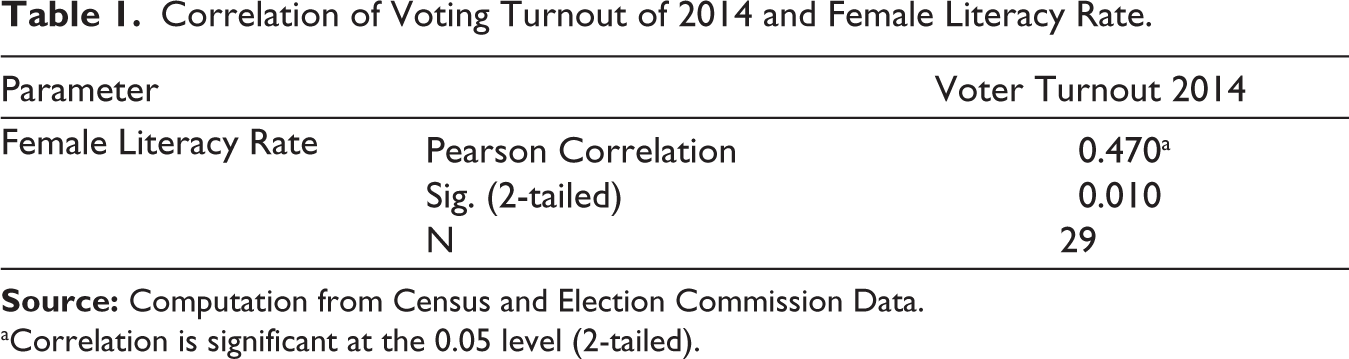
aCorrelation is significant at the 0.05 level (2-tailed).
Correlation of Voting Turnout of 2019 and Female Literacy Rate.

aCorrelation is significant at the 0.05 level (2-tailed).
Martins and Veiga (2013) found in a study of Portuguese elections that economic performance is associated with voter turnout only in national elections; regional elections are not associated with economic fundamentals. Size of government is positively impacted by reforms that enhance voter participation (Eterovic & Eterovic, 2012). Effective governance is a viable approach to achieve desirable social outcomes (Born, 2016). Fumagalli and Narciso (2012) found that higher voter turnout is associated with higher social welfare spending. Voter turnout has also been found to impact policy outcomes by government.
Diwakar (2008) has examined voter turnout in Indian states. It was found that voter turnouts in different states of India are consistent with the rational choice model of voter. Rational voter model is based on the argument that closely fought elections and higher literacy regions tend to have higher voter turnout. Kundu (2020) argued that lack of information among voters leads to higher influence of caste and religion in voting which results in criminalisation of politics. People with criminal charges get elected and seriously impact good governance. Poor quality of legislators leads to political corruption and poor governance. Politics in India is primarily driven by ethnicity, rather than economic gains (Banerjee et al., 2019).
Cloud-based Smart e-Voting
Cloud-based smart e-voting was proposed for India by Gupta et al. (2013) by integrating polling and result generation through a website. The identity of the voter would be authenticated by the polling officer and afterwards the voter will be allowed to cast vote and after that the voter would be provided with a token and disabled to vote further for that election by the system. Zissis and Lekkas (2011) examined cloud-based electronic voting supported by cryptographic technologies. Bellini et al. (2019) recommended the use of blockchain for electronic voting. Will et al. (2015) recommended use of exclusive hardware server for electronic voting using homomorphic verification and decryption. Smart voting using cloud computing and cryptography would face challenges of security, verifiability, accountability, privacy and foul-play charges by a political party losing the elections.
Conclusion
Higher voter turnout is associated with higher female literacy rate in Indian States. Higher voter turnout enhances inclusiveness by providing opportunity for citizens to participate in electing their representatives. Technology-enabled online-electronic voting is suggested to increase voter turnout and enable participation of more citizens in electing representatives for legislatures. Availability of biometric identities and digital infrastructure provide an opportunity to enhance participation of citizens in voting process. A diverse country with good voter turnout provides better representation of diverse groups for inclusive growth. Higher voter turnout provides an opportunity to move away from ethnic orientation of elections in India to developmental issues for inclusive growth. Success of direct benefit transfers and e-governance have proved that India needs technology more than ethnic hatred for inclusive growth. Cloud-based Smart e-voting will provide opportunity for a large section of left-out citizens to participate in the world’s largest democracy and strengthen the democratic processes with better participation.
Footnotes
Declaration of Conflicting Interests
The authors declared no potential conflicts of interest with respect to the research, authorship and/or publication of this article.
Funding
The authors received no financial support for the research, authorship and/or publication of this article