




Abstract
The transition from government to governance demands that numerous stakeholders participate in the policymaking and call for a strategy that could effectively help the process. Stakeholders’ engagement is extensively used in all types of public organisations, giving different stakeholders the chance to have a say in how decisions are made. The public policy process has also accepted and embraced this principle as a method, both formal and informal, for policy formation, monitoring and evaluation, owing to the interconnected interests of the two domains and the stakeholders’ expanding involvement in the process. This has enabled better alignment of public policy with the needs and aspirations of society.
Stakeholders’ participation has also become an important phenomenon in recent years in India. The National Education Policy (NEP) 2020, the conceptualisation of Students’ and Teachers’ Holistic Advancement through Quality Education (SARTHAQ) and the National Curriculum Framework are the results of massive stakeholders’ participation and a bottom-up approach. Involving stakeholders in the formulation of educational policies increases the quality of the educational system. This kind of wide and intensive consultation process and development of policies through a bottom-up approach ensures that diverse views are taken into consideration and citizens are significant contributors in the entire process. This essentially shows that collaboration and responsibility-sharing among stakeholders are key to achieving educational goals.
Keywords
Context
As we are entering into the 75th year of Independence (at the time of writing this paper), it is time for all of us to come together and work relentlessly to ensure that the country achieves new milestones in terms of development and is moving forward to constitute an equitable, inclusive and just society. Citizens are an essential component of governments as they can promote good governance when they exercise their democratic rights beyond the right to vote. The 73rd and 74th Constitutional Amendment Acts in India establish local self-governance institutions at the rural and urban levels, respectively. Decentralising governance intended to make entitlement provisions contingent on local governing bodies as well as the Central and State governments. These good-governance reforms are centred on effective citizens’ participation in decision-making, and this approach has the ability to revitalise the bond between citizens and decision-makers.
A clearly defined constitutional framework for public participation is one of the three key prerequisites for successful public participation, according to the European Institute for Public Participation (EIPP). Politicians and citizens can only build trust and public involvement and can only realise its democratising potential through an unambiguous, common understanding. In order to advance the integration of participatory approaches, a culture of learning about participation must be fostered, and methods for ‘public engagement must be evaluated in a rigorous and challenging manner. According to John Rawls’ doctrine of public reason’, citizens involved in specific political activities have a responsibility to be able to defend their choices about important political matters only in terms of public standards and values. By virtue of having the right to participate in governance, citizens also have a responsibility to make sure that their political choices are supported by their fellow citizens. They must be able to defend these choices of one another, using values and standards that are widely accepted by the public.
Stakeholders’ engagement/participation has become a key element in developing policies and putting them into action, signalling a paradigm shift in India’s educational system. The advent of the National Education Policy (NEP) (Ministry of Education, 2020a, b, c), through a multi-faceted and extensive consultation process, formulation of its implementation plan and the National Curriculum Framework (NCF) (National Council of Educational Research and Training [NCERT], 2022) following the same approach are the successful examples of having an effective public consultation process. This is also fostering a bottom-up approach, transparency and accountability in the entire system, which is crucial for achieving desired outcomes and a sustainable impact on society.
Public Participation in Formulation of National Education Policy (NEP), 2020
NEP, 2020, has been appreciated worldwide for its path-breaking, progressive and futuristic recommendations. The Indian education system will undergo considerable reforms by NEP, 2020. The NEP, 2020, is based on five pillars: access, equity, quality, affordability and accountability. It will provide our children with the skills they need to handle a range of current and upcoming national and global issues. In NEP, 2020, the cultivation of 21st Century skills is emphasised, and school and higher education are seen as two interconnected, natural streams that are rooted in Indian culture and constitutional principles. Pre-primary education for all children, a national mission to achieve foundational literacy and numeracy, flexibility in course selection for students in schools and higher education, reforms in examinations, governance and regulations, as well as accreditation for quality in both public and private educational institutions, a deliberate effort to include all segments of society, and make innovative and an extensive use of technology for education are some of the things that are included in it. This learner-centric NEP envisages that India will become a popular study destination for international students and advance the internationalisation of higher education through students, faculty, and institutional mobility in addition to ensure students’ holistic development by highlighting their creative potential.
NEP, 2020, is the result of widespread and intensive consultations held over a period that helped in formulating an instrument that not only reflects the aspirations of the society and prepares the young generation for the 21st Century but is also rooted in Indian ethos and its rich culture and heritage and policies. In fact, the process of developing education policies is changing from being more top-down and incorporating minimal stakeholders’ inputs to directly involving stakeholders from the phases of policy creation to implementation. Successful policy implementation in education ‘needs mobilising the knowledge and experience of teachers and school leaders, the people who can establish the real-world links between the classroom and the changes taking place outside the classroom’ (Schleicher, 2018).
Numerous stakeholders’ discussions, including those with State and local governments, the Government of India Ministries, Members of Parliament and the general public, were held during the development of National Education Policy 2020. Before the policy was finalised, a highly participative, inclusive and multi-pronged consultation process that included State governments, was carried out through online, grassroots, and thematic experts’ consultations. The Draft National Education Policy 2019 (Draft NEP 2019) was uploaded to the websites of the Ministry of Education (MoE,
An Education Dialogue with Honourable MPs of Andhra Pradesh, Telangana, Tamil Nadu, Puducherry, Kerala, Karnataka and Odisha was held on three consecutive days, that is, on 31 July 2019, 01 August 2019, and 02 August 2019. Two meetings, one with State Education Secretaries of School Education and another with State Secretaries of Higher & Technical Education, were held on 09 July 2019 and 08 August 2019, respectively. Nearly two lakh suggestions were received for the Draft National Education Policy by numerous stakeholders (Press Information Bureau Release, 29 July 2020). Various subject-specific committees were made at National Council for Educational Research and Training (NCERT) and these suggestions were analysed by the subject experts and necessary changes were made to the draft policy document.
A special meeting of the Central Advisory Board of Education (CABE) was convened on 21 September 2019, to deliberate on the National Education Policy. The meeting was attended by 26 Education Ministers from various States and Union Territories (UTs), representatives of States and UTs, members of CABE, leaders of autonomous organisations, and Vice-Chancellors of universities in addition to senior executives of the Central and State governments. The Parliamentary Standing Committee also met on 7 November 2019, to discuss the Draft National Education Policy. The proposed Cabinet Note on National Education Policy 2020 underwent inter-ministerial consultations as per the process. This detailed consultation process was expected to create greater awareness about the policy among the general public. As a result, the Ministry of Education (MoE) finalised the National Education Policy, 2020, based on the inputs and comments received from various stakeholders on the Draft NEP, and the Union Cabinet approved it on 29 July 2020 (Press Information Bureau Release, 29 July 2020).
According to Burns et al. (2016), the following are the significant advantages of including stakeholders more directly in the policymaking process:
Better policy outcomes can be achieved by making sure that policies are in keeping with stakeholders’ demands, interests and knowledge while also taking advantage of their experience and skills. Better implementation: Giving stakeholders the chance to affect the policy’s stakes while also improving their understanding of the policy can increase its legitimacy and foster ownership among stakeholders. There will be enhanced trust through direct communication and debate.
It is pertinent to note that better judgements are made as a result of public engagements because it provides decision-makers with more comprehensive information to consider during the decision-making process, such as new facts, values, viewpoints and informed knowledge and skills of all stakeholders involved. Decisions are more sustainable and able to be implemented because they take into consideration the needs and interests of all participants, including marginalised and socio-economic disadvantaged groups.
NEP 2020 included several new features which were not a part/focus of the earlier policies. These are as follows:
Early childhood care & education and new pedagogical and curricular framework: The 10+2 structure of school curricula is to be replaced with a 5+3+3+4 curricular framework, which corresponds to ages 3–8, 8–11, 11–14, and 14–18, respectively, with an emphasis on early childhood care and education. This will include the hitherto unaddressed age-range of 3–6 years, which has been acknowledged universally as the critical stage for a child’s development of mental abilities. In the new system, there will be 3 years of Anganwadi/pre-school and 12 years of formal education. Curriculum and pedagogy: By providing students with important 21st Century skills, reducing the amount of curriculum in the classroom to focus more on critical thinking and fundamental learning, and emphasising experiential learning, school curricula and pedagogy will strive to educate students holistically. The academic options and degree of flexibility for students will rise. There would not be any strict separation between the Humanities and Sciences, extracurricular activities or academic and vocational streams. NCERT will develop a new, comprehensive National Curriculum Framework for School Education (NCFSE). Focus on achieving foundational literacy and numeracy: The National Mission on Foundational Literacy and Numeracy is to be established by the union MoE in accordance with NEP 2020, which recognises Foundational Literacy and Numeracy as an urgent and essential prerequisite to learning. In order to achieve universal foundational literacy and numeracy for all students by grade 3 in next five years, each state will create an implementation plan. Multi-lingualism: The policy has placed a strong emphasis on using mother tongue, local languages and regional languages as the medium of instruction at least through the fifth grade, but preferably until the eighth grade and beyond. Children in grades six through eight should take part in a fun project or activity on ‘The Languages of India’, perhaps as part of the ‘Ek Bharat Shrestha Bharat’ programme. At the secondary level, other foreign languages will also be available. Indian Sign Language (ISL) will be standardised across the nation and national and state curricular materials will be developed. Assessment reforms: According to NEP 2020, assessments will transition from summative to regular and formative, more competency-based learning and development promoting, and testing higher-order abilities such as analysis, critical thinking and conceptual clarity. In Grades 3, 5 and 8, all students will take school exams, which will be administered by the proper authority. Board exams for Grades 10 and 12 will remain, but they will be revised with the goal of promoting holistic development. As a body for creating standards, a new National Assessment Centre called PARAKH (Performance Assessment, Review and Analysis of Knowledge for Holistic Development) will be established.
Robust recruitment and career path for teachers:
Recruitment for teachers will take place through thorough, open procedures. Promotions will be given on the basis of merit, and there will be a system in place for multi-source periodic performance evaluations and potential career routes to become educational administrators or teacher-educators. The National Council for Teacher Education will create a set of uniform National Professional Standards for Teachers (NPST) after consulting National Council of Educational Research and Training (NCERT), State Council of Educational Research and Training (SCERT), educators, and professional associations of various levels and locations. Equitable and inclusive education: No child should be denied the chance to learn and succeed due to their background or circumstances of birth, according to NEP 2020. A special focus will be placed on Socially and Economically Disadvantaged Groups (SEDGs), which include those with disabilities and gender, socio-cultural and regional identities. This includes creating Special Education Zones for underprivileged areas as well as a Gender-Inclusion Fund. From early education to higher education, children with disabilities will be able to fully participate in the regular educational process with the assistance of teachers who have received cross-disability training, resource centres, accommodations, assistive devices, suitable technology-based tools, and other support mechanisms tailored to their needs. Every state/district will be urged to start ‘Bal Bhavans’ as special daytime boarding schools, where students can engage in play-related, career-related and artistic activities. Schools should be used as Samajik Chetna Kendras (Social Consciousness Centres). School governance: In order to ensure that all resources, including infrastructures, academic libraries, and a strong professional teaching community, are available, schools can be organised into complexes or clusters that will serve as basic units of organisation. Accreditation for school education and standard-setting: For policymaking, regulation, operations, and scholarly affairs, NEP 2020 envisions distinct, transparent State School Standard Authority (SSSA). For wide public monitoring and accountability, transparent public self-disclosure of all the fundamental regulatory information, as prescribed by the SSSA, will be published on website. A School Quality Assessment and Accreditation Framework (SQAAF) will be created by the SCERT after consultations with all stakeholders.
Development of NEP Implementation Plan Through Stakeholders’ Participation: SARTHAQ
An indicative and suggestive Implementation Plan for School Education titled Students’ and Teachers’ Holistic Advancement through Quality Education (SARTHAQ; Ministry of Education, 2021) was developed by the Department of School Education and Literacy to assist States and UTs in implementing the goals and objectives of the NEP 2020. The development of SARTHAQ involved extensive and thorough consultation with States and UTs, autonomous bodies, and inputs gathered from all stakeholders; around 7,177 suggestions/inputs were obtained from them. From 8 September to 25 September 2020, a teachers’ festival called ‘Shikshak Parv’ was specifically planned to discuss the numerous NEP 2020 ideas and its implementation plan, which garnered over 15 lakh suggestions (Rajya Sabha Secretariat, 2022).
Figure 1 depicts that the Plan respects federalism and recognises that education is a concurrent endeavour by the Centre and the States/UTs. States and UTs have the freedom to change this Plan in accordance with their unique needs and conditions and to contextualise it appropriately. This implementation plan outlines the strategy and direction for NEP 2020’s implementation over the course of the next 10 years, which is crucial for a successful and efficient rollout. Additionally, efforts have been made to design the proposed activities as they will be built on the existing framework rather than developing new ones. As a result, SARTHAQ upholds the policy’s spirit and meaning and is intended to be implemented in a phased manner. SARTHAQ has also been created as an ongoing and working document that is generally suggestive/indicative in character and will be modified from time-to-time based on the inputs/feedback obtained from the stakeholders.
Stakeholder Consultation for NEP 2020.
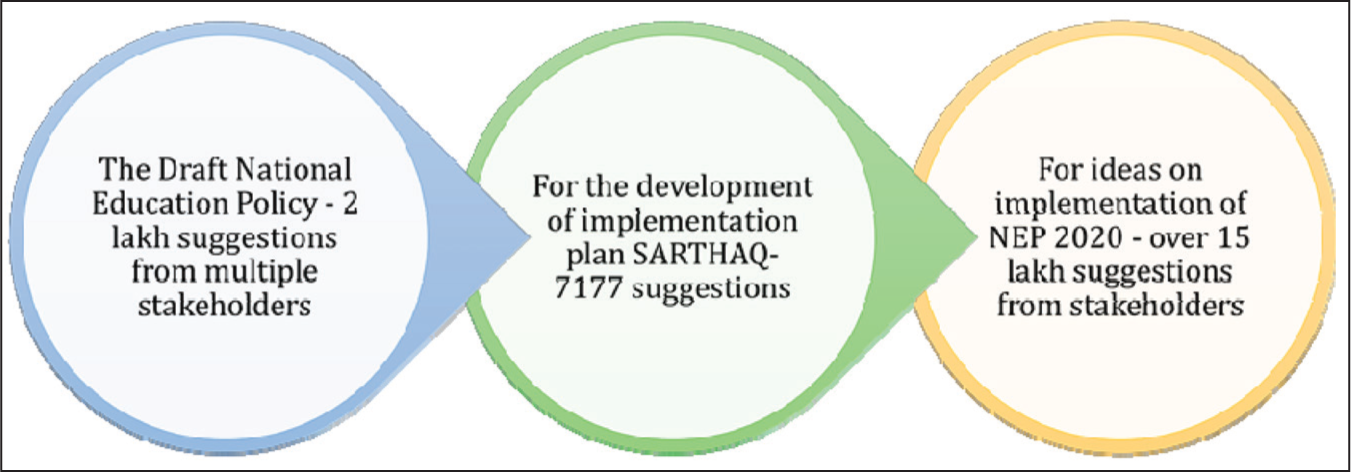
The main purpose of SARTHAQ is to describe tasks in a way that makes goals, outcomes and deadlines clear. To do this, it links the recommendations of the NEP with 297 Tasks, along with the relevant organisations, dates, and 304 outputs of these tasks. Out of these tasks, MoE has completed 24 major tasks, including the updation of UDISE+ data formats. A Joint Task Force with ministries has been set up with the Ministry of Tribal Affairs, Ministry of Women and Child Development, Ministry of Health and Family Welfare, etc., for developing guidelines, frameworks, etc., for quality ECCE. Guidelines for National Initiative for Proficiency in Reading with Understanding and Numeracy (NIPUN) (Expert) Bharat Mission, Codification of Learning Outcomes, has been developed for the foundational stage, ‘Vidya Pravesh’ 3-month play-based school preparation module for grade 1 students, a separate vertical for foundational literacy and numeracy resources at Digital Infrastructure for Knowledge Sharing (DIKSHA) have been developed to assist and mentor States/UTs and teachers, schemes of MoE, that is, Samagra Shiksha, Pradhan Mantri Poshan Shakti Nirman (PM Poshan), New India Literacy Programme, etc., have been aligned with NEP recommendations, National Achievement Survey (NAS) 2021, school safety framework, National Initiative for School Heads’ and Teachers’ Holistic Advancement (NISHTHA) 2.0 and 3.0 Teacher Training, New Policy on the weight of school bags, and E-learning has been expanded through DIKSHA and Vidyanjali 2.0, etc., have been introduced.
If policies are not properly executed, passing them does not guarantee success on the ground. The first researchers to demonstrate that implementation predominates results were Pressman and Wildavsky (1984). According to Payne (2008), successful implementation of education policy has been evidenced in schools where there is: coherence, stability, peer support, training, and engagement.
The Stakeholders’ Consultation Process for National Curriculum Framework
The NEP 2020, requires that the four NCFs, that are, National Curriculum Framework for Early Childhood Care and Education (NCFECCE) which is now called Foundational Stage (NCFFS), National Curriculum Framework for School Education (NCFSE), National Curriculum Framework for Teacher Education (NCFTE) and National Curriculum Framework for Adult Education (NCFAE) be developed.
The MoE and NCERT collaborated to create a comprehensive mandate document plan in this regard. According to this document, at the state level, all states and UTs would first prepare their State Curriculum Frameworks (SCFs) after conducting district-level consultations, conducting a mobile app survey and developing position papers by the state focus groups in 25 identified areas/themes as per the NEP 2020, including ECCE (foundational stage), teacher education and adult education. These preliminary SCFs would serve as inputs for the creation of the NCFs. To give inputs for the NCFs, states/UTs, autonomous organisations and organisations functioning under the MoE will all undertake this procedure. The NEP 2020’s recommendations will be taken into consideration throughout the entire process. The MoE set up the National Steering Committee for developing National Curriculum Frameworks on 21 September 2021. At the national level, NCERT surveyed the MyGov Portal to get input on the issues associated with curriculum implementation from various stakeholders. The strategy plan further said that the entire process, including consultations and the compilation of reports at all levels, would be carried out utilising a paperless method and a tech platform created explicitly for that purpose. In light of this, the NCERT and National Informatics Centre (NIC), MoE, created a robust tech platform. All the states and UTs received electronic templates for consultations, surveys, position-papers, etc., on this platform, and the nodal officers appointed at the Central level provided ongoing support. States also nominated their nodal officers for the smooth and speedy flow of this process.
Tech Platform for Development of NCFs
The bottom-up, paperless development of curriculum frameworks was made easier by the Tech Platform, which also facilitated consultations and the creation of reports at all levels. The platform also made use of machine learning (ML) to combine and summarise comments and opinions.
The development of position papers by the State Focus Groups in 25 areas/themes identified as per the NEP, 2020, was supported by technology during the preparation of the SCFs, which went through the process of district-level consultations, mobile app-based surveys and position papers.
The technological platform also unified all of the above-mentioned activities done by the states for the compilation of National Focus Group position papers at the national level, as well as the national-level survey carried out through the MyGov portal, district-level consultations by NCERT, and all of the above-mentioned activities by the states. The four National Curriculum Frameworks (NCFs) will be developed using the analysis of all these inputs.
This survey consists of 100 questions about the implementation of NEP, 2020, and it is broken down into four areas: early childhood care, education, teachers’ education and adult education. School education has 40 questions, which are further divided into two groups, GRP.I and GRP.II, with 20 questions in each group. According to their areas of interest or lines of work, the survey tried to elicit responses from a variety of stakeholders, including teachers and teacher-educators. In order to allow survey participants to select the set that is best suited to their preferences or areas of interest, questions were separated into four categories (five sets).
Tech platform’s creation and implementation happened in stages. The following lists the main attributes of the NCF tech platform:
Information dissemination and survey:
NCF website, Mobile app-based survey, and MyGov survey response integration Common features:
Resource management (committees, focus groups, consultation units, respondents, nodal officers, etc.), Consultation/meeting management, Dashboard and monitoring of reports at various national/state/district level stakeholders, Alerts and notifications, Version control & revision management for consultation reports, position papers, curriculum frameworks, etc., Editor with word-based features to submit district reports, position papers and curriculum frameworks, and Machine learning based summarization of responses received at district and state levels. District level consultation and focus group paper:
E-template(s) for preparation of District Consultation Report (DCR) for both state and national level consultation, Facility to upload PDF files with responses to the questions against each focus group prepared by the mandate group, and 25 E-templates for development of focus group position papers were developed.
Along with this the digital survey for National Curriculum survey was launched to seek inputs and suggestions for the development of the NCFs from all stakeholders, parents, students, all citizens, etc.
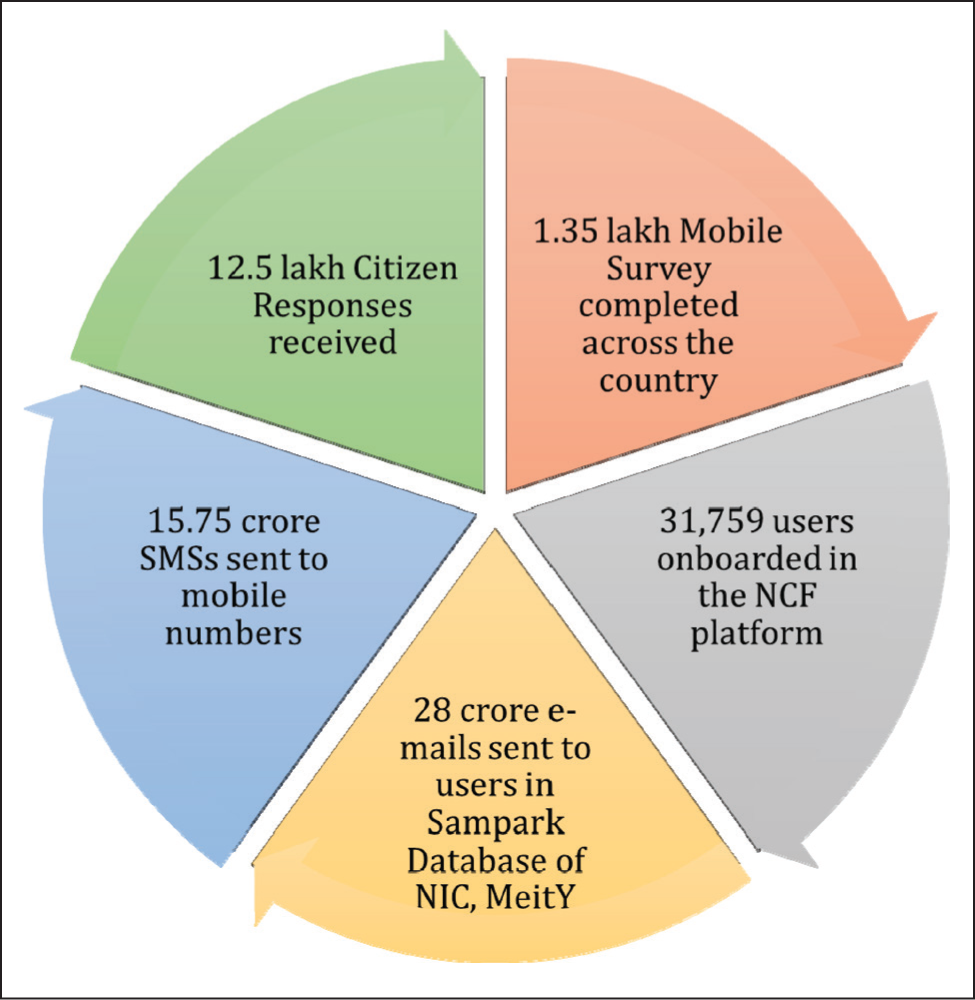
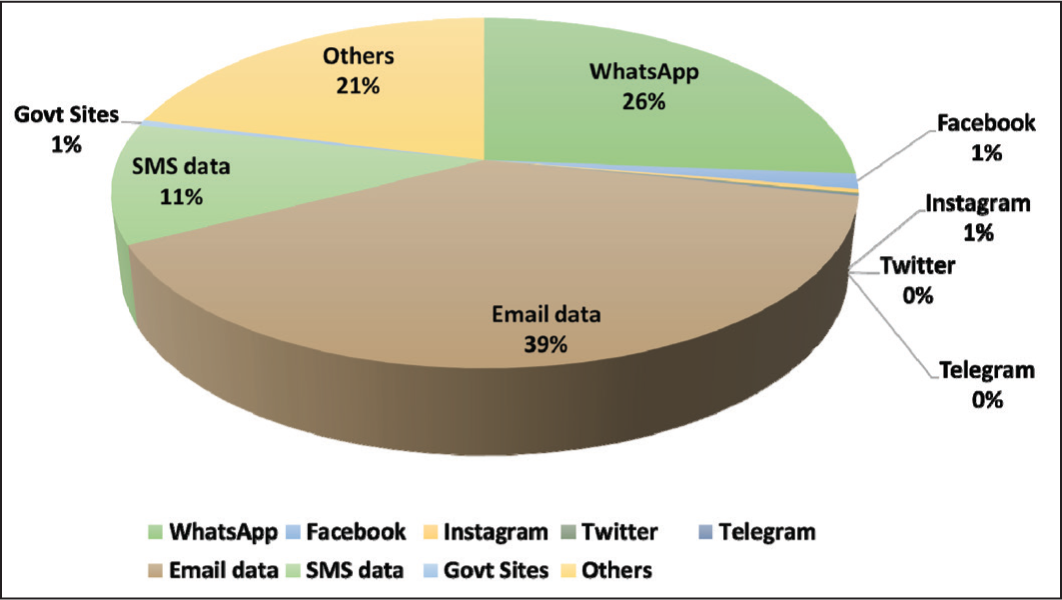
Figure 2 depicts the extent of engagement with stakeholders and Figure 3 depicts the platform-wise engagement for citizen’s survey. The abbreviation of the survey was called
NCF Public Consultation
As a consultative process of developing Curriculum Frameworks, National Consultation Workshops were conducted by various universities in collaboration with the NCERT. In the workshops, the Vice-Chancellors of different universities, members from civil societies (NGOs), representatives from State Council of Educational Research and Training and District Institute of Education and Training (SCERTs and DIETs), teacher educators, faculty members from higher education, school principals, teachers, subject-experts, students (school and higher education), parents, Anganwadi workers participated and contributed to the discussions held on various aspects of ECCE, school education, teachers’ education and adult education. Consultations were also held with the National Awardee Teachers.
Conclusion
Involving stakeholders in the policymaking process enables decision-makers to better comprehend the requirements of citizens and other stakeholders, test and refine various approaches to a policy challenge, and increase public confidence in the government. The process of facilitating numerous rounds of consultations helps policymakers overcome steadfast resistance to change, allows participants to see how their inputs have influenced policy development, and fosters a sense of shared policy ownership. Decisions that are based on public participation methods are, therefore, viewed as more credible and are less likely to be contested. Decision-makers who have a thorough understanding of stakeholders’ interests are also better communicators, able to articulate their choices and the thinking behind them in words that are relatable to stakeholders’ beliefs and issues. The ability to handle challenging social issues is another important outcome of persistent stakeholders’ participation in decisions and their execution. This capability comprises stronger bonds of trust between decision-makers and the general public as well as within the various stakeholders’ groups themselves. Additionally, when done correctly, public involvement aids in teachsing participants constructive and cooperative methods to interact with one another, handle challenging decisions and settle disagreements.
Stakeholders’ involvement in the decision-making process also empowers individuals and creates sustainable change and also helps in establishing relationships, cultivating new relationships and strengthening the current ones. NEP 2020 has been able to get vibrant and enthusiastic responses from all strata of society and has generated greater awareness among all stakeholders, which is a result of an effective and efficient participatory process. Furthermore, stakeholders’ active engagement/participation in policymaking is a sign of mature democracy. This process also ensures that democracy is implemented in its best form and that policies so formulated are citizen-centric, fosters a sense of belongingness and caters to the needs of diverse groups.
Footnotes
Declaration of Conflicting Interests
The authors declared no potential conflicts of interest with respect to the research, authorship and/or publication of this article.
Funding
The authors received no financial support for the research, authorship and/or publication of this article.