



Abstract
Minimum Support Price (MSP) is one of the many important aspects related to agricultural development. Farmers have been demanding MSP for decades, but the demand for legalisation of MSP has been raised prominently by the contemporary farmers movement. On the one hand, farmers had been engaging in protests in Tikri, Singhu (Delhi–Haryana border) and Ghazipur (Delhi–UP border) throughout the year (2020–2021) for legalisation of the MSP. On the other hand, the government is in favour of neoliberal policy and saw the MSP as an agro-ecological and financial risk. This article uses quantitative and qualitative methods to establish a relationship between MSP, agrarian issues and the farmers movement in India. The result shows that the MSP policy has had a very negative impact on agro-ecology and groundwater conditions in Punjab, Haryana and Western UP.
Keywords
Introduction
The issue of agriculture-price policy was at the centre of the new-farmers movement 1 in India in the early 1980s. Even at present, the agricultural-price policy is included as an important aspect in the centre of the contemporary farmers’ movement, which lasted for a year in North India (Punjab, Western Uttar Pradesh and Haryana) (Suthar & Kumar, 2022). The farmers and farmers’ organisations were agitating for the legalisation of minimum support price (MSP). For the last decade in India, farmers, the government, agricultural economists, farmers’ unions and the opposition leaders have been depicting different views regarding the MSP. On the one hand, farmers associate MSP with their livelihood and existence, on the other hand, some agricultural scientists and economists consider MSP in the context of Punjab, Haryana and Uttar Pradesh (West), a form of environmental crisis in the agro-ecology system. MSP came into existence in 1965 in the form of agriculture-price policy as a result of the suggestion of the L. K. Jha Committee. However, by the 1980s, pressure was put on the government by various farmers’ organisations to change the method of fixing the MSP and its structure. Shetkari Sangathan and other farmers’ organisations, through agitations, had put forth their demands before the Central government. From time to time, the central government also constituted some committees such as the Sen Committee (1980), Hanumantha Rao Committee (1990), Y. K. Alagh Committee (2005), M. S. Swaminathan Committee (2004) and the Ramesh Chand Committee (2013), 2 which exposed the reality of MSP. The Shanta Kumar Committee (2015) stated in its report that only 6% of the farmers were able to benefit from MSP, and a majority of such farmers were from Haryana and Punjab. The suggestions of the M. S. Swaminathan Committee (2004) led to debates on questions concerning not only agricultural growth but also the development of the farmers. The M. S. Swaminathan Committee suggested framing of an agricultural policy that would prioritise the upliftment and development of farmers. The committee emphasised on a policy that would be ‘farmer-welfare-centric’. It also recommended measures that would lead to an increase in the income of the farmers. For this, the M. S. Swaminathan Committee gave a new formula related to MSP along with other important suggestions, which are discussed below. In the last few years, India has been exporting non-basmati rice to China and other African countries. There has been a tremendous increase in the production of rice in the last few decades. In 1950–1951, 20.58 million tonnes of rice was produced, whereas in 2014–2015, 104.86 million tonnes of rice was produced (Agriculture Statistics at Glance, 2015). Yet the annual income of a farmer is only ₹6,491 at present (NSS, July 2012–June 2013; Ranganathan, 2015). This fact suffices to show that there is not much synergy between the increase in agricultural production and the increase in the standard of living of the farmers. Since 2005, there has been a big change in the public policy related to the agriculture sector in India. The M. S. Swaminathan Committee also made many important suggestions regarding the much-needed increase of investment in agriculture by the government, providing credit facilities for farmers and MSP. Therefore, after the formation of the M. S. Swaminathan Committee, there was a wide discussion on the politics and policy of farmers’ development at the national and state levels, and pressure was placed on the governments to formulate a policy to improve the socio-economic condition of the Indian farmers.
This article intends to understand how the politics and policy of MSP in India have been leading to a harmful impact on agro-ecology and crop diversity; secondly, it analyses how the new-farmers’ and contemporary farmers’ movements raised the issue of MSP at the national level.
Methodology
The research article is based on secondary and primary data analysis. Various government reports, such as L. K. Jha Committee (1965), Sen Committee (1980), Hanumantha Rao Committee (1990), Y. K. Alag (2005), M. S. Swaminathan Committee (2006), Ramesh Chand Committee (2013), Shanta Kumar Committee (2015) and NITI Aayog (2016), are referred to and used for the study. In this article, 25 farmers from the Tikri border and 25 farmers from the Singhu border were also interviewed. Farmers were selected for interview based on land size, social identity and affiliation with the farmer union. Women farmers were also included in the interview. Close-ended and open-ended questions were designed for the interview. The questionnaire included the farmers’ age profile, land size, land ownership and which farmer union they were associated. How many days farmers have attended farmer’s union meetings? Are farmers aware of MSP? Are they aware about the legalisation of MSP? Are farmers aware of three agricultural laws? Are they aware that due to the MSP policy, Punjab is facing groundwater depletion issues? Some relevant open questions were also included, such as why farmers were protesting against the three agricultural laws? What were the major lacuna in the three agricultural laws? Why were farmers supporting APMC mandi? Will the legalisation of MSP change farmers’ present economic and social condition?
A Brief History and the Politics of MSP
The system of MSP has been made to protect the interests of farmers in India. This system works to save the farmers from fluctuations in the prices of crops in the market. If the price of crops falls too much in the market, even in that situation, the Central government buys the crops from the farmers at the pre-fixed MSP, so that the farmers do not have to suffer much loss. The MSP is announced twice a year by the Central government based on the recommendations of the Commission for Agricultural Costs and Prices (CACP) for the rabi and kharif seasons. This price is announced before the sowing of rabi and kharif crops. At present, MSP is issued for about 23 crops. These include seven cereals, five pulses, seven oilseeds and four cash crops (Business Standard, 2021).
In the last two decades, the MSP issue was raised by almost all political parties and farmers’ organisations at the national and regional levels. Therefore, it has become necessary to analyse the history of MSP and fluctuations in prices. In Independent India, for the first time in 1957, the Food Grain Inquiry Committee was constituted under the leadership of Ashok Mehta. The Shastri government formed the Food Grain Price Committee under the leadership of L. K. Jha. The committee submitted its report to the Ministry of Food and Agriculture in December 1964. When the Green Revolution started in 1965, due to the advancement of technology, the demand for such policies started gaining momentum, so that farmers would get a fair price for their crops and thereby improve their socio-economic conditions. Therefore, for the betterment of the condition of the farmers, the Shastri government immediately approved the report of the L. K. Jha Committee, and in 1965, the Agricultural Prices Commission (APC) was formed. However, the first MSP was announced in 1967 by agriculture minister Jagjivan Ram in the Congress government led by Indira Gandhi. In this, the price of wheat was fixed at ₹65 per quintal (India Today, 2020). In 1985, the APC was renamed as CACP. When the APC was constituted in 1965, it mainly consisted of technocrats. The composition of this commission was changed in 1975 and 1988. In 1975, agricultural scientists were made members of the Agricultural Prices Commission, whereas in 1988, the Agricultural Costs and Prices Commission was divided into two parts, technical and political (Varshney, 1998).
New-farmers Movement and Issue of MSP
The failure of these agricultural policies resulted in the rise and spread of the new-farmers’ movement. As a result of the Green Revolution, India became self-sufficient in the matter of food, but this revolution gave rise to wide-scale inequalities in the rural farming society. Therefore, in the 1980s, a mass movement emerged in the states of Maharashtra, Punjab, Uttar Pradesh, Karnataka and Haryana for the remunerative price of crops. This movement put pressure on the Central and state governments for remunerative prices and subsidies on inputs of fertilisers and seeds, waiver of electricity bills and changes in terms of loans from state-owned and state-sponsored financial institutions (Brass, 1995). Shetkari Sangathan, Bharatiya Kisan Union and other farmers’ organisations have indicated that fair prices of crops play a much wider and more important role than the support that the governments give for adopting technology. Therefore, these farmers organisations put pressure on the governments to change the method by which the MSP was being fixed till 1980. Consequently, the government formed the Sen Committee in 1980 and the Hanumantha Rao Committee in 1990. Both these committees made important suggestions for the determination of MSP. Dhanagare (2017) stated that when the Rajiv Gandhi government came into power in October 1984, a development model was prepared in 1985. However, in this model, there was no special place for farmers and the agriculture sector. The Rajiv Gandhi government only changed the name of APC to CACP, but this neither led to an increase in the MSP nor did it resolve the issue of farm loan waiver (Dhanagare, 2017).
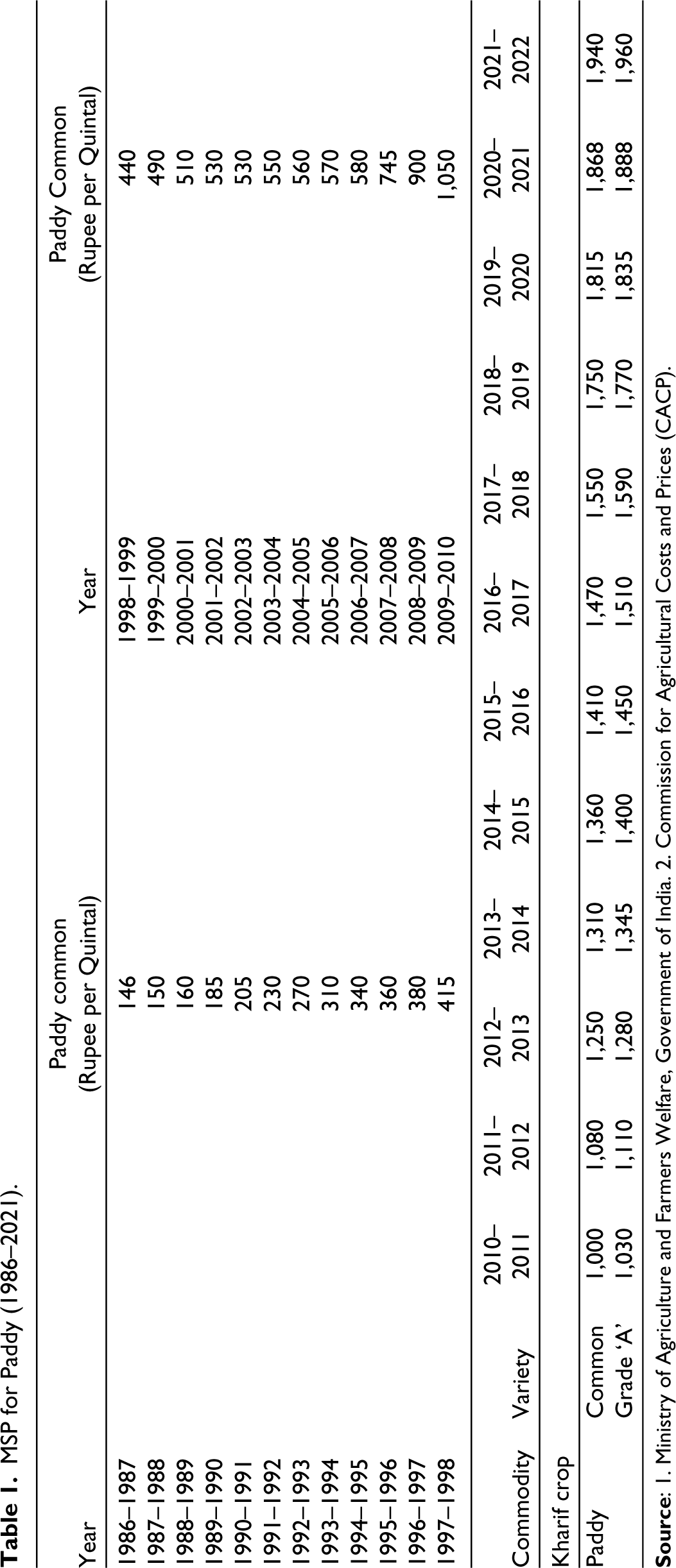
An analysis of the MSP data for paddy in Table 1 and the MSP data for wheat given in Table 2 shows that the MSP of wheat was increased by an average of ₹7 per quintal between 1985 and 1989. At the same time, the MSP of paddy was increased by an average of around ₹6 per quintal between 1985 and 1989. If we compare the rates of increase in MSP and the rate of inflation in these five years, then it can be ascertained that the increase in MSP has been very less.
MSP for Paddy (1986–2021).
MSP for Wheat (1985–2021).

In this context, Varshney (1998) tried to see the structure of the CACP, which was changed in 1985, by indirectly connecting it with electoral politics. Varshney stated that since the 1980s, the Central government had been working on three types of facilitation for the agriculture sector, two of which have affected the functioning of the APC. One is related to the principles of this APC functioning, and the other is related to changes in its personnel structures. The third type of decision is related to farm loan waiver (Varshney, 1998). Varshney attempted to look at the new-farmers movement that occurred in the 1980s and 1990s in a new way. In 1980, the movement of Shetkari Sangathan of Maharashtra and the movement of the Bharatiya Kisan Union in North India rested on fair prices for crops as well as the India versus Bharat narrative. Sharad Joshi believed that urban India imported raw materials from Bharat, but in return, the condition of ‘Bharat’ has become similar to a colony. Therefore, it became easy to mobilise the farmers based on this narrative. Varshney also mentioned how this narrative of India versus Bharat primarily involved reformist objectives, that is, to pressurise the government for higher agricultural prices, debt waivers, and better urban–rural balance in the allocation of the country’s resources. This mobilisation did not threaten the existing class structure at any time, but it was powerful enough that it shook politics and had an impact on many important and populous states of India such as Tamil Nadu and Karnataka in the south, Maharashtra and Gujarat in the west, Punjab and Uttar Pradesh in the north, and so on. Due to this mobilisation, political parties supported the demand for remunerative prices for crops and more allocation of public resources in rural areas. Some political parties reformed their political programmes and manifestos and started supporting the demand for loan waiver (Varshney, 1998).
Due to Mandal politics and Ram temple politics, from 1990 to 2003, none of the governments showed much interest in MSP (Hasan, 1994). 3 Finally, the Atal Bihari Vajpayee government constituted a national commission for farmers for two years under the leadership of Sompal Shastri. However, in the elections held in 2004, the National Democratic Alliance government was defeated. To take forward the outline of this national commission, the government of United Progressive Alliance-1 formed the M. S. Swaminathan Committee in 2005 to resolve the problems of farmers. This committee submitted its report in 2006. It suggested changing the name of the ‘Ministry of Agriculture’ to the ‘Ministry of Agriculture and Farmer’s Welfare’. This commission, which strongly advocated MSP, also suggested a new formula. that is, C2 + 50%, 4 for the calculation of MSP to improve the condition of farmers and increase their income. MSPs have been announced by APC and CACP at different times and based on six different formulas (A1, A2, B1, B2, C1 and C2). 5 On analysing the MSP data of paddy and wheat in the last two decades, given in Tables 1 and 2, it was observed that neither the United Progressive Alliance government nor the National Democratic Alliance government has fully implemented the recommendations of the M. S. Swaminathan Committee. Analysis of the data shows that just before the elections, the MSP increased more than normal. Between 2004 and 2007, the MSP of paddy was increased by ₹10 per year (in 2004–2005, 2005–2006 and 2006–2007, paddy was procured at ₹560, ₹570 and ₹580 per quintal while in 2007–2008 and in 2008–2009, paddy was purchased at ₹745 and ₹900 per quintal, respectively. Paddy was procured at ₹1,410, ₹1,470, ₹1,550 and ₹1,750 per quintal, respectively, during the tenure of the Modi government in 2015–2016, 2016–2017, 2017–2018, 2018–2019. So these figures show that elections had an impact on MSP.
Analysis of Figure 1 shows the relationship between MSP and elections. During the Lok Sabha elections held in 2009, 2014 and 2019, the relationship between the election manifestos of national political parties such as the Congress and the BJP can be clearly seen. These parties had all previously promised to the voters in their manifestos that they would increase the income of the farmers by implementing MSP in a systematic way.

Along with this, state governments such as Chhattisgarh have also used MSP as a strategy to win elections. In the 2018 Chhattisgarh elections, the Congress promised to buy paddy at the MSP of ₹2,500 per quintal to win the election. Therefore, some political analysts claim that due to the promise regarding MSP, the Congress government was formed in Chhattisgarh.
Contemporary Farmers’ Movement and the Legalisation of MSP
On 5 June 2020, the Central government introduced three ordinances, keeping in mind the reforms in the agricultural sector. These laws included the Farmers’ Produce, Trade and Commerce (Promotion and Facilitation) Law, 2020, the Farmers (Empowerment and Protection) Agreement of Price Assurance and Farm Services Law, 2020, and the Essential Commodities (Amendment) Law, 2020. Therefore, farmer organisations and farmers started agitating against these three agricultural laws. This movement started in Punjab, but gradually it spread to states such as Haryana, western Uttar Pradesh, Uttarakhand and other states. These agitating farmers demanded the withdrawal of three agricultural laws as well as making MSP legally binding. After 11 rounds of talks and a year’s agitation, the government withdrew three agricultural laws and assured the formation of a committee to legalise MSP.
Agricultural economists such as Ashok Gulati, while supporting the neoliberal policy, advocate for directly connecting the farmers with the market system. Ashok Gulati and Devesh Kapoor point to some policy changes in the context of reforms in Indian agriculture. They said that if the income of farmers is to be doubled and agriculture is to be made sustainable, the present government will have to improve in four areas. Under the first reform, the focus of agricultural policies needs to be shifted from enhancing production to enhancing farmers’ livelihood. Gulati and Kapoor suggested several different policy options to increase the income of farmers, such as, by utilising the Pradhan Mantri Kusum Yojana and changing the land contract laws. The second reform suggested changes in policies such as free electricity and subsidy on fertilisers, so as to preserve the groundwater level in a large area of Punjab, which has been continuously going down due to excessive use of tubewells, and arable land, which is gradually becoming barren due to the excessive use of fertilisers. Under the third reform, it was suggested that policy reforms are needed to help farmers deal with the increased risk of weather and price fluctuations. Fourth, agricultural markets should be opened up to the private sector (Gulati et al., 2020). Therefore, taking forward the suggestion of Ashok Gulati, the central government came up with three agricultural laws. The government said that due to the implementation of these agricultural laws, farmers would be able to sell their crops in any corner of the country, so the farmers would no longer have to depend on the mandi for this (The Times of India, 2020).
Bharadwaj (1994) tries to bring to the fore the paradox of agricultural-price policy for growth. She argues that agricultural prices need to be analysed for their macroeconomic and distributional consequences (in terms of production growth, income distribution and effective demand), which is a holistic and relevant form of the study of agricultural prices. She states that especially due to the increase in the price of food items, there is an increase in the demand for wages. The prices of agricultural commodities as raw materials influence industrial prices and can induce price inflation based on wage bargaining. Within agriculture, prices of agricultural commodities generate distributional effects driven by changes in real income and marketable surplus. Agricultural prices also affect the actual consumption level of producers who are net buyers of food or who produce mainly for subsistence. Also, continuous demand for increases in prices of agricultural produce may create short-term and long-term problems of effective demand (Bharadwaj, 1994).
Regarding MSP, the author interviewed the agitating farmers sitting on the Tikri and Singhu borders. 6 Basmati paddy is cultivated on about 1,939 thousand hectares all over India. In Punjab alone, basmati paddy was cultivated on about 550.1 thousand hectares in 2019 (Basmati Crop Survey Report Kharif, 2019). The problem here is that the government does not give support prices on basmati paddy, so farmers are forced to sell their crops to private traders only. These farmers said that sometimes these traders buy from farmers at ₹3,000 and sometimes at ₹3,500 per quintal, but in the market, the price of basmati rice is about ₹150 per kg, so the farmers want the government to buy basmati paddy and fix the MSP separately. These farmers said that we also cultivated the bajara, but due to non-purchase on the MSP, they were forced to sell it to private traders at a very low price. The farmers said that the cultivation of basmati is more profitable according to the geographical condition of Punjab, as compared to other paddy crops. Basmati crop grows quickly and water consumption is also less in it. Therefore, the government should fix the MSP on all of them, including basmati paddy, which is also an eco-friendly crop. Along with this, agricultural economists such as Devendra Sharma (2021) suggest giving MSP to all crops; they believe that this will give a new option to the farmers, and this can also save the agro-ecosystem from damage. The debate on making the MSP legally binding has brought out several important points which need to be analysed. First, Indian farmers cannot be completely left on the mercy of private traders and the open market, because there is uncertainty about agricultural prices in the world agricultural market, and also of circumstances where Indian farmers could be at a disadvantage with farmers belonging to countries in America and Europe, where they derive agricultural subsidies from their respective governments. Provided that, in such a situation, if the Indian agriculture sector is left to the market, then it will adversely affect the condition of farmers along with agriculture. But if MSP is legalised, then it has some advantages and disadvantages. According to the Shanta Kumar Committee (2015), only 6% of the farmers are able to take the benefit of MSP, and 85% of the purchases are done from Haryana and Punjab at this price. If the MSP is legalised, then to a large extent the disparity between the states and regions due to agricultural prices can be reduced. For example, in Bihar, Agriculture Produce Market Committee (APMC) was abolished in 2006, and Primary Agricultural Credit Societies (PACS) was formed in its place. In Bihar, PACS buys only paddy and wheat at the MSP, but in Bihar, along with maize, other crops are also in abundance. In the financial year 2021–2022, the centre had fixed the MSP of maize at ₹1,875 per quintal, but in Bihar, farmers had to sell it at ₹900 per quintal due to non-buying of maize at the MSP (Singh & Bhogal, 2021). If the MSP is made legally binding, then income disparity among states can be reduced, which is a positive side of MSP. But there are also some apprehensions regarding the legalisation of MSP, which include, financial risks to agro-ecology, diversity of crops, big farmers versus small farmers and the issue of inflation, and so on.
MSP, Crop Diversity and Agro-ecology (Basmati)
The production of rice (118.87 and 122.27 million tonnes) and wheat (107.86 and 109.52 million tonnes) was produced in India in the financial years 2019–2020 and 2020–2021. In the same financial year, pulses (23.03 and 25.72 million tonnes) and oilseeds (40.50 and 43.10 million tonnes) were produced (Ministry of Agriculture and Farmers Welfare and DFI Committee estimates based on data compiled from DACNET).
The data make it clear that rice and wheat are cultivated in abundance in India, but due to the support of these policies of production, the impact is being seen on the economy as well as on agro-ecology. India is the world’s largest consumer of edible oil, as well as the largest importer of edible oil globally. In the financial year 2020–2021, India imported 131.3 lakh tonnes of edible oil, due to which the Indian economy had to bear the financial burden of 1.17 lakh crores (The Economics Times, 2021). Therefore, in the Economic Survey (2021–2022), the government has linked the MSP with the diversity of the crops and has suggested that, in India, preference should be given to growing crops other than edible oil such as pulses and coarse grains and crops, which should be cultivated for production and consumption within India and should not be imported.

Paddy and wheat are procured the most at the MSP, and the Food Corporation of India (FCI) also makes maximum procurement of rice and wheat. According to the Economic Survey (2021–2022), West Bengal, Uttar Pradesh and Punjab are the three largest rice-producing states in India. But if we look at the geographical location of Punjab and western Uttar Pradesh, it is not suitable for rice cultivation. About 200–300 mm of rain is necessary for rice cultivation (Unjan, 2017). But for the last two decades, due to climate change, there has been a change in the monsoon pattern. Due to this, there has been an excess of rain and a decrease in some areas. But in these two decades, there has been an increase in the production and area of rice in Punjab. It has had a profound impact on the environment and agricultural ecology.
According to the Economic Survey (2021–2022), due to the cultivation of paddy in the north-west and southern states of the country, groundwater is being overexploited as about 44 million hectares of land are under paddy cultivation in these areas. Due to excessive exploitation of groundwater in districts of the Malwa region of Punjab such as Ferozepur, Muktsar-Sahib and Bathinda, the groundwater level has gone down so much, due to which this area had to be declared as a dark zone (Gulati et al., 2021). Paddy is cultivated in abundance in all these areas. Greenhouse gases play an important role in climate change. These gases include carbon dioxide, methane, nitrous oxide and so on. According to the National Greenhouse Gas Index, the agriculture sector emits 408 million metric tonnes of greenhouse gases, of which the methane and nitrous oxide gas emissions due to paddy cultivation account for 17.5% (The Indian Express, 2022).7 According to the Sixth Intergovernmental Panel on Climate Change (IPCC) Survey 2021, greenhouse gases emitted by paddy fields are 80–83 times more powerful than carbon dioxide gas.
In the context of the diversity of crops, if we study Punjab based on the data given in Table 3 and Figure 3, the share of pulses in the total crop area was 19.4% in 1960, which came down to just 0.5% in 2019–2020. The share of bajara and barley crops was 2.69% and 1.4% in 1960, which decreased to 0.03% and 0.12% in 2019–2020. In contrast, in 1960, the share of paddy in total crops was 4.8%, which increased to 40.1% in 2019–2020. The main reason for the area-wise increase in paddy crops is that paddy and wheat are the most procured at the MSP, and due to the use of hybrid seeds, the per-hectare productivity of paddy is also very high as compared to other crops, that is why the farmers of Punjab add more to the paddy crop.
Cropping Pattern in Punjab (1960–2020)* Crop-wise Percentage Share of the Cropped Area.


The diversity of the crop has been affected by MSP as made clear by the data given in Table 3 and Figure 3. The biggest question is as to why the farmers of Punjab add on the cultivation of rice? The procurement policy of the FCI is also responsible for this to a large extent. Because of the public distribution system, the FCI procures more than 95% of rice and wheat. That is why rice and wheat are also bought the most on MSP. Therefore, there must be a change in the procurement policy of the FCI, due to which the farmers will add on growing such crops, which are environment-friendly. Also, the government should work to reconcile the MSP and the option of a free market.
Conclusion
When we analyse the contemporary farmers’ movement, it is found that its influence was limited to the Jat-dominated areas of Haryana and western Uttar Pradesh and Punjab. In the regions of Bihar and eastern Uttar Pradesh, where about 90% of the farmers are small and marginal, there was no effect of the contemporary farmers’ movement at all. In the north-eastern states of India, more than the MSP, there is a need to connect the farmers directly to the market. During the new-farmers movement, many important questions also arose regarding the mobilisation of farmers. First, the interest of the big farmers was involved in the new-farmers’ movement, yet why did the small farmers join this movement? Even at present, at the time of the contemporary farmers’ movement, the question remains the same: If the interest of the big farmers is hidden in this movement, why did the small and marginal farmers join this movement? A long discussion with farmers and the analysis of primary and secondary data revealed that the MSP and procurement policy impact crop diversity and promote paddy cultivation in Punjab, Haryana and western Uttar Pradesh. The data also show that paddy cultivation has impacted and damaged agro-ecology on a large scale in Punjab. A large area of Punjab is facing groundwater scarcity due to paddy cultivation. Punjab’s agro-ecological and climatic conditions are not suitable for paddy cultivation, but due to subsidies and MSP policy, farmers are still cultivating paddy in large areas.
Footnotes
Declaration of Conflicting Interests
The author declared no potential conflicts of interest with respect to the research, authorship and/or publication of this article.
Funding
The author received no financial support for the research, authorship and/or publication of this article.