



Abstract
This article estimates the wage effects of foreign direct investment (FDI) using firm-level and linked employer-employee panel data containing a large number of foreign acquisitions over a long period of rapid development in Hungary. Matching on pre-acquisition data, the authors find that much of the raw foreign wage premium represents selection bias, but that foreign acquisition nevertheless raises average wages by 15 to 29% when controlling for fixed effects for firms and highly detailed worker groups, and by 6% with firm–worker match effects. Acquired firms that are later divested to domestic owners experience a substantial reversal of the positive acquisition effect. No type of worker—defined by education, experience, gender, incumbency, and occupational group—experiences wage decline, but the patterns suggest skill bias in the gains from acquisition. The evidence implies a strong cross-firm correlation of FDI wage and productivity differentials, and an inverse relationship between FDI effects and economic development level of the sending country relative to Hungary.
Keywords
The presence of substantial employer effects in wage determination suggests that firms play a role that goes beyond passively conveying market forces of demand and supply. Research on employer effects using linked employer-employee data (beginning with Groshen 1991; Abowd, Kramarz, and Margolis 1999; and Hellerstein and Neumark 1999) thus opens up a number of interesting questions: What characteristics of firms are associated with high and low wages? Are the effects of these characteristics neutral across workers, or do they reflect winners and losers across different groups of employees? What factors explain the observed wage differences across firms—are they attributable to measurement artifacts, selection bias, and unmeasured heterogeneity, or do they represent genuine differences in economic behavior?
This article addresses these questions by focusing on a firm characteristic that has been the subject of controversy in the context of both policy and research: foreign versus domestic ownership. Analyses of controlling foreign ownership (foreign direct investment [FDI]) have consistently documented a positive average wage premium in the raw data (see Lipsey [2002] and Moran [2011] for overviews). A crucial question is the extent to which this premium reflects selection, as foreign investors engage in cream-skimming or cherry-picking the best areas and industries for greenfield start-ups and targeting the best domestic firms for acquisition. Some studies at the firm level have addressed this problem using matching methods or fixed effects, usually finding a significant wage gap in favor of foreign ownership even after these adjustments. 1 Lack of information on individual worker wages and characteristics in most firm-level data, however, make it impossible to control for employee composition or to estimate effects for different types of workers. Studies at the worker level might address these issues, but they generally contain little information on firm characteristics and selection into ownership types. The advantages of both firm- and worker-level data are, in principle, combined in recent studies that use linked employer-employee data (LEED). The results have been mixed, with some implications that the causal effect of foreign ownership is small or zero. 2 A general problem in this literature, however, is that most databases contain few foreign acquisitions and short time series. Moreover, the analysis in these studies is frequently limited to estimating FDI wage premia for only two skill groups, thus omitting other dimensions of worker heterogeneity. 3
This article builds on the previous research by using data with unusual strengths. We estimate the impact of foreign acquisitions on wages in Hungary, a middle-income economy that abruptly liberalized inward investment and developed rapidly during the period we study. The Hungarian case provides not only large numbers of acquisitions and an interesting context for estimating their effects but also firm-level data with complete coverage and detailed financial information over a 23-year panel (1986–2008). These universal data include pre- and post-acquisition information on 4,928 acquisitions and a very large group of non-acquired firms that can be used to draw a control group. The data allow us to estimate the possibility of reversals following foreign investment, the relationship of productivity and wage changes, and the variation of the FDI premium with the level of development, as described below. The LEED are based on a random sample of personnel records for approximately 7% of all business-sector employees during the same period, and they permit us to analyze the variation in wages among workers and to control for their characteristics, so that the (observable) composition of employment is held constant. The LEED contain 2.5 million worker-year observations within the linked firms and enable us to estimate FDI premia using individual wages by schooling, age, gender, occupation, and recent hire status. Although the worker-level data do not contain a unique identifier, the available characteristics are detailed enough to enable us to follow most workers who remain with the same employer and to estimate worker turnover rates.
Our empirical strategies tap the richness and size of these data in several ways. The basic identification strategy focuses on ownership change at domestically owned firms—thus, on foreign acquisitions for which the pre- and post-acquisition information may help identify a foreign effect. Throughout, we exploit the full longitudinal structure of the data, rather than selecting arbitrary pre- and post-acquisition years. Following evaluation methods designed for training programs (Heckman, Ichimura, and Todd 1998; Blundell and Costa Dias 2000), we use firms’ wage histories to construct control groups of non-acquired firms; we also match on exact two-digit industry and year. By contrast, most previous studies are restricted by available data to coarser-grained matching based on information from only a single year of data with no controls for prior wage growth and sometimes no restrictions on matching across industries and years. We combine matching with regression, including firm fixed effects, to account for time-invariant unobserved heterogeneity across firms. Some specifications using the LEED include fixed effects for worker types within firms, defined by interactions of gender, educational category, years of experience, and region. Other specifications include worker–firm fixed effects to identify the wage impact for incumbent-stayers who remain with the firm after the acquisition.
We extend this identification approach to exploit the existence of 983 observations on Hungarian firms acquired by foreign investors but later re-divested into domestic Hungarian ownership. Using these acquisition reversals, we examine the extent to which divestment lowers wages to their pre-acquisition, domestic level. Our tests compare the impacts of ownership switches within the same firm using firm and worker-group fixed effects as well as firm–worker match effects. We estimate specifications that permit acquisition to affect not only the post-acquisition wage level but also the pre-acquisition level and growth as well as the post-acquisition growth of wages. We consider residual selection and measurement issues, including worker hiring rates, employment changes, and firm exit, as possible explanations for the foreign wage premium.
Do positive average wage effects mask differences in the outcomes experienced by different types of workers, so that there may be winners and losers or different levels of winning (in terms of wage increases or decreases)? This question has received relatively little attention in previous research, which typically distinguishes, at most, two types of workers by skill (based on occupation or education). Our analysis considers many aspects of worker heterogeneity by defining groups according to gender, experience, education, occupation, and incumbency status.
Finally, we estimate FDI effects on productivity to assess the plausibility of the estimated wage outcomes and to assess the “catch-up” hypothesis whereby FDI has a larger impact on wages and productivity in less developed economies (e.g., Moran 2011; Hijzen et al. 2013). Hungary is particularly appropriate for this assessment because it grew rapidly during the period we study (GDP per capita rose about 60% from the early 1990s to 2008), and our data permit us to analyze variation in the FDI impacts across types of acquisition target, level of development of the source country, and time period.
Data and Context
Data Sources and Samples
The main source of our firm-level panel is the National Tax Administration (TA) of Hungary. These data are available annually from 1992 to 2008 for nearly all firms engaged in double-entry bookkeeping, and from 1986 to 1991 for a sample of medium and large enterprises (based on inclusion in the Wage Survey, described below). The data thus span a long period from well before the transition started (in about 1990) until several years after the country’s accession to the European Union (in 2004). Comparison with the total number of companies by legal form from the Statistical Yearbooks of Hungary (1992–2008) reveals that essentially every employer is included in the data if the company is a limited liability form (Ltd or joint stock), and that the proportion of partnerships included gradually rises as the regulations increasingly required them to engage in double-entry bookkeeping. The proportion of partnerships included reached almost 80% by 2008. As foreign investors rarely acquired partnerships, our data can be considered universal for our question of interest. The TA files include the balance sheet and the income statement, the proportion of share capital held by different types of owners, and basic variables such as employment, location, and industry.
Information on the foreign nationality comes from a data set hosted by the Ministry of Public Administration and Justice. We identify the acquirer’s origin for about 700 acquisitions, and in most cases we can follow changes in country of origin throughout the post-acquisition history of the firm.
The source of our worker-level data is the Hungarian Wage Survey (WS), which contains personnel information for a large probability sample of workers in 1986 and 1989 and each year from 1992 to 2008. For 1986 and 1989, we select workers from narrowly defined occupational and earnings groups within firms, using a systematic random design with a fixed interval of selection. High-ranking managers are surveyed comprehensively. From 1992, we base the sample design on the day of birth of workers for employers with at least 20 workers (this threshold rises to 50 in 2002). Production workers are selected if born on the 5th or 15th of any month, and non-production workers if born on the 5th, 15th, or 25th of any month. This selection procedure results in a random sample of about 6.6% of production workers, and close to 10% of non-production workers.
From 1998, these WS selection procedures are supplemented with a random sample of smaller firms, with information on all their employees. In 1998 and 1999, employers with 11 to 19 workers are sampled and from 2000 the sampling threshold is reduced to firms with 5 employees. Variables in the WS data include earnings, educational attainment, gender, age, occupation, whether the worker is a new hire in the previous year, and working hours (since 1999). 4 The data also provide the total number of production and non-production workers for each firm, which we use to weight the within-firm samples and to adjust for oversampling of non-production workers. With the help of the TA, we construct firm weights that vary by firm size and adjust the sample to the total number of employees in the relevant sectors of the Hungarian economy.
Linking the WS with the TA firm-level data creates a linked employer-employee data set (LEED) in which we are able to follow firms through a consistent firm identifier. Workers do not have unique identifiers and thus cannot be readily followed over time, but relying on detailed individual characteristics and on the sampling scheme based on birthdays (which implies that the sample of continuing employees remains constant), we are able to link many of the employees who remain in the same workplace from one year to the next. Using information on these workers, who account for 37% of all observations and 64% of those with at least two consecutive firm-year observations, we can estimate separate foreign ownership effects for incumbent workers who remain with the firm for at least one observation point post-acquisition, and we can control for unobserved worker heterogeneity among these incumbent-stayers. These regressions are weighted with the probability of inclusion in the linked worker sample.
The estimation samples exclude firms in education and health care; two-digit industries for which no foreign acquisitions took place (15,560 cases in the firm-level data, NACE Rev 1.1 codes 12, 13, 42, 75, 80, 85, 91, 95, 99); and firms with more than two changes in majority ownership (792 cases in the firm-level data). In the LEED, we restrict attention to full-time employees aged 15 to 74. After further minor decreases caused by missing values, the resulting firm-level sample comprises 1.9 million firm-year observations on 377,000 unique firms. Of these firms, 33,000 are linked to employee information, which results in a LEED of 2.5 million worker-years. 5
FDI in Hungary
In 1986, the first year in our sample, Hungary’s economy was centrally planned and foreign ownership was prohibited. Some gradual decentralization and increased autonomy for state-owned enterprises in the late 1980s, including a law that allowed the unrestricted establishment of joint ventures with 50% foreign capital and the possibility of higher foreign capital involvement (Szakadát 1993), opened Hungary to FDI. In 1993, legislation was changed to allow 100% foreign ownership without any approval. The first large foreign acquisition took place in 1989 when General Electric bought the lighting company Tungsram. As OECD (2000) reported, in the early 1990s the freely elected governments quickly liberalized barriers to foreign investment and provided investment incentives in the form of tax relief, grants, loans, and industrial free trade zones. In principle, these subsidies were available for any investor, but they mainly served to foster FDI.
The size of the implicit subsidies varied on a case-by-case basis and frequently came with conditions related to investment, revenue, and employment—but not wages. For an investment of at least Hungarian forint (HUF) 1bln, taxes could be reduced by as much as 50% for up to five years in manufacturing and hotels, and as high as 100% in industrial zones and priority regions (defined as regions with unemployment rates above 15%). Direct financial incentives were provided mostly to enhance technological development and rural areas. Finally, enterprise zones allowed importing high value equipment without duties. 6
As a result of the policies, a relatively highly educated workforce (compared with developing countries), and the low wages that attracted foreign multinationals (Braconier, Norback and Urban 2005), by the mid-1990s Hungary had the highest FDI per capita among all post-socialist countries (World Bank 2002). The high pace of FDI continued throughout our sample period, as Hungary pursued and finally achieved EU accession in 2004. Because Hungary’s GDP roughly doubled, we are able to compare the FDI impacts at different stages of development for a single country. 7
The evolution of foreign-acquired firms and the percentage of workers in the firm-level and LEED samples are presented in Figure 1. We define FDI as majority foreign ownership, and acquisitions as changes from majority domestic to majority foreign ownership. 8 Expressed as a share of the total number of domestic firms plus firms that have been acquired by foreign investors, the percentage is 0 in the 1980s, and it rises during the 1990s to about 3% in the firm-level data and to about 5% in the LEED. The share of foreign-acquired firms in employment rises to around 10% in both data sets, reflecting the larger relative size of firms acquired through FDI.
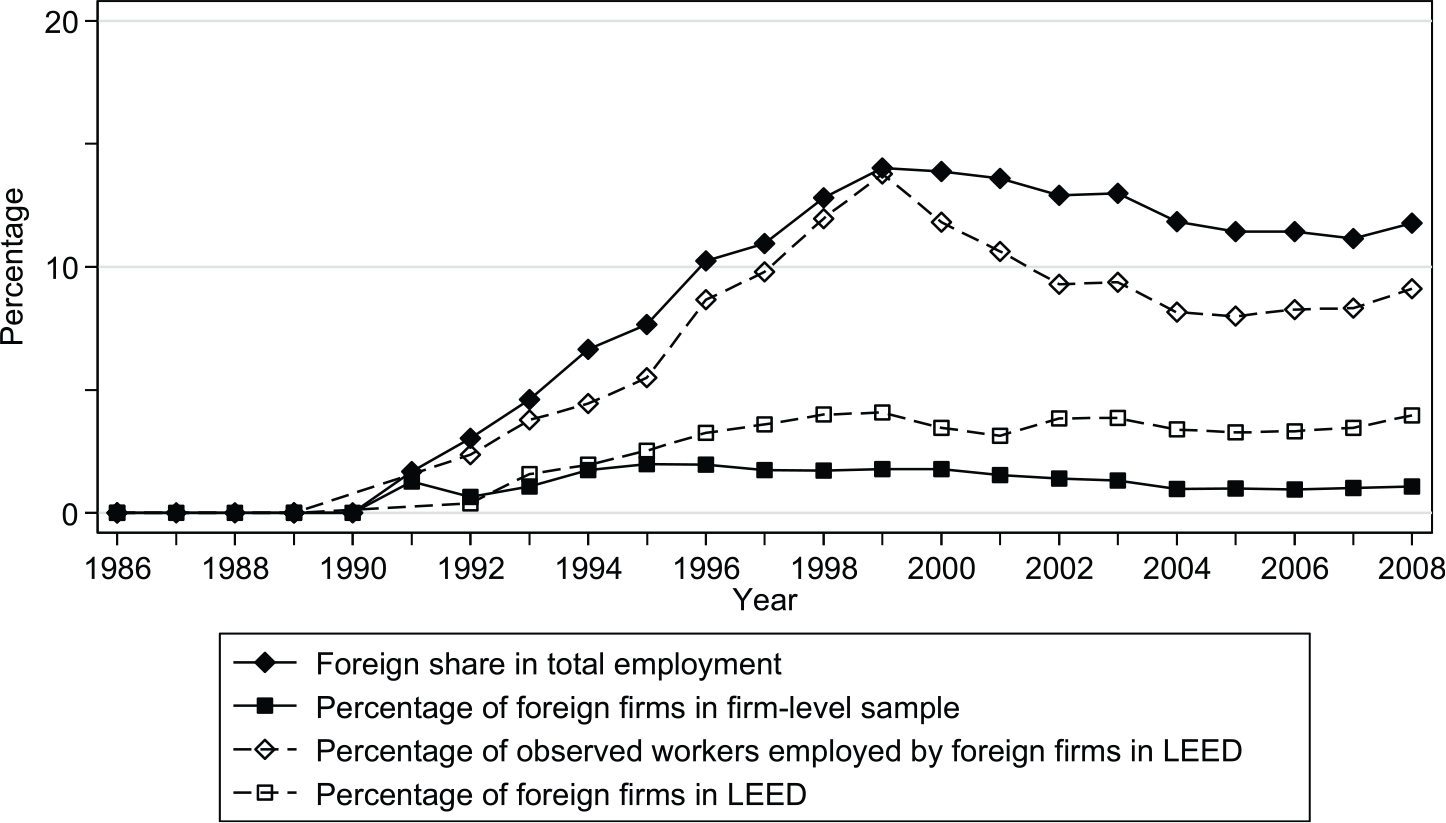
Evolution of the Share of Foreign Acquisitions, Firm-Level Data and LEED
This rapid influx of FDI provides large numbers of observations that we use to help identify FDI effects. As shown in Table 1, panel A, the full firm-level data contain 4,928 foreign acquisitions with information both before and after acquisition, which is a much larger sample for analysis than in previous studies of FDI and wages. Most of these acquisitions are takeovers of domestic private companies, but 314 are privatizations of state-owned enterprises and 323 are domestic private companies that had been privatized earlier. In the LEED, the number of ownership switches with pre- and post-acquisition data is smaller—646—but still larger than in most studies in this area. The incidence of FDI in the LEED is larger than in the firm-level data, however, because the probability of inclusion in the LEED and the probability of acquisition are both correlated with firm size; as our analysis shows below, the FDI wage differential is similar nevertheless. The time series before and after acquisition are also long in both data sets: the average of 9 to 10 years is much longer than in previous studies. 9
Number of Firm-Level Observations on Foreign Acquisitions with Pre- and Post-Treatment Wage Information—Full and Matched Samples

Notes: Number of firms acquired by foreign investors either as a “single acquisition,” with only one ownership change (from domestic to foreign ownership), or as “reversals,” with a foreign acquisition followed by a divestment from foreign to domestic owners; in both cases, only firms with pre- and post-change wage information are included. For acquisitions by year, see online Appendix Table B.2A, and for total number of switches, see Tables B.2B and B.2C; for the matched sample, see Table B.3 (all online at http://journals.sagepub.com/doi/suppl/10.1177/0019793917700087). Definition of foreign ownership: > 50% foreign-owned.
Most of the acquisitions are “single,” meaning that a domestic firm simply becomes foreign-owned and does not change ownership status again. But other acquisitions are reversals that are initially domestically owned, then acquired by foreign investors, and then subsequently divested by the foreign owners so that they become domestically owned once again. These firms are useful in an extension of our identification strategy, discussed in the next section. There are 983 and 86 such firms in the firm-level and the linked data, respectively, and they are typically observed for 11 to 12 years, which is divided roughly equally among their three periods of domestic-foreign-domestic.
Variable Definitions and Summary Statistics
The wage in the firm data is measured as total payments to workers (not including the payroll tax and non-pecuniary benefits) divided by the average number of employees over a particular year. 10 The worker-level data contain information on the monthly base wage, overtime pay, and regular payments other than the base wage (such as language and managerial allowances) paid in May of each year. In addition, the data include information on the previous year’s irregular payments (such as end-of-year bonuses); for most workers we add one-twelfth of this variable to the other wage components, but if the worker was hired during the previous calendar year, we divide these payments by the number of months the worker was employed with the company that year.
In both the firm-level data and LEED, wages are deflated by the yearly consumer price index (CPI) and measured in thousands of 2008 Hungarian forints (HUF). The first row of Table 2, which contains summary statistics for firm characteristics, shows that unconditional mean wages are about twice as large in firm-years of foreign ownership as in firm-years of domestic ownership (including both the always-domestic enterprises and the domestic years of acquired firms). The average foreign differential computed across firms present in the LEED (last two columns of Table 2) is slightly smaller than in the full firm-level data (first two columns), but the former is similar to the worker-level differential in the LEED sample, as shown in the first row of Table 3.
Firm Characteristics by Ownership—Firm-Level Data and LEED

Notes: Unweighted unconditional means and standard deviations. Domestic includes always-domestic enterprises, pre-acquisition years of foreign-acquired firms, and post-divestment years of firms acquired then divested. Foreign includes post-foreign acquisition years. Average wage computed as annual wage divided by employment and measured in thousands of 2008 HUF, labor productivity in millions of 2008 HUF, all deflated by CPI. Standard deviations in parentheses for continuous variables. Industrial distribution measured as percentages within ownership type. Definition of industries follows NACE Rev. 1.1. Agriculture includes hunting, fishing, and forestry. FIRE includes finance, insurance, and real estate. Business services include renting of equipment, computer and related activities, research, and other business activities. Other services cover hotels and restaurants, transport and communications, and other community, social, and personal services.
Individual Characteristics by Ownership—LEED

Notes: Weighted unconditional means and standard deviations. Earnings deflated by CPI. Female, Education, Recent hire, and Occupation measured as percentages of total workforce by ownership type. Standard deviations in parentheses. The definition of occupations follows ISCO-88 in which Elementary occupations, Service workers, Clerks, Associate professionals, Professionals, and Managers coincide with the corresponding major groups; Skilled manual workers cover Skilled agricultural and fishery workers, Craft and related trades workers and Plant and machine operators and assemblers.
In addition to wages, Table 2 presents firm characteristics. Measured by the level of employment, firms acquired by foreign investors tend to be much larger and to have higher labor productivity (value of sales over the average number of employees), compared to always-domestic firms. The industrial composition of foreign and domestic firms also differs, with foreign-owned firms more prevalent in manufacturing and less prevalent in most other sectors. Table 3 provides worker characteristics by ownership type. The shares of females and university and high school graduates are higher in foreign-acquired firms, and the shares of vocational and elementary education are lower. Average years of work experience and share of workers hired in the previous year are slightly lower under foreign ownership. 11
Estimation Procedures
The unconditional means suggest large differences in observable variables between domestic and foreign-acquired firms in the population of Hungarian firms and in the LEED sample. To control for such differences, we exploit the rich set of worker and firm characteristics as well as the longitudinal structure of the data to estimate panel regressions with several types of fixed effects and to construct matched samples that include a set of control firms similar to those acquired by foreigners. First we describe our regression specifications, which are applied to both matched and full samples of observations, and then we discuss the details of the matching procedures.
Regression Methods
Our regression samples include observations on firms or workers under domestic ownership and those with ownership that was formerly domestic but that have since been acquired by foreign investors. For the firm-level data, our basic estimating equation relates average wages to ownership status and controls:

where j indexes firms and t indexes years, ln(wjt) = ln(Wjt/Ejt) is the natural logarithm of the wage bill per employee, Foreignj,t-1 is a dummy variable that takes the value of 1 if the firm was controlled by foreign owners at the end of the previous year, and δ is the foreign effect, the parameter of interest. 12 Divestmentj,t-1 is a dummy for the post-divestment period if a firm that had been acquired by foreign investors was subsequently sold to domestic investors by end of t-1, and γ is the associated coefficient measuring the difference between pre-acquisition and post-divestment wages (in firms where this occurs); as a result, the foreign effect δ is measured relative to the initial, pre-acquisition period. The λt represent 23 year effects, αj are firm fixed effects (FFE), and ujt is an error term. The αj control for time-invariant heterogeneity across firms; in some basic specifications we omit the αj and control for industry affiliation. Firm-level regressions are weighted by employment. 13
This specification is essentially non-parametric; it could be computed as a weighted average of differences between foreign-acquired and domestic firms in wages demeaned by region, year, and firm. The specification is also parsimonious in avoiding any attempt to control for time-varying covariates of wages and ownership; variables such as size or productivity that are sometimes included in firm-level wage equations are potentially endogenous and represent possible channels through which ownership may affect wages. Thus, we control for their average levels with fixed effects, but do not remove the effects of changes in these variables after acquisition.
The analogous specification to Equation (1) for the individual data (LEED) can be written:

where i indexes workers, ln(wijt) is the natural logarithm of individual monthly earnings,
Although the αj (firm fixed effects [FFE]) control for some types of selection bias—those that vary across firms but are time-invariant—the LEED also permit us to control for unobserved heterogeneity at the worker level within the same firm. In a first extension of the FFE model, we interact the FFE with narrowly defined groups of workers defined by gender, four education categories, eight experience groups, and county (defined at plant level). This specification allows a different intercept for each education-gender-experience-county group within each firm, adding about 400,000 worker group–firm fixed effects (WGFE). Our aim is to provide the fullest possible controls for observable characteristics of workers within firms, but of course these do not account for unobserved heterogeneity within those groups. To the extent our data permit, we also estimate a specification with ρi, which are worker–firm match effects (WFE) using within-firm links based on workers employed at the time of acquisition and followed within employers. It bears emphasis that identification in this specification comes from a special group of workers, the incumbent-stayers.
The fixed effects control for several types of time-invariant heterogeneity and the variables representing worker characteristics control for worker composition, but the possibility remains that results are driven by a time-varying factor, either coincidental or based on how domestic firms are targeted for acquisition. In terms of Equations (1) and (2), there could be an innovation to ujt >a that raises wages after the acquisition year a for each year t > a. Although we cannot rule out this possibility, we can exploit our data to examine whether reversals of acquisitions lead to reversals of wage changes. For this purpose, we distinguish foreign acquisitions followed by later divestment to domestic owners after at least one year of foreign ownership (i.e., double transition: domestic–foreign followed by foreign–domestic). A comparison of the estimated effects associated with acquisition and divestment provides a reversal test—an evaluation of whether any estimated foreign wage effect remains after divestment, or whether wages revert to their earlier level and thus tend to be associated with ownership type. If the premium persists after divestment, it suggests that either the wage gain is coincidental with but not causally related to acquisition, or that the effect is causal but the changes induced by acquisition tend to persist. If the premium does not persist, then rejection of a causal interpretation would require a double coincidence of simultaneous wage and ownership changes. In Equations (1) and (2), this amounts to testing whether γ = 0. The identification strategy assumes no innovation to ujt > d after the divestment year d for each year t > d that lowers wages, or, in other words, that whatever jump in ujt occurs post-acquisition is not reversed by an equal and opposite drop post-divestment. This assumption is weaker than a complete absence of correlation between a single ownership transition and unobserved components of wages. Also note that the specifications for these tests can include FFE, WGFE, and WFE, so that the estimates are within firms, within worker groups within firms, or within incumbent workers. 15
As a final specification check and alternative specification of the equations estimating the average acquisition effect, we allow for pre-acquisition and post-acquisition dynamics. The specification contains not only the post-acquisition dummy but also a pre-acquisition dummy (with effects measured relative to the acquisition year) and both the pre-acquisition and post-acquisition trend growth. If the control variables and the various fixed effects (as well as the matching procedures for the matched samples) are successful in controlling for selection bias based on differences in the level and trend of wage growth, then the pre-acquisition effects should be small and insignificant. 16 The estimating equation (presented here for the firm-level data) is the following:

Turning from estimation methods for the average effect to those that permit heterogeneity, we use the detailed characteristics in the LEED to estimate separate FDI effects by worker characteristics, including gender, education, experience, incumbency (whether employed by the firm before the foreign takeover), and occupation. Extensions of Equation (2) that permit the acquisition effect to vary with these characteristics are estimated with combined matching fixed-effect methods. These results provide information on the potential winners and losers from foreign acquisition.
Although our methods (including the matching procedures described below) are designed to minimize selection bias in the sense of correlation between the probability of foreign acquisition and unobserved influences on wage growth, we also look for evidence of residual selection by estimating equations similar to (2) for measures of worker composition and hiring, and equations similar to (1) for firm-level employment and exit. To examine the relationship of the FDI wage effects with productivity, we estimate Equation (1) with labor productivity and total factor productivity as dependent variables. To assess the catch-up hypothesis whereby the FDI effects vary with the level of development, the coefficients are permitted to vary with time period of acquisition, GDP per capita of the FDI source country, and state ownership versus private ownership of the domestic target.
Matching Procedures
Our description of the basic characteristics of domestically owned and foreign-acquired firms (Tables 2 and 3) showed large differences. To construct a control group as similar as possible to the group of acquired firms, we apply exact and propensity score matching (Rosenbaum and Rubin 1983). We match on firm characteristics rather than worker characteristics, both because acquisition is a firm-level event and because doing so allows us to use the longitudinal history of firm-level variables in the matching process. 17 We include only those acquisitions that have observations on average wages for at least three years: the year before acquisition, two years before (to capture pre-treatment wage growth), and one year post-acquisition. As potential controls we use only those always-domestic firms that satisfy this requirement relative to the year when we add them among controls.
Subject to these restrictions, the propensity score is obtained from a linear probability model (LPM) on a sample including all years of firms that are always domestic and the acquisition year of acquired firms. 18 The regression is weighted to give equal weight to treated and potential controls. Independent variables include the level, square, and cube of the logarithms of the lagged average wage; lagged employment; lagged wage growth (i.e., from two years before to one year before); labor productivity; capital intensity (defined as the value of capital stock over employment); shares of females and university graduates; average age of workers; and industry and year effects. 19
Having obtained the propensity score, we enforce common support across treated and control firms by dropping the treated firms that have a larger propensity score than the largest score obtained for control firms, and by dropping the control firms that have a smaller propensity score than the smallest score obtained for treated firms. 20 On the common support we next match exactly on industry and year. Finally, within each industry-year cell, we match (with replacement) potential control firms based on the propensity score. Taking into account the trade-off between bias and efficiency in matching, we permit multiple controls for each acquired firm but restrict the included controls to those with propensity scores lying within a 10% bandwidth of that of the matched acquired firm, and we weight each included control inversely to the difference between the control’s propensity score and that of the matched acquired firm. 21
To quantify the differences between the full and matched samples, we first compute the average values of the variables used in the LPM in the year before acquisition for the control and treated firms separately (see online Appendix Table A.2 at http://journals.sagepub.com/doi/suppl/10.1177/0019793917700087). Firms in the matched sample pay higher average wages and are more productive in both the control and the treated samples, have fewer employees who are younger, and have a lower proportion of females. To test whether the differences are significant, we follow Imbens and Wooldridge (2009) and compute normalized mean differences in the matching variables between the treated and the control groups one year before acquisition. 22 In the firm-level sample, differences are very low; none of them exceed 0.050. In the LEED data, the differences are larger but most are within the threshold of 0.25, which is acceptable according to Imbens and Rubin (2010). The normalized mean differences of employment, share of university graduates, and share of females are larger, suggesting that the data are difficult to match along these dimensions.
We find matches for only about half the firms in the full sample: 2,229 acquisitions in the firm sample and 363 in the LEED, and for reversals the numbers are 458 and 48, respectively, as shown in Table 1, panel B. From 1992 onward, the distribution of matched acquisitions over time is fairly even, but it is clear that estimates for the matched sample pertain to types of firms and employees that are different from those in the full samples. To compare the raw foreign wage premium across the full and the matched samples, we apply a Ñopo (2008) decomposition of the wage gap (see online Appendix Table A.4 for details: http://journals.sagepub.com/doi/suppl/10.1177/0019793917700087). The total gap is 0.44 in the firm-level data and 0.32 in the LEED, and the differential in the matched sample is 0.19 and 0.14, implying that matching accounts for 40 to 60% of the total gap. Matched controls pay 24 to 19% higher wages than unmatched controls, whereas matched and unmatched treated firms pay essentially identical wages. Because the matched and full samples represent different subpopulations, we present most findings for both, as well as for the firm-level data and the LEED.
Results
We present results using both the firm-level and the worker-level data and both the full and the matched samples in order to take advantage of the strengths of the different types of data and to examine the robustness of results. Simple OLS regressions on the full samples provide measures of average wage differentials and function as benchmarks for attempts to distinguish selection bias from causal effects. Our efforts to handle selection bias include matching and several types of fixed effects, as well as testing for a reversal of the wage effect when a foreign acquisition is subsequently divested. We also study the pre-acquisition level and trend of wages in acquired and non-acquired firms. Note that differences in point estimates across specifications may result from changes in identifying variation and changes in sample composition as well as from differences in econometric approach.
Estimates of the Average Effect of FDI on Wages
Table 4 provides basic OLS estimates. The firm-level results in the top panel imply a 0.64 foreign wage premium controlling only for region and year effects (to account for price differences and economy-wide shocks). The corresponding analysis for the LEED data, shown in column (1) of the lower panel, yields a 0.48 differential. 23 The firm-level gap falls by 0.1 when industry controls are added, which implies that foreign investors tend to select higher wage industries.
The Effect of Foreign Acquisition on Wages—OLS Estimates with Full Samples

Notes: OLS estimates of Equations (1) and (2) on full (unmatched) samples. Dependent variable = ln(real wage bill/employment) in firm-level data and ln(real gross earnings) in LEED. Foreign = 1 if the firm is majority foreign owned in t-1. All equations include year, region, and divestment period effects. Columns (2) to (4) add full interactions between gender, education, and experience. Columns (3) and (4) add dummy variables for seven broad occupational groups. Industry effects in column (4) are two-digit NACE industries. Sample includes firms always under domestic ownership and foreign-owned firms that were previously domestic (i.e., acquisitions). N = 1,881,267 firm-years for firm-level data and 2,475,478 worker-years for LEED. Standard errors (corrected for firm clustering) are shown in parentheses.
Significant at 0.01; ** significant at 0.05.
The LEED permit us to include worker characteristics, and we report three alternative specifications in columns (2) to (4): (2) controls for gender, three educational dummies (vocational, high school, university, with elementary education omitted), a quadratic function of potential experience, and interactions between these variables, which are demeaned to allow the non-interacted variables to show the average effect; (3) additional controls for seven broad occupational categories; and (4) additional controls for two-digit industry. The inclusion of individual characteristics decreases the estimated foreign effect by only about 0.05. 24 Further adding the occupational groups reduces foreign effect by only an additional 0.01. Including industrial controls has a larger effect, but the estimate is still as large as 0.33. The estimated wage effects of worker characteristics are always highly statistically significant and are within our expected range: gender wage gap is around 0.2; educational wage premia (relative to elementary) are 0.05 to 0.10 for vocational studies, 0.17 to 0.35 for high school, and 0.54 to 0.90 for university; and the first year of potential experience increases wages by about 0.02 with the conventionally concave profile. 25
The top panel of Table 5 adds firm fixed effects (FFE), worker-group fixed effects (WGFE), and worker–firm match effects (WFE) to the regressions; the latter two use the LEED and controls from column (2) of Table 4. 26 Compared to the OLS results, these estimates are smaller, and the difference suggests that a sizable fraction of the average foreign–domestic wage gap results from selection bias based on these types of time-invariant heterogeneity. In all cases, however, the estimates of the partial effect (controlling for the fixed effects) of FDI remain sizable and statistically significant: the firm-level estimate with FFE is 0.29, the LEED FFE estimate is 0.18, and the WGFE is 0.15. The WFE specification, which identifies the effect only for incumbent-stayers in acquired firms, is smaller but statistically significant, with a magnitude of 0.06. 27 The estimates based on the matched data, also shown in Table 5, are similar but smaller in magnitude: 0.17 in the firm-level data, 0.10 in the LEED with FFE and WGFE, and 0.05 in the WFE specification.
Estimated FDI Effects on Wages for All Acquisitions and Reversals— Firm-Level Data and LEED

Notes: Foreign = 1 if the firm is majority foreign owned in t-1. Divestment = 1 if the firm was majority domestic in t-1 but had been majority foreign in a prior year and majority domestic still earlier. The Divestment effect is measured relative to the first domestic period; that is, for firms previously acquired by foreign and later divested to domestic owners, it measures the post-divestment wage differential relative to the pre-acquisition period. FFE = firm fixed effect; WGFE = worker-group fixed effects, based on interactions of gender, experience group, education group, county, and firm; WFE = worker fixed effects (for workers remaining with the same employer, thus identifying effects on incumbents). Top panel includes controls for the divestment period; bottom panel controls for single acquisitions. All regressions include year and region effects (the latter pertain to establishments so are not collinear with FFE). The FFE specification with the LEED also includes gender, education, experience, and their interactions, as in column (2) of Table 4. Standard errors (corrected for firm clustering) are shown in parentheses. N = 1,881,267 (874,146) firm-years in the full (matched) firm data, N = 2,475,478 (551,863) worker-years in the full (matched) LEED.
Significant at 0.01; ** at 0.05.
Are these magnitudes large? For some comparisons, they are in the general range or higher than typical regression-adjusted estimates reported in research on the wage effects of unions (e.g., Pencavel 1991), firm size (e.g., Brown, Hamilton, and Medoff 1990), gender and race (e.g., Altonji and Blank 1999), or job displacement (e.g., Jacobson, LaLonde, and Sullivan 1993). They are also consistent with the findings of Hijzen et al. (2013) that foreign acquisitions raise wages in Portugal, Brazil, and Indonesia. The magnitude of the effects is similar to ours in Brazil and Indonesia, but smaller in Portugal. 28 Regarding incumbent-stayers, Hijzen et al. (2013) find positive wage effects in Germany and Brazil, with the latter very similar to our estimate. Below, we exploit the long time series on Hungary to further examine the relationship of the foreign wage premium with the process of development.
The smaller estimates of effects for incumbent-stayer workers using WFE in the right-most column compared to the estimates of average effects computed using FFE and WGFE in the first three columns of Table 5 are also consistent with Hijzen et al.’s (2013) results. A natural interpretation, which they offer, is that the predominant effect of FDI on wages comes through hiring of higher wage and higher-skilled new employees, rather than through large relative wage increases for incumbents. We analyze this further by estimating separate effects for incumbents and non-incumbents and by examining hiring and changes in employment composition below.
The fixed effects in these specifications control for several types of time-invariant heterogeneity, but a causal interpretation of the results rests on the assumption of no time-varying factor correlated with wages and acquisitions. We can weaken this assumption by testing whether the wage effect reverses when acquired firms are divested back into domestic hands. For this reversal test, we allow the 983 acquisitions that were subsequently divested to have a different coefficient from single (undivested) acquisitions, and we also estimate the effect of divestment with a post-divestment period dummy (Divestmentjt in Equations (1) and (2)). The coefficient on this latter dummy (γ) measures the post-divestment wage relative to the pre-acquisition domestic period.
The lower panel of Table 5 shows the results of the reversal test. All the estimates, for both the full and the matched samples and using the three types of fixed effects, imply substantial reversal of the foreign wage effect. In the full sample, the estimated coefficients imply that divestment leads to a one-third to one-half loss of the relative wage gain associated with foreign acquisition, and in the matched sample, the estimated loss ranges from one-half to almost complete reversal. 29 In all of the matched sample estimates, the difference between the pre-foreign-acquisition and post-divestment wage levels is small and statistically insignificant. These results strengthen the interpretation that the estimated foreign acquisition effects do not simply reflect the effects of acquisition (as analyzed in research on mergers and acquisitions such as Lichtenberg and Siegel 1990; McGuckin and Nguyen 2001; Siegel, Simons, and Lindstrom 2009), but instead imply systematically different behavior of foreign and domestic owners.
Although these regressions use two ownership switches of the same firm to identify the foreign wage effect, they can still be biased if divestment is non-random. If, for example, acquired firm performance is negatively correlated with the divestment probability, then the selection into divestment could drive the observed relative wage reduction after divestment. To assess this possibility, we estimate the wage level of divested firms, pre-divestment, adding a dummy variable equaling 1 in the year preceding divestment, so that the foreign wage effect in that year is equal to the sum of the coefficient of the foreign ownership dummy and the newly constructed dummy variable. The results (online Appendix Table C.1) show that the estimated coefficients on the pre-divestment dummy are small and insignificant in all regressions except for the firm-level matched sample, for which the pre-divestment effect is negative and significant. It is unlikely, therefore, that the foreign owners divest low-wage firms. If anything, the data suggest owners tend to sell those firms that have higher than average wages.
Another way to assess the plausibility of estimated foreign effects is through a dynamic specification, results for which are presented in Table 6. Finding significant differences in the pre-acquisition level and trend growth of wages between firms subsequently acquired and those remaining domestically owned would suggest residual selection bias not accounted for by the fixed effects, worker characteristics, or matching procedures. The results for the full sample show some statistically significant pre-acquisition level and trend coefficients. We find significant pre-acquisition coefficients in the matched sample as well, but they are all negative, implying that firms with relatively low wages are more likely to be acquired. The results also show that the post-acquisition level effects are always large and significant, but differences in the estimated effect on post-acquisition trend wage growth are revealed. In the full sample, the post-acquisition trend growth coefficient is statistically insignificant in two cases out of three, which implies that the foreign wage increase was a one-time jump. In the matched sample, the positive and significant trends imply continuing substantial increases in wages after foreign acquisition.
Estimation of Levels and Trends of the Foreign Acquisition Effect—Firm-Level Data and LEED

Notes: Pre-Acquisition = 1 if firm is under domestic ownership and subsequently acquired by foreigners; Pre-Trend (Post-Trend) = Pre-Acquisition (Foreign) interacted with a time trend. FFE = firm fixed effect; WFE = worker fixed effects (for workers remaining with the same employer, thus identifying effects on incumbents). Top panel includes controls for the divestment period; bottom panel controls for single acquisitions. All regressions include divestment period, year, and region effects (the latter pertain to establishments so are not collinear with FFE). The FFE specification with the LEED also includes gender, education, experience, and their interactions, as in column (2) of Table 4. Standard errors (corrected for firm clustering) are shown in parentheses. N = firm-years in firm-level data, worker-years in LEED.
Significant at 0.01; ** at 0.05; * at 0.10.
Estimates of FDI Effects by Worker Characteristics
Although the evidence suggests positive average wage effects of foreign acquisitions, the detailed information in the LEED permit us to go deeper to estimate heterogeneous effects for workers with different demographic and human capital characteristics. Perhaps the positive average effects conceal variation such that some workers experience wage losses while others experience wage gains. If foreign ownership is associated with better technology that is complementary with human capital, for instance, then the gains may not be equally shared but rather biased toward higher-skilled employees. Finally, it is possible that even in the context of overall wage increases, incumbent workers at the time of acquisition may suffer wage losses. To estimate these heterogeneous effects, we interact the Foreign variable with worker characteristics in separate regressions similar to Equation (2).
Results for groups defined by gender, education, experience, and incumbent/non-incumbency status are presented in Table 7. Only FFE and WFE specifications are shown in the table; results with WGFE are similar to the FFE. The point estimate is positive for every worker-type and specification, implying that no group suffered a wage loss after the foreign acquisition and most received substantial wage gains. The extent of the gain varies across groups, in a pattern that is broadly consistent across specifications. The biggest winners from foreign acquisition are university graduates, whose estimated gains are 17 to 35% with FFE and 8 to 10% with WFE included in the regression. All specifications show a tendency for higher gains from foreign acquisition at higher education levels. The estimated gains are somewhat greater for the younger experience cohorts, but all are positive and statistically significant except for the 30+ years category in the matched sample with WFE, which is positive but very small and statistically insignificant. Variation in the estimated effects implies that the gender gap is little affected by FDI. Incumbents and non-incumbents also obtain similar wage increases after the firm is acquired by foreign investors. 30
FDI Wage Effects by Gender, Education, Experience, and Incumbency

Notes: Estimated effects of foreign acquisition on wages for worker groups. Results derived from an extension of Equation (2) using the LEED in which the acquisition dummy is interacted with individual characteristics. All regressions include divestment period, year, and region effects (the latter pertain to establishments so are not collinear with FFE). The FFE specification also includes gender, education, experience, and their interactions, as in column (2) of Table 4. Standard errors (corrected for firm clustering) are shown in parentheses. N = 2,475,478 worker-years in the full sample, 551,863 worker-years in the matched sample.
Significant at 0.01; ** at 0.05; * at 0.10.
Turning to estimates of the foreign wage effect across occupations, the results are never negative and they are nearly always statistically significant. Again they show evidence of skill bias, with larger increases estimated for higher-skilled occupations. 31
Selection and Measurement Issues
One potential concern in interpreting our estimates is the possibility of residual selection bias: acquired firms may be selected based on time-varying unobservables correlated with wages, even after conditioning on our matching procedures and on firm and worker fixed effects. Notice that such unobservables must be reversed upon divestment to explain the reversal of the wage effects (in Table 5), and they must be independent not only of fixed effects but also of time trends in wages, which our dynamic specification (Table 6) takes into account. We cannot completely rule out such unobserved factors, however; their absence is the basic identifying assumption necessary to give a causal interpretation to our estimates. Although the assumption is not directly testable, the data allow us to examine some evidence on differences in worker and firm turnover, employment levels, and worker composition by ownership type. Such evidence may provide indirect indications of the extent of the problem.
We first examine changes in workforce composition. Although the LEED regressions control for changes in observable worker characteristics and the regressions with WFE control for time-invariant unobservables as well, post-acquisition changes in workforce composition may suggest that a selection mechanism is underway. If unobservables and observables are highly correlated, then changes in observables provide a guide to underlying changes in unobservables (Altonji, Elder, and Taber 2005). To examine these changes, we use the LEED to estimate variants of Equation (2) with worker characteristics as dependent variables. Except for experience, which is measured in years, the dependent variables are binary and we estimate linear probability models. We always include firm fixed effects (FFE), so that the estimated Foreign coefficients show how the workforce changes after acquisition relative to the pre-acquisition within-firm composition.
The results of this analysis, which appear in Table 8, show only small changes in composition for most worker types, defined by gender, experience, and most types of education. For example, the experience effect shows that acquisition leads to a reduction of less than one year in average work experience. The only substantial change in composition is the share of university graduates, which rises by 3.7 percentage points in acquired firms. Relative to a baseline of about 10% in the total sample, this impact is further evidence of skill-biased restructuring in foreign-acquired employers, and it suggests that foreign-acquired firms engage more intensively in selection of workers based on observable (and possibly unobservable) skill-related characteristics. Such differences, however, cannot by themselves account for the sizable wage effects we find for all types of workers as well as for average wages.
Estimated FDI Effects on Worker Composition

Notes: Estimated coefficients on the foreign acquisition dummy from separate worker-level regressions using the matched LEED sample with listed individual characteristics as dependent variables; except for the last two columns, all are linear probability models. Regressions include firm fixed effects, year, divestment period, and region effects. Experience is measured in years as Age – Schooling – 6. Predicted wage is from a wage regression including all worker characteristics but without the foreign dummy. N = 551,863 worker-years.
Significant at 0.01; ** at 0.05.
To summarize the movement toward better-paid worker types, we use predicted wages from a standard earnings function (Table 4, column (4) without the foreign acquisition dummy) as a dependent variable and the foreign acquisition dummy as a right-hand-side variable. As shown in Table 8, the estimated coefficient is 0.16, which provides further evidence that foreign enterprises tend to hire workers with observable characteristics associated with higher wages (more education). 32
We also study the impact of foreign acquisition on hiring rates. Only the LEED can be used for this analysis, as the firm-level data contain no worker turnover information. Furthermore, we focus on the matched sample, in which pre- and post-acquisition periods can be defined for both acquisitions and controls. Hiring is measured using a variable in the WS that contains an indicator for whether the worker was hired in the previous calendar year. We present both FFE and WGFE linear probability model estimates of the impact of Foreign on the overall hiring probability, as well as a specification that interacts Foreign with the worker’s wage (logged and demeaned in the regression sample) to estimate the degree to which worker turnover influences the foreign wage effects. We use WGFE rather than WFE since the effects of foreign acquisition cannot be measured with the latter because we observe a worker hired by a firm or separated from a firm only once. Because of ambiguities in the timing of acquisitions and hiring, we omit the first year after acquisition from the regression.
The results (see online Appendix Table C.5) show only small differences in the hiring rates between acquired and domestic firms. In the FFE specification, for example, the estimated effect of Foreign is −0.007 on the hiring rate and it is imprecisely estimated. The estimated coefficient changes little in the WGFE regressions. When we include the interaction with the wage, the results show no tendency for hiring under foreign ownership to differ by wage level with either FFE or WGFE. 33
Next, we use the matched firm-level sample to examine the impact of foreign acquisition on two aspects of selection at the firm level: employment changes and survival. Again, for both variables, we present estimates of the impact of Foreign on overall rates as well as a specification in which we interact Foreign with the worker’s wage. To avoid mixing wage effects with any employment and exit effects of FDI, worker’s wage is defined for the pre-acquisition year. The estimates (see online Appendix Table C.6) imply foreign owners raise employment by 9% on average, but this outcome is not correlated with average wages. Survival rates are practically identical when we do not control for the level of wages in firms. When we add this control, the coefficient associated with foreign firms becomes about −2%, which suggests that foreign-owned enterprises are less likely to exit once wages are taken into account. The coefficient on the interaction between the foreign dummy and wages, however, is positive (and marginally significant), suggesting that high-wage foreign firms are more likely to exit than low-wage foreign firms.
Our analysis of various aspects of worker and firm selection into foreign acquisition does not allow us to entirely rule out an important role for selection based on unobservables, as no non-experimental evidence ever does. For instance, even if we could follow all workers longitudinally and exploit not only changes in firm ownership but also mobility of workers between domestic and foreign employers while controlling for worker fixed effects (as in Hijzen et al. 2013), we would still have to contend with endogenous mobility and non-random allocation of workers across employers. Nonetheless, the evidence from our data is sufficient for us to entertain the possibility that the estimated wage effects of foreign ownership reflect genuine changes in behavior.
Another potential concern is the possibility of measurement error in wages correlated with ownership. First, hours worked may differ under domestic and foreign ownership. The annual and monthly wage variables in the firm data and LEED, respectively, do not capture variation in working hours. From 1999, however, the LEED contain a variable measuring usual hours worked that we use as the dependent variable in a variant of Equation (2). The estimated Foreign effects are small and imprecisely estimated, which implies that hours are little affected by foreign acquisition, at least during the limited time period for which this analysis is possible. 34
Second, wages may be underreported for tax reasons; for instance, if underreporting is more prevalent in domestic firms, the estimated foreign effect may be biased upward. Although this hypothesis is inherently very difficult to test, we examine two types of evidence. The first extends Equations (1) and (2) to interact Foreign with a “cheating index” (drawn from Elek, Scharle, Szabó, and Szabó 2009) that represents the alleged extent of cheating by industry. The estimates (see online Appendix Table C.8) imply that the foreign wage differential is larger in industries with less likelihood of underreporting, which runs counter to the hypothesis that our results are driven by underreporting of domestic firms. Second, because anecdotal information suggests that firms underreport wages by declaring that only the minimum wage was paid, we replace the dependent variable in the LEED regression (Equation (2)) with a dummy indicating whether the worker was paid very close to the minimum wage that year (defined as being paid less than 3% above the minimum wage). The estimates show a lower incidence of minimum wage workers in foreign employers, but the magnitudes of the coefficient are much smaller than the corresponding estimated foreign wage effects. This outcome, together with the low overall incidence of the minimum wage (about 10%), implies that the level of minimum wage workers cannot explain the estimated foreign premium.
A third measurement issue is the possibility that the wage variables do not account for non-wage fringe benefits. In principle, it is possible that foreign owners shift compensation more toward cash and away from non-cash forms. The LEED contains no information on non-cash compensation, but the firm-level data include an accounting measure of employer costs for employee benefits. If we use the log of this variable as the dependent variable in an extension of Equation (1), the estimated effect of FDI on benefits is even larger than the estimated effect on wages in the full sample, and it is very similar to the estimated wage effect in the matched sample. 35
Productivity and Wage Effects of Foreign Ownership
What theoretical mechanisms might account for genuine foreign effects on wages? Some possibilities include shared gains from innovation or restructuring that lead to improved firm performance, compensating differentials associated with higher effort, and efficiency wages to reduce worker turnover or shirking. Although our purpose is not to distinguish their separate contributions, a common theme in these mechanisms is that the wage gains from foreign acquisition should be associated with productivity improvements, and that the largest gains should be observed where the scope for improvement is greatest. 36 With this motivation, we estimate productivity effects of FDI and examine the variation of our estimated wage effects by the level of development of the source country, the time period (early versus late transition), and the ownership of the target (state versus private).
Our productivity regressions are extensions of Equation (1), with real labor productivity (LP), measured by ln(real output/employment) as a dependent variable. In a second set of regressions, we estimate production functions to obtain differences in total factor productivity (TFP) between acquired and domestic enterprises. We include three factors in the TFP regressions: labor, tangible assets, and material costs. These factors are all interacted with industrial dummy variables (at the two-digit level according to the NACE classification) to allow factor shares to vary with the major activity of the firm. We control for a full set of industry-year interactions to account for industry-specific shocks and possible error in deflator measurement. The comparison of the labor productivity and TFP effect of foreign acquisitions can shed light on the effects of capital and material cost usage: If only input quality matters, the LP effect should be much larger than the TFP effect. We estimate wage regressions on the same samples to compare the estimated wage and productivity effects. 37
The top panel of Table 9 reports the results. The estimated LP effect of FDI (0.187) is larger than the estimated wage effect (0.118), and the TFP effect is very similar (0.128). 38 These results provide evidence that foreign acquisitions raise productivity, which is consistent with a genuine effect on wages. The results are also consistent with a partial sharing of productivity gains with workers. The comparison of LP and TFP effects suggests that the capital invested by the new foreign owners and the materials used do play a role, but even when we control for these inputs, we observe large and significant foreign acquisition effects on productivity.
Estimated FDI Effects on Wages and Productivity by Source Country GDP, Acquisition Period, and Target Type—Matched Firm-Level Samples

Notes: Dependent variable is the ln(average wage) in the first column and ln(labor productivity) in the second column. First row contains estimates of the average wage and productivity effects of foreign acquisition. Lower rows interact Foreign with source country GDP, acquisition period, and state versus domestic private ownership of the acquisition target. All specifications include industry-year interactions, divestment period, region, and firm fixed effects (FFE). GDP per capita is measured as the proportionate difference between the source country’s and Hungarian GDP per capita, relative to Hungarian GDP per capita, with all GDP values measured in 2000 US dollars (from http://data.worldbank.org/indicator/NY.GDP.PCAP.KD). Standard errors (corrected for firm clustering) are shown in parentheses. In top panel, N = 822,618 firm-years, in second panel, N = 815,781 firm-years, and in bottom two, N = 822,618 firm-years; samples are identical for wage and productivity regressions.
Significant at 0.01; ** at 0.05.
Moreover, the residuals across the wage and LP equations are closely related, with a correlation coefficient of 0.27. A scatter plot of the wage and productivity residuals in acquired firms post-acquisition makes the point graphically in online Appendix Figure C.1. Firms estimated to raise wages post-acquisition are twice as likely to raise productivity compared to firms that do not raise wages post-acquisition. Again, these results suggest that the FDI-wage relationship is part of a genuine change in firm behavior and not purely an artifact of selection bias.
Perhaps these productivity results provide some clue to the larger wage effects of FDI in Hungary compared to previous research in other countries. One possibility is that Hungarian firms were far from the frontier at the beginning of transition in the 1990s, and thus it was relatively easy for foreign investors to raise productivity and wages. To examine this hypothesis, we estimate variation in wage and productivity effects by three factors: GDP per capita of the foreign investor, time period, and nature of the target. Concerning GDP, our hypothesis is that investors from more-developed countries (proxied by GDP per capita relative to Hungary’s) would be likely to bring more advanced technology and organizational capital and so increase productivity more than would investors from less-developed countries. 39 Differences in the wage effects of FDI by time period (the early transition period up to and through 1998 compared with the late transition period thereafter) may result from Hungary’s rapid growth and development once transition began and the EU accession process was underway (the process was finalized in 2004). Different wage and productivity effects for state- and privately owned firms may result if state-owned firms are further from their production possibilities frontier.
The interaction term between the relative GDP per capita and the foreign acquisition dummy variable is positive and significant for both wages and productivity, showing that the foreign wage and productivity effects are indeed higher for more developed sending countries. The estimated wage effect of early (pre-1999) acquisitions is nearly twice as large as the later acquisitions, and the estimated productivity effect also declines dramatically in the late period compared to the early period. Finally, the estimated FDI effect is larger for state-owned targets for both wages and productivity. Taken together, the results suggest that the wage effects of FDI tend to rise with the potential for productivity improvement.
Conclusion
Are there true employer effects on wages, or is firm behavior merely passive in conveying the market forces of product demand and factor supplies? Answering this question introduces daunting identification problems. Even with ideal data sets that contain panels of linked workers and firms, which in principle would permit the estimation of separate fixed effects for each worker and each firm (as in Abowd et al. 1999), the researcher has to contend with non-random matching and switching behavior of firms and workers. An alternative approach is to examine systematic differences in wages associated with firm characteristics, as we have done here with foreign ownership. An advantage of this focus compared with some other firm (or individual) characteristics, such as size, industry, gender, or education, is that ownership is discrete and can change suddenly, as did occur in the foreign acquisitions we study. The analysis can therefore exploit changes over time, a dimension unavailable to studies of time-invariant or slowly varying characteristics (see, e.g., Goux and Maurin 1999 on industry, and Troske 1999 on firm size).
Using data covering virtually every firm and approximately 8% of all employees over a 23-year period for a country with large variation in FDI, we estimate wage impacts in the range of 15 to 29% with firm and worker-group fixed effects. Including worker–firm match effects that identify the acquisition effect for incumbent workers, the estimates decline to 4 to 9%. Our examination of acquisition reversals finds that within-firm wage gains from acquisition tend to reverse following divestment, which suggests our results are driven by foreign ownership rather than by ownership change more generally or by coincidental, contemporaneous effects on wages and ownership. Concerning effects for different groups of workers, defined by gender, age, education, and occupation, we find no group estimated to suffer wage losses from acquisition. Nearly all groups are estimated to receive significant wage gains, but the gains are larger for university-educated workers and those in higher-skilled occupations. An employment shift toward higher education suggests FDI may be skill biased. Other results show no evidence that differences in wage reporting, hours worked, or fringe benefits across foreign and domestic firms account for the estimated foreign wage premium; nor do the data show effects of foreign acquisition on worker or firm turnover. Finally, we find that foreign acquisition strongly raises productivity and that the magnitudes of the productivity and wage effects are similar on average and are highly correlated across matched pairs of acquired and non-acquired firms. We also find that both the wage and the productivity effects increase strongly in the level of development of the FDI source country, are greater for state-owned compared with private targets, and fall substantially in the post-1998 period compared with the early transition period.
We hasten to add important caveats: we have neither a randomized controlled trial nor a change to differentially alter acquisition probabilities and provide exogenous variation. We do have a large number of acquisitions to study and excellent data for conditioning the probability of acquisition, for examining treatment reversals, and for estimating variation with characteristics of workers, firms, source countries, and time periods. The data lack a unique identifier to facilitate following workers across firms (although this would not obviate worries about endogenous mobility and mis-measured compensation), so we focus on acquisitions to estimate the effects of FDI on wages.
Bearing in mind the caveats, why do our results paint such a consistent picture of foreign owners altering firm behavior, whereas previous research—particularly using LEED—has produced inconsistent results, including some cases in which foreign effects are insignificantly different from zero? The differences may lie in data, methods, and context. The size of our data—in the cross-section, time-series, and number of switchers providing identifying variation—permits us to use methods and perhaps draw stronger inferences than would otherwise be possible. Another possibility is the catch-up hypothesis that foreign ownership matters more in less-developed settings. Indeed, we find a decline in the estimated wage and productivity effects of FDI as Hungary has developed; we find, too, that the effects are increasing in the relative income level of the FDI source economy.
Footnotes
Acknowledgements
We are grateful to Judith Hellerstein, Gábor Kézdi, John Pencavel, Thorsten Schank, and Jonathan Wadsworth for helpful comments; to the Data Sources Department of the IE-HAS for cleaning and harmonizing the Wage Survey data; to Márk Kovács, Anna Lovász, Mariann Rigó, and Péter Révész for conscientious data preparation; and to László Tőkés for excellent research assistance.
Earle received support from NSF Grant No. 1262269, and Telegdy received support from the European Research Foundation Starting Grant “Measuring Knowledge Flows from Developed Countries to Central and Eastern Europe.”
1
See, Conyon, Girma, Thompson, and Wright (2002) and Girma and Görg (2007) on the United Kingdom; Aitken, Harrison, and Lipsey (1996) on Mexico, Venezuela, and the United States; Feliciano and Lipsey (2006) on the United States; Lipsey and Sjöholm (2004) on Indonesia; and Brown, Earle, and Telegdy (2010) on Eastern Europe.
2
See Almeida (2007) and Martins (2011) on Portugal; Heyman, Sjöholm, and Tingvall (2006, 2007) on Sweden; Huttunen (2007) on Finland; Andrews, Bellmann, Schank, and Upward (2007) on Germany; Earle and Telegdy (2008) on Hungary; and Hijzen, Martins, Schank, and Upward (2013) for Brazil, Germany, Indonesia, Portugal, and the United Kingdom.
3
In most previous studies, the length of the entire panel is five years or less, and the number of ownership switches is typically between 100 and 300. Studies with more switchers usually have few observations per firm before and after the switch. The recent  study is a partial exception, as it contains several hundred acquisitions for the United Kingdom and Indonesia, but there are few workers observed before and after acquisition in the UK firms (1,566 in the unmatched data and 923 in the matched), and the Indonesian data are only firm-level. An advantage of some studies is the possibility to track workers who move from domestic to foreign firms, which permits an identification approach that differs from our focus on acquisitions in this article.
5
6
The Hungarian incentives in this period resemble those in many developing and transition countries, as Oman (2000) showed for a large number of countries and Cleeve (2008) showed for 16 sub-Saharan governments. : 37) explicitly stated that the Hungarian incentives are similar to those in Poland and the Czech Republic.
7
Analysis of the impact of FDI on wages in the transition economies of Central and Eastern Europe is remarkably low, and none has our focus and type of data. Onaran and Stockhammer (2008) examined FDI effects on wages using data at the one-digit manufacturing level for several countries over 2000–2004, for example, whereas our data permit us to analyze within industries, within firms, within narrowly defined worker groups, and within workers (for incumbent-stayers). In a firm-level study of productivity in Slovenia, Orazem and Vodopivec (2009) included foreign ownership together with other factors, with a focus on market competition, but they did not analyze wages. Some of the many studies of privatization in Eastern Europe, such as , examined wage outcomes, but the data are firm-level only and the focus on privatization precludes analysis of foreign acquisitions of domestic private firms.
8
As described in online Appendix B, we employ a majority ownership definition of FDI because a 10% definition (sometimes employed in international statistics) would change the classification (and results) only slightly, and in a developing country like Hungary majority control likely represents the more important threshold. Moreover, the acquisitions we study nearly always involve large changes in ownership share: 70% of acquisitions occur at firms whose pre-acquisition foreign share is 0, and the post-acquisition share jumps to an average of 92%.
9
Data do not indicate domestic acquisitions, and so these cannot be distinguished from others in the control group.
10
In an extension below, we also examine the effects of foreign ownership on firm-level costs of nonwage benefits.
11
The recent hire variable equals 1 if the worker was hired during the previous calendar year. Since the reporting date is May, this variable does not capture hires in the given year between January and April.
12
As discussed in online Appendix B, ownership is reported in the balance sheets for the end of each calendar year, so the t-1 subscripts refer to the source year of the balance sheet information; practically, it can be thought of as ownership from the beginning of year t.
13
We report all standard errors permitting general within-firm correlation of residuals using Arellano’s (1987) clustering method, so the standard errors are robust to both serial correlation and heteroskedasticity. See for a detailed analysis of autocorrelation and the robust cluster estimator in panel data models.
14
The LEED include information on the workplace location by establishment, and with multi-establishment firms the location fixed effects are not collinear with firm fixed effects.
15
also estimated effects of divestments, but not reversals for acquired firms. Our analysis here uses fixed effects within firms; we estimate the wage changes for a particular firm that is initially domestically owned, then acquired by a foreign investor, and then later divested back to domestic hands.
16
Controlling for firm fixed effects, selection bias could arise with an idiosyncratic firm-level shock changing wages at the same time as acquisition. When we focus on firms experiencing first an acquisition and then a divestment, a finding of full reversal of the foreign effect could result from selection bias only with two equal and opposite idiosyncratic shocks, and thus the identification assumption is weaker in this case.
17
The lack of longitudinal links for workers means that this information is unavailable for most of the worker sample, and so we could match only workers who are with the firm both before and after the acquisition. Note that our WGFE specification with the LEED, however, controls for detailed education-gender-experience-location groups within each firm.
18
We estimate an LPM rather than a probit regression because, as a result of the large number of right-hand-side variables, the latter does not converge.
19
We impute the worker characteristics variable to be constant for missing firm-years and include an indicator for these firm-years. This procedure does not affect the estimated coefficients and predicted probabilities but allows estimating the LPM for the whole sample.
20
Details of the LPM estimation results are reported in online Appendix Table A.1 (). Most estimates are statistically significant. Bigger firms and those with faster wage growth are more likely to be acquired, whereas wage levels have a complicated non-linear relationship with the probability of acquisition. Out of the three worker characteristics, only age is statistically significant, which suggests that firms with older workforces are less likely to be acquired.
21
Abadie, Drukker, Herr, and Imbens. (2004) and discussed the trade-off, in particular the benefits of using multiple matches rather than nearest neighbors.
22
23
Differences between coefficients disappear when we use the same sample (firm-year observations) in both data sets.
24
25
The pattern of occupational differentials (available on request) follows typical skill-based patterns.
26
Results are qualitatively similar with full region-year interactions and if the regressions are unweighted.
27
The WFE estimates, as discussed in the data section, use longitudinal links of workers remaining with the same employer over time and are identified from changes in firm ownership during a worker’s observed tenure, that is, for incumbents at the time of acquisition. Compared to our other specifications, these estimates should be treated with greater caution because of error in identifying incumbents and the shortness of the linked time series for most: contributing to identification requires at least one observation on a worker’s wage before and at least one after acquisition, yet nearly half of workers with both pre- and post-acquisition observations have only a single observation either pre- or post-acquisition. Thus, the WFE results likely suffer from more attenuation bias than do other specifications.
28
As far as we know, no other studies of foreign acquisitions and wages use worker-level data for Central and Eastern European countries. At the firm-level, studies of privatization, such as , found large positive effects in four countries of the region, but non-privatization acquisitions are excluded from these studies. Below, we provide separate estimates for acquisitions through privatization and non-privatization channels.
29
30
Incumbents are workers observed at an acquired firm both before and after acquisition; in the matched controls, they are workers observed before and after the acquisition of the treated firm. The specification with WFE reproduces the results from for incumbents, but a non-incumbent coefficient cannot be estimated with WFE because these are identified only for workers observed both before and after a foreign acquisition, that is, only for incumbents.
31
Online Appendix Table C.2 shows these results, obtained from interacting Foreign with broad occupations (approximately one-digit level). We also estimated whether the foreign wage effects have changed over time, with results in online Appendix Tables C.3 and C.4 showing no consistent pattern, except for some indication that males, the elderly, and the low-skilled tend to lose the foreign premium in later years. Online appendices may be found at .
32
We thank the editor for this suggestion.
33
Note that the lack of any effect of FDI on worker turnover is inconsistent with a simple story of foreign owners protecting an unusual technology or organizational capital by raising wages to reduce quitting of workers who might otherwise share secrets with domestic competitors (e.g., Fosfuri, Motta, and Ronde 2001), although it is possible that other mechanisms offset this form of efficiency wage or that the data are not strong enough to detect it.
34
Results are shown in online Appendix Table C.7. An alternative approach would replace monthly wages with hourly wages in our LEED regressions, but the wage variable includes several types of payments that do not vary directly with hours worked. Furthermore, the very small impact of FDI on hours implies that hourly wage results would be nearly identical to the results we have presented. One potential problem with the hours regressions is mismeasurement for white-collar workers, but regressions restricted to blue-collar workers yield similar results.
35
The coefficients (standard errors) for the firm-level employee benefits are 0.620 (0.094) and 0.282 (0.080) with FFE in the full and matched samples, respectively.
36
Lipsey (2002) and Malchow-Moller, Markusen, and Schjerning (2013) summarized theoretical arguments. Our claim is not that productivity improvement is either necessary or sufficient for wage gains under FDI, but simply that correlation of the wage and productivity effects strengthens the case that the measured FDI effects reflect genuine changes in behavior. A different possibility, unrelated to productivity, involves changes in the sharing of a fixed amount of rents, although the typical version of this argument has acquisition leading to expropriation of workers’ quasi-rents (e.g., Shleifer and Summers 1988; Gokhale, Groshen, and Neumark 1995), which seems moot given our finding of wage growth after acquisition.
37
Previous research on firm-level productivity effects of FDI includes Aitken and Harrison (1999), Conyon et al. (2002), Harris and Robinson (2002), Javorcik (2004), Sabirianova Peter, Svejnar, and Terrell (2005), Benfratello and Sembenelli (2006), Brown, Earle, and Telegdy (2006), Haskel, Pereira, and Slaughter (2007), Arnold and Javorcik (2009), and , yet few previous efforts examined the degree to which the wage and productivity effects of FDI tend to move together across firms or groups of firms, as we do here.
38
39
As online Appendix Table B.4 shows, the FDI sources are predominantly continental European economies.
References
Supplementary Material
Please find the following supplemental material available below.
For Open Access articles published under a Creative Commons License, all supplemental material carries the same license as the article it is associated with.
For non-Open Access articles published, all supplemental material carries a non-exclusive license, and permission requests for re-use of supplemental material or any part of supplemental material shall be sent directly to the copyright owner as specified in the copyright notice associated with the article.
