



Abstract
In this article, the authors use inductive and deductive methods to explore the role of empathy in care-giving jobs: specifically, the relationship between empathetic care and patient safety. The authors argue that empathetic care is evidenced by extra-role behavior, emotional engagement, and relational richness between paid caregivers and clients. They develop a model using qualitative interviews with paid caregivers and test it using quantitative case studies in six skilled-nursing facilities. Findings show that empathetic care predicts patient safety, but only under some circumstances. Specifically, patient load, overtime work, and financial hardship dampen the otherwise positive relationship between empathetic care and safety. The authors discuss the implications of these findings for the design of care jobs.
Keywords
You gotta have the heart, really, though . . . to do a good job.
Paid care work is an increasingly important part of the occupational mix in developed economies. In the United States, for example, care occupations (in industries such as health care, education, and social services) account for almost a third of the gross domestic product. Demand for such work is projected to grow, with care jobs constituting 10 of the 20 fastest-growing occupations in the United States (BLS 2014). As Eaton (2000) aptly noted more than a decade ago, if manufacturing organizations such as auto plants represented the typical workplace of the 20th century, care organizations are the workplaces of the 21st century, both in their levels of employment and in their impact on the larger society. Indeed, in the United States, more people currently work in just one care occupation, as nursing aides, than all autoworkers, steelworkers, machinists, fabricators, metal workers, and boilermakers combined (BLS 2014).
Care work is distinct from other types of service work on several dimensions, most notably, its intensely relational nature. Paid care workers provide services face-to-face and are often on a first-name basis with their clients. Services can involve assistance with deeply personal aspects of clients’ lives, such as bathing, dressing, and eating. The services are also co-produced in that they are tailored to the unique needs of each client. Moreover, the quality of care should be enhanced when the care is provided with empathy, or “feeling with” the recipient of care (Folbre 2012). As Folbre and Wright (2012: 4) described, the hallmark of care work is that “concern for the well-being of the care recipient is likely to affect the quality of the services performed.”
In this article, we examine the importance of empathy in the context of the quintessential care occupation: aides who care for the frail elderly. We address three questions:
What does it mean to do one’s work with empathy?
What difference does individual empathy make in terms of outcomes for those who are cared for, specifically with regard to safety concerns?
Are there circumstances that attenuate the relationship between empathetic care and such outcomes?
Using samples of US nursing aides (hereafter “aides”) employed in long-term care facilities, we examine our research questions using both qualitative and quantitative methods, such that our initial qualitative inquiry provides grounding for a set of empirically testable hypotheses. We first predict and find that empathetic care is associated with higher patient safety, consistent with prior theory. Both qualitative and quantitative data, however, suggest that this positive relationship is extinguished when aides experience adverse work (high patient loads; overtime hours) and life (financial hardship) circumstances, negating the value of highly empathetic aides to patients and the facilities where they receive care. Thus, both individual behavior and situational constraints contribute to the quality of care.
Our study can inform both theory and practice. With regard to theory, our work contributes to a nascent literature stream focused on empathy and compassion at work (see, e.g., Kanov et al. 2004; Lilius et al. 2008; Lilius 2012; Melwani, Mueller, and Overbeck 2012; Barsade and O’Neill 2014). McClelland and Vogus (2014), for example, showed that “compassionate practice” is associated with higher facility-level ratings of nursing homes. Dutton, Workman, and Hardin (2014) developed a general model of compassion at work, articulating antecedents, processes, and potential outcomes. They noted that much of the literature to date has consisted of theoretical treatments of compassion and they called for research that addresses its consequences. We also note that most of this literature assumes a direct, main effect of empathy on desirable patient outcomes. We show that moderators exist in this relationship: empathy, per se, may yield desirable outcomes only in personal and work-related contexts that allow it to be effectively enacted. In this regard, we contribute not only to the nascent work on compassion but also to the more established streams of research on high-performance work systems (e.g., Hunter 2000) and, more pointedly, on patient-centered care (e.g., Avgar, Givan, and Liu 2011) that have focused on job characteristics that are beneficial to the care workers themselves, to show that many of these same job factors also result in positive outcomes for care recipients.
In terms of practice, our research provides both a theoretical basis and empirical evidence for how workplaces may be better designed to realize the benefits of employee empathy in care settings. Most important, our findings suggest that patient-related outcomes may not be attained simply by hiring the kindest and most empathetic employees. Rather, workload and financial stress can undermine investments in an empathetic staff, and they require active management and consideration in a care work context. Thus, our study presents a strong argument that the management of this labor force requires not simply identification of the most empathetic individuals, but appropriate understanding of the resources and constraints that may promote or reduce the positive outcomes of their empathy.
Theory Development
The Nature of Empathy in Care Work
Empathy is often described as being concerned for another’s emotional well-being, taking their perspective, being distressed in response to their trouble, and being able to imagine oneself in the place of another individual (Davis 1983). Our focus here is on how empathy is enacted as part of one’s job as a paid caregiver. Previous research (Lamberton, Leana, and Williams 2013) has labeled this as “empathetic care,” which is defined as behaviors that support the development of care recipients’ socio-emotional capabilities and address their emotional needs. Empathetic care is related to, but distinct from, more general concepts such at compassion at work (Dutton et al. 2014) and, in contrast to trait empathy (Davis 1983), it is focused on what one feels and does on the job, rather than being a generalized personality trait.
To better understand the nature of empathy in care jobs, we began our research inductively by conducting interviews and focus groups with aides from a variety of facilities, some of which were the settings for our later quantitative work. These qualitative data were gathered over time across numerous facilities so that we could obtain a broad picture of the dynamics surrounding empathetic care. We completed 12 focus groups, which included 68 participants, as well as 14 individual interviews. From these, we gleaned a number of insights that guided our quantitative research.
Empathetic care appears to be based more strongly in intrinsic than in extrinsic sources of motivation (Jochimsen 2003; England, Folbre, and Leana 2012). That is, caregivers who provide empathetic care do so not because it will result in additional pay, promotions, or other extrinsic benefits but, rather, because they derive satisfaction from promoting the well-being of patients. This trait was a consistent theme in all of our interviews and focus groups. By illustration, one aide noted:
Well, I’ve come out of the job actually very sad at times and wanting to leave and thinking it’s too much. But then I go back because, like I say, I have so much in common with them, and I feel that I’m really good for the patients. Unfortunately, the patient’s not really good for me at times. [Laughs.] ‘Cause it’s one of those matters that you learn too much. You see too much and you learn too much. But what keeps me going back to that unit is that I just feel that I need to be there. I need to help these people both physically and mentally.
Others noted the emotional benefits of the work when asked to describe the best parts of their job:
The best, I think, is the opportunity to be able to help people that are totally ill. . . . It’s a joy and satisfaction you get. I’m a very compassionate person. I love seeing others benefit from something I’ve done. It makes me so happy when I walk into a patient’s room and they say to me, “Thank God you’re here tonight.”
Three important points emerge from our recognition of the intrinsic nature of empathetic care. First, empathetic care may not be directly related to a care worker’s hourly wage; extrinsic rewards may or may not have anything to do with aides’ likelihood to behave empathetically toward their patients. Indeed, Folbre (2001) has described the relationship between intrinsic and extrinsic rewards in care work as the “prisoner of love” framework for understanding the relatively low pay in this occupation: workers are paid less in caregiver jobs such as nursing aides because they are assumed to receive intrinsic gratification from performing the work (a so-called compensating differential). Folbre and other scholars have convincingly questioned this neoclassical economics framework (e.g., England, Budig, and Folbre 2002; England 2005), arguing in part that the desire to help others is endogenous rather than exogenous to the work, and thus, intrinsic and extrinsic rewards are not substitutable.
Respondents in our qualitative research explicitly addressed the contrast between their low pay and the high intrinsic value of their work and the lack of substitutability between intrinsic and extrinsic rewards: “You should get paid way more money than what is given . . . but I will never let that come between the life of a resident. I feel if nothing else at this job, I have true love for each one I take care of.” Another aide stated that wages are irrelevant to their commitment to good care, saying, “We get paid very little for what we do, but many of us bend over backwards to see that our residents receive top-notch care.” Others noted the receding importance of financial gain, offering comments such as, “Five years ago money motivated me. Today helping my patient and learning do. When I started this I never knew how attached I would become to the people I take care of.”
Second, empathetic care is distinct from the concept of emotional labor (Hochschild 1983; Grandey 2003; Diefendorff, Croyle, and Gosserand 2005) and, indeed, may be antithetical to it. As noted earlier, the aides in our qualitative studies describe emotional displays as an aspect of their jobs that is an enhancement rather than a source of additional work. As described by one aide, “I love to help people who are in need. If I am able to make a difference in someone’s life, that makes me feel happy.”
Third, although many care workers tend to select into the profession because of a priori high levels of trait empathy (Schell and Kayser-Jones 2007), variance is likely to occur in the degree to which empathetic care is enacted among care workers. Prior research has found that in more cases than one might expect, professional and paraprofessional care workers can display surprisingly low levels of empathy in their work. For example, Christiansen (1977) found that occupational therapy students display generally low levels of empathy, and Hills and Knowles (1983) found that nurses often change the subject of a conversation instead of addressing clients’ emotional needs (see Reynolds and Scott [2000] for a review). With physicians, some research suggests that displayed empathy significantly decreases during their training (Hojat et al. 2009). Further, given that empathetic care is internally generated, like empathy in general, it may be difficult to externally manipulate. Indeed, prior research suggests that even intensive reflective training experiences may do little to change care workers’ base empathetic care levels (Webster 2010).
In our qualitative study, some care workers indict one another for their lack of displayed empathy and connect such differences to the quality of care that patients receive. As several aides described:
And some of these younger people, they just don’t care. . . . I don’t know if it’s just they don’t or if they’re just in and out—you know, this is a paycheck. I mean some people just—some newer employees I think that they just can’t stand being around old people.
In other interviews, aides discuss the frustration they feel with less-empathetic workers:
And I—we have the [Certified Nursing Assistant] classes and they bring them to my floor to orient and train a little bit, and I try to teach them also, you know, this isn’t a can of green beans here you’re dealing with. You’re dealing with a human life, and it’s somebody’s grandmother, it’s somebody’s aunt, it’s somebody’s daughter sometimes, you know, and you treat them with respect and you give them the time, and even though you’re rushed, you can rush doing other things. The bad parts—and there are many—would be people that really truly do not want to do this job, people that constantly disappear during a shift, only to be found texting. . . . I feel lucky to be here and to care for people. That is what my purpose in life is, I truly believe. Sometimes it is just very eye-opening and at times sad to see the dark side of how people that depend on us can be treated by people they are counting on. It makes me want to be the best that I can be every day. Seriously, you don’t want to work with people who don’t care. You work with them for one day, and you’re like, “Oh, that person doesn’t care about these people. Hope they take a hike.” Because you just don’t want to work with them. You can tell right away.
Facets of Empathetic Care
Given that caregivers are conscious of variations in the level of empathy expressed by those working around them, it is reasonable to expect that a self-report measure may capture empathetic care tendencies. To this end, past work has conceptualized and validated a self-report measure labeled the Empathetic Care Scale (Lamberton et al. 2013), which has three interrelated facets: extra-role behavior, emotional engagement, and relational richness.
1
Extra-role behavior is evidenced by the desire to go above and beyond the written job description of an aide to improve the quality of patients’ lives. This theme emerges strongly in our qualitative data, both in terms of tangible tasks and emotional support:
Now here is the thing . . . Well, it’s not my job, it’s housekeeping’s. Well, when I don’t really have nothing to do and everyone’s sleeping or quiet, I take a garbage bag and I empty all of the garbage cans. I put their—like when I worked three to eleven, my rooms were spotless. I hung up peoples’ clothes and put them in the wash. Since I left, I’ve had people say to me, “When you were here, these rooms were never a mess.” You should see some of the things that I don’t have to do or shouldn’t do, but I do it. You know, you don’t even have to tell me. And you won’t hear me say, “Well, that’s not my job.” We do more for these residents than people can imagine. We’re there for their birthday, Christmas, and any other milestone in their life. When their family leaves them here, we are there.
The second facet of empathetic care identified in Lamberton et al. (2013) is emotional engagement, a sense that the care of the emotional aspects of a patient’s life is an intrinsic part of the caregiving job. As Folbre and Wright (2012: 5) noted, “Emotional attachment often plays a crucial role in the development of concern for the well-being of care recipients.” In our qualitative research for this study, respondents also described the way that emotional experiences of workers and patients become intertwined:
I mean, you get emotionally involved in their lives, and they get emotionally involved in your life. They become like your family, you know? I treat them like I’d want somebody to treat my mother.
This concern for patients’ emotional well-being is often most notable as patients near the end of life. Here, a care worker describes the way that she attempts to ease the loneliness of death for a patient who may otherwise be alone:
And, you know, it’s—you know, if somebody doesn’t have family, we’ll try to get into the resident more often and try not to let them go by themselves if we can, you know.
The third facet of empathetic care that Lamberton et al. (2013) identified is relational richness—the tendency to form deep connections with patients. These connections lead aides to share information about their lives outside the facility, such as their family life, or to take on the role of family members to their patients. Our qualitative work supports this; more-empathetic caregivers reported that they tend to form these relationships, whereas less-empathetic caregivers do not:
If you know someone, you care more about them: Rather than seeing them as, okay, “that’s Patient 372-door” or “372-window” . . . instead you’re saying, “Oh, that’s Bill.” I like to hear about peoples’ families, and they like to hear about mine, and you know, especially with older folks. They love to hear about kids, you know, and the grandkids, and talking about their grandkids, it’s such a good topic of conversation, and, you know, you can’t hear enough. So, but you become friends with them. . . . I received a card today from one of my ladies. . . . It was a picture that my husband’s grandfather had taken. It was a postcard and she had copies made and sent me it. I just wrote her a thank you card. . . . Yeah, one of the older ladies, Rose. I’ll remember her forever. You just sort of remember those certain ones, you know. The best part of my job is I feel that our forty-five residents . . . are my extended family. Some of the residents do not have family members that come visit or don’t have family members at all, so I am their adopted family. I have an adoptive mother. My resident adopted me as her daughter.
Again, the richness of these relationships becomes particularly clear as patients enter their final days. In such cases, we see that caregivers can experience negative outcomes associated with their empathy:
I try to tell myself that most times when they’re very sick, they welcome that, and I realize it’s my selfishness that wants to keep them within the facility—that it is their time to go, but you still miss them. You know, the next day there will be an empty bed. Sometimes you get too close to them, and then somebody dies. You get emotionally attached. That can be really hard. And you cry.
Lamberton et al. (2013) found that the three facets described—extra-role behavior, emotional engagement, and relational richness—all load on the underlying construct of empathetic care. Interestingly, empathetic care scores were uncorrelated with trait empathy, suggesting that empathetic care is a construct describing what aides feel and do on the job, rather than an inherent personality trait.
In summary, empathy in care work goes beyond feelings or personality traits. Driven by the intrinsic motivation of care workers, empathetic care is enacted in the form of extra-role behaviors, high levels of emotional engagement, and the development of rich relationships with patients. The aides in our interviews and focus groups could clearly describe empathetic care and make a case for its importance in influencing patient well-being. Moreover, as the literature on compassion has suggested (Dutton et al. 2014), empathetic care is not synonymous with emotional labor. Emotional labor focuses on the mismatch between how one feels and how one behaves at work (i.e., emotional expression or suppression as work). Although some level of emotional “acting” is part of a nursing aide’s job (Brotheridge and Grandey 2002), the construct of empathetic care is broader and deeper: emotional engagement may or may not entail acting; extra-role behavior need not be (and typically is not) the product of faking emotions; and the authenticity required to build rich relationships is antithetical to the “acting” inherent in emotional labor.
Our respondents suggest a more specific relationship may exist between empathetic care and patient safety—an outcome of key importance not only to patients, as it is likely to raise their level of well-being, but also to policymakers and employers, who seek to continually improve their overall standards of care.
Effect of Empathetic Care on Patient Safety
Although little empirical work has focused specifically on empathetic care, it is reasonable to anticipate that such care promotes positive outcomes for patients. As long as concern for a patient’s emotional well-being is accompanied by appropriate levels of clinical skill, it should result in improved quality of care (Folbre and Wright 2012). But empirical evidence of this effect is scant. In one of the few such studies (Carol and Elaine 1979), mental health nurses were prompted to communicate with low or high levels of empathy to elderly patients over an eight-week period. Patients who were treated with higher empathy had significant increases in their self-concept, an important component of general well-being. Research with physicians has similarly found a positive relationship between physician empathy and patient behaviors and attitudes such as compliance with medical protocols (Roter et al. 1998) and patient satisfaction (Kim, Kaplowitz, and Johnston 2004). Other research argues that to the extent that empathetic care facilitates trust, it may allow for more client self-disclosure and better responsiveness to patient needs (Carver and Hughes 1990). Evidence is just beginning to emerge, however, that connects empathy in care to health outcomes (see, for example, Hojat et al. 2011) and, although scholarly literature on “patient-centered care” is increasing (e.g., Bergeson and Dean 2006; Avgar et al. 2011), we were not able to identify research that connects individual-level empathetic care to the types of systemic improvements in practice that could benefit both care recipients and the overall quality of the long-term care facility in which they reside.
We expect empathetic care to be particularly predictive of patient safety for several reasons. First, patient safety is the bedrock of quality care. The admonition to “do no harm” is critical to the effective functioning of skilled-nursing facilities and, indeed, all health care organizations. At the same time, care work requires attention in a cognitively crowded environment. Empathy for patients focuses the caregiver’s attention so that she notices patient needs and any changes in patient well-being that may result in threats to patient safety. Care workers we interviewed noted that their direct connection with patients facilitated awareness of changes in well-being, in many cases, in ways superior to those observed by their supervisors. For example:
If you care about them, you’re going to pay more attention to them, and you’re going to make sure that they’re safe. And try to be there when they need you. And you’re gonna do that little extra thing that they’re going to want in five minutes, that they might be getting up for, that you already know is going to keep them calm. The nurses don’t know when they’re sick; we do. We have to go tell the nurse, “Oh, do you know such and such ain’t ate in two or three—she ain’t eating like she normally eats. Something’s wrong.” That’s the only way the nurses know anything. And I don’t care what nobody says, a CNA [Certified Nursing Aide] runs a nursing home, hospital because, honey, that nurse has got to come to you and ask you, “What’s the vitals? What’s this? Why is she not eating?” They don’t know. The CNA is the most important person.
Second, the relational richness and emotional engagement entailed in empathetic care should allow for better service co-creation. When the caregiver knows the client well (relational richness) and is in tune with the client’s emotional needs (emotional engagement), communication is more fluid between the care worker and the care recipient regarding patient concerns, or any risks to or changes in client well-being. As described by the aides we interviewed:
Every resident is unique. Sometimes just asking, “Why are you hitting me?” And maybe they’re not mad at you at all; maybe they’re mad because it’s too noisy. And you just take them out of, like, the group activity and take them to another part of the facility where it’s quiet, that may be all. Maybe it’s because you need to take them to the bathroom and maybe they don’t think you should be disrobing them. So you try to explain, “Well, we’re going to go to the bathroom.” Maybe they don’t want to shower. Again, you’ve got to explain and to the best of your ability take the time to let them understand what you’re doing to them. And a lot of times, that will calm them down. If you are interacting with a dementia resident . . . and you’re better able to validate their reality, that plays directly into not only how compliant they’ll be with their care but also ensures their safety, because if they’re agitated and you’re not able to build a sense of trust and get mentally where they are, you’re going to get a lot of opposition. Patients have to have certain things that they have to do in order to be safe. Like maybe, a cushion in front of them, or a clip alarm, or maybe not stand up or try to walk or not get out of bed on their own. So we have to make sure that stuff is on them all the time, to be safe.
At the same time, clients may be more willing to accept care protocols and be more cooperative with caregivers who show empathy. This sentiment was expressed by several aides we interviewed:
I mean, we do have a job where you have to actually, physically take care of someone. That’s a huge part of our job. But we also have to figure out how to let that person let us take care of them, you know what I mean? So you’ve got to find out what they like, or what they need sometimes, in order to get them to do what you need them to do. And then that builds a stronger relationship with them later on. You know, you’re invested in them, and they’re kind of invested in you. I think they feel it, whether they’re confused or not. They feel it, when you care. They know it. And they’re less likely to act out when they are surrounded by those people, that . . . they know you care. She trusts certain people more than she does others, so, she’s not going to give me as hard a time as she would you if you go in there, she’s not going to bully you to put the blankets the right way, she can be very argumentative. So just doing those little things for her saves everyone on the floor.
Third, extra-role behavior means that the caregiver is willing to be proactive on behalf of the client so that client needs are met and is able to anticipate safety issues such as a change in patient behavior or special needs. They may also be willing to engage in behaviors that are objectively outside their job description, feeling that doing so will lead to a better patient outcome. As described by aides in our study:
If you’re more empathetic you’re more likely to check on residents more often. Like we have a resident who’s incontinent and needs to be checked on every two hours. If they don’t have an empathetic person who is checking in on them constantly, they may leave them alone sitting in their filth and that can lead to, well, not only are they not being turned over, but bed sores, or rashes or other complications just from sitting in that. And that’s a problem. Every time you walk into a room . . . you look and ask “what’s the danger” in anything they do. Your reaction is how you make it safe. And I think, in an emotional sense, you know, if a patient is really afraid or agitated, there’s certainly a certain point when you could just give that resident, you know, whatever they specifically need, and then leave them to be upset in their room by themselves. You know, there’s nothing in my job description that says that I have to sit there and comfort the client. And I’ve seen it—and certainly it’s a policy of this facility, as well as just being a CNA, that you never, ever hit the client, ever, but you know, I’ve witnessed quite a few nursing assistants as well as nurses being hit or pinched, or hit by clients. And they will just sit there and be the most calm, kind people ever, and it will be like that never even happened. And they will do everything they can, like, beyond—it’s not just a matter of not reacting, it’s a matter of not reacting, and then, like, taking steps beyond that, to make sure the patient is in a good physical and emotional state. [A client] has kind of been wild. And sometimes it doesn’t matter who you are. But the more caring you are toward her, even when she is being crazy, the better it is. I think you get a better outcome with her. . . . She punched me in the face the other day. And I just gave her a kiss on the forehead and said, “I love you anyways.”
Hindrance Factors
Although we hypothesize a main effect of empathetic care on patient safety, we also posit that multiple factors may amplify or attenuate this relationship. Caregiving is a demanding occupation, particularly in jobs with lower status and pay, such as nursing aides. Numerous “hindrance stressors” in the form of workplace and life demands may attenuate the otherwise positive relationship between empathetic care and the quality of care delivered. As Karasek (1979) and others (Landsbergis 1988; Cavanaugh, Boswell, Roehling, and Boudreau 2000; LePine, Podsakoff, and LePine 2005) have shown, such hindrance stressors are appraised as stressful and distract from work performance. Three stressors in particular emerged from our qualitative research that may dampen the otherwise positive relationship between empathetic care and attention to patient safety: patient load, overtime, and financial hardship.
Patient Load
Patient load is the number of clients to which a caregiver must attend. Prior research has shown that insufficient or “short” staffing in hospitals and other health care facilities is associated with poorer patient outcomes (Institute of Medicine 1986; AHRQ 2004). Medical conditions such as infections and, in particular, rates of pneumonia and pressure ulcers appear to be particularly sensitive to staffing levels. Other patient outcomes, such as dehydration (Kayser-Jones and Schell 1997) and rates of incontinence and catheterization (Feuerberg 1996), have been reported. Short staffing has also been associated with outcomes detrimental to the workers themselves. These outcomes include heightened worker injury rates in nursing homes (Trinkoff, Johantgen, Muntaner, and Le 2005) and work-related illnesses and injuries among hospital staff (Shogren and Calkins 1997). Other research has shown a link between staffing levels and turnover (Castle and Engberg 2006).
In a qualitative study of nursing aides, Bowers, Esmond, and Jacobson (2000) reported on a relational link between staffing levels and quality of care. As Bowers et al. (2000: 57) noted, “For [nursing aides], delivering high-quality care meant developing relationships with residents and then using those relationships to enhance the quality of residents’ lives.” When staffing was inadequate, aides coped by resorting to time-saving care routines rather than customizing care to each resident’s needs. At the same time, residents had to wait longer for services, or such services were provided quickly when staffing was short, leading to more problems with incontinence, immobility, and oral hygiene. Aides were less able to provide care that could ameliorate current medical problems, and they were less likely to anticipate future medical problems. Berg and Frost (2005) further showed that staffing levels are a significant predictor of low-wage health care workers’ feelings of dignity on the job, potentially resulting in negative affect that could influence patient outcomes.
In our interviews, aides echo this frustration, pointing out that for highly empathetic caregivers, high patient loads are particularly troubling:
Like, sometimes you become their families. And it’s a shame that we are so stressed out that you have to run from resident to resident sometimes. . . . so you have to deal with, you know, saying, “Okay, I have to go to the next resident” with tact, but sometimes, you know, like we have bed alarms going off that somebody’s crawling out of bed, see, you have to run from one resident clear down to another resident. . . . it’s a shame you have to feel like you’re neglecting somebody else. You can be taking care of a patient and have someone come in and say, “Hey, someone else needs something else” in the middle of care for a patient. So then, you’re like, OK, now I gotta hurry up and do this . . . and then I forget to do something. I forget to put a clip alarm on her, or I forget to put the side rail down, or forget to put shoes on, so that when they do get up, they fall and slip . . . but those are just some of the things that can make you not be able to get your job done right, and not even be as caring as you would be, because you’re in a hurry, and you’re trying to get stuff done, and you’ve got five different people yelling at you, and it’s—it can get hard to realize, wait, this is a person who needs a little bit of extra attention. Because everyone needs a little bit of extra attention. You’ve got ten patients. You’ve got lights going off. You’re running from this thing to that. . . . It’s just chaos. I had, my good friend, she said she wanted to do what I did . . . she lasted about a month. She said, “I can’t do this.” She said, “I thought it would be so rewarding.” She said, “You have to rush right by and—” I said, “Yeah . . .” But she was amazed that she had to do this many residents and try to do them and take care of them good. We have a resident right now, and she has a hip brace and a leg brace on, and her interactions with PT for her therapy have been very intensive. And she is a resident, and she needs someone to assist her in her movements who knows exactly—who is very conscientious about not putting any weight on the left leg. And I’ve seen . . . you know, even though they’re very good care workers . . . I’ve seen some of the other nursing assistants rush her a little bit too much, maybe because they’re rushed, and they’re not being quite as caring about her body movements. And in that case, she will become, like, unstable. If you’re not truly listening, you’re going to discard that, and then, you know, safety issues, they come up.
An exchange between two aides vividly tells the story of the relationship between staffing levels, empathetic care, and safety:
Some hallways have five clip alarms and they’re all going off at the same time, and you have two staff.
Try rescuing five people at once.
So, if more than two of them go off, then one of [the patients] gonna fall.
Sometimes that’s frustrating.
You want to pay attention to their emotional needs, there’s just not enough time.
Unfortunately, if those clip alarms go off, you’ve got to leave them. Makes it look like you’re not empathetic, but you can’t help them.
Thus when staffing is insufficient and a caregiver must attend to the needs of increasing numbers of clients, we expect that care will suffer, even for the most empathetic caregivers. This outcome does not mean that caregivers lose empathy. Rather, it means that it cannot be enacted. As one caregiver put it, “When you’re understaffed, you still care. But you don’t have as much time to devote.” Attention will be spread over more clients and attention to detail and individuation of care will be adversely affected. Thus, patient load is expected to moderate the relationship between empathetic care and attention to patient safety.
Working Overtime
Working more than a 40-hour workweek (working “overtime”) may also be associated with lower-quality patient care. Prior research has shown that overtime hours are associated with increased rates of accidents (Kogi 1991) and, within health care, increased rates of hospital infections (Arnow et al. 1982) and medical errors (Rogers et al. 2004)—all threats to patient safety. A large contributing factor is the fatigue associated with overtime work. Fatigue is associated with slowed reaction times, inattention to detail, and lower productivity (Krueger 1989). Additionally, experimental studies report that working a shift that extends longer than eight hours is associated with greater fatigue (Rosa, Bonnet, and Cole 1998) and decreased cognitive function and alertness (Macdonald and Bendak 2000).
Evidence also suggests that that overtime work adversely affects the worker. Caruso et al. (2004) reported that in 16 of 22 studies examined, overtime was associated with poorer overall health, a greater incidence of worker illness, and increased rates of on-the-job injury. As summarized by an Institute of Medicine report (2004), several reasons account for the association between overtime work and worker well-being, including higher exposure to demanding work conditions, decreased time for rest and recovery from these demands, and the use of adverse palliative measures to deal with these demands, such as alcohol use and smoking. The Institute of Medicine report also found a link between overtime and mental health conditions, such as depression. The strain of overtime work, and its detrimental effect on patient care, was noted by the aides in our interviews and focus groups:
Since we’re under-staffed, people have to work sixteen-hour shifts. That definitely sets back care and isn’t so good for the patients. By hour ten, hour twelve, you’re tired and, I mean, your brain isn’t working as efficiently as it should be . . . so sometimes you might forget about someone or forget to do something. So, if you’re trying to force this many hours into your week, paid hours, you’re going to be fatigued. I mean, it is a very physically demanding job. If you work an eight-and-a-half-hour shift, the likelihood of you being able to sit down for even fifteen minutes, even though we have supposedly two, fifteen-minute breaks and a thirty-minute lunch, I can tell you, it doesn’t happen. So, if you’re working these double shifts, and then, I mean, you’re really working it. You don’t have much left. I would say that, you know, after a certain number of hours, you know, understandably, people become fatigued, and, you know, not quite as able to care. If you’re working too much, because you’re trying to get more money, you’re putting in too many hours, and you don’t realize . . . that could affect you. You’re just more tired and you don’t know it. You don’t realize it. We’ve been there, done that. Everybody’s had to do it at one point in time. . . . You don’t realize, but I think . . . it still makes you short . . . your patience is a little shorter, and you get very frustrated very easily, and you just don’t realize it. And you try to walk away and count to ten and try to remember it’s not their fault, but it does, I mean, you do get tired.
Thus, as suggested in the literature and confirmed by the aides in our qualitative study, overtime work may impede the capacity of aides to enact empathetic care in a way that results in better patient outcomes. Even the most caring aides may not be able to consistently provide high-quality care to residents if they are too tired or too overwhelmed because of long working hours. For these reasons, overtime is expected to moderate the relationship between empathetic care and attention to patient safety.
Financial Hardship
The third factor influencing whether empathetic care translates into patient safety is financial hardship. Research in psychology has shown that financial deprivation, or “scarcity,” is associated with reductions in general cognitive performance (Mullainathan and Shafir 2013; Mani, Mullainathan, Shafir, and Zhao 2013), resulting in a cognitive and emotional toll on the financially distressed, which can interfere with other aspects of their lives. When individuals feel financially strapped, they tunnel in on such concerns, to the diminution of attention to other matters (e.g., Shah, Mullainathan, and Shafir 2012; see also Kahneman 1973). Meuris and Leana (2015) argued that this cognitive and emotional toll can affect work performance, particularly in occupations that require vigilance regarding safety procedures and/or interpersonal interactions with customers or clients.
For nursing aides, a heightened focus on their own financial concerns reduces their ability to be attentive to patient needs (Wallace and Chen 2005), which can hinder the translation of empathetic care into attention to patient safety. This concern was expressed repeatedly in our qualitative interviews:
If I’m having a bad day at home, and something’s affecting me, maybe even if it is financially, let’s say my checking account is overdrawn or something, and that’s weighing on me, [a patient] might say, “You’re not normal today. You seem really pissed off. I can see it in your face.” . . . and I think if you don’t notice, your co-worker’s gonna notice. When the price of milk is $3.87 and gas is $3.34 a gallon and when they do your review they cannot give you three percent or better for a pay raise and it’s only twenty-three cents, it’s funny. I have been here over seven years and I know some CNAs are coming in making more than me. I love my job and love most of the nurses but I love to provide for my family and I right now have to work forty-plus hours in a week to make it. Well, I know where I work, me and about, like, seven or eight of the other girls are all trying to go for nursing, and I think mainly it all has to do with the pay. None of us want to leave our residents. We all want to have one-on-one care with our residents. But the pay is horrible for what you do. So, why not go to school if you can pass pills and get paid more to do it? I’ll admit—my personal life—I mean, I try very hard each day. I mean, it’s weighing on you, even though you’re trying not to. . . . I mean, sometimes, it can take over, and I can see it reacting toward the people I take care of, and that’s why you’ve got to take a step back.
Empathetic care behaviors allow caregivers to develop relationships with their patients that offer them an advantage in recognizing and addressing signs of potential safety concerns; however, the reduction in cognitive resources due to worry about financial concerns undermines this advantage because the caregiver has less attention to devote to recognizing safety issues. Thus, financial hardship is expected to moderate the relationship between empathetic care and attention to patient safety.
Summary of Hypothesized Relationships
The expected relationships between empathetic care, patient safety, and work and life hindrances are formally stated in the following hypotheses:
Methods
Description of Case Study Contexts
Our research was conducted with nursing aides working in long-term care facilities. Nursing aides are archetypal care jobs in archetypal care organizations. Their primary job responsibilities are to assist residential patients with activities of daily living (ADLs) such as eating, bathing, and mobility. They also provide some skilled-nursing care, such as changing catheters and monitoring vital signs. Because nursing homes are residential facilities, aides interact with patients on a daily basis and thus have the opportunity to form rich relationships with them. As the National Center for O*NET Development (2015) reported, 85% of aides engage in face-to-face discussions on a daily basis at work, and 82% cite maintaining interpersonal relationships as an important part of their jobs. Yet, these environments present distinct challenges that may undermine the quality of care given. Nursing aides have been implicated in substantial concerns about patient safety. According to a 2014 report from the U.S. Office of the Inspector General, one-third of patients in skilled-nursing facilities suffered harm as a result of treatment, with 59% of adverse events clearly or likely preventable. Note that approximately 32% of these events occurred because of failures in patient care and another 30% because of infections—both areas are closely related to the aide’s care and hygiene duties.
Our quantitative case studies were conducted in six nursing home facilities in the northeastern United States. All nursing home facilities operated by this large health care organization were included in our study. The six facilities varied in size, with the smallest having a maximum capacity of 43 beds and the largest having a maximum capacity of 174 beds. By focusing on nursing homes operated by one organization, we were able to assess individual-level outcomes uniformly across the six facilities using standardized supervisor assessments of performance.
Most aides in our sample (87%) worked full-time in their facility. 2 Approximately half of the aides included in our study had some college education, but only 8% had a four-year college degree or higher. All aides were paid by the hour and, as is common in this industry (HHCS 2015), turnover among aides in these facilities was high. During the year our study was conducted, almost a third (32%) of the aides left their jobs. The workforce was not unionized.
Data Sources
Our analyses are based on three data sources. First, we conducted paper-and-pencil surveys with nursing aides in each of the six facilities included in our study. Next, approximately six months after the surveys were completed, we gathered supervisors’ assessments for each aide based on the annual performance review. To protect participant confidentiality and to ensure the study would not affect their employment relationship, these two data sources were linked using a de-identified coding system. Finally, we received facility-level information on size and total number of aides directly from the organization’s records.
Survey
We conducted surveys with aides in each of the facilities over a six-week period. Aides completed the surveys on their own time before or after their work shifts and were paid a total of $50 for completing all aspects of the research, including completion of the survey and consent to access their performance ratings. Of 283 aides working across the six facilities, 233 completed the survey for an overall response rate of 82%. Of these, 24 did not complete all survey items and were dropped in subsequent analysis, leaving a survey sample size of 209. Surveys included demographic information used for the controls and moderation analyses and the measurement of empathetic care.
Organization Records
We gathered information from organizational records on facility size and the total number of aides employed by each facility to calculate patient load. In addition, supervisor ratings of attention to patient safety were collected for each individual aide. For 108 aides, there were no supervisor assessments of safety, either because of turnover (32%) or because the supervisor did not conduct the assessment. For these reasons, the sample size used in the regression analyses related to patient safety was significantly lower than the total number of aides for whom we have complete survey data (101 compared to 209). Because of the large difference in the sample sizes, we compared aides who stayed versus those who left their jobs. There were no significant differences on gender or organizational tenure between aides who stayed compared with those who left their jobs; although, perhaps not surprisingly, there was a significant difference in age, with younger workers more likely to leave their jobs. In addition, there were no significant differences between aides who stayed compared to those who left in terms of patient load, overtime hours, financial hardship, or our index of “bad jobs” (described below).
Measures
Empathetic Care
Empathetic care was assessed using Lamberton et al.’s (2013) Empathetic Care Scale (ECS). This scale consists of 10 items measuring the three facets of empathetic care described earlier:
extra-role behavior (“Doing my job well means doing things that are not necessarily in my job description”; “I do many extra things for my clients, even if my employer doesn’t tell me to”; “It would be hard for me to measure a lot of things I do for my clients”; and “This job requires a lot more than it says in the job description”);
emotional engagement (“I help my clients feel better when they’re down”; “Sometimes you just have to give a client a hug when she’s feeling down”; and “My client’s emotional state is just as important as their physical state”); and
relational richness (“Part of my job is to get to know pretty much everything about the people I care for”; “My clients would find it difficult if another care worker were assigned to them instead of me”; and “I know what my client’s lives were like before they became unwell”).
Items were rated on 7-point scales with lower scores indicating lower empathetic care. Lamberton et al. (2013) described tests of the scale for convergent and discriminant validity, as well as the scale’s reliability. In the current study, mean scores ranged from 1.81 to 7 (M = 5.69; SD = .797). Cronbach’s Alpha for the scale in this sample was .72.
Outcome Variable
Because each patient in a skilled-nursing facility is cared for by multiple aides and other staff on a daily basis, facilities are not able to assign patient wellness scores to particular aides (be they incidents of preventable health problems, such as pressure ulcers, or family members’ assessments of the overall attention to patient safety). Instead these scores are reported at the level of the facility. In addition, patients often suffer cognitive impairments that prevent them from being reliable assessors of the quality of care provided by individual aides. Indeed, in pre-testing, we attempted to have patients rate individual aides, using prompts such as aides’ pictures, but many of the patients were unable to identify the names or even the pictures of the aides who cared for them on a daily basis, much less assess the aides’ work performance. Part of the job of the supervisors in each facility, however, is to make ongoing observations of each aide’s performance, particularly regarding the aide’s attention to patient safety, and to summarize these observations in an annual performance rating. We used these ratings as our measure of safety for each aide. The primary strength of these ratings is that supervisors are likely to be highly attuned to patient safety outcomes, given that they are ultimately responsible for safety-related incidents. Thus, we had reason to anticipate that supervisors’ ratings of safety would reflect vigilant attention. 3 The safety ratings consisted of supervisors’ assessments of each aide’s engagement in behaviors that promote patient safety as well as the individual’s compliance with safety regulations. Aides were evaluated at least once a year. We used the safety rating that was temporally closest to the date in which the survey data were collected from each aide. Ratings were done on a 5-point scale. In our sample, scores ranged from 2 (low) to 5 (high) (M = 3.05; SD = .39).
Moderator Variables
We used facility-level indicators of patient load because employee-level indicators were not practical given that multiple aides tended to the needs of each patient. To arrive at a score for average patient load within each facility, we divided the number of aides employed in a facility by the number of beds available to patients at the time of survey data collection. Patient load ranged from a low of 1.59 patients per aide to a high of 3.0 patients per aide (M = 2.7; SD = .35).
Given that people may have access to significantly more financial resources than their own wages, differences in household income serve as a better proxy for financial hardship than do individual wages alone (Leana and Meuris 2015). We measured financial hardship by dichotomizing household income to differentiate between aides who have an annual household income that falls within the lowest two quintiles of household incomes in the United States (upper limit = approximately $40,000 4 ) and those who have household incomes in the top three quintiles ($40,000+ per year). In our sample, approximately two-thirds of aides (66.2%) reported total household incomes below $40,000 per year. We elected to dichotomize the variable rather than use a continuous score because we predicted differences in the relationship between empathetic care and safety between people who have scarce resources and those who do not, rather than as a direct effect of household income. In other words, we do not expect to find differences in cognitive attention between people who have relatively small differences in annual household incomes (e.g., $38,000 compared to $42,000). Rather, we expect differences between people who are financially deprived (i.e., the lowest two quintiles) and those who are not (Meuris and Leana 2015). Therefore, we created two groups based on their household income: 0 = $40,000 or more per year; 1 = under $40,000 per year. 5
Overtime was measured by asking aides how many hours they worked in a typical workweek. Responses related to hours worked were collected as additional data after the initial survey, and we received fewer responses at this stage. Thus, more data are missing than with the other variables. Three-quarters of the aides reported that they worked 40 hours per week. 6 We split employee responses into two groups: In one group, we included aides who worked 40 hours or less, and in the other group we included aides who worked more than 40 hours in a typical week. In aggregate, 13.3% of aides reported working “overtime” or over 40 hours per week.
Control Variables
In all our regression analyses, we controlled for employee age, gender, number of jobs, full-time status, and job tenure. We also controlled for facility. Some research conducted within this context suggests there are facility-level effects of employee engagement on safety outcomes (Barsade and O’Neill 2014). We explored whether individual-level effects of empathetic care affected safety, after controlling for the variation in outcomes based on facility-level effects. Thus, we could illustrate whether there are individual-level effects beyond the facility effects found in prior research.
Although not the focus of the research, we also examined whether any potential effects were attributable to differences in pay and benefits among the aides in our study. Following Kalleberg, Reskin, and Hudson (2000), we developed a “bad jobs” index based on the availability of paid sick days, paid vacation days, paid personal days, and paid health insurance. Not surprisingly, these benefits were correlated (rs > .143; ps < .05), and collectively their presence (or absence) provides an indication of “badness” (Kalleberg et al. 2000). When employees indicated they did not receive one of these, their index increased by 1. In addition, again following Kalleberg et al. (2000), the index increases by 1 if their hourly wage was within the lowest quintile of hourly wages in the sample. Therefore, the index ranged from 0 to 5 with higher values indicating “worse” jobs. The worst jobs were characterized by no paid sick days, no paid vacation days, no paid personal days, no paid health insurance, and wages in the bottom quintile. We found variability in the sample, with scores ranging from 0 (best jobs) to 5 (worst jobs) on the index (M = 2.86; SD = 1.2). We additionally used this index as a control in the regression analyses to account for any differences in the overall unattractiveness of each aide’s job on the hypothesized relationships.
Results
Descriptive Analyses
Table 1 shows the percentages (for dichotomous variables), means, standard deviations, and ranges for the variables. Our sample is representative of the national nursing aide population in the United States (PHI 2014) regarding gender (91% female in our sample, 89% female in the population), age (mean = 35 years in our sample, 40 years in the population), and race (54% white in our sample, 47% white in the population). Job tenure in our sample ranged from < 1 to 12 years with an average of approximately 3.5 years (SD = 3.41). Two-thirds of the aides in our sample had household incomes in the bottom two quintiles of the United States (approx. $40,000) and 13% worked overtime (more than 40 hours per week). Survey responses indicated high levels of empathetic care among our sample with an average score of 5.69 (SD = .80) on a scale ranging from 1 to 7.
Descriptive Statistics

Note: All participants with available data were included in this table.
Supervisor ratings of an aide’s attention to patient safety (hereafter “safety rating”) ranged from 2 to 5 with a mean rating of 3.05 (SD = .39). The six facilities participating in this case study differed significantly in size, indicated by the maximum number of patients they could accommodate, ranging from 43 beds to 174 beds with an average of 125 beds. Facilities in our sample had an average patient load of 2.7 residents per aide (SD = .35) with a range between 1.59 and 3 residents per aide.
Table 2 shows the zero-order correlations among the variables collected. Our main variable of interest, empathetic care, is significantly and positively related to patient safety (r = .29, p < .001). Empathetic care was not significantly related to the “bad jobs” index (r = .04, p = .557) nor to any other variable included in the analyses. Aide age had a significant relationship with patient safety, with older aides tending to have higher safety ratings. Financial hardship was negatively related to safety ratings, consistent with previous research that has argued for a main effect of financial worry on employee performance (Meuris and Leana 2015). Patient load was also negatively related to safety ratings. Finally, our “bad jobs” index was not related to the predictor (empathetic care) or outcome (safety ratings) variables, although it was significantly correlated with patient load and full-time status.
Correlation Table

Notes: All participants with available data were included in the correlations; because of missing data, Ns ranged from 123 to 233. No correlation between safety ratings and turnover could be determined because we did not receive ratings for people who left the facility.
p < .001; *p < .05.
Regression Analyses
We tested the hypotheses using ordinary least square regression, examining the interaction of empathetic care and patient load, overtime, and financial deprivation (Table 3, model 1–2) in predicting safety ratings. As previously described, and shown in the table, the sample size used for these analyses was significantly smaller because of missing data due primarily to turnover and/or to lack of supervisor ratings for some aides. In all analyses we controlled for facility, age, gender, job tenure, full-time status, number of jobs worked, and the bad jobs index. Model 1 includes all controls and variables of interest to examine whether empathetic care has a direct effect on safety ratings. We examine the three predicted two-way interactions in model 2.
Regression Models of Empathetic Care on Safety Ratings

Notes: Parentheses contain standard errors. All participants with available data were included in the analyses. There was no difference on gender and tenure between those included in the regressions and excluded as a result of missing data. However, there was a significant difference on age between those included and excluded given that we do not have safety ratings for aides who turned over during the study, and age is significantly related to turnover. Analyzing the interactions in separate models yields similar results to those reported in Model 2. The change in R2 is based on a comparison to the baseline model (Model 1).
p < .001; *p < .05.
Hypothesis 1 predicts that empathetic care will be significantly and positively associated with safety ratings. As shown in model 1 of Table 3, this hypothesis is supported: empathetic care had a significant positive relationship to safety, B = .108, SE = .045, p < .05.
Hypothesis 2 predicts that the relationship between empathetic care and safety is moderated by patient load. Results shown in model 2 support this prediction, suggesting a significant interaction between empathetic care and patient load in predicting safety ratings, B = –.477, SE = .105, p < .001. To further explore the interaction, we used the Johnson-Neyman technique (Hayes and Matthes 2009). This method identifies the facility-level patient load at which the relationship between empathetic care and safety ratings becomes insignificant. Simple slopes beyond this point are insignificant. The results (Figure 1) indicate that the relationship between empathetic care and safety performance is significant when employees were in facilities with patient loads lower than 2.92 beds per aide. When patient load surpassed 2.92, the effect of empathetic care on safety ratings became insignificant. In our sample, 22% of aides work in facilities with patient loads higher than 2.92 beds per aide. Thus, overall our results suggest that high patient loads dampen the otherwise positive relationship between empathetic care and patient safety, and that this may be occurring in nearly a quarter of our sample.
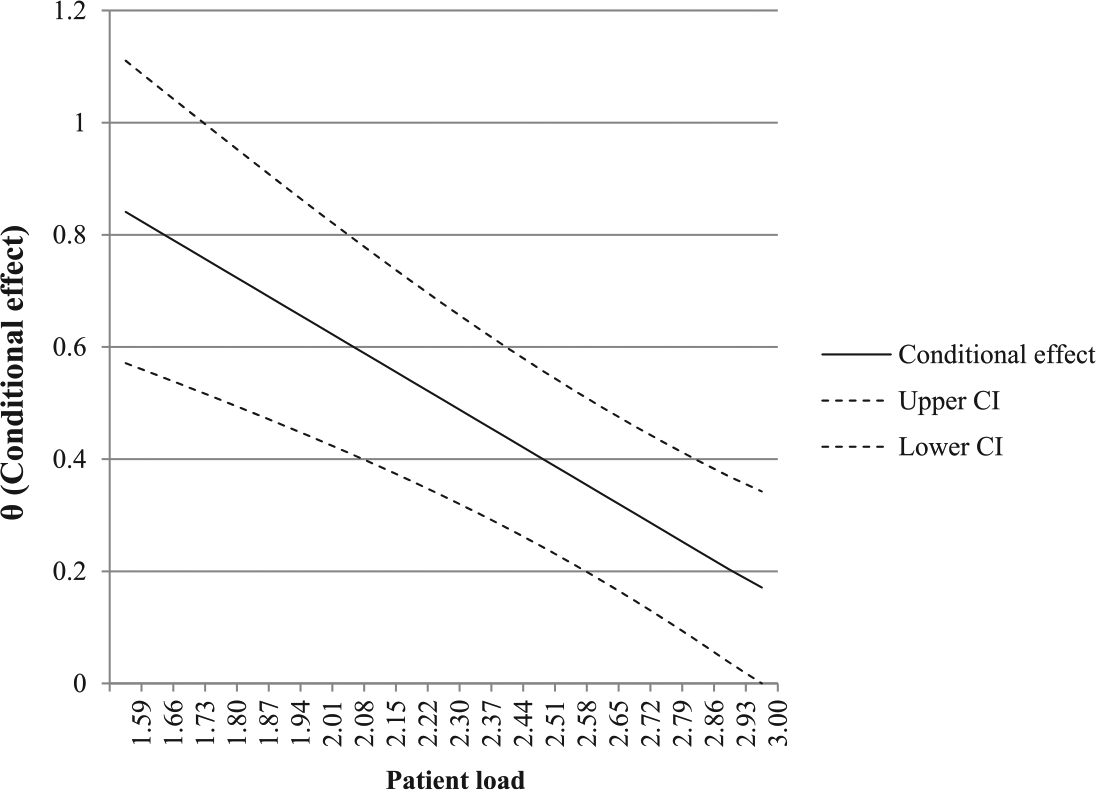
Region of Significance for the Effect of Empathetic Care on Patient Load Conditional on Patient Safety
Hypothesis 3 posits a weaker relationship between empathetic care and safety for aides who work overtime (more than 40 hours per week). As shown in model 2 of Table 3, the interaction between empathetic care and overtime was statistically significant, B = –.270, SE = .130, p < .05, lending support for Hypothesis 3. Simple slope analysis (Figure 2) indicates that when aides worked 40 hours per week or less, there was a significant effect of empathetic care on safety, B = .315, SE = .077, p < .001. This effect was insignificant, however, for aides who worked overtime (more than 40 hours per week), B = .045, SE = .142, p = .754. Thus, working overtime dampened the positive relationship between empathetic care and patient safety.

Simple Slopes for the Interaction between Empathetic Care and Overtime
Hypothesis 4 posits that financial hardship will dampen the effect of empathetic care on safety. Model 2 (Table 3) indicates a significant interaction between empathetic care and financial hardship in affecting safety, B = –.221, SE = .088, p < .05, lending support for Hypothesis 4. Simple slope analysis (Figure 3) indicates that empathetic care is related to higher safety ratings for aides who are not experiencing financial hardship (household income of $40,000 and higher), B = .311, SE = .078, p < .001, but this effect was attenuated among aides experiencing financial hardship (household income lower than $40,000), B = .090, SE = .046, p = .054. Overall, the variables entered in the regression equation explained 49.4% of the variance in safety ratings. 7
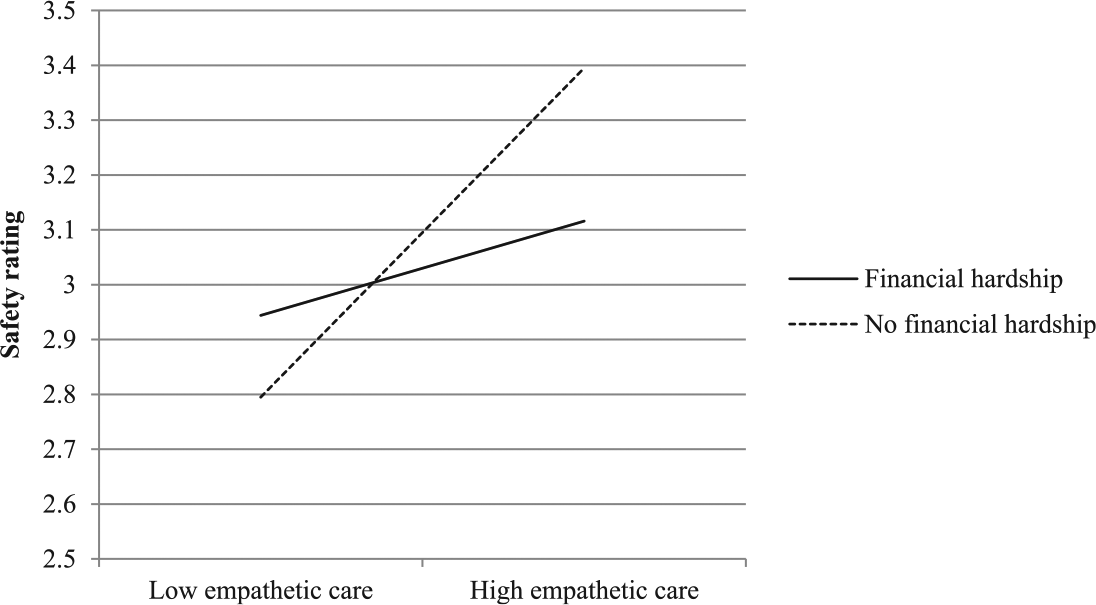
Simple Slopes for the Interaction between Empathetic Care and Financial Hardship
Additional Analysis
It could be argued that the workplace and life stressors examined here—patient load, overtime work, financial hardship—actually reduce empathetic care, rather than moderating the relationship between empathetic care and patient safety. If so, then an aide’s empathetic care could itself degrade because of adverse work and life circumstances. To address this possibility, we examined whether the work and life stressors moderated the relationship between trait empathy and empathetic care. This analysis indicated a significant main effect of trait empathy on empathetic care (B = –.062, SE = .118, p < .05), but this relationship was not moderated by any of the work and life stressors (ps > .194). Thus, it appears that work and life stressors do not reduce empathetic care itself but rather, moderate the relationship between empathetic care and how it is enacted in terms of patient safety, as hypothesized.
Discussion
In this study, we develop a theory of empathy in care work and its effects on patient safety using qualitative interviews and focus groups, and we test the model with a sample of nursing aides in six residential nursing homes. We hypothesize and find that empathetic care has a main effect on safety ratings. We also extend prior theory by demonstrating that this relationship is moderated by several situational variables. First, the relationship between empathetic care and safety is attenuated when higher patient loads burden aides. Second, we do not find the positive relationship between empathetic care and safety for aides who work more than 40 hours per week. Third, the relationship between empathetic care and patient safety holds only for workers who are not experiencing financial hardship, as indicated by low household income.
These findings have three important implications. First and foremost, empathetic care is beneficial to patient safety and, in this regard, is to be encouraged in health care facilities. Our research provides rare empirical confirmation of the hypothesized benefits of empathy, as predicted by the more general theories of compassion at work (e.g., Kanov et al. 2004; Dutton et al. 2014). Second, demanding workplace practices within the facility can erode these potential benefits. When aides are caring for a larger number of patients (high patient load), the benefits of empathetic care for patients disappear. When aides work overtime hours, the patient benefits of empathetic care similarly disappear. Thus, for facilities to realize the benefits of empathetic care, they must manage both patient loads and worker hours. Third, aides experiencing financial hardship, as indicated by low household income, also show difficulty translating empathetic care into patient safety. As suggested by work on the psychological consequences of scarcity (Mullainathan and Shafir 2013; Meuris and Leana 2015), the cognitive and affective toll imposed on people with financial worries may impede their ability to perform up to their potential at work. Taken together, these findings suggest that workplace practices that support employees (i.e., reasonable patient loads, no mandatory overtime, and sufficient wages to alleviate concerns about economic scarcity) also support patient safety. Moreover, these results provide unique support for the conservation of resources theory (Karasek 1979), which suggests that hindrance factors, such as adverse work and life circumstances, will impede work performance.
Finally, although most studies of patient safety have conceptualized workplace practices, such as patient load, as main effects, we show empathetic care here as the primary predictor, and such factors as situational moderators. In this conceptualization, the relationship between the caregiver and the care recipient is foundational. Such a model is consistent not only with the reports of aides in our qualitative studies but also with prior conceptual work on empathy and compassion in the workplace. Management practices (e.g., staffing levels, use of overtime) can amplify or attenuate the positive outcomes of empathy for patients but, as suggested by Folbre and others (Folbre 2012), the relationships themselves are the cornerstone of care.
Workplace practices, such as staffing levels, are a function of management decisions, but the institutional and regulatory environment in which long-term care facilities are situated also affect such practices. As Berg, Appelbaum, Bailey, and Kalleberg (2004) showed in their international comparison of workplace practices, important factors such as workload and worker control over scheduling significantly differ across countries, even within the same industry. Such differences may be particularly important in low-wage low-skill jobs, such as nursing aides, for which labor protections vary widely (see, for example, conditions in Denmark [Eskildsen and Nielsen 2008] and the Netherlands [van der Meer 2008] as compared to the United States). In addition, unionization rates, which also vary widely across nations, have a clear impact on workplace practices (Berg et al. 2004). Although not the focus of this study, the influence of regulatory and institutional practices on patient safety is an important area for further research.
Study Limitations
This study sheds new light on a phenomenon that is critical to quality care yet has received scant attention. We explore empathetic care using both qualitative and quantitative methods across several long-term care facilities. Nonetheless, there are limitations to this research. First, our sample size for the quantitative study is small, and so the findings may not generalize to facilities beyond our case study sites. Second, we cannot fully establish causal ordering regarding the relationship between empathetic care and patient safety. Our lagged dependent variable partially addresses this concern but cannot eliminate it. Third, we focus here on only one aspect of patient care (safety). Although safety is fundamental, it is clearly not the only indicator of quality care. Future research may explore other aspects, such as patients’ physical and emotional health, although, as noted earlier, linking such patient data to individual aides poses significant challenges. Fourth, the regulatory and institutional environment in which health care facilities operate may have an important impact on workplace practices; however, our research cannot explore such differences.
Finally, although past research has distinguished empathetic care from trait empathy (Lamberton et al. 2013), and our current research has shown it to be unrelated to individual factors such as demographics, our research does not address why some care workers are more empathetic than others in doing their jobs. If empathetic care is important for quality patient outcomes, yet it is not an inherent trait of the individual care worker, it is important to better understand the factors—both individual and situational—that encourage empathy in care work. Nursing aides are not paid more highly than other jobs that require far less intimate interaction (e.g., cashiers; fast food workers), yet something draws certain individuals to this profession and propels them to do their jobs with empathy. We leave this observation to future research, which might begin by focusing on factors such as worker motivations for doing care work.
Conclusion
As Folbre (2012) and others have argued, empathy is a key aspect of care work, which distinguishes it from other types of service jobs. With the burgeoning of paid care work in developed economies, it is important to better understand empathetic care—its consequences as well as its predictors. Our research is meant to shed light on the key role of empathy in such jobs. Our findings provide the theoretical insight that empathy, in and of itself, may not be universally associated with safety. Rather, empathy’s effects are contingent on the environments in which aides work; hence, hiring the “nicest” people may not translate to safer and more stable workplaces. Rather, an understanding of factors that may hinder the degree to which empathy is enacted—such as appropriate patient loads, work hours, caregivers’ economic situations, and other limitations and resources—is critical if we want to translate empathy into beneficial action.
Footnotes
Acknowledgements
We thank Christie Hudson and John Williams for assistance with data collection.
This research was supported by the Russell Sage Foundation.
Additional results and copies of the computer programs used to generate the results presented in the article are available from the first author at
1
Unlike some studies of professional care workers, Lamberton et al. (2013) found a fairly high mean level of empathetic care among paraprofessional care workers such as aides (M = 5.63 on a 7-point scale), and they also reported that the full range of the scale was reflected in the samples. They validated the empathetic care scale against time use and performance review scenarios and showed convergent and discriminant validity (see  for a full description of the scale construction and validation).
2
We included both full- and part-time aide employees in the analyses. The results were similar when we ran the analyses using only full-time employees, so we included both to enhance the sample size.
3
To address the issue of potential halo effects in these ratings, we also examined supervisor ratings of aide initiative (e.g., offers new ideas) and accountability (e.g., shows up on time for shift). We did not find a significant relationship between empathetic care and these dimensions of performance.
5
Household income was measured on a 9-point scale from 1 = Less than $10,000 to 9 = Over $80,000. We conducted the same regression analysis as reported using the continuous HH income variable and obtained similar results. The interaction between empathetic care and HH income was significant, B = .058, SE = .019, p < .05. Johnson-Neyman probing of the interaction indicated that no range was observed for which empathetic care did not have an effect on safety ratings, but the relationship was attenuated with lower household incomes.
6
Of the responses collected, 11.7% worked slightly less than 40 hours per week.