




Abstract
This article empirically examines whether employment discrimination claims differ from other types of disputes resolved through arbitration. Whether arbitration is appropriate for resolving violations of anti-discrimination statutes at work is a focus of ongoing policy debates. Yet empirical scholarship has rarely considered whether different types of complaints might have distinct characteristics and receive varied outcomes in arbitration. The authors analyze all of the employment arbitration awards for cases filed between 1991 and 2006 in the financial services industry to determine whether differences in the type of allegation affect award outcomes. They also examine the effects of the financial industry’s decision in 1999 to introduce voluntary arbitration for discrimination claims. Results indicate that discrimination claims largely fared worse in arbitration than did other statutory or non-statutory claims but that arbitration systems are capable of meaningful self-reform.
The use of arbitration to resolve employment complaints has been an especially controversial practice for more than two decades. On the one hand, proponents of the practice maintain that arbitration provides a faster, cheaper, and more flexible means of resolving employment disputes than does litigation. On the other hand, opponents of the practice argue that arbitration does not provide a level playing field for employment disputes. Critics have especially expressed their concerns about mandatory arbitration, that is, the employer practice of requiring employees to sign agreements waiving their right to pursue complaints in the courts and agreeing instead to have those complaints resolved by arbitration.
In this article, we analyze the use of arbitration to resolve employment claims in the securities industry. We hope our analysis will cast light on the arguments posed by both advocates and opponents of that method of resolving disputes. Between 1991 and 2008 nearly 3,000 arbitration awards were issued under the auspices of the industry’s regulatory authorities, and those awards form the database we use in our analysis. Currently the industry’s dispute resolution program is administered by the Financial Industry Regulatory Authority (FINRA). The FINRA dispute resolution program has undergone significant reforms since its inception, in part because of FINRA’s governance system, wherein the agency operates as a private and independent self-regulated organization (SRO) but is overseen by the Trading and Markets division of the U.S. Securities and Exchange Commission (SEC). The hybrid nature of FINRA allows for independent self-governance opportunities but also encourages public evaluations and critiques of the industry’s structures, including its dispute resolution program.
Several features of the database make it an ideal means for examining some of the most contentious issues in employment arbitration. First, it covers the entire universe of arbitration decisions in the industry through 2008, allowing for a more holistic examination of each entity’s experience in using employment arbitration. Second, since arbitrators hearing employment cases in the securities industry deal with three broad types of claims (allegations of unlawful discrimination, allegations of statutory violations unrelated to discrimination, and allegations of non-statutory violations), we are able to examine whether and to what extent discrimination complaints differ in both their characteristics and their outcomes from other types of complaints. Third, for the first several years of the FINRA employment arbitration program, mandatory arbitration was used to decide all types of claims, including those alleging discrimination, but since 1999 voluntary arbitration has been used to resolve discrimination claims and mandatory arbitration continues to be used for all other claims. This change from mandatory to voluntary arbitration allows us to examine the effects of self-governance on the types of cases resolved within an arbitration program as well as the outcomes of these cases.
In addition to contributing to academic debates regarding arbitration, our examination of discrimination within the securities industry’s system is relevant from a policy perspective. Support for the use of arbitration in employment relations writ large has been reinforced by several key US Supreme Court decisions, and many of the Court’s most important decisions on arbitration originated in the industry. Most critically for employment relations, the Supreme Court’s seminal decision in Gilmer v. Interstate/Johnson Lane Corp., 500 U.S. 20 (1991), held that a securities broker-employee who had signed a registration form (Form U4) required by the SEC mandating the use of arbitration to resolve statutory claims had waived his right to take an age discrimination claim to the federal courts. The Gilmer case is widely credited with ushering in extensive use of mandatory pre-dispute arbitration agreements in employment relations. Our examination of arbitration within this particular industry is therefore relevant to key policy decisions that have broadly affected how employment disputes are now resolved.
Empirical Research on Employment Discrimination Arbitration
From the 1980s onward, the Supreme Court has sought to expand the use of private arbitration as a mechanism for resolving disputes in the consumer, commercial, and employment arenas. Following the passage of anti-discrimination laws, such as Title VII of the 1964 Civil Rights Act, employees commonly adjudicated claims on these issues through litigation. The Court’s ruling in Gilmer, however, paved the way for companies to establish clauses in their employment contracts that required employees to arbitrate, and not litigate, any future claims they might wish to bring against the firm. These clauses, commonly referred to as mandatory pre-dispute arbitration agreements, were almost immediately controversial and remain polarizing in both practitioner and academic circles.
An impressive cohort of authors positioned themselves on either side of the debate regarding the effects of the expansion of private arbitration as an alternative to the court system (see Stone 1996; Estreicher 2001). Although most scholars generally accept that firms would prefer to arbitrate, rather than litigate, disputes, researchers have long wrestled with both the logic underlying this preference as well as the consequences of this method of conflict resolution, particularly when employees’ statutory rights are concerned (see Lipsky, Avgar, and Lamare 2016 for an overview of these debates). One of the challenges confronting researchers is the paucity of robust data available to study arbitration (Colvin 2011). As a result, only a small number of authors have managed to use sophisticated empirical techniques to test many of the assertions made by either proponents of or opponents to arbitration, and an even smaller subset has considered the potential for differentiated treatment in arbitration according to claim type and the effects of self-governance on arbitration systems.
Two of the earliest empirical explorations into the arbitration of employment discrimination claims come from Howard (1995) and Delikat and Kleiner (2003) and focus on summary statistics of employee win rates (i.e., findings of any merit by an arbitrator) and overall award amounts. Howard (1995) examined 510 American Arbitration Association (AAA) awards and 61 securities industry awards and found a 48% win rate in the securities industry, with a median award of $41,700. Delikat and Kleiner (2003) analyzed 186 securities arbitration awards and found win rates of 46.2% with median awards of $100,000. However, the empirical contributions of these studies are limited. Both are purely descriptive and rely on a small and truncated number of cases, resulting in concerns regarding selection bias (Schwartz 2009). Nevertheless, these two articles form a useful baseline from which to proceed to explore differences between discrimination and other claims in employment arbitration.
A heavily cited empirical assessment of employment discrimination arbitration comes from Eisenberg and Hill (2003), who use AAA data from 1999–2000 to compare the outcomes of statutory and non-statutory cases arbitrated within that forum, as well as to compare arbitration to similar cases within the court system. The authors found that non-statutory claims enjoy higher win rates, but award amounts had mixed results. The Eisenberg and Hill (2003) study faced limitations similar to Howard (1995) and Delikat and Kleiner (2003), in that it relied on a small sample (N = 297), which resulted in considerable unreliability with regard to the findings. For instance, the Eisenberg and Hill sample consists of only eight statutory disputes that received awards, which the authors acknowledge limits any meaningful interpretation with regard to award amounts (Eisenberg and Hill 2003: 50). Additionally, the results are based on descriptive data that do not include any controls to account for case and party characteristics that might shape arbitrator behavior. A concern with much of the early research into employment arbitration is that it focuses primarily on individually negotiated arbitration agreements rather than employer-promulgated cases (Colvin and Pike 2014). Finally, short timespans limit these studies to cross-sectional analytical methods (Schwartz 2009).
A more recent empirical analysis of the differences between discrimination and non-discrimination claims in employment arbitration can be found in Colvin and Pike (2014). The authors used AAA data from 2008 and overcame some limitations of earlier work. Their data allowed for a more nuanced examination of discrimination and non-discrimination claims, and they explored primarily employer-promulgated arbitration programs. Colvin and Pike focused on summary statistics of employee win rates and award amounts and found that win rates for discrimination claims are about 11 percentage points lower than are win rates for other allegation types, but award amounts are higher for meritorious discrimination complaints than they are for other claims.
We expand upon the aforementioned studies to analyze the treatment of various types of allegations in an arbitration system. In so doing, we use as our template similarly structured empirical analyses of employment arbitration that do not explicitly consider discrimination claims. Recent research examining outcomes in employment arbitration has enjoyed an empirical advantage by using larger, longitudinal samples and by being able to distinguish employer-promulgated systems. For instance, Colvin (2011) and Colvin and Gough (2015) studied several thousand AAA arbitration awards using sophisticated empirical techniques to determine that award outcomes in employment arbitration vary by representation status, experience in the arbitration system, professionalism, geography, and gender. Colvin and Gough also considered the important role of settlement behavior in affecting arbitration awards. However, neither Colvin (2011) nor Colvin and Gough (2015) explored differentiation by type of allegation.
Because of the scope of data available to us, we are able to examine a wider array of factors that affect arbitration than those available for prior studies of the arbitration of employment discrimination complaints, including those studies that take account of differences in the type of allegation and outcome variations. Also, because we have a universe of awards from the inception of the securities industry’s employment program through 2008, we are able to explore the effects of policy changes over time on arbitration outcomes. Perhaps the most important of these policy changes was the securities industry’s decision in 1999 to make arbitration voluntary, rather than mandatory, for employees with discrimination claims. Thus, after 1999, employees with discrimination claims could leave the arbitration program and attempt to settle their claim in litigation or by other means. We are therefore able to assess directly theories promulgated by scholars such as Sherwyn (2003) and Schwartz (2009) regarding the expected behavioral effects of the use of voluntary arbitration on the disputants. We consider this more fully and provide justifications for our own empirical expectations in the following sections.
Theory and Hypotheses
Our first hypothesis is that discrimination cases are likely to differ from non-discrimination cases, wherein discrimination complaints will have higher initial claims, will be more complex, and will be oriented around distinctive party characteristics (including employee gender and employer size). Our second hypothesis is that these differences, as well as other distinctions in the treatment of discrimination claims, result in less-favorable arbitration awards for employees filing discrimination charges. Our third hypothesis is that efforts to self-regulate the securities industry’s arbitration system, by removing the requirement that employees must arbitrate discrimination claims, were effective at reducing the number of discrimination charges resolved under arbitration.
How Discrimination Complaints Differ from Other Allegations
Researchers have yet to examine empirically differences in the characteristics of discrimination complaints compared with other types of claims in an arbitration system, but legal scholarship suggests that for several reasons discrimination claims that reach the award stage of arbitration should have characteristics that differ from other complaints. First, discrimination cases resolved in arbitration are likely to involve higher initial claim amounts than do non-discrimination allegations. Scholars have discovered that employees often fail to report behaviors by their employers that they believe constitute unlawful discrimination (particularly sexual harassment). If employees file discrimination claims, they often face significant challenges as they move through their firms’ internal grievance mechanisms. Therefore, only the most egregious violations are likely to be submitted to binding resolution (Marshall 2005). If we assume that employees who believe their employers are guilty of the worst violations make the largest financial claims, then the claims associated with the arbitration of discrimination complaints should be higher than the claims associated with other types of complaints.
Second, the arbitration of discrimination cases is likely to be more complex than arbitration of non-discrimination cases. Anti-discrimination laws allow employees to claim multiple subsets of violations, such as alleging both gender and race discrimination, rather than alleging either gender or race discrimination alone. Legal scholars maintain that these types of allegations are exceptionally complex and intersectional, far more so than non-discrimination comparators. Discrimination claims are especially complex since they often involve normative perceptions and require the determination of motives, whereas contractual claims are often based on more objective compensation practices (Abrams 1994; Kotkin 2009; Goldberg 2011).
Third, the characteristics of the parties in a discrimination case should differ from the characteristics of the parties in a non-discrimination case. Prior research (Bemmels 1988; Reder 1999; Antilla 2002; Lipsky, Lamare, and Gupta 2013) indicates that women are especially prone to be the victims of discrimination in the securities industry. We therefore anticipate that women will be more prevalent in discrimination complaints than in non-discrimination complaints.
Additionally, legal scholars contend that discrimination complaints may be more likely to involve larger, well-resourced organizations. Gelbach (2012: 2334) holds that larger firms might engage in more discrimination if they “believe themselves less likely to face lawsuits.” These large companies “might engage in more discrimination, or be less vigilant in policing any unlawful behavior of supervisors” if they think the rules allow for it. 1 Though we do not have data on the size or resources of each firm participating in arbitration, we believe that employer experience within the arbitration system (i.e., the number of arbitrated claims in which it has been involved) is an effective proxy for this measure. Researchers who study the so-called repeat player effect show that large and well-resourced firms are more likely to enter into arbitration and other adjudicative forums repeatedly (Galanter 1974; Bingham 1996, 1997; Colvin 2011; Colvin and Gough 2015).
Outcome Differences
We anticipate that the differences in characteristics between discrimination and other case types will affect outcomes. If we can assume the arbitrators act similarly to judges, they may be reluctant to find merit in relatively higher-cost and higher-profile discrimination cases, as any damages awarded under meritorious discrimination cases are likely to be significantly larger than they would be for contractual and other allegation types, given the egregiousness of the arbitrated discrimination claims. Additionally, if women more frequently claim discrimination, these cases may be less likely to receive favorable awards because of the claimant’s gender (Oppenheimer 2003; Lipsky et al. 2013). Further, if discrimination claims are more often brought against highly experienced companies, those bringing these types of allegations will be at a disadvantage since large and well-resourced firms also perform better in arbitration (Bingham 1996, 1997; Colvin 2011). In sum, each of the differences we expect to find regarding characteristics underlying discrimination and non-discrimination claims should have an effect of decreasing award outcomes when discrimination claims are involved, relative to other claims.
Some scholars have raised a second and perhaps more problematic possibility, which is that employees alleging discrimination face a so-called anti-plaintiff effect (Clermont and Schwab 2004, 2009). Evidence from studies into employment discrimination litigation suggest that jurors and judges may share a jaundiced view of employees who bring these types of claims to the courts (Hans and Vadino 2000; Selmi 2001; Hans and Albertson 2003). From this perspective, the hypothesized poor outcomes for discrimination cases in arbitration may also reflect conscious or unconscious attitudinal biases held by arbitrators that are akin to the biases alleged within judicial decision making.
Self-Regulation Effects
A central claim that proponents of the expansion of employment arbitration make is that private dispute resolution systems are flexible enough to self-regulate if perceived imbalances occur within the system. This belief is rooted in logic first developed in the 1930s within the financial industry writ large. Supreme Court Justice William Douglas, who wrote the majority opinion in 1960 that established court deferral to arbitration in the unionized employment context, had offered support for self-governance in his role as head of the SEC in the 1930s. He argued that private regulation mechanisms were capable of correcting any issues emerging within their systems, to the point that public bodies (i.e., the government or the courts) should not need to intervene (Stone 2005). The Court later carried similar logic into its opinion in Gilmer and other cases used to expand the scope of arbitration within the employment context, most notably Circuit City Stores, Inc. v. Adams (532 U.S. 105 [2001]), all of which underscored the capabilities of private dispute resolution forums to self-regulate.
Empirical studies of self-regulation within arbitration systems are rare, however. Bingham and Sarraf (2004) examined employment arbitration outcomes in the AAA before and after the adoption of minimum self-regulatory standards, such as the Due Process Protocol, designed to improve equity in arbitration. The authors found that arbitration awards rendered after these regulatory standards were introduced were more favorable to employees, concluding that “self-regulation is making a difference in employment arbitration” (Bingham and Sarraf 2004: 304). The study’s results are largely descriptive and focus only on outcomes, with the authors acknowledging the preliminary nature of the findings, especially given the small sample size (Bingham and Sarraf 2004: 325). Nonetheless, these findings give credibility to the notion that self-regulation can have meaningful consequences in arbitration and can provide a valuable starting point from which we examine the effects of moving from a mandatory to a voluntary system.
Sherwyn (2003) is the only study of which we are aware that has attempted to empirically assess mandatory versus voluntary systems of employment arbitration. Sherwyn examined survey data drawn from a sample of 247 defense lawyers and 41 plaintiff lawyers, paired with a descriptive analysis of the use of the Illinois Human Rights Commission’s voluntary arbitration program. The results indicate that a lawyer representing an employee and a lawyer representing an employer will rarely if ever agree to use arbitration to resolve a dispute if they have the choice under a voluntary arbitration program. Sherwyn found that at least one side, if not both, will always view arbitration as inferior to litigation. He concluded from this that policies designed to abolish mandatory arbitration and replace it with a voluntary system will be largely ineffective.
We expand upon the foundations provided by Bingham and Sarraf (2004) and Sherwyn (2003) by using a large sample of arbitration awards within a single universe and accounting for an array of confounding factors within our data. If we believe that Sherwyn’s assertions apply to our data, the efforts by the financial industry to remedy the perceived imperfections in employment arbitration by making discrimination claims voluntary after 1999 should result in a dramatic reduction (possibly approaching zero) in the number of those claims resolved in the arbitration system. 2
In our initial hypothesis, we maintain that the effects of self-regulation on changes in an arbitration system can be explored by examining the extent to which either or both parties exercise their option to leave the system when they are given the opportunity. We do not presuppose that discrimination outcomes might look any different under voluntary regimes as compared to mandatory ones, though we do examine outcomes under mandatory and voluntary systems and discuss the interpretation of our findings in this regard (particularly the difficulties inherent in presupposing how outcomes will change as a result of reforms) later in the article.
Relatedly, we have little reason to suspect that employees who left the arbitration system would have fared any better in litigation. In articles that have examined the treatment of discrimination complaints versus non-discrimination cases within the court system (Selmi 2001; Clermont and Schwab 2004, 2009; Seiner 2009), the consensus is that plaintiffs alleging discrimination are less supported, relative to those filing other types of claims, by the litigation system at every stage in the process, including the pretrial, trial, and appeal phases of the case. As such, we believe that employees alleging discrimination benefit only by being given agency to remove their claims from arbitration, but not necessarily with regard to pursuing better results. Irrespective of whether actual outcome differences exist, though, if employees (or their attorneys) perceived that private arbitration yielded unfair results relative to the court system, they would take advantage of the option to remove their claims from the system, which would support the notion that the financial industry’s efforts at self-correcting perceived inequalities were successful.
The FINRA Arbitration System
In 1986 both the New York Stock Exchange (NYSE) and the National Association of Securities Dealers (NASD) launched employment arbitration programs that covered employees registered with the SEC. The two programs were highly similar in their rules and structures, and in 2007 they were merged into a single program administered by FINRA. 3 Between 1986 when the program was established and December 31, 1998, the financial industry used mandatory arbitration to resolve all employment claims. On January 1, 1999, the NASD amended Rule 13201 of its code so that employees would no longer be required to arbitrate statutory employment discrimination claims. The NYSE took an identical step in changing its own Rules 347 and 600, so that, by 1999, arbitration was no longer required for employment discrimination claims arising in either of the major financial industry forums.
This change was made in response to concerns regarding the appropriateness of arbitration as a forum for handling discrimination cases. These concerns were expressed in part in the Equal Employment Opportunity Commission’s (EEOC) policy statement opposing the mandatory arbitration of civil rights claims and also in U.S. Government Accountability Office reports and in district court rulings supporting the EEOC’s position. 4 The financial industry faced especially high pressure to confront issues of fairness regarding discrimination complaints following a series of high-profile incidents that garnered nationwide public attention (Sullivan 1998). This pressure emerged in the form of media stories highlighting endemic gender discrimination at many of the top securities firms, as well as lawsuits and court rulings challenging the use of arbitration for these types of disputes (Iwata 1996; Fraser 1997; Sullivan 1998). Although the financial industry maintained that arbitration was an effective venue for the vindication of statutory rights, it concluded that the mandatory requirement to arbitrate discrimination claims should be removed.
Concurrent with the removal of mandatory arbitration, the NASD and the NYSE proposed significant adjustments to their internal systems to provide enhanced procedures for the administration of the employment discrimination claims that remained in arbitration. Many of these procedures were designed to overcome concerns related to the characteristics of the arbitrators selected to hear discrimination complaints, with chair arbitrator ties to securities firms constituting a particular concern. Arbitrators in the securities industry fall into one of two categories: they are either public or industry arbitrators. Industry arbitrators have specific connections to the securities industry, perhaps having previously worked as a broker or having served in a legal capacity within a securities firm. Public arbitrators have no such industry connections and are considered neutrals (Choi, Fisch, and Pritchard 2015). Typically, arbitration panels consist of either a sole public arbitrator or a panel of three arbitrators, one of whom is an industry arbitrator. This format of using a hybrid public/non-public panel creates controversy. Supporters of the system maintain that industry arbitrators provide valuable knowledge that helps produce more accurate awards, whereas opponents of the system hold that arbitrators having ties to securities firms might be more prone to bias in their decision making (Choi et al. 2015).
The internal systems adjustments adopted within the securities industry following the removal of mandatory arbitration were designed to help overcome this controversy. For instance, Rule 13802 of the NASD code, which was revised in January 2000, required arbitrators hearing discrimination cases to have a law degree; membership in a bar association; substantial familiarity with the law; 10 or more years’ experience in the practice of law, the teaching of law, or government enforcement of equal employment opportunities statutes; or experience as a judge, arbitrator, or mediator; or as an in-house counsel dealing with such matters. In addition, Rule 13802 prohibits the chair of a panel or a single arbitrator in a discrimination case from having represented primarily the views of employers or of employees within the past five years. Panel chairs are particularly important in securities arbitration and have considerably more power over the process and outcomes of cases than do the other members of an arbitration panel (Choi et al. 2015). It is therefore unsurprising that, in adapting panel composition rules for discrimination complaints, the securities industry chose to tighten requirements for panel chairs in particular. No similar adjustment to arbitration panel composition was made to non-discrimination claims at the time, which remained subject to mandatory arbitration.
Data and Models
As noted, our data consist of all arbitration awards rendered under the auspices of the securities industry’s employment arbitration program from July 1991 through May 2008, reflecting claims filed between January 1991 and December 2006. We received our award data from the organization in mid-2008, and we have limited the endpoint of our analysis to the most complete full year of claims subsequently arbitrated that we have available, which is 2006. In the years since we received our data, some aspects of the system have remained the same and others have changed. For instance, total cases filed and closed have remained roughly similar. In 2008, 4,982 cases were filed across all arbitral forums (including employment and also other claim types, such as customer–broker disputes) and 3,787 cases were closed. In 2016, 3,681 cases were filed and 3,635 were closed (the difference in cases filed appears to be a product of natural yearly fluctuations rather than a clear trend in numbers).
There have, however, been some important differences in the administration of employment arbitration cases in the years since we received the data. For instance, as of 2012, whistle-blower claims are treated as discrimination complaints, whereas in our data they were counted as statutory non-discrimination claims. Changes have also been made to the arbitrator selection process, which is now randomized (see footnote 7). In any given year, a handful of amendments were made to FINRA’s general arbitration rules, though most of these represent relatively minor procedural changes, and we capture these changes by including year fixed effects within our multivariate models.
In every arbitration case in our data file, the employee (or his or her attorney) presented the arbitrator(s) with the precise nature of the claim brought against his or her employer and a monetary figure representing the damages associated with the claim. The figure usually included the claimant’s demand for back pay and other compensatory damages and sometimes included punitive damages and attorneys’ costs as well. The nature of the claim can be classified into three broad categories: 1) statutory discrimination claims, in which the employer was alleged to have violated substantive legal protections given to certain groups of employees; 2) statutory non-discrimination claims, which involved allegations that the employer violated statutory laws but did not include violations of anti-discrimination statutes (e.g., federal racketeering violations or complaints regarding the Employee Retirement Income Security Act); or 3) non-statutory claims, consisting of a range of other complaints, such as defamation or breach of contract, that did not allege a violation of statutory laws. Employers almost always denied that the employees’ claims had merit and asked the arbitrator(s) not to award the employee any money.
We operationalize allegations into the above three categories (discrimination, statutory non-discrimination, and non-statutory claims); however, it should be noted that employees were allowed to list multiple allegations within their case. Therefore, those filing discrimination claims could ostensibly also list a non-statutory complaint (such as wrongful termination or breach of contract) alongside the discrimination charge. In practice, the bundling of independent non-discrimination and discrimination claims was rare. When employees presented multiple claims within a discrimination complaint, the vast majority of the additional claims were in fact extensions of the primary discrimination charge. For instance, if a claim listed discrimination and wrongful termination as the allegations, it was usually the case that the wrongful termination charge was directly connected to the discrimination charge, and the primary allegation was in fact discrimination.
Upon resolving the case, the chair arbitrator recorded the dates of filing and resolution, the number of half-day hearing sessions, information regarding the identities of each party involved in the arbitration, and information regarding the monetary award issued. The arbitrator also recorded other factors, such as whether any or all portions of the case were settled prior to an award being issued, whether punitive claims were made, whether the employee requested expungement of his or her disciplinary record, whether either side filed a motion for summary judgement, whether the employer filed a motion to dismiss the case, and whether any arbitrator, in cases in which a tripartite panel was used, dissented with the majority opinion. 5 Our models therefore are able to use control variables to proxy, to varying degrees, for case complexity (which we define as the number of hearing sessions and whether an arbitrator serving on a three-member panel dissented from the majority opinion), claim characteristics (such as size of the employee claim, location of the arbitration hearing, year of filing, requests for punitive damages, requests for expungement, motions by either party to dismiss the cases, motions for summary judgement, and settlement), and party characteristics (such as repeat employers, repeat chair arbitrators, repeat employer–chair arbitrator pairings, employee gender, chair arbitrator gender, and chair arbitrator professionalization, as measured by whether the arbitrator is a lawyer). 6
Our first hypothesis suggests discrimination charges would be more likely to be associated with larger claim sizes, more complex cases, more experienced employers, and female employee gender. We add to this the expectation that arbitrators handling discrimination complaints would be more likely to be lawyers, and that both the employee and the employer would more often hire lawyers to aid them in resolving these complaints, given the general presumption that all parties in discrimination cases should be versed in external law. In cases for which discrimination is claimed, we also believe the pairing of an arbitrator and an employer is more likely to be a repeat of a previous pairing than would occur in non-discrimination cases, since experienced arbitrators are likely to be assigned repeatedly to the same employer, even if such assignment is inadvertent. 7
To test our second hypothesis regarding the relationship between discrimination claims and financial industry arbitration awards, we treat discrimination as an independent variable predicting awards. We assess three types of award outcomes: the first is overall employee win rates, that is, findings of any merit at all by arbitrators (dichotomous, where 0 = no merit awarded and 1 = some amount of merit awarded). The second looks within meritorious claims only to examine relative award amounts (a continuous percentage of the amount claimed by the employee, excluding punitive damages or attorney fees). The third also looks within meritorious claims only to explore absolute award amounts (the total financial amount awarded to a meritorious claimant, measured continuously). This method of modeling outcomes is common in other analyses of arbitration outside the employment context (Choi, Fisch, and Pritchard 2010, 2015), and we follow this past research in focusing on only tangible compensation amounts in modeling relative award, which reduces the possibility that inflated initial claims could dampen relative award values.
To analyze our third hypothesis, that the financial industry’s efforts at self-regulation affected the nature of claims resolved through arbitration, we examine how the percentage of discrimination claims awarded by arbitrators changed from claims filed between 1991 and 1998 (the period when mandatory arbitration was used to resolve discrimination complaints) and between 1999 and 2006 (the period when voluntary arbitration was used). Later in this article, we assess in more detail the effects of moving from mandatory to voluntary arbitration for discrimination complaints.
Findings
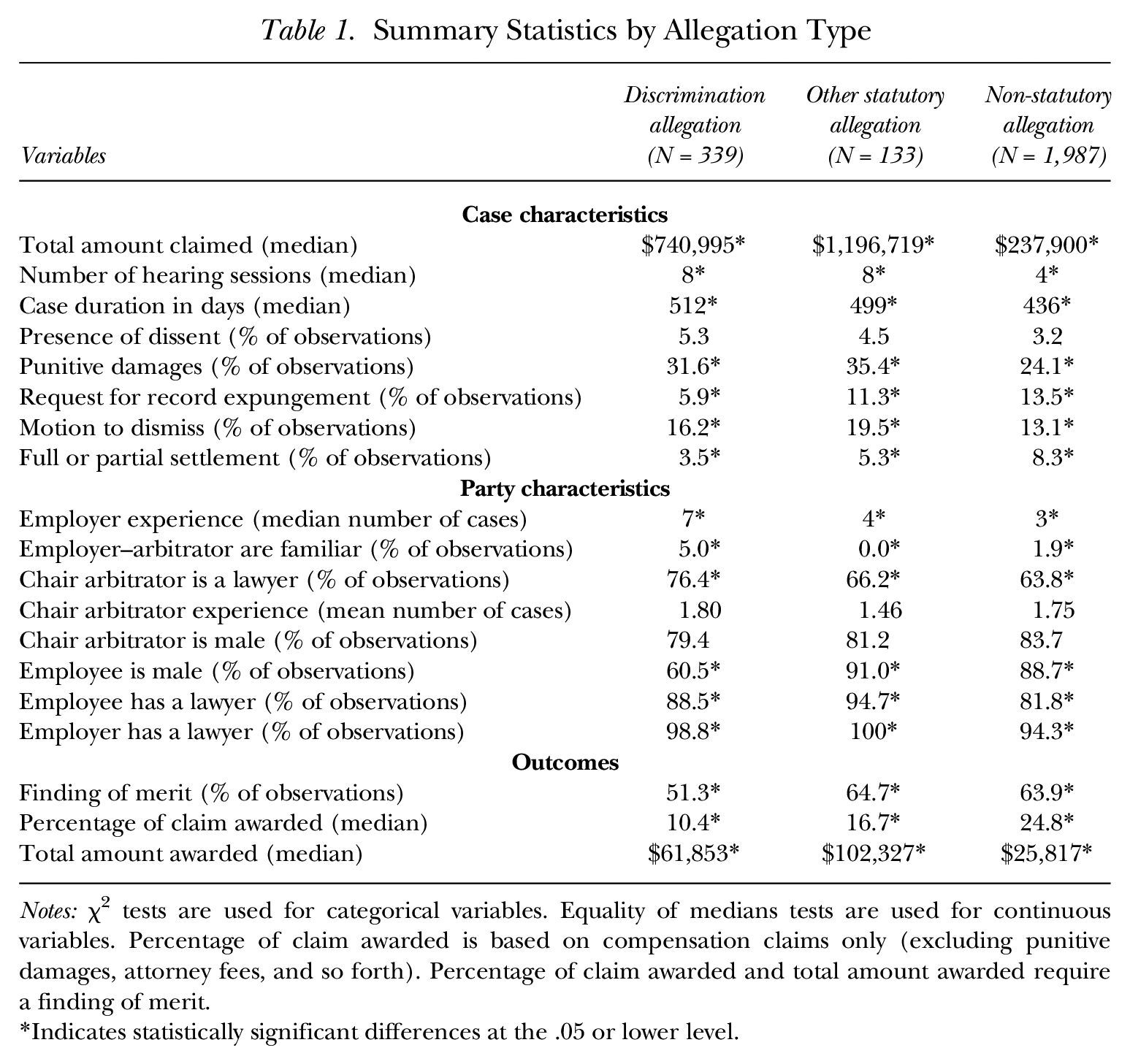
In examining our first hypothesis, we present a series of summary statistics from our data set and empirically assess whether statistically significant variations emerge by allegation. The results are reported in Table 1. We find evidence that both case and party characteristics vary across allegations. Nearly all indicated variations are statistically significant at the .05 level or lower, and the majority are statistically significant at the .01 or .001 levels. With regard to case characteristics, non-statutory cases involve far smaller median claim amounts ($237,900) than do discrimination ($740,995) or statutory non-discrimination ($1,196,719) cases. Statutory cases are more complex, both in terms of the median number of hearing sessions (eight versus four for non-statutory claims) and also the median time from filing to resolution (about 500 days for statutory cases compared to 436 days for non-statutory complaints). Finally, although the presence of dissent does not differ by allegation type, evidence supports that statutory claims are more likely to include punitive damages and motions to dismiss, and that discrimination claims settle less often and are less likely to involve requests for record expungement.
Summary Statistics by Allegation Type
Notes: χ2 tests are used for categorical variables. Equality of medians tests are used for continuous variables. Percentage of claim awarded is based on compensation claims only (excluding punitive damages, attorney fees, and so forth). Percentage of claim awarded and total amount awarded require a finding of merit.
Indicates statistically significant differences at the .05 or lower level.
Regarding party characteristics, we find that discrimination charges more commonly involved experienced employers and were decided by arbitrators holding law degrees. We also see that women were involved far more often in discrimination complaints than other case types, and that both employers and employees more often sought legal representation when statutory rights were at issue. Conversely, arbitrators did not vary by gender or experience levels according to type of complaint.
Award Outcomes
We next examine the extent to which variations in allegation type shape arbitration award decisions. The summary statistics found in Table 1 suggest superficially that the variance in outcomes across types of allegations should be statistically significant. Further, preliminary evidence suggests that discrimination claims fare substantially worse than do other types of claims with regard to arbitrator findings of merit. Consistent with past empirical studies of arbitration in the securities industry, we find that 51.3% of discrimination allegations were deemed meritorious, whereas 64.7% and 63.9% of statutory non-discrimination and non-statutory claims, respectively, were found to have merit.
A more nuanced empirical strategy is required to determine more precisely the legitimacy of these initial findings. We first use logit models to predict overall win rates across all claims. Ordinary least squares (OLS) models are then used to predict the relative award rate for meritorious cases, and negative binomial models are used for absolute award amounts in meritorious cases, since most awards are of low value and the number of awards becomes smaller as monetary values increase.
The type of allegation in each case is used as our key predictor of awards. But, as shown previously, allegations are not expected to occur randomly: They vary in terms of both case and party characteristics. Questions might therefore be asked as to what, exactly, the discrimination variable is measuring when it is used as an independent variable. Discrimination claims are associated with larger claim size, case complexity, employer experience, the use of legal professionals, and female gender, as well as other more minor case and party characteristics. If these are the only factors that might explain the difference between discrimination claims and other allegations with regard to award outcomes, then controlling for these measures should produce a nonsignificant coefficient for the discrimination variable when predicting awards.
If discrimination claims have an independent effect on outcomes above and beyond the variation in the types of allegations included in our analysis, however, then the coefficient for discrimination should remain statistically meaningful, even after accounting for these other factors. For example, if discrimination cases are more likely to involve female employees (which our findings indicate is true), and if female employees receive lower awards in arbitration than male employees receive (which prior research indicates is also true), then any effect of discrimination on awards should disappear after accounting for gender, unless other factors that are not included in our model explain why discrimination is statistically significant.
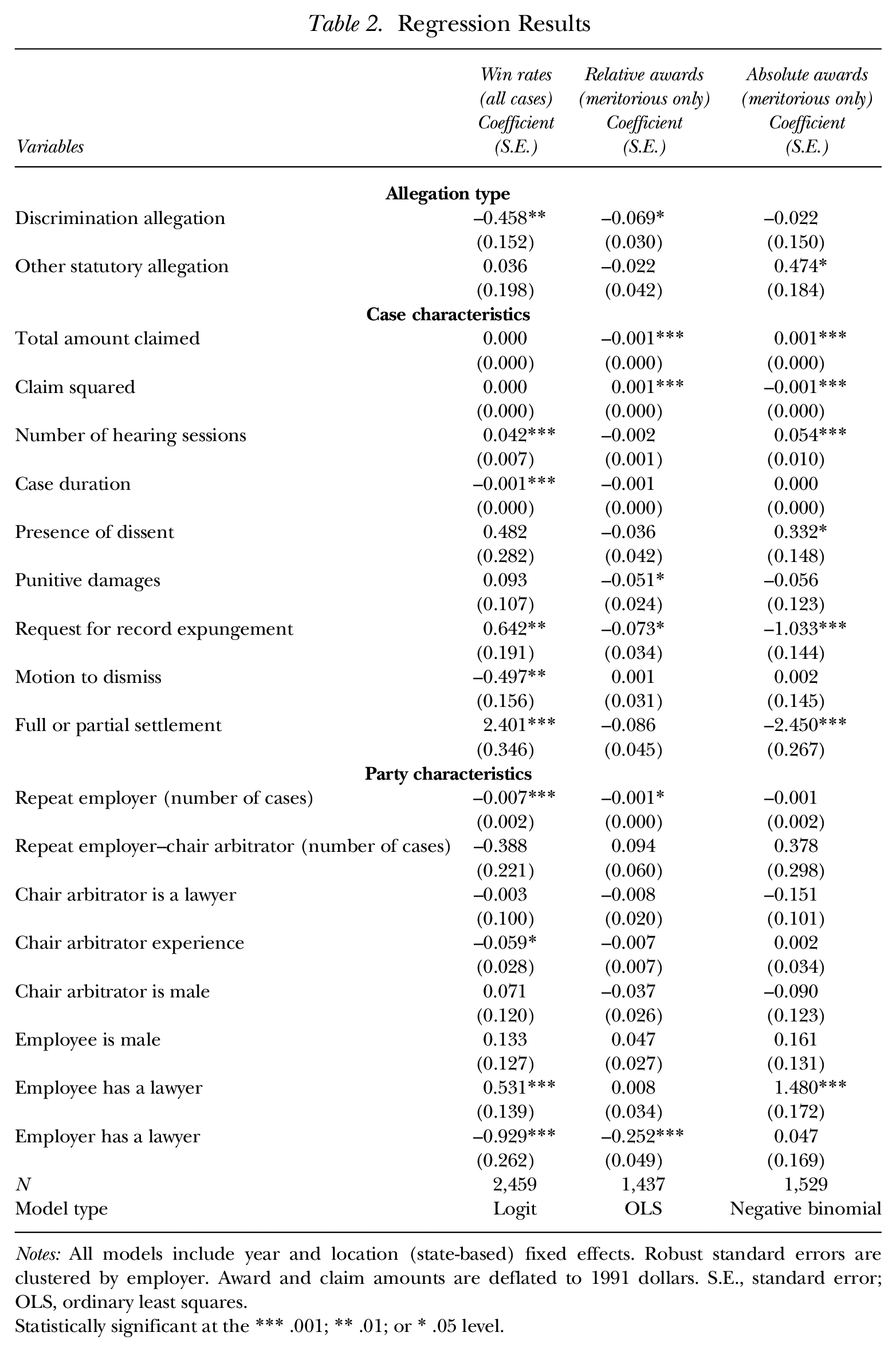
Table 2 provides the results. Regarding overall win rates, we find that discrimination claims were negatively associated with findings of merit when we control both for factors that we expect to be related to discrimination claims (and other types of claims) and for other available factors. We find that the predicted probabilities of win rates were about 10 percentage points lower when discrimination charges were filed compared to non-statutory and statutory non-discrimination claims, respectively, after controlling for claim size, case complexity, gender, and other factors (β = −0.458; S.E. = 0.152; p < .01).
Regression Results
Notes: All models include year and location (state-based) fixed effects. Robust standard errors are clustered by employer. Award and claim amounts are deflated to 1991 dollars. S.E., standard error; OLS, ordinary least squares.
Statistically significant at the *** .001; ** .01; or * .05 level.
Table 2 also shows that when arbitrators decided that a case had merit, discrimination claims fared worse than both statutory non-discrimination and non-statutory claims in terms of relative awards, but not absolute monetary awards. We find that employees who pursued discrimination claims received relative awards about 6 to 7 percentage points lower than did employees who pursued other types of allegations (p < .05). In cases for which arbitrators found claimants to have meritorious discrimination claims, however, the absolute monetary award was nonsignificant after accounting for the full array of factors included in our model. Also note that absolute awards were lower in cases with meritorious discrimination claims than they were in cases with meritorious claims involving other types of statutes.
The Shift to Voluntary Arbitration
To assess whether self-governance efforts resulted in meaningful change within the securities industry’s employment arbitration system, we examine two questions. Did the decision to eliminate the mandatory arbitration requirement for discrimination complaints alone affect the percentage of claims arbitrated? Were win rates affected as a consequence of the removal of mandatory arbitration for discrimination allegations?
The first set of columns in Table 3 provide the raw percentage figures for all three types of allegations filed from 1991 to 2006, showing the total claims arbitrated in a given year. We see evidence that the proportion of FINRA arbitration cases that involved a discrimination claim dropped discernibly after employees with such claims were allowed to leave the system. Discrimination cases constituted 18.7% of all claims filed from 1991 through December 31, 1998, and subsequently resolved in arbitration. By contrast, discrimination cases constituted only 9.5% of all cases filed and subsequently resolved in arbitration from January 1, 1999 through 2006. This change (a decline of 49.2% across the two periods) differs considerably from the proportions of cases that were required to be resolved by arbitration through the entire period. Table 3 shows that over the same time, the proportion of statutory non-discrimination cases filed and subsequently resolved by arbitration grew by 16%, whereas the proportion of non-statutory cases grew by 10.9% across the corresponding time periods.
Differences in Allegations over Time (Percentage Arbitrated and Win Rates)

Notes: Results report cases filed, and subsequently resolved in arbitration, through December 2006 (awards were rendered through March 2008). Numbers found under the “Employee win rates” columns represent predicted probabilities and are based on the full model specification (including all controls) from Table 2.
Yet we see little evidence of a difference in arbitrator findings of merit in discrimination cases during the pre- and post-1999 periods. We empirically examine win rate fluctuations over time by adding a year-by-allegation interaction term to the logit regression found in Table 2 and charting the predicted probabilities of employee win rates for each type of allegation after including all controls. Across the years, the predicted probabilities for employee win rates in discrimination cases generally hovered around 57%. Similarly, predicted probabilities of win rates for non-statutory cases remained consistent over time, at approximately 67%. The predicted probabilities of win rates for statutory non-discrimination complaints did fluctuate to a greater degree in the pre- and post-1999 periods, with the probabilities of arbitrators finding merit in statutory non-discrimination complaints less likely to occur for claims filed after 1999.
Discussion
In this article, we hypothesized that discrimination complaints brought to arbitration in the financial industry would consist of characteristics distinct from other types of allegations, would result in lower awards in arbitration, and would be affected by the system’s attempts at self-regulation. The findings informing each of these hypotheses deserve further discussion.
Differences between Discrimination and Other Allegations
Our empirical tests indicate that the characteristics of discrimination cases resolved under the FINRA system differed from the characteristics of cases involving other types of allegations. Compared to other types of cases (including allegations of other statutory violations), discrimination charges involved employers who had more experience in arbitration, a larger number of matched employer–arbitrator pairs, and a larger number of arbitrators who were lawyers. Employee-claimants involved in these cases were more likely to be women, and discrimination claims were less likely to result in settlements or requests for record expungement. Further, when comparing statutory claims with other types of cases, we found that statutory claims involved higher claim amounts, were more complex, more often involved punitive damages, and more commonly included legal representatives. These results largely confirm the expectations gleaned from the literature. However, the empirical evidence that arbitrated discrimination complaints do indeed differ in key respects from other types of cases suggests that practitioners and administrators are probably incorrect if they assume that discrimination claims receive treatment identical to other types of cases in arbitration systems. 8
After uncovering differences in the underlying characteristics across allegation types, we asked whether these distinctions affected arbitrator behavior. Our answer is primarily in the affirmative. Employee win rates in cases involving discrimination complaints were about 10 percentage points lower than win rates in other types of cases, which comports with what Eisenberg and Hill (2003: 49) deemed to be a “socially meaningful” difference. A notable finding in terms of outcomes is that discrimination claims were less likely to be found meritorious than were non-discrimination claims even after accounting for aspects of the claim that were correlated with discrimination charges.
Several possible explanations support these results. First, both arbitrators and judges in discrimination cases may succumb to the so-called anti-plaintiff effect, which consciously or unconsciously biases their decision making against those filing discrimination charges relative to individuals filing other types of claims. If this effect is valid, the inferior outcomes obtained by employee-claimants in the arbitration of discrimination claims would not necessarily be an artifact of flaws in the dispute resolution system itself, but would instead reflect issues inherent in decision making across forums, including litigation and arbitration.
Second, Clermont and Schwab (2009: 114) proposed that discrimination plaintiffs may bring uniquely weak cases to the courts, cannot effectively articulate their cases as well as other disputants, and appeal their claims too often. Though we are unable to directly test Clermont and Schwab’s proposals, our model attempts to account for factors that might indirectly proxy for some aspects of their explanation. For instance, we control for measures that are likely to correlate with case strength, such as claim amounts, requests for record expungement, demands for punitive damages, and motions to dismiss the case. We also include variables that capture legal representation and attorney experience in arbitration, which helps to account for possible differences in the presentation of cases. Additionally, arbitrator rulings are almost always final and binding, and essentially cannot be appealed.
A third factor that might explain the results is that employees filing civil rights claims might be lower-income workers (e.g., see Eisenberg and Hill 2003). Therefore, the employee’s salary (or characteristics associated with salary) might explain poorer-faring discrimination outcomes. Although we do not have salary information, this omitted variable is unlikely to bias the findings. We analyze a relatively homogenous group of workers (securities industry brokers), whose salaries are not likely to fluctuate so dramatically that lower-income individuals filing discrimination claims would be, for instance, unable to afford quality representation (this homogeneity does, however, suggest generalizability concerns, which we acknowledge later in the article).
Aside from the above omitted variables, a fourth explanation for our findings is that arbitrators might have used a different quantum of proof in determining whether discrimination charges had merit. Nominally, the quantum of proof in financial industry arbitration cases is “preponderance of the evidence” (Kirk A. Knapp, 51 S.E.C. 115, 1992). It is conceivable, however, that arbitrators may have required a higher quantum of proof in discrimination cases than in other types of cases. At least in the labor arbitration setting, when sexual harassment claims are involved, arbitrators could use a higher clear and convincing evidence standard in their decision making (Elkouri and Elkouri 2003). Our data, however, do not include the standard that arbitrators used when hearing claims in employment arbitration, and we suggest that researchers explore quantum of proof differences more thoroughly using survey or interview data.
The persistence of a negative discrimination coefficient in our regressions may be explained by selection effects, which is a general concern in studies of this type. Since the seminal hypothesis by Priest and Klein (1984: 4) that “disputes selected for litigation (as opposed to settlement) will constitute neither a random nor a representative sample of the set of all disputes,” legal scholars have wrestled with selection issues when interpreting outcomes including win rates. We first consider selection here, and then we examine the issue in the context of the change from mandatory to voluntary arbitration.
Three types of selection effects might explain our outcomes. The first is that the most meritorious discrimination cases (those with the greatest likelihood of proving discrimination) left arbitration after 1998. The second is that other such high-quality discrimination complaints may be the ones most likely to be settled rather than arbitrated, so that those resolved by arbitration are of lower quality. The third is that the most high-quality discrimination allegations were bundled into class action lawsuits and were resolved in court. We examine the first selection effect, in tests available on request, by restricting the sample to only those cases that were filed under mandatory arbitration. This restricted sample produces identical results to those reported in this article, which implies that the negative discrimination finding is not driven by employees or attorneys forum-shopping their best cases into litigation after the system was made voluntary in 1999.
We attempt to account for the second selection effect by using our measure of settlement to compare how allegations were resolved in our sample. Both bivariate and more robust empirical comparisons indicate that discrimination claims were no more likely to settle than were other types of claims. Nonetheless, since our settlement variable underreports the actual settlement rates of FINRA claims (recall footnote 5), we cannot be confident that our results effectively account for this element of selection, which represents a limitation within the study.
The third selection effect also cannot be accounted for by our data and may help explain the presence of a negative discrimination coefficient. Although the financial industry does not allow class action claims to be heard in arbitration, its member organizations could not prohibit employees from filing class action claims in court during the entire period under study. In fact, over the past two decades, many sexual harassment class action claims were brought against financial firms (i.e., Martens v. Smith Barney, Inc., 194 F.R.D. 113 [S.D.N.Y. 2000]; Shearson/American Express v. McMahon, 482 U.S. 220 [1987]; Cremin v. Merrill Lynch, Inc., 957 F. Supp. 1460 [N.D. Ill. 1997]). It is entirely feasible, therefore, that some of the strongest discrimination claims diverted into class action suits, which would result in possibly weaker discrimination cases being arbitrated. Our inability to account for the presence of claims that were bundled into class action suits represents a second limitation of the study.
In sum, we believe that the anti-plaintiff effect may well be present in arbitration as well as in litigation. Yet, other plausible explanations, including different standards of proof and the selection of the highest-quality discrimination claims into either settlement or class actions, cannot be discounted. These limitations are a product of the research design favored by most empirical studies into employment arbitration, which is that the unit of observation is commonly the arbitrator’s award, rather than the presence of a claim. Since, like most other arbitration studies, we cannot trace awards from claim to resolution, we echo Clermont and Schwab (2009) in noting that we can only speculate as to the inputs that might shape our results. We also encourage researchers to further disentangle possible confounding factors in employment arbitration by tracing claims across their full life cycle, rather than focusing solely on outcomes.
Effects of Moving to Voluntary Arbitration
The second major contribution of our article lies in our examination of the consequences of FINRA’s decision to allow employees to move discrimination claims from arbitration into litigation. We cannot track the discrimination cases that complainants took to litigation after voluntary arbitration was introduced, which represents a third limitation of the study. (We therefore encourage researchers to not only trace claims from filing to resolution, but to do so across competing forums in order to gain a fuller picture of the differences between arbitration and litigation.) Yet our results do allow us to make several interpretations. Allowing discrimination claims to be litigated made a difference in the proportion of those claims that proceeded to arbitration, with the proportion dropping from approximately 19% to just less than 10%. We draw several conclusions from this result.
First, the flexibility afforded by an arbitration system, compared to litigation, can be useful for both employees and employers. For example, the relative ease with which the financial industry adjusted its dispute resolution policies would be difficult in a court system, which by the nature of its governance structure makes changes much more difficult and time consuming. Our findings therefore offer some support to the notion that the arbitration forum is capable of meaningful self-governance (Bingham and Sarraf 2004).
Echoing these authors, we acknowledge that reforms to an arbitration system depend on its designers’ willingness to solicit feedback and to adjust the program in a fair manner. The securities industry, to its credit, sought a tremendous amount of advice after the system was introduced and has maintained a willingness to adopt new protocols to improve its program. However, the issue of generalizability represents a limitation: We cannot be sure that designers of other arbitration systems would show the same willingness to adopt similar reforms. The hybrid public/private nature of FINRA’s rulemaking process, which requires SEC approval and solicits feedback during a notice and comment period prior to any reforms, particularly complicates matters. On the one hand, the public nature of the rulemaking process might make FINRA less flexible than strictly private programs with regard to rule changes; if so, these private organizations might be more readily able to introduce reforms than is FINRA. On the other hand, the nature of FINRA’s rulemaking process may provide an opportunity for interest groups to influence the system during the notice and comment period. If this system is more easily affected by political interests than strictly private arbitration systems are, FINRA might be more likely to introduce reforms to its system than other programs would as a result of interest group pressures.
A second interpretation of the results is that some, but not all, employees (and their attorneys) probably perceived arbitration as inferior to the courts for the adjudication of discrimination complaints. If all employees perceived arbitration as equally effective as the courts in the vindication of their individual rights, we might expect to see no decline in the number of discrimination complaints taken to the courts following the rule changes. Employees may have wanted to test the waters of litigation for a year or two to ascertain which forum would be more appropriate for resolving their discrimination cases. This possibility might explain the decline in discrimination claims filed and subsequently resolved by arbitration from 1998 to 2000, but it cannot explain the fact that the number of discrimination claims continued to remain substantially lower for many years compared with the number in the pre-1998 period. Further, although we cannot completely rule out endogeneity, we are confident that the drop in discrimination claims resolved in arbitration was directly affected by the changes made to the system and not by other economic or political events that might have affected the number of discrimination claims resolved that would have mirrored, but be unrelated to, the reforms.
Yet we also see that a substantial number of employees continued to pursue their discrimination claims in arbitration even after they had the choice of litigating them. If, as implied by Sherwyn (2003), arbitration was almost uniformly perceived as being inferior to litigation in handling discrimination cases by at least one side involved in a dispute, we would expect to see practically all of these types of claims leave the system, either persistently across all post-1999 years or at least in the year or two immediately following the reform. Instead, we see a relatively consistent number of discrimination cases being filed and then resolved in arbitration following the reform.
By removing mandatory arbitration requirements for discrimination complaints, FINRA provided avenues for employees and their representatives to select which forum they thought gave them the best opportunity to win a favorable outcome. It is possible, then, that those who chose to have their discrimination claims resolved in arbitration, once the system was made voluntary, did so because they believed they would obtain a result at least as good as the result they might obtain in litigation. The considerable proportion of employees who were willing to remain in arbitration after it was made voluntary may have also been swayed by the additional rule changes FINRA introduced in 2000, which were aimed at enhancing arbitrator quality specifically for employment discrimination cases. The effect of these rule changes may have been to stem the potential tide of claimants leaving arbitration and choosing litigation, keeping a sizeable number in the system.
On balance, therefore, our findings regarding voluntary arbitration lend a degree of support to the argument proposed by Schwartz (2009: 1329) that “rational and well-informed parties should agree to voluntary, post-dispute arbitration . . . if arbitration is as fair as, and cheaper than, the alternatives.” Put slightly differently, our findings show some evidence that mandatory arbitration was not always necessary in order to induce employees filing discrimination complaints to use the system. We also believe that many individuals may have chosen to remain in arbitration even after the process was made voluntary because of perceived improvements in the arbitration of discrimination complaints following the rule change, which made the arbitration option more appealing than litigation for some employees.
One might therefore anticipate that, after employees could elect to leave arbitration, those who chose to remain in the system would have received better outcomes than those who resolved their discrimination complaints under the mandatory arbitration program. But, we see no clear evidence that arbitration awards differed by allegation type across different years. Unsurprisingly, the outcomes of non-statutory claims remained stable over time (with small fluctuations). Although the outcomes of statutory non-discrimination complaints varied more dramatically from year to year, the variance in the outcomes of these complaints may be an artifact of the small number of these cases in our sample, since we find little evidence of long-term trends in outcomes across all types of cases.
It is perhaps more surprising that we see no discernible changes in discrimination awards after mandatory arbitration was removed. If the reforms that were intended to improve arbitrator quality were beneficial for employees who pursued their discrimination claims in arbitration, even when they had the choice of using litigation, then one might expect the outcomes they obtained to be better than the outcomes obtained by employees who pursued discrimination claims under mandatory arbitration.
The nonsignificance of outcomes differences across time suggests a more complex picture. Perhaps the underlying characteristics of discrimination claims differed uniquely, when compared against the characteristics of other allegation types, across the time periods. To explore this, we divided claim types into 1991 to 1998 and 1999 to 2006 subsets and examined how case and party characteristics differed. We found that the characteristics underlying discrimination claims differed uniquely over time from other allegations in only two respects. First, motions to dismiss discrimination cases increased after 1998 but remained the same for all other allegations. Second, from 1998 onward arbitrators handling discrimination complaints were more likely to be male. On the whole, we did not see strong evidence that discrimination claims looked uniquely different from other types of claims in pre- and post-rule change eras.
Another explanation might be that outcomes obtained under mandatory and voluntary arbitration can be interpreted as reflecting classic theories of selection (i.e., Priest and Klein 1984), in which case this finding may simply suggest that employees and employers adjusted their settlement practices in such a way as to account for the reforms in the system. That win rates for discrimination claims approach 50% across both time frames provides a small amount of support to this hypothesis, but our limited settlement measure does not allow for a comprehensive examination of this theory.
Conclusion
This article has empirically examined the extent to which employment discrimination claims resolved in arbitration differed in their underlying characteristics from other types of allegations, whether these differences affected arbitrator behavior, and whether the financial industry’s efforts at self-regulation proved meaningful. We find largely affirmative evidence for each of our three hypotheses. In sum, we conclude that statutory rights claims arbitrated in the securities industry look different, and are resolved differently, from other types of cases brought to arbitration.
We also maintain, however, that arbitration systems are largely the creation of their administrators and stakeholders, and as such the designers of these systems have tremendous agency over them. In the financial industry, we believe that this agency proved useful in enabling the development of a more dynamic and flexible system of self-governance than would have been available in the courts, which allowed employees filing civil rights complaints multiple avenues through which to find resolution of those complaints. On balance, therefore, parroting President Bill Clinton’s prescription for dealing with affirmative action in a major 1995 speech, we believe that the proper approach to using arbitration to handle individual employment rights is to “mend it, don’t end it.”
Footnotes
For information regarding the data and/or the computer programs utilized for this study, please address correspondence to the author(s) at
1
Conversely, economists who have studied the relationship between firm size and discrimination found some evidence of an inverse correlation between size/resources and discrimination (Goldberg 1982;  ), which limits our ability to assume directionality within this sub-hypothesis.
2
A plausible alternative theory challenges Sherwyn’s perspective. Schwartz (2009: 1329) argued that both sides should in fact rationally favor voluntary arbitration as long as the system is deemed fair and remains cheaper than litigation. Schwartz (ibid.) also held that Sherwyn’s (2003) empirical evidence is “not constructed well enough to tell us anything valid about post-dispute arbitration preferences” because of sampling errors. We assess how assertion can be informed by our findings later in this article.
3
We do not distinguish between forums in our analysis because of the material equivalence between the two main programs. Controlling for forum type does not change our results.
4
See EEOC Notice No. 915.002, July 10, 1997, as well as the SEC archives on NYSE rulemaking and the NASD rule change archives; accessed at http://www.sec.gov/rules/sro/ny9828n.htm and (November 14, 2017).
5
Our measure of settlement is incomplete—about half of all cases filed under FINRA auspices are directly settled, whereas only about 8% of our data set indicates some degree of settlement. Although our settlement measure performs similarly in empirical testing when compared against a more comprehensive variable used by , our variable underrepresents the true number of securities employment claims that were settled prior to arbitration. We acknowledge and consider this limitation in our discussion of selection effects later in the article.
6
The repeat employer and repeat chair arbitrator variables are continuous counts of the instances an employer and an arbitrator appear in the data. The repeat employer–chair arbitrator variable is a continuous count of the number of times the same employer and arbitrator were paired together in the data. Scholarship into “repeat-player” effects in arbitration maintains that employer repetition can proxy for certain firm characteristics, such as size, familiarity with arbitration, and available resources, and employer–arbitrator pairings can proxy for potential biases in arbitration if an arbitrator renders decisions favorable to employers in order to attain future business (Bingham 1997; Colvin 2011; ).
7
The FINRA system currently uses random assignment of arbitrators to cases, though for most of the years under study, arbitrators were assigned on a rotational basis. Although it is conceivable that employers may have attempted to select arbitrators with whom they were familiar and had enjoyed a positive experience, we find that in only 2.6% of cases were arbitrators and employers matched more than once.
8
These results are supported under more rigorous empirical testing as well. In tests available on request, we performed a series of multivariate regressions in which allegation was treated as either a dependent or independent variable and the full array of other variables in our data set was included in each regression model. The majority of results indicate statistically significant associations between discrimination claims and the characteristics identified. We also find similar outcomes under multivariate ANOVA models.