




Abstract
The authors study the market for young attorneys. Using data from two surveys of attorneys who passed the bar exam in 2000, they find that attorneys who graduate from law schools ranked in the Top 10 nationally earn considerably more than those without such a qualification, even compared to attorneys who graduate from schools ranked 11–20. The premium to an elite education carries over to an attorney’s undergraduate institution as well, and the findings suggest that elite bachelor’s degrees and elite law degrees are close substitutes in terms of their relationships to salaries. The elite–law school premium is more robust to various methods for correcting for selection on ability than the widely studied premium to attending a selective undergraduate institution. The authors consider several reasons elite-school premiums may exist in this labor market.
Competition for seats in elite US graduate school programs has intensified dramatically over the past 40 years. For example, despite the long odds of an 11% acceptance rate, more than 7,000 people paid $75 each to apply to the Harvard Law School class of 2011. Aspiring lawyers work very hard to earn good grades as undergraduates to improve their applications to elite law schools, and a substantial proportion invest in Law School Admission Test (LSAT) preparation classes and materials that typically cost $1,000 or more and require more than 50 hours in classroom time alone. 1
Despite this intense competition, the existence of a causal effect of elite law schools on career success for attorneys is questionable for at least two reasons. First, many highly successful lawyers graduate from less-prestigious schools. Sullivan & Cromwell and Skadden Arps, for example, rank as the third and fourth most prestigious firms (according to Vault.com), and both employ many attorneys who graduated from elite law schools such as Harvard, Yale, and Columbia. But, Sullivan & Cromwell also has at least two associates and at least two partners from each of Brooklyn, Catholic, and Ohio State Law Schools. Skadden Arps has ten associates and three partners from Villanova, eight associates and three partners from the University of Connecticut, and eight associates and nine partners from St. Johns. 2 Thus, it is possible to reach the pinnacle of this field without attending an elite law school. Second, any association between elite law school attendance and career success could simply result from selection. A large literature suggests that much of the observed relation between undergraduate school selectivity and labor market outcomes is attributable to better schools attracting more-talented students. Although identification of this effect can be a challenge, the causal effect of American selective undergraduate schools’ prestige on wages is not generally considered to be large.
In this article, we study the market for young attorneys to illuminate the role that elite graduate programs play in human capital development. Figure 1 provides basic lawyer pay information that motivates our analysis. The figure shows a nonparametric kernel density estimate of the annual pay earned in 2002 by attorneys who first passed the bar exam in 2000, in which attorneys are placed into one of four categories based on their educational backgrounds. We categorize attorneys based on the U.S. News and World Report ranking of the law school they attended. For this figure, we consider only attorneys who attended a Top 20 law school and split the sample into those who attended a Top 10 law school and those who attended schools ranked 11–20. We further split the sample based on whether the attorney attended an elite undergraduate institution (defined as a school that is among the 25 highest-ranked national universities or liberal arts colleges, according to U.S. News and World Report). The graph depicts the well-known bimodal distribution of young lawyer earnings (see, e.g., National Association for Law Placement 2014), with one mode centered around $140,000 and another near $70,000.
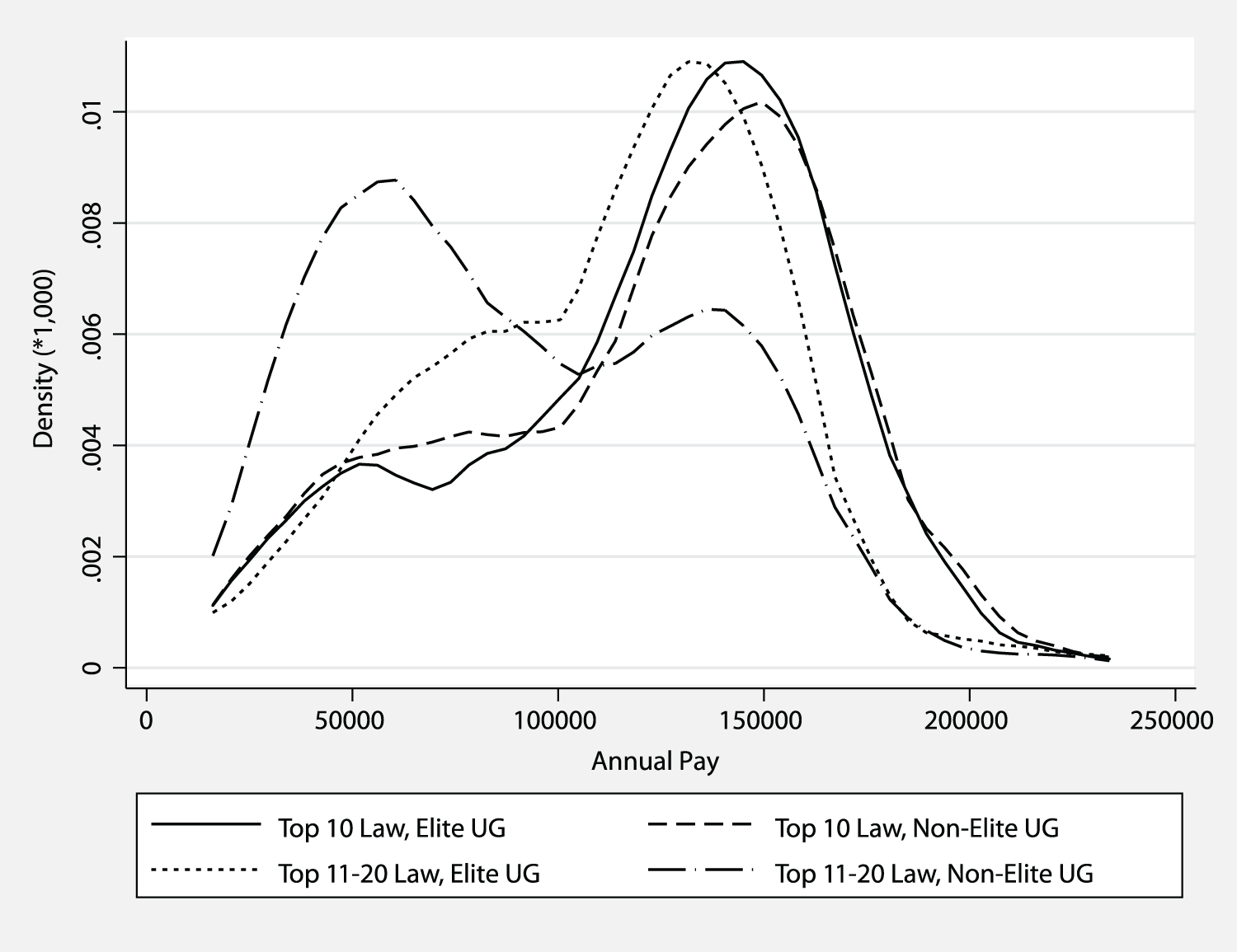
Nonparametric Kernel Density Estimates of the Annual Pay Earned in 2002 by Attorneys Who First Passed the Bar Exam in 2000
For three of our four categories of attorneys, the kernel density estimates are strikingly similar. For attorneys who attended Top 10 law school, an elite undergraduate institution, or both, the major mode (that is, the mode with greatest probability density) is the $140,000 mode. For attorneys who did not attend an elite undergraduate institution and attended an 11–20 law school, however, the major mode is near $70,000. This pattern is borne out in a cross-tabulation of the average 2002 annual salaries for these two groups, as shown in Table 1. Figure 1 suggests two potential findings, which we examine in our analysis. First, is there a substantial wage premium associated with attending a Top 10 ranked law school, even compared to law schools ranked 11–20? Second, are undergraduate and law degrees from elite institutions close substitutes in the lawyer labor market?
Lawyer Pay by School Prestige
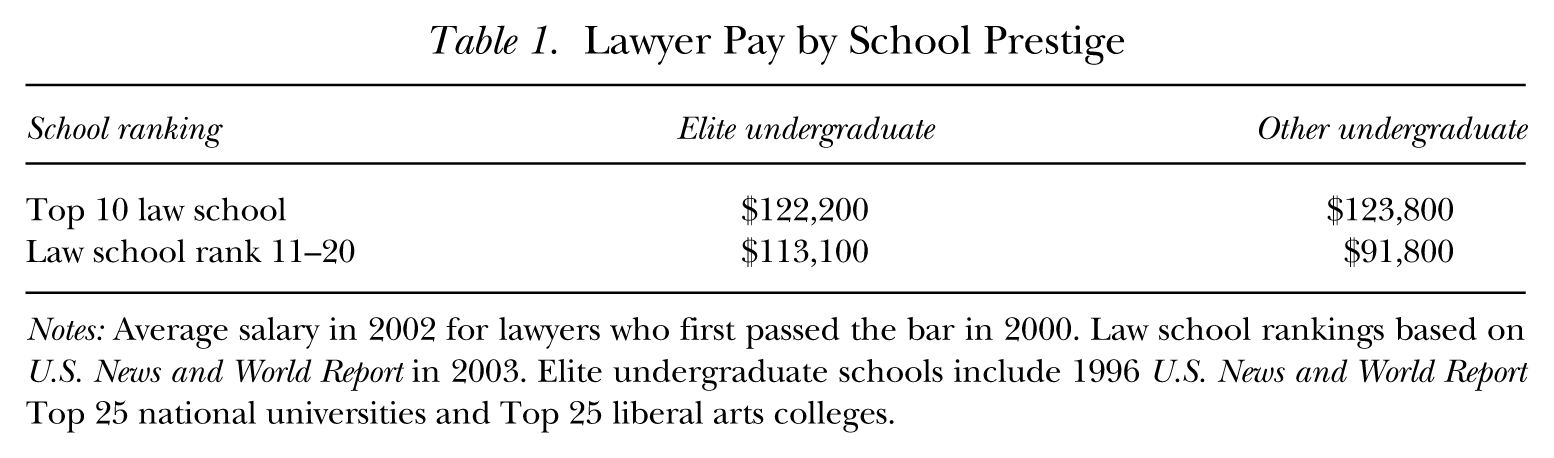
Notes: Average salary in 2002 for lawyers who first passed the bar in 2000. Law school rankings based on U.S. News and World Report in 2003. Elite undergraduate schools include 1996 U.S. News and World Report Top 25 national universities and Top 25 liberal arts colleges.
We examine these patterns in greater detail using a large, representative data set of lawyers, which was collected by the American Bar Association. We examine the factors that correlate with high lawyer wages and with holding a position at a “Big Law” firm. We then consider whether our findings are consistent with various models of determinants of lawyer career success, such as school-based networks, the quality of education at top schools, and unobservable characteristics that drive admission differently at the undergraduate and law-school levels. We close with some simple calculations about choices aspiring lawyers might make with regards to investments in gaining admission to and attending high-quality law schools.
Background and Prior Literature
Related Studies of the Market for Lawyers and Similar Professions
We are aware of only two other articles that relate individuals’ labor market outcomes to graduate school quality. In one of these, Arcidiacono, Cooley, and Hussey (2008) studied the effects of earning an MBA on wages. In specifications similar to ours, they found a large premium (20–25%) for attending a Top 25 MBA program relative to other schools but a very small difference between Top 10 and Top 11–25 schools. The premiums they found for Top 25 programs were cut roughly in half when they controlled for individual fixed effects using pre-MBA salary. We cannot use a similar strategy because we do not have pre-law salary data for our sample and because, unlike MBAs, many lawyers have limited or no work experience before law school. Most of our sample went straight from undergraduate school to law school or waited just one year in between. Another article in this stream is the highly controversial study of affirmative action mismatch in law schools by Sander (2004). In fact, Sander (2004) used the same data set we use and ran similar regressions. He also found a substantial premium to attending a top law school, controlling for other factors. However, this finding was not the focus of his analysis, and he made no inquiry into what drives the relationship between law school quality and career success. He further controlled for several variables in his analysis that would be inappropriate to include as explanatory variables in our analysis (such as the geographic area in which the lawyer works and the average LSAT score of the law school).
A substantial literature examines the economics of the legal profession. Galanter and Palay (1991) and Galanter and Henderson (2008) offered background on the traditional partner track at large and prestigious law firms. Ehrenberg (1989) looked at the relationship between pay and law school prestige, but his analysis was at the school level and made no attempt to separate selection and value-added. Spurr (1987) showed that lawyers from better law schools work for more-prestigious firms, on average, and handle legal issues with larger stakes. Rosen (1992) described many facets of the lawyer labor market, including determinants of pay, variation in pay, and growth in the overall market. Henderson and Morriss (2006) analyzed law schools’ attempts to appear prestigious and how students respond to these efforts in terms of attendance choices.
Background on Returns to Selective Schools
As has been widely studied in the undergraduate context (see below for details), measuring the causal effect of school reputation on labor market outcomes is difficult when unobservable factors such as intelligence and parental investments affect both the school a person attends and her eventual productivity in the workplace. Suppose that person i’s productivity (and, in equilibrium, her pay) is

where y is output or pay, x is a set of control variables such as age and family background, c is a measure of the reputation of the school she attended, α is person-specific ability, and ε is a random shock to productivity or to the measurement of productivity. If c were determined randomly conditional on x, traditional wage regressions would provide unbiased estimates of β2, the causal effect of college reputation on income. A more reasonable model would suggest that

That is, the college the person chooses is likely to be a function of her taste for particular types of schools (θ), the characteristics that affect her productivity (x), and other characteristics that are observed by school admission officers but not by employers (z). That the college choice is determined endogenously would not cause any problems in interpreting wage regressions using the specification in Equation (1) if α were independent of c, controlling for the variables in the vector x. This condition seems unlikely to be satisfied, though. For example, if person i has a positive work ethic, this is likely to affect productivity through α and make the person’s school admission application more attractive through z. In this case, a wage regression that did not have individual fixed effects would attribute some of the effects of α to c through an upwardly biased δ.
Table 2 summarizes several articles that, in the context of undergraduate institution prestige, differ in their approaches to solving the selection issue. That is, researchers have chosen various methods to determine an unbiased estimate of β2. Behrman, Rosenzweig, and Taubman (1996), who looked only at female twins born in Minnesota between 1936 and 1955, used the common background of twins to separate innate ability from the effects of schooling. They found that, at least for this group, a substantial wage premium was associated with attending an undergraduate school that grants PhDs, is a small private college, and has higher faculty salaries. The magnitude of their estimates was quite large, as they suggested that if a given person received her undergraduate degree from Wellesley College or the University of Pennsylvania instead of Mankato State University in Minnesota, she could expect approximately a 20% or 36% wage premium, respectively. Brewer, Eide, and Ehrenberg (1999) used a more representative sample and took a more structural approach by specifying a model for selection of college and subsequent earnings. They identified the causal effect of college quality on wages by instrumenting for college choice through the costs of the school attended and through the functional form of the school choice and wage equations. They found results generally in line with those in Behrman et al. (1996). The results in Brewer et al. (1999) are somewhat problematic, however, because, unlike other research in this area and counter to most researchers’ intuition, they found that selection correction is not important in measuring the effect of college quality.
Previous Findings on the Returns to Attending a Selective College
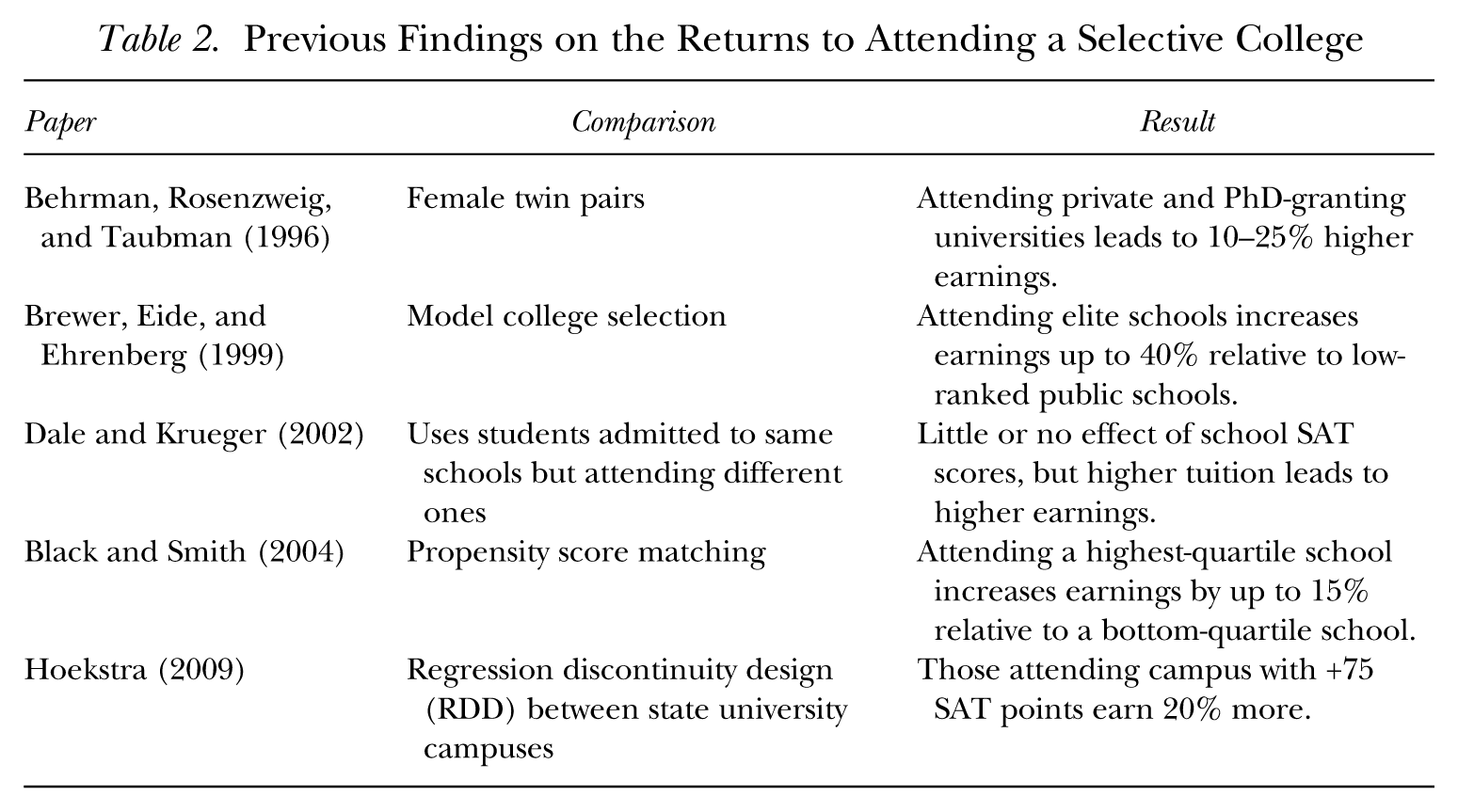
Dale and Krueger (2002) and Black and Smith (2004) found much smaller effects of college reputation on earnings. Dale and Krueger (2002) identified the effects of college reputation by comparing earnings of people who were accepted to similar colleges but made different choices about which one to attend. They found essentially no effect of college prestige on earnings. Black and Smith (2004) used propensity score matching techniques to control for school selection. They found that, in most specifications and most subgroups, selection was important. Their estimated causal wage premiums were generally not large, with a maximum of about 15% for a student who attended a highest-quartile school relative to if she attended a bottom-quartile school. Finally, Hoekstra (2009) used a regression discontinuity approach by comparing students near the margin for gaining admission to the most selective state university campus in one particular state. He found that getting into this campus, where the average SAT score is 65–90 points higher than the average scores at the other campuses, led to a 0 to 20% increase in earnings at ages 28–33. 3
The variety in the estimated effects of college quality suggests that this effect can be quite heterogeneous and/or that it is difficult to specify the proper selection correction to separate the selection and value-added effects of school quality measures on earnings. But we generally read the results as suggesting that selection is an important component in the correlation between undergraduate school quality and labor market outcomes and believe the estimates of the causal effect of college quality are generally small on the margins that most students consider. We suspect that few students who attend Wellesley College seriously consider Mankato State University, for example, or that many students who ultimately attend top schools were ever seriously at risk for attending a school in the bottom quartile. 4
Below, we produce our own (fairly small) estimates of the causal effect of undergraduate college quality on earnings. But the real innovation in our work is our examination of the effect of law school quality, so our undergraduate estimates are primarily for comparison and the details are relegated to tables in the online Appendix.
Empirical Analysis
Data
Our lawyer data come from the first two waves of the After the JD (AJD) survey, collected in May 2002 and 2007. This effort was led by the National Association for Law Placement and the American Bar Foundation. 5 The surveys were conducted primarily by mail and phone (with a few responses done over the Internet) and had a 70% response rate. We used only responses from the mail and Internet surveys, however, as the phone survey did not gather the background characteristics critical to our analysis. We dropped people who were age 40 or older when they first passed the bar and anyone who failed to report her law school, age, gender, whether her mother was born in the United States, how she paid for law school, and whether she lived near her mother at the time of the survey. We also limit our analysis to graduates of Top 100 law schools (defined below) for two reasons. First, the AJD sample imposes some potential selection bias into our analysis because it only includes law graduates who pass a bar exam. This problem is less severe when focusing on highly ranked schools, since bar passage rates for these schools are high. Second, we believe the labor market differs markedly for lawyers from low-ranked schools as compared to graduates of more-prestigious schools.
Our wage regressions contain 1,425 Wave 1 and 1,558 Wave 2 respondents. Some lawyers reported where they work but not their wage, so our sample size is slightly larger (1,531 in Wave 1) when we analyze a lawyer’s likelihood of holding a prestigious job. We do not have geographic information for Wave 2, and therefore confine our prestigious job analysis to Wave 1. 6
We measure the quality of the lawyers’ law and undergraduate schools using U.S. News and World Report rankings. The AJD data place each lawyer in one of six law-school categories varying from Top 10 to Unaccredited. We use the top three categories: Top 10, other Top 20, and other Top 100. 7 For undergraduate schools, we use 24 categories based on the U.S. News and World Report 1996 rankings. We created an indicator variable, Elite undergraduate, which equals 1 for lawyers whose undergraduate institution ranks as one of the Top 25 national universities or Top 25 liberal arts colleges. 8
Panel A of Table 3 provides summary statistics on the Wave 1 sample. The average age (both for the full sample and for the various law-school-category subsamples) is approximately 30 years, and about half of the respondents are women. Those attending Top 10 law schools appear to come from more-privileged backgrounds, as their friends and family paid for a higher fraction of their law school expenses, and they are more likely to have mothers who continued education after high school. Those attending more selective law schools are more likely to have had undergraduate grade point averages above 3.5 and are more likely to have graduated from an elite undergraduate institution. Panel B provides similar information for Wave 2 respondents. These respondents are approximately five years older and earn significantly more money than Wave 1 respondents earn. We do not have information on Wave 2 undergraduate GPAs, and the second wave survey asked about total debt rather than the source of funds for law school.
Summary Statistics
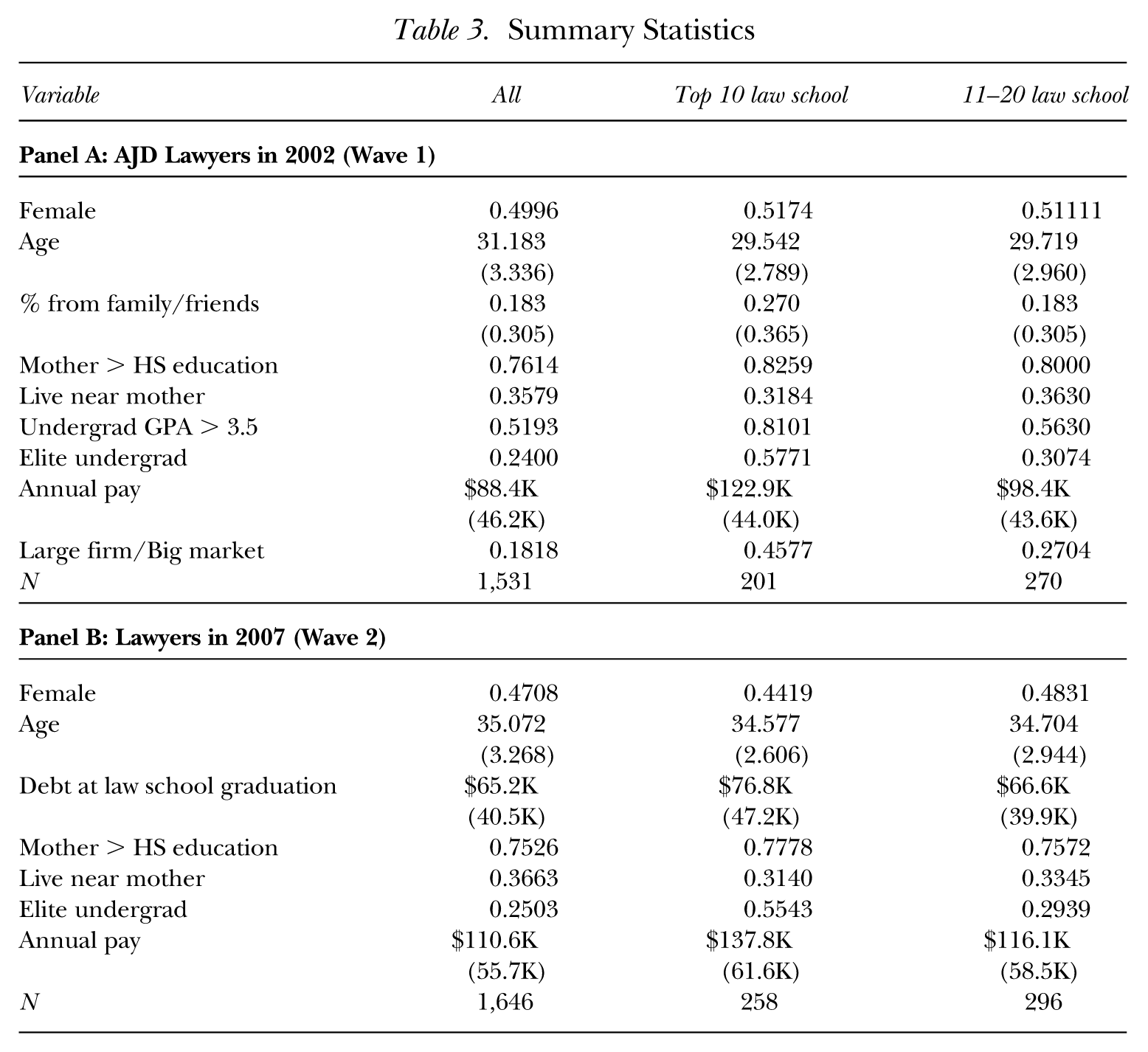
Our analysis below focuses on two dependent variables, the first of which is the log of an attorney’s annual earnings. Panel A of Table 3 shows that those attorneys who attend a Top 10 school earn approximately 40% more than the sample as a whole and 25% more than those going to Top 11–20 schools. Figure 2 displays kernel density estimates of Wave 1 pay differences between Top 10, Top 11–20, and Top 21–100 graduates. The graph shows the well-known bimodal nature of young lawyer earnings and large differences in what fraction are near the upper mode by law school tier. Figure 3, which graphs the same information for Wave 2, illustrates that while the bimodal distribution of earnings is gone, the substantial differences by law-school category are not.
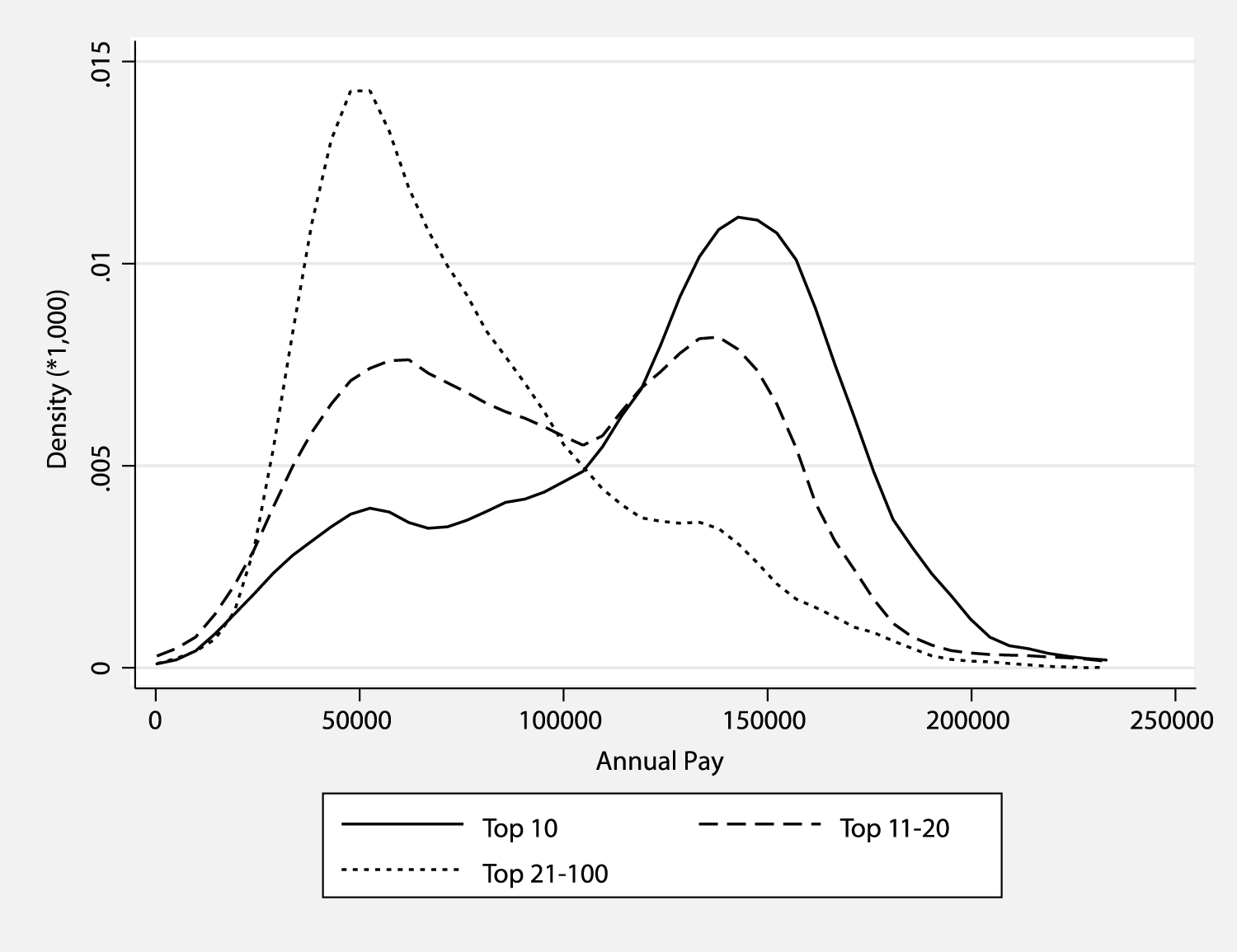
Nonparametric Kernel Density Estimates of the Annual Pay Earned in 2002 by Attorneys Who First Passed the Bar Exam in 2000
Our second dependent variable is an indicator that takes the value 1 if the person works at a Big Law job. We define this to be employment at a private law firm with more than 100 lawyers and in one of the top four legal markets (New York; Washington, DC; Chicago; and Los Angeles). Panel A of Table 3 also shows that Top 10 graduates are 21 percentage points more likely to hold a Big Law job compared to a Top 11–20 graduate.
For comparison purposes, we gathered data from two sources on earnings and undergraduate school quality from a broad sample of college graduates (which presumably include a few lawyers but mostly non-lawyers). We present results using the 1990 wave of the National Longitudinal Survey of Youth (NLSY) conducted by the U.S. Bureau of Labor Statistics. We divided the colleges attended into quintiles such that the top and second group are similar proportions of the NLSY sample as the Top 10 and Top 20 groups are of the AJD sample. We also performed analyses using the Baccalaureate and Beyond (B&B) survey conducted by the Institute of Education Sciences, National Center for Education Statistics. This survey has both advantages and disadvantages relative to the NLSY for our purposes and all our analyses led to conclusions that are similar to those we draw using the NLSY. More detail on both the NLSY and B&B can be found in the online Appendix, where we also present details of our NLSY analysis. In the main body of the article, we briefly discuss how the NLSY results compare to the AJD results, as well as the implications of those comparisons. Online Appendix Table A.1 displays summary information for the NLSY that is comparable to the AJD summary in Table 3. As with the lawyers, the NLSY respondents from better schools come from families with more education, and they are more likely to live somewhere different from where they grew up. Again, those attending better schools earn more money after school and show more skill before school (as measured by SAT scores), so it is not entirely clear whether the school quality/wage correlation is attributable to selection or a causal effect of school quality on earnings.

Nonparametric Kernel Density Estimates of the Annual Pay Earned in 2007 by Attorneys Who First Passed the Bar Exam in 2000
Selection effects are critical in our context given the competitive nature of admissions to top law schools. In an ideal world, we would control for all the factors that determine law school admissions but this is difficult given the holistic approach taken by admissions offices. According to O’Connor (2012), LSAT scores (which we do not have access to but argue below may not accurately predict income conditional on our other controls) and undergraduate GPA (which we control for precisely) are the two most important factors in admissions. This and other discussions of law school admissions also mention the quality of the undergraduate school as a relevant factor. We cannot directly control for some of the other factors, however, such as leadership experience and information in recommendations. This circumstance clearly limits our ability to nail down a causal effect of law school quality on career outcomes, as we discuss as we interpret our empirical results.
Table 4 shows the empirical relevance of selection issues. Panels A and B display results for Waves 1 and 2, respectively. The first two columns of each panel show the results of probits for which the dependent variable equals 1 if the person attended a Top 10 law school. Column (1) uses the whole Top 100 law schools sample, and column (2) is limited to lawyers from Top 20 schools. The results show that selection may be very important. For example, lawyers with at least one parent who graduated from college have a 3 percentage point higher probability of going to a Top 10 school, when looking at the whole sample (column (1)). Having an undergraduate GPA above 3.5 also has a highly significant (statistically and economically) effect on whether the person attends a Top 10 law school. Most dramatically, graduating from an elite undergraduate institution is associated with at least a 27 percentage point greater probability of attending a top law school. Holding other factors constant, minorities attend higher-ranked schools, which could be the result of affirmative action. The third column shows a regression in which the dependent variable is 1 if the person went to a U.S. News and World Report Top 100 school, is 2 if she went to a Top 20 school, and is 3 if she went to a Top 10 school. The implications are similar to the other probits. Reassuringly, given that all the variables in the table do not change once the person goes to law school, the panel B results for Wave 2 are very similar. The table points out the particularly important role of undergraduate institutions. When we run regressions similar to those in Table 4 without controlling for undergraduate school, the coefficients and significance on the other background variables increase substantially, indicating that the same factors affect selection into undergraduate and law schools.
Selection into Top Schools
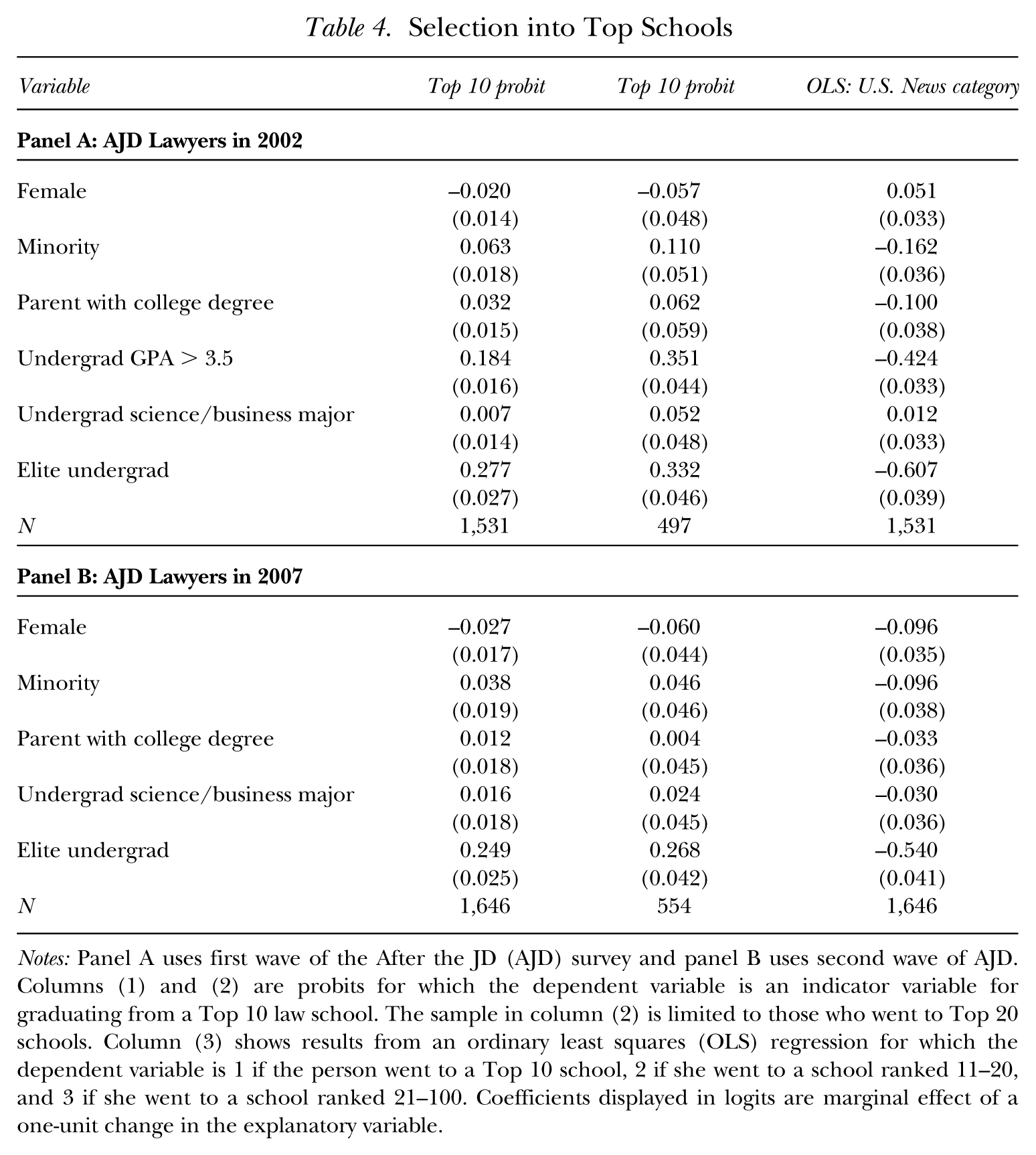
Notes: Panel A uses first wave of the After the JD (AJD) survey and panel B uses second wave of AJD. Columns (1) and (2) are probits for which the dependent variable is an indicator variable for graduating from a Top 10 law school. The sample in column (2) is limited to those who went to Top 20 schools. Column (3) shows results from an ordinary least squares (OLS) regression for which the dependent variable is 1 if the person went to a Top 10 school, 2 if she went to a school ranked 11–20, and 3 if she went to a school ranked 21–100. Coefficients displayed in logits are marginal effect of a one-unit change in the explanatory variable.
Online Appendix Table A.2 shows similar analyses for undergraduate schools using the NLSY sample. Going to a better undergraduate school is strongly associated with such factors as mother’s education, high school rank, and SAT scores. This initial look at who attends the most prestigious undergraduate and law schools indicates that the potential selection problems are similar in these two distinct environments.
OLS Regressions of Income
We begin by estimating Equation (1) for the lawyers in the Wave 1 AJD sample who attended a Top 100 school. This selection includes 1,425 individuals who first passed the bar exam in 2000 and who were younger than 40 years of age at the time. The dependent variable is the log of the lawyer’s salary in 2002. 9 It is common to use the log of a person’s hourly wage as the dependent variable in wage regressions such as these, but approximately one-fifth of AJD respondents did not provide hours. Our results are similar, but a bit less precise, if we use hourly wages. Regression results are reported in the first four columns of Table 5. Column (1) of panel A reports results with no control variables, so it indicates the average differences in lawyer pay across six levels of U.S. News and World Report school rankings. The omitted category in each regression is schools ranked 11–20, so the other ranks are relative to this group. Column (1) makes it clear that very substantial differences in pay exist based on where lawyers attended school. Lawyers in schools ranked 11–20 earn approximately 25% less, on average than those in Top 10 schools. Those in schools ranked 21–100 earn another 23% or so less. Lawyers from Top 10 schools average pay of almost $123K, whereas those from Top 11–20 schools earn about $98K. We know, therefore, that a large wage premium is associated with attending a higher-ranked law school.
Lawyer Pay Regressions
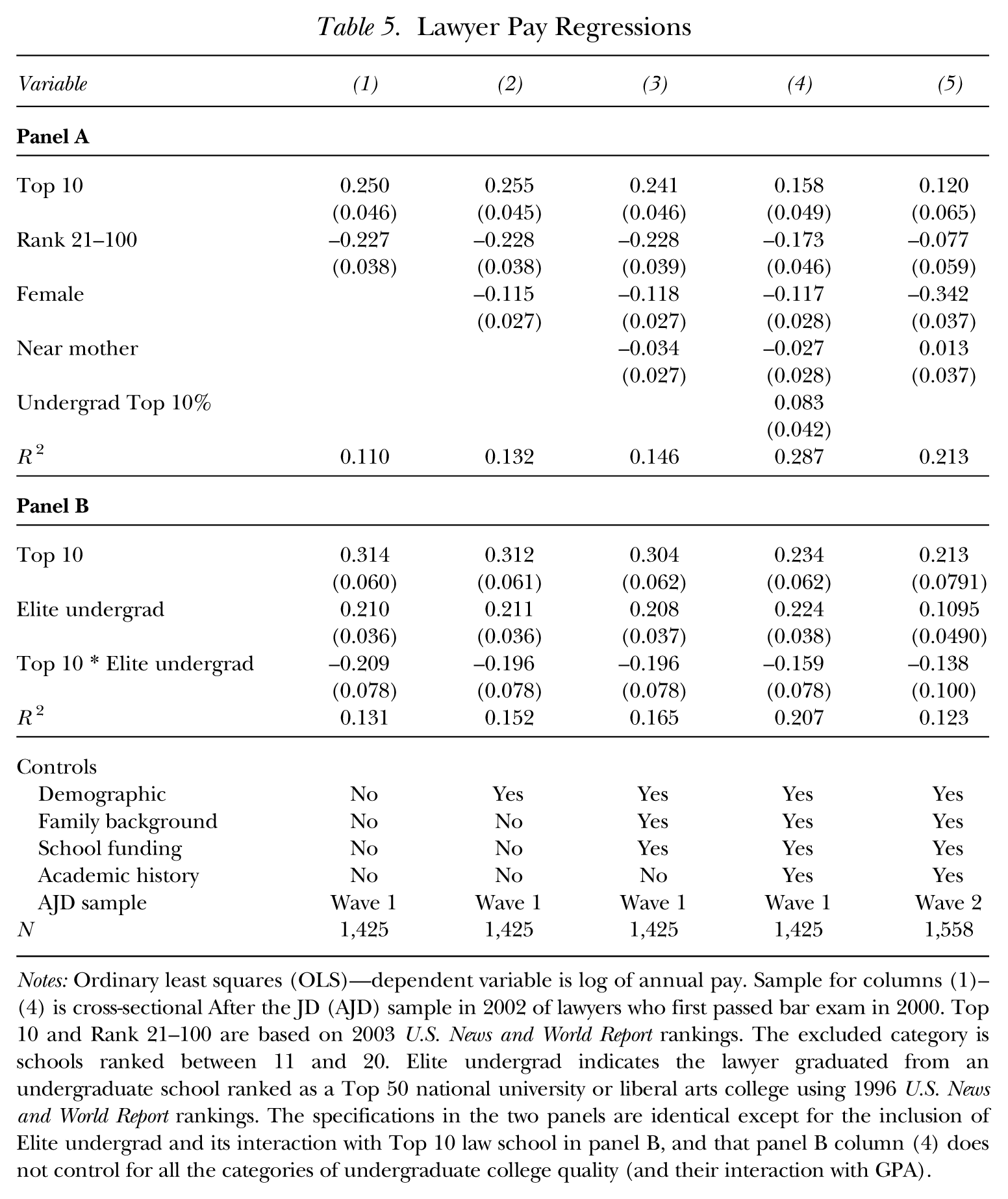
Notes: Ordinary least squares (OLS)—dependent variable is log of annual pay. Sample for columns (1)–(4) is cross-sectional After the JD (AJD) sample in 2002 of lawyers who first passed bar exam in 2000. Top 10 and Rank 21–100 are based on 2003 U.S. News and World Report rankings. The excluded category is schools ranked between 11 and 20. Elite undergrad indicates the lawyer graduated from an undergraduate school ranked as a Top 50 national university or liberal arts college using 1996 U.S. News and World Report rankings. The specifications in the two panels are identical except for the inclusion of Elite undergrad and its interaction with Top 10 law school in panel B, and that panel B column (4) does not control for all the categories of undergraduate college quality (and their interaction with GPA).
Column (2) adds controls for gender, marital status, age (indicators for 25–29, 30–34, and so on), and race (indicators for black, Hispanic, Native American, Asian, and other). Some of these control variables are important and they add considerable explanatory power to the regression, as measured by the R2. Women in the sample earn approximately 12% less than men earn (though this difference disappears when we look at hourly pay.) Adding these controls does not have any effect on the relationship between law school rank and pay.
The specification in column (3) adds several controls for family background and the way the lawyer paid for law school, including whether the lawyer lives near her mother, whether her mother was born in the United States, mother’s education, father’s education, whether any of her parents or grandparents are lawyers, and the fraction of law school expenses paid through savings and by parents. These variables provide a bit of explanatory power and some are significant predictors of lawyer income. Once again, however, the additional controls have no effect on the law school prestige relationship with pay.
Finally, column (4) includes our fullest set of controls by which we try to capture ability through measures of prior academic success and the cost of law school. Added control variables now include indicator variables for 24 categories of undergraduate school quality, undergraduate GPA (indicators for 3.75–4.0, 3.5–3.74, and so on), a full set of interactions between these undergraduate quality and GPA variables, an indicator variable for being in the top 10% of her undergraduate class, undergraduate major (indicators for science, business, social science, humanities, and other/missing), whether the person went to a public law school, and an indicator variable for other graduate degrees. In this case, the additional control variables—driven by the undergraduate quality measures—make a greater difference. As Table 5 shows, lawyers in the top decile of their undergraduate class earn 8% more, on average, than other lawyers earn. Looking at the college quality indicators carefully shows that, with all the column (4) controls included, lawyers who attended an elite undergraduate school (as defined above) earn 20% more than those who attended other schools. So this regression indicates that Top 10 law school graduates earn about 16% more than Top 11–20 graduates and that lawyers who went to elite undergraduate schools earn an additional 20% regardless of their law school. Thus, the regression in column (4) leads to two conclusions. First, a substantial premium for going to a top law school remains, even after including all possible controls. Second, that undergraduate school matters so much indicates that selection on unobservables is important for lawyers. If all this selection is captured by the undergraduate school categories, then column (4) captures the causal effect of going to a top law school. But that seems unlikely to be an entirely valid assumption, and we will use other methods to explore the role of unobservables.
Column (5) performs an analysis similar to column (4), using the Wave 2 sample of lawyers (that is, those who had passed the bar seven years before the time of the survey). Column (5) does not include controls for undergraduate GPA (which we do not have for Wave 2) or undergraduate GPA/undergraduate school quality interactions, but is otherwise the same as column (4). The results are quite similar to those for Wave 1 in terms of the magnitude of the law school quality coefficients. Note that the female wage discount is higher, as many women have pulled back on their hours. Also note that the R2 is much lower (by much more than the difference in explanatory variables would justify), which is typical as workers age and pay becomes more a function of individual ability than of observed proxies (Altonji and Pierret 2001).
Panel B of Table 5 repeats the analysis in panel A, but now shows the association between attending an elite undergraduate school and lawyer pay. Going to an elite undergraduate school leads to approximately 20% higher pay in each specification, and Top 10 law school graduates continue to show a large premium relative to the next tier. The large negative interaction effect indicates a large premium for attending an elite undergraduate school or a Top 10 law school, but the combination of the two adds little. The message is similar, though the coefficients are a bit smaller and less precise, when we observe Wave 2.
Table 6 limits the analysis to lawyers from Top 20 schools in order to focus on a somewhat more homogeneous sample. If the effects of some of the control variables differ much between lawyers who go to lower-tier schools and those who go to top schools, for example, then the restriction imposed in Table 5 (that the control variables have linear and constant effects for the all Top 100 graduates) would limit the ability of these variables to properly control for factors that could affect our school selectivity estimates. This possibility does not appear to be a major concern, however, as the results for the differences between lawyers from Top 10 schools and those ranked 11–20 in Table 6 are almost identical to those in Table 5. Also, comparing the two panels of the table again shows the results are similar for the two waves of AJD respondents.
Top School Lawyer Pay Regressions
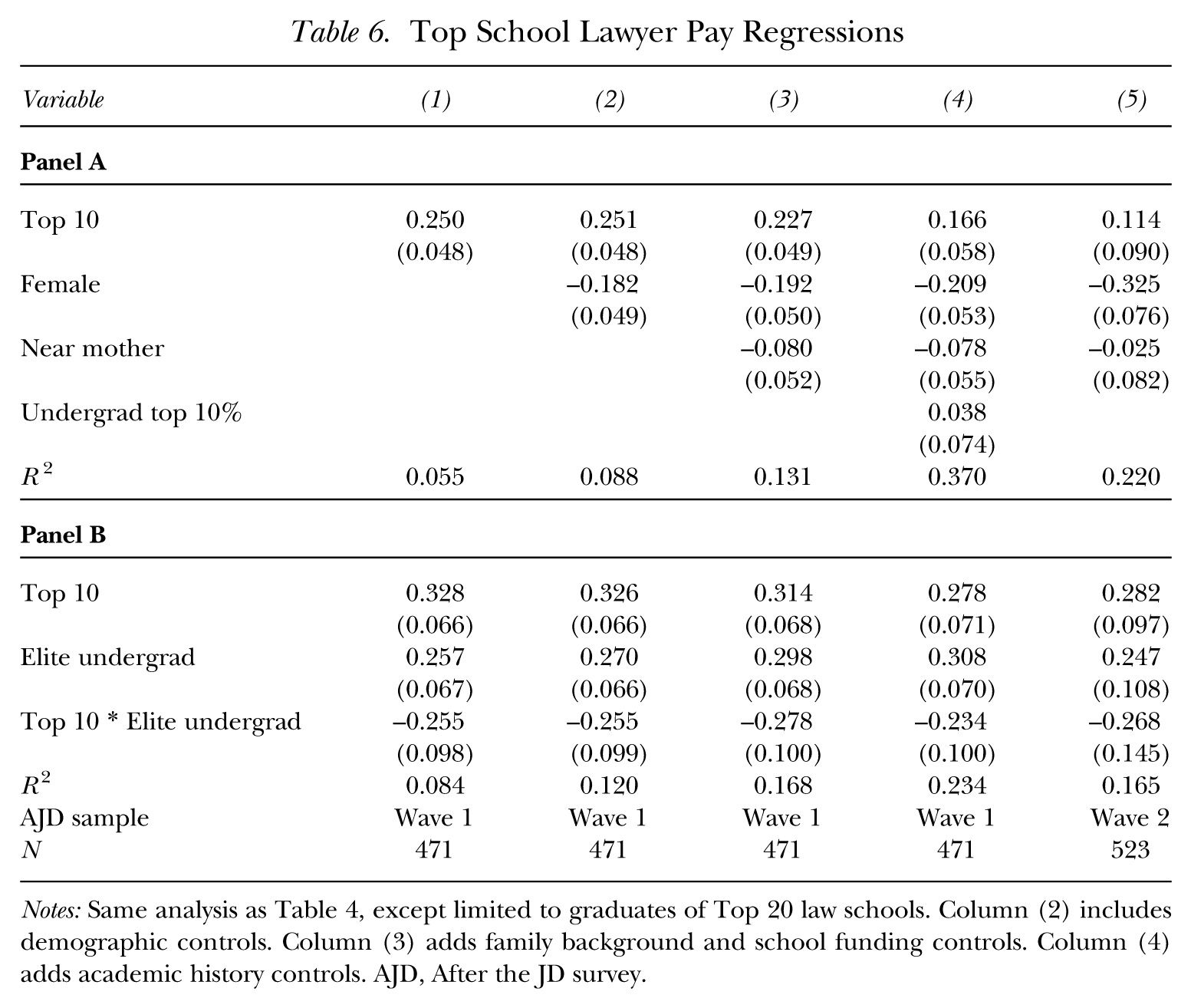
Notes: Same analysis as Table 4, except limited to graduates of Top 20 law schools. Column (2) includes demographic controls. Column (3) adds family background and school funding controls. Column (4) adds academic history controls. AJD, After the JD survey.
We also attempted to further account for unobservables using the methods in Altonji, Elder, and Taber (2005). We conclude that the selection on unobservables would have to be much greater than the selection on observables if the selection on unobservables is to fully explain our results. We also probed the robustness of our results using propensity score matching. As neither of these analyses affected our conclusions significantly, we present them in the online Appendix.
Figure 4 graphically represents the relation between income and class rank in law school. Class rank is self-reported and may be subject to considerable recall bias. 10 These data problems preclude the use of class rank in our formal analysis, but two patterns in the graph are instructive nonetheless. First, pay shows no evidence of declining with law school class rank at Top 10 schools but does drop off appreciably at the other levels. Second, pay at Top 10 schools is higher at all but the highest class ranks (as well as for the large group of Top 10 graduates who did not provide a class rank) compared to pay at any class rank of any other school. 11 While certainly not proof of the causal effect of attending a top school, the figure is consistent with the hypothesis that top students at schools outside the Top 10 could expect to earn more if they went to a Top 10 school, even if they were further down in the quality distribution at that school.
For comparison purposes, online Appendix Table A.3 shows the results of similar regressions on the NLSY cross-section in 1990. To make the sample comparable to our lawyer sample, we include only people with at least two years of college. The results show that college quality does not appear to be an important determinant of pay in this sample. The average person in the highest tier of colleges earns an average of 6% more than a person in the second tier. But this effect is not statistically significant. The top-tier premium grows as college quality drops but the difference becomes statistically and economically significant only when reaching schools with average SAT scores below 840. When all the controls are included, which makes the NLSY specification comparable to the full set of controls used in column (4) of Table 5 for lawyers, the school quality/income relationship is very small and the controls have a noticeably larger effect on the undergraduate school quality coefficients than they have on the law school quality coefficients.
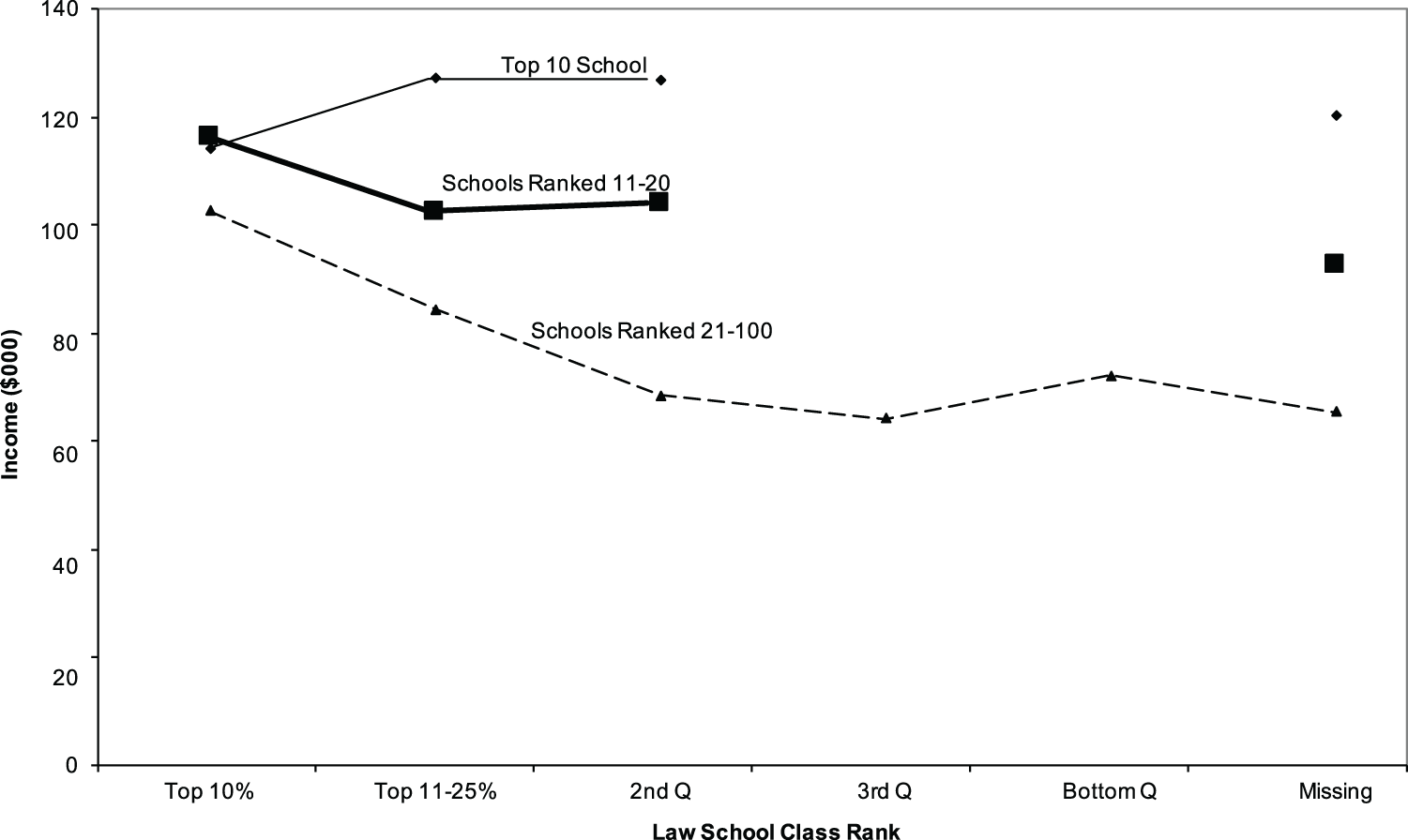
Income and Class Rank by Law School Ranking
The regressions so far provide at least circumstantial evidence consistent with law school quality having a larger effect on lawyer income than undergraduate school quality has on income. Further, they suggest that selection is a larger component of the undergraduate selectivity effect than of the law school ranking effect. The evidence is consistent with law school quality having a substantial causal effect on lawyer income and a bigger effect than undergraduate quality has on income. We do find, however, that undergraduate school quality is related to lawyers’ incomes in a way that substantially lowers the implied effect of law school quality.
Our analysis thus far is limited by the fact that the AJD covers only attorneys with seven or fewer years of experience and by the lack of information about LSATs. 12 We can partially address these issues by examining data from other sources.
The 1994–1995 Chicago Lawyers Survey provides another data set we can use to examine how the school-quality/career-success relation changes as lawyers gain experience. This survey of lawyers based in Chicago has some important limitations for our purposes. To the extent that part of the effect of law school quality is sorting lawyers into more productive locations, that will be lost when looking at lawyers in a single location. Also, the survey gathered significant demographic data but did not ask for undergraduate GPA or major. The survey does include the name of the person’s undergraduate school, so we can control for quality of undergraduate school. Using the 848 lawyers in this sample for whom we have sufficient data, we ran regressions of log annual pay on the same law school quality variables we used in Table 5. One specification includes no controls; another controls for years since law school graduation (linear and squared), indicators for female, minority, married, mother was/is a professional, father was/is a professional, either parent was/is a lawyer, grew up in Chicago, and grew up in Illinois; and the third controls for all those variables plus indicators for undergraduate school average SAT score (in 100-point increments). The results of all these specifications are similar (though somewhat less precisely estimated) to those in Table 5. The Top 10 premium relative to Top 11–20 is approximately 20%.
We used another data set, the University of Michigan Law School Alumni Survey, to try to more directly assess the importance of not being able to control for LSAT scores. 13 This approach comes at the rather steep cost of taking away our variable of interest, as no variation in law school quality exists among this group. We used data from surveys conducted five years after graduation for the classes of 1991 through 2000 and ran regressions of log annual pay (which is measured four years after graduation) on undergraduate GPA, LSAT percentile, fraction of law school paid for by family and savings, and indicators for female, minority, married, each graduating class, five-year age groupings, whether the person lives in the same state as his/her parents, parent occupations (lawyer, professional, business owner), non-law graduate school, four undergraduate major categories, University of Michigan undergraduate degree, and Ivy League/Seven Sisters undergraduate degree. Within this single school, very little of the variation in wages can be explained; even with these controls, the R2 of the regression is only 0.0677. The noteworthy finding for our purposes is that LSAT score is not significantly related to pay in this regression. Also, whether LSAT score, undergraduate school, and undergraduate GPA are included has no effect on the other variables in the regression. Of course, whether including these variables would have an effect on a school quality measure is not known and it seems plausible that, to the extent LSAT scores predict earnings, they do so across rather than within law schools. However, these results provide at least a bit of evidence that LSAT scores do not explain lawyer pay accurately and to the exclusion of other variables.
Job Quality Probits
It seems unlikely that any given employer of lawyers would vary pay for new lawyers based on where they went to school, so we expect the return to selective law schools to operate largely by sorting lawyers from more selective schools into higher-paying firms. We now look for evidence of this sorting by analyzing the relationship between law school prestige and the propensity of lawyers to work in the highest-paying segment of the law sector. Private law firms are the highest-paying jobs, on average, for new lawyers, with compensation considerably greater than pay in the public sector, as in-house counsel, or other jobs law graduates accept. 14 Opportunity to perform the most interesting and lucrative work is generally considered to be greatest in the largest legal markets (see Garicano and Hubbard 2009), so we focus on the four largest legal markets—New York; Washington, DC; Los Angeles; and Chicago.
As we noted in the introduction, almost all law firms have partners and associates from a wide spectrum of law school qualities. Using the data set in Oyer and Schaefer (2016), however, we found that the share of the graduates of Top 10 law schools at Big Law firms is much higher than that of graduates of schools ranked 11–20. Specifically, as of the summer of 2007, 13.4% of graduates of Top 10 law schools between 1970 and 2005 were partners at one of these 285 large firms. Nearly 9% of graduates of Top 11–20 schools and 3.5% of graduates of other Top 100 schools were partners at these firms.
Table 7 shows that this school/firm relationship is, indeed, a large driver of our earlier salary results. The table contains the results of probit regressions in which the dependent variable equals 1 if the AJD respondent works at a private law firm with at least 100 lawyers in one of the four largest legal markets. 15 Note that all analyses in this section are limited to Wave 1 of the AJD because we do not know where the Wave 2 lawyers live. The coefficients in the table are the marginal effect of a 1-unit change in the explanatory variable, so the coefficient of 0.240 on Top 10 in column (1) indicates that a graduate of a Top 10 school is 24 percentage points more likely to hold one of these top jobs than is a Top 10 graduate when we do not include any controls except the indicator variable for a prestigious undergraduate degree. That difference is very large, given that approximately 18% of the AJD sample works in one of these top jobs.
Lawyer Placement at Top Firms
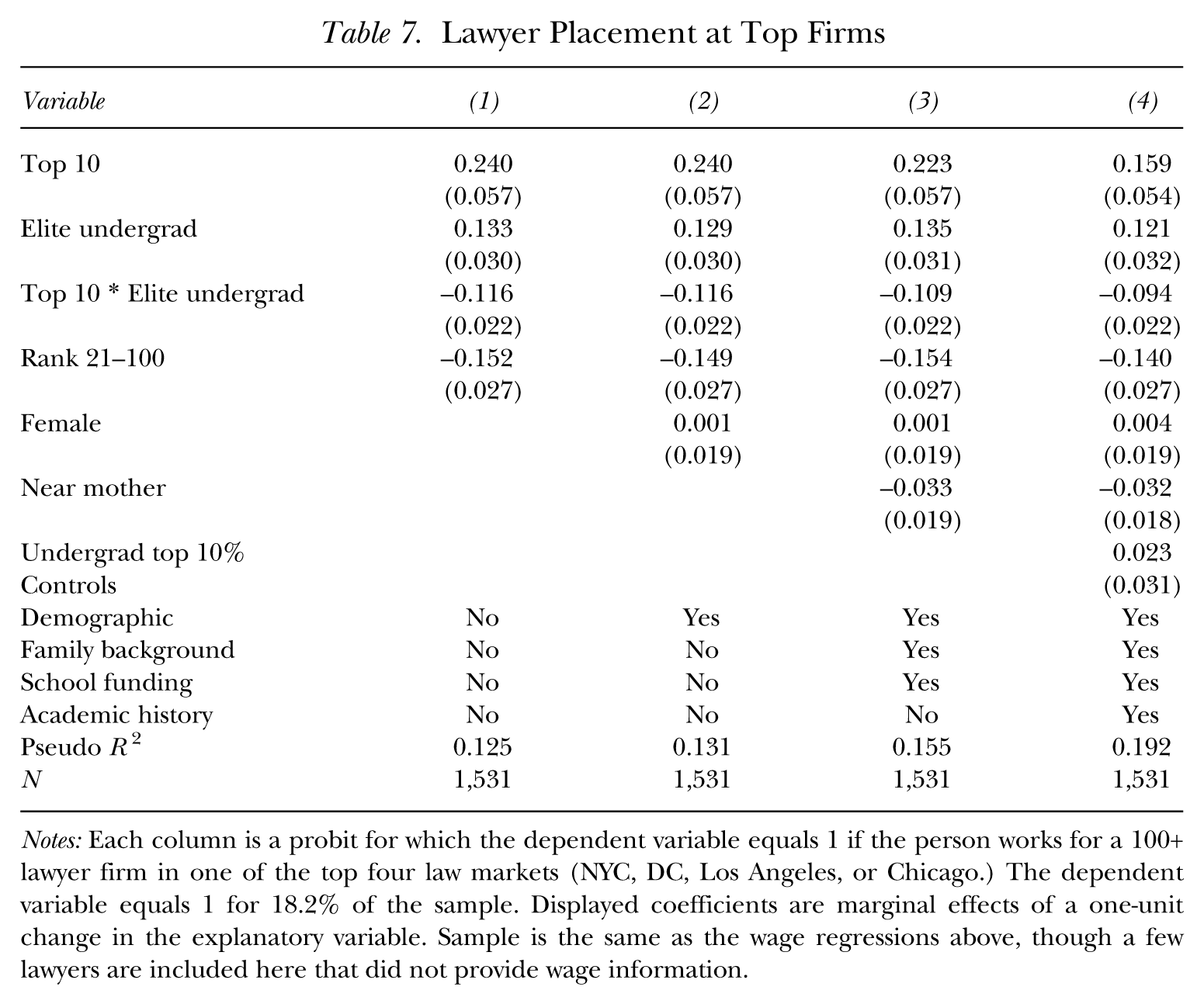
Notes: Each column is a probit for which the dependent variable equals 1 if the person works for a 100+ lawyer firm in one of the top four law markets (NYC, DC, Los Angeles, or Chicago.) The dependent variable equals 1 for 18.2% of the sample. Displayed coefficients are marginal effects of a one-unit change in the explanatory variable. Sample is the same as the wage regressions above, though a few lawyers are included here that did not provide wage information.
Moving to the right of the table and adding controls, we find that about one-third of the top-job/top-school relationship can be explained with controls for pre-law-school academic history. Top 10 graduates have a 16 percentage point advantage in these sought-after jobs when we add our full set of controls. The effects of the control variables in Table 7 on the effect of going to a top school mirrors those of the control variables in Table 5, which supports the hypothesis that the effect of school selectivity on earnings comes through sorting lawyers into higher-paying firms. As with the pay regressions, the coefficients on Elite undergrad and its interaction with Top 10 law school are consistent with large returns for lawyers who attend an elite undergraduate school or a Top 10 law school, but no additional value to attending both. 16
Heterogeneity of Effects
To generate further insight into the sources of the law school prestige relationships we have measured so far and the degree to which they may be driven by unobserved variables, we now measure the degree to which these relationships vary across various subsamples of the AJD sample. For simplicity, we limit the sample to graduates of Top 20 law schools, and we compare Top 10 graduates to other Top 20 graduates.
Table 8 presents the results, with Wave 1 wage regressions in panel A, Wave 2 wage regressions in panel B, and Wave 1 job quality probits in panel C. Columns (1) and (2) perform the same analyses presented in column (4) of Tables 6 and 7 separately for women and men. Point estimates for law school prestige relationship to pay are higher for men than for women, though the gender effects are not significantly different from one another or from the coefficients for the sample as a whole shown in earlier tables. The point estimates suggest that the larger effects of undergraduate school quality for men than for women (see Black and Smith 2004 and Hoekstra 2009) may apply for law school quality as well. 17 But the sample size is not large enough to state this confidently.
Top School Lawyer Analyses: Heterogeneous Effects

Notes: All specifications in panel A are the same as column (4) of Table 5 with sample limited as indicated. All specifications in panel B are the same as column (5) of Table 5 with sample limited as indicated. Specifications in panel C are the same as column (4) of Table 7 with sample limited as indicated.
Columns (3) and (4) split the sample based on whether a lawyer lives near her mother and is representative of several analyses we performed splitting the sample based on background characteristics. In panels A and B, we find no significant difference between the financial rewards of going to a top law school for these groups. In panel C, the school quality effects are larger for lawyers who live near their mothers (though it may be that a few people are driving the result, given those who live near their mothers are less likely to go to top law schools). Based on the results in columns (3) and (4), as well as other similar analyses, we do not find noteworthy differences in subsamples split by these characteristics.
Columns (5) and (6) show that law school prestige is much less closely related to labor market success for graduates of elite undergraduate schools than for other lawyers. The estimates for elite undergraduate lawyers (as defined above) in column (5) provide no evidence of a link between law school prestige and labor market success. Attending a Top 10 law school does not appear to help the initial legal careers of graduates of elite undergraduate schools. Column (6), however, shows a very strong relationship between law career success and attending a top law school for graduates of all other colleges. Using our full set of control variables (including indicators for undergraduate school quality within this sample and interactions of undergraduate quality with undergraduate GPA), we find that graduates of Top 10 schools earn approximately 24 to 30% more than do other Top 20 law school graduates. Top 10 graduates are 27 percentage points more likely to work at a large firm in a top market.
Figure 5 graphs the relationship between income and the prestige of lawyers’ undergraduate and law schools. The graph shows average incomes for lawyers grouped by law school tier and divided into elite undergraduate school graduates and lawyers who attended other schools. Pay rises steadily with law school quality, with the exception of Top 10 versus other Top 20 law school graduates who attended elite undergraduate schools. This figure, as well as columns (5) and (6) of Table 8, indicate that lawyers who graduate from an elite law school or an elite undergraduate school earn a substantial premium but that the marginal effect of going to a second elite school is very small. That is, we find no evidence that lawyers who attend elite undergraduate schools earn a further premium for attending a top law school.
Our finding that elite undergraduate schools and elite law schools are substitutes is quite different from the finding in Zimmerman (2016) that graduates of elite Chilean undergraduate institutions earn, on average, a sizable premium but this premium is limited to those who graduated from an elite high school. Zimmerman (2016) interpreted this as suggesting that ties get deeper as students progress through schools. By contrast, if school-based networks are driving our results, the network expands to include a large set of people who graduate from any single prestigious higher education institution.
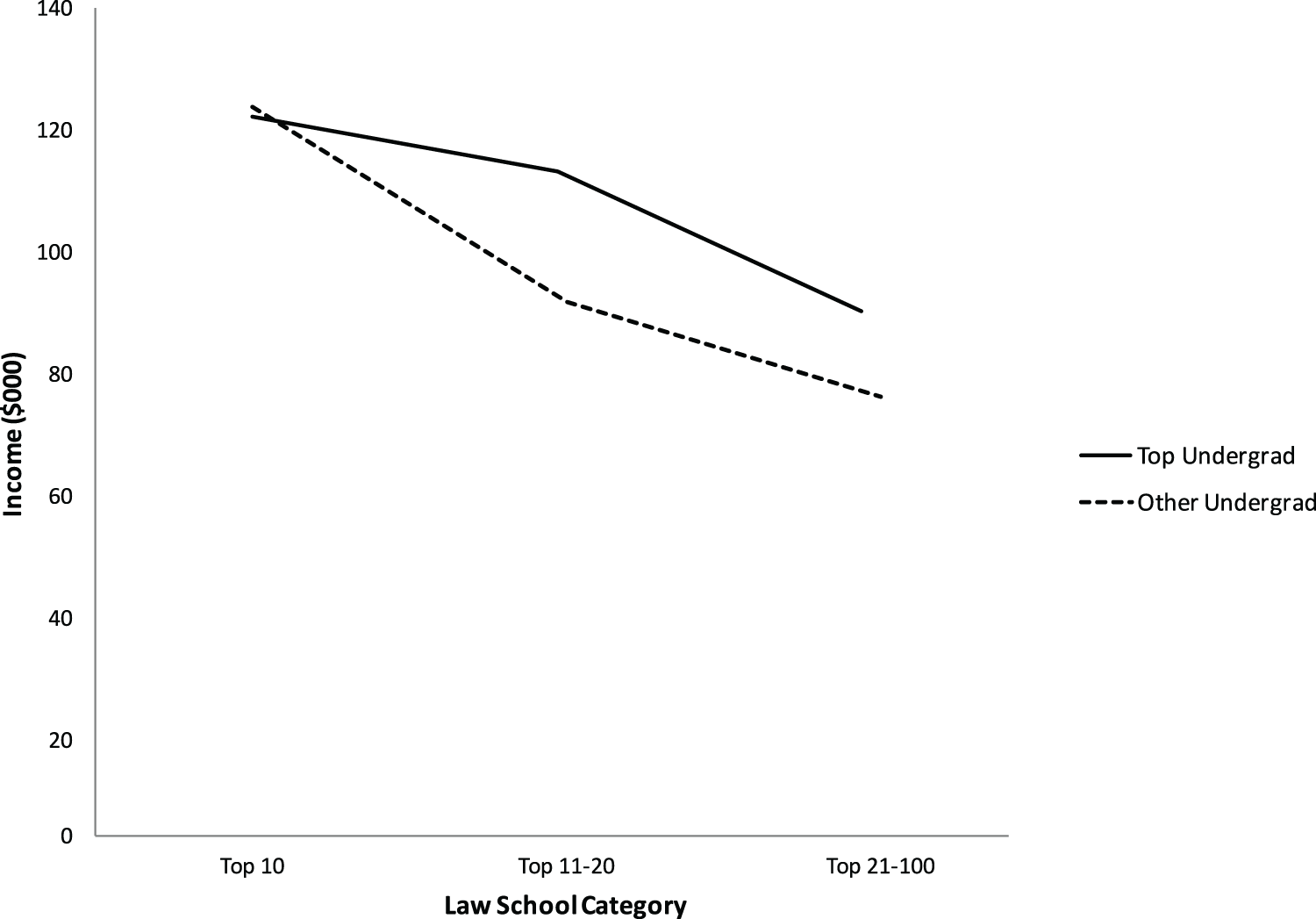
Relationship between Income and the Prestige of Lawyers’ Undergraduate and Law Schools
Interpretation
Reconciling the Results
Our results so far have established the following:
Graduates of Top 10 law schools earn a nearly 25% premium relative to graduates of other Top 20 law schools. Very little of this premium can be explained by reasonably extensive controls for demographics, background, school funding sources, and pre-law graduate degrees. When we control for quality of undergraduate institutions, the premium for attending a top law school drops substantially (and, using some methods, becomes negligible) to a degree consistent with the law school premium being largely driven by selection of high ability aspiring lawyers by high-prestige schools. When considering lawyers who attended the most elite undergraduate institutions, little evidence exists of a premium for attending a top law school. The premium for attending a top law school is much higher, and remains very high despite extensive controls, for graduates of less-elite undergraduate institutions. Lawyers who went to elite undergraduate schools earn a substantial premium relative to other lawyers, even controlling for quality of law school and other characteristics. This premium is substantially larger than most estimates of the returns to undergraduate school prestige for broader (that is, non-lawyer) samples.
We believe this set of results is consistent with any or all of the following three explanations.
Top Schools Teach and Prepare Lawyers Better
One possibility is that the top law schools actually produce, on average, more value added for their students—or at least that they produce more value for those students who did not go to elite undergraduate institutions. If top schools truly add much more value, it must be the case that the quality of education drops very steeply as one drops down the law school distribution. Given the effects are much smaller for elite undergraduate lawyers, it could be the case that the best schools at either level provide some set of skills that is critical to excelling as a lawyer (perhaps analytical thinking and/or writing skills) that most lawyers cannot get without obtaining at least one elite degree. Although it is hard to imagine such a difference in the teaching at Top 10 and other Top 20 schools, perhaps the effects of being surrounded by the most capable peers at elite undergraduate or law schools is what sets apart the learning at these institutions.
Some of the more qualitative questions in the AJD survey can provide insight into lawyers’ perceptions of the value of education at law schools. The AJD asked how helpful the respondent’s first-year law school curriculum and other specific elements of the law school curriculum were in making the transition to early lawyer work (Wave 1) and the person’s current work assignments (Wave 2). Respondents answered on a 7-point scale, with 1 indicating “Not at all helpful” and 7 indicating “Extremely helpful.” Because of varying response rates and the very subjective interpretations that these questions may generate, we do not perform any formal statistical analysis of these answers. A simple perusal of the means and medians of responses by law school quality and by undergraduate quality, however, leads to several clear and consistent conclusions.
First, lawyers who attended elite undergraduate schools report getting substantially less value out of the first-year law curriculum than those who went to less-elite colleges. This difference by college quality is sizable and similar for lawyers from Top 10 law schools and for lawyers from second-tier (ranked 11–20) schools. This similarity by law school rank suggests that, at least based on lawyers’ impressions, there is not a big difference in the value-added of elite law schools in terms of helping those from less-rigorous colleges catch up.
Second, if elite schools did have a unique teaching ability of value to lawyers, it seems likely that this skill would involve writing. However, lawyers from elite and non-elite undergraduate institutions answered nearly equally when asked about the value of “law school training for legal writing.”
The basic facts regarding lawyer salaries fit the “elite schools teach some unique skill” hypothesis. We think this is unlikely to be the primary driver of our results, though, given the lawyers’ responses to the value of their legal education and the implausibility that teaching quality would drop off so sharply from the Top 10 schools to the next group.
School-Based Networks
Whereas the previous explanation involved elite schools differentiating themselves from other schools through their teaching, perhaps the top school effects we have documented are driven by the networks lawyers develop in school. If lawyers who go to elite schools learn more from their relatively talented peers while in school and develop social connections with their classmates that are valuable in the labor market, then we would see graduates of more-prestigious schools making more money. Suppose that, in a very simplistic depiction of the lawyer market, only two networks are present—a high-level network where the most talented workers do the most difficult and lucrative legal work and the low-level network where other lawyers work and transact. Further suppose that, regardless of innate ability, a lawyer who attends either an elite law school or an elite undergraduate school is more likely to be admitted to the high-level network than any other lawyer but that no marginal return exists, in terms of admission to the high-level network, from going to elite undergraduate and law schools. That is, suppose a lawyer who attended the University of Utah for both undergraduate and law degrees is less likely than a lawyer who attended Stanford for undergraduate or law school to be able to join the high-level network and that a lawyer who went to Stanford for undergraduate school and Harvard for law school is no more likely to be in the network than a lawyer who earned one degree at Stanford and one at University of Utah. This premise would explain the pattern presented in Figure 5.
It is also consistent with analyses we have done elsewhere using a sample of lawyers at the largest and most prestigious firms. In Oyer and Schaefer (2016), we showed that law school is an important factor in determining which lawyers match with each other at these firms. We showed evidence consistent with networks within these schools (that is, preferences for lawyers from the same school to work together to capture either productivity or non-pecuniary benefits) driving this matching. The evidence we present in the current article is broadly consistent with this idea of elite-school-based networks being an important driver of the school prestige relationship to law labor market outcomes.
To gain more insight into the network hypothesis, we again turn (informally) to the AJD’s subjective questions. In both waves of the AJD, respondents were asked to rate various factors’ importance in their employers’ decision to offer them a job. Perhaps not surprisingly, graduates of Top 10 law schools generally rated “the reputation of the law school I attended” as very important and this response did not vary noticeably by the quality of the respondents’ undergraduate institution. Furthermore, graduates of elite colleges ranked “the reputation of the undergraduate school I attended” noticeably more highly than did non-elite college graduates. No sizable and consistent differences were present across other dimensions such as law school grades and prior jobs.
Perhaps the most relevant questions regarding networking asked how important various factors were in helping the lawyer to obtain her job. Among graduates of Top 10 law schools, those who did not attend elite undergraduate colleges reported making much more use of the law school’s placement office and much less use of friends than those who attended elite undergraduate schools. This outcome suggests graduates of elite undergraduate schools were more likely to have a useful network in place before they entered law school. Also, those who went to elite universities, when asked what was important in leading their employer to make them an offer, were much more likely to answer, “Friends,”“Connections through colleagues,” and/or “The reputation of the undergraduate school I attended.” Though hardly firm evidence to support the network hypothesis, the answers to the qualitative questions suggest that attending a top law school provides access to resources and people that is already possessed by those who have attended an elite undergraduate school.
Unobservables
Though we have attempted to control for as many variables as possible, we cannot rule out that highly talented potential lawyers have some innate skills that are observable to admissions officers of elite undergraduate schools and top law schools, but not to us. These skills could be revealed in information provided in the form of letters of reference or essays, for example, that indicates work ethic or some other important ability that is not evident from grades and test scores. If these skills are particularly valuable for lawyers, then one could imagine that talented prospective lawyers would be admitted to elite schools but would have done almost as well had they attended less-elite schools. We interpret our results using propensity score matching and consider unobservables unlikely to be the primary driver of our results regarding the empirical relationship between elite schools and lawyer incomes. But, given the lack of exogenous variation in who attends which universities, we cannot rule out an important role for unobservable measures of lawyer ability.
In any case, we note that, although an important role for unobservables would indicate that elite schools are not having a substantial causal effect on lawyer earnings, it would still mean there is something special about these elite schools. Specifically, this finding would indicate that admissions officers of elite colleges and law schools have the ability to identify especially talented (future) lawyers before the candidates ever practice law. In essence, admissions officers would have the ability to “learn” about applicants’ potential abilities as lawyers from reading an application in the way that typically takes months or years for firms to learn on the job (as in Farber and Gibbons 1996 and Lange 2007).
Note that given the size of the relationship we see between school quality and income is much higher for lawyers than prior work has found at selective American undergraduate institutions, our results can be explained by unobservables only if admissions officers are particularly good at identifying abilities not available to the econometrician that are related to ability as a lawyer.
Conversely, we do not think the set of results in this article can be reconciled with the following models and we therefore do not believe they are likely to be important determinants of wages in the market for lawyers.
Information Limitations
We do not think that the large association between university reputation and labor market success results from an information problem on the part of employers that hire lawyers. If, even with such information as grades and honors, firms cannot easily distinguish the ability of law students, they might rely on the reputation of law and undergraduate schools as the primary signal of the applicant’s ability. Attending (and, since we control for undergraduate grades, doing well at) an elite school at either level could be a sufficient signal of high ability to impress top firms. But this idea would suggest that high-ability lawyers from lower-ranked law schools would catch up with lawyers from higher-ranked schools as their careers develop. In that case, we would expect the top-school premium to dissipate over time. That is, initial placements of law graduates would place more unqualified lawyers from top schools into high-pay jobs than unqualified lawyers from less-good schools. Over time, these unqualified lawyers would be weeded out. Given that all our results are similar for the Wave 1 and Wave 2 sample and that moving between lawyer jobs should be relatively easy given the general human-capital intensity of the profession, we consider this unlikely. One caveat, however, is that research on other labor markets has shown that first job quality is “sticky” in the sense that those who obtain better-paying jobs at graduation are more likely to have better long-term labor market outcomes, holding ability constant (see, for example, Kahn 2010 and Oyer 2008). If this path dependence is a dominant force for lawyers, and if the frictions in lawyer labor markets are as great as in other labor markets, information limitations and the signal of a high-quality law school could explain some of the premium from a top law school degree.
Law School Admissions Preference for Less-Prestigious Schools
If undergraduate school is a characteristic for which law schools and their admissions offices value diversity, then we might expect that law schools provide the equivalent of affirmative action on behalf of students from less-prestigious undergraduate schools. That is, top law schools may fear that, if they admit strictly by test scores and similar factors, they would fill their class with Ivy League (and equivalent) undergraduates. As a result, all else equal, an applicant to a top law school who received his undergraduate degree at the University of Utah may be more appealing to the admissions committee than an undergraduate from Stanford. If this is the case, then we would expect that graduates of elite undergraduate schools would be of higher ability, holding quality of law school constant. This prospect would explain the large measured return to attending an elite undergraduate school in our sample. This idea does not seem to fit with the pattern in Figure 5, however. The graph shows that pay is lower for graduates of less-prestigious undergraduate schools who go to every tier of law school below the Top 10, but that Top 10 graduates earn the same amount regardless of the prestige of their undergraduate institution. So there is no evidence that Top 10 students from less-prestigious undergraduate schools are less skilled than Top 10 lawyers from elite undergraduate schools, which suggests that law firm admissions preference does not have a large impact on our results.
Lawyer Preferences Correlated with School Quality
One idea that may help explain how selection effects are related to lawyer pay and school prestige is that lawyers who are more ambitious apply to more-prestigious schools. So lawyers who attend a top law school or an elite undergraduate school are simply the ones who are most ambitious and, therefore, most successful. This correlation would lead to a large return to attending either an elite undergraduate or top law school and not (necessarily) a marginal return to attending both. Although this could also be a contributing factor to our results, we would expect the background characteristics to be more related to the law school–prestige premium as well. For example, if preferences and ambition drove the selection into top law schools, the law school premium would be smaller when controlling for how close a lawyer lives to her family and how she paid for law school. But, as we showed earlier, controlling for these variables has no effect on the law school premium.
Investments by Aspiring Lawyers
We now perform simple thought experiments to determine the implications of our results for law school applicants. Consider a law school applicant who, with probability 1, can earn acceptance into a law school ranked approximately 50th. 18 She would like to attend Stanford Law School (the representative Top 10 school for this analysis) if at all possible and, if not, she prefers UCLA (our representative school ranked in the 11–20 category) over the options ranked around 50th.
To formulate estimates of the probability that a student will be admitted to Stanford and UCLA, we use self-reported admissions outcomes, from http://lawschoolnumbers.com, of people who applied for fall 2008 entry to law school. We cannot be sure that people report reliably, but the website is anonymous so the incentive to misreport is small. More problematically, we cannot determine if selection bias is present related to who participates in this voluntary website and whether people who report outcomes here are more or less likely than others to be accepted for admission. So these admissions probabilities should be thought of as having wide standard errors. We estimate admissions probabilities for individual schools within 5-point LSAT ranges.
Suppose our hypothetical aspiring lawyer received a score of 163 on the LSAT. One out of a total of 25 people with LSAT scores between 160 and 164 report being admitted to Stanford so we assume our lawyer has a 4% probability of getting into Stanford. Five out of 65 UCLA applicants with LSAT scores in this range report being admitted, so she has a 7.6% chance of being admitted there. Assume maximum admissions correlation (that is, all applicants admitted to Stanford are also admitted to UCLA). If our lawyer does nothing to increase her LSAT score, she will go to Stanford with 4% probability, UCLA with 3.6% probability, and the school ranked approximately 50th with 92.4% probability.
Our estimates of expected income are based on a survey of Stanford Law School alumni that was conducted in 2007 and included just over 1,000 alumni from the classes of 1987 to 2006. These respondents were asked, “What is your total annual income, before taxes, from your CURRENT job? Please include salary, bonuses, profit sharing, and any other direct financial compensation.” They were asked to check a box for no income, under $50K, $50K–$99K, $100K–$199K, $200K–$399K, $400K–$599K, $600K–$2 million, or over $2 million. For each category, we assign the midpoint value; for those earning over $2 million, we assign the value $3 million. There were 790 valid responses to the survey. We calculate the average income by graduating class and, after discounting by zero (this would assume that discounting will be exactly outweighed by the increase in earnings for lawyers with a given number of years of experience in the time between graduation and when the person reaches that level of seniority), 5%, or 10%, add these up as an estimate of what an aspiring lawyer attending Stanford could expect to earn over the first 20 years after graduation. These averages are $6 million for zero discounting, $3.5 million when discounting by 5%, and $2.25 million when applying a 10% discount rate. We assume that these are our lawyer’s expected earnings if she goes to Stanford.
Next, we estimate the largest law school premium we believe to be at all plausible by assuming that the controls in column (4) of Table 5 fully capture all relevant observable and unobservable characteristics. Under this assumption, the lawyer’s earnings would be 84.9% of the Stanford earnings if she goes to UCLA (which is based on the 0.158 coefficient in column (4) of Table 5), and that her earnings are 71.5% of the Stanford level if she goes to a school ranked 50th (based on the sum of 0.158 and 0.173 in column (4) of Table 5).
Column (1) of Table 9 shows that, given these assumptions, our lawyer’s expected income with her LSAT of 163 is approximately $4.4 million if she does not discount future income streams, $2.6 million if she discounts at 5%, and $1.6 million if she discounts at 10%. 19 Column (2) shows that our lawyer’s chances of getting into a Top 10 or Top 20 school and, therefore, her income, are enhanced significantly if she can increase her LSAT scores by 5 points. If she does not discount, 5 LSAT points are worth approximately $600,000 in expected income and $200,000 if she discounts by the full 10%. The increases are smaller (nearly $200,000 without discounting and $70,000 with 10% discounting) for a further increase in LSAT scores from 168 to 173. Even taking our lowest estimates and allowing for some noise in our estimates, these estimates suggest that such actions as LSAT preparation classes, spending time refining admissions essays, and even studying hard in relevant undergraduate classes in hopes of improving grades all have a significant positive return for aspiring lawyers if our regressions fully control for unobservables.
Estimates of Relationship between LSAT Scores and Income

Notes: Probabilities of attending each school based on self-reported admission outcomes for applicants to UCLA and Stanford for entry in fall of 2008 on lawschoolnumbers.com. Potential assumed to be able to get into 50th-ranked school with certainty. Relative wage is based on column (4) of Table 4. Expected income (presented in millions of US$) over first 20 years after graduation for Stanford graduates based on averages from survey of Stanford classes of 1987 to 2006.
In a similar exercise, we consider two aspiring lawyers facing this same decision, with one attending a prestigious undergraduate school and the other attending a lower-ranked school. Looking at the far right columns in Table 8, it initially appears that the value of 5 LSAT points is much higher for the non–elite undergraduate law applicant than for the representative student analyzed in Table 9. However, this depends on what the LSAT scores would be in the absence of taking the preparation course. We estimate a bigger discount for going to UCLA relative to Stanford for the elite undergraduate but only a marginal advantage in terms of getting into Stanford so the value of 5 LSAT points is very high for this group, but not necessarily greater than indicated in Table 9. Looking at elite undergraduates, the premium of 0.045 from Table 8 still suggests the investment in improved LSAT scores is worthwhile, but the aspiring lawyer would also have to consider the fact that a zero effect cannot be ruled out by the underlying regression.
Another thought experiment is to consider an aspiring lawyer who has been admitted to Stanford and UCLA trying to maximize the net present value of her income, less tuition. Assuming room and board costs would be roughly the same at each school (they could be lower outside Silicon Valley and Los Angeles, but not by enough to affect this decision), the key difference is tuition. Stanford tuition costs $40,000 for a total of about $120,000 over the time in law school, whereas UCLA’s tuition is $81,000 ($27,000 per year for three years). The total difference is $39,000, which is approximately 1 to 2% of the discounted expected income over the first 20 years of the lawyer’s career. This result suggests that, as long as the causal portion is at least one-eighth of the measured 16% premium for attending Stanford instead of UCLA, the lawyer is better off paying to go to the more prestigious school. If she were offered a scholarship such that she paid no tuition to attend UCLA, the marginal cost of going to Stanford ($120,000) would be as much as about 6% of her expected future income. For a lawyer facing this choice, making the most financially beneficial decision requires taking a stand based on the degree to which she believes unobservables contribute to the 16% premium shown in Table 5. But it seems likely that, even if UCLA or a lower-ranked school offered a full tuition scholarship, the aspiring lawyer would be better off in terms of expected wealth by attending Stanford (especially if she did not attend an elite undergraduate institution). If she did not get into Stanford, it would also be worth paying UCLA’s $81,000 tuition ($27,000 per year for three years) instead of taking free tuition at a lower-ranked school.
Conclusions
We used a representative sample of lawyers who first passed the bar in 2000 to show that, as of 2002 and 2007, a large wage premium was associated with having gone to a highly ranked law school. Lawyers from Top 10 schools earned approximately 25% more than those from the next 10 schools and much more than those from schools ranked further below. Lawyers from top schools were also considerably more likely to hold jobs at large firms in top legal markets. Adding controls for various demographic factors that might affect both where a lawyer went to school and her later success did surprisingly little to lower the strong effect of attending a top law school. Controlling for the quality of a lawyer’s undergraduate school, however, made a significant difference in our estimates and suggests that unobservables are an important issue. As a result, we are left with evidence that there may be a substantial causal effect of going to a top school, but this conclusion depends on the assumptions one is willing to make about the role of unobservables.
Although the exact causal effect of attending a top law school depends on one’s interpretation of the potential role of unobservables in our analysis, we believe that, at a minimum, we have ruled out some explanations of drivers of the relationship between law school prestige and labor market outcomes. Our results are difficult to reconcile with law schools affecting the labor market by providing “affirmative action” on behalf of graduates of less-prestigious undergraduate institutions or firms statistically discriminating in favor of top law school graduates. Our results do suggest, however, that the finest academic institutions provide skills that are valuable to lawyers and generate networks that are valuable to their graduates.
Supplementary Material
Online Appendix, DS_10.1177_0019793918777870 – The Returns to Elite Degrees: The Case of American Lawyers
Online Appendix, DS_10.1177_0019793918777870 for The Returns to Elite Degrees: The Case of American Lawyers by Paul Oyer and Scott Schaefer in ILR Review
Footnotes
Acknowledgements
We thank Robert Nelson, Gabriel Plickert, and JeeYoon Park for helping us enhance the After the JD (AJD) data set, Dan Black and Jeff Smith for the college quality data, David Chambers for analyzing the Michigan Alumni data for us, William Vijverberg for research assistance, Todd Elder for providing programs and technical assistance, and Richard Brooks, Hanming Fang, Dan Ho, Abigail Payne, Richard Sander, anonymous referees, and participants in seminars and conferences for comments.
This article was previously presented under the title “The Returns to Attending a Prestigious Law School.”
The supplemental online Appendix may be found at  .
.
All the data in this article are publicly available but parts of some of the data sets require applying for access. Details on accessing the data and copies of the computer programs used to generate the results presented in the article are available from the first author at
Notes
References
Supplementary Material
Please find the following supplemental material available below.
For Open Access articles published under a Creative Commons License, all supplemental material carries the same license as the article it is associated with.
For non-Open Access articles published, all supplemental material carries a non-exclusive license, and permission requests for re-use of supplemental material or any part of supplemental material shall be sent directly to the copyright owner as specified in the copyright notice associated with the article.
