



Abstract
Using three waves of a representative survey of Italian private firms, the authors explore the impact of female managers on a firm’s use of part-time work. Building on a literature that suggests female leaders display relatively more altruistic values compared to their male counterparts, the authors assess whether these differences manifest themselves in relation to working time arrangements offered by firms. Results, robust to controls for several time-varying firm-level characteristics and unobserved fixed firm heterogeneity, indicate that female managers are significantly more likely to limit the employment of involuntary part-time workers and correspondingly make greater use of full-time employees. Female managers also are more prone to grant part-time arrangements to employees who request them. Results also suggest that increasing the number of female business leaders may mitigate the problem of underemployment among involuntary part-time workers and contribute to the work–life balance of workers with child care or elder care activities.
Since the mid-1970s, part-time work has become increasingly popular, and now it represents a pervasive feature of work arrangements. According to the Italian statistical office (Istat), 15% of employees worked on a part-time basis in 2010. Reduced working time is commonly regarded as a work–life balance instrument, and for many part-timers this is indeed the case. Much less is known, however, about its dual nature: Many part-time workers report they are employed part-time against their will. (Istat reported that in 2010, of the 15% who work part-time, as many as 49% of them are involuntary part-timers.) They would prefer to work full-time but they have not been able to find a full-time job. For this reason, involuntary part-time employees enter the count of underemployed people. Hence, while voluntary part-time work should be encouraged by policymakers as it often helps to better accommodate work and family needs, involuntary part-time work represents a social scourge that should be minimized.
Several studies suggest that female leaders differ from their male counterparts in terms of attitudes and values. Female leaders, including corporate leaders, display a significantly higher personal consideration for their subordinates and tend to be more attentive to their individual needs (Eagly, Johannesen-Schmidt, and van Engen 2003). Female corporate leaders also tend to value principles such as benevolence and universalism more highly than do their male counterparts (Adams and Funk 2012). While women remain heavily underrepresented in business leadership positions (according to Istat, approximately 22% of top and middle managers were females in 2008 in Italy), the number of female business leaders has been rapidly growing in recent years, primarily in response to policies that support female participation in key positions.
Thus, if women business leaders are indeed more other-oriented and compassionate than their male counterparts, they may play a crucial role in meeting employees’ needs regarding, among other things, working time arrangements. They may grant more part-time positions to employees asking for them (i.e., increase the work–life balance of workers) and provide more full-time jobs to employees aspiring to them (i.e., limit the phenomenon of involuntary part-time work). The aim of our study is to assess whether this actually happens, and to what extent.
Although the literature on the economic outcomes of female leadership has increased in recent years, to the best of our knowledge, no studies specifically analyze the effect of female business leaders on a firm’s use of part-time work.
Italy presents an interesting case study for two main reasons. First, involuntary part-time work is extremely widespread, making it possible to better assess how female managers behave in relation to this phenomenon. Second, as discussed in the 2010 OECD Employment Outlook, Italy has particularly weak legislation concerning the rights of workers to switch their work contracts from full-time to part-time when compared to the majority of other western countries, where the regulation is by far more worker-friendly. In fact, in Italy, the employer is allowed to refuse the worker’s request for a part-time contract on any grounds (regardless of whether he or she is a parent of young children or has proven needs to care for elderly parents), except in the case of workers suffering from an oncological pathology. Hence, because of the absence of legal constraints on employers, Italy represents a valuable case study to assess whether female managers really make the difference in meeting employees’ requests for part-time contracts.
To perform the empirical analysis, we use three waves of the Employer and Employee Survey (RIL), conducted in 2005, 2007, and 2010 by the Institute for the Development of Workers’ Vocational Training (ISFOL). The RIL data set collects a representative sample of Italian non-agricultural private firms and contains uniquely rich information concerning the representation of females in managerial positions, the adoption of part-time work, and an extensive set of firm-level controls.
We begin our analysis with a preliminary investigation of the impact of female business leaders on part-time work by estimating ordinary least square (OLS) regressions with large sets of controls for potentially confounding observable factors. Unobserved fixed-firm heterogeneity is then removed through fixed-effects (FE) estimation. In all the specifications, we measure the use of part-time work by the firm as the share of part-time employees over the total number of employees. Correspondingly, we measure the presence of female leaders in the firm as the share of female managers over the total number of managers. Throughout the analyses, “managers” refers to both top and middle managers. We also carry out robustness analyses that distinguish between the impact of female top and middle managers on (overall) part-time work and the impact of (overall) female managers on female and male part-time work.
Our primary finding, robust to controls for a large set of time-varying firm-level characteristics and unobserved fixed-firm heterogeneity, is that female managers significantly limit the use of part-time work. Considering only this overall result can be misleading, however, since it may hide the specific behaviors of female managers toward involuntary part-timers, on the one hand, and employees asking for part-time contracts, on the other hand.
Given that we do not have any direct information on the number of involuntary part-timers and employees asking for part-time contracts at the firm level, we have to determine an indirect method to pinpoint them. Our strategy relies on the assumption that firms in need of primarily part-time work employ most of the involuntary part-time workers (together with the voluntary ones), whereas firms with little need of part-time work can nonetheless use it if their workers ask for a part-time contract. To identify these two categories of firms (and, consequently, involuntary part-timers and employees asking for part-time contracts), we exploit information on the firms’ utilization of part-time work: Firms using primarily part-time workers tend to do so as a purposeful staffing strategy, and firms employing only a few part-time workers tend to be accommodating (sporadic) worker requests for part-time hours.
Results, based on FE estimations, confirm that female business leaders are more responsive to their employees’ needs as compared to their male counterparts. First, we find that in firms using high levels of part-time work, the coefficient associated with female managers is negative, large in magnitude, and strongly significant. This result suggests that female managers may limit the employment of involuntary part-timers, correspondingly providing more full-time employment. To ascertain that they do indeed limit the involuntary, and not the voluntary, part-time work (recall that in firms strategically using part-time work they coexist), we use data on the involuntary part-time and unemployment rates provided by Istat at a fine aggregation level. Our results show that female managers operating in local contexts of high involuntary part-time work or high unemployment are associated with significant decreases in the use of part-time work. Conversely, female managers operating in local contexts characterized by low incidences of involuntary part-time work or unemployment, where the degree of involuntary part-time work in the firm is likely to be small, do not display any significant association with the use of part-time work, thus indicating they limit the involuntary component of part-time work.
Second, in firms using low amounts of part-time work, we find the coefficient associated with female managers to be positive and significant, in line with the idea that they are more prone to accommodate workers’ requests for part-time arrangements as compared to male managers. We resort to unique information concerning workers’ requests for part-time work provided by the ISFOL PLUS, a large representative survey of about 40,000 Italian women and men, and we provide further evidence that corroborates this interpretation. We show that the positive coefficient associated with female managers is larger and significant only for firms in which full-time to part-time contracts are more often denied and where workers’ requests for part-time contracts are more frequent, suggesting that female managers may improve the outcomes for workers in need of part-time work.
We also explore an alternative strategy to identify the separate effect of female managers on involuntary part-timers and employees asking for part-time arrangements. Using the information available on the main reason (declared by the firm) for the adoption of part-time work, we can distinguish between firms who state that they mostly use part-time work to satisfy their own needs and the firms claiming to offer part-time positions to satisfy their workers’ requests. We recognize a number of weaknesses of this strategy; nonetheless, our findings are broadly in line with those discussed earlier.
In sum, consistent with the literature that suggests female business leaders tend to respond to the needs of their subordinates and to be more altruistic than do their male counterparts, our findings suggest that female managers meet their employees’ needs in terms of working time arrangements more than male managers do. Beyond natural equity concerns, actively undertaking policies to increase the participation of women in business leadership positions can thus represent a welfare-enhancing tool from the workers’ perspective.
Literature Review
In response to a recent increase in the female participation in business leadership positions, a growing body of literature investigates if and how women business leaders affect firm outcomes.
The bulk of the literature focuses on the impact of female business leaders on performance and wage policies, 1 and a few papers investigate how they affect employment policies: Gagliarducci and Paserman (2015), Matsa and Miller (2013), and Matsa and Miller (2014). Among these, Gagliarducci and Paserman (2015) is the only paper that addresses, albeit partially, the impact of female business leaders on part-time employment, whereas Matsa and Miller (2013, 2014) focus on their downsizing decisions.
Gagliarducci and Paserman (2015) used a matched employer–employee panel data set for Germany during 1993 to 2012 to explore the impact of female business leaders (defined as top managers and working proprietors) on several performance, wage, and employment outcomes, including the use of part-time work. They reported a simple OLS regression showing that female business leaders are associated with a significantly higher number of female part-timers and a significantly lower number of male part-timers. Once unobserved fixed-firm heterogeneity is taken into account, both relations vanish, leading them to conclude that the effect is null. Note, however, that they did not distinguish between involuntary part-timers 2 and workers asking for a part-time contract, which means their result may be a hybrid capturing opposite behaviors of female business leaders toward these two types of workers. 3
Hence, to the best of our knowledge, the present study is the first systematic attempt to examine the impact of female business leaders on a firm’s use of part-time work, distinguishing, as far as possible, between involuntary part-timers and employees asking for part-time contracts.
In their seminal paper, Bertrand and Shoar (2003) showed that corporate leaders seem to have their own management style. They constructed a manager–firm matched panel data set and found that a significant proportion of heterogeneity in investment, financial, and organizational practices undertaken by the firm is explained by the manager fixed effects, that is, it depends on the specific executive in charge. Although Bertrand and Shoar (2003) warned against any causal interpretation of their estimates, their findings highlight the importance of a managerial dimension in the observed unexplained heterogeneity in many corporate practices. To the extent that female business leaders are different from their male counterparts, how might that influence corporate strategies and outcomes, including decisions on the use of part-time work.
Indeed, an abundant literature shows that female business leaders are different from their male colleagues in terms of attitudes and values. The human resource management and psychological literature highlights that female leaders, including corporate leaders, often adopt a distinctive transformational leadership style (Rosener 1990; Eagly et al. 2003; Bass and Avolio 2006). Transformational leaders motivate their subordinates to higher levels of performance in several ways. For example, they align subordinates around a common purpose and vision, they work in a strict relationship with them to stimulate proactive solutions to problems and optimistic behavior, and they act as role models. Most important, transformational leaders take into great consideration the needs of their subordinates and the development of good interpersonal relationships with them (Bass and Avolio 2006). Relatedly, the meta-analysis conducted by Eagly et al. (2003) on 45 studies on leadership styles found that female leaders display significantly greater personal consideration for their subordinates compared to their male counterparts in terms of higher attention to their development, mentoring, and individual needs, for example. In addition to such differences in attitudes, male and female business leaders differ in terms of values. Using data on directors, CEOs, and vice CEOs of all publicly traded firms in Sweden in 2005, Adams and Funk (2012) found that female business leaders systematically differ from their male counterparts in core values, even when firm fixed effects are included. They found that women business leaders value more self-transcendence (benevolence and universalism) and correspondingly less self-enhancement (power and achievement) compared to their male counterparts, with substantial and strongly statistically significant differences. This finding strengthens the idea that female business leaders may be more inclined than their male colleagues to meet their employees’ needs. 4
The two studies by David Matsa and Amalia Miller shed light on this point. In their 2013 paper, they used a quasi-natural experiment provided by a law that imposed gender quotas on Norwegian boardrooms of publicly limited liability companies and found that firms affected by the law were less likely to undertake workforce downsizing compared to the other (non-affected) firms. In their 2014 paper, the authors used a panel data set covering privately owned US firms during the Great Recession (2006–2009) and found that female-owned firms were less likely to downsize their workforce during periods of crisis compared to firms owned by males. They also found that workers employed in female-owned firms operated with greater labor intensity shortly after the Great Recession, and that female-owned firms were less likely to hire workers on a temporary basis, suggesting that female business leaders were pursuing labor-hoarding practices. Relatedly, several studies report positive associations between the presence of women in corporate boards and corporate social responsibility (CSR), which includes promoting positive impacts on stakeholders (different from shareholders), such as employees, consumers, communities, and the environment (see, for instance, Boulouta 2013; Harjoto, Laksmana, and Lee 2015; Setó-Pamies 2015; Ben-Amar, Chang, and McIlkenny 2017). These findings suggest that the diversity in attitudes and values between female and male corporate leaders actually comes out in their employment policies and CSR practices. 5
Our article integrates this small but promising literature on the employment effects of female business leadership concentrating on part-time work, which is complex in its nature and now represents a pervasive feature of work arrangements.
Empirical Model and Identification
To assess the impact of female managers on the use of part-time work, we consider a simple regression model of the following form:

where
Identifying the effect of interest crucially depends on the ability to take into account potentially confounding factors, whether they are observable or unobservable.
In relation to the observable controls, we consider the sector of economic activity and the share of female workers in the firm as essential variables to add to Equation (1). On the one hand, some industries employ part-timers more intensively (such as the services and trade industries) and, at the same time, have a greater representation of females in the top layers of the firm. To properly control for these industry differentials, we insert dummies for industry as classified by the 2-digit Ateco 2007 code (78 different sectors). Moreover, we control for different paths over time of the industry differentials adding dummies for the interaction between industry and year. On the other hand, even after purging industry effects, firms that are characterized by a greater proportion of female workers may experience an overrepresentation of females among part-timers and managers.
As for the unobserved confounding factors, we regard the firm culture, broadly defined, to be a major threat in the identification of the effect. For instance, it may be that firms that are naturally open and sensitive to their employees’ needs are also more prone to grant part-time work to employees asking for it, even when part-time work does not fit the firm’s needs. Such open-minded firms may also have a substantial fraction of women among their top and middle management. Or, for instance, firms that are less sensitive to social issues, such as their workers’ welfare, may increment the employment of involuntary part-timers, when part-time work is part of an explicit corporate strategy. In addition, female managers may be overrepresented in such firms, for instance, because they are generally involved in activities that favor female managers, such as retail and personal care services. 6 In both circumstances, higher fractions of female managers would be associated with higher levels of part-time work. Hence, failing to account for the firm culture would result in an (upwardly) biased estimate of the effect.
Assuming that the firm culture is roughly stable over our six-year panel window (i.e., it is captured into

where the tilde operator indicates the within-group transformation:
Our empirical framework, though it controls for a wide set of time-varying firm-level characteristics and unobserved fixed-firm heterogeneity, does not necessarily lend itself to a causal interpretation of the estimated effects. In fact, we cannot exclude that other sources of endogeneity occur, such as changes in the firm culture (e.g., changes in the CSR policies) that may contemporaneously affect the female representation in the management and the use of part-time work. Considering the relatively short time dimension of our panel, however, we argue that the FE estimation represents a reliable, though not perfect, solution to the potential problems related to unobserved heterogeneity, delivering a more robust estimate of the impact compared to simple OLS estimation.
The Italian Case
As mentioned earlier, approximately 15% of Italian employees worked part-time in 2010, and the general tendency is toward an increase in the use of part-time arrangements.
Many studies stress that part-time work can act as an instrument of work–life balance, allowing people to better integrate work with their private life needs, such as child care or elder care, and for many part-timers this is indeed the case (let us call them “voluntary part-timers”). Given that part-time work can be a work–life balance instrument for the workers, many firms report the use of part-time work primarily to accommodate workers’ requests for reduced working time. (According to the 2010 RIL survey, such firms make up approximately 60% of those using part-time arrangements.) And yet, according to Istat, in 2010 as many as 49% of Italian part-timers declared themselves to be involuntarily employed on a part-time basis, since they would have preferred a full-time job but were unable to find one. These statistics shed light on the twofold and complex nature of part-time work.
According to Istat, female managers made up 21.9% of managers in the Italian private sector in 2008. More specifically, the share of female middle managers was 24.9% and the percentage of females among top managers was 12.2%. In response to exhortations by the European Union to undertake concrete policies in favor of women, 8 the female representation among managers in 2012 increased to 28.1% for middle managers and 14.5% for top managers. Istat also reports that the percentage of female managers varies significantly across sectors. The services industry (in particular, the industries of private instruction and private health care) features the highest incidence of female managers, which at its maximum reached 50%.
Data
To investigate the impact of female managers on the use of part-time work, we use the three available waves of the firm-level RIL survey, conducted in 2005, 2007, and 2010. Each wave of the survey interviews a representative sample of more than 23,000 non-agricultural private-sector Italian firms. The RIL survey has a randomly selected subsample of firms (around 30% of the original sample in each wave) that is followed over time. Albeit smaller, this panel component allows us to conduct fixed-effects estimation, and hence it is the main sample used in our econometric analysis. The data are uniquely rich concerning the composition of the workforce, including the numbers of part-time workers and top and middle managers, both males and females. Moreover, the RIL data provide information on the main motivation declared by the firm for adopting part-time work. Finally, the data include an extensive set of firm-level controls (e.g., the industry classification and the location of the firm).
Since we are interested in the effect of female managers on the use of part-time work, it is reasonable to consider firms with a minimal organizational structure. For this reason, we restrict the attention to firm-year observations that include at least 10 employees and at least one manager. Moreover, we remove observations with missing values in the variables used in the estimation.
The final data set comprises 12,298 firm-year observations for 9,117 firms. Table 1 presents the distribution of firms by the number of times that we observe them. Because of the partially panel nature of the RIL data set, 72.7% of the firms are observed only once. Approximately 20% of the firms are observed over two periods, and 7.6% of them are observed over three periods. 9
Distribution of Firms by Number of Panel Observations
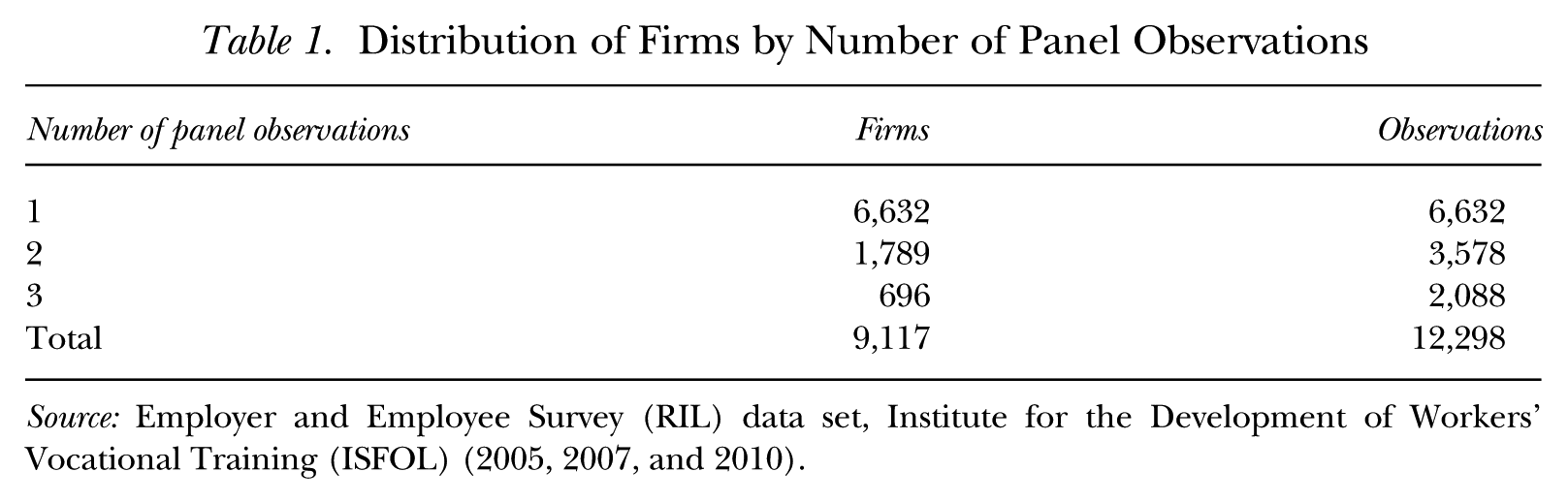
Source: Employer and Employee Survey (RIL) data set, Institute for the Development of Workers’ Vocational Training (ISFOL) (2005, 2007, and 2010).
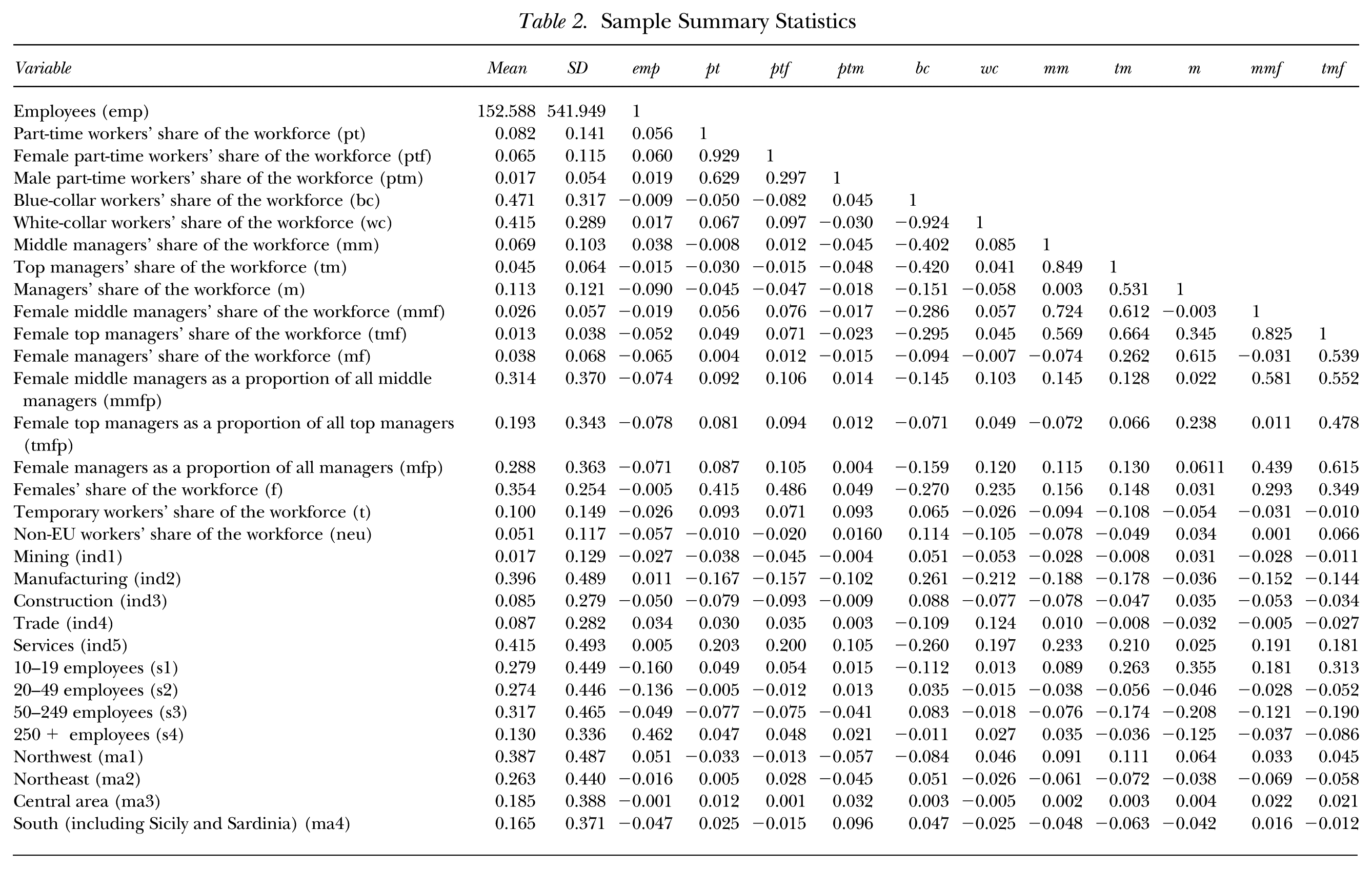
Table 2 reports relevant summary statistics of the RIL data set, including correlations between the main variables used in our regressions. The service and the manufacturing sectors are the largest, accounting for 41.5% and 39.6% of the firms, respectively. The trade and the construction industries represent 8.7% and 8.5% of the firms, respectively, while a tiny fraction of them (1.7%) belong to the mining industry. More than half of the companies (55.4%) are small- or medium-sized, employing between 10 and 49 workers; 31.7% and 13% of them are large or very large in size, employing between 50 and 249 workers or more than 250 workers, respectively. In the average firm, 8.2% of employees work on a part-time basis; 6.5% of them are female part-timers and 1.7% are male part-timers, consistent with the fact that most part-time jobs are held by women. 10 On average, female middle managers make up 2.6% of employees, and female top managers are 1.3% of employees. In particular, in accordance with the statistics provided by Istat, in the average firm, 19.3% of top managers are females and 31.4% of middle managers are females.
Sample Summary Statistics
Continued
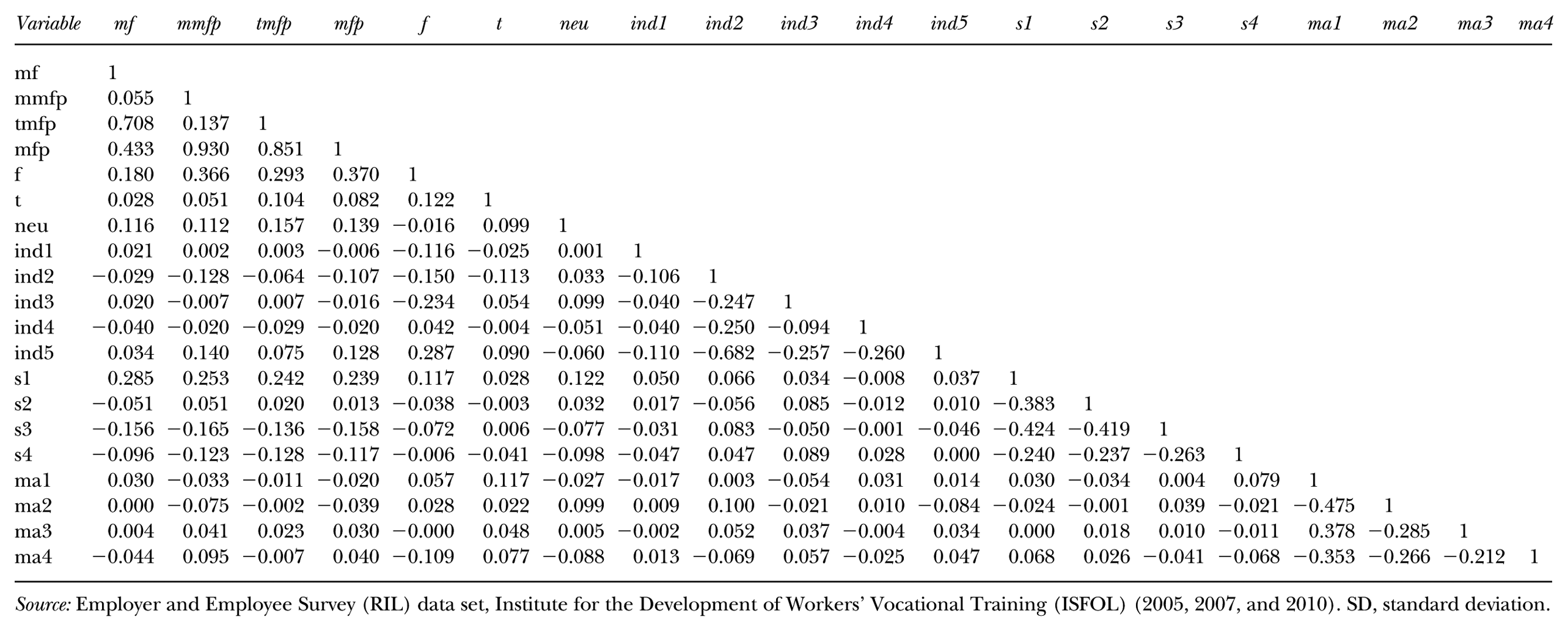
Source: Employer and Employee Survey (RIL) data set, Institute for the Development of Workers’ Vocational Training (ISFOL) (2005, 2007, and 2010). SD, standard deviation.
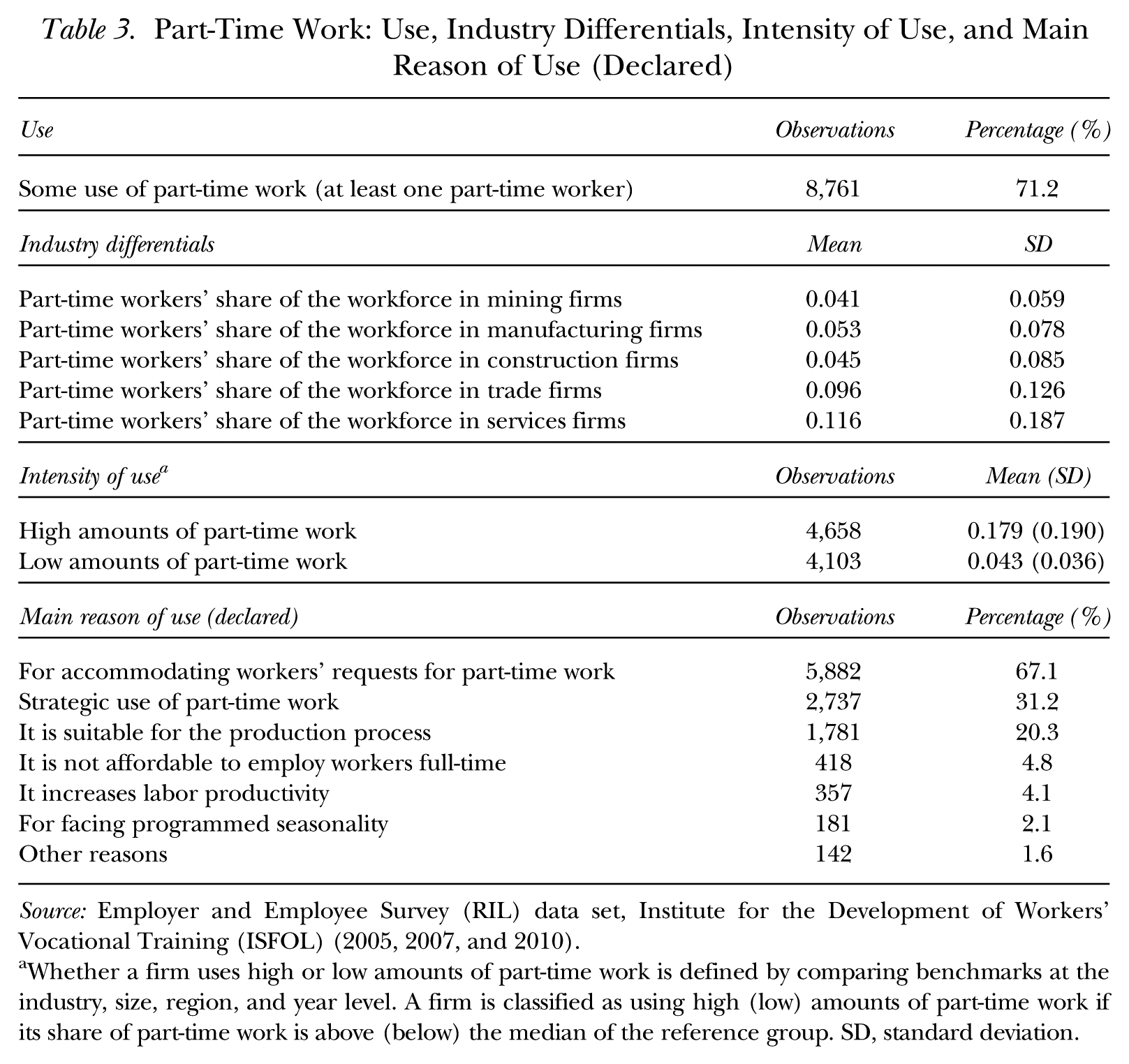
The first panel of Table 3 shows that part-time work is used by the great majority of firms: 71.2% of the firms employ at least one of their workers on a part-time basis. Consistent with our expectations, the use of part-time work varies significantly across industries (second panel of Table 3). For instance, in manufacturing firms, on average, 5.3% of the workers are part-timers, compared to 9.6% and 11.6% in the trade and services industries, respectively.
Part-Time Work: Use, Industry Differentials, Intensity of Use, and Main Reason of Use (Declared)
Source: Employer and Employee Survey (RIL) data set, Institute for the Development of Workers’ Vocational Training (ISFOL) (2005, 2007, and 2010).
Whether a firm uses high or low amounts of part-time work is defined by comparing benchmarks at the industry, size, region, and year level. A firm is classified as using high (low) amounts of part-time work if its share of part-time work is above (below) the median of the reference group. SD, standard deviation.
The third panel of Table 3 shows average shares of part-time work in the samples of firms using low and high levels of part-time work, respectively (see subsection in the Results and Discussion). To identify the two groups of firms, we first compute benchmarks (median values of part-time work use) for firms sharing the same industry (5 categories), size (4 categories), region, and year. This strategy allows us to better capture idiosyncrasies in the firms’ use of part-time work (and, ultimately, in the main reason of its use), which are purged from mere sectoral, regional, or size-related trends. Then, we compare the firms’ shares of part-time work with benchmarks of their reference groups, defining firms as using high (low) amounts of part-time work if their shares of part-time work are above (below) the median of the reference group. This procedure results in the identification of two distinct groups of firms. Firms using low amounts of part-time work, on average, employ only a small fraction (4.3%) of their employees on a part-time basis, whereas firms using high amounts of part-time work, on average, employ almost one-fifth (17.9%) of their workforce on a part-time basis.
The lowest panel of Table 3 summarizes the answers given by firms employing at least one part-timer regarding the reason for their use of part-time work. Note that respondents are requested to select only one of the proposed alternatives and, since they are not mutually exclusive, the procedure amounts to indicating the primary motivation. The available options include (1) it is suitable for the production process; (2) for facing programmed seasonality; (3) it increases labor productivity; (4) for accommodating workers’ requests for part-time work; (5) it is not affordable to employ workers full-time; (6) other reasons. We then group the firms on the basis of whether they declare that part-time work is mainly part of a deliberate corporate strategy (firms indicating items (1), (2), (3), or (5)) or it is mainly used to accommodate workers’ needs (firms selecting item (4)). Firms selecting item (6) constitute a third group. The majority of the firms using part-time work (67.1%) declare that they use it mainly to accommodate workers’ requests for part-time work. The remaining proportion is split between firms declaring to mainly use it strategically (31.2%) and those choosing the other reasons response (1.6%). In the group of firms reporting they mainly use part-time work strategically, the most selected alternative is item (1), “it is suitable for the production process” (20.3%). Only a few firms selected item (5), “it is not affordable to employ workers full-time” (4.8%); item (3), “it increases labor productivity” (4.1%); and item (2) “for facing programmed seasonality” (2.1%). 11
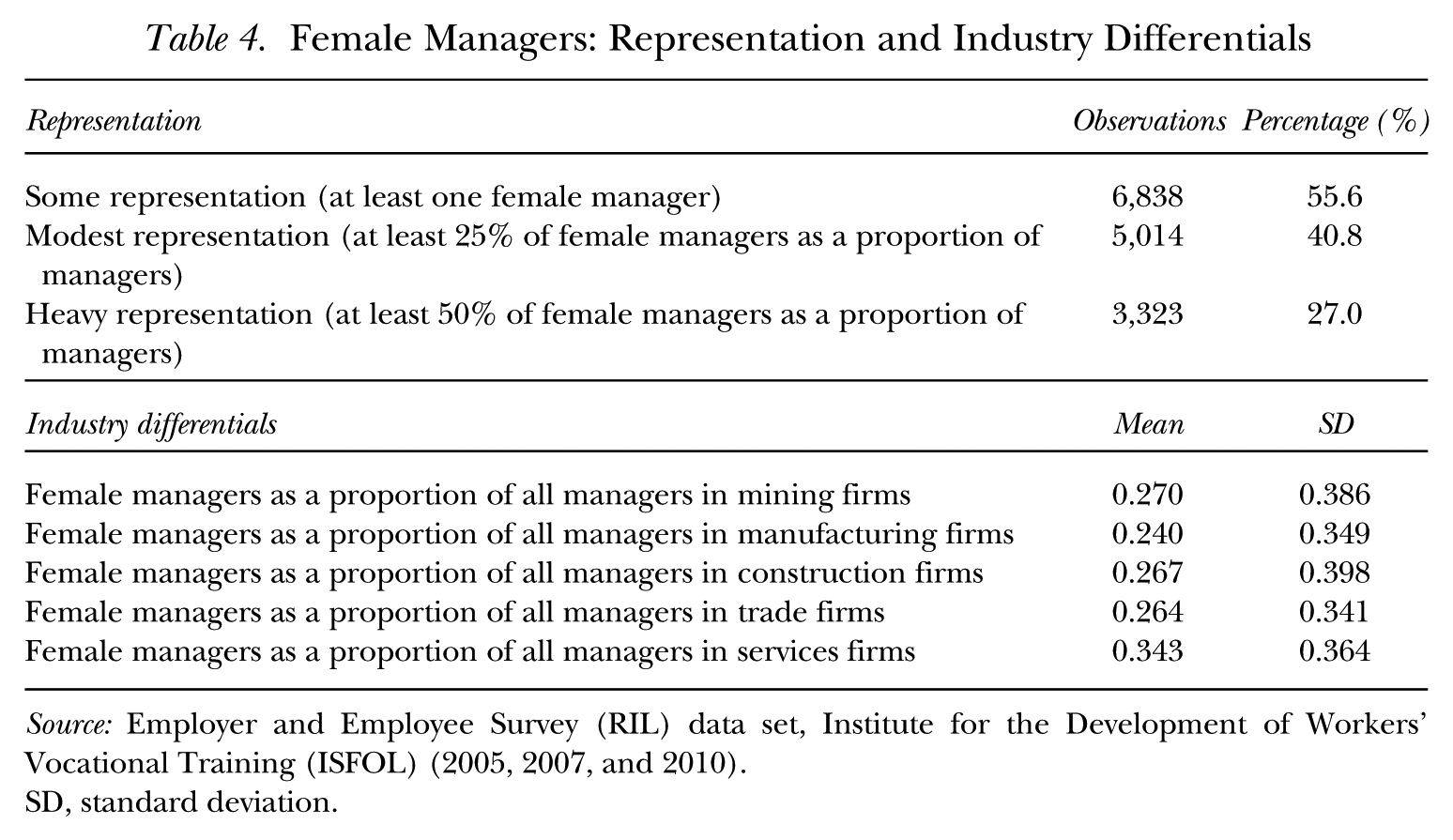
Table 4 shows that more than half (55.6%) of firms employ at least one female manager. For 40.8% of the firms, at least 25% of their management is composed of women; for 27% of the firms, women represent at least half of the management. In accordance with the official statistics, we observe considerable industry differentials in the female representation among managers. The values range from 34.3% of female managers over the total number of managers in firms operating in the service sector, to 24% in those belonging to the manufacturing sector.
Female Managers: Representation and Industry Differentials
Source: Employer and Employee Survey (RIL) data set, Institute for the Development of Workers’ Vocational Training (ISFOL) (2005, 2007, and 2010).
SD, standard deviation.
Assessing whether and how female managers affect the use of part-time work by firms constitutes the object of the following econometric analysis. We look at the overall impact of female managers on the use of part-time work, and then investigate how female managers behave toward involuntary part-timers as well as employees asking for part-time contracts.
Results and Discussion
Overall Impact of Female Managers on the Use of Part-Time Work
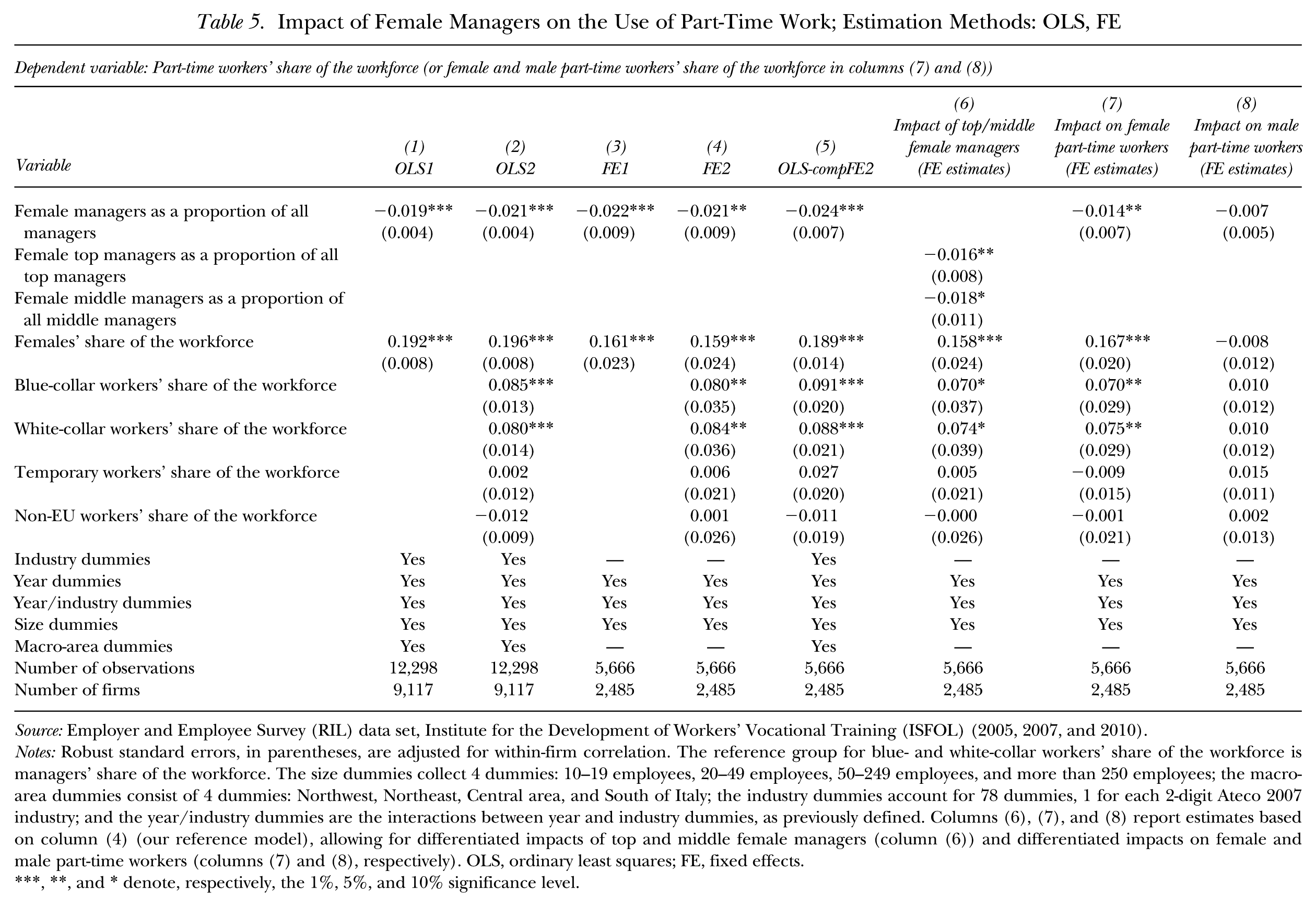
Table 5 reports the OLS and FE estimates of the overall impact of female managers on the use of part-time work, as modeled in Equation (1).
Impact of Female Managers on the Use of Part-Time Work; Estimation Methods: OLS, FE
Source: Employer and Employee Survey (RIL) data set, Institute for the Development of Workers’ Vocational Training (ISFOL) (2005, 2007, and 2010).
Notes: Robust standard errors, in parentheses, are adjusted for within-firm correlation. The reference group for blue- and white-collar workers’ share of the workforce is managers’ share of the workforce. The size dummies collect 4 dummies: 10–19 employees, 20–49 employees, 50–249 employees, and more than 250 employees; the macro-area dummies consist of 4 dummies: Northwest, Northeast, Central area, and South of Italy; the industry dummies account for 78 dummies, 1 for each 2-digit Ateco 2007 industry; and the year/industry dummies are the interactions between year and industry dummies, as previously defined. Columns (6), (7), and (8) report estimates based on column (4) (our reference model), allowing for differentiated impacts of top and middle female managers (column (6)) and differentiated impacts on female and male part-time workers (columns (7) and (8), respectively). OLS, ordinary least squares; FE, fixed effects.
, **, and * denote, respectively, the 1%, 5%, and 10% significance level.
Column (1) reports the OLS estimates of a parsimonious version of Equation (1) that adds a control for the share of female workers in the firm and dummies for industry, year, size, and macro-area.
12
The coefficient associated with female managers is negative, equal to −0.019, and strongly significant.
13
According to this estimate, a 1 standard deviation increase in the share of female managers over the total number of managers (0.363) decreases, on average, the share of part-time workers by 0.7 percentage points (i.e.,
Column (2) reports OLS estimates of a richer specification, which includes as controls the shares of blue- and white-collar workers (the reference group is the share of managers) and non-EU and temporary workers, which may correlate with both the use of part-time work and the female representation in the management of the firm. The coefficient associated with female managers is virtually unchanged (−0.021) and remains strongly significant.
Columns (3) and (4) of Table 5 report FE estimates of the previous two specifications. As already discussed, unobserved firm heterogeneity, including the firm’s culture and values, for example, can represent a threat in the identification of the impact of interest. In the absence of a natural experiment that imposes a truly exogenous variation in the representation of female managers at the firm level, we cannot make claims of causality in any definite manner. We are confident that removing unobserved fixed-firm heterogeneity helps to find a more robust estimate of the impact, especially given the relatively short panel window of the RIL data. Since only a subset of the firms included in RIL can be followed longitudinally, the FE estimation is performed on a smaller panel sample including 5,666 firm-year observations. Both the FE estimations predict that the impact of female managers on the use of part-time work is negative, equal to −0.022, according to the specification with the minimal set of controls, or −0.021, according to the richer specification, and significantly different from zero at the 5% level (at least). Comparing the FE estimates in column (4) with the OLS estimates resulting from the restricted panel sample (column (5)), the coefficient is substantially stable (−0.021 compared to −0.024), suggesting that issues related to (fixed) firm heterogeneity are not dramatically important. From now on though we will rely on and present the more robust FE estimates, using the specification with the richer set of controls.
Columns (6), (7), and (8) report two robustness analyses that distinguish between the impact of top and middle female managers and the impact on female and male part-time work. As reported in Column (6), both top and middle female managers have a negative impact on part-time work, which is similar in magnitude. The effect of female middle managers, however, is less precise (significant only at the 10% level). This finding indicates that the decision on issues concerning part-time work stems primarily from the top management, but the role of middle managers is still not negligible. In fact, especially in the recent years, the distinction between top and middle managers in Italy has become somewhat blurred, since middle managers have experienced a considerable increase in their field of action and responsibilities.
Columns (7) and (8) show that the observed overall impact stems from the effect on female part-timers rather than on male part-timers, on whom the effect is not significant. This result is in line with the fact that part-time jobs are mostly accounted for by women, and that female managers may be generally more effective on outcomes of other females rather than males, as a growing body of the literature tends to show. 15
Finally, note that a certain lag in the impact is possible, consistent with the fact that it takes time for the manager to adjust the workforce to her preferences. In addition, it takes time for a new manager to enter and understand the firms’ dynamics and to change established practices in the management of human resources. Our limited number of panel observations, unfortunately, does not allow us to fully explore underlying dynamics. That the three waves of the survey are two or three years apart from each other allows us to capture a relatively more medium-run effect.
In sum, thus far, we have found that the overall impact of female managers on the use of part-time work is negative and significant, and it does not change after controlling for a large set of time-varying firm-level characteristics and unobserved fixed-firm heterogeneity. In view of the dual nature of part-time work, this result might not be very informative and may even hide contrasting behaviors of female managers toward involuntary part-timers and employees who ask for part-time positions.
Impact of Female Managers on the Use of Involuntary Part-Time Work and on the Accommodation of Workers’ Requests for Part-Time Work
Since we do not have any direct information on the number of involuntary part-timers and employees asking for a part-time contract within each firm, we identify these two groups of workers indirectly.
Our method hinges on a practical and simple reasoning. First, consider the perspective of workers. A part-time worker can be either voluntary or involuntary. Voluntary part-timers are those who want to work part-time (e.g., because they want to better combine work with private life); involuntary part-timers are those who would like to work full-time but are unable to find a full-time job. Next, consider the perspective of the employers. A firm can either need part-time work (e.g., because it best suits its production process) or not need it. Firms that need part-time work post part-time jobs. Workers that apply for these part-time jobs are either people who want to work part-time (voluntary part-timers) or people who would like to work full-time, but, in absence of available full-time positions, apply for these jobs (involuntary part-time workers). Hence, firms that need part-time work would likely employ both voluntary part-timers (i.e., there is a perfect match between demand and supply) and involuntary part-timers. Firms that do not need part-time work do not post any part-time job. They can, however, decide to accommodate some of their full-time employees’ requests to switch to part-time (e.g., because of arising needs of child care or elder care). Hence, firms that do not need part-time work should employ only voluntary part-time workers. This reasoning is valid if firms either need or do not need part-time work. In practice, the situation is more blurred than this simple dichotomous distinction. In fact, firms may need part-time work to perform certain types of jobs, or they may not need part-time work, but nonetheless decide to accommodate (sporadic) workers’ requests for it. Hence, a more realistic picture is that firms that mainly need part-time work employ most of the involuntary part-time workers (together with the voluntary ones), whereas firms that mainly do not need part-time work can nonetheless use it to the extent that their workers ask for a switch from a full-time to a part-time contract.
At least two strategies can identify these two categories of firms. A first possibility is to look at the intensity of a firm’s use of part-time work. We suggest that a firm that uses a high amount of part-time work probably does so as part of a corporate strategy. Conversely, we suggest that a firm that uses a low amount of part-time work tends to do so mainly to accommodate (sporadic) workers’ requests.
Table 6 presents the results for the group of firms using high amounts of part-time work (defined by using the procedure described in the preceding section of this article). According to our preferred FE estimates, the impact of female managers in these firms is negative, rather large in magnitude (−0.062), and strongly significant. If the share of female managers over the total number of managers changes from 0 to 100%, the share of part-time work is predicted to decrease by 6.2 percentage points on average, thus moving from an average share of 17.9% to 11.7%. This finding is a first indication that female managers may limit the employment of involuntary part-timers, correspondingly increasing the fraction of full-time employment.
Impact of Female Managers on the Use of Involuntary Part-Time Work; Estimation Method: FE

Source: Employer and Employee Survey (RIL) data set, Institute for the Development of Workers’ Vocational Training (ISFOL) (2005, 2007, and 2010).
Notes: Robust standard errors, in parentheses, are adjusted for within-firm correlation. Note that only firms that are in the same state for at least two periods can be used in the estimation. Estimates include the same set of controls of Table 5, column (4). For all the rest, see Table 5 notes. FE, fixed effects.
, **, and * denote, respectively, the 1%, 5%, and 10% significance level.
Though studies suggesting that female business leaders are generally more other-oriented and compassionate than their male counterparts give solid grounds to believe that female managers reduce the involuntary fraction of part-time employment, we recognize the possibility that they may only reduce the voluntary fraction, or both the involuntary and the voluntary fractions. Unfortunately, we are not able to give direct evidence on this. Resorting to the information provided by Istat on the involuntary part-time rate and the unemployment rate at a fine aggregation level, however, we provide evidence that the interpretation that female managers limit the employment of involuntary part-time work may indeed be correct. In practice, we split the group of firms using high amounts of part-time work into two subgroups defined, respectively, by those firms that operate in contexts of high and low involuntary part-time rate or unemployment rate. Contexts of high or low involuntary part-time rate or unemployment rate are defined as those above and below the median values in each year. We then perform separate regressions on the two subgroups.
If female managers reduce the employment of involuntary part-timers, we expect that their effect is stronger in firms operating in contexts of high involuntary part-time work compared to firms in which the degree of involuntary part-time employment is lower. Istat provides involuntary part-time rates yearly at the macro-area and macro-industry level (identifying 16 discrete cells in each year). Table 6, columns (2) and (3) report results on this. Female managers operating in contexts of high involuntary part-time work are associated with a negative, very large in magnitude (−0.093), and strongly significant impact. Conversely, female managers operating in contexts of low involuntary part-time work display a small and largely not significant impact on part-time work, thus supporting the interpretation that female managers limit the employment of involuntary, and not voluntary, part-timers, correspondingly increasing the fraction of full-time employment.
Table 6, columns (4) and (5) give further evidence of this, exploiting the information on the yearly unemployment rate provided by Istat at the province level (identifying 100 discrete cells in each year). The unemployment rate is strictly related to the degree of involuntary part-time work. When there is high unemployment, the bargaining power of firms increases to the detriment of workers, and part-time work may represent the only alternative to unemployment. Hence, in cases of high unemployment, involuntary part-time work is most likely to be high. The results again support the interpretation that female managers limit the use of involuntary part-time work. Female managers working in conditions of high unemployment are estimated to have a negative, very large in magnitude (−0.138), and strongly significant impact on part-time work. Conversely, female managers working in contexts of low unemployment are estimated to have a small and largely not significant impact on it.
We now move on to assess whether female managers also grant more part-time work to employees who ask for it. To determine this, we focus on the group of firms using low amounts of part-time work. The results are reported in Table 7.
Impact of Female Managers on the Accommodation of Workers’ Requests for Part-Time Work; Estimation Method: FE

Source: Employer and Employee Survey (RIL) data set, Institute for the Development of Workers’ Vocational Training (ISFOL) (2005, 2007, and 2010).
Notes: Robust standard errors, in parentheses, are adjusted for within-firm correlation. Note that only firms that are in the same state for at least two periods can be used in the estimation. Estimates include the same set of controls of Table 5, column (4). For all the rest, see Table 5 notes. FE, fixed effects.
, **, and * denote, respectively, the 1%, 5%, and 10% significance level.
According to our estimates, the impact of female managers in these firms is positive, equal to 0.008, and significant. If the share of female managers over the total number of managers changes from 0 to 100%, the share of part-time work is predicted to increase by 0.8 percentage points on average, thus varying from an average share of 4.3% to 5.1%. This result gives a first indication that female managers may be more prone to grant switches from full-time to part-time arrangements when asked to do so.
For further evidence, we again turn to ISFOL PLUS for unique information on workers’ requests for part-time work. In particular, we use available information on 1) whether the worker has ever been denied (in the current job) a switch in his or her full-time contract into a part-time one and on 2) whether the worker intends (in the current job) to ask for a transformation of his or her full-time contract into a part-time one. We then aggregate this individual-level information, which is provided in each year, at the macro-industry and macro-area level (identifying 16 discrete cells in each year), to obtain two proxies measuring important aspects relative to the workers’ requests for part-time work. The first measure, “denied part-time work,” indicates how often workers’ requests for part-time work are typically met by the employers. The second measure indicates how often workers actually ask for part-time contracts. If female managers grant more part-time work to employees who ask for it, we expect to see a stronger impact when workers’ requests have generally been denied or have been relatively more frequent. We explore this possibility by splitting the group of firms using low amounts of part-time work into two groups composed, respectively, by those firms that operate in contexts with high and low incidence of denied part-time work. We carry out a similar splitting for those firms operating in contexts with high and low workers’ requests for part-time work. We then perform separate regressions on these various groups of firms. As before, high and low incidences are defined to be above and below the median values in each year.
Table 7, columns (2) and (3) show that female managers who work in contexts where workers’ requests for part-time work are more often refused than accommodated by employers, have a positive, larger in magnitude (0.011), and significant impact on part-time work. Conversely, female managers working in contexts where workers’ requests for part-time work are more often accommodated than refused by employers, display a lower, positive, and not significant impact on part-time work. This result suggests that female managers are likely to make a difference in such requests, granting more part-time work to employees who ask for it, where there is the need to. A similar picture emerges if we look at contexts where workers’ requests for part-time work are generally more frequent. In this case, female managers have a positive, larger in magnitude (0.010), and significant impact on part-time work. Conversely, female managers working in contexts where workers’ requests for part-time work are less frequent, display a smaller, positive, and not significant impact on part-time work, again indicating that they are likely to make a difference in working time arrangements when there is more need to.
Further Evidence
We acknowledge that the magnitude of these estimated coefficients (i.e., those related to the accommodation of employees’ requests for part-time work) is, in general, small, and yet, consider two aspects when interpreting these results. First, the sample of firms using low amounts of part-time work displays a small incidence of part-time work (recall that the share of part-time work for such firms is, on average, 4.3%), so that small coefficients can, in fact, represent not negligible impacts. Moreover, as mentioned before, large jumps in the share of female managers are rather frequent in the sample. Second, and more important, as suggested by the statistics recovered from the ISFOL PLUS survey, the workers’ requests for transformations of their full-time contracts into part-time ones are, in general, not a massive number. For example, the share of workers who report having been denied a transformation of their contract from a full-time to a part-time position in the current job is in the range of 2%. Equivalently, the share of workers who report that they intend to ask for a transformation of their full-time contract into a part-time contract in their current job stands at approximately 3%. These numbers are small compared to the dramatic diffusion of involuntary part-time work, which, as we mentioned before, reached a peak of 49% in 2010. The impact of female managers on employees requesting a part-time contract is also small compared to the impact on involuntary part-time work, but this does not mean they care less about their workers’ requests for working part-time.
So far we have focused on the intensity of part-time work use by firms as a practical strategy for pinpointing the presence of involuntary part-timers and employees asking for part-time contracts. A second strategy, based on the reasons’ variable described earlier, can also elicit the differential impact of female managers on the groups of involuntary part-time workers and employees asking for part-time arrangements.
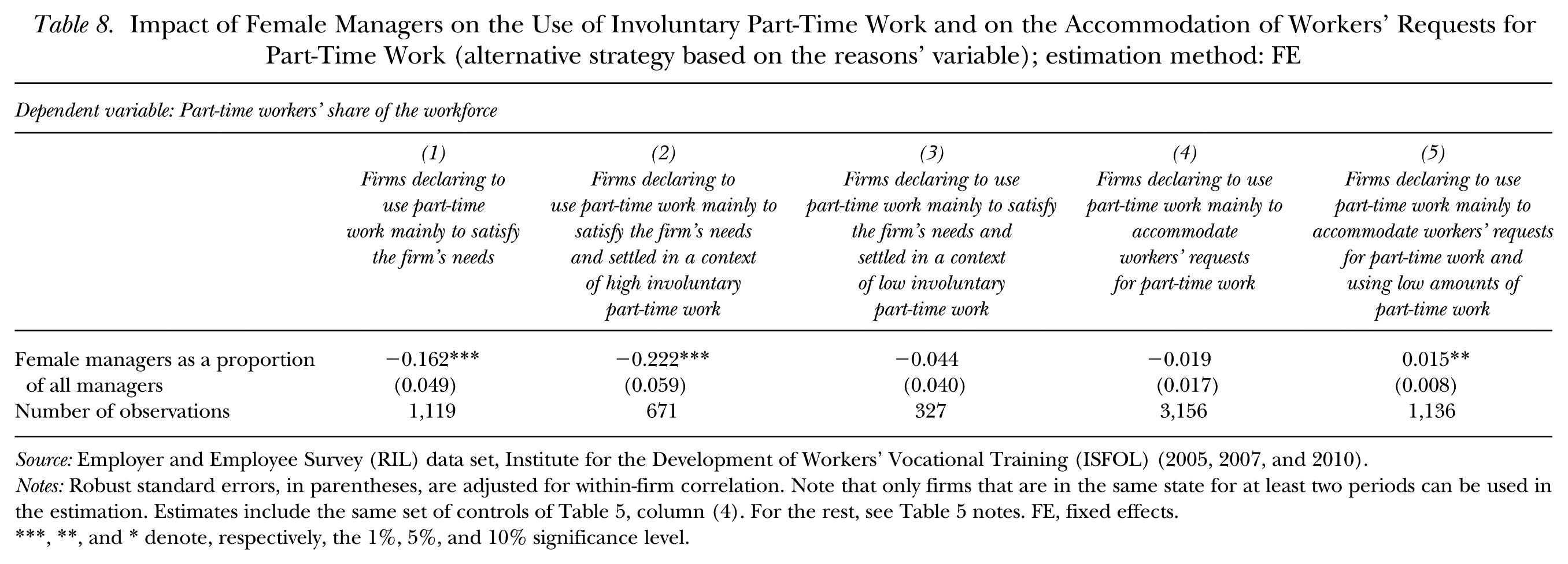
We divide the sample of firms using part-time work on the basis of the declared main reason for its use, that is, mainly to satisfy the firm’s needs or mainly to accommodate the workers’ requests. In Table 8 we present results on this.
Impact of Female Managers on the Use of Involuntary Part-Time Work and on the Accommodation of Workers’ Requests for Part-Time Work (alternative strategy based on the reasons’ variable); estimation method: FE
Source: Employer and Employee Survey (RIL) data set, Institute for the Development of Workers’ Vocational Training (ISFOL) (2005, 2007, and 2010).
Notes: Robust standard errors, in parentheses, are adjusted for within-firm correlation. Note that only firms that are in the same state for at least two periods can be used in the estimation. Estimates include the same set of controls of Table 5, column (4). For the rest, see Table 5 notes. FE, fixed effects.
, **, and * denote, respectively, the 1%, 5%, and 10% significance level.
In firms reporting they use part-time work strategically, female managers are associated with a strong and significant decrease in the use of part-time work (column (1)). This impact is large in magnitude and strongly significant only when female managers operate in local contexts of high involuntary part-time work (column (2)), whereas when they work in local contexts of low involuntary part-time work, the impact is small and largely not significant (column (3)). 16 Consistent with our baseline results, these findings provide additional evidence that suggests female managers limit involuntary part-time work.
Regarding the accommodation of employees’ requests for part-time work, results from the reasons’ variable are more mixed. In firms declaring to use part-time work mainly to accommodate workers’ requests, female managers are associated with a negative, yet largely not significant impact on part-time work (column (4)). In contrast to our baseline findings, this result points to female managers accommodating employees’ requests approximately as much as male managers would.
A motivation for this might be found in two problematic aspects of the reasons’ variable, which may hinder the analysis of the impacts of interest. 17 First, as mentioned earlier, the respondents have to individuate the main motivation and what they consider “main” is subjective. Second, the respondent can misrepresent their true motivation. In particular, some firms that use part-time work mainly to satisfy their needs can instead declare that they use part-time work to accommodate employees’ requests because they want to answer in a socially desirable way. As we know, in Italy, the phenomenon of involuntary part-time work is pervasive and represents a serious problem of underemployment, thus making this a very sensitive subject. Though the firm’s responses are not disclosed to the public (except in an aggregate form), they are seen by the survey administrators; the researchers (not in an anonymous form); and possibly also by stakeholders of the company, including owners, board of directors, and employees, thus creating an incentive to misreport their real motivation. In addition, some firms using part-time work mainly to accommodate workers’ requests might instead select answers such as (1) it is suitable for the production process or (3) it increases labor productivity, to show that the firm’s management does everything it can to maximize performance. If these issues do not prevent the impact on involuntary part-time work to show up, they can hinder the positive impact on employees requesting part-time contracts, which is present but small, as our baseline results suggest. If we look at firms declaring to use part-time work mainly to accommodate workers’ requests and actually using low amounts of part-time work (coherent with firms that truly use part-time work mainly to satisfy sporadic workers’ requests), 18 the impact becomes positive, relatively large in magnitude (0.015), and significant, thus indicating that problematic aspects associated with the reasons’ variable can, indeed, hinder the analysis of the impact on employees asking for part-time work.
Overall, we read the results of this section as providing further support to the conclusions reached through our former strategy based on intensity of use of part-time work by firms. Our two empirical strategies deliver a consistent picture that female managers limit the employment of involuntary part-timers, increase the fraction of full-time employment, and are more prone than male managers to grant part-time work to employees asking for it.
Conclusions
In this article we integrate a small but growing line of research studying the employment outcomes of women business leaders and how they manage their firms’ workforce differently from how men manage the workforce.
Building on a literature showing that female business leaders tend to display relatively more other-oriented and compassionate attitudes and values compared to their male counterparts, we aim to assess whether such attitudes and values have a bearing on managerial decisions related to working time arrangements. In particular, we explore whether the impact of female managers is differentiated across two distinct groups of part-time workers. The first group refers to those part-timers who would rather work full-time (involuntary part-timers). The second group includes those who ask for part-time arrangements, possibly to better conciliate their work and family life.
Based on three waves of a rich survey representative of Italian non-agricultural private firms and regressions accounting for several time-varying firm-level characteristics and unobserved fixed-firm heterogeneity, our results cast light on two main effects of female managers.
The first effect suggests that female managers significantly limit the employment of involuntary part-timers, correspondingly providing more full-time employment. Considering the dramatic diffusion of involuntary part-time work in Italy, which constitutes a relevant component of underemployment, female managers seem to play a crucial role in granting workers a better employment condition.
Second, female managers are more prone than male managers to grant part-time positions to employees asking for them, thus contributing to their work–life balance. Given that in Italy employers can easily refuse to meet the workers’ requests to transform their full-time contract into a part-time one, this finding is especially relevant when employees have child care or elder care responsibilities.
Overall, our findings lend support to the idea that female business leaders meet their employees’ needs more than their male counterparts do. Our results are in line with the conclusions of Matsa and Miller (2013, 2014) that the relatively more other-oriented and compassionate inclination of female business leaders can actually translate into real actions to protect their workers’ needs. Whereas their results found such attitudes and values in regard to downsizing decisions by female versus male business leaders, we discover them in decisions regarding working time arrangements. As Alice Eagly pointed out in her Presidential Address to the 2015 conference of the Society for the Psychological Study of Social Issues, “a tentative generalization is that women directors influence corporate decisions to be less single-mindedly concerned with shareholder value and more attentive to a wider range of stakeholders—in particular, to employees and the larger community, which are priorities generally consistent with women’s relatively other-oriented and compassionate attitudes and values” (Eagly 2016).
Of importance, however, are two potential limitations of our analysis. First, it does not necessarily lend itself to a causal interpretation of the estimated effects, as we lack a credible source of exogenous variation in the share of female managers at the firm level. Our fixed-effects regressions offer a way, albeit imperfectly, to minimize the bias in the estimated effects arising from unobserved firm heterogeneity. Second, as we cannot directly observe the shares of involuntary part-time workers and employees asking for part-time contracts at the firm level, we have to identify the impact of female managers on these two groups of workers indirectly. We rely on both a firm’s intensity in the use of part-time work and on the self-declared reasons for employing part-time workers, obtaining a broadly consistent picture. To corroborate our result interpretations, we resort to external information at fine aggregation levels on the diffusion of involuntary part-time work and the workers’ demand for part-time work arrangements.
Although these results and the related literature suggest that increasing the representation of females in business leadership positions, beyond obvious equity concerns, can be beneficial to workers, caution should be exercised before drawing definite welfare implications. For one thing, if female managers keep part-time employment at a suboptimal level (from the firm’s perspective), it is not obvious that overall welfare is improved once the producers’ welfare is included in the analysis. Moreover, even when attention is confined to workers’ welfare, the case for welfare gains is not clear-cut. On the one hand, suboptimal part-time employment levels might, in the longer-run, translate into lower firms’ performances, possibly leading to reductions of the companies’ labor demand and wages. On the other hand, human resource practices that are more attentive to the needs of a firm’s workforce can enhance workers’ motivation, increase their effort, and reduce worker turnover, with beneficial impacts on a firm’s productivity and, ultimately, on the workers themselves (e.g., through rent-sharing). Future research should continue to investigate these and related issues to provide a comprehensive picture of the implications of having more women (business) leaders on innovative and inclusive societies.
Footnotes
For information regarding the data and/or computer programs utilized for this study, please address correspondence to the authors at
1
For studies on firm performance, see, for instance, Deznő and Ross (2012) and Smith, Smith, and Verner (2006), for a positive impact; Adams and Ferreira (2009), Ahern and Dittmar (2012), and Parrotta and Smith (2013), for a negative impact; Rose (2007), for a null effect; and Amore, Garofalo, and Minichilli (2014) and Flabbi, Macis, Moro, and Schivardi (2016), for mixed effects. For studies on wage policies, examining the impact of female business leaders on gender wage gap, see Bertrand, Black, Jensen, and Lleras-Muney (2014), reporting no effect, and Cardoso and Winter-Ebmer (2010) and  , documenting positive effects (i.e., reduction of gender pay gap).
2
According to the OECD, the incidence of involuntary part-time work in Germany is not negligible. In the period considered by the study (1993–2012), it reached a peak of 19.2% in 2008 and has been above 11% since 2000.
3
Moreover, the use of part-time work enters their empirical specification through (the natural logarithm of) the absolute number of female and male part-timers. Even if size dummies are included in their specifications, it is possible that the above findings capture, at least partly, a size effect.
4
The literature on gender differences in attitudes and values is not limited to (business) leaders. As discussed by , many papers document that “ordinary” females and males are different in a variety of contexts, ranging from everyday life to politics. For instance, as compared to men, women tend to have more compassionate, other-oriented, and egalitarian attitudes, and to display greater favor toward policies supporting the poor, families, minorities, education, health care, and the environment while opposing military spending.
5
As discussed in , studies on women in politics also tend to suggest that women’s attitudes and values guide their behavior. Female legislators, in fact, are found to be more likely to advocate for socially compassionate policies, including policies that promote gender equality, the interests of the poor, minorities, children, and families and policies concerned with public health care and education.
6
Data confirm that female managers are overrepresented in firms declaring to use part-time work mainly as part of a corporate strategy. This finding remains valid after taking into account the sector of economic activity. Note that this argument represents a disadvantage in the identification of the effect to the extent that industry dummies cannot capture such segregation of female managers or that other, possibly unobserved, factors determine it.
7
To make the interpretation easier, we talk about “firm culture.” However, FE estimation deals with the totality of the unobserved fixed-firm heterogeneity, including other potentially relevant characteristics, such as whether the firm is a family firm or is part of a large holding company. Note also that the FE estimation does not include the dummies for industry and macro-area, since they are time invariant and already accounted for by the within-group transformation.
8
A notable example, although beyond the time frame of this article, is represented by a 2012 law that introduced gender quotas in the boardrooms of listed Italian firms.
9
From now on, when referring to “firm,” we actually mean “firm-year observation.” When necessary, we make the distinction clear.
10
In the RIL survey, part-time work is defined on the basis of whether the worker holds a part-time or a full-time employment contract. In Italy, any employment contract must be either full-time or part-time. According to the Italian labor legislation, a part-time employment contract involves a reduction of the working time with respect to the “usual” working time (i.e., full-time working time) set by law or by sectoral collective agreements, which is generally 40 hours per week. Hence, the RIL survey does not define part-time workers according to the number of hours worked (e.g., less than 35 hours, less than 30 hours, and so on). The respondents understand that they should report the number of workers with a part-time employment contract in the firm, given that the contract must be either full-time or part-time. But a certain degree of heterogeneity occurs in the number of hours worked by employees holding a part-time contract, which we cannot test with our data. What is certain is that by contract, workers with a part-time contract must work fewer hours than a (comparable) full-time worker. In practice, according to Istat, most of the part-time employees work approximately 20 hours per week (“part-time 50,” which is half of the full-time working time). Another smaller group work 30 hours per week (“part-time 75,” which is three-quarters of the full-time working time).
11
The correlation between the two classifications of firms using part-time work mainly to satisfy their needs or mainly to accommodate workers’ requests (i.e., based on intensity of use of part-time work and reasons of use part-time work) is positive and equal to 0.105.
12
Macro-area roughly follows the NUTS-1 classification of Italy. In particular, it classifies four geographical areas: Northwest, Northeast, Central area, and South (including Sicily and Sardinia).
13
The raw correlation between the share of female managers over the total number of managers and the share of part-time work is, instead, positive (equal to 0.034) and strongly significant. This value reflects the fact that firms operating in certain sectors, or anyway employing a greater proportion of female workers, generally employ a higher fraction of part-timers and, at the same time, a higher proportion of female managers.
14
Large jumps in the share of female managers over the total number of managers are rather frequent in the sample, as reflected by the relatively large standard deviation, because, in general, firms have a few managers. Sometimes, it also happens that the share jumps from 0 to 100%.
15
See, for example, Bell (2005), Cardoso and Winter-Ebmer (2010), Matsa and Miller (2011), Kurtulus and Tomaskovic-Devey (2012), Kunze and Miller (2014), Tate and Yang (2015), and for effects of female business leaders on the gender-wage gap and glass ceiling among lower-level managerial employees and other non-managerial employees.
16
Note that the same picture emerges when considering local contexts characterized by high and low unemployment. Coefficients are −0.239, significant at the 1% level, in the high-unemployment contexts, and −0.042, largely not significant, in the low-unemployment contexts.
17
We thank three anonymous referees and the editor for having raised these issues.
18
Note that the average share of part-timers is 18.1% in firms reporting they use part-time work strategically and 8.5% in firms reporting they use part-time work primarily to accommodate workers’ needs, a rather high proportion for firms truly accommodating workers’ requests.