



Abstract
To study the effect of the introduction of mediation-arbitration as a dispute resolution procedure on interest arbitration, the authors exploit a natural experiment in the arbitration institutions for police and firefighter sectors in the Canadian province of Ontario. They obtain estimates using a difference-in-difference estimator. Results show that the introduction of mediation-arbitration is significantly associated with increased use of arbitration by firefighters relative to the police. The article also draws on interviews with stakeholders to help explain the mechanisms that contribute to the increase in arbitration rates.
Keywords
Mediation-arbitration (med-arb) is a hybrid dispute resolution process that includes a mediation stage, in which a third-party attempts to resolve a bargaining impasse, and, if an impasse remains after mediation, an arbitration phase, in which an arbitrator issues a binding award that resolves the bargaining impasse. In collective bargaining, med-arb involves the neutral party (hereafter, neutral) playing both roles, the mediator and the arbitrator, a feature that helps give med-arb one of its nicknames, “mediation with a club.” Legislators have introduced med-arb as a dispute resolution procedure because it has been perceived as addressing some of the limitations of conventional interest arbitration without a mediation stage. In particular, researchers have hypothesized that stronger incentives for settlement will be present at the mediation stage since both parties will want to be seen as reasonable to the neutral since that same neutral will act as the arbitrator if necessary. Much like some of the theory behind final-offer arbitration, med-arb may therefore reduce extreme positions in bargaining because parties could be concerned that the arbitrator will view them as uncompromising and thus craft an award that favors the other party. Moreover, since the arbitrator would have been involved in the mediation stage, it has been hypothesized that awards (when necessary) may be more firmly grounded in the facts and circumstances of the case, which could reduce longer-term reliance on arbitration (i.e., the narcotic effect).
A great deal of debate surrounds the perceived merits of med-arb. Some legal practitioners and scholars have raised concerns that med-arb may involve coercion, and that awards, when necessary, may be unfair (see, e.g., Bartel 1991). Although there may be merit to both sides of the debate, it is not clear whether the perceived disadvantages of med-arb outweigh its perceived benefits on arbitration rates without considering empirical evidence on the effects of med-arb on bargaining behavior.
Unfortunately, very little research has been conducted on the effects of med-arb that could inform the debate. The research that has been undertaken tends to be more qualitative or to rely on specific case studies (Lester 1984; Stern 1984). On the one hand, Lester (1984) concluded that, for police and firefighters in Wisconsin, med-arb was more successful in facilitating voluntary settlement compared to final offer arbitration because the arbitration rates were lower in med-arb. On the other hand, Stern (1984) concluded that the med-arb system in Wisconsin was not very successful in producing voluntary settlements (since only 50% of disputes were settled in the mediation stage and this rate was lower than the benchmark set by mediation in other sectors). These conflicting conclusions make it difficult to determine the effects of med-arb on arbitration rates based on selected cases or qualitative evidence. Nonetheless, many observers view med-arb as an effective procedure for reducing arbitration rates (e.g., Lester 1984; Landry 1996; Devinatz and Budd 1997) and facilitating constructive labor relations (Lester 1984; Devinatz and Budd 1997). 1
We provide empirical evidence on the effect of the introduction of med-arb on interest arbitration rates using contract data from the Canadian province of Ontario for firefighting and police bargaining pairs. Our data comprise a census of all contract settlements for police and firefighters in Ontario from 1981 to 2015, so unlike earlier research our analysis is not on select cases. Our study focuses on a natural experiment created by a legislative change in Ontario. In particular, we exploit a major change in the collective bargaining legislation for firefighters—the Fire Protection and Prevention Act of 1997—that introduced med-arb as the dispute resolution procedure. Using police bargaining units, which were unaffected by this legislative change, as a comparison group, we adopt a differences-in-differences approach to estimate the effects of these reforms on the likelihood of requiring arbitration. Our research design includes a control group and has greater internal validity (Shadish, Cook, and Campbell 2002) than some of the before–after comparisons in the existing literature (e.g., Lester 1984) that do not have control groups. Finally, we provide qualitative evidence based on interviews of various stakeholders in the police and firefighter sectors to help interpret our quantitative findings.
Institutional Background: Interest Arbitration for Police and Firefighters in Ontario
Bargaining pairs for both police and firefighters use binding interest arbitration as the dispute resolution procedure if the parties reach an impasse when bargaining. In this section we focus on the legislation itself and the dispute resolution procedure. We discuss the broader policy environment later in the article. The overall legislative environment during the period of our study was complex, with a newly elected Conservative government making sweeping changes (most going into effect in 1997); see the Online Appendix for additional details.
Collective bargaining for police has been essentially stable since the Police Act was amended in 1972, which created the Ontario Police Arbitration Commission (hereafter the Commission). The Commission’s role is to oversee the dispute resolution process, including retaining the services of conciliators, maintaining a register of arbitrators, handling administrative matters, and maintaining a database of awards. The Commission is independently appointed and is responsible for both rights arbitration and interest arbitration. We emphasize that firefighters do not have an analogous institution. A key reason police were largely unaffected by the 1997 reforms was that the Commission was already established and its pivotal role in police collective bargaining was re-affirmed by the government. 2
The original legislation covering collective bargaining for professional firefighters in Ontario was the Fire Department Act (FDA), which was enacted in 1949 and remained largely intact until the Fire Prevention and Protection Act (FPPA) of 1997. Under the original FDA, the dispute resolution method was conventional interest arbitration. No formal conciliation or mediation stage was specified. While not specified by the statute, firefighters typically adopt arbitration by tripartite panel.
The FPPA introduced med-arb as the preferred dispute resolution method. Specifically, the new statute stated that if the parties could not agree on an arbitrator, the Minister of Labour would appoint an arbitrator (or, in the case of a tripartite panel, a chair), and the dispute resolution process would be either med-arb or mediation-final-offer selection. Although the final-offer threat was widely discussed in the literature (both practitioner and scholarly) at the time and may have influenced behavior in the short to medium run, to date it has never been chosen as the dispute resolution procedure. Many of the early appointments made by the Minister of Labour were former judges and not traditional arbitrators from previously established lists of neutrals. These appointments were challenged through the legal system, and ultimately the Supreme Court ruled in 2003 that such appointments were patently unreasonable. 3 The FPPA also made conciliation mandatory (as is the case under the Ontario Labour Relations Act) before arbitration can commence.
Although med-arb appears, on paper, to be an option for resolving interest disputes for police because of the broad 1997 reforms, interest arbitration for police has largely remained unchanged. In particular, police were affected by these legislative changes only if they could not mutually agree on an arbitrator, and, as noted, the reforms stressed the Commission’s unique role in police collective bargaining. Arbitrator selection in the police sector was also unchanged. For example, the process of arbitrator selection for police is that if the parties cannot agree on an arbitrator, the chair of the Commission (as opposed to the minister) will appoint one. Our interviews reveal, however, that the reality of an impasse for police is that the parties simply appoint an arbitrator from the Commission’s list based on who is available at the earliest date (and that conventional interest arbitration continues to be used to settle these impasses). The list contains approximately 30 arbitrators whom the parties (the local police services board and the union) have already agreed upon, and has been in effect, with the occasional addition or subtraction, for decades. We discuss additional details in our Online Appendix.
Theoretical Considerations and Empirical Methodology
The reforms mandated by the FPPA were viewed as highly controversial and were widely criticized by firefighters (Cole 2007). Here, we present a brief discussion of the reforms from a theoretical perspective as well as the intended effects of the policy. We then outline our empirical approach to estimating the effects of the reforms on arbitration rates.
The first phase of med-arb involves mediation, in which the bargaining parties caucus privately with the mediator in an effort to reach a voluntary settlement. We note that neither the statute nor the regulations give guidance as to how mediation should take place. Based on our interviews, it appears that the norm in Ontario for firefighters is private caucus, though some scholars have suggested joint sessions for mediation would be more fruitful (Program on Negotiation [PON] 2010). Although no regulation states this, we also discovered in our interviews—and as supported by evidence in the awards—that the government’s practice was to mandate a minimum one-day mediation session.
If an impasse remains after the mediation stage, the parties proceed to a binding arbitration hearing. Under the FPPA, the mediator and arbitrator (the neutral in the tripartite board) is the same individual, as is the near-universal practice in a collective bargaining context. In addition to the basic incentives to move the parties toward an agreement, med-arb has been argued to be attractive principally because: 1) mediation offers another opportunity for the parties to resolve the dispute and reach voluntary settlement; 2) if the mediator is trusted, the parties may view the award as “fairer” in the event arbitration is necessary; and 3) the time spent in mediation may—by giving the neutral the information they would normally need to compile in a hearing—reduce the time spent in the arbitration process. Elliot (1995) provided a review and legal analysis focused on the Canadian experience with med-arb, and reviews and commentaries on the US experience are provided in Henry (1987), Bartel (1991), and Vorys (2007).
Some possible disadvantages of med-arb have been noted in the literature as well. Most of these disadvantages relate to the hybrid nature of med-arb, and thus the inherent conflict between the role the neutral plays in each stage. Most (industrial relations) criticisms of med-arb revolve around the following: 1) incentives to share information—with the neutral playing both roles, there may an incentive to withhold information at the mediation stage if a party believes it will weaken its case in arbitration; 2) coercion—any settlement suggestion by the mediator may be perceived to be an imposed one thereby casting doubt on the ability of the mediator to mediate in the true interest of assisting with a voluntary settlement (i.e., the notion of med-arb being “mediation with muscle” or “mediation with a club”); and 3) confidentiality—the notion that awards may be deemed as unfair if the neutral is perceived to utilize confidential information obtained in caucus (as would not occur under conventional arbitration). In the legal literature, perhaps the most significant concern comes from a natural justice perspective. For instance, in mediation the neutral privately caucuses with each side; in conventional arbitrations this action would typically result in the decision being overturned. If the neutral plays both roles, how can they not, by definition, incorporate private information into the arbitration?
A few conceptual and theoretical frameworks may be used to consider the effects of med-arb on arbitration rates. The Farber and Katz (1979) model of arbitration offers some insights on the effects of med-arb on arbitration rates. More specifically, as noted by Devinatz and Budd (1997), since mediation requires the parties to share information with the arbitrator prior to an arbitration hearing, they may become more familiar with the arbitrator’s decision-making processes. Using Farber and Katz’s model, an implication of this familiarity is that it can remove some of the uncertainty associated with the arbitration phase and thus increase arbitration rates. 4 More recently, Ross and Conlon (2000) argued in their theoretical framework for hybrid dispute resolution procedures that med-arb could make the parties less cooperative if the neutral plays both roles. That is, the parties would reveal less information during private caucus with the mediator, and this could contribute to increases in impasse rates. Thus, both of these frameworks suggest that the introduction of med-arb would be associated with an increase in arbitration rates.
Note that these theoretical predictions were not the hypothesized effects of the reforms from the perspective of the Ontario government. The changes in the FPPA were expected to decrease arbitration rates. Certainly, the threat of mediation-final-offer early on in the reforms and the uncertainty around arbitrator selection were part of the policy tool. Indeed, the Minister of Labour stated in the Standing Committee proceedings: The idea here is to create deliberately some uncertainty for the parties as they enter into this process to encourage them to negotiate an outcome rather than to rely on arbitration. The idea here is that both parties should face some risk if they enter into this process, if they give up on negotiation, in a sense, and turn to the interest arbitration system for resolution of their collective agreement, that they should face some uncertainty as to how exactly it would be resolved. (Legislative Assembly of Ontario 1997)
The government’s view was that mediation in general, and med-arb in particular, would play a key role in decreasing reliance on interest arbitration to resolve negotiating impasses. A priori, there are arguments in both directions as to the hypothesized effects of med-arb on the use of arbitration. Consequently, the effect of med-arb on arbitration rates is better determined by an empirical analysis of the data.
We estimate the quantitative effects of these changes in the FPPA on the firefighter sector using the police sector as a comparison group. As discussed earlier, Cole (2007) noted a high degree of similarity in bargaining between police and firefighters historically in Ontario. The two sectors tracked each other in terms of bargaining outcomes—especially on wages and benefits—and multiple arbitrators over several decades have written that it is appropriate to consider the two sectors as close comparators (e.g., see the discussion in Cole 2007). Furthermore, because the two sectors are so highly regulated, they both have few non-economic issues on the bargaining table. We acknowledge from the outset that our analysis of the effects of the FPPA reforms are designed to estimate the effects of the entire reform package; for example, we cannot separate the immediate impact of the change to med-arb from the arbitrator selection issue. Note, however, that the length of our sample period allows us to distinguish between short-run effects and longer-run effects. In particular, we make some efforts to exploit the change in the arbitrator selection issue in 2003 when the Supreme Court ordered (as part of their ruling on the broader reforms) that the Minister of Labour refrain from appointing individuals (such as former judges) who were not on the established list of neutrals.
To estimate the effects of the FPPA reforms on the use of arbitration, we consider the standard difference-in-difference specification:

where
The Supreme Court decision on the arbitrator selection in 2003 means that in our analysis of the FPPA we can separate the effects of the FPPA reforms into several phases. In particular, since the period between 1997 and 2003 includes the FPPA as passed, but the 2004 and beyond period does not include the arbitrator selection elements, we can refine the difference-in-difference specification in Equation (1). In particular, we also estimate:

Equation (2) allows us to examine the heterogeneity in the estimates after the Supreme Court decision. In particular,
The key assumption underlying the difference-in-difference framework is the common trend. If the two groups—firefighter and police—are similar in their usage of arbitration before the changes in legislation, then the police, who did not experience a similar change in arbitration institutions, can be used as a counterfactual to determine what would have happened to arbitration rates for firefighters after the FPPA reforms. As illustrated in Figure 1, prior to the reforms, the trends and patterns in arbitration use for police and firefighters are very similar, suggesting that the common trends assumption is satisfied.
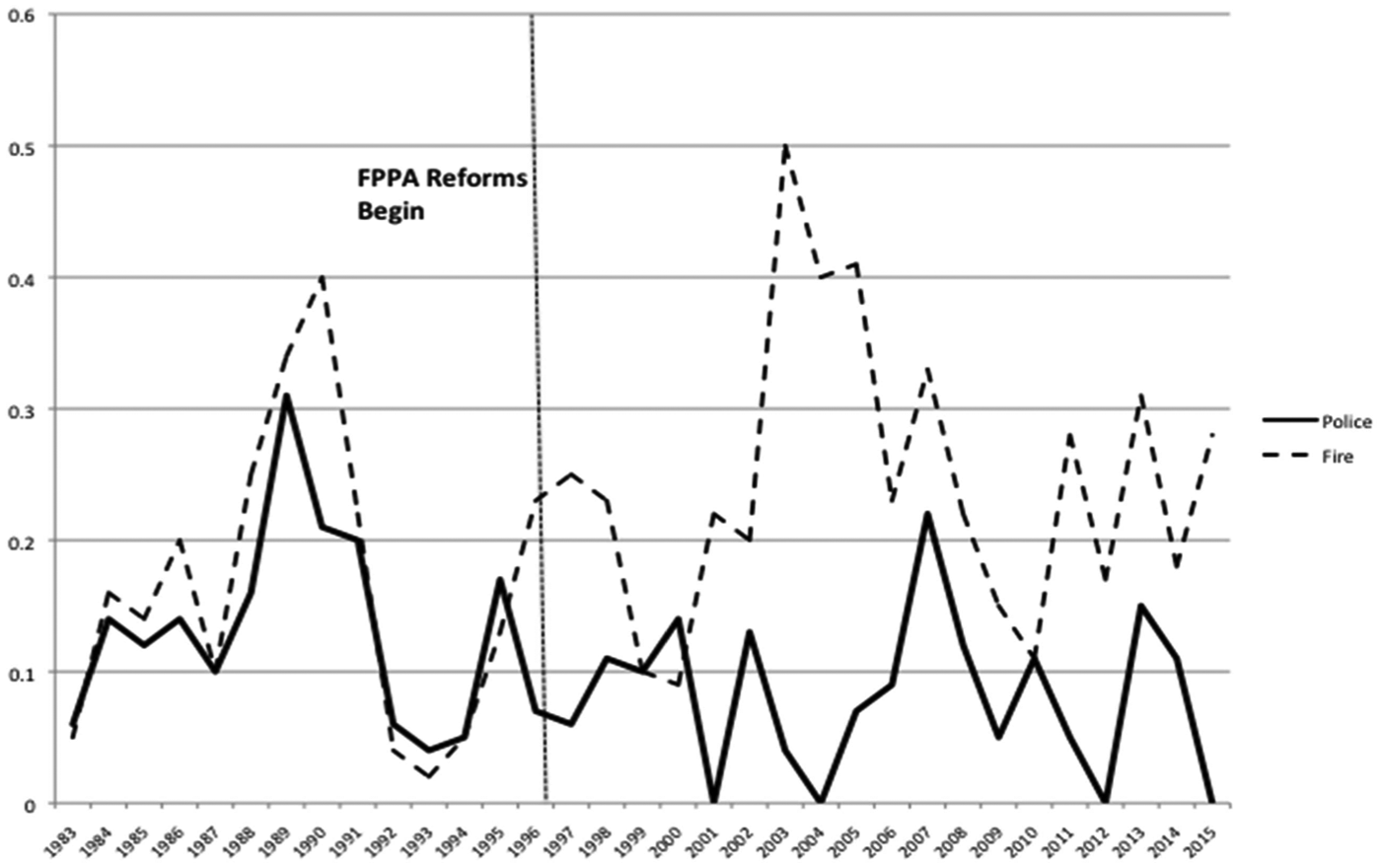
Comparison of Arbitration Rates, Police and Firefighters, 1982–2015
The changes in arbitration institutions we consider occur during a period of numerous amalgamations and annexations of cities and towns in Ontario that could have had an effect on collective bargaining in the police and firefighter sectors. We discuss these changes in more detail below in the context of our qualitative evidence. Unfortunately, town- and city-level information on tax revenues and expenditures is not available in Canada, which provides figures at the province level only. To capture the effects of restructuring of communities in Ontario we also use an alternative specification that includes two additional controls. First, we include city- and town-specific effects in each of the regressions we estimate. The city-specific effects should capture anything in the bargaining environment that is specific to the city, such as changes in taxes and expenditures. Second, we use information on the amalgamations and annexations of cities and towns in Ontario to create an indicator variable that denotes whether a city or town was part of an amalgamation with neighboring cities or towns or was annexed by a neighboring city or town. Close to two-thirds (64.1%) of the contracts in our sample were affected by an amalgamation or annexation. Finally, we also conduct our analysis for a subsample of cities and towns that were not amalgamated.
The conventional approach for estimating Equations (1) or (2) is ordinary least squares (OLS) with robust standard errors. A large literature has highlighted the problems inherent in that sort of approach, however, as the standard errors would underestimate the true standard errors on the difference-in-difference estimate (e.g., among others, Moulton 1990; Bertrand, Duflo, and Mullainathan 2004; Cameron and Miller 2015). A common solution to dealing with the underestimating of the standard errors is to employ cluster robust standard errors. Unfortunately, our data have a small number of clusters, which means that the cluster robust standard errors will be problematic (Webb 2014; Cameron and Miller 2015; Young 2016). To obtain more appropriate standard errors for our difference-in-difference estimate we use the two-step estimator suggested by Donald and Lang (2007) that conducts inference using a t-distribution. 5 Donald and Lang’s estimator will produce the proper standard errors in the small cluster setting we are working with and provide more-conservative critical values for testing the statistical significance of our estimates relative to approaches that use OLS.
Data
The police and firefighter contracts in our analysis come from Ontario Ministry of Labour Collective Agreements Archive, which contains a census of all collective agreements in the province. The archive was established in 1980 (with coverage becoming universal in 1982) and is one of only two provincial data sources of its kind in Canada (the other is in Nova Scotia) (Riddell 2013). The Ontario data contain information on the type of settlement (i.e., whether it was bargained, settled using arbitration, or was a legislated settlement) as well as bargaining unit characteristics (e.g., bargaining unit size, the type of workers, region in Ontario). We use data from 1981 to 2015 to estimate our difference-in-difference models. Unfortunately, these data do not contain information on wage settlements, so we focus our analysis on arbitration rates.
Data on collective agreements in Canada are also available through the federal government (Human Resources and Skills Development Canada); indeed, most Canadian studies of collective bargaining (e.g., among others, Currie and McConnell 1991; Campolieti, Hebdon, and Dachis 2014, 2016) use these data. However, the federal database is not a census of all settlements because of reporting limits on bargaining unit size in the federal and provincial jurisdictions (e.g., bargaining units with 500 or more members in the public sector). Large bargaining units are unusual in Canada; for instance, even in Ontario (the largest province and economic base of the country), only about 5.3% of police and firefighter bargaining units we examine in this article have 500 or more employees. Thus the data from Ontario are more representative since they are not restricted to a particular subset (i.e., large bargaining units).
We consider a sample that includes all the contracts in the police and firefighter sectors. We also conduct some robustness checks, one of which involves dropping contracts with legislated settlements. Most of the dropped contracts occur prior to the FPPA. Table 1 contains descriptive statistics on the arbitration variable and bargaining unit characteristics in the police and the firefighter contracts.
Descriptive Statistics, 1981–2015
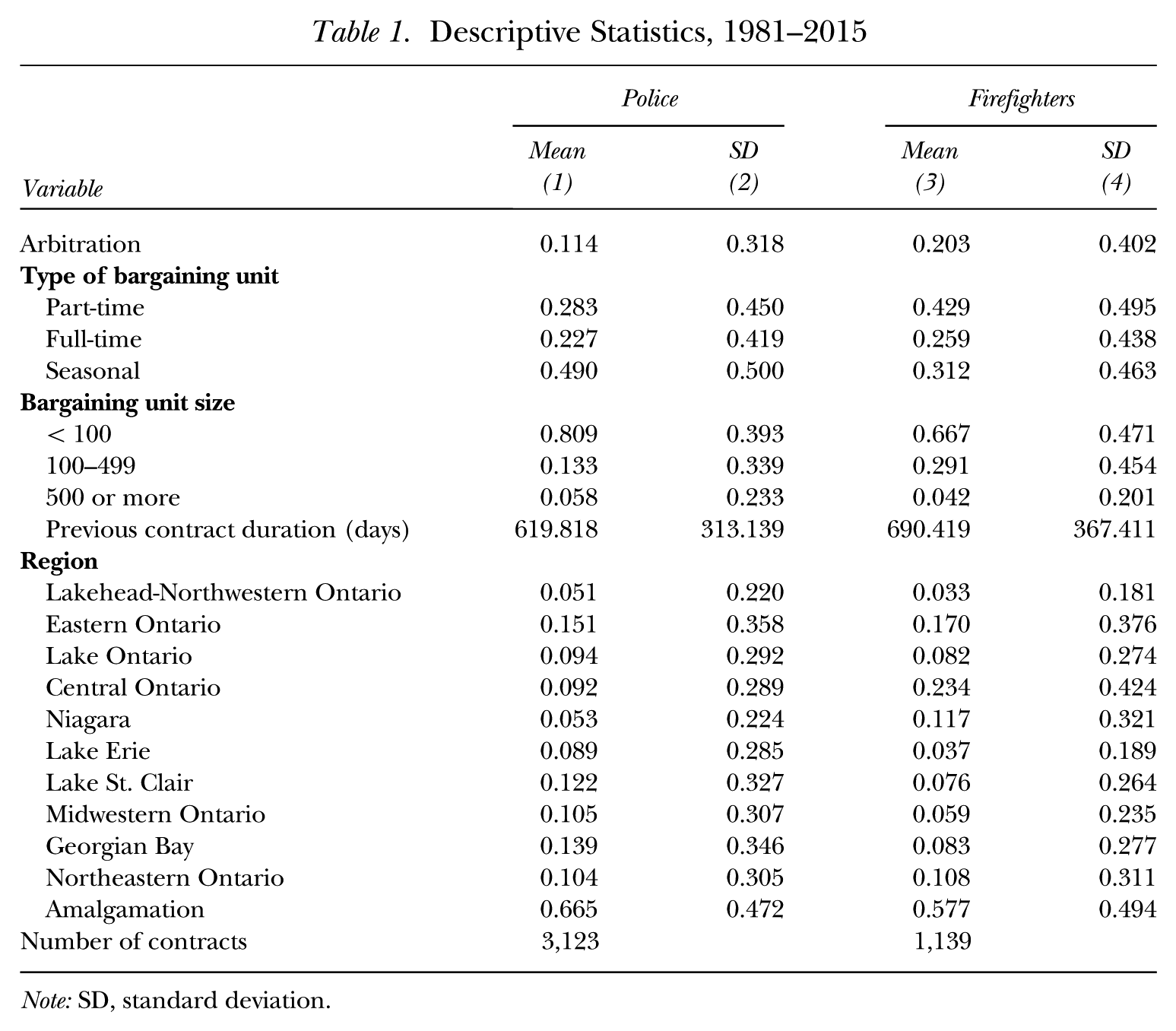
Note: SD, standard deviation.
As part of our analysis, we also conducted several interviews with key stakeholders in the arbitration process from the police and the firefighter sectors. We discuss this qualitative evidence in a later section. Finally, we compile a database of arbitration awards for both sectors. In the case of police, this database comes from the Commission and it represents a near-census of awards (i.e., we are able to match all but two cases to the archive). However, there is no universal coverage of arbitration awards in Ontario until roughly 2008. Prior to that date, one can use the Canadian Legal Information Institute database (back to 1996; based on the award date), but it is voluntary to submit an award and only 32 of the firefighter awards from 1996 to 2015 are available. Note that many awards have a one- to two-year lag (the broader reforms also incorporated rules about arbitrations in progress; see our Online Appendix) and thus most awards through 1998 pertained to the pre-FPPA period. We emphasize that the available awards we use (for such details as time spent in mediation or number of issues resolved in mediation, and so on) may differ systematically from the awards that are unavailable; however, we use these awards purely to complement the interviews.
Empirical Results
Difference-in-Differences Estimates of the FPPA
The difference-in-difference estimates provide insights into the effects of the FPPA, which included the introduction of med-arb along with, for a period of time, uncertainty around arbitrator selection on arbitration rates in the firefighter sector relative to the police sector. As noted previously, police were insulated from the broader reforms—which paralleled the FPPA reforms—as the government allowed the police’s arbitration infrastructure to continue.
As shown in Figure 1, arbitration rates in the firefighter sector tended to increase after the FPPA. This finding suggests there could be increased use of arbitration associated with the FPPA in the firefighter sector relative to the police sector that the difference-in-difference estimator can shed light upon. We present our estimates from the difference-in-differences analysis of police and firefighter contracts in Table 2. As noted earlier, we obtain these estimates using Donald and Lang’s estimator. We present a few estimates based on some alternative samples for both Equations (1) and (2). Recall that Equation (2) breaks up the period after the FPPA reforms into three phases, but Equation (1) does not make this distinction.
Difference-in-Difference Estimate of Introduction of Mediation-Arbitration on Dispute Rates, 2nd Step of Donald and Lang Estimator, Police and Firefighter, 1981–2015
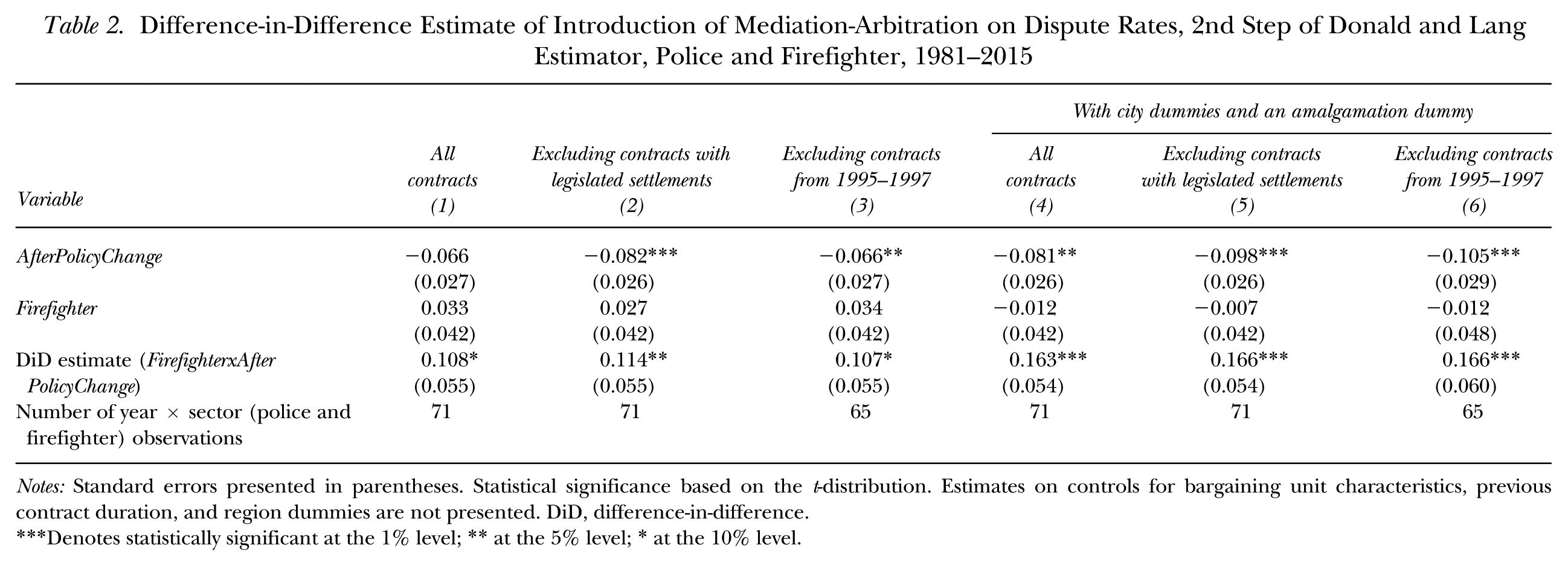
Notes: Standard errors presented in parentheses. Statistical significance based on the t-distribution. Estimates on controls for bargaining unit characteristics, previous contract duration, and region dummies are not presented. DiD, difference-in-difference.
Denotes statistically significant at the 1% level; ** at the 5% level; * at the 10% level.
Prior to discussing the difference-in-difference estimates, we highlight a few findings of interest on the other control variables, which we present in Online Appendix Tables A.1 and A.2. We do not find a great deal of regional differences in arbitration rates, since only a few of the dummies for the regions had statistically significant estimates. We find some evidence, however, that arbitration usage increases with bargaining unit size in the police and firefighter sectors. This approach is consistent with the conceptual frameworks in Ashenfelter and Currie (1990) and Currie (1989), which predicted that arbitration rates should increase as bargaining unit size increases, since dispute costs fall as bargaining unit size increases. We find similar estimates when we consider the samples that exclude some of the contracts, which we discuss in more detail below. For Online Appendix Table A.2, which contains the estimates from specifications that include city-specific dummies and an amalgamation dummy, we observe similar estimates. Although we cannot report the estimates on the city-specific dummy variables because they are so numerous, we do note that a large number of the city dummies are statistically significant.
In column (1) estimates from Equation (1), shown in Table 2, we consider the sample that includes all the contracts and obtain a difference-in-difference estimate of about 0.11, which is statistically significant at the 10% level. This estimate indicates that arbitration usage for firefighters increased by about 11 percentage points after the FPPA, relative to the police, who did not experience a similar change in arbitration institutions. This estimate is very large in magnitude relative to the mean arbitration rate in the pooled firefighter and police data, which is 13.7%. In column (2) of Table 2, we estimate the model excluding contracts that had legislated settlements and obtain a similar estimate, 0.114, that is statistically significant at the 5% level. The third set of estimates (column 3) considers a robustness check that is sometimes undertaken in difference-in-difference analysis (Meyer 1995), which excludes the last year or two in the old policy regime and the first year in the new policy regime. 6 For our contract data, this check would involve excluding contracts from 1995 to 1997. Excluding these years from analysis does not have a large effect on the magnitude of the difference-in-difference estimate or its statistical significance. When we include the city-specific and amalgamation dummies in the specification, which is our preferred specification, the estimates become somewhat larger (increasing by about 50% to approximately 0.16) and are all statistically significant at the 1% level. The estimates from these specifications (columns (4)–(6) in Table 2) indicate that arbitration usage by firefighters increased by about 16 to 17 percentage points after the introduction of the FPPA, relative to the police. The larger difference-in-difference estimates from the specification with the city-specific and amalgamation dummies suggest that important city-specific differences can influence arbitration use by the firefighters relative to the police.
In Table 3, we present the estimates based on Equation (2), which splits the post-policy change period (1997–2015) into three phases: the initial implementation of the FPPA (1997–2003); the first few years after the Supreme Court decision (2004–2006); and the 2007 to 2015 period. For brevity, we present only the estimates from the specification that includes the city-specific and amalgamation dummies. These are our preferred estimates, since they better control for unobserved differences that can reflect municipal finances and other circumstances in the city. Note also that the estimates that exclude these variables are somewhat smaller. The most striking result from the estimates of Equation (2) in Table 3 is the substantial difference in the estimate for the 2004 to 2006 period, which indicates a 39 percentage point increase in arbitration usage by firefighters relative to the police, compared to the other periods. The estimates for the 1997 to 2003 and 2007 to 2015 periods are relatively similar, which suggests an increase in firefighters’ arbitration usage just around the Supreme Court decision, but arbitration usage, relative to the police, reverts back to earlier levels after the implementation of the FPPA. The spike in arbitration use during 2004 to 2006 is intriguing and could be related to the Supreme Court decision, but could also reflect some variability in the estimates of the effect of the policy change over time. Nevertheless, these estimates suggest that, overall, an increase in arbitration usage in the firefighter sector relative to the police persists over time. We obtain similar estimates when our sample excludes the legislated settlements as well as the contracts from 1995 to 1997.
Difference-in-Difference Estimate of Introduction of Mediation-Arbitration on Dispute Rates, 2nd Step of Donald and Lang Estimator, Police and Firefighter, Post Period Distinguishes between Before and After Supreme Court Decision on Arbitrator Selection with Three Phases, 1981–2015
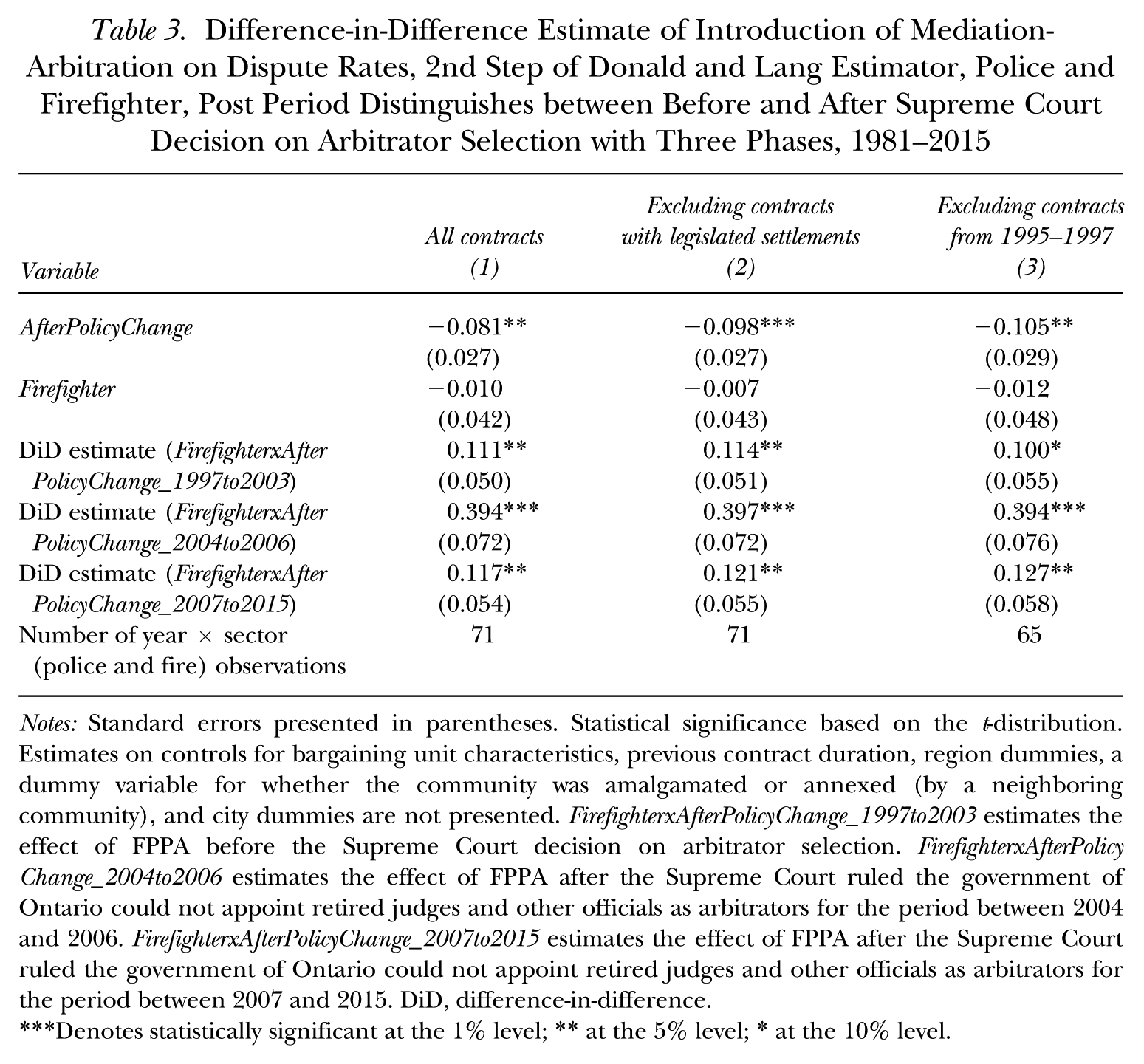
Notes: Standard errors presented in parentheses. Statistical significance based on the t-distribution. Estimates on controls for bargaining unit characteristics, previous contract duration, region dummies, a dummy variable for whether the community was amalgamated or annexed (by a neighboring community), and city dummies are not presented. FirefighterxAfterPolicyChange_1997to2003 estimates the effect of FPPA before the Supreme Court decision on arbitrator selection. FirefighterxAfterPolicyChange_2004to2006 estimates the effect of FPPA after the Supreme Court ruled the government of Ontario could not appoint retired judges and other officials as arbitrators for the period between 2004 and 2006. FirefighterxAfterPolicyChange_2007to2015 estimates the effect of FPPA after the Supreme Court ruled the government of Ontario could not appoint retired judges and other officials as arbitrators for the period between 2007 and 2015. DiD, difference-in-difference.
Denotes statistically significant at the 1% level; ** at the 5% level; * at the 10% level.
One potential concern about the difference-in-differences estimates is that they may also reflect changes in municipal finance that occurred around the time the FPPA was introduced. We discuss these other potential confounding factors in more detail below. To address this issue we also estimated our difference-in-difference models using contracts from cities that were not amalgamated or annexed. The amalgamated cities may face greater budgetary pressures as they assume greater responsibilities for services without a commensurate increase in the ability to pay for these services (Kitchen 2002). We present these estimates in Table 4 with the specification that includes city-specific dummies. For brevity we do not present the estimates from the samples that exclude legislated contracts nor those from 1995 to 1997, but we note that the estimates from these samples are similar to those we present. The estimates from the subsample of contracts from cities and towns that were not amalgamated are very similar to their counterparts in Tables 2 and 3. This finding indicates that arbitration use in the firefighting sector relative to the police sector is not overly different between bargaining pairs in cities that were amalgamated and those that were not. Furthermore, it suggests that our difference-in-difference estimates are likely not capturing changes in municipal finance along with the impact of the FPPA, that is, they likely reflect the changes in the FPPA.
Difference-in-Difference Estimate of Introduction of Mediation-Arbitration on Dispute Rates, 2nd Step of Donald and Lang Estimator, Police and Firefighter, Post Period Distinguishes between Before and After Supreme Court Decision on Arbitrator Selection with Alternative Phases, Includes Only Communities that Were Not Amalgamated or Annexed, 1981–2015
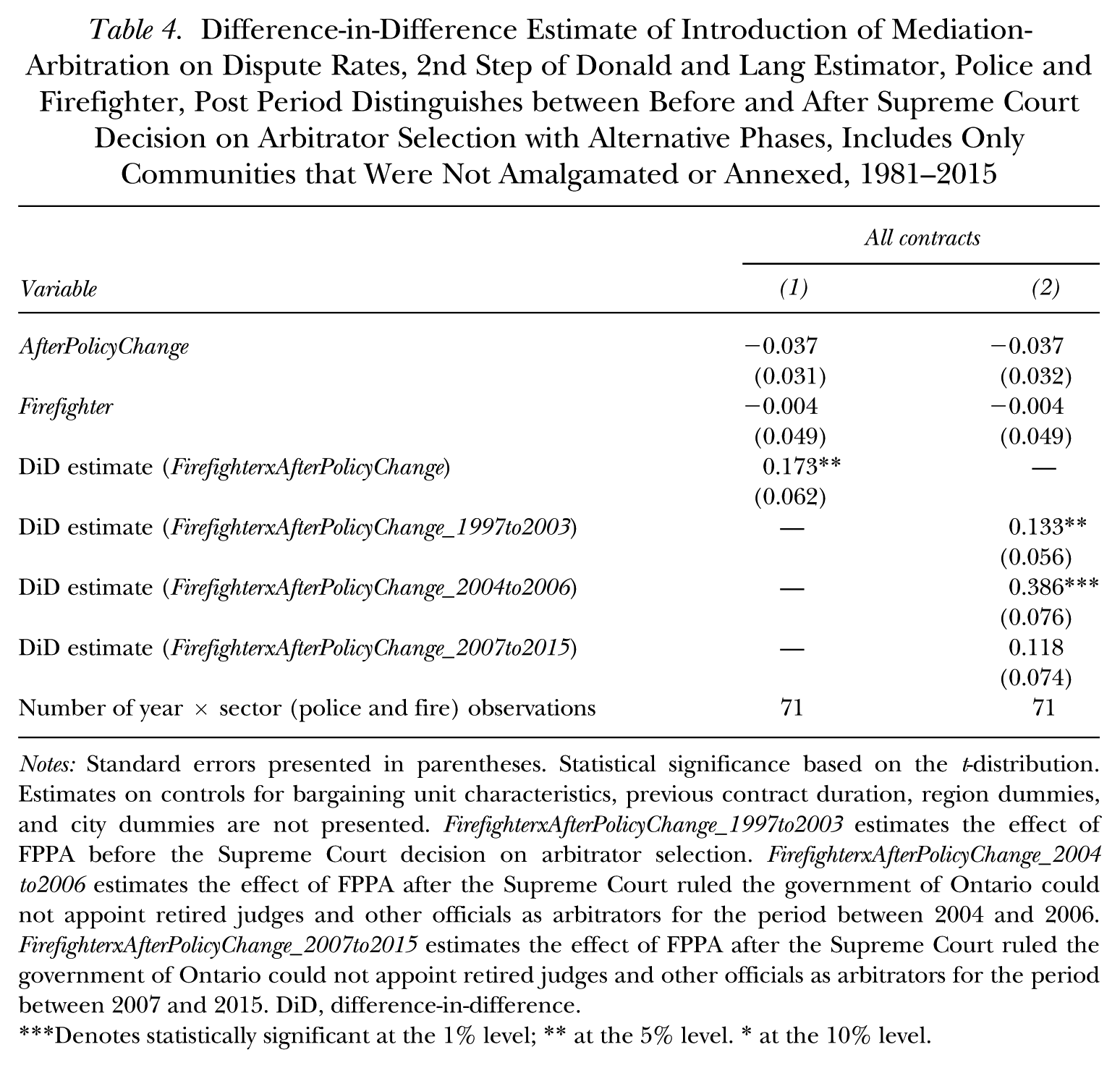
Notes: Standard errors presented in parentheses. Statistical significance based on the t-distribution. Estimates on controls for bargaining unit characteristics, previous contract duration, region dummies, and city dummies are not presented. FirefighterxAfterPolicyChange_1997to2003 estimates the effect of FPPA before the Supreme Court decision on arbitrator selection. FirefighterxAfterPolicyChange_2004to2006 estimates the effect of FPPA after the Supreme Court ruled the government of Ontario could not appoint retired judges and other officials as arbitrators for the period between 2004 and 2006. FirefighterxAfterPolicyChange_2007to2015 estimates the effect of FPPA after the Supreme Court ruled the government of Ontario could not appoint retired judges and other officials as arbitrators for the period between 2007 and 2015. DiD, difference-in-difference.
Denotes statistically significant at the 1% level; ** at the 5% level. * at the 10% level.
Discussion of Difference-in-Differences Estimates and Qualitative Evidence
Our difference-in-differences estimates are consistent with med-arb creating a bargaining environment in which arbitration is more likely to be required. That is, the estimates suggest that the introduction of med-arb chilled negotiations in the firefighter sector relative to the police sector. As noted previously, the government of Ontario stated their rationale for introducing med-arb was to reduce reliance on arbitration and to increase voluntary settlement rates. Our findings cast doubt on the ability of med-arb to reduce arbitration rates in the firefighter sector. We also conducted interviews with stakeholders about the med-arb reforms and their effects on collective bargaining in the police and the firefighter sector following the FPPA. The interviews with these stakeholders shed some light on the increase in arbitration rates for firefighters.
Our estimates are consistent with the theoretical perspectives (i.e., Farber and Katz 1979; Ross and Conlon 2000) we discussed, which hypothesized increases in arbitration usage—for different reasons—with med-arb as a dispute resolution procedure. In particular, the model of arbitration introduced by Farber and Katz (1979) predicted that greater familiarity with an arbitrator could reduce uncertainty associated with an arbitrator (and the expected award). In their model it is precisely the uncertainty around the expected award that provides incentives to negotiate. Our interviews reveal that the firefighter sector was known historically for a relatively small number of arbitrators working in the sector. 7 The available data on awards supports this view; indeed, despite using tripartite panel (as opposed to single arbitrator in the police sector), the same individual chaired the panel in almost 90% of arbitrations between 2010 and 2013, and the same individual served as the union appointee in more than 90% of cases during those four years. The small number of arbitrators handling a large volume of cases means that those bargaining in this sector would have a much greater familiarity with the arbitrators and their approaches to formulating an award. It also, however, appears that the same group of arbitrators dominated the firefighter section before and after the FPPA based on the evidence in the awards and our interviews. Moreover, we note that virtually all of the arbitrators—both named in our interviews and those available in the firefighter awards data—also served as arbitrators in the police sector (here we focus on the chair of the tripartite committee for fire). Consequently, we do not find that the familiarity with arbitrators, or (relatedly) Tier 1 dominance in the firefighter sector, is driving the divergence in the dispute rates between the firefighter and the police sectors.
To prelude evidence discussed below, we acknowledge it is plausible that Tier 1 arbitrators may be such good arbitrators that they lack the skills necessary for successful mediation. Indeed, the general point that arbitration (a process of evaluation) and mediation (a process of participation and self-determination) involve very different skill sets has been raised many times in the literature (e.g., Nolan-Haley 2012).
The remaining evidence from our interviews can be classified in two ways. First, we discuss evidence that is suggestive of med-arb itself playing a causal role. Second, we discuss other possible explanations for the divergence in arbitration usage between firefighters and police that appear more difficult to tie causally to med-arb, despite med-arb often receiving the blame from participants.
Although no direct quote explicitly indicated as such, the totality of our evidence suggests the primary link between med-arb and the divergence in arbitration use between the police and the firefighter sectors is attributable to med-arb providing a new “passing the buck” strategy for negotiators. It is useful to first highlight differences in the process of declaring an impasse before and after the FPPA. Prior to the FPPA, if the parties could not come to an agreement either party could trigger dispute resolution by declaring an impasse, at which point the board issues an official notification—known as a “No Board” report—and then, after a certain number of days (similar to the process in the United States), an impasse exists and arbitration is automatically triggered. (Alternately, in other sectors, the parties are in a legal strike or lockout position.) Post FPPA, the steps are initially the same but upon receiving the No Board report (in addition to compulsory conciliation with a board-appointed conciliation officer), the parties begin the process of booking a neutral for the mediation session. Thus, we emphasize that arbitration appears to stakeholders (as well as to the negotiating committee) as simply an option under the FPPA compared to the situation prior to the reforms, wherein triggering an impasse essentially amounts to triggering arbitration.
It appears quite plausible therefore that the pool of negotiations declaring an impasse (i.e., where a No Board report is issued) is higher under the FPPA. This finding leaves open the possibility that if mediation (and/or conciliation) has a relatively low success rate, arbitration rates could be higher under med-arb than under conventional arbitration. The question is, then: Does mediation simply fail—perhaps because Tier 1 arbitrators are poor mediators—or was mediation never given a chance because med-arb was a new passing-the-buck opportunity?
An issue raised several times in interviews is that some stakeholders are reluctant to invoke arbitration not because of uncertainty around the outcome, but because arbitration is perceived by some stakeholders as poor public relations. Indeed, many references in the media highlight that various parties believe low arbitration rates are suggestive that the public should accept bargaining outcomes as fair and reasonable. Thus, there appears to be constraints on the negotiating committee in “going to arbitration,” even if the negotiating committee is predisposed to do so.
Other results from an analysis of the awards are consistent with this idea. In particular, only three of the 24 post-FPPA awards had mediation sessions beyond the required single day. Given that the average number of open issues was nearly eight, with wages being an issue in every case from our awards database, it seems unlikely the single day could be expected to lead to a voluntary settlement. Moreover, in nearly all cases the arbitrator writes some synopsis about the mediation session, and only four of the 24 awards indicated that an issue was resolved in mediation—and in those four cases the issues resolved were a small fraction of those remaining. Finally, when pressed, none of our participants could recall a specific case in recent years in which mediation led to voluntary settlement.
Our interview participants also indicated that mediation was not taken seriously. For instance, the dominant view was dissatisfaction with med-arb, but when pressed on why an increasing number of cases were going to an apparently inferior arbitration system, several participants pointed toward med-arb’s promise—as highlighted publicly by the government on numerous occasions 8 —providing an easy-to-justify solution to an increasingly challenging economic landscape. 9 For instance, one participant (union-side consultant) stated, “well med-arb is supposed to solve the problem, that is how it’s touted. . . . so we go to mediation, but it’s like the conciliation, everyone knows it’s a waste of time and money.” We acknowledge that if circumstances, including possibly the use of other policy tools, were such that mediation was taken more seriously, that is, participants were more receptive toward mediation, med-arb could well produce a different result. In addition, participants told us that in the firefighter sector in recent years, a proclivity developed to declare an impasse very early in the bargaining process, which has led to fire chiefs (who typically serve as chief negotiator in the firefighter sector) with remarkably little experience at the table. Such behavior seems to more closely align with med-arb providing a passing-the-buck opportunity; that is, med-arb is easier to sell to stakeholders than what is available under conventional arbitration.
Given the various points noted above and the lack of any qualitative data suggesting that mediation itself, or the mediation ability of neutrals, is ineffective—as opposed to the parties, ex ante, not going in with appropriate intentions—we believe the more plausible explanation is that mediation was exploited as a rationale for declaring an impasse (and thus triggering dispute resolution and increasing the pool of cases that could potentially go to arbitration). We note, however, that even if med-arb “lured” more negotiations into dispute resolution (since the parties do not yet give up complete control), but then mediation itself was relatively unsuccessful (resulting in an increasing arbitration rate), the findings are still consistent with med-arb (as opposed to other factors) being the causal factor.
Although these points from the qualitative data are suggestive of med-arb potentially playing a causal role, it is also possible that if a different dispute resolution system had been implemented and was touted in a similar manner, it would have led to the same outcome in terms of bargaining behavior. That is, stakeholders focused on the government’s advertising of the new system, and not on the dispute resolution procedure itself. We cannot rule out the above possible explanation of the divergence in arbitration between the two sectors, although we believe the fact that arbitration use in the firefighter sector has remained persistently high (for almost two decades) is more consistent with the dispute resolution procedure (i.e., med-arb), rather than a touting effect being the underlying cause.
Other factors raised in our interviews are more complex, and the link to med-arb as a causal factor more tenuous. Perhaps most important, participants indicated that the political climate in Ontario changed following the FPPA (and the election of the Conservative government in 1995) when municipalities began taking a harder line when bargaining with firefighters. For instance, one participant told us: “You have municipalities just saying no to fire, that just doesn’t happen for the cops.” Another participant stated with regards to comparables for arbitration for firefighters: “You’ve had for 50 years to agree to police, and now we want to compare you to a snow clean-up guy at CUPE [Canadian Union of Public Employees].” Moreover, police may have been insulated from this because of the decision-making process (i.e., who ultimately is responsible for ratification) in the police sector compared to the firefighting sector in Ontario. For police, the employer decision-making authority rests with the Police Services Board, upon which municipal counselors typically constitute a minority of the board (with locally appointed residents, and provincially appointed individuals making up the majority). Conversely, for firefighters, municipal counselors are the entire decision-making body, and also typically sit on the negotiating committee (especially in smaller municipalities). 10 Our empirical analysis of cities and towns that did not undergo an amalgamation may lessen these as a confounding factor, however. As we noted earlier, Kitchen (2002) found that amalgamated cities may face greater budgetary pressures as they assume greater responsibilities for services without a commensurate increase in the ability to pay for these services. The similarity of our estimates between the non-amalgamated cities and the sample that includes the amalgamated cities means that the political environment is not likely driving our results on the increased usage of arbitration by the firefighters relative to the police.
Participants also firmly believed that arbitration proceedings for firefighters have been further delayed as a result of med-arb. This belief is in part attributable to the extra time required for mediation, which interacts with the above-noted point on the norm in firefighter arbitration of using Tier 1 arbitrators who are often booked a year or more in advance, as well as the norm for using a tripartite panel. 11 Moreover, as a result of the mediation stage (and likely also the now-required conciliation stage), proceedings have become more expensive, which has been a particular hardship on smaller communities. The problems of expense and delay appear to have further interacted with the overall ill will toward the reforms, leading to a general view of contempt toward the new system and to med-arb in particular. 12 A lengthier process with higher costs, however, is generally seen as predicting less use of arbitration, not more—these views therefore appear unlikely to explain our quantitative results, since the theoretical frameworks in, among others, Ashenfelter and Currie (1990) as well as Farber and Katz (1979), suggest that dispute rates should be inversely related to dispute costs. We suspect many of the comments along these lines pertain more to dissatisfaction with collective bargaining (for firefighters) post–late-1990s reforms than to the divergence in voluntary settlement rates between firefighters and police.
Another consideration that arose in our interviews is inexperience with bargaining. Some participants in our interviews pointed to the increase in impasse rates—and to declaring an impasse very early because of (for one reason or another) the reforms—leading to inexperienced firefighter presidents (who, as noted, typically act as chief negotiator). For instance, one senior consultant stated, “and if it looks like the employer won’t negotiate you just declare impasse. So there are firefighters’ presidents who have for their whole career, say more than a decade, only actually bargained a couple days.” Interestingly, the converse is not the case for police. This inexperience may be another factor underlying the spike in arbitration during the 2000 to 2004 period in the firefighter sector that is more challenging to link directly with med-arb.
We remain unconvinced, however, that the experience issue is a valid explanation of the divergence in voluntary settlement between police and firefighters. On average, impasse rates were quite similar between firefighter and police sectors prior to the reforms. Although we cannot rule it out, it seems unlikely that negotiators prior to the mid-1990s reforms had less experience than their police counterparts. Our sense is that participants were more often referring to recent bargaining after well over a decade of high impasse rates (i.e., as a result of the reforms, instead of the increase in impasse rates being caused by inexperience). In addition, it was at times difficult to correlate some of our evidence from the interviews to the appropriate time period; in particular, much of the discussion around interest arbitration now mirrors the climate of the mid-1990s. Often we felt that participants were referring to why current impasse rates appear high for firefighters within the context of the Financial Crisis of 2008 and increased fiscal pressures. When we pushed participants on how bargaining changed as a result of the reforms, it was difficult to determine if the factor explained the rise in impasse rates or the current levels of impasse rates. Nevertheless, it is noteworthy that med-arb continually came up as an underlying problem for firefighters. There is also no question that the parties viewed settlement as optional. Many participants made comments such as, “It’s the political nature, a lot of it [impasse] because there is no mandate to settle,” as well as, “You simply don’t have to bargain in this [fire] sector. . . . I think people get lazy sometimes.” Thus, as noted previously, at a minimum med-arb was unable to meet the additional challenges of bargaining in a time of major economic challenges in the public sector—and may have even exacerbated the issue.
Finally, the interviews also suggested a contributing factor to the increased use of arbitration for firefighters (unlikely to be related to med-arb) may have been the ability or desire of unions to pursue demands for catch-up wage increases in arbitration. In particular, our participants noted that police successfully negotiated the so-called 3-6-9 retention salary top-up (for retention purposes) paid at 9 (3% increase), 17 (6% increase), and 23 (9% increase) years of service. Our interviews revealed that the 3-6-9 for firefighters was hugely problematic during bargaining. In follow-up discussions, coupled with our own checking into the collective agreements of several municipalities (and see Canadian Press 2015), however, we discovered that the first 3-6-9 clause was negotiated in 2007. Thus, 3-6-9 cannot explain the original divergence in arbitration rates although it is possible it helped to sustain the gap.
Overall, although much of our qualitative evidence is suggestive of other factors (and not med-arb) playing a role in the divergence in arbitration rates between police and firefighters, many of the issues raised by participants—when analyzed in more detail—do not explain the initial divergence although it is possible that some of these factors may have helped sustain the divergence.
Concluding Remarks
Med-arb has received considerable attention in the dispute resolution literature, but empirical assessments of its effects on negotiations are scant. We consider the effect of the introduction of med-arb as a dispute resolution procedure for firefighters in Ontario. In particular, we consider the effects of the FPPA on arbitration use in the firefighter sector—using the police sector as a comparison group—with a difference-in-differences approach and find that firefighters increased their use of arbitration after the policy changes (relative to police). Based on various accounts of the government’s intentions, it is clear that the FPPA reforms were designed to increase voluntary settlement rates. This finding is consistent with some theoretical predictions for med-arb that view the procedure as “mediation with a club,” whereby the parties are more likely to share information and pursue other tactics consistent with compromise during the mediation phase because they know the neutral will also be the arbitrator if a voluntary agreement cannot be reached. This finding is similar to some of the hypothesized incentives involved in final-offer arbitration. Other theories are more pessimistic about med-arb’s ability to reduce the chilling effect and increase voluntary settlements. For instance, the Farber and Katz model predicts that the greater certainty about the arbitrator’s award (from the mediation phase) leads the parties to view arbitration as a more certain outcome with less risk associated with it (compared to proceeding without the greater arbitrator familiarity). Our results suggest that med-arb may not hold much promise as a tool to reduce impasses in collective bargaining for those sectors in which the right to strike is withheld, although not because of the reasons stemming from the Farber and Katz model. Indeed, there is reason to believe that a very high level of familiarity existed among the small group of Tier 1 arbitrators utilized in the firefighter sector both before and after the reforms.
Our interviews provide some understanding of the quantitative results that transcend the predictions of previous theory (specifically, Farber and Katz [1979], which posited that med-arb lowers uncertainty about arbitrator behavior). Our first observation—which may not extrapolate to non-collective bargaining scenarios—is that med-arb could plausibly increase the pool of negotiations at impasse given that the parties are not committing, on paper at any rate, to arbitration (relative to conventional interest arbitration). Thus, unless mediation is reasonably effective it is not necessarily surprising to see an increase in arbitration rates. Perhaps most important, we believe the totality of our evidence points toward med-arb providing a new justification for the tactic of passing the buck to the arbitrator. Negotiators require a premise to abandon negotiations and declare to their stakeholders that arbitration is required, and the mediation component of med-arb appears to have provided a justification that was not available previously. As we discuss, it is possible any other dispute resolution procedure—especially when touted so strongly by the government—could also credibly lead to more arbitrations, and thus we need to be cautious in determining the reason for the increase. The fact that the FPPA reforms seem to have created a permanent divergence in arbitration use between firefighters and police is consistent with med-arb playing a causal role, however. If med-arb was simply receiving the blame for other factors, we suspect the effects of the reforms would have been more short term with bargaining behavior eventually returning to its original baseline level (prior to the FPPA).
Other results from our interviews also point toward med-arb receiving blame for causal factors that lie elsewhere, including—most strongly from the qualitative evidence—the change in political climate coupled with the governance structure of firefighter bargaining. For example, some municipalities decided not to bargain and exploit the arbitration system to voice wage bill concerns. Although it is difficult to conclusively rule out these potentially confounding factors, the fact that our results are robust to municipal and town fixed effects, and that our policy impact is largely the same in the non-amalgamated cities and towns, makes it difficult for the change in governance structures factor to explain our results.
Overall, we find that the FPPA appears to have contributed to a greater propensity for passing the buck to arbitrators by both parties involved in these negotiations. Ultimately, we cannot isolate the role of med-arb from other potential factors, nor rule out that med-arb could have produced a different result if mediation had been taken more seriously. Thus, one cannot conclude firmly that if med-arb were introduced in another jurisdiction, arbitration rates would increase (i.e., as in the causal effect known as an average treatment effect). Nevertheless, we believe our findings cast doubt on the ability of med-arb to create incentives to settle relative to conventional arbitration.
Footnotes
For information regarding the data and/or computer programs utilized for this study, please address correspondence to the authors at
1
Both Fuller (1962) and  wrote that med-arb is most effective when the mediator and arbitrator are not the same individual.
2
As stated by the Minister of Labour (Hon. Elizabeth Witmer) in the Standing Committee: “Also, our changes will ensure that police retain a separate and distinct arbitration regime.” We also note that the Police Act was not changed.
3
Given the uncertainty around legal challenges, and the fact the original appeal was dismissed by the Divisional Court, this change may have influenced behavior for some years. We return to this issue later in the article.
4
Another view with the opposite prediction, based on the early economic models of strikes such as , is that if there is certainty about the outcome under disagreement (a strike in the classic model but under arbitration in our setting) then disagreement should not occur; it is only under information asymmetries that disagreement emerges as an equilibrium.
5
We estimate Equations (1) and () as linear probability models for computational ease when applying Donald and Lang’s estimator, which was derived for linear models. Their estimator comprises two steps. The first includes only the variables that vary at the bargaining pair level, for example, bargaining unit size, region, type of worker, and a set of indicator variables that denote sector × year groupings. The second step includes only the variables that vary at the sector level, for example, the firefighter dummy, the after-the-policy-change dummy, and the interaction term between these variables. The first step of the analysis is run at the individual level (with arbitration rates as the dependent variable), but the second step is run at the sector × year level (with coefficient estimates on sector × year level dummy variables from the first step as the dependent variable) and weighted by the number of observations (contracts) in each sector × year grouping.
6
7
For instance, in discussing arbitrations for police relative to firefighters, a senior consultant stated to us: “They [police] don’t use Tier 1 arbitrators, they use people who are available. . . . I mean the Commission prides itself on efficiency, they look to see who is available now. It’s essentially automated. I know they aren’t A-level arbitrators. . . . The parties never really objected to that.” By contrast, firefighters in Ontario insist on using “A-level” or “Tier 1” arbitrators. Consequently, a much smaller group of arbitrators work in this sector.
8
For instance, one of the senior government officials : 105) interviewed stated: “It’s the philosophy of the Ministry of Labour and everyone in the ministry that a consensual outcome is preferable to an opposed outcome . . . as I recall that time it was trumpeted as one of the big innovations and it was anytime you’ll see a press release or a Minister’s thing about it med-arb was referred to as a list of features of the new Bill.”
9
Many municipalities faced fiscal and budgetary challenges arising out of the Harris government’s policies toward municipalities in Ontario, for example, amalgamations of municipalities, service realignment (i.e., downloading services previously provided and financed by the provincial government to local governments), and property tax changes (Sancton 2000; ).
10
Another feature of the reforms that appears to have complicated arbitration for firefighters, but not for police, relates to the introduction of ability-to-pay criteria (see our Online Appendix for more details). Although debate is considerable about whether ability-to-pay criteria affect arbitrator decisions, with most scholars (on the Canadian side where ability to pay is not enforced) concluding that they do not (e.g., Rose 2000; ), it does not mean the proceedings themselves are unaffected. Our interviews suggest that the reforms of the mid-1990s led to an increase in expert witness testimony on the employer side relating to data on fiscal pressures, the taxpayer base, service requirements, and so forth, which was a key reason for longer delays in hearings (and more expense). It may be the case that arbitrators ultimately gave little or no weight to such issues, but municipalities appeared very interested in using the arbitration process to voice these issues. The link to med-arb for such an issue is complex. On the one hand, these changes suggest a causal role for the reforms, but not directly to med-arb itself. On the other hand, one theory behind med-arb is that through mediation (especially with the same neutral) the parties will be incentivized to be more forthcoming on difficult issues, share more information, and in turn move toward each other’s positions. Collective bargaining is rarely easy, and it often takes place in an environment of economic pressures. The results thus still point toward med-arb as—at a minimum—failing to maintain previous settlement rates as the bargaining challenge increased.
11
For instance, one participant said during an interview in January 2015 that it is common knowledge that Kevin Burkett—a well-known senior arbitrator—is already booked until 2017. The participant also indicated that even if med-arb reduced delays in the overall dispute resolution process (as some scholars have noted as a possible benefit), that for the neutral, med-arb unambiguously requires more time allocated in their calendar.
12
This general view of contempt toward the FPPA was seen throughout our interviews. For instance, one of our participants—a senior consultant for both police and firefighters—stated: “The firefighters always wanted to go back to conventional arbitration. I think a problem has been that they (firefighters) kept hoping the legislation would be reversed, and I am just saying, I think that ship has sailed.” It is also important to note that part of the delays relates to the employer’s increased use of expert witness testimony, which ties to the introduction of ability-to-pay criteria noted previously.