



Abstract
Income inequality in the United States has been lower in periods when trade unionism has been strong. Using observations on wages by occupation, by geography, and by gender in collective bargaining contracts from the 1940s to the 1970s, patterns in movements of wage differentials are revealed. As wages increased, some contracts maintained relative wage differentials constant, some maintained absolute differences in wages constant, others combined these two patterns, and some did not reveal an obvious pattern. The patterns persisted even as price inflation increased in the 1970s. The dominant pattern implies a reduction in inequality as usually measured.
Every change in wages tends to raise questions of internal equity that can be very troublesome to solve. Even if it is decided to raise all wages uniformly, it must be decided whether this is to be by a uniform percentage or a uniform amount, and whether the increase is to extend all the way up the structure of wages and salaries or only part way. The problems are not unlike those faced by the United States Congress in separating problems of the level of the income tax from issues of tax reform.
Since the beginning of the twentieth century, there has been an association over time in America between the extent of unionism and income inequality. One expression of this is shown in Figure 1: Years in which a larger fraction of workers belong to unions tend to be years in which income inequality was low. The claim that this association is causal, that trade union behavior results in less inequality, requires a mechanism that links the practices of unions to inequality.

A Century of Trade Unionism and Income Inequality
This article asks whether this mechanism is found in enduring patterns of wage setting in union-negotiated bargaining agreements. Reder and Neumann (1980) called such patterns bargaining protocols. They are conventions adopted by the parties to save on negotiation costs (including disagreements).
In the literature on the distribution of income, when increases in income are allocated among agents, there are at least two reference points for an allocation that some would judge as leaving the degree of inequality unchanged. One adopts a Relativist perspective according to which inequality would be unchanged if the increased income were distributed such that every agent received additional income in proportion to his or her initial income. A second reference point is Absolutist in which inequality would be unaltered if every agent received the same amount of additional income regardless of each agent’s initial income.
In their choice among metrics to describe the extent of income inequality, economists tend to be Relativists in that their most common indicators of income inequality imply no change in inequality if all incomes change in the same proportion and in the same direction. This pattern is true of Gini’s coefficient, Atkinson’s measure, Theil’s index, the ratio of income at a high rank in the distribution to a lower ranked income, the share of aggregate income received by the top x percent of agents (as in Figure 1), and the coefficient of variation of income.
A few writers object to Relativist indicators of inequality. For instance, Kolm (1976) disapproved of “the social implications” of Relativism noting that a common proportionate increase in all incomes raises the incomes of the rich by a larger absolute amount than those of the poor, a property he labeled “rightist.” The “leftist” indicator he proposed had the property that a common absolute increase in all incomes left inequality unchanged. Dalton’s (1920) classic article on income inequality devoted considerable attention to the attributes of relative and of absolute measures of inequality.
In place of abstract arguments about the merits and defects of various measures of income inequality, this article reports the findings of an empirical investigation into how increases in labor income were actually allocated among workers. Also did these increases in income follow a simple regularity recognizable as an Absolutist standard or a Relativist standard or a mixture of both? Or perhaps no such regularity is evident.
Conceptual Framework and a Taxonomy
Intuition for the following research is provided by Figure 2, which, for a group of workers in various occupations in a specific contract, traces movements over time in a lower wage wL and the associated hypothetical movements in a higher wage wH. Increases in the lower wage correspond to rightward movements along the horizontal axis of Figure 2. The accompanying movements in the higher wage are measured on the vertical axis. N denotes the initial observations with coordinates (WH) 0 for the higher wage and (WL) 0 for the lower wage. At N, using a Relativist perspective, (WH)0 = λ (WL) 0 where λ > 1; or, at N, with an Absolutist outlook, (WH)0 = k + (WL) 0 where k > 0. All wages in this figure are measured in nominal terms.
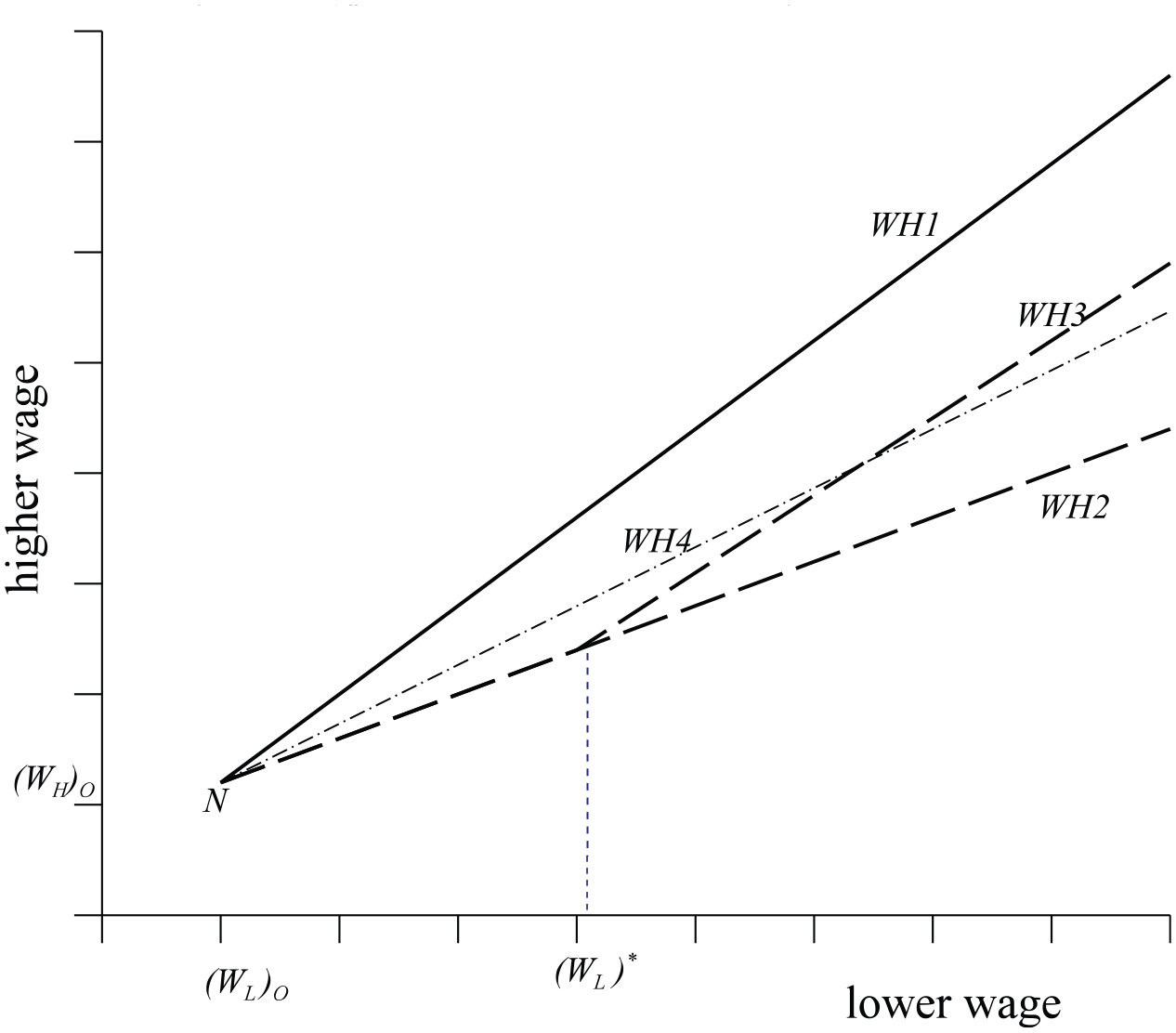
Hypothetical Movements in Wage Differentials
Envisage increases over time t in the lower wage. On the one hand, if the higher wage maintains the same value relative to the lower wage as at N, namely λ, then the higher wage follows the ray WH1. If wages lower than those at N’s coordinates followed this same pattern, the ray WH1 would reach the origin. Starting at N, the ray WH1 may be written as

WH1 describes a Relativist relation between wH and wL.
On the other hand, as the lower wage rises over time t, if the higher wage maintains the same absolute difference from the lower wage as at N, successive increases in wH would follow the ray WH2 along which wH is k dollars greater than wL:

Along WH2, wH and wL follow an Absolutist path. If this ray were extended to values of wL less than (WL) 0 , the ray would meet the vertical axis at k dollars.
A Relativist would describe movements along WH1 as constituting no change in wage inequality. By contrast, because the slope of WH1 is λ > 1 and the slope of WH2 is unity, an Absolutist would describe the widening dollar gap between the higher and lower wage along WH1 as one of increasing wage inequality. An Absolutist would propose that movements along WH2 represent no change in wage inequality whereas a Relativist would describe such movements as a reduction in wage inequality because the ratio of the higher wage to the lower wage along WH2 falls as the lower wage increases.
The initial conditions at N have an enduring consequence for subsequent wage differentials: The movements along WH1 preserve the initial wage ratio λ while the movements along WH2 maintain the initial wage difference k. These wage patterns endure because the inherited wage pattern has a standing that makes it the obvious starting point in negotiation. Indeed, when presented with the need to change wages, those actually involved in wage setting often admit to starting with the existing wage distribution and then making adjustments to it.
The bargainers need not be locked-in to the initial wage ratio or wage difference. Consider the ray WH3 in Figure 2: At first, it follows WH2 with wH exceeding wL by k1 and then, after wL reaches (wL)*, wH continuously exceeds wL by k2 where k2 > k1. This might be called a Piecewise Absolutist path:

where X = 1 for wL < (wL)* and X = 0 otherwise. An analogous Piecewise Relativist path may also cause a discontinuity in the WH1 path.
The distinction between WH1 and WH2 is apparent in principle, but it can be difficult to distinguish them in practice especially if λ is only a little more than unity. If those involved in adjusting wages tend to favor one pattern over time, then following Reder and Neumann (1980) the pattern might be characterized as a wage-setting protocol—a convention or an enduring set of procedures that save on negotiation costs and that is acceptable to those whom the bargainers represent. One protocol is the Relativist in which wages are adjusted so that existing wage ratios are preserved. Another protocol is the Absolutist whereby the same dollar and cent change in wages is applied to all workers regardless of their existing wage.
This article ascertains whether bargaining agents adhere to a readily identifiable protocol in setting wages. There may be no discernible protocol, the negotiation of a new contract may start from scratch, and an entirely new wage distribution may come into effect that bears only a weak association with that thrashed out during the previous contract negotiations.
As described in the following section, for each contract, the wage distribution for a group of workers in different occupations or with different job titles is reduced to merely three points: wH, the wages of the highest paid workers; wL, the wages of the lowest paid workers, and wM, the wages of those in the approximate middle of the wage distribution. The three groups of workers might be characterized as, respectively, skilled, unskilled, and semi-skilled workers. For each contract between workers and employers, these workers’ wages are followed over time. With three wages, there are three Relativist wage differentials—wH / wL, wH / wM, and wM / wL—and, once two of them are given, the third can be determined. If two of these relative wage differentials are constant over time, the third will be constant also. There are three Absolutist wage differentials, namely, wH– wL, wH– wM, and wM– wL. If an Absolutist wage-setting protocol is followed such that two of these differentials are constant over time, then necessarily the third absolute wage difference will be constant.
A third possibility is a contract that specifies one wage differential to be Relativist and a second wage differential Absolutist: A change in wages preserves the relative wages of some workers and maintains the same absolute difference between the wages of others. In this event, the third differential will be neither Relativist nor Absolutist even though its value is fully determined from the other wages. This third differential will be called a Blended wage-setting protocol and exhibits a mixture of Relativist and Absolutist elements.
To show this, using the notation of Equations (1) and (2), suppose wHt = λ wLt and wMt = k + wLt implying the relation between wH and wL is Relativist and the relation between wM and wL is Absolutist. Then the remaining differential, that between wH and wM, may be written as


Equations (4) and (5) each contain components of an Absolutist wage-setting relation and of a Relativist relation so Blended is an apt label. Provided the other two wage differentials follow their pattern, according to Equations (4) and (5), neither the wage difference between wH and wM nor the wage ratio of wH to wM is a constant and independent of wage levels. However, if (k / wMt) takes on a “small” value, wHt / wMt may come close to being a constant. Also if λ is close to unity, movements in wHt– wMt will diverge little from constancy. Indeed, according to Equation (4), wHt is linearly associated with wMt:

Designate this case Blended Type I. It is drawn by the ray WH4 in Figure 2.
A second case of this Blended wage setting retains the Absolutist relation wMt = k + wLt, but supposes that it is the relation between wH and wM that is Relativist, namely, wHt = λ wMt. 1 In this case, Blended Type II, the wage difference between wHt and wLt and the wage ratio of wHt to wLt are


and the relation between wH and wL is linear:

The Observations on Wages
The information on wages is drawn from the Wage Chronology publications of the U.S. Bureau of Labor Statistics (BLS) Bulletins published between 1949 and 1980. (The series ceased publication after 1980.) Workers’ basic hourly wages (or, in a few instances, daily or weekly or monthly wages) 2 are followed over time. What is measured is not the take-home earnings of these workers, which depend on factors such as their hours of work, any supplements they receive, and taxes they pay. Most of the contracts relate to the wages of workers in a variety of jobs or occupations, and these will be analyzed first. A few contracts specify hourly rates of pay for a given occupation across cities, and two contracts specify wages by gender in the same occupation.
In the typical contract, the wages of a large number of jobs or occupations are reported in the Bulletins. Sometimes a range of wages is laid out for a given occupation or job. A range allows for some discretion in wage setting at the level of the plant or department, and it provides for promotion within an occupation following training and experience. Whenever a BLS Bulletin reports a range of wages, the maximum of that range provides the observation in this article. In some instances, it is only the maximum that the Bulletin reports.
From this wealth of detail, the wages of just three groups of workers are selected for analysis, and these workers’ wages are tracked over time. The three groups are those who were paid the highest wage, those who were paid the lowest wage, and a third group with wages between the highest and lowest paid: wHjt denotes the highest wage specified in contract j and that became effective in year and month t; wLjt is the lowest wage specified in contract j at t; and wMjt is the middle wage, a wage between wHjt and wLjt at t in contract j.
The identity of the three groups of workers for each contract is listed in Appendix Table A.1. In the empirical work, when measuring wages all wage differences and all wage ratios are expressed in units rounded to two decimal places. These wages were specified in contracts negotiated by representatives of employers and of workers; they are the outcome of explicit bargaining.
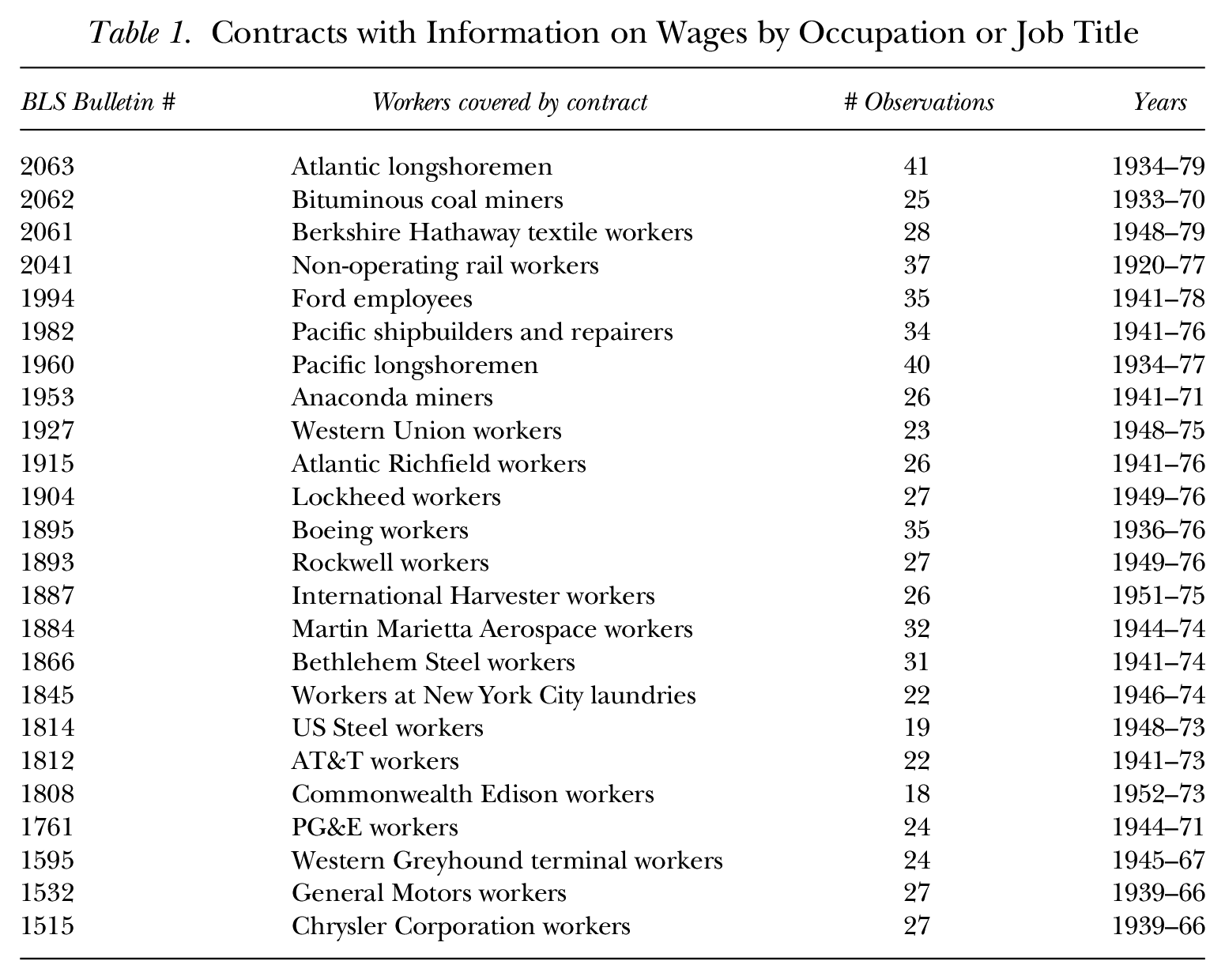
In all, there are 24 contracts on wages by occupation or by job title over time, and they are listed in Table 1. The number of observations over time on each contract ranges from 18 observations between the Commonwealth Edison Company of Chicago and the International Brotherhood of Electrical Workers from 1952 to 1973 to 41 observations in the contract specifying the wages of longshoremen on the Atlantic ports from 1934 to 1979. The contract on the railroad workers goes back to 1920. Aggregated over all of the 24 contracts in Table 1, there are 560 observations on each of the three wages recorded or 1,680 (560 × 3) wage-year observations.
Contracts with Information on Wages by Occupation or Job Title
The contracts examined here involved employers and workers in the private sector of the economy. This does not mean that public agencies were uninvolved in wage setting. During the Second World War, changes in wages had to be approved by the National War Labor Board. Its successor, the Wage Stabilization Board in the early 1950s served a watchdog role at a time when inflation became of increasing concern. In the early 1970s, the rising pace of wage and price inflation induced the government to establish the Council on Wage and Price Stability, the first head of which was Albert Rees. Throughout the years of the analysis here, certain sectors of the economy, such as railroads, steel, and maritime trade, were deemed to be of national importance. There were occasions when an emerging labor dispute induced the government to step in with mandatory arbitration. Hence, these contracts in the BLS Bulletins were negotiated by private-sector agents whose wage agreements were followed by public agencies concerned with the possible consequences of the negotiations for society at large.
In the context of wages determined by collective bargaining, a new wage structure is one that is explicitly accepted by the employers and by the workers or, more precisely, accepted by the agents of these principals. In a new wage contract, the trade union negotiators use some standard to assess whether the wages are “fair” or “appropriate.” In this article’s epigraph, Albert Rees alludes to the equity issues raised. What is fair or appropriate may be determined by what has existed in the past. The comparison may take the form of either a Relativist assessment (“they have always been paid twice what that other group has been paid”) or it may be an Absolutist judgment (“they have always been paid 25 cents an hour more than that other group was paid”). A wage structure deemed to be unfair may jeopardize the negotiators’ status in the union hierarchy. There have been instances of the rank-and-file rejecting the contract that their representatives have negotiated. 3
Management may also be concerned with whether the wage structure will be seen as fair or appropriate insofar as perceptions of fairness affect workers’ productivity and the probability of an interruption in production. In addition, management know their principals will be concerned with the implications of a new wage structure for costs, and this might be calculated in terms of the dollar change in labor costs or in terms of the proportionate change in costs. Thus, both parties to the contract have reason to think in Relativist terms or in Absolutist terms or, indeed, in neither.
Most of the observations cover the period from the end of the Second World War to the late 1960s or 1970s. Over this period, the typical contract was renegotiated each year, although on a few occasions a new contract was not negotiated in a given year and on a few occasions contracted wages were negotiated more than once in a year. When reference is made to the number of contracts, only those contracts that altered wage levels are counted (most of the contracts). Many Bulletins provide estimates of the total number of workers covered by these contracts. In the later years of these contracts, in total, the wages of approximately one million workers were covered. All the major union-management private-sector contracts in the economy are covered in these Wage Chronology publications. Information on the number of workers by occupation or job title is not available in these publications.
Table 2 reports the compound annual percentage growth rates of each wage series, denoted by Δ wi for i = H, M, L, over the years stated in the table. In 14 of the 24 contracts listed in Table 2, their compound annual growth rates in wages exhibit the following pattern:

That is, the growth rates of nominal wages for the lowest paid workers exceeded the growth rates of wages of workers in the middle of the wage distribution, which, in turn, exceeded the growth rates of wages of the highest paid workers. These contracts are identified by an asterisk. In all but two of the contracts listed in Table 2, the compound annual growth rate of wL equals or exceeds that of wH. In short, measured by comparative compound annual growth rates in wages, wage inequality fell over this period for those workers covered by these 14 contracts.
Compound Annual Growth Rates (in percent) of Wages by Occupation
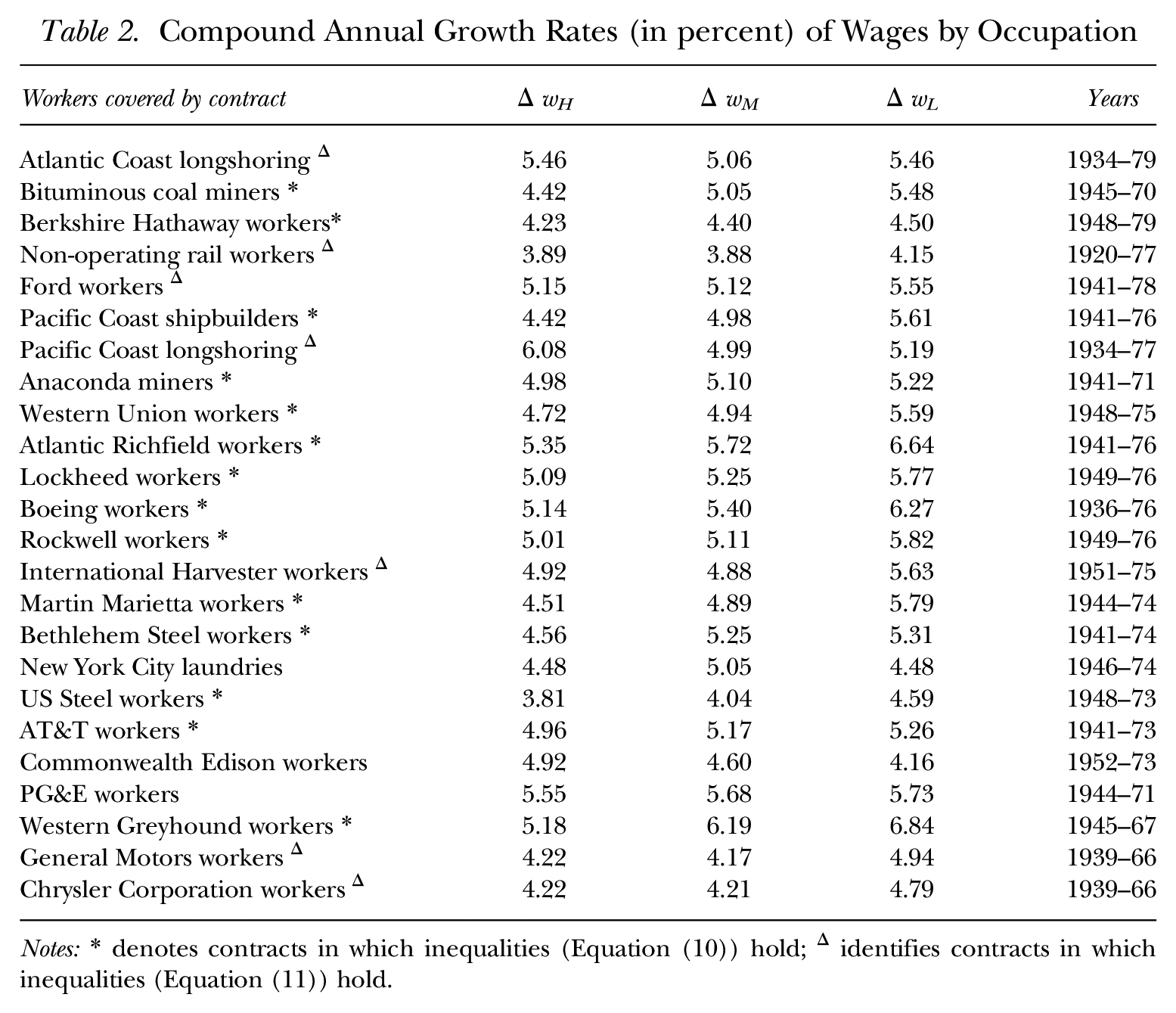
Notes:* denotes contracts in which inequalities (Equation (10)) hold; Δ identifies contracts in which inequalities (Equation (11)) hold.
Another pattern appears in Table 2: In seven contracts the following inequality holds:

That is, the growth rate of the wages of workers in the middle of the wage distribution was less than the growth rate for both those workers with the highest wages and those workers with the lowest wages. These seven contracts are identified by a triangle superscript. An explanation for this pattern will follow.
The compound annual growth rate of the wages of a group of workers is defined as

where wO is the value of the wage in the initial year O, wT is the value of the wage in the terminal year T, and n = T – O.
Note that Equation (12) is a Relativist metric; it is an operation on the ratio of the end-period value of wages to its value at the beginning of the period. An Absolutist might object to such a metric and call for the Absolutist analogue. Following the same chain of reasoning that yields Equation (12), an Absolutist might propose that an appropriate description of the growth of wages is Dw, the average annual change in wages over a period of time:

Dw is an operation on the difference between the end-period value of a variable and its value at the beginning of the period. Table 3 lists these average annual changes of each wage series, denoted by Dwi for i = H, M, L, over the same years as those in Table 2.
Average Annual Changes in Wages (in dollars) by Occupation
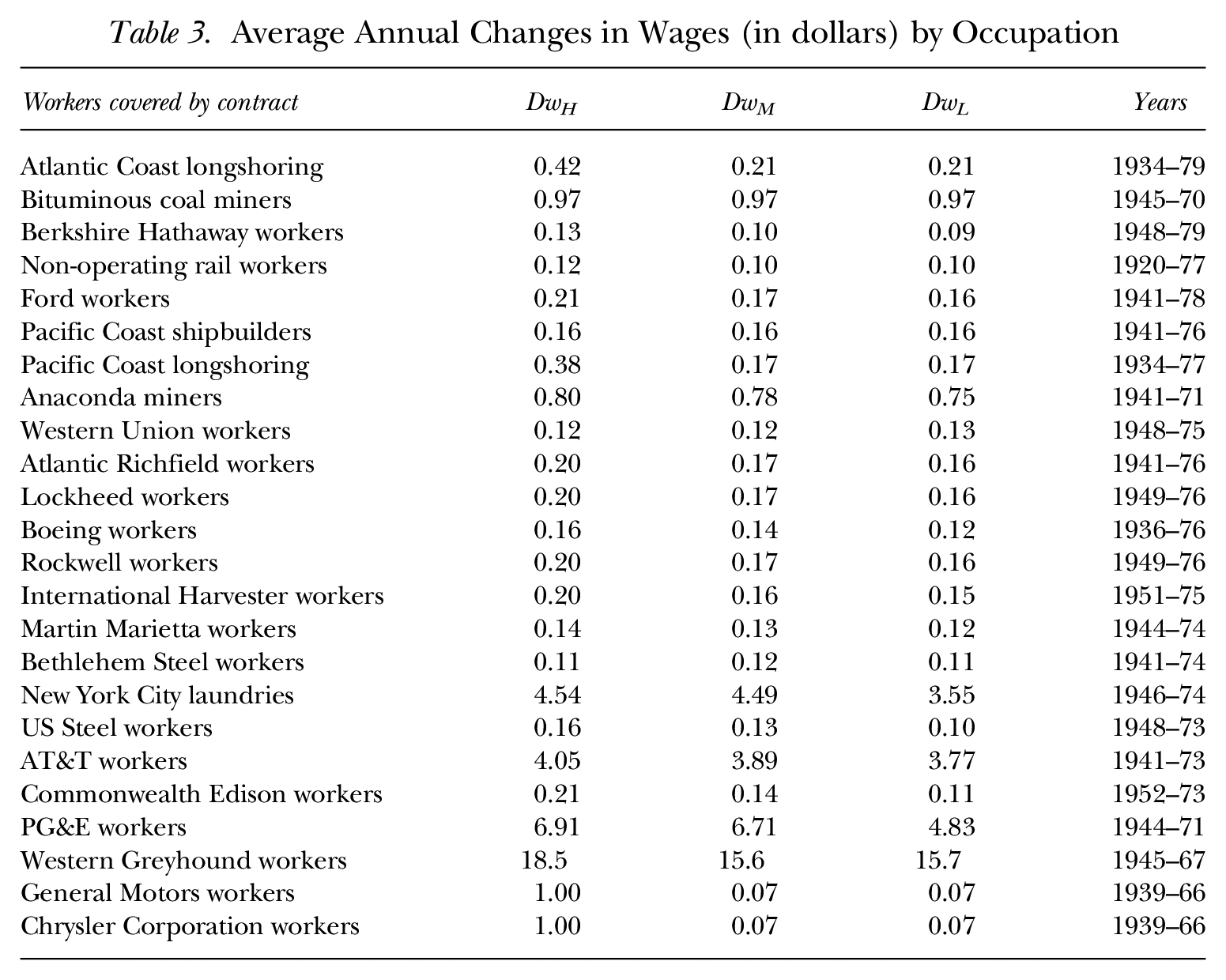
Perhaps the most noteworthy feature of Table 3 is the frequency of near or exact equalities: In nine of the 24 contracts, wage changes were exactly the same for at least two of the three skill groups, and in another 10 contracts, they were only one or two cents apart.
Does the identification of a wage-setting protocol help understand these patterns in the movements of wage differentials?
Occupational Wage Differentials with Long and Definitive Patterns
Consider wage patterns that have operated over a long period of time (at least 10 consecutive contracts) and that conform to an unambiguous interpretation.
Absolutist Wage Patterns
The earliest information on wage differentials in the Wage Chronology series is provided by the contract for non-operating railroad workers. (“Non-operating” refers to workers who do not work on a moving train.) The highest paid workers were blacksmiths, the lowest paid workers were helpers, and those occupying the approximate middle of the wage distribution were groundmen—those who dig holes and raise poles for electric power, telephone, or telegraph lines. Between 1920 and 1937, only five contracts resulted in a change in the hourly wage rates of these workers over these 17 years, a consequence perhaps of the consumer price index (CPI) in 1937 being 70% of its level in 1920. 4 After 1937 and until December 1977, there were 32 contracts that changed the wages of these workers.
The top six rows of Table 4 report the wage differences of these railroad workers: wH– wL, wH– wM, and wM– wL were constant from 1920 to 1948 and then constant at a slightly higher value from 1949 to 1966. They are an example of what I earlier referred to as a Piecewise Absolutist wage-setting protocol. They are the empirical correspondence of the ray WH3 in Figure 2. More instances of Absolutist protocols are listed in the other rows of Table 4.
Absolutist Wage Patterns by Contract
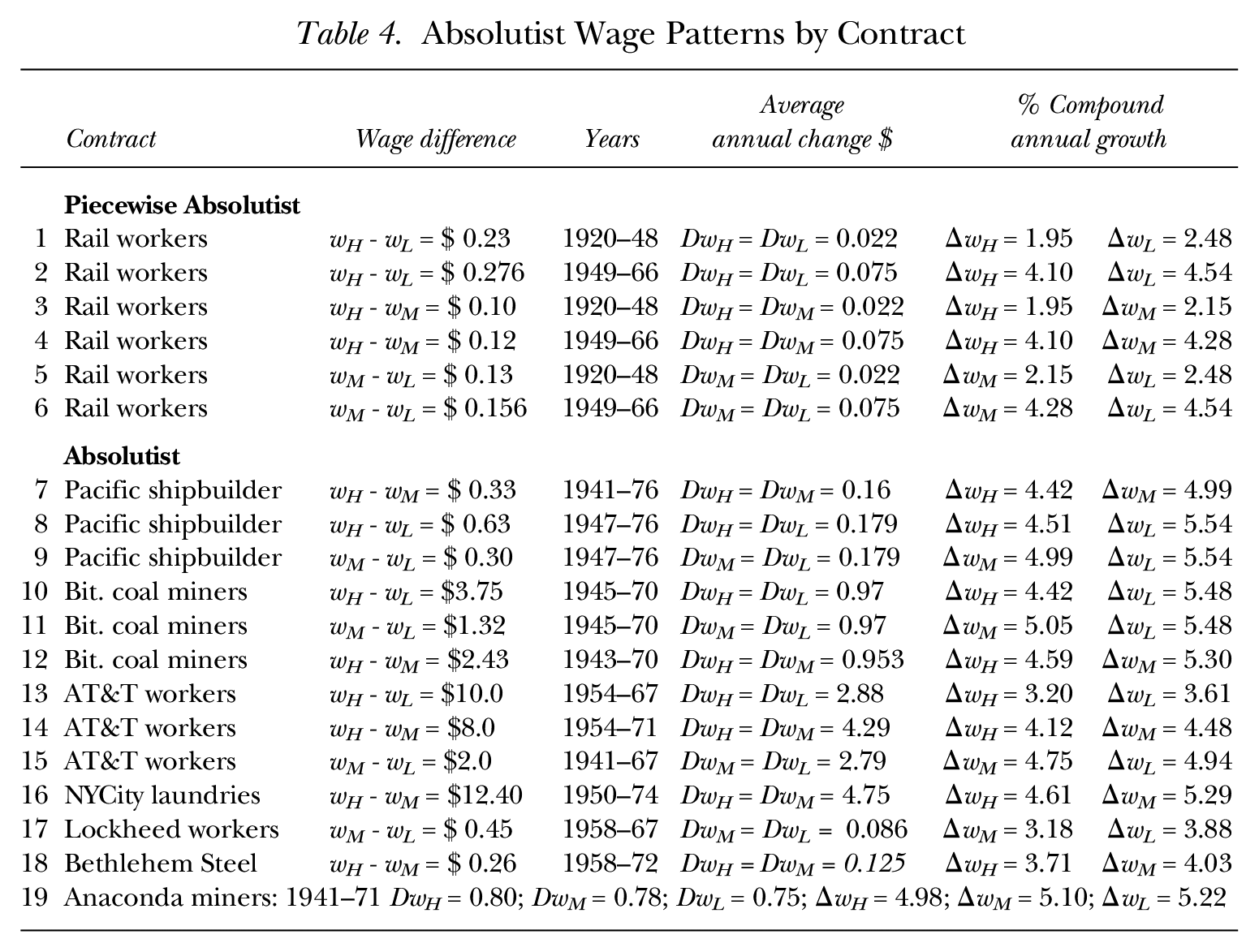
Shipbuilding and ship-repairing workers on the Pacific Coast maintained the same differences in hourly wages for at least 29 years. Bituminous coal miners had the same differences in full-time daily pay for at least 25 years. 5
The contracts of the AT&T workers and the New York City laundry workers relate to weekly pay. The laundry workers’ contracts specify virtual constancy of the differences in the weekly wages between non-commission routemen (wH) and special delivery routemen (wM) of $12.40 for 24 years. (“Virtual” because in one contract in 1962 the difference was $12.50.)
The values of the annual compound growth rates in Table 4 show that, in all instances, lower wage workers enjoyed a higher growth rate than that experienced by higher wage workers. A Relativist would conclude that, for these workers over these years, wage inequality declined. An Absolutist would examine the average annual change in wages in Table 4 and note that their values for the lower wage workers were the same as those for the higher wage workers. From this, the Absolutist would conclude that wage inequality did not change.
Note an unusual Absolutist pattern of the daily wages of the Anaconda miners in Butte, Montana: For every contract between 1941 and 1971, the wages of regular miners (wM) occupied the exact middle of the wage distribution so that wH– wM = wM– wL in every year. The values of wH– wM and wM– wL tended to remain the same for periods of three to seven years before being revised. 6 The average annual change in wages was similar for the three groups of Anaconda workers, as was the compound annual wage growth although, again, ΔwL > ΔwM > ΔwH.
These are all nominal wage differences. Consumer prices in 1976 were four times greater than those in 1941. The real wage levels of the Pacific Coast shipbuilding workers in 1976 were substantially above those in 1941, but the real wage differences between these shipbuilding workers were considerably less. The 33-cent nominal hourly wage difference between heavy forge blacksmiths (wH) and loft riggers (wM) in both 1941 and 1976 represents a differential of 8 cents in 1976 expressed in 1941 dollars. More generally, all the Absolutist nominal wage differentials that changed little or not at all over 10 or more years overstate—sometimes appreciably overstate—the differentials expressed in terms of the differential command over resources that is implied over these years.
Relativist Wage Patterns
In the previous section, contracts were described that maintained the same absolute differentials in wages between groups of workers and that lasted for 20 years or more notwithstanding rising price levels. They applied across the wage distribution as measured here. From the BLS Wage Chronologies, there is no comparable evidence for contracts that maintained the same relative wage differentials across the wage distribution for as many years.
Cases will be discussed under blended wage patterns of contracts that maintained the same relative wages between two groups of workers but, in these contracts, the other workers maintained absolute differences in wages. There are contracts that maintained the same relative wages for shorter periods of time for part of the wage distribution. Some of these are mentioned here.
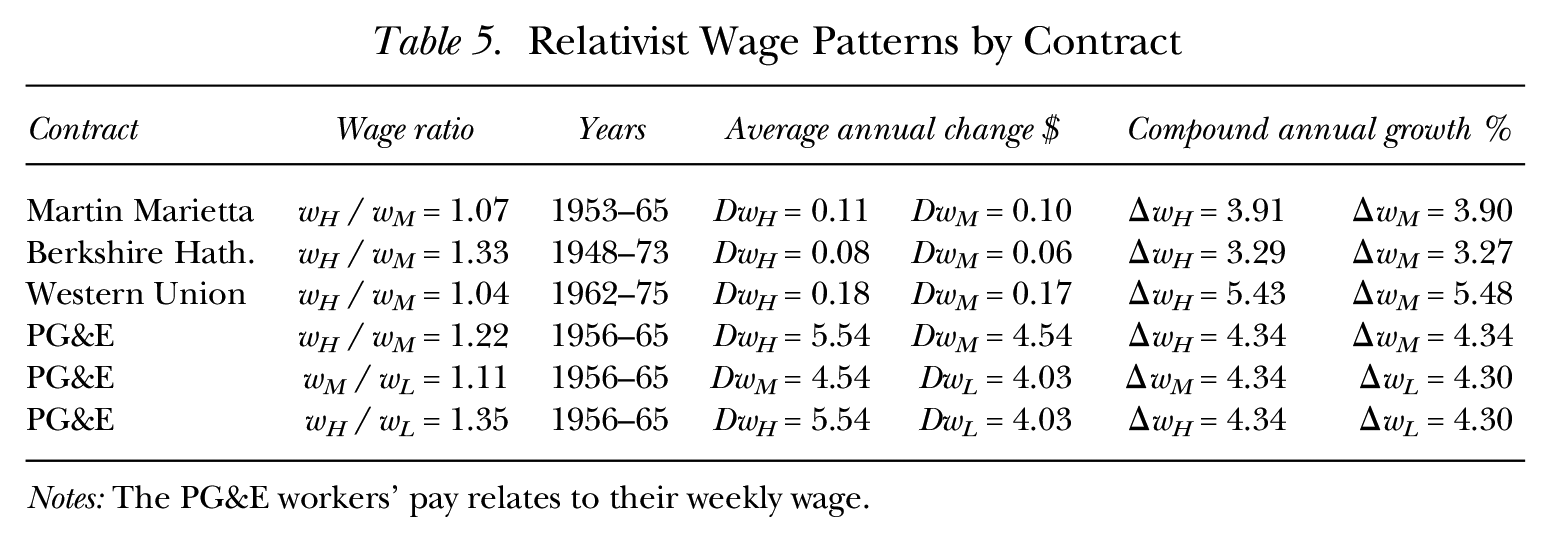
Whenever a Relativist differential operates in every contract over time, the annual compound growth rate of the higher wage will equal the annual compound growth rate of the lower wage and, by the criteria favored by economists, wage inequality between the two groups of workers did not change. If the Relativist differential does not operate in every contract, then the compound growth rates will not be exactly the same. This accounts for the small difference between the growth rates of wages for the contracts in Table 5.
Relativist Wage Patterns by Contract
Notes: The PG&E workers’ pay relates to their weekly wage.
In Martin Marietta’s case, the wage ratio was 1.07 on 14 occasions and 1.08 on 11 occasions. For Berkshire Hathaway’s workers, wH / wM was 1.33 from 1948 to 1956 and in 1972 and 1973, but it took values of 1.32, 1.44, and 1.28 in between. 7 For Berkshire Hathaway, of the 27 occasions on which hourly wage levels changed, wH / wM and wM / wL each remained constant on 15 occasions.
The 1948 values of each of the three relative wages are not materially different from their 1979 values: wH / wL was 1.59 in 1948 and 1.49 in 1979; wH / wM was 1.33 in 1948 and 1.27 in 1979; and wM / wL was 1.20 in 1948 and 1.17 in 1979. Suggestive of a Relativist wage-setting protocol is the fact that the compound annual growth rates of the wages of the three groups of workers were similar, ranging between 4.50 and 4.23% (Table 2).
Similarly, for the PG&E workers, the compound growth rates of wages over the entire period for the three groups of workers in Table 2 suggest a Relativist wage-setting protocol even if a sub-period may not precisely conform to the required pattern. In the case of Western Union, the small difference between the compound growth rates is attributable to the rounding of the wage ratios.
Blended Wage Patterns
A third type of wage-setting pattern in a contract is for one differential to be Relativist and another differential to be Absolutist, in which case the remaining differential will be neither but will follow the movement expressed by Equations (4) and (5) or by Equations (7) and (8). Instances of these Blended wage-setting protocols are given in Table 6. 8 The percentage compound annual growth in wages and the average annual change in wages are measured over the years given in this table. The asterisk denotes relations determined through the use of Equations (6) or (9). 9
Blended Wage Patterns by Contract

Notes:* denotes contracts in which Equations (6) or (9) hold.
Following the earlier discussion, a distinction is made according to which wage differential is Relativist. A Blended Type I specifies the relation between wH and wL to be Relativist, and Blended Type II expresses the relation between wH and wM as Relativist. Whenever a Relativist wage pattern operates, the compound annual growth of the lower wages equals the compound annual growth of the higher wage. 10 This explains why the contracts under Blended Type I in Table 6 show the compound annual growth rates of wH and wL to be the same (rows 2 and 6) or Δ wH = Δ wL. At the same time, the Absolutist component of these Blended wage patterns implies that the compound annual growth rates of the lower wages in an Absolutist relation will exceed those of the higher wages so that in rows 1, 4, and 5 of the Type I Blended wage pattern, Δ wL > Δ wM. Putting these inequalities together:

If the average annual changes in wages are examined in Table 6 of the Blended Type I wage patterns, a different ranking emerges:

Under Blended Type II wage patterns, the compound annual growth rates of wH and wM are the same or nearly the same: Δ wH = Δ wM (in rows 10, 13, 16, and 19). In rows 9, 12, 15, and 18 of Table 6, the Absolutist relation implies the lower wage wL will have a higher growth rate than the higher wage, wM or Δ wM < Δ wL. Putting these relations together implies for the Blended Type II wage patterns:

while the ranking by the average annual changes in wages implies:

Notwithstanding the difference in the years covered, these inequalities are approximately reflected in Tables 2 and 3 for these contracts. As noted earlier, inferences about the comparative growth in wages are sensitive to the metric applied.
The duration of some of these differentials is remarkable. For more than 30 years, on both the Atlantic and the Pacific Coasts, the hourly wages of longshoremen handling explosives (wH) were twice those of longshoremen handling general cargo (wL). 11 The workers with an hourly wage of wM were workers handling refrigerated cargo and kerosene in New York, and they were hatch tenders 12 on the Pacific Coast. The contracts for the Atlantic Coast longshoremen specified a difference between wM and wL of exactly 20 cents an hour for 45 years whereas, on the Pacific Coast, the difference between wM and wL was 10 cents from 1934 to 1956 and then 15 cents from 1957 to 1977, a case of Piecewise Absolutism.
As for the ratio of wH to wM, using Equation (5), for the years between 1964 and 1979, both the Atlantic Coast contract and the Pacific Coast contract maintained a ratio of approximately 1.9, close to the ratio of wH to wL. The bargaining agents—the employer associations and the major unions—on the Pacific Coast were different from those on the Atlantic Coast. The International Longshoremen’s Association (ILA) on the Atlantic Coast and the International Longshore and Warehouse Union (ILWU) on the Pacific Coast talked about coordinating their bargaining, but, as documented by Kahn (1980), the differences between the unions prevented this: The ILWU has a left-leaning tradition (e.g., encouraging workers not to work on May 1, 2008, to protest the war in Iraq) whereas the ILA, for a time, was accused of links with organized crime, a claim popularized by the film On the Waterfront. Nevertheless, the similarity of the wage patterns of longshoremen on the Pacific and Atlantic Coasts is remarkable.
The gap between the hourly wages of major assemblers (wM) and janitors (wL) at Ford Motor Company remained at 20 cents for the 20 years from 1941 to 1961 and, indeed, it remained less than 30 cents for almost another 20 years. The similarity in the wage patterns in Ford, General Motors, and Chrysler—in each case, wM– wL and wH / wM are constant over time—may testify to the technology of motor vehicle manufacture or it may suggest the influence of the labor union with which each company bargained, the United Automobile Workers (UAW). If the UAW is relevant here, the same Blended wage-setting protocol might be evident in other contracts for which the workers are represented by this union. 13
The agent of the workers at International Harvester was the UAW, and rows 18, 19, and 20 of Table 6 provide evidence to support this possibility. Again it is wM– wL and wH / wM that remain constant over time. The workers at Martin Marietta Aerospace were represented by the UAW and one component of a Blended protocol is evident in Table 5 by the constancy of wH relative to wM over 21 years. In addition, there were years when absolute differences between the other wages of Martin Marietta’s workers remained constant for periods of four and five years. 14
A Summary
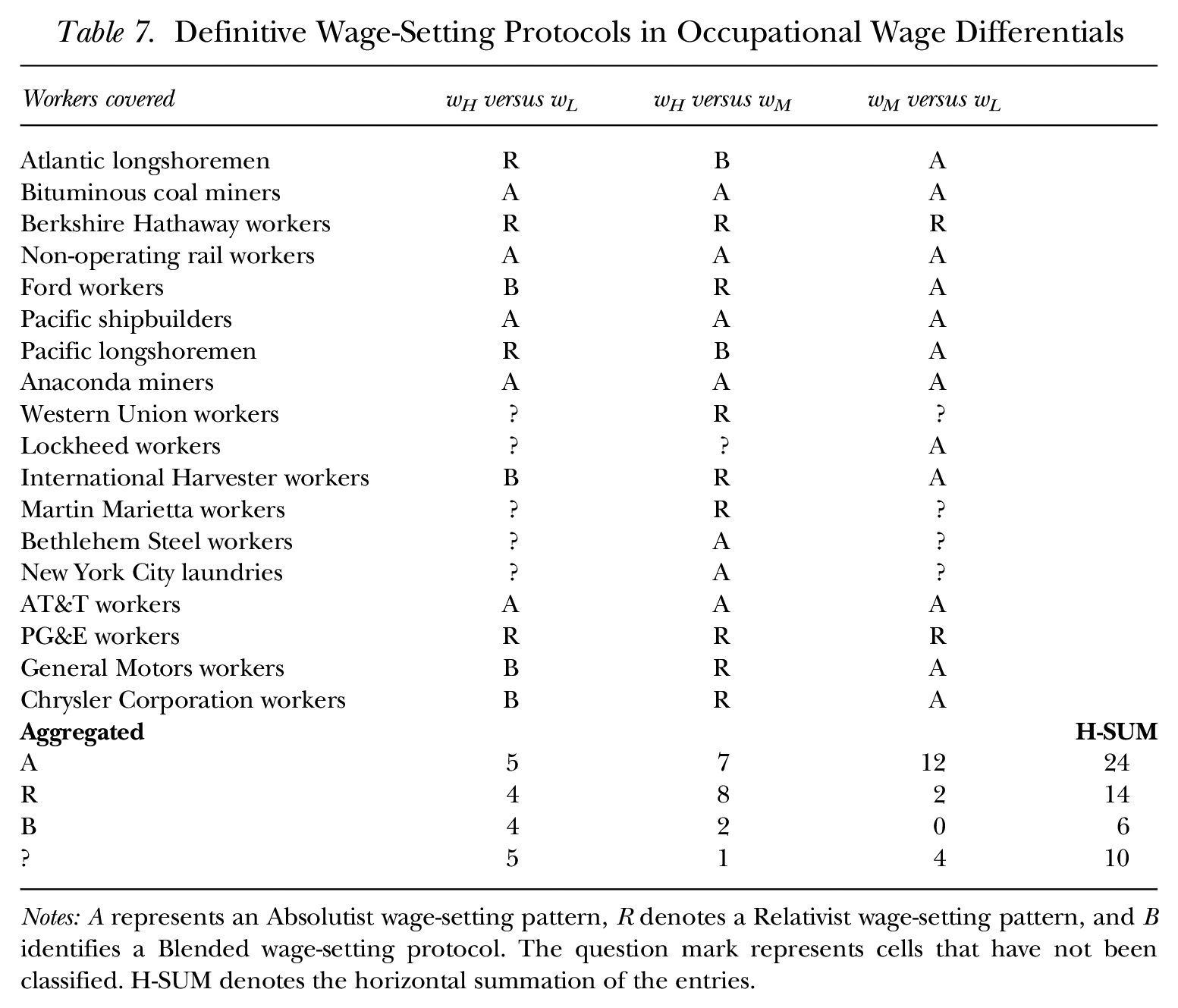
Table 7 summarizes the inferences drawn from the wage differentials by occupation in those instances when the patterns were both long-lasting and definitive. In this table, the entry A represents an Absolutist wage-setting pattern, R denotes a Relativist wage-setting pattern, and B identifies a Blended wage-setting protocol for which Equations (6) or (9) apply.
Definitive Wage-Setting Protocols in Occupational Wage Differentials
Notes: A represents an Absolutist wage-setting pattern, R denotes a Relativist wage-setting pattern, and B identifies a Blended wage-setting protocol. The question mark represents cells that have not been classified. H-SUM denotes the horizontal summation of the entries.
The question mark represents cells that have not been classified. Thus, while wH versus wM of Western Union’s workers has been designated Relativist over the years from 1962 to 1975, the relation between wH and wL and the relation between wM and wL have not been classified for this contract. They may also correspond to a Relativist pattern, but they do not warrant a confident designation. Of the 51 cells in Table 7, 10 are unclassified.
The most common wage-setting protocol in Table 7 is Absolutist with 24 of the cells so classified. This outcome is consistent with the frequency of similar, if not exact, values for the average annual changes in wages across workers in Table 3. One-half of the Absolutist protocols occur in the wage difference between workers with wages in the middle of the wage distribution and workers with the lowest wage. The lowest wage rate, wL, is involved in 17 Absolutist protocols (namely, 5 of wH versus wL and 12 of wM versus wL). The Relativist wage differential is most common between the workers with the highest wage and workers in the middle of the wage distribution.
Occupational Wage Differentials with Shorter Inexact Wage-Setting Patterns
In the previous section, patterns in wage setting were identified in 18 of the 24 bargaining contracts listed in Table 1. These concerned wage differentials between workers in different occupations or job titles. I referred to them as definitive because there is little question about the presence of these patterns, and they were called long because the patterns were uninterrupted for 10 contracts or more. Many of these wage differentials were exact or almost so. In determining their pattern, there was no need to ascribe to them an additive disturbance term and thus no need to invoke regression analysis to help detect the wage patterns.
By contrast, the patterns in the six remaining contracts are inexact and the wage differentials were not continuous for 10 or more contracts. These six contracts are listed in Table 8. Because the wage differentials are inexact, there might be a role for regression analysis to help determine whether they followed a recognizable pattern. Indeed, regression equations were fitted to the wages in the six contracts in this section. The results from these regressions do not require an alteration in the inferences drawn from inspecting the raw observations below. 15
Incidence of Absolutist and Relativist Occupational Wage Setting in Six Inexact Contracts

Notes: For each column, the entry in row 7 is the aggregate of the entries in rows 1 through 6. For each column, the entry in row 8 expresses the entry in row 7 as a percentage of 429, the total number of wage changes observed in all the contracts in this table.
The growth in the workers’ wages are given in Tables 2 and 3, and the identity of the high-wage, middle-wage, and low-wage workers are given in Appendix Table A.1. The elements of a pattern in their wage differentials are summarized in Table 8. The years covered are those given in Table 1.
Consider the workers at the California plants of Rockwell International between 1949 and 1976. There are 27 observations of the workers’ wages at Rockwell and, therefore, 26 observations on wage changes. Each contract embodies three wage differentials so there were 78 (26 x 3) potential changes in wage differentials. Of these 78 occasions, the first row of Table 8 reports 8 occasions on which wH– wL was unchanged, 8 occasions on which wH–wM was unchanged, and 10 occasions on which wM–wL was unchanged. Thus, for the Rockwell workers, the total number of occasions on which the same wage difference was maintained was 26 (the sum of 8, 8, and 10), and this is reported in the first row of Table 9 (in column (2)).
Aggregated Unchanging Wage Differentials by Occupation for Six Inexact Contracts

Notes: The entries in column (2) aggregate the values of wH– wL, wH– wM, and wM– wL in Table 8 for each contract. The entries in column (3) aggregate the values of wH / wL, wH / wM, and wM / wL in Table 8 for each contract. The entries in column (4) aggregate the entries in columns (2) and (3) and express this as a percentage of the entry in column (1) of each contract.
Now consider the frequency with which wage ratios were unchanged for these Rockwell workers as reported in the first row of Table 8 in columns (5), (6), and (7). The total number of occasions on which the same wage ratio was maintained was 25 (the sum of 5, 8, and 12), as reported in the first row in column (3) of Table 9. This is almost the same as the number of occasions on which wage differences were maintained.
In short, the incidence of Absolutism in wage differentials was approximately the same as the incidence of Relativism in these Rockwell contracts. The wage-setting process gives the appearance of being Blended and, with the UAW as the agent of these workers, the influence of this union reappears.
The analogous figures for the other six contracts are reported in rows 2 through 7 of Table 8, and the corresponding aggregated figures are in Table 9. In total, almost one-half (49%) of potential changes in wage differentials followed either a Relativist or an Absolutist pattern (as reported in Table 9 in column (4) and row (7)).
To provide a contrast with the wage-setting practices of the contracts considered earlier with long and definitive patterns, consider the wages of the Pacific Coast shipbuilders and ship-repairers in Table 4: Of the wage changes experienced by these shipbuilding workers from 1941 to 1976, 95% were accompanied by no changes in wage differences. In comparison, the wage-setting patterns in these six contracts are far from definitive.
Wage Differentials by Geography
The wage differentials examined above relate to workers in different occupations. The wage differentials reported in this section concern the pay of workers in the same occupation who work in different US cities. The BLS Bulletins containing this information are listed in Table 10. For each contract, three cities are selected—the city with the highest wages, the city with the lowest wages, and a city with wages in the approximate middle of the wage distribution—and the wages of workers belonging to the same occupation in each of the three cities are followed over time. The differentials in pay between these cities are examined to ascertain whether they follow a discernible pattern over time.
Contracts with Information on Wages by City
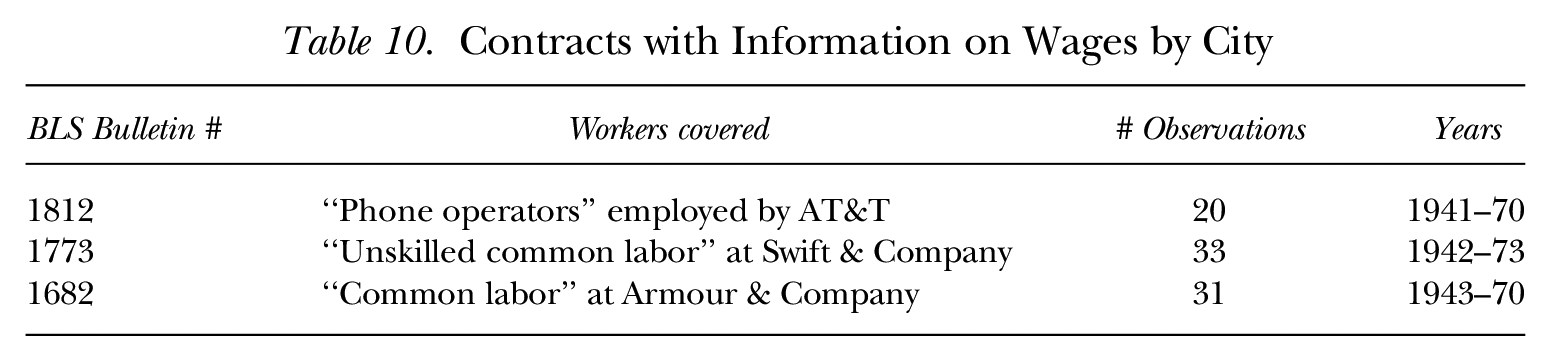
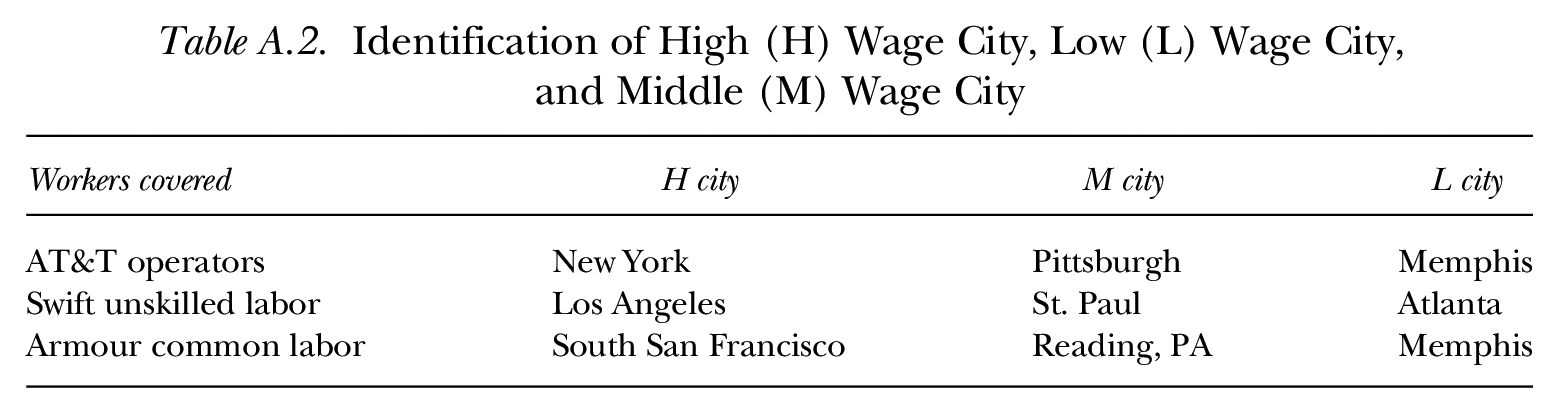
For each of the three contracts in Table 10, Appendix Table A.2 identifies the high-wage, middle-wage, and low-wage cities. For each contract, the workers were represented by the same labor union in the three cities. 16 In examining the entries to the tables that follow, note that the wages of the AT&T operators are their weekly pay. Those of the Swift and Armour workers are their hourly wages.
Table 11 reports the typical annual increase in the wages of these workers over the entire period for which observations are provided in the Bulletins. The compound annual growth rates (as a percentage), Δ wj, reveal the following pattern: Δ wL > Δ wM > Δ wH. This means that, for each of the three groups of workers, the typical economist would infer that the geographic differences in their rates of pay narrowed from the 1940s to the 1970s.
Compound Annual Growth Rates (in %) of Wages and Average Annual Change in Wages (in dollars) by City
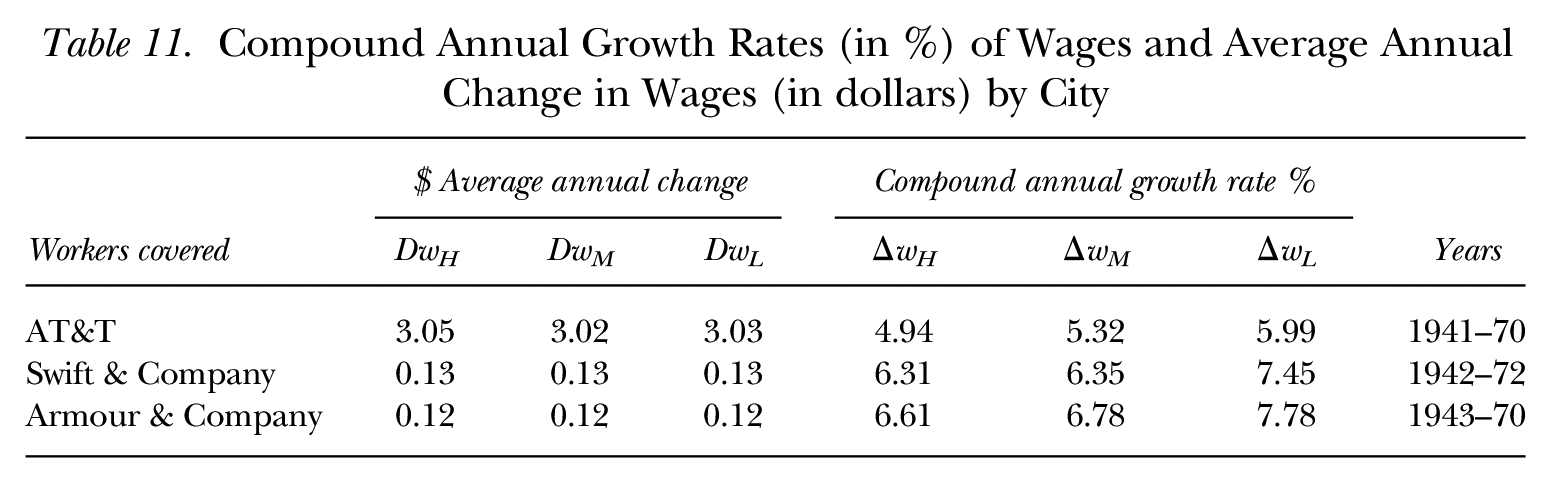
The entries of the average annual changes in wages Dwj in Table 11 suggest an explanation for the pattern in the compound growth rates: For each group of workers, the average annual changes in wages of the high-wage workers, the middle-wage workers, and the lowest-wage workers are very similar, if not the same. A pattern such as this is a feature of Absolutist wage-setting protocols. Indeed, Table 12 indicates that, for many of the same years, such Absolutist wage patterns operated.
Wage-Setting Protocols across Cities

Notes: The percentage compound annual growth in wages and the average annual change in wages are measured over the years indicated in this table.
The differentials listed in Table 12 are those contracts with the same wage difference or wage ratio (calculated up to two decimal places) for 10 or more consecutive contracts. All the movements in wages that satisfied this condition followed an Absolutist path. There were no Relativist cases that satisfied the condition. In each case the compound annual growth in wages is greater for the lower wage workers than for the higher wage workers. A decline in wage inequality (as conventionally measured) is associated with Absolutist wage setting. 17
Wage Differentials by Gender
Two BLS Bulletins report bargaining agreements that specify hourly wages for men and for women working in the same occupation.
One contract (Bulletin 2023) was between the International Paper Company and two unions that negotiated jointly (the United Papermakers International Union and the International Brotherhood of Electrical Workers). Information on “beginners’ minimum” hourly wages for women and men are available from 1942 until 1964. After 1963, the pay differential between women and men was eliminated. (The Equal Pay Act was passed in 1963.) Between 1942 and 1964, of the 21 occasions on which wages were changed, the hourly wage difference between men and women did not change on 17 occasions. It was exactly 6 cents in favor of men from 1948 to 1961. The ratio of men’s wages to women’s wages did not change on 10 occasions. An Absolutist pattern is more frequent than a Relativist pattern.
The other contract with information on the differential in pay between men and women covered the workers in the fiber division of the FMC Corporation’s Chemical Group from 1945 to 1968 (Bulletin 1924). The workers were represented by the Textile Workers Union of America (TWUA). The hourly wages relate to what the contract calls “plant common labor.” There were 18 occasions between 1945 and 1968 when wages were changed. On 11 of those 18 occasions, the hourly wage difference between men and women remained the same, and on 7 occasions the wage ratio remained the same, which showed a preference for maintaining an absolute wage difference in favor of men. After 1966 the wage difference between men and women at FMC was terminated. Both contracts reveal a preference for Absolutist thinking, an inference that is consistent with the fact that the annual compound growth rates of wages of women exceeded those of men and the average annual change in wages for men and women were the same, as shown in Table 13.
Compound Annual Growth Rates (in %) and Average Annual Change in Wages (in dollars) by Gender
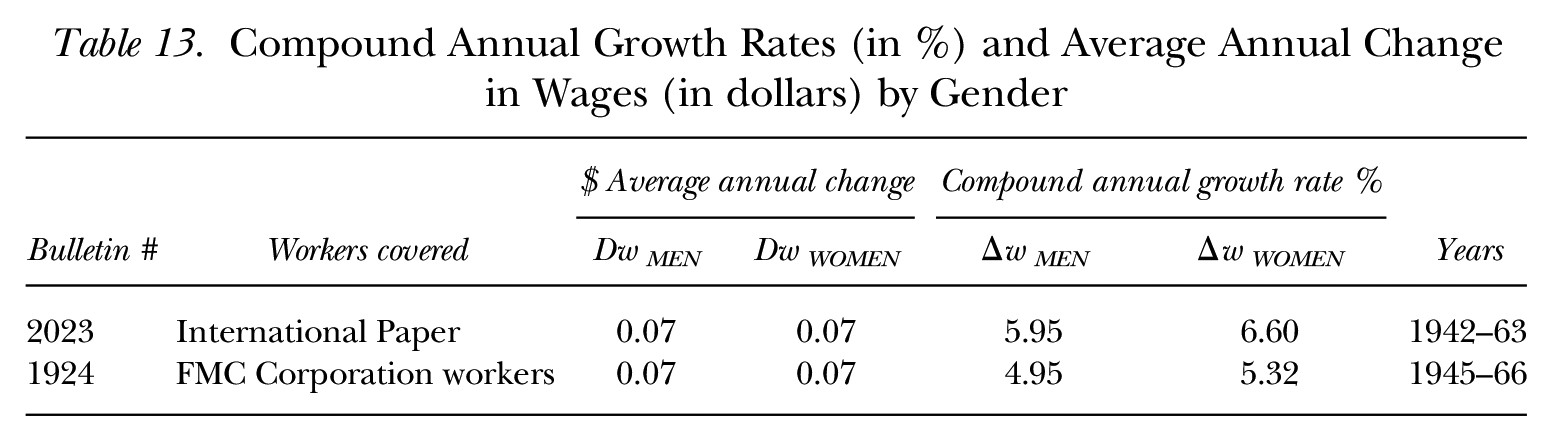
One difference between the two contracts concerns the movement of the gender wage difference before it was eliminated. In the case of the workers at the International Paper Company, the men–women wage difference narrowed between 1942 and 1963 from 8 cents to 2 cents before being eliminated in 1964. By contrast, for the workers at the FMC Corporation, the pay difference showed no evidence of becoming smaller before it was erased: It was 11 or 12 cents in and before 1951 and 15 cents in the mid-1960s. This growing difference occurred over a period of rising wages and prices for both women and men so that, if wages were deflated by a price index, the real wage difference would be substantially lower in the 1960s. The deflated wage difference in 1966 was 7 cents in 1951 prices, lower than the 12-cent difference in 1951.
Conclusions
In most of the 28 collective bargaining contracts examined in this article, the movement of wage differentials followed an identifiable pattern. This is the case for wage differentials by occupation, by geography, and by gender. Relativism throughout the wage distribution (as measured here by three wages) was unusual. The more recognizable pattern is Absolutist whereby wages increased by the same dollar amount for high-wage and low-wage workers alike. It is implied by the frequency with which the compound annual growth of wages is largest for low-wage workers and least for high-wage workers and the similarity of the average annual increases in wages for the workers. At the same time, examining the similarity of the average annual increase in wages for workers in different occupations, in different cities, and for men and women, an Absolutist will infer not a decline in inequality but little change in inequality over these years. The choice of metric affects one’s conclusions.
It is remarkable that, in the cases described above, over a period when consumer prices tripled, nominal wage differences revealed such permanence. This preference for Absolutism coupled with the growth of unionism between 1940 and the late 1970s will help to explain why, using Relativist measures of income inequality, Farber, Herbst, Kuziemko, and Naidu (2018: 1) found that “U.S. income inequality has varied inversely with union density” as shown in Figure 1.
Of course, the inequality in wages examined in this article is not inequality across the entire income distribution, but simply inequality among workers covered by union-negotiated contracts. At the same time, given the large number of workers directly affected by these contracts in the period studied (more than one-quarter of wage and salary workers by the end of the 1970s were covered by these union-negotiated contracts) and, given the norms set by these bargaining agreements for other workers, this was a significant fraction of the labor force.
The preference for Absolutism over Relativism in these wages drawn from the BLS Wage Chronology series does not appear to decline over time as wages rise. Perhaps this is because, at higher incomes, if a Relativist wage-setting protocol were adopted, its across-the-board proportional increase in wages would imply much larger absolute differences in incomes, which are regarded as increasingly inequitable to an Absolutist mindset. That is, the aversion to Relativism probably increases as incomes rise. In addition, aversion to Relativism is probably higher when income inequality is already perceived to be wide.
The preference for Absolutism was revealed also in the particular form taken by cost-of-living escalator clauses whereby, during the life of a contract, wages were adjusted as prices rose. More contracts contained these clauses in later years when price increases became larger. The typical formula linking wage increases to consumer prices took the form of an across-the-board absolute wage increase for a specified absolute change in the Bureau of Labor Statistics CPI. 18 David Card (1983) noted this same feature in Canadian contracts.
The period studied in this research, roughly from 1940 to 1980, 19 corresponds to America’s Golden Age of Unionism, and the impulse to attribute this preference for Absolutist wage setting to trade union wage policy is difficult to resist. Indeed, a role for unionism is strongly suggested by the distinctive pattern of blended wage differentials in contracts in which the UAW acted as the workers’ bargaining agent and the similarity of the longshoremen’s contracts on the two coasts. At the same time, employers agreed to these wage-setting protocols so, unless the union was the dominant party in many contracts, the enduring wage patterns were acceptable to both parties.
A natural inference is that a simple pattern, what Reder and Neumann (1980) called a protocol, that appears fair and reasonable shortens the negotiation period and avoids the costs of disruption. Both parties to a bargain have an incentive to apply a simple rule that is easy to implement and that will be accepted by the principals. The rule that was preferred was Absolutist.
It would be very useful if this analysis were extended beyond 1980 when income inequality grew. Of course, the extent of unionism declined over these years, but did the incidence of Absolutism within union-management contracts also decline and thereby contribute to the growth of inequality? Unfortunately, some other source of information will have to be used to address this question as the Wage Chronology publications ceased after 1980. 20
An examination of collective bargaining contracts after 1980 would need to take account of the increasing popularity of lump-sum wage supplements. These supplements are expressed sometimes in Absolutist terms and sometimes in Relativist. An example of the former is the contract in April 2016 between Lockheed Martin Information Systems and the International Association of Machinists that specified a lump-sum wage supplement of $1,500 to each employee, contingent on the confirmation of the acceptance of the contract by a specified date. 21 Note that these payments are not embedded in a worker’s regular pay on which future wage increases can be built. Nevertheless, when they take this Absolutist character, they have the appeal of distributing the same amount of money to all, regardless of their status.
My use of the wages of merely three groups of workers to characterize the entire wage distribution of a contract is an obvious simplification. The underlying notion is that this will approximate the wages of skilled, semi-skilled, and unskilled workers. The degree to which our inferences are sensitive to this approximation could and should be determined by examining more points in the wage distribution. Moreover, these contracts became more complex and embraced more issues over time and, insofar as they affected high-wage and low-wage workers to different degrees, this is another reason for not regarding the conclusions drawn here as the final word.
The principal purpose of this article has been to document some facts about movements in wage differentials. The reasons for the different wage-setting protocols have not been addressed, yet they call for research: Why have some bargaining pairs opted to change wages by the same proportion while others have changed wages such that absolute differences in pay are retained? As these contracts are an instance in which the bargainers are agents of their principals, this has led to conjectures that, because Absolutist wage setting raises the relative wage of low-wage workers and because the union representatives are accountable to their member-workers, the preference for Absolutism reflects the influence of low-wage workers within labor unions. This influence will be greater when the frequency distribution of wages is skewed to the right so that the wage of the median union member (voter) is below the wage of the member at the arithmetic mean (Ashenfelter and Layard 1983).
In searching for explanations, I found an essay that reviewed the facts in Britain for the first half of the twentieth century. In this essay, Turner (1952) noted that Relativism was strongly preferred in some industries (including steel and cotton spinning) whereas Absolutism was dominant in others (such as engineering and woodworking trades). 22 Although both Relativism and Absolutism might meet the requirement for wage increases to be seen by workers as egalitarian, Turner reported that Absolutism tended to be more common. He noted that the usual practice of academics to examine proportionate differences in wages overlooked the “remarkable” constancy of the absolute differences between workers’ wages (1952: 241).
His explanation for the dominance of Absolutism was that, because of its implication of raising the wages of unskilled workers relative to those of the skilled, Absolutism appealed particularly to the unskilled, and unions were anxious to expand membership beyond the already-unionized skilled workers to the semi-skilled and unskilled workers. 23 Absolutism served as a membership drive.
Currently, the issues surrounding the implications of inferences from proportional differences in incomes and absolute differences in incomes have appeared in other areas of economics, such as the debate over the changes in the World Income Distribution in which inferences over the direction of the changes are sensitive to the choice of metric (Ravallion, Thorbecke, and Pritchett 2004; Svedberg 2004; Atkinson and Brandolini 2010).
The literature on models of trade union behavior would be enriched if it recognized a typical union’s interest in wage differentials among its members. Currently, these models endow a union with an objective function in which “the” wage appears. In fact, unions appear to care not only about the wage level but also about the wage differentials of many classes of workers. No doubt, for some purposes, it will suffice to put aside the wage structure, but for studying issues such as income inequality and unionism, the disregard of the union’s interest in wage differentials may well be a serious omission.
Finally, even though Relativist thought dominates the metrics used by most economists to measure wage inequality, evidence here shows that, at least at the level of incomes considered from the 1940s to the 1970s, absolute differences in wages matter more to workers and their employers even in the presence of rising prices. This finding may help economists understand better the level of discontent among many people with labor market developments that many economists themselves regard as benign.
To illustrate, Gini’s coefficient of US household inequality rose from 0.481 in 2016 to 0.482 in 2017. Many economists would judge this as a small, perhaps trivial, increase in income inequality. The Census Bureau itself reports that this increase is insignificantly different from a zero increase. Yet the households with an income at the 20th percentile experienced an increase in real income from 2016 to 2017 of $120 while those at the 95th percentile experienced an increase in real income from 2016 to 2017 of $6,939. 24 Would non-economists characterize these increases as constituting a small, perhaps trivial, increase in income inequality? Probably not if they were Absolutists. The aversion to Relativism is greater at a time and place in which income inequality is already viewed as highly unequal.
Footnotes
Appendix
Identification of High (H) Wage City, Low (L) Wage City, and Middle (M) Wage City
| Workers covered | H city | M city | L city |
|---|---|---|---|
| AT&T operators | New York | Pittsburgh | Memphis |
| Swift unskilled labor | Los Angeles | St. Paul | Atlanta |
| Armour common labor | South San Francisco | Reading, PA | Memphis |
Please address correspondence to
1
A third case posits that the relation between wM and wL is Relativist and that between wH and wM is Absolutist, which implies a linear relation between wH and wL. This combination of an Absolutist and Relativist wage setting is not observed in the contracts below.
2
The information on wages of the bituminous coal miners and the Anaconda miners relate to daily pay. The contracts of the AT&T workers, the PG&E workers, and the workers at the New York City laundries designated weekly rates of pay. Those of the Greyhound workers listed monthly rates.
4
The hourly wage rates of these workers fell during the contraction of 1920–21 and then recovered. By 1937 they had returned to their 1920 levels.
5
Although observations from the Wage Chronology publications on the wages of these miners are available up to 1980, a comprehensive job reclassification in 1970 frustrates linking the wage series of each group of workers after 1970 to those in earlier years.
6
Shaft miners were at the top of the wage distribution and laborers at the bottom. Shaft miners work the seams vertically rather than horizontally as in a tunnel.
7
In the 1970s, Berkshire Hathaway was a textile manufacturer with 14 plants in New England. Today Berkshire Hathaway is a holding company that owns Duracell, Geico, and other companies. Its activities in textile manufacturing ended in the 1980s.
8
9
Thus, in row 3, wH = −0.40 + 2.wM; in row 7, wH = −0.20 + 2.wM; in row 8, wH = −0.30 + 2.wM; in row 11, wH = 0.27 + 1.33.wL; in row 14, wH = 0.33 + 1.32.wL; in row 17, wH = 0.26 +1.31.wL; and in row 20, wH = 0.51 + 1.25.wL.
10
This statement is subject to the qualifications expressed above under Relativistic Wage Patterns regarding occasional small departures from an exact ratio and the effects of rounding to two decimal places. See the small differences in  between the growth rates of wH and wM in row 10 for Chrysler, in row 13 for General Motors, and in row 19 for International Harvester.
11
On the Atlantic Coast, wH was precisely twice wL in those contracts from 1934 to 1946 and then again from 1956 to 1979. In the intervening years from 1947 to 1955, wH / wL ranged from 1.94 to 1.96.
12
Hatch tenders signal to the winch driver when to transfer cargo to and from the ship’s hold. The wages of hatch tenders are not identified in the Atlantic contracts. The hourly wages in the Atlantic contracts apply to those for New York although for much of the period the rates were the same in other East Coast ports. The Pacific contracts covered workers at San Francisco, Los Angeles, Portland, Long Beach, and the Puget Sound.
13
Ford, General Motors, and Chrysler bargained separately, not on an industry-wide basis. Often, the UAW chose one of these three companies as a “target” and, after a settlement had been reached with that firm, the outlines of that agreement were the starting point for negotiations with the other two.
14
Thus wH– wL was 0.70 for five years and 0.73 for another five years in the 1950s. It was 0.93 for four years in the 1960s. Then wM– wL was 0.56 from 1954 to 1957 and 0.69 from 1965 to 1968.
15
In these regressions, the higher wage was the left-hand side variable and the lower wage the right-hand variable in an attempt to derive the empirical correspondence to the rays drawn in . The estimated coefficients on the lower wage tended to congregate around unity though often they were significantly different from unity. The equations were also estimated with the lower wage as the left-hand side variable and the higher wage the right-hand side variable with similar results. If these equations were fitted to clusters of years, a pattern may well have been evident.
16
The AT&T workers were represented by the Communication Workers of America, the workers at Swift were represented by the United Packinghouse Workers of America, and the workers at Armour were represented by the Amalgamated Meat Cutters and Butcher Workmen of North America. Other contracts reported in BLS Bulletin 1812 extend to 1973; however, the observations on Memphis cease after 1970 so, for this analysis, the final observations on weekly salaries are in 1970.
17
Instead of examining those cases in which wage ratios or wage differences remained the same for 10 or more consecutive contracts, suppose all occasions on which wages changed are considered as in Tables 8 and for occupational wage differentials. Then the conclusion regarding the relative frequency of Absolutist wage setting is confirmed. The incidence of Absolutism is 60% for AT&T workers, 78% for Swift workers, and 67% for Armour workers.
18
An example is contained in the contract covering the bituminous coal miners in December 1974. The clause specified a one cent per hour increase for each 0.4 point increase in the CPI. At that time, the CPI took the value of 152 (with 1962 = 100).
19
20
For estimates of the effects of unionism on earnings inequality in recent years, see Card, Lemieux, and Riddell (2020).
22
23
Turner also claimed that employers “had little to do” (p. 273) with the spread of Absolutism in wage differentials. Indeed, he maintains, there are cases in which employers opposed it unsuccessfully.
24
These figures come from Tables H-1 and H-4 of the U.S. Census Bureau’s P-60 report published in September 2018. “Real income” means the dollar figures are deflated by 2017 CPI-U-RS prices.